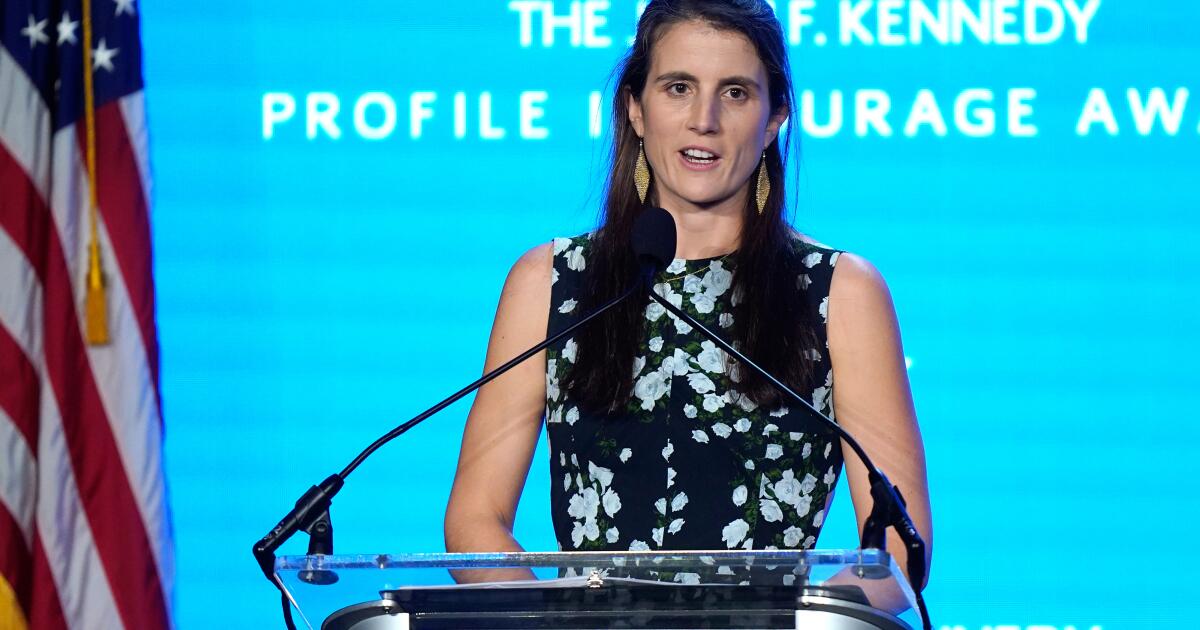
BOSTON — Environmental journalist Tatiana Schlossberg, the granddaughter of the late President John F. Kennedy, has died. She was 35.
Schlossberg, the daughter of Kennedy’s daughter, Caroline Kennedy, and Edwin Schlossberg, revealed that she had terminal cancer in a November 2025 essay in The New Yorker. Her family issued a statement disclosing her death, which was released on social media by the John F. Kennedy Library Foundation.
“Our beautiful Tatiana passed away this morning. She will always be in our hearts,” the statement said. It did not disclose a cause of death or say where she died.
Schlossberg was diagnosed with acute myeloid leukemia in May 2024 at 34. After the birth of her second child, her doctor noticed her white blood cell count was high. It turned out to be acute myeloid leukemia with a rare mutation, mostly seen in older people.
In the essay, “A Battle With My Blood,” Schlossberg recounted going through rounds of chemotherapy and two stem cell transplants and participating in clinical trials. During the most recent trial, she wrote, her doctor told her “he could keep me alive for a year, maybe.”
Schlossberg also criticized policies pushed by her mother’s cousin, Health and Human Services Secretary Robert F. Kennedy Jr., in the essay, saying policies he backed could hurt cancer patients like her. Her mother had urged senators to reject his confirmation.
“As I spent more and more of my life under the care of doctors, nurses, and researchers striving to improve the lives of others, I watched as Bobby cut nearly a half billion dollars for research into mRNA vaccines, technology that could be used against certain cancers,” the essay reads.
Schlossberg had worked as a reporter covering climate change and the environment for The New York Times’ Science section. Her 2019 book “Inconspicuous Consumption: The Environmental Impact You Don’t Know You Have” won the Society of Environmental Journalists’ Rachel Carson Environment Book Award in 2020.
Schlossberg wrote in The New Yorker essay that she feared her daughter and son wouldn’t remember her. She felt cheated and sad that she wouldn’t get to keep living “the wonderful life” she had with her husband, George Moran. While her parents and siblings, Rose and Jack, tried to hide their pain from her, she said she felt it every day.
“For my whole life, I have tried to be good, to be a good student and a good sister and a good daughter, and to protect my mother and never make her upset or angry,” she said. “Now I have added a new tragedy to her life, to our family’s life, and there’s nothing I can do to stop it.”
Dec. 30 (UPI) — A federal judge on Tuesday ordered the Trump administration to reinstate temporary protected status against deportation for citizens of South Sudan.
U.S. District Court of Massachusetts Judge Angel Kelley, in a four-page ruling, ordered an administrative stay of the Trump administration’s decision to end TPS for those from South Sudan as of Jan. 6.
“Because of the serious consequences at stake, both for the plaintiffs and the defendants, the court finds an administrative stay appropriate as it would ‘minimize harm’ while allowing the assigned district court judge the time this case deserves,” Kelley said.
The stay does not represent the merits of the case and instead gives the court time to weigh arguments and evidence before rendering a decision.
Kelley, who was appointed by former President Joe Biden in 2021, gave plaintiffs through Jan. 9 to file their arguments and the Trump administration through Jan. 13.
She will rule on the matter after reviewing the respective arguments.
The federal lawsuit was filed on Dec. 22 by African Communities Together on behalf of four unnamed plaintiffs and all others similarly situated, which makes it a class action.
The defendants are the Department of Homeland Security, Secretary of Homeland Security Kristi Noem, U.S. Citizenship and Immigration Services and the federal government.
African Communities Together says 232 South Sudanese nationals benefit from TPS, plus another 73 who have applied for TPS protection.
The Obama administration first provided TPS protection for those from South Sudan in 2011, and the status repeatedly was extended over the past 14 years.
South Sudan became an independent nation in 2011 in East Africa, but it has been subject to war and conflict since then.
Noem in November announced conditions in South Sudan have changed and no longer merit TPS status for its citizens in the United States.
TPS status enables recipients to stay in the United States and obtain work authorizations when their home countries are subject to armed conflict, environmental disasters and other “extraordinary conditions.”
While the plaintiffs oppose deportations of South Sudanese to their nation of citizenship, the Supreme Courtrecently approved the Trump administration’s deportation of eight others — seven of whom are citizens of other countries — to South Sudan.
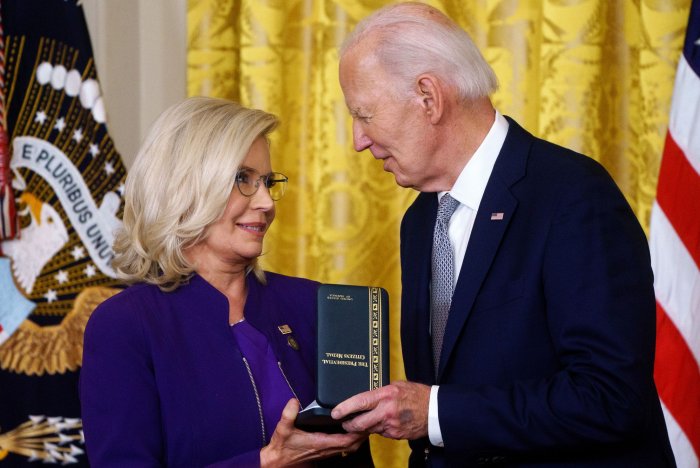
Former President Joe Biden presents the Presidential Citizens Medal to Liz Cheney during a ceremony in the East Room of the White House in Washington, on January 2, 2025. The Presidential Citizens Medal is bestowed to individuals who have performed exemplary deeds or services. Photo by Will Oliver/UPI | License Photo
Wildflower seekers typically must wait until February or March to see blankets of color in Borrego Springs but, thanks to the early autumn rain, the blooms are arriving early. Last weekend, visitors walking through Anza-Borrego Desert State Park and nearby areas found tall, bright sunflowers, deep pink desert sand-verbena, basket evening primrose and even elusive desert lilies, which thrilled photographers like myself.
I headed out there Sunday morning with a friend. The go-to location for seeing wildflowers in the area is Henderson Canyon Road, just northeast of the town of Borrego Springs, and it did not disappoint. Both sides of the road were full of colorful blooms.
Desert sand-verbena grows in the area around Henderson Canyon Road in Borrego Springs.
(Raul Roa / Los Angeles Times)
Some may wonder if this December mini explosion means we’ll see a superbloom this coming spring, the rare phenomenon in which large areas bloom en masse. Jennifer Koles, a nature enthusiast and former docent at Irvine Ranch Conservancy and Orange County Parks, said it’s not a guarantee but that folks can see it as “an early delight in the desert.”
She added, “It all comes down to precipitation.”
Basket evening primrose and desert sand-verbena.
(Raul Roa / Los Angeles Times)
After enjoying the variety of flowers and colors on Henderson Canyon Road, my friend and I went looking for the desert lily (Hesperocallis undulata), a perennial herb native to the southwestern deserts. It’s known for its large, white, trumpet-shaped flowers with a green stripe that bloom from late winter to spring in sandy soils. Also called the ajo lily, it grows from a deep bulb, has long, wavy-edged leaves and is pollinated by sphinx moths.
We did see some desert lilies off Henderson Canyon Road, but none in bloom, so we headed farther east. We spotted them beginning to sprout along a dry creek wash.
Then we saw one person crouching down on a small steep hill, and we immediately stopped and asked if the desert lilies were blooming. The answer was yes, and so we immediately hopped out of the vehicle and ran with excitement. While most plants only had one flower with many buds yet to open up, some were in full bloom with the sweet fragrant scent only the lily can provide.
A desert lily grows on a small hillside just above a dry creek wash in Borrego Springs.
(Raul Roa / Los Angeles Times)
After clicking away with our cameras, we were thankful to have experienced a sight that many search for in vain. I’ve seen chocolate lilies in the wild, but I had never seen a desert lily. Check off one more flower from my list. After that, we visited the newly installed Ricardo Breceda rattlesnake and roadrunner metal sculptures. All in all, it was a perfect day for wildflowers in the cool desert in wintertime.
If you visit the area, remember to leave no trace, never step on the wildflowers and do not collect anything — flowers, rocks or artifacts. Also do not drive off-road unless it is a designated dirt road, and make sure you read warning signs because some of the dirt roads can be sandy, and two-wheel drive cars and even some AWD vehicles may get stuck. Enjoy the day and the flowers, and take lots of photos.
Two recently added metal sculptures by Ricardo Breceda, a rattlesnake and a roadrunner, can be seen off Borrego Springs Road.
The trouble with prosecutorial independence, however, is that it has not been codified in US law.
Instead, it is a norm that has developed over more than a century, stretching back to the earliest days of the Justice Department.
While the role of the attorney general dates back to 1789, the Justice Department itself is a more recent creation. It was established in 1870, during the Reconstruction period following the US Civil War.
That period was marked by an increasing rejection of political patronage: the system of rewarding political allies with favours and jobs.
Reformers argued that, rather than having law enforcement officers scattered across various government agencies, consolidating them in one department would make them less susceptible to political influence.
That premise, however, has been tested over the subsequent decades, most notably in the early 1970s under then-President Richard Nixon.
Nixon courted scandal by appearing to wield the threat of prosecutions against his political rivals — while dropping cases that harmed his allies.
In one instance, he allegedly ordered the Justice Department to drop its antitrust case against the company International Telephone and Telegraph (ITT) in exchange for financial backing at the Republican National Convention.
Key Justice Department officials were also implicated in the Watergate scandal, which involved an attempted break-in at Democratic Party headquarters.
But Sklansky, the Stanford Law professor, noted that Nixon tended to operate through back channels. He avoided any public calls to prosecute his rivals.
“He believed that, if he called for that openly, he would’ve been pilloried not just by Democrats but by Republicans,” Sklansky said. “And that was undoubtedly true at the time.”
But Sklansky believes the second Trump administration has abandoned such discretion in favour of a public display of power over the Justice Department.
“Trump’s openness about the use of the Justice Department to go after his enemies is really something that is quite new,” he said.
GEMMA Collins has shown off her impressive three stone weight loss in a bikini after turning to fat jabs.
The 44-year-old took to Instagram to proudly share a picture of herself looking slimmed down in a turquoise and black two-piece bikini set.
Sign up for the Showbiz newsletter
Thank you!
Gemma Collins has proudly shown off her impressive weight lossCredit: InstagramThe reality star began using NHS-approved Mounjaro last yearCredit: Instagram
The reality star showed off the results of her huge weight loss as she stood on a beach with a pair of black sunglasses on.
She looked happier than ever and comfortable in her skin as her tanned body glistened in the sun.
Gemma took the opportunity to wish her followers an early happy new year as she captioned the post with an insightful message.
She penned: “As we step into 2026, do so with grace, confidence and unwavering self- belief. Your intuition is sacred guidance – trust it, honour it and allow it to lead the way.
“Never dilute the essence of who you are to meet the expectations of others. The foundations of your soul were divinely designed and do not need to be changed.
“True luxury is authenticity. True power is alignment. When you remain rooted in your truth, abundance flows naturally. Stay real, stay grounded and stay radiant. Your presence alone is powerful.”
The former TOWIE star continued: “May 2026 bring elevated success, abundant wealth, deep inner peace and soul-level happiness to everyone.
“May your path be blessed, your heart protected and your dreams manifested with ease.
“You are becoming. You are rising. You are exactly where you are meant to be. HAPPY NEW YEAR,” she signed off.
Her followers flocked to the comments section and many couldn’t help but compliment her on her figure.
One person gushed: “Well said Gemma, you look fabulous. Love to you all xxx.”
Another fan penned: “Looking fab, love your swimwear,” while somebody else enthused: “Wow! You look amazing x.”
A fourth added: “That’s so lovely, so beautiful. May you have the most amazing 2026. You look stunning by the way, radiant.”
The weight loss comes after she began getting help from the NHS-approved Mounjaro back in November last year.
Having struggled with weight gain since being diagnosed with polycystic ovary syndrome aged 28, Gemma weighed in at over 23st and a size 26 at her heaviest.
She proudly told OK! Magazine: “I’ve actually just lost another stone and four pounds, I feel really good.
“I love myself as I am – you’ve got to be kind to yourself, it’s just about constantly remembering to make those right choices and be mindful.”
The I’m A Celeb star added: “I don’t put pressure on myself.
“It didn’t take you five minutes to gain it and it’s not going to take you five minutes to lose it.”
The reality TV star, who is a poster girl for shapely women, now only eats one meal a day after a two-decade battle with her body.
However she refuses to lose her famous curves, previously telling The Sun: “Nothing against skinny people, but I don’t ever want to be thin.”
She added: “Darling, I became most famous being who I am.
“If I got stick thin overnight, it would kill my brand, my endorsements and it wouldn’t be me.”
Gemma has been open about her struggles with her weight over the yearsCredit: GettyShe now only eats one meal a dayCredit: Getty
U.S. President Donald Trump’s sweeping April 2025 tariff measures sent shockwaves through financial markets while upending decades of carefully built trade relationships worldwide, marking the most significant U.S. trade policy shift in at least a century. Economic experts immediately warned that raising the average effective U.S. tariff rates from just under 1.0% to between about 22.5% and 24%, the highest since 1910, could be catastrophic for an economy that was among the few to show significant growth coming out of the pandemic.
Since “the tariff increases were significantly larger than expected,” U.S. Federal Reserve Chair Jerome Powell said in a speech two days after their announcement, “the same is likely to be true of the economic effects, which will include higher inflation and slower growth.” George Pearkes, a macro analyst at Bespoke Investment Group, and Justin Wolfers, professor of public policy and economics at the University of Michigan, both told Investopedia the size of the tariffs significantly increased the likelihood of a recession, with JPMorgan forecasters raising their risk of a global recession to 60%.
Key Takeaways
Trump’s tariffs represent the most dramatic shift in U.S. trade policy in over a century.
Analysts across Wall Street and at economic research centers immediately increased their estimates of the likelihood of a U.S. recession by year-end 2025.
Tariffs and the Potential for a Recession
The rationale economists give is based on several mutually reinforcing outcomes they view as likely:
Direct consumer impact: “These tariffs are going to hurt. A lot,” Wolfers wrote in a piece for the New York Times, adding that “they are going to reshape your life in much more fundamental ways”—more akin to a “crash” than a “jolt”—compared with those from the first Trump administration. The tariffs are expected to raise consumer prices by 2.3% in 2025, an average loss of about $3,800 per U.S. household, with the proportional effects growing worse for those lower on the income scale. Higher costs will come, too, from knock-on effects beyond the price tags for foreign goods. For example, “higher prices for auto parts will raise insurance costs,” Wolfers pointed out to Investopedia.
Business investment and supply chain disruptions: Half of U.S. imports are production inputs, meaning tariffs directly increase manufacturing costs for American companies that need them to make finished products. On the heels of the April tariff changes, many analysts projected it would decrease real gross domestic product (GDP) growth by about 0.9% in 2025, with exports projected to fall 18.1%.
Global retaliation: Trading partners are sure to counter with their own tariffs, causing blowback for the world’s economy: the World Trade Organization warns of a potential 1% contraction in global trade volumes.
Problems facing any U.S. Federal Reserve response: Specific sectors are expected to see major price increases (see the table on this page), potentially creating a combination of rising inflation and economic contraction called stagflation—something that the U.S. Federal Reserve would find difficult to address since its primary tool, interest rates, can’t address both prices and growth at the same time.
If the tariffs do lead to an economic contraction, how you prepare depends on your circumstances:
Long-term investors: “Your focus right now should be structured by your time frame. For anyone in the long term—10-plus years, like retirement accounts—today’s headlines don’t matter,” Pearkes said. “Don’t try and time the market, you won’t be successful.”
Short-term investors: “For shorter-term investors, it’s hard to see a positive catalyst in the near term,” Pearkes said. “The better entries to step in and buy are likely going to come later.” In other words, those with shorter time horizons might consider maintaining higher cash positions until the markets stabilize.
Consumers: With projected price increases of 2.3% across the board and significantly higher in categories like food (2.8%) and apparel (17%), households should consider doing the following:
Review your budget to account for higher prices on imported goods.
Consider accelerating major purchases in categories facing steep tariffs before they arrive, then switching to delaying, if you can, those purchases once they are in force.
Build emergency savings.
The Bottom Line
“Few propositions command as much consensus among professional economists as that [free] world trade increases economic growth and raises living standards,” noted Harvard economist Greg Mankiw has written. Economists now worry the April 2025 U.S. tariffs could trigger a recession. With global markets in turmoil and businesses beginning to implement layoffs, the question is how severe and widespread the pain will be. “No one wins a trade war,” Wolfers said.
ATLANTA — The Rams already knew they will be on the road for the playoffs, a difficult assignment for any team.
It’s trending toward becoming one especially tough for the Rams, who only a few weeks ago appeared to be the class of the NFC, if not the NFL.
Not anymore.
On Monday night, the Rams for much of their game against the Atlanta Falcons, looked like a team on the road to nowhere. Or one more interested in limping through the end of the regular season before turning it on for the playoffs.
Gary Klein breaks down what went wrong for the Rams in their 27-24 loss to the Atlanta Falcons on Monday night.
It was the Rams’ second loss in a row, both coming on the road.
“Here we are again in a disappointing situation,” coach Sean McVay said.
The loss dropped the Rams to 11-5 going into Sunday’s regular-season finale against the Arizona Cardinals at SoFi Stadium.
On Saturday, the Seattle Seahawks and the San Francisco 49ers will play for the NFC West title and the No. 1 seed in the NFC. The Rams are seeded No. 6. If the Seahawks defeat the 49ers, and the Rams beat the Cardinals, the Rams could move up to No. 5.
McVay said starters would play against the Cardinals rather than rest for the playoffs.
“They were going to play anyways,” McVay said. “We need to play better football.”
Way better.
Defensive lineman Kobie Turner said McVay told the team that if they play in the wild-card round like they did on Monday night, they were going to be sitting on their couches watching the rest of the postseason.
“It’s the reality of the situation,” Turner said, adding, “I back him. … That’s not where we want to be.”
The Rams have no choice about where they will begin their postseason as they attempt to earn a Super Bowl berth for the third time in McVay’s nine seasons.
They will not be at SoFi Stadium, where they have lost only once this season. The Rams’ other losses — to Philadelphia, Carolina, Seattle and Atlanta — came on the road.
Rams quarterback Matthew Stafford tries to avoid diving Atlanta Falcons linebacker Khalid Kareem during the second half of the Rams’ 27-24 loss Monday night at Mercedes-Benz Stadium.
(Brynn Anderson / Associated Press)
Monday’s defeat by the Falcons (7-9), coming on the heels of their 38-37 overtime loss in Seattle on Dec. 18, gave the Rams consecutive road games defeats for the first time since the start of the 2024 season, when they lost their opener in overtime at Detroit and then got routed at Arizona.
Players could not explain Monday night’s first-half malaise.
“It’s a little embarrassing because we preach about the things we want to get done, and we know how good we can be,” offensive lineman Steve Avila said. “And today was probably the worst we’ve ever shown.”
Rams quarterback Matthew Stafford moved past Ben Roethlisberger into sixth place on the NFL’s all-time passing yards list, but there was not much to be happy about on a night that had set up as a possible MVP-clinching stage.
Stafford completed 22 of 38 passes for 269 yards and two touchdowns but had three passes intercepted, including one that was returned for a touchdown.
“I obviously didn’t play well enough,” he said. “That’s what it is.”
Rams coach Sean McVay speaks with quarterback Matthew Stafford in the fourth quarter Monday against the Falcons.
(Kevin C. Cox / Getty Images)
The first half was a nightmare for Stafford, who went into the game with a league-leading 40 touchdown passes and only five interceptions.
The Falcons built a 21-0 halftime lead on Bijan Robinson’s touchdown catch, Jessie Bates III’s interception return for a touchdown and Robinson’s 93-yard touchdown run, which came one play after Xavier Watts got the first of his two interceptions.
Robinson finished with 195 yards rushing and also caught a touchdown pass.
If there was a bright spot for the Rams, it was special teams. Just over a week after McVay elevated Ben Kotwica to replace fired special teams coordinator Chase Blackburn, Jared Verse blocked a field-goal attempt and returned it 76 yards for a touchdown that cut the Falcons’ lead to 24-17 with less than a minute left in the third quarter.
The Rams’ chances for a comeback appeared to end when Watts intercepted another pass with just more than nine minutes left.
But Stafford’s 11-yard touchdown pass to Puka Nacua tied the score with 2:46 left.
Gonzalez’s field goal put the Falcons ahead by three.
Stafford got the ball one last time, but he missed a wide-open Xavier Smith on a route, and Tutu Atwell and Nacua could not come up with deep passes. With five seconds left, Stafford’s fourth-down pass to Nacua fell incomplete.
So instead of resting for the playoffs, starters will try to get the Rams back on track in the season finale.
“We don’t need rest right now,” Turner said. “We need momentum.”
Elsewhere in Group C, Tanzania scrape through to the knockout stages for the first time after 1-1 draw with Tunisia.
Published On 30 Dec 202530 Dec 2025
Share
Raphael Onyedika has scored twice, and Paul Onuachu has netted his first international goal in four years as already-qualified Nigeria overcame 10-man Uganda 3-1 to maintain a 100 percent record after the group stage and send the East African side home.
Nigeria finished top of Group C on Tuesday with nine points, followed by Tunisia in second with four and Tanzania, who reached the round of 16 as one of the four best third-placed sides after their 1-1 draw with Tunisia, also on Tuesday.
Recommended Stories
list of 4 itemsend of list
It was a dominant performance from Nigeria despite resting several regulars, having already been assured of the top spot in the group.
After Onuachu missed a simple chance midway through the first half, he found the back of the net after 28 minutes.
Fisayo Dele-Bashiru showed quick feet on the left, and his pass in to Onuachu was perfect for the big forward to finish. The goal was the striker’s first for Nigeria since 2021.
Uganda were reduced to 10 men in the 56th minute when substitute goalkeeper Salim Jamal Magoola used his hands about 9 metres (10 yards) outside his area to stop a Victor Osimhen shot.
Magoola had been a halftime replacement for injured starter Denis Onyango, so Uganda had to use their third goalkeeper in the game as Nafian Alionzi was brought on for midfielder Baba Alhassan.
Nigeria scored their second goal in the 62nd minute when Onyedika took Samuel Chukwueze’s pass and drilled his shot low through the legs of Alionzi.
Onyedika netted his second five minutes later with a side-footed finish, Chukwueze again the provider with a pass from the right.
Uganda got a consolation goal with 15 minutes left as the Nigerian defence momentarily went to sleep and Rogers Mato had time and space from Allan Okello’s pass to lift the ball over the keeper and into the net.
Nevertheless, Nigeria have impressed in the group stage, having been losing finalists two years ago and following the shock of missing out on 2026 World Cup qualification.
Meanwhile, Tanzania reached the knockout stage of the Africa Cup of Nations for the first time, 45 years after their maiden appearance, by coming from behind to draw 1-1 with fellow qualifiers Tunisia in Rabat.
Feisal Salum’s powerful shot three minutes into the second half was enough to secure the draw after Tunisia had been ahead with a 43rd-minute penalty converted by Ismael Gharbi.
It was only Tanzania’s second point of the tournament but proved enough for them to advance as one of the four best third-placed finishers.
Tanzania have been trying since 1980 to advance beyond the group stage and have still to win a match in four appearances.
Weekly insights and analysis on the latest developments in military technology, strategy, and foreign policy.
Belarus has announced the deployment on its territory of Russia’s still-shadowy Oreshnik intermediate-range ballistic missile. The development comes soon after the appearance of satellite imagery that suggests that Moscow is likely stationing the nuclear-capable missiles in Belarus. However, there remain questions about the status of the Oreshnik, as well as its overall capabilities.
Official video declaring Oreshnik IRBM deployment in Belarus by the Russian Strategic Rocket Forces.
The Belarusian Ministry of Defense today released a video that it says shows the deployment of the Oreshnik system on its territory. The footage shows a flag-raising ceremony involving Russian troops in Belarus as well as a column of vehicles moving out into a firing position in the field, where they are then covered in camouflage netting.
A screen grab from a video shows elements of the Oreshnik missile system being covered by camouflage netting on December 30, 2025, in Belarus. Photo by Russian Defense Ministry/Anadolu via Getty Images
It’s notable that the vehicles shown appear to all be associated with support roles, rather than being transporter-erector launchers (TEL) for the missile itself. It could be the case that the TELs (and missiles) have yet to arrive in Belarus, or that they were deliberately omitted from the footage. It may also be that the missiles themselves are based elsewhere.
A thought about Krichev-6 – it’s possible that it’s not where the missiles (and support vehicles) are based. A secure railhead etc. are signs of a technical base, which may be (and probably is) different from missile bases (as it’s the case with Vypolzovo and other ICBM bases) https://t.co/RpoXcgdDVy
A senior officer is seen telling troops that the systems have officially been placed on combat duty and talks about the missile crews’ regular training and reconnaissance drills.
The location of the missile systems and the date of the video were not disclosed.
The release of the video follows Belarusian President Alexander Lukashenko’s announcement earlier this month that the Oreshnik would be deployed in his country, part of his extensive military support for his staunch ally, Russian President Vladimir Putin.
Russian President Vladimir Putin (right) shakes hands with Belarusian President Alexander Lukashenko during their meeting on the sidelines of the informal summit of Commonwealth of Independent States (CIS) leaders in Saint Petersburg on December 21, 2025. Photo by Alexander KAZAKOV / POOL / AFP
Only last week, evidence emerged pointing to the likely stationing of the Oreshnik at a former airbase near Krichev (also known as Krichev-6) in eastern Belarus, around 190 miles east of the capital of Minsk, and 300 miles southwest of Moscow.
A satellite image of Krichev (also known as Krichev-6) in 2019, when the airbase was still abandoned. Google Earth
After assessing available satellite imagery, researchers Jeffrey Lewis of the Middlebury Institute of International Studies, in California, and Decker Eveleth of the CNA research and analysis organization in Virginia, said they were “90 percent certain” that mobile Oreshnik launchers would be stationed there, if they weren’t already.
Lewis and Eveleth highlighted a hurried construction project that began at the site between August 4-12, which was consistent with a Russian strategic missile base. By November of this year, key evidence included a “military-grade rail transfer point” surrounded by a security fence, from where TELs and other components could be unloaded. There were also signs of a concrete pad being constructed at the end of the former runway, “consistent with a camouflaged launch point.”
According to Lewis and Eveleth, the site near Krichev is large enough to accommodate three launchers. Previously, Lukashenko said up to 10 Oreshniks would be based in Belarus, suggesting that more might yet be fielded at other locations.
The researchers’ assessment “broadly aligns with U.S. intelligence findings,” Reutersreported, citing a person familiar with the matter who spoke to the news agency on the condition of anonymity.
A screen grab from a video shows a vehicle associated with the Oreshnik missile system on December 30, 2025, in Belarus. Photo by Russian Defense Ministry/Anadolu via Getty Images
After a December 2024 meeting with Lukashenko, Putin had made clear his plan to station Oreshnik missiles in Belarus, but the exact location had not previously been reported. The Russian leader had said the deployment would occur in the second half of 2025.
As for the Oreshnik (Russian for hazel tree) system itself, U.S. officials have said this is an intermediate-range design derived from the RS-26 Rubezh intercontinental ballistic missile (ICBM). The new missile first emerged in public after it was used in an unprecedented attack on Ukraine in November 2024. Ukrainian authorities said that the missile that was fired at them carried six warheads, each containing six more sub-payloads, but that these contained no explosives.
Ok, two reasons why I think Russia probably used a variant of the long-gestating RS-26 Rubezh IRBM: (1) Russia hinted that it resumed development of the RS-26 this summer and (2) that’s what the Ukrainians predicated a day ago, down to the launch site. https://t.co/eUIPx7eqVt
Otherwise, details about the Oreshnik remain limited. After its use against Ukraine, Putin described it as a “medium-range missile system” and “a ballistic missile equipped with non-nuclear hypersonic technology” capable of reaching a peak speed of Mach 10. “The kinetic impact is powerful, like a meteorite falling,” the Russian president also said.
Overall, Russian claims of hypersonic performance for the Oreshnik are questionable. There is no evidence of true hypersonic boost-glide vehicles, for example, but larger ballistic missiles, even ones with traditional designs, do reach hypersonic speeds, typically defined as anything above Mach 5, in the terminal stage of their flight.
The Ukrainian Air Force confirmed that Russia struck the Ukrainian city of Dnipro with a conventionally armed ICBM this morning, marking the first combat use of an ICBM in history.
Footage from Dnipro showed glowing reentry vehicles hitting the ground around 5 AM local time. pic.twitter.com/PWTGajH9bT
Western estimates suggest the missile has a range of up to 3,400 miles.
While positioning the Oreshnik marginally farther west does extend its reach further into Europe, the difference is less significant, bearing in mind its already considerable maximum range is enough to hit every NATO capital city in Europe from within Russian territory. With that in mind, stationing these missiles in Belarus does little to practically enhance Moscow’s ability to deliver these kinds of weapons across Europe.
In fact, the missile’s likely minimum range, forward deploying the Oreshnik to Belarus might actually limit the ability to employ it against certain targets, such as those in Ukraine. For example, Ukraine’s capital Kyiv lies less than 60 miles from the border with Belarus.
The approximate location of Krichev (also known as Krichev-6) in relation to the wider region. Google Earth
Another option might be to use a very high lofted trajectory that would allow the missile to hit targets at shorter ranges, but there would still be a limit to what could be achieved in this way. At the same time, we don’t know for sure what kinds of trajectories the Oreshnik can actually be fired on.
Russia really wants West to see they’re doing a tac nuke exercise. After several exercise videos they put the head of the 12 GUMO in front of a Belarusian Su-25 (possibly at Lida air base) loaded with what is said to be “training nuclear ammunition.” https://t.co/h9rHp2qvGvpic.twitter.com/sTzAqSNd9f
— Hans Kristensen (also on Bluesky) (@nukestrat) June 13, 2024
Placing these missiles (and air-dropped nuclear bombs) in Belarus is indicative of the Kremlin’s new nuclear strategy, which includes basing these kinds of weapons outside its territory for the first time since the Cold War.
The apparent deployment also comes only weeks before the expiration of the 2010 New START pact, the last U.S.-Russia treaty that puts limits on the deployments of strategic nuclear weapons by these two powers.
For NATO, it’s very much arguable whether Russia’s placing of the Oreshnik in neighboring Belarus, rather than on Russian territory, will really be seen as a more direct threat.
“The military implications of this missile being in Belarus are not all that different from the missile being in Russia — the technical support site is already very close to the Russian border,” Eveleth wrote on X last week.
A screen grab from a video shows elements of the Oreshnik missile system on December 30, 2025, in Belarus. Photo by Russian Defense Ministry/Anadolu via Getty Images
For Belarus, the situation is different. For a country in the international wilderness, the deployment does underscore Russia’s guarantee of providing Belarus with (nuclear) protection.
Russia’s revised nuclear stance also relies increasingly on these kinds of weapons to deter NATO members from supplying Kyiv with weapons that can strike deep inside Russia, although it’s questionable whether placing the Oreshnik in Belarus will have a significant, if any, effect in this regard.
A U.S. Army briefing slide providing an overview of the components of the Typhon weapon system. U.S. Army
While these U.S. long-range strike systems are all conventionally armed, it’s worth recalling that the Oreshnik, too, can be utilized in a non-nuclear version, as demonstrated in Ukraine. The missile, therefore, presents a longer-range strategic-level threat that can be employed without crossing the nuclear threshold.
Provided that the Oreshnik is indeed now deployed on Belarusian territory, we still don’t know how many missiles might be involved, or what kinds of warheads they might carry. While we may learn more in due course, for now, the missile’s greatest significance is in the political domain.
Married At First Sight star Leisha Lightbody has hinted that she has started dating a premiere league footballer but is keen to keep his identity under wraps as it’s still early days for the pair
Leisha Lightbody has hinted that she is dating a huge footballer
Married At First Sight star Leisha Lightbody has shared with fans that she is dating a Premier League footballer, months after her split with show husband Reiss Boyce. The 32-year-old reality TV star had mentioned while on the show that she had been DM’d by a footballer while on the E4 show, but assured Reiss that she had told him she was in a relationship.
But now it looks as though her desire to be a WAG has finally come true. Although Leisha has remained tight-lipped over his identity, a source has said that she is “excited” over her new romance.
Posting a cryptic video on TikTok, followers only saw the shoulder of a man sitting next to her. She captioned the video saying: “Last plot twist of the year.” Now, it’s been claimed that Leisha is dating not just any footballer but a Premier League one.
A source told The Sun: “Leisha has spent the summer single but feels she’s finally ready to get into another relationship. It’s too early to tell whether this will work out, but she’s hopeful and excited to see what happens.” The added: “Leisha wants to keep his identity under wraps until she knows if it’s the real deal.”
Adding further fuel to the rumours, she tagged her location as Manchester. Explaining why she has chosen to keep her new beau’s identity a secret, she said: “I honestly can’t”. She went on to say: “We love and adore a man who knows what he wants.”
Earlier this month, Leisha was linked to Love Island star Jack Fincham. The pair reportedly shared a kiss at an event. One fan told her: “I really hope you’ve found someone that appreciates your excitement about the future and your intensity about life.”
In response, Leisha said: “Me too. Thank you so much. 2026, let’s pray.” Another fan said: “As long as you’re happy that’s all that matters.” And again Leisha said: “Yes I am happy. Neeeded the summer to be alone but now things are so good.”
Leisha was left devastated when she split with Reiss after the show. At the time of the commitment ceremony, the couple had decided to try to make it work in the outside world.
But after a few months, the pair failed to make it work after Reiss visited Leisha in Scotland, and they got into an argument while out and about. Soon after the split, Leisha claimed she still had unanswered questions.
In a chat with the Mirror: “When we left after final vows, I genuinely thought that we were in this fairytale and thought we were going to watch it back and it was going to be a magical thing, but actually, he didn’t like me as much as I thought.”
She added: “I honestly thought that he really did like me, and I’m not saying he didn’t, but obviously they picked up things that he said on camera that he didn’t necessarily say too much to me.” Leisha said she felt she had mixed feelings about Reiss.
She continued: “I’m not a body, I’m a human being, I’ve got feelings, I’ve got emotions, and I feel like there was just a lot of mixed emotions, and I think looking back, he probably just wasn’t emotionally available!”
Ex-Gov. Jim Guy Tucker’s ex-business partner pleaded guilty to a Whitewater fraud charge that accused him and Tucker of arranging a sham bankruptcy that saved them $2 million in taxes. Boston businessman William J. Marks Sr. said Tucker and Tucker’s lawyer–who are scheduled for trial this winter–used falsified documents to understate the value of cable television systems Marks and the former governor owned in Texas and Florida. Marks told U.S. District Judge Stephen M. Reasoner in Little Rock, Ark., he had full knowledge of the plan. Tucker, then governor, was sentenced to 18 months’ home detention after being convicted in a separate Whitewater case last year.
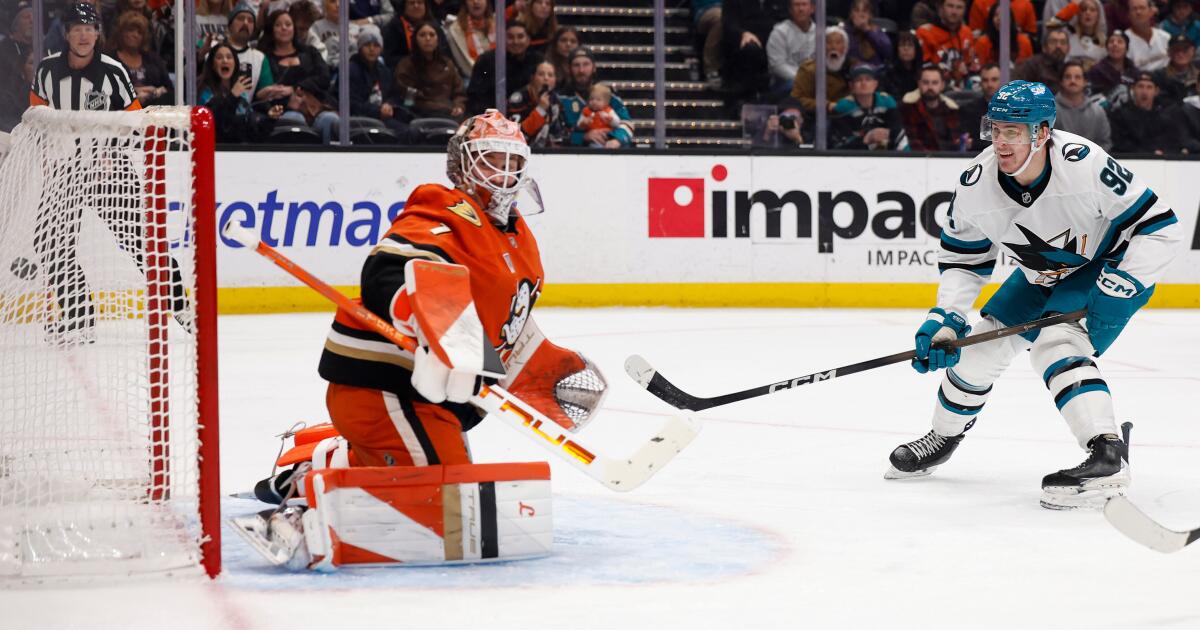
Macklin Celebrini became the third player with 60 points this season with a goal and two assists in the San José Sharks’ 5-4 victory over the Ducks on Monday night.
Mario Ferraro, Igor Chernyshov, William Eklund and Zach Ostapchuk also scored for the Sharks, who earned their second win since the holiday break despite getting outshot 43-13. Yaroslav Askarov made 38 saves.
Troy Terry scored two goals, Cutter Gauthier got his 19th goal and Pavel Mintyukov also scored for the Ducks, who have lost three straight and seven of nine while falling out of first place in the Pacific Division. Lukas Dostal allowed four goals on nine shots before Petr Mrazek replaced him during the second period.
With his seventh multipoint game of December, Celebrini needed just 39 games to get 60 points — the most scored by a teenager before New Year’s Day in the NHL. He also extended his points streak to eight games.
Celebrini left the ice after getting hit in the face by a deflected puck in the third period, but returned several minutes later.
Alexander Wennberg set up San José’s first two goals with exceptional passes, but Anaheim scored off an atrocious turnover by Askarov. He gave away the puck behind his net to Nikita Nesterenko, who found an uncontested Terry.
Celebrini scored his 21st goal late in the first, and he set up Chernyshov’s second career goal in the second. Eklund chased Dostal with his 10th goal after another clever pass by Celebrini.
Gauthier scored late in the second before setting up Mintyukov early in the third.
San José scored on two of its three shots in the second period, and it didn’t put the puck on Anaheim’s net in the first 11 minutes of the third. Ostapchuk still made it 5-3 on a long tip with 6:13 to play, but Terry scored moments later with Mrazek pulled.
Washington accuses Tehran and Caracas of ‘reckless proliferation of deadly weapons’ amid spiraling tensions.
Published On 30 Dec 202530 Dec 2025
Share
Washington, DC – The United States has issued sanctions against a Venezuelan company over accusations that it helped acquire Iranian-designed drones as Washington’s tensions with both Tehran and Caracas escalate.
The penalties on Tuesday targeted Empresa Aeronautica Nacional SA (EANSA), a Venezuelan firm that the US Department of the Treasury said “maintains and oversees the assembly of” drones from Iran’s Qods Aviation Industries, which is already under sanctions by Washington.
Recommended Stories
list of 3 itemsend of list
The department also sanctioned the company’s chairman, Jose Jesus Urdaneta Gonzalez, accusing him of coordinating “with members and representatives of the Venezuelan and Iranian armed forces on the production of UAVs [unmanned aerial vehicles] in Venezuela”.
“Treasury is holding Iran and Venezuela accountable for their aggressive and reckless proliferation of deadly weapons around the world,” Treasury official John Hurley said in a statement.
“We will continue to take swift action to deprive those who enable Iran’s military-industrial complex access to the US financial system,” he said. The sanctions freeze any assets of the targeted firms and individuals in the US and make it generally illegal for American citizens to engage in financial transactions with them.
In its statement, the US alleged Tehran and Caracas have coordinated the “provision” of drones to Venezuela since 2006.
Iran’s Ministry of Defence and Armed Forces Logistics (MODAFL) has been under US sanctions since 2020 for what Washington said is its role in both selling and procuring weapons. The US is by far the largest weapons exporter in the world.
On Tuesday, the US Treasury Department also imposed new sanctions against several Iranians it accused of links to Iran’s arms industry.
The actions came a day after President Donald Trump threatened more strikes against Iran if the country rebuilds its missile capabilities or nuclear programme.
The US had joined Israel in its attacks against Iran in June and bombed the country’s three main nuclear sites before a ceasefire ended a 12-day escalation.
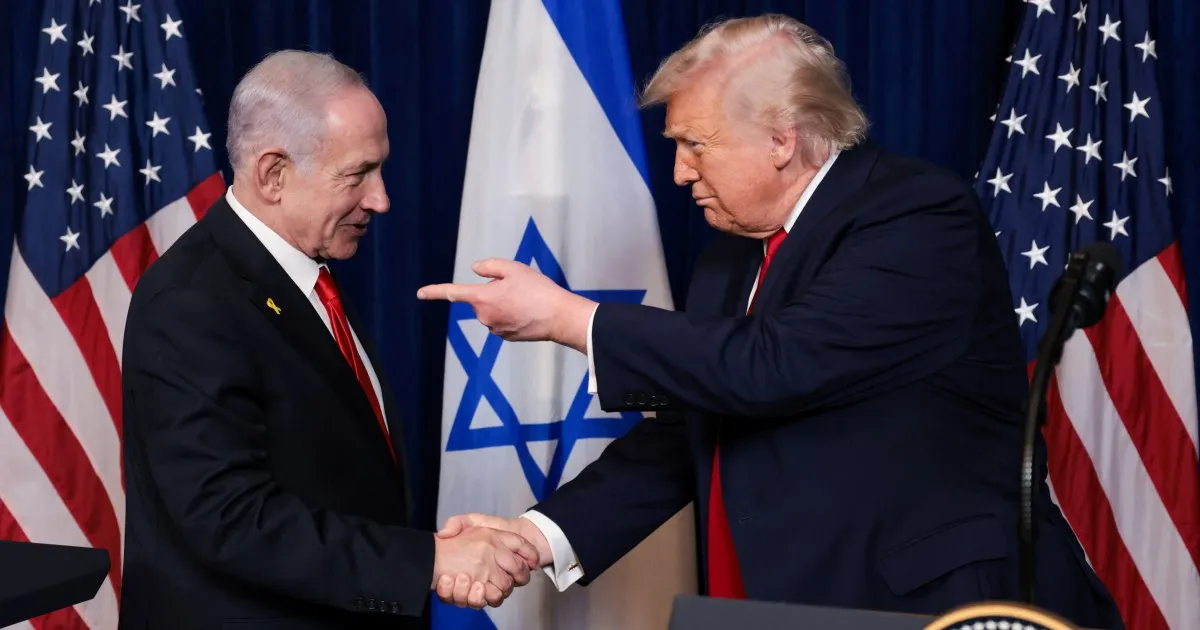
“Now I hear that Iran is trying to build up again, and if they are, we’re going to have to knock them down,” Trump said on Monday during a joint news conference with visiting Israeli Prime Minister Benjamin Netanyahu. “We’ll knock them down. We’ll knock the hell out of them. But hopefully, that’s not happening.”
“The response of the Islamic Republic of Iran to any oppressive aggression will be harsh and regrettable,” President Masoud Pezeshkian wrote in a social media post.
The Trump administration has also taken a confrontational approach towards Venezuela.
The US president announced this week that the US “hit” a dock in the Latin American country that he said was used to load drug boats. Details of the nature of the strike remain unclear.
Trump and some of his top aides have falsely suggested that Venezuela’s oil belongs to the US. Washington has also accused Venezuelan President Nicolas Maduro, without evidence, of leading a drug trafficking organisation.
The Trump administration has simultaneously been carrying out strikes against what it says are drug-running vessels in the Caribbean Sea and eastern Pacific Ocean, a campaign that many legal experts said violates US and international law and is tantamount to extrajudicial killings.
Over the past month, the US also has seized at least two oil tankers off the coast of Venezuela after Trump announced a naval blockade against the country.
Venezuela has rejected the US moves as “piracy” and accused the Trump administration of seeking to topple Maduro’s government.
X FACTOR star Chico may have exceeded the drink-drive limit because he took cough medicine before being breathalysed, a court has heard.
The 54-year-old singer – who donned a fur coat and cowboy hat to court – pleaded not guilty to drink-driving in Southgate, London, on December 13.
Sign up for the Showbiz newsletter
Thank you!
Chico arrived at court donning a cowboy hat and black fur coatCredit: PAHe pleaded not guilty to a drink driving offenceCredit: Rex FeaturesChico’s real name is Yousseph SlimaniCredit: PA
Chico – whose real name is Yousseph Slimani – appeared in the 2005 series of the TV talent show and later released a number one single, It’s Chico Time.
He is accused of driving a Vauxhall Astra with 40 microgrammes of alcohol in 100 millilitres of breath, Willesden Magistrates’ Court heard on Tuesday.
The legal limit of alcohol for driving in England is 35 microgrammes per 100 millilitres.
Chico had consumed cough medicine before giving the reading and that could have impacted its accuracy, Sarah King, defending, said.
Slimani pleaded not guilty and was given bail until his trial on April 9.
Welsh-born Chico found fame after reaching the quarter finals of the X Factor in 2005.
Simon Cowell famously walked out of his initial X Factor audition after fellow judges Louis Walsh and Sharon Osbourne voted him through.
In 2006, Chico had a number one hit on the British charts titled It’s Chico Time, which became his signature catchphrase.
In 2008, he appeared on the reality TV show CelebAir alongside socialite Tamara Beckwith and singer Lisa Maffia.
In 2010, Slimani recorded a single in support of the English Football Team for the 2010 FIFA World Cup in South Africa, aptly called “It’s England Time”, a play on “It’s Chico Time”.
He also competed in ITV’s 2012 series of Dancing on Ice.
In 2018, he was rushed to hospital after suffering a stroke.
Recently, he launched his own fitness app called Block Fit which includes workout classes based around his hits.
Chico married singer Daniyela Rakic, sister of Wimbledon Champion Nenad Zimonjić, and the couple have two children.
The star maintained a TV profile after finishing fifth on the X FactorCredit: Channel 4Slimani was given bail until his trial which will take place next year on April 9.Credit: Andrew Styczynski
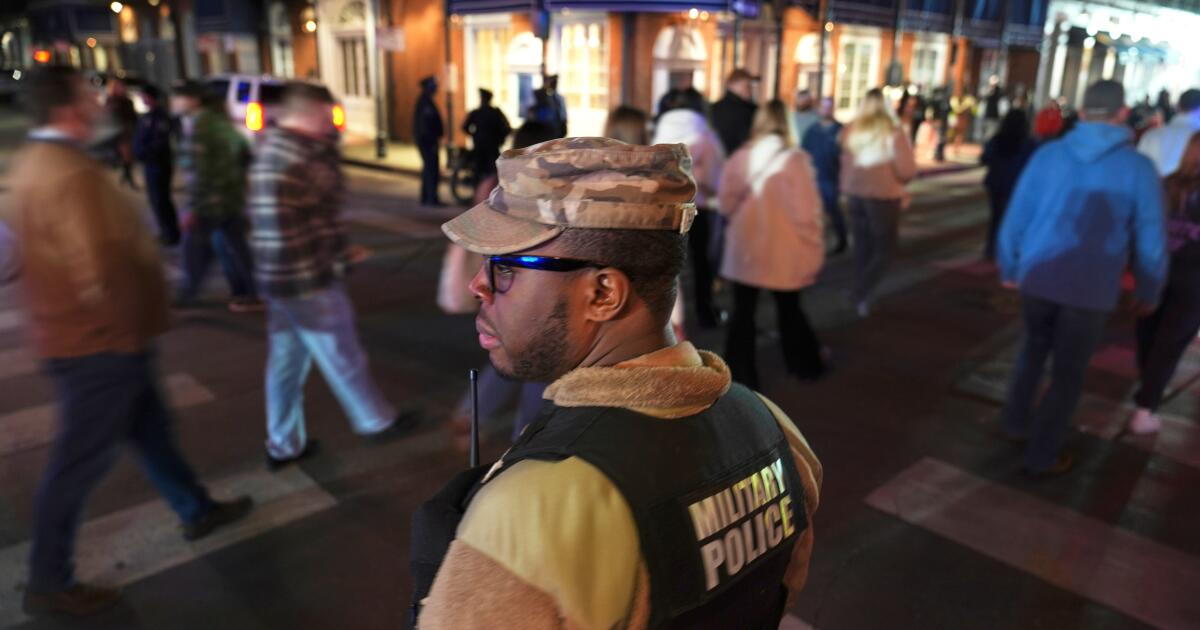
NEW ORLEANS, La. — A National Guard deployment in New Orleans authorized by President Trump will begin Tuesday as part of a heavy security presence for New Year’s celebrations a year after an attack on revelers on Bourbon Street killed 14 people, officials said Monday.
The deployment in New Orleans follows high-profile National Guard missions the Trump administration launched in other cities this year, including in Washington and Memphis, Tennessee. But the sight of National Guard troops is not unusual in New Orleans, where troops earlier this year also helped bolster security for the Super Bowl and Mardi Gras.
“It’s no different than what we’ve seen in the past,” New Orleans police spokesperson Reese Harper said.
The Guard is not the only federal law enforcement agency in the city. Since the start of the month, federal agents have been carrying out an immigration crackdown that has led to the arrest of at least several hundred people.
Harper stressed that the National Guard will not be engaging in immigration enforcement.
“This is for visibility and just really to keep our citizens safe,” Harper said. “It’s just another tool in the toolbox and another layer of security.”
The Guard is expected be confined to the French Quarter area popular with tourists and won’t be engaging in assisting in immigration enforcement, Harper said. Guardsmen will operate similar to earlier this year when they patrolled the area around Bourbon Street following the vehicle-ramming attack on Jan. 1.
The 350 Guard members will stay through Carnival season, when residents and tourists descend on the Big Easy to partake in costumed celebrations and massive parades before ending with Mardi Gras in mid-February.
Louisiana National Guard spokesperson Lt. Col. Noel Collins said in a written statement that the Guard will support local, state, and federal law enforcement “to enhance capabilities, stabilize the environment, assist in reducing crime, and restoring public trust.”
In total, more than 800 local, state and federal law enforcement officials will be deployed in New Orleans to close off Bourbon Street to vehicular traffic, patrol the area, conduct bag searches and redirect traffic, city officials said during a news conference Monday.
The extra aid for New Orleans has received the support of some Democrats, with Mayor LaToya Cantrell saying she is “welcoming of those added resources.”
The increased law enforcement presence comes a year after Shamsud-Din Jabbar drove around a police blockade in the early hours of Jan. 1 and raced down Bourbon Street, plowing into people celebrating New Year’s Day. The attacker, a U.S. citizen and Army veteran who had proclaimed his support for the Islamic State militant group on social media, was fatally shot by police after crashing. After an expansive search, law enforcement located multiple bombs in coolers placed around the French Quarter. None of the explosive devices detonated.
In the immediate aftermath of the attack, 100 National Guard members were sent to the city.
In September, Gov. Jeff Landry asked Trump to send 1,000 troops to Louisiana cities, citing concerns about crime. Democrats pushed back, specifically leaders in New Orleans who said a deployment was unwarranted. They argued that the city has actually seen a dramatic decrease in violent crime rates in recent years.
Cline and Brook write for the Associated Press. Cline reported from Baton Rouge.
Chip Kelly didn’t land on his feet by taking the offensive coordinator position at Northwestern on Tuesday, a month after the Las Vegas Raiders fired him.
More likely, he’ll land on his derriere, seated in a comfy chair overlooking Ryan Field, the Wildcats’ gleaming new $850-million stadium, while calling plays for a program that finished 15th in the Big Ten in points per game this season.
This is what a consolation prize feels like. A year ago, Kelly was calling plays at Ohio State, the most prolific offense in college football and eventual national champion. He’d still be there, pulling the strings again for a juggernaut offense in the College Football Playoff, but for his decision to jump to the Raiders.
It’s been quite the free fall. Las Vegas was 2-9 when Kelly was fired shortly after the lowly Cleveland Browns registered 10 sacks in a 24-10 win over the Raiders on Nov. 23. Whatever play-calling magic Kelly mustered at Ohio State didn’t translate in the NFL, where in years past he had mostly failed in head coaching assignments with the San Francisco 49ers and Philadelphia Eagles.
Kelly, who honed his reputation as a man of few words during his mediocre 2018-2023 tenure as UCLA head coach, didn’t express hard feelings toward the Raiders on his way out.
Now he’ll have an opportunity to repair his reputation at Northwestern. Coach David Braun clearly is enamored with Kelly, who cemented his offensive genius bona fides by leading Oregon to a 46-7 record as head coach from 2009 to 2012.
“His innovative approach to offense using systems that focus on varying tempo, efficiency and smart decision-making, his track record of developing quarterbacks, and his ability to maximize talent are exactly what our program needs at this moment,” Braun said in a statement. “Make no mistake: this is a program-defining change and is reflective of our long-term commitment to the pursuit of championships.”
The only titles Northwestern can claim are a dozen Academic Achievement Awards from the American Football Coaches Assn. since 2002. Since leaving Oregon, Kelly has stumbled at every stop except the single season at Ohio State, where he could still be calling plays had he not left for the lure of the NFL.
Yesterday, Israeli Prime Minister Benjamin Netanyahu paid his fifth visit to the United States since President Donald Trump took office in January. Before the meeting between the two, the Israeli press described the prime minister as fully engaged in an attempt to placate his domestic political partners by achieving “concessions” from Trump. What were these concessions? They were predominantly related to denying Turkiye any presence in the Gaza stabilisation force and to US approval for an Israeli strike on Iran.
Netanyahu failed on both counts. Trump specifically referred to his good relationship with Turkish President Recep Tayyip Erdogan, and spoke of “Bibi’s” respect for him, too. With regard to Iran, Trump mentioned Iran’s willingness to “make a deal” and provided clear guidelines for American involvement while saying nothing about authorising a solo Israeli operation. Israeli media suggests that Trump provided Israel with a “green light” for a strike on Iran. That is not reflected in Trump’s official statement in any way.
Trump talked about the reconstruction of Gaza beginning “soon”. When he spoke of the disarmament of Hamas, he said that it must happen or nearly 60 states will make it happen. Hamas has already agreed to disarm if the process is carried out by a Palestinian-led force. Trump said nothing to suggest that he does not agree with Hamas’s logic, especially when one considers the refusal of most participating countries to carry out a violent disarmament of the group. Trump also made no mention of the last hostage body held in Gaza as a necessary condition for moving to “Stage II” of the deal.
Nothing is more significant in Trump’s world than the use of language and symbolic gestures. When Trump referred to Netanyahu as a “great wartime prime minister” as he was discussing his blueprint for “peace”, he made it clear that his guest was running out of time. This was also clearly apparent when Trump said he had spoken with Israel’s official head of state, President Isaac Herzog, about a pardon for Netanyahu and was assured such a pardon was imminent. President Herzog, by the way, categorically denied that such a conversation had taken place.
What may be the best reflection of the Trump-Netanyahu meeting at Mar-a-Lago has to do with a brief conversation over the phone between Trump and Israeli Minister of Education Yoav Kish. The purpose of the call was for Kish to inform Trump that he will be awarded the Israel Prize on Israel’s Independence Day in 2026.
The award is given out by the minister of education in a televised ceremony attended by Israel’s leaders. It marks the official end of Independence Day celebrations. Its recipients are most frequently career academics at a late stage of their careers. The prize reflects a lifetime’s devotion to the expansion of human knowledge. Sometimes, special prizes are awarded in civic categories, most often for what is called a “life’s work”, such as fostering coexistence between Jews and Palestinians, promoting social equality, etc.
The prize, as understood by its name, is nearly always awarded to Israeli citizens but can be awarded to Jews living abroad and even to non-Jews who have made a “special contribution to the Jewish people”.
In other words, the Trump-Netanyahu meeting involved Trump instructing Netanyahu with regard to upcoming measures and Netanyahu snapping to attention and signalling his acceptance by heaping yet another semi-fictitious honour on Trump’s already crowded head.
Yet, despite these clear displays of the unequal nature of their relationships, there have been persistent voices suggesting that Trump and Netanyahu are operating in cahoots. According to such analyses, the United States fully supports the Israeli attempt to “change the Middle East” – Netanyahu’s favourite phrase – as the Americans make a pivot to Asia and the global race for dominance with China.
Israel will “take care” of the “Iranian threat” as the Arabs languish in their own irresolvable internal tensions and competitions. The mobilisation of Arab states after the Israeli strike on Doha is all but ignored.
These voices also point to the fact that Israel continues to completely ignore the “ceasefire” enacted by “Stage I” of the Trump plan, and does so with the full support of the United States. In fact, Trump said that Israel has “lived up” to the ceasefire “100 percent”, and that he has no problems with Israel’s actions in Gaza. These include bombing, destruction of buildings and infrastructure, the blocking of life-saving aid amid harsh weather and many other steps that ensure and expand the ongoing Israeli genocide.
It is indeed extremely difficult to reconcile this with the notion that Israel has run out of options for delaying Stage II and an internationally-brokered solution to Palestinian statehood. After all, one hears repeatedly from Israeli media about initiatives to “settle Gaza”, “relocate” 1.5 million Palestinians to Somaliland and dismantle the Oslo Accords, one ethnically cleansed Palestinian community at a time.
The US and other countries, like Germany and the UK, continue to buy Israeli arms at a massive rate and to equip Israel with arms of their own. How is it possible to reach a conclusion that the Israeli genocide is reaching its endgame?
The short answer is that it is not. Israel continues to kill, destroy, subvert and expand its efforts to destabilise any semblance of regional order. For example, Israel recognised the statehood of Somaliland in order to have a “dumping ground” for ethnically cleansed Palestinians, but also to pit the United Arab Emirates against Saudi Arabia, as both have conflicting interests in Somalia, and, by doing so, ensure that the Palestinian question is not addressed and that everyone remains frozen by fear of Israeli weapons.
The longer answer recognises the effects of this genocide on Israel itself: Genocide consumes genocidaires.
That is not to suggest that justice is assured by cosmic forces; far from it. Justice should be pursued at the most grounded and realistic level, as should the dignity and preservation of Palestinian lives.
However, the genocide has shaped Israel in its image on a daily, immediate level. Violence is rising as quickly as the prices of the staples, democracy is backsliding, and there is no end in sight to the “forever war”. This is not an abstract, “strategic” matter.
While Israel has been actively seeking to delete Palestinian identity for nearly 80 years, it has not succeeded in doing so. Israel’s internal contradictions have surfaced with paralysing force over the past two years.
Israel will not “die” or “recede”, but the gap between Israeli perceptions of the world and global perceptions of Israel has never been wider.
Trump and his vision of America do not appreciate “losers”. Israel no longer has any “wins” in the offing. It can and does kill and burn, procrastinate and obfuscate.
Even Trump recognises that this power has no lasting effects following its own immediate application. Israel has no options. There is no greater loss.
The views expressed in this article are the author’s own and do not necessarily reflect Al Jazeera’s editorial stance.
Trump is seeking to end protected status for South Sudan, claiming country no longer poses danger to those returning.
Published On 30 Dec 202530 Dec 2025
Share
A federal judge has blocked the administration of President Donald Trump from stripping temporary protections from deportations for South Sudanese citizens living in the United States.
US District Judge Angel Kelley in Boston, Massachusetts, granted an emergency request on Tuesday in a lawsuit filed by several South Sudanese nationals and an immigrant rights group.
Recommended Stories
list of 3 itemsend of list
The order prevents the temporary protected status (TPS) for South Sudanese citizens from expiring on January 5 as the Trump administration has sought.
The lawsuit, led by the African Communities Together, accuses the US Department of Homeland Security of acting unlawfully in its effort to strip South Sudanese citizens of TPS, a US immigration status granted to citizens of countries experiencing natural disasters, conflict or other extraordinary circumstances that could make return to their homelands dangerous.
The status was initially granted for South Sudan in 2011 when the country officially broke away from Sudan. It has been repeatedly renewed amid repeated bouts of fighting, widespread displacement and regional instability.
The status allows eligible individuals to work and receive temporary protection from deportation.
The lawsuit further alleged that the Trump administration exposed South Sudan citizens to being deported to a country facing what is widely considered one of the world’s worst humanitarian crises.
Homeland Security Secretary Kristi Noem, in a notice published on November 5, had argued the country no longer met the conditions for TPS.
“With the renewed peace in South Sudan, their demonstrated commitment to ensuring the safe reintegration of returning nationals, and improved diplomatic relations, now is the right time to conclude what was always intended to be a temporary designation,” she said, appearing to refer to a tenuous 2018 peace agreement.
The statement contradicted the findings of a panel of United Nations experts, who wrote in a report to the UN Security Council in November that “while the contours of the conflict may be altered, the resulting human suffering has remained unchanged.”
“Ongoing conflict and aerial bombardments, coupled with flooding and the influx of returnees and refugees from the Sudan, have led to near-record levels of food insecurity, with pockets of famine reported in some of the communities most affected by renewed fighting,” it added.
The Trump administration has increasingly targeted TPS as part of its crackdown on immigration and its mass deportation drive.
It has moved to similarly end TPS for foreign nationals from countries including Syria, Venezuela, Haiti, Cuba and Nicaragua, prompting several court challenges.
It has also sought to deport individuals to countries in Africa, even if they have no ties there.
More artists have canceled scheduled performances at the Kennedy Center following the addition of President Donald Trump’s name to the facility, with jazz supergroup The Cookers pulling out of a planned New Year’s Eve concert, and the institution’s president saying the cancellations belie the artists’ unwillingness to see their music as crossing lines of political disparity.
The fresh round of cancellations after Trump put his name of the building follows an earlier artist backlash in spring. After Trump ousted the Kennedy Center board and named himself the institution’s chairman in February, performer Issa Rae and the producers of “Hamilton” cancelled scheduled engagements while musicians Ben Folds and Renee Flaming stepped down from advisory roles.
The Cookers, a jazz supergroup performing together for nearly two decades, announced their withdrawal from “A Jazz New Year’s Eve” on their website, saying the “decision has come together very quickly” and acknowledging frustration from those who may have planned to attend.
The group didn’t mention the building’s renaming or the Trump administration but did say that, when they return to performing, they wanted to ensure that “the room is able to celebrate the full presence of the music and everyone in it,” reiterating a commitment “to playing music that reaches across divisions rather than deepening them.”
The group may not have addressed the Kennedy Center situation directly, but one of its members has. On Saturday, saxophone player Billy Harper said in comments posted on the Jazz Stage Facebook page that he “would never even consider performing in a venue bearing a name (and being controlled by the kind of board) that represents overt racism and deliberate destruction of African American music and culture. The same music I devoted my life to creating and advancing.”
According to the White House, Trump’s handpicked board approved the renaming. Harper said both the board, “as well as the name displayed on the building itself represents a mentality and practices I always stood against. And still do, today more than ever.”
Richard Grenell, a Trump ally whom the president chose to head the Kennedy Center after he forced out the previous leadership, posted Monday night on X that “The artists who are now canceling shows were booked by the previous far left leadership,” intimating the bookings were made under the Biden administration.
In a statement to the Associated Press, Grenell said Tuesday the ”last minute cancellations prove that they were always unwilling to perform for everyone — even those they disagree with politically,” adding that the Kennedy Center had been “flooded with inquiries from real artists willing to perform for everyone and who reject political statements in their artistry.”
There was no immediate word from Kennedy Center officials if the entity would pursue legal action against the group, as Grenell said it would after musician Chuck Redd canceled a Christmas Eve performance. Following that withdrawal, in which Redd cited the Kennedy Center renaming, Grenell said he would seek $1 million in damages for what he called a “political stunt.”
President John F. Kennedy was assassinated in 1963, and Congress passed a law the following year naming the center as a living memorial to him. Scholars have said any changes to the building’s name would need congressional approval; the law explicitly prohibits the board of trustees from making the center into a memorial to anyone else, and from putting another person’s name on the building’s exterior.
Kinnard writes for the Associated Press. AP writers Steven Sloan and Hillel Italie contributed to this report.
If history is a guide, Republicans stand a good chance of losing control of the House of Representatives in 2026. They have just a slim majority in the chamber, and the incumbent party usually gives up seats in midterm elections.
President Trump, whose loss of the House halfway through his first term led to two impeachments, is trying to keep history from repeating — and doing so in ways his opponents say are intended to manipulate next year’s election landscape.
He has rallied his party to remake congressional maps across the country to create more conservative-leaning House seats, an effort that could end up backfiring on him. He’s directed his administration to target Democratic politicians, activists and donors. And, Democrats worry, he’s flexing his muscles to intervene in the midterms like no administration ever has.
Democrats and other critics point to how Trump has sent the military into Democratic cities over the objections of Democratic mayors and governors. They note that he’s pushed the Department of Homeland Security to be so aggressive that at one point its agents handcuffed a Democratic U.S. senator. And some warn that a Republican-controlled Congress could fail to seat winning candidates if Democrats reclaim the House majority, recalling Trump’s efforts to stay in power even after voters rejected him in 2020, leading to the violent attack by his supporters on the U.S. Capitol.
Regarding potential military deployments, Ken Martin, chairman of the Democratic National Committee, told The Associated Press: “What he is going to do is send those troops there, and keep them there all the way through the next election, because guess what? If people are afraid of leaving their house, they’re probably not going to leave their house to go vote on Election Day. That’s how he stays in power.”
Military to the polls, or fearmongering?
Democrats sounded similar alarms just before November’s elections, and yet there were no significant incidents. California Gov. Gavin Newsom, a frequent Trump antagonist who also warns about a federal crackdown on voting in 2026, predicted that masked immigration agents would show up at the polls in his state, where voters were considering a ballot measure to counter Trump’s redistricting push.
There were no such incidents in November, and the measure to redraw California’s congressional lines in response to Trump’s efforts elsewhere won in a landslide.
White House spokeswoman Abigail Jackson said the concerns about the midterms come from Democratic politicians who are “fearmongering to score political points with the radical left flank of the Democrat party that they are courting ahead of their doomed-to-fail presidential campaigns.”
She described their concerns as “baseless conspiracy theories.”
Susie Wiles, Trump’s chief of staff, denied that Trump was planning to use the military to try to suppress votes.
“I say it is categorically false, will not happen. It’s just wrongheaded,” she told Vanity Fair for an interview that was published earlier in December.
DNC litigation director Dan Freeman said he hasn’t seen an indication that Trump will send immigration enforcement agents to polling places during the midterms, but is wary.
He said the DNC filed public records requests in an attempt to learn more about any such plans and is drafting legal pleadings it could file if Trump sends armed federal agents to the polls or otherwise intervenes in the elections.
“We’re not taking their word for it,” Freeman said in an interview.
States, not presidents, run elections
November’s off-year elections may not be the best indicator of what could lie ahead. They were scattered in a handful of states, and Trump showed only modest interest until late in the fall when his Department of Justice announced it was sending federal monitors to California and New Jersey to observe voting in a handful of counties. It was a bureaucratic step that had no impact on voting, even as it triggered alarm from Democrats.
Alexandra Chandler, the legal director of Defend Democracy, a group that has clashed with Trump over his role in elections, said she was heartened by the lack of drama during the 2025 voting.
“We have so many positive signs we can look to,” Chandler said, citing not only a quiet election but GOP senators’ resistance to Trump’s demands to eliminate the filibuster and the widespread resistance to Trump’s demand that television host Jimmy Kimmel lose his job because of his criticism of the president. “There are limits” on Trump’s power, she noted.
“We will have elections in 2026,” Chandler said. “People don’t have to worry about that.”
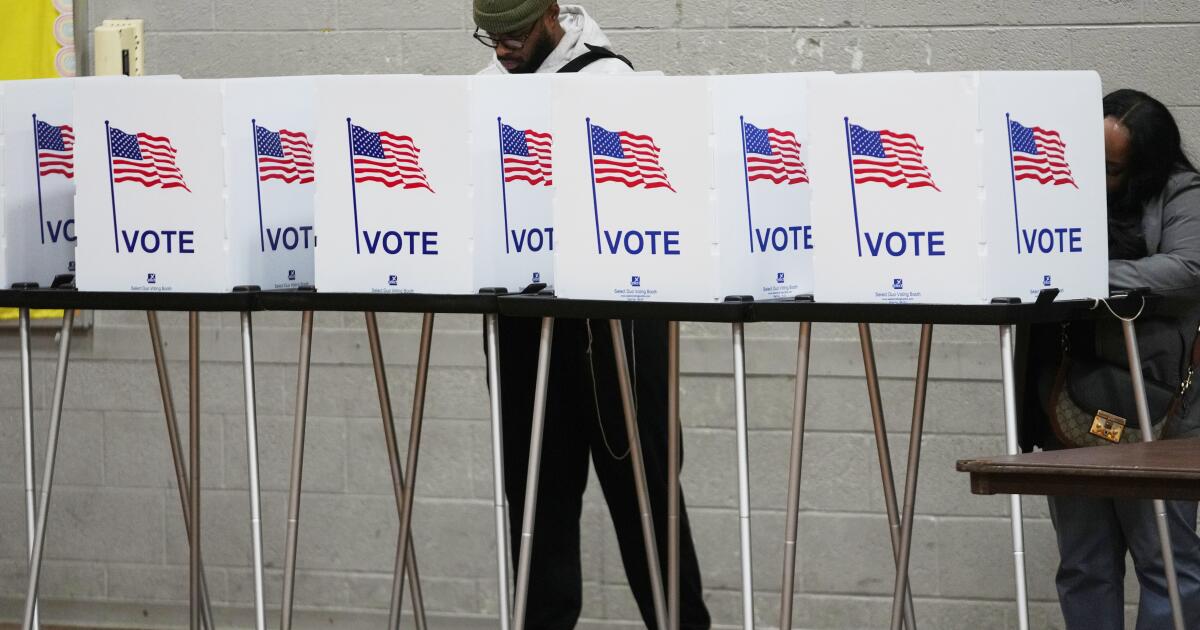
Under the Constitution, a president has limited tools to intervene in elections, which are run by the states. Congress can help set rules for federal elections, but states administer their own election operations and oversee the counting of ballots.
When Trump tried to singlehandedly revise election rules with a sweeping executive order shortly after returning to office, the courts stepped in and stopped him, citing the lack of a constitutional role for the president. Trump later promised another order, possibly targeting mail ballots and voting machines, but it has yet to materialize.
DOJ voter data request ‘should frighten everybody’
Still, there’s plenty of ways a president can cause problems, said Rick Hasen, a UCLA law professor.
Trump unsuccessfully pushed Georgia’s top election official to “find” him enough votes to be declared the winner there in 2020 and could try similar tactics in Republican-dominated states in November. Likewise, Hasen said, Trump could spread misinformation to undermine confidence in vote tallies, as he has done routinely ahead of elections.
It’s harder to do that in more lopsided contests, as many in 2025 turned into, Hasen noted.
“Concerns about Trump interfering in 2026 are real; they’re not frivolous,” Hasen said. “They’re also not likely, but these are things people need to be on guard for.”
One administration move that has alarmed election officials is a federal demand from his Department of Justice for detailed voter data from the states. The administration has sued the District of Columbia and at least 21 states, most of them controlled by Democrats, after they refused to turn over all the information the DOJ sought.
“What the DOJ is trying to do is something that should frighten everybody across the political spectrum,” said David Becker, a former Justice Department voting rights attorney and executive director of the Center for Election Innovation & Research. “They’re trying to use the power of the executive to bully states into turning over highly sensitive data — date of birth, Social Security numbers, driver’s license, the Holy Trinity of identity theft — hand it over to the DOJ for who knows what use.”
‘Voter protection’ vs ‘election integrity’
Voting rights lawyers and election officials have been preparing for months for the midterms, trying to ensure there are ways to counter misinformation and ensure state election systems are easy to explain. Both major parties are expected to stand up significant campaigns around the mechanics of voting: Democrats mounting what they call a “voter protection” effort to monitor for problems while Republicans focus on what they call “election integrity.”
Freeman, the DNC litigation director who previously worked in the DOJ’s voting section, said his hiring this year was part of a larger effort by the DNC to beef up its in-house legal efforts ahead of the midterms. He said the committee has been filling gaps in voting rights law enforcement that the DOJ has typically covered, including informing states that they can’t illegally purge citizens from their voter rolls.
Tina Barton, co-chair of the Committee on Safe and Secure Elections, a coalition of law enforcement and election officials who advise jurisdictions on de-escalation and how to respond to emergencies at polling places, says interest in the group’s trainings has “exploded” in recent weeks.
“There’s a lot at stake, and that’s going to cause a lot of emotions,” Barton said.
Riccardi writes for the Associated Press. AP writers Marc Levy in Harrisburg, Penn., Julie Carr Smyth in Columbus, Ohio, and Ali Swenson in New York contributed to this report.