Venezuela

Congress’s role questioned as Democrats vow to rein in Trump on Venezuela | Donald Trump News

Washington, DC – It has become a familiar pattern. United States presidents conduct unilateral military actions abroad. Congress shrugs.

On Saturday, in the hours after the US military abducted Venezuelan leader Nicolas Maduro, Democrats in the Senate pledged to raise yet another resolution to rein in US President Donald Trump’s military actions.

Recommended Stories

list of 4 itemsend of list

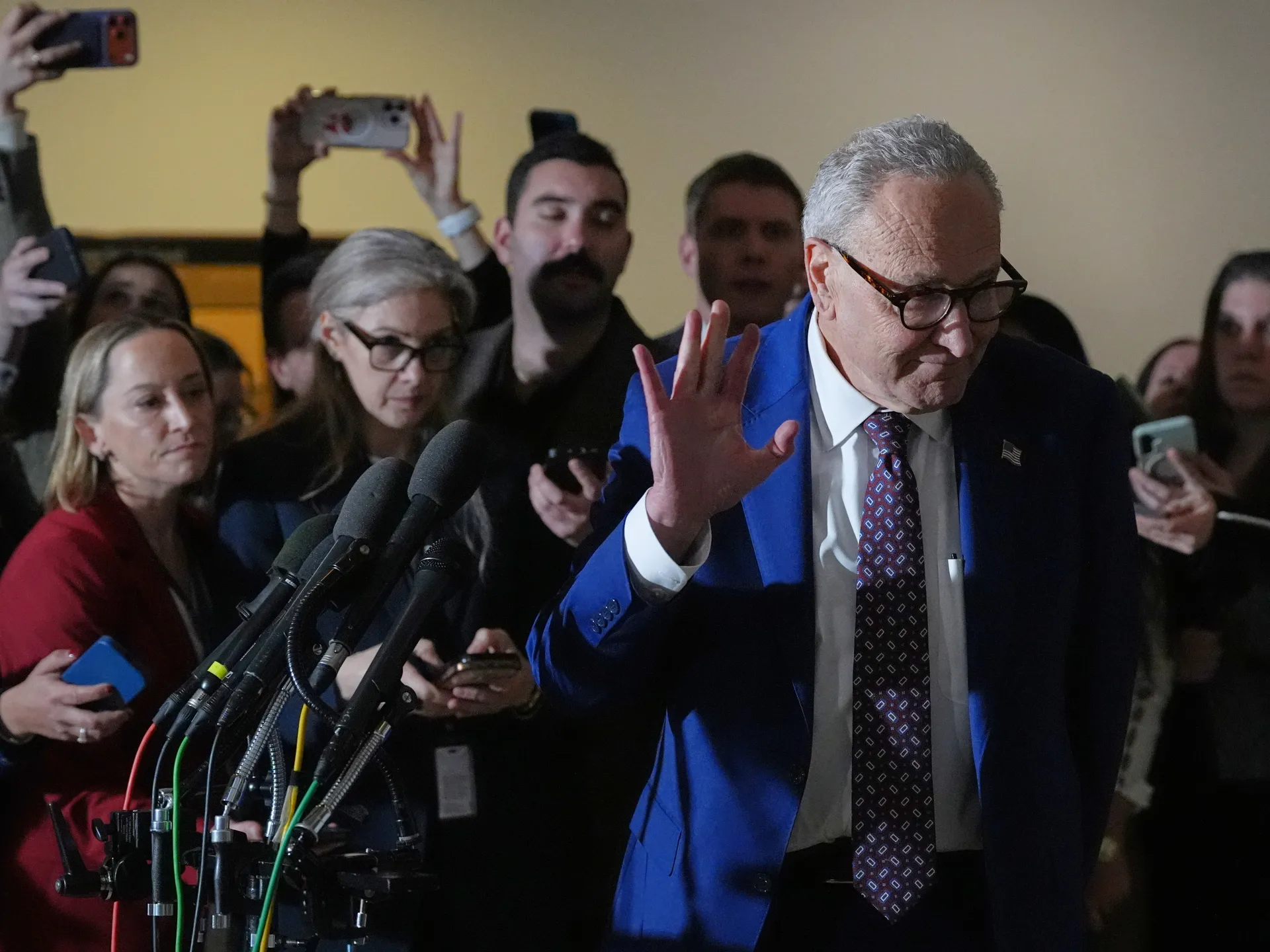
Chuck Schumer, the top Democrat in the chamber, has said the party will push for a vote within the week. By all accounts, the odds of its success remain long.

Since Trump took office for a second term in 2025, Congress has weighed multiple bills that would force him to seek legislative approval before initiating a military strike.

But the latest attack on Venezuela offers a stark instance of presidential overreach, one that is “crying out for congressional action”, according to David Janovsky, the acting director of the Constitution Project at the Project on Government Oversight.

Experts say it is also one of the clearest tests in recent history of whether Congress will continue to cede its authority to check US military engagement abroad.

“There are a lot of angles where you can come at this to say why it’s a clear-cut case,” Janovsky told Al Jazeera.

He pointed out that, under the US Constitution, Congress alone wields the authority to allow military action. He also noted that the Venezuela attack “is in direct contravention of the UN Charter, which is, as a treaty, law in the United States”.

“Any of the fig leaves that presidents have used in the past to justify unilateral military action just don’t apply here,” Janovsky added. “This is particularly brazen.”

An uphill battle

Since August, the Trump administration has signalled plans to crank up its “maximum pressure” campaign against Venezuela.

That month, Trump reportedly signed a secret memo calling on the US military to prepare for action against criminal networks abroad. Then, on September 2, the Trump administration began conducting dozens of strikes on alleged drug-smuggling boats off the Venezuelan and Colombian coasts.

That deadly bombing campaign was itself condemned as a violation of international law and an affront to Congress’s constitutional powers. It coincided with a build-up of US military assets near Venezuela.

Trump also dropped hints that the US military campaign could quickly expand to alleged drug-trafficking targets on Venezuelan soil. “When they come by land, we’re going to be stopping them the same way we stopped the boats,” Trump said on September 16.

The strikes prompted two recent votes in the House of Representatives in December: one that would require congressional approval for any land strikes on the South American country, and one that would force Trump to seek approval for strikes on alleged drug-smuggling boats.

Both resolutions, however, failed roughly along party lines. A similar resolution in the Senate, which would have required congressional approval before any more attacks, also fell short in November.

But speaking to reporters in a phone call just hours after the US operation on Saturday, Senator Tim Kaine said he hoped the brashness of Trump’s latest actions in Venezuela would shock lawmakers into action.

Republicans, he said, can no longer tell themselves that Trump’s months-long military build-up in the Caribbean and his repeated threats are a “bluff” or a “negotiating tactic”.

“It’s time for Congress to get its a** off the couch and do what it’s supposed to do,” Kaine said.

In an interview with CNN’s Dana Bash, US Senator Chris Murphy also agreed that it was “true” that Congress had become impotent on matters of war, a phenomenon that has spanned both Democratic and Republican administrations.

Bash pointed to former President Barack Obama’s 2011 military deployment to Libya, which went unchecked by Congress.

“Congress needs to own its own role in allowing a presidency to become this lawless,” Murphy responded.

Republicans ho-hum about resolutions

Under the US Constitution, only Congress can declare war, something it has not done since World War II.

Instead, lawmakers have historically passed Authorizations for Use of Military Force (AUMFs) to approve committing troops to recent wars, including the US invasions of Iraq and Afghanistan and the strikes on alleged al-Qaeda affiliates across the Middle East, Africa and Asia.

No AUMFs have been passed that would relate to military action in Venezuela.

When lawmakers believe a president is acting beyond his constitutional power, they can pass a war powers resolution requiring Congressional approval for further actions.

Beyond their symbolism, such resolutions create a legal basis to challenge further presidential actions in the judiciary.

However, they carry a high bar for success, with a two-thirds majority in both chambers of Congress needed to override a presidential veto.

Given the current makeup of Congress, passage of a war powers resolution would likely require bipartisan support.

Republicans maintain narrow majorities in both the House and Senate, so it would be necessary for members of Trump’s own party to back a war powers resolution for it to be successful.

In November’s Senate vote, only two Republicans — co-sponsor Rand Paul of Kentucky, and Lisa Murkowski, of Alaska — split from their party to support the resolution. It failed by a margin of 51 to 49.

December’s vote on a parallel resolution in the House only earned 211 votes in favour, as opposed to 213 against. In that case, three Republicans broke from their party to support the resolution, and one Democrat opposed it.

But Trump’s abduction of Maduro has so far only received condemnation from a tiny fragment of his party.

Overall, the response from elected Republicans has been muted. Even regular critics of presidential adventurism have instead focused on praising the ouster of the longtime Venezuelan leader, who has been accused of numerous human rights abuses.

Senator Todd Young, a Republican considered on the fence ahead of November’s war powers vote, has praised Maduro’s arrest, even as he contended the Trump administration owed Congress more details.

“We still need more answers, especially to questions regarding the next steps in Venezuela’s transition,” Young said.

Some Democrats have also offered careful messaging in the wake of the operation.

That included Debbie Wasserman Schultz, a Democrat who represents a large Venezuelan diaspora community in Florida.

In a statement on Saturday, Wasserman Schultz focused on the implications of Maduro’s removal, while avoiding any mention of the military operation that enabled it. Instead, she asserted that Trump owed Congress an explanation about next steps.

“He has failed to explain to Congress or the American people how he plans to prevent the regime from reconstituting itself under Maduro’s cronies or stop Venezuela from falling into chaos,” she wrote.

In December, however, Wasserman Schultz did join a group of Florida Democrats in calling for Congress to exercise its oversight authority as Trump built up military pressure on Venezuela.

What comes next?

For its part, the Trump administration has not eased up on its military threats against Venezuela, even as it has sought to send the message that Maduro’s abduction was a matter of law enforcement, not the start of a war.

Trump has also denied, once again, that he needed congressional approval for any further military action. Still, in a Monday interview with NBC News, he expressed optimism about having Congress’s backing.

“We have good support congressionally,” he told NBC. “Congress knew what we were doing all along, but we have good support congressionally. Why wouldn’t they support us?”

Since Saturday’s attack and abduction, Trump has warned that a “second wave” of military action could be on the horizon for Venezuela.

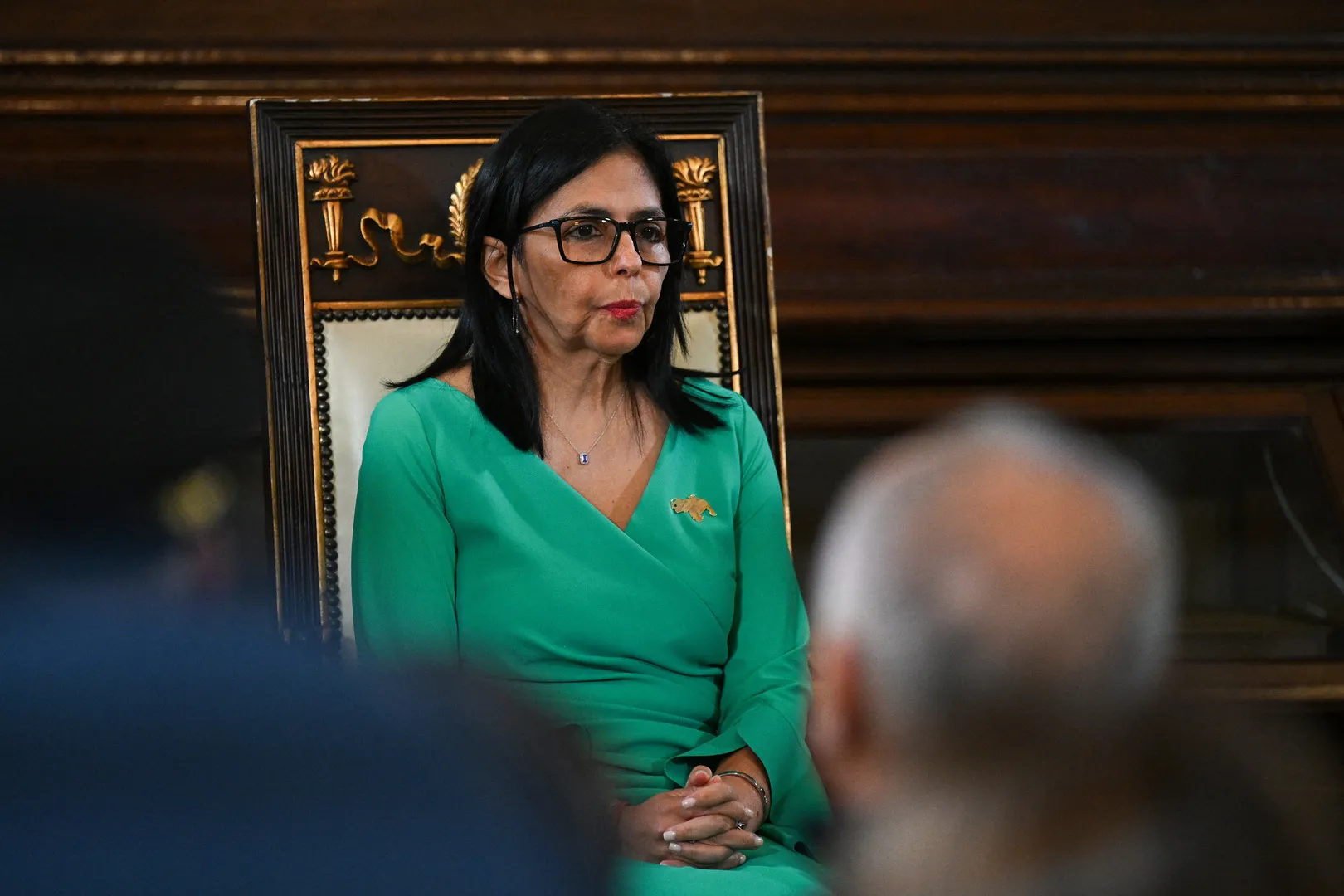
That threat has extended to the potential for the forced removal of Maduro’s deputy, Delcy Rodriguez, who was formally sworn in as the country’s interim president on Monday.

“If she doesn’t do what’s right, she is going to pay a very big price, probably bigger than Maduro,” Trump told The Atlantic magazine.

The administration has also said that strikes on alleged drug-smuggling boats near Venezuela will continue and that US military assets will remain deployed in the region.

Constitutional expert Janovsky, however, believes that this is a critical moment for Congress to act.

Failure to rein in Trump would only further reinforce a decades-long trend of lawmakers relinquishing their oversight authorities, he explained. That, in turn, offers tacit support for the presidency’s growing power over the military.

“To say this was a targeted law enforcement operation — and ignore the ongoing situation — would be a dangerous abdication of Congress as a central check on how the United States military is used,” Janovsky said.

“Continued congressional inaction does nothing but empower presidents to act however they want,” he added.

“To see Congress continue to step back ultimately just removes the American people even farther from where these decisions are actually being made.”
Source link

Ukraine’s allies meet in Paris but progress is uncertain with U.S. focus on Venezuela and Greenland

Ukraine’s allies met Tuesday in Paris for key talks that could help determine the country’s security after any potential peace deal is reached with Russia.

But prospects for progress are uncertain: The Trump administration’s focus is shifting to Venezuela while U.S. suggestions of a Greenland takeover are causing tension with Europe, and Moscow shows no signs of budging from its demands in its nearly 4-year-old invasion.

Before the U.S. capture of Venezuelan leader Nicolás Maduro, French President Emmanuel Macron had expressed optimism about the latest gathering of what has been dubbed the “coalition of the willing. They have been exploring for months how to deter any future Russian aggression should it agree to stop fighting Ukraine.

In a Dec. 31 address, Macron said that allies would “make concrete commitments” at the meeting “to protect Ukraine and ensure a just and lasting peace.”

Macron’s office said an unprecedented number of officials will attend in person, with 35 participants including 27 heads of state and government. The U.S. envoys, Steve Witkoff and Trump’s son-in-law Jared Kushner, met with Macron at the Elysee presidential palace for preparatory talks ahead of the gathering.

Moscow has revealed few details of its stance in the U.S.-led peace negotiations. Officials have reaffirmed Russia’s demands and have insisted there can be no ceasefire until a comprehensive settlement is agreed. The Kremlin has ruled out any deployment of troops from NATO countries on Ukrainian soil.

A series of meetings on the summit’s sidelines illustrated the intensity of the diplomatic effort and the complexity of its moving parts.

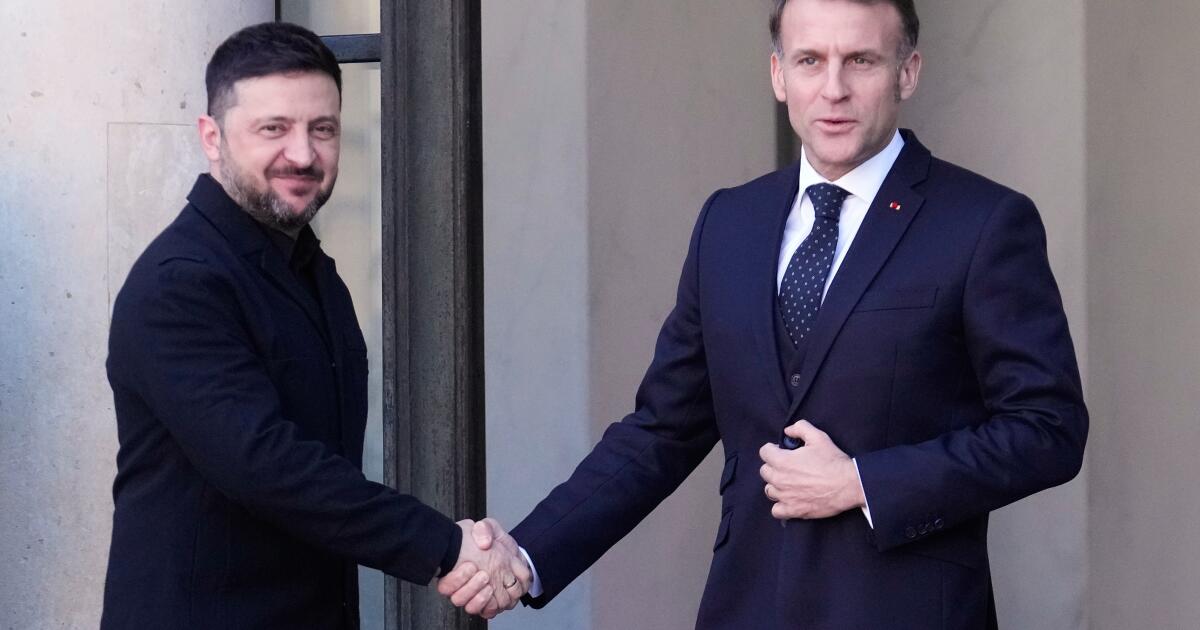
Ukrainian President Volodymyr Zelensky met with Macron ahead of the summit. French, British and Ukrainian military chiefs also met, with NATO’s top commander, U.S. Gen. Alexus G. Grynkewich, participating in talks that France’s army chief said focused on implementing security guarantees. Army chiefs from other coalition nations joined by video.

A news conference including Zelensky, Macron, British Prime Minister Keir Starmer and German Chancellor Friedrich Merz was planned later in the day.

Macron’s office said the U.S. delegation was initially set to be led by Secretary of State Marco Rubio, but he changed his plans after the U.S. military intervention in Venezuela.

Trump on Sunday renewed his call for the U.S. to take control of Greenland, a strategic, mineral-rich Arctic island.

The leaders of France, Germany, Italy, Poland, Spain and the U.K. on Tuesday joined Danish Prime Minister Mette Frederiksen in defending Greenland’s sovereignty in the wake of Trump’s comments about the self-governing territory of the kingdom of Denmark.

But the continent also needs U.S. military might to back up Ukrainian security guarantees and ward off Russia’s territorial ambitions. That could require a delicate diplomatic balancing act in Paris.

Participants are seeking concrete outcomes on five key priorities once fighting ends: ways to monitor a ceasefire; support for Ukraine’s armed forces; deployment of a multinational force on land, at sea and in the air; commitments in case of more Russian aggression; and long-term defense cooperation with Ukraine.

But whether that’s still achievable Tuesday isn’t so clear now, after the U.S. military operation targeting Maduro in Venezuela.

Ukraine seeks firm guarantees from Washington of military and other support seen as crucial to securing similar commitments from other allies. Kyiv has been wary of any ceasefire that it fears could provide time for Russia to regroup and attack again.

Recent progress in talks

Witkoff had indicated progress in talks about protecting and reassuring Ukraine. In a Dec. 31 post, he said “productive” discussions with him, Rubio and Kushner on the U.S. side and, on the other, national security advisers of Britain, France, Germany and Ukraine had focused on “strengthening security guarantees and developing effective deconfliction mechanisms to help end the war and ensure it does not restart.”

France, which with the U.K. has coordinated the multinational effort to shore up a possible peace plan, has given only broad-brush details about its scope. It says Ukraine’s first line of defense against a Russian resumption of war would be the Ukrainian military and that the coalition intends to strengthen it with training, weaponry and other support.

Macron has also spoken of European forces potentially being deployed away from Ukraine’s front lines to help deter future Russian aggression.

Important details unfinalized

Zelensky said during the weekend that potential European troop deployments still face hurdles, important details have not been finalized, and “not everyone is ready” to commit forces.

He noted that many countries would need approval from their lawmakers even if leaders agreed on military support for Ukraine. But he recognized that support could come in forms other than troops, such as “through weapons, technologies and intelligence.”

Zelensky said deployments in Ukraine by Britain and France, Western Europe’s only nuclear-armed nations, would be “essential.”

“Speaking frankly as president, even the very existence of the coalition depends on whether certain countries are ready to step up their presence,” he said. “If they are not ready at all, then it is not really a ‘coalition of the willing.’”

Leicester and Corbet write for the Associated Press. Volodymyr Yurchuk in Kyiv, Ukraine, contributed to this report.

Source link

Did The U.S. Use Kamikaze Drones To Strike Venezuela?

Multiple video clips offer strong evidence that kamikaze drones were among the capabilities the U.S. military brought to bear during the operation to capture Venezuelan dictator Nicolas Maduro over the weekend. This may have been the first real-world use of a new slate of U.S. long-range one-way attack drones and loitering munitions. After years of being outpaced by lower-end drone developments overseas, there is now a significant new push across America’s armed forces, and the special operations community in particular, to dramatically step up the acquisition and fielding of various tiers of uncrewed one-way strike aircraft.

Bystanders on the ground in Venezuela captured various videos of the U.S. assault on Saturday, which was officially dubbed Operation Absolute Resolve. In multiple clips, as seen in the social media post below, distinctly terrorizing high-pitched buzzing can be clearly heard, which are then followed immediately by explosions and/or other visual or auditory signs of munitions impacting the ground, all consistent with the use of one-way attack drones.

U.S. Special Operations Command (SOCOM) declined to offer any comment when asked for additional details about the use of drones, in general, during Operation Absolute Resolve. TWZ has reached out to U.S. Southern Command (SOUTHCOM) and the White House for more information.

Similar high-pitched buzzing sounds, which were followed by impacts and detonations, are featured in a mountain of existing confirmed videos of various types of kamikaze drones powered by small piston engines driving single pusher propellers hitting their targets. The distinctive acoustic signature, in particular, has been consistently present in footage of attacks involving these kinds of uncrewed aerial systems that have emerged from multiple conflict zones globally in the past five years or so. Ukrainian forces have even established a network of acoustic sensors to help spot incoming Russian drone attacks across their country to capitalize on this acoustic signature.

This is the footage of the russian Shahed drone attacking an oil mill belonging to the American company Bunge.

As the result, more than 300 tons of oil was spilled, causing serious damage to the mill and environment. pic.twitter.com/JflSn2NkBd

— Oleksiy Goncharenko (@GoncharenkoUa) January 5, 2026

Footage released by Ukraine’s military show electronic warfare units disabling a Russian Shahed attack drone and forcing it to descend intact into the Black Sea, rather than detonating on impact. pic.twitter.com/PQfVscqBIM

— Open Source Intel (@Osint613) December 14, 2025

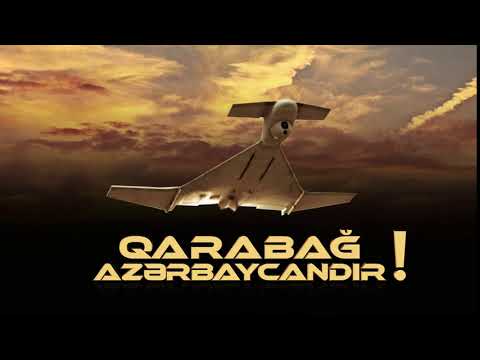
In 2021, Azerbaijan’s Border Guard even released a video, seen below, focused on the sounds produced by the Israeli-made Harop loitering munitions that it had actively employed in a conflict with Armenia the previous year. At that time, TWZ highlighted the knock-on psychological effect this would have. Direct comparisons have also been drawn to the iconic sound of World War II-era dive bombers, and Nazi Ju-87 Stukas, in particular, swooping down onto their targets.

Qarabağ Azərbaycandır!


As mentioned, the U.S. military finally launched a new, concerted effort to expand the use of various types of one-way attack drones last year. The special operations community, which was front and center in this weekend’s operation in Venezuela, has been heavily involved in executing this initiative and has already been at the forefront of fielding other kinds of kamikaze drones within America’s armed forces for years now.

Just last October, U.S. Central Command (CENTCOM) disclosed the first known operational fielding of long-range one-way attack drones by a task force in the Middle East led by special operations forces. That unit, officially named Task Force Scorpion Strike (TFSS), is equipped with multiple versions of the Low-Cost Uncrewed Combat Attack System (LUCAS), a design notably reverse-engineered from the Iranian-designed Shahed-136. However, LUCAS drones can operate collaboratively in a fully networked swarm and beyond-line-of-sight links that enable them to attack targets, including ones that might suddenly pop up, in real time and far from their operators. This makes them far more capable than Iran’s original design, as well as variants and derivatives that Russia is now actively using against Ukraine.

CENTCOM

In December, TFSS, together with the U.S. Navy, also demonstrated the ability to launch LUCAS drones from ships. Other elements of the U.S. military have at least been experimenting with LUCAS, and those drones and/or other similar designs may already be in wider service within America’s armed forces.

“Bravo Zulu. U.S. Navy forces in the Middle East are advancing warfighting capability in new ways, bringing more striking power from the sea and setting conditions for using innovation as a deterrent.” – Adm. Brad Cooper, CENTCOM Commander https://t.co/TgQ4WLbph3 pic.twitter.com/WUiAVojTht

— U.S. Central Command (@CENTCOM) December 18, 2025

The extent to which other relevant developments are ongoing in the classified realm is unknown, but this is certainly something that has been occurring in recent years. This includes the Phoenix Ghost kamikaze drones that emerged publicly after examples were delivered to Ukraine, but which trace back to a classified project under the Air Force’s Big Safari special projects office.

The AEVEX Disruptor kamikaze drone seen here is one of the designs now known to be part of the Phoenix Ghost family. Jamie Hunter

It is worth noting that the Shahed-136 was itself directly influenced by Israeli kamikaze drones like the Harop, which were originally designed with an explicit focus on targeting enemy air defenses. Iran has shown Shaheds being employed in this role in exercises, as seen in the video below, though the drones have now proven themselves in real-world attacks on a much wider array of targets on land and at sea.

Баражуючий іранський боєприпас «Shahed 136»


In Venezuela this past weekend, U.S. forces could well have used long-range one-way attack drones, launched from ships off the coast or forward locations on land in the region, as part of the broader suppression and destruction of enemy air defenses (SEAD/DEAD) mission, which we know was central to the operation.

“As the force began to approach Caracas, the Joint Air Component began dismantling and disabling the air defense systems in Venezuela, employing weapons to ensure the safe passage of the helicopters into the target area,” Chairman of the Joint Chiefs of Staff U.S. Air Force Gen. Dan “Razin” Caine said during a press conference on Saturday. “The goal of our air component is, was, and always will be to protect the helicopters and the ground force and get them to the target and get them home.”

Caine also said that “numerous remotely piloted drones” were among the U.S. assets employed during Operation Absolute Resolve.

Long-range kamikaze drones would have also offered a way to stimulate enemy air defenses, helping to expose their exact locations and provide emissions to hone in on, after which they could then be struck by other platforms or avoided entirely. The U.S. spent months cataloging Venezuela’s electronic order of battle from standoff distances, but road mobile systems are something of a wild card. If they radiate, they could be rapidly geolocated and destroyed. Similar drones could have been employed purely as decoys or for stand-in (close proximity) jamming of key radars and communications systems, depending on their exact configuration.

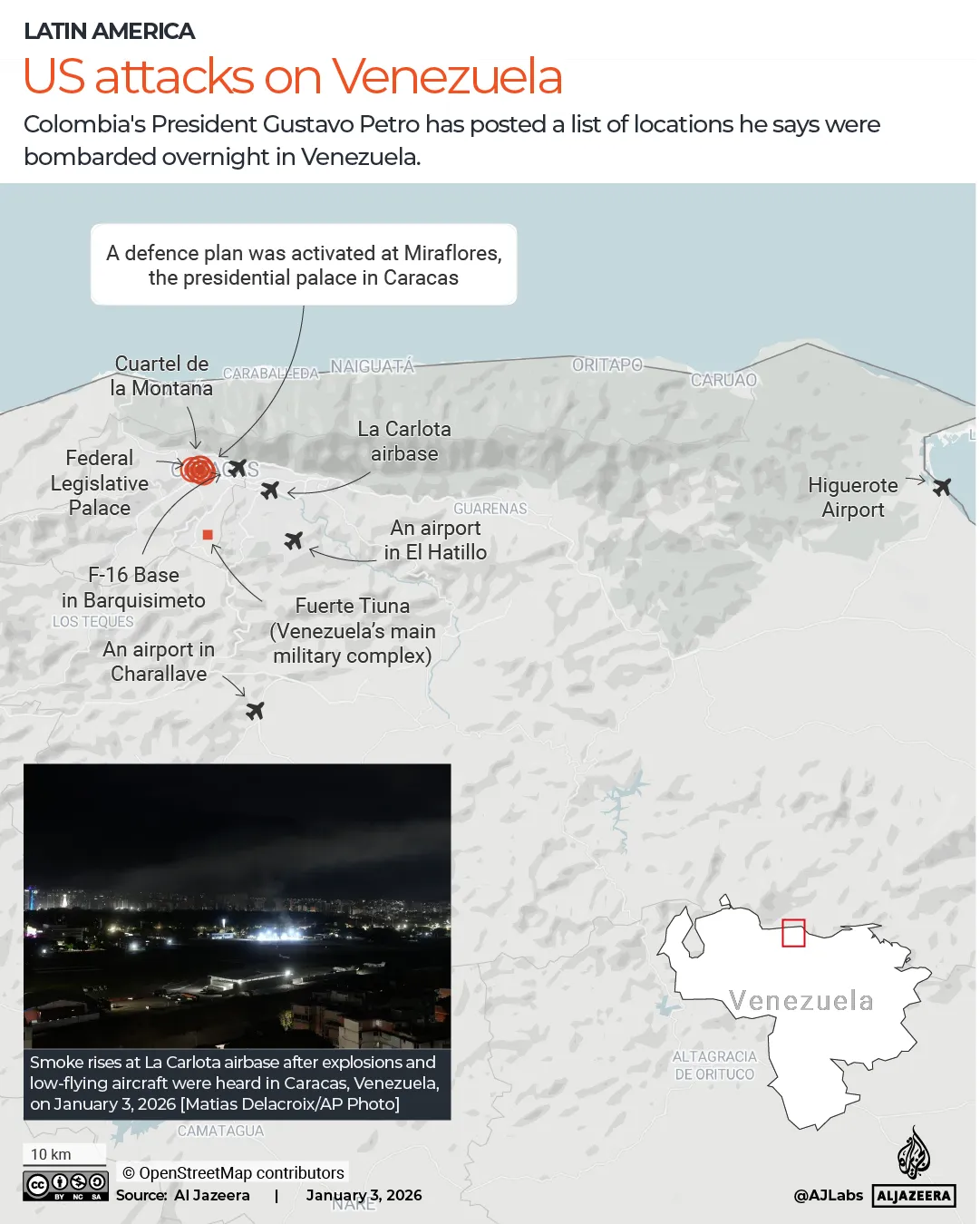
Strikes on other targets in Venezuela during the operation that were clearly intended to prevent or disrupt the country’s security forces from responding effectively could also have involved the use of long-range kamikaze drones. Light armored vehicles and other assets on the ground at the sprawling Fuerte Tiuna base in Caracas were destroyed in the course of the mission. This is reportedly where Maduro and his wife were captured. Key communications nodes in the country were also unsurprisingly targeted.

Damaged Venezuelan Dragoon 300 APC at Fort Tiuna following US airstrikes, January 3, 2026.

Note that the vehicle has been modified into similar configuration to Cadillac Gage V-100 Commandos.

2026 United States strikes in Venezuela pic.twitter.com/ThfPnqdC5m

— Buschlaid (@BuschModelar) January 3, 2026

The 312th “Ayala” Armored Cavalry Battalion of the Venezuelan Army appears to have had all of its equipment and most of its armored vehicles entirely destroyed in last night’s strike operation by the United States, which heavily targeting the Fuerte Tiuna Military Complex in the… pic.twitter.com/VXmVHRK4ha

— OSINTdefender (@sentdefender) January 3, 2026

Parte de los sistemas de telecomunicaciones destruídos en la zona del Cerro El Volcan a las afueras de Caracas, en la vía Oripoto de Los Guayabitos, Sector El Volcán, Baruta –Edo. Miranda 🇻🇪
Coordenadas 10.416374,-66.849306 pic.twitter.com/Iyo8UObH42

— 𝘼𝙧𝙧𝙚𝙘𝙝𝙤 (@Arr3ch0) January 3, 2026

There is the additional possibility that what is seen and heard in the videos are smaller loitering munitions, which U.S. forces could have utilized more dynamically in response to threats as they approached their objectives. The U.S. military now commonly uses the term “launched effect” to refer to these munitions, as well as other uncrewed aerial systems configured for other tasks, all of which are designed to be fired from aircraft, as well as ground and maritime platforms.

The U.S. Army’s elite 160th Special Operations Aviation Regiment (SOAR), better known as the Night Stalkers, elements of which were at the very core of the operation to capture Maduro, have at least been experimenting with employing launched effects from their MH-60 Black Hawk helicopters for years now, though this is not an operational capability, at least that we know of at present. This is a capability also planned for the Army’s conventional Black Hawk fleet, but it would not be surprising for the Night Stalkers to receive it first. With launched effects, MH-60s, or other platforms the 160th operates, would have a new way to react to air defenses, either striking them if they pop up along the way or jamming them. They could also strike small mobile targets if need be.

The video below, which the Army released in 2021, includes footage at around the 0:34 mark in the runtime of one of 160th SOAR’s MH-60 Black Hawk helicopters carrying a tube for a ‘launched effect’ under its right stub wing.

The U.S. Army Futures Command’s Future Vertical Lift Cross-Functional Team (FVL-CFT)


At the Association of the U.S. Army’s (AUSA) main annual conference last October, the current head of the 160th SOAR, Col. Stephen Smith, also talked explicitly about the current and future use of uncrewed systems, including launched effects, to lead the way for crewed helicopters, especially in higher-threat environments.

Other elements of SOCOM have been touting the expected importance of air and surface-launched effects in future operations in recent years. These are capabilities that conventional forces across the U.S. military have been working to field, as well.

A graphic giving a broad “operational view” (OV) of a concept Air Force Special Operations Command (AFSOC) calls the Adaptive Airborne Enterprise (A2E), which has envisioned multiple types of drones and other capabilities able to operate across permissive, contested, and denied environments. Air and surface ‘launched effects’ are shown here. USAF

All this being said, the sounds and subsequent impacts heard and seen in the videos from Venezuela do seem to point more to the use of kamikaze drones that are larger than the ones that typically fall into the category of launched effects, especially air-launched types.

Regardless, the video clips do offer clear evidence of a possible first-of-its-kind use of U.S. kamikaze drones during Operation Absolute Resolve, and more details about their employment may emerge as more becomes known about the mission overall.

Contact the author: joe@twz.com

Joseph has been a member of The War Zone team since early 2017. Prior to that, he was an Associate Editor at War Is Boring, and his byline has appeared in other publications, including Small Arms Review, Small Arms Defense Journal, Reuters, We Are the Mighty, and Task & Purpose.


Source link

Venezuela: Machado hails Trump operation as ‘huge step for humanity’

Jan. 6 (UPI) — Venezuelan opposition leader Maria Corina Machado praised U.S. President Donald Trump for ousting former President Nicolas Maduro, calling it a giant achievement for humanity, for which Trump should rightly receive the Nobel Peace Prize.

“Jan. 3 will go down in history as the day justice defeated tyranny. It’s a milestone, and it’s not only huge for the Venezuelan people and our future, I think it’s a huge step for humanity, for freedom, and human dignity,” Machado told Fox News on Monday night.

She said Trump’s action to begin dismantling Maduro’s “narco-terrorist regime,” bringing him to justice, and with it, bringing democracy within reach for 30 million Venezuelans, proved beyond doubt that he deserved the Nobel Peace Prize, said Machado, herself the recipient of this year’s peace prize.

However, she issued a warning to the Trump administration that the woman who was sworn in as Maduro’s replacement, interim president Delcy Rodriguez, was not to be trusted, accusing her of being “one of the main architects of torture, persecution, corruption, narco-trafficking,” in Venezuela.

“She’s a main ally and liaison of Russia, China, Iran, certainly not an individual who could be trusted by international investors and she’s really rejected by the Venezuelan people.”

Trump said Monday night that Rodriguez was cooperating with his administration but insisted there had been no deal with any individuals or group inside Venezuelan to take down Maduro.

He said there was no communication with Rodríguez prior to Friday night’s military operation to capture Maduro, adding that a decision was imminent on whether earlier sanctions imposed on her would remain in place.

He also strongly denied that his preference for Rodriguez had anything to do with the fact he beleived the peace prize should have gone to him, rather than Machado.

The Wall Street Journal repored Monday that Trump determined Rodriguez and other members of Maduro’s inner circle were best placed to head a transition administration and keep stability in Venezuela in the event Maduro lost power, based on a CIA intelligence assessment of various scenarios.

The classified report was, in part, responsible for Trump’s decision to support Maduro’s vice president over Machado.

Publicly, he has said she lacked sufficient “support” and “respect” in her home country, despite the fact that Machado won the presidential primary in December 2023, but was barred from running by Maduro.

Machado was replaced on the ballot by Edmundo Gonzales, who is widely regarded to have won the presidency by most Western countries.

Machado, who is in Norway after being smuggled out of Venezuela in December to travel to Oslo to collect her award, vowed to return to Venezuela as soon as possible and that her opposition movement, which had the 2024 election stolen from it by Maduro, wanted the transition to democracy to move forward.

“We won an election by a landslide under fraudulent conditions. In free and fair elections, we will win over 90% of the votes, I have no doubt about it,” said Machado.

However, Trump quashed speculation that elections could be held as soon as next month, saying Venezuela had to be fixed first.

“You can’t have an election. There’s no way the people could even vote. No, it’s going to take a period of time. We have — we have to nurse the country back to health,” said Trump.

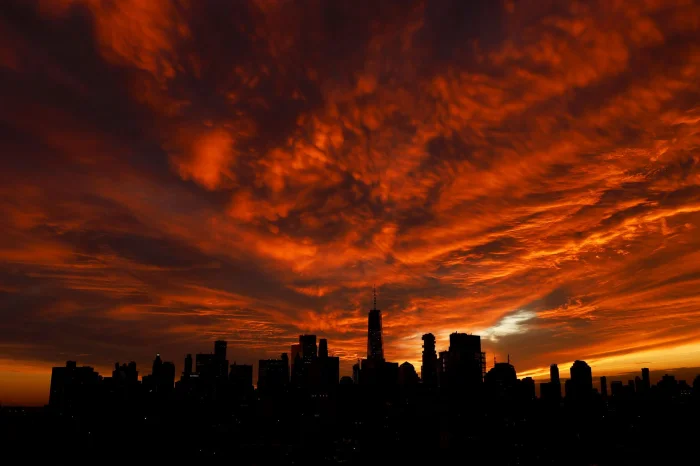
Clouds turn shades of red and orange when the sun sets behind One World Trade Center and the Manhattan skyline in New York City on November 5, 2025. Photo by John Angelillo/UPI | License Photo

Source link

Who Gets to Explain Venezuela?

For the past four years, I’ve taught a course called Environment and Sustainable Development at a university in Chile. Because the class is taught in English, it tends to attract exchange students, mostly from Europe, North America, and occasionally other parts of Latin America. 

The syllabus covers poverty, economic growth, environmental protection, the Sustainable Development Goals, public policy. In general, big themes where the discussions are often intense, idealistic, and deeply moral. They are also revealing, not only of what students believe, but of what kinds of explanations are considered legitimate, and which ones are quietly ruled out.

Certain patterns repeat themselves every year.

When we discuss the root causes of poverty, European students almost invariably point to colonization. Chilean students, understandably, emphasize dictatorship. When we talk about development and environmental protection, activism is framed as the primary solution, corporations as the main villains. When I ask what makes them angry about sustainability, the answers tend to cluster around the same targets: multinational companies, billionaires, “the rich,” or the latest celebrity caught flying a private jet.

What rarely makes the list are authoritarianism, institutional collapse, censorship, human trafficking, organized crime, or forced migration. Human rights violations in countries like China or Russia are mentioned cautiously, if at all. The destruction of economic institutions is treated as a technical detail rather than a political choice. And when Venezuela comes up, it exists less as a lived reality and more as an ideological case study.

I’ve had the privilege of teaching remarkably bright students. Many have gone on to pursue master’s degrees at some of the most prestigious universities in the world. Yet explaining Venezuela to them remains one of the most challenging parts of my job.

The problem is not lack of interest. It’s the dominance of explanations that leave no room for Venezuelans to speak for themselves.

Not because the country is incomprehensible, but because the narrative space around it is so crowded.

I first encountered this problem more than a decade ago. In 2012, I attended a summer school at the London School of Economics on conflict and democracy. One session focused on Venezuela. The discussion portrayed the Hugo Chávez government as a democratic success story: a country that voted frequently, reduced poverty, and empowered the poor. There was no mention of inflation, no discussion of institutional erosion, no reference to restrictions on the press or early signs of authoritarianism.

I remember arguing, armed with data, reports, and personal experience, while several European classmates passionately defended the “Bolivarian Revolution” as one of the best things that had happened in Latin America. Venezuela, to them, was not a country but an idea. A symbol. A rebuttal to US foreign policy.

More than ten years later, that framework has proven remarkably resilient.

In my classroom today, Venezuela still raises an extraordinary number of questions. Once I open the subject, it’s like Pandora’s box, there’s no closing it back. When I share data on media censorship, students ask how people inform themselves. When we discuss the food crisis, they genuinely worry about how families ate during the worst years, particularly around 2017. They ask how daily life functions in a country with hyperinflation, collapsing public services, and mass migration.

These questions are genuine. They come from empathy, not ideology. And they point to something important: there is a real appetite to understand Venezuela better. The problem is not lack of interest. It’s the dominance of explanations that leave no room for Venezuelans to speak for themselves.

There comes a point when constantly defending one’s lived reality against people who have never visited the country, never read Venezuelan sources, and never spoken to those who endured the collapse becomes exhausting.

Venezuela is often discussed through frameworks imported from elsewhere, dependency theory, anti-imperialism, critiques of neoliberalism, while the data produced by Venezuelans is dismissed as biased, exaggerated, or politically motivated. Inflation figures that reached 1,00,000% are questioned. Hunger surveys that show 90% of poverty in the country are treated with suspicion. Migration numbers are downplayed. Reports on institutional collapse are framed as opposition propaganda. 

But Venezuela is not a country lacking data. It is a country whose data has been systematically silenced with the regime’s propaganda even echoed in the most prestigious universities around the world. 

For years, independent universities, NGOs, and research centers stepped in to document what the state refused to measure: poverty levels, food insecurity, public health outcomes, migration flows. Much of what we know today about Venezuela comes not from international institutions, but from Venezuelans collecting, analyzing, and publishing data under conditions of censorship and intimidation.

This is the data that rarely makes it into global debates.

Instead, Venezuela is often reduced to a morality play: a noble project sabotaged from abroad, or a cautionary tale stripped of agency. In both cases, Venezuelans themselves disappear. We are either victims of external forces or footnotes in someone else’s ideological argument.

There comes a point when constantly defending one’s lived reality against people who have never visited the country, never read Venezuelan sources, and never spoken to those who endured the collapse becomes exhausting. Ignorance, after all, is not always innocent—it can be a choice.

But there is also a responsibility. For those of us who have migrated, who now teach, research, or work abroad, there is a duty to keep explaining Venezuela, not as an abstraction, but as a country shaped by deliberate political decisions. The elimination of central bank independence was not an accident. Expropriations were not symbolic gestures. The pursuit of total state control over the economy was not an unfortunate side effect of good intentions. These choices produced hunger, poverty, and mass migration.

Explaining this does not require abandoning concern for the international rules-based system. It requires intellectual honesty.

But many others are willing to listen. They ask questions. They want to understand how a country with immense natural wealth ended up with one of the largest displacement crises in the world.

Recent events have shown what happens when Venezuelans reclaim the tools of documentation and accountability. When María Corina Machado and others insisted on preserving electoral records, the act itself became political, not because it was partisan, but because it challenged the monopoly over truth. Data, in authoritarian contexts, is never neutral.

Not everyone will be willing to reconsider their views. Some people remain deeply attached to narratives shaped primarily by hostility toward the United States, projecting that conflict onto Venezuela regardless of evidence. For them, the country serves a symbolic function, and symbols are rarely surrendered easily.

But many others are willing to listen. They ask questions. They want to understand how a country with immense natural wealth ended up with one of the largest displacement crises in the world. They are capable of seeing Venezuelans not as ideological placeholders, but as millions of people who have resisted, adapted, protested, voted, migrated, and survived in pursuit of something very simple: the ability to live freely in their own country.

Venezuela matters not only because it is our history, but because its future challenges a narrative that has gone largely unquestioned for too long, the idea that anything framed as anti-US is automatically virtuous, and anything aligned with self determination and power to the people is in our best interest. This binary leaves no space for critical thinking, and even less for evidence.

In defending old ideological frameworks from the comfort of distant classrooms and safe democracies, some fail to reckon what they are actually defending: mass human rights violations, institutional destruction, and prolonged human suffering. Whether through ignorance or willful blindness, the cost of that defense is paid by Venezuelans.In his book Animal Farm, George Orwell’s final chapters tells the story of how the new animals in charge end up proclaiming “all animals are equal, but some are more equal than others”.  In the global conversation about Venezuela, some voices are still treated as more legitimate than those who lived through the collapse. Reclaiming Venezuelan data, and Venezuelan narratives, is not about winning an argument. It is about restoring the basic right to explain our own reality.

Source link

US critics and allies condemn Maduro’s abduction at UN Security Council | Nicolas Maduro News

Denmark and Mexico, also threatened by US President Donald Trump, warn that the US violated international law.

Members of the United Nations Security Council (UNSC), including key US allies, have warned that the abduction of Venezuelan President Nicolas Maduro and his wife by US special forces could be a precedent-setting event for international law.

The 15-member bloc met for an emergency meeting on Monday in New York City, where the Venezuelan pair were also due to face drug trafficking charges in a US federal court.

Recommended Stories

list of 4 itemsend of list

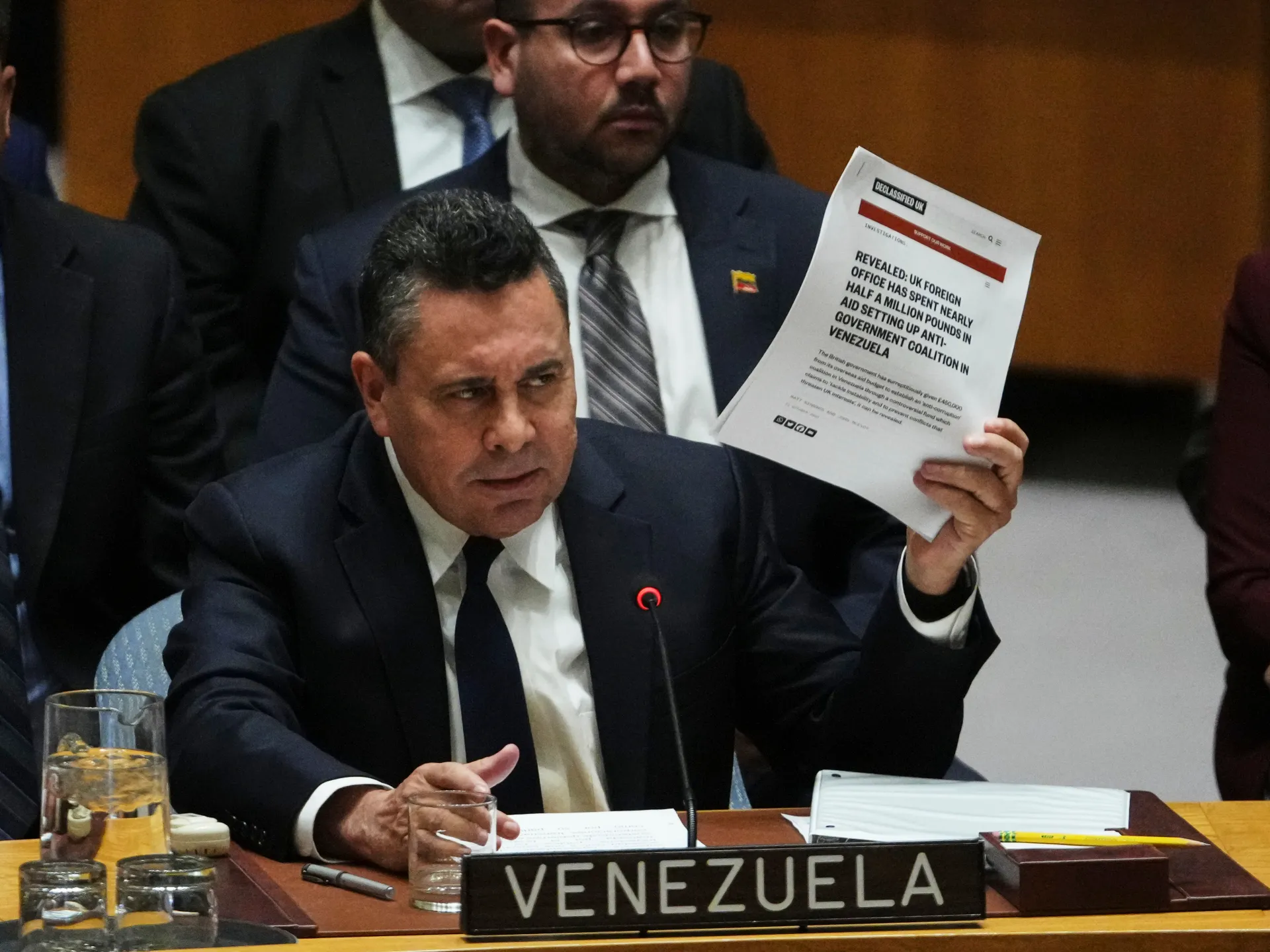
Venezuela’s ambassador to the UN, Samuel Moncada, condemned the US operation as “an illegitimate armed attack lacking any legal justification”, in remarks echoed by Cuba, Colombia and permanent UNSC members Russia and China.

“[The US] imposes the application of its laws outside its own territory and far from its coasts, where it has no jurisdiction, using assaults and the appropriation of assets,” Cuba’s ambassador, Ernesto Soberon Guzman, said, adding that such measures negatively affected Cuba.

Russia’s ambassador, Vassily Nebenzia, said the US cannot “proclaim itself as some kind of a supreme judge, which alone bears the right to invade any country, to label culprits, to hand down and to enforce punishments irrespective of notions of international law, sovereignty and non-intervention”.

Notable critics at the emergency session included traditional US allies, Mexico and Denmark, both of whom Trump has separately threatened with military action over the past year.

Mexico’s ambassador, Hector Vasconcelos, said that the council had an “obligation to act decisively and without double standards” towards the US, and it was for “sovereign peoples to decide their destinies,” according to a UN readout.

His remarks come just days after Trump told reporters that “something will have to be done about Mexico” and its drug cartels, following Maduro’s abduction.

Denmark, a longstanding US security ally, said that “no state should seek to influence political outcomes in Venezuela through the use of threat of force or through other means inconsistent with international law.”

“The inviolability of borders is not up for negotiation,” Denmark’s ambassador, Christina Markus Lassen, told the council in an oblique reference to Trump’s threat that the US would annex Greenland, a self-governed Danish territory.

France, another permanent member of the UNSC, also criticised the US, marking a shift in tone from French President Emmanuel Macron’s initial remarks that Venezuelans “can only rejoice” following Maduro’s abduction.

“The military operation that has led to the capture of Maduro runs counter to the principle of peaceful dispute resolution and runs counter to the principle of non-use of force,” said the French deputy ambassador, Jay Dharmadhikari.

Representatives from Latvia and the United Kingdom, another permanent UNSC member, focused on the conditions in Venezuela created by Maduro’s government.

Latvia’s ambassador, Sanita Pavļuta-Deslandes, said that Maduro’s conditions in Venezuela posed “a grave threat to the security of the region and the world”, citing mass repression, corruption, organised crime and drug trafficking.

The UK ambassador, James Kariuki, said that “Maduro’s claim to power was fraudulent”.

The US ambassador, Mike Waltz, characterised the abduction of Maduro and his wife as a “surgical law enforcement operation facilitated by the US military against two indicted fugitives of American justice”.

The White House defended its wave of air strikes on Venezuela, and in the waters near it, and Maduro’s abduction as necessary to protect US national security, amid unproven claims that Maduro backed “narcoterrorist” drug cartels.

Source link

Americans evenly split on Maduro’s abduction, poll shows | Donald Trump News

One in three Americans opposes the Venezuelan leader’s abduction by US forces, a poll shows, while others are unsure.

Americans are evenly split in their support for the US military operation to abduct Venezuelan President Nicolas Maduro, an opinion poll has found.

Thirty-three percent of Americans support Maduro’s abduction, compared with 34 percent who are against it and 32 percent who are not sure, the Reuters/Ipsos poll showed on Monday.

Recommended Stories

list of 4 itemsend of list

Supporters of President Donald Trump’s Republican Party are much more likely to support the military operation, with 65 percent in favour, compared with 11 percent of Democrats and 23 percent of independents.

On the question of who should govern Venezuela, Americans lean against Washington taking control of the country, according to the poll.

Forty-three percent oppose Washington governing Venezuela until a new government is established in Caracas, compared with 34 percent in favour and 20 percent who are unsure.

Americans lean against the US stationing troops in Venezuela – 47 percent to 30 percent – according to the poll.

More Americans than not also oppose the Trump administration taking control of Venezuela’s oil fields, with 46 percent against the idea and 30 percent in favour.

On the question of whether the US could become “too involved” in the Latin American country, 72 percent are very or somewhat concerned.

Trump said on Saturday that the US would “run” Venezuela, though officials in his administration have sought to downplay the prospect of Washington occupying the country.

On Sunday, Trump threatened further military action against Venezuela if it “doesn’t behave”.

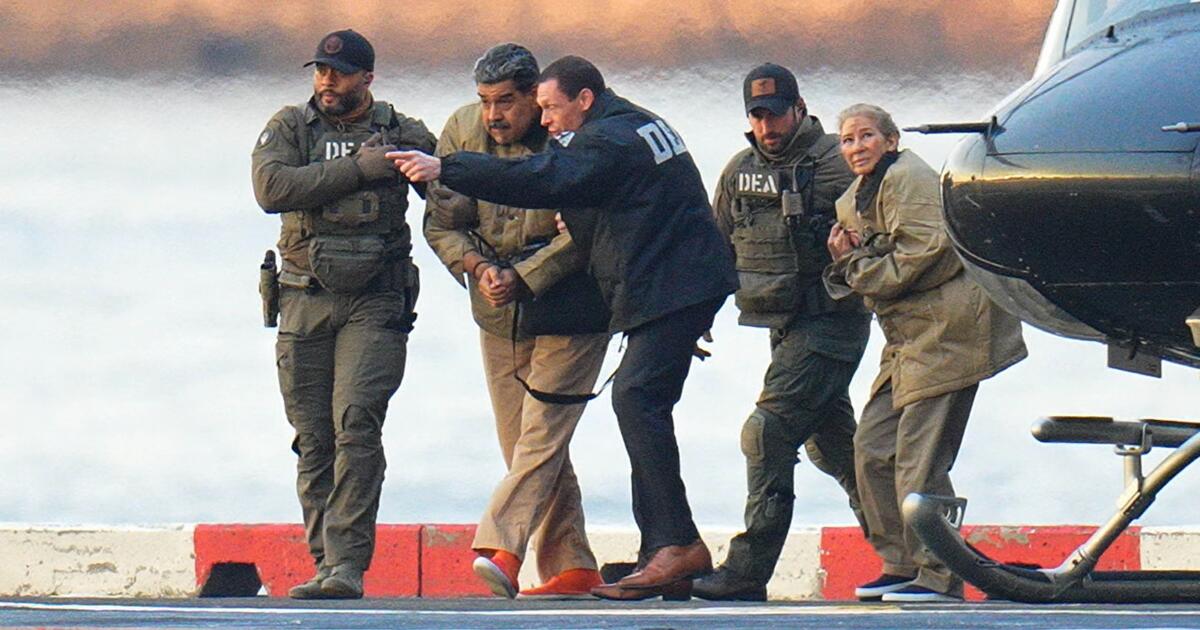
Maduro, who was abducted in a raid by US special forces over the weekend, on Monday made his first court appearance to face charges related to “narcoterrorism”, drug trafficking and weapons possession.

Maduro pleaded not guilty to all charges, declaring himself the victim of a kidnapping and a “decent man”.

“I am still president of my country,” Maduro told a US federal court in New York through an interpreter.

Maduro, his wife, Cilia Flores, son Nicolás Ernesto Maduro Guerra, and three others face the possibility of life in prison if convicted.

On Monday, Maduro’s deputy, Vice President Delcy Rodríguez, was sworn in as Venezuela’s interim president.

“I come with pain over the kidnapping of two heroes who are being held hostage: President Nicolás Maduro and First Lady Cilia Flores,” Rodriguez said during a swearing-in ceremony at Venezuela’s National Assembly.

Source link

Delcy Rodriguez sworn in as Venezuela’s president after Maduro abduction | US-Venezuela Tensions News

Delcy Rodriguez, formerly Venezuela’s vice president, has been formally sworn in to lead the South American country following the abduction of Nicolas Maduro in a United States military operation.

On Monday, Rodriguez appeared before Venezuela’s National Assembly to take her oath of office.

Recommended Stories

list of 3 itemsend of list

Speaking before the legislative body, composed largely of government loyalists, Rodriguez reaffirmed her opposition to the military attack that led to the capture and removal of Maduro and his wife, Cilia Flores.

“I come with pain over the kidnapping of two heroes who are being held hostage: President Nicolás Maduro and First Lady Cilia Flores,” Rodriguez, 56, told the assembly.

“I swear to work tirelessly to guarantee the peace, spiritual, economic and social tranquillity of our people.”

A former labour lawyer, Rodriguez has been serving as acting president since the early-morning attack that resulted in the abduction. Explosions were reported before dawn on Saturday in the capital, Caracas, as well as at nearby Venezuelan military bases and some civilian areas.

Monday’s swearing-in ceremony was overseen by Rodriguez’s brother – the president of the National Assembly, Jorge Rodriguez – and Maduro’s son, Nicolás Maduro Guerra, who held a copy of the Venezuelan Constitution.

Other members of Maduro’s inner circle, including Interior Minister Diosdado Cabello and Defence Minister Vladimir Padrino, were also in attendance.

The ceremony took place as Maduro, her predecessor and former boss, faced an arraignment proceeding in a New York City courthouse.

Federal prosecutors in the US have charged Maduro with four counts related to allegations he leveraged government powers to export thousands of tonnes of cocaine to North America.

The charges include narco-terrorism conspiracy, cocaine importation conspiracy, the illegal possession of machine guns and other destructive devices, and conspiracy to possess such guns and devices.

Maduro and his wife have pleaded not guilty to the charges, and their allies, including Rodriguez, have denounced the pair’s abduction as a violation of international law, as well as Venezuelan sovereignty.

In court on Monday, Maduro maintained he remained the rightful leader of Venezuela, saying, “I am still president.”

The administration of US President Donald Trump, however, has signalled that it plans to work with Rodriguez for the time being, though Trump himself warned that her tenure as president could be cut short, should she fail to abide by US demands.

“If she doesn’t do what’s right, she is going to pay a very big price, probably bigger than Maduro,” Trump told The Atlantic magazine in a Sunday morning interview.

A day earlier, in a televised address announcing the attack, Trump had said his administration plans “to run the country until such time as we can do a safe, proper, and judicious transition”.

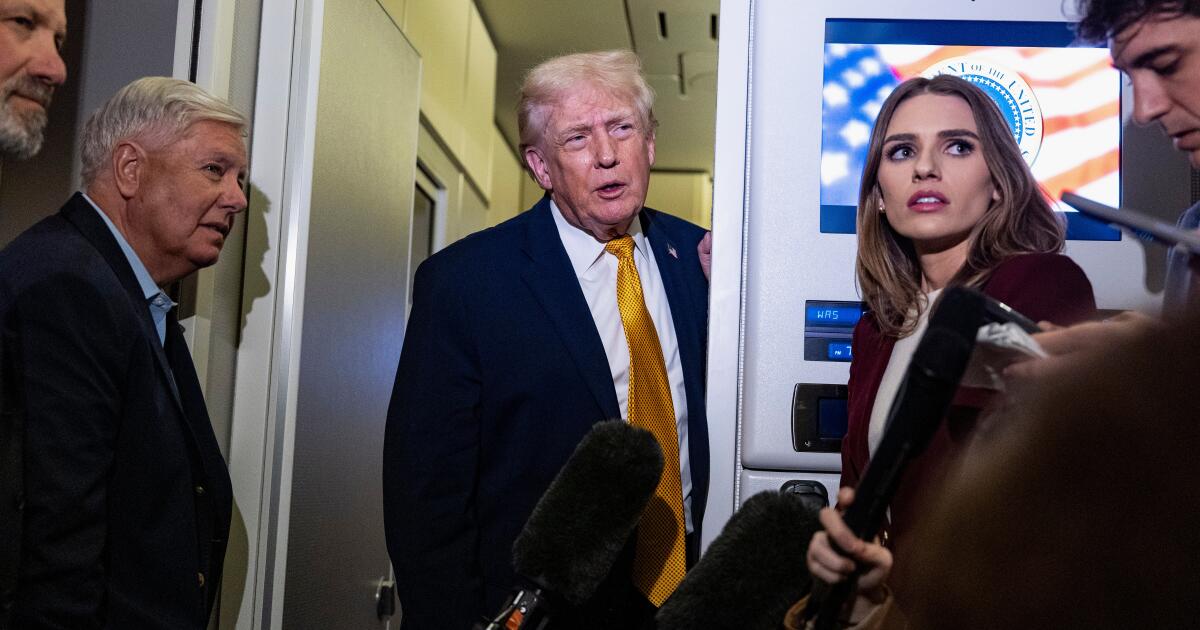
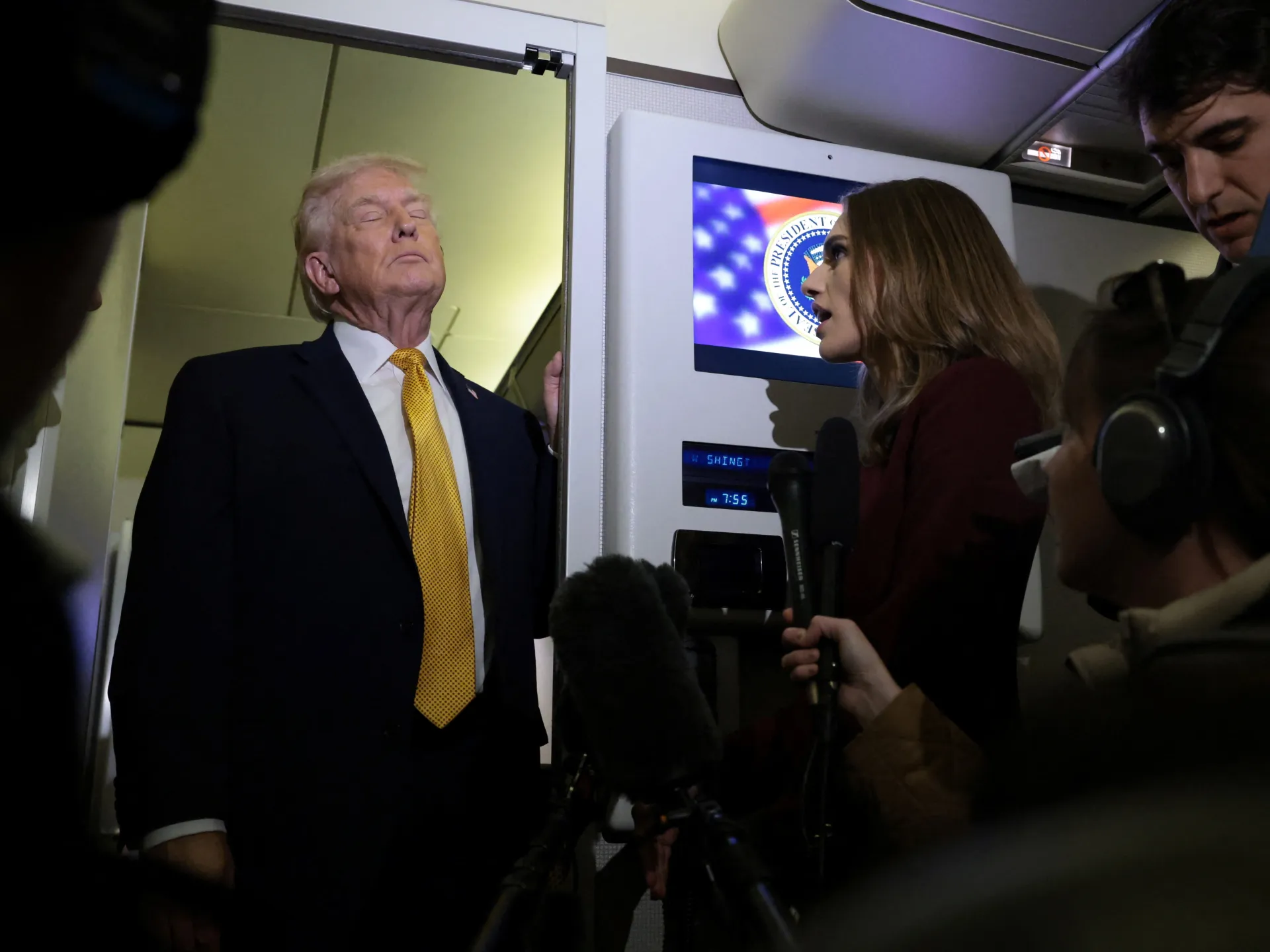
On Air Force One on Sunday, as he flew back to Washington, DC, Trump doubled down on that statement.

“Don’t ask me who’s in charge, because I’ll give you an answer that will be very controversial. We’re in charge,” he told reporters.

He added that Rodriguez is “cooperating” and that, while he personally has not spoken to her, “we’re dealing with the people who just got sworn in”.

The Trump administration’s seeming willingness to allow Rodriguez, a former labour lawyer, to remain in charge has raised eyebrows.

Rodriguez, who served as vice president since 2018, is known to be a stalwart “chavista”: an adherent of the left-wing political movement founded by Maduro’s mentor, the late Hugo Chavez. She has held various ministerial roles under Maduro, including leading the Ministry of Foreign Affairs.

But Trump’s allies in the Republican Party have argued that keeping Rodriguez in place is simply a practical reality.

“We don’t recognise Delcy Rodriguez as the legitimate ruler of Venezuela. We didn’t recognise Nicolas Maduro as a legitimate ruler,” Republican Senator Tom Cotton told CNN on Sunday.

“It is a fact that she and other indicted and sanctioned officials are in Venezuela. They have control over the military and security services. We have to deal with that fact. That does not make them a legitimate leader.”

While on Air Force One, Trump largely avoided committing to new elections in Venezuela, indicating he would instead focus on “fixing” the country and allowing US oil companies access to its vast petroleum reserves.

One reporter on the aeroplane asked, “How soon can an election take place?”

“Well, I think we’re looking more at getting it fixed, getting it ready first, because it’s a mess. The country is a mess,” Trump replied. “It’s been horribly run. The oil is just flowing at a very low level.”

He later added, “We’re going to run everything. We’re going to run it, fix it. We’ll have elections at the right time. But the main thing you have to fix: It’s a broken country. There’s no money.”

Recent presidential elections in Venezuela have been widely denounced as fraudulent, with Maduro claiming victory in each one.

The contested 2018 election, for example, led to the US briefly recognising opposition leader Juan Guaido as president, instead of Maduro.

Later, Maduro also claimed victory for a third term in office during the 2024 presidential race, despite election regularities.

The official vote tally was not released, and the opposition published documents that appeared to show that Maduro’s rival, Edmundo Gonzalez, had won. Protests erupted on Venezuela’s streets, and the nonprofit Human Rights Watch reported that more than 2,000 protesters were unlawfully detained, with at least 25 dead in apparent extrajudicial killings.

The opposition has largely boycotted legislative elections in Venezuela, denouncing them as rigged in favour of “chavistas”.

Monday’s swearing-in ceremony included the 283 members of the National Assembly elected last May. Few opposition candidates were among them.

Source link

Trump administration sets meetings with oil companies on Venezuela: Report | Nicolas Maduro News

The administration of United States President Donald Trump is planning to meet with executives from US oil companies later this week to discuss boosting Venezuelan oil production after US forces abducted its leader, Nicolas Maduro, the Reuters news agency has reported, citing unnamed sources.

The meetings are crucial to the administration’s hopes of getting top US oil companies back into the South American nation after its government, nearly two decades ago, took control of US-led energy operations there, the Reuters news agency report said on Monday.

Recommended Stories

list of 4 itemsend of list

The three biggest US oil companies – Exxon Mobil, ConocoPhillips and Chevron – have not yet had any conversations with the Trump administration about Maduro’s ouster, according to four oil industry executives familiar with the matter, contradicting Trump’s statements over the weekend that he had already held meetings with “all” the US oil companies, both before and since Maduro was abducted.

“Nobody in those three companies has had conversations with the White House about operating in Venezuela, pre-removal or post-removal, to this point,” one of the sources said on Monday.

The upcoming meetings will be crucial to the administration’s hopes to boost crude oil production and exports from Venezuela, a former OPEC nation that sits atop the world’s largest reserves, and whose crude oil can be refined by specially designed US refineries. Achieving that goal will require years of work and billions of dollars of investment, analysts say.

It is unclear what executives will be attending the upcoming meetings, and whether oil companies will be attending individually or collectively.

The White House did not comment on the meetings, but said it believed the US oil industry was ready to flood into Venezuela.

“All of our oil companies are ready and willing to make big investments in Venezuela that will rebuild their oil infrastructure, which was destroyed by the illegitimate Maduro regime,” said White House spokesperson Taylor Rogers.

Exxon, Chevron and ConocoPhillips did not immediately respond to requests for comment from Reuters.

One oil industry executive told Reuters the companies would be reluctant to talk about potential Venezuela operations in group settings with the White House, citing antitrust concerns that limit collective discussions among competitors about investment plans, timing and production levels.

Political risks, low oil prices

US forces on Saturday conducted a raid on Venezuela’s capital, arresting Maduro in the dead of night and sending him back to the US to face narcoterrorism charges.

Hours after Maduro’s abduction, Trump said he expects the biggest US oil companies to spend billions of dollars boosting Venezuela’s oil production, after it dropped to about a third of its peak over the past two decades due to underinvestment and sanctions.

But those plans will be hindered by a lack of infrastructure, along with deep uncertainty over the country’s political future, legal framework and long-term US policy, according to industry analysts.

“While the Trump administration has suggested large US oil companies will go into Venezuela and spend billions to fix infrastructure, we believe political and other risks, along with current relatively low oil prices, could prevent this from happening anytime soon,” wrote Neal Dingmann of William Blair in a note.

Material change to Venezuelan production will take a lot of time and millions of dollars of infrastructure improvement, he said.

And any investment in Venezuelan infrastructure right now would take place in a weakened global energy market. Crude prices in the US are down by 20 percent compared with last year. The price for a barrel of benchmark US crude has not been above $70 since June, and has not touched $80 per barrel since June of 2024.

A barrel of oil cost more than $130 in the leadup to the US housing crisis in 2008.

Chevron is the only US major currently operating in Venezuela’s oil fields.

Exxon and ConocoPhillips, meanwhile, had storied histories in the country before their projects were nationalised nearly two decades ago by former Venezuelan President Hugo Chavez.

Conoco has been seeking billions of dollars in restitution for the takeover of three oil projects in Venezuela under Chavez. Exxon was involved in lengthy arbitration cases against Venezuela after it exited the country in 2007.

Chevron, which exports about 150,000 barrels per day of crude from Venezuela to the US Gulf Coast, meanwhile, has had to carefully manoeuvre with the Trump administration in an effort to maintain its presence in the country in recent years.

A US embargo on Venezuelan oil remained in full effect, Trump has said.

The S&P 500 energy index rose to its highest since March 2025, with heavyweights Exxon Mobil rising by 2.2 percent and Chevron jumping by 5.1 percent.

Source link

Ties between California and Venezuela go back more than a century with Chevron

As a stunned world processes the U.S. government’s sudden intervention in Venezuela — debating its legality, guessing who the ultimate winners and losers will be — a company founded in California with deep ties to the Golden State could be among the prime beneficiaries.

Venezuela has the largest proven oil reserves on the planet. Chevron, the international petroleum conglomerate with a massive refinery in El Segundo and headquartered, until recently, in San Ramon, is the only foreign oil company that has continued operating there through decades of revolution.

Other major oil companies, including ConocoPhillips and Exxon Mobil, pulled out of Venezuela in 2007 when then-President Hugo Chávez required them to surrender majority ownership of their operations to the country’s state-controlled oil company, PDVSA.

But Chevron remained, playing the “long game,” according to industry analysts, hoping to someday resume reaping big profits from the investments the company started making there almost a century ago.

Looks like that bet might finally pay off.

In his news conference Saturday, after U.S. Special Forces snatched Venezuelan President Nicolás Maduro and his wife in Caracas and extradited them to face drug-trafficking charges in New York, President Trump said the U.S. would “run” Venezuela and open more of its massive oil reserves to American corporations.

“We’re going to have our very large U.S. oil companies, the biggest anywhere in the world, go in, spend billions of dollars, fix the badly broken infrastructure, the oil infrastructure, and start making money for the country,” Trump said during a news conference Saturday.

While oil industry analysts temper expectations by warning it could take years to start extracting significant profits given Venezuela’s long-neglected, dilapidated infrastructure, and everyday Venezuelans worry about the proceeds flowing out of the country and into the pockets of U.S. investors, there’s one group who could be forgiven for jumping with unreserved joy: Chevron insiders who championed the decision to remain in Venezuela all these years.

But the company’s official response to the stunning turn of events has been poker-faced.

“Chevron remains focused on the safety and well-being of our employees, as well as the integrity of our assets,” spokesman Bill Turenne emailed The Times on Sunday, the same statement the company sent to news outlets all weekend. “We continue to operate in full compliance with all relevant laws and regulations.”

Turenne did not respond to questions about the possible financial rewards for the company stemming from this weekend’s U.S. military action.

Chevron, which is a direct descendant of a small oil company founded in Southern California in the 1870s, has grown into a $300-billion global corporation. It was headquartered in San Ramon, just outside of San Francisco, until executives announced in August 2024 that they were fleeing high-cost California for Houston.

Texas’ relatively low taxes and light regulation have been a beacon for many California companies, and most of Chevron’s competitors are based there.

Chevron began exploring in Venezuela in the early 1920s, according to the company’s website, and ramped up operations after discovering the massive Boscan oil field in the 1940s. Over the decades, it grew into Venezuela’s largest foreign investor.

The company held on over the decades as Venezuela’s government moved steadily to the left; it began to nationalize the oil industry by creating a state-owned petroleum company in 1976, and then demanded majority ownership of foreign oil assets in 2007 under Chávez.

Venezuela has the world’s largest proven crude oil reserves — meaning they’re economical to tap — about 303 billion barrels, according to the U.S. Energy Information Administration.

But even with those massive reserves, Venezuela has been producing less than 1% of the world’s crude oil supply. Production has steadily declined from the 3.5 million barrels per day pumped in 1999 to just over 1 million barrels per day now.

Currently, Chevron’s operations in Venezuela employ about 3,000 people and produce between 250,000 and 300,000 barrels of oil per day, according to published reports.

That’s less than 10% of the roughly 3 million barrels the company produces from holdings scattered across the globe, from the Gulf of Mexico to Kazakhstan and Australia.

But some analysts are optimistic that Venezuela could double or triple its current output relatively quickly — which could lead to a windfall for Chevron.

The Associated Press contributed to this report.

Source link

Trump’s threats of intervention jolt allies and foes alike

Venezuela risks “a second strike” if its interim government doesn’t acquiesce to U.S. demands. Cuba is “ready to fall,” and Colombia is “very sick, too.”

Iran may get “hit very hard” if its government cracks down on protesters. And Denmark risks U.S. intervention, as well, because “we need Greenland,” President Trump said.

In just 37 minutes while speaking with reporters Sunday aboard Air Force One, Trump threatened to attack five countries, both allies and adversaries, with the might of the U.S. military — an extraordinary turn for a president who built his political career rejecting traditional conservative views on the exercise of American power and vowing to put America first.

The president’s threats come as a third of the U.S. naval fleet remains stationed in the Caribbean, after Trump launched a daring attack on Venezuela that seized its president, Nicolás Maduro, and his wife over the weekend.

The goal, U.S. officials said, was to show the Venezuelan government and the wider world what the American military is capable of — and to compel partners and foes alike to adhere to Trump’s demands through intimidation, rather than commit the U.S. military to more complex, conventional, long-term engagements.

It is the deployment of overwhelming and spectacular force in surgical military operations — Maduro’s capture, last year’s strikes against Iranian nuclear facilities, assassinations of Islamic State leadership and Iran’s top general in Iraq — that demonstrate Trump as a brazen leader willing to risk war, thereby effectively avoiding it, one Trump administration official said, explaining the president’s strategic thinking.

Yet experts and former Trump aides warn the president’s approach risks miscalculation, alienating vital allies and emboldening U.S. competitors.

At a Security Council meeting Monday at the United Nations in New York — called by Colombia, a long-standing and major non-North Atlantic Treaty Oranization ally to the United States — Trump’s moves were widely condemned. “Violations of the U.N. Charter,” a French diplomat told the council, “chips away at the very foundation of international order.”

Even the envoy from Russia, which has cultivated historically strong ties with the Trump administration, said the White House operation was an act of “banditry,” marking “a return to the era of illegality and American dominance through force, chaos and lawlessness.”

Trump’s threats to annex Greenland, an autonomous territory of the Kingdom of Denmark with vast natural resources, drew particular concern across Europe on Monday, with leaders across the continent warning the United States against an attack that would violate the sovereignty of a NATO ally and European Union member state.

“That’s enough now,” Greenland’s prime minister, Jens-Frederik Nielsen, said after Trump told reporters that his attention would turn to the world’s largest island in a matter of weeks.

“If the United States decides to militarily attack another NATO country, then everything would stop,” Denmark’s prime minister, Mette Frederiksen, told local press. “That includes NATO, and therefore, post-World War II security.”

Trump also threatened to strike Iran, where anti-government protests have spread throughout the country in recent days. Trump had previously said the U.S. military was “locked and loaded” if Iranian security forces begin firing on protesters, “which is their custom.”

“The United States of America will come to their rescue,” Trump wrote on social media on Jan. 2, hours before launching the Venezuela mission. “We are locked and loaded and ready to go. Thank you for your attention to this matter!”

In Colombia, there was widespread outrage after Trump threatened military action against leftist President Gustavo Petro, whom Trump accused, without evidence, of running “cocaine mills and cocaine factories.”

Petro is a frequent critic of the American president and has slammed as illegal a series of lethal U.S. airstrikes against alleged drug boats in the Caribbean and the eastern Pacific.

“Stop slandering me,” Petro wrote on X, warning that any U.S. attempts against his presidency “will unleash the people’s fury.”

Petro, a former leftist guerrilla, said he would go to war to defend Colombia.

“I swore not to touch a weapon again,” he said. “But for the homeland, I will take up arms.”

Trump’s threats have strained relations with Colombia, a devoted U.S. ally. For decades, the countries have shared military intelligence, a robust trade relationship and a multibillion-dollar fight against drug trafficking.

Even some of Petro’s domestic critics have comes to his defense. Presidential candidate Juan Manuel Galán, who opposes Petro’s rule, said Colombia’s sovereignty “must be defended.”

“Colombia is not Venezuela,” Galán wrote on X. “It is not a failed state, and we will not allow it to be treated as such. Here we have institutions, democracy and sovereignty that must be defended.”

The president of Mexico, another longtime U.S. ally and its largest trading partner, has also spoken out forcefully against the American operation in Caracas, and said the Trump administration’s aggressive foreign policy in Latin America threatens the stability of the region.

“We categorically reject intervention in the internal affairs of other countries,” President Claudia Sheinbaum said in her daily news conference Monday. “The history of Latin America is clear and compelling: Intervention has never brought democracy, has never generated well-being or lasting stability.”

She addressed Trump’s comments over the weekend that drugs were “pouring” through Mexico, and that the United States was “going to have to do something.”

Trump has been threatening action against cartels for months, with some members of his administration suggesting that the United States may soon carry out drone strikes on drug laboratories and other targets inside Mexican territory. Sheinbaum has repeatedly said such strikes would be a clear violation of Mexican sovereignty.

“Sovereignty and the self-determination of peoples are non-negotiable,” she said. “They are fundamental principles of international law and must always be respected without exception.”

Cuba also rejected Trump’s threat of a military intervention there, after Trump’s secretary of State, Marco Rubio, himself the descendant of Cuban immigrants, suggested that Havana may be next in Washington’s crosshairs.

“We call on the international community to stop this dangerous, aggressive escalation and to preserve peace,” Cuban President Miguel Díaz-Canel posted on social media.

The U.S. attacks on Venezuela, and Trump’s threats of additional military ventures, have caused deep unease in a relatively peaceful region that has seen fewer interstate wars in recent decades than Europe, Asia or Africa.

It also caused unease among some Trump supporters, who remembered his pledge to get the United States out of “endless” military conflicts for good.

“I was the first president in modern times,” Trump said, accepting the Republican presidential nomination in 2024, “to start no new wars.”

Wilner reported from Washington and Linthicum from Mexico City.

Source link

Why the Maduro prosecution could drag on for years

Ousted Venezuelan leader Nicolás Maduro stood in a Manhattan courthouse Monday a captive criminal defendant: surrounded by heavy security, deprived of his power as a head of state and facing drug, weapon and conspiracy charges likely to keep him behind bars for years.

“I was captured,” he said in Spanish, before pleading not guilty during a brief arraignment. “I am a decent man, the president of my country.”

Just two days prior, more than 2,000 miles away in Caracas, Maduro was seated “atop a corrupt, illegitimate government that, for decades, has leveraged government power to protect and promote illegal activity, including drug trafficking,” according to a sweeping indictment unsealed Saturday.

What preceded Maduro’s swift downfall was not just his weekend capture in what President Trump called “one of the most stunning, effective and powerful displays of American military might” in U.S. history, but decades of partnership with “narco-terrorists” from Venezuela, Colombia and Mexico to enrich himself and his family through “massive-scale” cocaine trafficking, the indictment claims.

The allegations, built off a 2020 indictment, stretch back a quarter-century and implicate other Venezuelan leaders and Maduro’s wife and son. They suggest extensive coordination with notorious drug trafficking organizations and cartels from across the region, and paint a world Trump himself has long worked to instill in the minds of Americans — one in which the nation’s southern neighbors are intentionally flooding the U.S. with lethal drugs and violent criminals, to the devastation of local communities.

It is a portrait of drugs, money and violence every bit as dramatic as the nighttime raid that sent jets and helicopters into Venezuelan airspace, U.S. special forces into Maduro’s bedroom and Maduro and his wife into U.S. custody and ultimately to their arraignment in court Monday.

It appears to rely on clandestine intelligence and other witness testimony gathered over the course of decades, which Maduro’s defense team will undoubtedly seek to discredit by impugning the cast of characters — some drug traffickers themselves — whom prosecutors relied on.

Legal experts said it could take years for the case to reach trial, slowed not only by the normal nuance of litigating a multi-defendant conspiracy case but the added complexity of a prosecution that is almost certainly predicated in part on classified intelligence.

“That’s very different than a typical drug case, even a very high-level drug case, [where] you’re not going to have classified State Department cables the way you’re going to have them when you’re actually prosecuting a head of state or a former head of state,” said Renato Stabile, an attorney for former Honduran president Juan Orlando Hernández, who was convicted in a similar cocaine trafficking case in 2024 before being pardoned by Trump last month.

Joe McNally, the former acting U.S. attorney for the Central District of California, which includes Los Angeles, said he expects the case will take at least a year to get to trial, after prosecutors “show their cards” and Maduro’s attorneys review that evidence and seek out their own witnesses.

He said he expects a strong case from prosecutors — despite it being “not easy to prove a case that involves high level cartel activity that’s happening thousands of miles away” — that will appropriately play out entirely in public view.

“He’ll have his day in court. It’s not a military tribunal,” McNally said. “His guilt or innocence will be decided by 12 people from the district [in New York where he’s been indicted], and ultimately the burden will be on the prosecutor.”

The case against Maduro

According to the indictment, Maduro and his fellow indicted Venezuelan leaders have since about 1999 “partnered with some of the most violent and prolific drug traffickers and narco-terrorists in the world” — including the FARC and ELN groups in Colombia, the Sinaloa and Los Zetas cartels in Mexico and the Tren de Aragua gang in Venezuela.

Among the others indicted in the case is Hector Rusthenford Guerrero Flores, aka “Niño Guerrero,” a purported leader of Tren de Aragua.

Trump has accused Tren de Aragua of committing violence in the U.S. and used alleged ties between it and Maduro to justify using a wartime statute to deport Venezuelans accused of being in the gang to a notorious Salvadoran prison. However, Maduro’s links to the group have been heavily questioned in the past — including by U.S. intelligence agencies — and the indictment doesn’t spell out any specific links between Maduro and Guerrero Flores.

The indictment alleges Maduro and his co-conspirators “facilitated the empowerment and growth of violent narco-terrorist groups fueling their organizations with cocaine profits,” including by providing “law enforcement cover and logistical support for the transport of cocaine through Venezuela, with knowledge that their drug trafficking partners would move the cocaine north to the United States.”

It specifically alleges that between 2006 and 2008, when he was foreign affairs minister, Maduro sold diplomatic passports to people he knew were drug traffickers, specifically so they could move drug proceeds from Mexico back to Venezuela “under diplomatic cover” and without military or law enforcement scrutinizing their flights.

It also alleges that between 2004 and 2015, Maduro and his wife, Cilia Flores, “worked together to traffic cocaine, much of which had been previously seized by Venezuelan law enforcement, with the assistance of armed military escorts.”

It alleges the couple “maintained their own groups of state-sponsored gangs known as colectivos to facilitate and protect their drug trafficking operation,” and “ordered kidnappings, beatings, and murders against those who owed them drug money or otherwise undermined their drug trafficking operation, including ordering the murder of a local drug boss in Caracas.”

The indictment references a half-dozen other criminal cases already brought in the U.S. against others with alleged ties to Maduro and his alleged co-conspirators, several of whom have been convicted.

What’s ahead

Stabile said the legally questionable nature of Maduro’s capture will no doubt be a factor in the criminal proceedings ahead, with his defense team likely to argue that his detention is unlawful. “That’s going to be front and center, and I assume it’s going to be the subject of a motion to dismiss,” he said.

Whether anything will come of that argument, however, is less clear, as courts in the U.S. have in the past allowed criminal proceedings to continue against individuals captured abroad, including former Panama dictator Manuel Noriega. Part of the U.S. argument for why Noriega could be prosecuted was that he was not the legitimate leader of Panama, an argument that is likely to be made in Maduro’s case, too.

Beyond that, Stabile said how the case plays out will depend on what evidence the government has against Maduro.

“Is his case just gonna be based on the testimony of sources and cooperators, which is pretty much what it was in President Hernandez’s case?” Stabile said. “Or are there recordings? Are there videos? Are there bank records? Are there text messages? Are there emails?”

McNally said he will be watching to see whom prosecutors have lined up to testify against Maduro.

“In most of the high-level narcotics trafficking cases, international narcotics trafficking cases that have been brought and go to trial, the common thread is that you end up with cooperators — individuals who were part of the conspiracy, they were the criminal partners of the defendant, and they ultimately decide, hey, it’s in my self-interest to come forward and testify,” McNally said.

“They obviously are cross-examined, and they’ll frequently be accused of … lying for their own self-interest,” he said. “But in my experience, cooperators in these types of cases are especially valuable, and the key is to then corroborate them with other witnesses who tell the same story or documentary evidence.”

Source link

South American countries tighten migration controls after Venezuela crisis

A member of the Colombian Army stands guard at the Simon Bolivar International Bridge in Cucuta, Colombia, on Sunday. The bridge is the main crossing point between Colombia and Venezuela, and it remains open after Venezuelan President Nicolas Maduro and his wife, Cilia Flores, were captured by the United States military action on Saturday and flown to New York to stand trial. Photo by Mario Caicedo/EPA

Jan. 5 (UPI) — Several South American countries announced new migration controls and border security measures in response to Venezuela’s political crisis following a United States operation that detained Venezuelan President Nicolás Maduro and his wife, Cilia Flores, and transferred them to New York to face drug-related charges.

While Colombia said it will keep its border crossings with Venezuela open and ruled out closures, Argentina, Peru, Ecuador and Paraguay announced restrictions on the entry of people linked to the Venezuelan government amid regional uncertainty and diplomatic coordination.

Colombian Vice Foreign Minister Mauricio Jaramillo said keeping the border open is strategic given cross-border migration and commercial flows along some 1,370 miles of shared frontier.

“Colombia has no interest in closing the border. It is essential that it remain open,” Jaramillo said, adding that Migration Colombia activated a permanent monitoring plan to oversee the situation without disrupting the regular movement of people and goods.

At the same time, President Gustavo Petro ordered tighter security along the border through the deployment of more than 30,000 public security personnel, including military and police forces, as a preventive measure against possible disturbances to public order.

Argentina, Peru, Ecuador and Paraguay separately announced new migration controls and entry restrictions targeting government officials, military personnel and others linked to the Venezuelan government.

In Ecuador, the Foreign Ministry said it will apply migration restrictions to public officials, members of the armed forces and security services, business figures, and other people associated with the government of Nicolás Maduro, citing national security concerns.

Authorities said asylum and refugee protections will not be misused and must comply with principles and procedures established under national and international law.

In Argentina, National Security Minister Alejandra Monteoliva said the National Migration Directorate will impose limits on the entry of people connected to the Venezuelan government, including officials, members of the armed forces, business figures and sanctioned individuals, to prevent what she described as regime collaborators from using the country as a refuge or protective platform.

“Argentina will not grant protection to collaborators of the Maduro regime,” the ministry said in a statement. President Javier Milei welcomed the fall of the Venezuelan leader and voiced support for a political transition process in Venezuela.

In Peru, the Interior Ministry announced the immediate implementation of migration controls through the National Superintendency of Migration, in coordination with the National Police.

The measures target Venezuelan citizens linked to the Caribbean nation’s government who appear on international sanctions lists, particularly those issued by the United States, to prevent Peru from being used to evade judicial proceedings.

“Notified. Those who oppressed their country for years are not welcome,” interim President Jose Jeri said in a post on social media platform X.

In Paraguay, the National Migration Directorate said it adopted control and restriction measures, with support from state security agencies, to block the entry of people linked to the Venezuelan government or with alleged ties to drug trafficking, narcoterrorism or pending criminal cases.

Authorities said they will evaluate international cooperation mechanisms and database cross-checks to verify individuals’ links to the Venezuelan government.

Source link

Maduro’s son delivers message to father at Venezuelan congress | US-Venezuela Tensions

NewsFeed

“We are here fulfilling our duties until you return.” The son of abducted Venezuelan leader Nicolas Maduro delivered a message to his father from the floor of the country’s congress, where he also serves as a lawmaker. He also mentioned his mother, Cilia, who is also in US custody.

Source link

Venezuela’s abducted leader Nicolas Maduro, wife appear in NYC court | US-Venezuela Tensions News

Venezuelan President Nicolas Maduro – recently abducted with his wife by US commandos from his home – has appeared in a federal courtroom in New York City for a hearing on alleged “narco-terrorism” and other charges.

Maduro and his wife, Cilia Flores, were brought before US District Judge Alvin K Hellerstein at 12pm (17:00 GMT) on Monday for a brief legal proceeding that kicks off a long legal battle over whether they can face trial in the United States.

Recommended Stories

list of 4 itemsend of list

Handcuffed and wearing blue jail uniforms, Maduro and his wife were led into the court by officers, and both put on headsets to hear the English-language proceeding as it was translated into Spanish.

Maduro pleaded not guilty in the US court, telling the judge: “I was captured. I am innocent and a decent man, the president of my country.”

Across the street from the courthouse, the police separated a small but growing group of protesters from about a dozen pro-intervention demonstrators, including one man who pulled a Venezuelan flag away from those protesting the US abduction.

The left-wing leader, his wife, son and three others could face life in prison if convicted of allegedly working with drug cartels to facilitate the shipment of thousands of tons of cocaine into the country. Some observers say there is no evidence linking him to cartels.

Maduro’s lawyers said they’ll contest the legality of his arrest, arguing he is immune from prosecution as a sovereign head of a foreign state, though he is not recognised as Venezuela’s legitimate leader by the US and other nations around the world.

Flores also pleaded not guilty to US charges against her during the arraignment. Hellerstein ordered the Venezuelan leader to next appear in court for a hearing on March 17.

INTERACTIVE - US attacks on Venezuela map-1767437429

‘Attacks’ against US people

Near the end of the hearing, Maduro’s attorney Barry J Pollack said his client “is head of a sovereign state and entitled to the privilege” that the status ensures.

Pollack said there were “questions about the legality of his military abduction”, and there will be “voluminous” pretrial filings to address those legal challenges.

Earlier, images showed the pair being led handcuffed and under heavy guard from a helicopter en route from a detention facility to the courthouse, two days after they were forcibly removed from Caracas in a brazen US special forces operation.

“The United States arrested a narco-trafficker who is now going to stand trial in the United States,” US Ambassador to the United Nations Mike Waltz told an emergency UN Security Council meeting about the US attack on Venezuela on Saturday.

Waltz accused Maduro of being “responsible for attacks against the people of the United States, for destabilising the Western Hemisphere, and illegitimately repressing the people of Venezuela”.

Samuel Moncada, Venezuela’s ambassador to the UN, accused the US of carrying out an illegal armed attack against his country.

Venezuela was subjected to bombing, the destruction of civilian infrastructure, the loss of civilian and military lives, and the “kidnapping” of Maduro and his wife, Moncada said.

The abduction of a sitting head of state breached a core norm of international law, the personal immunity of leaders in office, he added, warning that such actions set a dangerous precedent for all countries.

Vast oil wealth

All eyes are on Venezuela’s response to the swiftly moving events after US President Donald Trump said late on Sunday that the US is “in charge” of the South American nation, which has the world’s largest proven oil reserves.

Interim President Delcy Rodriguez, who took the place of her ally Maduro, initially took a defiant stand against the seizure of the president in what some observers labelled a return to “US gunboat diplomacy”. But she has now offered “to collaborate” with Washington.

Venezuela’s opposition appreciates US intervention to remove Maduro from power, but is alarmed by Trump’s comments about US plans to “run” Venezuela, apparently with members of his government, one analyst said.

“Trump doesn’t recognise the decision of the Venezuelan people. We are not a colony of the US. We are an independent country,” Jose Manuel Puente, a professor at the Instituto de Estudios Superiores de Administracion, a private university in Caracas, told Al Jazeera.

“We want to initiate a transition to democracy, to rebuild the institutions, to rebuild the economy, to rebuild the oil sector. And we don’t see that from Trump until now.”

Rodriguez has served as Maduro’s vice president since 2018, overseeing much of Venezuela’s oil-dependent economy and its feared intelligence service, and was next in the presidential line of succession.

She’s part of a band of senior officials in Maduro’s administration who now appear to control Venezuela, even as Trump and other US officials say they’ll pressure the government to fall in line with their vision for the oil-rich nation.

On Sunday, some 2,000 Maduro supporters, including rifle-wielding men on motorcycles, rallied in Caracas with crowds shouting and waving Venezuelan flags. The Venezuelan military, loyal to Maduro, announced it recognised Rodriguez and urged calm.

The White House indicated on Sunday that it does not want regime change, only Maduro’s removal and a pliant new government that will enable US companies to exploit the country’s vast oil reserves – even if the government is filled with his former associates.

Source link

Trump has made US militarism worse | US-Venezuela Tensions

For many years before becoming president, Donald Trump publicly criticised the George W Bush administration over its decision to launch the war on Iraq. And yet, today, in his second term as president, he finds himself presiding over a military debacle that is quite reminiscent of Bush’s.

Trump ordered a military intervention to remove an antagonistic foreign leader, based on a flimsy argument of national security, with the goal of accessing that country’s oil. In both cases, we see a naive confidence that the United States can simply achieve its goals through regime change. US intervention into Venezuela reeks of the same hubris that surrounded the Iraq invasion two decades ago.

Yet there are also important differences to consider. The most important distinguishing feature of the operation in Venezuela is its lack of an overarching vision. On Saturday after Trump finished an hour-long news conference alongside his secretaries of defence and state, it was not clear what the plan was for Venezuela going forward, or if there was a plan at all. His statements threatening more attacks in the following days brought no clarity either.

Past instances of US-led regime change fit into the larger ideological visions of the incumbent US commander-in-chief. In 1823, President James Monroe declared the Western Hemisphere off-limits to European colonialism. As the United States spent the 20th century consolidating its sphere of influence across the Americas, the Monroe Doctrine would justify various interventions in Latin America and the Caribbean. The Cold War added new justifications for the United States to overthrow leftist regimes and install friendly governments in the Americas.

As the Cold War ended, President George HW Bush sought to serve as a caretaker for a “new world order” in which the US had emerged as the world’s lone superpower. When Bush sent troops to Somalia in 1992 and his successor Bill Clinton reversed a military coup in Haiti in 1994, they did so under the paradigm of “humanitarian intervention”. When George W Bush ordered the invasion of Iraq, it was done under the umbrella of the post-9/11 “war on terror”. When President Barack Obama intervened against the forces of Libyan leader Muammar Gaddafi in 2011, he was guided by the “responsibility to protect” doctrine concerning civilians in danger.

But in the case of the US attack on Venezuela, there has been no ideological justification. Trump and his team have haphazardly thrown around references to humanitarianism, counterterrorism and more to justify the attack. The president even brought up the Monroe Doctrine. But just as it seemed that he was grounding his foreign policy in a larger ideology, albeit one borrowed from two centuries ago, he made a joke of the concept.

“The Monroe Doctrine is a big deal,” Trump explained on Saturday. “But we’ve superseded it by a lot, by a lot. They now call it the Donroe Doctrine.” Trump did not make up this pun; it was used by the New York Post a year ago to describe Trump’s aggressive foreign policy as he threatened to annex Canada, Greenland and the Panama Canal.

The president’s decision to embrace the tongue-in-cheek term illustrates a disturbing reality of his foreign policy: Any notion that he is promoting an ideological vision is a joke.

The truth is Trump is pursuing an increasingly aggressive and militaristic foreign policy in his second term, not because he wants to impose a grand vision, but because he has discovered he can get away with it.

Striking a variety of foreign “bad guys” who have little capacity to fight back – ISIL (ISIS) affiliates in Nigeria who are “persecuting” Christians and “narcoterrorists” in Latin America – appeals to members of Trump’s base.

After he mentioned the Venezuelan gang Tren de Aragua during Saturday’s news conference, he went on a minutes-long tangent to brag about his military interventions into US cities. While the president’s inability to stay on topic may be concerning for those questioning his health and mental fitness, this digression into domestic affairs had some relevance for his Venezuelan intervention, at least as far as he was concerned: His increasingly militarised war on drugs and crime abroad justifies an increasingly militarised war on drugs and crime at home.

Past presidents have used US power to pursue a wide variety of ideologies and principles. Trump appears to be paying lip service to past ideologies to justify the use of US power. Many times, the “good” intentions of previous  presidents paved the way to hellish outcomes for the peoples who found themselves on the receiving end of US intervention. But those intentions at least created a level of predictability and consistency for the foreign policies of various US administrations.

Trump, by contrast, seems driven solely by immediate political concerns and short-term prospects for glory and profit. If there is a saving grace of such an unprincipled foreign policy, it may be the ephemeral nature of interventions conducted without an overarching vision. An unprincipled approach to military intervention does not foster the kind of ideological commitment that has led other presidents to engage in long-term interventions like the Iraq occupation.

But it also means that Trump could conceivably use military intervention to settle any international dispute or to pursue any ostensibly profitable goal – say assuming control of Greenland from Denmark.

Last year, he decided tariffs were a potent tool for asserting his interests and started applying them almost indiscriminately on allies and adversaries alike. Now that Trump has grown comfortable using the US military to achieve a range of goals – profit, gunboat diplomacy, distraction from domestic scandals, etc – the danger is that he will grow similarly haphazard in his use of force.

That does not bode well for the US nor for the rest of the world. At a time when multiple global crises are overlapping – climate, conflict and impoverishment – the last thing the world needs is a trigger-happy superpower without a clear strategy or a day-after plan.

The views expressed in this article are the author’s own and do not necessarily reflect Al Jazeera’s editorial stance.

Source link

Why Regime Change Doesn’t Mean Stability For Venezuela

Home Executive Interviews After Maduro: Why Regime Change Doesn’t Mean Stability For Venezuela—Or Investors

Economist Abigail Hall explains what Maduro’s removal means for Venezuela, global markets, and the risks of US-led regime change.

The sudden ouster of Venezuelan President Nicolás Maduro following a US-led operation has shaken global markets, energy circles, and Latin America’s political landscape.

As Washington signals plans to temporarily oversee Venezuela’s government and reopen access to the world’s largest proven oil reserves, questions are mounting over legality, economic fallout, and what comes next.

To unpack the implications, Global Finance spoke with Abigail Hall, associate professor of economics at the University of Tampa and a senior fellow at the Independent Institute, whose research focuses on US intervention, political economy, and Latin America.

Global Finance: How does this episode affect investment banks operating in Venezuela, like J.P. Morgan, Banesco Banco, Mercantil Banco and BBVA Provincial?

Hall: One of the things that has been happening with the US buildup to this point is regime uncertainty. We cannot predict which government policies will be in place in the near or intermediate future. Having some predictability about the regulatory or other government policy environment is essential for planning. This is relevant whenever we discuss domestic planning, such as with tariffs in the US. But it is also important when we’re talking about international business.

Abigail Hall, senior fellow at the Independent Institute

In this case, an external actor is imposing changes on a foreign country. I would not be surprised if international companies adopt a wait-and-see approach regarding Venezuela. No one will want to invest resources without knowing what comes next. We don’t know who’s in power or how the transition will occur. From an economic development perspective, that approach is detrimental and necessitates that the US government expend resources to prop up or stimulate Venezuela’s economy. The obvious way is oil, but there’s a lot that goes into that, too.

GF: Should business leaders focus on who controls Venezuelan oil, or on whether institutional incentives will actually change now that Maduro faces an arraignment in New York?

Hall: It’s both. Who is in power and who controls Venezuela’s primary asset—oil—certainly matters. But it’s equally important to understand the institutional structures surrounding the Venezuelan government. If, as the Trump administration has suggested, the US moves to temporarily run the country and impose new institutions, a key question is whether those institutions would “stick” after a potential US withdrawal. At this point, it’s simply too early to tell what Venezuela’s political and economic landscape will look like, even weeks or months from now.

GF: Maduro’s vice president, Delcy Rodríguez, was sworn in as acting president and denounced his capture as an “illegal kidnapping.” Meanwhile, Venezuelan opposition leader María Corina Machado, who recently won the Nobel Peace Prize, has called for Edmundo González, to be recognized as the rightful leader of the nation, considering he won the country’s 2024 presidential election. Will conditions get worse before they get better, given the confusion about who will be running the country and its resources?

Hall: Certainly things could get worse before they get better—if they get better. Whether we liked the regime in power and whether this is an effective way to transition away from it are two separate questions. Thinking broadly, we mustn’t throw the baby out with the bathwater. Maduro has been absolutely detrimental to Venezuela’s economy and its people. He’s guilty of numerous crimes. I don’t think he’s guilty of the crimes that he’s being charged with by the US government, but he certainly has run the Venezuelan economy into a ditch, as did his predecessor, Hugo Chavez. We could now wind up with a situation as we had in Iraq or Afghanistan, where the US has a military presence and they work to hold elections or try to help install a US-friendly “democratic” regime. You could also have a situation like Libya in 2012, where the US takes out the head of a regime and a subsequent power struggle follows. We’re still seeing geopolitical instability across northern Africa as a result of the Libyan conflict. I would not be surprised if we observe a similar scenario in Latin America, particularly in northern South America.

GF: The US alleges that Maduro participated in so-called “narco terrorism,” and that he used Venezuelan government power to facilitate shipments of drugs to the US. But data shows that Venezuela accounts for less than 1% of the US drug market, while Trump explicitly called on American companies to rebuild Venezuela’s oil industry. How do we reconcile that?

Hall: I don’t know that you can effectively reconcile them. In terms of narco trafficking, Venezuela has not been a significant power player in the illicit drug market in the US, or really anywhere. It’s not a key power player. It doesn’t manufacture or transport a lot of illicit drugs. If you look at other places, such as Mexico, you might actually see a significant amount of drugs that enter the US coming through. However, you have diplomatic ties with Mexico, and if you’re trying to negotiate a trade agreement, bombing Mexico would likely not go over well. You have no love lost between Washington and Caracas by going after Venezuela.

But when we start talking about oil, Venezuela is sitting on the largest repository of crude oil. They have vast amounts of resources that should make Venezuela a very wealthy country. A friendlier regime in Caracas could benefit the US by enabling imports of that crude oil. Beyond that, another important consideration regarding Venezuelan oil at this point is to whom it has been sold. The Venezuelan government has deep ties with both the Chinese and Russian governments, allowing them to conduct oil drilling in the Orinoco River basin and Lake Maracaibo. From a geopolitical perspective, this is really poking both of the US’s main geopolitical rivals square in the eye.

For Russia, which is fighting a war with Ukraine, having access to relatively cheap resources like oil is essential. A lot is going on here close to the surface. And I think you have a very difficult case making an argument that this would actually be about drugs and narco terrorism, when it has everything to do with Venezuelan oil, but also, more fundamentally, a friendlier regime to the US and Caracas compared to a friendly regime to China and Russia.

GF: At a January 3 press conference, Trump hinted at military action against Cuba, Mexico, and Colombia next. Considering that the US is effectively “poking” Russia and China, did Washington just light a powder keg?

Hall: Geopolitically, the US has engaged in a variety of interventions throughout Latin America, specifically from the 1950s onwards. Look at Guatemala in the 1950s, or El Salvador and Nicaragua in the 1980s. At this point, people have likely heard of the Monroe Doctrine or the Roosevelt Corollary, which essentially states that the US government will prohibit foreign entities, meaning those in the other half of the world, from intervening in the Western Hemisphere. People now point out that this is kind of a return to that more aggressive type of US intervention.

President Obama explicitly signaled that the Monroe Doctrine was dead. Now it’s roaring back. While we don’t have a crystal ball to predict how this will play out, there are broader implications to consider—particularly regarding how other powers, such as China, might interpret these actions in light of its relationship with Taiwan. If the US justifies intervention on grounds like drugs or criminal activity, it may open the door for similar rationales elsewhere. The potential spillover effects are significant.

GF: Is the US involving itself in something that’s unlikely to be economically beneficial?

Hall: History suggests this is unlikely to be economically beneficial for the US. Even setting China and Russia aside and focusing solely on intervention, the US has a poor track record when it comes to regime change and externally imposed democracy. A cursory glance at history makes that clear.

What we can say with certainty is that any form of intervention—whether airstrikes, boots on the ground, or, as suggested in recent statements, running a foreign government—requires enormous resources. History also shows that once external pressure is removed, these efforts tend not to hold, often dragging the US into prolonged, costly engagements. That’s why some are already asking whether Venezuela risks becoming another Afghanistan.

There are also broader consequences to consider, including migration. Venezuela has lost roughly a quarter of its population over the past decade, which is staggering. Further instability could exacerbate migration pressures, not just from Venezuela but across the region. These are costs we rarely account for upfront. While monetary costs are easier to tally, the non-monetary costs—political, social, and human—are harder to predict and often emerge gradually over time.

GF: In the last year, the Trump administration conducted 626 airstrikes against Somalia, Iraq, Yemen, Iran, the Caribbean, Syria, Nigeria, and now Venezuela. Is this a pattern better understood as a strategic necessity, or is it merely political signaling to a domestic audience in the US?

Hall: Utilizing airstrikes is very much a continuation of the policy that we’ve seen for several decades at this point.

GF: It’s already well over what the Biden administration conducted during its entire four years.

Hall: It’s an escalation of what we’ve seen historically, but it’s a difference of degree as opposed to a difference of kind. Many people don’t know that the last time the United States formally declared war through Congress was in the 1940s. Since then, the US has not formally declared war. If you look at the war-on-terror period forward, specifically, we’ve seen the supposed permissions for engaging in this type of activity stem from Authorizations for Use of Military Force, or AUMFs, which came out when we were looking at Iraq and Afghanistan. Even though those have since both been repealed, it’s largely seen as a nominal type of repeal.

Administrations following President George W. Bush have used the AUMFs as a way to effectively engage in all kinds of intervention, if you can link it to terrorism. And this is important in the Venezuelan case, and part of the reason that I imagine you have narco terrorism within the charges. That’s a way to couch this as part of the broader global war on terror. Much of what we’ve seen from the administration is clearly an attempt to flex its muscle and assert what it is capable of: using military force to achieve political objectives. And as you alluded to earlier, I think some of Trump’s statements to Cuba and to Colombia in the January 3 press conference are indicative of that.

GF: Many Venezuelans are happy that Maduro is gone. Is that the biggest upside here?

Hall: It depends on perspective. Anyone who understands Venezuela knows that Maduro is a tin-pot dictator. But being anti-Maduro and anti-US intervention are not mutually exclusive positions. Whether this ultimately benefits the people of Venezuela is to be determined. The country has been in such dire economic straits for so long—it’s the kind of poverty and policy where they hit bottom and kept digging.

To the extent that this pivots Venezuela away from the types of economic policies that have been so detrimental to its population, this could be beneficial to your average Venezuelan—those are the people who are at the direct receiving end of these interventions, regardless of what flavor they come in, whether they’re sanctions, air strikes or boots on the ground, but have largely been ignored in a lot of conversations.

But the thing that I would caution people against is that we’ve been sold these benefits to intervention before. We’ve seen this movie, and yet we are continuously convinced that this time is going to be different. If history is an indicator, we should be highly skeptical of such arguments.

Source link

Colombia can be “part of solution” for Venezuela transition | US-Venezuela Tensions

Former Colombian President Ivan Duque Marquez, discusses how Colombia’s could play a supporting role in Venezuela transition after the abduction of Nicolas Maduro. US President Donald Trump has threatened military action against Colombia, accusing its government of making and selling cocaine to the United States.

Source link

Venezuela: Delcy Rodriguez sworn in as president, Maduro due in court

Heavily armed federal law enforcement officers on guard Sunday outside the Metropolitan Detention Center in Brooklyn, where Venezuelan President Nicolas Maduro and first lady Cilia Flores are being held after being seized from the presidential palace in Caracas at the weekend. Photo by Olga Fedorova/EPA

Jan. 5 (UPI) — U.S. President Donald Trump issued a warning to Venezuela’s new president, Delcy Rodriguez, to “do what’s right,” or face a similar or worse fate than President Nicolas Maduro, who is in a U.S. prison after being seized by U.S. Special Forces over the weekend.

“If she doesn’t do what’s right, she is going to pay a very big price, probably bigger than Maduro,” Trump told The Atlantic, adding that regime change remained on the table, saying that it was preferable to the present state of affairs and the situation “can’t get any worse.”

Rodriguez, who was due to be sworn in as president in Caracas at 7 a.m. EST with the support of the country’s military and the supreme court, has said she is willing to cooperate with the United States after initially condemning the arrest of Maduro and his wife, Cilia Flores, and demanding their release.

“We invite the U.S. government to collaborate with us on an agenda of cooperation orientated towards shared development within the framework of international law,” she told her cabinet at her first meeting in charge on Sunday.

Trump said U.S. Secretary of State Marco Rubio had spoken with Rodriguez and that she was “essentially willing to do what we think is necessary to make Venezuela great again.”

Amid conflicting messaging, it was unclear if that was Trump’s meaning when he said in his news conference Saturday announcing the military operation that the United States was “going to run the country until such time as we can do a safe, proper and judicious transition.”

“We’re going to be running it with a group, and we’re going to make sure it’s run properly,” Trump said.

Rubio clarified Sunday that Trump was talking about exerting control from outside the country to bring about major policy shifts.

He said sanctions were one of the tools at the administration’s disposal to ensure the cooperation of the acting leadership, saying in an American broadcast TV interview that a blockade on Venezuela’s oil exports, being enforced by the U.S. military, would remain in place.

“We continue with that quarantine and we expect to see that there will be changes not just in the way the oil industry is run for the benefit of the people, but also so that they stop the drug trafficking, so that we no longer have these gang problems, so that they kick the [Columbian insurgent groups] FARC and the ELN out, and that they no longer cozy up to Hizballah and Iran in our own hemisphere,” Rubio said.

Meanwhile, Maduro was due to make his first appearance in Federal Court in New York later Monday, where he and Flores will be read a 25-page indictment accusing the pair of accumulating vast wealth from a narco-terrorism conspiracy.

They also face three related charges of cocaine importation conspiracy, possession of machine guns and destructive devices, and conspiracy to possess machine guns and destructive devices.

They are due to be transferred from the Metropolitan Detention Center in Brooklyn, which houses defendants accused of regular crimes, to the U.S. District Court for the Southern District of New York in White Plains, N.Y., to appear at 12 p.m. EST.

Clouds turn shades of red and orange when the sun sets behind One World Trade Center and the Manhattan skyline in New York City on November 5, 2025. Photo by John Angelillo/UPI | License Photo

Source link