Relatives of the late President John F Kennedy slammed the centre’s board, saying the name cannot be changed under law.
Published On 20 Dec 202520 Dec 2025
Share
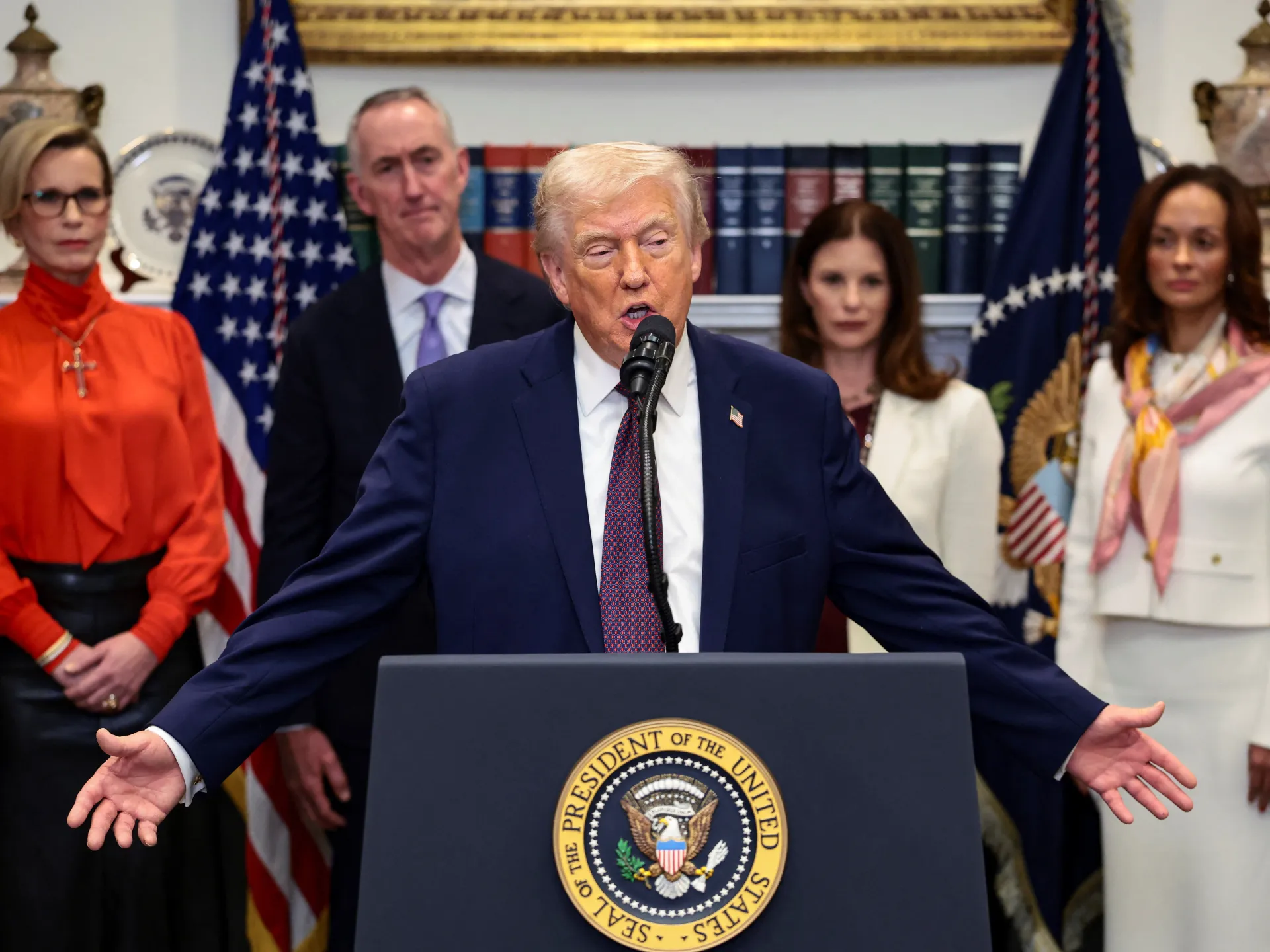
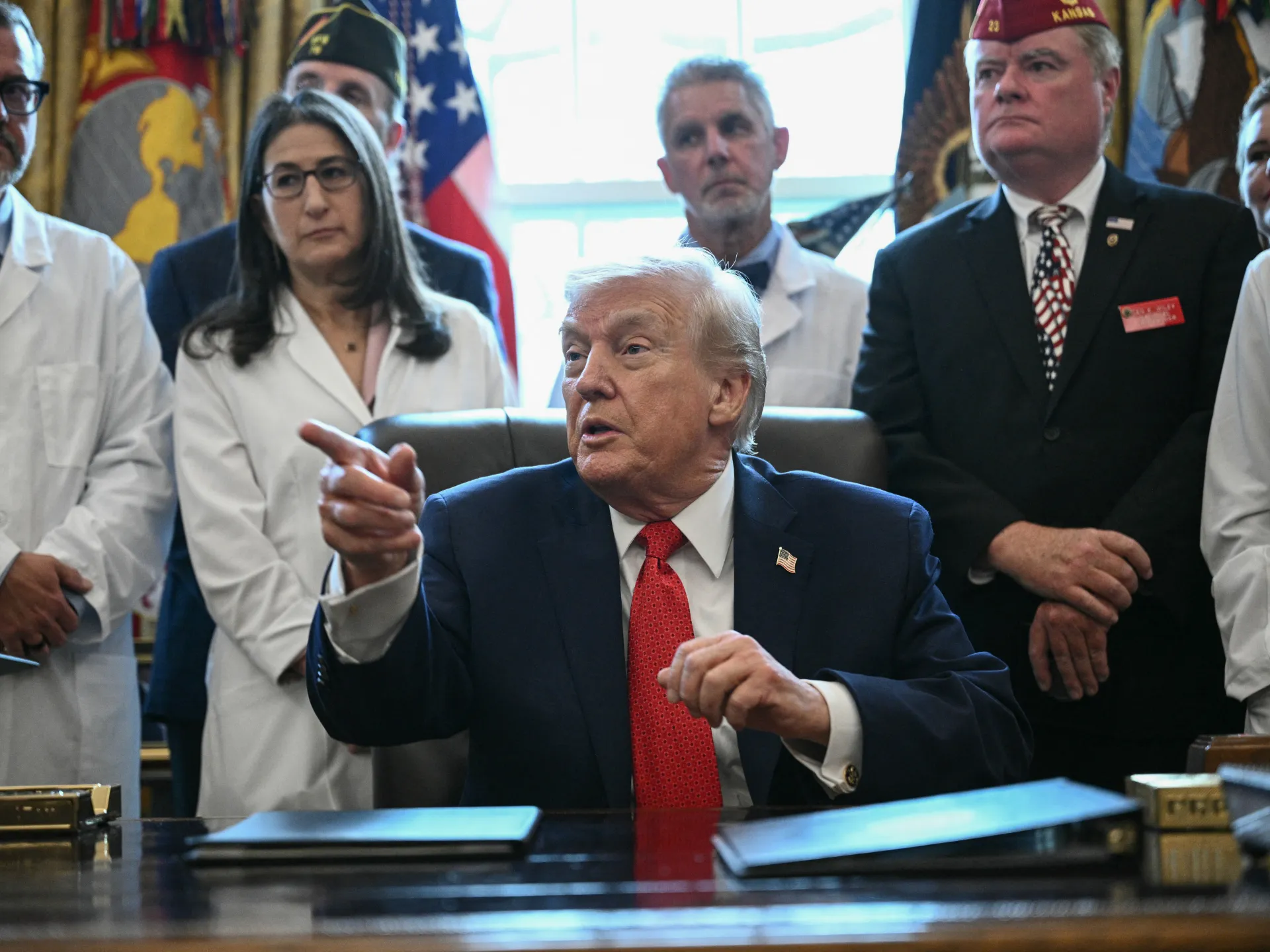
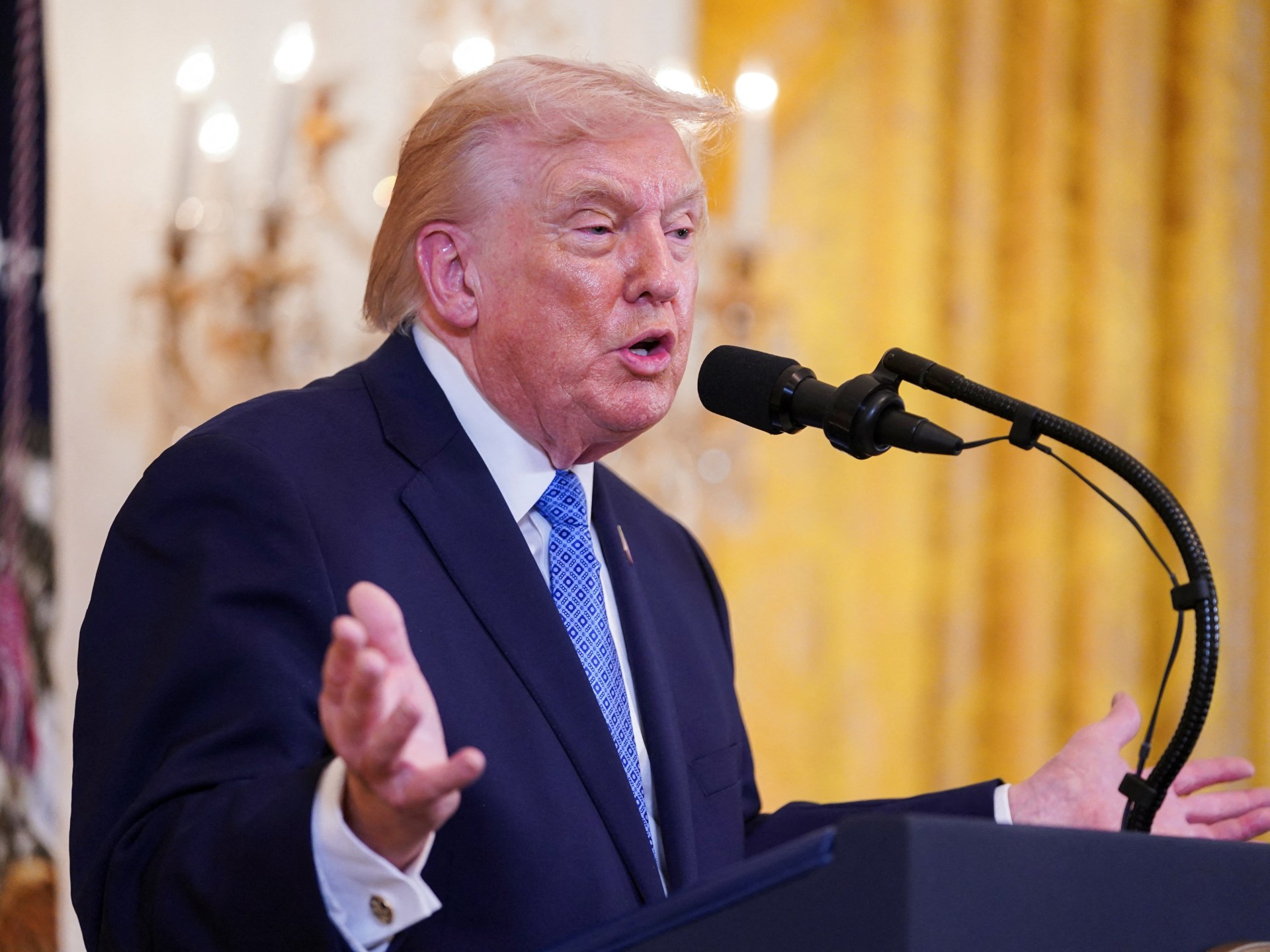
Donald Trump’s name has been added to the Kennedy Center in Washington, DC, just one day after his hand-picked board members controversially voted to rename the arts venue, the first time a national institution has been named after a sitting US president.
Workmen added metal lettering to the building’s exterior on Friday that declared, “The Donald J Trump and the John F Kennedy Memorial Center for the Performing Arts.”
Recommended Stories
list of 4 itemsend of list
“Today, we proudly unveil the updated exterior designation – honoring the leadership of President Donald J Trump and the enduring legacy of John F Kennedy,” the centre said on social media.
Family members of former President Kennedy, who was killed by an assassin’s bullet in 1963, as well as historians and Democratic lawmakers, have criticised the move, saying only an act of Congress could alter the name of the centre, which was designated as a living memorial to Kennedy a year after his assassination.
“The Kennedy Center was named by law. To change the name would require a revision of that 1964 law,” Ray Smock, a former House of Representatives historian, told the Associated Press (AP) news agency. “The Kennedy Center board is not a lawmaking entity. Congress makes laws,” Smock said.
A smile lights the face of President John F Kennedy as he is cheered during a speech to a Democratic Party rally in Milwaukee, US, in 1962 [File: AP Photo]
The AP reports that the law naming the centre explicitly prohibits the board of trustees from making the centre into a memorial to anyone else, and from putting another person’s name on the building’s exterior.
Kerry Kennedy, a niece of former President Kennedy, said in a post on social media that she will remove Trump’s name herself when his term as president ends.
“Three years and one month from today, I’m going to grab a pickax and pull those letters off that building, but I’m going to need help holding the ladder. Are you in?” she wrote on X.
Naming a national institution after a sitting president is unprecedented in US history. Landmarks such as the Washington Monument, Lincoln Memorial and indeed, the Kennedy Center were all named after the deaths of the renowned US leaders.
Kennedy’s grandnephew, former Congressman Joe Kennedy III, also said the Kennedy Center, like the Lincoln Memorial, was a “living memorial to a fallen president” and cannot be renamed, “no matter what anyone says”.
Trump claimed on Thursday that he was “surprised” by the renaming of the Kennedy Center, even though he personally purged the centre’s previous board after calling it “too woke”.
He has also previously spoken about having his name added to the centre and appointed himself chairman of the centre’s board earlier this year.
Trump has sought to rein in the Kennedy Center since the start of his second term as part of an assault on cultural institutions that his administration has accused of being too left-wing.
The administration of President Donald Trump has announced it will halt the visa lottery programme that allowed the suspect in the Brown University shooting to enter the United States.
The lottery awards approximately 50,000 immigrant visas each year, according to the US government.
Recommended Stories
list of 3 itemsend of list
But Trump has long opposed the Diversity Immigrant Visa Programme, sometimes known as the DV Programme. On Friday, his Secretary of Homeland Security Kristi Noem revealed that he had directed her to end the lottery immediately.
She also identified the suspect as Portuguese national Claudio Manuel Neves Valente, who received his green card — a certificate for permanent residency — through the lottery in 2017.
“This heinous individual should never have been allowed in our country,” Noem wrote in her social media statement.
“At President Trump’s direction, I am immediately directing USCIS [US Citizenship and Immigration Services] to pause the DV1 program to ensure no more Americans are harmed by this disastrous program.”
Campaign to end visa lottery
Friday’s announcement is not the first time Trump has sought to wind down the diversity visa lottery.
Trump has long sought to narrow the country’s pathways to legal immigration, and he has used crime as a pretext for doing so.
Noem herself pointed out that, in 2017, Trump “fought” to shut down the diversity visa lottery in the wake of an attack in New York City that saw a truck ram into a crowd of people, killing eight.
Speaking at a graduation ceremony for the Federal Bureau of Investigation (FBI) in December 2017, Trump — then in his first term as president — called on Congress to “end the visa lottery system”.
“They have a lottery. You pick people. Do you think the country is giving us their best people? No,” Trump said.
“What kind of a system is that? They come in by lottery. They give us their worst people.”
The Diversity Immigrant Visa Programme was established in 1990 to ensure applicants from underrepresented countries had access to the US immigration system.
Immigration rights advocates have long argued that pathways to permanent residency are narrow for those who do not already have a spouse, relatives or some other kind of sponsor in the country.
The visa lottery helps to answer that need, by creating an alternative route to residency.
The lottery system selects visa recipients randomly, but critics argue it remains a long-shot avenue to gain US residency, and even successful applicants must still pass a rigorous screening process after the lottery.
While the Diversity Immigrant Visa Programme used to accept 55,000 applicants each year, in 2000 that number was lowered to its current level, according to the American Immigration Council.
Surveillance images released by police show Claudio Neves Valente, the suspect in the mass shooting at Brown University [Providence Police Dept via AP Photo]
A suspect identified
Friday’s decision to immediately suspend the lottery comes as new details emerge about Neves Valente, a physics scholar found dead in a storage unit in New Hampshire after a nationwide manhunt.
The search began on December 13, when gunfire erupted on the campus of Brown University, a prestigious Ivy League school in Providence, Rhode Island.
The school’s fall semester was at its conclusion, and the exam period had begun. Students in the Barus and Holley physics laboratory were taking their end-of-course exams when a suspect, clad in black, entered the building and opened fire, killing two students and injuring nine others.
The physics lab was close to the edge of campus, and the suspect was able to escape on foot undetected.
The manhunt included several false starts, as authorities said they quickly detained a person of interest, only to release the individual without charges.
Then, on November 15, law enforcement officials announced that a plasma physics scholar named Nuno Loureiro had been found dead at his home, after suffering multiple gunshot wounds.
Loureiro was also a Portuguese immigrant, and he served as a professor at the Massachusetts Institute of Technology (MIT), a highly regarded science institution.
It was not immediately clear that the two shooting incidents were related, and authorities faced pressure to bring the Brown University shooter to justice, as the manhunt dragged on.
But on Thursday night, officials announced they had discovered Neves Valente dead from a self-inflicted gunshot wound, and that they believed him to be responsible for both attacks.
Neves Valente had previously studied in a PhD programme at Brown, though he did not complete his degree, and he had been Loureiro’s classmate in Portugal.
Visa revocations
The administration of President Trump has a track record of revoking visas and terminating immigration programmes after high-profile attacks.
On November 26, for example, two National Guard members from West Virginia were shot while on patrol in Washington, DC, as part of Trump’s crime crackdown in the capital.
The suspect in that case was identified as Rahmanullah Lakanwal, an Afghan national who had previously worked with allied forces during the US-led war in Afghanistan.
One of the National Guard soldiers, 20-year-old Sarah Beckstrom, ultimately died from her wounds.
Trump responded to the incident by announcing he was halting all visa applications and asylum requests from Afghan nationals, despite outcry from human rights and veterans groups.
The Republican leader also said he would pursue a “permanent pause” on entry for immigrants from “all third-world countries”.
In the aftermath of the shooting, the Trump White House tightened entry for 19 countries it had identified in June as “high risk” and expanded the list of restrictions to include 20 more countries.
Trump has also taken targeted actions to strip individuals of their immigration status following shootings.
After the assassination of conservative commentator Charlie Kirk in September, the Trump administration announced it was yanking visas from six foreign nationals who posted disrespectful comments or memes online about the attack. They hailed from countries ranging from Argentina to Brazil, Germany to Paraguay.
Free-speech advocates said the decision was a clear violation of the First Amendment of the US Constitution, which protects the freedom of expression.
But the Trump administration has repeatedly threatened to boot foreign nationals that do not align with its policy priorities.
“Aliens who take advantage of America’s hospitality while celebrating the assassination of our citizens will be removed,” the US State Department wrote in response.
The suspect in the Kirk shooting is a 22-year-old US citizen named Tyler James Robinson from Utah.
Studies have repeatedly shown that US-born citizens are more likely to commit violent crimes than immigrants.
The Delaware Supreme Court rules in favour of Musk and his $56bn compensation package.
Published On 19 Dec 202519 Dec 2025
Share
Elon Musk’s 2018 pay package from Tesla, once worth $56bn, has been restored by the Delaware Supreme Court, in the United States, two years after a lower court struck down the compensation deal as “unfathomable”.
Friday’s ruling overturns a decision that had prompted a furious backlash from Musk and damaged Delaware’s business-friendly reputation.
Recommended Stories
list of 4 itemsend of list
The pay package was by far the largest ever, until Tesla shareholders approved a new, even larger pay plan of nearly $1 trillion in November.
The ruling means that Musk can finally get paid for his work since 2018, when he transformed Tesla from a struggling startup to one of the world’s most valuable companies.
The 2018 pay deal provided Musk options to acquire about 304 million Tesla shares at a deeply discounted price if the company hit various milestones, which it did.
Tesla estimated in 2018 that the plan was potentially worth $56bn, although given the rise in the stock price, the value ballooned to about $120bn by early November. The options represent approximately 9 percent of Tesla’s outstanding stock.
Musk never collected his stock options because, soon after shareholders approved the 2018 compensation, the board was sued by Richard Tornetta, an investor with just nine Tesla shares.
In 2024, after a five-day trial, Delaware Judge Kathaleen McCormick concluded that Tesla’s directors were conflicted and key facts were hidden from shareholders when they voted to approve the plan. She ordered that the 2018 plan be rescinded.
Musk accused Delaware judges of being activists, hostile to tech founders, and he urged businesses to follow Tesla and reincorporate elsewhere.
Dropbox, Roblox, The Trade Desk and Coinbase were among the handful of large companies that moved their legal homes to Nevada or Texas. However, Delaware remains by far the most popular legal home for US public companies.
Tesla’s board has warned that Musk, the world’s richest person who also leads the SpaceX rocket venture and the artificial intelligence startup xAI, could leave the electric car company if he does not get the pay he wants and an increase in his voting power.
In November, shareholders approved a new pay package that could be worth $878bn if Tesla meets targets for self-driving vehicles, a robotaxi network and sales of humanoid robots.
Tesla has taken steps to reduce the risk that a shareholder could tie up the 2025 package in the courts.
The Austin-based company is now incorporated in Texas, which allows Tesla to require that any investor or group of investors must own 3 percent of the company stock before suing for an alleged corporate law violation. A stake of that size would be worth about $30bn, and Musk is the only individual with that much stock.
United States President Donald Trump announced new agreements aimed at lowering prescription drug prices.
On Friday, alongside leaders from Bristol Myers Squibb, Gilead Sciences, and Merck, among other leading pharma giants, the president announced deals that would cut prices on their medications to match that of the developed nation with the lowest price.
Recommended Stories
list of 4 itemsend of list
“Starting next year, American drug prices will come down fast and furious and will soon be some of the lowest in the developed world,” Trump said.
“This is the biggest thing having to do with drugs in the history of the purchase of drugs.”
Under the deals, each drugmaker will cut prices on some of the drugs sold to the Medicaid programme for low-income people, senior administration officials said, promising “massive savings” on widely used medicines without giving specific figures.
“We were subsidising the entire world. We’re not doing it anymore,” Trump said at a White House news conference, flanked by nine pharma executives.
Mehmet Oz, the director of the Centres for Medicare and Medicaid Service, said Regeneron, Johnson & Johnson, and AbbVie would visit the White House after the holidays for the launch of the government’s TrumpRx website.
US patients currently pay by far the most for prescription medicines, often nearly three times more than in other developed nations, and Trump has been pressuring drugmakers to lower their prices to what patients pay elsewhere.
The details of each deal were not immediately available, but officials said they included agreements to cut cash-pay direct-to-consumer prices of select drugs sold potentially through the TrumpRx.gov website, to launch drugs in the US at prices equal to – not lower than – those in other wealthy nations and to increase manufacturing. In return, companies can receive a three-year exemption from any tariffs.
Drug prices fall
Merck said it will sell its diabetes drugs Januvia, Janumet and Janumet XR – set to face generic competition next year – directly to US consumers at about 70 percent off list prices. If approved, its experimental cholesterol drug enlicitide will also be offered through direct-to-consumer channels.
Enlicitide is one of two Merck drugs expected to receive a speedy review under the FDA’s new, fast-track pathway, the Reuters news agency has previously reported.
Amgen said it will expand its direct-to-patient programme to include migraine drug Aimovig and rheumatoid arthritis medicine Amjevita, offering both at $299 a month – nearly 60 percent and 80 percent below current US list prices.
In July, Trump sent letters to leaders of 17 major pharmaceutical companies, outlining how they should provide so-called most-favoured -nation prices to the US government’s Medicaid health programme for low-income people, and guarantee that new drugs will not be launched at prices above those in other high-income countries.
So far, five companies have struck deals with the administration to rein in prices. They are Pfizer, Eli Lilly, AstraZeneca, Novo Nordisk and EMD Serono, the US division of Germany’s Merck.
A portion of revenues from each company’s foreign sales will also be remitted to the US to offset costs, officials said.
The companies pledged together to invest more than $150bn in the US for R&D and manufacturing, according to officials, although it was unclear whether that included earlier commitments. Several also agreed to donate drug ingredients to the US strategic reserve.
Trump has long focused on the disparity between drug prices in the US and other wealthy countries, which have government-run health systems that negotiate price discounts.
The spectre of tighter price controls by the US government initially spooked investors, but the terms of the deals announced so far have calmed many of those fears.
Analysts have noted that Medicaid, which accounts for only approximately 10 percent of US drug spending, already benefits from substantial price discounts, exceeding 80 percent in some cases.
The United States Middle East envoy, Steve Witkoff, will hold talks in Miami, Florida, with senior officials from Qatar, Egypt and Turkiye as efforts continue to advance the next phase of the Gaza ceasefire, even as Israel repeatedly violates the truce on the ground.
A White House official told Al Jazeera Arabic on Friday that Witkoff is set to meet representatives from the three countries to discuss the future of the agreement aimed at halting Israel’s genocidal war on Gaza.
Recommended Stories
list of 3 itemsend of list
Axios separately reported that the meeting, scheduled for later on Friday, will include Qatari Prime Minister and Foreign Minister Sheikh Mohammed bin Abdulrahman bin Jassim Al Thani, Turkish Foreign Minister Hakan Fidan and Egyptian Foreign Minister Badr Abdelatty.
At the same time, Israel’s public broadcaster, quoting an Israeli official, said Prime Minister Benjamin Netanyahu is holding a restricted security consultation to examine the second phase of the ceasefire and potential scenarios.
That official warned that Israel could launch a new military campaign to disarm Hamas if US President Donald Trump were to disengage from the Gaza process, while acknowledging that such a move was unlikely because Trump wants to preserve calm in the enclave.
Despite Washington’s insistence that the ceasefire remains intact, Israeli attacks have continued almost uninterrupted, as it continues to renege on the terms of the first phase, as it blocks the free flow of desperately needed humanitarian aid into the besieged Palestinian territory.
According to an Al Jazeera analysis, Israeli forces carried out attacks on Gaza on 58 of the past 69 days of the truce, leaving only 11 days without reported deaths, injuries or violence.
In Washington, Trump said on Thursday that Netanyahu is likely to visit him in Florida during the Christmas holidays, as the US president presses for the launch of the agreement’s second phase.
“Yes, he will probably visit me in Florida. He wants to meet me. We haven’t formally arranged it yet, but he wants to meet me,” Trump told reporters.
Qatar and Egypt, who are mediating and guaranteeing the truce after a devastating two-year genocide in Gaza, have urged a transition to the second phase of the agreement. The plan includes a full Israeli military withdrawal and the deployment of an international stabilisation force (ISF).
Fragile truce, entrenched occupation
Qatar’s prime minister warned on Wednesday that daily Israeli breaches of the Gaza ceasefire are threatening the entire agreement, as he called for urgent progress towards the next phase of the deal to end Israel’s genocidal war on the besieged Palestinian enclave.
Sheikh Mohammed made the appeal following talks with United States Secretary of State Marco Rubio in Washington, where he stressed that “delays and ceasefire violations endanger the entire process and place mediators in a difficult position”.
The ceasefire remains deeply unstable, and Palestinians and rights groups say it is a ceasefire only in name, amid Israeli violations and a rapidly deteriorating humanitarian situation in Gaza.
Since the truce took effect on October 10, 2025, Israel has repeatedly breached the agreement, killing hundreds of Palestinians.
Gaza’s Government Media Office says Israel committed at least 738 violations between October 10 and December 12, including air strikes, artillery fire and direct shootings.
Israeli forces shot at civilians 205 times, carried out 37 incursions beyond the so-called “yellow line”, bombed or shelled Gaza 358 times, demolished property on 138 occasions and detained 43 Palestinians, the office said.
Israel has also continued to block critical humanitarian aid while systematically destroying homes and infrastructure.
Against this backdrop, Israel Hayom quoted an Israeli security official as saying the so-called “yellow line” now marks Israel’s new border inside Gaza, adding that Israeli forces will not withdraw unless Hamas is disarmed. The official said the army is preparing to remain there indefinitely.
The newspaper also reported that Israeli military leaders are proposing continued control over half of Gaza, underscoring Israel’s apparent intent to entrench its occupation rather than implement a genuine ceasefire.
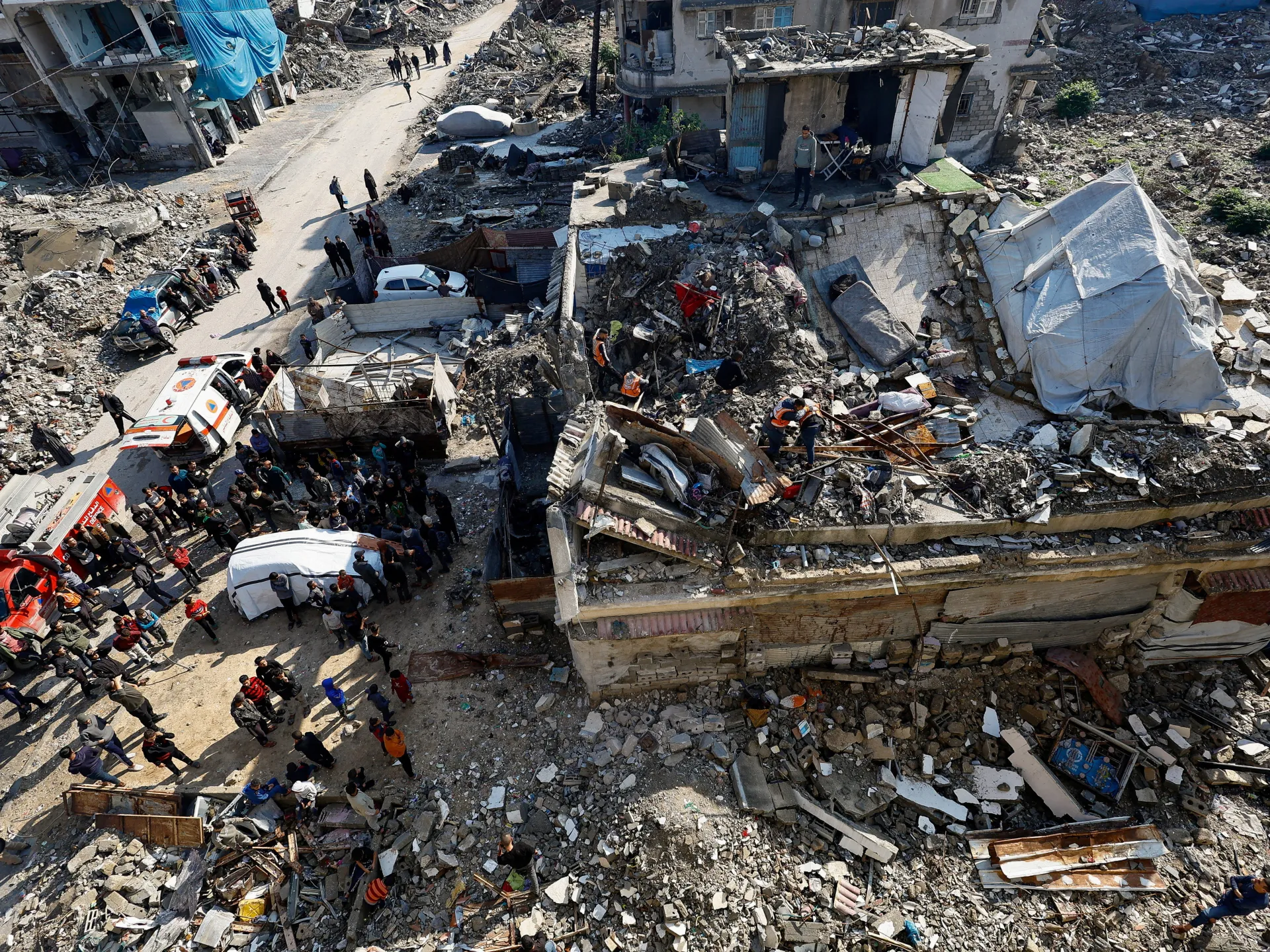
Compounding the misery in Gaza, a huge storm that recently hit the Strip has killed at least 13 people as torrential rains and fierce winds flooded tents and caused damaged buildings to collapse.
Israel’s two-year war has decimated more than 80 percent of the structures across Gaza, forcing hundreds of thousands of families to take refuge in flimsy tents or overcrowded makeshift shelters.
Favourite Anthony Joshua tips the scales more than 12 kilos heavier than YouTuber-turned-boxer Jake Paul at weigh-in.
Published On 19 Dec 202519 Dec 2025
Share
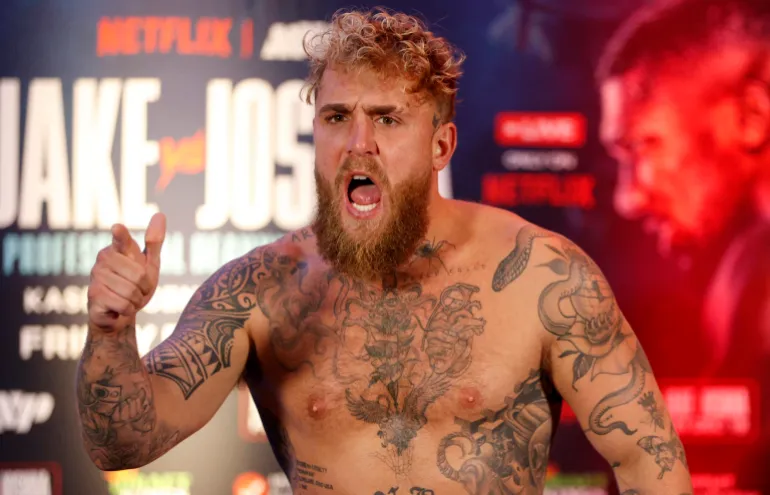
Former heavyweight world champion Anthony Joshua easily made weight ahead of his fight against social media boxing disruptor Jake Paul at Thursday’s official weigh-in in Miami.
Joshua, who under the rules of the fight, couldn’t weigh more than 245 pounds (111kg), tipped the scales at 243.4 pounds (110kg).
Recommended Stories
list of 4 itemsend of list
Joshua (28-4, 25 KOs), who usually fights in the heavyweight classification at about 250 pounds (11kg), was the lightest he has been since he dropped to 240 pounds (109kg) for his first heavyweight title fight against Oleksandr Usyk on September 25, 2021.
Paul (12-1, 7 KOs) weighed in at a bulky 216 pounds (98kg) – but still more than two stones, or 12.7 kilogrammes, less than the Briton, who is 13 centimetres taller at 1.98m (Six feet, six inches).
It was just the second time in his professional career that the American weighed in above his usual cruiserweight limit of 91kg, or 200 pounds.
Paul riles up the crowd at the weigh-in [Marco Bello/Reuters]
After the weigh-in, Paul, who excitedly took to the stage first and jeered up the crowd, claimed Joshua was nervous heading into the fight and said he would “shock the world” on Friday.
“I smell fear. I see something in his eyes, I truly do,” Paul said.
“The pressure is on him. I’m fighting free. I’ve already won. This is a lose-lose situation for him. I’ve got him right where I want him.”
Joshua, who remained composed throughout the weigh-in, other than when he pushed Paul’s fist away from his face and exclaimed “don’t touch me” during the promotional stare off, said his talent would prevail against the smaller, less experienced boxer.
“I’ll just outclass this kid. I’m a serious fighter. That’s the difference. I’m a serious, serious fighter,” the 2012 Olympic champion said.
The fight will take place at Miami’s Kaseya Center at 10:30pm on Friday (03:30 GMT Saturday).
The contest is an eight-round sanctioned bout with 10-ounce gloves to be used.
Joshua is returning to the ring for the first time since his knockout defeat to fellow Briton Daniel Dubois in September 2024.
In the weigh-in for the co-main event, holder Alycia Baumgardner came in at 129.2 pounds (58.6kg) while challenger Leila Beaudoin came in at 130 pounds (58.9kg) ahead of their unified junior lightweight title bout.
Baumgardner hasn’t been beaten since 2018 and is the strong favourite to retain her titles.
Alycia Baumgardner, left, and Leila Beaudoin face off during their ceremonial weigh-in ahead of their co-main event fight [Leonardo Fernandez/Getty Images via AFP]
Greg Biffle’s plane caught fire after crash-landing at a regional airport, state authorities said. Other victims have not yet been identified.
Published On 18 Dec 202518 Dec 2025
Share
A former NASCAR driver has been identified as one of seven people who died in a plane crash in the southern United States.
Authorities said Greg Biffle and members of his family died when a private jet crashed on Thursday while trying to land at Statesville Regional Airport, north of Charlotte, North Carolina.
Recommended Stories
list of 3 itemsend of list
Flight records showed the plane was registered to a company run by Biffle.
“Although the post-crash fire prevents us from releasing a definitive list of the occupants at this time, it is believed that Mr Gregory Biffle and members of his immediate family were occupants of the airplane,” state police said.
Further details about the victims were not immediately available.
First responders tend to the scene of a reported plane crash at a regional airport in Statesville, North Carolina [Matt Kelley/The Associated Press]
Throughout his 16-year career, Biffle won more than 50 races across the three racing-circuit types offered by NASCAR, a US-based association for car races.
He placed first in 19 races at the Cup Series, considered NASCAR’s top level. He also won the Craftsman Truck Series championship in 2000 and the Xfinity Series title in 2002.
Biffle’s plane had taken off from the airport shortly after 10am local time on Thursday (15:00 GMT), but it then returned to North Carolina and was attempting to land there, according to tracking data posted by FlightAware.com.
Video from WSOC-TV showed first responders rushing onto the runway as flames burned near scattered wreckage from the plane.
The National Transportation Safety Board (NTSB) and the Federal Aviation Administration (FAA) were investigating the crash.
All told, the NTSB has investigated 1,331 crashes in the US in 2025.
The FTC had accused the grocery delivery giant of charging fees to consumers after promising ‘free delivery’.
Published On 18 Dec 202518 Dec 2025
Share
Instacart has agreed to pay $60m in refunds to settle allegations brought by the United States Federal Trade Commission (FTC) that the online grocery delivery platform deceived consumers about its membership programme and free delivery offers.
According to court documents filed in San Francisco on Thursday, Instacart’s offer of “free delivery” for first orders was illusory because shoppers were charged other fees, the FTC alleged.
Recommended Stories
list of 4 itemsend of list
The agency also accused Instacart of failing to adequately notify shoppers that their free trials of its Instacart+ subscription service would convert to paid memberships and of misleading consumers about its refund policy.
“The FTC is focused on monitoring online delivery services to ensure that competitors are transparently competing on price and delivery terms,” said Christopher Mufarrige, who leads the FTC’s consumer protection work.
An Instacart spokesperson said the company flatly denies any allegations of wrongdoing, but that the settlement allows the company to focus on shoppers and retailers.
“We provide straightforward marketing, transparent pricing and fees, clear terms, easy cancellation, and generous refund policies — all in full compliance with the law and exceeding industry norms,” the spokesperson said.
The shopping platform is currently under scrutiny after a recent study by nonprofit groups found that individual shoppers simultaneously received different prices for the same items at the same stores.
The FTC is investigating the company and has demanded information about Instacart’s Eversight pricing tool, the news agency Reuters reported on Wednesday.
Instacart has said that retailers are responsible for setting prices, and that pricing tests run through Eversight are random and not based on user data.
Lindsay Owens, the executive director of the Groundwork Collaborative, an economic think tank, criticised the grocery platform for using artificial intelligence (AI) to tweak its prices.
“At a time when families are being squeezed by the highest grocery costs in a generation, Instacart chose to run AI experiments that are quietly driving prices higher,” Owens said in written remarks provided to Al Jazeera.
She also called on the administration of US President Donald Trump to take action to prevent such price manipulation from continuing into the future.
“While the FTC’s investigation is welcome news, it must be followed with meaningful action that ends these exploitative pricing schemes and protects consumers,” Owens said. “Instacart must face consequences for their algorithmic price gouging, not just a slap on the wrist.”
On Wall Street, Instacart’s stock is taking a hit on the heels of the settlement, finishing out the day down 1.5 percent.
The executive order calls on the US attorney general to expedite federal reclassification, creating fewer barriers for studies.
Published On 18 Dec 202518 Dec 2025
Share
United States President Donald Trump has signed an executive order to federally reclassify marijuana as less dangerous.
The move on Thursday requires Attorney General Pam Bondi to expedite the process under the Drug Enforcement Administration for reclassifying marijuana.
Recommended Stories
list of 3 itemsend of list
In the US, drugs and other chemical substances are divided into a five-tier classification system, with Schedule I representing the most restricted tier and Schedule V the least.
Marijuana was previously in the Schedule I category, where it was classed alongside potent narcotics like heroin and LSD. With Thursday’s order, it would be fast-tracked down to Schedule III, in a class with ketamine and anabolic steroids.
Trump said the change “is not the legalisation” of marijuana, and he added that it “in no way sanctions its use as a recreational drug”.
The change, however, will make it easier to conduct research on marijuana, as studies on Schedule III drugs require far less approval than for Schedule I substances.
Speaking earlier in the week, Trump told reporters the change was popular “because it leads to tremendous amounts of research that can’t be done unless you reclassify, so we are looking at that very strongly”.
The change is in line with several states that have moved to legalise marijuana for both medical and recreational use. That has created a patchwork of state-level regulations at odds with federal law, wherein marijuana remains illegal.
Former US President Joe Biden had taken several steps to lessen federal penalties related to marijuana, including a mass pardon for those handed harsh sentences for simple possession.
Such convictions had disproportionately affected minority communities and fuelled mass incarceration in the US.
The Biden administration had also begun the process of reclassifying marijuana to Schedule III, but the effort was not completed before the Democratic president left office in January.
Trump has faced some pushback from within his party about the classification shift. Earlier this year, 20 Republican senators signed a letter urging the president to keep the more severe restrictions.
The group argued that marijuana continues to be dangerous and that a shift would “undermine your strong efforts to Make America Great Again”, a reference to Trump’s campaign slogan.
Meanwhile, public support for legalising marijuana for recreational use has nearly doubled in recent years, increasing from 36 percent support in 2005 to 68 percent in 2024, according to Gallup polls.
New plaques have been installed in US President Donald Trump’s ‘Presidential Walk of Fame’ at the White House that attack many of his predecessors and make questionable claims about his own achievements.
Legislators have been publishing photos related to convicted sex offender as Justice Department faces Friday deadline to release more.
Published On 18 Dec 202518 Dec 2025
Share
Democrats in the United States House of Representatives have released dozens more photos from the estate of financier and convicted sex offender Jeffrey Epstein.
The release on Thursday comes a day before the Department of Justice faces a deadline to release a more comprehensive set of files related to Epstein, who died in a New York jail in 2019 while awaiting sex-trafficking charges.
Recommended Stories
list of 3 itemsend of list
In a statement, Democrats on the House Oversight Committee said they would “continue releasing photographs and documents to provide transparency for the American people”.
“It’s time for the Department of Justice to release the files,” they said.
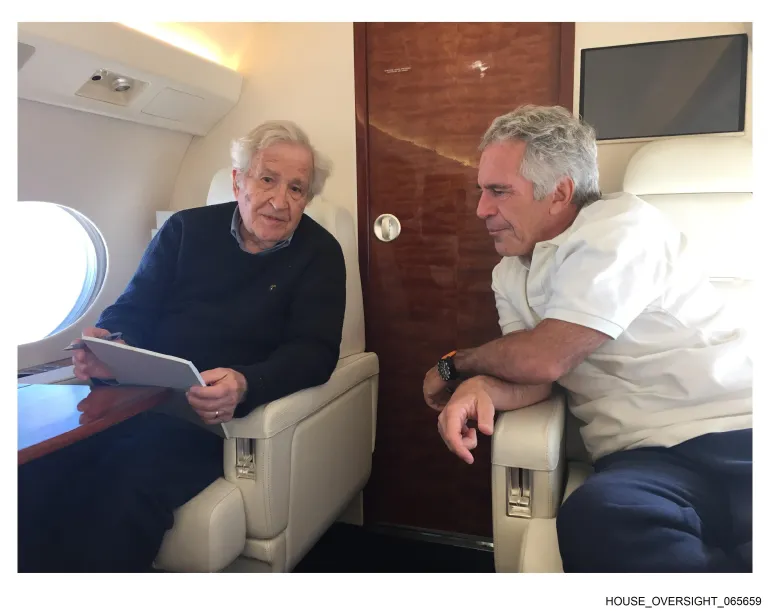
The latest trove includes photos of Epstein with public intellectual Noam Chomsky, as well as images of billionaire Bill Gates, filmmaker Woody Allen and former Donald Trump strategist Steve Bannon at Epstein’s compound.
One release shows a screenshot of a text exchange in which an unknown sender appears to discuss recruiting young women.
“I have a friend scout she sent me some girls today. But she asks 1000$ per girl. I will send u girls now. Maybe someone will be good for J?” the post says.
An undated photo released by Democrats on the House Oversight Committee on Thursday, December 18, 2025, shows professor and political activist Noam Chomsky with Jeffrey Epstein.
Other images show women’s passports and the body of an unidentified woman with messages written on her skin, next to Vladimir Nabokov’s Lolita, a novel about a man’s sexual obsession with a child.
Like a trove of images released last week, the materials released on Thursday were not accompanied by any further context or details. Last week’s images also showed Bannon, Allen, and Gates, as well as former US President Bill Clinton and former Israeli Prime Minister Ehud Barak.
Another image showed US President Trump surrounded by three young women, his hand clutching the waist of the woman to his right.
Trump has acknowledged a prior relationship with Epstein, but has denied taking part in the sex abuse ring that Epstein ran. He said the two men had a falling out years before Epstein’s arrest.
In emails previously released by House Democrats, Epstein said that Trump “knew about the girls”. In another, Epstein described Trump as “the dog that hasn’t barked”.
The president had initially opposed a more complete release of files related to Epstein, but faced mounting pressure, including from within his own Make America Great Again (MAGA) base.
Speculation has focused on the influential figures in Epstein’s orbit, and any involvement they made have had in his crime. The intrigue has been fueled by the murky circumstances surrounding Epstein’s death in a New York jail cell, which was ruled a suicide.
Last month, Trump pivoted on the issue, signing into law a bill requiring the Justice Department to publish materials connected to the Epstein investigation.
However, the Justice Department has remained silent on whether it will meet Friday’s deadline outlined in the law, dubbed the Epstein Files Transparency Act.
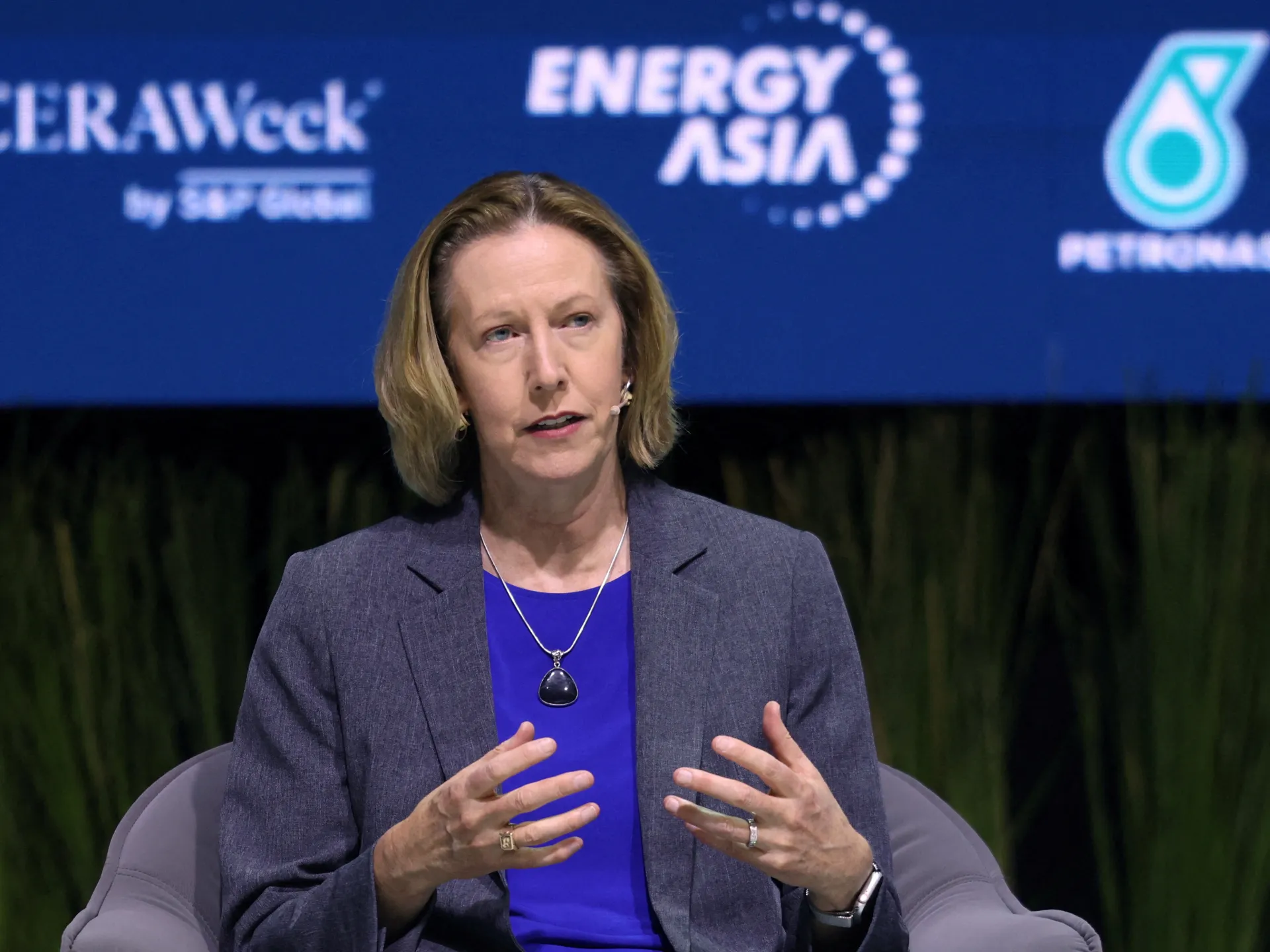
BP has tapped Woodside Energy’s Meg O’Neill as its next CEO, its first external hire for the post in more than a century and the first woman to lead a top-five oil major as the firm pivots back to fossil fuels.
O’Neill, an Exxon veteran, will take over in April following the abrupt departure of Murray Auchincloss, the second CEO change in just over two years as the British oil major strives to improve its profitability and share performance, which for years has lagged competitors like Exxon.
Recommended Stories
list of 4 itemsend of list
The company embarked on a major strategy shift earlier this year, slashing billions in planned renewable energy initiatives and shifting its focus back to traditional oil and gas. BP has pledged to divest $20bn in assets by 2027, including its Castrol lubricants unit, and reduce debt and costs.
“Progress has been made in recent years, but increased rigour and diligence are required to make the necessary transformative changes to maximise value for our shareholders,” new BP Chair Albert Manifold said in a statement.
When Manifold took up his post in October, he emphasised the need for a deeper reshaping of BP’s portfolio to increase profitability and faced pressure from activist investor Elliott Investment Management, one of BP’s largest shareholders, which called for him to urgently address the company’s shortcomings.
Elliott saw the change of CEO as a sign of BP’s willingness to act swiftly to deliver cost cuts and divestments, a person familiar with the situation said.
An external change
O’Neill, a 55-year-old American from Boulder, Colorado, and the first openly gay woman to helm a FTSE 100 company, headed Woodside since 2021, having previously spent 23 years at Exxon.
Under O’Neill’s leadership, Woodside merged with BHP Group’s petroleum arm to create a top 10 global independent oil and gas producer valued at $40bn and doubled Woodside’s oil and gas production.
The acquisition took the company to the US, where it embarked on a major Louisiana liquefied natural gas project, which it is progressing in an LNG market braced for oversupply.
BP spent more than 40 percent of its $16.2bn investment budget in the United States last year and plans to boost its US output to 1 million barrels of oil equivalent per day by the end of the decade.
Markets react
Woodside shares fell as much as 2.9 percent after news of O’Neill’s departure. At BP, shares were up 0.3 percent, compared with a broader index of European energy companies.
Like BP, Woodside shares have underperformed rivals. In absolute terms, though, the stock has risen about 10 percent during O’Neill’s tenure.
BP’s executive vice president, Carol Howle, will serve as interim CEO. Auchincloss, 55, will step down on Thursday and serve in an advisory role until December 2026.
BP said O’Neill’s appointment was part of its long-term succession planning, though it had not publicly announced a search process.
Auchincloss became CEO in 2024, taking over from Bernard Looney, who was fired after lying to the board about personal relationships with colleagues.
After an ill-fated foray into renewables under Looney, BP has promised to increase profitability and cut costs while re-routing spending to focus on oil and gas, launching a review in August of how best to develop and monetise oil and gas production assets.
During BP’s third-quarter earnings call last month, the company did not give an update on the closely watched sale process for its Castrol lubricants unit, the centrepiece of its $20bn asset-sale drive to slash its debt pile.
“We question whether this is set to change BP’s thinking once again on key strategic initiatives – should they defer the sale of Castrol? We think yes. Should they cut the buyback to zero and repair the balance sheet further? We think yes,” said RBC analyst Biraj Borkhataria.
Woodside said in a separate statement that O’Neill was leaving immediately, and it had appointed executive Liz Westcott as acting CEO, while intending to announce a permanent appointment in the first quarter of 2026.
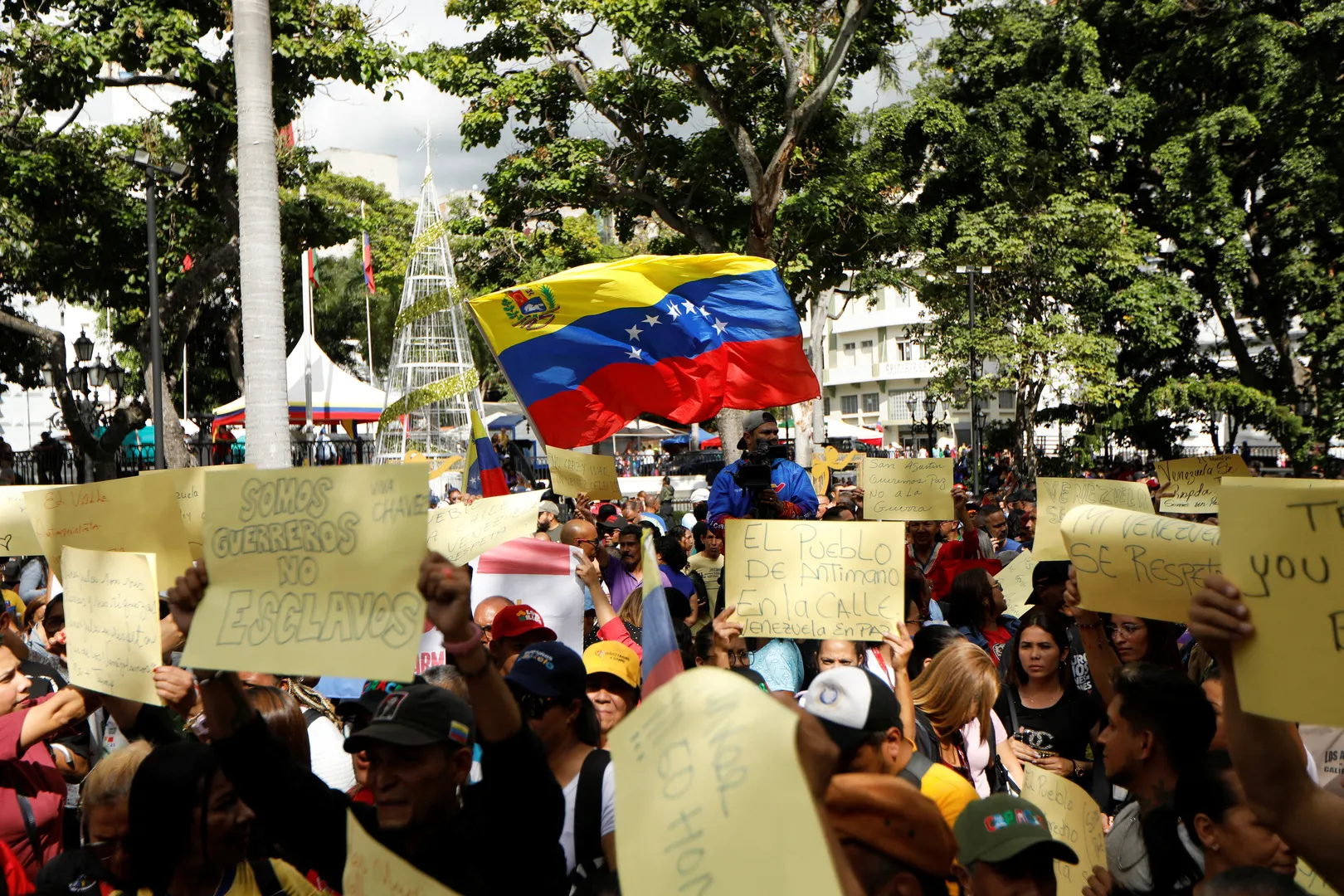
US President Donald Trump has said the US owns rights to Venezuelan oil and land. The claims follow the US seizure of Venezuelan oil and the declaration of a naval blockade. But is any of this true? Soraya Lennie explains.
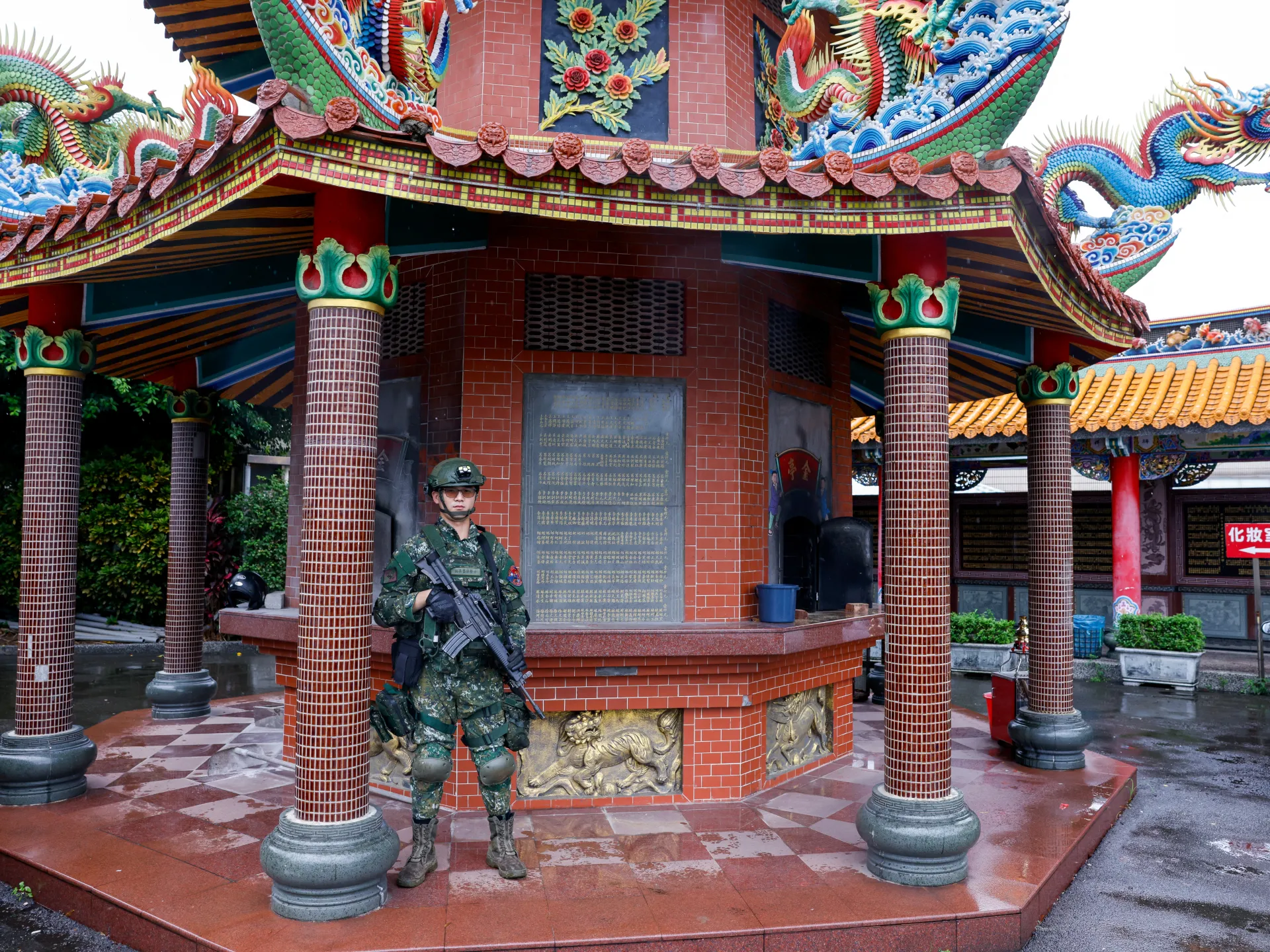
Huge US arms package for Taiwan includes HIMARS rocket systems, howitzer artillery, antitank missiles, and drones.
Published On 18 Dec 202518 Dec 2025
Share
The United States has approved $11.1bn in arms sales to Taiwan, one of Washington’s largest-ever weapons packages for the self-ruled island, which Beijing has promised to unify with mainland China.
The US State Department announced the deal late on Wednesday during a nationally televised address by President Donald Trump.
Recommended Stories
list of 4 itemsend of list
Weapons in the proposed sale include 82 High Mobility Artillery Rocket Systems, or HIMARS, and 420 Army Tactical Missile Systems, or ATACMS – worth more than $4bn – defence systems that are similar to what the US had been providing Ukraine to defend against Russian aerial attacks.
The deal also includes 60 self-propelled howitzer artillery systems and related equipment worth more than $4bn and drones valued at more than $1bn.
Other sales in the package include military software valued at more than $1bn, Javelin and TOW missiles worth more than $700m, helicopter spare parts worth $96m and refurbishment kits for Harpoon missiles worth $91m.
In a series of separate statements announcing details of the weapons deal, the Pentagon said the sales served US national, economic and security interests by supporting Taiwan’s continuing efforts to modernise its armed forces and to maintain a “credible defensive capability”.
Taiwan’s defence ministry and presidential office welcomed the news while China’s foreign ministry did not immediately respond to a request for comment from the Reuters news agency.
Washington’s huge sale of arms to Taiwan will likely infuriate China, which claims Taiwan is part of its territory and has threatened to use force to bring it under its control.
“The United States continues to assist Taiwan in maintaining sufficient self-defence capabilities and in rapidly building strong deterrent power,” Taiwan’s defence ministry said in a statement.
Taiwan presidential office spokesperson Karen Kuo said Taiwan would continue to reform its defence sector and “strengthen whole-of-society defence resilience” to “demonstrate our determination to defend ourselves, and safeguard peace through strength”.
China’s Taiwan Affairs Office said on Wednesday that it opposed efforts by the US Congress to pass bills “related to Taiwan and firmly opposes any form of military contact between the US and Taiwan”.
“We urge the US to abide by the one China principle and the provisions of the three Sino-US joint communiques : Stop ‘arming Taiwan’, stop reviewing relevant bills, and stop interfering in China’s internal affairs,” the office’s spokesperson Zhu Fenglian said in a statement.
Zhu said Taiwan’s political leaders were pursuing “independence”, and were “willing to let external forces turn the island into a ‘war porcupine’,” which could result in the population becoming “cannon fodder” and “slaughtered at will, which is despicable”.
Taiwan’s President William Lai Ching-te last month announced a $40bn supplementary defence budget, to run from 2026 to 2033, saying there was “no room for compromise on national security”.
Maxwell, a former British socialite and Epstein accomplice, says her conviction for trafficking a ‘miscarriage of justice’.
Published On 18 Dec 202518 Dec 2025
Share
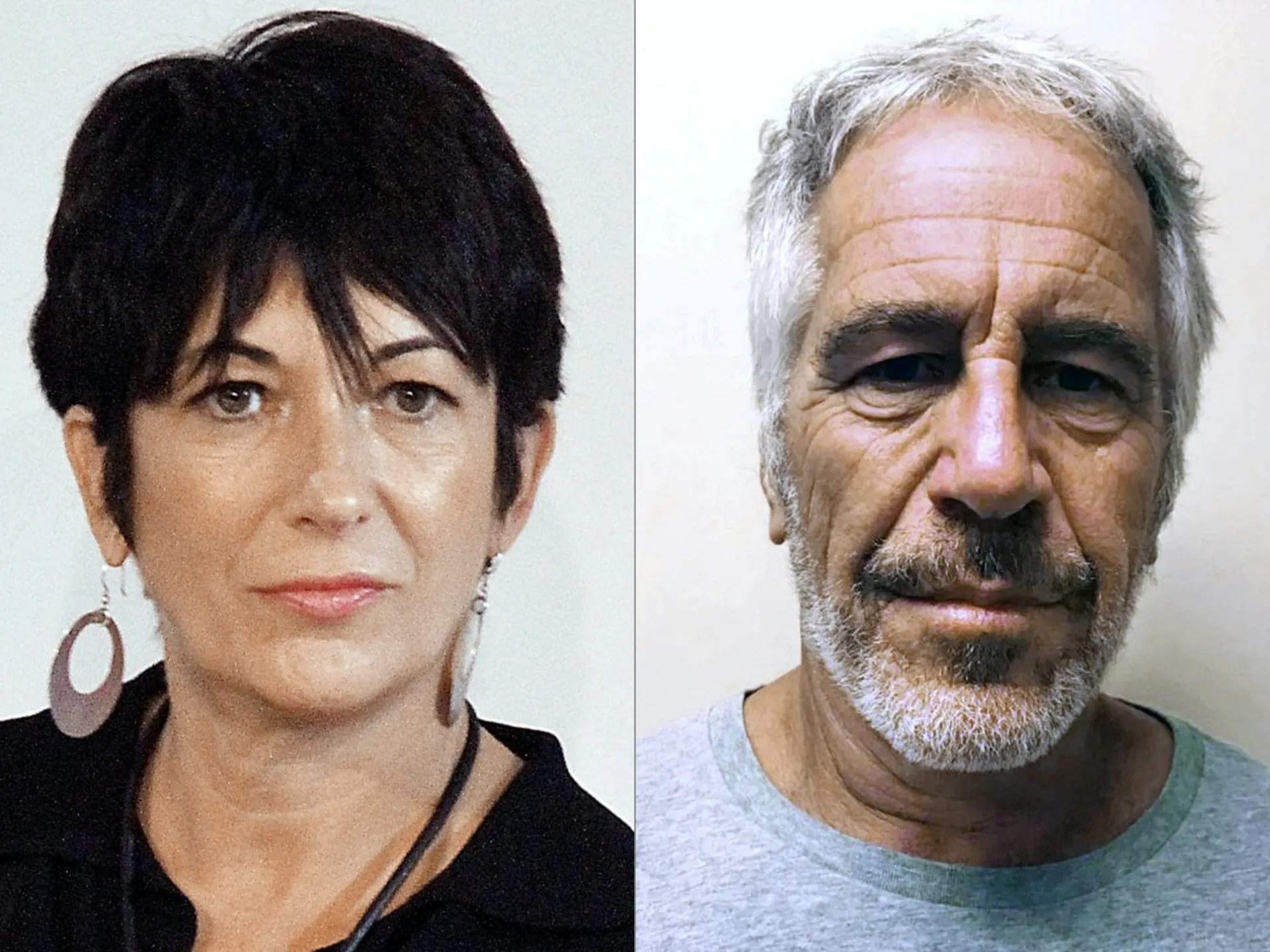
Ghislaine Maxwell, former girlfriend and accomplice of convicted sex offender Jeffrey Epstein, has asked a federal judge in the United States to set aside her sex trafficking conviction and quash her 20-year prison sentence.
Maxwell made the long-shot legal bid in a Manhattan court on Wednesday, saying “substantial new evidence” had emerged proving that constitutional violations spoiled her trial in 2021 for recruiting underage girls for wealthy financier Epstein, who died in 2019.
Recommended Stories
list of 4 itemsend of list
In the lengthy filing, Maxwell, 63, argues that “newly discovered evidence” proves that she “did not receive a fair trial by independent jurors coming to Court with an open mind”.
“If the jury had heard of the new evidence of the collusion between the plaintiff’s lawyers and the Government to conceal evidence and the prosecutorial misconduct they would not have convicted,” Maxwell wrote.
She said the cumulative effect of the constitutional violations resulted in a “complete miscarriage of justice”.
Maxwell submitted the filing herself, not in the name of a lawyer.
Proceedings of the type brought by Maxwell are routinely denied by judges and are often the last-ditch option available to offenders to have their convictions overturned, the AFP news agency reports.
Maxwell’s filing also comes just days before records in her legal case are scheduled to be released publicly as a result of US President Donald Trump’s signing of the Epstein Files Transparency Act.
The law, which Trump signed after months of public and political pressure on his administration, requires the Department of Justice to provide the public with Epstein-related records by December 19.
The circumstances of Epstein’s death and his influential social circle, which spanned the highest reaches of business and politics in the US, have also fuelled conspiracy theories about possible cover-ups and unnamed accomplices
Critics also continue to press President Trump to address his own once-closerelationship with Epstein.
The Justice Department has said it plans to release 18 categories of investigative materials gathered in the massive sex trafficking probe, including search warrants, financial records, notes from interviews with victims, and data from electronic devices.
Epstein was arrested in July 2019 on sex trafficking charges but was found dead a month later in his cell at a New York federal jail, and his death was ruled a suicide.
Maxwell, once a well-known British socialite, was arrested a year later and convicted of sex trafficking in December 2021.
In July, she was interviewed by the Justice Department’s second-in-command and soon afterwards moved from a federal prison in Florida to a prison camp in Texas.
Maxwell’s transfer from the Federal Correctional Institution (FCI) Tallahassee – a low-security prison in Florida – to the minimum-security Federal Prison Camp in Bryan, Texas, was carried out without explanation at the time.
Winter storms are worsening conditions for hundreds of thousands of displaced Palestinians in Gaza, as aid agencies warn that Israeli restrictions are preventing lifesaving shelter assistance from reaching people across the besieged enclave.
The United Nations has said it has tents, blankets and other essential supplies ready to enter Gaza, but that Israeli authorities continue to block or restrict access through border crossings.
Recommended Stories
list of 4 itemsend of list
In Gaza City’s Shati refugee camp, the roof of a war-damaged family home collapsed during the storm, rescue workers said on Wednesday. Six Palestinians, including two children, were pulled alive from the rubble.
It comes after Gaza’s Ministry of Health said a two-week-old Palestinian infant froze to death, highlighting the risks faced by young and elderly people living in inadequate shelters.
A spokesperson for UN Secretary-General Antonio Guterres said the storms had damaged or destroyed shelters and personal belongings across the territory.
“The disruption has affected approximately 30,000 children across Gaza. Urgent repairs are needed to ensure these activities can resume without delay,” Farhan Haq said.
The Palestinian Civil Defence in Gaza added in a statement that “what we are experiencing now in the Gaza Strip is a true humanitarian catastrophe”.
Ceasefire talks and aid access
The worsening humanitarian situation comes as Qatar’s Prime Minister Sheikh Mohammed bin Abdulrahman bin Jassim Al Thani held talks in Washington, DC, with United States Secretary of State Marco Rubio on efforts to stabilise the tenuous ceasefire in Gaza.
According to Qatari officials, the talks focused on Qatar’s role as a mediator, the urgent need for aid to enter Gaza, and moving negotiations towards the second stage of a US-backed plan to end Israel’s genocidal war against the Palestinian people in Gaza.
Al Jazeera’s Alan Fisher, reporting from Washington, said Sheikh Mohammed stressed that humanitarian assistance must be allowed into Gaza “unconditionally”.
“He said aid has to be taken into Gaza unconditionally, clearly making reference to the fact that a number of aid agencies have said that Israel is blocking the access to aid for millions of people in Gaza,” Fisher said.
The Qatari prime minister also discussed the possibility of an international stabilisation force to be deployed in Gaza after the war, saying such a force should act impartially.
“There has been a lot of talk in the US over the past couple of weeks about how this force would work towards the disarmament of Hamas,” Fisher said.
Sheikh Mohammed also called for swift progress towards the second phase of the ceasefire agreement.
“He said that stage two of the ceasefire deal has to be moved to pretty quickly,” Fisher said, adding that US officials were hoping to announce early in the new year which countries would contribute troops to a stabilisation force.
Israeli attacks continue
Meanwhile, violence continued in Gaza despite the ceasefire, with at least 11 Palestinians wounded in Israeli attacks in central Gaza City, according to medical sources.
The Israeli army said it is investigating after a mortar shell fired near Gaza’s so-called yellow line “missed its target”.
Al Jazeera journalists in Gaza reported Israeli artillery shelling east of the southern city of Khan Younis. Medical sources said Israeli gunfire also wounded two people in the Tuffah neighbourhood of eastern Gaza City.
In the occupied West Bank, where Israeli military and settler attacks have escalated in recent days, Palestinian news agency Wafa reported that Israeli troops shot and wounded a man in his 20s in the foot in Qalqilya. He was taken to hospital and is reported to be in stable condition.
Since October 2023, at least 70,668 Palestinians have been killed and 171,152 wounded in Israeli attacks on Gaza, according to Palestinian health authorities. In Israel, 1,139 people were killed during the Hamas-led October 7 attack, and more than 200 others were taken captive.
An expanded federal healthcare subsidy that grew out of the pandemic looks all but certain to expire on December 31, as Republican leaders in the United States faced a rebellion from within their own ranks.
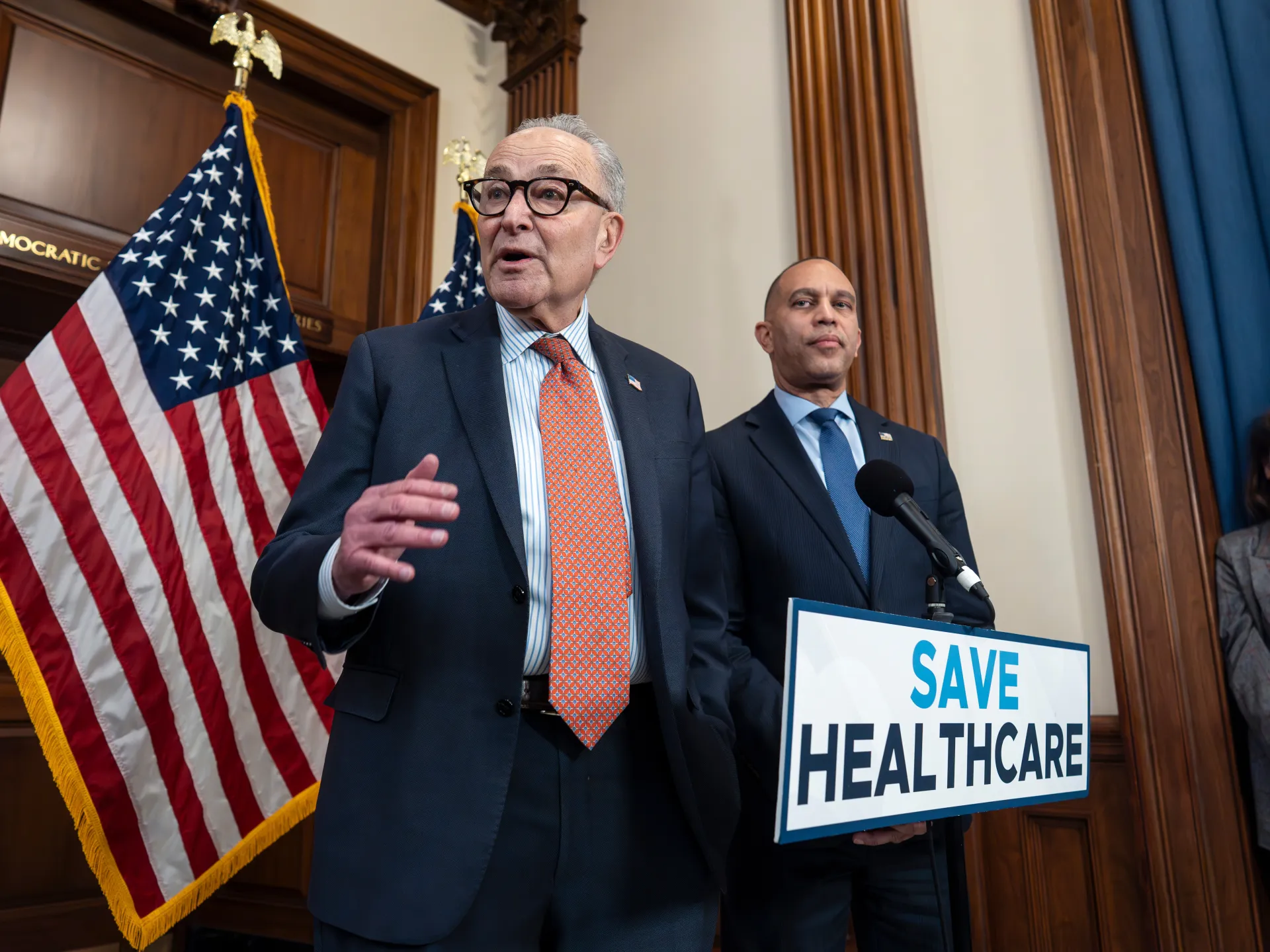
On Wednesday, four centrist Republicans in the House of Representatives broke with their party’s leadership to support a Democratic-backed extension for the healthcare subsidies under the Affordable Care Act (ACA), sometimes called “Obamacare”.
Recommended Stories
list of 3 itemsend of list
By a vote of 204 to 203, the House voted to stop the last-minute move by Democrats, aided by four Republicans, to force quick votes on a three-year extension of the Affordable Care Act subsidy.
Democrats loudly protested, accusing Republican leadership of gavelling an end to the vote prematurely while some members were still trying to vote.
“That’s outrageous,” Democratic Representative Jim McGovern of Massachusetts yelled at Republican leadership.
Some of the 24 million Americans who buy their health insurance through the ACA programme could face sharply higher costs beginning on January 1 without action by Congress.
Twenty-six House members had not yet voted – and some were actively trying to do so – when the House Republican leadership gavelled the vote closed on Wednesday. It is rare but not unprecedented for House leadership to cut a contested vote short.
Democratic Representative Rosa DeLauro of Connecticut said the decision prevented some Democrats from voting.
“Listen, it’s playing games when people’s lives are at stake,” DeLauro said. “They jettisoned it.”
It was the latest episode of congressional discord over the subsidies, which are slated to expire at the end of the year.
The vote also offered another key test to the Republican leadership of House Speaker Mike Johnson. Normally, Johnson determines which bills to bring to a House vote, but recently, his power has been circumvented by a series of “discharge petitions”, wherein a majority of representatives sign a petition to force a vote.
In a series of quickfire manoeuvres on Wednesday, Democrats resorted to one such discharge petition to force a vote on the healthcare subsidies in the new year.
They were joined by the four centrist Republicans: Mike Lawler of New York and Brian Fitzpatrick, Robert Bresnahan and Ryan MacKenzie of Pennsylvania.
The Democratic proposal would see the subsidies extended for three years.
But Republicans have largely rallied around their own proposal, a bill called the Lower Health Care Premiums for All Americans Act. It would reduce some insurance premiums, though critics argue it would raise others, and it would also reduce healthcare subsidies overall.
The nonpartisan Congressional Budget Office (CBO) on Tuesday said the legislation would decrease the number of people with health insurance by an average of 100,000 per year through 2035.
Its money-saving provisions would reduce federal deficits by $35.6bn, the CBO said.
Republicans have a narrow 220-seat majority in the 435-seat House of Representatives, and Democrats are hoping to flip the chamber to their control in the 2026 midterm elections.
Three of the four Republicans who sided with the Democrats over the discharge petition are from the swing state of Pennsylvania, where voters could lean right or left.
Affordability has emerged as a central question ahead of the 2026 midterms.
Even if the Republican-controlled House manages to pass a healthcare bill this week, it is unlikely to be taken up by the Senate before Congress begins a looming end-of-year recess that would stop legislative action until January 5.
By then, millions of Americans will be looking at significantly more expensive health insurance premiums that could prompt some to go without coverage.
Wednesday’s House floor battle could embolden Democrats and some Republicans to revisit the issue in January, even though higher premiums will already be in the pipeline.
Referring to the House debate, moderate Republican Senator Lisa Murkowski told reporters: “I think that that will help prompt a response here in the Senate after the first of the new year, and I’m looking forward to that.”
The ACA subsidies were a major point of friction earlier this year as well, during the historic 43-day government shutdown.
Democrats had hoped to extend the subsidies during the debate over government spending, but Republican leaders refused to take up the issue until a continuing budget resolution was passed first.
Washington, DC – For the past two years, weekdays for Susanna have meant thumbing through picture books, organising cubby holes and leading classroom choruses of songs.
But her work as a pre-school teacher came to a screeching halt in October, when she found out her application to renew her work permit had been denied.
Recommended Stories
list of 3 itemsend of list
Susanna, who uses a pseudonym in this article for fear of reprisals, is one of the nearly 10 percent of teachers in the United States who are immigrants.
But while the US has increasingly looked abroad to fill teacher shortages, some foreign-born teachers say the deportation push under President Donald Trump has threatened their livelihoods — and risks traumatising their students.
Susanna, an asylum applicant who fled violence in Guatemala nearly a decade ago, said that losing her permit meant she had to stop working immediately.
She recalls breaking the news to her students, some of whom are only three years old. Many were too young to understand.
“In one week, I lost everything,” Susanna told Al Jazeera in Spanish. “When I told the kids goodbye, they asked me why, and I told them, ‘I can only tell you goodbye.’ There were kids that hugged me, and it hurt my heart a lot.”
Advocates warn that the sudden departure of teachers could harm the development of young children in school [Mohammed Zain Shafi Khan/Al Jazeera]
Looking abroad for teachers
Estimates vary as to how many foreign-born teachers currently work in the US. But one 2019 report from George Mason University found that there were 857,200 immigrants among the country’s 8.1 million teachers, in roles ranging from pre-school to university.
For the 2023-2024 school year alone, the US government brought 6,716 full-time teachers to the country on temporary exchange visas to fill openings in pre-kindergarten, primary and secondary school education.
Many hailed from the Philippines, as well as countries like Jamaica, Spain and Colombia.
The uncertainty for immigrants under Trump’s second term, however, has proven disruptive to schools that rely heavily on foreign-born teachers.
That is the case for the pre-school where Susanna worked, CommuniKids, which offers language immersion programmes in Washington, DC.
Cofounder and president Raul Echevarría estimates that immigrants — both citizens and non-citizens working with legal authorisation — comprise about 90 percent of CommuniKids’s staff.
But Echevarría told Al Jazeera that the push to rescind legal pathways to immigration has jeopardised the employment of several faculty members.
Five other teachers at the school have seen their ability to work affected by changes to the Temporary Protected Status (TPS) programme.
All five, Echevarría explained, were originally from Venezuela. But in October, the Trump administration ended TPS status for more than 350,000 Venezuelan citizens, including the teachers at CommuniKids.
Their authorisation to work legally in the US will expire on October 2, 2026, according to the US Citizenship and Immigration Services website.
“These teachers lost their ability to make a living,” Echevarria said, noting that his school requires educators with expertise in languages like Spanish, French and Mandarin.
CommuniKids, a language immersion school in Washington, DC, helps young children develop skills in French, Mandarin and Spanish [Mohammed Zain Shafi Khan/Al Jazeera]
‘Strong bonds’
For the schools themselves, the losses can be devastating. Every state in the US has reported teacher shortages to the federal government.
But advocates say the high stress and low pay of education make teachers difficult to recruit and keep.
That leads some states to look abroad for education workers. In North Carolina, for example, 1,063 foreign nationals worked full-time as grade-school teachers on temporary J-1 visas during the 2023-2024 school year.
The top destinations for such recruits were all southern states: North Carolina was followed by Florida with 996 teachers on J-1 visas, and Texas with 761.
But Echevarria said some of the biggest impacts of the deportation drive are felt by the students themselves.
“Our students develop strong bonds with their teachers, and all of a sudden, overnight, they lost their teachers,” said Echevarría.
“Their number one superpower”, he added, “is their ability to empathise and to create strong, effective bonds with people from any background”.
But when those bonds are broken, there can be mental health consequences and setbacks for educational achievement, particularly among younger children.
A 2024 study published by the American Educational Research Association found that, when teachers leave midyear, children’s language development takes a measurable hit.
In other words, the loss of a familiar teacher — someone who knows their routines, strengths and fears — can quietly stall a child’s progress. The consequences extend to a child’s sense of self and stability.
Mental health consequences
For parents like Michelle Howell, whose child attends CommuniKids, the loss of teachers has also made the classroom environment feel fragile.
“The teachers there aren’t just teachers for these young kids,” Howell said of CommuniKids. “They’re like extended family.
“They hug them, they hold them, they do the things a parent would do. When those people disappear, it’s not just hard for the kids. It’s hard for everyone.”
Howell, who is Chinese American, said the sudden disappearances reminded her of her own family’s history.
“I used to read about things like this happening in China, the place my family left to find safety,” she said. “It’s very disturbing to know that what we ran from back then is our reality now. People disappear.”
School psychologist Maria C, who asked to remain anonymous to protect her work in the Texas public school system, has noticed the children she works with struggling with instability caused by the deportation push.
The disappearance of a loved one or mentor — say, a favourite teacher — could flood a child’s body with cortisol, the hormone meant to protect them in moments of danger, she explained.
But when that stress becomes chronic, the same hormone starts to hurt more than it helps. It interferes with memory, attention and emotional regulation.
“For some, it looks like anxiety. For others, it’s depression or sudden outbursts,” Maria said. “They’re in fight-or-flight mode all day.”
She added that selective mutism, an anxiety disorder, is on the rise among the children she sees, who range in age from five to 12.
“It used to be rare, maybe one case per school,” she said. “Now I see it constantly. It’s a quiet symptom of fear.”
Preparing for the worst
Back at CommuniKids, Echevarría explained that he and other staff members have put together contingency plans, just in case immigration enforcement arrives at the pre-school.
The aim, he said, is to make both employees and students feel safer coming to class.
“We put those steps in writing because we wanted our staff to know they’re not alone,” he said. “We have attorneys on call. We’re partners with local police. But above all, our job is to protect our children.”
But as an added precaution, teachers are advised to carry their passports or work permits with them.
Even Echevarría, a US citizen born in Virginia, said he carries his passport wherever he goes. The fear of deportation has a way of lingering.
“I’m bilingual and of Hispanic descent,” he said. “Given how things are, I want to be able to prove I’m a citizen if anyone ever questions it.”
Foreign nationals arrested for illegally processing applications under Trump’s contentious programme for white South Africans.
South Africa has arrested and ordered the deportation of seven Kenyan nationals who were illegally working at a centre processing refugee applications for a highly controversial United States resettlement programme aimed at only white Afrikaners.
The arrests on Tuesday in Johannesburg followed intelligence reports that the Kenyans had entered the country on tourist visas and taken up employment despite South Africa’s Home Affairs Department having previously denied work visa applications for the same positions.
Recommended Stories
list of 3 itemsend of list
The seven individuals will be banned from re-entering South Africa for five years.
The operation has led to a new diplomatic dispute between Pretoria and Washington, adding to tensions that have escalated throughout 2025 over US President Donald Trump’s widely rejected claims that white South Africans face “genocide” and racial persecution.
The US State Department told CNN that “interfering in our refugee operations is unacceptable” and said it would seek immediate clarification.
CNN reported that two US government employees were briefly detained during the raid, though South Africa’s statement said no American officials were arrested.
The Kenyans were working for processing centres run by Amerikaners, a group led by white South Africans, and RSC Africa, a Kenya-based refugee support organisation operated by Church World Service. These organisations handle applications for Trump’s programme, which has brought small numbers of white South Africans to the US this year.
South Africa’s Department of International Relations and Cooperation said the presence of foreign officials coordinating with undocumented workers “raises serious questions about intent and diplomatic protocol” and has initiated formal engagements with both the US and Kenya.
‘If you’re not white, forget about it’
Trump launched the resettlement programme in February through an executive order titled “Addressing Egregious Actions of The Republic of South Africa”, cutting all US aid and prioritising Afrikaner refugees who he claims face government-sponsored discrimination.
In September, he set a historic low refugee ceiling of 7,500 for 2026, with most spots reserved for white South Africans.
Scott Lucas, a professor of US and international politics at University College Dublin’s Clinton Institute, previously told Al Jazeera the contrast between how Trump treats white South African refugees, and refugees of colour from other countries, showed a “perverse honesty” about Trump’s conduct and worldview.
“If you’re white and you’ve got connections you get in,” Lucas said. “If you’re not white, forget about it.”
South Africa’s government strongly rejects the persecution allegations.
Foreign Minister Ronald Lamola has said there is no data supporting claims of white persecution, noting that Afrikaners are among the country’s “most economically privileged” citizens.
Major Afrikaner organisations also rejected Trump’s characterisation.
AfriForum and the Solidarity Movement, representing some 600,000 Afrikaner families, declined his refugee offer, saying emigration would mean “sacrificing their descendants’ cultural identity”.
The Afrikaner enclave of Orania said: “Afrikaners do not want to be refugees. We love and are committed to our homeland.”
Deteriorating relations
Trump has repeatedly presented debunked evidence to support his claims, including a choreographed and televised ambush of South African President Cyril Ramaphosa during a White House visit.
Trump played video in May featuring images later verified as being from the Democratic Republic of the Congo and footage of a temporary memorial that Trump falsely claimed showed mass graves.
Relations between the countries have deteriorated sharply this year.
Trump expelled South Africa’s ambassador in March, boycotted Johannesburg’s G20 summit in November, and last month excluded South Africa from participating in the 2026 Miami G20, calling it “not a country worthy of Membership anywhere” in a social media post.
Just one day before the arrests, South Africa condemned its G20 exclusion as an “affront to multilateralism”.
Israeli authorities are engaged in multiple major efforts, including building settlements and pursuing annexation, to ensure there will be no Palestinian state in the future.
Israeli authorities are expected to advance plans to build 9,000 new housing units in an illegal settlement on the site of the abandoned Qalandiya airport in occupied East Jerusalem, in another attempt to cut off Palestinian lands from each other and block any possibility of a contiguous Palestinian state ever emerging.
The so-called Atarot neighbourhood in northern East Jerusalem, reminiscent of the E1 plan to undermine Palestinian statehood, is to be discussed and have its outlines approved on Wednesday by the District Planning and Building Committee, according to Israeli group Peace Now.
Recommended Stories
list of 3 itemsend of list
The advocacy group said the new settlement is envisioned to be built within a densely populated Palestinian urban area, stretching from Ramallah in the occupied West Bank and Kafr Aqab in the north through the Qalandiya refugee camp, ar-Ram, Beit Hanina and Bir Nabala.
It would build an Israeli enclave in an area where hundreds of thousands of Palestinians live in close proximity, with the aim of blocking development in a key area and further damaging the likelihood of a sovereign Palestinian state being established.
“This is a destructive plan that, if implemented, would prevent any possibility of connecting East Jerusalem with the surrounding Palestinian area and would, in practice, prevent the establishment of a Palestinian state alongside Israel,” Peace Now said.
Translation: The massacre government is working to establish a new ultra-Orthodox mega-settlement across the Green Line north of Jerusalem. The new political attack called ‘Atarot’ is planned to be built in the heart of the Palestinian state that will be established alongside Israel. This involves 9,000 housing units that Israel will have to evacuate. Isn’t it a shame?
The organisation said the far-right government of Prime Minister Benjamin Netanyahu is seizing every moment to bury chances for a future of peace and compromise.
“Especially now, when it is clear to everyone that the ideas of ‘managing the conflict’ and ‘decisive victory’ have led to a security disaster for Israel, we must act to resolve the conflict.”
The plan’s advancements date back to early 2020, when Israel’s Housing Ministry sent it to the Jerusalem municipality to prepare it for approval. It completed the bureaucratic preparation process within months, but faced objections from the Environmental Protection and Health ministries, according to Peace Now, which said the administration of United States President Barack Obama had also opposed it.
It would need further government consideration and approval before being given legal effect and moving towards tender processes to select construction contractors.
Most of the plan area is designated as “state land” by Israeli authorities, meaning they would not have to seek permission from Palestinian landowners.
Israel has been quickly advancing with several major projects to build illegal settlements on occupied Palestinian territory and pursuing annexation of the occupied West Bank, alongside its genocidal war on Gaza that started in October 2023 and has now killed more than 70,000 people.
The E1 plan, which would see the construction of thousands of illegal Israeli homes in the occupied West Bank, is hailed by Israeli officials despite international condemnation.
Israel’s security cabinet last week signed off on plans to formalise 19 illegal settlements across the West Bank.
Demolitions and widespread arrests
Israeli forces continue to launch raids across the occupied West Bank and support violent settlers in attacking Palestinian lands while issuing permits to demolish Palestinian homes.
Israeli authorities began carrying out demolition operations Wednesday morning in the town of Biddu, located northwest of occupied East Jerusalem, under the pretext that the Palestinian buildings lacked permits.
In the central part of the West Bank, settlers, who have been rampaging with impunity often backed by the Israeli military, burned Palestinian vehicles and wrote racist slogans in the village of Ein Yabrud in Ramallah on Wednesday.
Several Palestinians were also arrested during raids across the West Bank, including in Nablus.