Australia’s government is fending off political attacks from inside and outside the country after the Bondi massacre. Israeli leaders and interest groups have been condemned for trying to politicise the killings, as Soraya Lennie explains.
Philippine armed forces advance into Marawi city on the southern island of Mindanao amid fierce fighting with foreign Islamist fighters and local rebels allied to ISIS in May 2017. The then-President and former mayor of Davao City, Rodrigo Duterte, declared martial law in the region days later. Australian police believe the Bondi terror attack suspects received training from militants on the island. File photo by Francis R. Malasig/EPA
Dec. 16 (UPI) — The two suspects in the deadly mass terror attack in Bondi Beach in Sydney over the weekend spent most of November in the southern Philippines, where they allegedly received military-style training from Islamic militants.
The Philippine Bureau of Immigration told ABC News on Tuesday that the father and son, Sajid Akram, 50, and Naveed Akram, 24, arrived in the Philippines from Australia on Nov. 1, giving Davao on the southern island of Mindanao as their destination.
“They left the country on Nov. 28, on a connecting flight from Davao to Manila, with Sydney as their final destination,” said Immigration Bureau spokesperson Dana Sandoval.
Australian national security officials said investigators were now looking at the duo’s links to an international jihadist network after a senior counterterrorism officer said the pair underwent terrorist training on the island.
The development came hours after Prime Minister Anthony Albanese declared that the pair were motivated by “Islamic State ideology” after the discovery by police of flags of the jihadist group and improvised explosive devices in the suspects’ car.
Philippine and Australian officials said they were working together to establish exact details of where the pair stayed and their movements with Australian Foreign Minister Penny Wong and her Philippine counterpart Maria Theresa Lazaro vowing to “keep each other closely informed” of progress in the investigation into Sunday’s attack targeting Jews celebrating Hanukkah.
“The Philippines stands firmly in solidarity with Australia and underscores strong Philippine-Australia cooperation in security and law enforcement matters. We reaffirm our support for efforts that protect communities from intolerance, hatred, and violence,” said Lazaro.
The largely Muslim region of the predominantly Catholic country has been a base for Islamic militants for decades after terror camps relocated there from the Afghanistan-Pakistan border in the 1990s, with the Philippine military at war with the secessionist Moro Islamic Liberation Front and Moro Islamic Liberation Front before that.
In 2017, ISIS fighters laid siege to the city of Marawi in Mindanao for five months, prompting the central government in Manila to launch an all-out military offensive to regain control.
A New South Wales health department spokesman said 22 people were still being treated for their injuries in the hospital, nine of whom were in a critical condition following the shooting attack in which 15 people were killed.
The victims included children, survivors of the Holocaust and two rabbis.
Authorities said Akram Naveed, who was shot and wounded by police, had regained consciousness in the hospital. The elder Akram was shot dead by police at the scene.
South Africans honor Nelson Mandela
Large crowds gather outside Nelson Mandela’s former home in the Johannesburg suburb of Houghton to pay their respects on December 7, 2013. Mandela, former South African president and a global icon of the anti-apartheid movement, died on December 5 at age 95 after complications from a recurring lung infection. Photo by Charlie Shoemaker/UPI | License Photo
A British driver who injured more than 130 people by ploughing his car into a crowd of Liverpool football fans during a championship victory parade in May has been sentenced to 21-and-a-half years.
Paul Doyle, 54, rammed his minivan into the mass of fans in the city of Liverpool simply because he lost his temper, according to prosecutors. Last month, he pleaded guilty to charges including nine counts of causing grievous bodily harm with intent and 17 counts of attempting to cause grievous bodily harm.
“The footage is truly shocking,” Judge Andrew Menary said on Tuesday.
“It is difficult if not impossible to convey in words alone the scenes of devastation you caused. It shows you deliberately accelerating into groups of fans, time and time again.”
Dec. 16 (UPI) — President Donald Trump is suing the BBC for $10 billion, alleging it intentionally misrepresented a speech he gave before the Jan. 6 storming of Capitol Hill in order to influence the result of the 2024 presidential election.
The lawsuit was filed in a Florida court on Monday, more than a month after Trump threatened to bring litigation against Britain’s public broadcaster over the editing of a speech he gave to supporters in Washington on Jan. 6, 2021, in the documentary Trump: A Second Chance.
Trump’s lawyers described the documentary’s depiction of him as “false, defamatory, deceptive, disparaging, inflammatory and malicious,” alleging it was aired “in a brazen attempt to interfere in and influence the election’s outcome to President Trump’s detriment.”
The suit is for $5 billion in damages, plus interest, costs, punitive damages, attorneys’ fees and other relief the court finds appropriate.
The BBC declined to comment Tuesday but vowed it would fight the case.
“As we have made clear previously, we will be defending this case. We are not going to make further comment on ongoing legal proceedings,” said a spokesman.
The Panorama documentary aired in Britain on Oct. 28, 2024, just days ahead of the Nov. 5 election. The BBC stresses it was not broadcast in the United States and that it did not make it available to view there.
In the documentary, video of Trump’s speech was edited to piece together two comments the president made about 50 minutes apart, while omitting other parts of his speech.
“[T]he BBC “intentionally and maliciously sought to fully mislead its viewers around the world by splicing together two entirely separate parts of Trump’s speech on January 6, 2021,” his lawyers state in the lawsuit.
“The Panorama Documentary deliberately omitted another critical part of the Speech in such a manner as to intentionally misrepresent the meaning of what President Trump said.”
The claim refers to the splicing together of excerpts lifted from the video that made it sound as if Trump was inciting his supporters to march on the Capitol and fight:
“We’re going to walk down to the Capitol and I’ll be there with you. And we fight. We fight like hell,” was what viewers of the program saw, when Trump’s actual words were, “We’re going to walk down to the Capitol, and we’re going to cheer on our brave senators and congressmen and women.”
It wasn’t until 50 minutes later in the speech that Trump made the comments about fighting.
The infraction went unnoticed until early November when The Telegraph published an exclusive on a leaked internal BBC memo in which a former external ethics adviser allegedly suggested that the documentary edited Trump’s speech to make it appear he directed the Jan. 6 attack on Congress.
Following the report, the BBC’s director-general, Tim Davie, and head of news, Deborah Turness, resigned.
BBC chairman Samir Shah immediately apologized for what he called an unintentional “error of judgment.”
After Trump wrote the BBC demanding a correction, compensation and threatening a $1 billion lawsuit, the corporation formally apologized and issued a retraction that was the lead story across all of its news platforms on television, radio and online — but said it strongly disagreed “there is a basis for a defamation claim.”
To win the case, Trump’s legal team would need to convince the court the program had caused Trump “overwhelming financial and reputational harm.”
The BBC has said that since the program was not broadcast in the United States or available to view there, Trump was not harmed by it and the choices voters made in the election were not affected as he was re-elected days after.
However, Trump’s legal team alleges the BBC had a deal with a third-party media company that had rights to air the documentary outside of the United Kingdom.
The blunder has reignited a furious national debate about the BBC’s editorial impartiality and the institution itself, which is funded by a $229 annual license that households with a TV must pay.
It also comes as the future of the BBC is under review, with the renewal date of its royal charter approaching on the centenary of its founding in 2027.
Trump has won out-of-court settlements in a series of disputes with U.S. broadcasters, although largely at significantly reduced sums than those sought in the original lawsuit.
In July, CBS settled a $20 billion claim out of court for $16 million over an interview with Democratic presidential nominee Kamala Harris that aired four weeks before the election on Nov. 5.
ABC News paid Trump $15 million and apologized to settle a defamation suit over comments by presenter George Stephanopoulos that incorrectly stated Trump was “liable for rape.”
In 2022, CNN fought and successfully defended a $475 million suit alleging it had defamed Trump by dubbing his claim the 2020 election was stolen from him as the “Big Lie.” The judge ruled it did not meet the legal standard of defamation.
He has live cases pending cases against the Wall Street Journal and The New York Times.
President Donald Trump and first lady Melania Trump attend the Congressional Ball in the Grand Foyer of the White House on Thursday. Photo by Shawn Thew/UPI | License Photo
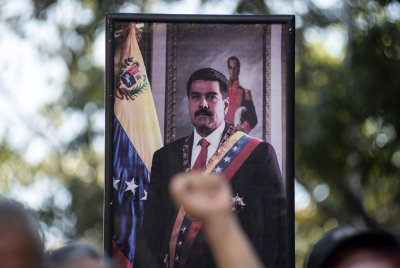
President Maduro’s rival was hurt as she sped on a boat through choppy waters in secret escape from hiding to reach Oslo ceremony.
Published On 16 Dec 202516 Dec 2025
Share
Venezuelan opposition leader Maria Corina Machado was injured as she made a clandestine dash to collect her Nobel Peace Prize last week, her spokesperson has said.
Claudia Macero said late on Monday that the right-wing opposition figure fractured a vertebra during a choppy boat ride that had formed part of a risky cloak-and-dagger journey to reach the Norwegian capital, Oslo, for the Nobel award ceremony.
Recommended Stories
list of 4 itemsend of list
Machado has been in hiding since she was banned from running in Venezuela’s July 24 presidential election, fearing that her life is under threat from long-time Venezuelan President Nicolas Maduro.
“The vertebra fracture is confirmed,” Macero told the AFP news agency, adding that no further details would be released beyond what had been reported in the Norwegian daily Aftonbladet.
The newspaper had earlier reported that the 58-year-old Machado sustained the fracture while crossing the sea in a small fishing boat battered by high waves.
The opposition leader was examined by doctors at Oslo University Hospital during her time in the city.
Dangerous dash
Media reports in the United States said Machado’s escape last week involved wearing a disguise, including a wig, and travelling from a small Venezuelan fishing village on a wooden boat to the island of Curacao, before boarding a private plane to Norway.
Machado has said she feared for her life during the voyage, which saw US forces situated in the Caribbean alerted to avoid a strike on the vessel.
Several similar boats have been attacked in recent months in a campaign that the Trump administration asserts is a bid to avert drug smuggling into the US.
Maduro has accused Washington of seeking to engineer regime change in the hope of seizing Venezuela’s large oil reserves.
The leader of the opposition Vente Venezuela party was attempting to reach the ceremony at which she was due to be presented with the Nobel Peace Prize.
She was announced the winner of the prestigious award in October, with the selection committee praising her role in the country’s opposition movement and her “steadfast” support for democracy.
‘Broken soul’
Despite her speedy trip, Machado failed to reach Oslo in time for the ceremony. Her daughter received the award on her behalf and delivered a speech that slammed Maduro and warned of the need to fight for democracy.
Hours after the ceremony, early on Thursday morning, Machado greeted supporters from an Oslo hotel balcony in what was her first public appearance in a year.
Despite the fracture, she climbed over a barrier to greet supporters outside the hotel, AFP reported.
Machado said authorities in Venezuela would have attempted everything possible to prevent her journey to Norway.
Appearing set to challenge Maduro in the vote, the opposition leader was barred from running in the country’s presidential election in July last year.
She then announced that she would be going into hiding within Venezuela due to fear for her life while Maduro is in power.
The Venezuelan president commented dismissively on the reports of Machado’s injury on television on Monday.
Machado “says she has a broken vertebra”, he said. “What’s broken is her brain and her soul because she’s a demon – she hates Venezuela.”
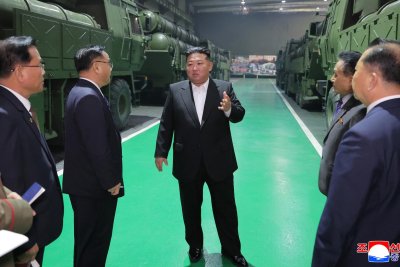
SEOUL, Dec. 16 (UPI) — The likelihood of a renewed summit between U.S. President Donald Trump and North Korean leader Kim Jong Un has increased, even as Pyongyang presses ahead with nuclear weapons development, a South Korean think tank said Tuesday.
In an annual forecast released by the Foreign Ministry-linked Korea National Diplomatic Academy, analysts said Trump is expected to continue a top-down approach to North Korea under which leader-level talks could resume.
“The likelihood of a North Korea-U.S. summit has increased somewhat due to common ground in the two leaders’ desire to hold a summit, pursue peaceful coexistence and lower the priority of the denuclearization issue,” the report said.
Trump met Kim three times during his first term — in Singapore in 2018, in Hanoi in 2019 and briefly at the Demilitarized Zone later that year — but talks collapsed amid disagreements over sanctions relief and steps toward denuclearization.
Since returning to office, Trump has floated another summit with Kim on numerous occasions, telling reporters in October he “would love” to meet the North Korean leader during a visit to South Korea.
Kim has also signaled a willingness to resume diplomacy with Washington, saying he has “fond memories” of Trump, while warning that any discussion of giving up his regime’s nuclear arsenal would be off the table.
Despite the prospect of renewed diplomacy, the KNDA report said engagement with Washington is unlikely to slow Pyongyang’s military buildup.
North Korea is expected to “accelerate the production of nuclear materials and the development and deployment of new missile systems” in 2026 as it works to operationalize a broader range of nuclear strike capabilities, the report said.
The academy added that a seventh nuclear test remains a “military and technological necessity,” although Pyongyang is likely to exercise restraint as it weighs the impact on its relations with China and the United States.
North Korea last conducted a nuclear test in September 2017 at its Punggye-ri site. During a period of detente with Seoul and Washington the following year, Pyongyang demolished the entrances to two test tunnels in a highly publicized move.
Those steps have since been reversed, however. The U.N. nuclear watchdog International Atomic Energy Agency said North Korea began restoring tunnels at the site in 2022, and a 2025 U.S. Defense Intelligence Agency assessment concluded the country is now “postured to conduct a seventh nuclear test at a time of its choosing.”
Prospects for inter-Korean relations remain dim, the report said, despite efforts by South Korean President Lee Jae Myung to rehabilitate ties since taking office in June
Communication between Seoul and Pyongyang is unlikely to resume as the North continues to promote its “hostile two-state doctrine,” which defines the two Koreas as permanently separate adversaries.
“The likelihood of inter-Korean dialogue reopening is not high,” the report said.
When armed soldiers in the small West African nation of Benin appeared on national television on December 7 to announce they had seized power in a coup, it felt to many across the region like another episode of the ongoing coup crisis that has seen several governments toppled since 2020.
But the scenes played out differently this time.
Recommended Stories
list of 4 itemsend of list
Amid reports of gunfire and civilians scampering to safety in the economic capital, Cotonou, Beninese and others across the region waited with bated breath as conflicting intelligence emerged. The small group of putschists, on the one hand, declared victory, but Benin’s forces and government officials said the plot had failed.
By evening, the situation was clear – Benin’s government was still standing. President Patrice Talon and loyalist forces in the army had managed to hold control, thanks to help from the country’s bigger neighbours, particularly its eastern ally and regional power, Nigeria.
While Talon now enjoys victory as the president who could not be unseated, the spotlight is also on the Economic Community of West African States (ECOWAS). The regional bloc rallied to save the day in Benin after their seeming resignation in the face of the crises rocking the region, including just last month, when the military took power in Guinea-Bissau.
This time, though, after much criticism and embarrassment, ECOWAS was ready to push back against the narrative of it being an ineffective bloc by baring its teeth and biting, political analyst Ryan Cummings told Al Jazeera.
“It wanted to remind the region that it does have the power to intervene when the context allows,” Cummings said. “At some point, there needed to be a line drawn in the sand [and] what was at stake was West Africa’s most stable sovereign country falling.”
People gather at the market of Dantokpa, two days after Benin’s forces thwarted the attempted coup against the government, in Cotonou, December 9, 2025 [Charles Placide Tossou/Reuters]
Is a new ECOWAS on the horizon?
Benin’s military victory was an astonishing turnaround for an ECOWAS that has been cast as a dead weight in the region since 2020, when a coup in Mali spurred an astonishing series of military takeovers across the region in quick succession.
Between 2020 and 2025, nine coup attempts toppled five democratic governments and two military ones. The latest successful coup, in Guinea-Bissau, happened on November 28. Bissau-Guineans had voted in the presidential election some days before and were waiting for the results to be announced when the military seized the national television station, detained incumbent President Umaro Sissoco Embalo, and announced a new military leader.
ECOWAS, whose high-level delegation was in Bissau to monitor the electoral process when the coup happened, appeared on the back foot, unable to do much more than issue condemnatory statements. Those statements sounded similar to those it issued after the coups in Mali, Burkina Faso, Niger, and Guinea. The bloc appeared a far cry from the institution that, between 1990 and 2003, successfully intervened to stop the civil wars in Liberia and Sierra Leone, and later in the Ivory Coast. The last ECOWAS military intervention, in 2017, halted Gambian dictator Yahya Jammeh’s attempt to overturn the election results.
Indeed, ECOWAS’s success in its heyday hinged on the health of its members. Nigeria, arguably ECOWAS’s backbone, whose troops led the interventions in Liberia and Sierra Leone, has been mired in insecurity and economic crises of its own lately. In July 2023, when Nigeria’s President Bola Ahmed Tinubu was the ECOWAS chair, he threatened to invade Niger after the coup there.
It was disastrous timing. Faced with livelihood-eroding inflation and incessant attacks by armed groups at home, Nigerians were some of the loudest voices resisting an invasion. Many believed Tinubu, sworn in just months earlier, had misplaced his priorities. By the time ECOWAS had finished debating what to do weeks later, the military government in Niger had consolidated support throughout the armed forces and Nigeriens themselves had decided they wanted to back the military. ECOWAS and Tinubu backed off, defeated.
Niger left the alliance altogether in January this year, forming the Alliance of Sahel States (AES) with fellow military governments in Mali and Burkina Faso. All three share cultural and geographic affinities, but are also linked by their collective dislike for France, the former colonial power, which they blame for interfering in their countries. Even as they battle rampaging armed groups like Jama’at Nusrat al-Islam wal-Muslimin (JNIM), the three governments have cut ties with French forces formerly stationed there and welcomed Russian fighters whose effectiveness, security experts say, fluctuates.
Sierra Leone’s President Julius Maada Bio, who chairs ECOWAS, walks with Guinea-Bissau’s transitional president, Major-General Horta Inta-A, during a meeting in Bissau, Guinea-Bissau, on December 1, 2025 [Delcyo Sanca/Reuters]
But Benin was different, and ECOWAS appeared wide awake. Aside from the fact that it was one coup too far, Cummings said, the country’s proximity to Nigeria, and two grave mistakes the putschists made, gave ECOWAS a fighting chance.
The first mistake was that the rebels had failed to take Talon hostage, as is the modus operandi with putschists in the region. That allowed the president to directly send an SOS to his counterparts following the first failed attacks on the presidential palace at dawn.
The second mistake was perhaps even graver.
“Not all the armed forces were on board,” Cummings said, noting that the small group of about 100 rebel soldiers had likely assumed other units would fall in line but had underestimated how loyal other factions were to the president. That was a miscalculation in a country where military rule ended in 1990 and where 73 percent of Beninese believe that democracy is better than any other form of government, according to poll site Afrobarometer. Many take particular pride in their country being hailed as the region’s most stable democracy.
“There was division within the army, and that was the window of opportunity that allowed ECOWAS to deploy because there wasn’t going to be a case of ‘If we deploy, we will be targeted by the army’. I dare say that if there were no countercoup, there was no way ECOWAS would have gotten involved because it would have been a conventional war,” Cummings added.
Quickly reading the room, Benin’s neighbours reacted swiftly. For the first time in nearly a decade, the bloc deployed its standby ground forces from Nigeria, Ghana, the Ivory Coast, and Sierra Leone. Abuja authorised air attacks on rebel soldiers who were effectively cornered in a military base in Cotonou and at the national TV building, but who were putting up a last-ditch attempt at resistance. France also supported the mission by providing intelligence. By nightfall, the rebels had been completely dislodged by Nigerian jets. The battle for Cotonou was over.
At least 14 people have since been arrested. Several casualties were reported on both sides, with one civilian, the wife of a high-ranking officer marked for assassination, among the dead. On Wednesday, Beninese authorities revealed that the coup leader, Colonel Pascal Tigri, was hiding in neighbouring Togo.
At stake for ECOWAS was the risk of losing yet another member, possibly to the landlocked AES, said Kabiru Adamu, founder of Abuja-based Beacon Security intelligence firm. “I am 90 percent sure Benin would have joined the AES because they desperately need a littoral state,” he said, referring to Benin’s Cotonou port, which would have expanded AES export capabilities.
Nigeria could also not afford a military government mismanaging the deteriorating security situation in northern Benin, as has been witnessed in the AES countries, Cummings said. Armed group JNIM launched its first attack on Nigerian soil in October, adding to Abuja’s pressures as it continues to face Boko Haram in the northeast and armed bandit groups in the northwest. Abuja has also come under diplomatic fire from the US, which falsely alleges a “Christian genocide” in the country.
“We know that this insecurity is the stick with which Tinubu is being beaten, and we already know his nose is bloodied,” Cummings said.
Revelling in the glory of the Benin mission last Sunday, Tinubu praised Nigeria’s forces in a statement, saying the “Nigerian armed forces stood gallantly as a defender and protector of constitutional order”. A group of Nigerian governors also hailed the president’s action, and said it reinforced Nigeria’s regional power status and would deter further coup plotters.
Nigerian ECOWAS Ceasefire Monitoring Group (ECOMOG) soldiers guard a corner in downtown Monrovia during fighting between militias loyal to Charles Taylor and Roosevelt Johnson in Liberia in 1996. Between 1990-2003, ECOWAS successfully intervened to help stop the Liberian civil war [File: Reuters]
Not yet out of the woods
If there is a perception that ECOWAS has reawakened and future putschists will be discouraged, the reality may not be so positive, analysts say. The bloc still has much to do before it can be taken seriously again, particularly in upholding democracy and calling out sham elections before governments become vulnerable to mass uprisings or coups, Beacon Security’s Adamu said.
In Benin, for example, ECOWAS did not react as President Talon, in power since 2016, grew increasingly autocratic, barring opposition groups in two previous presidential elections. His government has again barred the main opposition challenger, Renaud Agbodjo, from elections scheduled for next April, while Talon’s pick, former finance minister Romuald Wadagni, is the obvious favourite.
“It’s clear that the elections have been engineered already,” Adamu said. “In the entire subregion, it’s difficult to point to any single country where the rule of law has not been jettisoned and where the voice of the people is heard without fear.”
ECOWAS, Adamu added, needs to proactively re-educate member states on democratic principles, hold them accountable when there are lapses, as in the Benin case, and then intervene when threats emerge.
The bloc appears to be taking heed. On December 9, two days after the failed Benin coup, ECOWAS declared a state of emergency.
“Events of the last few weeks have shown the imperative of serious introspection on the future of our democracy and the urgent need to invest in the security of our community,” Omar Touray, ECOWAS Commission president, said at a meeting in the Abuja headquarters. Touray cited situations that constitute coup risks, such as the erosion of electoral integrity and mounting geopolitical tensions, as the bloc splits along foreign influences. Currently, ECOWAS member states have stayed close to Western allies like France, while the AES is firmly pro-Russia.
Another challenge the bloc faces is managing potential fallout with the AES states amid France’s increasing closeness with Abuja. As Paris faces hostility in Francophone West Africa, it has drawn closer to Nigeria, where it does not have the same negative colonial reputation, and which it perceives as useful for protecting French business interests in the region, Cummings said. At the same time, ECOWAS is still hoping to woo the three rogue ex-members back into its fold, and countries like Ghana have already established bilateral ties with the military governments.
“The challenge with that is that the AES would see the intervention [in Benin] as an act not from ECOWAS itself but something engineered by France,” Adamu said. Seeing France instigating an intervention which could have benefitted AES reinforces their earlier complaints that Paris pokes its nose into the region’s affairs, and could push them further away, he said.
“So now we have a situation where they feel like France did it, and the sad thing is that we haven’t seen ECOWAS dispel that notion, so the ECOWAS standby force has [re]started on a contentious step,” Adamu added.
Pro-Palestine, antigovernment, anti-colonial group accused of targeting immigration agents and companies in ‘massive and horrific terror plot’.
Published On 16 Dec 202516 Dec 2025
Share
Federal authorities in the United States have arrested four members of an antigoverment left-wing group over an alleged bomb plot targeting immigration agents and companies, among others, in California, officials have said.
Announcing the arrests on Monday, US Attorney General Pam Bondi said the Justice Department and the Federal Bureau of Investigation had disrupted “a massive and horrific terror plot” being prepared by the Turtle Island Liberation Front.
Recommended Stories
list of 2 itemsend of list
“The Turtle Island Liberation Front – a far-left, pro-Palestine, anti-government, and anti-capitalist group – was preparing to conduct a series of bombings against multiple targets in California beginning on New Year’s Eve,” Bondi said in a statement.
She was careful to note that among the group’s planned targets were Immigration and Customs Enforcement (ICE) agents and their vehicles.
Audrey Illeene Carroll, 30; Zachary Aaron Page, 32; Dante Gaffield, 24; and Tina Lai, 41, have been charged with conspiracy and possession of an unregistered destructive device. Officials said additional charges are expected.
Desert meeting
The suspects, who are all from the Los Angeles area, were arrested on Friday in the Mojave Desert as they were working on the plot, First Assistant US Attorney Bill Essayli told a news conference.
Officials showed reporters’ surveillance footage of the suspects in the desert moving a large black object to a table. The group was arrested before they had the opportunity to build a functional bomb, the officials said.
Essayli said Carroll had created a detailed plan to bomb at least five locations. The plot included the targeting of two “Amazon-type” logistics centres operated by US companies in the Los Angeles area on New Year’s Eve.
Backpacks filled with IEDs that were to be detonated simultaneously at midnight were to be left at the locations. The group believed the explosions would be less likely to be noticed due to fireworks detonated during the celebrations.
Two of the suspects had discussed plans for attacks targeting ICE agents and vehicles with pipe bombs early next year, according to the complaint.
Officials said the suspects were an offshoot of a group dubbed the Turtle Island Liberation Front, which says it is for the “liberation of all colonised peoples”.
The group, which has a small social media following, describes itself on Facebook as a political organisation advocating for the “Liberation of occupied Turtle Island and liberation of all colonized peoples across the world”.
The term “Turtle Island” is used by some Indigenous peoples to describe North America in a way that reflects its existence outside the colonial boundaries put in place by the US and Canada. It comes from Indigenous creation stories where the continent was formed on the back of a giant turtle.
Activists affiliated with the group have previously organised campaigns against detentions and deportations by ICE, as well as anti-colonial issues.
Los Angeles Police Chief Jim McDonnell said while federal and local officials disagree on the Trump administration’s immigration raids, they still come together to protect residents.
Dec. 16 (UPI) — President Donald Trump has awarded 13 soldiers and Marines the newly established Mexican Border Defense Medal for their contributions to safeguarding the U.S. southern border.
The service members are the first to receive the commendation, created Aug. 13 in a memo signed by Defense Secretary Pete Hegseth to honor those deployed to the U.S.-Mexico border.
The commander-in-chief awarded the medals to the service members at the White House.
“On day one of my administration, I signed an executive order making it [the] core mission of the United States military to protect and defend the homeland. And today, we’re here to honor our military men and women for their central role in the protection of our border,” Trump said during the ceremony.
Since returning to the White House in January, Trump has overseen crackdowns on immigration and crime that have included the deployment of troops to the U.S.-Mexico border.
More than 10,000 U.S. military service members attached to Joint Task Force Southern Border have been deployed to the U.S.-Mexico border in support of the Department of Homeland Security, with the missions to secure the border, disrupt transnational criminal organizations and respond to national security threats.
Trump said Monday that more than 25,000 service members have served in this “incredible and historic operation,” which has overseen 13,000 patrols along the border.
“They’ve spent night and day enduring scorching hot and bitter cold, and they’ve given up their holidays and their weekends, working with the offices of Customs and Border Protection,” Trump said.
“And today, we give these great warriors the recognition that they have earned — and they have really earned it.”
The medal, according to the Department of Defense, is identical to the Mexican Border Service Medal awarded for service in 1916 and 1917 in the Mexican state of Chihuahua as well as the U.S.-Mexico border regions in New Mexico and Texas.
It is bronze with a sheathed Roman sword hanging on a tablet on the front, which bears an inscription that reads: “For Service on the Mexican Border.”
Those eligible for the award must have been permanently assigned to a designated Department of Defense military operation supporting CBP within the area of eligibility for at least 30 consecutive or non-consecutive days from Jan. 20 of this year.
“We’re proud of this mission,” Hegseth said during the White House event. “We’re proud to defend the American people and pinning these medals on is an example of how important it is to us.”
The Trump administration states that its crackdown has resulted in more than 2.5 million undocumented migrants removed from the United States and the lowest level of illegal border crossings since 1970.
Dec. 16 (Asia Today) — “Decade of the Spy” was a label used by U.S. media in the 1980s, when major espionage cases involving the former Soviet Union were uncovered year after year. In 2025, the phrase has resurfaced in a different context: most information is now digital, physical distance matters less, and the security environment has shifted toward a broader “all-against-all” competition.
Against that backdrop, South Korea is pushing amendments to Article 98 of the Criminal Act, commonly referred to as the Espionage Act. Enacted in 1953, the law has historically been applied primarily to North Korea, even as alleged espionage activity linked to other countriesh as increased. The proposed revision would allow espionage acts carried out on behalf of any foreign country to be prosecuted under the same statute.
But practitioners argue that changing the law is not enough. Bae Jeong-seok, an adjunct professor at Sungkyunkwan University’s Graduate School of National Strategy and a former National Intelligence Service counterespionage bureau chief with more than 30 years of experience, said revising the law is “normalization,” not a full upgrade of counterintelligence capacity.
In an interview with Asia Today on Dec. 8, Bae said counterespionage should be treated not only as a criminal matter but as a national security function that requires long-term operations and can carry diplomatic value.
-What structural limitations existed for counterespionage activities under the current legal framework?
“Today’s intelligence environment is not like the Cold War, when you mainly focused on one adversary. It involves many state actors. But in South Korea, activity linked to foreign intelligence services other than North Korea often could not be charged as espionage. It was handled under separate laws protecting military secrets or industrial technology. In counterintelligence, the core is recruiting sources and running counter-operations, including using double agents, to gather more information. If everything is treated only as a standard criminal case, it limits intelligence work that needs time and flexibility.”
-How does this revised espionage bill compare to major advanced nations?
“This is not ‘toughening’ the law so much as bringing South Korea in line with what many advanced countries already have. But legal tools to deal with influence operations are still limited. Efforts to shape public opinion, cultivate media ties, or influence policymaking can be hard to prosecute under traditional espionage charges. A separate reporting-based system like the U.S. Foreign Agents Registration Act, which requires disclosure of certain activities performed on behalf of foreign principals, is also needed.”
-What will change with this amendment?
“It can help deter and disrupt foreign intelligence activity. If recruiting agents or providing information to a foreign intelligence service is itself treated as espionage, authorities can investigate earlier and more directly. That reduces the risk of South Korean citizens being recruited. It also gives counterintelligence more room to run long-term operations instead of moving immediately to prosecution in every case.”
-What aspects of the amendment require further refinement?
“The most important point is allowing strategic decision-making. Counterespionage should not be limited to catching spies and quickly building a prosecution. It requires understanding how networks operate over time, then recruiting and turning sources. In some cases, captured agents can also be used as leverage in security and diplomatic channels. Without that kind of approach, you fall behind in modern intelligence competition.”
-Beyond legal amendments, what direction should counterespionage personnel, technology, and organizational culture take?
“Police are expanding counterespionage efforts, but the main responsibility should remain with the NIS, which has the specialized experience. Police, which have investigative authority, can focus on arrests and prosecution. Coordination between the two needs to improve. Over the long term, South Korea should consider a dedicated counterintelligence body. This work requires continuity, and the typical government job-rotation system is not well suited to long-term operations.”
Exiled punk band says its members are proud to be branded ‘extremists’ and hits back at Putin as an ‘aging sociopath’.
A Moscow district court has designated Russian punk protest band Pussy Riot as an extremist organisation, according to the state TASS news agency.
The exiled group’s lawyer, Leonid Solovyov, told TASS that Monday’s court ruling was made in response to claims brought by the Russian Prosecutor General’s Office and that the band plans to appeal. According to TASS, the case was heard in a closed session at the request of the Prosecutor General’s Office.
Recommended Stories
list of 4 itemsend of list
The court said that it had upheld prosecution submissions “to recognise the punk band Pussy Riot as an extremist organisation and ban its activities on the territory of the Russian Federation”, the AFP news agency reports.
An official Pussy Riot social media account shared a statement, responding defiantly to the ruling, saying the band’s members, who have lived in exile for years, were “freer than those who try to silence us”.
“We can say what I think about putin — that he is an aging sociopath spreading his venom around the world like cancer,” the statement said.
“In today’s Russia, telling the truth is extremism. So be it – we’re proud extremists, then.”
The group’s designation will make it easier for the authorities to go after the band’s supporters in Russia or people who have worked with them in the past.
“This court order is designed to erase the very existence of Pussy Riot from the minds of Russians,” the band said. “Owning a balaclava, having our song on your computer, or liking one of our posts could lead to prison time.”
According to TASS, earlier reports said that the Prosecutor General’s Office had brought the case over Pussy Riot’s previous actions, including at Christ the Saviour Cathedral in February 2012, and the World Cup Final in Moscow in 2018.
Today Russian court designated Pussy Riot as an extremist organization.
And yet, we’re freer than those who try to silence us. We can say what I think about putin — that he is an aging sociopath spreading his venom around the world like cancer. In today’s Russia, telling the… pic.twitter.com/ymz3BbApTo
The band’s members have already served sentences for the 2012 protest at the cathedral in Moscow, where they played what they called a punk prayer, “Mother of God, Cast Putin Out!”
Nadezhda Tolokonnikova and Maria Alyokhina, who were jailed for two years on hooliganism charges over the cathedral protest, were released as part of a 2013 amnesty, which extended to some 26,000 people facing prosecution from Russian authorities, including 30 Greenpeace crew members.
In September, a Russian court handed jail terms to five people linked with Pussy Riot – Maria Alyokhina, Taso Pletner, Olga Borisova, Diana Burkot and Alina Petrova – after finding them guilty of spreading “false information” about the Russian military, news outlet Mediazona reported. All have said the charges against them are politically motivated.
Mediazona was founded by Alyokhina alongside fellow band member Tolokonnikova.
The news outlet says that it is continuing to maintain a verified list of Russian military deaths in Moscow’s war on Ukraine.
“We have confirmed 153,000 names, each supported by evidence, context, and documentation,” Mediazona said on Monday.
Jeong Cheong-rae, leader of the Democratic Party, speaks during the party’s fourth Central Committee meeting at the National Assembly in Seoul on Dec. 15. Photo by Asia Today
Dec. 15 (Asia Today) — Democratic Party leader Jeong Cheong-rae, whose party holds the presidency, on Monday called for a second, wide-ranging special investigation into an alleged insurrection case, raising questions about Supreme Court Chief Justice Cho Hee-dae after courts rejected arrest warrants for several figures tied to the probe.
Jeong made the remarks at a party Supreme Council meeting at the National Assembly in Seoul, as the mandate of a special prosecutor was set to end. He said the special prosecutor made progress byre-arresting former President Yoon Suk-yeol and referring 24 people to trial, but argued the investigation was constrained by court decisions, including warrant denials.
Jeong said the rejection of warrants for figures such as Choo Kyung-ho was “difficult to accept,” and claimed it fueled suspicions that the judiciary was blocking steps that could lead to broader legal consequences for the People Power Party. He also said the circumstances raised questions about whether Chief Justice Cho may have been involved, citing a meeting on Dec. 3, the day martial law was declared.
Jeong said the Democratic Party would work with the government and presidential office to push for what he called a “second comprehensive special investigation,” and urged a tougher approach without leniency. He said a follow-up probe should also examine allegations involving first lady Kim Keon-hee and issues the current special prosecutor did not fully resolve.
He additionally questioned court case assignment procedures, citing media reports that the treason-related trial was assigned through unusual in-person discussions rather than random distribution. He said the party would pursue legislation to create a specialized court for sedition-related cases.
Jeong also criticized the People Power Party’s use of filibusters, including on bills he said were bipartisan or originally proposed by the party, and said the Democratic Party would seek revisions to parliamentary rules governing the tactic. He offered condolences to victims of a collapse at a construction site at the Gwangju Central Library and called fora thorough investigation.
These are the key developments from day 1,391 of Russia’s war on Ukraine.
Published On 16 Dec 202516 Dec 2025
Share
Here is where things stand on Tuesday, December 16:
Fighting
A Russian drone attack killed a 62-year-old Ukrainian man as he was riding a bicycle in the Velyka Pysarivka community of Ukraine’s Sumy region, Governor Oleh Hryhorov said in a post on the Telegram messaging app.
Russian forces launched 850 attacks on Ukraine’s Zaporizhia region in a single day, injuring 14 people and damaging houses, cars and infrastructure, Governor Ivan Fedorov said on Telegram.
Russian forces injured five people in attacks on Ukraine’s Dnipropetrovsk region, and six people in the Kherson region in the past day, local officials said, according to the Ukrainian news agency Ukrinform.
In Dnipropetrovsk, those injured included a firefighter and factory worker, hurt after Russian forces launched a second attack on a factory in the Synelnykivskyi district, as rescuers tried to respond to a fire caused by an earlier Russian attack, the State Emergency Service of Ukraine reported on its website.
Russian attacks caused power outages in Ukraine’s capital, Kyiv, as well as the Donetsk and Dnipropetrovsk regions, the Ukrainian energy company NPC Ukrenergo said on Facebook.
Ukraine claimed that underwater drones had, for the first time in the war, struck a Russian submarine docked in the Black Sea port of Novorossiysk.
The head of Russia’s Black Sea Fleet press service, Aleksei Rulyov, denied that the underwater drone attack was successful. “Not a single ship or submarine of the Black Sea Fleet located at the base in Novorossiysk Bay was damaged,” he said. “The enemy’s attempt at sabotage through underwater drones failed to achieve its aims.”
Ceasefire talks
US President Donald Trump said a deal to end Russia’s war in Ukraine was “closer than ever” after American, Ukrainian, European and NATO leaders met in Berlin for hours of talks on a potential settlement, hosted by German Chancellor Friedrich Merz.
European leaders issued a joint statement after the talks, saying that any decisions on potential Ukrainian territorial concessions to Russia can only be made by the people of Ukraine, and once robust security guarantees are in place for Kyiv.
They also said that US and European leaders had agreed to “work together to provide robust security guarantees”, including a European-led “multinational force” made up of nations willing to assist “in securing Ukraine’s skies, and in supporting safer seas, including through operating inside Ukraine”.
Speaking at a news conference after the talks, Merz said that the US had offered “considerable” security guarantees, and that although there is now a “chance for a real peace process”, “territorial settlement remains a key question”.
Regional security
Russian Minister of Foreign Affairs Sergey Lavrov called “the EU’s aggressive actions the main threat in the world at the moment”, and claimed that the US is trying to put Europe “in its place”, in an interview with Iranian state television.
Germany’s lower house of parliament, the Bundestag, suffered a major email outage. Officials told UK newspaper The Financial Times that they suspect it was a cyberattack, while the Ukraine ceasefire talks were taking place in Berlin.
Air Chief Marshal Sir Richard Knighton, the new head of the UK’s armed forces, has called for “national resilience” in the face of a “growing” risk from Russia. “It means more people being ready to fight for their country,” Knighton said of the threat from Moscow, while also referring to recent comments from his French counterpart, Fabien Mandon, who said France must be ready to “lose its children”.
Dec. 15 (UPI) — The trial for Milwaukee County Circuit Court Judge Hannah Dugan began Monday, with prosecutors playing audio of the judge saying she’ll “get the heat” by showing an undocumented defendant how to leave her courtroom to avoid immigration officials.
Dugan pleaded not guilty earlier this year to federal charges including one count of obstructing and official proceeding and concealing a person from arrest and another of concealing an individual to prevent his discovery and arrest.
The case stems from an incident on April 18, when Immigration and Customs Enforcement officials came to her courtroom and notified her they planned to arrest undocumented immigrant Eduardo Flores-Ruiz. They said she sent the agents to the chief judge’s office before going back to her courtroom, pushing Flores-Ruiz’s case to the front of her docket, then helped him and his lawyer leave from a private jury door.
The ICE agents ultimately found and arrested Flores-Ruiz.
During Monday’s trial, Assistant U.S. Attorney Keith Alexander played audio from the day appearing to depict Dugan speaking with the court reporter, Joan Butz, who offers to show Flores-Ruiz the private door. Dugan says, “I’ll do it. I’ll get the heat.”
Alexander said Dugan’s actions were tantamount to formulating an escape plan for Flores-Ruiz, according to the Milwaukee Journal Sentinel.
“The judicial robe the defendant wore that morning did not put her above the law,” Alexander said in his opening statements.
Dugan’s lawyer, former U.S. Attorney Steven Biskupic, said the private jury door Dugan showed Flores-Ruiz wasn’t hidden and was less than 12 feet away from the public doors of the courtroom. He said she didn’t seek to thwart ICE agents.
“Not even as far as your jury box,” he said. “There was a federal agent to the left and to the right.”
Biskupic said that instead of arresting Flores-Ruiz, the federal agents chose to follow him outside and arrest him after a foot chase, NBC News reported.
“Now, after the fact, everyone wants to blame Judge Dugan,” he said.
US President Donald Trump has said that an agreement to end Russia’s war on Ukraine is “closer than ever” after key leaders held talks in Berlin, but several officials said that significant differences remain over territorial issues.
Trump told reporters in the Oval Office on Monday that he had “very long and very good talks” with Ukrainian President Volodymyr Zelenskyy and the leaders of France, Germany, the United Kingdom and NATO.
Recommended Stories
list of 4 itemsend of list
“We’re having tremendous support from European leaders. They want to get it [the war] ended also,” he said.
“We had numerous conversations with President [Vladimir] Putin of Russia, and I think we’re closer now than we have been, ever, and we’ll see what we can do.”
Zelenskyy had earlier said that negotiations with US and European leaders were difficult but productive.
The high-level discussions, involving Zelenskyy, a US delegation led by envoy Steve Witkoff, Trump’s son-in-law, Jared Kushner, and European leaders, took place in Berlin over two days amid mounting pressure from Washington for Kyiv to make concessions to Moscow to end one of Europe’s deadliest conflicts since World War II.
In a statement following the talks, European leaders said they and the US were committed to working together to provide “robust security guarantees” to Ukraine, including a European-led “multinational force Ukraine” supported by the US.
They said the force’s work would include “operating inside Ukraine” as well as assisting in rebuilding Ukraine’s forces, securing its skies and supporting safer seas. They said that Ukrainian forces should remain at a peacetime level of 800,000.
Two US officials, speaking to the Reuters news agency, described the proposed protections as “Article 5-like”, a reference to NATO’s Article 5 mutual defence pledge.
Ukraine had earlier signalled it may be willing to abandon its ambition to join the NATO military alliance in exchange for firm Western security guarantees.
Speaking to reporters in Berlin, Zelenskyy said that Kyiv needed a clear understanding of the security guarantees on offer before making any decisions on territorial control under a potential peace settlement. He added that any guarantees must include effective ceasefire monitoring.
Ukrainian officials have been cautious about what form such guarantees could take. Ukraine received security assurances backed by the US and Europe after gaining independence in 1991, but those did not prevent Russia’s invasions in 2014 and 2022.
German Chancellor Friedrich Merz said Washington had offered “considerable” security guarantees during the Berlin talks.
“What the US has placed on the table here in Berlin, in terms of legal and material guarantees, is really considerable,” Merz said at a joint news conference with Zelenskyy.
“We now have the chance for a real peace process,” he said, adding that territorial arrangements remain a central issue. “Only Ukraine can decide about territorial concessions. No ifs or buts.”
Merz also said it was essential for the European Union to reach an agreement on using frozen Russian assets to support Ukraine to demonstrate to Moscow that continuing the war is futile. He warned that EU members must share the risks involved in appropriating those assets, or risk damaging the bloc’s reputation.
Meanwhile, the EU has adopted new sanctions targeting companies and individuals accused of helping Russia circumvent Western restrictions on oil exports that help finance the war.
In Moscow, Kremlin spokesperson Dmitry Peskov said that Putin was “open to peace and serious decisions” but opposed to what he described as “temporary respites and subterfuges”.
Reporting from Berlin, Al Jazeera’s Dominic Kane said the outcome of the talks remains unclear.
“We know American emissaries were speaking to Ukrainians here in Berlin yesterday and today. Talks between those two groups have finished, according to a statement by Zelenskyy’s office,” Kane said.
“What we don’t yet know is how much of the US-led 28-point plan – parts of which were acceptable to Moscow but strongly opposed by Kyiv and EU officials – remains intact.”
Kane added that the German government has presented a separate 10-point proposal focused on military and intelligence cooperation rather than a peace settlement. European leaders are expected to continue discussions on the remaining areas of disagreement.
Fighting continues
Meanwhile, Ukraine said on Monday that Russia launched 153 drones overnight, with 17 striking their targets.
Russia’s Ministry of Defence said its forces destroyed 130 Ukrainian drones over Russian territory.
Kyiv said its underwater drones struck a Russian submarine docked at the Black Sea port of Novorossiysk. Ukraine has stepped up naval attacks in recent weeks on what it has described as Russia-linked vessels in the Black Sea.
Russian forces have continued to target the Ukrainian port city of Odesa, with two Turkish cargo ships hit in recent days. Kyiv said the strikes were aimed at Russian targets.
Zelenskyy also accused Moscow of using its attacks as leverage in peace negotiations.
He said Russia has struck every power station in Ukraine as part of its campaign against the country’s energy infrastructure.
Dec. 15 (UPI) — A judge in Connecticut on Monday ordered the disbarment of Hunter Biden after his convictions on federal gun and tax charges and then pardoned by his father, Joe Biden, as president.
In Waterbury, Judge Trial Referee Patrick Carroll III suspended him from practicing law in the state after finding he violated the rules of professional conduct for attorneys.
In April, Biden voluntarily surrendered his license to practice law in Washington, D.C.
The judge found he violated several ethical rules for lawyers, including engaging in conduct for “dishonesty, fraud, deceit or misrepresentation. Carroll also cited the Washington disbarment in his decision.
During the virtual hearing, Biden, 55, didn’t contest the decision and didn’t speak. He appeared with his lawyer, Ross Garber.
Biden graduated from Yale Law School and passed the bar one year later in 1997. But Biden apparently hadn’t practiced law in recent years with no cases in state or civil court.
A reciprocal discipline was imposed in the District of Columbia, where Biden lives and consented to disbarment. There were two other grievances filed by private individuals after Biden’s federal convictions on tax and gun charges last year.
Paul Dorsey, a private attorney who filed a grievance, objected to the proposed resolution because Biden does not admit to the criminal acts.
“It was very frustrating, very odd, and frankly, I don’t think the court should accept the proposed disposition as it is written because it doesn’t comply with the Practice Book. He has to admit to it, and he’s not doing that,” Dorsey said.
The proposed disposition does not include the admission of a crime because of Biden’s pardon by his father on Dec. 1, Leanne M. Larson, first assistant chief disciplinary counsel, said.
In Delaware federal court, he was found guilty of purchasing a gun in 2018 while allegedly lying on a federal form about not illegally using or being addicted to drugs. He was scheduled to be sentenced before the pardon, facing up to 25 years in prison. As a first-time offender, he could have stayed out of prison.
Biden also faced charges in California for not paying at least $1.4 million in federal taxes. He agreed to plead guilty to misdemeanor and felony charges hours before jury selection was scheduled to begin in September 2024.
After the pardon, U.S. District Judge Maryellen Noreika closed the gun case, though she didn’t toss out the conviction.
The federal pardon covered the gun and tax offenses and any “offenses against the United States which he has committed or may have committed or taken part in during the period from January 1, 2014, through December 1, 2024.”
“Today, I signed a pardon for my son Hunter,” Biden said in a statement. “From the day I took office, I said I would not interfere with the Justice Department’s decision-making, and I kept my word even as I have watched my son being selectively, and unfairly, prosecuted.”
Biden said it was clear that his son was “treated differently” than other people who have faced similar circumstances, and that Hunter Biden was “singled out because he is my son.”
The younger Biden said in a statement that he has taken accountability and responsibility for his mistakes “during the darkest days of my addiction.”
“I will never take the clemency I have been given today for granted and will devote the life I have rebuilt to helping those who are still sick and suffering,” he said.
Dec. 15 (UPI) — Florida Gov. Ron DeSantis on Monday said President Donald Trump’s executive order last week seeking national rules on artificial intelligence doesn’t prevent states from imposing laws on the use of the technology.
Speaking at an AI event at Florida Atlantic University, DeSantis said Florida will move forward on AI policies he has dubbed a “Citizen Bill of Rights for Artificial Intelligence.”
“The president issued an executive order. Some people were saying, ‘well, no, this blocks the states,'” DeSantis said, according to The Hill. “It doesn’t.”
Trump signed an executive order Thursday seeking to give the United States a “global AI dominance through a minimally burdensome national policy framework.”
“To win, United States AI companies must be free to innovate without cumbersome regulation,” the order says. “But excessive state regulation thwarts this imperative.”
Politico reported the Trump administration has said it’s prepared to file lawsuits and without funding to states that interfere with federal AI plans.
DeSantis said, though, that an executive order can’t block states.
“You can preempt states under Article 1 powers through congressional legislation on certain issues, but you can’t do it through executive order,” he said.
“But if you read it, they actually say a lot of the stuff we’re talking about are things that they’re encouraging states to do. So even reading very broadly, I think the stuff we’re doing is going to be very consistent. But irrespective, clearly we have the right to do this.”
Morocco has earned itself a spot in the FIFA Arab Cup final after soundly defeating the UAE 3-0 in Monday’s semi-final at Khalifa International Stadium in Qatar.
Dec. 15 (UPI) — Trinidad and Tobago announced Monday that it will open up its airport to U.S. military flights as tensions escalate between the United States and Venezuela.
The country’s foreign ministry announced it has “granted approvals” to military jets to use its airports, adding that the United States said the flights would be “logistical in nature, facilitating supply replenishment and routing personnel rotations.”
“The Ministry of Foreign and CARICOM Affairs maintains close engagement with the United States Embassy in Trinidad and Tobago,” an announcement from Trinidad and Tobago said.
“The honorable prime minister, Kamla Persad-Bissessar, has affirmed the government’s commitment to cooperation and collaboration in the pursuit of safety and security for Trinidad and Tobago and the wider region. We welcome the continued support of the United States.”
At its closest point, Trinidad is just 7 miles from Venezuela.
The country allowed the USS Graverly to dock Oct. 26 and conducted joint military drills with the U.S. 22 Marine Expeditionary Unit in October and November.
The U.S. military also installed a high-tech radar unit, AN/TPS-80 G/ATOR at the ANR Robinson International Airport in Crown Point, on Tobago, ostensibly to combat drug trafficking.
Persad-Bissessar initially denied reports of Marines being in Trinidad and Tobago. She retracted those statements last month, saying there were Marines working on the radar, runway and road.
Some on the island have expressed concern that it could be used as a launchpad for fighting with Venezuela, but Persad-Bissessar has denied that. She has voiced support of the U.S. attacks on boats in the Caribbean.
The United States has placed a large number of ships in the Caribbean, including warships, fighter jets, Marines and the USS Gerald R. Ford to show force against Venezuelan President Nicolas Maduro, a foe of President Donald Trump.
Statement comes as regional body says no evidence of fraud in November vote that Trump-backed candidate Asfura leads.
Published On 15 Dec 202515 Dec 2025
Share
The head of Honduras’s National Electoral Council (CNE) has decried acts preventing the ongoing recount of the Central American country’s presidential election, as a regional body said there was no reason to suspect fraud in the November 30 vote.
Ana Paola Hall’s statement on Monday came amid ongoing protests and unrest over the unresolved election. Nasry Asfura, a right-wing businessman publicly supported by US President Donald Trump, has held a razor-thin lead over his top opponent, Salvador Nasralla.
Recommended Stories
list of 3 itemsend of list
At least 99 percent of votes have already been counted, but CNE has said that nearly 2,800 ballots will need to be re-examined through a special recount.
In a post on X, Hall said disturbances seen in the country’s capital, Tegucigalpa, have “prevented the necessary conditions for the special recount to begin”.
Observers have said infighting at the CNE, which is run by three officials each representing one of the major political parties, has delayed reaching the final results.
Both Nasralla, a conservative, and outgoing left-wing President Xiomara Castro have alleged vote tampering, although several international missions have dismissed the claims.
On Monday, the Organization of American States (OAS), a regional body, said that despite a lack of expertise in overseeing the election, there was not “any evidence that would cast doubt on the results”.
The OAS mission “urgently calls on the electoral authorities to immediately begin the special recount and to explore all possible ways to obtain the official results as quickly as possible,” OAS official Eladio Loizaga said in a report he read to the group’s members.
“The current delay in processing and publishing the results is not justifiable,” he said in the report.
The OAS statement added that its mission of 101 observers from 19 countries “did not observe any malice or obvious manipulation of the electoral materials or computer systems”. The finding was in line with that of a parallel European Union mission.
The election in Honduras had been in turmoil even before polls opened, with several major parties, political figures, and foreign interference for months casting doubt on the election’s integrity.
The most prominent scandal involved an investigation by the attorney general into a member of Asfura’s National Party for allegedly discussing plans with a military officer to influence the vote.
The candidate for outgoing President Castro’s LIBRE party, Rixi Moncada, later told Reuters news agency that the alleged conspiracy proved the election was “the most rigged in history”.
Several candidates have also criticised the influence of Trump, who endorsed Asfura in the final stretch of the race and vowed to withhold US funding if his candidate did not win.
The US president also pardoned former Honduran President and National Party member Juan Orlando Hernandez, who had been convicted in the US of drug trafficking, two days before the vote.
A banner advertising Spotify’s public trading debut hangs in April 2018 from the facade of the NYSE in New York City, N.Y. The streaming platform Spotify experienced a brief disruption to its services in the morning hours, according to social media updates. File Photo by Monika Graff/UPI | License Photo
Dec. 15 (UPI) — Spotify said Monday an unknown glitch hampered service for thousands of users of the music streamer.
The streaming platform Spotify experienced a brief disruption to its services in the morning hours, according to updates on social media.
“All clear! Thanks for your patience,” Spotify Status posted on X at 10:34 a.m. local time.
Spotify first acknowledged the issue around 9:45 a.m. local time. But the cause remains unclear.
“We’re aware of some issues right now and are checking them out!” officials wrote in the morning.
At one point, Downdetector showed more than 10,000 reports on the issue.
The company followed up roughly an hour later confirming the outage had been resolved by 10:34 a.m. local time.
In May, Spotify announced that Apple had approved its app update following a federal court ruling that found the tech giant in violation of an earlier injunction.
Meanwhile, Spotify said Monday if users still experience issues they can find out more on a community support thread page it posted.
Company Kawasaki Heavy Industries presents its latest humanoid robot, “RHP Kaleido 9,” during the 2025 International Robot Exhibition in Tokyo on December 3, 2025. Photo by Keizo Mori/UPI | License Photo