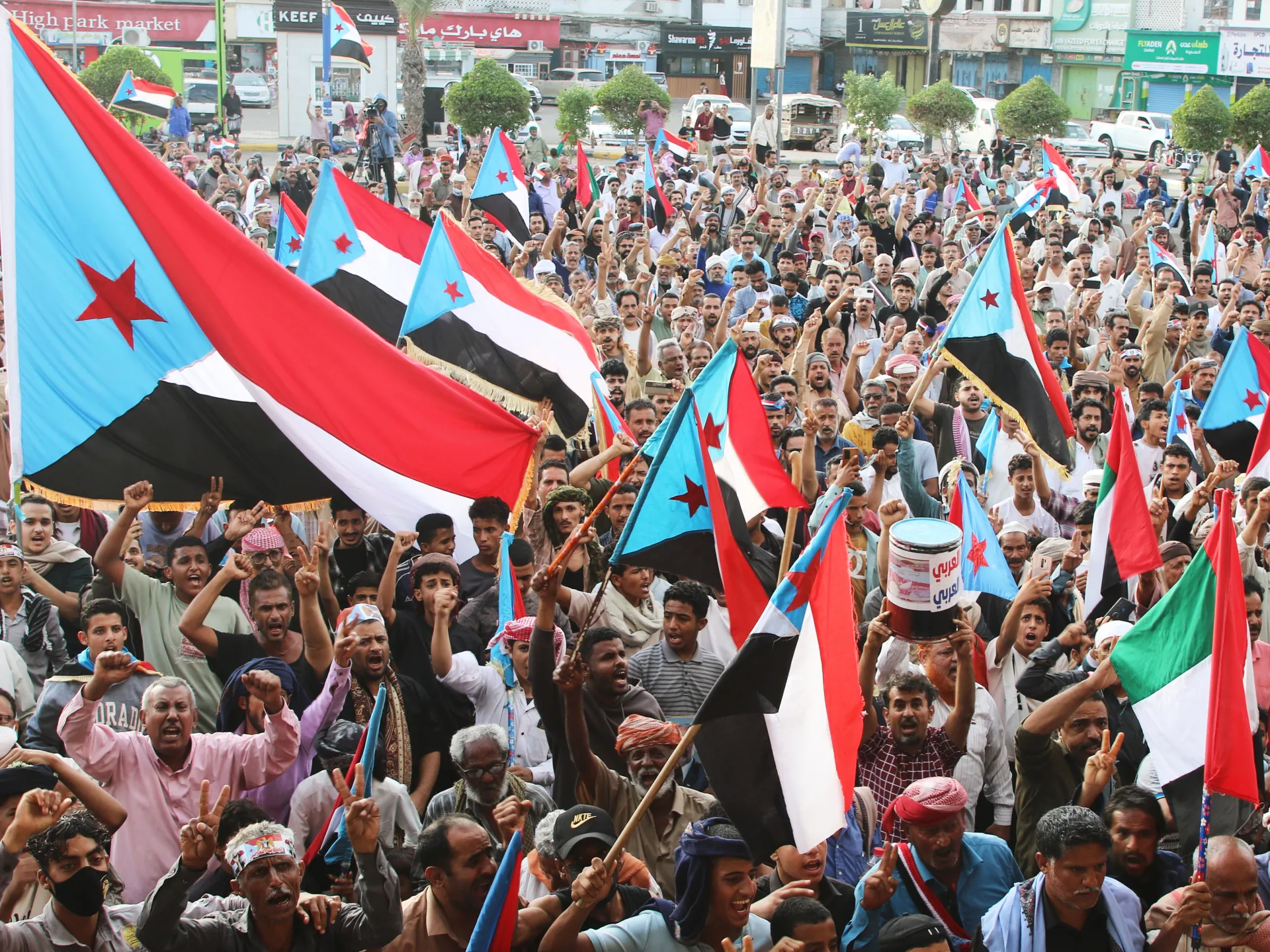
Landing at Aden International Airport on a trip in late 2017, the plane had two flags visible as it moved along the tarmac. One was the flag of the former South Yemen, resurrected as a symbol of Yemen’s secessionist southern movement. The other was of the United Arab Emirates (UAE), the movement’s primary backer.
Passing one checkpoint after another on the road out of Aden, the flag of the actual Republic of Yemen wasn’t visible, and only made an appearance towards the city of Taiz, to the north.
Recommended Stories
list of 3 itemsend of list
The UAE-backed secessionist Southern Transitional Council (STC) had been formed a few months earlier, in May 2017. Headed by Aidarous al-Zubaidi, it made clear that its ultimate goal was separation from the rest of Yemen, even if it found itself on the same side as the Yemeni government in the fight against the Houthi rebels occupying the Yemeni capital Sanaa.
By 2019, the STC and the Yemeni government fought in Aden and other areas of the south. The STC emerged on top, forcing the government out of Aden – the former capital of South Yemen and the city the government had designated as a temporary capital during the conflict against the Houthis.
Momentum continued to be on the STC’s side for the next few years, as it seized more territory. Even after al-Zubaidi joined the Saudi-backed Presidential Leadership Council (PLC) as a vice-president, officially making him a member of the Yemeni government, it was clear that on the ground, the STC had de facto control over much of the former South Yemen.
Al-Zubaidi must have felt close to achieving his goals when he found himself at the United Nations General Assembly in September. Speaking to the international media, he said that the “best solution for Yemen” was a “two-state solution”.
But then he went too far. His move last month to push STC forces into the eastern governorates of Hadhramout and al-Mahra, effectively securing control over all of the former South Yemen, was a red line for Saudi Arabia.
The STC leader is on the run, forces now loyal to the Yemeni government are in control of the majority of southern Yemen, and many of his allies have changed sides.
The UAE, meanwhile, appears to have accepted that Saudi Arabia is the primary foreign actor in Yemen, and has taken a step back – for now.
What now for South Yemen?
In a matter of weeks, secession has gone from a de facto reality to seemingly further away than it has been since the early days of Yemen’s war in the mid-2010s.
It was only last Friday that al-Zubaidi announced a two-year transitional period before a referendum on the independence of southern Yemen and the declaration of the state of “South Arabia”.
A week later, the STC looked divided – with Abdul Rahman al-Mahrami, a PLC member also known as Abu Zaraa, now in Riyadh, appearing to position himself in the Saudi camp.
The Yemeni government, with Saudi support, is attempting to reorganise the anti-Houthi military forces, with the aim of moving them away from being a divided band of groups under different commands to a force unified under the umbrella of the government.
Nods to the “southern issue” – the disenfranchisement of southern Yemen since the country’s brief 1994 north-south civil war – continues, with plans for a conference on the issue in Riyadh.
But the ultimate goal of hardline southerners – secession – is off the table under current circumstances, with consensus instead forming around the idea of a federal republic allowing for strong regional representation.
The Yemeni government also sees an opportunity to now use the momentum gained in the recent successes against the STC to advance against the Houthis, who control Yemen’s populous northwest – even if that remains an ambitious goal.
Of course, this is Yemen, and the winds can always change once again.
Support for the secession of southern Yemen remains strong in governorates like Al-Dhale, where al-Zubaidi is from. Hardcore STC supporters, those who have not been coopted, will be unlikely to simply give up, sowing the seeds for a potential insurgency.
And President Rashad al-Alimi will have to show that his power does not simply rest on Saudi Arabia’s military strength. One of the major tests of his legitimacy is whether he will be able to return with his government to Aden, and finally be based in Yemen for the first time in years.
That will be the ultimate challenge for the Yemeni government. Is it truly capable of being in control once again? Or are current events just a temporary setback for the STC and the cause of southern secession, waiting for the opportunity to rise up again?
Trump has ‘greenlit’ bipartisan push to sanction countries that buy Russian energy exports, Lindsey Graham says.
Published On 8 Jan 20268 Jan 2026
Share
United States President Donald Trump has backed a bill to impose sanctions on countries that buy Russian oil, including China and India, an influential Republican senator has said.
Lindsey Graham, a senator for the US state of South Carolina, said on Wednesday that Trump had “greenlit” the bipartisan bill following a “very productive” meeting.
Recommended Stories
list of 4 itemsend of list
Graham’s Sanctioning Russia Act, drafted with Democrat Richard Blumenthal, would give Trump the authority to impose a tariff of up to 500 percent on imports from countries doing business with Russia’s energy sector.
“This bill will allow President Trump to punish those countries who buy cheap Russian oil fueling Putin’s war machine,” Graham said in a statement, referring to Russian President Vladimir Putin.
““This bill would give President Trump tremendous leverage against countries like China, India and Brazil to incentivize them to stop buying the cheap Russian oil that provides the financing for Putin’s bloodbath against Ukraine.”
China and Russia continue to be major buyers of Russia’s oil despite US and European sanctions imposed on the Russian energy sector in response to Moscow’s war in Ukraine.
China bought nearly half of Russia’s crude oil exports in November, while India took about 38 percent of exports, according to an analysis by the Centre for Research on Energy and Clean Air. Brazil dramatically ramped up its purchase of subsidised Russian oil after the invasion of Ukraine in 2022, but those imports have fallen substantially in recent months.
The latest US push to increase pressure on Russia comes as Moscow and Kyiv are engaged in Washington-brokered negotiations to bring an end to the nearly four-year war.
On Tuesday, the Trump administration for the first time gave its backing to European proposals for binding security guarantees for Ukraine, including post-war truce monitoring and a European-led multinational force.
Russia, which has repeatedly said that it will not accept any deployment of NATO member countries’ soldiers in Ukraine, has yet to indicate that it would support such security measures.
In his statement on his bill, Graham said the legislation was timely in light of the current situation in Ukraine.
“This will be well-timed, as Ukraine is making concessions for peace and Putin is all talk, continuing to kill the innocent,” he said.
Jan. 7 (UPI) — President Donald Trump said Wednesday night that he will withdraw the United States from dozens of international organizations and treaties, escalating the U.S. policy shift from multilateral engagement under his second administration.
The 66 international organizations, conventions and treaties affected were those deemed “contrary to the interests of the United States,” according to a statement from the White House.
The withdrawal was initiated via a presidential memorandum, which names 35 non-United Nations organizations and 31 U.N. entities. Among them are the landmark U.N. Framework Convention on Climate Change, established in 1992, and several others that fight climate change, the U.N. Entity for Gender Equality and the Empowerment of Women, U.N. Oceans and the U.N. Alliance of Civilizations.
“The Trump administration has found these institutions to be redundant in their scope, mismanaged, unnecessary, wasteful, poorly run, captured by the interests of actors advancing their own agendas contrary to our own, or a threat to our nation’s sovereignty, freedoms and general prosperity,” Secretary of State Marco Rubio said in a statement.
“President Trump is clear: It is no longer acceptable to be sending these institutions the blood, sweat and treasure of the American people, with little to nothing to show for it.”
Since returning to the White House in January, Trump has used his executive powers to expunge left-leaning ideology and initiatives from U.S. domestic and foreign policy. Rubio argued that the dozens of organizations and treaties the United States was exiting are those where progressive ideology “detached from national interests.”
“From DEI mandates to ‘gender equity’ campaigns to climate orthodoxy, many international organizations now serve a globalist project rooted in the discredited fantasy of the ‘End of History,'” he said.
“These organizations actively seek to constrain American sovereignty,” he continued. “Their work is advanced by the same elite networks — the multilateral ‘NGO-plex’ — that we have begun dismantling through the closure of USAID.”
A fact sheet from the White House claims that many of the organizations named Wednesday “promote radical climate policies, global governance and ideological programs that conflict with U.S. sovereignty and economic strength.”
“By exiting these entities, President Trump is saving taxpayer money and refocusing resources on America First policies.”
Trump has frequently rallied against international organizations that have stood counter or even criticized his policies. He has twice removed the United States from the World Health Organization, first during his first term and again on his first day in office of his second after President Joe Biden reinstated the United States’ membership in the world’s leading health organization.
The same day he pulled the United States from the WHO he directed the withdrawal from the U.N. Framework Convention on Climate Change, also known as the Paris Agreement.
He has also twice withdrawn the United States from The U.N. Educational, Scientific and Cultural Organization, better known as UNESCO. He also withdrew the United States from the U.N. Human Rights Council and prohibited future funding to the U.N. Relief and Works Agency for the Near East.
During his first term, he withdrew the United States from the landmark Obama-era multinational accord that aimed to prevent Iran from gaining a nuclear weapon and the Intermediate-Range Nuclear Forces Treaty.
“I’ve always felt that the U.N. has tremendous potential. It’s not living up to that potential right now — it really isn’t — hasn’t for a long time,” Trump said Wednesday before signing the memorandum in the Oval Office.
“There are great hopes for it, but it’s not being well run, to be honest.”
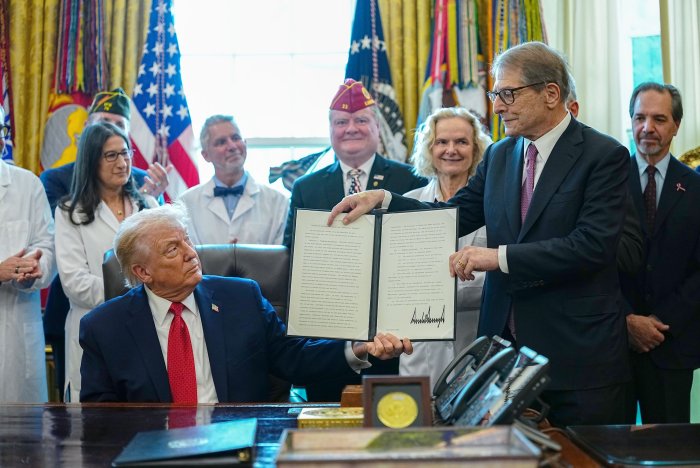
President Donald Trump holds a signed executive order reclassifying marijuana from a schedule I to a schedule III controlled substance in the Oval Office of the White House on Thursday. Photo by Aaron Schwartz/UPI | License Photo
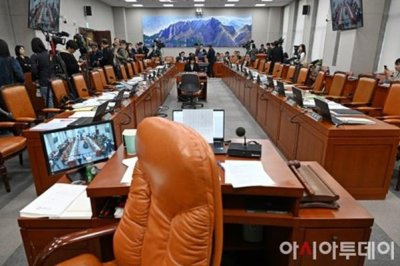
An empty seat is seen at a National Assembly committee hearing room in Seoul during a parliamentary audit session, as lawmakers, aides and reporters take their places around the chamber. Photo by Asia Today
Jan. 7 (Asia Today) — A coalition of South Korean civic groups that monitors the National Assembly’s annual audit process said Wednesday it gave the Lee Jae-myung administration’s first parliamentary audit an “F,” citing what it called a crisis in separation of powers and poor preparation.
The NGO Monitoring Group for National Audits, which said it has tracked the audit process for 27 years with participation from more than 1,000 experts and civic activists, said in a position paper that the audit “began” with controversy over Supreme Court Chief Justice Cho Hee-dae and “ended” with allegations of abuse of power involving Kim Hyeon-ji, the first deputy chief of staff at the presidential office.
The group listed reasons for the failing grade that included what it described as the worst crisis in separation of powers, inadequate preparation, extreme confrontation and an audit of Cho that it said only provoked backlash.
It also cited what it called structural problems during the audit, including committee chairs it said acted without restraint, a shortened audit period and the presence of seven senior ruling party lawmakers serving as ministers leading agencies subject to scrutiny.
The group said some committee chairs restricted lawmakers’ opportunities to question witnesses and, rather than acting as lawmakers, behaved like investigators, turning the audit into a confrontation-style interrogation.
These are the key developments from day 1,414 of Russia’s war on Ukraine.
Published On 8 Jan 20268 Jan 2026
Share
Here is where things stand on Thursday, January 8:
Fighting
One person was killed and five people were injured in a Russian attack on two ports in Ukraine’s Odesa region, Ukraine’s Deputy Prime Minister Oleksii Kuleba said in a post on Facebook. “The attack damaged port facilities, administrative buildings, and oil containers,” Kuleba said.
A Russian attack on Kryvyi Rih, in Ukraine’s Dnipro region, injured eight people, including two seriously, the head of the Kryvyi Rih defence council, Oleksandr Vilkul, wrote on Telegram.
Russian attacks left Ukraine’s Dnipropetrovsk and Zaporizhia regions in southeastern Ukraine “almost completely without electricity”, Ukraine’s Ministry of Energy said in a statement on Telegram. “Critical infrastructure is operating on reserve power,” the ministry added.
Firefighters put out a blaze that broke out at an oil depot in Russia’s southern Belgorod region following an overnight Ukrainian drone attack, the Vesti state TV channel reported on Wednesday, citing the regional governor.
Politics and diplomacy
British Prime Minister Keir Starmer said that any deployment of UK forces under a declaration signed with France and Ukraine would be subject to a parliamentary vote. “I will keep the house updated as the situation develops, and were troops to be deployed under the declaration signed, I would put that matter to the house for a vote,” Starmer told parliament on Wednesday.
Ukrainian President Volodymyr Zelenskyy told reporters on WhatsApp that he hopes to meet with United States President Donald Trump soon to gauge his openness to a Ukrainian proposal that Washington ensure security for Kyiv for more than 15 years in the event of a ceasefire, according to the Reuters news agency. “The Americans, in my view, are being productive right now; we have good results … They need to put pressure on Russia. They have the tools, and they know how to use them,” Zelenskyy said.
Zelenskyy also said during a visit to Cyprus on Wednesday that Ukraine is “doing everything required on our side in the negotiation process. And we expect that no additional or excessive demands will be placed on Ukraine.”
Zelenskyy was in Cyprus as it assumed the rotating presidency of the European Union, as he continued a push for his country to join the bloc. “We are working to make as much progress as possible during this period on opening negotiating clusters and on Ukraine’s accession to the European Union,” Zelenskyy said after a meeting with Cypriot President Nikos Christodoulides in Nicosia, in a statement posted on X.
Spain’s Foreign Minister Jose Manuel Albares said on Wednesday that negotiations are still “far from a peace plan” for Ukraine. “There is an outline of ideas,” Albares said, according to Reuters.
Sanctions
The US seized two Venezuela-linked oil tankers in the Atlantic Ocean on Wednesday, including the Marinera crude oil tanker sailing under Russia’s flag.
US Vice President JD Vance said that the tanker “was a fake Russian oil tanker,” in an interview set to air on Fox News, excerpts of which were provided in advance. “They basically tried to pretend to be a Russian oil tanker in an effort to avoid the sanctions regime,” Vance said, referring to sanctions imposed by the Trump administration on Venezuelan oil. The Trump administration has separately imposed sanctions on some Russian oil companies.
Ukraine’s foreign minister said on Wednesday that Kyiv welcomed the move. “The apprehension of a Russian-flagged ship in the North Atlantic underscores the United States’ and President Trump’s resolute leadership,” Andrii Sybiha wrote on X. “We welcome such an approach to dealing with Russia: act, not fear. This is also relevant to the peace process and bringing a lasting peace closer.”
Russia’s Ministry of Transport protested the seizure, saying in a statement that “in accordance with the 1982 UN Convention on the Law of the Sea, freedom of navigation applies in the high seas, and no state has the right to use force against vessels duly registered in the jurisdictions of other states”.
US Republican Senator Lindsey Graham of South Carolina said that President Trump has “greenlit” a long-awaited bipartisan bill imposing sanctions on Russia after the pair met on Wednesday. “I look forward to a strong bipartisan vote, hopefully as early as next week,” Graham said in a statement.
The Trump administration has accused Somali officials of destroying a World Food Programme warehouse that contained US-funded food aid.
Published On 8 Jan 20268 Jan 2026
Share
The United States says that it has suspended all assistance to the government of Somalia, alleging that officials destroyed a World Food Programme warehouse filled with food aid it funded.
In a social media post on Wednesday, the administration of US President Donald Trump alleged that Somali officials had seized 76 metric tonnes of donor-funded food aid that had been intended for Somalis in need.
Recommended Stories
list of 3 itemsend of list
“The US is deeply concerned by reports that Federal Government of Somalia officials have destroyed a US-funded World Food Programme (WFP) warehouse and illegally seized 76 metric tons of donor-funded food aid for vulnerable Somalis,” the post said.
“The Trump Administration has a zero-tolerance policy for waste, theft, and diversion of life-saving assistance.”
The announcement was made on the social media platform representing the US State Department’s Under Secretary for Foreign Assistance, Humanitarian Affairs and Religious Freedom.
Somali officials have not yet responded to the allegations of aid theft.
Still, the stark measure continues a recent trend under the Trump administration. In recent months, President Trump has leaned into criticism of Somalis living in the United States and placed restrictions on Somalis seeking to enter the US.
His administration has also stepped up air strikes targeting armed groups in Somalia itself.
Notably, in a December cabinet meeting, Trump personally levelled racist attacks against the Somali community in the US, saying they are “destroying America”. He also attacked Ilhan Omar, a Democratic representative from Somalia who arrived in the US as a child refugee.
“We’re going to go the wrong way if we keep taking in garbage into our country,” Trump said at the December 2 meeting.
“Ilhan Omar is garbage, just garbage. Her friends are garbage. These aren’t people that work. These aren’t people that say, ‘Let’s go, come on, let’s make this place great.’ These are people that do nothing but complain.”
As part of his tirade, Trump cited a fraud scandal in the midwestern state of Minnesota, which has seen some members of the large Somali community there charged with wrongdoing.
White House Press Secretary Karoline Leavitt has since indicated that Trump could use denaturalisation – the revocation of US citizenship – as “a tool” to penalise Somali Americans involved in the fraud scheme.
The Trump administration has also ramped up immigration enforcement raids in Minneapolis, Minnesota, a city with the largest Somali community in the US.
The Trump administration has dramatically scaled back US humanitarian assistance since returning to the White House in 2025, and it is not clear how much aid will be affected by the suspension of assistance.
Trump’s Democratic predecessor Joe Biden had provided about $770m in assistance for projects in Somalia, but only a small portion went towards the Somali government.
In announcing Wednesday’s aid freeze, the US State Department signalled that assistance could resume – but only with an acknowledgement of responsibility from the Somali government.
“Any resumption of assistance will be dependent upon the Somali Federal Government, taking accountability for its unacceptable actions and taking appropriate remedial steps.”
Jan. 7 (UPI) — Florida Gov. Ron DeSantis issued a proclamation on Wednesday calling on the state Legislature to hold a special session for the purpose of redistricting its U.S. House seats.
The special session is to occur in April and will last no more than 20 consecutive days, unless extended by a three-fifths vote in each chamber, the proclamation says.
“Every Florida resident deserves to be represented fairly and constitutionally,” DeSantis said in a news release.
“Today, I announced that I will be convening a special session of the Legislature focused on redistricting to ensure that Florida’s congressional maps accurately reflect the population of our state and to comply with an upcoming U.S. Supreme Court ruling,” he said.
“This special session will take place after the regular legislative session, which will allow the Legislature to first focus on the pressing issues facing Floridians before devoting its full attention to congressional redistricting in April.”
He said the redistricting will better ensure that race is not a predominant factor in determining Florida’s federal congressional districts and cited a Supreme Court case challenging recent redistricting in Louisiana that created a congressional district comprising mostly of racial minority populations.
That case accuses Louisiana of violating the 14th and 15th Amendments to the U.S. Constitution by using race as a basis for creating congressional districts.
DeSantis’ proclamation says there is no law against the state redrawing its congressional district mid-decade, and a majority vote in both chambers of Florida’s bicameral Legislature is required to legally redraw the districts ahead of the 2026 mid-term elections.
Florida has 28 U.S. House seats after gaining one in 2022 as a result of the 2020 census, with Republicans holding 20 seats and Democrats eight.
Florida’s redistricting effort comes after several other states have announced their intent to do the same or already have, with Texas and California being the most-publicized efforts.
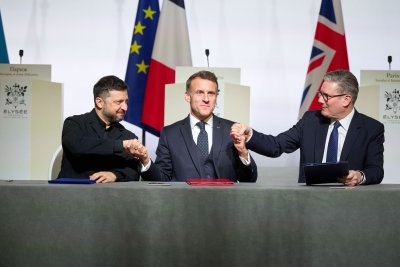
Ukrainian President Volodymyr Zelensky (L), French President Emmanuel Macron (C) and British Prime Minister Keir Starmer take part in the signing of the declaration on deploying post-ceasefire force in Ukraine during the Coalition of the Willing summit at the Elysee Palace in Paris on Tuesday. Facing questions from the British Parliament, Starmer said Wednesday lawmakers would have the ability to vote on such a deployment should a peace deal be signed. Photo courtesy Ukrainian President Office | License Photo
Jan. 7 (UPI) — British Prime Minister Keir Starmer said Wednesday Parliament would be able to debate and vote on whether to deploy troops to Ukraine on a peacekeeping mission.
Speaking to members of Parliament, Starmer said any action involving British troops deploying to Ukraine would be “in accordance with our military plans” and require parliamentary approval.
On Tuesday, Starmer, along with French President Emmanuel Macron signed a trilateral agreement with Ukrainian President Volodymyr Zelensky, opening the door for the two countries to deploy troops to Ukraine after it signs a peace agreement with Russia.
Starmer told members of Parliament that the leaders “made real progress on security guarantees, which are vital for securing a just and lasting peace.”
“We will set out the details in a statement at the earliest opportunity. I will keep the house updated as the situation develops, and were troops to be deployed under the declaration signed, I would put that matter to the house for a vote.”
His comments were in response to Conservative leader Kemi Badenoch, who questioned why Starmer hadn’t made a full statement to the House of Commons on the issue, The Guardian reported. She said she welcomed the prime minister’s efforts on peace in Ukraine, but she found it “astonishing” that he wasn’t making a full statement to lawmakers.
“No prime minister, Labour or Conservative, has failed to make a statement to the house in person after committing to the deployment of British troops,” she said. “His comments about making a statement in due course, quite frankly, are not good enough.”
Starmer responded that he wasn’t required to make a statement to Parliament because the agreement he signed Tuesday fell under previously existing military plans.
He also declined to specify how many British troops would be deployed should a peace deal be reached, the BBC reported.
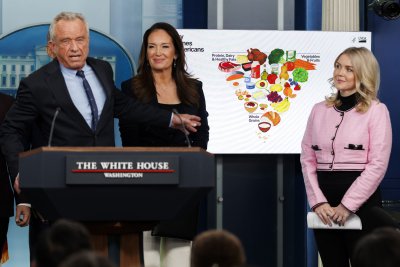
Jan. 7 (UPI) — The Trump administration announced Wednesday it created new dietary guidelines and created a new food pyramid.
“Under President Trump’s leadership common sense, scientific integrity and accountability have been restored to federal food and health policy,” a fact sheet from the Department of Health and Human Services announced. “For decades, the Dietary Guidelines favored corporate interests over common sense, science-driven advice to improve the health of Americans. That ends today.”
The new guidelines focus on high-quality protein, healthy fats, fruits, vegetables and whole grains, the fact sheet said. It calls for people to avoid highly processed foods and refined carbohydrates.
“The Dietary Guidelines are the foundation to dozens of federal feeding programs, and today marks the first step in making sure school meals, military and veteran meals, and other child and adult nutrition programs promote affordable, whole, healthy, nutrient-dense foods,” the fact sheet said.
The government also released a new website, Realfood.gov.
The American Heart Association said it welcomed the new guidelines on fruits, vegetables and whole grains.
The AHA “commends the inclusion of several important science-based recommendations, notably the emphasis on increasing intake of vegetables, fruits and whole grains while limiting consumption of added sugars, refined grains, highly processed foods, saturated fats and sugary drinks,” the AHA said in a statement.
But it took issue with some of the recommendations.
“We are concerned that recommendations regarding salt seasoning and red meat consumption could inadvertently lead consumers to exceed recommended limits for sodium and saturated fats, which are primary drivers of cardiovascular disease. While the guidelines highlight whole-fat dairy, the Heart Association encourages consumption of low-fat and fat-free dairy products, which can be beneficial to heart health,” the statement said.
The new guidance pushes protein at every meal and says to eat as much as twice the recommended daily allowance of 0.08 grams of protein per kilogram of body weight. It says to eat 1.2 to 1.6 grams. Proteins can be flavored with “salt, spices, and herbs,” it said.
The guidelines also recommend full-fat dairy, which is different from past recommendations of low-fat or fat-free dairy. Full-fat dairy has saturated fats. The fact sheet calls this “ending the war on healthy fats.”
“Paired with a reduction in highly processed foods laden with refined carbohydrates, added sugars, excess sodium, unhealthy fats, and chemical additives, this approach can change the health trajectory of America,” the fact sheet said.
“When [Diversity, Equity and Inclusion] impacts nutrition science, it enables special interests to argue the status quo is acceptable because it would violate ‘health equity’ principles to encourage Americans to eat healthier food,” the fact sheet added.
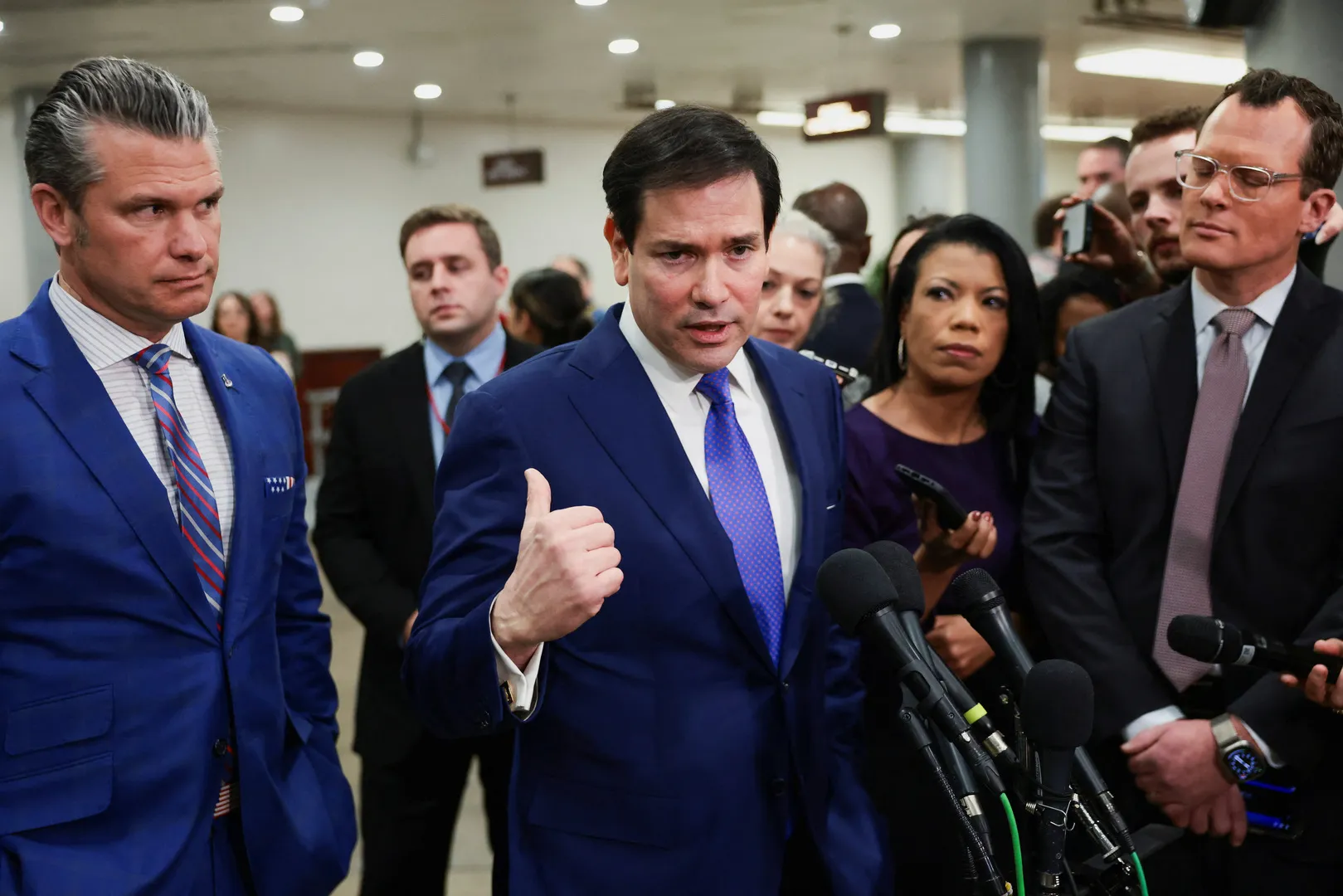
US Secretary of State Marco Rubio said he will meet Denmark next week as Donald Trump again raises the prospect of gaining control of Greenland. When pressed on NATO concerns, Rubio said the president can use force, but diplomacy is preferred.
Children play in the Royal Parc in Brussels, Belgium, Wednesday. Snowfall was expected to continue in the coming days, with cold temperatures forecast to persist across the region as winter Storm Goretti hits the Atlantic coast of Europe. Photo by Olivier Matthys/EPA
Jan. 7 (UPI) — Flights and train service were delayed or canceled and driving became treacherous in parts of Europe on Wednesday as a winter storm hit the Atlantic coast.
Storm Goretti is the first named storm of the year in Europe, and it brought heavy snow, ice and cold to the area. Flights and train service were canceled or suspended in parts of France and Belgium.
About 100 flights were canceled at Paris’ Charles de Gaulle airport and 40 more at the city’s Orly airport, France’s transportation minister said.
In parts of the United Kingdom, amber snow warnings were issued for “danger to life” conditions, The Independent reported. Wind gusts of up to 90 mph were expected Thursday night, bringing large waves and debris. About 12 inches of snow was expected in Wales and the Peak District in central England.
There were four yellow weather warnings for snow and ice in Scotland, Northern Ireland and the Midlands. There were two more in eastern England and Wales, and a wind warning in the southwest.
A bus in Kent slid into a ditch, and a school coach full of children crashed into a bus in Reading after hitting black ice.
“Crews are reminding everyone to use extra caution when driving in cold temperatures as there could be black ice on the roads, so avoid sudden breaking and leave plenty of space between you and the vehicle in front,” the Kent Fire District warned.
Some intercity trains told passengers to reschedule Thursday travel to Wednesday to avoid the worst of the weather.
Flights from Amsterdam’s Schiphol Airport were canceled and delayed for the past week due to inclement weather. About 700 flights were canceled Wednesday, and Dutch airline KLM has been hit the hardest for the past six days, The Independent reported. Flightradar24 said more than 3,200 flights were canceled over the past week.
“While Schiphol certainly can operate during winter weather, the airport’s de-icing infrastructure obviously isn’t designed to handle a barrage of snow for multiple days in a row,” Daniel Gustafsson of Flightradar24 wrote on the site. He said there was also a “critical shortage” of de-icing fluid.
More than 1,000 people spent the night at Schiphol, the airport told Euronews. It said it set up cots and offered breakfast to travellers who had to sleep there.
The board of Warner Bros Discovery (WBD) has unanimously turned down Paramount Skydance’s latest attempt to acquire the studio, saying its revised $108.4bn hostile bid amounted to a risky leveraged buyout that investors should reject.
In a letter to shareholders on Wednesday, the WBD board said Paramount’s offer hinges on “an extraordinary amount of debt financing” that heightens the risk of closing. It reaffirmed its commitment to streaming giant Netflix’s $82.7bn deal for the film and television studio and other assets.
Recommended Stories
list of 4 itemsend of list
Some investors, however, pushed back on Warner Bros. Pentwater Capital Management CEO Matthew Halbower said that the media giant’s board had “made an error” by not considering Paramount’s bid.
On CNBC on Wednesday, Halbower called the deal “economically superior”.
Paramount’s financing plan would saddle the smaller Hollywood studio with $87bn in debt once the acquisition closes, making it the largest leveraged buyout in history, the Warner Bros board told shareholders after voting against the $30-per-share cash offer on Tuesday. The letter accompanied a 67-page amended merger filing that laid out its case for rejecting Paramount’s offer.
Paramount deal ‘remains inadequate’
The revised Paramount offer “remains inadequate particularly given the insufficient value it would provide, the lack of certainty in Paramount Skydance ability to complete the offer, and the risks and costs borne by WBD shareholders should Paramount Skydance fail to complete the offer”, the Warner Bros board wrote.
Paramount, which has a market value of about $14bn, proposed to use $40bn in equity, which would be personally guaranteed by Oracle’s billionaire co-founder Larry Ellison, whose son David is Paramount’s CEO, and $54bn in debt to finance the deal.
Its financing plan would further weaken its credit rating, which S&P Global already rates at junk levels, and strain its cash flow – heightening the risk that the deal will not close, the Warner Bros board said. Netflix, which has offered $27.75 a share in cash and stock, has a $400bn market value and investment-grade credit rating.
The decision keeps Warner Bros on track to pursue the deal with Netflix, even after Paramount amended its bid on December 22 to address the earlier concerns about the lack of a personal guarantee from Ellison, who is Paramount’s controlling shareholder.
Paramount and Netflix have been vying to win control of Warner Bros, and with it, its prized film and television studios and its extensive content library. Its lucrative entertainment franchises include Harry Potter, Game of Thrones, Friends, and the DC Comics universe; as well as coveted classic films such as Casablanca and Citizen Kane.
Netflix applauds
Netflix co-CEOs Ted Sarandos and Greg Peters welcomed Warner Bros’ decision on Wednesday, saying it recognises the streaming giant’s deal “as the superior proposal that will deliver the greatest value to its stockholders, as well as consumers, creators and the broader entertainment industry”.
Warner Bros Chairman Samuel Di Piazza told CNBC that the company was not currently in talks with Paramount but remains open to a transaction with the Ellison-led firm, and both the deals have a path to regulatory approval.
“From our perspective, they’ve got to put something on the table that is compelling,” he said, referring to the Paramount offer.
Wednesday’s filing said Warner Bros’ board met on December 23 to review Paramount’s amended offer and noted some improvements, including Ellison’s personal guarantee and a higher reverse termination fee of $5.8bn, but found “significant costs” associated with Paramount’s bid compared with a Netflix deal.
Warner Bros would be obligated to pay the streaming service a $2.8bn termination fee for abandoning its merger agreement with Netflix, $1.5bn in fees to its lenders and about $350m in additional financing costs. Altogether, Warner Bros said it would incur about $4.7bn in additional costs to terminate its deal with Netflix, or $1.79 per share.
The board repeated some concerns it had laid out on December 17, such as that Paramount would impose operating restrictions on the studio that would harm its business and competitive position, including barring the planned spin-out of the company’s cable television networks into a separate public company, Discovery Global.
Paramount offered “insufficient compensation” for the damage done to the studio’s business, if the Paramount deal failed to close, Warner Bros said.
Paramount “repeatedly failed to submit the best proposal” to Warner Bros shareholders, the board wrote, “despite clear direction” on the deficiencies in its bid and potential solutions.
The jockeying for Warner Bros has become Hollywood’s most closely watched takeover battle, as studios race to scale up amid intensifying competition from streaming platforms and volatile theatrical revenues.
While Netflix’s offer has a lower headline value, analysts have said it presents a clearer financing structure and fewer execution risks than Paramount’s bid for the entire company, including its cable TV business.
“WBD does not want to sell to Paramount, so it will keep rejecting Paramount as long as it is able to,” said Ross Benes, an analyst at eMarketer.
“But this process is not over … Paramount will have opportunity to make further attempts.”
Harris Oakmark, Warner Bros’ fifth-largest investor, previously told Reuters that Paramount’s revised offer was not “sufficient”, noting it was not enough to cover the breakup fee.
Paramount has argued its bid would face fewer regulatory obstacles, but a combined Paramount-Warner Bros entity would create a formidable competitor to industry leader Disney and merge two major television operators and two streaming services.
The valuation of Warner Bros’ planned Discovery Global spin-off, which includes cable television networks CNN, TNT Sports and the Discovery+ streaming service, is seen as a major sticking point. Analysts peg the cable channels’ value at up to $4 per share, while Paramount has suggested just $1.
Lawmakers from both parties have raised concerns about further consolidation in the media industry, and US President Donald Trump has said he plans to weigh in on the landmark acquisition.
On Wall Street, Warner Bros Discovery is up 0.3 percent in midday trading amid the news of the rejected bid. Netflix is also up 0.3. Meanwhile, Paramount is down 0.1 percent.
1 of 2 | A member of the U.S. Coast Guard keeps watch on the Marinera, formerly known as the M/V Bella 1, in the North Atlantic. Photo courtesy of U.S. European Command
Jan. 7 (UPI) — The United States on Wednesday said that it seized two oil tankers — a Russian-flagged vessel in the North Atlantic and another in the Caribbean Sea.
U.S. Southern Command said, in coordination with the U.S. Department of Homeland Security, it “apprehended a stateless, sanctioned dark fleet motor tanker without incident.”
SOUTHCOM accused the vessel, the M/T Sophia, of carrying out “illicit activities” in international waters in the Caribbean Sea. In a post on X, the agency said the U.S. Coast Guard was escorting the vessel to the United States for “final disposal.”
U.S. European Command, meanwhile, announced it seized the Russian-flagged Mariners — formerly known as the M/V Bella 1 — a vessel it had been chasing across the Atlantic Ocean since December.
EUCOM, in a post on X, said it seized the tanker for violating U.S. sanctions and transporting Iranian oil.
“The vessel was seized in the North Atlantic pursuant to a warrant issued by a U.S. federal court after being tracked by USCGC Munro,” the agency said.
U.S. officials said Russia sent two naval ships and a submarine to escort the Marinera, which was between Iceland and Britain, heading northeast.
The United States deployed at least 10 special-ops military aircraft and transporter aircraft thought to be carrying helicopters to RAF bases in Britain in recent days, possibly in preparation for an interdiction.
The U.S. Coast Guard attempted to execute a warrant to seize the tanker in the Caribbean in December, when it was believed to be headed to Venezuela in contravention of a partial U.S. blockade.
The ship’s final destination was thought to be the Baltic Sea, or possibly the Russian port of Murmansk on the Barents Sea.
The Russian Foreign Ministry said it was monitoring the situation with “concern” and complained about what it said was unwarranted attention from the United States and its NATO allies.
The vessel refused to permit the Coast Guard to board on its first attempt Dec. 21 when it was en route from Iran to collect oil from Venezuela, changed course and headed back out into the Atlantic.
On the way, it painted a Russian flag on the hull, changed its name from Bella 1 to “Marinera” and listed on a Russian shipping registry, in a bid to shake off its U.S. pursuers.
The New York Times reported that Hyperion and at least three other vessels plying the Venezuela route, employed similar stealth tactics, swapping their original flags for Russian ones — exacerbating already tense relations strained over the U.S. attack on Venezuela which is backed by Moscow.
All the ships are suspected of being part of Russia’s so-called “shadow fleet,” moving Russian, Iranian and Venezuelan oil subject to sanctions imposed by the United States, European Union and other countries around the world.
The Russian Maritime Shipping Registry records show the ships, which are all sanctioned by the United States for transporting Iranian or Russian oil, changed their home ports to Sochi or Taganrog in southern Russia and switched flags.
Supporters of ousted Venezuela’s President Nicolas Maduro carry his portrait during a rally outside the National Assembly in Caracas, Venezuela, on January 5, 2026. Photo by Jonathan Lanza/UPI | License Photo
U.S. District Judge David Novak ordered Lindsey Halligan to give an explanation of her continued use of the U.S. attorney title within seven days on Tuesday. File Photo by Al Drago/EPA
Jan. 7 (UPI) — President Donald Trump‘s first pick to serve as the U.S. attorney for the Eastern District of Virginia has been ordered to explain why she is still using the title despite her appointment being ruled unlawful.
U.S. District Judge David Novak ordered Lindsey Halligan to give an explanation of her continued use of the U.S. attorney title within seven days. Novak said her use of the title, including in court documents, may amount to false or misleading statements.
False and misleading statements in a court of law can result in punishment, including charges of perjury, fines and imprisonment.
Halligan, a Trump loyalist, was the president’s original pick to serve in the Eastern District of Virginia last year. A federal judge determined that the Department of Justice illegally appointed Halligan and barred her from assuming the role.
U.S. District Judge Cameron Currie ruled in November that Halligan was never eligible to hold the position of U.S. attorney for the Eastern District of Virginia. Her appointment had circumvented the standard appointment process, including a Senate confirmation. She also has no experience as a prosecutor.
Despite the ruling, the Justice Department has kept Halligan in office.
On Tuesday, Novak said that Halligan and the department cannot continue to ignore the ruling.
“It remains the binding precedent in this district and is not subject to being ignored,” Novak said in his order.
Erik Siebert, the acting U.S. attorney for the Eastern District of Virginia prior to Halligan’s appointment, resigned in September after refusing to prosecute New York Attorney General Letitia James.
After her appointment, Halligan filed charges against James and former FBI Director James Comey, who investigated Trump’s ties to Russia during Trump’s first term.
Both cases were dismissed when Currie ruled that Halligan was not qualified for the U.S. attorney role.
President Donald Trump holds a signed executive order reclassifying marijuana from a schedule I to a schedule III controlled substance in the Oval Office of the White House on Thursday. Photo by Aaron Schwartz/UPI | License Photo
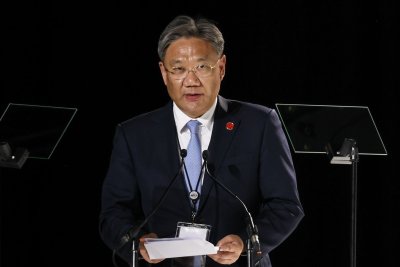
Wang Wentao, Minister of Commerce of the People’s Republic of China addresses attendees on behalf of Xi Jinping, President of China on day one of the BRICS summit at Sandton Convention Center in August 2023. China is opening an anti-dumping investigation into Japan over a key chemical used in manufacturing semiconductors, the Ministry of Commerce announced Wednesday. File Photo by Jemal Countess/UPI | License Photo
Jan. 7 (UPI) — China is opening an anti-dumping investigation into Japan over a key chemical used in manufacturing semiconductors, the Ministry of Commerce announced Wednesday.
The investigation is set to last a year as China probes whether Japan has been selling the chemical dichlorosilane at an unfairly low price — dumping — harming its domestic producers.
Dichlorosaline is commonly used to manufacture computer chips.
The investigation stems from a complaint by the Chinese company Sunfar that submitted evidence showing a 31% decrease in prices on the chemical from Japan despite an increase in imports between 2022 and 2024.
A review of the complaint found that it met the criteria for further investigation under Chinese laws and rules set out by the World Trade Organization.
“The investigating authority will conduct the investigation in accordance with the law, fully safeguard the rights of all interested parties and make an objective and impartial ruling based on the investigation results,” the Chinese Ministry of Commerce said in a statement.
The ensuing investigation will dig into dichlorosilane imports from Japan from July 1, 2024, through June 30, 2025.
Japan is home to the three leading producers of dichlorosilane, making it the top exporter of the chemical.
China’s top dichlorosilane producer has the fourth-largest market share of the chemical in the world. It relies heavily on imports from Japan, with Japanese products making up about 72% of China’s domestic market between 2022 and 2024.
On Tuesday, China banned the export of products to Japan’s military. Japan has warned China about pursuing control over Taiwan as China believes Taiwan to be part of its territory.
Wednesday’s announcement continues the escalating tension between the countries.
Jan. 7 (UPI) — The White House said military force was among a range of options it was looking at in an effort to “acquire” Greenland for the United States.
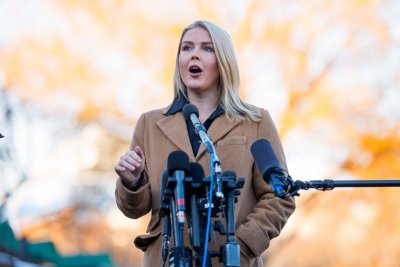
Doubling down on comments by the administration officials in the past few days that the United States has a stronger claim to the Arctic Island than Denmark, in a statement Tuesday carried by The Hill, ABC News and the BBC, White House Press Secretary Karoline Leavitt said using the military was “always an option.”
“President Trump has made it well known that acquiring Greenland is a national security priority of the United States, and it’s vital to deter our adversaries in the Arctic region. The president and his team are discussing a range of options to pursue this important foreign policy goal, and of course, utilizing the U.S. Military is always an option at the Commander-in-Chief’s disposal.”
The statement came hours after European leaders pushed back hard on the renewed claims emanating from the administration since the U.S. military action in Venezuela at the weekend that the United States needs Greenland for its security, and by extension NATO’s, and that Denmark was not up to the job of defending Greenland.
In a joint statement of solidarity with Denmark, the leaders of France, Germany, Britain, Italy, Poland and Spain said Greenland belonged to its people and that “it is for Denmark and Greenland, and them only, to decide on matters concerning Denmark and Greenland.”
They insisted that security in the Arctic was a priority and that they were taking steps to boost their military “presence, investments and activities,” but stressed that security could only be achieved collectively and “sovereignty, territorial integrity and the inviolability of borders,” had to be upheld.
“These are universal principles, and we will not stop defending them,” read the statement.
In a closed-briefing on Capitol Hill on Monday, Secretary of State Marco Rubio suggested to lawmakers that Trump’s talk of taking Greenland by force was just rhetoric to pressure Copenhagen to come to the table, and his actual goal was to buy Greenland from Denmark.
However, later Monday, White House Deputy Chief of Staff Stephen Miller reignited fears, telling CNN, military force was a non-question because America’s overwhelming military superiority meant “nobody is going to fight the United States militarily over Greenland.”
He also questioned the basis of Denmark’s territorial claim.
Greenland has been closely tied to Denmark since the 18th century, initially as a colony and then as an incorporated, semi-autonomous region with representation in the Danish Parliament.
Danish control of Greenland was recognized by the United States in 1916, as part of a deal for the purchase of what is now the U.S. Virgin Islands from Denmark.
Violence, designation of ‘closed military zones’ and evacuations of civilians follow collapse of talks aimed at ending standoff over absorption of semiautonomous Kurdish forces by state institutions.
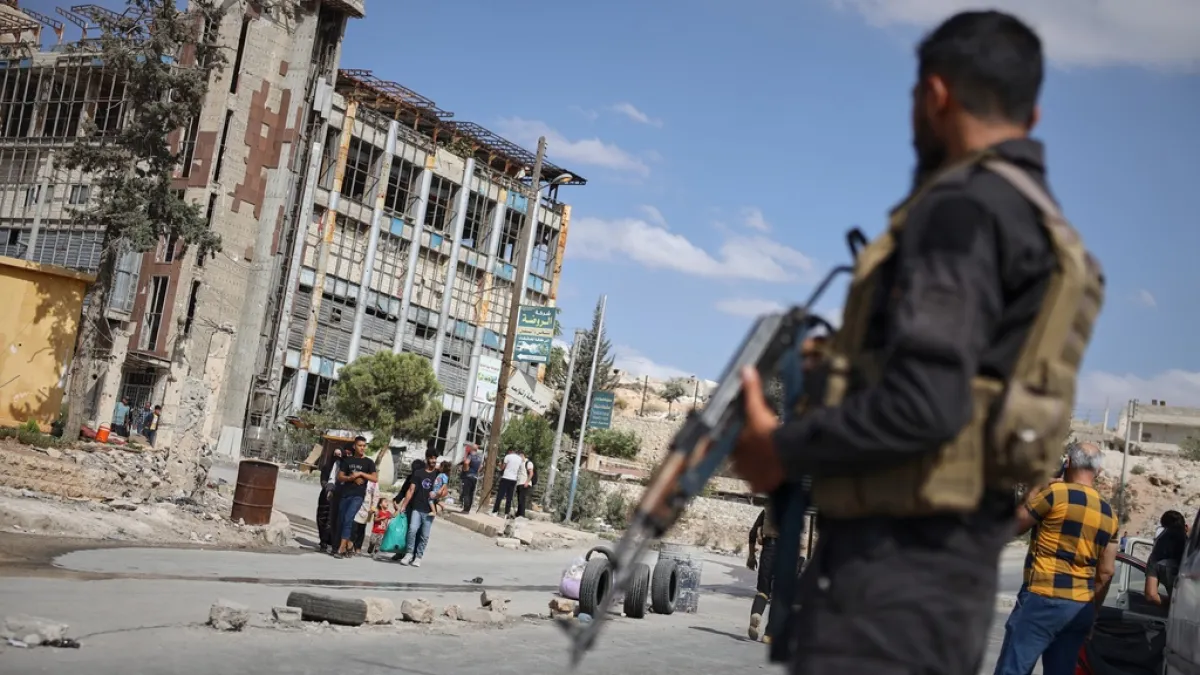
The Syrian army has declared Aleppo’s Kurdish areas “closed military zones” and ordered civilians to leave as clashes with the Syrian Democratic Forces (SDF) extended into a second day.
The Syrian Army Operations Command told Al Jazeera that all SDF military positions in Aleppo neighbourhoods are legitimate targets as sporadic fighting between the government forces and Kurdish-led SDF continued on Wednesday after violence flared the previous day.
Recommended Stories
list of 3 itemsend of list
The clashes, which killed nine people on Tuesday, according to officials, are the fiercest fighting since the two sides failed to implement a March deal to merge the United States-backed semiautonomous Kurdish administration and military force with Syria’s new government.
The Syrian army announced that two neighbourhoods in Aleppo would become “closed military zones” from 3pm (12:00 GMT). In the meantime, it said, it would operate “humanitarian corridors” to allow civilians to leave.
All “military sites of the SDF organisation within the Sheikh Maqsoud and Ashrafieh neighbourhoods of Aleppo are a legitimate military target for the Syrian Arab Army, following the organisation’s major escalation towards the neighbourhoods of Aleppo city and its perpetration of numerous massacres against civilians,” the Army Operations Authority said in a statement.
The SDF noted a large deployment of Syrian army vehicles near the Sheikh Maqsoud and Ashrafiyah neighborhoods, labelling it a “dangerous indicator that warns of escalation and the possibility of a major war”.
The army, meanwhile, said it “urges our civilian population in the Sheikh Maqsoud and Ashrafieh neighbourhoods of Aleppo to immediately stay away from the SDF positions”.
The state news agency SANA reported that the Syrian Civil Defence Forces and Syrian Arab Red Crescent are providing aid to people evacuating.
The Civil Defence said it had evacuated 850 civilians from Aleppo by about midday, citing deteriorating humanitarian conditions and shelling by the SDF.
A Syrian security source reported to Al Jazeera that prisoners have escaped from al-Shafiq prison, which is run by the SDF, to safe areas in Aleppo. He did not specify the number of prisoners that absconded.
Sectarian tensions
Both sides have blamed the other for sparking the violence, which broke out after talks this week between government officials and the main SDF commander stalled with “no tangible results” achieved, according to state media.
The incorporation of the SDF, which controls large chunks of Syria’s north and northeast, into state institutions has remained a subject of consternation since President Ahmed al-Sharaa took office a year ago.
The deal reached in March, in which the SDF agreed “all civil and military institutions in northeastern Syria” would be merged into “the Syrian state, including border crossings, the airport, and oil and gas fields”, has yet to be carried out.
Al-Sharaa’s efforts to amalgamate power and quell sectarian tensions among the numerous groups across Syria after the fall of longtime leader Bashar al-Assad have not been helped by Israel.
Prime Minister Benjamin Netanyahu’s government has carried out persistent raids and bombardments in a bid to demilitarise southern Syrian regions bordering Israel.
Over the past year, Israel has launched more than 600 air, drone and artillery attacks across Syria, averaging nearly two a day, according to a tally by the Armed Conflict Location and Event Data Project.
Marie Forestier, a nonresident senior fellow for the Atlantic Council’s Syria Project, told Al Jazeera that the distance between Syrian, Israeli and US goals is “very difficult”, especially given that “Israel is doing everything to destabilise Syria.”
Malam Fatori, Nigeria — It’s been more than 10 years since Isa Aji Mohammed lost four of his children in one night when Boko Haram fighters attacked their home in northeast Nigeria’s Borno State.
Maryam, who was 15 at the time, was killed alongside her brothers Mohammed, 22, and Zubairu, who was only 10. Yadoma, 25 and married with children, who had returned home to her parents’ house for a visit, also died in the attack.
Recommended Stories
list of 3 itemsend of list
“We ran with nothing,” said 65-year-old Isa, standing on the parched soil of his farm in the Lake Chad village of Malam Fatori, to which he recently returned. “For more than 10 years, we slept in relatives’ homes. I felt like a stranger in my own country.”
Before the deadly attack, Isa, a farmer, produced hundreds of bags of rice, maize and beans annually, enough to feed his family and sell in markets in neighbouring Niger.
After that night, he fled and spent the next decade in displacement camps across the border.
But last year, he joined thousands of other former residents who have relocated back to Malam Fatori and other towns as part of a resettlement programme initiated by the government.
The village sits on the edge of Nigeria’s northeastern frontier, close to the border with Niger, where the vast, flat landscape stretches into open farmland and seasonal wetlands.
A decade ago, homes there were intact and full, their courtyards echoing with children’s voices and the steady rhythm of daily life. Farms extended well beyond the town’s outskirts, producing grains and vegetables that sustained families and supported local trade.
Irrigation canals flowed regularly, and the surrounding area was known for its productivity, especially during the dry season. Markets were active, and movement between Malam Fatori and neighbouring communities was normal, not restricted by fear.
Today, the town carries the visible scars of conflict and neglect, with much of it lying in ruin.
Rows of mud-brick houses stand roofless or partially collapsed, their walls cracked by years of abandonment. Some homes have been hastily repaired with scrap wood and sheets of metal, signs of families slowly returning and rebuilding with whatever materials they can find.
The farms surrounding Malam Fatori are beginning to show faint signs of life again. Small plots of millet and sorghum are being cleared by hand, while irrigation channels – once choked with sand and weeds – are gradually being reopened.
Many fields, however, remain empty, overtaken by thorny bushes and dry grass after years without cultivation. Farmers move cautiously, working close to the town, wary of venturing too far into land that was once fertile but has long been unsafe.
For returnees like Isa, walking through these spaces means navigating both the present reality and memories of what once was. Each broken wall and abandoned field tells a story of loss, while every newly planted seed signals a quiet determination to restore a town that violence nearly erased.
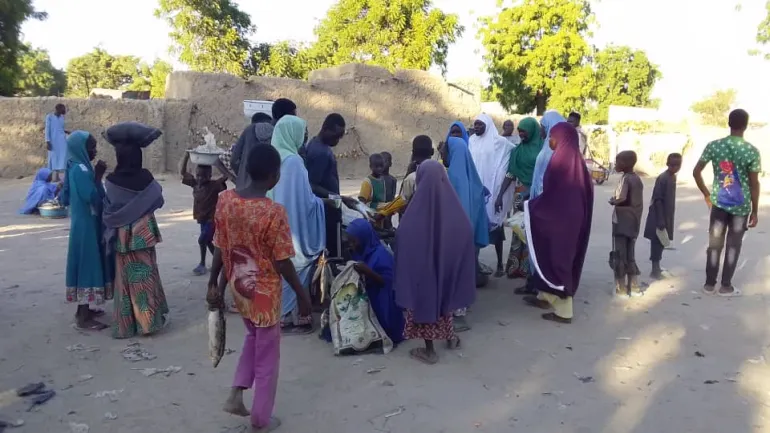
Residents of Malam Fatori buy fish at a local market in the town [Adamu Aliyu Ngulde/Al Jazeera]
Between ‘two pressures’: Boko Haram and the army
For the Borno State administration, the returns are a success. “There are 5,000 households of returnees in Malam Fatori, while the town’s total population now exceeds 20,000 people,” Usman Tar, Borno State commissioner for information and internal security, told Al Jazeera last year.
As we toured the town, the security presence was visible. Armed patrols, checkpoints and observation posts were stationed along major routes and near public spaces, reflecting ongoing efforts to deter attacks and reassure residents.
Families interviewed said they were subjected to frequent security checks and strict movement controls, measures they understand as necessary but which also disrupt daily routines and limit access to farms, markets and neighbouring communities.
Residents and local officials say the threat remains close. Fighters from Islamic State West Africa Province (ISWAP), another armed group active in the area, are believed to be operating from swampy areas approximately two kilometres from the town, using the difficult terrain as cover.
Although the town itself is under heavy military protection, surrounding areas continue to experience attacks, kidnappings and harassment, particularly along farming routes and access roads.
These persistent security incidents reinforce a climate of fear and uncertainty among returnees. While many families have chosen to remain and rebuild despite the risks, they say the proximity of armed groups and the ongoing violence in nearby communities make long-term recovery fragile.
“Here in Malam Fatori, we live under two pressures,” said resident Babagana Yarima. “Boko Haram dictates our safety, and the military dictates our movement. Both limit how we live every day.”
Farmers wait up to eight hours at military checkpoints when transporting produce. Curfews prevent evening farm work. Access to agricultural land beyond the town requires military permits or armed escorts.
“Insecurity and military restrictions limit access to farmlands, forcing farmers to cultivate smaller areas than before,” said Bashir Yunus, an agrarian expert at the University of Maiduguri who also farms in the region.
Fishing, previously a major food source and income generator from Lake Chad, has become dangerous and requires permits to leave the town boundaries.
“Movement beyond the town’s boundaries now requires military permits. Militant attacks in isolated areas continue,” said Issoufou.
The United Nations has raised concerns about the government’s resettlement programme, citing potential protection violations. Mohamed Malick, UN resident and humanitarian coordinator in Nigeria, said during an interview with journalists in Maiduguri that “any returns or relocations must be informed, voluntary, safe, dignified and sustainable”.
Malick added that the return of refugees to Malam Fatori and other insecure areas must be carefully evaluated against established safety and humanitarian standards, and must only take place if conditions allow for basic services and sustainable livelihoods.
A committee registers returnees from Niger in Malam Fatori [Adamu Aliyu Ngulde/Al Jazeera]
‘A man without land is a man without life’
Settled back on his land, Isa wakes before dawn each day, leaving his home in the quiet hours before the town stirs.
He walks to the fields that once yielded fertile harvests, now choked with weeds and debris. The land that once fed his family and supported their livelihood now demands relentless effort just to coax a small crop from the exhausted soil.
With each turn of the hoe and careful planting of seeds, he is determined to reclaim a fragment of the life that was disrupted by conflict.
He also participates in community farming initiatives, joining neighbours in collective efforts to restore agricultural production for the returning population and aid the town’s slow recovery.
However, the area he personally cultivates is far smaller than what he once managed, constrained by limited access to tools, seeds and water, as well as by the lingering insecurity in the region.
”A man without land is a man without life,” he said.
Most families in Malam Fatori now eat only twice a day, a sharp contrast to life before the conflict. Their meals typically consist of rice or millet, often eaten with little or no vegetables due to cost and limited availability.
Food prices have risen dramatically, placing further strain on households already struggling to recover. A kilogramme of rice now sells for about 1,200 naira (approximately $0.83), nearly double its previous price, making even basic staples increasingly unaffordable for many families.
Fish, once plentiful and affordable thanks to proximity to Lake Chad, have become scarce and expensive. Insecurity, restricted access to fishing areas, and disrupted supply chains have severely reduced local catches.
At the local market and at aid distribution points, women queue before dawn, hoping to secure small quantities of dried fish, groundnut oil or maize flour when supplies arrive.
Deliveries are irregular and unpredictable, often selling out within hours. Many women say they return home empty-handed after waiting for hours, compounding daily stress and uncertainty about how to feed their families.
Local health workers warn that malnutrition remains a serious concern, particularly among children under the age of five.
Basic services remain inadequate across town. Roads are poor, and schools and health clinics operate with minimal resources.
“Security risks and inaccessible routes through surrounding bushland continue to restrict humanitarian access, preventing aid agencies from reaching several communities. Basic services such as clean water, healthcare and quality education remain inadequate,” Kaka Ali, deputy director of local government primary healthcare, told Al Jazeera.
Returnee homes in Malam Fatori [Adamu Aliyu Ngulde/ Al Jazeera]
Despite ongoing challenges, residents of Malam Fatori are steadily working to rebuild their community and restore livelihoods disrupted by years of conflict.
Across the town, women have organised themselves into small cooperatives, producing handmade mats and processing groundnut oil for household use and local sale.
Fishermen, once central to the local economy, now operate cautiously in small groups in line with security regulations. Along riverbanks and storage areas, they repair damaged canoes and carefully mend fishing nets that were abandoned or destroyed during the conflict.
At the same time, teams of bricklayers are reconstructing homes destroyed during the violence, using locally sourced materials and shared labour to rebuild shelters for returning families.
The town’s clinic, staffed by six nurses, is overstretched. Vaccinations, malaria treatment and maternal health services are rationed. Power outages and equipment shortages compound the challenges. But it is a lifeline.
At Malam Fatori Central Primary School, children from the town and surrounding communities are being taught with the few resources available.
There are only 10 functional classrooms for hundreds of pupils, so some learn outdoors, under trees or in open spaces. There is a shortage of teachers, so some educators brave the conditions and travel long distances from the southern parts of Borno State.
In another, more unusual arrangement, soldiers stationed in the town occasionally step in to teach basic civic education and history lessons.
While not a replacement for trained teachers, community leaders say their involvement provides pupils with some continuity in education. The presence of soldiers in classrooms, they say, also reassures parents about security and underscores a shared effort to stabilise the town and rebuild essential services.
Primary school students in Malam Fatori [Adamu Aliyu Ngulde/Al Jazeera]
‘This land contains our future’
Amid all of the returning and rebuilding, security remains a dominant feature of daily life in Malam Fatori.
Soldiers remain stationed throughout the town, at markets and other public spaces to deter attacks.
Meanwhile, former Boko Haram members who have enrolled in a government-led deradicalisation and repentance programme also assist in protecting farmers working on the outskirts of the town, helping to rebuild trust between civilians and security structures.
Abu Fatimais a former Boko Haram fighter who joined the repentance programme. “Troop patrols are constant, curfews dictate daily life,” he said about the security arrangements in Malam Fatori.
Although residents welcome the security provided by the soldiers’ presence in the town, “many say they feel trapped – unable to fully rebuild the lives they had before Boko Haram, yet unwilling to abandon a homeland that defines them”, he said, echoing the tension felt by many returnees.
Bulama Shettima has also lived through the personal cost of the fighting that has devastated northeast Nigeria. Two of the 60-year-old’s sons joined ISWAP, a tragedy that left the family with deep emotional scars. After years of uncertainty and fear, one of his sons was later deradicalised through a government rehabilitation programme. This has allowed his family to heal and reconcile. Coming back to Malam Fatori is also part of that.
“Returning wasn’t about safety,” he said. “It was about belonging. This land contains our history. This land contains our grief. This land contains our future.”
Today, Bulama is focused on rebuilding his life and securing a different future for his children.
He works as a farmer, cultivating small plots of land under difficult conditions, while also running a modest business to supplement his income.
Despite his losses, Bulama places strong emphasis on educating his other children, saying that their schooling is a form of resistance against the cycle of violence that once tore his family apart. It will also allow them to grow up with choices, he says.
As many displaced families remain in Niger or live in limbo in Maiduguri, fearing a return to towns where armed men operate not far away, those now in Malam Fatori consider it a move worth making.
For Isa, the decision to return represents a calculated risk.
“We are caught between fear and order,” he said. “But still, we must live. Still, we must plant. Still, we must hope.”
This piece was published in collaboration with Egab.
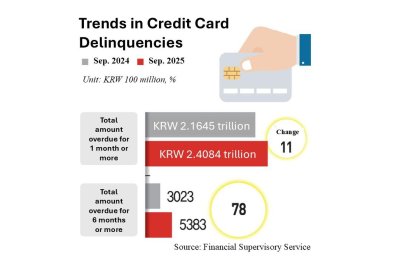
Trends in South Korea’s credit card delinquencies show rising overdue balances, with long-term arrears of six months or more jumping sharply between September 2024 and September 2025, according to the Financial Supervisory Service. Graphic by Asia Today and translated by UPI.
Jan. 6 (Asia Today) — South Korea’s credit card delinquencies have climbed to near 2.5 trillion won ($1.7 billion), with hard-to-collect arrears of six months or more jumping 78% from a year earlier, raising concerns about card issuers’ earnings and asset quality.
Data from the Financial Supervisory Service’s financial statistics system showed overdue payments of one month or more at eight major card companies totaled 2.4084 trillion won ($1.66 billion) as of the end of September 2025, up about 11% from a year earlier, the report said. The total peaked at 2.5845 trillion won ($1.79 billion) at the end of March 2025 before edging lower.
The sharper risk signal was in longer-term delinquencies. Overdue balances of six months or more totaled 538.3 billion won ($372 million), up 78% year-on-year, the report said. Such debts are often treated as effectively uncollectible, and analysts said a rapid increase can drive higher bad-debt costs and volatility in card companies’ performance.
Long-term delinquencies accounted for 22.3% of total delinquencies, up from about 11% at the start of 2025, the report said.
By issuer, Lotte Card posted the steepest increase in six-month-plus delinquencies, up 306% to 194.8 billion won ($135 million), the largest among the eight firms. The report attributed the rise to the reflection of delinquent debts linked to Homeplus entering corporate rehabilitation last March.
Other issuers’ six-month-plus delinquency balances were listed as BC Card at 41.7 billion won ($28.8 million), Shinhan Card at 98.5 billion won ($68.1 million), Hana Card at 77.7 billion won ($53.7 million), Hyundai Card at 27.5 billion won ($19.0 million), KB Kookmin Card at 30.1 billion won ($20.8 million), Samsung Card at 23.6 billion won ($16.3 million) and Woori Card at 40.9 billion won ($28.3 million), the report said.
Analysts linked the trend to heavier repayment burdens for vulnerable borrowers amid a slowing economy, high inflation and high interest rates. They also warned that rising card delinquencies can be an early risk indicator for household debt more broadly, since card loans and cash advances often serve as emergency funding for lower-income households.
An industry official said the rise suggests household finances have not fully recovered, but added that not all long-term overdue balances are uncollectible and that firms are managing receivables with recovery rates in mind.
Jan. 7 (UPI) — The Justice Department has sued Arizona and Connecticut for refusing to hand over their full voter registration lists, making them the 22nd and 23rd states to be targeted by the Trump administration in its litigious campaign over voter data ahead of the midterm elections.
The lawsuits were filed Tuesday, with Attorney General Pam Bondi arguing she is charged by Congress to ensure that states have proper and effective voter registration and voter list maintenance programs.
She also threatened that she has the Civil Rights Act of 1960 to demand the statewide voter registration lists.
“Accurate voter rolls are the foundation of election integrity, and any state that fails to meet this basic obligation of transparency can expect to see us in court,” she said in a statement.
The Justice Department has sent demands for the voter registration rolls to at least 40 states and the District of Columbia, according to the Brennan Center for Justice.
All states except North Dakota require citizens to register with election officials, with the information forming voter registration rolls.
The demands for these rolls, which include private and sensitive information, have raised concerns among both voting-rights groups, who say the Trump administration may try to undermine elections, and immigration advocates worried the rolls could be shared with the Department of Homeland Security.
The Trump administration has argued that it needs the lists to ensure election integrity, including that non-citizens are not voting. President Donald Trump continues to falsely claim that the 2020 election, which he lost to Joe Biden, was stolen from him.
The lawsuits overwhelming target Democratic-led states, and the effort comes ahead of November’s midterm elections, which Trump has increasingly become involved with.
Jesus Osete, principal deputy assistant attorney general for civil rights, posted the lawsuit naming Arizona as a defendant on X, saying the Democratic-led state “didn’t respond” to the Justice Department requests for the voter rolls.
Arizona Secretary of State Adrian Fontes responded to Osete with a video statement, saying they have responded to every Justice Department request, and that he will not break state and federal law to share unredacted voter data with the federal government.
“I would recommend that Mr. Osete read those correspondence and we will see you apparently in court,” he said.
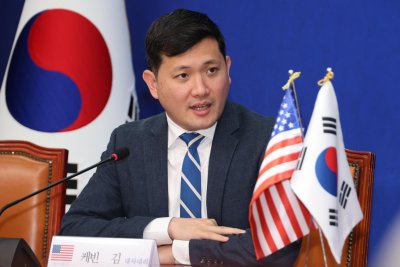
Acting U.S. Ambassador to South Korea Kevin Kim, seen here at the National Assembly in Seoul in December, has left his post and returned to the United States, the foreign ministry said Wednesday, File Photo by Yonhap
Acting U.S. Ambassador to South Korea Kevin Kim has left his post in Seoul and returned to the United States, the foreign ministry said Wednesday, amid speculation he may be assigned a new role in the Trump administration related to Korea issues.
Kim’s departure came just about two months after he took up the post as charge d’affaires at the U.S. Embassy in Seoul in October last year.
Kim succeeded then acting U.S. Ambassador Joseph Yun after the position had remained vacant since former U.S. Ambassador to Seoul Philip Goldberg left the post early last year following the launch of the second Trump administration.
Kim recently informed Seoul officials he returned to the U.S., according to the foreign ministry.
Jim Heller, deputy chief of mission at the U.S. Embassy in Seoul, is expected to serve as charge d’affaires until a new ambassador is appointed.
Sources say that Kim could be tapped for a new role handling Korea-related issues, possibly a position tasked with implementing the summit agreements reached between the allies on security and other matters, or dealing with North Korea issues.
Kim has likely been named a senior adviser to Allison Hooker, U.S. under secretary of state for political affairs, a diplomatic source said. Both Hooker and Kim were deeply involved in nuclear negotiations with North Korea during Trump’s first term, when denuclearization talks were in full swing.
Prior to his posting in Seoul, Kim served as U.S. deputy assistant secretary of state for China, Japan, Korea, Mongolia and Taiwan at the Bureau of East Asian and Pacific Affairs.
Kim’s departure leaves the ambassadorial post in Seoul vacant once again. Goldberg assumed the position more than a year after the Biden administration took office. It took about 18 months for Ambassador Harry Harris to take up the post under Trump’s first term.
South Korean President Lee Jae Myung proposes a halt to Pyongyang’s nuclear programme in exchange for ‘compensation’.
Published On 7 Jan 20267 Jan 2026
Share
South Korean President Lee Jae Myung has said he has asked his Chinese counterpart Xi Jinping to play a mediation role as his government seeks to improve relations with the North and restart talks over its nuclear programme.
Speaking in Shanghai on Wednesday, at the end of a four-day state visit to China, Lee proposed a freeze in Pyongyang’s nuclear programme in exchange for “compensation or some form of return”.
Recommended Stories
list of 4 itemsend of list
“Just stopping at the current level – no additional production of nuclear weapons, no transfer of nuclear materials abroad, and no further development of ICBMs – would already be a gain,” Lee told journalists following meetings with top Chinese officials, including his second meeting with Xi in two months.
“If that stage is achieved, then in the medium term we can move toward gradual reduction,” Lee added. “In the long term, we must not give up the goal of a nuclear-free Korean Peninsula.”
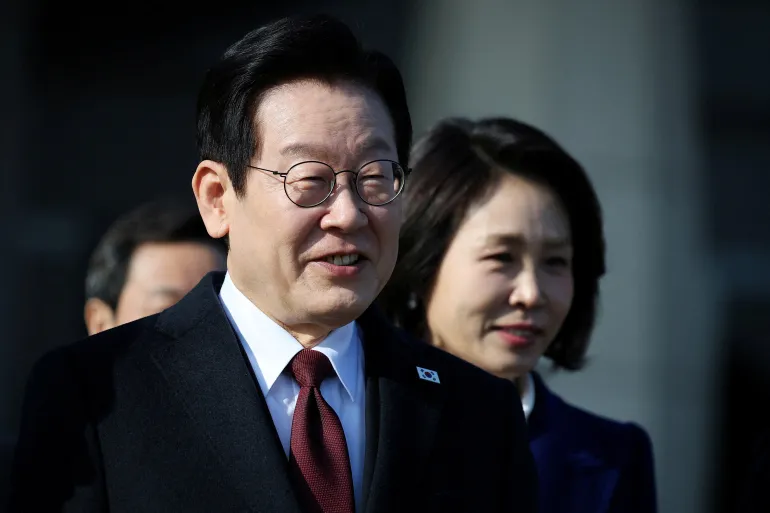
South Korean President Lee Jae Myung and his wife Kim Hye-kyung arrive at Seoul airbase as they leave for Beijing, in Seongnam, South Korea, on Sunday [Kim Hong-Ji/Reuters]
Lee was speaking to reporters on the final day of his trip, which was the first state visit by a South Korean leader to China in six years.
The visit aimed to reset relations between the countries following a rocky period in recent years due to a dispute over the deployment in South Korea of a United States missile defence system in 2017.
Lee told reporters that much progress had been made in restoring trust and that he had told Xi he would “like China to play a mediating role on issues related to the Korean Peninsula, including North Korea’s nuclear programme”.
“All our channels are completely blocked,” Lee said. “We hope China can serve as … a mediator for peace.”
Xi had urged Seoul to show “patience” in its dealings with Pyongyang, given how fraught ties between the two Koreas have become, Lee added.
“And they’re right. For quite a long period, we carried out military actions that North Korea would have perceived as threatening,” Lee said.
South Korea’s ousted former President Yoon Suk-yeol has been indicted for allegedly trying to provoke military aggression from North Korea in a bid to help him consolidate power.
On Monday, Pyongyang confirmed it had carried out test flights of hypersonic missiles, with leader Kim Jong Un saying it was important to “expand the … nuclear deterrent” in light of “the recent geopolitical crisis” – an apparent reference to Washington’s attacks on Venezuela and its abduction of Venezuelan President Nicolas Maduro.