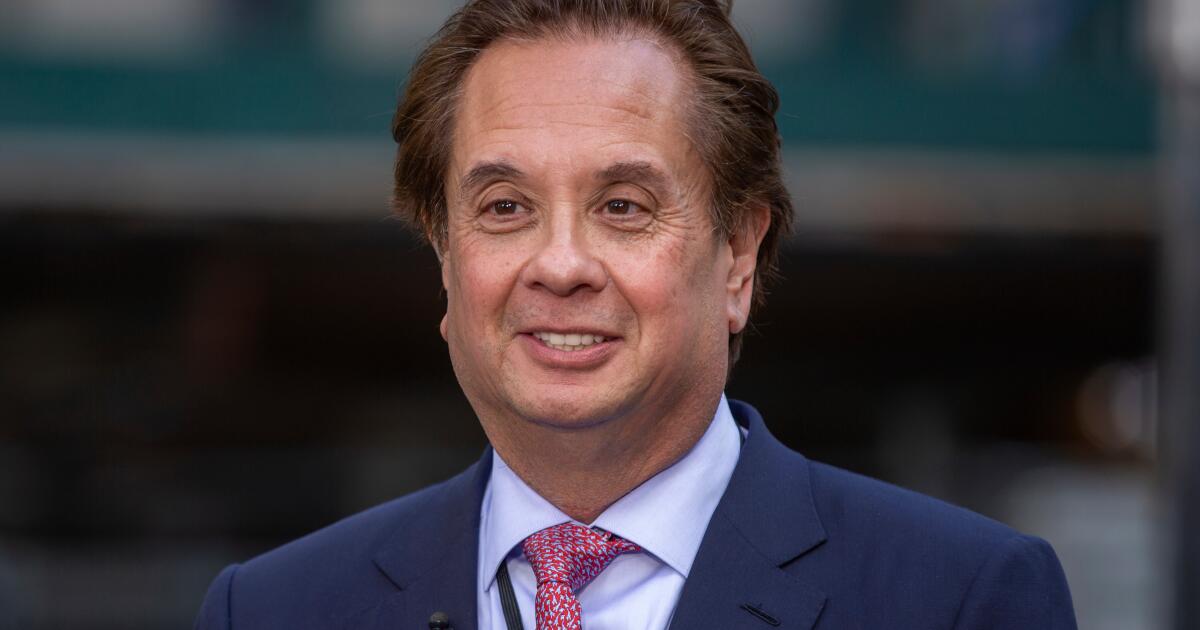
NEW YORK — George Conway, who was once married to a former advisor to the president before becoming a prominent anti-Trump voice, announced on Tuesday that he is running for a U.S. House seat in New York City, testing whether he can turn his strong social media following into votes in a crowded Democratic primary.
Conway — who worked for years in New York City as an attorney but has more recently been living in Bethesda, Md. — said he was spurred to run for Congress after a conversation with a friend about her frustration with some Democrats’ decision to vote to end last year’s government shutdown.
Conway didn’t want to challenge his congressman in Maryland, Rep. Jamie Raskin, who he said he loves, so the friend suggested he instead look at a seat in Manhattan that was soon to be vacant following the retirement of Democratic Rep. Jerry Nadler.
Conway said he looked it up on Wikipedia, and realized it was his old stomping grounds.
“It was like, huh, it’s an open seat. This isn’t crazy. I should think about this,” he said in an interview.
He relocated back to Manhattan a few weeks ago, he said.
Conway joins a flood of Democrats looking to take over Nadler’s seat. Among the candidates are Nadler protégé and state lawmaker Micah Lasher, school shooting survivor and advocate Cameron Kasky and Jack Schlossberg, the grandson of John F. Kennedy.
In a campaign launch video, Conway, 62, positioned himself as a seasoned Trump foe whose extensive experience as an attorney would allow him to continue his years-long fight against the president from Congress.
“This is no ordinary time. And I will not be an ordinary member of Congress,” he said.
Conway, a former Republican who helped found the anti-Trump Lincoln Project, said that he doesn’t want to be a career politician but felt that “this is a moment where we need people who can fight Trump the way he needs to be battled.”
He supported Trump’s 2016 presidential run and had been married to Kellyanne Conway, a pollster and strategist who became a senior presidential advisor in the first Trump White House and was one of Trump’s fiercest defenders.
As Trump’s first term went on, George Conway began to criticize Trump with an aggressiveness that rivaled his then-wife’s ardent support of the president, drawing extraordinary attention to their relationship’s diverging political positions.
At one point, Trump fired back, calling George Conway “a stone cold LOSER & husband from hell!”
The Conways announced their divorce in 2023, writing in a statement that their marriage had included “many happy years.”
The district Conway is hoping to represent is considered solidly Democratic, consisting of Midtown Manhattan and the tony Upper East and Upper West sides.
Nadler, 78, last year said he would not run for reelection, with the longtime fixture of New York’s congressional delegation calling for generational change in Congress. His planned exit has led to a flood of Democratic candidates emerging to take over his seat.
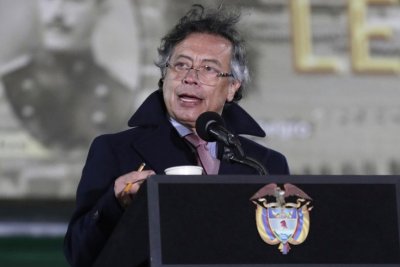
Colombian President Gustavo Petro called for a nationwide mobilization Wednesday and urged citizens to “defend sovereignty,” in response to statements by U.S. President Donald Trump that left open the possibility of military intervention. Photo by Carlos Ortega/EPA
Jan. 6 (UPI) — Colombian President Gustavo Petro has called for a nationwide mobilization Wednesday and urged citizens to “defend sovereignty,” responding to statements by the U.S. President Donald Trump that in Colombia have been widely interpreted as threats of intervention and direct attacks against the head of state.
The call, posted by Petro on X and echoed by government officials and political allies, urges rallies in public squares across the country starting at 4 p.m. local time, with the main protest planned for Bogota’s Plaza de Bolivar, the historic square that houses Colombia’s main government institutions. Petro said he will address the crowd.
The escalation follows remarks by Trump in which he referred to Petro in disparaging terms, accused him of backing drug production and left open the possibility of military action, according to reports by Colombian media.
In recent comments, Trump said a military operation against Colombia “sounds good,” following a U.S. military incursion in Venezuela. He also accused Petro of links to drug trafficking and said Colombia is “very sick.”
Petro publicly rejected the accusations and framed the dispute as a matter of national sovereignty. He said he would carefully assess the scope of Trump’s words before issuing a broader response but insisted that dialogue should be “the first path” and defended the legitimacy of his government.
“Although I have not been a soldier, I know about war and clandestinity. I swore not to touch a weapon again after the 1989 peace pact, but for the homeland, I would take up arms again, which I do not want,” Petro wrote, referring to the agreement that led to the demobilization of the M-19 guerrilla movement in which he once participated.
“I am not illegitimate, nor am I a drug trafficker. I own only my family home, which I am still paying for with my salary. My bank statements have been made public. No one has been able to say I have spent more than my salary. I am not greedy,” he added.
Separately, Colombia’s Foreign Ministry issued a statement after remarks attributed to Trump on Sunday and said it rejects what it considers unacceptable interference in matters of sovereignty and bilateral relations.
Vice President Francia Marquez joined those describing Trump’s statements as “threats” and called on Colombians to defend national sovereignty, according to local radio reports.
Demonstrations planned for Wednesday are expected in cities including Bogota, Medellin, Cali, Bucaramanga, Cartagena and Santa Marta, with calls to gather in central squares.
Petro described the protests as “peaceful” and urged Colombians to fly the national flag at their homes and bring it to public squares, El Espectador reported. He warned of the risks of military escalation and reiterated that the armed forces must follow their constitutional mandate to defend sovereignty.
The episode unfolds amid regional upheaval linked to Venezuela’s crisis and rising diplomatic tensions in Latin America.
According to daily El Tiempo, the situation has pushed Petro’s government to return to street mobilization as a political tool while Bogota seeks to manage relations with Washington without losing internal control.
WASHINGTON — President Trump has made broad but vague assertions that the United States is going to “run” Venezuela after the ouster of Nicolás Maduro but has offered almost no details about how it will do so, raising questions among some lawmakers and former officials about the administration’s level of planning for the country after Maduro was gone.
Seemingly contradictory statements from Trump and Secretary of State Marco Rubio have suggested at once that the U.S. now controls the levers of Venezuelan power or that the U.S. has no intention of assuming day-to-day governance and will allow Maduro’s subordinates to remain in leadership positions for now.
Rubio said the U.S. would rely on existing sanctions on Venezuela’s oil sector and criminal gangs to wield leverage with Maduro’s successors.
The uncertainty on definitive next steps in Venezuela contrasts with the years of discussions and planning that went into U.S. military interventions that deposed other autocratic leaders, notably in Iraq in 2003, which still did not often lead to the hoped-for outcomes.
‘Disagreement about how to proceed’
The discrepancy between what Trump and Rubio have said publicly has not sat well with some former diplomats.
“It strikes me that we have no idea whatsoever as to what’s next,” said Dan Fried, a retired career diplomat, former assistant secretary of state and sanctions coordinator who served under both Democratic and Republican administrations.
“For good operational reasons, there were very few people who knew about the raid, but Trump’s remarks about running the country and Rubio’s uncomfortable walk back suggests that even within that small group of people, there is disagreement about how to proceed,” said Fried who is now with the Atlantic Council think tank.
Supporters of the operation, meanwhile, believe there is little confusion over the U.S. goal.
“The president speaks in big headlines and euphemisms,” said Rich Goldberg, a sanctions proponent who worked in the National Energy Dominance Council at the White House until last year and is now a senior adviser to the Foundation for Defense of Democracies, a hawkish think tank.
Goldberg does not see Rubio becoming “the superintendent of schools” but “effectively, the U.S. will be calling the shots.”
“There are people at the top who can make what we want happen or not, and we right now control their purse strings and their lives,” he said. “The president thinks it’s enough and the secretary thinks it’s enough, and if it’s not enough, we’ll know very soon and we’ll deal with it.”
If planning for the U.S. “to run” Venezuela existed prior to Maduro’s arrest and extradition to face federal drug charges, it was confined to a small group of Trump political allies, according to current U.S. officials, who note that Trump relies on a very small circle of advisers and has tossed aside much of the traditional decision-making apparatus.
These officials, who spoke on condition of anonymity to discuss their understanding of internal deliberations, said they were not aware of any preparations for either a military occupation or an interim civilian governing authority, which has been a priority for previous administrations when they contemplated going to war to oust a specific leader or government. The White House and the State Department’s press office did not return messages seeking comment.
Long discussion among agencies in previous interventions
Previous military actions that deposed autocratic leaders, notably in Panama in 1989 and Iraq in 2003, were preceded by months, if not years, of interagency discussion and debate over how best to deal with power vacuums caused by the ousters of their leaders. The State Department, White House National Security Council, the Pentagon and the intelligence community all participated in that planning.
In Panama, the George H.W. Bush administration had nearly a full year of preparations to launch the invasion that ousted Panama’s leader Manuel Noriega. Panama, however, is exponentially smaller than Venezuela, it had long experience as a de facto American territory, and the U.S. occupation was never intended to retake territory or natural resources.
By contrast, Venezuela is vastly larger in size and population and has a decadeslong history of animosity toward the United States.
“Panama was not successful because it was supported internationally because it wasn’t,” Fried said. “It was a success because it led to a quick, smooth transfer to a democratic government. That would be a success here, but on the first day out, we trashed someone who had those credentials, and that strikes me as daft.”
He was referring to Trump’s apparent dismissal of opposition leader Maria Corina Machado, whose party is widely believed to have won elections in 2024, results that Maduro refused to accept. Trump said Saturday that Machado “doesn’t have the support within or the respect within the country” to be a credible leader and suggested he would be OK with Maduro’s No. 2, Delcy Rodríguez, remaining in power as long as she works with the U.S.
Hoped-for outcomes didn’t happen in Iraq and Afghanistan
Meanwhile, best-case scenarios like those predicted by the George W. Bush administration for a post-Saddam Hussein Iraq that it would be a beacon of democracy in the Middle East and hopes for a democratic and stable Afghanistan following the ouster of the Taliban died painfully slow deaths at the tremendous expense of American money and lives after initial euphoria over military victories.
“Venezuela looks nothing like Libya, it looks nothing like Iraq, it looks nothing like Afghanistan. It looks nothing like the Middle East,” Rubio said this weekend of Venezuela and its neighbors. “These are Western countries with long traditions at a people-to-people and cultural level, and ties to the United States, so it’s nothing like that.”
The lack of clarity on Venezuela has been even more pronounced because Trump campaigned on a platform of extricating the U.S. from foreign wars and entanglements, a position backed by his “Make America Great Again” supporters, many of whom are seeking explanations about what the president has in mind for Venezuela.
“Wake up MAGA,” Republican Rep. Thomas Massie of Kentucky, who has bucked much of his party’s lockstep agreement with Trump, posted on X after the operation. “VENEZUELA is not about drugs; it’s about OIL and REGIME CHANGE. This is not what we voted for.”
Sen. Rand Paul, also a Kentucky Republican, who often criticizes military interventions, said “time will tell if regime change in Venezuela is successful without significant monetary or human cost.”
“Easy enough to argue such policy when the action is short, swift and effective but glaringly less so when that unitary power drains of us trillions of dollars and thousands of lives, such as occurred in Afghanistan, Iraq, and Vietnam,” he wrote on social media.
In addition to the Venezuela operation, Trump is preparing to take the helm of an as-yet unformed Board of Peace to run postwar Gaza, involving the United States in yet another Mideast engagement for possibly decades to come.
And yet, as both the Iraq and Afghanistan experiences ultimately proved, no amount of planning guarantees success.
People attend an event held at the Anti-Imperialist Tribune in support of Venezuela in Havana on Saturday. Cuban President Miguel Diaz-Canel condemned the United States’ attack on Venezuela and the capture of President Nicolas Maduro and his wife, Cilia Flores. Photo by Ernesto Mastrascusa/EPA
BUESNOS AIRES, Jan. 6 (UPI) — Cuba is navigating another delicate moment in its recent history after the capture of Venezuelan President Nicolás Maduro by U.S. forces Saturday.
The operation that removed him from Caracas and left him facing a court in New York killed 32 Cuban soldiers, part of Maduro’s praetorian guard, and abruptly dismantled the island’s main economic lifeline.
The blow comes amid an energy and health crisis already considered the worst in decades — and one that could now deepen rapidly.
For more than 20 years, the alliance with Venezuela served as a strategic pillar for the Cuban government. The exchange of subsidized oil for medical and security services allowed Havana to sustain its economy after the Soviet collapse and cushion the impact of the U.S. embargo.
Maduro’s fall and the prospect of a regime change in Caracas directly disrupt that balance and place Cuba in a position of heightened economic and political vulnerability.
In the days after the Venezuelan leader’s arrest, the Cuban government responded with a mix of public gestures of support, internal political mobilization and tighter security.
On Saturday, President Miguel Díaz-Canel led a protest outside the U.S. Embassy in Havana, where he said Cuba was prepared to defend its alliance with Venezuela “even at a very high cost.”
The next day, the government decreed two days of national mourning in response to events in Venezuela. Senior officials dominated state television broadcasts to reinforce the idea of a “shared homeland” and a historic resistance to adversity.
The official narrative sought to counter statements by U.S. President Donald Trump, who publicly warned that allies of chavismo would face direct consequences.
Speaking about the island nation just 90 miles from Key West, Fla., Trump said, “Cuba is ready to fall … going down for the count,” while aboard Air Force One on Sunday.
On Monday, according to diplomatic sources, Cuban authorities stepped up surveillance at strategic facilities and convened emergency meetings. At the same time, reports of prolonged blackouts multiplied across several provinces — a concrete sign of the fragility of the energy system, as Venezuelan assistance could disappear or be sharply reduced within weeks.
Cuba’s energy crisis stems from a combination of obsolete infrastructure, chronic lack of maintenance and fuel shortages.
Most electricity generation depends on decades-old thermoelectric plants that are frequently offline due to breakdowns. Limited alternative capacity forces the state to rely on floating plants and diesel generators, whose operation depends on imports the country cannot secure due to a lack of hard currency or the loss of free supplies from traditional allies such as Venezuela.
Venezuelan lawyer and former prosecutor Zair Mundaray told UPI that for decades, Cuba depended entirely on Venezuelan oil, and that the collapse of Petróleos de Venezuela, S.A., Venezuela’s state‑owned oil and gas company, which started around 2014, broke that anchor. That left the island exposed to more frequent blackouts and a deeper economic downturn.
“In that vacuum, Mexico’s assistance emerged,” Mundaray said.
Press reports indicate that during the peak years of cooperation with Cuba, Caracas sent between 90,000 and 120,000 barrels per day. Since 2023, the Mexican state has shipped hundreds of thousands of barrels of crude and diesel to Cuba in operations valued at more than $300 million.
For economic historian Leandro Morgenfeld at the University of Buenos Aires, one of the objectives of U.S. intervention in Venezuela is to deepen Cuba’s isolation.
“The United States sees the Western Hemisphere as its exclusive domain. It will not accept the presence of extra-hemispheric forces and is willing to remove governments if it believes its interests or national security are at risk,” Morgenfeld said.
From that perspective, he added, the goal goes beyond Venezuela and seeks to dismantle the political and economic ties that sustain adversarial governments in the region, including Cuba.
“That is why they want to cut the political and economic link with Venezuela and further suffocate the island. Despite the blockade, they aim to intensify financial pressure to achieve what they have pursued for decades: the fall of the Cuban revolutionary government,” he said.
Morgenfeld said concern in Havana is real and deep. Cuba has faced a complex economic situation for years, marked by sanctions, lack of hard currency and low productivity.
“It is no longer, as in other times, an economy with easy sources of financing. If chavismo were to fall, the impact on Cuba would be very severe, economically and politically,” he said, while noting that a full regime change in Venezuela has not yet occurred.
From another angle, Colombian political scientist Christian Arias Barona said it is premature to anticipate an immediate collapse of the Cuban model.
He told UPI that as long as Delcy Rodríguez remains in power and U.S. hostility does not intensify, an abrupt shift is unlikely.
“Cuba would not face a drastic alteration in its economy or international relations, especially in its ties with Venezuela, from which it receives significant assistance, particularly in energy,” Arias Barona said. “Nor would its links with Russia and China be immediately affected.”
He recalled that Cuba’s recent history reflects an ability to adapt to adverse scenarios. Since the 1959 revolution, the island has faced what he described as constant “aggressions and hostilities” from the United States, including the ongoing economic embargo.
“That experience has allowed it to develop mechanisms of political and diplomatic survival,” he said.
Arias Barona also noted that the U.N. General Assembly has repeatedly voted against the U.S. embargo on Cuba, calling it a unilateral measure without backing in international law.
However, he said the United States, as a permanent member of the Security Council, has maintained its position and secured occasional support, including from Israel and, in recent votes, Argentina, Ecuador and Paraguay.
“What we are seeing today is a situation that increases Cuba’s vulnerability,” he said.
Sociologist Luis Wainer, also an academic at the University of Buenos Aires, agreed it is too early to project definitive scenarios.
“We do not know whether there will be a change in the political and economic model, how such a transition would look or even whether a transition will exist,” he told UPI.
“We are at a moment of negotiations, where what will be defined is who manages to impose the conditions,” he said.
Wainer said strong interest exists in framing this moment as a return to the Special Period, the severe economic and social crisis that began in 1991 after the collapse of the Soviet Union, Cuba’s main ally and supplier, and resulted in extreme shortages of fuel, food and medicine.
“There is a tendency to think Cuba will return to that scenario, but Cuban experience itself shows the country has developed creative responses to sustain itself without surrendering sovereignty,” he said.
Those responses include selective openings to new trade schemes, agreements with strategic sectors in other countries and the promotion of activities such as international tourism.
In that context, he highlighted the political and economic impact of Latin America’s leftward shift following Hugo Chávez’s electoral victory in 1998.
“That progressive cycle was a key lifeline for Cuba,” Wainer said. “It enabled regional integration, political cooperation and economic agreements that were fundamental for the island, especially with Venezuela.”
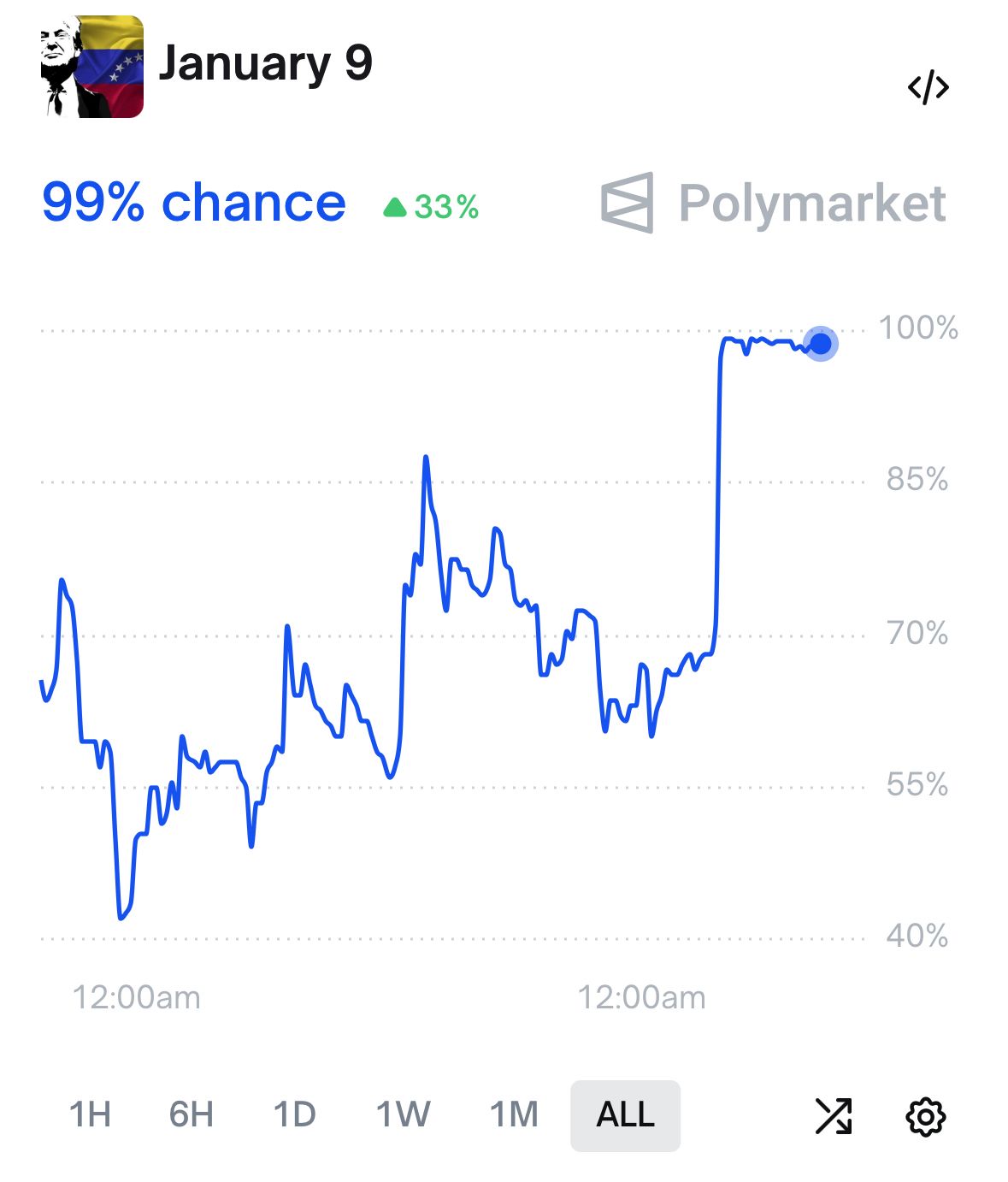
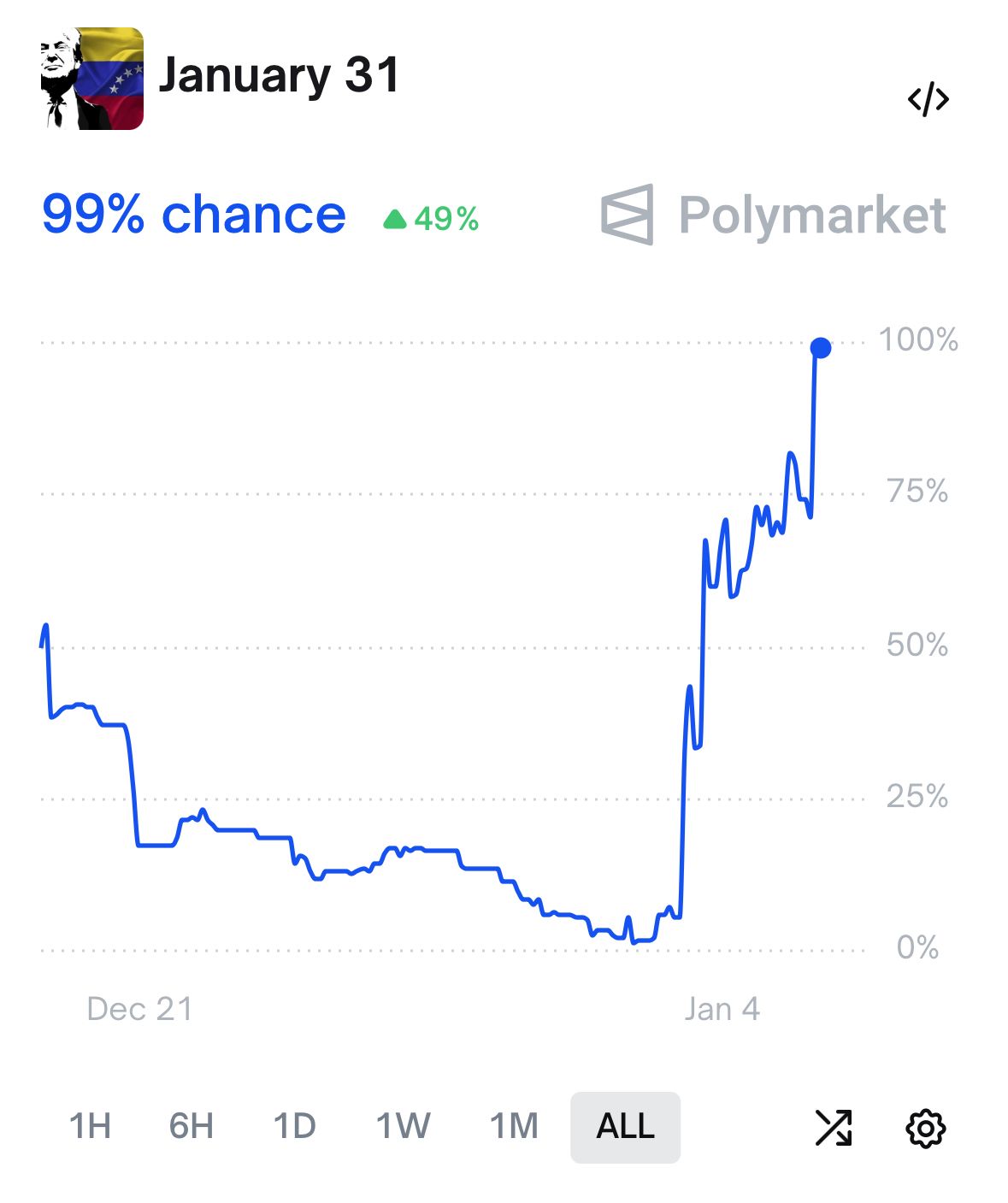
The betting markets suddenly jumped to near 100% that Trump will “invoke war powers” against Venezuela. What does it mean? The President, exercising his commander-in-chief authority, would order military action and then initiate the legal process that follows when U.S. forces are deployed into hostilities.
A few weeks ago we published a piece on what Polymarket and the debt surge could reveal about the Venezuela conflict. There was a nugget on what happened the day before María Corina Machado received the Nobel peace prize:
“The 2025 Nobel Peace Prize awarded to Maria Corina Machado made the news due to the behaviour of the Polymarket odds. Machado had a winning probability of around 3.5% around 12 hours prior to the announcement. Then, it shot up to a 73% probability of Machado taking the prize. This led to speculation that information was leaked, giving some traders room to cash in on bets in her favour. The ability of the site to “predict” an outcome, in this case, seems to be no more than information asymmetry. Someone out there had better (insider) intelligence, and simply traded on that information.“
Moreover, the night before the Maduro extraction, this happened:
Someone made $408,000 by placing a $30,000 bet in the nick of time. It obviously doesn’t mean that it’s going to happen in this case, pero cuando el río suena… One user placed around $15,000 during the past 6 hours on Trump invoking War Powers on Venezuela. Maybe someone knows something, or they’re just going on a limb because they saw The Verge post.
On War Powers
Under Article II of the US Constitution, presidents have long argued they can initiate certain military operations to defend U.S. interests without waiting for Congress, especially if they frame it as limited, urgent, or defensive. The War Powers Resolution (1973) was intended to impose limits on this authority: once forces are committed, the President must notify Congress within 48 hours, and the operation has a 60-day clock, unless Congress authorizes it or extends it. The US, after all, is a democracy with established separations of powers. Right? It’s likely to get messy in Congress, but we’ll see.
So why reach for that toolbox now, especially if Maduro has already been extracted? And why didn’t it need to before? Because Maduro’s removal was carried out through legal warrants, in coordination with the DEA, in other words, it was done through other legal motions. In this new transition, if the U.S. wants the option to use force quickly (without having to establish the legal basis for it every time), having the “war powers” gives Trump the legal framework to continue using force.
Now, Polymarket shows a sudden, overnight repricing of almost 100%, as if someone had entered the market with new information. Prediction markets can move on leaks or real inside signals. In other words: does someone know something and wants to profit out of it? Does it flag imminent action? The next few days will tell, but with confidence it is almost a certainty that Trump will request (or invoke!) such powers.
George Conway, shown with his ex-wife Kellyanne Conway, has joined the race for the House of Representatives in Manhattan. He’s running for the seat being vacated by the retiring Rep. Jerry Nadler, D-N.Y. File Photo by Erik S. Lesser/EPA
Jan. 6 (UPI) — Vocal Trump critic George Conway officially announced his run for the House of Representatives as a Democrat in New York for the seat being vacated by Rep. Jerry Nadler.
“We have a corrupt president, a mendacious president, a criminal president whose masked agents are disappearing people from our streets, who’s breaking international law, and he’s running our federal government like a mob protection racket,” Conway said in his video.
Conway is a formerly conservative lawyer who rose to widespread fame when his then-wife, Kellyanne Conway, became an adviser to President Donald Trump in his first term. Despite his wife’s position, he was an outspoken voice against the president. They divorced in 2023.
“I know how to fight these people. They are corrupt, amoral people,” Conway said. “They will stop at nothing to rig the system for themselves. I’ve been fighting Trump for years, and nothing will stop me.”
Nadler, D-N.Y., announced in September that he would retire from Congress. The 78-year-old Nadler said he wanted to make room for a younger generation. He represents New York’s 12th District, which includes Midtown and the Upper West and Upper East sides of Manhattan.
The 12th District voted for Vice President Kamala Harris by 64 points in 2024.
The field for that primary is crowded. Other candidates include Jack Schlossberg, President John F. Kennedy‘s grandson; New York State Assemblypeople Micah Lasher and Alex Bores; activists Cameron Kasky and Mathew Shurka; journalist Jami Floyd; civil rights lawyer Laura Dunn; fundraiser Alan Pardee; nonprofit founder Liam Elkind; entrepreneur Micah Bergdale; and software engineer Christopher Diep.
“We’re at a crossroads in our country, and Donald Trump is the greatest threat to the Constitution and the rule of law and democratic government that we have ever seen in our lifetime,” Conway told NBC News.
Conway only recently moved back to the district, a point his opponents have made.
“This campaign welcomes George to the race. And the city. And the party,” Bores said in a statement. “I personally would be delighted to offer George local dining tips. Tell him to give me a call when he’s in town.”
Pardee made a statement and mentioned Conway’s “years living in D.C. advancing a conservative agenda before discovering the monster he helped create.”
Floyd, who was a White House fellow under President Bill Clinton, said, “I’m not concerned about George Conway.” She said he “is a life-long conservative Republican and not even from here. So why isn’t he running in Bethesda, Md., or Alpine, N.J., where he belongs?”
Conway said he spent his legal career working in the district and that it has “been the epicenter of my life.”
“I lived in this district for decades before moving out to the suburbs,” he said. “All four of my kids were born in this district, and my life is centered around this district.”
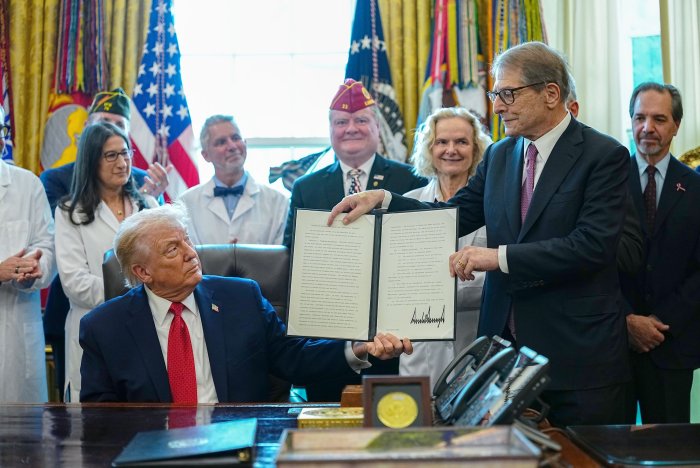
President Donald Trump holds a signed executive order reclassifying marijuana from a schedule I to a schedule III controlled substance in the Oval Office of the White House on Thursday. Photo by Aaron Schwartz/UPI | License Photo
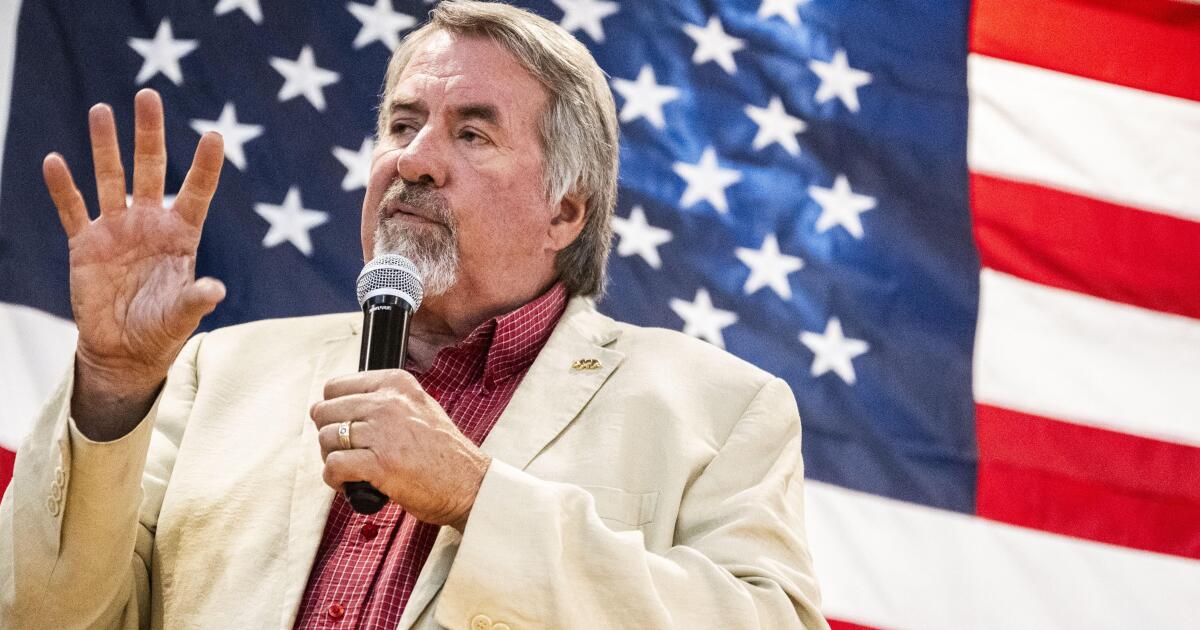
California Rep. Doug LaMalfa (R-Richvale) has died, GOP leadership confirmed in a social media post Tuesday morning.
“Jacquie and I are devastated about the sudden loss of our friend, Congressman Doug LaMalfa. Doug was a loving father and husband, and staunch advocate for his constituents and rural America,” said Rep. Tom Emmer (R-Minn.), the House majority whip, in an X post. “Our prayers are with Doug’s wife, Jill, and their children.”
LaMalfa, 65, was a rice farmer from Oroville and staunch Trump supporter who had represented his Northern California district for the past 12 years. His seat was one of several that was in jeopardy under the state’s redrawn districts approved by voters with Prop 50.
LaMalfa’s death reduces the GOP’s already slim House majority to 218-213.
Jan. 6 (UPI) — The 2026 midterm elections are coming later this year with 33 seats in the U.S. Senate and all 435 House seats on ballots across the country.
The Nov. 3 midterms are an opportunity for voters to respond to President Donald Trump‘s second term. Midterm elections are often viewed as a measure of voters’ response to the sitting president’s policies.
After a year of aggressive deportation practices, a withdrawal from the international arena and economic upheaval, 2026 has begun with the Trump administration abducting a foreign leader and launching offensives on foreign nations.
Republicans will seek to maintain a 219-213 majority in the House and three-seat majority in the Senate while Democrats hope to make gains and offer a check on Trump’s power. The results will signal approval or disapproval of how the country is being run and will set the landscape for the final two years of Trump’s presidency.
Retirements to bring changes to Senate
Nine senators have announced they are retiring from the chamber in 2026, including one of the most senior lawmakers.
Sen. Mitch McConnell, R-Ky., the longest-serving Senate party leader in history, will end his 40-year career at the end of the current term. He is one of four Republicans retiring from the Senate.
Six Republicans launched campaigns to succeed McConnell last year, along with eight Democrats. Kentucky has been a firmly Republican-leaning state, voting more than 65% for Trump in 2024.
Alabama voted similarly in 2024, with about 64% of votes going to Trump. Sen. Tommy Tuberville, R-Ala., is ending his time in the Senate to run for state governor.
Like Tuberville, Sen. Marsha Blackburn, R-Tenn., and Sen. Michael Bennet, D-Colo., will leave the Senate to run for governor of their respective states. Bennet has been a senator since 2009 while Blackburn entered the chamber in 2019.
Of the senators not running for re-election, Sen. Joni Ernst, R-Iowa, is leaving open a seat that is considered to be the most competitive. Ernst has been a senator since 2015.
Republicans are backing Rep. Ashley Hinson to take Ernst’s seat. Hinson was elected to the U.S. House in 2020.
Three candidates are in the Democratic primary seeking to challenge Hinson in November: state Sen. Zach Wahls, state Rep. Josh Turek and Nathan Sage, a military veteran.
Wahls was the youngest Iowa Senate Democratic Leader, serving in that role from 2020 to 2023.
The race for an open seat in North Carolina features former Gov. Roy Cooper on the ticket for the Democratic Party. Cooper served two terms as governor.
On the Republican side, former Republican National Committee Chairman Michael Whatley has earned the endorsement of Trump but he is being challenged in the primary by Michele Morrow. She ran an unsuccessful campaign for North Carolina’s superintendent of public instruction in 2024 and has never held public office.
North Carolina has historically been a tightly contested state. Trump earned about 50% of the vote there in 2024. Prior to that, the last time a presidential candidate received 50% of votes was 2012 when Mitt Romney received 50.4%.
North Carolina’s Senate seats have been held by Republicans since 2014. Kay Hagan was a state senator from 2009 to 2015 before being succeeded by Sen. Thom Tillis, R-N.C. Tillis is retiring at the end of the term.
The Democratic Party has tapped former Sen. Sherrod Brown to attempt a return to the chamber in 2026 after he lost a bid for re-election in 2024 to Republican Bernie Moreno.
Brown has launched a campaign to challenge Sen. Jon Husted, the Republican who was appointed to fill Vice President JD Vance’s seat that he vacated when Trump was elected president.
Sen. Jon Ossoff, D-Ga., is running for re-election in a state won by Trump in 2024. Three Republicans have entered their party’s primary to challenge Ossoff: Rep. Buddy Carter, Rep. Mike Collins and former college and pro football coach Derek Dooley.
Georgia Gov. Brian Kemp has given Dooley his endorsement.
Georgia’s 6th Congressional District re-elected Democrat Lucy McBath to the House in 2024 by nearly 50 points over her Republican challenger. Democrats hold both of the state’s Senate seats.
Sen. Susan Collins, R-Maine, will be challenged in 2026 but who will be on the other side of the ticket will not be known until the Democratic primary in June. Collins represents a state that former Vice President Kamala Harris carried by about seven points in 2024.
Maine Gov. Janet Mills and military veteran Graham Platner are campaigning in the Democratic primary.
Texas Sen. John Cornyn is running for re-election but will first have to win a contested Republican primary. Attorney General Ken Paxton, who has been a key figure in Texas’ redistricting battle and often opponent to Biden administration policies, will challenge Cornyn, along with Rep. Wesley Hunt.
In another battleground state, the retirement of Democratic Sen. Gary Peters will leave the race for a Michigan Senate seat open.
Former congressman Mike Rogers is expected to be on the ticket for Republicans after receiving an endorsement from Trump. Three candidates have entered the Democratic primary: Rep. Haley Stevens, state Sen. Mallory McMorrow and physician Abdul El-Sayed.
Congresspeople seeking new offices
Several members of Congress are running for different offices outside of the House chambers, including 11 running for governor. Meanwhile 18 members of the House are retiring, including former House Speaker Nancy Pelosi.
Republicans running for governor in their respective states include Iowa Rep. Randy Feenstra, South Dakota Rep. Dusty Johnson, Florida Rep. Byron Donalds and South Carolina Rep. Nancy Mace.
Rep Chip Roy, R-Texas, will not run for re-election as he will try to succeed Paxton as his state’s attorney general.
New Mexico’s 2nd Congressional District is held by Democrat Gabriel Vasquez but was won by Trump in 2024. New Mexico has voted for Democrats in every presidential election since 2008.
Vasquez faces a challenge from Republicans Greg Cunningham, a veteran of the U.S. Marines and former Albuquerque police officer. Cunningham ran for a seat in the state legislature in 2024 and lost.
Arizona’s 6th Congressional District seat, held by Republican Rep. Juan Ciscomani, had several Democrats looking to challenge Ciscomani in November.
Some candidates have begun dropping out of the Democratic primary as 2026 has arrived. JoAnna Mendoza, a military veteran, and engineer Chris Donat remain in the race. Mendoza has vastly outraised Donat, tallying $1.9 million in receipts compared to Donat’s $21,061, according to Federal Elections Commission data.
Trump won Arizona in 2024 with about 52% of the vote.
Colorado’s newest seat, District 8, is held by Republican Rep. Gabe Evans. He represents the district located in the northern Denver area after flipping the seat for Republicans in 2024.
Evans has a new challenger in the Republican primary as of November with former Air Force cadet and current Colorado Army Reserve Capt. Adam DeRito filing to run against him.
DeRito has been in a long legal battle with the U.S. Air Force which expelled him hours before he was set to graduate in 2010. He was denied a diploma for allegedly violating academy rules by fraternizing with a subordinate. DeRito claims these allegations were retaliation for him reporting sexual assaults at the academy.
The Democratic primary is set to feature five candidates, former state legislator Shannon Bird, state lawmaker Manny Rutinel, Marine veteran Evan Munsing, Denis Abrate and self-proclaimed former Republican John Francis Szemler.
Michigan is one of the biggest battleground states in 2026 with three seats expected to feature close races, along with an open Senate seat.
District 7, held by Republican Tom Barrett, has flipped in consecutive elections. Barrett, a U.S. Army veteran, will seek re-election with seven Democrats declared for their primary. He assumed the seat after Democrat Elissa Slotkin ran for and was elected to the Senate.
Among the Democrats vying to challenge Barrett is former U.S. Ambassador to Ukraine Bridget Brink, Michigan State professor Josh Cowen and William Lawrence, the founder of nonprofit environmental advocacy organization the Sunrise Movement.
District 10 will feature an open election as Rep. John James, a Republican, enters the state gubernatorial race.
FEC campaign data shows a field of six Democrats seeking their party’s nomination. Eric Chung, a former U.S. Department of Commerce official under the Biden administration, has raised the most out of any candidate, followed by Republican Robert Lulgjuraj, a former county prosecutor.
After some delay, District 4 Rep. Bill Huizenga, a Republican, announced last month that he will seek re-election. Four Democrats have filed to appear in the primary, including state Sen. Sean McCann.
Washington, DC – It has become a familiar pattern. United States presidents conduct unilateral military actions abroad. Congress shrugs.
On Saturday, in the hours after the US military abducted Venezuelan leader Nicolas Maduro, Democrats in the Senate pledged to raise yet another resolution to rein in US President Donald Trump’s military actions.
Recommended Stories
list of 4 itemsend of list
Chuck Schumer, the top Democrat in the chamber, has said the party will push for a vote within the week. By all accounts, the odds of its success remain long.
Since Trump took office for a second term in 2025, Congress has weighed multiple bills that would force him to seek legislative approval before initiating a military strike.
But the latest attack on Venezuela offers a stark instance of presidential overreach, one that is “crying out for congressional action”, according to David Janovsky, the acting director of the Constitution Project at the Project on Government Oversight.
Experts say it is also one of the clearest tests in recent history of whether Congress will continue to cede its authority to check US military engagement abroad.
“There are a lot of angles where you can come at this to say why it’s a clear-cut case,” Janovsky told Al Jazeera.
He pointed out that, under the US Constitution, Congress alone wields the authority to allow military action. He also noted that the Venezuela attack “is in direct contravention of the UN Charter, which is, as a treaty, law in the United States”.
“Any of the fig leaves that presidents have used in the past to justify unilateral military action just don’t apply here,” Janovsky added. “This is particularly brazen.”
An uphill battle
Since August, the Trump administration has signalled plans to crank up its “maximum pressure” campaign against Venezuela.
That month, Trump reportedly signed a secret memo calling on the US military to prepare for action against criminal networks abroad. Then, on September 2, the Trump administration began conducting dozens of strikes on alleged drug-smuggling boats off the Venezuelan and Colombian coasts.
That deadly bombing campaign was itself condemned as a violation of international law and an affront to Congress’s constitutional powers. It coincided with a build-up of US military assets near Venezuela.
Trump also dropped hints that the US military campaign could quickly expand to alleged drug-trafficking targets on Venezuelan soil. “When they come by land, we’re going to be stopping them the same way we stopped the boats,” Trump said on September 16.
The strikes prompted two recent votes in the House of Representatives in December: one that would require congressional approval for any land strikes on the South American country, and one that would force Trump to seek approval for strikes on alleged drug-smuggling boats.
Both resolutions, however, failed roughly along party lines. A similar resolution in the Senate, which would have required congressional approval before any more attacks, also fell short in November.
But speaking to reporters in a phone call just hours after the US operation on Saturday, Senator Tim Kaine said he hoped the brashness of Trump’s latest actions in Venezuela would shock lawmakers into action.
Republicans, he said, can no longer tell themselves that Trump’s months-long military build-up in the Caribbean and his repeated threats are a “bluff” or a “negotiating tactic”.
“It’s time for Congress to get its a** off the couch and do what it’s supposed to do,” Kaine said.
In an interview with CNN’s Dana Bash, US Senator Chris Murphy also agreed that it was “true” that Congress had become impotent on matters of war, a phenomenon that has spanned both Democratic and Republican administrations.
Bash pointed to former President Barack Obama’s 2011 military deployment to Libya, which went unchecked by Congress.
“Congress needs to own its own role in allowing a presidency to become this lawless,” Murphy responded.
Republicans ho-hum about resolutions
Under the US Constitution, only Congress can declare war, something it has not done since World War II.
Instead, lawmakers have historically passed Authorizations for Use of Military Force (AUMFs) to approve committing troops to recent wars, including the US invasions of Iraq and Afghanistan and the strikes on alleged al-Qaeda affiliates across the Middle East, Africa and Asia.
No AUMFs have been passed that would relate to military action in Venezuela.
When lawmakers believe a president is acting beyond his constitutional power, they can pass a war powers resolution requiring Congressional approval for further actions.
Beyond their symbolism, such resolutions create a legal basis to challenge further presidential actions in the judiciary.
However, they carry a high bar for success, with a two-thirds majority in both chambers of Congress needed to override a presidential veto.
Given the current makeup of Congress, passage of a war powers resolution would likely require bipartisan support.
Republicans maintain narrow majorities in both the House and Senate, so it would be necessary for members of Trump’s own party to back a war powers resolution for it to be successful.
In November’s Senate vote, only two Republicans — co-sponsor Rand Paul of Kentucky, and Lisa Murkowski, of Alaska — split from their party to support the resolution. It failed by a margin of 51 to 49.
December’s vote on a parallel resolution in the House only earned 211 votes in favour, as opposed to 213 against. In that case, three Republicans broke from their party to support the resolution, and one Democrat opposed it.
But Trump’s abduction of Maduro has so far only received condemnation from a tiny fragment of his party.
Overall, the response from elected Republicans has been muted. Even regular critics of presidential adventurism have instead focused on praising the ouster of the longtime Venezuelan leader, who has been accused of numerous human rights abuses.
Senator Todd Young, a Republican considered on the fence ahead of November’s war powers vote, has praised Maduro’s arrest, even as he contended the Trump administration owed Congress more details.
“We still need more answers, especially to questions regarding the next steps in Venezuela’s transition,” Young said.
Some Democrats have also offered careful messaging in the wake of the operation.
That included Debbie Wasserman Schultz, a Democrat who represents a large Venezuelan diaspora community in Florida.
In a statement on Saturday, Wasserman Schultz focused on the implications of Maduro’s removal, while avoiding any mention of the military operation that enabled it. Instead, she asserted that Trump owed Congress an explanation about next steps.
“He has failed to explain to Congress or the American people how he plans to prevent the regime from reconstituting itself under Maduro’s cronies or stop Venezuela from falling into chaos,” she wrote.
In December, however, Wasserman Schultz did join a group of Florida Democrats in calling for Congress to exercise its oversight authority as Trump built up military pressure on Venezuela.
What comes next?
For its part, the Trump administration has not eased up on its military threats against Venezuela, even as it has sought to send the message that Maduro’s abduction was a matter of law enforcement, not the start of a war.
Trump has also denied, once again, that he needed congressional approval for any further military action. Still, in a Monday interview with NBC News, he expressed optimism about having Congress’s backing.
“We have good support congressionally,” he told NBC. “Congress knew what we were doing all along, but we have good support congressionally. Why wouldn’t they support us?”
Since Saturday’s attack and abduction, Trump has warned that a “second wave” of military action could be on the horizon for Venezuela.
That threat has extended to the potential for the forced removal of Maduro’s deputy, Delcy Rodriguez, who was formally sworn in as the country’s interim president on Monday.
“If she doesn’t do what’s right, she is going to pay a very big price, probably bigger than Maduro,” Trump told The Atlantic magazine.
The administration has also said that strikes on alleged drug-smuggling boats near Venezuela will continue and that US military assets will remain deployed in the region.
Constitutional expert Janovsky, however, believes that this is a critical moment for Congress to act.
Failure to rein in Trump would only further reinforce a decades-long trend of lawmakers relinquishing their oversight authorities, he explained. That, in turn, offers tacit support for the presidency’s growing power over the military.
“To say this was a targeted law enforcement operation — and ignore the ongoing situation — would be a dangerous abdication of Congress as a central check on how the United States military is used,” Janovsky said.
“Continued congressional inaction does nothing but empower presidents to act however they want,” he added.
“To see Congress continue to step back ultimately just removes the American people even farther from where these decisions are actually being made.”
PARIS — Ukraine’s allies met Tuesday in Paris for key talks that could help determine the country’s security after any potential peace deal is reached with Russia.
But prospects for progress are uncertain: The Trump administration’s focus is shifting to Venezuela while U.S. suggestions of a Greenland takeover are causing tension with Europe, and Moscow shows no signs of budging from its demands in its nearly 4-year-old invasion.
Before the U.S. capture of Venezuelan leader Nicolás Maduro, French President Emmanuel Macron had expressed optimism about the latest gathering of what has been dubbed the “coalition of the willing. They have been exploring for months how to deter any future Russian aggression should it agree to stop fighting Ukraine.
In a Dec. 31 address, Macron said that allies would “make concrete commitments” at the meeting “to protect Ukraine and ensure a just and lasting peace.”
Macron’s office said an unprecedented number of officials will attend in person, with 35 participants including 27 heads of state and government. The U.S. envoys, Steve Witkoff and Trump’s son-in-law Jared Kushner, met with Macron at the Elysee presidential palace for preparatory talks ahead of the gathering.
Moscow has revealed few details of its stance in the U.S.-led peace negotiations. Officials have reaffirmed Russia’s demands and have insisted there can be no ceasefire until a comprehensive settlement is agreed. The Kremlin has ruled out any deployment of troops from NATO countries on Ukrainian soil.
A series of meetings on the summit’s sidelines illustrated the intensity of the diplomatic effort and the complexity of its moving parts.
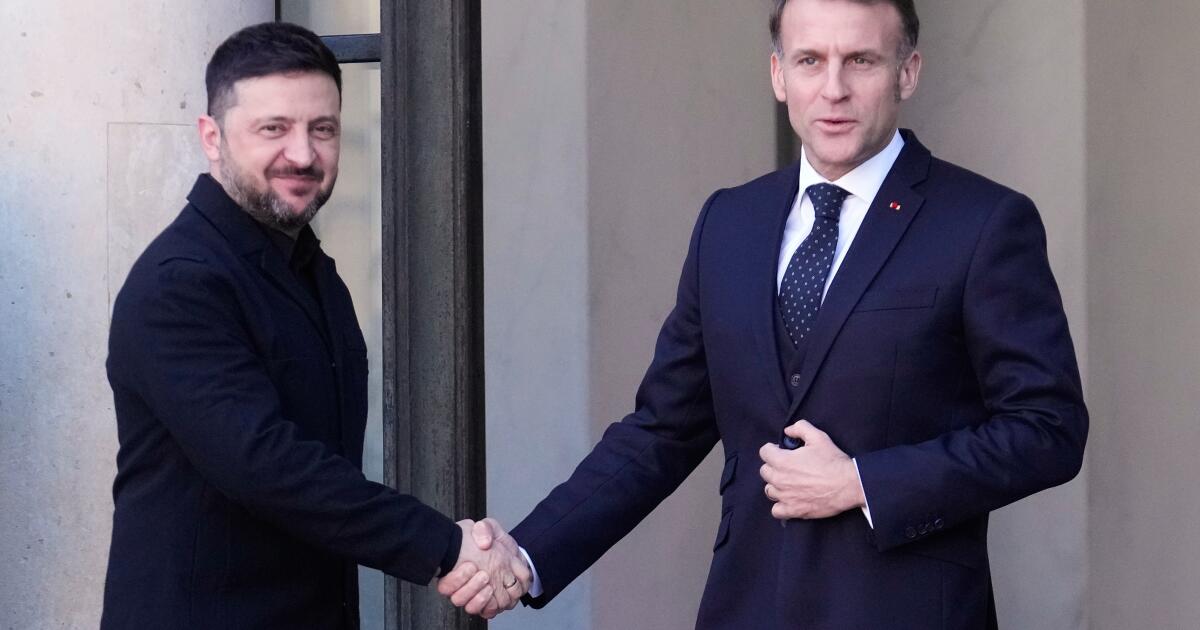
Ukrainian President Volodymyr Zelensky met with Macron ahead of the summit. French, British and Ukrainian military chiefs also met, with NATO’s top commander, U.S. Gen. Alexus G. Grynkewich, participating in talks that France’s army chief said focused on implementing security guarantees. Army chiefs from other coalition nations joined by video.
A news conference including Zelensky, Macron, British Prime Minister Keir Starmer and German Chancellor Friedrich Merz was planned later in the day.
Macron’s office said the U.S. delegation was initially set to be led by Secretary of State Marco Rubio, but he changed his plans after the U.S. military intervention in Venezuela.
Trump on Sunday renewed his call for the U.S. to take control of Greenland, a strategic, mineral-rich Arctic island.
The leaders of France, Germany, Italy, Poland, Spain and the U.K. on Tuesday joined Danish Prime Minister Mette Frederiksen in defending Greenland’s sovereignty in the wake of Trump’s comments about the self-governing territory of the kingdom of Denmark.
But the continent also needs U.S. military might to back up Ukrainian security guarantees and ward off Russia’s territorial ambitions. That could require a delicate diplomatic balancing act in Paris.
Participants are seeking concrete outcomes on five key priorities once fighting ends: ways to monitor a ceasefire; support for Ukraine’s armed forces; deployment of a multinational force on land, at sea and in the air; commitments in case of more Russian aggression; and long-term defense cooperation with Ukraine.
But whether that’s still achievable Tuesday isn’t so clear now, after the U.S. military operation targeting Maduro in Venezuela.
Ukraine seeks firm guarantees from Washington of military and other support seen as crucial to securing similar commitments from other allies. Kyiv has been wary of any ceasefire that it fears could provide time for Russia to regroup and attack again.
Recent progress in talks
Witkoff had indicated progress in talks about protecting and reassuring Ukraine. In a Dec. 31 post, he said “productive” discussions with him, Rubio and Kushner on the U.S. side and, on the other, national security advisers of Britain, France, Germany and Ukraine had focused on “strengthening security guarantees and developing effective deconfliction mechanisms to help end the war and ensure it does not restart.”
France, which with the U.K. has coordinated the multinational effort to shore up a possible peace plan, has given only broad-brush details about its scope. It says Ukraine’s first line of defense against a Russian resumption of war would be the Ukrainian military and that the coalition intends to strengthen it with training, weaponry and other support.
Macron has also spoken of European forces potentially being deployed away from Ukraine’s front lines to help deter future Russian aggression.
Important details unfinalized
Zelensky said during the weekend that potential European troop deployments still face hurdles, important details have not been finalized, and “not everyone is ready” to commit forces.
He noted that many countries would need approval from their lawmakers even if leaders agreed on military support for Ukraine. But he recognized that support could come in forms other than troops, such as “through weapons, technologies and intelligence.”
Zelensky said deployments in Ukraine by Britain and France, Western Europe’s only nuclear-armed nations, would be “essential.”
“Speaking frankly as president, even the very existence of the coalition depends on whether certain countries are ready to step up their presence,” he said. “If they are not ready at all, then it is not really a ‘coalition of the willing.’”
Leicester and Corbet write for the Associated Press. Volodymyr Yurchuk in Kyiv, Ukraine, contributed to this report.
SACRAMENTO — A California lawmaker introduced a bill Monday to crack down on fake liens filed against politicians, court employees and businesses that can force victims to spend thousands of dollars in legal fees to clear their names and repair their credit.
The bill by Assemblymember Diane Papan (D-San Mateo) comes after a Times investigation in July found lien claims filed with the secretary of state’s office are used by antigovernment agitators, including so-called “sovereign citizens,” for conspiracy-laced demands and vendettas. The U.S. Justice Department and the nonpartisan Congressional Research Service have called fake liens a form of “paper terrorism.”
“This isn’t an exotic or onerous fix,” Papan said Monday after the state Legislature returned to the Capitol to begin a new session. “The fact is that someone can do irreparable damage to someone’s reputation and their ability to have good credit. And we can certainly do better in California.”
Liens are recorded in state Uniform Commercial Code databases across the country, with the public filings intended to standardize interstate transactions and alert creditors about business debts and financial obligations.
The Times’ investigation found that state databases of UCC liens, which were designed to be straightforward and quick to file, are inherently vulnerable to abuse. A single false filing can claim an individual or business owes debts worth hundreds of millions or even trillions of dollars. Others flood victims with repeated filings that make it appear they are entangled in complex financial disputes.
In California, a lien recorded with the secretary of state costs $5 to file, but removing a fraudulent one from the public database requires a court order, which can cost thousands in attorney and court fees. The state does not notify a person when a lien names them as the debtor, allowing fake filings to remain in California’s public database for years before a victim discovers them. Many politicians and government employees learned from The Times that they had been targeted with spurious filings.
Under Assembly Bill 501, the secretary of state’s office would be required to notify individuals within 21 days if they are named as a debtor in a lien filing. The legislation also would delay court fees until the end of judicial proceedings.
In cases where the lien is found to be fraudulent, the bill would make the guilty party liable to the victim for three times the amount of court fees paid. The bill would also increase the maximum civil penalty for filing a fraudulent lien to $15,000, up from $5,000. California law already makes it a felony to knowingly file a fake lien.
“Victims of these fraudulent filings often have no idea they’ve been targeted until real harm is done,” Papan said. “That harm can look like wrecked credit, failed background checks, or failed mortgage applications while the people committing the fraud face relatively little risk or consequence.”
The National Assn. of Secretaries of State said the vast majority of UCC filings are legitimate. But, in a 2023 report, the association said that “fraudulent or bogus filings” were a widespread and persistent problem across the country, warning that they “can create serious financial difficulties for victims.”
One high-profile California public official who was unaware he had been named in a UCC claim until contacted by The Times said he was alarmed to find that the filing contained his home address. The Times identified hundreds of other UCC filings with no apparent legal basis that also listed the home addresses of government officials and prominent power-brokers, effectively turning the state’s public database into a doxing tool.
In the debt claims, individuals falsely allege government officials owe them money or property, in some cases claiming ownership of the victim’s home. Other fake filings target businesses with claims of being owed cash and cars. In some cases, individuals file dozens or hundreds of fake liens. Paid online classes associated with fringe antigovernment ideologies teach people how to record UCC liens, often promoting the filings as a way to pressure perceived adversaries or falsely claiming that the filings can erase debts.
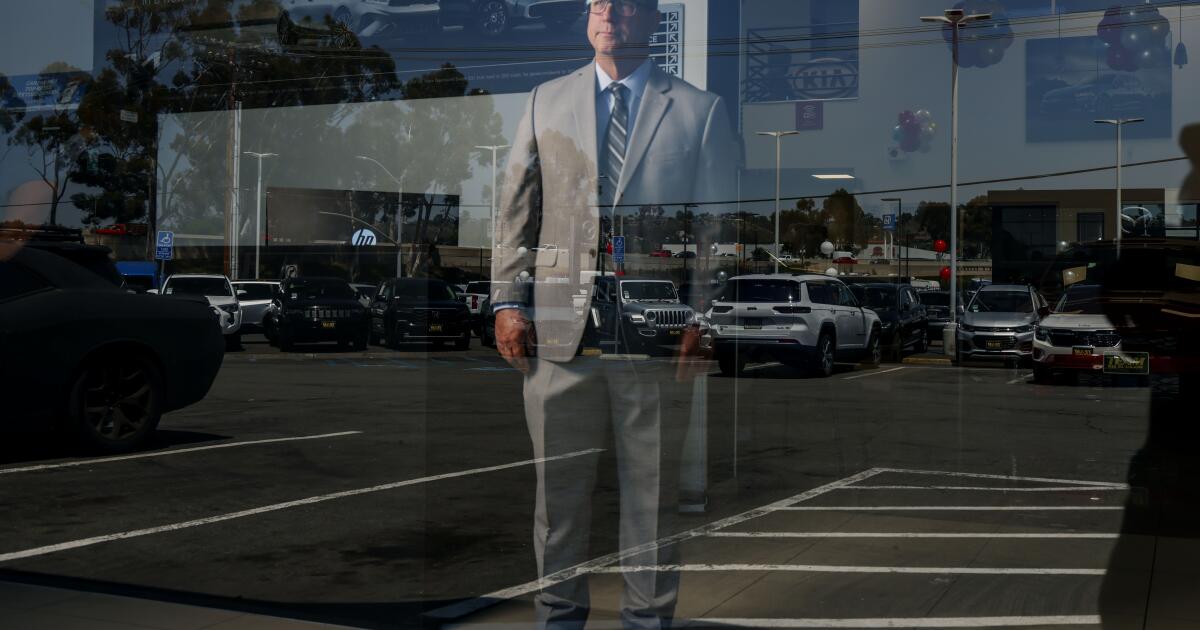
Michael Rogers, a San Diego attorney who represents auto dealers targeted by fake filings, said AB 501 would “greatly curb some of the systemic abuses used by the sovereign citizen movement and others” who file unsupported or fraudulent lien notices.
Consumer credit expert John Ulzheimer said in July that liens can complicate a person’s ability to obtain a mortgage or a company’s chances of securing lines of credit. In some cases, he said, the filings can derail job applications for positions that require thorough background checks.
Papan said her bill would restore “balance and accountability” to the UCC system, ensuring it remains a trusted commercial tool while adding protections for Californians targeted by fraudulent filings.
“We can’t allow the Uniform Commercial Code to be used as a weapon,” Papan said. “The fact that these forms are being used to damage the integrity of commercial transactions is very troubling.”
Lou Dobbs had David from Freeport, N.Y., on the line, the caller musing darkly about President Obama “rushing all these programs through by whatever means,” knowing he will soon be exposed as a fake, a fraud, a . . . Kenyan.
At that point, a scrupulous radio host had three options: (A) hit the kill button (B) laugh and hit the kill button or (C) offer some push-back against the fantastical notion that Barack Obama was born on foreign soil and thus serves — illegally — as the Oval Office’s first resident alien.
Instead, Dobbs chose the maximum complicity-minimum integrity route, or (D): “Certainly your view can’t be discounted,” the host said.
So it went over the last week, with the bloviating interviewer offering the (nominal) credibility of his syndicated radio show, which airs on dozens of stations, and the CNN television brand as a platform for assorted wing nuts, whose conspiracy fulminations about Obama had previously been most virulent in the more disreputable reaches of the Internet.
The subject fits neatly with Dobbs’ nativist, immigrant obsession. And the cable demagogue, already well behind Fox News, has got to find some way to keep from sagging behind even traditional cable television laggard MSNBC.
Cooler heads at CNN put some distance between themselves and their once star host, with fill-in Kitty Pilgrim using a segment of “Lou Dobbs Tonight” on Friday to provide a substantially more skeptical look at the Obama-made-in-Africa claims.
Pilgrim introduced the topic of Obama’s alleged foreign birth as she sat in for Dobbs that night, calling it “the discredited rumor that won’t go away.”
“CNN has fully investigated the issue,” the substitute said, and “found no basis for the questions about the president’s birthplace.”
When the issue first surfaced in the presidential campaign last summer, numerous credible news organizations and even the Hawaii Department of Health presented clear evidence that Obama was born Aug. 4, 1961, in Honolulu.
But those reports have done little to snuff out elaborate and ever-mutating conspiracy theories.
I often hear from disgruntled readers that they don’t pay attention to the dread “Mainstream Media” because they can find “the truth” on the Internet. Translation: Some blogger will please them by propping up just about any cockeyed theory that they hold.
The Internet agitators, in turn, get support and sustenance from mainstream provocateurs like Sean Hannity and Rush Limbaugh, who last month chortled, “God does not have a birth certificate, and neither does Obama — not that we’ve seen.”
Dobbs and the others found a nominal “news” peg for the story last week when the U.S. Army allowed a reserve major, Stefan F. Cook, to reverse his voluntary deployment to Afghanistan. Cook proclaimed his orders invalid because, he insisted, his commander in chief wasn’t born in the U.S.
Never mind that the good major appears in this instance to be more agent provocateur than man of arms or that he is represented by Orly Taitz, an Orange County attorney (and dentist) who has made it her life’s work to prove Obama isn’t one of us.
Dobbs welcomed Taitz and another of her clients, Alan Keyes (who was crushed by Obama in their Illinois U.S. Senate race), to his radio program like seers instead of extreme partisans. Dobbs suggested he had reached no conclusions, before barreling ahead with questions about why Obama hasn’t produced “his birth certificate, the long form, the real deal.”
But Obama has presented his birth certificate, as first noted by the nonpartisan FactCheck.org in June of last year.
Rather than settling the matter, though, the Internet display of the “Certification of Live Birth” provoked the first in what has become an endless cycle of challenges and innuendo.
Just last month, the Hawaii Department of Health confirmed to the Honolulu Star-Bulletin that the document is the only official record of the president’s birth and proves he was born in that state.
But conspiracy theorists argue that the lack of an underlying paper document (the so-called long-form birth certificate) proves a cover-up.
That ignores multiple truths including this one: Hawaii’s records, like those in many states, have gone electronic, and the certification document is accepted by both the state and national government as full proof of citizenship. To insist otherwise is to embrace the notion that thousands upon thousands of Hawaiians have obtained their U.S. passports, using similar documents, fraudulently.
One Internet “proof” of Obama’s alien roots truncates a taped interview with his grandmother to make it sound as if she is confirming his birth in Kenya, when the full tape shows she does nothing of the sort.
Another canard asserts that Obama must have been traveling on an Indonesian passport when he went to Pakistan at age 20, because the U.S. had banned travel there. Problem: There was no such travel ban.
To believe the wild theories, one must also accept that Obama’s mother — rather than apply for citizenship for her son as one would expect if he had been born overseas — launched an elaborate hoax. It would have begun in 1961 with her placing false birth notices in Honolulu’s two daily newspapers. Diabolical.
Brooks Jackson, director of Annenberg Political Fact Check (FactCheck.Org) and a reporter with 34 years in the business, has seen one howler after another knocked down, only for another to sprout in its place.
“CNN should be ashamed of itself for putting some of that stuff on the air,” said Jackson, who worked at the cable outlet for more than 20 years.
Besides Pilgrim’s skin-back report last week, one CNN employee reminded me several times that Dobbs’ most pointed assertions were made on his radio program, which is unconnected to CNN.
Jackson has studied the kind of “disordered thinking” exhibited by the foreign-birth gadflies, known collectively as “birthers.” His book “unSpun: Finding Facts in a World of Disinformation” — co-authored with another journalism authority, Kathleen Hall Jamieson — explored instances in which the public let itself be overtaken by emotion.
Jackson said he saw a bit of this emotional attachment to a conspiracy theory from Democrats who insisted that Sen. John F. Kerry lost the 2004 election only because of voter fraud in Ohio. They kept finding new examples.
Certainly, a good chunk of the American public hasn’t armed itself with enough plain information to sniff out the flimflam. Well after this year’s presidential inauguration, the Pew Research Center for the People and the Press found that 11% of Americans believed Obama was a Muslim. And 35% weren’t sure of his religion.
Republican Rep. Mike Castle of Delaware saw a town hall meeting this month interrupted as a woman, rooted on by a boisterous crowd, angrily demanded to know why nothing was being done to oust the “citizen of Kenya” pretending to be president.
On the even more extreme fringes, such sentiments border on dangerous. James von Brunn, the elderly neo-Nazi who shot and killed a guard last month at the U.S. Holocaust Memorial Museum in Washington, D.C., had posted anti-Obama “birther” theories on the Internet.
Dobbs did not return my call Tuesday. But he did go on the radio and rant about the L.A. Times and the other liberal media that are “subservient and servile to this presidency.”
He insisted he believed Obama is a citizen, while continuing to tell listeners “there is no actual birth certificate.” He did it because he is a Man of the People. And, as he explained, “the American people want an answer.”
There were no stars in the October sky. No moon that 64-year-old Masuma Khan could see from the narrow window of the California City Immigration Processing Center.
“No planes,” she said, recalling her confinement.
Once a prison, the facility in the Mojave Desert, located 67 miles east of Bakersfield, reopened in April to hold people in removal proceedings, including Khan.
It was not the kind of place where she imagined ending up — not after living in the country for 28 years, caring for her daughter and surviving one of California’s deadliest wildfires, the Eaton fire.
Khan was fortunate not to have lost her west Altadena home to the Jan. 7 fire, which destroyed more than 9,000 structures and killed 19 people.
But in the months that followed, Khan faced another threat — deportation.
As fire recovery efforts were underway in Los Angeles, the Trump administration launched immigration raids in the city, hampering recovery efforts and creating more distress for immigrants after the fires.
Khan worried. She was in the process of adjusting her immigration status and was required to check in every year with U.S. Immigration and Customs Enforcement.
An immigration attorney reassured her that there was no cause for concern: Her husband and daughter were citizens, she had no criminal record, and her case was still under review.
And so, on Oct. 6, Khan drove to downtown Los Angeles for her routine immigration check-in and found herself caught up in Trump’s deportation surge.
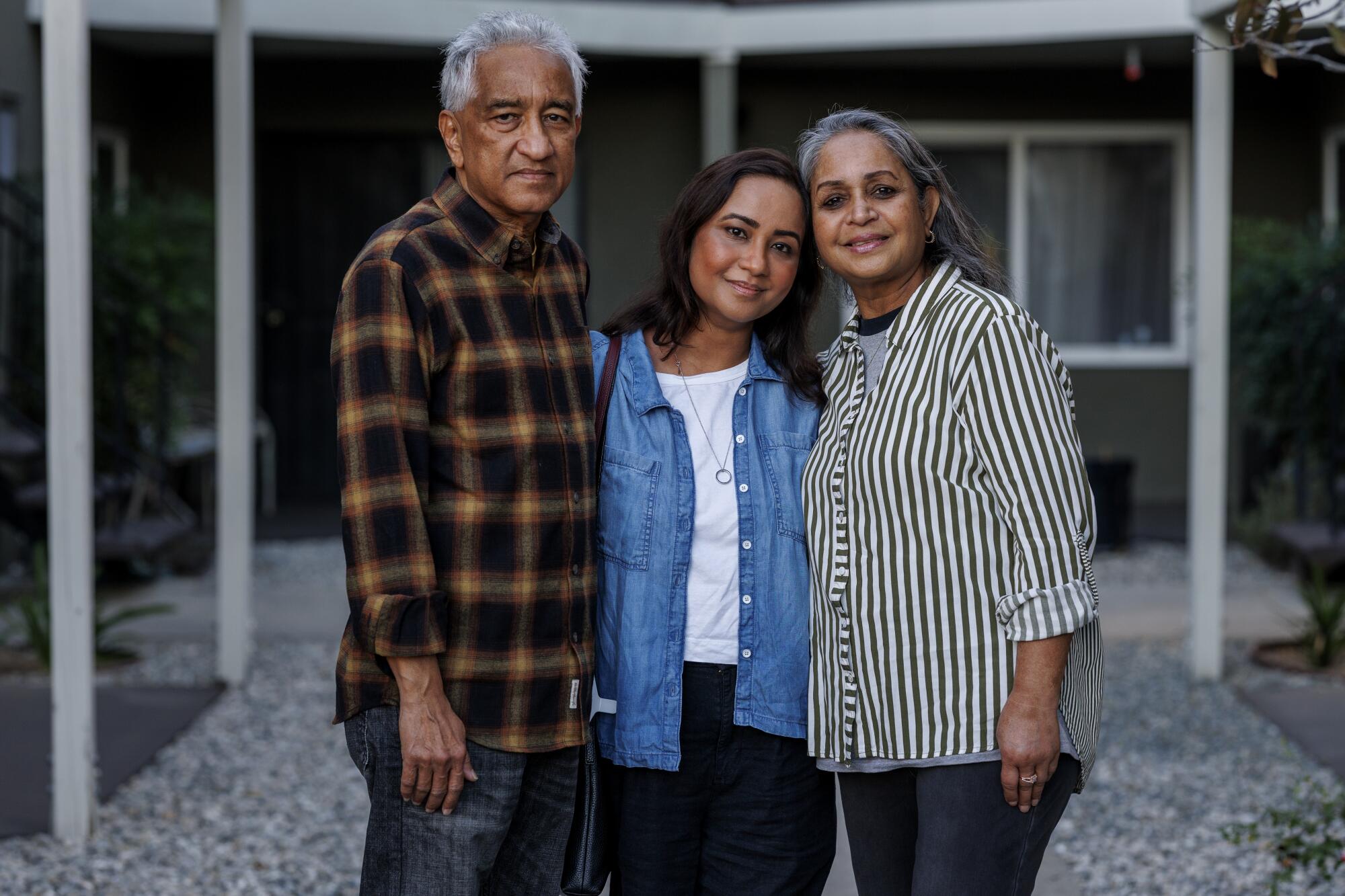
Eaton fire survivor Masuma Khan, 64, right, with her daughter Riya Khan and husband Isteak Khan after bring released in December.
(Gina Ferazzi/Los Angeles Times)
Khan was taken into custody by ICE agents and kept in a cold room for almost an entire day. She said agents denied her access to a lawyer and a phone until she signed deportation papers. Khan resisted but later signed.
She was placed in a van with other detainees and driven three hours north to the detention center in California City. She said there was no air conditioning in the van and she became nauseous and started to experience hypertension symptoms.
At the facility she was denied access to medications for high blood pressure, asthma, peripheral arterial disease, general anxiety and hypothyroidism, she said.
Khan, who is also prediabetic, said she struggled to maintain her health at the facility. Her blood pressure spiked and she began to experience stroke-like symptoms. Her legs swelled up and she became weak.
She said the facility was so cold that people often became ill, including staff. She and other women used socks as scarves, sleeves and mittens but were threatened with fines if they continued to misuse the garments.
She said she became sick and her vision got blurry without her prescribed eye drops. Her Halal meals shifted to a medical diet that included pork, which she cannot eat because she is Muslim.
Khan’s experience at the facility was similar to that of other detainees who filed a federal class-action lawsuit against the Department of Homeland Security and ICE. They alleged inhumane conditions at the facility that included inadequate food, water and medical care, frigid cells and lack of access to medications and lawyers.
The California City Immigration Processing Center in Kern County, where Masuma Khan was held.
(Patrick T. Fallon/AFP/Getty Images)
In an email response, Tricia McLaughlin, a DHS spokesperson, said any claims about “subprime conditions at ICE detention facilities are false.”
“All detainees are provided with proper meals, certified by dietitians, medical treatment and have the opportunities to communicate with lawyers and family members.”
Khan said she spent most days in her cell crying.
“I missed my family, I missed everything,” she said “I was frustrated.”
She often thought of home: her husband and daughter, her small garden and the birds she fed daily with seeds and oranges from her balcony.
It would be weeks before she could see her family again, before she could gaze at the mountains and hear the symphony of wildlife.
‘Like an inferno’
The Eaton fire had been raging for hours in west Altadena when Khan and her husband were awakened by evacuation alerts on their phones at 3:30 a.m.
Khan got out of bed and from her bedroom window could see flames raging in the mountains.
Khan hadn’t seen anything like it. Four years before she arrived, the Kinneloa fire, sparked by a campfire, erupted in the same mountains. It fed on dry and flammable vegetation and was driven by Santa Ana winds. It was a destructive fire.
But the Eaton fire was different. Hurricane-force winds helped spread the embers and flames deep into the town’s heart — destroying homes, schools and countless structures.
A business and vehicle are a total loss as the Eaton fire rages along Lake Avenue in Altadena on January 8, 2025.
(Gina Ferazzi/Los Angeles Times)
Khan and her husband, Isteak, didn’t have time to grab much before fleeing in their car that evening.
“It was like an inferno,” Isteak Khan, 66, recalled. “You could see the embers flying everywhere. It was very chaotic.”
The couple drove about three miles south to a supermarket in Pasadena. For a month they lived at a hotel until they were allowed to return home.
When they got back the surrounding neighborhoods were in ruins: Trees were charred, cars were stripped down to metal frames and homes were gutted or left in ash.
The couple’s apartment still was standing but had suffered smoke damage and there was no electricity, no safe water to use. The couple depended on water bottles and showered at the homes of relatives.
Khan never thought she would experience such a disaster in the U.S. Then again, she didn’t journey here for her own reasons. She came to save her daughter.
‘Incredibly traumatized’
In August 1997, Khan was living in Bangladesh with her husband and their 9-year-old daughter, Riya. That month Riya had traveled with her grandparents to the U.S. to see relatives when she fell seriously ill. Doctors determined she was suffering from kidney failure and needed ongoing treatment including chemotherapy and peritoneal dialysis.
Khan traveled to the U.S. on a visitor’s visa to be with Riya. For more than a decade her daughter received treatment at the Children’s Hospital in Los Angeles.
Khan became her daughter’s primary caretaker and did not return to Bangladesh as her visa was expiring. Her husband joined her in 1999 after obtaining a visa. He and Riya eventually received green cards and became citizens.
The following year, as Khan looked for legal ways to adjust her immigration status, she met a man at a Bangladeshi grocery store who befriended her and offered to help her obtain a green card, according to court records. Little did Khan know that this man — who spoke her language and was well known in the Bangladeshi community — was a scammer, one of many who prey on South Asians migrating to the U.S.
At the time Khan did not speak, read or write English well, and this man told her he could file an asylum application on her behalf, for a fee amounting to several thousand dollars.
But Khan was unaware this man had filed the application for her using a false name and listed his own address for future correspondence from immigration authorities, according to court documents.
All this came to light when she showed up for an asylum hearing in Anaheim in 1999 and responded to the questions of an asylum officer who noticed the information did not match what was in the application.
The officer denied the application, and later she was unaware of a notice to appear before an immigration court, since it had been sent to the scammer’s address.
Her absence at the hearing prompted an immigration judge to order her to be deported. Khan did not find out about the court’s action until 2015, when her husband petitioned to adjust her status so she could obtain a green card.
After the petition was denied and her case was closed because of the deportation order, Khan hired an immigration attorney who sought to reopen the case. But a judge denied it, and her appeal also was rejected by the 9th Circuit Court of Appeals.
In February 2020, Khan was detained by ICE but released and required to check in with immigration officials. That year she hired an immigration attorney who submitted paperwork to let her stay in the U.S. The application was pending when ICE took her into custody on Oct. 6.
McLaughlin, the DHS spokesperson, said there was no reason for the government to reconsider her case, since Khan had a final removal order since 1999 and had exhausted all appeals.
“She has no legal right to be in our country,” McLaughlin said. “DHS law enforcement lawfully arrested her on Oct. 6.”
Yet Khan caught a break in early November when a federal judge ordered her released. The judge ruled the government cannot detain Khan without giving her a hearing and explaining why it needs to detain her.
It was a victory for her legal team, made up of a law firm and two nonprofit groups — the South Asian Network and Public Counsel and Hoq Law APC.
Laboni Hoq, a chief attorney on the case, said the goal is to keep Khan out of detention while the team seeks to adjust her status.
“We’re feeling like she has a shot to pursue that process … given her long history in the country and that she is law-abiding and has met all the requirements to deal with her case through the court system and immigration system,” Hoq said.
Khan’s predicament has drawn the attention of numerous Southern California politicians, including U.S. Rep. Judy Chu and U.S. Sen. Adam Schiff. Much of it had to do with Khan’s 38-year-old daughter, Riya, who reached out to the lawmakers and also took to social media to bring her mother’s case to the public’s attention.
Still, it is unclear what will happen next.
As Khan’s legal fight proceeds, she must check in regularly with immigration authorities, as she did in downtown L.A. on Dec. 19, accompanied by Sen. Sasha Renée Pérez (D-Alhambra), who also became aware of her case from Riya’s efforts.
“She’s incredibly traumatized by what’s happened to her,” Pérez said of Khan. “She’s scared to even participate in the community events that we have during the holidays … it’s painful, it makes me angry, it makes me sad and I just wanted to be here with her.”
At their Altadena home one recent evening, the Khans sat in their living room. Riya said the hope was that the case will be reopened so her mother can obtain a green card.
“We’re going to stay together,” Isteak said.
Not far from Masuma, old “welcome home” balloons hovered. As she sat next to her daughter, she could express only two things: “I cannot leave this country. This is my home.”
Leading medical groups in the United States have raised alarm after the Centers for Disease Control and Prevention (CDC) under President Donald Trump took the unprecedented step of cutting the number of vaccines it recommends for children.
Monday’s sweeping decision, which advances the agenda of Trump-appointed Secretary of Health Robert F Kennedy Jr, removes the recommendation for rotavirus, influenza, meningococcal disease and hepatitis A vaccines for children.
Recommended Stories
list of 3 itemsend of list
It comes as US vaccination rates have been slipping, and the rates of diseases that can be protected against with vaccines, such as measles and whooping cough, are rising across the country, according to government data.
“This decision protects children, respects families, and rebuilds trust in public health,” Kennedy said in a statement on Monday.
In response, the American Medical Association (AMA) said it was “deeply concerned by recent changes to the childhood immunisation schedule that affects the health and safety of millions of children”.
“Vaccination policy has long been guided by a rigorous, transparent scientific process grounded in decades of evidence showing that vaccines are safe, effective, and lifesaving,” Sandra Adamson Fryhofer, a doctor and AMA trustee, said in a statement posted on the group’s website.
She pointed out that major policy changes needed “careful review” and transparency, which are lacking in the CDD’s decision.
“When longstanding recommendations are altered without a robust, evidence-based process, it undermines public trust and puts children at unnecessary risk of preventable disease,” she said.
The change was effective immediately and carried out following the approval by another Trump appointee, CDC acting director Jim O’Neill, without the agency’s usual outside expert review.
The changes were made by political appointees, without any evidence that the current recommendations were harming children, Sean O’Leary, chair of the American Academy of Pediatrics, said.
“It’s so important that any decision about the US childhood vaccination schedule should be grounded in evidence, transparency and established scientific processes, not comparisons that overlook critical differences between countries or health systems,” he told journalists.
Protections against those diseases are only recommended for certain groups deemed high risk, or when doctors recommend them in what’s called “shared decision-making”, the new CDC guidance stated.
States, not the federal government, have the authority to require vaccinations for schoolchildren.
But CDC requirements often influence the state regulations, even as some states have begun creating their own alliances to counter the Trump administration’s guidance on vaccines.
Kennedy, the US health secretary, is a longtime vaccine sceptic.
In May, Kennedy announced that the CDC would no longer recommend COVID-19 vaccines for healthy children and pregnant women, a move immediately questioned by public health experts who saw no new data to justify the change.
In June, Kennedy fired an entire 17-member CDC vaccine advisory committee, later installing several of his own replacements, including multiple vaccine sceptics.
In August, he announced that the US is to cut funding for mRNA vaccine development, a move health experts say is “dangerous” and could make the US much more vulnerable to future outbreaks of respiratory viruses like COVID-19.
Kennedy in November also personally directed the CDC to abandon its position that vaccines do not cause autism, without supplying any new evidence to support the change.
Trump, reacting to the latest CDC decision on his Truth Social platform, said the new schedule is “far more reasonable” and “finally aligns the United States with other Developed Nations around the World”.
The unprecedented January 3rd US attack and the capture of Nicolás Maduro has shaken Venezuela’s political board. Today, after the new chavista legislature was sworn in and Jorge Rodríguez was ratified as its president, we saw the latter taking the oath of his sister, Delcy, as Nicolás Maduro’s acting president. As this was happening, Maduro and his wife, Cilia Flores, were being arraigned in a New York court. It’s Monday, January 5th, all of this could change in months, weeks, or even days. This is where the different players stand.
Delcy and Jorge Rodríguez
It’s widely being reported that Delcy Rodríguez backstabbed Maduro and Flores, giving away their coordinates for a Delta Force unit to take them out on January 3rd. While it’s easy to imagine the Rodríguez siblings lobbying hard for a chavismo-without-Maduro outcome that sought to end months of US hostilities in the Caribbean, it can’t be ruled out that the White House just grew tired of Maduro calling Trump’s bluff and decided to snatch him and his wife while unilaterally handing the reins of the country to the beleaguered siblings, the two chavistas that US diplomats know best at this point (a mixture between the Rubio and Grenell approaches, leave the “moderates” but get Maduro). Those two are far from being in a comfortable position. On one hand, they must deal with a US government that, according to Politico, is asking Rodríguez to stop the flow of drugs, expel Iranian and Cuban agents, and block US adversaries from Venezuelan oil. Por ahora, other more complicated asks may come later.
Apart from this, the Rodríguez house must keep itself safe from the most predatory clan within the ruling coalition, embodied by Diosdado Cabello and the web of security agencies he leads. It’s fair to say that chavismo is quite good at maintaining cohesiveness in the toughest circumstances. However, the ease at which the US entered Venezuela and captured its dictator makes the current equilibrium quite fragile. Delcy and Jorge may have an insurmountable challenge ahead of them: keeping the US satisfied in whatever appears in Trump and Runio’s (or Stephen Miller’s!) agenda, while making themselves unexpendable for the safety of Cabello et al until who knows when. At some point, something’s gotta give.
The Venezuelan business elite
For this actor, Plan A for unlocking the country’s near-permanent, multidimensional crisis has always been a transitional government led by reformist and pragmatic figures who, in their view, would prioritize preserving the economic order built over the past five years. The Rodríguez siblings served as the bridge between the ruling elite and organizations such as Fedecámaras and Conapri—leaders of the domestic private sector who, in recent years, benefited from de facto dollarization, price deregulation, tariff exemptions for certain products, and informal privatizations driven by the drastic shrinking of the Venezuelan state.
If the new chavista setup was to last without Maduro and Cilia at the helm, the business elite would be betting on a continuation of what Venezuela was between 2019 and 2023, when the logic of the so-called Pax Bodegónica prevailed, before political instability surged again in 2024. Beyond enjoying a fairly exclusive relationship with what TheNew York Times calls “Venezuela’s industry captains,” the Rodríguez siblings embody the socioeconomic architecture that has been wobbling since Maduro’s electoral fraud: a spiraling exchange rate, the revocation of licenses granted to oil companies that had returned to the country, and more recently, the US naval blockade of Venezuelan crude in the Caribbean.
In the coming weeks and months, this actor is likely to push for what it has sought since 2019: the lifting of sanctions on PDVSA (and, of course, the oil blockade); the expansion of oil licenses to companies that benefited from the 2023-2024 Barbados Agreement; further deregulation of private-sector activity; and continued access to the ruling elite still that remains running the country.
The Trump administration
The United States bypassed Venezuela’s defenses with little resistance, bombed the capital’s main military installations (possibly destroying weapons and air-defense systems), and penetrated the country’s most important military complex to capture what it considers the two kingpins of an international drug-trafficking network threatening US national security. All of this without suffering a single combat casualty.
In line with its newly unveiled foreign policy doctrine, the US showed the world it is willing to remove its enemies in its old backyard, as it did a century ago, and to carry out spectacular interventions in its own hemisphere—not only in distant places like Iran or Syria. Collateral damage from the so-called Operation Absolute Resolve appears low compared to previous US interventions such as Libya (2011) or Iraq (2003), though the true human toll of January 3 is still unknown.
The operation also exposed Cuban presence within Venezuela’s security apparatus that has long been questioned by some foreign analysts. On Monday, Cuban President Miguel Díaz-Canel admitted that 32 Cubans who were “on mission” in Venezuela died as a result of the January 3 attacks. This revelation may give Washington leverage to demand that Delcy Rodríguez purge Cuban networks from the Venezuelan state in the near future.
A big win for Trump in general terms, but the question is how impactful it may be back home—where it actually matters to him. How much do Americans care about Trump ending a dictator’s run and dangling him for people to see in a New York court? How much do they care about the business that may come from Bolivar’s homeland? Also, while it’s great to see Maduro dragged out of his home and delivered to a court of justice, some of the actions and decisions of T2 during this whole process may come back to judicially haunt him in the future—unless he’s able to go full Chávez and stay on forever.
International intermediaries close to the Rodríguez siblings
One of the great ironies of this episode is that some of the figures who downplayed the events of July 28 and advocated for a “negotiated solution with chavismo” amid the conflict with the United States (which, according to Trump, could have meant a safe exile for Maduro) are now seeing their desired outcome materialize through military intervention.
Delcy Rodríguez—the “Deng Xiaoping” of chavismo, who has cultivated influence and contacts in Western countries—is, for now, in charge of steering the transition. Figures such as special envoy Ric Grenell and former Spanish Prime Minister José Luis Rodríguez Zapatero may play a role in maintaining cooperation between the US administration, the European Union, and the teams of Delcy and Jorge Rodríguez, with whom they have long-standing ties.
Diosdado Cabello
The interior minister survived the US attack. Washington prioritized capturing the presidential couple over going after the regime’s chief enforcer—arguably its most dangerous figure. Cabello responded by appearing publicly with a group of armed men that included DGCIM Colonel Alexander Granko Arteaga and CICPC Director Douglas Rico.
Simply surviving the incursion is a victory for the Cabello clan, which now has the opportunity to regroup, reassess its options, and consider off-ramps that seemed unnecessary just a month ago. Still, Cabello’s medium-term options may be limited. Too much rapprochement and cooperation between Delcy Rodríguez and Trump could lead to another “anti-corruption” episode that takes down the Cabello clan, as happened to El Aissami in 2022. On the other hand, a refusal by Delcy Rodríguez to advance Washington’s agenda risks triggering a second wave of US aircraft, with Cabello as a potential primary target.
Faux opposition lawmakers in the 2025 National Assembly
With an interim government supposedly under pressure to enact reforms to “re-steer” Venezuela after Maduro’s capture, figures such as Henrique Capriles, Stalin González, Antonio Ecarri, and Bernabé Gutiérrez—recently sworn in—gain renewed relevance. More than 20 supposedly opposition politicians, many of whom failed to secure enough votes to legislate, have just taken office.
The 2025 National Assembly is likely to present itself as a venue for approving new agreements and “national unity pacts” in response to US aggression. This group—often referred to as the faux opposition or systemic opposition—can act as a proxy for real power centers, backing initiatives and extracting favors that may empower them. In the coming months, this could yield:
More releases of political prisoners;
The lifting of political bans for specific opposition politicians (or a combination of 1 and 2); and
New political appointments for faux opposition figures as part of a prospective “national unity government.”
María Corina Machado and the opposition
The US attack doesn’t seem to have been carried out with prior consultation with Team Machado, which had no time to craft an immediate response and watched as President Gustavo Petro became the first international leader to react. More troubling for them is that both Donald Trump and Marco Rubio have made clear, for now, that Machado or her allies are not being considered to lead the transition. The preference seems to be to run the country in the coming months through de facto power holders, including the ruling elite and the existing security apparatus.
Machado can celebrate the fall of chavismo’s top boss, but it doesn’t look like she can claim to have access to “the room where it happens.” Por ahora. At this moment, it seems unlikely that the military option will allow Edmundo González Urrutia to take the presidential oath right now. Or ever. However, this doesn’t mean that she’s done. Machado has yet to do her next move, and if she waits for the right moment, and plays her cards correctly, it may pay off.
This hiccup may be a blessing and not a curse. While at this moment we see highly unlikely that we will see the enforcement of the result of the 2024 presidential elections, if the Trump administration tried to impose the proclamation of the rightful winner, it could easily backfire. The coming months are going to be highly unstable. Machado could take her time to put that Nobel to good use and strengthen international alliances (in the US and the EU) that could back her up if and when she decides to return to the country. Then, she would have a chance to go back to the ground to lead the political movement that she built and perhaps run in an election without a stand in dummy. Is it unlikely that she will be allowed to run? Absolutely! But this is the transition path that we’re on. If Trump and Rubio follow through, eventually we could get to a place where she can get there. Hindsight is 20/20, but it is what it is. Trump wasn’t going to force Edmundo. It would’ve required a scorched earth campaign, with the US assuming much more responsibility—NOT GONNA HAPPEN.
The Bolivarian National Armed Forces (FANB)
Without repeating what has already been said, Venezuela’s military forces stood out for their complete inability to resist the US attacks. They failed to shoot down a single helicopter that roamed the Caracas valley in the early hours of January 3. The humiliation is nearly total for a force that has spent 20 years chanting anti-imperialist slogans while claiming readiness to withstand a Yankee onslaught in perfect “civic-military-police unity,” or even to reclaim the Essequibo.
The myth of Russian, Chinese, and Iranian defense systems—sold by Chávez until his death—has also evaporated. The FANB’s response to the “imperialist aggression” (without naming Trump or the United States) made no reference to soldiers killed in combat, for whom there is still no official figure. Nor was there an accounting of the cities and facilities attacked.
Within both the FANB and the PSUV, the discourse insists on Maduro’s release while refusing to acknowledge how defenseless the territory proved to be during a limited bombing campaign. Internally, this should:
significantly demoralize mid- and lower-ranking officers in the Army and National Guard, who may now see themselves as cannon fodder; and
generate greater mistrust among generals and military regions that may well consider cooperating with the US to save themselves in the event of a second wave of attacks.
Luiz Inácio Lula da Silva and Gustavo Petro
The United States upended the scenarios of both leaders. Nicolás Maduro and his wife were forcibly removed from power, yet the country did not collapse nor descend into the kind of bloody Libyan-style civil war that Brazil and Colombia had predicted. January 3 sets a troubling precedent for Venezuela’s neighbors: Washington did not consult Lula, who had repeatedly offered to mediate with Trump during the conflict.
The possibility of a golden exile for Maduro—facilitated by allies in the old regional left—has been buried, or at least reduced to very low odds. Both Lula and Petro are now watching, in real time, as Venezuela—whether under chavismo or another political force—may be drifting into the US sphere of influence, without Washington incurring significant reputational damage during the operation.
Maduro’s capture could also provide Washington with compromising information about three decades of alliances between chavismo and figures of the regional left, including Petro and Lula—valuable ammunition ahead of elections in both South American countries and as the US seeks to reassert its hemispheric dominance.
Venezuelan society
There have been celebrations in the diaspora over the imprisonment of Maduro and Cilia Flores. It is also possible that many inside Venezuela harbor cautious, if private, optimism about what has happened and what may come. But Venezuela remains far from the political changes people are waiting for—let alone those demanded by the more than seven million voters of July 28, 2024.
Even though the U.S. managed to decapitate the regime’s leadership, chavismo remains standing. Meanwhile, confusion reigns. The uncertainty Venezuelans already felt in their daily lives continues to grow, reflected in long lines at grocery stores and supermarkets in the hours following Absolute Resolve.
History will judge whether this truly marks the beginning of a democratic transition. For now, colectivos and security agents will keep rounding up activists, journalists and ordinary Venezuelans. The official dollar exchange rate has just surpassed Bs. 300—five times its value in February 2024. The material precarity of Venezuelans will not change unless the country shows real signs of deep transformation in the months ahead.
Yet, never underestimate the indomitable Venezuelan spirit.
The Maduros
Well, not much to say about this. While Nicolás Jr. (aka Nicolasito) has to submit himself to the rule of the Rodríguez siblings, Maduro and Cilia are in for a ride and will be paraded as trophies as they dive into a complicated trial. Will they rot in jail? Probably, beyond the drug charges, there’s a couple of jurisdictions that want them for human rights violations. And besides, who would pardon a drug trafficker? Right?
Delcy Rodriguez, formerly Venezuela’s vice president, has been formally sworn in to lead the South American country following the abduction of Nicolas Maduro in a United States military operation.
On Monday, Rodriguez appeared before Venezuela’s National Assembly to take her oath of office.
Recommended Stories
list of 3 itemsend of list
Speaking before the legislative body, composed largely of government loyalists, Rodriguez reaffirmed her opposition to the military attack that led to the capture and removal of Maduro and his wife, Cilia Flores.
“I come with pain over the kidnapping of two heroes who are being held hostage: President Nicolás Maduro and First Lady Cilia Flores,” Rodriguez, 56, told the assembly.
“I swear to work tirelessly to guarantee the peace, spiritual, economic and social tranquillity of our people.”
A former labour lawyer, Rodriguez has been serving as acting president since the early-morning attack that resulted in the abduction. Explosions were reported before dawn on Saturday in the capital, Caracas, as well as at nearby Venezuelan military bases and some civilian areas.
Monday’s swearing-in ceremony was overseen by Rodriguez’s brother – the president of the National Assembly, Jorge Rodriguez – and Maduro’s son, Nicolás Maduro Guerra, who held a copy of the Venezuelan Constitution.
Other members of Maduro’s inner circle, including Interior Minister Diosdado Cabello and Defence Minister Vladimir Padrino, were also in attendance.
The ceremony took place as Maduro, her predecessor and former boss, faced an arraignment proceeding in a New York City courthouse.
Federal prosecutors in the US have charged Maduro with four counts related to allegations he leveraged government powers to export thousands of tonnes of cocaine to North America.
The charges include narco-terrorism conspiracy, cocaine importation conspiracy, the illegal possession of machine guns and other destructive devices, and conspiracy to possess such guns and devices.
Maduro and his wife have pleaded not guilty to the charges, and their allies, including Rodriguez, have denounced the pair’s abduction as a violation of international law, as well as Venezuelan sovereignty.
In court on Monday, Maduro maintained he remained the rightful leader of Venezuela, saying, “I am still president.”
The administration of US President Donald Trump, however, has signalled that it plans to work with Rodriguez for the time being, though Trump himself warned that her tenure as president could be cut short, should she fail to abide by US demands.
“If she doesn’t do what’s right, she is going to pay a very big price, probably bigger than Maduro,” Trump told The Atlantic magazine in a Sunday morning interview.
A day earlier, in a televised address announcing the attack, Trump had said his administration plans “to run the country until such time as we can do a safe, proper, and judicious transition”.
On Air Force One on Sunday, as he flew back to Washington, DC, Trump doubled down on that statement.
“Don’t ask me who’s in charge, because I’ll give you an answer that will be very controversial. We’re in charge,” he told reporters.
He added that Rodriguez is “cooperating” and that, while he personally has not spoken to her, “we’re dealing with the people who just got sworn in”.
The Trump administration’s seeming willingness to allow Rodriguez, a former labour lawyer, to remain in charge has raised eyebrows.
Rodriguez, who served as vice president since 2018, is known to be a stalwart “chavista”: an adherent of the left-wing political movement founded by Maduro’s mentor, the late Hugo Chavez. She has held various ministerial roles under Maduro, including leading the Ministry of Foreign Affairs.
But Trump’s allies in the Republican Party have argued that keeping Rodriguez in place is simply a practical reality.
“We don’t recognise Delcy Rodriguez as the legitimate ruler of Venezuela. We didn’t recognise Nicolas Maduro as a legitimate ruler,” Republican Senator Tom Cotton told CNN on Sunday.
“It is a fact that she and other indicted and sanctioned officials are in Venezuela. They have control over the military and security services. We have to deal with that fact. That does not make them a legitimate leader.”
While on Air Force One, Trump largely avoided committing to new elections in Venezuela, indicating he would instead focus on “fixing” the country and allowing US oil companies access to its vast petroleum reserves.
One reporter on the aeroplane asked, “How soon can an election take place?”
“Well, I think we’re looking more at getting it fixed, getting it ready first, because it’s a mess. The country is a mess,” Trump replied. “It’s been horribly run. The oil is just flowing at a very low level.”
He later added, “We’re going to run everything. We’re going to run it, fix it. We’ll have elections at the right time. But the main thing you have to fix: It’s a broken country. There’s no money.”
Recent presidential elections in Venezuela have been widely denounced as fraudulent, with Maduro claiming victory in each one.
The contested 2018 election, for example, led to the US briefly recognising opposition leader Juan Guaido as president, instead of Maduro.
Later, Maduro also claimed victory for a third term in office during the 2024 presidential race, despite election regularities.
The official vote tally was not released, and the opposition published documents that appeared to show that Maduro’s rival, Edmundo Gonzalez, had won. Protests erupted on Venezuela’s streets, and the nonprofit Human Rights Watch reported that more than 2,000 protesters were unlawfully detained, with at least 25 dead in apparent extrajudicial killings.
The opposition has largely boycotted legislative elections in Venezuela, denouncing them as rigged in favour of “chavistas”.
Monday’s swearing-in ceremony included the 283 members of the National Assembly elected last May. Few opposition candidates were among them.
The administration of United States President Donald Trump is planning to meet with executives from US oil companies later this week to discuss boosting Venezuelan oil production after US forces abducted its leader, Nicolas Maduro, the Reuters news agency has reported, citing unnamed sources.
The meetings are crucial to the administration’s hopes of getting top US oil companies back into the South American nation after its government, nearly two decades ago, took control of US-led energy operations there, the Reuters news agency report said on Monday.
Recommended Stories
list of 4 itemsend of list
The three biggest US oil companies – Exxon Mobil, ConocoPhillips and Chevron – have not yet had any conversations with the Trump administration about Maduro’s ouster, according to four oil industry executives familiar with the matter, contradicting Trump’s statements over the weekend that he had already held meetings with “all” the US oil companies, both before and since Maduro was abducted.
“Nobody in those three companies has had conversations with the White House about operating in Venezuela, pre-removal or post-removal, to this point,” one of the sources said on Monday.
The upcoming meetings will be crucial to the administration’s hopes to boost crude oil production and exports from Venezuela, a former OPEC nation that sits atop the world’s largest reserves, and whose crude oil can be refined by specially designed US refineries. Achieving that goal will require years of work and billions of dollars of investment, analysts say.
It is unclear what executives will be attending the upcoming meetings, and whether oil companies will be attending individually or collectively.
The White House did not comment on the meetings, but said it believed the US oil industry was ready to flood into Venezuela.
“All of our oil companies are ready and willing to make big investments in Venezuela that will rebuild their oil infrastructure, which was destroyed by the illegitimate Maduro regime,” said White House spokesperson Taylor Rogers.
Exxon, Chevron and ConocoPhillips did not immediately respond to requests for comment from Reuters.
One oil industry executive told Reuters the companies would be reluctant to talk about potential Venezuela operations in group settings with the White House, citing antitrust concerns that limit collective discussions among competitors about investment plans, timing and production levels.
Political risks, low oil prices
US forces on Saturday conducted a raid on Venezuela’s capital, arresting Maduro in the dead of night and sending him back to the US to face narcoterrorism charges.
Hours after Maduro’s abduction, Trump said he expects the biggest US oil companies to spend billions of dollars boosting Venezuela’s oil production, after it dropped to about a third of its peak over the past two decades due to underinvestment and sanctions.
But those plans will be hindered by a lack of infrastructure, along with deep uncertainty over the country’s political future, legal framework and long-term US policy, according to industry analysts.
“While the Trump administration has suggested large US oil companies will go into Venezuela and spend billions to fix infrastructure, we believe political and other risks, along with current relatively low oil prices, could prevent this from happening anytime soon,” wrote Neal Dingmann of William Blair in a note.
Material change to Venezuelan production will take a lot of time and millions of dollars of infrastructure improvement, he said.
And any investment in Venezuelan infrastructure right now would take place in a weakened global energy market. Crude prices in the US are down by 20 percent compared with last year. The price for a barrel of benchmark US crude has not been above $70 since June, and has not touched $80 per barrel since June of 2024.
A barrel of oil cost more than $130 in the leadup to the US housing crisis in 2008.
Chevron is the only US major currently operating in Venezuela’s oil fields.
Exxon and ConocoPhillips, meanwhile, had storied histories in the country before their projects were nationalised nearly two decades ago by former Venezuelan President Hugo Chavez.
Conoco has been seeking billions of dollars in restitution for the takeover of three oil projects in Venezuela under Chavez. Exxon was involved in lengthy arbitration cases against Venezuela after it exited the country in 2007.
Chevron, which exports about 150,000 barrels per day of crude from Venezuela to the US Gulf Coast, meanwhile, has had to carefully manoeuvre with the Trump administration in an effort to maintain its presence in the country in recent years.
A US embargo on Venezuelan oil remained in full effect, Trump has said.
The S&P 500 energy index rose to its highest since March 2025, with heavyweights Exxon Mobil rising by 2.2 percent and Chevron jumping by 5.1 percent.
Tony Dokoupil took his place at the anchor desk of the “CBS Evening News” on Monday as the troubled news division undergoes reinvention under its new editor in chief, Bari Weiss.
Dokoupil was supposed to start his run with a trip to 10 cities across the U.S., to connect with viewers outside of the media centers of New York and Washington. CBS News leased a private 14-seat jet for the tour, but the plan was delayed once the U.S. military action in Venezuela became a major story early Saturday morning.
Instead, Dokoupil took the chair Saturday night and broadcast live from San Francisco before returning to New York for his official premiere on Monday. The tour is still on and will commence Tuesday from Miami.
Dokoupil’s new role will be the first major test for Weiss, who came to the division with no previous experience in television or with running a massive journalism operation. Choosing on-air talent who help drive ratings for the network is considered the most critical task for a TV news executive.
Dokoupil, 45, follows the duo of John Dickerson and Maurice DuBois, who co-anchored “CBS Evening News” for a year. The program tried to bring more in-depth pieces to the typically fast-paced network evening news format. But it lost viewers and put CBS further behind “ABC World News Tonight With David Muir” and “NBC Nightly News With Tom Llamas.”
Dokoupil’s first official broadcast returned to a style that resembled previous iterations of “CBS Evening News,” with a tight shot of the anchor sitting at a desk in a newsroom.
Over the past year, Dickerson and DuBois were seated at a long desk and often interacted with correspondents shown on a large screen. The program no longer includes an in-studio meteorologist to present national weather.
CBS News promoted Dokoupil’s launch with a whimsical social media video that showed the journalist presenting a piece of paper with his name written on it to commuters at Grand Central Terminal in New York. Asked to pronounce “Dokoupil,” few of the commuters came close even though he had been co-host of “CBS Mornings” for several years.
The promo seemed like an odd choice given how the network evening news anchor has traditionally been a position requiring gravitas and comforting familiarity for its habit-driven audience.
Dokoupil also issued a video message last Thursday suggesting organizations such as CBS News are no longer reliable sources of information for much of the public.
“A lot has changed since the first person sat in this chair,” he said. “But for me, the biggest difference is people do not trust us like they used to. And it’s not just us. It’s all of legacy media.”
“The point is, on too many stories the press has missed the story,” he added. “Because we’ve taken into account the perspective of advocates and not the average American. Or we put too much weight in the analysis of academics or elites and not enough on you.”
The anchor went further on his Instagram account, where he cited Walter Cronkite, who sat at the desk during the division’s glory years of the 1960s and ‘70s. “I can promise we’ll be more accountable and more transparent than Cronkite or anyone else of his era,” he said.
Dokoupil’s claim prompted a response from Michael Socolow, a journalism professor at the University of Maine and the son of Sandy Socolow, who produced Cronkite’s broadcast.
Socolow noted how Cronkite believed the public should be skeptical of what it saw on TV news and take in other sources and points of view.
In an interview with The Times, Socolow said Cronkite was never comfortable with his designation as “the most trusted man in America.” CBS News touted that point, which was based on a single public opinion poll.
“Cronkite thought it wouldn’t be in the public interest to be too trustful of any specific media source,” Socolow said. “And he made that clear in public speeches and TV interviews for decades.”
Socolow posted a clip of a 1972 interview with Cronkite as an example.
“I don’t think they ought to believe me, or they ought to believe Brinkley, or they ought to believe anybody who’s on the air, or they ought to get all their news from one television station,” Cronkite said.
The latest change at “CBS Evening News” also follows one of the most tumultuous periods in the long history of CBS News. The organization was shaken by the Dec. 20 decision by Weiss to pull a “60 Minutes” piece on the harsh El Salvador mega-prison the U.S. government is using to hold undocumented migrants.
Weiss believed the story needed more reporting, including an on-camera response from Trump White House officials. The White House, Department of Homeland Security and the State Department had all declined comment to “60 Minutes.”
But the decision to yank the announced segment the day before it was scheduled to air led “60 Minutes” correspondent Sharyn Alfonsi to claim in an email to colleagues that the decision was political. Alfonsi had worked on the story for months and had it vetted by the division’s standards and practices department.
“Government silence is a statement, not a VETO,” Alfonsi wrote in the email. “If the administration’s refusal to participate becomes a valid reason to spike a story, we have effectively handed them a ‘kill switch’’ for any reporting they find inconvenient.”
Alfonsi’s reporting did show up on Canada’s Global TV service, which had been given a feed of the program before the change was made, an embarrassing operational error by CBS News. The segment was shared widely on social media.
Every move by Weiss has received heightened scrutiny since she was given editorial control over CBS News in October. She joined the network after parent company Paramount acquired the Free Press, a digital news and opinion platform she co-founded. The site made its name by calling out perceived liberal bias by legacy media organizations and so-called woke policies.
Media industry critics have used the “60 Minutes” controversy to suggest Weiss was installed to placate President Trump as Paramount pursues the acquisition of Warner Bros. Discovery, which would require government regulatory approval. A person close to Weiss who was not authorized to comment publicly said Paramount had no say on the Alfonsi piece.
Paramount already paid $16 million to Trump to settle a defamation suit against “60 Minutes.” Trump claimed the program deceptively edited an interview with Kamala Harris, calling it election interference. CBS News did not admit any wrongdoing in the settlement.
Several congressional leaders got notice of Osama bin Laden’s death before President Obama’s formal announcement and quickly released statements praising the president and the military on the successful mission. Some, largely Republicans, took care also to give some credit to former President George W. Bush.
Lawmakers from both parties signaled that the killing does not bring an end to the fight against Al Qaeda. A few excerpts from reaction on Capitol Hill:
Senate Majority Leader Harry Reid (D-Nev.): “This is the most significant victory in our fight against al Qaeda and terrorism, but that fight is not over. We will continue to support our troops and the American civilians who are fighting every day to protect our homeland.”
House Speaker John Boehner, (R-Ohio) “We continue to face a complex and evolving terrorist threat, and it is important that we remain vigilant in our efforts to confront and defeat the terrorist enemy and protect the American people. I want to congratulate — and thank — the hard-working men and women of our Armed Forces and intelligence community for their tireless efforts and perseverance that led to this success. I also want to commend President Obama and his team, as well as President Bush, for all of their efforts to bring Osama bin Laden to justice.”
House Minority Leader Nancy Pelosi (D-Calif.): “The death of Osama bin Laden marks the most significant development in our fight against al-Qaeda. I salute President Obama, his national security team, Director Panetta, our men and women in the intelligence community and military, and other nations who supported this effort for their leadership in achieving this major accomplishment. It is a testament to the professionalism of our dedicated national security professionals that no American lives were lost in this operation. … Though the death of Osama bin Laden is historic, it does not diminish our relentless pursuit of terrorists who threaten our country.”
Senate Assistant Majority Leader Dick Durbin (D-Ill.): “I was advised by Vice President Biden this Sunday evening that Osama bin Laden has been killed. Though this is not the end of the threat of terrorism, it is a clear warning to our enemies that when they threaten and kill Americans, they will be pursued and held accountable. … Those who believed bin Laden and his network were invincible will now awaken to a new reality.”
House Majority Leader Eric Cantor (R-Va.): “Families who lost loved ones at the hands of Bin Laden and his terrorist organization have grieved for far too long and this sends a signal that America will not tolerate terrorism in any form. … I commend President Obama who has followed the vigilance of President Bush in bringing Bin Laden to justice. While this is no doubt a major event in our battle against terrorism, we will not relent in our fight against terror and our efforts to keep America safe and secure.”
Sen. Charles Schumer (D-N.Y.): “This is a thunderous strike for justice for the thousands of my fellow New Yorkers — and citizens from all over the world — who were murdered on 9/11. It took close to ten years, but the world’s most wanted terrorist has finally met his deserved fate. New York’s heart is still broken from the tragedy of 9/11, but this at least brings some measure of closure and consolation to the victims and their families.”
Rep. Peter King (R-N.Y.), chairman of the House Homeland Security Committee: “Today, the American people have seen justice. The leader of the United States’ top enemy has gotten what he deserves for orchestrating the deaths of nearly 3,000 innocent Americans on September 11, 2001. …In 2001, President Bush said ‘we will not tire, we will not falter, and we will not fail.’ President Bush deserves great credit for putting action behind those words. President Obama deserves equal credit for his resolve in this long war against al-Qaeda.”
Sen. Dianne Feinstein (D-Calif.), chairman of the Senate intelligence committee:”Bin Laden is responsible for the attacks of 9/11 and has been the head of al-Qa’ida and inspirational leader of extremism for more than a decade. His death presents an opportunity for a new and better day if the will is there. I truly hope this will be a turning point in our efforts to defeat global terrorism. … I was notified on Sunday of the strike and have been briefed in the past about intelligence on bin Laden’s whereabouts. It has been a very impressive CIA operation and they deserve praise.”
Rep. Michele Bachmann (R-Minn.), a possible GOP presidential candidate: “I want to express my deepest gratitude to the men and women of the U.S. military and intelligence community. Their persistence and dedicated service has yielded success in a mission that has gripped our nation since the terrible events of 9/11. Tonight’s news does not bring back the lives of the thousands of innocent people who were killed that day by Osama bin Laden’s horrific plan, and it does not end the threat posed by terrorists, but it is my hope that this is the beginning of the end of Sharia-compliant terrorism.”
As a stunned world processes the U.S. government’s sudden intervention in Venezuela — debating its legality, guessing who the ultimate winners and losers will be — a company founded in California with deep ties to the Golden State could be among the prime beneficiaries.
Venezuela has the largest proven oil reserves on the planet. Chevron, the international petroleum conglomerate with a massive refinery in El Segundo and headquartered, until recently, in San Ramon, is the only foreign oil company that has continued operating there through decades of revolution.
Other major oil companies, including ConocoPhillips and Exxon Mobil, pulled out of Venezuela in 2007 when then-President Hugo Chávez required them to surrender majority ownership of their operations to the country’s state-controlled oil company, PDVSA.
But Chevron remained, playing the “long game,” according to industry analysts, hoping to someday resume reaping big profits from the investments the company started making there almost a century ago.
Looks like that bet might finally pay off.
In his news conference Saturday, after U.S. Special Forces snatched Venezuelan President Nicolás Maduro and his wife in Caracas and extradited them to face drug-trafficking charges in New York, President Trump said the U.S. would “run” Venezuela and open more of its massive oil reserves to American corporations.
“We’re going to have our very large U.S. oil companies, the biggest anywhere in the world, go in, spend billions of dollars, fix the badly broken infrastructure, the oil infrastructure, and start making money for the country,” Trump said during a news conference Saturday.
While oil industry analysts temper expectations by warning it could take years to start extracting significant profits given Venezuela’s long-neglected, dilapidated infrastructure, and everyday Venezuelans worry about the proceeds flowing out of the country and into the pockets of U.S. investors, there’s one group who could be forgiven for jumping with unreserved joy: Chevron insiders who championed the decision to remain in Venezuela all these years.
But the company’s official response to the stunning turn of events has been poker-faced.
“Chevron remains focused on the safety and well-being of our employees, as well as the integrity of our assets,” spokesman Bill Turenne emailed The Times on Sunday, the same statement the company sent to news outlets all weekend. “We continue to operate in full compliance with all relevant laws and regulations.”
Turenne did not respond to questions about the possible financial rewards for the company stemming from this weekend’s U.S. military action.
Chevron, which is a direct descendant of a small oil company founded in Southern California in the 1870s, has grown into a $300-billion global corporation. It was headquartered in San Ramon, just outside of San Francisco, until executives announced in August 2024 that they were fleeing high-cost California for Houston.
Texas’ relatively low taxes and light regulation have been a beacon for many California companies, and most of Chevron’s competitors are based there.
Chevron began exploring in Venezuela in the early 1920s, according to the company’s website, and ramped up operations after discovering the massive Boscan oil field in the 1940s. Over the decades, it grew into Venezuela’s largest foreign investor.
The company held on over the decades as Venezuela’s government moved steadily to the left; it began to nationalize the oil industry by creating a state-owned petroleum company in 1976, and then demanded majority ownership of foreign oil assets in 2007 under Chávez.
Venezuela has the world’s largest proven crude oil reserves — meaning they’re economical to tap — about 303 billion barrels, according to the U.S. Energy Information Administration.
But even with those massive reserves, Venezuela has been producing less than 1% of the world’s crude oil supply. Production has steadily declined from the 3.5 million barrels per day pumped in 1999 to just over 1 million barrels per day now.
Currently, Chevron’s operations in Venezuela employ about 3,000 people and produce between 250,000 and 300,000 barrels of oil per day, according to published reports.
That’s less than 10% of the roughly 3 million barrels the company produces from holdings scattered across the globe, from the Gulf of Mexico to Kazakhstan and Australia.
But some analysts are optimistic that Venezuela could double or triple its current output relatively quickly — which could lead to a windfall for Chevron.
WASHINGTON — Venezuela risks “a second strike” if its interim government doesn’t acquiesce to U.S. demands. Cuba is “ready to fall,” and Colombia is “very sick, too.”
Iran may get “hit very hard” if its government cracks down on protesters. And Denmark risks U.S. intervention, as well, because “we need Greenland,” President Trump said.
In just 37 minutes while speaking with reporters Sunday aboard Air Force One, Trump threatened to attack five countries, both allies and adversaries, with the might of the U.S. military — an extraordinary turn for a president who built his political career rejecting traditional conservative views on the exercise of American power and vowing to put America first.
The president’s threats come as a third of the U.S. naval fleet remains stationed in the Caribbean, after Trump launched a daring attack on Venezuela that seized its president, Nicolás Maduro, and his wife over the weekend.
The goal, U.S. officials said, was to show the Venezuelan government and the wider world what the American military is capable of — and to compel partners and foes alike to adhere to Trump’s demands through intimidation, rather than commit the U.S. military to more complex, conventional, long-term engagements.
It is the deployment of overwhelming and spectacular force in surgical military operations — Maduro’s capture, last year’s strikes against Iranian nuclear facilities, assassinations of Islamic State leadership and Iran’s top general in Iraq — that demonstrate Trump as a brazen leader willing to risk war, thereby effectively avoiding it, one Trump administration official said, explaining the president’s strategic thinking.
Yet experts and former Trump aides warn the president’s approach risks miscalculation, alienating vital allies and emboldening U.S. competitors.
At a Security Council meeting Monday at the United Nations in New York — called by Colombia, a long-standing and major non-North Atlantic Treaty Oranization ally to the United States — Trump’s moves were widely condemned. “Violations of the U.N. Charter,” a French diplomat told the council, “chips away at the very foundation of international order.”
Even the envoy from Russia, which has cultivated historically strong ties with the Trump administration, said the White House operation was an act of “banditry,” marking “a return to the era of illegality and American dominance through force, chaos and lawlessness.”
Trump’s threats to annex Greenland, an autonomous territory of the Kingdom of Denmark with vast natural resources, drew particular concern across Europe on Monday, with leaders across the continent warning the United States against an attack that would violate the sovereignty of a NATO ally and European Union member state.
“That’s enough now,” Greenland’s prime minister, Jens-Frederik Nielsen, said after Trump told reporters that his attention would turn to the world’s largest island in a matter of weeks.
“If the United States decides to militarily attack another NATO country, then everything would stop,” Denmark’s prime minister, Mette Frederiksen, told local press. “That includes NATO, and therefore, post-World War II security.”
Trump also threatened to strike Iran, where anti-government protests have spread throughout the country in recent days. Trump had previously said the U.S. military was “locked and loaded” if Iranian security forces begin firing on protesters, “which is their custom.”
“The United States of America will come to their rescue,” Trump wrote on social media on Jan. 2, hours before launching the Venezuela mission. “We are locked and loaded and ready to go. Thank you for your attention to this matter!”
In Colombia, there was widespread outrage after Trump threatened military action against leftist President Gustavo Petro, whom Trump accused, without evidence, of running “cocaine mills and cocaine factories.”
Petro is a frequent critic of the American president and has slammed as illegal a series of lethal U.S. airstrikes against alleged drug boats in the Caribbean and the eastern Pacific.
“Stop slandering me,” Petro wrote on X, warning that any U.S. attempts against his presidency “will unleash the people’s fury.”
Petro, a former leftist guerrilla, said he would go to war to defend Colombia.
“I swore not to touch a weapon again,” he said. “But for the homeland, I will take up arms.”
Trump’s threats have strained relations with Colombia, a devoted U.S. ally. For decades, the countries have shared military intelligence, a robust trade relationship and a multibillion-dollar fight against drug trafficking.
Even some of Petro’s domestic critics have comes to his defense. Presidential candidate Juan Manuel Galán, who opposes Petro’s rule, said Colombia’s sovereignty “must be defended.”
“Colombia is not Venezuela,” Galán wrote on X. “It is not a failed state, and we will not allow it to be treated as such. Here we have institutions, democracy and sovereignty that must be defended.”
The president of Mexico, another longtime U.S. ally and its largest trading partner, has also spoken out forcefully against the American operation in Caracas, and said the Trump administration’s aggressive foreign policy in Latin America threatens the stability of the region.
“We categorically reject intervention in the internal affairs of other countries,” President Claudia Sheinbaum said in her daily news conference Monday. “The history of Latin America is clear and compelling: Intervention has never brought democracy, has never generated well-being or lasting stability.”
She addressed Trump’s comments over the weekend that drugs were “pouring” through Mexico, and that the United States was “going to have to do something.”
Trump has been threatening action against cartels for months, with some members of his administration suggesting that the United States may soon carry out drone strikes on drug laboratories and other targets inside Mexican territory. Sheinbaum has repeatedly said such strikes would be a clear violation of Mexican sovereignty.
“Sovereignty and the self-determination of peoples are non-negotiable,” she said. “They are fundamental principles of international law and must always be respected without exception.”
Cuba also rejected Trump’s threat of a military intervention there, after Trump’s secretary of State, Marco Rubio, himself the descendant of Cuban immigrants, suggested that Havana may be next in Washington’s crosshairs.
“We call on the international community to stop this dangerous, aggressive escalation and to preserve peace,” Cuban President Miguel Díaz-Canel posted on social media.
The U.S. attacks on Venezuela, and Trump’s threats of additional military ventures, have caused deep unease in a relatively peaceful region that has seen fewer interstate wars in recent decades than Europe, Asia or Africa.
It also caused unease among some Trump supporters, who remembered his pledge to get the United States out of “endless” military conflicts for good.
“I was the first president in modern times,” Trump said, accepting the Republican presidential nomination in 2024, “to start no new wars.”
Wilner reported from Washington and Linthicum from Mexico City.