Politics

Latest news about politics

Judge blocks Trump effort to strip security clearance from attorney who represented whistleblowers

A federal judge has blocked the Trump administration from enforcing a March presidential memorandum to revoke the security clearance of prominent Washington attorney Mark Zaid, ruling that the order — which also targeted 14 other individuals — could not be applied to him.

The decision marked the administration’s second legal setback on Tuesday, after the Supreme Court declined to allow Trump to deploy National Guard troops in the Chicago area, capping a first year in office in which President Trump’s efforts to impose a sweeping agenda and pursue retribution against political adversaries have been repeatedly slowed by the courts.

U.S. District Judge Amir Ali in Washington granted Zaid’s request for a preliminary injunction, after he sued the Trump administration in May over the revocation of his security clearance. Zaid’s request called it an act of “improper political retribution” that jeopardized his ability to continue representing clients in sensitive national security cases.

The March presidential memorandum singled out Zaid and 14 other individuals who the White House asserted were unsuitable to retain their clearances because it was “no longer in the national interest.” The list included targets of Trump’s fury from both the political and legal spheres, including former Deputy Attorney General Lisa Monaco, New York Attorney General Letitia James, former President Joe Biden and members of his family.

The action was part of a much broader retribution campaign that Trump has waged since returning to the White House, including directing specific Justice Department investigations against perceived adversaries and issuing sweeping executive orders targeting law firms over legal work he does not like.

In August, the Trump administration said it was revoking the security clearances of 37 current and former national security officials. Ordering the revocation of clearances has been a favored retributive tactic that Trump has wielded — or at least tried to — against high-profile political figures, lawyers and intelligence officials in his second term.

Zaid said in his lawsuit that he has represented clients across the political spectrum over nearly 35 years, including government officials, law enforcement and military officials and whistleblowers. In 2019, he represented an intelligence community whistleblower whose account of a conversation between Trump and Ukrainian President Volodymyr Zelenskyy helped set the stage for the first of two impeachment cases against Trump in his first term.

“This court joins the several others in this district that have enjoined the government from using the summary revocation of security clearances to penalize lawyers for representing people adverse to it,” Ali wrote in his order.

Ali emphasized that his order does not prevent the government from revoking or suspending Zaid’s clearance for reasons independent of the presidential memorandum and through normal agency processes. The preliminary injunction does not go into effect until January 13.

Zaid said in a statement, “This is not just a victory for me, it’s an indictment of the Trump administration’s attempts to intimidate and silence the legal community, especially lawyers who represent people who dare to question or hold this government accountable.”

Cappelletti writes for the Associated Press. AP reporter Eric Tucker contributed to this report.

Source link

‘Gummie’ Johnson, 81; Political Strategist Led Washington State GOP

C. Montgomery Johnson, 81, a veteran political strategist and former Washington state Republican Party chairman, died of complications from a stroke and diabetes May 21 in Olympia, Wash.

Widely known as “Gummie,” Johnson directed Daniel J. Evans’ successful 1964 gubernatorial campaign.

He was the first full-time chairman of the state Republican Central Committee from 1964 to 1971, during which he helped purge members of the John Birch Society from the state party.

During that time, Johnson also served as an executive member of the Republican National Committee.

In partnership with his third wife, Democratic lobbyist Ann Quantock, he founded the political consulting firm C. Montgomery Johnson Associates.

The cigar-smoking Johnson, who was known for being opinionated, profane and progressive, campaigned for public education, the environment, Native Americans, libraries and hospitals. As a champion of equal rights for women, Johnson advised the campaign that elected the state’s first female governor, conservative Democrat Dixy Lee Ray, in 1976.

The Seattle native received a master’s degree in forestry from the University of Washington in 1950, and later worked as a forest ranger before becoming public relations director for Weyerhaeuser, a forest products company.

Source link

New Greenland envoy Jeff Landry says U.S. isn’t ‘trying to conquer’ island

Dec. 24 (UPI) — President Donald Trump’s newly tapped special envoy to Greenland, Louisiana Gov. Jeff Landry, has denied suggestions the United States is “trying to conquer” the island, which belongs to Denmark.

Landry made the remarks Tuesday during an appearance on Fox News’ The Will Cain Show.

He said the United States wants an open dialogue with the people of Greenland, which is self-governing, to understand what they want.

“What are they looking for?” Landry said. “What opportunities have they not gotten? Why haven’t they gotten the protection that they actually deserve.”

He added that the United States “has always been a welcoming party.”

“We don’t go in there trying to conquer anybody and trying to … take over anybody’s country,” Landry added. “We say, ‘Listen, we represent liberty, we represent economic strength, we represent protection.'”

Trump named Landry his special envoy to Greenland on Monday, sparking concern from the Danish foreign minister, Lars Løkke Rasmussen, who summoned the U.S. ambassador in response. Rasmussen said the appointment showed that the United States has not given up on Trump’s idea of trying to buy Greenland from Denmark.

“We insist that everyone, including the U.S., must show respect for the territorial integrity of the Kingdom of Denmark,” Rasmussen said.

Greenland is a territory of Denmark, but controls its own government. Trump has discussed the possibility of annexing the island nation, saying the United States needs it for national and world security.

“I think we’re going to get it, one way or another,” Trump said in a televised speech in March.

Trump announced his appointment of Landry as special envoy in a post on Truth Social on Monday.

“Jeff understands how essential Greenland is to our national security and will strongly advance our country’s interests for the safety, security and survival of our allies and, indeed, the world. Congratulations Jeff!” Trump posted.

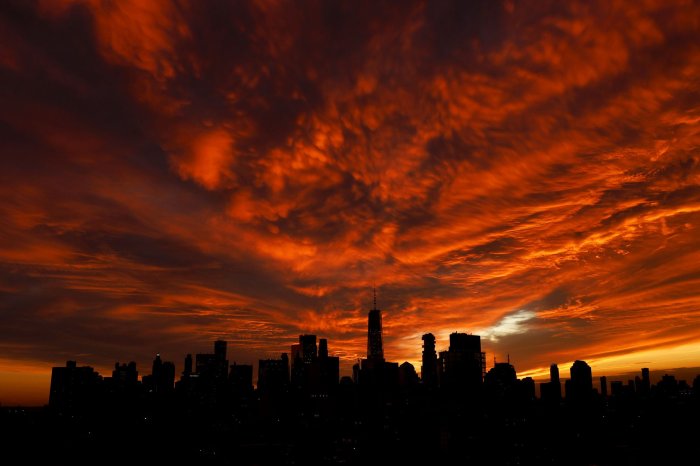
Clouds turn shades of red and orange when the sun sets behind One World Trade Center and the Manhattan skyline in New York City on November 5, 2025. Photo by John Angelillo/UPI | License Photo

Source link

French Empire: Civilising Mission | History

How the French Empire built power through language, schooling and cultural assimilation and what it means today.

Beyond armies and violence, France built its empire through language, schooling and cultural influence. This film explores how assimilation became a method of rule and a source of resistance.

At the heart of French colonial rule was the mission “civilisatrice”, a doctrine that claimed to lift up colonised societies through education, administration and the French language. In practice, this system sought to reshape colonised people’s identities, loyalties and cultures, replacing local traditions with French norms while maintaining strict political and economic control. Schools, legal systems and bureaucracies became tools of empire as powerful as armies.

Through case studies in Algeria, Indochina and West Africa, the documentary shows how colonial administrations operated on the ground. In Algeria, settler colonialism and mass repression led to war. In Indochina, education and bureaucracy coexisted with exploitation and nationalist resistance. In West Africa, language policy and indirect rule reshaped social hierarchies and governance.

This episode examines how resistance movements challenged the promise of civilisation, forcing France to confront the contradictions at the heart of its empire. Anticolonial struggles, intellectual movements and armed uprisings not only weakened imperial rule but reshaped French politics, culture and identity itself.

The documentary also places French colonial strategies in a broader modern context. In the contemporary world, the United States projects influence less through formal empire and more through soft power. Hollywood cinema, television and digital platforms circulate American values, lifestyles and narratives globally, shaping cultural imagination in ways that echo earlier imperial projects. At the same time, US dominance in higher education, academic publishing and institutional standards helps define what knowledge is valued, taught and legitimised worldwide.

It also draws direct connections between French colonialism and the modern world. Contemporary debates over language, immigration, secularism and inequality are deeply rooted in colonial systems designed to classify, discipline and extract. Many modern state institutions, education models and economic relationships reflect structures first imposed under empire.

By tracing how cultural control, education and administration functioned as instruments of power, the documentary reveals how the legacy of French colonialism continues to shape modern capitalism, global inequality and postcolonial relations today.


Source link

EU warns of possible action after the U.S. bars 5 Europeans accused of censorship

The European Union’s executive arm on Wednesday warned that it would take action against any “unjustified measures” after the U.S. State Department barred five Europeans it accuses of pressuring U.S. technology firms to censor or suppress American viewpoints.

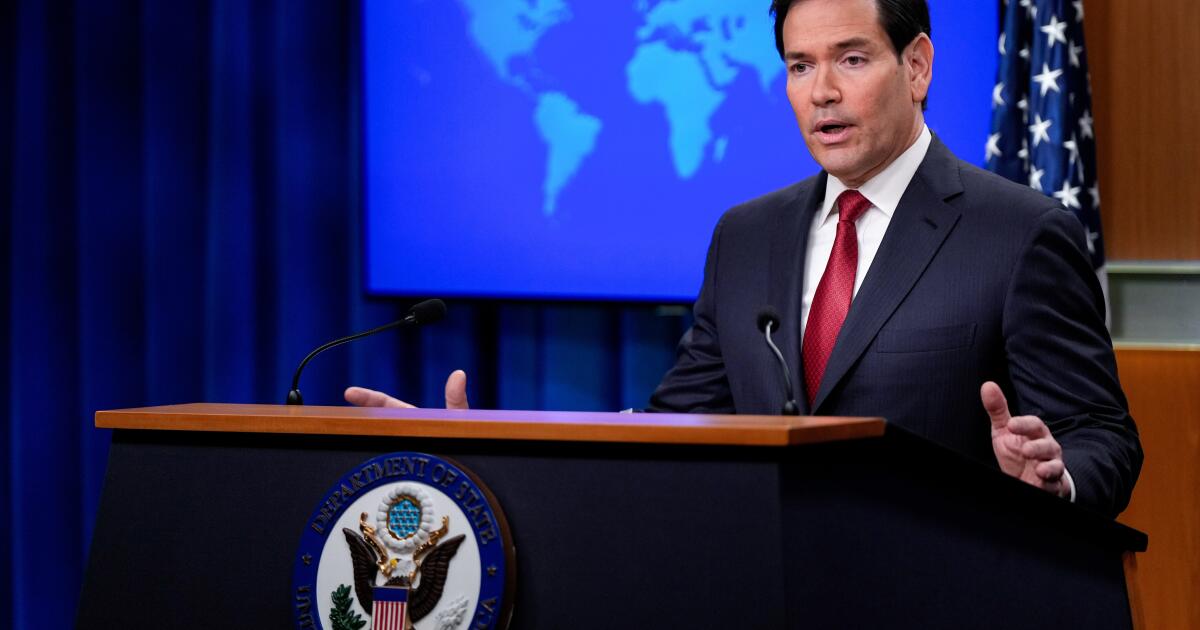
The Europeans were characterized by U.S. Secretary of State Marco Rubio as “radical” activists and “weaponized” nongovernmental organizations. They include the former EU commissioner responsible for supervising social media rules, Thierry Breton.

Breton, a businessman and former French finance minister, clashed last year on social media with tech billionaire Elon Musk over broadcasting an online interview with Donald Trump in the months leading up to the U.S. election.

The European Commission, the EU’s powerful executive branch and which supervises tech regulation in Europe, said that it “strongly condemns the U.S. decision to impose travel restrictions” and that it has requested clarification about the move. French President Emmanuel Macron also condemned it.

“If needed, we will respond swiftly and decisively to defend our regulatory autonomy against unjustified measures,” the commission said in a statement, without elaborating.

Rubio wrote in an X post on Tuesday that “for far too long, ideologues in Europe have led organized efforts to coerce American platforms to punish American viewpoints they oppose.”

“The Trump Administration will no longer tolerate these egregious acts of extraterritorial censorship,” he posted.

The European Commission countered that “the EU is an open, rules-based single market, with the sovereign right to regulate economic activity in line with our democratic values and international commitments.”

“Our digital rules ensure a safe, fair, and level playing field for all companies, applied fairly and without discrimination,” it said.

Macron said that the visa restrictions “amount to intimidation and coercion aimed at undermining European digital sovereignty,” he posted on X.

Macron said that the EU’s digital rules were adopted by “a democratic and sovereign process” involving all member countries and the European Parliament. He said that the rules “ensure fair competition among platforms, without targeting any third country.”

He underlined that “the rules governing the European Union’s digital space are not meant to be determined outside Europe.”

Breton and the group of Europeans fell afoul of a new visa policy announced in May to restrict the entry of foreigners deemed responsible for censorship of protected speech in the United States.

The four others are: Imran Ahmed, chief executive of the Centre for Countering Digital Hate; Josephine Ballon and Anna-Lena von Hodenberg, leaders of HateAid, a German organization; and Clare Melford, who runs the Global Disinformation Index.

Rubio said the five had advanced foreign government censorship campaigns against Americans and U.S. companies, which he said created “potentially serious adverse foreign policy consequences” for the United States.

The action to bar them from the U.S. is part of a Trump administration campaign against foreign influence over online speech, using immigration law rather than platform regulations or penalties.

In a post on X on Tuesday, Sarah Rogers, the U.S. under secretary of state for public diplomacy, called Breton the “mastermind” behind the EU’s Digital Services Act, which imposes a set of strict requirements designed to keep internet users safe online. This includes flagging harmful or illegal content like hate speech.

Breton responded on X by noting that all 27 EU member countries voted for the Digital Services Act in 2022. “To our American friends: ‘Censorship isn’t where you think it is,’” he wrote.

Cook writes for the Associated Press. AP journalist Angela Charlton contributed to this report from Paris.

Source link

How Christmas has evolved into a global holiday

Christmas is a Christian holiday that observes the birth of Jesus. But did you know that the earliest followers of Jesus did not annually commemorate his birth? Or that Santa Claus is inspired by the acts of kindness of a fourth-century Christian saint? And have you heard about the modern-day Japanese tradition of eating Kentucky Fried Chicken on Christmas?

Since the early 20th century, Christmas has evolved from a religious holiday to a hugely popular cultural holiday observed by Christian and secular people across the globe who gather with families, exchange gifts and cards and decorate Christmas trees.

Here’s a look at the history, beliefs and the evolution of Christmas:

Origins and early history of Christmas

Early followers of Jesus did not annually commemorate his birth but instead focused on commemorating their belief in his resurrection at Easter.

The story of the birth of Jesus appears only in two of the four Gospels of the New Testament: Matthew and Luke. They provide different details, though both say Jesus was born in Bethlehem.

The exact day, month and even year of Jesus’s birth are unknown, said Christine Shepardson, a professor at the University of Tennessee who studies early Christianity.

The tradition of celebrating Jesus’ birth on Dec. 25, she said, only emerged in the fourth century.

“It’s hard to overemphasize how important the fourth century is for constructing Christianity as we experience it in our world today,” Shepardson said. It was then, under Emperor Constantine, that Christians began the practice of gathering at churches instead of meeting at homes.

Some theories say the date coincides with existing pagan winter solstice festivals, including the Roman celebration of Sol Invictus, or the “Unconquered Sun,” on Dec 25.

While most Christians celebrate Christmas on Dec. 25, some Eastern Orthodox traditions celebrate the holy day on Jan. 7. That’s because they follow the ancient Julian calendar, which runs 13 days behind the Gregorian calendar, used by Catholic and Protestant churches as well as by much of the secular world.

Rowdy medieval celebrations

For centuries, especially during the Middle Ages, Christmas was associated with rowdy street celebrations of feasting and drinking, and for many Christians, it “was not in good standing as a holiday,” said Thomas Ruys Smith, a professor of American literature and culture at the University of East Anglia in England.

“Puritans,” he said, “were not fond of Christmas.”

But in the 19th century, he said, Christmas became “respectable” with “the domestic celebration that we understand today — one centered around the home, the family, children, gift-giving.”

The roots of modern-day Christmas can be traced back to Germany. In the late 19th century, there are accounts of Christmas trees and gift-giving that, according to Smith, later spread to Britain and America, helping to revitalize Christmas on both sides of the Atlantic.

Christmas became further popularized with the publication of “A Christmas Carol” by Charles Dickens in 1843, and the writings of Washington Irving, who was a fan of St. Nicholas and helped popularize the celebration of Christmas in America.

The first Rockefeller Center Christmas tree was put up by workers in 1931 to raise spirits during the Great Depression. The tradition stuck as the first tree-lighting ceremony was held in 1933 and remains one of New York City’s most popular holiday attractions.

America’s secular Santa is inspired by a Christian saint

St. Nicholas was a fourth-century Christian bishop from the Mediterranean port city of Myra (in modern-day Turkey). His acts of generosity inspired the secular Santa Claus legend.

The legends surrounding jolly old St. Nicholas — celebrated annually on Dec. 6 — go way beyond delivering candy and toys to children. He is believed to have interceded on behalf of wrongly condemned prisoners and miraculously saved sailors from storms.

Devotion to St. Nicholas spread during the Middle Ages across Europe and he became a favorite subject for medieval artists and liturgical plays. He is the patron saint of sailors and children, as well as of Greece, Russia and New York.

Devotion to St. Nicholas seems to have faded after the 16th century Protestant Reformation, except in the Netherlands, where his legend remained as Sinterklaas. In the 17th century, Dutch Protestants who settled in New York brought the Sinterklaas tradition with them.

Eventually, St. Nicholas morphed into the secular Santa Claus.

It’s not just Santa who delivers the gifts

In the U.K., it’s Father Christmas; in Greece and Cyprus, St. Basil (who arrives on New Year’s Eve). In some parts of Italy, it’s St. Lucy (earlier in December) and in other Italian regions, Befana, a witch-like figure, who brings presents on the Epiphany on Jan. 6.

Instead of a friendly Santa Claus, children in Iceland enjoy favors from 13 mischievous troll brothers, called the Yule Lads. They come down from their mountain cave 13 days before Christmas, according to folklore.

Christian traditions of Christmas

One of the oldest traditions around Christmas is bringing greenery — holly, ivy or evergreen trees — into homes. But determining whether it’s a Christian tradition is harder. “For many people, the evergreen can symbolize Christ’s promise of eternal life and his return from death,” Smith said. “So, you can interpret that evergreen tradition within the Christian concept.”

The decorating of evergreen trees is a German custom that began in the 16th century, said Maria Kennedy, a professor at Rutgers University—New Brunswick’s  Department of American Studies. It was later popularized in England and America.

“Mistletoe, an evergreen shrub, was used in celebrations dating back to the ancient Druids — Celtic religious leaders — some 2,000 years ago,” Kennedy writes in The Surprising History of Christmas Traditions.

“Mistletoe represented immortality because it continued to grow in the darkest time of the year and bore white berries when everything else had died.”

Other traditions include Christmas services and Nativity scenes at homes and churches. More recently, Nativity scenes — when erected on public property in the U.S. — have triggered legal battles over the question of the separation of church and state.

Christmas caroling, Kennedy writes, can also be traced back to European traditions, where people would go from home to home during the darkest time of the year to renew relationships within their communities and give wishes for good luck, health and wealth for the forthcoming year.

“They would recite poetry, sing and sometimes perform a skit. The idea was that these acts would bring about good fortune to influence a future harvest,” Kennedy writes.

Kentucky Fried Chicken for Christmas in Japan

Among the many Christmas traditions that have been adopted and localized globally, there’s one that involves KFC.

In 1974, KFC launched a Christmas campaign where they began to sell fried chicken with a bottle of wine so it could be used for a Christmas party.

KFC says the idea for the campaign came from an employee who overheard a foreign customer at one of its Tokyo restaurants saying that since he couldn’t get turkey in Japan, he’d have to celebrate Christmas with Kentucky Fried Chicken.

“That really stuck,” Smith said. “And still today, you have to order your KFC months in advance to make sure that you’re going to get it at Christmas Day.”

Henao writes for the Associated Press.

Source link

Oxnard still reeling from Glass House immigration raids, deportations

A father who has become the sole caretaker for his two young children after his wife was deported. A school district seeing absenteeism similar to what it experienced during the pandemic. Businesses struggling because customers are scared to go outside.

These are just a sampling of how this part of Ventura County is reckoning with the aftermath of federal immigration raids on Glass House cannabis farms six months ago, when hundreds of workers were detained and families split apart. In some instances, there is still uncertainty about what happened to minors left behind after one or both parents were deported. Now, while Latino households gather for the holidays, businesses and restaurants are largely quiet as anxiety about more Immigration and Customs Enforcement raids lingers.

“There’s a lot of fear that the community is living,” said Alicia Flores, executive director of La Hermandad Hank Lacayo Youth and Family Center. This time of year, clients usually ask her about her holiday plans, but now no one asks. Families are divided by the U.S. border or have loved ones in immigration detainment. “They were ready for Christmas, to make tamales, to make pozole, to make something and celebrate with the family. And now, nothing.”

At the time, the immigration raids on Glass House Farms in Camarillo and Carpinteria were some of the largest of their kind nationwide, resulting in chaotic scenes, confusion and violence. At least 361 undocumented immigrants were detained, many of them third-party contractors for Glass House. One of those contractors, Jaime Alanis Garcia, died after he fell from a greenhouse rooftop in the July 10 raid.

A woman, with a mirror in the background showing a person using a hair dryer  on another person's head.

Jacqueline Rodriguez, in mirror, works on a customer’s hair as Silvia Lopez, left, owner of Divine Hair Design, waits for customers in downtown Oxnard on Dec. 19, 2025.

(Genaro Molina/Los Angeles Times)

The raids catalyzed mass protests along the Central Coast and sent a chill through Oxnard, a tight-knit community where many families work in the surrounding fields and live in multigenerational homes far more modest than many on the Ventura coast. It also reignited fears about how farmworker communities — often among the most low-paid and vulnerable parts of the labor pool — would be targeted during the Trump administration’s intense deportation campaign.

In California, undocumented workers represent nearly 60% of the agricultural workforce, and many of them live in mixed-immigration-status households or households where none are citizens, said Ana Padilla, executive director of the UC Merced Community and Labor Center. After the Glass House raid, Padilla and UC Merced associate professor Edward Flores identified economic trends similar to the Great Recession, when private-sector jobs fell. Although undocumented workers contribute to state and federal taxes, they don’t qualify for unemployment benefits that could lessen the blow of job loss after a family member gets detained.

“These are households that have been more affected by the economic consequences than any other group,” Padilla said. She added that California should consider distributing “replacement funds” for workers and families that have lost income because of immigration enforcement activity.

A woman stands in a front of a window near quinceanera dresses

An Oxnard store owner who sells quinceañera and baptism dresses — and who asked that her name not be used — says she has lost 60% of her business since the immigrant raids this year at Glass House farms.

(Genaro Molina/Los Angeles Times)

Local businesses are feeling the effects as well. Silvia Lopez, who has run Divine Hair Design in downtown Oxnard for 16 years, said she’s lost as much as 75% of business after the July raid. The salon usually saw 40 clients a day, she said, but on the day after the raid, it had only two clients — and four stylists who were stunned. Already, she said, other salon owners have had to close, and she cut back her own hours to help her remaining stylists make enough each month.

“Everything changed for everyone,” she said.

In another part of town, a store owner who sells quinceañera and baptism dresses said her sales have dropped by 60% every month since August, and clients have postponed shopping. A car shop owner, who declined to be identified because he fears government retribution, said he supported President Trump because of his campaign pledge to help small-business owners like himself. But federal loans have been difficult to access, he said, and he feels betrayed by the president’s deportation campaign that has targeted communities such as Oxnard.

A woman poses for a portrait.

“There’s a lot of fear that the community is living,” said Alicia Flores, executive director of La Hermandad Hank Lacayo Youth and Family Center in downtown Oxnard, on Dec. 19, 2025.

(Genaro Molina/Los Angeles Times)

“Glass House had a big impact,” he said. “It made people realize, ‘Oh s—, they’re hitting us hard.’ ”

The raid’s domino effect has raised concerns about the welfare of children in affected households. Immigration enforcement actions can have detrimental effects on young children, according to the American Immigration Council, and they can be at risk of experiencing severe psychological distress.

Olivia Lopez, a community organizer at Central Coast Alliance United for a Sustainable Economy, highlighted the predicament of one father. He became the sole caretaker of his infant and 4-year-old son after his wife was deported, and can’t afford child care. He is considering sending the children across the border to his wife in Mexico, who misses her kids.

In a separate situation, Lopez said, an 18-year-old has been suddenly thrust into caring for two siblings after her mother, a single parent, was deported.

Additionally, she said she has heard stories of children left behind, including a 16-year-old who does not want to leave the U.S. and reunite with her mother who was deported after the Glass House raid. She said she suspects that at least 50 families — and as many as 100 children — lost both or their only parent in the raid.

“I have questions after hearing all the stories: Where are the children, in cases where two parents, those responsible for the children, were deported? Where are those children?” she said. “How did we get to this point?”

Robin Godfrey, public information officer for the Ventura County Human Services Agency, which is responsible for overseeing child welfare in the county, said she could not answer specific questions about whether the agency has become aware of minors left behind after parents were detained.

“Federal and state laws prevent us from confirming or denying if children from Glass House Farms families came into the child welfare system,” she said in a statement.

The raid has been jarring in the Oxnard School District, which was closed for summer vacation but reopened on July 10 to contact families and ensure their well-being, Supt. Ana DeGenna said. Her staff called all 13,000 families in the district to ask whether they needed resources and whether they wanted access to virtual classes for the upcoming school year.

Even before the July 10 raid, DeGenna and her staff were preparing. In January, after Trump was inaugurated, the district sped up installing doorbells at every school site in case immigration agents attempted to enter. They referred families to organizations that would help them draft affidavits so their U.S.-born children could have legal guardians, in case the parents were deported. They asked parents to submit not just one or two, but as many as 10 emergency contacts in case they don’t show up to pick up their children.

A man with a guitar.

Rodrigo is considering moving back to Mexico after living in the U.S. for 42 years.

(Genaro Molina/Los Angeles Times)

With a district that is 92% Latino, she said, nearly everyone is fearful, whether they are directly or indirectly affected, regardless if they have citizenship. Some families have self-deported, leaving the country, while children have changed households to continue their schooling. Nearly every morning, as raids continue in the region, she fields calls about sightings of ICE vehicles near schools. When that happens, she said, she knows attendance will be depressed to near COVID-19 levels for those surrounding schools, with parents afraid to send their children back to the classroom.

But unlike the pandemic, there is no relief in knowing they’ve experienced the worst, such as the Glass House raid, which saw hundreds of families affected in just a day, she said. The need for mental health counselors and support has only grown.

“We have to be there to protect them and take care of them, but we have to acknowledge it’s a reality they’re living through,” she said. “We can’t stop the learning, we can’t stop the education, because we also know that is the most important thing that’s going to help them in the future to potentially avoid being victimized in any way.”

Jasmine Cruz, 21, launched a GoFundMe page after her father was taken during the Glass House raid. He remains in detention in Arizona, and the family hired an immigration attorney in hopes of getting him released.

Each month, she said, it gets harder to pay off their rent and utility bills. She managed to raise about $2,700 through GoFundMe, which didn’t fully cover a month of rent. Her mother is considering moving the family back to Mexico if her father is deported, Cruz said.

“I tried telling my mom we should stay here,” she said. “But she said it’s too much for us without our dad.”

Many of the families torn apart by the Glass House raid did not have plans in place, said Lopez, the community organizer, and some families were resistant because they believed they wouldn’t be affected. But after the raid, she received calls from several families who wanted to know whether they could get family affidavit forms notarized. One notary, she said, spent 10 hours working with families for free, including some former Glass House workers who evaded the raid.

“The way I always explain it is, look, everything that is being done by this government agency, you can’t control,” she said. “But what you can control is having peace of mind knowing you did something to protect your children and you didn’t leave them unprotected.”

For many undocumented immigrants, the choices are few.

Rodrigo, who is undocumented and worries about ICE reprisals, has made his living with his guitar, which he has been playing since he was 17.

While taking a break outside a downtown Oxnard restaurant, he looked tired, wiping his forehead after serenading a pair, a couple and a group at a Mexican restaurant. He has been in the U.S. for 42 years, but since the summer raid, business has been slow. Now, people no longer want to hire for house parties.

The 77-year-old said he wants to retire but has to continue working. But he fears getting picked up at random, based on how abusive agents have been. He’s thinking about the new year, and returning to Mexico on his own accord.

“Before they take away my guitar,” he said, “I better go.”

Source link

Analysis: Is Lebanon controlled by ‘mini deep states’?

Bank customers and Depositors Association members hold placards during a protest organized by the ‘Depositors’ Outcry’, a group campaigning for the rights of depositors, in Beirut, Lebanon, on Thursday Customers are angry over the continued restrictions that local banks have imposed on withdrawals and transfers since 2019. Photo by Wael Hamzeh/EPA

BEIRUT, Lebanon, Dec. 24 (UPI) — Once hailed as the “Switzerland of the Middle East,” Lebanon has undergone an infernal descent into deeply rooted corruption, financial collapse and state failure, suggesting that the country is governed by a unique model of “mini deep states” that have flourished under its sectarian and clientelist system, political and financial analysts said.

Endemic corruption, misgovernance, sectarianism, wars and political disputes have long fueled Lebanon’s multiple crises.

The 2019 financial collapse — described by the World Bank as a “deliberate depression” and the worst globally since 1850 — was the tipping point that revealed the country’s situation to be far worse than anyone had realized.

Six years later, the situation remains almost unchanged. No one has been charged or put on trial and no official has acknowledged responsibility for the crisis or the estimated $110 billion in bank deposits squandered under state mismanagement.

The first serious attempt to address the financial crisis came Friday, when Prime Minister Nawaf Salam’s government presented a draft law aimed at tackling the financial system’s huge funding gap and enable depositors to gradually regain access to their frozen savings — though probably not in full.

The draft law, yet to be debated and expected to be amended, was quickly met with opposition from the banks and depositors, arguing that its provisions are insufficient or unfair. Crucially, it fails to address corruption as the root cause of the crisis and provides no mechanism for accountability.

However, Lebanon’s problems extend far beyond the recent financial crisis, stemming from a corrupt and inept political elite whose sectarian and clientelist networks consistently put personal gain above the nation’s survival, analysts say.

One of the most striking examples of deliberate systemic failure is the chronic power shortages, which have forced most citizens to rely on private or neighborhood generators — run by what many describe as a “mafia” protected by influential political leaders — since the end of the 15-year civil war in 1990. This has created cumulative deficits of about $43 billion.

The same pattern applies to nearly every other sector and extends to the country’s political system, reflecting the reality that all major political forces have blocked meaningful change and prevented reforms for decades.

Despite their political divisions, these forces share common interests, effectively acting as a deep state rather than merely an elite sectarian cartel.

To Mohammad Fheili, a risk strategist and monetary economist, Lebanon is better understood as a system of “multiple, competing and at times cooperating mini-deep states operating within a consociational (power-sharing) confessional framework.”

Rather than a single hidden chain of command, power, Fheili notes, is distributed across overlapping circuits involving security services, the banking and financial sector, senior judges and prosecutors, and top public officials. These networks outlast governments and are bound together by mutual protection.

“Sectarianism is the main channel of organization and veto, but it is not the only engine,” he told UPI. “It provides quotas, patronage pipelines and narratives of legitimacy. However, the driving incentives are often clientelism, rent extraction, protection from prosecution and control of state resources.”

As a result, the same political establishment came to dominate legislation, government and the economy, with decisive influence over appointments, contracts and financial regulation.

Such a “deep state” is not a new phenomenon. Its roots can be traced back to Lebanon’s founding in 1943, when it developed alongside a “rentier economic model,” according to Makram Rabah, a political activist and history professor at the American University of Beirut.

While the civil war saw the rise of militia leaders who later became powerful political figures in peacetime, Rabah said that Syria’s military presence in Lebanon after 1990 introduced “a kind of dual system, in which local actors were allowed to benefit economically as long as Syria controlled foreign policy and security.”

“This is what gave the system its longevity,” he told UPI.

The civil war also normalized militia power, wartime political economy and impunity, Fheili noted, adding that the post-war order “recycled many wartime actors into peacetime governance through a spoils-and-veto arrangement rather than institutional reconstruction.”

A sectarian cartel, he said, then emerged, dividing ministries, contracts and regulatory favors –and transforming political competition into a struggle over access to the state.

The withdrawal of Syrian troops from Lebanon in 2005 — just a few months after the assassination of Prime Minister Rafik Hariri in Beirut — paved the way for Iran-backed Hezbollah to consolidate its control over the country.

Although the militant group has consistently denied involvement in Lebanon’s entrenched corruption — arguing that its funding from Iran is sufficient — experts contend that it nonetheless benefits from the country’s clientelist system, even operating a shadow parallel economy.

Lebanon’s financial collapse, Rabah argued, revealed Hezbollah as both a beneficiary of and a participant in the system, as many of its institutions faltered during the meltdown. Moreover, the perception that it relied solely on Iranian funding and was free from corruption has proven to be “a fallacy.”

With each sect — Muslims and Christians alike — protecting its own corrupt members, it became impossible to hold anyone accountable or bring them to justice. A few exceptions were recorded, but only because those arrested had lost the political protection of their patrons.

“There are many ministers and officials who are extremely corrupt, but no one dares to act against them, as they are protected by their sect and political leaders,” said Mohammad Chamseddine, policy research specialist at the Information International research and consultancy firm.

Although the Lebanese government adopted a new, anti-corruption law in 2020 and began work on a national anti-corruption strategy, he said these efforts failed to yield any results due to the prevailing sectarianism.

“Such an interaction of religion, politics and money is everywhere and consolidates corruption,” Chamseddine told UPI. “Only a real revolution — when people storm the houses and palaces of the corrupt and put them in jail — can change this.”

Lebanon’s losses from corruption and the deep state, accumulating since the 1990s, are difficult to estimate, exceeding tens of billions of U.S. dollars, according to Chamseddine.

However, dismantling the country’s “mini deep states” and eliminating corruption is possible –even if only partially — but it would require a long process of gradual, progressive steps, starting with an independent judiciary, the analysts said.

Would the disarming of Hezbollah, which was significantly weakened by Israel during last year’s war, be the starting point?

“It may open tactical space, but only if reforms target the entire ecosystem, not just Hezbollah or the banks,” Fheili said.

Source link

Struggle With Conscience Was Gore’s Biggest Vietnam Battle

Albert Gore Jr. was 21 that summer of 1969 when he confronted Vietnam, the draft and an early test of his manhood.

He had just graduated from Harvard, where he joined in anti-war protests that had split college campuses across the country. He had spent his summers on the family farm outside of this small town, and he knew that many of the local boys were heading off to the Army.

Over the next two months Gore would struggle with a decision:

Should he follow his ideals and defy the draft, or join the tens of thousands of other young men gone to war?

On a more personal level, should he refuse to go and risk hurting his father’s next reelection bid to the U.S. Senate, where Albert Gore Sr. was one of the nation’s leading critics of the war? Evading the draft might make his father look unpatriotic.

His search for an answer would take him from the family farm in Tennessee to the doorstep of a Harvard instructor on Cape Cod, Mass. It would plunge him into a series of long, wrenching debates that failed to ease his dilemma.

Finally, it delivered him, about to be drafted, to the federal building in Newark, N.J., where surprised Army recruiters listened as he told them who he was and what he intended to do–sign up.

Those crucial months in 1969 offer insights into the man who would become vice president of the United States–and who now aspires to the presidency.

What emerges is a portrait of a young man discovering the cruel contradictions between his beliefs and sense of duty, between loyalty to family and commitment to a cause. His deliberations show the slow and painstaking approach that has become a trademark of his decision-making style as a political leader.

Gore’s anguish over the decision also provides a glimpse into his unsettled place in the world of privilege; he would not exploit his special advantages but would not fully reject them either.

Unsettled Place Amid Privilege

Many young men with famous names or elite educations–and many without them–were able to avoid the war in Vietnam if not always active duty. In 1969, 21.8 million men from the ages of 18 to 26 were eligible for the draft. About 283,000 were inducted into the armed services that year.

Rather than seek an out, Gore went voluntarily. He became Spc. 5 Gore in Vietnam, where he was stationed with the 20th Engineers Brigade headquarters near Saigon. In some ways, he was one of the guys, playing poker and drinking, smoking cigarettes and sometimes marijuana with his buddies.

But in other ways, he was apart from the fray. He served as a news reporter and not a combat soldier. His reporting duties took him to potentially dangerous spots. But like some other servicemen in support specialties, he was never in actual combat, his fellow soldiers say.

Several of his colleagues remember they were assigned to make sure this son of a prominent politician was never injured in the war. After five months, he returned home at his own request when his job was being phased out.

Nevertheless, Gore the politician over the years sometimes has been inclined to describe his Vietnam days as though he was in the thick of the war.

On the campaign trail today, while he suggests no combat heroics, he nonetheless mentions his service in Vietnam proudly. Addressing 4,000 veterans last month at the national American Legion convention in Anaheim, he spoke of the curse of that war and how “few respected our service, much less welcomed us home.”

But Gore also said, “Some of the greatest times of my whole life were times spent with my buddies in the Army.”

Gore declined to be interviewed for this article.

In the 2000 presidential campaign, the Vietnam draft experience continues to be a benchmark for Gore’s generation of national leaders. The old themes of the war surface so often that it is clear they never left.

John McCain, the son and grandson of Navy admirals, is a Republican senator from Arizona. But he is better known as a war hero; his book about his 5 1/2 years as a prisoner of war in Vietnam, issued in conjunction with his campaign, is a bestseller.

McCain’s main rival for the Republican nomination, Texas Gov. George W. Bush, missed Vietnam by serving in the Texas Air National Guard–a slot critics say he received through connections from his father, then a U.S. congressman.

Gore’s opponent in the Democratic contest, former Sen. Bill Bradley of New Jersey, served in the Air Force Reserve from 1967 to 1978 and saw no active duty.

Harvard Brimming With Anti-War Fervor

Gore, the youngest of these candidates, was still in college when public support for the war began to sour. Harvard, like many campuses, was a caldron of anti-war fervor.

John Tyson, one of Gore’s Harvard friends, said he and Gore both signed anti-war petitions in the dining hall, attended rallies and talked for hours about what they saw as the misguided pursuit of an unwinnable conflict.

“He was against the war,” Tyson recalled, “but he wasn’t one of those guys who considered himself a revolutionary, who was against America.” He became “enraged,” Tyson recalled, when some protesters talked about securing some dynamite.

Gore, viewing Vietnam as more than a local conflict, worried about whether it would become a flash point for nuclear war. “He had scope,” Tyson said. He added that Gore “listened to his father. He emulated him.”

In the summer before his senior year, Gore helped his father write his landmark speech against the war at the 1968 Democratic National Convention in Chicago.

The senator noted that 25,000 U.S. soldiers–less than half the final death count–had died in Southeast Asia. “What harvest do we reap from their gallant sacrifice?” he asked.

Outside, anti-war protesters clashed with police in what became a major turning point for the peace movement at home.

Martin Peretz, who taught Gore in a seminar on the political culture of post-World War II America, said “very, very few” of Gore’s classmates went into the service. Many sought other ways to stay out of the service.

So few made the journey from Harvard to Vietnam that when one of Gore’s friends, freshman Denmark Groover III, interrupted his studies to join the military, many of his classmates ridiculed him.

Gore wrote his girlfriend, Tipper Aitcheson, that, while he admired his friend’s “courage and rashness,” he did not know whether his own views would allow him to follow Groover’s example.

“It’s wrong, we’re wrong,” he wrote, according to letters published last week in Talk magazine. “A lot of people won’t admit it and never will, but we’re wrong.”

By the time Gore graduated in June 1969, anti-war sentiment drove a hundred angry students to walk out of the commencement ceremony. Others tore up their diplomas; half of the senior class raised clenched fists.

When Gore left school, his student deferment expired. He was staring straight into the draft. Like others opposed to the war, his options were stark. He could apply for conscientious-objector status. He could try to land a spot in a reserve or National Guard unit, although the waiting lists were long. He could flee to Canada or end up in jail.

Many of the sons of Carthage were already in Vietnam. One of them, James H. Wilson, had been killed earlier that year, on Gore’s 21st birthday.

“I don’t want to spend any more time over here than I have to,” Wilson had written in his last letter home. In all, eight young men from Carthage and surrounding Smith County–whose population then was 15,000–died over there.

“This is a small rural county, and there always seemed to be a load of them going, five or six or seven at a time,” said Edward S. Blair, a boyhood chum of Gore’s.

“A lady ran the local draft board, she was the supervisor, and she would send notices out. Then a group of boys would catch the bus at the Trailways station near the old river bridge and go to Nashville for their exams.

“It would have gone down badly had he [Gore] not gone,” said Blair, now the U.S. marshal in Nashville.

But Gore was a product of two worlds: rural Tennessee and political Washington. If the norm for boys from the Volunteer State of Tennessee was to enlist, the standard was much different for the sons of lawmakers.

A report from that time by Congressional Quarterly showed that 234 sons of senators and congressmen had reached draft age during the Vietnam era. Half of them received deferments. Of the rest, only 28 went to Vietnam, 19 into combat.

The subject of privilege was all the more apparent in a hit song in 1969 by Creedence Clearwater Revival. Gore loved rock ‘n’ roll and memorized the lyrics of many songs, including “Fortunate Son.” He told friends the refrain haunted him:

It ain’t me, it ain’t me,

I ain’t no senator’s son, son.

It ain’t me, it ain’t me,

I ain’t no fortunate one, no.

But now was decision time, and Gore began to turn to those closest to him. Sometimes he seemed on the brink of a decision but then would suddenly reach out for more guidance.

A first stop was at the family farm.

Sen. Al Gore Sr., interviewed in a video for use in his son’s current presidential campaign, recalled the visit.

“He and I took a walk back on the farm. Then we came back in here and had lunch.” Suddenly, the father remembered, his son stood up and announced, “I believe I’ll take a walk. Alone.”

“So,” the senator recalled, “he walked to the bluff back of the farm and came in and his mother and I were seated in here, continuing to discuss the matter.

“We asked him and recommended to him to use his own judgment. His mother and I assured him we would support his decision whatever it was. But it was his decision. And I particularly asked him to not take into consideration any political matter as his decision might affect me. Whether he did take that into consideration, I don’t know. I hope not.”

After his solitary stroll, his son walked back into the house and blurted out, “I’ve made up my mind. I’m going. I’ll volunteer tomorrow.”

But he hesitated, and, joined by Tipper, next sought out his former instructor Peretz at his home on Cape Cod.

It was the weekend of the first moonwalk. When Gore wasn’t watching television, he asked Peretz how he could be true to himself without endangering his father’s anti-war position–or the life of someone he knew from Tennessee.

“ ‘My draft board is small,’ ” Peretz quoted Gore as saying. “ ‘If I don’t go, someone I played baseball with or went to church with or shoveled horseshit with will go in my place.’ ”

Peretz, now chairman of New Republic magazine, said he never advised students on how to handle the draft, and Gore left, still uncertain.

Soon after, he took a train to Newark, N.J., where he joined Harvard pal Tyson at a downtown diner. They ate lunch, then talked long enough to get hungry again.

Gore was eating one French fry at a time. Should he go or shouldn’t he?

Abruptly, Gore sprung to his feet, Tyson said. “He was ready.”

They hurried the few blocks to the nearby federal building and up to the Army recruiting station on the fourth floor.

Astonishment at Recruiting Office

Sgt. Dess Stokes ran the office, and he and his recruiters were astonished to see who walked in, he recalled. They all knew of Sen. Gore, especially Stokes, who had already done one tour in Vietnam and, like many soldiers, shared the senator’s opposition to the war.

In the recruiting station, Stokes handed Gore some paperwork and explained how volunteering for the draft, rather than waiting to be inducted, could keep him out of the infantry. Noting that Gore was a Harvard man, Stokes told him he could get into communications, maybe become an Army reporter.

Having reached the moment, Gore stepped away and telephoned his father. When he returned, he signed the papers. He was in the Army.

His two-year hitch was to run until August 1971, and his first assignment after basic training was in the Army media pool at Ft. Rucker, Ala. There he learned to write press releases and short newspaper stories.

Richard Abalos, who bunked with Gore at Ft. Rucker, had a tan 1962 Chevy four-door, and many in the unit would pile in and drive to Panama City, Fla., renting a dilapidated beach house for the weekend. They would play bridge and poker, barbecue steaks and drink cheap beer and wine, including one inexpensive label called Tickle Me Pink.

Gore has admitted that he smoked marijuana in the Army; there was plenty of pot to pass around. “It usually was on the beach in Florida,” said Guenter “Gus” Stanisic. “But hell, the MPs [military police] smoked. Just about everybody in the Army smoked.”

In April 1970, Gore was named Post Soldier of the Month, a citation awarded to soldiers who demonstrated leadership qualities. The honor came with a $50 savings bond.

A month later, in a ceremony at the National Cathedral in Washington, he married Tipper.

By summer, his father–who died last year–was being challenged for his Senate seat by Rep. William Brock, a Chattanooga Republican and supporter of the war.

Brock said that young Gore’s decision to enlist did not appear to help or hurt his father. “I didn’t see any change with what young Albert did,” Brock said.

But the Gore campaign tried its best to show that Sen. Gore, while against the war, was still a patriot. The team produced a television commercial in which the senator rode up on a white horse and told Al, dressed in Army fatigues, “Son, always love your country.”

When Gore received his orders for Vietnam, just five weeks before the November 1970 election, his father announced it publicly: “Like thousands of other Tennessee boys, he volunteered. . . . Like other fathers, I am proud.”

But the orders to Vietnam were delayed, and Gore would not ship out until Christmas. The family believed President Nixon postponed the orders to deny Sen. Gore any political boost from having a son in Vietnam on election day.

After three decades in Congress, Gore lost to Brock by 4% of the vote. And by the end of 1970, his son was in Vietnam.

Gore arrived in Vietnam nearly three years after the Tet Offensive, the so-called turning point in the war. By that time, the U.S. troop withdrawals ordered by Nixon had begun, and South Vietnamese forces were taking over a larger share of the fighting.

But U.S. forces were continuing their bombing campaign against North Vietnam and also conducting raids into Laos and Cambodia. Although both sides had reached a stalemate, the war would drag on several more years.

Though far from the action, young Gore was shaken by what he saw. “When and if I get home from Vietnam,” he wrote his friend Abalos, “I’m going to divinity school to atone for my sins.”

Other soldiers with long experience in Vietnam said that Gore was treated differently from his fellow enlistees. Two of them recalled that before Gore arrived Brig. Gen. Kenneth B. Cooper advised them that a senator’s son would be joining the outfit.

H. Alan Leo said soldiers were ordered to serve as Gore’s bodyguards, to keep him out of harm’s way. “It blew me away,” Leo said. “I was to make sure he didn’t get into a situation he could not get out of. They didn’t want him to get into trouble. So we went into the field after the fact [after combat actions], and that limited his exposure to any hazards.”

Cooper, however, said Gore “didn’t get anything he shouldn’t have.”

Gore covered the 20th Engineers Brigade, based 30 miles northeast of Saigon, as it cleared jungle and built and repaired roads and bridges in the war zone.

In his most ambitious piece, he re-created a battle at a fire support base code-named Blue near the Cambodian border, which a group of Viet Cong had tried to overrun.

“On the night of February 22nd, there was no moon,” Gore wrote. “The men sacked out early as usual, soon after the movie was over–’Bloody Mama’ with Shelley Winters as the maniac murderess–the guards were posted as usual–the password was ‘four.’ ”

‘He Took Risks’ During Tour

Fire Support Base Blue was as close as Gore came to combat. Mike Roche, editor of the engineers’ Castle Courier newspaper, said it took courage to go to the fire base, even if the battle was over.

“He was tanned and he had the bleached-out fatigues and . . . he was doing war-related stories,” Roche said. “He took risks.”

Veterans said a standard tour in Vietnam was 12 months; Gore was out in five. Early releases were not uncommon at the time, though. The 20th Engineers was departing Vietnam, which meant the Army no longer needed a reporter assigned to the brigade.

Gore also was approaching the last months of his two-year commitment. In March, with less than three months in Vietnam, he requested an early release and was told the next day he could leave in May to return to school.

When he left Vietnam, Gore flew to Oakland, along with Army pal Bob Delabar. At the airport bar, they hoisted drinks and parted ways. “We both got smashed,” Delabar remembered. “And it wasn’t on beer.”

Gore enrolled in Vanderbilt University’s divinity school but stayed only a year and left to take a job in Nashville as a reporter for the Tennessean, where he worked for four years.

When the House seat from his dad’s old district opened up in 1976, Gore ran and won. He later was elected to his father’s old Senate seat. The Army and Vietnam came up in his campaigns; he often portrayed his experience as more dangerous than it truly was.

In 1988, running for president, he told Vanity Fair magazine, “I took my turn regularly on the perimeter in these little firebases out in the boonies. Something would move, we’d fire first and ask questions later.”

He told the Washington Post: “I was shot at. I spent most of my time in the field.”

“I carried an M-16 . . . ,” he told the Baltimore Sun. “I pulled my turn on the perimeter at night and walked through the elephant grass and I was fired upon.”

For the Weekly Standard, he described flights aboard combat helicopters. “I used to fly these things with the doors open, sitting on the ledge with our feet hanging down. If you flew low and fast, they wouldn’t have as much time to shoot you.”

Any location in Vietnam was potentially dangerous during the war. But eight men who served there with Gore said in separate interviews that he was never in the middle of a battle. Gore himself has toned down descriptions of his wartime activity during the current campaign; he now emphasizes that he was in Vietnam as a news reporter and not as a combat soldier.

As he runs for the presidency this time, old Army pals sometimes show up at political events. Abalos appeared at a Gore rally in San Antonio; Delabar sat in the front row at the American Legion convention in Anaheim.

His enduring ties to his Army buddies appear to reflect an inner connection between Gore the reluctant soldier and Gore the national politician and presidential candidate.

At the American Legion convention, he told the veterans, “There will always be the bond between who we were and who we are.”

Times researchers John Beckham and Edith Stanley and staff writer Elizabeth Shogren contributed to this story.

(BEGIN TEXT OF INFOBOX / INFOGRAPHIC)

How They Served All presidential contenders except for Elizabeth Hanford Dole were eligible for the draft during the Vietnam War. The following are their records, or lack of them, and the reasons:

Republicans

Gary Bauer: No military service; student deferment

Patrick J. Buchanan: None; student, medical deferments

Texas Gov. George W. Bush: Texas Air National Guard; no overseas duty

Dole: None; not subject to draft

Steve Forbes: New Jersey National Guard, 1970-76; no combat duty

Sen. Orrin G. Hatch of Utah: None; sole remaining heir deferment

Alan Keyes: None; student deferment, then high draft number

Sen. John McCain of Arizona: Navy pilot; prisoner of war in North Vietnam for 5 1/2 years

*

Democrats:

Former Sen. Bill Bradley: U.S. Air Force Reserve, 1967-78; no active duty

Vice President Al Gore: Army journalist, 1969-71; six months in Vietnam; no combat duty

*

Independent

Sen. Bob Smith of New Hampshire: Navy, 1965-67, including one year in Vietnam; Naval Reserve, 1962-65 and 1967-69; no combat duty

*

Sources: Time/CNN and Houston Chronicle

Source link

Syria ministers discuss military cooperation with Putin in Russia: Report | Vladimir Putin News

Talks held between Foreign Minister Asaad Hassan Al-Shaibani, Defence Minister Murhaf Abu Qasra and the Russian president.

Syria’s foreign and defence ministers met Russian President Vladimir Putin in Moscow and held discussions on expanding “strategic cooperation in the military industries sector”, Syrian state media has reported.

The Syrian Arab News Agency (SANA) ⁠said that Putin’s meeting on Tuesday with Syrian Minister of Foreign Affairs Asaad Hassan Al-Shaibani and Minister of Defence Murhaf Abu Qasra ‌focused on political, economic and military issues of “mutual interest”, but that “particular emphasis” was on defence.

Recommended Stories

list of 4 itemsend of list

According to SANA, Putin and the Syrian ministers discussed a range of defence-related matters, including developing military cooperation to strengthen the Syrian army’s capabilities and ‌modernising its equipment, transferring expertise and cooperation in research and development.

“During the meeting, both sides reviewed ways to advance military and technical partnership in a manner that strengthens the defensive capabilities of the Syrian Arab Army and keeps pace with modern developments in military industries,” SANA reported.

The two sides also discussed political and economic issues, including the “importance of continued political and diplomatic coordination between Damascus and Moscow in international forums”, according to the news agency.

On the economic front, the talks addressed expanding Syrian-Russian cooperation, including in reconstruction projects, infrastructure development and investment in Syria.

Putin also reaffirmed Russian “steadfast support” for Syria and its territorial integrity, while renewing “Moscow’s condemnation of repeated Israeli violations of Syrian territory, describing them as a direct threat to regional security and stability”.

The ministers’ visit to Moscow is the latest by Syria’s new authorities since the removal from power last December of the country’s longtime ruler and Moscow’s former ally in Damascus, Bashar al-Assad.

Russia was a key supporter of al-Assad during Syria’s nearly 14-year civil war, providing vital military aid that kept the Assad regime in power, including Russian air support that rained air strikes on rebel-held areas.

Despite al-Assad and his family fleeing to Russia after the toppling of his regime, Moscow is eager to build good relations with the new government in Damascus.

Moscow, in particular, is hoping to secure agreements to continue operating the Khmeimim airbase and the Tartous naval base on Syria’s Mediterranean coast, where Russian forces continue to be present.

In October, Syria’s new president, Ahmed al-Sharaa, visited Russia, where he said his government ‍would honour all the past deals struck between Damascus and Moscow, a pledge that suggested that the two Russian military bases were secure in the post-Assad period.

Putin said ‍at the time of al-Sharaa’s visit ⁠that Moscow was ready to do all it could to act on what he called the “many interesting and useful beginnings” discussed by the two sides on renewing relations.

Russian ‌state media on Tuesday quoted the country’s Ministry of Foreign Affairs spokeswoman, Maria Zakharova, as saying that Russian Foreign Minister Sergey Lavrov would also hold talks with ‍his Syrian counterpart, Al-Shaibani, during the Syrian delegation’s visit.

During a visit to Moscow in July, Al-Shaibani said his country wanted Russia “by our side”.

“The current period is full of various challenges and threats, but it is also an opportunity to build a united and strong Syria. And, of course, we are interested in having Russia by our side on this path,” Al-Shaibani told Lavrov at the time.

Russia's President Vladimir Putin and Syria's President Ahmed al-Sharaa speak during a meeting at the Kremlin in Moscow, Russia, October 15, 2025. Alexander Zemlianichenko/Pool via REUTERS
Syrian President Ahmed al-Sharaa speaks during a meeting with Russian President Vladimir Putin at the Kremlin in Moscow, Russia, on October 15, 2025 [Pool: Alexander Zemlianichenko via Reuters]

Source link

Author of LAFD Palisades fire report declined to endorse final version, called it ‘highly unprofessional’

The author of the Los Angeles Fire Department’s after-action report on the Palisades fire declined to endorse it because of substantial deletions that altered his findings, calling the edited version “highly unprofessional and inconsistent with our established standards.”

Battalion Chief Kenneth Cook emailed then-interim Fire Chief Ronnie Villanueva and other LAFD officials with the subject line “Palisades AARR Non-Endorsement,” about an hour after the highly anticipated report was made public Oct. 8.

“Having reviewed the revised version submitted by your office, I must respectfully decline to endorse it in its current form,” Cook wrote in the email obtained by The Times. “The document has undergone substantial modifications and contains significant deletions of information that, in some instances, alter the conclusions originally presented.”

Battalion Chief Kenneth Cook complained to former interim Fire Chief Ronnie Villanueva about deletions and revisions

Battalion Chief Kenneth Cook complained to former interim Fire Chief Ronnie Villanueva about deletions and revisions in the Palisades fire after-action report.

(L.A. City Mayor’s Office)

He continued, “While I fully understand the need to address potential liability concerns and to modify certain sections in consultation with the City Attorney to mitigate litigation risks, the current version appears highly unprofessional and inconsistent with our established standards. I strongly urge you to reconsider publishing the report as it stands.”

In the email, Cook also raised concerns that the LAFD’s final report would be at odds with a report on the January wildfires commissioned by Gov. Gavin Newsom’s office, which has yet to be released.

“I am concerned that substantial disparities may exist between the two reports,” Cook wrote.

Izzy Gardon, a spokesperson for Newsom, said in a statement Tuesday, “The Governor commissioned an independent review by the world’s leading fire safety experts to ensure the public receives a complete, accurate, and unvarnished accounting of the events leading up to the Palisades fire and how responding agencies carried out their response.”

Cook — who emails show provided a final draft of the after-action report to Villanueva in August — has declined to comment. Attempts to reach Villanueva were unsuccessful.

The LAFD has refused to answer questions from The Times about the deletions and revisions. Mayor Karen Bass’ office said the LAFD wrote and edited the report, and that the mayor did not demand changes.

On Sunday, The Times reported that Cook was upset about the changes to the report. The previous day, The Times had disclosed the watering down of the after-action report after analyzing seven drafts obtained through a public records request. The most significant changes involved the LAFD’s failure to order firefighters to stay on duty for an additional shift and to fully pre-deploy engines in high-risk areas before the Jan. 7 fire, as the wind warnings became increasingly dire. It’s unclear who exactly directed the revisions.

Cook’s Oct. 8 email laying out his concerns in stark language adds to the growing evidence that city and LAFD officials attempted to burnish the LAFD’s image in a report that should have been an honest assessment of the department’s failings in preparing for and fighting the fire, which killed 12 people and destroyed thousands of homes. The goal of such a report is to prevent similar mistakes.

Cook’s email reached Bass’ office in mid-November, according to Bass spokesperson Clara Karger.

Karger said last week that “the Mayor has inquired with Chief Moore about the concerns,” referring to Jaime Moore, who became LAFD chief last month.

The Times submitted a public records request last month for all of the mayor’s emails about the after-action report, a request that the city has not yet fulfilled. Bass’ office provided Cook’s email to The Times on Tuesday.

The city had withheld Cook’s email from its response to a separate records request filed by an unknown party in October. Almost 180 of Cook’s emails were posted on the city’s records portal on Dec. 9, but the one that expressed his concerns about the report was missing. That email was only posted on the portal Tuesday, after The Times asked about it.

The LAFD did not respond to a Times query about why the email was not released with Cook’s other emails. Bass’s office also did not respond to a query about Cook’s concerns and the fact that they were withheld from the public.

Gene Cameron, who lived in the Palisades for 50 years before his home burned down in the Jan. 7 fire, was disturbed by the LAFD’s revisions, which he said amounted to a cover up.

“I appreciate his bravery to stand up against these unprofessional immoral edits,” he said of Cook, adding that the point of the report is not to assign blame, but to prevent future mistakes. “It’s just to establish a set of rules, procedures and guidelines so that this doesn’t happen again.”

City Councilmember Traci Park, whose district includes the Palisades, said in a statement Tuesday that the city can’t fix systemic failures or rebuild public trust without full transparency.

“I’ve said from the beginning that LAFD should not be investigating itself. After a disaster of this magnitude, the public deserves a full, unfiltered accounting of what went wrong and why — and my independent after-action report will provide exactly that,” she said, referring to a report she requested that the City Council approved and funded earlier this year, though it hasn’t been completed.

Genethia Hudley Hayes, president of the Board of Fire Commissioners, did not immediately respond Tuesday to a request for comment. She previously told The Times that she heard rumors that the author of the report was unhappy, but that she did not look into the matter.

A July email thread reviewed by The Times shows concern over how the after-action report would be received, with the LAFD forming a “crisis management workgroup.”

“The primary goal of this workgroup is to collaboratively manage communications for any critical public relations issue that may arise. The immediate and most pressing crisis is the Palisades After Action Report,” LAFD Asst. Chief Kairi Brown wrote in an email to eight other people.

“With significant interest from media, politicians, and the community, it is crucial that we present a unified response to anticipated questions and concerns,” Brown wrote. “By doing so, we can ensure our messaging is clear and consistent, allowing us to create our own narrative rather than reactive responses.”

Cook was not included on that email thread. It’s unclear how much of a role, if any, that group had on the revisions.

The after-action report has been widely criticized for failing to examine a New Year’s Day fire that later reignited into the Palisades fire. Bass has ordered the LAFD to commission an independent investigation into its missteps in putting out the earlier fire.

One edit to the after-action report involved language stating that the decision to not fully staff up and pre-deploy all available crews and engines ahead of the extreme wind forecast “did not align” with the department’s policy and procedures during red flag days.

The final report did not include that language, saying instead that the number of engine companies rolled out ahead of the fire “went above and beyond the standard LAFD pre-deployment matrix.”

A section on “failures” was renamed “primary challenges,” and an item saying that crews and leaders had violated national guidelines on how to avoid firefighter deaths and injuries was scratched.

Another passage that was deleted said that some crews waited more than an hour for an assignment the day of the fire.

Two drafts contain notes typed in the margins with suggestions that seemed intended to soften the report’s effect and make the Fire Department look good. One note proposed replacing the image on the cover page — which showed palm trees on fire against an orange sky — with a “positive” one, such as “firefighters on the frontline.” The final report’s cover displays the LAFD seal.

The final version listed only 42 items in the section on recommendations and lessons learned, while the first version reviewed by The Times listed 74.

Source link

Pope disappointed over assisted suicide legislation in his home state

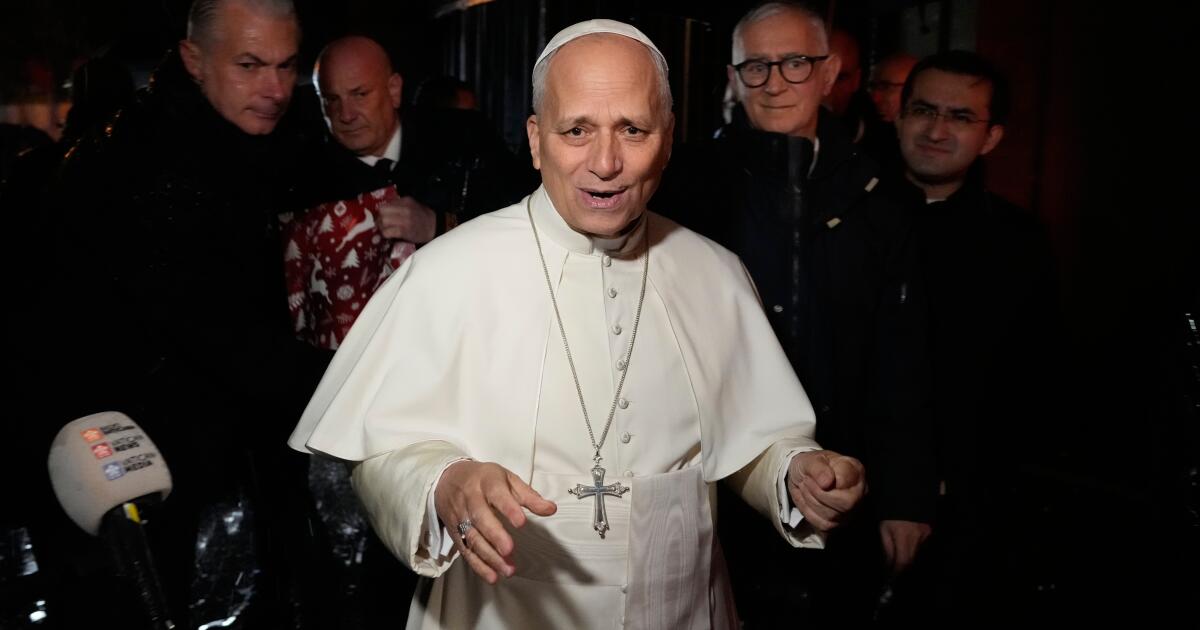
Pope Leo XIV said Tuesday he was “very disappointed” that his home state of Illinois had approved a law allowing for medically assisted suicide, and he called for greater respect for life.

Leo said he had spoken “explicitly” with Gov. JB Pritzker and urged him to not sign the bill into law. Chicago Cardinal Blase Cupich did the same, Leo told reporters as he left his country house in Castel Gandolfo, south of Rome.

“We were very clear about the necessity to respect the sacredness of life from the very beginning to the very end, and unfortunately, for different reasons, he decided to sign that bill,” Leo said. “I am very disappointed about that.”

Pritzker signed the legislation Dec. 12. The measure is also known as “Deb’s Law,” honoring Deb Robertson, a resident of the state living with a rare terminal illness. She had pushed for the measure’s approval and testified to the suffering of people and their families wanting the chance to decide for themselves how and when their lives should end.

Pritzker, a Democrat, had said he had been moved by stories of patients suffering from terminal illnesses.

Leo, who grew up in Chicago, cited Catholic teaching, which calls for the defense and protection of life from conception until natural death, forbidding abortion and euthanasia.

“I would invite all people, especially in these Christmas days, to reflect upon the nature of human life, the goodness of human life,” Leo said. “God became human like us to show us what it means really to live human life, and I hope and pray that the respect for life will once again grow in all moments of human existence, from conception to natural death.”

The state’s six Catholic dioceses had criticized Pritzker’s signing, saying the law puts Illinois “on a dangerous and heartbreaking path.”

Eleven other states and the District of Columbia allow medically assisted suicide, according to the advocacy group, Death With Dignity. Delaware was the latest, and its provision takes effect Jan. 1, 2026. Seven other states are considering allowing it.

Santalucia writes for the Associated Press. AP writer Nicole Winfield contributed to this report from Rome.

Source link

Trump administration to resume wage garnishment for student loan defaulters | Education News

Borrowers to receive wage garnishment notices starting January 7, Department of Education confirms.

The administration of United States President Donald Trump says it will begin garnishing wages from some borrowers who have defaulted on their student loans, marking the first time the federal government has taken such action since the onset of the COVID-19 pandemic.

Affected borrowers will begin receiving notices on January 7, a Department of Education spokesperson told Al Jazeera on Tuesday.

Recommended Stories

list of 4 itemsend of list

The policy is expected to initially impact about 1,000 borrowers, and the number is to grow over time.

“The notices will increase in scale on a month-to-month basis,” the spokesperson said.

Al Jazeera asked the department for clarification on how borrowers were selected for the first round of garnishments, how many additional people may be affected and the rationale behind those decisions.

The agency did not clarify but said collections are “conducted only after student and parent borrowers have been provided sufficient notice and opportunity to repay their loans”.

Under federal law, the government may garnish up to 15 percent of a borrower’s take-home pay as long as the individual is left with at least 30 times the federal minimum wage per week. The federal minimum wage is currently $7.25 an hour, a rate that has remained unchanged since July 2009.

About one in six American adults holds student loan debt, which totals about $1.6 trillion. As of April, more than 5 million borrowers had not made a payment in at least a year, according to the Education Department.

The garnishments are planned as economic pressure mounts for many Americans amid rising prices and a cooling labour market. According to consulting firm Challenger, Gray & Christmas, more than 1.1 million people lost their jobs in 2025 as job growth slowed. Federal data also showed mixed employment trends in recent months with job losses reported in October followed by modest gains in November.

In the months of October and November, the unemployment rate increased to 4.6 percent, the highest since 2021, according to the US Department of Labor’s Bureau of Labor Statistics.

“Families are being forced to choose between paying their bills and putting food on the table. The Trump administration’s decision to begin garnishing wages takes even that meagre choice away from student loan borrowers who are living on the brink,” Julie Margetta Morgan, former deputy undersecretary at the Education Department under former President Joe Biden, told Al Jazeera.

“Instead of solving the affordability crisis that’s leaving Americans unable to pay their student loans, the president is further punishing families and forcing them to forgo the very basics.”

In addition to wages, the federal government has the authority to garnish income from tax refunds, Social Security benefits and certain disability payments.

Source link

Oklahoma college instructor fired after giving failing grade to a Bible-based essay on gender

The University of Oklahoma has fired an instructor who was accused by a student of religious discrimination over a failing grade on a psychology paper in which she cited the Bible and argued that promoting a “belief in multiple genders” was “demonic.”

The university said in a statement posted Monday on X that its investigation found the graduate teaching assistant had been “arbitrary” in giving 20-year-old junior Samantha Fulnecky zero points on the assignment. The university declined to comment beyond its statement, which said the instructor had been removed from teaching.

Through her attorney, the instructor, Mel Curth, denied Tuesday that she had “engaged in any arbitrary behavior regarding the student’s work.” The attorney, Brittany Stewart, said in a statement emailed to the Associated Press that Curth is “considering all of her legal remedies.”

Conservative groups, commentators and others quickly made Fulnecky’s failing grade an online cause, highlighting her argument that she’d been punished for expressing conservative Christian views. Her case became a flashpoint in the ongoing debate over academic freedom on college campuses as President Trump pushes to end diversity, equity and inclusion initiatives, and restrict how campuses discuss race, gender and sexuality.

Fulnecky appealed her grade on the assignment, which was worth 3% of the final grade in the class, and the university said the assignment would not count. It also placed Curth on leave, and Oklahoma’s conservative Republican governor, Kevin Stitt, declared the situation “deeply concerning.”

“The University of Oklahoma believes strongly in both its faculty’s rights to teach with academic freedom and integrity and its students’ right to receive an education that is free from a lecturer’s impermissible evaluative standards,” the university’s statement said. “We are committed to teaching students how to think, not what to think.”

A law approved this year by Oklahoma’s Republican-dominated Legislature and signed by Stitt prohibits state universities from using public funds to finance DEI programs or positions or mandating DEI training. However, the law says it does not apply to scholarly research or “the academic freedom of any individual faculty member.”

Home telephone listings for Fulnecky in the Springfield, Mo., area had been disconnected, and her mother — an attorney, podcaster and radio host — did not immediately respond Tuesday to a Facebook message seeking comment about the university’s action.

Fulnecky’s failing grade came in an assignment for a psychology class on lifespan development. Curth directed students to write a 650-word response to an academic study that examined whether conformity with gender norms was associated with popularity or bullying among middle school students.

Fulnecky wrote that she was frustrated by the premise of the assignment because she does not believe that there are more than two genders based on her understanding of the Bible, according to a copy of her essay provided to The Oklahoman.

“Society pushing the lie that there are multiple genders and everyone should be whatever they want to be is demonic and severely harms American youth,” she wrote, adding that it would lead society “farther from God’s original plan for humans.”

In feedback obtained by the newspaper, Curth said the paper did “not answer the questions for the assignment,” contradicted itself, relied on “personal ideology” over evidence and “is at times offensive.”

“Please note that I am not deducting points because you have certain beliefs,” Curth wrote.

Hanna writes for the Associated Press.

Source link

Wage garnishment for defaulted student loans set to resume next year

Dec. 23 (UPI) — The U.S. Department of Education has signaled that next year it will resume garnishing wages of people who’ve defaulted on their student loans.

The change, reported by multiple news outlets, comes after a years-long respite on garnishment that began as a pandemic-era economic relief measure. The resumption follows other Trump administration efforts to recoup past-due student loan debt.

The department intends to notify about 1,000 borrowers who have defaulted on their debt that it will begin seizing parts of their paychecks, The Washington Post reported Monday. The initial notices will go out the week of Jan. 7, with more going out to borrowers each month, according to the paper.

Roughly 5.3 million borrowers have not made student loan payments, with many having fallen behind before the federal government stopped collecting on defaulted loans nearly six years ago, the Post reported.

A borrower is considered to be in default on their loan when they have not made a payment for more than 270 days. Up to 15% of their pay can be garnished as a result.

After returning to power earlier this year, the Trump administration has sought to undo Biden-era policies meant to ease the burden of student loans on borrowers. The department announced in April that it would again require defaulted borrowers to make payments on their loans and has sought to tighten rules for the Public Service Loan Forgiveness program.

The Trump administration has defended its approach, saying it’s holding irresponsible borrowers accountable for loans that have cost taxpayers billions.

However, the Student Borrower Protection Center criticized the department for resuming garnishments, saying the measure is used without oversight and has been used to unjustifiably seize wages from hundreds of millions during the pandemic.

“At a time when families across the country are struggling with stagnant wages and an affordability crisis, this administration’s decision to garnish wages from defaulted student loan borrowers is cruel, unnecessary, and irresponsible,” Persis Yu, the group’s deputy executive director and managing counsel, said in a statement. “As millions of borrowers sit on the precipice of default, this administration is using its self-inflicted limited resources to seize borrowers’ wages instead of defending borrowers’ right to affordable payments.”

Clouds turn shades of red and orange when the sun sets behind One World Trade Center and the Manhattan skyline in New York City on November 5, 2025. Photo by John Angelillo/UPI | License Photo

Source link

A look at aging baby boomers in the United States

The oldest baby boomers — once the vanguard of an American youth that revolutionized U.S. culture and politics — turn 80 in 2026.

The generation that twirled the first plastic hula hoops and dressed up the first Barbie dolls, embraced the TV age, blissed out at Woodstock and protested and fought in the Vietnam War — the cohort that didn’t trust anyone over age 30 — now is contributing to the overall aging of America.

Boomers becoming octogenarians in 2026 include actor Henry Winkler and baseball Hall of Famer Reggie Jackson, singers Cher and Dolly Parton and presidents Donald Trump, George W. Bush and Bill Clinton.

The aging and shrinking youth of America

America’s population swelled with around 76 million births from 1946 to 1964, a spike magnified by couples reuniting after World War II and enjoying postwar prosperity.

Boomers were better educated and richer than previous generations, and they helped grow a consumer-driven economy. In their youth, they pushed for social change through the Civil Rights Movement, the women’s rights movement and efforts to end the Vietnam War.

“We had rock ‘n’ roll. We were the first generation to get out and demonstrate in the streets. We were the first generation, that was, you know, a socially conscious generation,” said Diane West, a metro Atlanta resident who turns 80 in January. “Our parents played by the rules. We didn’t necessarily play by the rules, and there were lots of us.”

As they got older they became known as the “me” generation, a pejorative term coined by writer Tom Wolfe to reflect what some regarded as their self-absorption and consumerism.

“The thing about baby boomers is they’ve always had a spotlight on them, no matter what age they were,” Brookings demographer William Frey said. “They were a big generation, but they also did important things.”

By the end of this decade, all baby boomers will be 65 and older, and the number of people 80 and over will double in 20 years, Frey said.

The share of senior citizens in the U.S. population is projected to grow from 18.7% in 2025 to nearly 23% by 2050, while children under 18 decline from almost 21% to a projected 18.4%.

Without any immigration, the U.S. population will start shrinking in five years. That’s when deaths will surpass births, according to projections from the Congressional Budget Office that were revised in September to account for the Trump administration’s immigration crackdown. Population growth comes from immigration as well as births outpacing deaths.

The aging of America is being compounded by longer lives due to better healthcare and lower birth rates.

The projected average U.S. life expectancy at birth rises from 78.9 years in 2025 to 82.2 years in 2055, according to the CBO. And since the Great Recession in 2008, when the fertility rate was 2.08, around the 2.1 rate needed for children to numerically replace their parents, it has been on a steady decline, hitting 1.6 in 2025.

Younger generations miss boomer milestones

Women are having fewer children because they are better educated, they’re delaying marriage to focus on careers and they’re having their first child at a later age. Unaffordable housing, poor access to child care and the growing expenses of child-rearing also add up to fewer kids.

University of New Hampshire senior demographer Kenneth Johnson estimates that the result has been 11.8 million fewer births, compared to what might have been had the fertility rate stayed at Great Recession levels.

“I was young when I had kids. I mean that’s what we did — we got out of college, we got married and we had babies,” said West, who has two daughters, a stepdaughter and six grandchildren. “My kids got married in their 30s, so it’s very different.”

A recent Census Bureau study showed that 21st-century young adults in the U.S. haven’t been adulting like baby boomers did. In 1975, almost half of 25-to-34-year-olds had moved out of their parents’ home, landed jobs, gotten married and had kids. By the early 2020s, less than a quarter of U.S. adults had hit these milestones.

West, whose 21-year-old grandson lives with her, understands why: They lack the prospects her generation enjoyed. Her grandson, Paul Quirk, said it comes down to financial instability.

“They were able to buy a lot of things, a lot cheaper,” Quirk said.

All of her grandchildren are frustrated by the economy, West added.

“You have to get three roommates in order to afford a place,” she said. “When we got out of college, we had a job waiting for us. And now, people who have master’s degrees are going to work fast food while they look for a real job.”

Implications for the economy

The aging of America could constrain economic growth. With fewer workers paying taxes, Social Security and Medicare will be under more pressure. About 34 seniors have been supported by every 100 workers in 2025, but that ratio grows to 50 seniors per 100 working-age people in about 30 years, according to estimates released last year by the White House.

When West launched her career in employee benefits and retirement planning in 1973, each 100 workers supported 20 or fewer retirees, by some calculations.

Vice President JD Vance and Tesla Chief Executive Elon Musk are among those pushing for an increase in fertility. Vance has suggested giving parents more voting power, according to their numbers of children, or following the example of Hungary’s Viktor Orbán in giving low-interest loans to married parents and tax exemptions to women who have four children or more.

Frey said programs that incentivize fertility among U.S. women hardly ever work, so funding should support pre-kindergarten and paid family leave.

“I think the best you can do for people who do want to have kids is to make it easier and less expensive to have them and raise them,” he said. “Those things may not bring up the fertility rate as much as people would like, but at least the kids who are being born will have a better chance of succeeding.”

Schneider writes for the Associated Press. AP writer Emilie Megnien in Atlanta contributed to this report.

Source link

Claims about Trump in Epstein files are ‘untrue,’ the Justice Department says

Tips provided to federal investigators about Donald Trump’s alleged involvement in Jeffrey Epstein’s schemes with young women and girls are “sensationalist” and “untrue,” the Justice Department said on Tuesday, after a new tranche of files released from the probe featured multiple references to the president.

The documents include a limousine driver reportedly overhearing Trump discussing a man named Jeffrey “abusing” a girl, and an alleged victim accusing Trump and Epstein of rape. It is unclear whether the FBI followed up on the tips. The alleged rape victim died from a gunshot wound to the head after reporting the incident.

Nowhere in the newly released files do federal law enforcement agents or prosecutors indicate that Trump was suspected of wrongdoing, or that Trump — whose friendship with Epstein lasted through the mid-2000s — was investigated himself.

But one unidentified federal prosecutor noted in a 2020 email that Trump had flown on Epstein’s private jet “many more times than previously has been reported,” including over a time period when Ghislaine Maxwell, Epstein’s top confidante who would ultimately be convicted on five federal counts of sex trafficking and abuse, was being investigated for criminal activity.

The Justice Department released an unusual statement unequivocally defending the president.

“Some of these documents contain untrue and sensationalist claims made against President Trump that were submitted to the FBI right before the 2020 election,” the Justice Department statement read. “To be clear: the claims are unfounded and false, and if they had a shred of credibility, they certainly would have been weaponized against President Trump already.”

“Nevertheless, out of our commitment to the law and transparency, the DOJ is releasing these documents with the legally required protections for Epstein’s victims,” the department added.

The Justice Department files were released with heavy redactions after bipartisan lawmakers in Congress passed a new law compelling it to do so, despite Trump lobbying Republicans aggressively over the summer and fall to oppose the bill. The president ultimately signed the Epstein Files Transparency Act into law after the legislation passed with veto-proof majorities in both chambers.

One newly released file containing a letter purportedly from Epstein — a notorious child sex offender who died in jail while awaiting federal trial on sex-trafficking charges — drew widespread attention online, but was held up by the Justice Department as an example of faulty or misleading information contained in the files.

The letter appeared to be sent by Epstein to Larry Nassar, another convicted sex offender, shortly before Epstein’s death. The letter’s author suggested that Nassar would learn after receiving the note that Epstein had “taken the ‘short route’ home,” possibly referring to his suicide. It was postmarked from Virginia on Aug. 13, 2019, despite Epstein’s death in a Manhattan jail three days prior.

“Our president shares our love of young, nubile girls,” the letter reads. “When a young beauty walked by he loved to ‘grab snatch,’ whereas we ended up snatching grub in the mess halls of the system. Life is unfair.”

The Justice Department said that the FBI had confirmed that the letter is “FAKE” after it made the rounds on Tuesday.

“This fake letter serves as a reminder that just because a document is released by the Department of Justice does not make the allegations or claims within the document factual,” the department posted on social media. “Nevertheless, the DOJ will continue to release all material required by law.”

The department has faced bipartisan scrutiny since failing to release all of the Epstein files in its possession by Dec. 19, the legal deadline for it to do so, and for redacting material on the vast majority of the documents.

Justice Department officials said they were following the law by protecting victims with the redactions. The Epstein Files Transparency Act also directs the department not to redact images or references to prominent or political figures, and to provide an explanation for each and every redaction in writing.

The latest release, just days before the Christmas holiday, includes roughly 30,000 documents, the department said. Hundreds of thousands more are expected to be released in the coming weeks.

Democrats on the House Oversight Committee released a statement in response to the Tuesday release accusing the Justice Department of a “cover-up,” writing on social media, “the new DOJ documents raise serious questions about the relationship between Epstein and Donald Trump.”

Documents from Epstein’s private estate released by the oversight committee earlier this fall had already cast a spotlight on that relationship, revealing Epstein had written in emails to associates that Trump “knew about the girls.”

The latest documents release also includes an email from an individual identified as “A,” claiming to stay at Balmoral Castle, a royal residence in Scotland, asking Maxwell if she had found him “some new inappropriate friends.” Andrew Mountbatten-Windsor, formerly known as Prince Andrew, has come under intense scrutiny over his ties to Epstein in recent years.

Speaking at his Mar-a-Lago resort in Florida on Monday, Trump said the continuing Epstein scandal amounts to a “distraction” from Republican successes, and expressed disapproval over the release of images in the files that reveal associates of Epstein.

“I believe they gave over 100,000 pages of documents, and there’s tremendous backlash,” Trump told reporters. “It’s an interesting question, because a lot of people are very angry that pictures are being released of other people that really had nothing to do with Epstein. But they’re in a picture with him because he was at a party, and you ruin a reputation of somebody. So a lot of people are very angry that this continues.”

Source link

Justices block troop deployment in Chicago; 3 conservatives object

The Supreme Court ruled against President Trump on Tuesday and said he did not have legal authority to deploy the National Guard in Chicago to protect federal immigration agents.

Acting on a 6-3 vote, the justices denied Trump’s appeal and upheld orders from a federal district judge and the 7th Circuit Court of Appeals that said the president had exaggerated the threat and overstepped his authority.

The decision is a major defeat for Trump and his broad claim that he had the power to deploy military forces in U.S. cities.

In an unsigned order, the court said the Militia Act allows the president to deploy the National Guard only if U.S. military forces were unable to quell violence.

“At this preliminary stage, the Government has failed to identify a source of authority that would allow the military to execute the laws in Illinois. The President has not invoked a statute that provides an exception to the Posse Comitatus Act,” the court said.

Conservative Justices Clarence Thomas, Samuel A. Alito Jr. and Neil M. Gorsuch dissented.

The 9th Circuit Court of Appeals had allowed the deployments in Los Angeles and Portland, Ore., after ruling that judges must defer to the president.

But U.S. District Judge Charles Breyer ruled Dec. 10 that the federalized National Guard troops in Los Angeles must be returned to the control of California Gov. Gavin Newsom.

Trump’s lawyers had not claimed in their appeal that the president had the authority to deploy the military for ordinary law enforcement in the city. Instead, they said the Guard troops would be deployed “to protect federal officers and federal property.”

The two sides in the Chicago case, like in Portland, told dramatically different stories about the circumstances leading to Trump’s order.

Democratic officials in Illinois said small groups of protesters objected to the aggressive enforcement tactics used by federal immigration agents. They said police were able to contain the protests, clear the entrances and prevent violence.

By contrast, administration officials described repeated instances of disruption, confrontation and violence in Chicago. They said immigration agents were harassed and blocked from doing their jobs, and they needed the protection the National Guard could supply.

Trump Solicitor Gen. D. John Sauer said the president had the authority to deploy the Guard if agents could not enforce the immigration laws.

“Confronted with intolerable risks of harm to federal agents and coordinated, violent opposition to the enforcement of federal law,” Trump called up the National Guard “to defend federal personnel, property, and functions in the face of ongoing violence,” he told the court in an emergency appeal filed in mid-October.

Illinois state lawyers disputed the administration’s account.

“The evidence shows that federal facilities in Illinois remain open, the individuals who have violated the law by attacking federal authorities have been arrested, and enforcement of immigration law in Illinois has only increased in recent weeks,” state Solicitor Gen. Jane Elinor Notz said in response to the administration’s appeal.

The Constitution gives Congress the power “to provide for calling forth the militia to execute the laws of the union, suppress insurrections and repel invasions.”

The Militia Act of 1903 says the president may call up and deploy the National Guard if he faces an invasion, a rebellion or is “unable with the regular forces to execute the laws of the United States.”

Trump’s lawyers said that referred to police and federal agents. But after taking a closer look, the court concluded it referred to the regular military forces. By that standard, the president’s authority to deploy the National Guard comes only after the military has failed to quell violence.

But on Oct. 29, the justices asked both sides to explain what the law meant when it referred to the “regular forces.”

Until then, both sides had assumed it referred to federal agents and police, not the military.

Trump’s lawyers stuck to their position. They said the law referred to the “civilian forces that regularly execute the laws,” not the military.

If those civilians cannot enforce the law, “there is a strong tradition in this country of favoring the use of the military rather than the standing military to quell domestic disturbances,” they said.

State attorneys for Illinois said the “regular forces” are the “full-time, professional military.” And they said the president could not “even plausibly argue” that the U.S. soldiers were required to enforce the law in Chicago.

California Atty. Gen. Rob Bonta and Newsom filed a brief in the Chicago case that warned of the danger of the president using the military in American cities.

“On June 7, for the first time in our Nation’s history, the President invoked [U.S. law] to federalize a State’s National Guard over the objections of the State’s Governor,” they said.

“President Trump and Defense Secretary Hegseth transferred 4,000 members of California’s National Guard — one in three of the Guard’s total active members — to federal control to serve in a civilian law enforcement role on the streets of Los Angeles and other communities in Southern California.”

That has proved to be “the opening salvo in an effort to transform the role of the military in American society,” they said. “At no prior point in our history has the President used the military this way: as his own personal police force, to be deployed for whatever law enforcement missions he deems appropriate.

“What the federal government seeks is a standing army, drawn from state militias, deployed at the direction of the President on a nationwide basis, for civilian law enforcement purposes, for an indefinite period of time,” they said.

Source link

Why California’s milk cartons may lose their coveted recycling symbol

California milk cartons may lose their coveted recycling symbol, the one with the chasing arrows, potentially threatening the existence of the ubiquitous beverage containers.

In a letter Dec. 15, Waste Management, one of the nation’s largest waste companies, told the state the company would no longer sort cartons out of the waste stream for recycling at its Sacramento facility. Instead, it will send the milk- and food-encrusted packaging to the landfill.

Marcus Nettz, Waste Management’s director of recycling for Northern California and Nevada, cited concerns from buyers and overseas regulators that cartons — even in small amounts — could contaminate valuable material, such as paper, leading them to reject the imports.

The company decision means the number of Californians with access to beverage carton recycling falls below the threshold in the state’s “Truth in Recycling” law, or Senate Bill 343.

And according to the law, that means the label has to come off.

The recycling label is critical for product and packaging companies to keep selling cartons in California as the state’s single-use packaging law goes fully into effect. That law, Senate Bill 54, calls for all single-use packaging to be recyclable or compostable by 2032. If it isn’t, it can’t be sold or distributed in the state.

The labels also provide a feel-good marketing symbol suggesting to consumers the cartons won’t end up in a landfill when they’re discarded, or find their way into the ocean where plastic debris is a large and growing problem.

On Tuesday, the state agency in charge of waste, CalRecycle, acknowledged Waste Management’s change.

In updated guidelines for the Truth in Recycling law, recycling rates for carton material have fallen below the state threshold.

It’s a setback for carton manufacturers and their customers, including soup- and juice-makers. Their trade group, the National Carton Council, has been lobbying the state, providing evidence that Waste Management’s Sacramento Recycling and Transfer Station successfully combines cartons with mixed paper and ships it to Malaysia and other Asian countries including Vietnam, proving that there is a market. The Carton Council persuaded CalRecycle to reverse a decision it made earlier this year that beverage cartons did not meet the recycling requirements of the Truth in Recycling law.

Brendon Holland, a spokesman for the trade group, said in an email that his organization is aware of Waste Management’s decision, but its understanding is that the company will now sort the cartons into their own dedicated waste stream “once a local end market is available.”

He added that even with “this temporary local adjustment,” food and beverage cartons are collected and sorted in most of California, and said this is just a “temporary end market adjustment — not a long-term shift away from historical momentum.”

In 2022, Malaysia and Vietnam banned imports of mixed paper bales — which include colored paper, newspapers, magazines and other paper products — from the U.S. because they were so often contaminated with non-paper products and plastic, such as beverage cartons. Waste Management told The Times on Dec. 5 that it has a “Certificate of Approval” by Malaysia’s customs agency to export “sorted paper material.” CalRecycle said it has no regulatory authority on “what materials may or may not be exported.”

Adding the Sacramento facility to the list of waste companies that were recycling cartons meant that the threshold required by the state had been met: More than 60% of the state’s counties had access to carton recycling.

At the time, CalRecycle’s decision to give the recycling stamp to beverage cartons was controversial. Many in the environmental, anti-plastic and no-waste sectors saw it as a sign that CalRecycle was doing the bidding of the plastic and packaging industry, as opposed to trying to rid the state of non-recyclable, polluting waste — which is not only required by law, but is something state Atty. Gen. Rob Bonta is investigating.

Others said it was a sign that the Truth in Recycling law was working: Markets were being discovered and in some cases, created, to provide recycling.

“Recyclability isn’t static, it depends on a complicated system of sorting, transportation, processing, and, ultimately, manufacturers buying the recycled material to make a new product,” said Nick Lapis, director of advocacy for Californians Against Waste.

He said this new information, which will likely remove the recycling label from the cartons, also underscores the effectiveness of the law.

“By prohibiting recyclability claims on products that don’t get recycled, SB 343 doesn’t just protect consumers. It forces manufacturers to either use recyclable materials or come to the table to work with recyclers, local governments and policymakers to develop widespread sustainable and resilient markets,” he said.

Beverage and food cartons — despite their papery appearance — are composed of layers of paper, plastic and sometimes aluminum. The sandwiched blend extends product shelf life, making it attractive to food and beverage companies.

But the companies and municipalities that receive cartons as waste say the packaging is problematic. They say recycling markets for the material are few and far between.

California, with its roughly 40 million residents, has some of the strictest waste laws in the nation. In 1989, the state passed legislation requiring cities, towns and municipalities to divert at least 50% of their residential waste away from landfills. The idea was to incentivize recycling and reuse. However an increasing number of products have since entered the commercial market and waste stream — such as single use plastics, polystyrene and beverage cartons — that have limited (if any) recycling potential, can’t be reused, and are growing in number every year.

Fines for municipalities that fail to achieve the required diversion rates can run $10,000 a day.

As a result, garbage haulers often look for creative ways to deal with the waste, including shipping trash products overseas or across the border. For years, China was the primary destination for California’s plastic, contaminated paper and other waste. But in 2018, China closed its doors to foreign garbage, so U.S. exporters began dumping their waste in smaller southeast Asian countries, including Malaysia and Vietnam.

They too have now tried to close the doors to foreign trash as reports of polluted waterways, chokingly toxic air, and illness grows — and as they struggle with inadequate infrastructure to deal with their own domestic waste.

Jan Dell, the founder and CEO of Last Beach Cleanup, released a report with the Basel Action Network, an anti-plastic organization, earlier this month showing that the Sacramento facility and other California waste companies were sending bales of carton-contaminated paper to Malaysia, Vietnam and other Asian nations.

According to export data, public records searches and photographic evidence collected by Dell and her co-authors at the Basel Action Network, more than 117,000 tons or 4,126 shipping containers worth of mixed paper bales were sent by California waste companies to Malaysia between January and July of this year.

Dell said these exports violate international law. A spokesman for Waste Management said the material they were sending was not illegal — and that they had received approval from Malaysia.

However, the Dec. 15 letter suggests they were receiving more pushback from their export markets than they’d previously disclosed.

“While certain end users maintain … that paper mills are able to process and recycle cartons,” some of them “have also shared concerns … that the inclusion of cartons … may result in rejection,” wrote Nettz.

Dell said she was “pleased” that Waste Management “stopped the illegal sortation of cartons into mixed paper bales. Now we ask them and other waste companies to stop illegally exporting mixed paper waste to countries that have banned it.”

Source link

Former Nebraska U.S. Sen. Ben Sasse reveals advanced pancreatic cancer diagnosis

Former Nebraska U.S. Sen. Ben Sasse, a conservative who rebuked political tribalism and stood out as a longtime critic of President Trump, announced Tuesday he was diagnosed with advanced pancreatic cancer.

Sasse, 53, made the announcement on social media, saying he learned of the disease last week and is “now marching to the beat of a faster drummer.”

“This is a tough note to write, but since a bunch of you have started to suspect something, I’ll cut to the chase,” Sasse wrote. “Last week I was diagnosed with metastasized, stage-four pancreatic cancer, and am gonna die.”

Sasse was first elected to the Senate in 2014. He comfortably won reelection in 2020 after fending off a pro-Trump primary challenger. Sasse drew the ire of GOP activists for his vocal criticism of Trump’s character and policies, including questioning his moral values and saying he cozied up to adversarial foreign leaders.

Sasse was one of seven Republican senators to vote to convict the former president of “ incitement of insurrection ” after the Jan. 6, 2021, attack on the U.S. Capitol. After threats of a public censure back home, he extended his critique to party loyalists who blindly worship one man and rejected him for his refusal to bend the knee.

He resigned from the Senate in 2023 to serve as the 13th president of the University of Florida after a contentious approval process. He left that post the following year after his wife was diagnosed with epilepsy.

Sasse, who has degrees from Harvard, St. John’s College and Yale, worked as an assistant secretary of Health and Human Services under President George W. Bush. He served as president of Midland University, a small Christian university in eastern Nebraska, before he ran for the Senate.

Sasse and his wife have three children.

“I’m not going down without a fight. One sub-part of God’s grace is found in the jawdropping advances science has made the past few years in immunotherapy and more,” Sasse wrote. “Death and dying aren’t the same — the process of dying is still something to be lived.”

Source link

UK police drop probe into Bob Vylan’s chants about Israeli military | Music News

Police say there is ‘insufficient evidence’ to bring charges after investigating comments made at Glastonbury festival.

British police have said they will take no further action over comments made by punk-rap duo Bob Vylan about the Israeli military during a performance at the Glastonbury music festival in June.

Avon and Somerset Police said on Tuesday that the remarks did not meet the criminal threshold required for prosecution “for any person to be prosecuted”.

Recommended Stories

list of 4 itemsend of list

During the performance, the group’s lead singer – Pascal Robinson-Foster, known by his stage name Bobby Vylan – led chants of “death, death” directed at the Israeli military over its genocidal war in Gaza.

Police said there was “insufficient evidence to provide a realistic prospect of conviction”. The force added that it interviewed a man in his mid-30s and contacted about 200 members of the public as part of the investigation.

The chant, which was livestreamed by the BBC as part of its Glastonbury coverage on June 28, prompted a widespread backlash. The broadcaster later apologised for transmitting what it described as “such offensive and deplorable behaviour”, and its complaints unit found the BBC had breached editorial guidelines.

Avon and Somerset Police said it had considered the intent behind the words, the wider context, relevant case law and freedom of expression issues before concluding the investigation.

“We believe it is right this matter was comprehensively investigated, every potential criminal offence was thoroughly considered, and we sought all the advice we could to ensure we made an informed decision,” the statement said.

“The comments made on Saturday 28 June drew widespread anger, proving that words have real-world consequences.”

Following the performance, the United States revoked the visas of Bob Vylan, forcing the cancellation of a planned US tour scheduled to begin in October.

Bob Vylan have launched defamation proceedings against Irish broadcaster RTE, alleging it falsely claimed they led anti-Semitic chants during the Glastonbury performance.

In July, the British police also dropped an investigation into the Irish-language rap group Kneecap after chants of “Free Palestine” during a performance.

Detectives sought advice from the Crown Prosecution Service and decided to take no further action, citing “insufficient evidence to provide a realistic prospect of conviction for any offence”.

Source link