Politics

Latest news about politics

Trump’s ‘favorite dictator’ is now President Biden’s burden

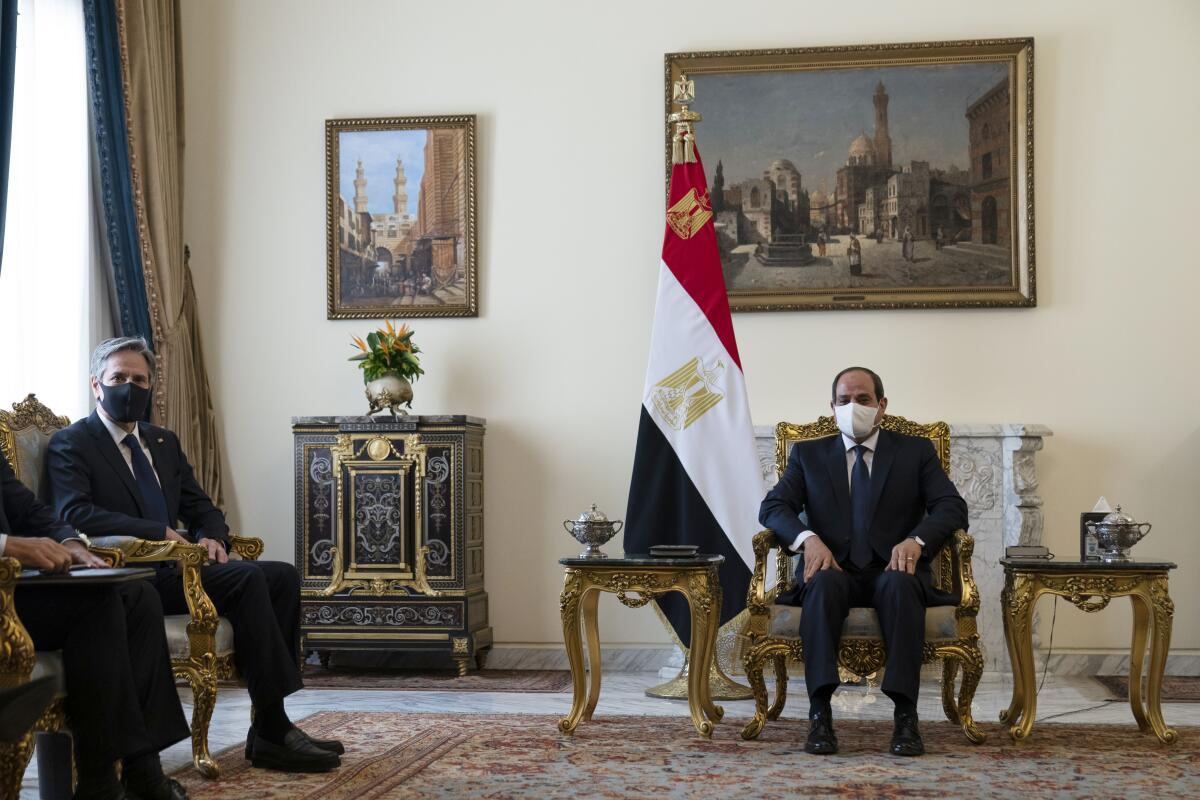
Egyptian President Abdel Fattah Sisi sat at the head of the ornate room, on a chair that seemed slightly bigger than the rest, thronelike. Even through his COVID mask, it was clear he was not smiling.

His visitor, the first envoy from the new Biden administration, was relegated to the side chairs with other members of the U.S. and Egyptian delegations.

Secretary of State Antony J. Blinken had called on the notorious strongman, a military man whom former President Trump once called his “favorite dictator,” to thank him for helping stop a war between Israel and the militant group Hamas.

It was an awkward position for Blinken. Human rights, he has said repeatedly, are at the core of Biden-era foreign policy — and human rights are not something Sisi regards favorably. He jails and tortures dissidents, journalists and others, activists say, and has been accused of repeatedly ordering deadly fire on peaceful demonstrators.

But Sisi, as Egyptian leaders have before him, helped defuse violence between Israel and Palestinian groups. So Blinken made the high-level visit to offer thanks, which Sisi will attempt to leverage to influence Washington and to skirt criticism. During his campaign, President Biden promised “no blank checks” for Sisi, but Egypt has long parlayed its recognition of Israel into an alliance in which U.S. officials tended to look the other way when it came to abuses.

“Egypt played a crucial role in brokering the cease-fire,” Blinken said later in discussing his meeting with Sisi. He insisted that he raised human rights issues with the Egyptian leader. “We had a lengthy exchange on that with President Al Sisi as a reflection of the fact that it remains very much on the agenda with Egypt.”

Before the meeting late last month, reports had circulated among diplomats that Sisi would release a number of detained American citizens as a good-faith gesture. That did not happen.

Blinken and Sisi met for one hour and 45 minutes, with Sisi speaking for more than an hour without interruption, according to people familiar with the encounter. He extolled his own achievements in what he considers true human rights: making daily life better for ordinary Egyptians. Political rights or the right to dissent do not figure in his narrative.

Secretary of State Antony Blinken meets with Egyptian President Abdel Fattah Sisi

Secretary of State Antony J. Blinken, left, is seated to the side during a meeting with Egyptian President Abdel Fattah Sisi at the Heliopolis Palace in Cairo on May 26.

(Associated Press)

Journalists accompanying Blinken on his trip were given about 30 seconds to view the initial seating of the meeting, but no more. Once during an earlier visit, Vice President Mike Pence answered a question from the attending journalists and invited Sisi to join in. The Egyptian was appalled at such openness, refused to engage and subsequently fired several palace aides who he blamed for allowing such an affront, according to diplomats.

This time, Sisi’s supporters in the mostly state-controlled Egyptian media celebrated Blinken’s visit and two telephone calls from Biden as validation of the government’s tactics and its recovered importance to regional diplomacy.

Critics said the diplomatic niceties obscure the ruthlessness of the government.

Sisi, 66, a former minister of defense and head of military intelligence, began his rise to power in a July 2013 coup against democratically chosen President Mohamed Morsi, and eventually won election as president in 2014.

After gaining power, Sisi jettisoned the Egyptian Constitution, unleashed brutally lethal security forces on massive civilian protests in Cairo and kept power through a 2018 vote widely seen as fraudulent.

Human Rights Watch, in an extensive report, held Sisi at least partially to blame for a massacre of hundreds of government critics, including many Muslim Brotherhood members, in July and August of 2013.

“His utmost concern is the sustainability of his regime, with him at the top of that regime, and he is ready to do whatever he can for the sustainability of the regime,” said Bahey eldin Hassan, director of the Cairo Institute for Human Rights Studies, which has repeatedly urged the Sisi government to end its crackdown on peaceful dissent.

Sisi sees enemies everywhere, Hassan and other human rights experts said — especially from among Islamists like the Muslim Brotherhood that backed Morsi, and activists who would hold him accountable for repeated killings of dissidents. Sisi does not tolerate internal debate, much less public criticism, said people who know him.

Hassan fled to France after the Sisi judiciary prosecuted him twice for what he says was his work on behalf of human rights. The activist blames decades of U.S. “political support and complicity” for strengthening the hands of autocratic Egyptian rulers. Egypt receives roughly $1.3 billion annually in military aid, second only to Israel, and the Biden administration is asking for the same amount for next fiscal year.

“I’d just like President Biden to keep his promises from the campaign,” Hassan said in a telephone interview, referring to Biden’s pledge to work to free tens of thousands of political prisoners said to have been detained under Sisi.

Egypt has for decades enjoyed a unique spot in U.S. foreign policy and the geopolitics of the Middle East.

Through successive U.S. administrations, Washington upheld a string of Egyptian strongmen, from the late Anwar Sadat and Hosni Mubarak, to Sisi now. Until last year, Egypt, along with Jordan, was one of only two Arab nations to recognize Israel. That vital role led Washington to ignore many of the abuses of Cairo governments while enlisting their help in protecting Israel.

The role came into focus again last month when it took Sisi and Egypt to persuade the militant Hamas organization based in the Gaza Strip to agree to stop its rocket fire onto Israeli cities and towns. Israel responded with heavy aerial bombardment that devastated parts of the Gaza Strip including residential buildings and schools. Because the U.S. formally regards Hamas as a terrorist group, it cannot negotiate with its leaders directly.

For Sisi, it was a welcome opportunity to prove his mettle to the Biden administration and to counter a shift in U.S. attentions to Persian Gulf nations after several agreed to recognize Israel as part of the 2020 Abraham Accords brokered by the Trump administration.

“Egypt is working hard on reclaiming and cementing its role as a significant international player that can be an ally, rather than a liability,” Mirette Mabrouk, founding director of the Egypt program at the Washington-based Middle East Institute, wrote in a recent analysis.

That includes Sisi’s intervention in Libya, where he has sought to mediate among warring factions, and in the debate over a massive dam on the Nile that pits Egypt against Ethiopia and Sudan.

Sisi was unsure of the Biden administration, experts said, following four years of latitude under Trump.

For example, Blinken’s predecessor called on Sisi in January 2019. And rather than raise human rights issues, Trump’s secretary of State, Michael R. Pompeo, praised Sisi for what he called an embrace of religious freedom because he had allowed a Coptic Christian church to be built in a Cairo suburb. (Shortly thereafter, Egypt built a mosque nearby.)

Under pressure from the Trump administration and advocacy groups, Sisi last year released an American arts teacher who had been detained for 300 days, Reem Desouky. But another U.S. citizen, Moustafa Kassem, died in Egyptian custody. The United Nations estimates that there are half a dozen Americans among the tens of thousands of political prisoners in Egypt.

Sisi hopes his ability to influence Hamas will help keep Washington off his back, said Nimrod Novik, an Israeli foreign policy analyst who worked for the late Prime Minister Shimon Peres and has continued close ties with Egyptian intelligence officials.

“He was very apprehensive about the dual phenomenon of a Biden administration and a Democratic Congress,” Novik, a senior fellow at the U.S.-based Israel Policy Forum advocacy group, said in an interview. “There was great concern on that score: America is back, and human rights are back.”

Administration officials reject the idea that Sisi will be able to leverage his usefulness in Hamas negotiations to thwart their concern about human rights. They are able to address the issues in compartmentalized ways, they say.

“President Biden takes the issue of human rights and our commitment to human rights very seriously,” Blinken said in a news conference. “Indeed, he’s asked us to put it at the heart of our foreign policy, and that’s exactly what we’re doing, and that was reflected in the conversations that we had” with Sisi.
Get our L.A. Times Politics newsletter


Source link

What’s happening in Myanmar’s civil war as military holds elections? | Military News

Yangon, Myanmar – Voters in parts of Myanmar are heading to the polls on Sunday for an election that critics view as a bid by the country’s generals to legitimise military rule, nearly five years after they overthrew the government of Nobel Laureate Aung San Suu Kyi.

The multi-phased election is unfolding amid a raging civil war, with ethnic armed groups and opposition militias fighting the military for control of vast stretches of territory, stretching from the borderlands with Bangladesh and India in the west, across the central plains, to the frontiers with China and Thailand in the north and east.

Recommended Stories

list of 4 itemsend of list

In central Sagaing, voting will take place in only a third of the region’s townships on Sunday. Another third will be covered during a second and third phase in January, while voting has been cancelled altogether in the remainder.

Fighting, including air raids and arson, has intensified in several areas.

“The military is deploying troops and burning villages under the guise of ‘territorial dominance’,” said Esther J, a journalist based there. “People here are saying this is being done for the election.”

In most of the region, “we haven’t seen a single activity related to the election,” she said. “No one is campaigning, organising or telling people to vote.”

Across Myanmar, voting has been cancelled in 56 of the country’s 330 townships, with more cancellations expected. The conflict, triggered by the 2021 coup, has killed an estimated 90,000 people and displaced more than 3.5 million, according to monitoring groups and the United Nations. It has left nearly half of the country’s population of 55 million in need of humanitarian assistance.

“People [in Sagaing] say they have no interest in the election,” said Esther J. “They do not want the military. They want the revolutionary forces to win.”

Shifting battlefield

For much of last year, the Myanmar military appeared to be losing ground.

A coordinated offensive launched in late 2023 by the Three Brotherhood Alliance – a coalition of ethnic armed groups and opposition militias – seized vast areas, nearly pushing the military out of western Rakhine state and capturing a major regional military headquarters in the northeastern city of Lashio, about 120km (75 miles) from the Chinese border. Armed with commercial drones modified to carry bombs, the rebels were soon threatening the country’s second-largest city of Mandalay.

The operation – dubbed 1027 – marked the most significant threat to the military since the 2021 coup.

But the momentum has stalled this year, largely because of China’s intervention.

In April, Beijing brokered a deal in which the Myanmar National Democratic Alliance Army agreed to surrender the city of Lashio, without a single shot being fired. The military subsequently reclaimed key towns in north and central Myanmar, including Nawnghkio, Thabeikkyin, Kyaukme and Hsipaw. In late October, China brokered another agreement for the Ta’ang National Liberation Army to withdraw from the gold mining towns of Mogok and Momeik.

“The Myanmar military is definitely resurgent,” said Morgan Michaels, a research fellow at the International Institute for Strategic Studies (IISS). “If this current trend continues, the Myanmar military could be back in a relatively dominant position in a year or so, maybe two.”

The military turned the tide by launching a conscription drive, expanding its drone fleet and putting more combat credible soldiers in charge. Since announcing mandatory military service in February 2024, it has recruited between 70,000 to 80,000 people, researchers say.

“The conscription drive has been unexpectedly effective,” said Min Zaw Oo, executive director at the Myanmar Institute for Peace and Security. “Economic hardship and political polarisation pushed many young men into the ranks,” he said, with many of the recruits technically adept and serving as snipers and drone operators. “The military’s drone units now outmatch those of the opposition,” he added.

According to the Armed Conflict Location & Event Data Project (ACLED), a monitoring group, air and drone attacks by the military have increased by roughly 30 percent this year. The group recorded 2,602 air attacks that it said killed 1,971 people – the highest toll since the coup. It said Myanmar now ranks third in the world for drone operations, behind only Ukraine and Russia.

China, meanwhile, has applied pressure beyond brokering ceasefires.

According to analysts, Beijing pressed one of the strongest armed ethnic groups, the United Wa State Army, to cut off weapons supplies to other rebels, resulting in ammunition shortages across the country. The opposition forces have also suffered from disunity. “They are as fragmented as ever,” said Michaels of the IISS. “Relationships between these groups are deteriorating, and the ethnic armed organisations are abandoning the People’s Defence Forces,” he said, referring to the opposition militias that mobilised after the coup.

China’s calculations

China, observers say, acted for fear of a state collapse in Myanmar.

“The situation in Myanmar is a ‘hot mess’, and it’s on China’s border,” said Einar Tangen, a Beijing-based analyst at the Centre for International Governance Innovation. Beijing, he said, wants to see peace in Myanmar to protect key trade routes, including the China-Myanmar Economic Corridor that, when completed, will link its landlocked Yunnan province to the Indian Ocean and a deep seaport there.

Tangen said Beijing harbours no love for the military, but sees few alternatives.

Indeed, after the coup, Beijing refrained from normalising relations with Myanmar or recognising coup leader Min Aung Hlaing. But in a sign of shifting policy, Chinese President Xi Jinping met Min Aung Hlaing twice this year. During talks in China’s Tianjin in August, Xi told Min Aung Hlaing that Beijing supports Myanmar in safeguarding its sovereignty, as well as “in unifying all domestic political forces” and “restoring stability and development”.

Tangen said China sees the election as a path to more predictable governance. Russia and India, too, have backed the process, though the UN and several Western nations have called it a “sham”. But Tangen noted that while Western nations denounce the military, they have done little to engage with the rebels. The United States has dealt further blows by cutting off foreign aid and ending visa protections for Myanmar citizens.

“The West is paying lip service to the humanitarian crisis. China’s trying to do something but doesn’t know how to solve it,” Tangen said.

Limited gains, lasting war

The military’s territorial gains, meanwhile, remain modest.

In northern Shan state, Myanmar’s largest, the military has recaptured only 11.3 percent of the territory it had lost, according to the Institute for Strategy and Policy – Myanmar, a think tank. But it is western Rakhine State that remains the “larger and more intense theatre of war”, said Khin Zaw Win, a Yangon-based analyst.

There, the Arakan Army is pushing beyond the borders of the state, overrunning multiple bases, and pushing east in a move that threatens the military’s defence industries. In northern Kachin state, the battle for Bhamo, a gateway to the north, is approaching its first anniversary, while in the southeast, armed groups have taken a “number of important positions along the border with Thailand”, he said.

So the military’s recent gains in other parts were “not that significant”, he added.

ACLED, the war monitor, also described the military’s successes as “limited in the context of the overall conflict”. In a briefing this month, Su Mon, a senior analyst at ACLED, wrote that the military remains in a “weakened position compared to before the 2021 coup and Operation 1027 and is unable to assert effective control over the areas it has recently retaken”.

Still, the gains give the military “more confidence to proceed with the elections”, said Khin Zaw Win.

The military-backed Union Solidarity and Development Party, which has fielded the most candidates, is expected to form the next government. Aung San Suu Kyi’s National League for Democracy has been dissolved, and she remains held incommunicado, while other smaller opposition parties have been barred from participating.

Khin Zaw Win said he does not expect the election to “affect the war to any appreciable extent” and that the military might even be “deluded to go for a complete military victory”.

But on the other hand, China could help de-escalate, he said.

“China’s mediation efforts are geared toward a negotiated settlement,” he noted. “It expects a ‘payoff’ and does not want a protracted war that will harm its larger interests.”

Zaheena Rasheed wrote and reported from Kuala Lumpur, Malaysia, and Cape Diamond reported from Yangon, Myanmar.

Source link

Judge to hold hearing on whether Abrego Garcia is being vindictively prosecuted

A federal judge this week canceled the trial of Kilmar Abrego Garcia, the Salvadoran man who was mistakenly deported by the Trump administration, and scheduled a hearing on whether the prosecution is being vindictive in pursuing a human smuggling case against him.

Abrego Garcia has become a centerpiece of the debate over immigration after the Trump administration deported him in March to a notorious prison in El Salvador. Facing mounting public pressure and a court order, the Trump administration brought him back to the U.S. in June, but only after issuing an arrest warrant on human smuggling charges in Tennessee.

Abrego Garcia has denied the allegations, and argued that prosecutors are vindictively and selectively targeting him. Judge Waverly D. Crenshaw Jr. wrote in Tuesday’s order that Abrego Garcia had provided enough evidence to hold a hearing on the topic, which Crenshaw scheduled for Jan. 28.

At that hearing, prosecutors will have to explain their reasoning for charging Abrego Garcia, Crenshaw wrote, and if they fail in that, the charges could be dismissed.

When Abrego Garcia was pulled over in 2022, there were nine passengers in the car, and the officers discussed among themselves their suspicions of smuggling. But Abrego Garcia was eventually allowed to continue driving with only a warning.

A Department of Homeland Security agent previously testified that he did not begin investigating the traffic stop until after the U.S. Supreme Court said in April that the Trump administration had to work to bring Abrego Garcia from El Salvador, where he was deported.

Years earlier, Abrego Garcia had been granted protection from deportation to his home country after a judge found he faced danger there from a gang that targeted his family. That order allowed Abrego Garcia, who has an American wife and child, to live and work in the U.S. under Immigration and Customs Enforcement supervision.

The Trump administration has accused Abrego Garcia of being a member of the MS-13 gang. He has denied the accusations and has no criminal record.

Abrego Garcia’s defense attorney and the U.S. attorney’s office in Nashville did not immediately respond to requests for comment.

Bedayn writes for the Associated Press.

Source link

Israel’s recognition of Somaliland slammed across world capitals | Politics News

Regional blocs join nations in condemning Israel’s move to formally recognise breakaway Somali region as independent.

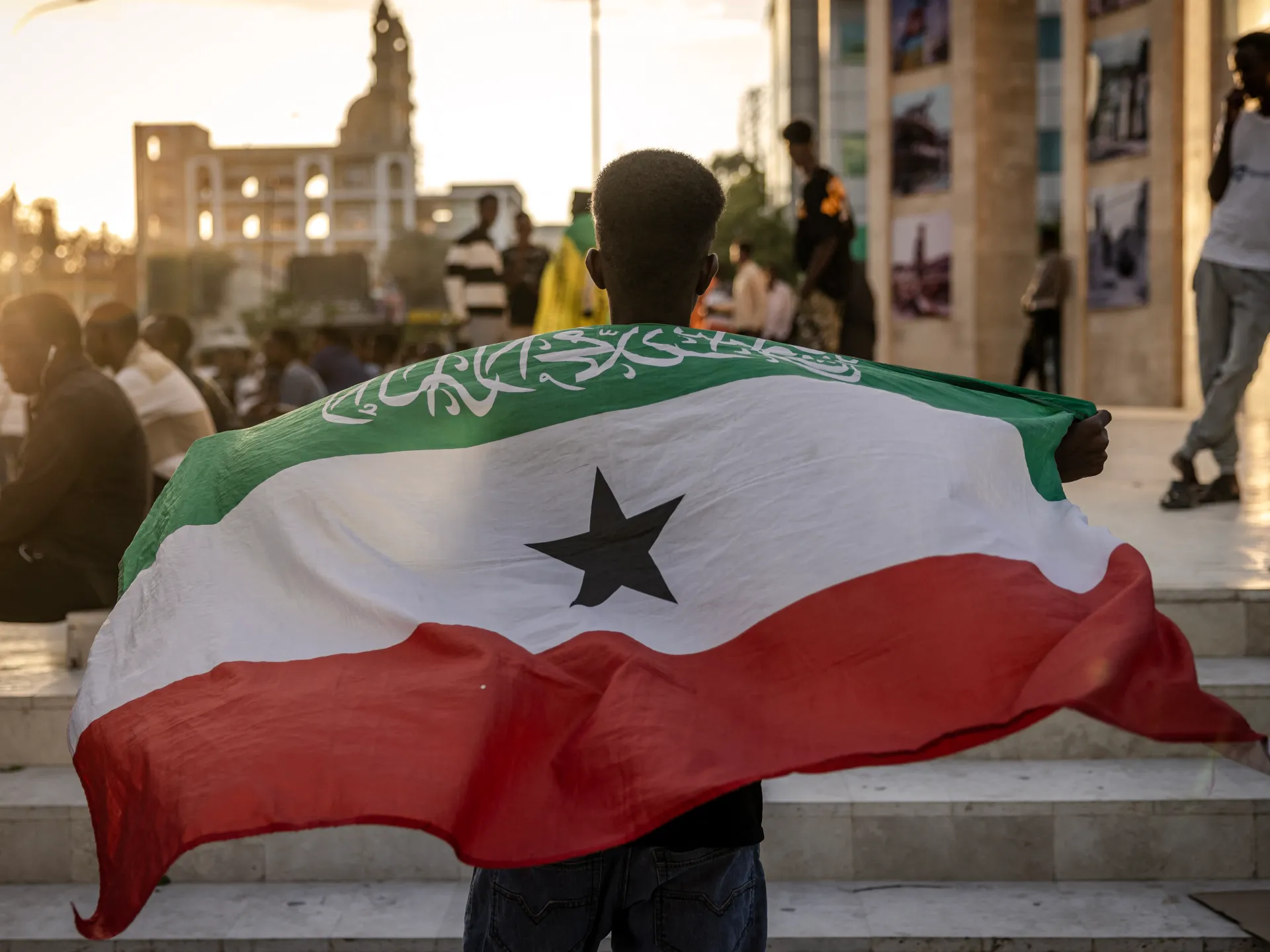
The Arab League, the Gulf Cooperation Council (GCC) and the African Union (AU) have joined numerous countries decrying Israel’s formal recognition of the northern Somali breakaway region of Somaliland as an independent state.

Somaliland, a region in the Horn of Africa, declared independence from Somalia in 1991 and has pushed for international recognition for decades, with President Abdirahman Mohamed Abdullahi making it a top priority since taking office last year.

Recommended Stories

list of 4 itemsend of list

Israel announced on Friday that it viewed Somaliland as an “independent and sovereign state”, becoming the first country to make such a declaration.

The announcement prompted Somalia to call the decision a “deliberate attack” on its sovereignty that would undermine regional peace.

In a statement on Friday, the AU continental bloc rejected Israel’s move and warned that it risked “setting a dangerous precedent with far-reaching implications for peace and stability across the continent”.

The AU Commission chair, Mahmoud Ali Youssouf, said the institution “firmly rejects any initiative or action aimed at recognising Somaliland as an independent entity, recalling that Somaliland remains an integral part of the Federal Republic of Somalia”.

‘Dangerous precedent’

Arab League Secretary-General Ahmed Aboul Gheit called Israel’s action “a clear violation of international law and a flagrant infringement of the principle of the unity and sovereignty of states”.

“Any attempt to impose unilateral recognitions constitutes an unacceptable interference in Somalia’s internal affairs and sets a dangerous precedent that threatens regional and international security and stability,” he warned.

The GCC called the development “a grave violation of the principles of international law and a blatant infringement” of Somalia’s sovereignty.

“This recognition represents a dangerous precedent that will undermine the foundations of stability in the Horn of Africa region and open the door to further tensions and conflicts, contradicting regional and international efforts aimed at strengthening international peace and security in the region,” GCC Secretary-General Jasem Albudaiwi said in a statement.

The European Union said it respected Somalia’s territorial integrity and sovereignty, calling for dialogue between the Somali national government and Somaliland.

The foreign ministers of Somalia, Egypt, Turkiye and Djibouti also condemned Israel’s recognition of Somaliland, saying: “The ministers affirmed their total rejection and condemnation of Israel’s recognition of the Somaliland region, stressing their full support for the unity, sovereignty and territorial integrity of Somalia.”

Egypt’s Ministry of Foreign Affairs made the statement following a phone call between the countries’ top diplomats on Friday.

Somalia demands reversal of recognition

Qatar, Iran, Saudi Arabia, Pakistan and China were among the other countries that condemned Israel’s move.

The Palestinian Authority and Hamas also rejected Israel’s recognition of Somaliland.

On Friday, Somalia demanded Israel reverse its recognition of Somaliland as independent, condemning the move as an act of “aggression that will never be tolerated”.

However, Somaliland leader Abdullahi hailed Israel’s decision as a “historic moment” and said in a post on X that it marked the beginning of a “strategic partnership”.

As world leaders weighed in, Somalia’s al-Qaeda-linked armed group al-Shabab pledged on Saturday to fight any attempt by Israel “to claim or use parts of Somaliland”.

“We will not accept it, and we will fight against it,” the group that has waged a decades-long armed rebellion in the region said in a statement.

United States President Donald Trump also commented on the issue.

Asked by the New York Post newspaper whether Washington planned to also recognise Somaliland, Trump said “no”.

“Does anyone know what Somaliland is, really?” he added on Friday.

Source link

Cooley targeted on ‘three strikes’ cases

As Los Angeles County Dist. Atty. Steve Cooley seeks to become the state’s next attorney general, a dominant issue in the campaign has been his approach to the state’s three-strikes law, with his two Republican opponents seeking to cast him as being soft on crime.

Cooley defends his policy of generally not pursuing life sentences for relatively minor offenses, saying that justice requires that the punishment should fit the crime. His approach has won widespread support during three successful election campaigns for district attorney but has also drawn fire from critics who say his policy fails to adequately protect society from repeat offenders.

One of the clearest examples of the risks involved is the case of Gilton Beltrand Pitre, a convicted rapist who in 2007 went on to kill a homeless teenage girl whose body was dumped in a Silver Lake alley.

Pitre was found guilty of her murder last month and details of his criminal history were laid out in a court record filed by prosecutors last week.

Two years before the murder, Pitre had been eligible for prosecution under the state’s “three-strikes” law when he was charged with a felony for selling $5 worth of marijuana to an undercover police officer. His two strikes included a 1994 residential burglary and a 1996 rape.

Under the law, prosecutors could have sought a sentence of 25 years to life in prison. Instead, Pitre was allowed to plead guilty to a drug crime in exchange for a 32-month prison sentence, court records show.

Alyssa Gomez, 15, was killed four days after Pitre was released from prison. Prosecutors say Pitre visited the Olive Motel on Sunset Boulevard with the teenage runaway, who had been living on the streets since she was 12.

Her lifeless body, wrapped in a bedspread from the motel, was discovered the next morning in an alley behind a restaurant. Prosecutors said Pitre had sex with the girl and then strangled her.

Pitre, 38, was scheduled to be sentenced for the girl’s murder on Thursday but the hearing was postponed until July 14.

Head Deputy Dist. Atty. Michael A. Yglecias defended the office’s handling of the 2005 drug case. He said the 32-month prison sentence was appropriate given the relatively minor nature of that crime.

Yglecias noted that Pitre’s rape conviction was at the time the only violent crime in his background. Prosecutors, he said, consider not just the office’s policy when they decide how to pursue a case but also whether a judge would probably impose a potential life sentence for such a crime.

“The overriding feature in this case was that it was a sale of $5 of marijuana,” he said. “That’s pretty much what dictated the outcome.”

A district attorney’s spokeswoman said Cooley declined to comment on Pitre’s case. But his campaign strategist, Kevin Spillane, said that Los Angeles County is among the state’s top three counties when it comes to convictions for three-strikes cases.

“The reality is that the D.A.’s office is aggressive about pursuing three-strikes cases,” Spillane said. “Tens of thousands of criminals go through the D.A.’s office. It’s always easy to find someone who recommits.”

Mike Reynolds, who helped draft the 1994 three-strikes law after the murder of his 18-year-old daughter, blamed Cooley’s policy for the decision not to seek a longer sentence for Pitre.

Although district attorneys around the state are typically cautious about seeking possible life sentences for eligible third-strikers accused of relatively minor crimes, Reynolds said Cooley’s policy goes too far. He said Pitre’s rape conviction provided compelling evidence that he was a danger to society.

“You’re literally playing Russian roulette politically with every one of these guys that you let out,” said Reynolds, who has endorsed state Sen. Tom Harman of Huntington Beach in the June 8 primary race with Cooley and former law school dean John Eastman.

Under the three-strikes law, a judge can sentence an offender to 25 years to life in prison even for a nonviolent felony, such as petty theft or drug possession, as long as the offender’s criminal history includes at least two violent or serious crimes.

It is unclear from the court file whether the prosecutor who oversaw Pitre’s 2005 plea bargain realized he was eligible for a three-strikes sentence. Deputy Dist. Atty. Marlene Sanchez did not return calls seeking comment.

Under Cooley’s policy, prosecutors can seek permission from supervisors to pursue a third-strike sentence even for a minor felony. Yglecias said that was not done in Pitre’s case and that such requests are usually granted when offenders have lengthier criminal records.

“While the three-strikes law gives us a great tool … the present crime has to have the most weight,” Yglecias said. “If not, then we would be talking about the other extreme. Why is the D.A.’s office seeking 25 years to life against a guy who stole a slice of pizza? … There has to be a balance.”

Pitre’s strikes began with the burglary of his mother’s home, when he stole a television set that he sold for $40 to support a cocaine habit, according to a sentencing memorandum filed by prosecutors last week in the murder case. He was sentenced to two years in prison.

Two years later, in 1996, Pitre attacked his roommate and began strangling her with the cord from some Venetian blinds, according to a memo.

Pitre told the victim he was going to rape and kill her and that he had killed before, the memo said. He took her to a bathtub that he had filled with water and said she could choose whether she wanted to be choked or drowned. Then he raped and sodomized her.

After the attack, Pitre told the victim he planned to kill her so he would not have to go to jail. The victim dissuaded him by feigning a romantic interest and reminding him she had a young daughter, the memo said.

Pitre pleaded no contest to rape and was sentenced to three years in prison.

In the murder case, the district attorney’s office highlighted details about the rape to argue in court papers that Pitre is a “violent, predatory recidivist who falls squarely within the spirit of the three-strikes law.”

jack.leonard@latimes.com

richard.winton@latimes.com

Source link

Nominee Has Some Unexpected Supporters

Samuel A. Alito Jr. was quickly branded a hard-core conservative after President Bush announced his nomination, but a surprising number of liberal-leaning judges and ex-clerks say they support his elevation to the Supreme Court.

Those who have worked alongside him say he was neither an ideologue nor a judge with an agenda, conservative or otherwise. They caution against attaching a label to Alito.

Kate Pringle, a New York lawyer who worked last year on Sen. John F. Kerry’s presidential campaign, describes herself as a left-leaning Democrat and a big fan of Alito’s.

She worked for him as a law clerk in 1994, and said she was troubled by the initial reaction to his nomination. “He was not, in my personal experience, an ideologue. He pays attention to the facts of cases and applies the law in a careful way. He is conservative in that sense; his opinions don’t demonstrate an ideological slant,” she said.

Jeff Wasserstein, a Washington lawyer who clerked for Alito in 1998, echoes her view.

“I am a Democrat who always voted Democratic, except when I vote for a Green candidate — but Judge Alito was not interested in the ideology of his clerks,” he said. “He didn’t decide cases based on ideology, and his record was not extremely conservative.”

As an example, he cited a case in which police in Pennsylvania sent out a bulletin that called for the arrest of a black man in a black sports car. Police stopped such a vehicle and found a gun, but Alito voted to overturn the man’s conviction, saying that that general identification did not amount to probable cause.

“This was a classic case of ‘driving while black,’ ” Wasserstein said, referring to the complaint that black motorists are targeted by police. Though Alito “was a former prosecutor, he was very fair and open-minded in looking at cases and applying the law,” Wasserstein said.

It is not unusual for former law clerks to have fond recollections of the judge they worked for. And it is common for judges to speak respectfully of their colleagues. But for a judge being portrayed by the right and left as a hard-right conservative, Alito’s enthusiastic backing by liberal associates is striking.

Former federal Judge Timothy K. Lewis said that when he joined the U.S. 3rd Circuit Court of Appeals in 1992, he consulted his mentor, Judge A. Leon Higginbotham Jr. The late Higginbotham, a legendary liberal and a scholar of U.S. racial history, was the only other black judge on the Philadelphia-based court at the time.

“As he was going down the roster of colleagues, he got to Sam Alito. I expressed some concern about [him] being so conservative. He said, ‘No, no. Sam Alito is my favorite judge to sit with on this court. He is a wonderful judge and a terrific human being. Sam Alito is my kind of conservative. He is intellectually honest. He doesn’t have an agenda. He is not an ideologue,’ ” Higginbotham said, according to Lewis.

“I really was surprised to hear that, but my experience with him on the 3rd Circuit bore that out,” added Lewis, who had a liberal record during his seven years on the bench. “Alito does not have an agenda, contrary to what the Republican right is saying about him being a ‘home run.’ He is not result-oriented. He is an honest conservative judge who believes in judicial restraint and judicial deference.”

In January 1998, Alito, joined by Judge Lewis, ruled that a Pennsylvania police officer had no probable cause to stop a black man driving a sports car after a rash of robberies in which two black males allegedly fled in a different type of sports car. The driver, Jesse Kithcart, was indicted for being a felon in possession of a gun, which police discovered when they patted him down after his car was stopped. After a trial judge refused to suppress the search, Kithcart pleaded guilty but reserved his right to appeal.

“Armed with information that two black males driving a black sports car were believed to have committed three robberies in the area some relatively short time earlier,” the police officer “could not justifiably arrest any African-American man who happened to drive by in any type of black sports car,” Alito wrote. He said the trial judge had erred in concluding that the police had probable cause that extended to the weapons charge because Kithcart had not been involved in the robberies.

Alito and Lewis sent the case back to the trial judge for new hearings on whether the search was legal. The third judge in the case, Theodore A. McKee, said he would have gone even further.

“Just as this record fails to establish” that the officer “had probable cause to arrest any black male who happened to drive by in a black sports car, it also fails to establish reasonable suspicion to justify stopping any and all such cars that happened to contain a black male,” wrote Judge McKee. He said he would have thrown out the search without further proceedings.

Judge Edward R. Becker, former chief judge of the 3rd Circuit, said he also was surprised to see Alito labeled as a reliable conservative.

“I found him to be a guy who approached every case with an open mind. I never found him to have an agenda,” he said. “I suppose the best example of that is in the area of criminal procedure. He was a former U.S. attorney, but he never came to a case with a bias in favor of the prosecution. If there was an error in the trial, or a flawed search, he would vote to reverse,” Becker said.

Some of his former clerks say they were drawn to Alito because of his reputation as a careful judge who closely followed the text of the law.

Clark Lombardi, now a law professor at the University of Washington, became a clerk for Alito in 1999.

“I grew up in New York City, and I’m a political independent. But I liked Judge Alito because he was a judicial conservative, someone who believed in judicial restraint and was committed to textualism,” he said. “His approach leads to conservative results in some cases and progressive results in other cases. In my opinion, he is a fantastic jurist and a good guy.”

Some of Alito’s former Yale Law School classmates who describe themselves as Democrats say they expect they will not always agree with his rulings if he joins the Supreme Court. But they say he is the best they could have hoped for from among Bush’s potential nominees.

“Sam is very smart, and he is unquestionably conservative,” said Washington lawyer Mark I. Levy, who served in the Justice Department during the Carter and Clinton administrations. “But he is open-minded and fair. And he thinks about cases as a lawyer and a judge. He is really very different from [Justice Antonin] Scalia. If he is going to be like anyone on the court now, it will be John Roberts,” the new chief justice.

Joel Friedman teaches labor and employment law at Tulane University Law School, but is temporarily at the University of Pittsburgh because of Tulane’s shutdown following Hurricane Katrina.

“Ideology aside, I think he is a terrific guy, a terrific choice,” said Friedman, a Yale classmate of Alito’s. “He is not Harriet Miers; he has unimpeachable credentials. He may disagree with me on many legal issues — I am a Democrat; I didn’t vote for Bush. I would not prefer any of the people Bush has appointed up until now.

“The question is, is this guy [Alito] going to be motivated by the end and find a means to get to the end, or is he going to reach an end through thoughtful analysis of all relevant factors? In my judgment, Sam will be the latter.”

*

Savage reported from Washington and Weinstein from Los Angeles.

Source link

Saudi coalition will counter Yemen separatists undermining de-escalation | Conflict News

Saudi defence minister urges Yemen’s STC to withdraw “peacefully” from seized provinces, Hadramout and al-Mahra.

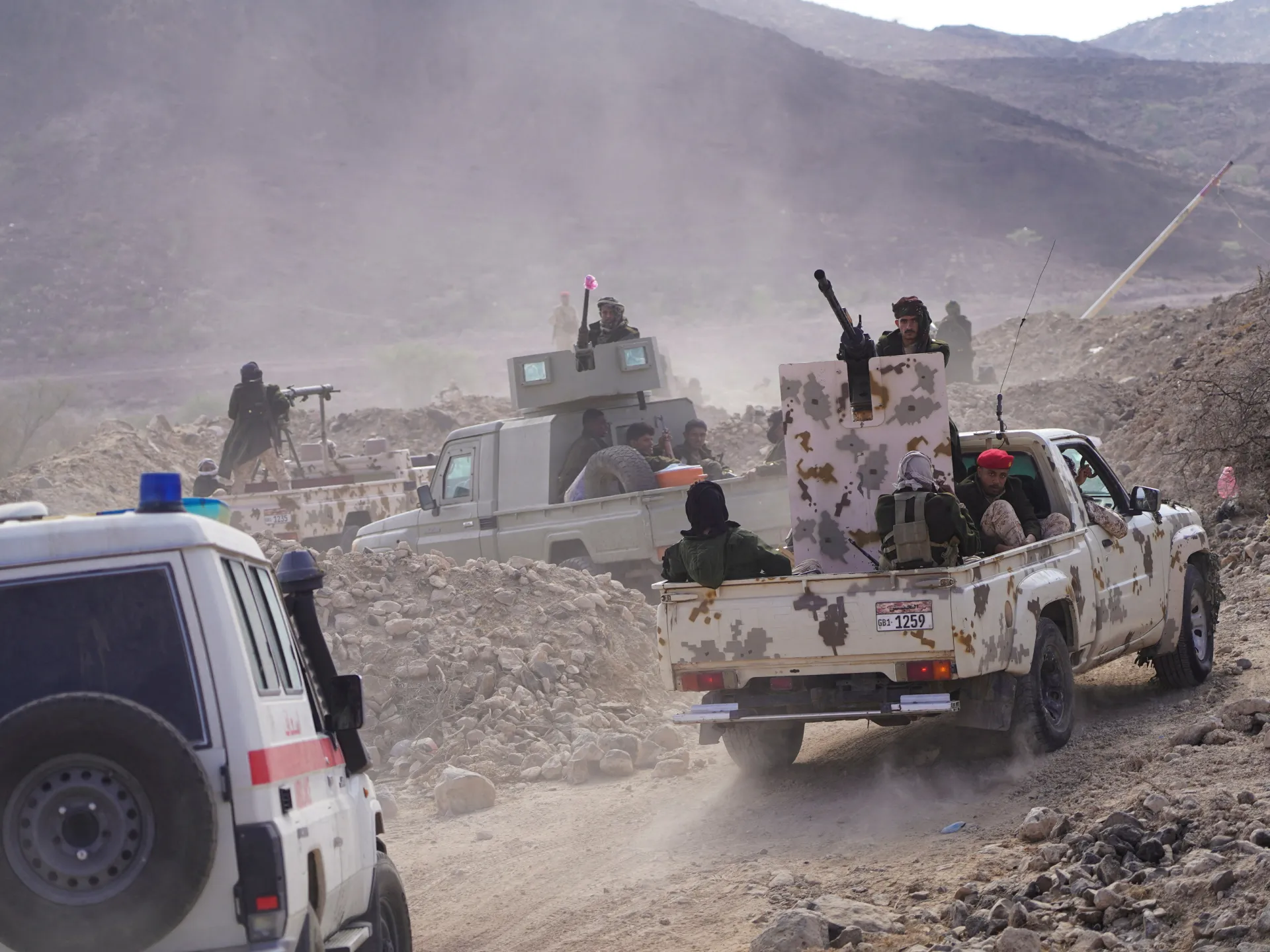
The Saudi-led coalition in Yemen says it will respond to any separatist military movements that undermine de-escalation efforts in the southern region, as Riyadh doubles down on calls for the group to “peacefully” withdraw from recently seized eastern provinces.

Saudi Arabia’s Defence Minister Khalid bin Salman said on X on Saturday that “it’s time” for troops from the separatist Southern Transitional Council (STC) to “let reason prevail by withdrawing from the two provinces and doing so peacefully”.

Recommended Stories

list of 4 itemsend of list

Brigadier General Turki al-Maliki, the spokesman for the Saudi-led coalition, said “any military movements that violate these [de-escalation] efforts will be dealt with directly and immediately in order to protect civilian lives and ensure the success of restoring calm,” according to the Saudi Press Agency.

Al-Maliki also accused the STC separatists of “serious and horrific human rights violations against civilians”, without providing evidence.

The statements came a day after the STC accused Saudi Arabia of launching air strikes on separatist positions in Yemen’s Hadramout province, and after Washington called for restraint in the rapidly escalating conflict.

Earlier this month, forces aligned to the STC took over large chunks from the Saudi-backed government in the provinces of Hadramout and al-Mahra. The STC and the government have been allies for years in the fight against the Iran-allied Houthi rebels.

Abdullah al-Alimi, a member of the Yemeni Presidential Leadership Council, the governing body of the internationally recognised government, welcomed the Saudi defence minister’s remarks, considering them to “clearly reflect the kingdom’s steadfast stance and sincere concern for Yemen’s security and stability”, he said on X.

Rashad al-Alimi, the head of the Presidential Leadership Council, said after an emergency meeting late on Friday that STC movements posed “serious violations against civilians”.

The STC, which has previously received military and financial backing from the United Arab Emirates (UAE), is seeking to revive the formerly independent state of South Yemen. The group warned on Friday that they were undeterred after strikes it blamed on Saudi Arabia hit their positions.

Diplomacy, de-escalation?

In Washington, US Secretary of State Marco Rubio said: “We urge restraint and continued diplomacy, with a view to reaching a lasting solution.”

Azerbaijan, meanwhile, said it welcomed efforts led by both Saudi Arabia and the UAE to de-escalate ongoing tensions in Yemen.

Following Friday’s raids, Yemen’s government urged the Saudi-led coalition to support its forces in Hadramout, after separatists seized most of the country’s largest province.

The government asked the coalition to “take all necessary military measures to protect innocent Yemeni civilians in Hadramout province and support the armed forces”, the official Yemeni news agency said.

A Yemeni military official said on Friday that about 15,000 Saudi-backed fighters were amassed near the Saudi border but had not been given orders to advance on separatist-held territory. The areas where they were deployed are at the edges of territory seized in recent weeks by the STC.

Separatist advances have added pressure on ties between Saudi Arabia and the UAE, close allies who support rival groups within Yemen’s government.

On Friday, the UAE welcomed Saudi efforts to support security in Yemen, as the two Gulf allies sought to present a united front.

Yemen’s government is a patchwork of groups that includes the separatists, and is held together by shared opposition to the Houthis.

The Houthis pushed the government out of Yemen’s capital, Sanaa, in 2014, and secured control over most of the north.

Source link

Bond Issues – Los Angeles Times

I have been reading in The Times for over a year that California’s economy is doing great and that we have a state budget surplus. Isn’t this surplus in cash? Then why is the voter being asked to approve bonds for schools, libraries, parks and clean water?

I’ve also been reading that one should apply any extra cash to pay down high-interest debts and that, to ensure financial security, one should be careful about spending and to try to save a little for the future. Does this only apply to individuals and not to governments?

KATHRYN FONG ROUSH

Granada Hills

*

Not much is said about Prop. 16, the veterans bond. If passed, bonds will be sold to pay for retirement homes for American veterans. I will be voting yes on Prop. 16, and I urge you to do the same. These veterans served our country with honor. They were ready to sacrifice their lives for us, and I’m sure we can sacrifice a few bucks for them now, when they need our help.

AMUL PANDYA

Moorpark

Source link

As the state’s new top lawyer, Xavier Becerra says he will defend California’s policies against attacks by Trump

Sworn in Tuesday as California’s attorney general, Xavier Becerra said he will team up with his counterparts in other states to form a united front to defend state policies against any challenge from the administration of President Trump.

The Los Angeles Democrat, who resigned Tuesday from Congress to become California’s top lawyer, was appointed by Gov. Jerry Brown to counter Trump proposals that are expected to include mass deportations, a roll-back of environmental laws and the dismantling of the national healthcare system that Californians have come to rely on.

“I don’t think California is looking to pick a fight, but we are ready for one,” Becerra told reporters Tuesday at his first news conference as attorney general.

One of Becerra’s first actions will be to arrange meetings with like-minded attorneys general in other states to “start charting a path together as a team on how we deal with representing our people.”

Becerra is supported by Democratic lawmakers as “the tip of the spear” for California in a coming legal battle with the federal government. Some observers see the state becoming the leading antagonist of the Trump administration in much the same way Republican elected officials in Texas were a leading counterforce to the administration of former President Obama.

At the same time, Becerra has been counseled by former top officials of the state attorney general’s office to avoid suing the federal government “early and often” because it could result in legal precedents that they say might hurt California for decades.

“Becerra will need to box, not brawl,” former state attorney general’s office advisors Michael Troncoso and Debbie Mesloh wrote in a recent op-ed piece published by The Times.

Becerra, 58, is the state’s first Latino attorney general and supports California policies that provide immigrants in the country illegally with driver’s licenses, college financial aid and legal services to appeal deportations.

He weighed in quickly Tuesday with concerns about a Trump administration proposal to deport criminals in the country illegally who could pose a threat to the community. While committed to removing dangerous people from California streets, Becerra worried that any eventual deportation orders may be too broad, unfairly catching in the net those with minor offenses who are otherwise productive members of society.

“Is someone who has a broken tail light a criminal?” he asked. “I hope that’s not the definition that the administration in Washington, D.C., will use.”

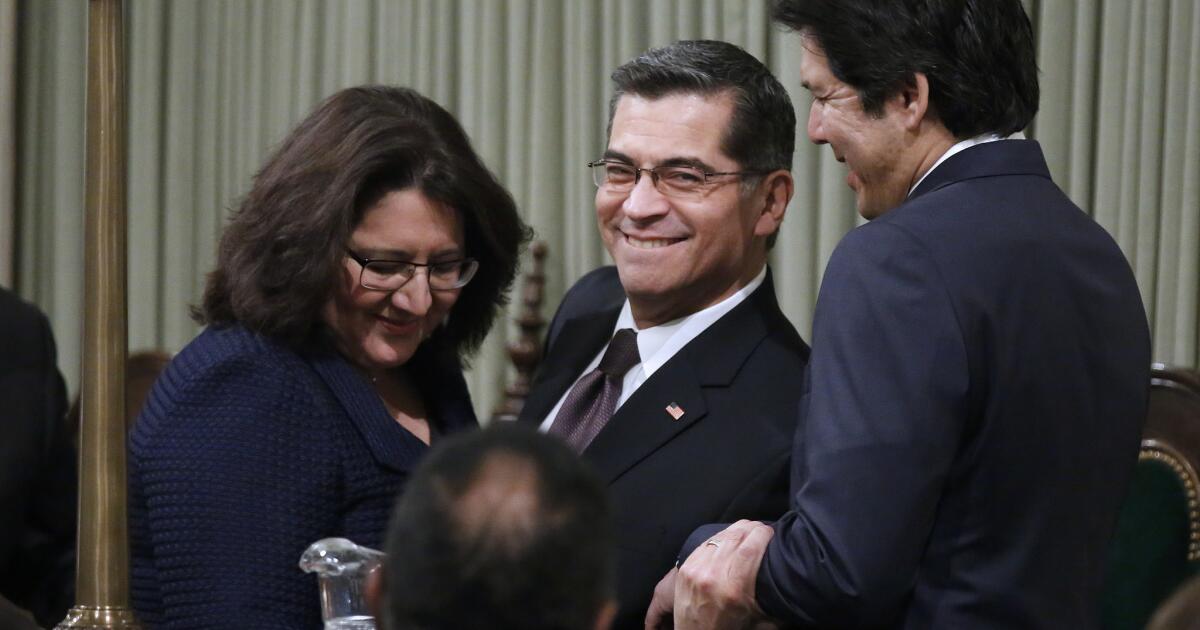
Becerra was given the oath of office at the Capitol by Brown, who said that he “will be a champion for all Californians.” The ceremony was held before Brown delivered his annual State of the State address, and a day after Becerra received final confirmation by the state Senate.

Becerra was accompanied at the ceremony by his wife, physician Carolina Reyes, two of his three daughters, and his parents, both immigrants from Mexico.

Brown noted his appointee’s background during his speech.

“Like so many others, he is the son of immigrants who saw California as a place where, through grit and determination, they could realize their dreams,” Brown said.

Arturo Vargas, executive director of the National Assn. of Latino Elected and Appointed Officials, congratulated Becerra for making history as the first Latino in the post, and predicted he “will set the gold standard for defending the values of the Golden State and fighting for the rights of Latinos and all Californians.”

Asked what it means to have a Latino become attorney general, Becerra said “It’s about time.”

Updates from Sacramento »

Brown appointed Becerra to fill a vacancy created when former state Atty. Gen. Kamala Harris won election to a seat in the U.S. Senate.

Becerra, who did not attend the Trump inauguration, said he would take direction from Brown’s speech Tuesday.

“You heard the governor,” Becerra said later to reporters. “He laid out a game plan that’s forward leaning. It’s clear that we’re going to move forward and we’re not stopping.”

The new attorney general said he planned to meet with staff at the state Department of Justice on Tuesday. He said he also looks forward to working together with former U.S. Atty. Gen. Eric Holder, whose law firm was hired by the California Legislature to provide advice in dealing with potential threats from the federal government over conflicting policies.

“The more we prove that we are ready to take on any battle, the better off we will be,” Becerra said.

Becerra met with some county sheriffs on Monday, but plans to meet with more of them next week to talk about law enforcement issues facing the state. His first meetings with residents, civic leaders and others in coming weeks will be in the state’s Central Valley, he said.

“Some people think that California revolves around Los Angeles, San Francisco, sometimes Sacramento. There are a whole bunch of phenomenal Californians who often feel neglected,” Becerra said of people who live in the central part of the state.

The initial focus on local law enforcement in the Central Valley was welcomed by Kern County Sheriff Donny Youngblood, president of the California State Sheriffs’ Assn.

“He wants to start with law enforcement in the San Joaquin Valley, and I think that’s a really positive step,” Youngblood said. “I’m impressed with his credentials. I’m impressed with his background, and I think he’s going to be a good attorney general.”

Becerra will fill out the last two years of Harris’ term before the next election. He said he plans to run to keep the post in the 2018 election.

“I will officially open an account and do everything it takes to be a candidate for this office,” he said. “I hope that I can prove to the people of this state that I will be able to earn their support to be reelected.”

After 12 terms in Congress, Becerra’s appointment represents a homecoming, he told reporters.

“It’s nice to be here in Sacramento, where I grew up,” he said. “It’s nice to be in California. It’s nice not to have to do red-eye flights. It’s great to be home.”

patrick.mcgreevy@latimes.com

Twitter: @mcgreevy99

ALSO

Assembly panel recommends Becerra for state attorney general after he promises to protect California against ‘federal intrusion’

Xavier Becerra is officially California’s new attorney general. Here are all the people running to replace him in Congress

Updates from Sacramento


Source link

Investigation after jet carrying Libyan officers crashes in Turkiye | Transport News

Istanbul, Turkiye – Turkish authorities and Libyan officials are conducting an investigation into the crash of a private jet that killed Libya’s army chief, Mohammed Ali Ahmed al-Haddad, and seven other people near Ankara.

The probe, coordinated by the Ankara Chief Public Prosecutor’s Office, is focusing on technical evidence, flight recordings, crew activity and aircraft maintenance, officials said. The French civil aviation investigations agency, BEA, has announced that it will participate in the probe.

Recommended Stories

list of 3 itemsend of list

General al-Haddad had been received in Ankara on Tuesday for talks with his Turkish counterpart, Selcuk Bayraktaroglu, and Defence Minister Yasar Guler.

According to officials, the French-made Dassault Falcon 50 took off from Ankara Esenboga Airport at 2:17pm on Tuesday, heading back to Libya, reported an electrical malfunction 16 minutes later and requested an emergency return.

Radar contact was lost shortly after at 2:41 pm (17:41 GMT) while the aircraft was descending towards the runway.

Officials said there was only a two-minute window between the emergency alarm and the crash.

The probe’s many factors

The forensic examination of the bodies of General al-Haddad and his military companions was completed early on Saturday and they have been repatriated to Libya after a ceremony in their honour at an airbase outside Ankara.

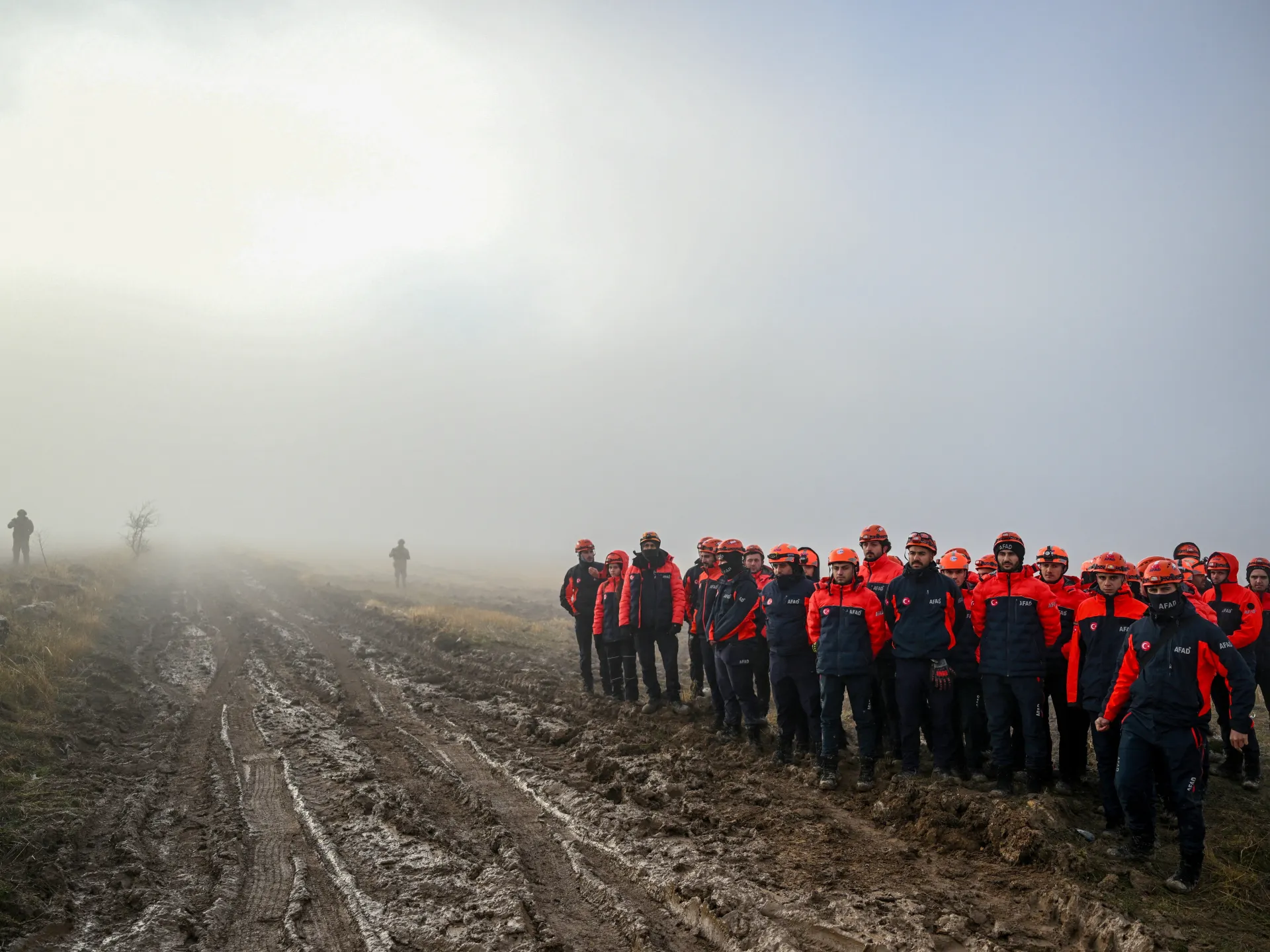
The site of Tuesday’s crash – near Kesikkavak village in Haymana district, roughly 70km (43 miles) south of Ankara – has been sealed off by Turkish security forces. All wreckage, including the cockpit voice recorder and flight data recorder, or “black boxes”, has been secured and transported for analysis, according to authorities.

As part of the prosecutor-led investigation, specialists are examining air traffic control recordings, radar data and airport security camera footage.

Authorities have also requested communication logs between the pilots and the control tower and are reviewing the crew’s rest periods, medical history and records of meals or medication taken before the flight.

Maintenance logs and documentation related to the aircraft’s most recent checks are also under scrutiny to identify any possible technical lapses.

Fuel samples have been taken from both the wreckage and airport tanks to rule out contamination or incorrect fuel use, while local weather data from the time of the crash has been requested.

If evidence points to a structural failure or design flaw, investigators said, the inquiry could be expanded to include manufacturers and maintenance contractors.

International rules and reporting timeline

Gursel Tokmakoglu, former head of the Turkish air force’s intelligence agency, said the crash should be viewed as an international case, given the number of actors involved.

“The Libyan government chartered an aircraft from a foreign country. The aircraft was manufactured in another country. The pilots were from elsewhere. The passengers were Libyan, and the crash happened in Turkiye,” he said.

“If you also consider insurance companies and international aviation bodies, this is clearly a multinational incident.”

Earlier, Turkish Transport Minister Abdulkadir Uraloglu had announced that the black boxes may be sent to another country for further analysis, raising some questions about why analysis could not be done in either Turkiye or Libya.

Tokmakoglu said Turkiye could either examine the black boxes domestically or send them abroad for further analysis.

“Transferring the recorders can help ensure greater transparency and a clearer understanding of what happened, especially in a case involving so many international stakeholders,” he said.

Tokmakoglu noted that according to preliminary findings, the aircraft transmitted the 7700 emergency “squawk” code, which indicates an emergency that requires immediate attention, and the crew reported an electrical malfunction.

However, he added, it would be premature to assume that the electrical malfunction was the cause of the aircraft’s crash.

“In aviation, an electrical failure can trigger other problems,” he said, likening such a situation to “being admitted to intensive care for heart failure but dying later from a lung infection”.

Aviation industry analyst Guntay Simsek told Al Jazeera, citing his own sources, that there are no indications so far that the crash was caused by an external factor such as an explosion, adding that the technical investigation remains ongoing.

The probe starting immediately is within general best practices after a crash, aviation industry analyst Guntay Simsek said, pointing to ICAO regulations that govern aircraft accident investigations, which require a preliminary report within 30 days and a final report within 12 months.

Source link

After a year of insults, raids, arrests and exile, a celebration of the California immigrant

What comes next is a mystery, but I’d like to share a note of appreciation as 2025 fades into history.

If you came to Greater Los Angeles from Mexico, by way of Calexico, Feliz Navidad.

If you once lived in Syria, and settled in Hesperia, welcome.

If you were born in what once was Bombay, but raised a family in L.A., happy new year.

I’m spreading a bit of holiday cheer because for immigrants, on the whole, this has been a horrible year.

Under federal orders in 2025, Los Angeles and other cities have been invaded and workplaces raided.

Immigrants have been chased, protesters maced.

Livelihoods have been aborted, loved ones deported.

With all the put-downs and name-calling by the man at the top, you’d never guess his mother was an immigrant and his three wives have included two immigrants.

President Trump referred to Somalis as garbage, and he wondered why the U.S. can’t bring in more people from Scandinavia and fewer from “filthy, dirty and disgusting” countries.

Not to be outdone, Homeland Security chief Kristi Noem proposed a travel ban on countries that are “flooding our nation with killers, leeches and entitlement junkies.”

The president’s shtick is to rail mostly against those who are in the country without legal standing and particularly those with criminal records. But his tone and language don’t always make such distinctions.

The point is to divide, lay blame and raise suspicion, which is why legal residents — including Pasadena Mayor Victor Gordo — have told me they carry their passports at all times.

In fact, thousands of people with legal status have been booted out of the country, and millions more are at risk of the same fate.

In a more evolved political culture, it would be simpler to stipulate that there are costs and benefits to immigration, that it’s human nature to flee hardship in pursuit of better opportunities wherever they might be, and that it’s possible to enact laws that serve the needs of immigrants and the industries that rely on them.

But 2025 was the year in which the nation was led in another direction, and it was the year in which it became ever more comforting and even liberating to call California home.

The state is a deeply flawed enterprise, with its staggering gaps in wealth and income, its homelessness catastrophe, housing affordability crisis and racial divides. And California is not politically monolithic, no matter how blue. It’s got millions of Trump supporters, many of whom applauded the roundups.

But there’s an understanding, even in largely conservative regions, that immigrants with papers and without are a crucial part of the muscle and brainpower that help drive the world’s fourth-largest economy.

That’s why some of the state’s Republican lawmakers asked Trump to back off when he first sent masked posses on roundups, stifling the construction, agriculture and hospitality sectors of the economy.

When the raids began, I called a gardener I had written about years ago after he was shot in the chest during a robbery attempt. He had insisted on leaving the hospital emergency room and going back to work immediately, with the bullet still embedded in his chest. A client had hired him to complete a landscaping job by Christmas, as a present to his wife, and the gardener was determined to deliver.

When I checked in with the gardener in June, he told me he was lying low because even though he has a work permit, he didn’t feel safe because Trump had vowed to end temporary protected status for some immigrants.

“People look Latino, and they get arrested,” he told me.

He said his daughter, whom I’d met two decades ago when I delivered $2,000 donated to the family by readers, was going to demonstrate in his name. I met up with her at the “No Kings” rally in El Segundo, where she told me why she wanted to protest:

“To show my face for those who can’t speak and to say we’re not all criminals, we’re all sticking together, we have each other’s backs,” she said.

Mass deportations would rip a $275-million hole in the state’s economy, critically affecting agriculture and healthcare among other industries, according to a report from UC Merced and the Bay Area Council Economic Institute.

“Deportations tend to raise unemployment among U.S.-born and documented workers through reduced consumption and disruptions in complementary occupations,” says a UCLA Anderson report.

Californians understand these realities because they’re not hypothetical or theoretical — they’re a part of daily life and commerce. Nearly three-quarters of the state’s residents believe that immigrants benefit California “because of their hard work and job skills,” says the Public Policy Institute of California.

I’m a California native whose grandparents were from Spain and Italy, but the state has changed dramatically in my lifetime, and I don’t think I ever really saw it clearly or understood it until I was asked in 2009 to address the freshman convocation at Cal State Northridge. The demographics were similar to today’s — more than half Latino, 1 in 5 white, 10% Asian and 5% Black. And roughly two-thirds were first-generation college students.

I looked out on thousands of young people about to find their way and make their mark, and the students were flanked by a sprinkling of proud parents and grandparents, many of whose stories of sacrifice and yearning began in other countries.

That is part of the lifeblood of the state’s culture, cuisine, commerce and sense of possibility, and those students are now our teachers, nurses, physicians, engineers, entrepreneurs and tech whizzes.

If you left Taipei and settled in Monterey, said goodbye to Dubai and packed up for Ojai, traded Havana for Fontana or Morelia for Visalia, thank you.

And happy new year.

steve.lopez@latimes.com

Source link

Key Bolsonaro ally arrested in Paraguay while trying to flee to El Salvador | Jair Bolsonaro News

Ex-Brazilian police chief caught using fake Paraguay passport in attempt to board flight to Panama, sent back to Brazil.

A Brazilian former police chief, who fled the country after he was convicted as an accomplice in the attempted coup by Brazil’s far-right ex-President Jair Bolsonaro, has been arrested in Paraguay, according to the country’s immigration agency.

Silvinei Vasques was arrested on Friday at the Silvio Pettirossi International Airport in Paraguay’s capital Asuncion, the Paraguayan National Migration Directorate (DNM) said in a statement posted on its website.

Recommended Stories

list of 3 itemsend of list

The agency said Vasques was arrested for “identity theft” after “attempting to evade immigration controls by impersonating a Paraguayan citizen”.

Vasques was arrested while attempting to board a flight to Panama, declaring El Salvador as his final destination, the DNM statement said.

The wanted police chief had “clandestinely” entered Paraguay while “evading justice in his home country”, DNM added.

An image published on X by Paraguayan immigration authorities showed Vasques’s arrest and identification.

A separate video clip posted on the same account showed Vasques being turned over to Brazilian federal police at the Friendship Bridge border crossing that connects Paraguay’s Ciudad del Este and Brazil’s Foz do Iguacu.

Translation: The National Directorate of Migration (DNM) expelled Silvinei Vasques from the country. Moments ago, the DNM expelled Silvinei Vasques (50) from the country, subsequently handing him over to Brazilian Federal Police authorities at the Friendship Bridge border crossing.

Vasques, the former chief of Brazil’s highway police, was accused of deploying officers to prevent voters in left-leaning areas from casting their ballots in 2022 elections that Bolsonaro lost to left-wing candidate and current President Luiz Inacio Lula da Silva.

He was arrested in 2023 and placed under supervision with an electronic ankle monitor pending trial. Earlier this month, he was sentenced to more than 24 years in prison to be served under house arrest. He fled Brazil shortly after.

Brazilian media reported that Vasques broke his ankle monitor and drove across the border to Paraguay.

Brazil Supreme Court Justice Alexandre de Moraes ordered the fugitive’s preventive detention as a precautionary measure on  Friday, Reuters news agency reported, citing a court document and information from two people familiar with the matter.

Reached by Reuters, Vasques’s lawyer did not comment on his client’s attempt to flee.

Vasques is not the first official convicted over the 2023 coup attempt who has tried to escape from Brazil. In November, the Supreme Court ordered the arrest of the former intelligence agency director Alexandre Ramagem, who left the country in September and has since been living in the United States.

That same month, Justice Moraes also ordered Bolsonaro be detained after the former president tried to remove his court-ordered ankle monitor using a soldering iron, in what the court saw as an attempt to escape justice.

Bolsonaro, 70, is now serving a 27-year sentence in jail after being found guilty in September of having led the plot to prevent Lula from taking office.

On Thursday, the former president underwent surgery in hospital for a hernia.


Source link

Central African Republic election: Who’s running and what’s at stake? | Elections News

Citizens of the Central African Republic (CAR) will vote on Sunday in highly controversial presidential and legislative elections expected to extend President Faustin-Archange Touadera’s tenure beyond two terms for the first time in the country’s history.

Touadera, who helped put his country on the map when he adopted Bitcoin as one of its legal tenders in 2022, had earlier pushed through a referendum abolishing presidential term limits. That, as well as significant delays that almost upturned the confirmation of two major challengers, has led some opposition groups to boycott the vote, calling it a “sham”.

Recommended Stories

list of 4 itemsend of list

CAR will also hold local elections for the first time in 40 years, after a long period of destabilising political conflict, including an ongoing civil war between the predominantly Muslim Seleka rebel movement and the largely Christian Anti-balaka armed groups, which has led to the displacement of one million people. There are fears that the country’s electoral body is not equipped to handle an election on this scale.

The landlocked nation is sandwiched between several larger neighbours, including Chad to the north and the Democratic Republic of the Congo (DRC) to the south. It has an ethnically and religiously diverse population of about 5.5 million, with French and Sango being the national languages.

Although rich in resources like crude oil, gold and uranium, persistent political instability since independence from France in 1960, and the ongoing civil war (2013-present) have kept CAR one of Africa’s poorest nations. For security, CAR is increasingly reliant on Russian assistance to guard major cities against rebels.

Citizens of CAR are referred to as Central Africans. The country’s largest city and capital is Bangui, named after the Ubangi River, which forms a natural border between CAR and the DRC. The country exports mainly diamonds, timber and gold, but much of the population depends on subsistence agriculture, and economic activity is limited.

toUADERA
Supporters of presidential candidate Faustin-Archange Touadera react during a campaign before Sunday’s second round election against longtime opposition candidate Anicet-Georges Dologuele, in Bangui, Central African Republic, February 12, 2016 [File: Siegfried Modola/Reuters]

Here’s what we know about Sunday’s election:

Who can vote and how does it work?

About 2.3 million Central Africans over the age of 18 are registered to vote for the country’s next president. Of these, 749,000 registrations are new since the previous election in 2020.

They’ll also be voting for national lawmakers, regional and, for the first time in about 40 years, municipal administrators. Average turnout in past years has been about 62 percent, according to the International Foundation for Electoral Systems (IFES). There are about 6,700 polling units across the country.

The National Elections Authority initially planned to hold the municipal government elections at the end of August, but moved the polls to December at the last minute, blaming insufficient funds as well as technical and organisational challenges. The decision has added to concerns among election observers and opposition politicians about how prepared the electoral body is.

Campaigning began on December 13, but opposition groups claim that delays in including Touadera’s biggest challengers in the process have favoured the president’s rallies.

The presidential candidate with an absolute majority is declared the winner, but if there is no outright winner in the first round, a second run-off vote will determine the victor.

Although presidents were previously limited to two, five-year terms, a controversial 2023 referendum introduced a new constitution which removed term limits and increased each term to seven years.

Who is running for president?

The country’s constitutional court approved Touadera’s candidacy alongside prominent opposition leader Anicet-Georges Dologuele, ex-Prime Minister Henri-Marie Dondra, and five others.

However, delays in approving the two major opponents and concerns around the readiness of the electoral body have led an opposition coalition, the Republican Bloc for the Defence of the Constitution (BRDC), to boycott the election. The group has, therefore, not presented a candidate.

Here is what we know about the candidates who are standing:

Faustin-Archange Touadera

Touadera, 68, is a mathematician and former vice chancellor of the University of Bangui. He is running under the ruling United Hearts Movement (MCU).

He served as the country’s prime minister from 2013 to 2015 under President Francois Bozize. He was elected as president in 2016 and again in 2020, although opposition groups contested the vote.

Touadera, who is the favourite to win in these polls, has campaigned on promises of peace, security and new infrastructural development in the country.

After 10 years in office, the president’s legacy is mixed. His administration has been dogged by accusations of suppressing the opposition and rigging elections.

Indeed, Touadera would not be eligible to run had he not forced the 2023 referendum through. He sacked a chief judge of the constitutional court in October 2022, after she ruled that his referendum project was illegal.

Opposition members boycotted the referendum, but that only gave the Touadera camp more “yes” votes. Although a civil society group launched a legal challenge against his candidacy before the polls, the constitutional court threw out the suit.

Touadera
Russian President Vladimir Putin and Central African Republic’s President Faustin-Archange Touadera shake hands as they meet in Moscow, Russia, January 16, 2025 [File: Evgenia Novozhenina/Reuters]

Touadera is credited with spearheading some economic development, compared with his predecessors. New roads and highways have been built where there were previously none, but the World Bank still ranks CAR’s economy as “stagnant”.

Touadera has also been praised for achieving relative stability in the conflict-affected country where armed groups hold swaths of territory, especially in the areas bordering Sudan.

Support from a United Nations peacekeeping force, Rwandan troops and Russian Wagner mercenaries has helped to reduce violence in recent years.

CAR was the first country to invite the Russian mercenary group to the continent in 2018 in a security-for-minerals deal, before other countries, including Mali, Burkina Faso, and Niger, also secured security contracts.

CAR was historically closer to former colonial power France, but Paris suspended its military alliances and reduced aid budgets to the country in 2021 following the Russia cooperation.

At a meeting with Russian President Vladimir Putin in 2023, Touadera praised Russia for saving CAR’s democracy. The two met again in January 2025.

In advance of the elections, Touadera has also signed a series of peace accords with some armed groups active in the country, although there are fears that the agreements will only hold until after the polls.

The president launched Bitcoin as a legal tender in 2022, making CAR the second country to do so after El Salvador. The idea drew scepticism, as less than 10 percent of Central Africans can access the internet, and was ultimately abandoned after a year.

In February 2025, CAR launched the $CAR meme coin, which the government said is an experiment.

This week, Touadera’s government signed a new contract with Elon Musk’s Starlink to expand internet services to rural and remote regions.

Henri-Marie Dondra

The 59-year-old is a career banker and former finance minister. He is running under his Republican Unity party (UNIR), which has positioned itself as a reformist party and is not part of the opposition coalition. He served as prime minister under Touadera between 2021 and 2022 but was fired, likely because of his strong pro-France tendencies at a time when the administration was turning towards Russia, according to reporting by French radio, RFI.

Dondra’s candidacy was not approved until November 14, after Touadera accused him of holding Congolese citizenship, which he denied. The accusations raised fears that he would be barred from the vote. Two of his brothers were reportedly arrested and detained without charge before the vote, Dondra told Human Rights Watch in late November.

Dologuele
A campaign billboard of presidential candidate Anicet-Georges Dologuele, of the Union for Central African Renewal (URCA), stands before the presidential election scheduled for December 28, in Bangui, Central African Republic, December 24, 2025 [Leger Serge Kokpakpa/Reuters]

Anicet-Georges Dologuele

The main opposition leader of the Union for Central African Renewal (URCA) party broke from the boycotting opposition coalition in order to run in these elections. Dologuele’s candidacy has prompted what some analysts say are xenophobic statements from Touadera’s supporters.

The 68-year-old dual citizen French-CAR politician first ran for the top job back in 2015 and was the runner-up in the 2020 presidential race. His third bid has faced challenges over his citizenship status. The 2023 referendum limited candidates to CAR citizenship only, and derisive comments from some in the governing camp have suggested some opposition candidates are not “real Central Africans”.

In September, Dologuele said he had given up his French citizenship; however, in October, a Central African court stripped him of his CAR citizenship, citing a clause in the old constitution disallowing dual citizenship. Dologuele reported the issue as a violation of his human rights to the UN human rights agency. It’s unclear what, if any, action the agency took, but Dologuele’s name on the final candidates list suggests his citizenship was reinstated.

Dologuele served as prime minister in the 1990s, under President Ange-Felix Patasse, before joining the Bank of Central African States and later heading the Development Bank of Central African States.

Although he is seen by some as an experienced hand, others associate him with past government failures. Dologuele is promising stronger democratic institutions and better international alliances.

Other notable candidates

  • Aristide Briand Reboas – leader of the Christian Democratic Party, the 46-year-old was a former intelligence official and the sports minister until 2024. He is running on promises of better amenities, including electricity and water. He previously ran in 2020.
  • Serge Djorie – a former government spokesperson until 2024, the 49-year-old is running under his Collective for Political Change for the new Central African Republic party. The medical doctor and published researcher has campaigned on public health reforms, poverty reduction and more pan-Africanism. Djorie ran in the 2020 elections.
  • Eddy Symphorien Kparekouti – The civil engineer helped draft the new constitution that was controversially adopted in 2023. In his campaigns, the independent candidate has emphasised poverty reduction in order to solve political insecurity and other developmental challenges.

What are the key issues for this election?

Armed groups

Protracted political conflict in CAR has continued for more than a decade, with many Central Africans saying they want a leadership that can bring peace.

Trouble began following a coup in March 2013 by the mainly Muslim Seleka rebel alliance that overthrew President Francois Bozize. In retaliation, Bozize assembled Christian and animist rebel armed groups, known as the Anti-balaka. Both sides attacked civilians and have been accused of war crimes by rights groups. Bozize, who continues to lead a rebel coalition, is now in exile in Guinea-Bissau. His attempted attacks in 2020 were fended off by Touadera’s Russian mercenaries.

However, killings, kidnappings and displacement continue in many rural communities in the country’s northwest, northeast and southeast regions, despite recent peace deals signed with some groups. Russian mercenaries have proven pivotal in securing major areas, but are also accused of human rights violations, such as mass killings, while opposition politicians have criticised the reliance on foreign fighters.

A 17,000-strong UN peacekeeping force, MINUSCA, has been extended until November 2026, although the move faced resistance from the US, which wants CAR to handle its own security going forward. The force has suffered at least three deaths in deadly attacks this year alone. There are also fears about the security of voters in rural areas; about 800 voting units were forced to close in the last elections due to rebel violence.

Poverty

CAR remains one of the poorest nations in the world, with more than 60 percent of the population living in poverty, according to the World Bank.

Most people live in rural areas and survive on subsistence farming in the absence of any state-propelled industry.

Economic growth rate is slow, averaging 1.5 percent yearly. Only 16 percent of citizens have access to electricity, and only 7.5 percent have access to the internet.

Persistent fuel shortages make economic activity more difficult.

The country ranked 191st of 193 countries in the 2022 Human Development Index.

Divisive politics

The country’s turbulent political history and the present landscape of deeply divided political groups have failed to deliver a unified opposition coalition that can challenge Touadera and enshrine a functioning democracy.

Fears around whether Touadera intends to run for life following the 2023 referendum are high, with opposition and rights groups already calling for reforms to the new constitution. There are also fears around vote rigging in the elections in favour of Touadera’s governing party.

Source link

Opposition parties advance impeachment of Taiwan’s president, premier

Taiwan President William Lai Ching-te, pictured, and Premier Cho Jung-tai will undergo impeachment proceedings after Taiwan’s legislature approved an impeachment motion on Friday. File Photo by Ritchie B. Tongo/EPA-EFE

Dec. 26 (UPI) — Taiwan President William Lai Ching-te and Premier Cho Jung-tai face impeachment proceedings filed by opposition party leaders accusing them of constitutional and legislative violations.

Members of Taiwan’s KMT and TPP parties and two independent lawmakers secured enough support on Friday to advance impeachment proceedings to go before Taiwan’s Constitutional Court, Al Jazeera reported.

The impeachment effort is viewed as symbolic because a two-thirds majority is needed to impeach an official holding public office in Taiwan.

“It’s not possible to have a real impeachment,” Yen-tu Su, a constitutional law and democratic theory expert at Taiwan’s Academia Sinica, told Al Jazeera.

“They want to make a record that President Lai would be the first president considered impeached in the history of Taiwan’s democracy,” he said. “It’s a way to register their protest.”

The Legislative Yuan approved an impeachment motion with a 60-51 vote on Friday, but it would take 76 of its 113 seated members to impeach the president and premier.

The conflict arises from Lai’s administration refusing to enact a legislatively approved amendment that would give more public funding for local units of government, according to the South China Morning Post.

The Legislative Yuan is controlled by opposition parties, but Lai’s refusal to enact the law change created conflict, and Cho Jung-tai declined to sign the amendment.

Lai became president in 2024, but Taiwan’s legislature has been divided and mostly deadlocked since.

Source link

Judge blocks deportation of British man Trump accused of ‘censorship’

Dec. 26 (UPI) — A federal judge has blocked the deportation of a British man targeted by President Donald Trump.

Imran Ahmed, founder and CEO of the Center for Countering Digital Hate, was one of five people placed on a visa ban after the government accused him of censorship.

Ahmed filed suit against Secretary of State Marco Rubio and Attorney General Pam Bondi to prevent “the imminent prospect of unconstitutional arrest.”

The suit said the case comes from “the federal government’s latest attempt to abuse the immigration system to punish and punitively detain noncitizens for protected speech and silence viewpoints with which it disagrees.”

Ahmed is a legal permanent resident of the United States, where he lives with his American wife and child. He praised the judge’s decision.

“I will not be bullied away from my life’s work of fighting to keep children safe from social media’s harm and stopping antisemitism online,” Ahmed said.

The speed of the judge’s decision was telling, said his lawyer Roberta Kaplan.

“The federal government can’t deport a green card holder like Imran Ahmed, with a wife and young child who are American, simply because it doesn’t like what he has to say,” the BBC reported she said.

Rubio said in a statement Tuesday that the five had “led organized efforts to coerce American platforms to censor, demonetize and suppress” the views of Americans with whom they disagreed.

“These radical activists and weaponized NGOs have advanced censorship crackdowns by foreign states — in each case targeting American speakers and American companies,” Rubio said. He described the five as “agents of the global censorship-industrial complex.”

The others included in the ban are former European Union technology commissioner Thierry Breton; Anna-Lena von Hodenberg and Josephine Ballon of Berlin-based non-profit HateAid; Clare Melford, co-founder of Global Disinformation Index.

Ahmed told The Guardian that it was another attempt to deflect accountability and transparency.

“This has never been about politics,” he said. “What it has been about is companies that simply do not want to be held accountable and, because of the influence of big money in Washington, are corrupting the system and trying to bend it to their will, and their will is to be unable to be held accountable. There is no other industry that acts with such arrogance, indifference and a lack of humility and sociopathic greed at the expense of people.”

Ahmed said he had not formally received any notification from the government.

“I’m very confident that our first amendment rights will be upheld by the court,” he told The Guardian.

He is expected to be in court Monday, when the protective order will be confirmed.

In 2023, Elon Musk‘s company X sued the CCDH after it reported on a rise in hate speech on the platform since Musk’s takeover. The case was dismissed but X appealed the decision.

Simon Cowell, the judge on the TV series “American Idol” strangles the show’s host Ryan Seacrest during the May 15, 2003 photo op for the 2003 Fox Upfront at New York’s Grand Central Station in New York City. Photo by Ezio Petersen/UPI | License Photo

Source link

Zelenskyy to meet Trump in Florida amid diplomatic push to end war | Russia-Ukraine war News

Ukrainian president highlights ‘significant progress’ in talks, but Moscow says Kyiv is working to ‘torpedo’ deal.

Ukrainian President Volodymyr Zelenskyy is to meet with his United States counterpart, Donald Trump, in Florida on Sunday to discuss territorial disputes that continue to block progress towards ending Russia’s war on Ukraine.

Announcing the meeting on Friday, Zelenskyy said the talks could be decisive as Washington intensifies its efforts to broker an end to Europe’s deadliest conflict since World War II. “A lot can be decided before the New Year,” Zelenskyy said.

Recommended Stories

list of 3 itemsend of list

Territory remains the most contentious issue in the negotiations. Zelenskyy confirmed he would raise the status of eastern Ukraine and the Zaporizhzhia Nuclear Power Plant, which has been under Russian control since the early months of Russia’s invasion.

“As for the sensitive issues, we will discuss both Donbas and the Zaporizhzhia Nuclear Power Plant. We will certainly discuss other issues as well,” he told reporters in a WhatsApp chat.

Moscow has demanded that Kyiv withdraw from parts of the Donetsk region still under Ukrainian control as it pushes for full authority over the wider Donbas area, which includes Donetsk and Luhansk. Ukraine has rejected that demand, instead calling for an immediate halt to hostilities along the existing front lines.

Territorial concessions

In an attempt to bridge the divide, the US has floated the idea of establishing a free economic zone should Ukraine relinquish control of the contested area although details of how such a plan would operate remain unclear.

Zelenskyy reiterated that any territorial concessions would require public approval. He said decisions on land must be made by Ukrainians themselves, potentially through a referendum.

Beyond territory, Zelenskyy said his meeting with Trump would focus on refining draft agreements, including economic arrangements and security guarantees. He said a security pact with Washington was nearly finalised while a 20-point peace framework was close to completion.

Ukraine has sought binding guarantees after previous international commitments failed to prevent Russia’s invasion, which began in February 2022.

Trump has previously voiced impatience with the pace of negotiations, but he has indicated he would engage directly if talks reached a meaningful stage.

Last week, US Secretary of State Marco Rubio said his country is the only mediator that can speak to both sides to secure a peace agreement. At the same time, he downplayed the importance of the conflict for Washington.

“It’s not our war. It’s a war on another continent,” he said.

Zelenskyy said European leaders could join Sunday’s discussions remotely and confirmed he had already briefed Finnish President Alexander Stubb on what he described as “significant progress”.

Despite Zelenskyy’s assertion, Russian Deputy Foreign Minister Sergey Ryabkov accused Ukraine of working to “torpedo” the peace talks, saying a revised version of the US peace plan promoted by Kyiv was “radically different” from an earlier version negotiated with Washington.

“Our ability to make the final push and reach an agreement will depend on our own work and the political will of the other party,” he said during a television interview on Friday.

Ryabkov said any agreement must remain within the parameters set out between Trump and Russian President Vladimir Putin during a summit in August, which Ukraine and European partners have criticised as overly conciliatory towards Russia’s war aims.

On the ground, Moscow has intensified strikes on Ukraine’s energy infrastructure and the southern port city of Odesa while an attack on Kharkiv on Friday killed two people.

Source link

Marco Rubio congratulates Honduran President-elect Nasry Asfura | Elections News

Washington’s top diplomat says he thanked Asfura, who was backed by Trump, for ‘advocacy of US strategic objectives’.

United States Secretary of State Marco Rubio has congratulated Honduran President-elect Nasry Asfura, whom President Donald Trump had endorsed, for his victory in the Central American country’s contentious election.

The Department of State said on Friday that Rubio and Asfura in a phone call discussed collaboration on issues such as trade and security.

Recommended Stories

list of 3 itemsend of list

“Secretary Rubio commended President-Elect Asfura for his advocacy of US strategic objectives, including advancing our bilateral and regional security cooperation, and strengthening economic ties between our two countries,” the State Department said in a statement.

Asfura claimed a narrow victory on Wednesday in the November 30 election marked by Trump’s intervention on his behalf. Election authorities declared Asfura the winner after weeks of counting amid high tensions and allegations of fraud and impropriety from other candidates.

The right-wing Asfura, representing the National Party, edged out Salvador Nasralla of the centre-right Liberal Party with 40.27 percent of the vote to Nasralla’s 39.53 percent.

“Today, with deep gratitude, I accept the honour of being able to work for you. I extend my hand so we can walk together with determination to work tirelessly for Honduras. I will not fail you,” Asfura said in a video statement released on Wednesday night.

Both Nasralla and Rixi Moncada, the candidate for current President Xiomara Castro’s left-leaning LIBRE Party, who came in a distant third, have disputed the results of the election.

Nasralla said on Wednesday that election authorities had “betrayed the Honduran people”. He also took aim at Trump, who said before the election that a victory for anyone but Asfura would put US economic ties with Honduras at risk.

“Mr President, your endorsed candidate in Honduras is complicit in silencing the votes of our citizens,” Nasralla said in a social media post. “If he is truly worthy of your backing, if his hands are clean, if he has nothing to fear, then why doesn’t he allow for every vote to be counted?”

Honduras has experienced several contested elections since a US-backed coup in 2009. Protests over the November election have thus far remained peaceful.

Before the election, Trump also issued a criticised pardon for right-wing former Honduran President Juan Orlando Hernandez, who was convicted of crimes linked to the trafficking of drugs to the US during his time in office.

The pardon came as the US says it is shifting its foreign policy focus to the Americas.

Asfura, the former mayor of Honduras’s capital, Tegucigalpa, is of Palestinian descent. But his National Party is staunchly pro-Israel.

Under Hernandez in 2021, Honduras became only the fourth country to move its embassy in Israel to Jerusalem in breach of international law.

Asfura has also aligned himself with Trump and other right-wing leaders in the Americas, including Argentina’s Javier Milei.

Source link

Milei’s government bill cuts state role in Argentina public education

BUENOS AIRES, Dec. 26 (UPI) — Argentine President Javier Milei’s government is promoting a reform that seeks to redefine the role of the state in public education, curb direct government intervention and give families greater control over their children’s schooling.

A proposed law would legalize homeschooling, expand school choice and grant parents a more active role in school governance, including mechanisms to influence the appointment or removal of principals.

The stated goal is to introduce greater competition among educational institutions to attract students. The initiative has been submitted to Congress, and debate could begin in March.

The reform focuses primarily on basic education, which includes preschool, primary and secondary levels, while also introducing changes to the university financing system.

If approved, it would fully replace the current National Education Law in force since 2006.

“Argentina faces a deep educational crisis, as shown by our students’ results in national and international assessments,” a report by the Ministry of Deregulation and the Secretariat of Education said.

Internationally, PISA tests, which measure skills in math, reading and science, show stagnation or a sustained decline in the performance of Argentine students.

“Compared with other countries in the region, Argentina consistently ranks among the worst performers,” the report said.

Domestically, national assessments show that more than 80% of students in their final year of secondary school fail to reach satisfactory levels in math, while more than 40% have difficulties with reading comprehension.

The official diagnosis also describes the system as overly centralized and bureaucratic, with little room for pedagogical innovation and oversight mechanisms considered weak and lacking transparency.

“The family is the natural and primary agent of education; civil society is the space where it develops through various institutions and projects; and the state has the obligation to guarantee access, continuity and completion of studies at all levels,” the draft law says.

At the secondary level, reform would promote agreements between schools, companies and the productive sector to improve general education and vocational guidance.

Basic education also would be declared an essential service, requiring a minimum level of classes.

The bill recognizes multiple teaching modalities, including in-person, hybrid, community-based, home-based and distance learning, all subject to supervision and evaluation under national and local standards.

Julio Alonso, an academic at the University of Buenos Aires, told UPI the education reform is part of a broader package of changes pushed by the government.

“It is not an isolated measure. It is linked to labor and tax reforms,” he said.

According to Alonso, the central change lies in redefining the role of the state relative to that of families.

“The state takes on a subsidiary role. It guarantees access, but the main decisions fall to parents. The family is formally established as the central actor in the education system,” he said.

Another key point, he said, is the abandonment of a unified national curriculum. Provinces and the country’s capital would assume full responsibility for education, while the federal government would be limited to setting common minimum content.

“The idea of a national education project is left behind. In practice, responsibilities are further delegated to provincial governments,” Alonso said.

He added that the initiative also decentralizes education financing by eliminating the legal spending floor equivalent to 6% of gross domestic product.

“Under this reform, provinces would cover costs with their own resources, while the national government would concentrate spending on direct transfers to families,” he said.

A third pillar of the proposal concerns teachers, with greater family participation in evaluation processes, though not in hiring decisions.

Alonso warned, however, that the reform faces political and social obstacles. The ruling coalition lacks a majority in Congress and depends on support from provincial lawmakers — a weakness recently seen during the budget debate.

On the social front, Alonso anticipates strong resistance, particularly over cuts to the university system, with possible strikes and protests.

Source link

Tajikistan-Taliban border clashes: What’s behind them, why it affects China | Explainer News

Tensions are flaring along the Tajikistan-Afghanistan border in Central Asia with the Tajik government reporting multiple armed incursions this month, straining its fragile relationship with Afghanistan’s Taliban leaders.

More than a dozen people have been killed in attacks by men whom Tajik authorities call “terrorists” and the resulting clashes with Tajik forces, officials in Dushanbe and Beijing said. Victims include Chinese nationals working in remote areas of the mountainous former Soviet republic.

In the latest fighting this week, at least five people were killed in Tajikistan‘s Shamsiddin Shokhin district, including “three terrorists”, officials said.

Tajikistan has long opposed the rise of the Taliban in Afghanistan, a country it shares a largely unsecured 1,340km (830-mile) border with.

Despite cautious diplomatic engagement between the two countries to adjust to new regional realities, analysts said, the frequency of the recent border clashes risks eroding the Taliban’s credibility and raises questions about its capacity to enforce order and security.

Here is all we know about the clashes along the Tajik-Afghan border and why they matter:

taliban
A Taliban flag flies on top of a bridge across the Panj river on the Afghan-Tajik border as seen from Tajikistan’s Darvoz district [File: Amir Isaev/AFP]

What’s happening on the Tajik-Afghan border?

The border runs along the Panj river through the remote, mountainous terrain of southern Tajikistan and northeastern Afghanistan.

On Thursday, Tajikistan’s State Committee for National Security said in a statement that “three members of a terrorist organisation” crossed into Tajik territory on Tuesday. The committee added that the men were located the following morning and exchanged fire with Tajik border guards. Five people, including the three intruders, were killed, it said.

Tajik officials did not name the armed men or specify which group they belonged to. The officials, however, said they seized three M-16 rifles, a Kalashnikov assault rifle, three foreign-made pistols with silencers, 10 hand grenades, a night-vision scope and explosives at the scene.

Dushanbe said this was the third attack originating from Afghanistan’s Badakhshan province in the past month that has resulted in the deaths of its personnel.

These attacks, Tajik officials said on Thursday, “prove that the Taliban government is demonstrating serious and repeated irresponsibility and non-commitment in fulfilling its international obligations and consistent promises to ensure security … and to combat members of terrorist organisations”.

The Tajik statement called on the Taliban to “apologise to the people of Tajikistan and take effective measures to ensure security along the shared border”.

Tajikistan has not suggested what the motive for the attacks may be, but the assaults have appeared to target Chinese companies and nationals working in the area.

china
Workers of Talco Gold, a joint Tajik-Chinese mining firm, speak in front of a poster of Chinese President Xi Jinping and Tajik President Emomali Rahmon at the Saritag antimony mine in western Tajikistan [File: AFP]

How is China involved in all this?

Beijing is Tajikistan’s largest creditor and one of its most influential economic partners with a significant footprint in infrastructure, mining and other border-region projects.

China and Tajikistan also share a 477km (296-mile) border running through the high-altitude Pamir Mountains in eastern Tajikistan, adjacent to China’s Xinjiang region.

Two attacks were launched against Chinese companies and nationals in the last week of November. On November 26, a drone equipped with an explosive device attacked a compound belonging to Shohin SM, a private Chinese gold-mining company, in the remote Khatlon region on the Tajik-Afghan border, killing three Chinese citizens.

In a second attack on November 30, a group of men armed with guns opened fire on workers employed by the state-owned China Road and Bridge Corporation, killing at least two people in Tajikistan’s Darvoz district.

Tajik officials said those attacks had originated from villages in Afghanistan’s Badakhshan province but did not disclose any affiliation or motive behind the attacks.

Chinese nationals have also come under attack in Pakistan’s Balochistan province and along the Afghanistan-Pakistan border.

China’s embassy in Dushanbe advised Chinese companies and personnel to evacuate the border area. Chinese officials demanded “that Tajikistan take all necessary measures to ensure the safety of Chinese enterprises and citizens in Tajikistan”.

Who is carrying out these attacks?

While the attackers have not been identified, analysts and observers believe the attacks carry the hallmarks of the ISIL (ISIS) affiliate in Khorasan Province (ISKP), which, they said, aims to discredit Afghanistan’s Taliban leaders.

“The ISKP has attacked foreigners inside Afghanistan and carried out attacks on foreigners inside Afghanistan as a key pillar of their strategy,” said Ibraheem Bahiss, a Kabul-based analyst at the International Crisis Group think tank.

“The aim is to shatter the Taliban’s image as a security provider with whom the regional governments should engage,” Bahiss told Al Jazeera.

taliban
Taliban members participate in a rally to mark the third anniversary of the Taliban’s seizure of Kabul in the Afghan capital on August 14, 2024. [Sayed Hassib/Reuters]

How has the Taliban reacted to these attacks?

Kabul expressed its “deep sorrow” over the killings of Chinese workers on November 28.

The Taliban blamed the violence on an unnamed armed group which, it said, is “striving to create chaos and instability in the region and to sow distrust among countries”, and it assured Tajikistan of its full cooperation.

After this week’s clashes, Sirajuddin Haqqani, the Taliban’s interior minister, said Kabul remains committed to the 2020 Doha Agreement, its deal with the United States for a phased foreign troop withdrawal from Afghanistan in exchange for Taliban commitments to prevent Afghanistan from being used as a base for attacking other countries.

Addressing a police cadet graduation ceremony at the National Police Academy in Kabul on Thursday, Haqqani said Afghanistan posed no threat to other countries and the door to dialogue remains open.

“We want to address problems, distrust or misunderstandings through dialogue. We have passed the test of confrontation. We may be weak in resources, but our faith and will are strong,” he said, adding that security had improved to the extent that Taliban officials now travel across the country without weapons.

The Taliban insists that no “terrorist groups” are operating from Afghanistan. However, in a recent report, the United Nations sanctions-monitoring committee cited the presence of multiple armed groups, including ISKP, Tehreek-e-Taliban Pakistan, al-Qaeda, the Turkistan Islamic Party, Jamaat Ansarullah and Ittehad-ul-Mujahideen Pakistan.

Jamaat Ansarullah is a Tajik group linked to al-Qaeda-aligned networks and active primarily in northern Afghanistan near the Tajik border.

taliban
Afghans travel along a border road as seen from Tajikistan’s Darvoz district [File: Amir Isaev/AFP]

How are relations between Tajikistan and the Taliban?

For decades, the relationship between Tajikistan and the Taliban has been defined by deep ideological hostility and ethnic mistrust with Dushanbe one of the group’s fiercest critics in Central Asia.

In the 1990s, Tajikistan aligned with the anti-Taliban Northern Alliance, led by Afghan military commander and former Defence Minister Ahmad Shah Massoud.

After the Taliban’s return to power in Afghanistan in August 2021, Tajikistan stood as the lone holdout among its neighbours in refusing to officially recognise the new government.

However, pragmatic diplomatic engagement quietly began about 2023, driven by economic necessity and shared security fears over the presence of ISKP. Stepping up the restoration of relations, a high-level Tajik delegation visited Kabul in November, the first such visit since the Taliban’s return to power.

But the two governments continue to trade accusations that the other is harbouring “terrorists”, the major thorn remaining in their bilateral relationship, and that drug smuggling is occurring across their border.

The Tajik-Afghan border has long been a major trafficking route for Afghan heroin and methamphetamine into Central Asia and onwards to Russia and Europe, exploiting the area’s rugged terrain and weak policing.

“The rising frequency [of the clashes] is new and interesting and raises a point: whether we might be seeing a new threat emerging,” Bahiss said.

Badakshan province, from which Tajik authorities said the attacks on Chinese nationals originate, presents a complex security situation for the Taliban as it has struggled to stem the threat from armed opposition groups, Bahiss added.

This security issue has been further complicated by the Taliban’s crackdown on poppy cultivation in the province, he said. The Taliban has faced resistance to this policy from farmers in the north. This is largely because the terrain of Badakshan means poppies are the only viable cash crop.

taliban
Afghanistan’s Taliban Foreign Minister Amir Khan Muttaqi called his Tajik counterpart early this month to express regret about the attacks on Chinese nationals and say his government was prepared to boost cooperation between their border forces [Anushree Fadnavis/Reuters]

How is the Taliban faring with other neighbours?

Since the Taliban retook control of Afghanistan in 2021, some of its neighbours have maintained a pragmatic transactional relationship while others have not.

Relations with Pakistan, previously its patron, have particularly deteriorated. Islamabad accuses Kabul of harbouring fighters of Tehrik-i-Taliban Pakistan, also known as the Pakistan Taliban. Tensions over this issue boiled over in November when Pakistan launched air strikes in Kabul, Khost and other provinces, prompting retaliatory Taliban attacks on border posts.

Dozens of people were killed before a ceasefire was brokered by Qatar and Turkiye. However, both sides have engaged in fighting since, blaming each other for breaking the fragile truce.

The Taliban denies Islamabad’s allegations and has blamed Pakistan for its “own security failures”.

Meanwhile, the Taliban is now invested in developing a new relationship with Pakistan’s archrival, India, with delegations visiting Indian cities for trade and security discussions. New Delhi was earlier part of the anti-Taliban alliance. However, that approach has changed with the deteriorating ties between Pakistan and the Taliban.

Source link

Israel becomes first country to recognise Somaliland | Politics News

BREAKING,

Breakaway region achieves diplomatic breakthrough after more than 30 years without international recognition

Israel has become the first nation in the world to formally recognise Somaliland, ending the breakaway region’s three-decade quest for international legitimacy.

Foreign Minister Gideon Saar announced on Friday that Israel and the Republic of Somaliland had signed an agreement establishing full diplomatic relations, including the appointment of ambassadors and the opening of embassies in both countries.

The historic accord marks a significant breakthrough for Somaliland, which declared independence from Somalia in 1991 but has failed to gain recognition from any United Nations member state.

Somaliland controls the northwestern of the former British Protectorate on what is today northern Somalia.

Israeli Prime Minister Benjamin Netanyahu described the new friendship as “seminal and historic” in a video call with Somaliland President Abdirahman Mohamed Abdullahi, inviting him to visit Israel and calling it a “great opportunity to expand their partnership.”

Saar said the agreement followed a year of extensive dialogue between the two governments and was based on a joint decision by Netanyahu and Abdullahi.

“We will work together to promote the relations between our countries and nations, regional stability and economic prosperity,” Saar wrote on social media, adding that he had instructed his ministry to immediately institutionalise ties across a wide range of fields.

More to come…

Source link

What is remigration, the far-right fringe idea going mainstream? | Migration News

Last week, Republican Ohio gubernatorial hopeful Vivek Ramaswamy challenged other Republicans over their idea that ancestry or heritage is what makes someone truly American.

“The idea that a ‘heritage American’ is more American than another American is un-American at its core,” Ramaswamy, who was born to Indian immigrant parents, said during Turning Point USA’s annual conference.

Remigration — once a fringe far-right notion advocating the deportation of ethnic minorities — is now gaining traction in United States Republican circles as President Donald Trump’s second term enters the final weeks of its first year.

Earlier this year, reports said that the US State Department was considering creating a department of remigration. A few months later, the Department of Homeland Security posted in favour of remigration online.

But it is not just American far-right figures evoking the idea of remigration; European far-right leaders are also joining in.

Here is a closer look at what remigration means and what its origins are.

What is remigration?

Broadly, remigration refers to when an immigrant voluntarily returns to their country of origin.

However, in the context of far-right movements, remigration is a method of ethnic cleansing.

For white ethnonationalists, remigration is a process through which all non-white people are forcibly removed from traditionally white countries.

What are the origins of remigration?

Ideas of remigration trace back to Nazi Germany in the late 1930s. The Nazis attempted to “remigrate” the Jews in Germany to Madagascar.

But the concept got wind through the work of Renaud Camus, a French novelist who devised the Great Replacement conspiracy theory in his 2011 book, Le Grand Remplacement.

His widely debunked white nationalist theory suggests that elites are replacing white Christians in the West with non-white, primarily Muslim, people through mass migration and demographic changes. Camus calls this “genocide by substitution”.

Far-right nationalists in Europe and beyond have borrowed ideas from this theory.

Heidi Beirich, an expert on the American and European far-right movements, told Al Jazeera that the term remigration is “relatively new” in far-right circles.

Beirich said that the concept was popularised by Martin Sellner.

Sellner, 36, is the leader of Austria’s ultranationalist Identitarian Movement, a far‑right group known for anti-immigration activism and promoting ethnonationalist ideology. Ethnonationalists define the nation primarily by shared ethnicity, ancestry, culture and heritage.

“Remigration advocates the forced removal of non-white people from what Sellner and others with his beliefs view as historically white countries, basically Europe, Canada, the US, Australia and New Zealand,” Beirich explained.

Beirich said remigration in essence, is a “policy solution to the white supremacist ‘Great Replacement’ conspiracy theory”.

Do different groups have different ideas?

There are strands of nationalists beyond ethnonationalism.

Civic nationalists, who also called liberal nationalists or constitutional nationalists, define the nation by shared political values, laws and institutions, regardless of ethnicity. They believe that a person belongs to a country if they hold legal citizenship and are committed to the state’s principles.

While civic nationalists are less enthusiastic about remigration than ethnonationalists, to them, remigration means voluntary return migration. This could mean policies or incentives for immigrants to return to their country of origin if they choose, often for economic, family or cultural reasons.

Why is the idea of remigration becoming mainstream?

Beirich said that Sellner has been pushing this idea with far-right parties in Europe for the past two years.

“The astounding thing is not that a xenophobic political party like AfD in Germany would be open to this, but rather that a white supremacist policy position is now being pushed by the US government.”

The AfD is a far-right party called Alternative for Germany, which is designated an “extremist” organisation in the country.

In May 2025, Axios reported, quoting an unnamed State Department official, that the department is planning to create an “Office of Remigration”.

Then, in an X post on October 14, the Department of Homeland Security wrote “remigrate,” adding a link to its mobile application, which allows US immigrants to self-deport.


Where is the remigration movement picking up?

The idea of remigration has been revived by far-right leaders in Europe as well.

This includes Herbert Kickl, the leader of Austria’s far-right anti-immigration Freedom Party (FPO).

“As People’s Chancellor, I will initiate the remigration of all those who trample on our right to hospitality,” Kickl said in the FPO manifesto ahead of the election in September 2024.

While FPO won most seats in the election, other parties — the conservative People’s Party (OVP), the Social Democrats (SPO) and the liberal NEOS — came together to form a ruling coalition under an early 2025 deal which sidelined the FPO.

Across the border in Germany, Alice Weidel, the leader of the AfD, referred to “remigration” while supporting the closure of the country’s borders to new immigrants at a party conference in January.

In May 2025, a conference called the Remigration Summit was held in Italy. It was attended by far-right activists from across Europe. InfoMigrants, a website which covers migration issues in Europe, estimated that 400 right-wing activists attended the summit.

But Beirich said that remigration, if implemented as a policy, would in effect be an “attempt to create all-white countries through ethnic cleansing”.

Source link

Palestine Action: Prison hunger strikes that shaped history | Israel-Palestine conflict News

Four members of the advocacy group Palestine Action have pledged this week to continue their hunger strike amid grave medical warnings and the hospitalisations of their fellow protesters.

The group’s members are being held in five prisons in the United Kingdom over alleged involvement in break-ins at a facility of the UK’s subsidiary of the Israeli defence firm Elbit Systems in Bristol and a Royal Air Force base in Oxfordshire. They are protesting for better conditions in prison, rights to a fair trial, and for the UK to change a July policy listing the movement as a “terror” group.

Recommended Stories

list of 4 itemsend of list

Palestine Action denies charges of “violent disorder” and others against the eight detainees. Relatives and loved ones told Al Jazeera of the members’ deteriorating health amid the hunger strikes, which have led to repeated hospital admissions. Lawyers representing the detainees have revealed plans to sue the government.

The case has brought international attention to the UK’s treatment of groups standing in solidarity with Palestinians amid Israel’s genocidal war in Gaza. Thousands of people have rallied in support of Palestine Action every week.

Hunger strikes have been used throughout history as an extreme, non-violent way of seeking justice. Their effectiveness often lies in the moral weight they place upon those in power.

Historical records trace hunger strikes back to ancient India and Ireland, where people would fast at the doorstep of an offender to publicly shame them. However, they have also proved powerful as political statements in the present day.

Here are some of the most famous hunger strikes in recent world history:

IRA mural
A pigeon flies past a mural supporting the Irish Republican Army in the Ardoyne area of north Belfast, September 9, 2015 [Cathal McNaughton/Reuters]

Irish Republican Movement hunger strikes

Some of the most significant hunger strikes in the 20th century occurred during the Irish revolutionary period, or the Troubles. The first wave was the 1920 Cork hunger strike, during the Irish War of Independence. Some 65 people suspected of being Republicans had been held without proper trial proceedings at the Cork County Gaol.

They began a hunger strike, demanding their release and asking to be treated as political prisoners rather than criminals. They were joined by Terence MacSwiney, the lord mayor of Cork, whose profile brought significant international attention to the independence cause. The British government attempted to break up the movement by transferring the prisoners to other locations, but their fasts continued. At least three prisoners died, including MacSwiney, after 74 days.

Later on, towards the end of the conflict and the signing of the Good Friday Agreement, imprisoned Irish Republicans protested against their internment and the withdrawal of political prisoner status that stripped them of certain rights: the right to wear civilian clothes, or to not be forced into labour.

They began the “dirty protest” in 1980, refusing to have a bath and covering walls in excrement. In 1981, scores of people refused to eat. The most prominent among them was Bobby Sands, an IRA member who was elected as a representative to the British Parliament while he was still in jail. Sands eventually starved to death, along with nine others, during that period, leading to widespread criticism of the Margaret Thatcher administration.

India’s Mohandas Karamchand Gandhi, who was later popularly known as Mahatma Gandhi, used hunger strikes as a tool of protest against the British colonial rulers several times. His fasts, referred to as Satyagraha, meaning holding on to truth in Hindi, were considered by the politician and activist not only as a political act but also a spiritual one.

Gandhi’s strikes sometimes lasted for days or weeks, during which he largely sipped water, sometimes with some lime juice. They achieved mixed results – sometimes, the British policy changed, but at other times, there were no improvements. Gandhi, however, philosophised in his many writings that the act was not a coercive one for him, but rather an attempt at personal atonement and to educate the public.

One of Gandhi’s most significant hunger strikes was in February 1943, after British authorities placed him under house arrest in Pune for starting the Quit India Movement back in August 1942. Gandhi protested against the mass arrests of Congress leaders and demanded the release of prisoners by refusing food for 21 days. It intensified public support for independence and prompted unrest around the country, as workers stayed away from work and people poured out into the streets in protest.

Another popular figure who used hunger strikes to protest against British rule in colonial India was Jatindra Nath Das, better known as Jatin Das. A member of the Hindustan Socialist Republican Association, Das refused food while in detention for 63 days starting from August 1929, in protest against the poor treatment of political prisoners. He died at the age of 24, and his funeral attracted more than 500,000 mourners.

Palestinian kids wave their national flag and hold posters showing Khader Adnan
Palestinian kids wave their national flag and hold posters showing Khader Adnan following his death on May 2, 2023 [Majdi Mohammed/AP Photo]

Palestinian prisoners in Israeli prisons

Palestinians held, often without trial, in Israeli jails have long used hunger strikes as a form of protest. One of the most well-known figures is Khader Adnan, whose shocking death in May 2023 after an 86-day hunger strike drew global attention to the appalling treatment of Palestinians by the Israeli government.

Adnan, who was 45 when he starved to death at the Ayalon Prison, leaving behind nine children, had repeatedly been targeted by Israeli authorities since the early 2000s. The baker from the occupied West Bank had once been part of the Palestinian Islamic Jihad group as a spokesperson, although his wife later stated publicly that he had left the group and that he had never been involved in armed operations.

However, Adnan was arrested and held without trial multiple times, with some estimates stating that he spent a cumulative eight years in Israeli prisons. Adnan would often go on hunger strike during those detentions, protesting against what he said was usually a humiliating arrest and a detention without basis. In 2012, thousands in Gaza and the West Bank rallied in a non-partisan show of support after he went 66 days without food, the longest such strike in Palestinian history at the time. He was released days after the mass protests.

In February 2023, Adnan was once again arrested. He immediately began a hunger strike, refusing to eat, drink, or receive medical care. He was held for months, even as medical experts warned the Israeli government that he had lost significant muscle mass and had reached a point where eating would cause more damage than good. On the morning of May 2, Adnan was found dead in his cell, making him the first Palestinian prisoner to die in a hunger strike in three decades. Former Palestinian Information Minister Mustafa Barghouti described his death as an “assassination” by the Israeli government.

Hunger strikes at Guantanamo

Following the 2002 opening of the Guantanamo Bay detention camp of the United States in Cuba, where hundreds of “terror” suspects were held prisoners, often with no formal charges, they used hunger strikes in waves to protest against their detention. The camp is notorious for its inhumane conditions and prisoner torture. There were 15 detainees left by January 2025.

The secret nature of the prison prevented news of earlier hunger strikes from emerging. However, in 2005, US media reported mass hunger strikes by scores of detainees – at least 200 prisoners, or a third of the camp’s population.

Officials forcefully fed those whose health had severely deteriorated through nasal tubes. Others were cuffed daily, restrained, and force-fed. One detainee, Lakhdar Boumediene, later wrote that he went without a real meal for two years, but that he was forcefully fed twice a day: he was strapped down in a restraining chair that inmates called the “torture chair”, and a tube was inserted in his nose and another in his stomach. His lawyer also told reporters that his face was usually masked, and that when one side of his nose was broken one time, they stuck the tube in the other side, his lawyer said. Sometimes, the food got into his lungs.

Hunger strikes would continue intermittently through the years at Guantanamo. In 2013, another big wave of strikes began, with at least 106 of the remaining 166 detainees participating by July. Authorities force-fed 45 people at the time. One striker, Jihad Ahmed Mustafa Dhiab, filed for an injunction against the government to stop officials from force-feeding him, but a court in Washington, DC rejected his lawsuit.

Protests against apartheid South Africa

Black and Indian political prisoners held for years on Robben Island protested against their brutal conditions by going on a collective hunger strike in July 1966. The detainees, including Nelson Mandela, had been facing reduced food rations and were forced to work in a lime quarry, despite not being criminals. They were also angry at attempts to separate them along racial lines.

In his 1994 biography, Long Walk to Freedom, Mandela wrote that prison authorities began serving bigger rations, even accompanying the food with more vegetables and hunks of meat to try to break the strike. Prison wardens smiled as the prisoners rejected the food, he wrote, and the men were driven especially hard at the quarry. Many would collapse under the intensity of the work and the hunger, but the strikes continued.

A crucial plot twist began when prison wardens, whom Mandela and other political prisoners had taken extra care to befriend, began hunger strikes of their own, demanding better living conditions and food for themselves. Authorities were forced to immediately settle with the prison guards and, a day later, negotiate with the prisoners. The strike lasted about seven days.

Later, in May 2017, South Africans, including the then Deputy President Cyril Ramaphosa, who was imprisoned in a different facility during apartheid, supported hunger-striking Palestinian prisoners by participating in a collective one-day fast. At the time, late Robben Island veteran Sunny “King” Singh wrote in the South African paper Sunday Tribune that hunger strikes in the prison never lasted more than a week before things changed, and compared it with the protracted situation of Palestinian strikers.

“We were beaten by our captors but never experienced the type of abuse and torture that some of the Palestinian prisoners complain of,” he wrote. “It was rare that we were put in solitary confinement, but this seems commonplace in Israeli jails.”

Source link