SACRAMENTO — California State Treasurer Bill Lockyer recently said he was retiring from public office next year, so how does he explain filing papers this week to form a campaign committee for a possible run for lieutenant governor in 2018?
He probably won’t run for lieutenant governor in 2018, but the filing allows him to keep his large political war chest in play to influence elections of other candidates, a spokesman said.
As many other politicians have done, Lockyer is exploiting a much-criticized loophole in the campaign finance law so he can continue to use more than $2.2 million in surplus campaign funds after he leaves office next year.
Normally, an elected official would have to close his campaign committee no later than nine months after the date he leaves office or the term of office ends.
But many politicians form new committees for offices they do not intend to seek so they can continue to have use of the money for years to come. That way they can contribute to candidates and causes using political funds rather than personal funds.
“His decision to retire from elective office stands,” spokesman Tom Dresslar said. “He hasn’t changed his mind. But at this point he doesn’t want to completely foreclose any options in 2018.”
“Besides, to make sure he can continue using the money to support select candidates and causes beyond 2014 he was gonna have to transfer his campaign funds to a new committee eventually. He decided the sooner the better,” Dresslar said.
NEW YORK — By nearly any measure, 2025 has been a rough year for anyone concerned about freedom of the press.
It’s likely to be the deadliest year on record for journalists and media workers. The number of assaults on reporters in the U.S. nearly equals the last three years combined. The president of the United States berates many who ask him questions, calling one woman “piggy.” And the ranks of those doing the job continues to thin.
It’s hard to think of a darker time for journalists. So say many, including Timothy Richardson, a former Washington Post reporter and now program director for journalism and disinformation at PEN America. “It’s safe to say this assault on the press over the past year has probably been the most aggressive that we’ve seen in modern times.”
Tracking killings and assaults against journalists
Worldwide, the 126 media industry people killed in 2025 by early December matched the number of deaths in all of 2024, according to the Committee to Protect Journalists, and last year was a record-setter. Israel’s bombing of Gaza accounted for 85 of those deaths, 82 of them Palestinians.
“It’s extremely concerning,” said Jodie Ginsberg, chief executive of the Committee to Protect Journalists. “Unfortunately, it’s not just, of course, about the sheer numbers of journalists and media workers killed, it’s also about the failure to obtain justice or get accountability for those killings.
“What we know from decades of doing this work is that impunity breeds impunity,” she said. “So a failure to tackle journalists’ killings creates an environment where those killings continue.”
The committee estimates there are at least 323 journalists imprisoned worldwide.
None of those killed this year were from the United States. But the work on American soil has still been dangerous. There have been 170 reports of assaults on journalists in the United States this year, 160 of them at the hands of law enforcement, according to the U.S. Press Freedom Tracker. Many of those reports came from coverage of immigration enforcement efforts.
It’s impossible to look past the influence of Trump, who frequently seethes with anger at the press while simultaneously interacting with journalists more than any president in memory — frequently answering their cell phone calls.
“Trump has always attacked the press,” Richardson said. “But during the second term, he’s turned that into government action to restrict and punish and intimidate journalists.”
Journalists learn quickly they have a fight on their hands
The Associated Press learned that quickly, when Trump limited the outlet’s access to cover him after it refused to follow his lead to rename the Gulf of Mexico. It launched a court fight that has remained unresolved. Trump has also extracted settlements from ABC and CBS News in lawsuits over stories that displeased him, and is suing the New York Times and Wall Street Journal.
Long angry about a perceived bias against conservatives on PBS and NPR newscasts, Trump and his allies in Congress successfully cut funding for public broadcasting as a whole. The president has also moved to shut down government-run organizations that beam news to all parts of the world.
“The U.S. is a major investor in media development, in independent media outlets in countries that have little or no independent media, or as a source of information for people in countries where there is no free media,” Ginsberg said. “The evisceration of Radio Free Europe, Radio Free Asia and the Voice of America is another blow to press freedom globally.”
Others in his administration take Trump’s lead, like when his press office chose the day after Thanksgiving to launch a web portal to complain about outlets or journalists being unfair.
“It’s part of this overall strategy that we’re seeing from certain governments, notably the United States, to paint all journalists who don’t simply [repeat] the narrative put out by the government as fake news, as dubious, as dodgy, as criminal,” Ginsberg said.
Trump’s defense secretary, Pete Hegseth, has portrayed journalists as dark figures skulking around Pentagon halls to uncover classified secrets as his rationale for enacting restrictive rules for coverage.
That’s led to the most notable example of journalists fighting back: most mainstream news outlets gave up their credentials to work in the Pentagon rather than agree to these rules, and are still breaking stories while working off-site. The New York Times has sued to overturn the rules. The newspaper also publicly defends itself when attacked by the president, such as when he complained about its coverage of his health.
Despite the more organized effort against the press, the public has taken little notice. The Pew Research Center said that 36% of Americans reported earlier this year hearing a lot about the Trump administration’s relationship with the press, compared to 72% who said that at the same point in his first term.
Pew’s polling shows that trust in news organizations has declined over the last decade, and journalists are likely to elicit little sympathy when their work becomes harder.
“Really, the harm falls on the public with so much of this because the public depends on this independent reporting to understand and scrutinize the decisions that are being made by the most powerful office in the world,” Richardson said.
Some reasons for optimism
The news industry as a whole is more than two decades in to a retrenchment caused largely by a collapse in the advertising market, and every year brings more reports of journalists laid off as a result. One of the year’s most sobering statistics came in a report by the organizations Muck Rack and Rebuild Local News: in 2002, there were 40 journalists for every 100,000 people in the United States; by this year, it was down to a little more than eight.
Asked if they could find reasons for optimism, both Ginsberg and Richardson pointed to the rise of some independent local news organizations, shoots of growth in a barren landscape, such as the Baltimore Banner, Charlottesville Tomorrow in Virginia and Outlier Media in Michigan.
As much as they are derided in Trump’s America, reporters at mainstream media outlets are still working hard and able to set the nation’s agenda with their reporting, noted influential Axios CEO Jim VandeHei in a recent column.
As he told the AP: “Over time, people will hopefully come to their senses and say, ‘Hey, the media like anything else is imperfect but, man, it’s a nice thing to have a free press.’”
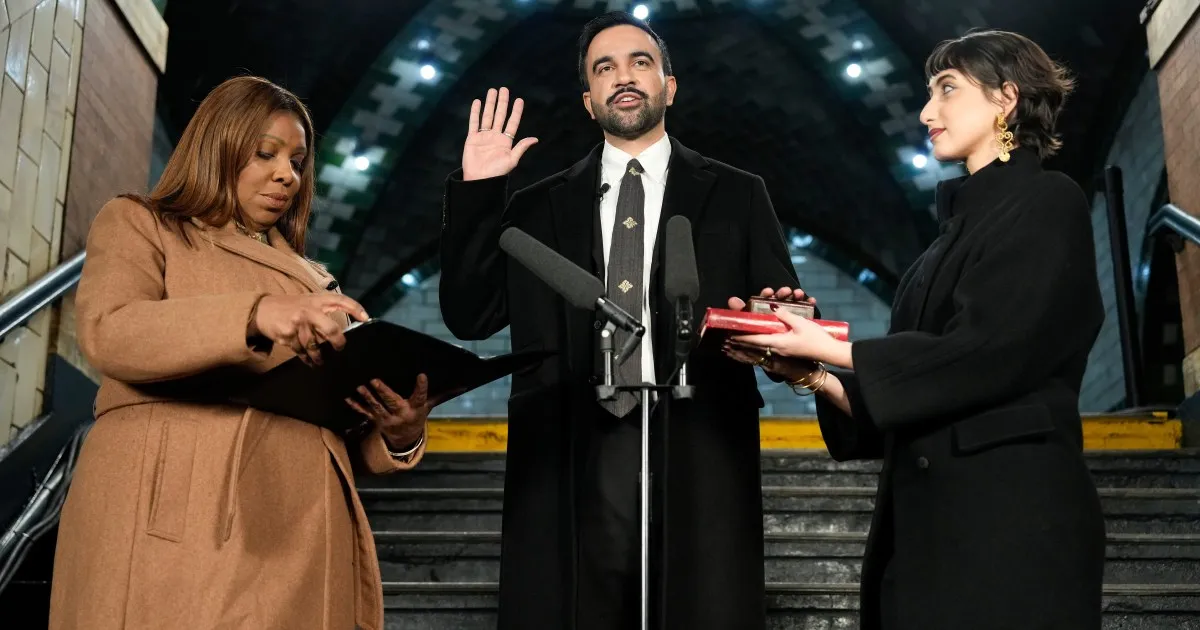
Zohran Mamdani was sworn in as New York City’s mayor just after midnight in a historic ceremony at a decommissioned Manhattan subway station.
Making history as the first Muslim to lead the United States’ largest city, Mamdani took his oath with his hand placed on a Quran.
“This is truly the honour and the privilege of a lifetime,” Mamdani said in a brief speech.
The private ceremony, conducted by New York Attorney General Letitia James at the architecturally stunning old City Hall station – one of the city’s original subway stops known for its arched ceilings – marked the official transition of power.
In his inaugural remarks, Mamdani highlighted the venue as a “testament to the importance of public transit to the vitality, the health and the legacy of our city” while announcing Mike Flynn as his new Department of Transportation commissioner.
The mayor concluded his brief address saying, “Thank you all so much, now I will see you later,” before ascending the stairs with a smile.
A more elaborate public inauguration will take place at 1pm (18:00 GMT) at City Hall. A public celebration will follow on Broadway’s “Canyon of Heroes”, famous for hosting ticker-tape parades.
As he steps into one of the US’s most demanding political positions, Mamdani breaks multiple barriers. At 34, he becomes the city’s youngest mayor in generations and the first of Muslim faith, South Asian descent, and African birth.
Zohran Mamdani has been sworn in as mayor of New York City, becoming the first Muslim and the youngest person in generations to take the oath of office in the United States’ biggest city.
Mamdani, a Democrat, was sworn in at a historic, decommissioned subway station in Manhattan just after midnight on Thursday, placing his hand on a Quran as he took his oath.
“This is truly the honour and the privilege of a lifetime,” Mamdani said.
The ceremony, administered by New York Attorney General Letitia James, a political ally, took place at the old City Hall station, one of the city’s original subway stops that is known for its stunning arched ceilings.
He will be sworn in again, in grander style, in a public ceremony at City Hall at 1pm (18:00GMT) by US Senator Bernie Sanders, one of the mayor’s political heroes. That will be followed by what the new administration is billing as a public block party on a stretch of Broadway known as the “Canyon of Heroes,” famous for its ticker-tape parades.
Mamdani now begins one of the most unrelenting jobs in US politics as one of the country’s most-watched politicians.
In addition to being the city’s first Muslim mayor, Mamdani is also its first of South Asian descent and the first to be born in Africa. At 34, Mamdani is also the city’s youngest mayor in generations.
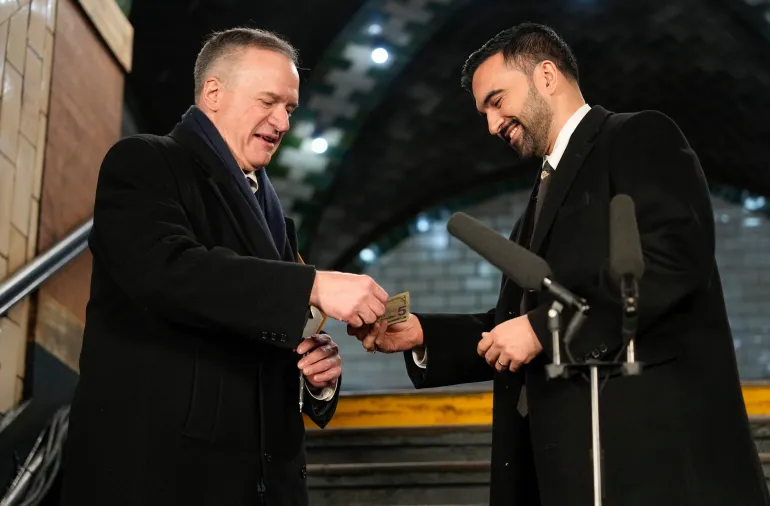
Mamdani, right, hands nine dollars to city clerk Michael McSweeney before signing a registry [Yuki Iwamura/AP]
In a campaign that helped make “affordability” a buzzword across the political spectrum, the democratic socialist promised to bring transformative change with policies intended to lower the cost of living in one of the world’s most expensive cities.
His platform included free child care, free buses, a rent freeze for about 1 million households, and a pilot of city-run grocery stores.
But he will also have to face other responsibilities: handling trash and snow and rats, while getting blamed for subway delays and potholes.
Tensions with Trump
Mamdani will also have to deal with Republican President Donald Trump.
During the mayoral race, Trump threatened to withhold federal funding from the city if Mamdani won and mused about sending National Guard troops to the city and suggested that he should be deported.
He also called Mamdani a “100% Communist Lunatic” in a social media post.
But Trump surprised supporters and foes alike by inviting the Democrat to the White House for what ended up being a cordial meeting in November.
“I want him to do a great job and will help him do a great job,” Trump said in the meeting, and the US president even came to Mamdani’s rescue as the two addressed reporters.
When a journalist asked Mamdani if he continued to view Trump as a fascist, the president stepped in.
“That’s OK. You can just say it. That’s easier,” Trump told Mamdani. “It’s easier than explaining it. I don’t mind.”
Still, tensions between the two leaders remain.
Following the meeting, Mamdani said he still believed Trump is a fascist.
“That’s something that I’ve said in the past; I say it today,” Mamdani told NBC News.
US President Donald Trump (R) shakes hands with New York Mayor-elect Zohran Mamdani as they meet in the Oval Office of the White House in Washington, DC, on November 21, 2025 [File: AFP]
Mamdani was born in Kampala, Uganda, the son of filmmaker Mira Nair and Mahmood Mamdani, an academic and author. His family moved to New York City when he was 7, with Mamdani growing up in a post-9/11 city where Muslims didn’t always feel welcome. He became an American citizen in 2018.
He worked on political campaigns for Democratic candidates in the city before he sought public office himself, winning a state Assembly seat in 2020 to represent a section of Queens.
Still, Mamdani had minimal name recognition when he launched his mayoral campaign late last year.
However, in the lead-up to the Democratic primary, he quickly rose in the polls with a message focused on lowering the cost of living.
Mamdani ultimately defeated former Governor Andrew Cuomo twice: once to clinch the Democratic nomination in June, and a second time in the November election.
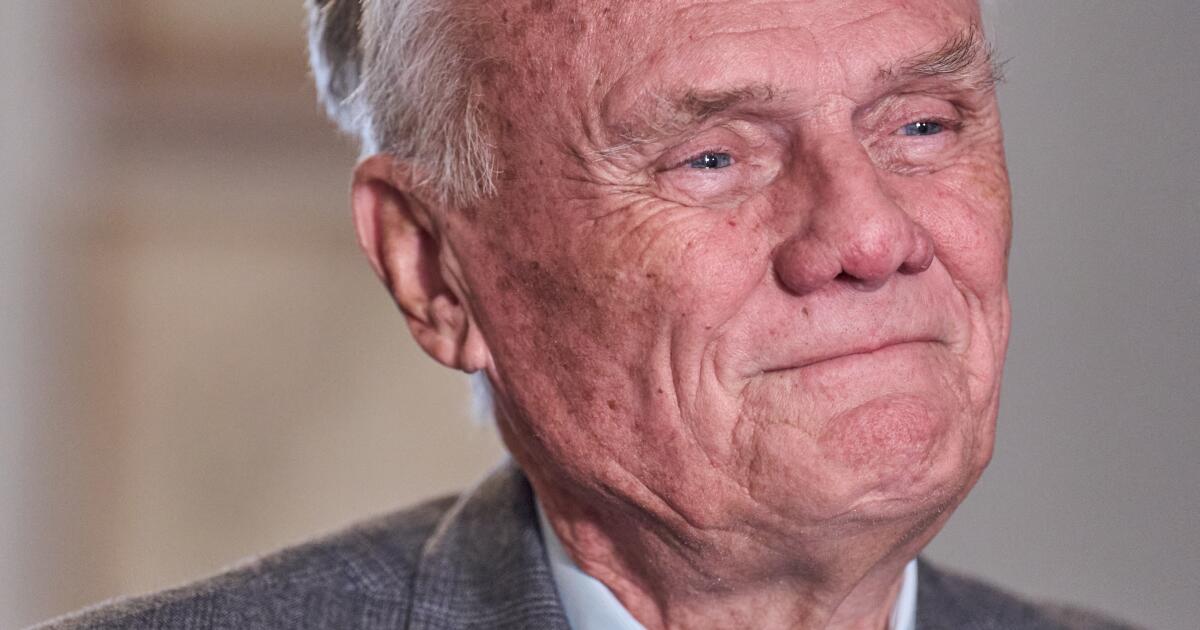
WASHINGTON — President Trump is not the first president to want more room at the White House for entertaining, says the longest-serving top aide in the executive residence, offering some backup for the reason Trump has cited for his ballroom construction project.
Gary Walters spent more than two decades as White House chief usher to presidents Reagan, George H.W. Bush, Clinton and George W. Bush — a role that is akin to being the general manager of the residence.
“All the presidents that I had an opportunity to serve always talked about some possibility of an enlarged area” for entertaining, Walters said in an interview with the Associated Press about his recently published memoir.
Trump has been talking about building a White House ballroom for years, even before he entered the political arena. In July, the White House announced a 90,000-square-foot space would be built on the east side of the complex to accommodate 650 seated guests at a then-estimated cost of $200 million. Trump has said it will be paid for with private donations, including from him.
The Republican president later upped the proposed ballroom’s capacity to 999 people and, by October, had demolished the two-story East Wing of the White House to build it there. In December, he updated the price tag to $400 million — double the original estimate.
Images of the East Wing being demolished shocked historians, preservationists and others, but Walters said there is a long history of projects on the campus, ranging from conservatories, greenhouses and stables being torn down to build the West Wing in 1902, to the expansion of the residence with a third floor, to the addition of the East Wing itself during World War II to provide workspace for the first lady, her staff and other White House offices.
“So there’s always been construction going on around the White House,” Walters said.
Other presidents bemoaned the lack of space for entertaining
When Walters was on the job, the capacity of the largest public rooms in the White House was among the first topics he discussed with the incoming president, first lady and their social secretary, he said. The presidents he served all talked about the limited number of people the White House could handle.
When set up for a state dinner, the State Dining Room can hold about 130 people: 13 round tables each with seating for 10, Walters said. The East Room can accommodate about 300 chairs — fewer if space is needed for television cameras.
Trump complains often that both rooms are too small. He also has complained about the use of large tents on the south grounds, the main workaround for big events such as ritzy state dinners for foreign leaders. Walters said the tents had issues.
“When it rained, the water flows downhill and the grass became soggy, no matter what we tried to do,” Walters said. “We dug culverts around the outside of the tent to try and get the water.” Tents damaged the grass, requiring more work to reseed it, he said.
Walters admitted it was a bit jarring to see the East Wing torn down, and said he had fond personal memories of the space. “I met my wife at the White House and she worked in the East Wing, so that was a joy for me,” said Walters, 79.
His wife, Barbara, was a receptionist in the visitors office during the administrations of Richard Nixon and Gerald Ford. The couple recently celebrated 48 years of marriage.
Broken bones alter usher’s career trajectory
Walters owes his place in history as the longest-serving White House chief usher to the misfortune of a broken ankle.
He was 23 in early 1970, honorably discharged from the Army and looking for a job that would allow him to finish college at night. The Executive Protective Service, a precursor to the U.S. Secret Service, was hiring and accepted him.
But shortly before the graduation ceremony, Walters broke an ankle playing football. He could not patrol out of uniform, wearing a cast and hobbling around on crutches, so he was given a temporary assignment in the White House Police Control and Appointments Center. He stayed for five years.
“This injury also changed the course of my career,” Walters wrote in his memoir, “White House Memories: 1970-2007: Recollections of the Longest-Serving Chief Usher.” He gained an ”in-depth knowledge of the ways and security systems of the White House that would ultimately greatly benefit me in my future role in the Usher’s Office.”
A few months after being promoted to sergeant in 1975, he learned of an opening in the Usher’s Office. He applied and joined as an assistant in early 1976.
A decade later, he was elevated to chief usher by Reagan, who gave Walters the top job in the residence overseeing maintenance, construction and renovation projects, and food service, along with administrative, financial and personnel functions. He managed a staff of about 90 butlers, housekeepers, cooks, florists, electricians, engineers, plumbers and others.
Walters retired in 2007 after 37 years at the White House, including a record 21 years as chief usher. He served under seven presidents, from Nixon to George W. Bush.
In that time, Walters saw a broad swath of presidential history: the only president who ever resigned, an appointed vice president become the only unelected president, a president be impeached and stay in office, a father and son become president and the Supreme Court decide the most closely contested presidential election in U.S. history.
He’s often asked what he liked most about his work and “without hesitation I say it is getting to know and interact directly with the president, first lady, and other members of their family. It was an honor to get to know them with my own eyes and ears,” Walters wrote.
The incoming mayor will take his oath of office with two family editions of the Quran and a 19th century edition, symbolising New York City history, in the public ceremony on Friday.
Zohran Mamdani on Thursday became the first New York City mayor to be sworn in using a Quran.
The first Muslim and South Asian mayor of the United States’ biggest metropolis, Mamdani used his grandfather’s Quran and a 200-year-old copy on loan from the New York Public Library (NYPL) for the private swearing-in event held at a disused subway station under Times Square.
Recommended Stories
list of 4 itemsend of list
He then plans to use two copies of the Quran that belonged to his grandfather and grandmother for a daytime ceremony at New York City Hall on Friday.
The historic Quran, borrowed from the library, once belonged to Arturo Schomburg, a Black historian and writer who sold his collection of 4,000 books to the NYPL in 1926. His collection became the Schomburg Center for Research in Black Culture.
Schomburg was born in Puerto Rico in the 1870s to parents of German and Afro-Caribbean descent. He later immigrated to New York and was a key player in the Harlem Renaissance of the 1920s and 1930s – a period of intense cultural and intellectual flourishing within New York’s Black community.
The library praised Mamdani’s decision to use Schomburg’s Quran because of its connection to one of New York’s “most groundbreaking scholars and for its simple, functional qualities”.
This photo provided by the New York Public Library shows the Schomburg Quran on December 16, 2025, in New York [Jonathan Blanc/The New York Public Library via AP Photo]
The small size of the Quran and its black and red ink suggest it was designed for everyday use, the library said. The edition is neither signed nor dated, but its “minute naskh script and its binding, featuring a gilt-stamped medallion filled with a floral composition, suggest it was produced in Ottoman Syria in the 19th century”, the library added.
“The significance of this Quran extends far beyond the beauty of its pages,” said Hiba Abid, curator of Middle Eastern and Islamic studies. “It is a Quran close to the people, not only because of its simple craftsmanship, but also because it is part of the collections of the nation’s largest public library system.”
Anthony W Marx, the library’s president and CEO, said the choice of Quran and its association with Schomburg “symbolises a greater story of inclusion, representation, and civic-mindedness”.
Mamdani is one of only a handful of US politicians to be sworn in with the Quran. New York does not require mayors to take the oath of office with their hand on a religious text, but many past mayors have used a copy of the Bible.
Former New York City Mayor Michael Bloomberg used a 100-year-old family Bible during one ceremony, while Mayor Bill de Blasio used a Bible that once belonged to US President Franklin D Roosevelt. Mamdani’s predecessor, Mayor Eric Adams, also used a family Bible for his oath.
This photo provided by the New York Public Library shows the Schomburg Quran on December 16, 2025, in New York [Jonathan Blanc/The New York Public Library via AP Photo]
Mamdani’s faith and his background as a Ugandan-born American of South Asian descent were front and centre during his campaign, which focused on celebrating the diversity of New York.
In viral social media videos, Mamdani also spoke candidly about the effect of the September 11 terrorist attacks on New York and the subsequent rise in Islamophobia in the US. Other videos featured the experiences of everyday New Yorkers, including many of its Muslim and immigrant communities.
Mamdani has also been a firm critic of Israel’s policies towards Palestinians and its genocidal war on Gaza.
Critics like New York Representative Elise Stefanik homed in on Mamdani’s background and left-wing politics as a Democratic Socialist, calling the incoming mayor a “jihadist Communist” and “terrorist” sympathiser.
Mamdani, however, pledged to never hide from his background during a campaign speech. “I will not change who I am, how I eat, or the faith that I’m proud to call my own,” he said during his campaign. “I will no longer look for myself in the shadows. I will find myself in the light.”
Dhaka, Bangladesh – On Tuesday, the premises of Evercare Hospital in Bangladesh’s capital turned into a sombre focal point for a nation’s grief as news filtered out of the medical facility: Khaleda Zia, three-time prime minister and longtime leader of the Bangladesh Nationalist Party (BNP), was dead.
Khaleda had been receiving treatment at the hospital since the night of November 23.
Supporters, party leaders and common citizens stood silently in front of the hospital gates, wiping away tears and offering prayers. “The news made it impossible for us to stay at home,” said BNP activist Riyadul Islam. “Since there is no opportunity to see her, everyone is waiting outside. There are tears in everyone’s eyes.”
Her funeral at Dhaka’s Manik Mia Avenue on Wednesday drew tens of thousands of BNP supporters from across the country, alongside leaders of other political parties, interim government head Muhammad Yunus and foreign diplomats – underscoring the imprint of Khaleda’s legacy, and how it extended well beyond Bangladesh’s borders.
But beyond the grief, Khaleda Zia’s death marks a decisive political rupture for the BNP at a critical moment, say political analysts.
With national elections scheduled for February 12, the party is entering the campaign without the leader who remained its ultimate symbol of unity, even during years of illness and political inactivity.
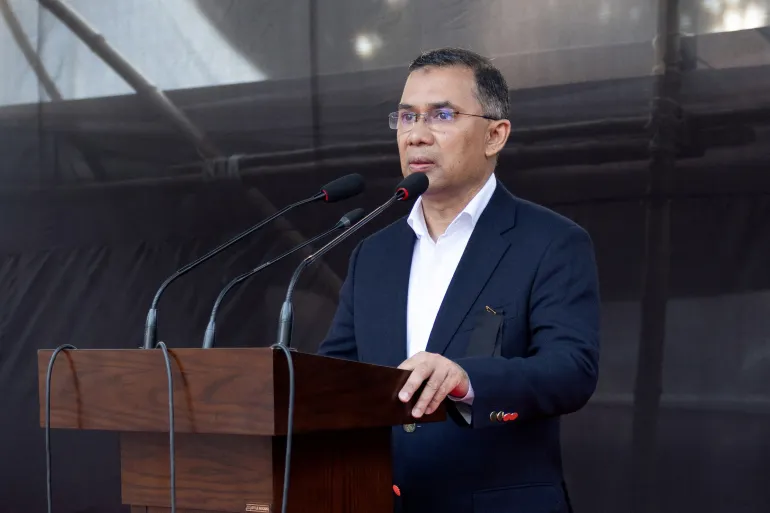
Her passing pushes BNP into a fully post-Khaleda phase, concentrating authority and accountability on her son and acting chairperson, Tarique Rahman, as the party seeks to consolidate its base and compete in a reshaped political landscape following the July 2024 upheaval and the subsequent banning of the Awami League’s political activities.
Bangladesh Nationalist Party’s acting chairman Tarique Rahman addresses mourners before the funeral prayers for his mother and former Prime Minister Khaleda Zia at the Parliament building area of Manik Mia Avenue, in Dhaka, Bangladesh, December 31, 2025 [Stringer/Reuters]
Legacy as anchor, absence as test
For decades, Khaleda Zia’s relevance extended beyond formal leadership.
Even when absent from front-line politics, she functioned as the party’s moral centre and final authority, helping to contain factionalism and defer leadership questions.
Mahdi Amin, adviser to Tarique Rahman, told Al Jazeera that Bangladesh had lost “a true guardian”, describing Khaleda Zia as a unifying symbol of sovereignty, independence and democracy.
He said the BNP would carry forward her legacy through its policies and governance priorities if elected.
“The hallmark of her politics was a strong parliamentary democracy – rule of law, human rights and freedom of expression,” Amin said, adding that the BNP aims to restore institutions and rights that, he claimed, were eroded during the Awami League’s 15-year rule, between 2009 and 2024, under then Prime Minister Sheikh Hasina, Khaleda’s longtime rival.
Amin insisted that Tarique has already emerged as a unifying figure, citing his role in coordinating the movement against Hasina and formulating a 31-point reform agenda aimed at restoring voting rights and institutional accountability.
Despite these assertions, however, analysts say Khaleda’s absence removes a critical layer of symbolic authority that long helped stabilise the BNP’s internal politics.
Writer and political analyst Mohiuddin Ahmed said Khaleda’s personal charisma played a key role in keeping the party energised and cohesive.
“That rhythm will be disrupted,” he said. “Tarique Rahman now has to prove his leadership through a process. His leadership remains untested.”
Ahmed noted that Khaleda herself was once an untested political figure, rising to national prominence during the mass pro-democracy movement of the 1980s that ultimately led to the fall of military ruler General Hussain Muhammad Ershad. Her husband, the then-President Ziaur Rahman, was assassinated in 1981 during a failed military coup.
Ahmed argued that the February election could play a similar defining role for Tarique Rahman: Success would validate his leadership, while failure would intensify scrutiny.
Leaders of the National Citizen Party chat during an interview with an aspiring candidate ahead of the country’s upcoming national election, in Dhaka, Bangladesh, November 24, 2025. The NCP, founded by students who led the July 2024 movement against Sheikh Hasina, has now tied up with the Jamaat-e-Islami, Bangladesh’s biggest Islamist force, in a coalition for the election [Sam Jahan/Reuters]
A tougher electoral terrain
BNP’s challenge is compounded by a transformed opposition landscape.
For more than three decades, Bangladesh’s electoral politics were shaped by a near-binary rivalry between the Awami League and the BNP, a pattern that emerged after the fall of military rule in 1990 and hardened through successive elections in the 1990s and 2000s.
With the Awami League now absent – its political activities banned by the Yunus administration – that two-party dominance has fractured, forcing BNP to compete in a more crowded field that includes a strong alliance led by the Jamaat-e-Islami, Bangladesh’s biggest Islamist force. The Jamaat coalition includes the National Citizen Party, launched by many of the youth leaders who drove the July 2024 mass movement that forced Hasina out of power and into exile in India.
“This will not be easy for BNP,” Ahmed said. “Post-July [2024] politics has changed the equation. New polarisation is emerging, and the dominance of two parties no longer holds,” he added.
Analysts also point to key uncertainties that linger: whether the election will be held on time, whether it will be peaceful, and whether major parties can ensure public confidence in the process.
Dilara Choudhury, a political scientist who observed both Khaleda and her husband closely, said Khaleda Zia functioned as a “guardian figure” for not just her party, but also the country, and that her death represents the loss of a senior stabilising presence in Bangladesh politics.
Tarique, Khaleda’s son, was in exile in the United Kingdom from 2008 until December 25, 2025, when he returned after a series of cases against him that were initiated by a military-backed government in power between 2006 and 2009, or by the subsequent Hasina government, were closed.
She argued that Tarique’s return to the country has reduced fears of internal division within the party and that his recent speeches – reaffirming Bangladeshi nationalism, rejecting authoritarianism and honouring victims of the 2024 July uprising violence – have reassured party supporters about ideological continuity.
“BNP and Awami League have both been personality-centred parties,” she said. “After Khaleda Zia, it is natural that Tarique Rahman occupies that space within the BNP.”
Thousands of people gather to attend funeral prayers for former Prime Minister Khaleda Zia outside the national Parliament building in Dhaka, Bangladesh, Wednesday, December 31, 2025 [Mahmud Hossain Opu/AP Photo]
From legacy to verdict
Yet BNP leaders acknowledge that legacy alone will not determine the party’s future.
Allegations of extortion involving some party activists continue to surface – an issue that adviser Mahdi Amin described as mostly exaggerated, though he said the party plans to address it through stricter internal controls.
At the grassroots level, some party members say Tarique’s leadership transition will not be without challenges.
“It would be unrealistic to say there will be no difficulties,” said Kamal Uddin, senior joint secretary of the Chakaria upazila unit of Jubo Dal, the BNP’s youth wing, in Cox’s Bazar district. “In the past, there were disagreements with senior leaders who worked closely with Khaleda Zia – and even with Ziaur Rahman. That could be a challenge in decision-making. But I believe he will be able to manage.”
Kamal Uddin travelled with three other BNP activists from Cox’s Bazar, a coastal city on the Bay of Bengal about 350km (217 miles) south of Dhaka, to attend Khaleda Zia’s funeral on Wednesday.
Senior BNP leaders, however, dismiss doubts over Tarique’s authority.
Standing committee member Amir Khasru Mahmud Chowdhury, who served as commerce minister in Khaleda Zia’s cabinet from 2001 to 2004, said Tarique’s leadership credentials were already established.
“His leadership has been proven,” Chowdhury told Al Jazeera earlier this month. “He is capable of leading the party effectively.”
As BNP prepares for the polls, analysts say the party’s ability to ensure discipline, project reform and contribute to a peaceful election will itself be a test of Tarique’s leadership.
A separate discussion has emerged on social media and among political rivals.
On November 29, ahead of his eventual return, Tarique wrote on his verified Facebook page that the decision to come home was not “entirely within his control” and not “under his sole control”. Critics interpreted this as raising questions about possible external influence – particularly India – on whether and when he would return.
BNP leaders rejected these claims, insisting his return was a political and legal matter tied to domestic realities rather than foreign negotiation, and that national interest would guide the party’s policy if it comes to power.
For many supporters, however, politics remains deeply personal.
Fifty-seven-year-old Dulal Mia, who travelled from the northeastern district of Kishoreganj to attend Tarique’s reception rally in Dhaka on December 25, still recalls the moment that made him a lifelong BNP supporter.
When he was a sixth-grader in 1979, he said, then-President Ziaur Rahman visited the paddy field where he was working and shook his hand. Ziaur Rahman is remembered for addressing drought by digging canals across the country and visiting remote areas barefoot, often without formal protocol.
“Tarique Rahman will have to carry the legacy of his parents,” Mia said. “If he doesn’t, people will turn away. The BNP’s politics is people’s politics – it began with Ziaur Rahman and was carried by Khaleda Zia for so long. I believe Tarique Rahman will do the same. Otherwise, it is the people who will reject him.”
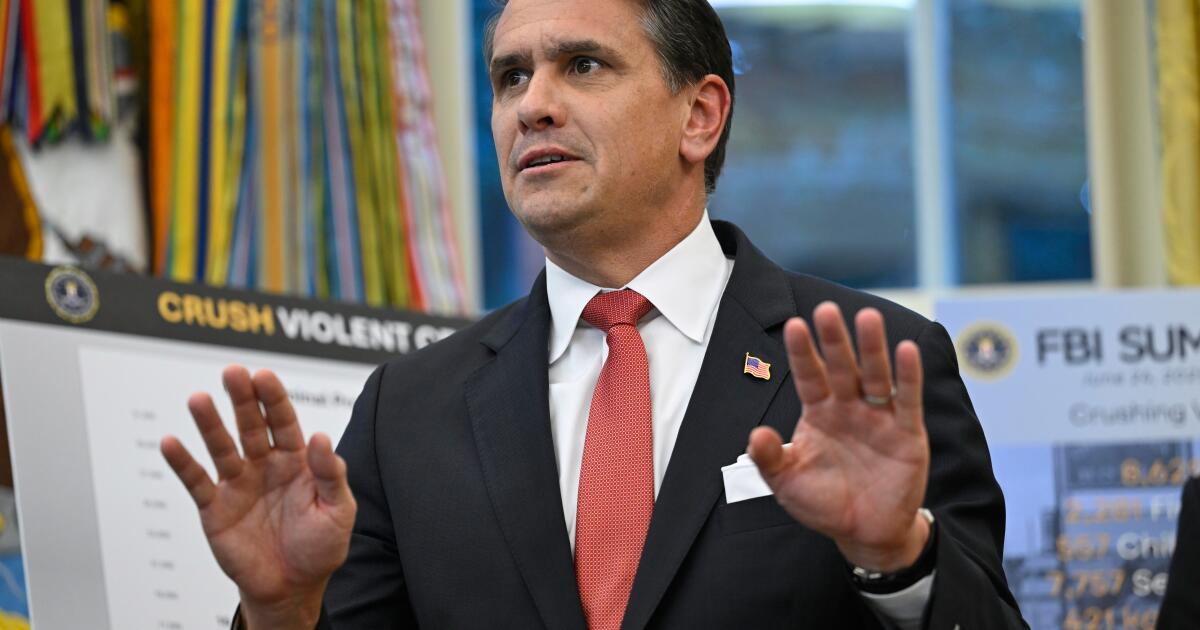
WASHINGTON — The Department of Justice has expanded its review of documents related to the convicted sex offender Jeffrey Epstein to 5.2 million as it also increases the number of attorneys trying to comply with a law mandating release of the files, according to a person briefed on a letter sent to U.S. attorneys.
The figure is the latest estimate in the expanding review of case files on Epstein and his longtime girlfriend Ghislaine Maxwell that has run more than a week past a deadline set in law by Congress.
The Justice Department has more than 400 attorneys working on the review, but does not expect to release more documents until Jan. 20 or 21, according to the person briefed on the letter who spoke on condition of anonymity because they were not authorized to discuss it.
The White House did not dispute the figures laid out in the email, and pointed to a statement from Todd Blanche, the deputy attorney general who said the administration’s review was an “all-hands-on-deck approach.”
Blanche said Wednesday that lawyers from the Justice Department in Washington, the FBI, the Southern District of Florida and the Southern District of New York are working “around the clock” to review the files. The additional documents and lawyers related to the case were first reported by the New York Times.
“We’re asking as many lawyers as possible to commit their time to review the documents that remain,” Blanche said. “Required redactions to protect victims take time but they will not stop these materials from being released.”
Still, Atty. Gen. Pam Bondi is facing pressure from Congress after the Justice Department’s rollout of information has lagged behind the Dec. 19 deadline to release the information.
“Should Attorney General Pam Bondi be impeached?” Rep. Thomas Massie, a Kentucky Republican who helped lead the effort to pass the law mandating the document release, asked on social media this week.
Democrats also are reviewing their legal options as they continue to seize on an issue that has caused cracks in the Republican Party and at times flummoxed President Trump’s administration.
Senate Democratic leader Chuck Schumer said on social media that the latest figures from the Department of Justice “shows Bondi, Blanche, and others at the DOJ have been lying to the American people about the Epstein files since day one” and pointed out that the documents released so far represent a fraction of the total.
Dec. 31 (UPI) — Two African countries have announced travel bans against U.S. citizens in retaliation for President Donald Trump‘s travel bans against their own people.
The governments of Mali and Burkina Faso said on Tuesday that they were acting “in accordance with the principle of reciprocity.” They said Americans wanting to travel to their countries would see the same impositions that their citizens face in the United States. Niger’s state news agency announced a travel ban on Americans last week, though no official statement was released.
On Dec. 14, Trump announced travel bans on Burkina Faso, Mali, Niger, South Sudan and Syria. He also created new restrictions on people seeking entry from Laos and Sierra Leone, as well as those with travel documents issued by the Palestinian Authority. There are now 19 countries on the list.
Mali’s foreign ministry said in a statement that it “regrets that such an important decision was taken without any prior consultation and in substance deplores the security grounds put forward, which contradict the actual developments on the ground, in an attempt to justify a decision whose motivation lies elsewhere.”
Niger, Mali and Burkina Faso are led by military juntas after recent coups, The New York Times said. Their leaders had all mostly cut ties with the United States and developed closer relations with Russia, China, Turkey and the United Arab Emirates.
A United Nations report published on Dec. 18 said that the Sahel region — Niger, Burkina Faso and Mali — now accounts for more than half of the world’s terrorism-related deaths.
Laos and Sierra Leone were moved from partial travel restrictions to full bans. The administration put partial restrictions on 15 other countries.
The State Department ban does not affect lawful permanent residents, many existing visa holders, diplomats or athletes traveling for major sports events.
Taiwan’s Lai pledges to defend national sovereignty after Beijing holds live-fire drills around island.
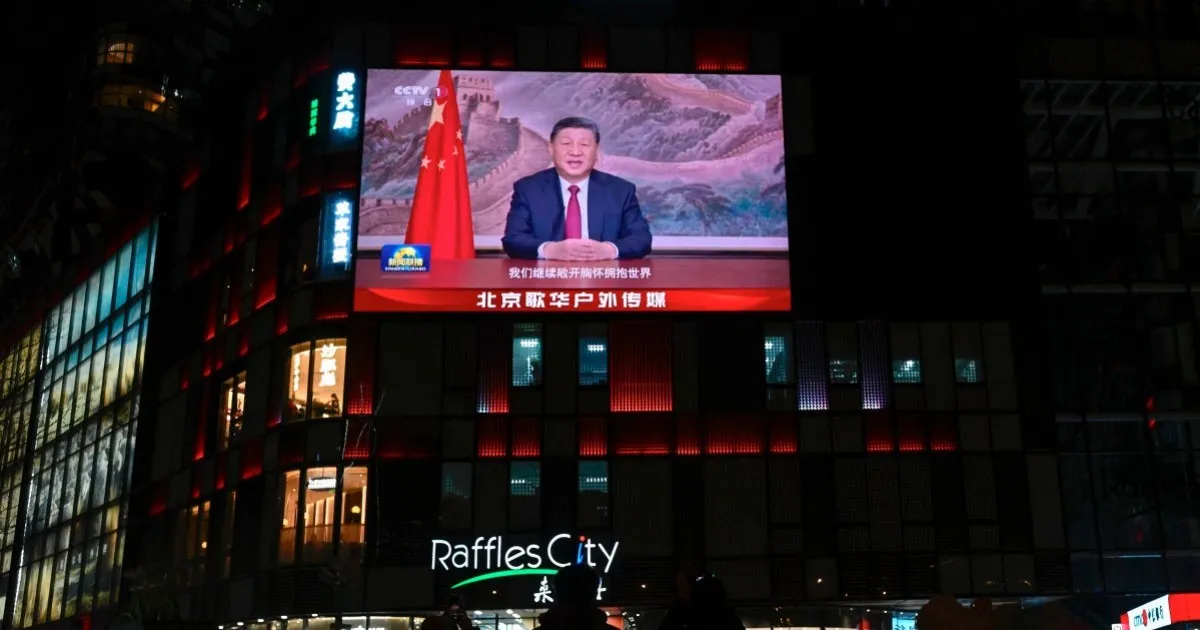
Chinese President Xi Jinping has pledged to achieve the “reunification” of China and Taiwan, calling Beijing’s long-held goal “unstoppable.”
In a New Year’s address delivered a day after China’s military wrapped up war games around Taiwan, Xi on Wednesday invoked the “bond of blood and kinship” between Chinese people on each side of the Taiwan Strait.
Recommended Stories
list of 4 itemsend of list
“The reunification of our motherland, a trend of the times, is unstoppable,” Xi said.
Xi also hailed the institution in 2025 of an annual “Taiwan Recovery Day”, marking the end of imperial Japan’s rule of the island at the end of World War II.
Xi’s speech came on the heels of two days of live-fire drills simulating a blockade of the island, in what officials called a “stern warning” against “separatist” and “external interference” forces.
The drills were the largest ever held around Taiwan in terms of geographical area.
The war games, codenamed “Justice Mission 2025”, came just days after the United States approved its largest-ever arms package to Taiwan, valued at $11.1bn.
China views self-governing Taiwan as part of its territory and has long pledged to bring the island under its control, using force if necessary.
Taiwan’s ruling Democratic Progressive Party maintains that the island is a de facto independent country, though it has not formally declared independence.
In his New Year’s Day address on Thursday, Taiwanese President William Lai Ching-te pledged to “firmly” uphold national sovereignty and boost the island’s defences.
“In the face of China’s escalating expansionist ambitions, the international community is closely watching whether the people of Taiwan have the determination to defend themselves,” Lai said.
While Taiwan elects its leaders and has its own military, passport and currency, the island is officially recognised by just 11 countries and Vatican City.
China insists that countries do not officially recognise Taipei in order to maintain diplomatic ties with Beijing.
Although the US does not officially recognise Taiwan, Washington is committed to helping the island to defend itself under the Taiwan Relations Act of 1979.
While Washington is Taipei’s principal supplier of arms, the law does not stipulate any obligation to directly intervene militarily in the event of a Chinese blockade or invasion.
Opinion polls suggest a large majority of Taiwanese favour the status quo, with much smaller proportions supporting imminent moves towards formal independence or unification.
In his speech on Wednesday, Xi also hailed China’s innovation in industries including artificial intelligence and space.
“We sought to energise high-quality development through innovation. We integrated science and technology deeply with industries, and made a stream of new innovations,” he said.
“Many large AI models have been competing in a race to the top, and breakthroughs have been achieved in the research and development of our own chips. All this has turned China into one of the economies with the fastest-growing innovation capabilities.”
Sereen Banna said the partners of Downtown LA Law Group called her “Erin Brockovich” for her work helping hundreds sue over noxious fumes spewing out of a landfill in northern Los Angeles County.
An ambitious paralegal, Banna said she embraced the role she had in empowering residents to take on companies suspected of polluting their neighborhoods.
Her bosses were proud, too, she said. Banna, 28, recalled them saying she would make them all billionaires someday.
But in early 2024, Banna said, she discovered a troubling trend in some of the firm’s most lucrative cases: Clients who claimed they were paid before joining lawsuits.
On Dec. 16, Banna sued Downtown LA Law Group, also known as DTLA, stating the firm failed to address her complaints about “illegal solicitation, as well as deceptive and unethical practices aimed at persuading individuals to become clients through misrepresentations.”
She accused the firm, which she left in the fall of 2024, of amassing plaintiffs through “practices that appeared designed to exploit vulnerable individuals.”
DTLA called the allegations “baseless,” saying they came from a disgruntled former employee.
“Any allegations of fraud, paid referrals, or unethical practices by DTLA Law Group are not only unsubstantiated, but false,” the firm said in a statement. “We intend to fight this in the court of law, where the facts will show that we operate with unwavering integrity, prioritizing client welfare.”
Banna’s lawsuit caps a tumultuous year for DTLA. A partnership between three childhood friends, DTLA has grown from a small firm focused on car crash victims into a civil litigation powerhouse, filing thousands of cases related to the January wildfires and sexual abuse in government facilities. The firm filed nearly a quarter of the cases in the $4-billion sex abuse settlement approved last spring by Los Angeles County — the largest of its kind in U.S. history.
But the meteoric rise has drawn scrutiny.
The Times reported in the fall that nine of the firm’s clients who sued over sex abuse in L.A. County facilities said recruiters paid them to file a lawsuit, including four who said they were told to fabricate claims. The L.A. County district attorney’s office is now conducting a probe into the allegations.
With the investigation pending, questions have lingered about how DTLA managed to amass so many plaintiffs so quickly. The Times spoke to more than 40 of the firm’s clients and 10 former employees, many of whom described aggressive tactics to bring in new clients and reap profits stretching back years.
More than a dozen people represented by DTLA in personal injury cases said they were recruited at a crisis point in their lives with promises of massive payouts and pressured into expensive surgeries that attorneys said would make their case more valuable. The more medical procedures, they were told, the more damages attorneys could claim.
At the end, some clients say, they were left with a fraction of what they were promised.
DTLA said in a statement it exists “to support clients through some of the most difficult moments of their lives.”
“That includes helping them avoid unnecessary financial stress while their cases are pending,” the firm said. “Medical care decisions are made solely by clients and their physicians.”
Sereen Banna, a former DTLA paralegal, sued the firm on Dec. 16, alleging it did not listen to her complaints of unethical solicitation. The firm has denied wrongdoing.
(Allen J. Schaben / Los Angeles Times)
Banna said in her lawsuit she “repeatedly complained” about how clients were being solicited.
She said in an interview she reported the first paid landfill client she was aware of — a woman who received a $20 gift card — to her bosses in early 2024. In her lawsuit, she alleged “such conduct constitutes unlawful and unethical behavior for attorneys.”
She said her boss told her the alleged payments would be investigated.
“At that point, I was reminded it was above my pay grade,” she said.
‘A really big part of the recruitment process’
Banna said she resigned from DTLA in October 2024, around the time the firm began pursuing a new cohort of clients: human trafficking victims who’d been abused in hotels.
Banna said one of her colleagues, an intake coordinator, told her a man named Kevin Johnson had paid one sex worker $20 to come into the office.
Over the last two years, five ex-workers told The Times, Johnson became an increasingly common sight at the firm as he started shepherding in clients he’d found to sue over sex abuse in the juvenile halls and the Eaton fire. Like most former employees, the ex-workers requested anonymity, fearing professional retaliation.
Johnson, a 54-year-old entertainer who hosts gospel brunches and soul nights in Inglewood according to his social media, did not respond to messages or a letter left at his home. The firm is currently representing him in a lawsuit over a Mid-City car crash.
California law bans a practice known as capping, in which non-attorneys solicit clients to join litigation with a firm. DTLA has denied working with cappers and Johnson did not respond to questions about his recruitment for the firm.
Former employees said Johnson was responsible for bringing in a large number of clients.
“He is a really big part of the recruitment process for Downtown LA,” said Banna, who described how she was called to do intake with sex abuse clients after Johnson brought them into the offices of one of the partners.
Johnson wasn’t a DTLA employee, yet workers say he was a familiar face around the office.
He was close with the partners and chummy with employees, handing out lucky $2 bills to workers last holiday season, three former employees said. Two said that at one point he had his own swipe card, so he could come and go freely.
A digital trail connects Johnson to DTLA’s client list.
The Times found more than a dozen friends of Johnson’s on Facebook who appeared to have a sex abuse lawsuit filed with the county. To do this, The Times cross-referenced a list of county sex abuse plaintiffs represented by DTLA with Johnson’s Facebook friends to see how many shared identifying details.
Larisa Ellis, whom Johnson describes on Facebook as his wife, paid someone who later had a DTLA sex abuse lawsuit $50 at a social services office in November 2024 with the payment caption “Thanks for using our referral service,” according to a Cash app transaction. Ellis did not respond to a message and a letter left at their home.
“DTLA does not pay clients to retain our services or for referrals,” the firm said in a statement.
Austin Beagle and Nevada Barker, former clients of DLTA, said they were paid to sue over alleged sexual abuse in L.A. County by a man named Kevin, whose last name they didn’t know. Beagle and Barker later had their lawsuit dismissed.
(Joe Garcia / For The Times)
Nevada Barker and Austin Beagle, two former DTLA clients, previously told The Times a man named Kevin, whose last name they didn’t know, paid them $100 each in DTLA’s office after they made false claims of sex abuse. Barker identified Johnson through pictures as the man who paid her.
The couple said they were under the impression they were being compensated to be actors in a movie. The firm later asked the court to dismiss their lawsuits.
“He said he worked for a referral service and the lawsuit needed enough participants to go through,” said Beagle. “He didn’t work for the law office.”
‘Tell her I got $ for her’
Several clients told The Times they were offered money by DTLA partner Farid Yaghoubtil if they could find people to sign up for lawsuits with the firm.
“He called it an advancement, ” said LaShelle Allison, 53, a former client who said she referred several car accident victims for Yaghoubtil. “Here’s $250,’ ‘Here’s $650,’ ‘Here’s $500 for rent.”
California is one of the few states where lawyers are allowed to loan clients money.
The State Bar has a general rule that lawyers are not supposed to pay “personal or business expenses.” The bar makes exceptions that include if the client promises in writing to repay the loan, for providing funds to promote “the interests of an indigent person,” and for “advancing costs” to protect a client, with repayment contingent on the outcome of the matter.
DTLA said in a statement that it offers small loans to clients “in limited situations.”
“The firm has offered small, interest-free micro-advances to help with short-term needs like temporary housing or basic expenses, specifically so clients do not feel compelled to turn to third-party lenders,” the firm said. “These advances are entirely voluntary, never tied to medical or legal decisions, and are only recovered if a case is successfully resolved.”
Akeem Smith, 40, had DTLA sue on his behalf at least four times, twice for car crashes, once after he was punched at a night club and again over a shopping cart mishap at Rite Aid.
Smith referred 10 potential clients to Yaghoubtil, nearly all car crash victims, according to text messages between the two men. In return, Smith said, he was told he’d be compensated, though he said he was disappointed to find he was never paid for the clients he referred.
Instead, Smith said he received monthly advances of about $2,000 based on potential settlements the firm was expecting in his cases.
Smith said he would encourage clients to sign up for cases with DTLA but did not pay them. He told some about money Yaghoubtil was offering.
“Tell her I got $ for her,” Yaghoubtil texted Aug. 9, 2022, regarding a woman who Smith said had been in an accident and was considering not moving forward with the firm. “Get her back for me.”
Akeem Smith stands in front of the old DTLA office in East Hollywood.
(Ronaldo Bolanos / Los Angeles Times)
After The Times reached out to DTLA seeking comment on the allegations made by Smith, Yaghoubtil texted Smith asking him to notify the reporter that “everything you told her was a lie” and to remind The Times that he was still a client of the firm, according to a message Smith shared.
The next day, after telling The Times he planned to go into DTLA’s office, Smith falsely accused the reporter via text of harassment and failing to disclose they were a journalist.
In August, Smith made an ill-fated attempt to sue the firm, representing himself in a lawsuit accusing them of keeping too much of his settlement money. He asked for the case to be dismissed a month later.
Smith said he became dependent on the firm for income and, sometimes, shelter. In the summer of 2022, Smith moved into a downtown building where he paid rent to Yaghoubtil’s uncle, according to text messages between the two men. The handwritten lease, rife with misspellings, said he could stay there until he “seatel his case whit Dawntow Law Group.”
Smith said he made monthly trips to pick up checks from DTLA, which was providing him money for his rent, bills, food and car repairs, according to loan statements and text messages between the two men.
Smith said he flitted in and out of homelessness during that time — his first time ever without stable housing.
“When I met you I had my own everything,” Smith texted Yaghoubtil July 18, 2022 “Now I don’t even have clothes.”
Listed in Smith’s phone as “Farid Ferrari,” Yaghoubtil replied, “What happened to the money you got?”
Landlords, landfills and ‘incentives in exchange for signatures’
Downtown LA Law Group, founded in 2016, is run by three longtime friends.
Yaghoubtil, 42, is cousins with founding partner Daniel Azizi, 43. They met Salar Hendizadeh, 44, in elementary school, according to an interview they did with a commercial real estate company.
All attended Beverly Hills High School together, yearbooks show.
Hendizadeh left the firm in October, according to a letter sent to staff this month. The note did not explain why but said Hendizadeh “cannot be conducting any firm related business.” He did not respond to an inquiry from The Times.
Many clients who spoke to The Times said that among the partners, Yaghoubtil in particular vied hard to get their business.
In January 2019, William Brighton, who was in the VA hospital recovering from a car accident, asked a judge for a restraining order against Yaghoubtil, accusing him of making “numerous visits at the hospital to coerce (and bribe) me to retain them as counsel.”
He said Yaghoubtil offered him $1,000 to switch from his current law firm, according to the request for a restraining order. Brighton later asked a judge to dismiss the case.
DTLA did not address questions about the restraining order request.
The firm expanded quickly, outgrowing four different offices before landing this year in a 52,000-square-foot headquarters in the Arts District. They moved beyond their bread-and-butter fare of personal injury, adding departments for mass torts — cases that involves thousands of people suing over the same thing — and housing law.
An empty plot of land where the DTLA partners used to own an apartment building across the street from their East Hollywood office. Multiple tenants sued the partners for living conditions and the building is now demolished.
(Ronaldo Bolanos / Los Angeles Times)
The trio moonlighted as landlords themselves, owning an apartment building across the street from their East Hollywood office. They were sued by several units in 2023 and 2024 over living conditions, including allegations of infestations of rats, vermin and cockroaches that tenants said made their lives “a living hell.” One of the cases settled for $2 million, according to court records.
The partners were charged in October 2024 with a misdemeanor for failing to maintain the building. The case was dismissed and the building is now demolished.
Around 2024, their mass torts business began booming, starting with the landfill lawsuits, in which the firm accused the operators of recklessly allowing nauseating odors.
Heather Stone said she saw representatives of DTLA looking for people for landfill cases outside a Santa Clarita Walmart in 2024, one of two residents who told The Times they saw representatives at the store who appeared to be recruiting clients.
Castaic’s Chiquita Canyon Landfill, which residents say emits noxious odors, is the subject of a flood of lawsuits brought by DTLA.
(Allen J. Schaben / Los Angeles Times)
Banna said in an interview that she later learned some clients for the landfill cases had been receiving gift cards to sign petitions at box stores in the area and those names later appeared on signed retainers even though clients were adamant they never signed up for a lawsuit. She accused the firm in her lawsuit of “providing gift cards, money gifts, and similar incentives in exchange for signatures.”
The firm said in a statement it would be impossible for someone to believe they were signing a petition when they were signing up for a lawsuit due to the large number of documents required to come on board.
“If someone made that claim, we would certainly discontinue our services at their request,” the firm said.
A former DTLA case manager, who asked to remain anonymous, fearing professional repercussions, said the alleged recruitment effort became clear to him after he was assigned to call people from a list he’d been provided of new Chiquita Canyon clients and found several who believed they had signed up for a petition, not a case.
“A lot of these people were completely unaware of what they were signing up for,” the former case manager said.
Surgeries and promises of ‘lottery money’
Three former case managers, who worked as liaisons between clients and attorneys, described the same modus operandi at DTLA: Sign up personal injury clients, then get them to agree to surgeries.
The more surgeries, they were told, the more profit, as it would make the case more valuable by allowing lawyers to claim higher medical damages.
The case managers said partners pushed surgeries and would give bonuses when clients went under the knife. Doctors — who stood to benefit by being able to bill for the procedures — would have gifts dropped off at the office, the ex-employees said.
The firm said any allegations of unethical practices were the result of “disgruntled former employees … who have ulterior self-serving motives.”
The case managers reported getting $500 checks from the firm when they got a client to agree to a surgery — often with the word “bonus” in the memo. The Times viewed one of these “bonus” checks, which the former employee said was for a client’s skin graft.
If they didn’t convince their clients to get surgeries, the former case managers said they feared losing their job. Yaghoubtil would ask case managers to send him a list of their surgeries at the end of the month, according to messages viewed by The Times.
“Our sx numbers for the month of May were very low,” said Yaghoubtil in a June 3 Teams message to 64 staff members, using an abbreviation for surgery. “Many were unable to produce even a single procedure… this is not acceptable.”
“How can you go an entire month and not have at least one of your cases worked up?” he continued. “It does not go un-noticed and will be letting go of those who are not trying hard enough.”
The firm said in a statement that it doesn’t interfere with a client’s medical care decisions.
“DTLA’s role is to advocate, inform, and support with transparency, compassion, and respect at every stage of the process,” the firm said.
DTLA recently moved into a new office at the former Lucky Brand headquarters in the Arts District of Los Angeles.
(Myung J. Chun / Los Angeles Times)
Jacqueline McClelland, 60, said she was assured “lottery money” by a DTLA attorney in July 2018 after she slipped in a puddle of oil in a Willowbrook shopping plaza.
The insurer for the plaza called her up and offered her $1 million if she didn’t lawyer up, she said. But she said her DTLA attorney promised they could get her far more — as long as she went to all the doctors they recommended. She turned the insurer down.
Her case settled for $350,000.
It was not even close to enough to pay for the half-million in fees she said she’d racked up, primarily from going to doctors. She said she is still in excruciating back pain from her surgery.
DTLA took 46% of the settlement and sent the rest of the money to a judge to decide how to divvy between her and the 31 doctors, clinics and loan companies she owes, according to a court record filed on behalf of DTLA to determine the distribution. A volunteer at a Watts high school, McClelland has spent a year lawyerless in court fighting for any bit of it she can get.
“Is someone helping you?” asked Judge Gary Tanaka at a Dec. 17 hearing in his Torrance courtroom where she had been appearing with such regularity that the clerk knows her by first name.
“No one. Sorry, your honor, no one has helped me at all,” said McClelland, standing in a court proceeding she said repeatedly she did not understand. “Downtown LA Law just gave me to the wolves.”
“I would agree with that,” said Scott Meehan, an attorney representing one of the doctors fighting her for her settlement money.
DTLA said it could not comment on privileged conversations with McClelland. The firm said in a statement that all medical providers had legitimate liens that entitled them to money from the client’s settlement, including McClelland’s.
Jacqueline McClelland, a former client of DTLA, stands outside Los Angeles Superior Court in Torrance on Dec. 17 ahead of her court hearing.
(Myung J. Chun / Los Angeles Times)
The Times found court records for more than 60 DTLA clients who had costs, typically medical bills, that ended up being more than their settlement. In those cases, DTLA couldn’t convince the doctors to reduce fees, and the attorney would hand the remaining money over to let the court decide how to divvy it up among everyone who needed to be paid.
But the lawyers get their cut — in some cases, more than three-quarters of the settlement, according to lawsuits filed on the firm’s behalf to determine who gets the remaining money.
“Our clients only pay for legal fees and costs if they win a lawsuit or get a settlement,” DTLA said in a statement.
After he was beaten by a Santa Monica security guard, David Villatoro, a 33-year-old construction worker, said a DTLA attorney told him he could get half a million easy, probably double that. But only if he went to a litany of doctors’ appointments, including a neck surgery.
It would mean losing his construction job and going on disability. But he claims his attorney said the surgery would make the case more valuable.
“That’s where the big bucks come in,” he recalled the attorney saying.
The big bucks never came.
Instead, months after the case settled, Villatoro got an email telling him not to contact the firm anymore about his case. Attorneys had taken 58% of his settlement money — about $72,000 — and he would have to go to court to fight for a cut of what was left along with the doctors.
He said he still can’t turn his head fully to the right.
“I’m just so confused,” he said. “I was so naive. It was my first time ever, ever, ever getting a lawyer.”
Laura Stephenson, a 57-year-old baker, was told by her DTLA attorney that her slip-and-fall in her Menifee cul-de-sac could net millions. But she would need to do a shoulder surgery.
She hesitated. It would mean too much time away from her bakery and she wasn’t sure she wanted to do it. The attorney convinced her by offering her a loan for $10,000, she said.
More than four years after the fall, she has received no money and can’t fully move her arm. The firm took 77% of her $175,000 settlement, according to a court filing to decide how to distribute the money. The rest went to the court to distribute, and she is still fighting to get a portion.
“I am living this nightmare,” said Stephenson, one of eight people The Times spoke with who said they filed a complaint with the State Bar.
The firm said all medical treatment was voluntary and ethics rules prevent sharing more information about discussions with clients.
“DTLA does not force anyone to receive medical treatment they do not want,” the firm said.
Uber, a common target of DTLA, sued the firm and one of the main surgeons used by clients, Greg Khounganian, last summer for racketeering, alleging the firm had “side agreements” with him to inflate medical bills for unnecessary procedures. Uber’s lawsuit alleged that many patients underwent an unnecessary spinal fusion that takes months to recover from in order to get a larger settlement.
In some cases, Uber alleged, Khounganian inflated the bills by as much as 640%. If the case didn’t settle for much, the lawsuit stated, Khounganian would agree to dramatically reduce their liens.
In an Instagram post, DTLA called the lawsuit a “calculated attempt by a billion-dollar corporation” to suppress legitimate claims. An attorney representing Khounganian said the doctor had a spotless professional record and had never faced any disciplinary action.
“He is assuredly a first-rate and widely respected orthopedic surgeon,” Stephen Larson, an attorney for Khounganian, said in a statement. “Uber’s meritless lawsuit, we believe, is part of its nationwide political and lawfare campaign to suppress liability for accidents caused by Uber’s drivers.”
Khounganian sought to have Uber’s case against him dismissed, with his attorneys calling it in one court filing “a lawsuit designed purely for tabloid effect with no meaningful effort at substance.”
One person, who saw another doctor for a heart valve condition that heightened the risk of complications, could no longer walk for more than 10 minutes after their surgery, Uber alleged in the lawsuit.
DTLA clients said the firm would often insist on sending them to specific L.A. doctors even if they lived in a different county, or, in some cases, a different state.
Christy Strickland, who had a case over a fall that occurred while working for the delivery app Instacart, said the firm insisted L.A. doctors were cheaper than those in Texas. So she said they flew her in from Houston and once gave her gas money to drive, putting her up in a hotel for two weeks to recuperate along with two of her children.
Those travel expenses would total more than $10,000 — including two $482 Uber rides, according to a breakdown. She said she was never told those travel costs would be coming out of her money.
“YOU AND YOUR DOCTOR advised me to get these surgeries and I have told you that I am still in pain even more since the surgery,” she emailed Yaghoubtil in July 2023. “Do you know how it feels to wake up in the morning and your back hurts so bad all you can do is just lay there until it subsides?”
In November, Yaghoubtil, speaking on a podcast episode called “Lawyering With Empathy,” emphasized his focus was never high-dollar verdicts. The well-being of clients, he said, always came before profit.
“We love a client,” he said. “If we have to, we’ll go down fighting with them.”
Times staff writer Christopher Buchanan contributed reporting.
It’s been called an “epidemic” of loneliness and isolation. The “bowling alone” phenomenon.
By any name, it refers to Americans’ growing social disconnection by many measures.
Americans are less likely to join civic groups, unions and churches than in recent generations. They have fewer friends, are less trusting of each other and less likely to hang out in a local bar or coffee shop, recent polling indicates. Given all that, it’s not surprising that many feel lonely or isolated much of the time.
Such trends form the backdrop to this Associated Press report on small groups working to restore community connections.
They include a ministry pursuing “trauma-informed community development” in Pittsburgh; a cooperative helping small farmers and their communities in Kentucky; an “intentional” community of Baltimore neighbors; and organizations seeking to restore neighborhoods and neighborliness in Akron, Ohio.
Loneliness and its health risks
In 2023, then Surgeon General Vivek Murthy reported on an “ epidemic of loneliness and isolation,” similar to his predecessors’ advisories on smoking and obesity.
Isolation and loneliness aren’t identical — isolation is being socially disconnected, loneliness the distress of lacking human connection. One can be alone but not lonely, or lonely in a crowd.
But overall, isolation and loneliness are “risk factors for several major health conditions, including cardiovascular disease, dementia, depression, and premature mortality,” the report said.
Murthy says he’s encouraged by groups working toward social connection through local initiatives ranging from potluck dinners to service projects. His new Together Project, supported by the Knight Foundation, aims to support such efforts.
“What we have to do now is accelerate that movement,” he said.
The pandemic temporarily exacerbated social isolation. There’s been some rebound, but often not back to where it was before.
Scholars and activists have cited various potential causes — and effects — of disconnection. They range from worsening political polarization to destructive economic forces to rat-race schedules to pervasive social media.
Murthy said for many users, social media has become an endless scroll of performance, provocation and unattainably perfect body types.
“What began perhaps as an effort to build community has rapidly transformed into something that I worry is actually now actively contributing to loneliness,” he said.
Bowling alone, more than ever
Harvard’s Robert Putnam, 25 years ago, described the decline in civic engagement in a widely cited 2000 book “Bowling Alone.” It was so named because the decline even affected bowling leagues. The bowling wasn’t the point. It was people spending time together regularly, making friends, finding romantic partners, helping each other in times of need.
Memberships in many organizations — including service, veterans, scouting, fraternal, religious, parental and civic — have continued their long decline into the 21st century, according to a follow-up analysis in “The Upswing,” a 2020 book by Putnam and Shaylyn Romney Garrett.
While some organizations have grown in recent years, the authors argue that member participation often tend to be looser — making a contribution, getting a newsletter — than the more intensive groups of the past, with their regular meetings and activities.
A reaction against institutions
Certainly, some forms of social bonds have earned their mistrust. People have been betrayed by organizations, families and religious groups, which can be harshest on their dissenters.
But disconnection has its own costs.
“There’s been such a drive for personal autonomy, but I think we’ve moved so far past wanting not to have any limits on what we can do, what we can believe, that we’ve become allergic to institutions,” said Daniel Cox, the director of the Survey Center on American Life and a senior fellow in polling and public opinion at the American Enterprise Institute.
“I’m hoping we’re beginning to recognize that unbounded personal autonomy does not make us happier and creates a wealth of social problems,” said Cox, co-author of the 2024 report “ Disconnected: The Growing Class Divide in American Civic Life.”
By the numbers
1. About 16% of adults, including around one-quarter of adults under 30, report feeling lonely or isolated all or most of the time, according to a 2024 survey by the Pew Research Center.
2. Just under half of Americans belonged to a religious congregation in 2023, a low point for Gallup, which has tracking this trend since 1937.
3. About 10% of workers are in a union, down from 20% four decades ago, the Bureau of Labor Statistics reports.
4. Around half of Americans regularly spent time in a public space in their community in 2025, such as a coffee shop, bar, restaurant or park. That’s down from around two-thirds in 2019, according to “America’s Cultural Crossroads,” another study by the Survey Center on American Life.
5. About two in 10 U.S. adults have no close friends outside of family, according to the “Disconnected” report. In 1990, only 3% said that, according to Gallup. About one-quarter of adults have at least six close friends, down from nearly half in 1990.
6. About 4 in 10 Americans have at most one person they could depend on to lend them $200, offer a place to stay or help find a job, according to “Disconnected.”
7. About one-quarter of Americans say most people can be trusted — down from about half in 1972, according to the General Social Survey.
Exceptions and a stark class divide
Some argue that Putnam and others are using too limited a measurement — that people are finding new ways of connecting to replace the old ones, whether online or other newer forms of networking.
Still, many numbers depict an overall decline in connection.
This hits hardest on those who are already struggling — who could most use a friend, a job referral or a casserole at the door in hard times.
Those with lower educations, which generally translates to lower incomes, tend to report having fewer close friends, fewer civic gathering places in their communities and fewer people who could help out in a pinch, according to “Disconnected.”
Responses to the crisis
Across the country, small organizations and informal groups of people have worked to build community, whether through formal programs or less structured events like potluck dinners.
Murthy will continue to be visiting such local groups in his “Together Project,” supporting such efforts.
Another group, Weave: The Social Fabric Project at the Aspen Institute, has a searchable database of volunteer opportunities and an online forum for connecting community builders, which it calls “weavers.” It aims to support and train them in community-building skills.
“Where people are trusting less, where people are getting to know each other less, where people are joining groups less, there are people still in every community who have decided that it’s up to them to bring people together,” said its executive director, Frederick J. Riley.
WASHINGTON — Chief Justice John Roberts said Wednesday that the Constitution remains a sturdy pillar for the country, a message that comes after a tumultuous year in the nation’s judicial system with pivotal Supreme Court decisions on the horizon.
Roberts said the nation’s founding documents remain “firm and unshaken,” a reference to a century-old quote from President Coolidge. “True then; true now,” Roberts wrote in his annual letter to the judiciary.
The letter comes after a year in which legal scholars and Democrats raised fears of a possible constitutional crisis as President Trump’s supporters pushed back against rulings that slowed his far-reaching conservative agenda.
Roberts weighed in at one point, issuing a rare rebuke after Trump called for the impeachment of a judge who had ruled against him in a case over the deportation of Venezuelan migrants accused of being gang members.
The chief justice’s Wednesday letter was largely focused on the nation’s history, including an early 19th-century case establishing the principle that Congress shouldn’t remove judges over contentious rulings.
While the Trump administration faced pushback in the lower courts, it has scored a series of some two dozen wins on the Supreme Court’s emergency docket. The court’s conservative majority has allowed Trump to move ahead for now with banning transgender people from the military, clawing back billions of dollars of congressionally approved federal spending, moving aggressively on immigration and firing the Senate-confirmed leaders of independent federal agencies.
The court also handed Trump a few defeats over the last year, including in his push to deploy the National Guard to U.S. cities.
Other pivotal issues are ahead for the high court in 2026, including arguments over Trump’s push to end birthright citizenship and a ruling on whether he can unilaterally impose tariffs on hundreds of countries.
Roberts’ letter contained few references to those issues. It opened with a history of the seminal 1776 pamphlet “Common Sense,” written by Thomas Paine, a “recent immigrant to Britain’s North American colonies,” and closed with Coolidge’s encouragement to “turn for solace” to the Constitution and Declaration of Independence “amid all the welter of partisan politics.”
Dec. 31 (UPI) — Former special counsel Jack Smith denied targeting President Donald Trump ahead of the 2024 presidential election while testifying before the House Judiciary Committee on Dec. 17.
He firmly denied pursuing the dual prosecutions against Trump for political reasons, Axios reported.
“I entirely disagree with any characterization that our work was in any way meant to hamper him in the presidential election,” Smith said.
The committee hearing was done behind closed doors, but House Judiciary Chairman Rep. Jim Jordan. R-Ohio, on Wednesday released the transcript and a video of the hearing that lasted for 8 hours and 21 minutes.
Smith led the Biden administration’s effort to prosecute Trump for his handling of classified documents and efforts to overturn the 2020 election results after losing to President Joe Biden.
“The decision to bring charges against President Trump was mine, but the basis for nine of those charges rests entirely with President Trump and his actions, as alleged in the 10 indictments returned by grand juries in two different districts,” Smith told House Judiciary Committee members.
He said he was deciding whether to charge alleged co-conspirators for attempting to overturn the 2020 election results, but Trump’s election win in 2024 halted the investigation.
Smith said Rudy Giuliani and Boris Epshteyn were among the Trump associates his prosecutorial team had interviewed but did not charge with alleged crimes.
When asked why he didn’t charge those two and others with lesser crimes to force them to testify against Trump, Smith said the case had plenty of evidence and no other witnesses were needed.
Smith did not offer any information to the committee that was not already publicly available regarding Trump’s handling of classified documents because U.S. District Court of Southern Florida Judge Aileen Cannon ordered him to keep the relevant contents of a 137-page case report private, he told the committee.
He said Giuliani did not believe the claims that he had made regarding voter fraud during the 2020 election and “disavowed a number of the claims,” which he excused as “mistakes or hyperbole,” Smith said.
The former special counsel also acknowledged that testimony by former White House aide Cassidy Hutchinson was based on hearsay and inadmissible in court.
Hutchinson claimed she was told Trump had become very angry when told that his driver was taking him to the White House instead of the Capitol and tried to grab the steering wheel of an SUV in which he was being transported during the Jan. 6, 2021, demonstration at the Capitol that devolved into a riot.
She made the claim privately and before an ad-hoc House select committee, the members of which then-House Speaker Nancy Pelosi, D-Calif., had chosen and mostly were Democrats.
Her account was not corroborated by others with firsthand information, Smith said.
He told the committee that Trump was the most responsible party for the Jan 6 demonstration that became a riot by stirring distrust and making false statements and refused to stop the riot.
Smith said he would pursue charges against the president again if given the chance to do so.
Zohran Mamdani will become mayor of New York City as the clock ticks over into 2026 — but the celebrations are set to last through New Year’s Day.
The Democrat’s team is planning two separate swearing-in ceremonies Thursday — a small, private one with his family in an old subway station around midnight, followed by a large event in the afternoon that will include a public block party outside City Hall.
As a new mayor’s term begins immediately with the new year, it has been customary for the city’s incoming leaders to hold two events. Departing Mayor Eric Adams held his initial swearing-in at Times Square shortly after the famous ball drop, while Adams’ predecessor Bill de Blasio took his first oath at home in Brooklyn.
For his part, Mamdani will take his initial oath at the former City Hall subway station in Manhattan — one of the city’s original stops on its subterranean transit system, known for its tiled arches and vaulted ceilings.
New York Atty. Gen. Letitia James, a political ally and notable foe of President Trump, will administer the oath of office.
The old City Hall stop was designed as the flagship station of the city’s first subway line, but was decommissioned in 1945. These days, outside of occasional guided historical tours, locals can usually only catch a glimpse of it by staying on the 6 train after its last stop downtown when it turns around to head north.
In a statement, Mamdani’s office said the choice to be sworn in at the station reflected his “commitment to the working people who keep our city running every day.”
“When Old City Hall Station first opened in 1904 — one of New York’s 28 original subway stations — it was a physical monument to a city that dared to be both beautiful and build great things that would transform working peoples’ lives,” Mamdani said.
“That ambition need not be a memory confined only to our past, nor must it be isolated only to the tunnels beneath City Hall: it will be the purpose of the administration fortunate enough to serve New Yorkers from the building above,” he said.
On Thursday afternoon, Mamdani will be sworn in again, this time by U.S. Sen. Bernie Sanders, one of his political heroes, on the steps of City Hall in a ceremony. It’s scheduled to kick off at 1 p.m. with opening remarks from U.S. Rep. Alexandria Ocasio-Cortez, another political ally and a fellow New Yorker.
Mamdani’s transition formed an inaugural committee that includes actor John Turturro, playwright Cole Escola and writer Colson Whitehead, as well as advocates, small business owners and campaign workers who the incoming mayor’s office says have “provided perspective, guidance, and cultural sensibility” for the ceremony.
The public swearing-in will be accompanied by a block party along a stretch of Broadway leading up to City Hall. Mamdani’s office expects thousands of people to attend and says there will be performances, music and interfaith elements.
Pacific Palisades had been burning for less than two hours when word raced through the ranks of the Los Angeles Fire Department that the agency’s leaders had failed to pre-deploy any extra engines and crews to the area, despite warnings of life-threatening winds.
In the days after the fire broke out, and as thousands of homes and business continued to go up in flames, then-Fire Chief Kristin Crowley said little about the lack of pre-deployment, which was first disclosed by The Times, instead blaming those high winds, along with a shortage of working engines and money, for her agency’s failure to quickly knock down the blaze.
Crowley’s comments did not stand up to scrutiny. To several former LAFD chief officers as well as to people who lost everything in the disaster, her focus on equipment and City Hall finances marked the beginning of an ongoing campaign of secrecy and deflection by the department — all designed to avoid taking full responsibility for what went wrong in the preparations for and response to the Jan. 7 fire, which killed 12 people and leveled much of the Palisades and surrounding areas.
“I don’t think they’ve acknowledged that they’ve made mistakes yet, and that’s really a problem,” said Sue Pascoe, editor of the local publication Circling the News, who lost her home of 30 years. “They’re still trying to cover up … It’s not the regular firefighters. It’s coming from higher up.”
With the first anniversary of the fire a week away, questions about missteps in the firefight remained largely unanswered by the LAFD and Mayor Karen Bass. Among them: Why were crews ordered to leave the still-smoldering scar of an earlier blaze that would reignite into the Palisades inferno? Why did the LAFD alter its after-action report on the fire in a way that appeared intended to shield it from criticism?
The city also has yet to release the mayor’s communications about the after-action report. The Times requested the communications last month, and the report — which was meant to pinpoint failures and enumerate lessons learned, to avoid repeating mistakes — was issued in early October. Nor has the city fulfilled a records request from The Times about the whereabouts of fire engines in the Palisades when the first 911 call came in. It took the first crews about 20 minutes to reach the scene, by which time the fierce winds were driving the flames toward homes.
A Bass spokesperson has said that the mayor did not demand changes to the after-action report, noting that she pushed for its creation and that it was written and edited by the LAFD.
“This administration is only interested in the full truth about what happened before, during, and after the fire,” the spokesperson, Clara Karger, said earlier this month.
The LAFD has stopped granting interviews or answering questions from The Times about the matter, vaguely citing federal court proceedings. David Loy, legal director of the First Amendment Coalition, said that the federal prosecution of a man accused of starting the earlier blaze does not preclude the department from discussing its actions surrounding both fires.
In a December television interview, Fire Chief Jaime Moore acknowledged that some residents don’t trust his agency and said his mandate from Bass was to “help guide and rebuild the Los Angeles Fire Department to the credibility that we’ve always had.”
The Lachman fire
Shortly after midnight on New Year’s Day, a man watched flames spread in the distant hills and called 911.
“Very top of Lachman, is where we are,” he told the dispatcher. “It’s pretty small but it’s still at the very top and it’s growing.”
“Help is on the way,” the dispatcher said.
A few hours later, at 4:46 a.m., the LAFD announced that the blaze, which later became known as the Lachman fire, was fully contained at eight acres.
Top fire commanders soon made plans to finish mopping up the scene and to leave with their equipment, according to text messages obtained by The Times through a state Public Records Act request.
“I imagine it might take all day to get that hose off the hill,” LAFD Chief Deputy Phillip Fligiel said in a group chat. “Make sure that plan is coordinated.”
Firefighters who returned the next day complained to Battalion Chief Mario Garcia that the ground was still smoldering and rocks still felt hot to the touch, according to private text messages from three firefighters to a third party that were reviewed by The Times. But Garcia ordered them to roll up their hoses and leave.
At 1:35 p.m., Garcia texted Fligiel and Chief Deputy Joseph Everett: “All hose and equipment has been picked up.”
Five days after that, on the morning of Jan. 7, an LAFD captain called Fire Station 23 with an urgent message: The Lachman fire had started up again.
LAFD officials were emphatic early on that the Lachman fire was fully extinguished. But both inside and outside the department, many were certain it had rekindled.
“We won’t leave a fire that has any hot spots,” Crowley said at a community meeting in mid-January.
“That fire was dead out,” Everett said at the same meeting, adding that he was out of town but communicating with the incident commander. “If it is determined that was the cause, it would be a phenomenon.”
The department kept under wraps the complaints of the firefighters who were ordered to leave the burn site. The Times disclosed them in a story in late October. In June, LAFD Battalion Chief Nick Ferrari had told a high-ranking fire official who works for a different agency in the L.A. region that LAFD officials knew about the firefighters’ complaints, The Times also reported.
Bass has directed Moore, an LAFD veteran who took charge of the department in November, to commission an “independent” investigation of the Lachman fire mop-up. The after-action report contained only a brief mention of the earlier fire.
No pre-deployment
The afternoon before hazardous weather is expected, LAFD officials are typically briefed by the National Weather Service, using that information to decide where to position firefighters and engines the following morning.
The weather service had been sounding the alarm about critical fire weather for days. “HEADS UP!!!” NWS Los Angeles posted on X the morning of Jan. 6. “A LIFE-THREATENING, DESTRUCTIVE” windstorm was coming.
It hadn’t rained much in months, and wind gusts were expected to reach 80 mph. The so-called burning index — a measure of the wildfire threat — was off the charts. Anything beyond 162 is considered “extreme,” and the figure for that Tuesday was 268.
In the past, the LAFD readied for powerful windstorms by pre-deploying large numbers of engines and crews to the areas most at risk for wildfires and, in some cases, requiring a previous shift of hundreds of firefighters to stay for a second shift — incurring large overtime costs — to ensure there were enough personnel positioned to attack a major blaze.
None of that happened in the Palisades, with its hilly terrain covered in bone-dry brush, even though the weather service had flagged it as one of the regions at “extreme risk.”
Without pre-deployment, just 18 firefighters are typically on duty in the Palisades.
LAFD commanders decided to staff only five of the more than 40 engines available to supplement the regular firefighting force citywide. Because they didn’t hold over the outgoing shift, they staffed the extra engines with firefighters who volunteered for the job — only enough to operate three of the five engines.
On Jan. 6, officials decided to pre-deploy just nine engines to high-risk areas, adding eight more the following morning. None of them were sent to the Palisades.
The Times learned from sources of the decision to forgo a pre-deployment operation in the Palisades. LAFD officials were mum about the inadequate staffing until after The Times obtained internal records from a source in January that described the department’s pre-deployment roll-out.
The officials then defended their actions in interviews. Bass cited the LAFD’s failure to hold over the previous shift of firefighters as a reason she removed Crowley as chief less than two months after the fire.
The after-action report
In March, a working group was formed inside the LAFD to prepare the Palisades fire after-action report. A fire captain who was recommended for the group sought to make sure its members would have the freedom to follow the facts wherever they led, according to internal emails the city released in response to a records request by an unidentified party.
“I am concerned about interference from outside entities that may attempt to influence the direction our report takes,” Capt. Harold Kim wrote to Battalion Chief Kenneth Cook, who was leading the review. “I would like to ensure that the report that we painstakingly generate be published as is, to as reasonable an extent as possible.”
He worried about revisions, saying that once LAFD labor unions and others “are done with many publications, they become unrecognizable to the authors.”
Cook, who had been involved with review teams for more than a decade and written numerous reports, replied: “I can assure you that I have never allowed for any of our documents to be altered in any way by the organization.”
Other emails suggest that Kim ultimately remained in the group.
As the report got closer to completion, LAFD officials, worried about how it would be received, privately formed a second group for “crisis management” — a decision that surfaced through internal emails released through another records request by an unidentified party.
“The primary goal of this workgroup is to collaboratively manage communications for any critical public relations issue that may arise. The immediate and most pressing crisis is the Palisades After Action Report,” LAFD Asst. Chief Kairi Brown wrote in an email to eight others, including interim Fire Chief Ronnie Villanueva.
“With significant interest from media, politicians, and the community, it is crucial that we present a unified response to anticipated questions and concerns,” Brown wrote. “By doing so, we can ensure our messaging is clear and consistent, allowing us to create our own narrative rather than reactive responses.”
Cook emailed a PDF of his report to Villanueva in early August, asking the chief to select a couple of people to provide edits so he could make the changes in his Word document.
The following week, Cook emailed the chief his final draft.
“Thank you for all your hard work,” Villanueva responded. “I’ll let you know how we’re going to move forward.”
Over the next two months, the report went through a series of edits — behind closed doors and without Cook’s involvement. The revised report was released publicly on Oct. 8.
That same day, Cook emailed Villanueva, declining to endorse the public version because of changes that altered his findings and made the report “highly unprofessional and inconsistent with our established standards.”
“Having reviewed the revised version submitted by your office, I must respectfully decline to endorse it in its current form,” Cook wrote in the email obtained by The Times. “The document has undergone substantial modifications and contains significant deletions of information that, in some instances, alter the conclusions originally presented.”
Cook’s version highlighted the failure to recall the outgoing shift and fully pre-deploy as a major mistake, noting that it was an attempt to be “fiscally responsible” that went against the department’s policy and procedures.
The department’s final report stated that the pre-deployment measures for the Palisades and other fire-prone locations went “above and beyond” the LAFD’s standard practice. The Times analyzed seven drafts of the report obtained through a records request and disclosed the significant deletions and revisions.
Cook’s email withdrawing his endorsement of the report was not included in the city’s response to one of the records requests filed by an unknown party in October. Nearly 180 of Cook’s emails were posted on the city’s records portal on Dec. 9, but the one that expressed his concerns about the report was missing. That email was posted on the portal, which allows the public to view documents provided in response to records requests, after The Times asked about it.
The LAFD did not respond to a query about why the email was not released with Cook’s other emails. Karger, the Bass spokesperson, said the link to the document was broken and the city fixed it after learning the email wasn’t posted correctly. The Times has inquired about how and why the link didn’t work.
Former LAFD Asst. Chief Patrick Butler, who worked for the agency for 32 years and now heads the Redondo Beach Fire Department, said the city’s silence on such inquiries is tantamount to deceiving the public.
“When deception is normalized within a public agency,” he said, “it also normalizes operational failure and puts people at risk.”
PHOENIX — Republican former U.S. Sen. Jon Kyl of Arizona on Tuesday announced his withdrawal from public life after a dementia diagnosis.
Kyl, 83, represented Arizona in both chambers of Congress for nearly three decades. Most of those years were in the Senate, including a term as minority whip.
“My family and I now head down a path filled with moments of joy and increasing difficulties,” Kyl said in a statement. “I am grateful beyond expression for their love and support, in these coming days as in all the days of my life. Despite this diagnosis, I remain a very fortunate man.”
Kyl left the Senate in 2013 and joined the lobbying firm Covington and Burling. In 2018 he was appointed by then-Gov. Doug Ducey, a fellow Republican, to fill the vacancy after the death of Sen. John McCain. Kyl served several months before rejoining the lobbying firm.
Kyl leveraged his expertise on water policy in Congress to gain approval of tribal water rights settlements, said Sarah Porter of Arizona State University. He was an “important participant” in negotiations that created the state’s water rules, said Porter, director of the university’s Kyl Center for Water Policy that is named after the former senator.
As a lobbyist, Kyl helped guide the confirmation of U.S. Supreme Court Justice Brett M. Kavanaugh.
The United States Department of the Treasury has issued a new round of sanctions aimed at isolating Venezuela’s oil industry, as part of President Donald Trump’s pressure campaign against the South American country.
The sanctions announced on Wednesday target four companies and their associated oil tankers, which are allegedly involved in transporting Venezuelan oil.
Recommended Stories
list of 3 itemsend of list
Trump has claimed that Venezuelan leader Nicolas Maduro leads a so-called “narco-terrorist” government that seeks to destabilise the US, a charge repeated in the latest sanctions announcements.
“Maduro’s regime increasingly depends on a shadow fleet of worldwide vessels to facilitate sanctionable activity, including sanctions evasion, and to generate revenue for its destabilizing operations,” the Treasury said on Wednesday.
Petroleum is Venezuela’s primary export, but the Trump administration has sought to cut the country off from its international markets.
Wednesday’s notice accuses four tankers – the Nord Star, the Rosalind, the Valiant and the Della – of helping Venezuela’s oil sector to circumvent existing sanctions, thereby providing the “financial resources that fuel Maduro’s illegitimate narco-terrorist regime”.
“President Trump has been clear: We will not allow the illegitimate Maduro regime to profit from exporting oil while it floods the United States with deadly drugs,” said Treasury Secretary Scott Bessent.
“The Treasury Department will continue to implement President Trump’s campaign of pressure on Maduro’s regime.”
Claims on Venezuelan oil
The sanctions come a day after Washington imposed sanctions on a separate Venezuelan company it says assembled drones designed by Iran.
In recent months, the Trump administration has cited several motives for ratcheting up pressure against Venezuela, ranging from immigration to Maduro’s contested election in 2024.
Trump, for instance, has framed the pressure campaign as a means of stemming the trade of illegal drugs, despite Venezuela exporting virtually none of the administration’s main target, fentanyl.
Critics have also accused Washington of seeking to topple Maduro’s government to take control of the country’s vast oil reserves.
Trump officials have fuelled those suspicions with remarks seeming to assert ownership over Venezuela’s oil.
On December 17, a day after Trump announced a “total and complete blockade” of sanctioned oil tankers entering and leaving Venezuela, his top adviser, Stephen Miller, claimed that the US “created the oil industry in Venezuela”.
He suggested that the oil was stolen from the US when Venezuela nationalised its petroleum industry, starting in 1976.
That process accelerated after the 1998 election of socialist President Hugo Chavez, who reasserted state control over Venezuela’s oil sector, ultimately leading to the seizure of foreign assets in 2007.
That “tyrannical expropriation” scheme, Miller alleged, “was the largest recorded theft of American wealth and property”.
Still, one major US oil company, Chevron, continues to operate in the country.
Trump has echoed Miller’s claims, writing online that the US “will not allow a Hostile Regime to take our Oil, Land, or any other Assets”.
He added that all of those assets “must be returned to the United States, IMMEDIATELY”.
Military build-up in the Caribbean
In recent months, the Trump administration has tightened its focus on Venezuela’s oil industry, taking a series of military actions against tankers.
On December 10, the administration seized its first tanker, the Skipper, followed by a second seizure 10 days later.
The US military has reportedly been pursuing a third tanker as it crosses the Atlantic Ocean.
The attacks on the oil tankers come several months after the US began surging aircraft, warships and other military assets to the Caribbean region along Venezuela’s coast.
Since September 2, the US military has conducted dozens of bombing campaigns against alleged drug-smuggling boats in international waters in the Caribbean Sea and eastern Pacific, in what rights groups call extrajudicial killings.
More than 100 people have been killed, and the administration has offered scant legal justification for the attacks.
On Monday, Trump told reporters that the US had struck a “dock area” in Venezuela he claimed was used to load the alleged drug boats.
The dock bombing is believed to be the first of its kind on Venezuelan soil, though Trump has long threatened to begin attacking land-based targets.
While the administration has not officially revealed which agency was behind the dock strike, US media has widely reported it was conducted by the Central Intelligence Agency (CIA).
WASHINGTON — The day after Christmas is typically quiet in the nation’s capital. But President Trump’s decision to acknowledge a covert U.S. strike on Venezuelan territory, in an interview with an obscure local news outlet on Friday, set off a scramble in a drowsy Washington that has become a hallmark of the president.
Officials working on Latin America policy for the administration that had been closely tracking reports of refinery fires and other curious events throughout Venezuela couldn’t immediately figure out which target the president was talking about, three sources familiar with the matter told The Times.
Trump would later detail that the strike targeted a “dock area where they load the boats up with drugs.” But initial confusion from within his own government signaled just how tight a circle within the West Wing is determining whether to climb the escalation ladder toward war with Caracas.
Trump initially confirmed he had authorized CIA actions in Venezuela in an exchange with reporters on October. While the administration is obligated to report covert CIA operations to Congress, more robust congressional authorization is required for the use of military force.
“I authorized for two reasons, really. No. 1, they have emptied their prisons into the United States of America,” Trump said at the time. “And the other thing, the drugs, we have a lot of drugs coming in from Venezuela, and a lot of the Venezuelan drugs come in through the sea.”
The strike comes as Venezuelan authorities have increased the number of U.S. citizens detained in their custody, the New York Times first reported on Friday. Caracas had freed 17 Americans and permanent residents held in notorious Venezuelan prisons at the start of the Trump administration.
Evan Ellis, who served in Trump’s first term planning State Department policy on Latin America, the Caribbean and international narcotics, said it was “unclear whether the initial plan was for this operation to be publicly announced in an interview by the president.” Venezuela’s dictatorial president, Nicolás Maduro, “was certainly confused about it,” he said.
“It would make sense for them to do something like that, rather then a military strike, especially right now when there’s a delicate line between military operations and other things,” Ellis added. “My sense is — to the extent the president has acknowledged it — that this was them carrying out their mission to shape the battlespace in support of broader national objectives.”
Trump has repeatedly told the media that Maduro’s days in power are numbered. The administration refers to him and his regime as an illegitimate narco-state terrorizing American communities. On a bipartisan basis, going back to Trump’s first term and throughout the Biden administration, the United States has recognized a democratic opposition in Venezuela as its rightful government.
But a military war on the drug trade would make little sense targeting Venezuela, where only a fraction of illicit narcotics smuggled into the United States originate. Trump has hinted in recent weeks at other motives driving his calculus.
Over the last four months, the Trump administration slowly ramped up its pressure campaign on Maduro, first by targeting boats allegedly carrying narcotics and drug smugglers in international waters before announcing a blockade of Venezuelan oil tankers. Venezuela’s oil exports have consequently plummeted by half over the course of the last month.
On Wednesday, the Treasury Department also issued sanctions against four companies that it said were either operating in Venezuela’s oil sector or as accompanying oil tankers.
“Maduro’s regime increasingly depends on a shadow fleet of worldwide vessels to facilitate sanctionable activity, including sanctions evasion, and to generate revenue for its destabilizing operations,” the department said in a statement. “Today’s action further signals that those involved in the Venezuelan oil trade continue to face significant sanctions risks.”
The Pentagon, meanwhile, has stationed nearly a quarter of the U.S. naval fleet in the Caribbean since the summer, in what Trump has referred to as a “massive armada” without precedent in the region.
While Venezuela’s current oil output is modest, the nation sits on the world’s largest known oil reserves, offering significant potential access to any future strategic partners. China is currently the largest importer of Venezuelan oil, and at least one tanker subjected to the U.S. blockade has sought protection from Moscow, Maduro’s chief military ally.
Addressing the blockade in an exchange with reporters, Trump said he had spoken with top U.S. oil executives about what the Venezuelan market would look like with Maduro no longer in power. And he suggested the U.S. government would keep whatever barrels are seized, hearkening back to Trump’s campaign, throughout the 2010s, for the United States to control the oil fields of Iraq as the spoils of its war there.
“We’re going to keep it,” Trump said last week, of the 1.9 million barrels of Venezuelan oil on the first tanker seized. “Maybe we’ll sell it. Maybe we’ll keep it. Maybe we’ll use it in the strategic reserves. We’re keeping it.”
DENVER — Ben Nighthorse Campbell, the former senator and U.S. representative of Colorado known for his passionate advocacy of Native American issues, died Tuesday. He was 92.
Campbell died of natural causes surrounded by his family, his daughter, Shanan Campbell, confirmed to the Associated Press.
Campbell, a Democrat who stunned his party by joining the Republican Party, stood out in Congress as much for his unconventional dress — cowboy boots, bolo ties and ponytail — as his defense of children’s rights, organized labor and fiscal conservatism.
A member of the Northern Cheyenne tribe, Campbell said his ancestors were among more than 150 Native Americans, mostly women, children and elderly men, killed by U.S. soldiers while camped under a flag of truce on Nov. 29, 1864.
He served three terms in the House, starting in 1987. He then served two terms in the Senate, from 1993 to 2005.
Among his accomplishments was helping sponsor legislation upgrading the Great Sand Dunes National Monument in southern Colorado to a national park.
“He was a master jeweler with a reputation far beyond the boundaries of Colorado,” said Colorado Sen. John Hickenlooper on X. “I will not forget his acts of kindness. He will be sorely missed.”
Campbell was seen as a maverick
The motorcycle-riding lawmaker and cattle rancher was considered a maverick even before he abruptly switched to the Republican Party in March 1995, angry with Democrats for killing a balanced-budget amendment in the Senate. His switch outraged Democratic leaders and was considered a coup for the GOP.
“I get hammered from the extremes,” he said shortly afterward. “I’m always willing to listen … but I just don’t think you can be all things to all people, no matter which party you’re in.”
Considered a shoo-in for a third Senate term, Campbell stunned supporters when he dropped out of the race in 2004 after a health scare.
“I thought it was a heart attack. It wasn’t,” said Campbell. “But when I was lying on that table in the hospital looking up at all those doctors’ faces, I decided then, ‘Do I really need to do this six more years after I’ve been gone so much from home?’ I have two children I didn’t get to see grow up, quite frankly.”
He retired to focus on the Native American jewelry that helped make him wealthy and was put on display at the Smithsonian Institution’s National Museum of the American Indian. He also worked on a line of outdoor gear with a California-based company, Kiva Designs, and became a senior policy adviser with the powerhouse law firm of Holland & Knight in Washington.
Campbell founded Ben Nighthorse Consultants which focused on federal policy, including Native American affairs and natural resources. The former senator also drove the Capitol Christmas Tree across the country to Washington, D.C., on several occasions.
“He was truly one of a kind, and I am thinking of his family in the wake of his loss,” said Colorado Rep. Diana DeGette on X.
An accidental politician
In 1982, Campbell was planning to deliver his jewelry to California, but bad weather grounded his plane. He was killing time in the southern Colorado city of Durango when he went to a county Democratic meeting and wound up giving a speech for a friend running for sheriff.
Democrats were looking for someone to challenge a GOP legislative candidate and sounded out Campbell during the meeting. “Like a fish, I was hooked,” he said.
His opponent, Don Whalen, was a popular former college president who “looked like he was out of a Brooks Brothers catalog,” Campbell recalled. “I don’t think anybody gave me any kind of a chance. … I just think I expended a whole lot of energy to prove them wrong.”
Campbell hit the streets, ripping town maps out of the Yellow Pages and walking door to door to talk with people. He recalled leaving a note at a house in Cortez, Colo., where no one was home when he heard a car roar into the driveway, gravel flying and brakes squealing.
The driver jumped out, tire iron in hand, and screamed that Campbell couldn’t have his furniture. “Aren’t you the repossession company?” the man asked.
“And I said, ‘No man, I’m just running for office.’ We got to talking, and I think the guy voted for me.”
Campbell went on to win and he never lost an election thereafter, moving from the Colorado House to the U.S. House and then the Senate.
Born April 13, 1933, in Auburn, Calif., Campbell served in the Air Force in Korea from 1951 to 1953 and received a bachelor’s degree from San Jose State University in 1957. He attended Meiji University in Tokyo from 1960 to 1964, was captain of the U.S. judo team in the 1964 Olympics and won a gold medal in the Pan American Games.
Campbell once called then-Interior Secretary Bruce Babbitt a “forked-tongued snake” for opposing a water project near the southern Colorado town of Ignacio, which Campbell promoted as a way to honor the water rights of the Southern Ute and Ute Mountain Ute tribes.
He clashed with environmentalists on everything from mining law and grazing reforms to setting aside land for national monuments.
Despite all this — or perhaps because of it — voters loved him. In 1998, Campbell won reelection to the Senate by routing Democrat Dottie Lamm, the wife of former Gov. Dick Lamm, despite his switch to the GOP. He was the only Native American in the Senate at the time.
Campbell insisted his principles didn’t change, only his party
He said he was criticized as a Democrat for voting with Republicans, and then pilloried by some newspapers for his stances after the switch.
“It didn’t change me. I didn’t change my voting record. For instance, I had a sterling voting record as a Democrat on labor. I still do as a Republican. And on minorities and women’s issues,” he said.
Campbell said his values — liberal on social issues, conservative on fiscal ones — were shaped by his life. Children’s causes were dear to him because he and his sister spent time in an orphanage when his father was in jail and his mother had tuberculosis.
Organized labor won his backing because hooking up with the Teamsters and learning to drive a truck got him out of the California tomato fields. His time as a Sacramento County sheriff’s deputy in California in the late 1960s and early ’70s made him a law enforcement advocate.
His decision to retire from politics, Campbell said, had nothing to do with allegations that Ginnie Kontnik, his former chief of staff, solicited kickbacks from another staffer and that his office lobbied for a contract for a technology company with ties to the former senator.
He referred both matters to the Senate Ethics Committee. In 2007, Kontnik pleaded guilty to a federal charge of not reporting $2,000 in income.
“I guess there was some disappointment” with those charges, Campbell said. “But a lot of things happen in Washington that disappoint you. You just have to get over them because every day there’s a new crisis to deal with.”
“President Trump has made it clear: we are restoring SNAP to its true purpose — nutrition. Under the [Make America Healthy Again] initiative, we are taking bold, historic steps to reverse the chronic diseases epidemic that has taken root in this country for far too long,” Secretary of Agriculture Brooke Rollins said in a statement.
“America’s governors are answering that call with courage and innovation, offering solutions that honor the generosity of the taxpayer while helping families live longer, healthier lives.
“With these new waivers, we are empowering states to lead, protecting our children from the dangers of highly processed foods and moving one step closer to the President’s promise to Make America Healthy Again.”
About 42 million people, about 12% of the U.S. population, used SNAP benefits each month during the 2024 federal fiscal year, the Department of Agriculture said.
States had to request waivers from the federal government for rules governing how people can spend their SNAP benefits.
Anti-hunger advocacy group Food Research and Action said the new laws in some states are too vague and put the burden to decide what’s allowed on retailers and shoppers.
“The items list does not provide enough specific information to prepare a SNAP participant to go to the grocery store,” the group said in a Monday blog post about Iowa’s new law.
The post pointed out that while a Snickers bar is not eligible, a Twix bar is because it contains flour. It said candy-coated fruit or nuts, including barbecue-coated peanuts and yogurt-coated raisins are not allowed, but cakes and cookies are.
“These restrictions will do nothing to make healthy food more affordable,” said blog authors Luke Elzinga and Gina Plata-Nino of Food Research and Action. “Instead, it will increase stigma for SNAP participants, create confusion at checkout counters [and] raise grocery prices for us all.”
SNAP users have also expressed concern.
“I agree, I would love to eat vegetables, I would love to eat hamburger, but I can’t store it,” said Marc Craig, a homeless Iowa man, USA Today reported. “And if you’re in a shelter, you can’t bring in outside food.
Soft drinks and “sweetened beverages” will be banned in all 18 of the states, though some call them “unhealthy drinks” or add energy drinks to the list.
Candy is banned in Arkansas, Florida, Idaho, Iowa, Indiana, Louisiana, Missouri, North Dakota, Oklahoma, South Carolina, Tennessee and Texas.
Iowa specifically bans any taxable food item, which eliminates vitamins and minerals. Iowans also can’t purchase drinks with 50% or less fruit or vegetable juice.
Florida and Missouri also ban “prepared desserts.”
Our pendulum of hope and frustration oscillated with particular violence in 2025. We went from seeing Nicolas Maduro and his dictatorship acting with total impunity to being—apparently—threatened by the biggest military force in the world, the US armed forces. However, the year is ending with the typical bitterness of a Maduro Christmas: asphyxiating inflation, empty airports, and painful video calls across continents, with the addition of an uncertainty about 2026 that feels more blurry than ever. Hyperinflation is threatening a comeback, migration remains as an escape valve, and we’re forced to struggle with assessing the likelihood and potential effects of an unprecedented scenario such as an American military intervention. We might need more rum than usual in tonight’s ponche crema.
The January of dispair
2025 started with a January of traumatic disappointments. An opposition demonstration in Caracas and other cities on January 9th showed little turnout, perfectly understandable after months of unprecedented state terror following the theft of the presidential election by the Maduro regime. The main event was the dramatic reappearance of Maria Corina Machado, who was in hiding since August 2024, followed by the news of her being kidnapped for some hours by chavista goons. On this very opaque incident, when she was forced to record a video from a park in Caracas, we still feel the complete story is yet to be told. Machado was physically attacked and threatened, making everyone aware that not even her was safe from a dictatorship that is no longer disguising but exposing its cruelty. Soon, that message would be underlined by the disappearance of the candidate that represented the “center” in the election, Enrique Marquez, who dared to defy the Supreme Court about its contribution to the fraud. Marquez was recently released but has remained silent since then. Also, the regime took president elect Edmundo Gonzalez Urrutia’s son in law, Rafael Tudares, who remains in jail and isolated to this date.
Then, on January 10th, it was clear that Gonzalez Urrutia’s promise about returning to Venezuela was impossible to accomplish. Maduro took oath for a second illegitimate term in a hall of the Legislative Palace, smaller than the one when presidents used to celebrate their inauguration, but even with that modest ceremony he made evident that the world was unable or unwilling to punish him for stealing the election, and that once again the armed forces decided to keep supporting the Bolivarian Revolution, as they had done in every crossroads since the failed coup of April 2002.
Maduro got away with it, one more time.
The betrayal of El Catire
A few days after Maduro’s inauguration, Trump had his own, also in an unconventional venue inside the Capitol, and signed a barrage of executive orders that signaled the tempo of T2. Trump’s new term went in sync with the hateful discourse on Venezuela he advanced during the campaign, and not with the hopes of Venezuelans in the US. A tweet from one of those popular and deeply irresponsible Venezuelans that spread nonsense in social media, as proven by this investigation, led Trumpism to embrace the narrative that Venezuelan migrants are weapons sent by Maduro to infect the US, which led to the removal of TPS for around 600,000 Venezuelans.
While he charged against migrants, Trump sent a special envoy, Richard Grennell, to greet Maduro and Jorge Rodriguez in Miraflores Palace. They made a deal: in exchange for the release of ten prisoners with American citizenship (including a Venezuelan accused of killing three people in Madrid) and the renewal of the operating license for American oil company Chevron, Maduro would take deportees in chartered flights from the US. Trump would also send almost 300 Venezuelans to the CECOT megajail in El Salvador and even the infamous Guantanamo, where they were treated as terrorists even when few of them had ties with Tren de Aragua (the infamous Venezuelan transnational gang) or committed any serious crime. The Venezuelans in CECOT would be eventually shipped to Venezuela. They and their families were traumatized; Machado and Gonzalez Urrutia only asked to respect due process (which did not happen); and both Trump and Maduro won: the first by looking as being tough on crime, the latter by greeting the deportees in the Maiquetia tarmac as a good dad that welcomes home the victims of imperialism.
One landmark to explore in this story: the shattering of a century-long fascination with the US by many Venezuelans, who are now seeing that the country they aspired to live in and prosper is suddenly treating us as pariahs.
The flight of the guacamayas
The idea of tolerating and normalizing Maduro was confirmed in May with the parliamentary election that served to assign new roles to people coming from the opposition. Besides the group of the faux opposition—those who rebelled in 2017 against the leadership of Accion Democratica, Primero Justicia and Voluntad Popular and took part in stealing those party brands with Maduro’s SUpreme Court—the May election produced a new kind of co opted opposition, led by no other than Henrique Capriles. Along with Stalin Rivas and Juan Requesens (this one a special case that deserves his own story), Capriles went back to square one of his political career, being a lawmaker, this time not against chavismo but subordinated to it, as the new face of the “good opposition” that Maduro used to show to the rest of the world as proof of his democratic tolerance. Capriles embraced the anti-sanctions rhetoric, criticizes Machado and claims for continuing the electoral path after the massive fraud of 2024 even before actually seating in the National Assembly, which is supposed to happen in a few days.
May 2025 also saw another big development in the real opposition: the escape of the Machado team that was under siege in the Argentina embassy. The breakout humiliated Diosdado Cabello’s repressive apparatus and made even more visible how useless Lula is, given that Brazil was supposedly in charge of the embassy after Caracas broke diplomatic liaisons with Buenos Aires. It gave Machado’s very disciplined team the ability to move at ease in the world, lobbying with the Trump administration and coordinating the plans for the “day after.”
Looking at the sky
The climate changed dramatically in August with a Reuters scoop saying that the Southern Command started a naval deployment in front of Venezuelan waters just after the US increased the rhetoric against Maduro, Cartel de los Soles and Tren de Aragua. Without interrupting the Chevron operation in Venezuela and the deportation flights, warships and planes actually began to accumulate in Puerto Rico and other islands, while Trinidad and Tobago, Guyana and other pro-Trump governments offered assistance to the US in its fight against the drug trafficking and the security concerns represented by the chavista regime.
It looked like suddenly Trump had changed his mind about leaving Maduro be, or rather listened to Marco Rubio’s plan of toppling chavismo to make Cuba and all the Latin American left collapse. It also seemed a casus belli was in the making, with some international support. The US discourse would lean harder—helped by years of indictments and sanctions by previous Democrat and Republican administrations—on the the designation of Maduro as chief of Cartel de los Soles and Tren de Aragua, and therefore the leader of two criminal organizations considered terrorists by the US.
In September, a video revealed the bombing of a boat that according to the US was shipping drugs from Venezuela to Trinidad. Eleven Venezuelans were killed.
Next, more boats manned by unknown civilians were attacked (and continue to be targeted in the Caribbean and the Pacific Ocean) and the Southern Command populated the sea with drones, war planes, a submarine, more warships and the USS Gerald Ford. Some of us became addicted to OSINT tweets about F35s and B52s patrolling the borders of Venezuelan airspace, closer and closer, and even drawing obscene radar traces in the map. At the same time, the total lack of due process in the attack on boats, and the weaknesses of the narrative against Maduro as a narco instead of the enabler of crimes against humanity he really is, increased the pressure on Trump from Democrats, some Republicans and pundits with different interests and motivations across whole world. The Monroe Doctrine and gunboat diplomacy have returned, they say. Maduro, of course, activated the only defense he really has against such a threat: posing his regime as a victim of imperialism, and making dozens of media outlets write headlines about the millions of militia men he raised to fight an American invasion, ignoring the fact that milicianos are mostly senior citizens trying to survive and that the only thing that the armed forces are doing is watching among themselves in search of traitors, and increasing the repression on their hostages: Venezuelans in Venezuela.
We got used to looking at the sky, not only to see if a missile was coming on Fuerte Tiuna. The canonization of two Venezuelan saints in October was an opportunity for the new Pope to criticize Maduro, but the miracle that Machado kind of promised did not happen either. The day of the canonization there were no demonstrations against the regime in Venezuela. Maduro cancelled the big event he had scheduled in the Monumental stadium. The Church focused on the religious character of the event, but even so, cardinal Baltazar Porras would be harassed and get his passport confiscated.
The Nobel
Everyone was discussing whether Trump would get his deeply desired Nobel peace prize when we were surprised by the news that the winner was no other than Maria Corina Machado—although she dedicated the award to Trump.
Actually, the Nobel became a new case of foreigners using our tragedy to play the moral high ground in their respective political arenas, like the Colombian writers who refused to take part in the Hay Festival in Cartagena de Indias next January because Machado was also invited. The same people that could accept invitations from chavismo and ignore the international reports of continuing human rights violations, issued by the researchers of the International Crime Court or the UN Fact Finding Mission who just closed their offices in Venezuela given the absolute lack of cooperation from the dictatorship.
Even with that noise around, the prize served to turn part of the attention to the main story behind it, the effort made by thousands of volunteers to win the election and prove that Maduro stole it. The two powerful speeches read during the ceremony in Oslo reminded the world the real nature of what Venezuelans are going through, by mentioning for instance the death in custody of former Nueva Esparta governor Alfredo Diaz, a landmark in repression during the chavista era. That December 10 culminated in the arrival of Maria Corina, after hours of disturbing uncertainty on her whereabouts. She had managed to escape the siege and now was out in the world, with increased maneuvering range. That same day, the US announced it had seized a tanker shipping Venezuelan oil to Cuba, making December 10th the worst day Maduro had since July 28, 2024, and opening new questions.
Still waiting on the gringos
The main question we’re asking ourselves at the end of 2025 is whether the US will ever make a direct attack on the chavista regime. Has Trump decided to push Maduro out just by showing the weapons but refraining from using them on FANB, ELN or FARC dissidents on Venezuelan soil?
We really don’t know. Maybe all that naval deployment is just about changing the American geopolitical doctrine and replenishing the Americas of military assets to reassert dominion in the “Latin American backyard.” Maybe Trump’s plan (assuming he has any) is to break the regime with an oil blockade.
What we do know is that Trump is mistaken if he expects that the chavista regime would break without a clear, unquestionable threat to their personal safety.
The Venezuelan drama has many similarities with a hostage crisis. Maduro & Co. are a gang assaulting a bank branch and depleting its vault while holding the clients and personnel kidnapped; SWAT arrived, but instead of storming the bank after so many negotiators had failed, they decided to cut the food supply. The chavista regime can endure that by transferring all the hunger to the hostages; they have done it before. In the meantime, another negotiator with a savior complex may appear to attend the “political crisis.”.
Marco Rubio said that Maduro would not play with Trump as he did with Joe Biden. But that is precisely what Maduro is doing so far, waiting out this new threat. So far, the US president is bluffing. He had issued several vague threats, but during T2 he has never really made a commitment to remove Maduro and induce a regime change in Venezuela. His speech against Maduro and Venezuelans can stretch well into the next year, keeping him (and us) as scapegoats and villains in a story about the pure American race being polluted by a foreign evil.
2026: another level of uncertainty
Just after Trump said something very vague about destroying a port in Venezuela on Christmas eve, CNN claimed that the CIA executed a drone strike on a beach used by Tren de Aragua to export drugs—not a chemical plant in Maracaibo as it was though because of OSINT reports in social media—, with no victims. We have no details, but if this is true, this implies the first clear violation of Venezuelan sovereignty by the US, a historical landmark and a hint that the whole thing could escalate into bombing military facilities and spread chaos within the regime.
Our assessment is that the panic wave necessary to push the chavista elite to eat itself and collapse must not be taken for granted, due to the resilience of the regime and the dependency on Trump’s decision-making. Not even a dramatic cut of oil income because of the pressure on oil tankers will necessarily bring down the dictatorship in the short term.
Polls in the US indicate that attacking Venezuela is not in fashion. Trump has already started to pay a political price without making a dent in the chavista alliance. On the contrary, a criminal like Maduro is being defended by the global left and Cabello is gaining more and more power as the Great Inquisitor. The regime released dozens of political prisoners, but retained those of strategic importance, and with Machado out, the opposition was deprived of its more significant leader in the country.
Time is running out for the increasingly unpopular Trump, who must take care of the midterm election in 2026, and for Marco Rubio, who might leave the cabinet to run for Florida governor. Time is helping Maduro and Cabello, whose only goal is to remain in power day after day.
Common Venezuelans, on their part, continue to see how everyone speaks on their behalf without considering their opinion, or the fact that they are prohibited to express it. More than geopolitics or Trump’s polls or CIA drones or the USS Gerald Ford, they are worried by the exchange rate and the luring of hyperinflation. All this uncertainty and the fall of oil income will make their lives harder.
However, 2026 could be the year when the US increases pressure to the point that the regime breaks and a democratic transition starts. It still is a possibility. We must hope for the best, without blinding ourselves to the challenges of reality and the unstable nature of the guys who can define the outcome.