Politics

Latest news about politics

Trump says the U.S. has seized an oil tanker off the coast of Venezuela

President Trump said Wednesday that the United States has seized an oil tanker off the coast of Venezuela as tensions mount with the government of Venezuelan President Nicolás Maduro.

Using U.S. forces to seize an oil tanker is incredibly unusual and marks the Trump administration’s latest push to increase pressure on Maduro, who has been charged with narcoterrorism in the United States. The U.S. has built up the largest military presence in the region in decades and launched a series of deadly strikes on alleged drug-smuggling boats in the Caribbean Sea and eastern Pacific Ocean.

“We’ve just seized a tanker on the coast of Venezuela, a large tanker, very large, largest one ever seized, actually,” Trump told reporters at the White House.

Trump said “other things are happening,” but did not offer additional details, saying he would speak more about it later.

The seizure was led by the U.S. Coast Guard and supported by the Navy, according to a U.S. official who was not authorized to comment publicly and spoke on the condition of anonymity. The official added that the seizure was conducted under U.S. law enforcement authority.

Venezuela has the world’s largest proven oil reserves and produces about 1 million barrels a day. Locked out of global oil markets by U.S. sanctions, the state-owned oil company sells most of its output at a steep discount to refiners in China.

The transactions usually involve a complex network of shadowy intermediaries as sanctions scared away more established traders. Many are shell companies, registered in jurisdictions known for secrecy. The buyers deploy so-called ghost tankers that hide their location and hand off their valuable cargoes in the middle of the ocean before they reach their final destination.

During past negotiations, among the concessions the U.S. has made to Maduro was approval for oil giant Chevron Corp. to resume pumping and exporting Venezuelan oil. The corporation’s activities in the South American country resulted in a financial lifeline for Maduro’s government.

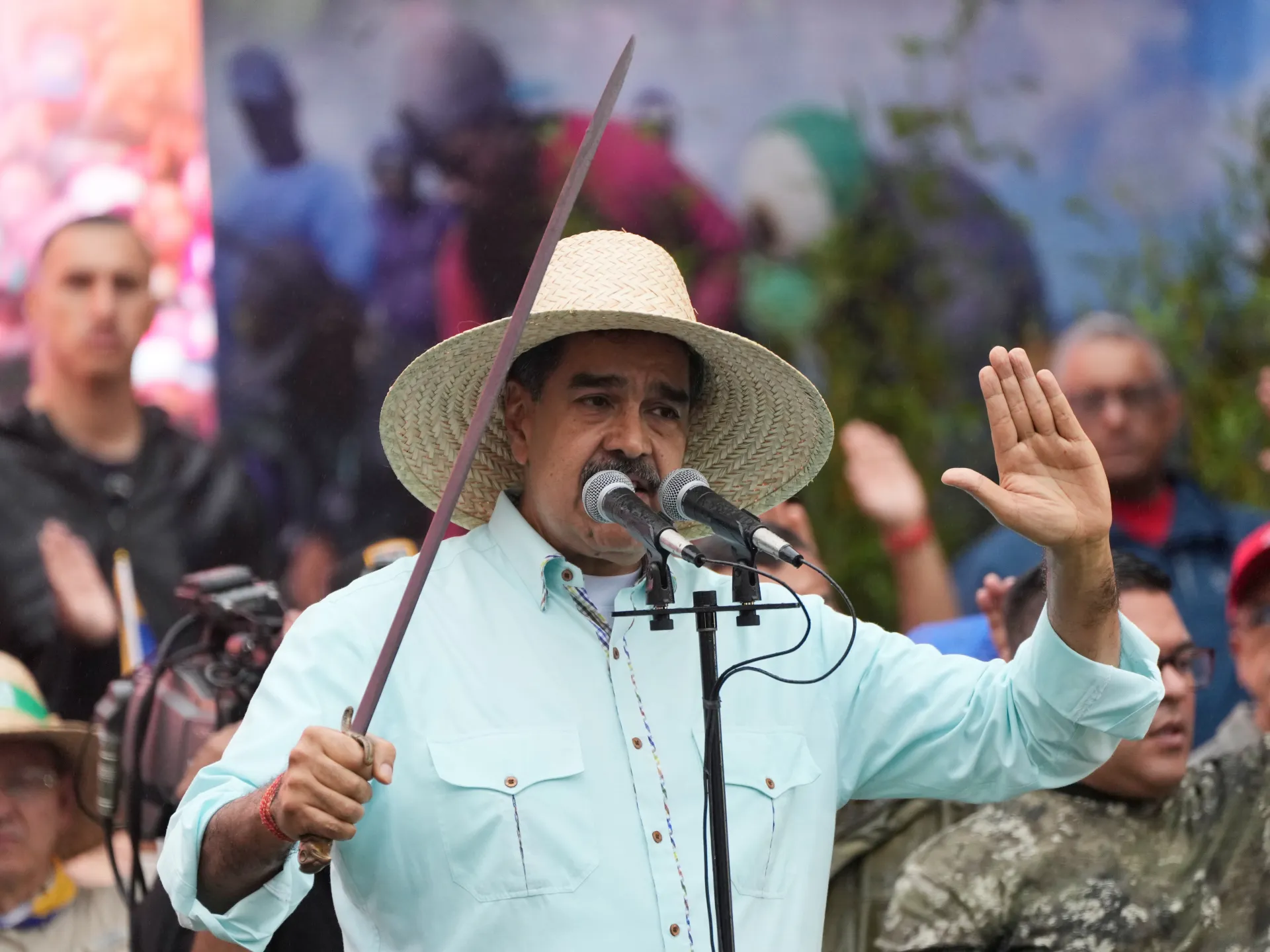
Maduro did not address the seizure during a speech before a ruling-party organized demonstration in Caracas, Venezuela’s capital. But he told supporters that Venezuela is “prepared to break the teeth of the North American empire if necessary.”

Maduro, flanked by senior officials, said that only the ruling party can “guarantee peace, stability, and the harmonious development of Venezuela, South America and the Caribbean.”

The seizure comes a day after the U.S. military flew a pair of fighter jets over the Gulf of Venezuela in what appeared to be the closest that warplanes had come to the South American country’s airspace since the start of the administration’s pressure campaign. Trump has said land attacks are coming soon but has not offered any details on location.

It was not immediately clear who owned the tanker or what national flag it was sailing under. The Coast Guard referred a request for comment to the White House.

Madhani and Toropin write for the Associated Press. AP writer Regina Garcia Cano in Caracas, Venezuela, contributed to this report.

Source link

Travelers who don’t need U.S. visa could face social media screening

Foreigners who are allowed to come to the United States without a visa could soon be required to submit information about their social media, email accounts and extensive family history to the Department of Homeland Security before being approved for travel.

The notice published Wednesday in the Federal Register said Customs and Border Protection is proposing collecting five years worth of social media information from travelers from select countries who do not have to get visas to come to the U.S. The Trump administration has been stepping up monitoring of international travelers and immigrants.

The announcement refers to travelers from more than three dozen countries who take part in the Visa Waiver Program and submit their information to the Electronic System for Travel Authorization, or ESTA, which automatically screens them and then approves them for travel to the U.S. Unlike visa applicants, they generally do not have to go into an embassy or consulate for an interview.

The Department of Homeland Security administers the program, which currently allows citizens of roughly 40 mostly European and Asian countries to travel to the U.S. for tourism or business for three months without visas.

The announcement also said that CBP would start requesting a list of other information, including telephone numbers the person has used over the last five years or email addresses used over the last decade. Also sought would be metadata from electronically submitted photos, as well as extensive information from the applicant’s family members, including their places of birth and their telephone numbers.

The application that people are now required to fill out to take part in ESTA asks a more limited set of questions such as parents’ names and current email address.

The public has 60 days to comment on the proposed changes before they go into effect, the notice said.

CBP officials did not immediately respond to questions about the new rules.

The announcement did not say what the administration was looking for in the social media accounts or why it was asking for more information.

But the agency said it was complying with an executive order that Republican President Trump signed in January that called for more screening of people coming to the U.S. to prevent the entry of possible national security threats.

Travelers from countries that are not part of the Visa Waiver Program system are already required to submit their social media information, a policy that dates to the first Trump administration. The policy remained during Democratic President Biden’s administration.

But citizens from visa waiver countries were not obligated to do so.

Since January, the Trump administration has stepped up checks of immigrants and travelers, both those trying to enter the U.S. as well as those already in the country. Officials have tightened visa rules by requiring that applicants set all of their social media accounts to public so that they can be more easily scrutinized and checked for what authorities view as potential derogatory information. Refusing to set an account to public can be considered grounds for visa denial, according to guidelines provided by the State Department.

U.S. Citizenship and Immigration Services now considers whether an applicant for benefits, such as a green card, “endorsed, promoted, supported, or otherwise espoused” anti-American, terrorist or antisemitic views.

The heightened interest in social media screening has drawn concern from immigration and free speech advocates about what the Trump administration is looking for and whether the measures target people critical of the administration in an infringement of free speech rights.

Santana writes for the Associated Press.
Source link

Homeland Security signs deal to buy 6 planes for deportations

Department of Homeland Security Secretary Kristi Noem took a tour of CECOT in Tecoluca, El Salvador, in March. This week, the Department of Homeland Security signed a contract to buy six planes with which to deport people. File Photo by Tia Dufour/U.S. Department of Homeland Security | License Photo

Dec. 10 (UPI) — The Department of Homeland Security has inked a deal to buy six Boeing 737 planes to deport immigrants.

U.S. Immigration and Customs Enforcement has used charter planes in the past for deportation flights, but this deal will allow it to operate its own fleet.

The money comes from the $170 billion that Congress authorized for Trump’s immigration control plans in a spending bill earlier this year, according to the Washington Post.

In late October, DHS announced it had deported nearly 600,000 people this year.

DHS spokesperson Tricia McLaughlin said in a statement to The Post that the planes would save money “by allowing ICE to operate more effectively, including by using more efficient flight patterns.” She said it would save $279 million in taxpayer dollars, though she didn’t elaborate.

“We are delighted to see The Washington Post is highlighting the Trump administration’s cost-effective and innovative ways of delivering on the American people’s mandate for mass deportations of criminal illegal aliens,” she said in a statement.

She added that Trump and Homeland Security Secretary Kristi Noem “are committed to quickly and efficiently getting criminal illegal aliens OUT of our country.”

In November, The Wall Street Journal reported that Noem and her chief adviser, Corey Lewandowski, directed ICE officials to buy 10 planes from Spirit Airlines for deportation flights and their own travel. But Spirit didn’t own the planes, which did not have engines.

The DHS contract is with Virginia-based Daedalus Aviation, created in February 2024, according to corporate records, The Post reported. Daedalus’s website says it “offers a full range of commercial and charter aviation services” and “provides comprehensive responsive flight operations tailored to the unique needs of each mission.”

John Sandweg, former acting director of ICE under President Barack Obama, said the purchase shows that ICE has a lot of money, but isn’t likely to be cost-effective.

“It’s so much easier to issue a contract to a company that already manages a fleet of airplanes,” Sandweg told The Post. “So this move I’m surprised by because what the administration wants to accomplish, by and large, can be accomplished through charter flights already.”

Source link

US Federal Reserve cuts interest rates in final decision of the year | Banks News

The central bank cut rates for the third time in 2025 as limited government data clouds economic outlook.

The United States Federal Reserve has cut interest rates by a quarter of a percentage point, marking the last rate cut of the year.

On Wednesday, the Federal Reserve cut its benchmark interest rate by 25 basis points to 3.50 – 3.75 percent as US job growth has appeared to stall.

Recommended Stories

list of 4 itemsend of list

“Job gains have slowed this year, and the unemployment rate has edged up through September. More recent indicators are consistent with these developments. Inflation has moved up since earlier in the year and remains somewhat elevated,” the central bank said in a statement.

The cut was widely expected with an 89 percent probability of a rate cut, according to the CME Fed Watch, a tracker which monitors the likelihood of monetary policy decisions.

The decision came as the central bank faced gaps in many sets of government data used to assess the state of the US economy. During the record-long 43-day government shutdown, key agencies, including the Department of Labor, were unable to gather information needed for their reports.

Among them were import and export prices, the producer price index report, as well state employment and unemployment. The Bureau of Labor Statistics on Monday said that it would not release numbers from October because the agency did not have enough resources to collect information.

The last top-line data that the central bank had to make its interest rate decision was from September. At the time, the unemployment rate rose slightly to 4.4 percent and the core inflation rose to 2.8 percent.

A new government report on Wednesday showed US labour costs increased 0.8 percent in the third quarter, slightly less than expected.

The central bank might be more cautious about interest rate cuts in the next year as economic data shows a cooling labour market.

“There is considerable uncertainty around the labour market, but some of the weights should begin to lift early next year,” Ryan Sweet, managing director, US Macro Forecasting and Analysis at Oxford Economics, said in a report published ahead of the central bank’s decision.

“The challenge facing the Fed next year is the potential jobless expansion, when GDP increases but employment gains are modest, at best. This leaves the economy vulnerable to shocks because the labour market is the main firewall against a recession.”

Political turmoil

While the Fed has maintained its independence from partisan interference, there has been increased pressure from US President Donald Trump to cut rates further and he has often used hostile rhetoric towards the Fed chair to do it. The first rate cut in Trump’s second term as president came only in September.

The White House has also installed loyalist Stephen Miran to the Fed board where he is on leave from his job as an economic adviser in the White House. Miran has dissented against the 25 basis point rate cut that was undertaken at each of the two meetings he has attended in favour of larger half-percentage-point cuts.

On Wednesday, Miran, again, voted for a more aggressive cut of half a percentage point while governors Austan D Goolsbee and Jeffrey R Schmid voted not to make a rate cut at all. The other governors all voted for a 25 basis point cut.

“Still elevated inflation and a backlog of economic data complicate the picture for the Fed looking into next year — with President Trump’s aggressive push for lower short-term rates potentially complicating the objective of bringing down longer-term borrowing costs,” Daniel Hornung, policy fellow at Stanford Institute of Economic Policy Research, said in remarks provided to Al Jazeera.

Fed Chair Powell’s term is up in mid-May 2026. Trump, in an interview published on Tuesday in news outlet Politico, said support for immediately cutting interest rates would be a requirement for anyone he chose to lead the Federal Reserve.

Source link

Justice Department can unseal records from Epstein’s 2019 sex trafficking case, judge says

Secret grand jury transcripts from Jeffrey Epstein’s 2019 sex trafficking case can be made public, a judge ruled on Wednesday, joining two other judges in granting the Justice Department’s requests to unseal material from investigations into the late financier’s sexual abuse.

U.S. District Judge Richard M. Berman reversed his earlier decision to keep the material under wraps, citing a new law that requires the government to open its files on Epstein and his longtime confidant Ghislaine Maxwell. The judge previously cautioned that the 70 or so pages of grand jury materials slated for release are hardly revelatory and “merely a hearsay snippet” of Epstein’s conduct.

On Tuesday, another Manhattan federal judge ordered the release of records from Maxwell’s 2021 sex trafficking case. Last week, a judge in Florida approved the unsealing of transcripts from an abandoned Epstein federal grand jury investigation in the 2000s.

The Justice Department asked the judges to lift secrecy orders in the cases after the Epstein Files Transparency Act, passed by Congress and signed into law by President Trump last month, created a narrow exception to rules that normally keep grand jury proceedings confidential. The law requires that the Justice Department disclose Epstein-related material to the public by Dec. 19.

The court records cleared for release are just a sliver of the government’s trove — a collection of potentially tens of thousands of pages of documents including FBI notes and reports; transcripts of witness interviews, photographs, videos and other evidence; Epstein’s autopsy report; flight logs and travel records.

While lawyers for Epstein’s estate told Berman in a letter last week that the estate took no position on the Justice Department’s unsealing request, some Epstein victims backed it.

“Release to the public of Epstein-related materials is good, so long as the victims are protected in the process,” said Brad Edwards, a lawyer for some victims. “With that said, the grand jury receives only the most basic information, so, relatively speaking, these particular materials are insignificant.”

Questions about the government’s Epstein files have dominated the first year of Trump’s second term, with pressure on the Republican intensifying after he reneged on a campaign promise to release the files. His administration released some material, most of it already public, disappointing critics and some allies.

Berman was matter of fact in his ruling on Wednesday, writing that the transparency law “unequivocally intends to make public Epstein grand jury materials and discovery materials” that had previously been covered by secrecy orders. The law “supersedes the otherwise secret grand jury materials,” he wrote.

The judge, who was appointed by President Clinton, a Democrat, implored the Justice Department to carefully follow the law’s privacy provisions to ensure that victims’ names and other identifying information are blacked out. Victim safety and privacy “are paramount,” he wrote.

In court filings, the Justice Department informed Berman that the only witness to testify before the Epstein grand jury was an FBI agent who, the judge noted, “had no direct knowledge of the facts of the case and whose testimony was mostly hearsay.”

The agent testified over two days, on June 18, 2019, and July 2, 2019. The rest of the grand jury presentation consisted of a PowerPoint slideshow and four pages of call logs. The July 2 session ended with grand jurors voting to indict Epstein.

Epstein, a millionaire money manager known for socializing with celebrities, politicians, billionaires and the academic elite, killed himself in jail a month after his 2019 arrest. Maxwell was convicted in 2021 by a federal jury of sex trafficking for helping recruit some of Epstein’s underage victims and participating in some of the abuse. She is serving a 20-year prison sentence.

Maxwell’s lawyer told a judge last week that unsealing records from her case “would create undue prejudice” and could spoil her plans to file a habeas petition, a legal filing seeking to overturn her conviction. The Supreme Court in October declined to hear Maxwell’s appeal.

Maxwell’s grand jury records include testimony from the FBI agent and a New York Police Department detective.

Judge Paul A. Engelmayer sought to temper expectations as he approved their release on Tuesday, writing that the materials “do not identify any person other than Epstein and Maxwell as having had sexual contact with a minor.”

“They do not discuss or identify any client of Epstein’s or Maxwell’s,” wrote Engelmayer, an appointee of President Obama, a Democrat. “They do not reveal any heretofore unknown means or methods of Epstein’s or Maxwell’s crimes.”

Sisak writes for the Associated Press.

Source link

Congressional Democrats say Paramount’s bid for Warner raises ‘serious national security concerns’

Congressional Democrats are sounding alarms over the deep involvement of Saudi Arabian and other Middle Eastern royal families in Paramount’s proposed bid for Warner Bros. Discovery.

Warner Bros. Discovery owns CNN, HBO and the historic Warner Bros. film and television studios in Burbank, behind such beloved American classics as “Casablanca,” “Citizen Kane,” and Bugs Bunny, and blockbuster hits including “Harry Potter,” “Dirty Harry,” “The Matrix,” and “Friends.”

Late last week, the Larry Ellison controlled Paramount came up short in the bidding for Warner Bros., in part, over the Warner board’s concerns about Paramount’s deal financing. On Monday, Paramount launched a hostile takeover of Warner Bros., appealing directly to Warner shareholders — asking them to sell their Warner stock to Paramount for $30 a share.

Paramount’s gambit has thrown the auction, and Warner board’s selection of Netflix’s $72-billion deal, into doubt.

Paramount has long insisted that it represents the best partner for Warner Bros., in part, because of the Ellison family’s cozy relations with President Trump. The company has trumpeted its ability to gain the blessing of the Trump administration.

Paramount’s bid is heavily backed by Saudi Arabia, Abu Dhabi and Qatar’s sovereign wealth funds. The three royal families have agreed to contribute $24 billion — twice the amount the Larry Ellison family has agreed to provide in financing for Paramount’s proposed $78-billion takeover of Warner Bros. Discovery, according to regulatory filings.

Trump son-in-law Jared Kushner’s private equity firm, Affinity Partners, would also have an ownership stake.

On Wednesday, U.S. Reps. Sam T. Liccardo (D-San Jose) and Ayanna Pressley (D-Boston) called on Warner Bros. board to recognize the consequences of selling the legendary company, which includes news organization CNN, to foreign governments.

“This transaction raises national security concerns because it could transfer substantial influence over one of the largest American media companies to foreign-backed financiers,” Liccardo and Pressley wrote.

“Warner’s platforms reach tens of millions of American households through HBO, Max, CNN, Warner Bros. Pictures, Discovery, and numerous digital and cable properties,” the lawmakers wrote. “They also shape the news, entertainment, and cultural content consumed by the American public.”

Transactions “foreign investors with governance rights, access to non-public data, or indirect influence over content distribution creates vulnerabilities that foreign governments could exploit,” the lawmakers wrote.

Paramount Chairman and Chief Executive David Ellison in the center. T

Paramount Chairman and Chief Executive David Ellison on the Paramount lot in August.

(Paramount)

Paramount, in its regulatory filings, said the three Middle Eastern families had agreed to give up voting rights and a role in the company’s decision-making — despite contributing more than half the equity needed for the deal.

Representatives of Warner Bros. and Paramount declined to comment.

The Ellison family acquired Paramount in August. David Ellison, the chief executive, attended a White House dinner last month to celebrate Saudi Crown Prince Mohammed bin Salman.

The involvement of bin Salman was concerning to the lawmakers.

“The fund is controlled by Crown Prince Mohammed bin Salman, whom (according to the declassified 2021 report of the U.S. Director of National Intelligence) ordered the murder of U.S. resident and Washington Post journalist Jamal Khashoggi,” the lawmakers wrote.

Over the weekend, Trump said the Netflix deal, which would give the streaming an even more commanding presence in the industry, “could be a problem.”

Source link

House to debate military funding bill; some GOP members unhappy

Dec. 10 (UPI) — The House of Representatives will vote on Wednesday on the bipartisan $900 billion defense policy bill, though some lawmakers take issue with some of its provisions.

The 3,086-page bill authorizes $8 billion more in spending than President Donald Trump had asked for.

“This year’s National Defense Authorization Act helps advance President Trump and Republicans’ Peace Through Strength Agenda by codifying 15 of President Trump’s executive orders, ending woke ideology at the Pentagon, securing the border, revitalizing the defense industrial base, and restoring the warrior ethos,” House Speaker Mike Johnson said in a statement.

The bill would codify the use of active-duty troops at the U.S.-Mexico border, create a “Golden Dome” to protect the U.S. from aerial attacks and ban diversity, equity and inclusion programs at the Department of Defense. The bill would also create a 3.8% raise for all service members.

It includes a ban on transgender women competing in sports at military academies.

The annual legislation has normally been approved with bipartisan support. But several Republicans have voiced dissent.

“I think that it’s in trouble because it’s not the version we sent over,” Rep. Anna Paulina Luna, R-Fla., told The Hill. She said she was disappointed with the bill because it authorizes funds for the Ukraine Security Assistance Initiative. It includes $400 million for military help to Ukraine in fiscal years 2026 and 2027.

Last week, Rep. Elise Stefanik, R-N.Y., criticized Johnson for blocking a provision requiring the FBI to tell Congress when it begins counterintelligence investigations on candidates running for federal office. It was later added.

Rep. Marjorie Taylor Greene, R-Ga., said on X that the bill will “fund foreign aid and foreign country’s wars.” She also accused Republican leadership of breaking a promise to include a ban on creating a central bank digital currency. Hardline conservatives have argued that the digital currency could be used to spy on Americans.

“Conservatives were promised that an anti-Central Bank Digital Currency language, authored by Tom Emmer, the whip, would be in the NDAA,” Rep. Keith Self, R-Texas, said on Fox Business Monday. “There are red lines that we need to put in here.”

Emmer, R-Minn., said about leaving the anti-CBDC segment out, “they’ll understand what is going on, and they’ll be fine,” The Hill reported.

Rep. Andy Harris, R-Md., said he doesn’t like that the bill allows “8 billion more than we should have.”

Defense Secretary Pete Hegseth will see his travel budget cut under the bill until the Pentagon releases the footage of strikes against alleged drug boats near Venezuela. His travel budget would be reduced by 25% until he shares “unedited video of strikes conducted against designated terrorist organizations in the area of responsibility of the United States Southern Command.”

It also requires him to submit some overdue reports before getting his travel budget back.

“That was a bipartisan shot across the bow to Donald Trump to hand over the tapes, done by Republicans. I salute them for their courage for bucking Trump and bucking Hegseth,” Senate Minority Leader Chuck Schumer, D-N.Y., said on the Senate floor Tuesday.

President Donald Trump walks on the South Lawn of the White House after arriving on Marine One in Washington on Tuesday. Trump said people were “starting to learn” the benefits of his tariff regime. Photo by Graeme Sloan/UPI | License Photo

Source link

WTF? Embracing profanity is one thing both political parties seem to agree on

As he shook President Obama’s hand and pulled him in for what he thought was a private aside, Vice President Joe Biden delivered an explicit message: “This is a big f——— deal.” The remark, overheard on live microphones at a 2010 ceremony for the Affordable Care Act, caused a sensation because open profanity from a national leader was unusual at the time.

More than 15 years later, vulgarity is now in vogue.

During a political rally Tuesday night in Pennsylvania that was intended to focus on tackling inflation, President Trump used profanity at least four times. At one point, he even admitted to disparaging Haiti and African nations as “ shithole countries ” during a private 2018 meeting, a comment he denied at the time. And before a bank of cameras during a lengthy Cabinet meeting last week, the Republican president referred to alleged drug smugglers as “sons of b——-s.”

While the Biden incident was accidental, the frequency, sharpness and public nature of Trump’s comments are intentional. They build on his project to combat what he sees as pervasive political correctness. Leaders in both parties are seemingly in a race now to the verbal gutter.

Vice President JD Vance called a podcast host a “dips—t” in September. In Thanksgiving remarks before troops, Vance joked that anyone who said they liked turkey was “full of s—-.” After one National Guard member was killed in a shooting in Washington last month and a second was critically injured, top Trump aide Steven Cheung told a reporter on social media to “shut the f—- up” when she wrote that the deployment of troops in the nation’s capital was “for political show.”

Among Democrats, former Vice President Kamala Harris earned a roar of approval from her audience in September when she condemned the Trump administration by saying “these mother———- are crazy.” After Trump called for the execution of several Democratic members of Congress last month, Sen. Chris Murphy, D-Conn., said it was time for people with influence to “pick a f——— side.” Senate Democratic leader Chuck Schumer of New York said the administration cannot “f—- around” with the release of the Jeffrey Epstein files. Democratic Rep. Jasmine Crockett, who on Monday announced her Senate campaign in Texas, did not hold back earlier this year when asked what she would tell Elon Musk if given the chance: “F—- off.”

The volley of vulgarities underscore an ever-coarsening political environment that often plays out on social media or other digital platforms where the posts or video clips that evoke the strongest emotions are rewarded with the most engagement.

“If you want to be angry at someone, be angry at the social media companies,” Utah Gov. Spencer Cox, a Republican, said Tuesday night at Washington National Cathedral, where he spoke at an event focused on political civility. “It’s not a fair fight. They’ve hijacked our brains. They understand these dopamine hits. Outrage sells.”

Cox, whose national profile rose after calling for civility in the wake of conservative activist Charlie Kirk’s assassination in his state, approved an overhaul of social media laws meant to protect children. A federal judge has temporarily blocked the state law.

Tough political talk is nothing new

Tough talk is nothing new in politics, but leaders long avoided flaunting it.

Recordings from Democrat Lyndon B. Johnson’s administration, for instance, revealed a crude, profane side of his personality that was largely kept private. Republican Richard Nixon bemoaned the fact that the foul language he used in the Oval Office was captured on tape. “Since neither I nor most other Presidents had ever used profanity in public, millions were shocked,” Nixon wrote in his book “In the Arena.”

“Politicians have always sworn, just behind closed doors,” said Benjamin Bergen, a professor at the University of California-San Diego’s Department of Cognitive Science and the author of “What the F: What swearing reveals about our language, our brains, and ourselves.” “The big change is in the past 10 years or so, it’s been much more public.”

As both parties prepare for the 2026 midterm elections and the 2028 presidential campaign, the question is whether this language will become increasingly mainstream. Republicans who simply try to imitate Trump’s brash style do not always succeed with voters. Democrats who turn to vulgarities risk appearing inauthentic if their words feel forced.

For some, it is just a distraction.

“It’s not necessary,” said GOP Rep. Don Bacon of Nebraska, who is retiring next year after winning five elections in one of the most competitive House districts. “If that’s what it takes to get your point across, you’re not a good communicator.”

There are risks of overusing profanity

There also is a risk that if such language becomes overused, its utility as a way to shock and connect with audiences could be dulled. Comedian Jerry Seinfeld has talked about this problem, noting that he used swear words in his early routines but dropped them as his career progressed because he felt profanity yielded only cheap laughs.

“I felt like well I just got a laugh because I said f—- in there,” he said in a 2020 interview on the WTF podcast with fellow comedian Marc Maron. “You didn’t find the gold.”

White House spokesperson Liz Huston said Trump “doesn’t care about being politically correct, he cares about Making America Great Again. The American people love how authentic, transparent, and effective the President is.”

But for Trump, the words that have generated the most controversy are often less centered in traditional profanity than slurs that can be interpreted as hurtful. The final weeks of his 2016 campaign were rocked when a tape emerged of him discussing grabbing women by their genitals, language he minimized as “locker room talk.” His “shithole” remark in 2018 was widely condemned as racist.

More recently, Trump called a female journalist “piggy,” comments that his press secretary, Karoline Leavitt, defended as evidence of a president who is “very frank and honest.” Trump’s use of a slur about disabled people prompted an Indiana Republican whose child has Down syndrome to come out in opposition to the president’s push to redraw the state’s congressional districts.

On rare occasions, politicians express contrition for their choice of words. In an interview with The Atlantic published last week, Gov. Josh Shapiro, D-Pa., dismissed Harris’ depiction of him in her book about last year’s presidential campaign by saying she was “trying to sell books and cover her a—.”

He seemed to catch himself quickly.

“I shouldn’t say ‘cover her a—,” he said. “I think that’s not appropriate.”

Sloan writes for the Associated Press.
Source link

Democrat wins Miami mayor’s race for the first time in nearly 30 years

Democrat Eileen Higgins won the Miami mayor’s race on Tuesday, defeating a Republican endorsed by President Trump to end her party’s nearly three-decade losing streak and give Democrats a boost in one of the last electoral battles ahead of the 2026 midterms.

Higgins, 61, will be the first woman to lead the city of Miami. She spoke frequently in the Hispanic-majority city about Trump’s immigration crackdown, saying she has heard of many people in Miami who were worried about family members being detained. She campaigned as a proud Democrat despite the race being officially nonpartisan and beat Trump-backed candidate Emilio Gonzalez, a former city manager, who said he called Higgins to congratulate her.

“We are facing rhetoric from elected officials that is so dehumanizing and cruel, especially against immigrant populations,” Higgins told The Associated Press after her victory speech. “The residents of Miami were ready to be done with that.”

With nearly all votes counted Tuesday, Higgins led the Republican by about 19 percentage points.

The local race is not predictive of what may happen at the polls next year. But it drew attention from the two major national political parties and their leaders. The victory provides Democrats with some momentum heading into a high-stakes midterm election when the GOP is looking to keep its grip in Florida, including in a Hispanic-majority district in Miami-Dade County. The area has shifted increasingly rightward politically in recent years, and the city may become the home of Trump’s presidential library.

“Tonight’s result is yet another warning sign to Republicans that voters are fed up with their out-of-touch agenda that is raising costs,” said Ken Martin, the chair of the Democratic National Committee, in a statement.

Some nationally recognized Democrats supported Higgins, including former Transportation Secretary Pete Buttigieg. U.S. Sen. Ruben Gallego and former Chicago Mayor Rahm Emanuel traveled to Miami on Sunday and Monday to rally voters for the Democrat who served as a Miami-Dade county commissioner for seven years.

Higgins, who speaks Spanish, represented a district that leans conservative and includes the Cuban neighborhood of Little Havana. When she first entered politics in 2018, she chose to present herself to voters as “La Gringa,” a term Spanish speakers use for white Americans, because many people did not known how to pronounce her name.

“It just helps people understand who I am, and you know what? I am a ‘gringa,’ so, what am I going to do, deny it?” she told the AP.

Republicans’ anxiety grows

Republicans in Florida have found strong support from voters with heritage from Cuba, Venezuela and Nicaragua, because they likened some members of the Democratic party’s progressive wing with politicians from the governments they fled. Trump and other GOP members have tapped into those sentiments over the past eight years.

However, some local Republicans are growing increasingly frustrated since November’s elections when Democrats scored wins in New Jersey and Virginia, where both winning gubernatorial candidates performed strongly with nonwhite voters.

The results from those races were perceived as a reflection of concerns over rising prices and the Trump administration’s aggressive immigration policies.

U.S. Rep. Maria Elvira Salazar, a Republican whose district is being targeted by Democrats and includes the city of Miami, called the elections elsewhere a “wake-up call.” She said Hispanics also want a secure border and a healthy economy but some relief for “those who have been here for years and do not have a criminal record.”

“The Hispanic vote is not guaranteed,” Salazar said in a video posted on X last month. “Hispanics married President Trump, but they are only dating the GOP.”

David Jolly, who is running to represent Democrats in the Florida governor’s race next year, said the mayoral election was good news for Democrats in what used to be a battleground state.

“Change is here. It’s sweeping the nation, and it’s sweeping Florida,” Jolly said.

Miami mayor-elect gains national platform

The mayoral position in Miami is more ceremonial, but Higgins promised to execute it like a full-time job.

The city is part of Miami-Dade County, which Trump flipped last year, a dramatic improvement from his 30 percentage point loss to Democrat Hillary Clinton in 2016.

As Florida’s second-largest city, Miami is considered the gateway to Latin America and attracts millions of tourists. Its global prominence gives Higgins a significant stage as mayor.

Her pitch to voters included finding city-owned land that could be turned into affordable housing and cutting unnecessary spending.

Licon writes for the Associated Press.

Source link

Judge: Epstein grand jury files can be released

A demonstrator holds a poster during a press conference on the Epstein Files Transparency Act on Nov. 18 in Washington, D.C. On Wednesday, a New York federal judge ruled that the grand jury files in the case against Jeffrey Epstein can be released. File Photo by Bonnie Cash/UPI | License Photo

Dec. 10 (UPI) — A federal judge in New York said Wednesday that the 2019 grand jury files in the case against convicted sex offender Jeffrey Epstein can be released.

U.S. District Judge Richard Berman had denied a previous request by the Department of Justice. Grand jury proceedings are normally sealed. But the Epstein Files Transparency Act — signed into law on Nov. 19 — now allows for the release, Berman said.

“The Court hereby grants the Government’s motion in accordance with the Epstein Files Transparency Act and with the unequivocal right of Epstein victims to have their identity and privacy protected,” he said in the four-page ruling.

A federal judge in Florida on Dec. 5 ordered the release of grand-jury transcripts from the investigation against Epstein from 2005 to 2007. That investigation was abandoned.

The ruling comes one day after a similar ruling in which a judge allowed the release of grand jury files in the case of Epstein’s accomplice, Ghislaine Maxwell, who is serving 20 years for child sex trafficking. Epstein died by suicide in prison in 2019.

Congressional Democrats recently released photos of Epstein’s private island, Little St. James, in the U.S. Virgin Islands.

President Donald Trump walks on the South Lawn of the White House after arriving on Marine One in Washington on Tuesday. Trump said people were “starting to learn” the benefits of his tariff regime. Photo by Graeme Sloan/UPI | License Photo

Source link

Venezuela’s Machado unable to pick up her Nobel Peace Prize in Oslo

Ana Corina Sosa addresses the audience at Oslo City Hall on Wednesday after accepting the 2025 Nobel Peace Prize on behalf of her mother, Maria Corina Machado, who was given the award in her absence in recognition of her struggle for democracy in Venezuela. Sosa proceeded to deliver a lecture written by her mother who was unable to attend due to a travel ban. Pool photo by Ole Berg-Rusten/EPA

Dec. 10 (UPI) — Nobel Peace Prize laureate Maria Corina Machado did not attend a ceremony in Oslo to receive her award on Wednesday as the Venezuelan opposition leader was in hiding from the regime of President Nicolas Maduro, somewhere in the country.

The Norwegian committee said in a news release that Machado had done everything possible to make what it said would have been a very risky journey, but confirmed she was safe and appeared to suggest her imminent arrival in Norway.

“Machado has done everything in her power to come to the ceremony today. A journey in a situation of extreme danger. Although she will not be able to reach the ceremony and today’s events, we are profoundly happy to confirm that she is safe and that she will be with us in Oslo,” the statement read.

The news followed days of contradictory statements over whether Machado, who has been in hiding since disputed elections in July 2024, would make it to Oslo. Machado, who has been repeatedly threatened with arrest by Venezuelan authorities has not appeared in public since January.

Machado’s daughter, Ana Corina Sosa, received the diploma and medal on her behalf at the ceremony at City Hall in the Norwegian capital.

The committee shared a recording of a phone call with Machado in which she confirmed she would not attend to receive her prize, which was awarded in recognition “her struggle to achieve a just and peaceful transition from dictatorship to democracy.”

“I want to thank the Norwegian Nobel committee for this immense recognition to the fight of our people for democracy and freedom. We feel very emotional and very honoured, and that’s why I’m very sad and very sorry to tell you that I won’t be able to arrive in time for the ceremony, but I will be in Oslo and on my way to Oslo right now.

“I know that there are hundreds of Venezuelans from different parts of the world that were able to reach your city, that are right now in Oslo, as well as my family, my team, so many colleagues. Since this is a prize for all Venezuelans, I believe that it will be received by them.”

Machado, who ran for president in 2011 and attemped to run last year, has been a leader of the country’s democratic movement more than 20 years, opposing and holding to account the administration of Hugo Chavez, first, and then the authoritarian rule of Maduro.

She was elected to the National Assembly in 2010 but removed in 2014 after being accused of conspiring with other critics and the United States to assassinate Maduro. She denies the charges which she says were based on fabricated evidence.

In October 2023, she won a primary to run against Maduro in last summer’s election, to which the Maduro government responded by banning her from politics for 15 years. She was replaced on the ballot by Edmundo Gonzalez.

The results of the July 2024 were widely rejected by the opposition and internationally, including by Brazil, Colombia and the United States, which instead recognized Gonzalez as the real winner.

He fled the country in September in 2024 and was granted political asylum in Spain.

Representative Shigemitsu Tanaka (L) holds the medal while Toshiyuki Mimaki holds the certificate for the 2024 Nobel Peace Prize winner Nihon Hidankyo, a Japanese grassroots movement of atomic bomb survivors from Hiroshima and Nagasaki, at the Nobel Prize awarding ceremony in Oslo, Norway. The honor was for advocating on behalf of atomic bomb survivors and nuclear disarmament. File Photo by Paul Treadway/UPI | License Photo

Source link

Hungary Puts Juvenile Centres Under Police Oversight Following Abuse Scandal

Hungary’s government has moved state-run juvenile detention centres under direct police supervision in response to an abuse scandal at a facility in Budapest. The decision comes after a video showing physical abuse at the centre was published by a former lawmaker and opposition activist, sparking public outrage.

Incident Details
The video led to the resignation of the acting director of the Budapest juvenile centre. Prosecutors have detained three people connected to the state-run facility and are investigating the former director for alleged involvement in prostitution, money laundering, and human trafficking. The government cited failures in the social care system’s management of these centres as a key factor in the decision to place them under police oversight.

Political Fallout
Opposition leader Peter Magyar, head of the Tisza party, has called on Prime Minister Viktor Orban to resign and urged early elections. Magyar also announced a demonstration for Saturday in Budapest to protest the scandal. This incident follows a previous controversy that led to the resignation of President Katalin Novak, marking a rare political setback for Orban, who has been in power since 2010.

Current Status
The five state-run juvenile detention centres are now under direct police supervision. Prosecutors continue investigations into the abuse allegations, and further details are expected. Public demonstrations and political pressure are mounting ahead of upcoming elections.

With information from Reuters.

Source link

Machado in Oslo, but will not attend Nobel Peace ceremony to receive award | Politics News

The build-up to the ceremony has been tinged with shadowy intrigue, after the Nobel institute earlier said Machado’s whereabouts were unknown.

Venezuelan opposition leader Maria Corina Machado will not receive the Nobel Peace Prize in person at an award ceremony in Oslo but she will be in the European city, the director of the Norwegian Nobel Institute has said.

Machado, 58, was due to receive the award on Wednesday at Oslo City Hall in the presence of Norway’s monarchs and Latin American leaders, including fellow right-wing politicians Argentinian President Javier Milei and Ecuadorean President Daniel Noboa.

Recommended Stories

list of 4 itemsend of list

The opposition leader of the Vente Venezuela party was awarded the prize in October, with the Nobel committee praising Machado’s role in the country’s opposition movement and her “steadfast” support for democracy.

Machado, who holds many right-wing views, dedicated it in part to United States President Donald Trump, who has said he, himself deserved the honour and was infuriated that he did not.

“Although she will not be able to reach the ceremony and today’s events, we are profoundly happy to confirm that Machado is safe and that she will be with us in Oslo,” the institute stated.

She is expected to reach Oslo “sometime between this evening and tomorrow morning,” the institute’s director Kristian Berg Harpviken told the AFP news agency on Wednesday, shortly before the 1pm (12:00 GMT) ceremony, at which her daughter, Ana Corina Sosa Machado, is set to accept the award in her place.

“I will be in Oslo, I am on my way,” Machado stated in an audio recording released by the institute.

The announcement was part of a sequence of events more befitting of cloak-and-dagger intrigue, as the institute had earlier stated Machado’s whereabouts were unknown. A planned news conference a day earlier was also cancelled due to her absence.

Machado has a decade-long travel ban on her and has spent more than a year in hiding.

Alignment with right-wing hawks

The political leader has welcomed international sanctions and US military intervention in Venezuela, a move her critics say harkens back to a dark past.

The US has a long history of interference in the region, particularly in the 1980s when it propped up repressive right-wing governments through coups, and funded paramilitary groups across Latin America that were responsible for mass killings, forced disappearances and other grave human rights abuses.

Venezuelan authorities cited Machado’s support for sanctions and US intervention when they barred her from running for office in last year’s presidential election, where she had intended to challenge President Nicolas Maduro. Machado has accused Maduro of stealing the July 2024 election.

Shortly after her Nobel win in October, Machado also voiced support for Israel in a phone call with Prime Minister Benjamin Netanyahu, during its ongoing genocidal war in Gaza.

Machado has previously pledged to move Venezuela’s embassy in Israel to Jerusalem, as Trump did with the US diplomatic presence during his first term in office, if her movement comes to power. This would be on par with other right-wing Latin American leaders who have taken pro-Israel stances, including Argentina’s Milei and former Brazilian President Jair Bolsonaro.

Machado has aligned herself with right-wing hawks close to Trump who argue that Maduro has links to criminal gangs that pose a direct threat to US national security, despite doubts raised by the US intelligence community.

The Trump administration has ordered more than 20 military strikes in recent months against alleged drug-trafficking vessels in the Caribbean and off Latin America’s Pacific coast.

Human rights groups, some US Democrats and several Latin American countries have condemned the attacks as unlawful extrajudicial killings of civilians.

Maduro, in power since 2013 following the death of Hugo Chavez, says Trump is pushing for regime change in the country to access Venezuela’s vast oil reserves. He has pledged to resist such attempts.

Venezuela’s armed forces are planning to mount a guerrilla-style resistance in the event of a US air or ground attack, according to sources with knowledge of the efforts and planning documents seen by the Reuters news agency.

Source link

They Really Deserve a Raise

Less than five months after the House wilted under the heat of an organized pressure campaign and voted down higher pay for members of Congress and other federal officials, Speaker Thomas S. Foley is again saying that judicial and executive branch pay should be raised, preferably by action this year. He’s right, and it would be just as right to extend the prospect of higher pay to Congress as well, however politically unpalatable that idea might seem right now. The fact is that pay scales in all branches of government have fallen far behind what they ought to be. Worse, in the case of Congress, the present pay ceiling continues to provide an excuse for accepting outside fees, thus inescapably corrupting the legislative process.

A lot of people, to be sure, remain distinctly unimpressed by calls for higher federal pay. It’s not hard to see why. At $89,500 a year, a member of Congress, a federal district judge, a civilian secretary of one of the armed services or a deputy secretary in the Department of State, Defense or Treasury already earns far more than the great majority of people. Indeed, these salaries, like the $99,500 Cabinet officers are paid annually, puttheir recipients among the 4% or 5% best-paid Americans. People who have to get by on a lot less have every reason to wonder why certain well-paid public servants should be paid even more.

The best answer, at least for the judicial and executive branches, has to do with equity and pay competitiveness. Americans want high-quality public servants; that, we think, can be taken as a given. But quality is a marketable value.

There are, happily for the nation, a lot of talented and selfless people in the federalgovernment who are willing to work for less than they could earn elsewhere because they aregenuinely committed to public service. It’s one thing, though, to be prepared to work for less; it’s something else to be asked to accept a rate of pay that is effectively punitive.

A good lawyer invited to the federal bench is usually asked to give up an annual income three or more times greater than what he will earn as a judge. And a Cabinet officer or senior executive-branch official almost certainly could expect to earn four, six or even 10 times as much in the private sector. No one has ever suggested that government should pay such people what the private sector offers. But certainly, if talented people are to be drawn to and remain in federal service, they deserve to be paid 40% or 50% more than what they are offered now.

And Congress? The Senate and House are institutions where the idea that you get what you pay for almost certainly doesn’t apply, because as an institution Congress really doesn’t compete with the private sector. The real issue with Congress is that its members should be paid more primarily so they will no longer have an excuse for accepting money from special pleaders in the form of “honoraria,” speaking fees or phony book “royalties.” What’s needed, in short, is a congressional pay increase of, say, 40%, which is comparable to the Senate’s present limit on outside income, welded to a ban on accepting any fees or rewards for outside appearances, talks, publications or whatever. That provision ought to seriously weaken, even if it doesn’t wholly eliminate, the temptation to sell votes and influence for cash and other favors.

Yes, Congress should be held to a strict standard of legislative honesty even without the incentive of higher pay. The unpleasant fact is that we’re not likely to achieve the first without providing the second. In any event, Congress will probably be asked to reconsider the question of higher federal pay before the year is out. This time it ought to do the right thing and vote senior federal officials, members of Congress included, the pay boosts that are so long overdue.

Source link

Zelensky offers to hold elections in 3 months, with Western security

Ukrainian President Volodymyr Zelensky (L) is greeted by Italian Prime Minister Giorgia Meloni on Tuesday as he arrives for a meeting at the Chigi Palace in Rome. Photo by Riccardo Antimiani/EPA

Dec. 10 (UPI) — Ukrainian President Volodymyr Zelensky said Ukraine could hold elections within the next three months in response to allegations by U.S. President Donald Trump that Kyiv was using the war as an excuse to stay in power.

Speaking to reporters Tuesday evening, Zelensky said he was ready for elections and would seek to hold them on condition that the United States and other allies provided guarantees to keep voters safe at a time when Ukraine’s cities were under attack day and night.

“I’m asking now, and stating this openly, for the U.S. to help me. Together with our European partners, we can ensure the security needed to hold elections. If that happens, Ukraine will be ready to conduct elections in the next 60 to 90 days,” said Zelensky.

“I personally have the will and readiness for this,” he added, saying that he had instructed lawmakers to come with proposals to amend legislation that currently prohibits the holding of elections while the country is under a state of martial law.

“I’m waiting for proposals from our partners, expecting suggestions from our lawmakers, and I am ready to go to the elections,” Zelensky said.

Zelensky’s comments came after Trump, in an interview with Politico, said “it’s time” for Ukraine to hold an election because it was getting to the point where it was no longer a democracy.

“I think it’s an important time to hold an election. You know, they’re using war not to hold an election, but I would think the Ukrainian people would, you know, should have that choice. And maybe Zelensky would win. I don’t know who would win, but they haven’t had an election in a long time,” Trump said.

“You know, they talk about a democracy, but it gets to a point where it’s not a democracy anymore.”

Ukraine has been under martial law since Russia launched its full-scale invasion on Feb. 24, 2022, meaning that Zelensky has remained in office long beyond the expiration of his five-year term in May 2024.

Zelensky said in September that he would not run for a second term, saying his goal was to serve his country amid a crisis and finish the war, not win elections.

The offer represents a new position for his administration. For the first half of the war it completely rejected suggestions that elections should be held before relenting to U.S. pressure and saying toward the end of 2024 that it would consider holding elections if a cease-fire were implemented.

A significant majority of Ukrainians say elections should be held only after the war ends, with only around a fifth in favor of elections following a cease-fire. Support for Zelensky is also down markedly, after a recent corruption scandal involving some of his close associates.

Critics warn of numerous pitfalls of elections, ranging from the logistical issue of people being in the wrong places with large numbers of Ukrainians displaced internally, 4 million refugees overseas and 1 million mobilized in the military. There is also the question of how to include Ukrainians living in regions of the country occupied by Russia.

“In order for these elections to be fair all of the people of Ukraine would need to be allowed to vote,” Ukrainian opposition MP Lesia Vasylenko told the BBC.

“Elections are never possible in wartime.”

The United States, Canada, Australia and New Zealand all held elections during World War II with only Britain effectively suspending democracy in favor of a government of national unity through July 1945. However, Britain was the only nation under direct, sustained attack and imminent threat of invasion.

Tuesday’s moves came amid a U.S. drive to broker a peace deal that was making little to no headway in bridging the gap between Moscow, which is demanding Ukraine cede territory and demilitarize and Kyiv, which has vowed not to give up land or cut the size of its military without cast-iron security guarantees.

South Africans honor Nelson Mandela

Large crowds gather outside Nelson Mandela’s former home in the Johannesburg suburb of Houghton to pay their respects on December 7, 2013. Mandela, former South African president and a global icon of the anti-apartheid movement, died on December 5 at age 95 after complications from a recurring lung infection. Photo by Charlie Shoemaker/UPI | License Photo

Source link

How deferments protected Donald Trump from serving in Vietnam

Donald Trump’s public feud with the Muslim family of a fallen soldier has drawn attention to the businessman’s own record of military service.   

Khizr Khan delivered an emotional speech at the Democratic National Convention in which he told the story of his son, Humayun, who was killed in 2004 by a car bomb while serving in Iraq. In his remarks, Khan, with his wife at his side, said the Republican presidential nominee had “sacrificed nothing” for his country. 

And in a response condemned by both Democrats and Republicans, Trump criticized the Gold Star parents and insisted his own “sacrifices” included creating jobs and helping establish a Vietnam War memorial in New York.

But for all of Trump’s boasting about his support from veterans, he has never served in the military, thanks to a string of deferments that enabled him to avoid the draft during the Vietnam War. 

Here’s a look at what happened: 

Trump graduates from New York Military Academy in 1964 as Vietnam War is ramping up.

At the military academy, Trump wore a uniform and participated in marching drills all four years, up until his graduation in the spring of 1964.  In March 1965, the first U.S. combat troops arrived on the ground in Vietnam.

Shortly after his 18th birthday, Trump registered with the Selective Service on June 24, 1964. Federal law requires men at age 18 to register and be available for military draft. His Selective Service card noted that Trump was 6-foot-2 and 180 pounds. Under a section titled “physical characteristics” it stated that Trump has a birthmark on both heels. 

Registering made Trump a candidate for a military draft, which was about to ramp up as U.S. involvement in Vietnam grew. 

But Trump said he wanted to pursue his education so he could enter the real estate business and follow in the footsteps of his father, Fred, who had built a profitable company in New York.

Donald Trump’s Selective Service card (National Archives and Records Administration )

(Kurtis Lee)

College deferments during his years at Fordham and the University of Pennsylvania.

Trump decided to stay in New York, enrolling at Fordham University in the fall of 1964. He would remain there for two years, before transferring to the Wharton School at the University of Pennsylvania, where he would study business. 


Trump received four education deferments while in school, according to the National Archives and Records Administration.

The first education deferment came on July 28, 1964, several weeks before he began his freshman year at Fordham. Trump received similar deferments his sophomore, junior and senior years. 

The deferments ended once he graduated from Wharton, making the then-22-year-old Trump eligible to be drafted again.

After college, Trump receives a medical deferment.

Trump graduated in 1968, one of the most turbulent years of the war. He set his sights on returning to New York.

On Oct. 15, several months after his graduation that spring, Trump was granted a 1-Y medical deferment. 

In an interview with the New York Times, Trump said the reason he received the medical deferment was because of  bone spurs in his heels.

The National Archives and Records Administration does not specify the reason for the medical deferment, only that it resulted from a September 1968 physical exam that “disqualified” him from service. 

“I had a doctor that gave me a letter — a very strong letter on the heels,” Trump told the New York Times.

Trump spokeswoman Hope Hicks declined to offer additional comment about the deferment. 

Election 2016 | Live coverage on Trail Guide | Sign up for the newsletter

What’s a 1-Y medical deferment?

This deferment was handed out to individuals with health conditions that would have limited their effectiveness to serve. Those conditions, among others, included high blood pressure, severe asthma and allergies. 

Registrants who received this deferment were deemed “not qualified for military service” by the Selective Service. 

Trump’s high lottery number for the draft.

When the draft lottery for Vietnam began in December 1969, Trump was already shielded because of his medical deferment. 

Over the years, Trump has offered few details about his deferments, but has sometimes said the reason he did not fight in Vietnam was because he was fortunate enough to receive a high lottery number. 

“If I would have gotten a low number, I would have been drafted. I would have proudly served,” he told ABC News last year. “But I got a number, I think it was 356. That’s right at the very end. And they didn’t get — I don’t believe — past even 300, so I was — I was not chosen because of the fact that I had a very high lottery number.”

An official for the National Archives confirmed that Trump received a draft number of 356 out of 365.

But before that, Trump was protected from the draft for more than year by his 1-Y medical deferment. 

The draft ended in 1973. 

Listen to Trump talk about his draft number and deferments:

What are Trump’s views on not serving?

At a campaign rally in New Hampshire last year, after Trump had criticized the war record  of Sen. John McCain for being captured and held prisoner in Vietnam, he expressed some guilt about having not served. 

“I didn’t serve, I haven’t served,” said Trump. “I always felt a little guilty.”

Trump’s relations with veterans groups.

Trump has aggressively courted veterans in his presidential campaign and boasted of his contributions to veterans’ causes. But many of those donations remain undocumented. 

Earlier this year, the Washington Post found that Trump had raised $3.1 million at a January fundraiser for veterans, despite proclaiming  he had raised about $6 million. At that same fundraiser, Trump pledged to personally donate $1 million to veterans’ causes. Only after intense pressure and questions from reporters did Trump make good on his pledge four months later. 

While speaking at the Veterans of Foreign Wars conference last month, Trump asserted he would be the best commander-in-chief that veterans have ever seen. “Our debt to you is eternal — yet our politicians have totally failed you,” he said. 

Yet after his confrontation with the Khan family, the VFW issued a statement condemning Trump’s remarks. 

“Election year or not, the VFW will not tolerate anyone berating a Gold Star family member for exercising his or her right of speech or expression,” said Brian Duffy, head of the veterans organization. “There are certain sacrosanct subjects that no amount of wordsmithing can repair once crossed.”

Numerous other Gold Star families called upon Trump to apologize, but he has said he does not regret responding to what he called Khan’s “vicious” attack against him.

At a Virginia rally Tuesday, a retired lieutenant colonel gave Trump his Purple Heart medal in a gesture of support. Trump thanked him and said, “I always wanted to get the Purple Heart. This was much easier.”

Follow @kurtisalee on Twitter 

kurtis.lee@latimes.com 

ALSO

Op-Ed: Why Trump can’t tell the difference between a Twitter war and a presidential campaign

Foreign leaders long refrained from commenting on U.S. elections. Then Trump came along.

‘A sense of panic is rising’ among Republicans over Trump, including talk of what to do if he quits


Source link

Justice Scalia: Americans ‘should learn to love gridlock’

Many Americans think badly of the government because of “gridlock” in Washington. Supreme Court Justice Antonin Scalia is not one of them.

Americans “should learn to love gridlock,” he told the Senate Judiciary Committee on Wednesday. “The framers (of the Constitution) would say, yes, ‘That’s exactly the way we set it up. We wanted power contradicting power (to prevent) an excess of legislation.’ ”

And that was in 1787, he added. They “didn’t know what an excess of legislation was.”

Scalia, the longest-serving justice, contrasted the American system to those of governments in Europe, and he said this country’s Constitution is better because it provides for an independent president, an independent judiciary and two independent branches of Congress.

“I hear Americans nowadays … talk about dysfunctional government because there’s disagreement,” he said. If they understood the Constitution, he continued, they can “learn to love the separation of powers, which means learning to love gridlock, which the framers believed would be the main protection of minorities.”

Scalia discounted the importance of the Bill of Rights and its protection for freedom of speech and the press. “Every banana republic has a Bill of Rights,” he said. Those are “just words on paper.” It depends on the “structure of government,” including independent courts, to enforce the rights of individuals.

The Senate committee invited Scalia and Justice Stephen G. Breyer to talk about the role of judges, and the two carried on a two-hour conversation about their views of the Constitution and the law.

In recent years, they have conducted their own debate over whether the justices should rely on the original meaning of the Constitution in deciding cases. Breyer said judges needed to start with the “values” set in the Constitution, but need to update them to take account of modern times.

Scalia said he wanted no part of it. “I’m hoping the living Constitution will die,” he said.

Source link

A Matter of Honesty: Bill Clinton and Whitewater

Carl Bernstein, co-author of “All the President’s Men,” is author, more recently, of “Loyalties: A Son’s Memoir.” He is now working on a book about Pope John Paul II

If anyone doubts that self-interest, not the national interest, is the coin of the realm in Washington, Whitewater is ample confirmation. It is the inevitable culmination of a quarter-century of hypocrisy, lying and posturing by Presidents, press and partisan hacks alike. This time, the result may be tragic: to take a seemingly insignificant series of questions that should have been settled in the 1992 campaign–and turn them into the diminution and possible ruin of the first presidency in a generation to deal seriously with the nation’s problems.

On Whitewater, I have read far too much and learned far too little from the effort. But failing a whole new conspiracy unearthed by the special prosecutor or Congress or the press, Whitewater is not Watergate–or anything like it.

Bill Clinton hasn’t abused his presiden- tial authority, as Richard M. Nixon–or even Ronald Reagan–did. He has not promulgated illegal, unconstitutional schemes to bring about desired political goals, judging from the facts thus far revealed. But the distinction may be meaningless in today’s atmosphere of rabid partisanship and media stampede.

The most significant fact known about Whitewater to date is that it occurred 15 years ago. Clinton, as President, is being prosecuted for his ethical standards as governor. Moreover, he is being judged wanting by members of a congressional political class who, in many cases, fed at the same statehouse troughs that he apparently fattened at and who, according to PAC reports, have continued their bottom-feeding on the Potomac.

But it is Bill and Hillary Rodham Clinton’s own lack of candor that has ensured this sordid story is going to go on, and on. Congressional hearings begin on July 26; the special prosecutor will be at work for at least another year. The Clintons’ truth trimming has guaranteed that the press and Congress will continue down predictable paths–reducing the whole sorry business to a high-stakes game of liar’s poker, where only the Clintons can lose. They are heading toward a credibility problem that, in today’s talk-show nation, could achieve Nixonian and Johnsonian proportions. Worse, unlike Reagan, who had his own troubles with the truth, Clinton is now perceived as a less-than-strong leader.

This is something quite apart from obstruction of justice, as practiced by Nixon and documented on his tapes, or the Iran-Contra cover-up. George Stephanopoulus sounding off at the Treasury Department about the appointment of an official investigator who is an acknowledged political opponent of the President would seem, under the circumstances, reasonable. And, indeed, the special prosecutor reported June 30 that White House aides had not acted illegally in their contacts with investigators.

If Clinton has conspired with his aides to lie to grand juries or pay off colleagues for their silence (“I don’t give a shit what you do. Lie, stonewall, whatever you have to do to get past the grand jury,” Nixon said into his microphones), the press has uncovered no shred of evidence.

But the Clintons and this presidency have a special burden. Unlike Nixon, the Clintons came to Washington riding the engine of political reform and change. Indeed, they have brought substantive change to the swamp of inertia and indifference that is Washington.

But it is impossible to accomplish genuine political reform while practicing the same old tricks without bringing new values–some might say spiritual or moral values–to Washington. That was the promise of this Administration, that the breeze of truth–about our politics, our national condition, ourselves–would blow through the denial and pathology about America’s difficulties. The “new politics” would be reality-based.

For that to happen, our President could not be a part-time truth teller. He had to break the pattern of deception that for a generation has informed what passes for political debate in Washington: a pattern in which posture passes for principle, process is valued more highly than policy and the most urgent national business goes untended.

Thus, for the Clinton presidency to succeed on the terms it aspired to office–honesty about our problems and the means available for their solution, beginning with the country’s economic health–a new pattern of presidential candor had to be established, especially after Lyndon B. Johnson’s falsehoods on Vietnam, Nixon’s on Watergate, Reagan and George Bush’s disingenuousness on Iran-Contra and the arming of Iraq.

The conundrum of the 1992 campaign was always that Clinton promised us the truth, and we bought the promise–because he told the truth about almost everything except himself. His judgment was right that, ultimately, people cared less about the assertions of Gennifer Flowers than about health care. But he was wrong to believe most people bought his self-serving answers to tough personal questions in the campaign; any more than most people are buying the Clintons’ tortured explanations about cattle futures and chicken lobbyists. Let’s face it: The Clintons sleazed some back in Arkansas. It is time to fess up: To acknowledge the glaring conflicts of interest–and whatever else untoward may have occurred.

Clinton ran for President under a new-age banner: The courage to change. The difficulty is that Clinton implicitly promised not only change for the country–but change in himself. Perhaps that is why he is politically vulnerable in Whitewater: He appears not to have changed. The truth shaving, the lack of candor, that came to be known as the “character” issue in the campaign are now attached to his presidency. Surprisingly, the issue of candor–and character–now extends to Hillary Clinton.

Worse, the Administration’s responses to its substantive failings and inconsistencies, to the differences between principle and practice from Bosnia to Haiti, are increasingly described in the same kind of defensive, half-truthful context as the Clintons’ answers on Whitewater.

The Clinton presidency is in danger of becoming marginalized by temporizing. Clinton no longer commands the political high ground–though, substantively, the facts and public opinion remain on his side of the issues. (“When Whitewater hearings are televised, it will be Clinton’s turn in the bucket,” Nixon told a trusted friend shortly before his death–remembering that his own polls remained relatively high until the Watergate hearings.) Today, Clinton is much less an inspiring presence in the thought life of the nation than in the days following his election or his masterful State of the Union–even as his eloquence and daring in confronting some of the true problems of our civil society have become more apparent.

His explanations of inconsistencies between his campaign rhetoric and policies–on gays in the military, the abandonment of nominees when they got into trouble, his waffling on campaign-finance reform–all fit the same pattern as the Clintons’ answers on Whitewater. These are the old patterns of presidential prevarication, not the new politics he promised. Clinton’s problems–with the press, the Congress and the people–are due to a growing perception that we are in danger of moving back to business-as-usual.

I write this as a believer in the potential of the Clinton presidency. Clinton shifted the terms of debate, just as Reagan moved the terms of debate and reference roughly 180 degrees early in his tenure. Clinton is the best-informed President of our lifetime. Today, imaginative ideas are being discussed–in Washington and the country–to address national problems.

Clinton is articulate, and clearly relishes the job and its opportunities. He has the political instincts to be a great leader. Moreover, like Reagan, he is prevailing: His basic economic program is being implemented. Some health-care reform will be accomplished, though in what form is still to be determined. As promised, he has undone 12 years of Reagan-Bush antipathy to abortion rights. He speaks sensibly and compassionately–not in code–about crime and family values and race. He was elected to change the country and the way things get done in Washington, and his agenda still reflects the promise.

But all this could disappear in the flotsam of Whitewater.

If Clinton succumbs to that part of himself that plays fast with the truth, that doesn’t inhale–he is finished. If he thinks the lesson of the campaign is that he was helped by his equivocations, that he got away with it–on the draft, on his personal life–he is courting disaster. The press will, inevitably, make this the central issue of his presidency–regardless of all the substance and programs.

Clinton has been besieged by partisan enemies and thoughtless journalism since his tenure began. With some justification, he disdains the press. The press would be more interested in the truth if it were easier to obtain and did not require attention to context. Hence, the wild and loopy coverage in Whitewater. But the underlying questions raised in a handful of legitimate stories deserve honest, expeditious answers. Those haven’t been forthcoming.

Lying and dissembling, once the press pack is on to it, is an easy story to cover–and contributes mightily to the devastation of presidencies. Witness the final chapters of Johnson in Vietnam, of Watergate, Iran-Contra. The GOP and the press are on the lookout for “Slick Willie,” and any time they sense his presence, the truthfulness of the President–not the worthiness of his programs–will become the issue.

In electing Clinton, the country summoned the courage to change that he called for. Now he must summon that same courage to change. The fate of his presidency may be at stake.*

Source link

A no-pardon president – Los Angeles Times

Just as a president is entitled to pardon anyone convicted or accused of a crime, he is free to dismiss any petitions for clemency without offering an explanation. Indeed, he can choose never to issue any pardons or commutations of sentences at all. Still, it’s disappointing that President Obama so far hasn’t approved even one request for a pardon or other form of clemency.

It’s not that there is a shortage of claimants. Earlier this month, Obama formally denied 605 petitions for commutation of sentences and 71 pardon requests. It’s hard to believe that none of those was deserving of approval.

In the public mind, the president’s authority to grant clemency tends to be associated with high-profile and politically motivated grants of clemency, such as President Gerald R. Ford’s pardon of Richard M. Nixon for Watergate crimes, President Clinton’s scandalous pardon of the fugitive financier Marc Rich or President George W. Bush’s commutation of the sentence of I. Lewis “Scooter” Libby, the former aide to Vice President Dick Cheney who was convicted of perjury and obstruction of justice.

But presidents also have used the pardon authority to right wrongs and reward rehabilitation in much less prominent cases. They are aided in such decisions by the Office of the Pardon Attorney in the Justice Department, which scrutinizes claims for clemency and passes them along to the White House with recommendations. There are strict standards for clemency petitions submitted through the pardon attorney. For example, no petition for a pardon may be submitted until five years after a prisoner is released or, if no prison sentence was imposed, five years after conviction. Petitions for a commutation of a sentence are usually entertained only when no other form of relief is available.

Ideally, presidents would give great deference to the pardon attorney’s recommendations and take a liberal view of the clemency power, exercising it often and on the basis of clear standards. Their reluctance to do so likely reflects not the merits or demerits of particular petitions but the political liability of appearing soft on crime. That reality has led some advocates of more pardons to hope that Obama is waiting to announce grants of clemency until after next week’s election. If so, we hope his first exercise of his clemency power won’t be his last.

Source link

S Korea, Japan scramble warplanes in response to Russia, China air patrol | Military News

Seoul’s Joint Chiefs of Staff said Russian, Chinese planes entered its air defence zone during the joint exercise.

South Korea and Japan separately scrambled fighter jets after Russian and Chinese military aircraft conducted a joint air patrol near both countries.

Seven Russian and two Chinese aircraft entered South Korea’s Air Defence Identification Zone (KADIZ) at approximately 10am local time (01:00 GMT) on Tuesday, according to the office of the Joint Chiefs of Staff in Seoul.

Recommended Stories

list of 3 itemsend of list

The planes, which included fighter jets and bombers, were spotted before they entered the KADIZ – which is not territorial airspace but where planes are expected to identify themselves – and South Korea deployed “fighter jets to take tactical measures in preparation for any contingencies”, according to reports.

The Russian and Chinese planes flew in and out of the South Korean air defence zone for an hour before leaving, the military said, according to South Korea’s official Yonhap news agency.

On Wednesday the defence ministry said that a diplomatic protest had been lodged with representatives of China and Russia over the entry of their warplanes into South Korea’s air defence zone.

“Our military will continue to respond actively to the activities of neighbouring countries’ aircraft within the KADIZ in compliance with international law,” said Lee Kwang-suk, director general of the International Policy Bureau at Seoul’s defence ministry.

Japan separately deployed military aircraft to “strictly implement” air defence measures “against potential airspace violations”, following the reported joint patrol of Russia and China, Japanese Minister of Defence Shinjiro Koizumi said.

In a statement posted on social media late on Tuesday, Koizumi said two Russian “nuclear-capable Tu-95 bombers” flew from the Sea of Japan to the Tsushima Strait, and met with two Chinese jets “capable of carrying long-range missiles”.

At least eight other Chinese J-16 fighter jets and a Russian A-50 aircraft also accompanied the bombers as they conducted a joint flight “around” Japan, travelling between Okinawa’s main island and Miyako Island, Koizumi said.

“The repeated joint flights of bombers by both countries signify an expansion and intensification of activities around our country, while clearly intending to demonstrate force against our nation, posing a serious concern for our national security,” he added.

Koizumi’s statement comes just days after he accused Chinese fighter jets on Sunday of directing their fire-control radar at Japanese aircraft in two separate incidents over international waters near Okinawa.

On Monday, Japan’s Ministry of Defence said that it had monitored the movements of the Chinese aircraft carrier Liaoning and accompanying support vessels near Okinawa since Friday, adding that dozens of takeoffs and landings from Chinese aircraft on the carrier were monitored.

Japan said it was the “first time” that fighter jet operations on a Chinese aircraft carrier had been confirmed in waters between Okinawa’s main island and Minami-Daitojima island to the southeast.

FILE PHOTO: Chinese aircraft carrier Liaoning sails through the Miyako Strait near Okinawa on its way to the Pacific in this handout photo taken by Japan Self- Defence Forces and released by the Joint Staff Office of the Defence Ministry of Japan on April 4, 2021. Joint Staff Office of the Defence Ministry of Japan/HANDOUT via REUTERS ATTENTION EDITORS - THIS IMAGE WAS PROVIDED BY A THIRD PARTY. MANDATORY CREDIT. THIS PICTURE WAS PROCESSED BY REUTERS TO ENHANCE QUALITY. AN UNPROCESSED VERSION HAS BEEN PROVIDED SEPARATELY/File Photo
Chinese aircraft carrier Liaoning sails through the Miyako Strait near Okinawa on its way to the Pacific in this handout photo taken by Japan Self-Defence Forces and released by the Joint Staff Office of the Defence Ministry of Japan on April 4, 2021 [Joint Staff Office of the Defence Ministry of Japan via Reuters]

China’s Ministry of National Defence said on Tuesday that it had organised the joint air drills with Russia’s military according to “annual cooperation plans”.

The air drills took place above the East China Sea and western Pacific Ocean, the ministry said, calling the exercises the “10th joint strategic air patrol” with Russia.

Moscow also confirmed the joint exercise with Beijing, saying that it had lasted eight hours and that some foreign fighter jets followed the Russian and Chinese aircraft.

“At certain stages of the route, the strategic bombers were followed by fighter jets from foreign states,” the Russian Defence Ministry said.

Since 2019, China and Russia have regularly flown military aircraft near South Korean and Japanese airspace without prior notice, citing joint military exercises.

In November 2024, Seoul scrambled jets as five Chinese and six Russian military planes flew through its air defence zone. In 2022, Japan also deployed jets after warplanes from Russia and China neared its airspace.

China and Russia have expanded military and defence ties since Moscow’s full-scale invasion of Ukraine nearly four years ago. Both countries are also allies of North Korea, which is seen as an adversary in both South Korea and Japan.


Source link

'Angry Majority'

Re “The Angry Majority,” Opinion, Oct. 16: I agree that it’s time to have a “bloodless revolution” to change the Establishment in Washington (I don’t believe in destroying it) by abolishing the electoral voting system but keeping the popular voting system.

Source link