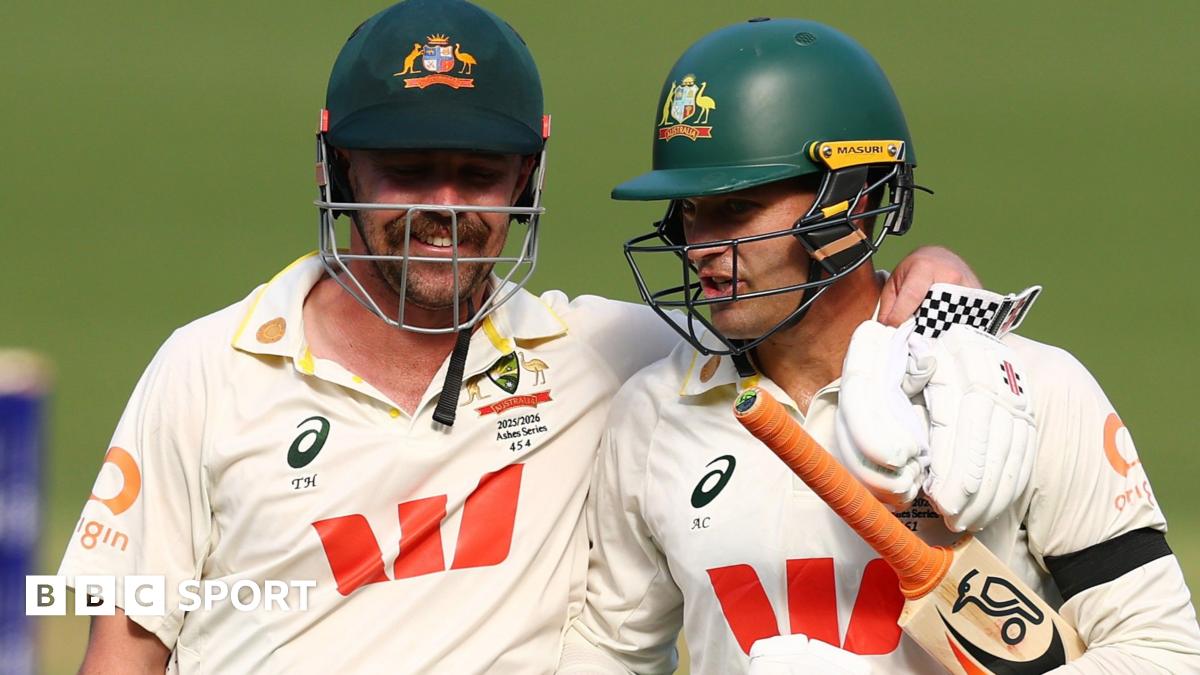
England were pushed towards the precipice of the fastest Ashes series defeat in more than 100 years as a Travis Head century maintained Australia’s grip on the third Test in Adelaide.
Head was dropped on 99 by Harry Brook and spent eight balls one run short of a hundred before belting Joe Root down the ground for four to draw a deafening roar from his home-town crowd at the Adelaide Oval.
The left-hander moved Australia’s second innings to 271-4 and their overall lead to 356 at the end of the third day.
If England’s third loss in as many Tests is completed on Saturday, it would mean the Ashes have been decided in 10 days of cricket.
Not since 1921, when Australia needed only eight days of play to win in England, has the destination of the urn been settled so swiftly.
Head’s inevitable ton snuffed out brief England hope that was raised when captain Ben Stokes and Jofra Archer added 73 runs in the morning session.
Stokes made 83 and Archer 51 in a stand of 106, the highest by an England ninth-wicket pair in Australia since 1924.
By creeping to 286 all out, 85 behind on first innings, England could have left themselves an outside chance by dismissing Australia for a total below 240 in their second innings.
At 53-2 and 149-4, England clung on before being cut adrift by Head. At some point, England will be tasked with pulling off the highest successful chase on this ground in order to keep the Ashes alive.
Of further concern to the visitors is the fitness of all-rounder Stokes, who is yet to bowl in the 66 overs of Australia’s second innings.
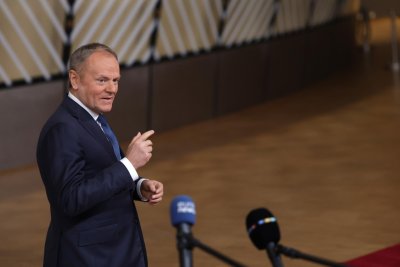
Polish Prime Minister Donald Tusk attends the EU Council Summit in Brussels, Belgium, Thursday. EU leaders are meeting to discuss the latest developments in Ukraine, the EU’s next multiannual financial framework, the EU enlargement process, and the geoeconomic situation in the European Union. EPA/OLIVIER MATTHYS
Dec. 18 (UPI) — European leaders have agreed to continue funding Ukraine in its fight against Russia with a two-year, $105 billion loan to provide the embattled nation with munitions and other material in the ongoing war, the latest battle of which has dragged on since 2022.
The plan to use frozen Russian assets to back the loan fell apart in the final moments, a schism that risked making the EU appear indecisive at a critical moment in negotiations.
European leaders announced Thursday that they will instead use money from the EU budget to fund Ukraine’s defense effort. As a result, the backup plan could be more costly and difficult to mobilize than the original plan to leverage the stash of Russian money currently frozen in Europe.
European leaders said since the end result is the same, getting funds to Kyiv, they celebrated it as a victory.
“This will address the urgent financial needs of Ukraine,” Antonio Costa, the president of the European Council, said at a media briefing in Brussels.
Partly because of a cut in funding from the United States, Ukraine is facing a $160 billion shortfall over the next two years, according to forecasts by the International Monetary Fund. The EU sought to fill about $105 billion of that gap.
Costa added that the EU will reserve its right to use frozen Russian assets for continued funding in the future.
Weekly insights and analysis on the latest developments in military technology, strategy, and foreign policy.
As military and economic pressure builds on Venezuelan dictator Nicholas Maduro,an E-3 Sentry Airborne Warning and Control System (AWACS) aircraft was tracked on FlightRadar24 flying close to the Venezuelan coast. To our knowledge, at least in recent days, these aircraft have not been present on flight tracking software in this increasingly high-activity area. And if they have popped-up, their presence has been impersistent at best. At the same time, E-3s are no stranger to this region though and have played a role in drug interdiction operations for years in this exact area.
🇺🇸🇻🇪⚡️- A U.S. Air force E-3C Sentry, airborne early warning and control aircraft, is currently loitering off the coast of Venezuela. pic.twitter.com/oujrc0CpxA
While E-3s may have been present but not trackable over the Caribbean in recent days, this one being trackable is not a mistake. U.S. military aircraft executing easily trackable sorties very near Venezuelan airspace has been a key component of the pressure campaign placed on Maduro.
The reappearance of the E-3s is a relatively important development, as they would be key to any major kinetic operation against Venezuela. While the carrier-based E-2D Hawkeye, which have been a staple of operations in the area for weeks, is extremely capable, and in some ways more so than the E-3, they are not as well suited for providing airborne early warning, data-sharing and command and control functions for a large and diverse force beyond the carrier air wing. The E-3 also has a higher perch for its radar and passive sensors to take advantage of. It can also better integrate with USAF forces.
Meanwhile, other U.S. combat aircraft made their closest and most sustained publicly-known presence near the northern Venezuelan coast on Thursday. It’s worth mentioning that we do not know how close aircraft with transponders turned off have been getting, as we can only see the flights that are publicly trackable. These missions are part of Operation Southern Spear, a counter-narcotics mission that morphed into one aimed at Maduro and Venezuelan oil, the country’s main source of income.
Amid all this aerial activity, President Donald Trump today said he was open to notifying Congress before a direct attack on Venezuela. His comments to reporters at the White House today came a day after the House of Representatives shot down measures requiring the president to obtain prior permission for such an action.
“I wouldn’t mind telling them,” Trump said when asked if he would seek permission from lawmakers for land and boat attacks against Venezuela. He added that prior notification is not required.
“I don’t have to tell them,” he posited. “It’s been proven, but I wouldn’t mind at all. I just hope they wouldn’t leak it. You know, people leak it. They are politicians, and they leak like a sieve, but I have no problem.”
BREAKING: Reporter: Will you be seeking any authorization from Congress for any land attacks on cartels in Venezuela?
Trump: I don’t have to tell them, but I would not mind it at all. I just hope they would not leak it. They are politicians, and they leak like a sieve. pic.twitter.com/UpFHPtt2vX
Trump’s views on Congressional authority have generated debate on Capitol Hill that broke down almost completely along party lines, with nearly all Republicans in agreement and Democrats opposed.
Under the 1973 War Powers Resolution, the Commander-In-Chief must notify Congress within 48 hours after“introducing United States Armed Forces into hostilities or into situations where imminent involvement is clearly indicated by the circumstances.” The Resolution also says any such actions are limited to 60 days without subsequent Congressional authorization, though the President can extend that timeline by 30 days with a written certification of the need for the continued use of force.
Donald Trump does NOT have the authority to carry out his current plans to use military force in the Caribbean without authorization from Congress.
If he acts without congressional authorization, the Senate will move a bipartisan resolution to prevent the unauthorized use of…
Trump, who ordered a blockade against sanctioned ships carrying oil to and from Venezuela, continues to assert that the U.S. has a right to that oil. On, Wednesday, Trump doubled down on his blockade warning, telling reporters that the U.S. is “not gonna let anybody go through that shouldn’t go through.”
Trump on Venezuela:
It’s a blockade, not gonna let anybody going through that shouldn’t be going through…
The blockade announcement sparked a separate debate in Congress and elsewhere about its legality.
“American presidents have broad discretion to deploy U.S. forces abroad, but Trump’s asserted blockade marks a new test of presidential authority,” international law scholar Elena Chachko of U.C. Berkeley Law School told Reuters.
Meanwhile, Venezuela condemned the blockade and said it would take its case to the United Nations.
Venezuela has released a statement. Here is the English translation of both pages:
On the night of today, December 16, 2025, the President of the United States, Donald Trump, violating International Law, free trade, and freedom of navigation, has issued a reckless and serious… https://t.co/dS3e4Yib1Xpic.twitter.com/Irf9ECnaux
Despite Trump’s pronouncement, several ships carrying oil byproducts from the South American country sailed from Venezuela’s east coast under escort from that country’s Navy “between Tuesday evening and Wednesday morning,” The New York Times reported.
“The ships transporting urea, petroleum coke and other oil-based products from the Port of José were bound for Asian markets,” per that story, citing anonymous sources. “The Venezuelan government imposed the military escort in response to Mr. Trump’s threats.”
🇻🇪🇺🇸 Venezuela’s government has ordered its Navy to escort ships carrying petroleum products from port following Trump’s blockade announcement.
Several ships sailed from the country’s east coast with a naval escort between Tuesday evening and Wednesday morning, according to… pic.twitter.com/xY9huYtMqa
— Status-6 (Military & Conflict News) (@Archer83Able) December 17, 2025
The blockade announcement came after the U.S. government had already seized one sanctioned oil tanker, the M/T Skipper. That mission, which occurred on December 10, was led by the U.S. Coast Guard with elements of the U.S. military providing support.
Today, the Federal Bureau of Investigation, Homeland Security Investigations, and the United States Coast Guard, with support from the Department of War, executed a seizure warrant for a crude oil tanker used to transport sanctioned oil from Venezuela and Iran. For multiple… pic.twitter.com/dNr0oAGl5x
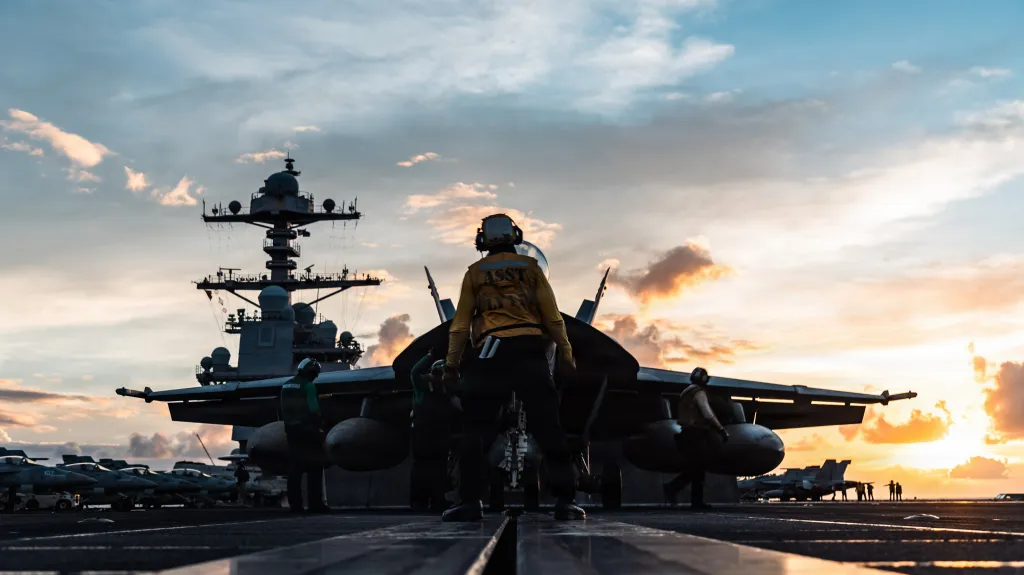
A U.S. Sailor directs an F/A-18F Super Hornet onto a catapult during flight operations aboard the world’s largest aircraft carrier, USS Gerald R. Ford (CVN 78), while underway in the Caribbean Sea in support of Operation Southern Spear (U.S. Navy photo) Petty Officer 3rd Class Gladjimi Balisage
The presence of aerial refueling tankers is also growing. KC-46 Pegasus tankers have been flying sorties out of the U.S. Virgin Islands for months, with a ramp-up in activity in recent weeks. There are now at least 10 KC-135 Stratotanker refuelers deployed to the Dominican Republic.
While these assets, along with about 15,000 deployed U.S. troops, are capable of limited sustained operations, it is far from the force that would be required for a land invasion or any large ground operation in Venezuela.
US Air Force KC-135 tankers forward deployed in the US Southern Command area of responsibility. USAF
Since September, U.S. military operations in the Caribbean Sea, as well as the Eastern Pacific, have already included nearly two dozen strikes on boats allegedly involved in drug smuggling. The first of these strikes, which came on September 2, has become the focus of particular controversy, including allegations that it may have constituted a war crime.
The Sept. 2 incidenthas spurred numerous Congressional briefings, but on Wednesday, the Chairman of the House Armed Services Committee, Mike Rogers, an Alabama Republican, said he was satisfied by testimony about that strike and that no further hearings would be held. It is unclear if there will be other Congressional action, though, since the Senate Armed Services Committee has also been investigating the matter.
The boat attacks continued on Wednesday, with another four suspected traffickers killed, bringing the total number of fatalities to about 100.
On Dec. 17, at the direction of @SecWar Pete Hegseth, Joint Task Force Southern Spear conducted a lethal kinetic strike on a vessel operated by a Designated Terrorist Organizations in international waters. Intelligence confirmed that the vessel was transiting along a known… pic.twitter.com/Yhu3LSOyea
Amid all this tension, Brazilian President Luiz Inacio Lula da Silva offered to serve as an intermediary between Trump and Maduro to “avoid armed conflict.”
Lula told reporters on Thursday that Brazil was “very worried” about the mounting crisis between Venezuela and the United States. He added that he told Trump that “things wouldn’t be resolved by shooting, that it was better to sit down around a table to find a solution.”
The Brazilian leader suggested that he may speak to Trump again before Christmas to reinforce this offer “so that we can have a diplomatic agreement and not a fratricidal war.”
“I am at the disposal of both Venezuela and the US to contribute to a peaceful solution on our continent.”
🇧🇷🇺🇸🇻🇪 | Lula da Silva: “Estoy pensando que, antes de Navidad, posiblemente tenga que conversar con el presidente Trump otra vez, para saber en que puede contribuir Brasil para que tengamos un acuerdo diplomático y no una guerra fraticida”
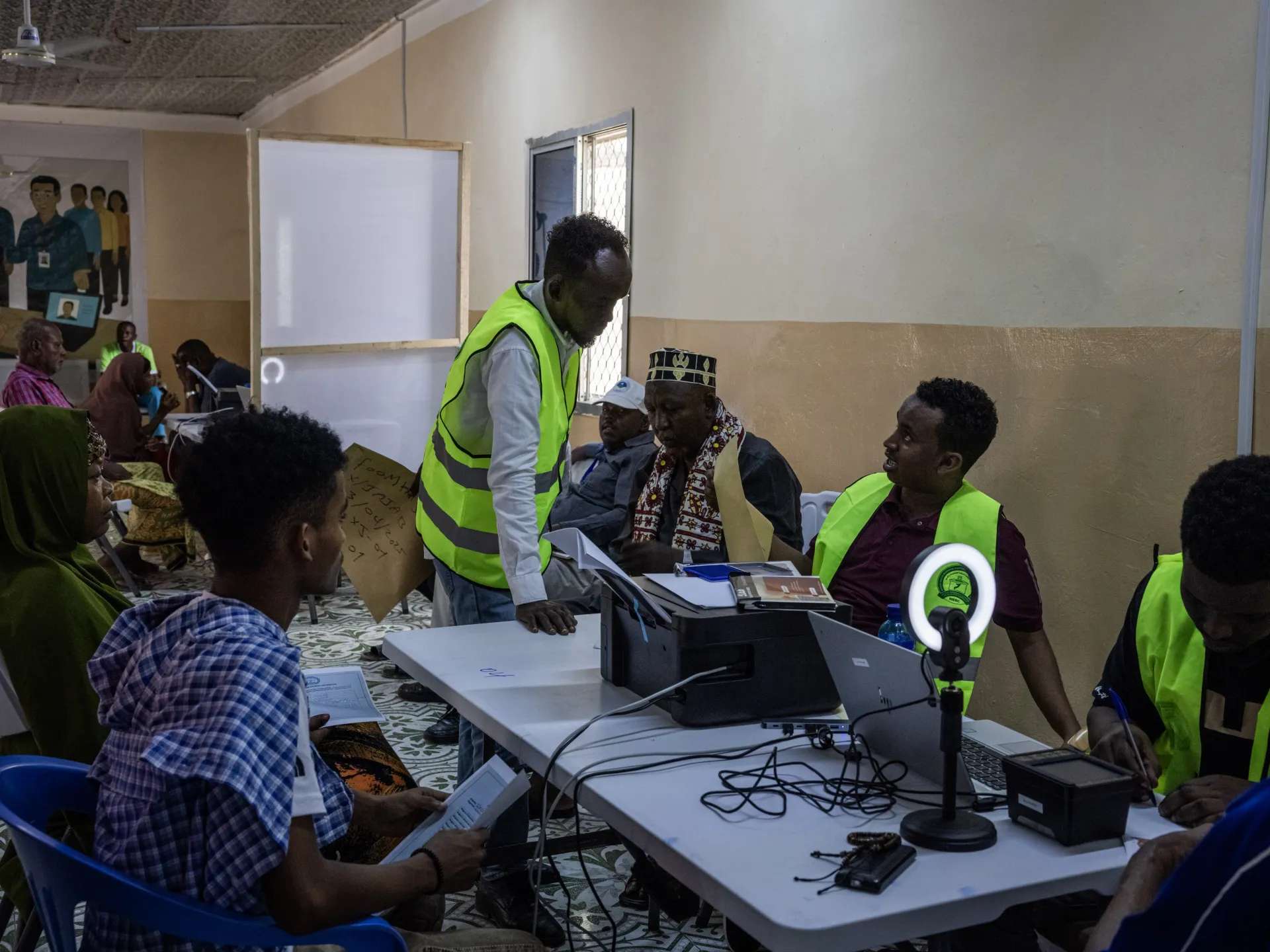
For the past 25 years, Somalia’s political transitions have not succeeded by accident. They were sustained through international engagement, pressure, and mediation aimed at preserving fragile political settlements. Today, however, Somalia stands at a dangerous crossroads. The federal government’s unilateral pursuit of power, cloaked in the language of democratic reform, threatens to trigger a legitimacy crisis and undo decades of political gains and international investment.
Universal suffrage is an ideal that all Somalis share. However, deep political disagreement among groups, persistent security challenges, the looming expiry of the government’s mandate, and financial constraints make the timely implementation of universal suffrage nearly impossible.
Pursuing universal suffrage without political consent, institutional readiness, or minimum security guarantees does not deepen democracy or sovereignty; it concentrates power in the hands of incumbents while increasing the risk of fragmentation and parallel authority.
Instead of addressing these constraints through consensus, the government is engaged in a power grab, deploying the rhetoric of universal suffrage. It has unilaterally changed the constitution, which forms the basis of the political settlement. It has also enacted self-serving laws governing electoral processes, political parties, and the Election and Boundaries Commission. Moreover, the government has appointed 18 commissioners, all backed by the ruling Justice and Solidarity Party (JSP).
Meanwhile, Somaliland announced its secession in 1991 and has been seeking recognition for the last three and a half decades. Most of Somalia’s national opposition, along with the leaders of Puntland and Jubbaland Federal Member States, have rejected the government’s approach and formed the Council for the Future of Somalia. These groups have announced plans to organise a political convention in Somalia, signalling their intent to pursue a parallel political process if the government does not listen.
The Federal Government of Somalia does not fully control the country. Al-Shabab controls certain regions and districts and retains the ability to conduct operations well beyond its areas of direct control. Recently, the hardline group attacked a prison located near Villa Somalia, a stark reminder of the fragile security environment in which any electoral process would have to take place.
Given the extent of polarisation and the limited time remaining under the current mandate, the international community must intervene to support Somalia’s sixth political transition in 2026. The most viable way to ensure a safe transition is to promote an improved indirect election model. Somalia’s political class has long experience with indirect elections, having relied on this model five times over the past 25 years. However, even with political agreement, the improved indirect election model for the 2026 dispensation must meet standards of timeliness, feasibility, competitiveness, and inclusivity.
The current government mandate expires on May 15, 2026, and discussions are already under way among government supporters about a unilateral term extension. This must be discouraged. If a political agreement is reached in time, some form of technical extension may be necessary, but this should only occur while the 2026 selection and election processes are actively under way. One way to avoid this recurring crisis would be to establish a firm and binding deadline for elections. Puntland, for example, has maintained a schedule of elections held every five years in January.
The improved indirect election model must also be feasible, meaning it should be straightforward to understand and implement. Political groups could agree on a fixed number of delegates to elect each seat. Recognised traditional elders from each constituency would then select delegates. Delegates from a small cluster of constituencies would collaborate to elect candidates for those seats. This system is far from ideal, but it is workable under current conditions.
Unlike previous attempts, the improved indirect election model must also be genuinely competitive and inclusive. In past elections, politicians manipulated parliamentary selection by restricting competition through a practice known as “Malxiis” (bestman). The preferred candidate introduces a bestman, someone who pretends to compete but is never intended to win. For the upcoming election, the process must allow candidates to compete meaningfully rather than symbolically. A clear threshold of “no manipulation” and “no bestman” must be enforced.
Inclusivity remains another major concern. Women’s seats, which should account for about 30 percent of parliament, have frequently been undermined. Any political agreement must include a clear commitment to inclusivity, and the institutions overseeing the election must be empowered to enforce the women’s quota. Government leaders have also arbitrarily managed seats allocated to Somaliland representatives. Given the unique political circumstances, a separate, negotiated, and credible process is required.
Finally, widespread corruption has long tainted Somalia’s selection and election processes, undermining their integrity. In 2022, the presidents of the Federal Member States managed and manipulated the process. To curb corruption in the 2026 improved indirect election model, one effective measure would be to increase the number of voters per seat by aggregating constituencies. In practice, this would mean combined delegates from several constituencies voting together, reducing opportunities for vote buying.
The international community has previously pressured Somali political actors to reach an agreement, insisting there should be “no term extension or unilateral elections by the government” and “no parallel political projects by the opposition”. This approach, combined with the leverage the international community still holds, can be effective. Somalia’s political class must again be pushed into serious, structured negotiations rather than unilateral manoeuvres.
As before, the international community should clearly define political red lines. The government must refrain from any term extensions or unilateral election projects. At the same time, the opposition must abandon plans for a parallel political agenda, including Federal Member States conducting elections outside a political agreement.
Somalis have repeatedly demonstrated their democratic aspirations. What stands in the way is not public will, but elite polarisation and the instrumentalisation of reform for political survival. At this critical moment, the international community cannot afford to retreat into passivity. Proactive and principled engagement is essential to prevent a legitimacy collapse, safeguard the gains of the past 25 years, and protect the substantial investments made in peacebuilding and state-building in Somalia.
The views expressed in this article are the author’s own and do not necessarily reflect Al Jazeera’s editorial stance.
The Thai-Cambodian tension is almost uniformly treated as a manageable bilateral issue, serious but contained, sensitive but familiar. This is a mistake. The real implication of the dispute is not the danger it poses of immediate escalation but rather what it indicates of the future security order of Southeast Asia and of ASEAN’s decreasing strategic relevance in the formation of that order. The problem is not that ASEAN lacks goodwill or experience, but that it is increasingly misaligned with the type of conflicts now emerging within its own region. At the heart of the dilemma is a category mistake: ASEAN was never constituted to arbitrate or adjudicate, only to regulate. Its diplomatic culture emphasizes confidence-building practices and the maintenance of open, institutionalized avenues for dialogue. Those are things necessary and reasonable. Territory sovereignty is different; it is zero-sum and domestically chiseled. As such, solving such disputes with ASEAN’s traditional toolkit is to operate outside one’s skill set, not unlike an artist trying to bake a cake.
Border tensions play a role in domestic politics on both sides. They play into narratives of sovereignty, justify military readiness, and distract from internal pressures. Crucially, escalation is not an end in itself. Escalation has its risks; resolution has its concessions. Protracted ambiguity, on the other hand, can be handled politically. ASEAN’s preference for dialogue without deadlines, restraint without enforcement, and consensual rather than arbitrated decision-making seems to reproduce this state of equilibrium. This dynamic is often misinterpreted as diplomatic paralysis. It is instead the reflection of a stable, albeit fragile, strategic equilibrium. ASEAN offers a forum for de-escalation. From the standpoint of member states, this is not an institutional malfunction but a rational outcome. The costs of change exceed the benefits, especially when national leaders must answer to domestic audiences that reward toughness over compromise. Where this method turns strategically perilous is in the aggregate. Managed conflicts are not frozen conflicts; they harden over the years. Military interventions are normalized, crisis rhetoric becomes established, and trust dribbles away. What begins as stability based on restraint gradually transforms into militarized coexistence. This process is not the escalation of the crisis but its solidification. As strife becomes routine, the region becomes accustomed to permanent insecurity, and politicians come to treat it as usual, not abnormal.
The regional context renders this trend more significant. Southeast Asia is not functioning in a permissive strategic environment today. Competition among the great powers is increasingly shaping the calculations of states in the region. Thailand’s security ties and Cambodia’s external alignments are not marginal to the conflict; they are part of its strategic backdrop. With external alignments solidifying, tensions within the region are becoming less easy to isolate. Even when they are not directly involved, the great powers’ presence changes bargaining behavior, threat perceptions, and strategic confidence. ASEAN can least afford to see its centrality challenged now. Centrality is strategically and politically meaningful when regional institutions make rather than take outcomes. When disagreements are settled outside the ASEAN framework through bilateral interests, external balancing, or strategic ambiguity, the organization’s role is so minimal as to be symbolic at worst. The consultations and statements continue, but the real influence is shifting elsewhere. ASEAN, over time, also runs the risk of becoming a platform on which it simply reacts rather than organizes and shapes regional strains.
The economic aspect makes the matter even more complex. ASEAN’s integration project presupposes a degree of predictability and strategic restraint. However, it is not entirely effective while security tensions between the two remain unresolved. Border disputes impede cross-border trade and infrastructure planning and introduce risk into investment calculations. They seldom produce immediate or dramatic changes, but they do build up. For a while, economic integration can coexist with political tensions, but not forever. Often, uncertainty begins to erode confidence, particularly in mainland Southeast Asia, where connectivity is most vulnerable to instability. The fundamental problem, then, is not whether ASEAN can stop war. It pretty much can, and it often does. The more profound question, then, is whether war prevention is sufficient in a region under such long-term strategic duress. A security order based solely on restraint, without avenues for resolution, will erode its ability to adapt. It treats the symptoms and not the causes of these problems. This does not necessitate that ASEAN turn away from its founding principles, but rather that it apply them in new and innovative ways. Consensus and respect for non-interference continue to be the pillars of regional cohesion. However, they no longer suffice. Without additional tools in the toolbox, such as informal arbitration, issue-specific mediation regimes, or more explicit regional norms on appropriate dispute behavior, ASEAN will remain trapped in a stance of containment, with no progress.
Overall, the Thai–Cambodian tension is no mere side issue. It shows how latent tensions, domestic politics, and external competition converge in ways that ASEAN cannot fully control. The risk is not a sudden breakdown but strategic stagnation: a region at peace but progressively divided, stable but strategically tenuous, and whose members continue to hesitate over which direction they want to take. If ASEAN is ever to have a fundamental, not just a token, role, it has to face up to this fact, not just in rhetoric but in its structures. This decision will determine whether the future security structure in Southeast Asia is built on deterrence of conflict or on the tolerance of latent tensions as the price of regional cohesion.
Buddhist and Christian leaders attend a Christmas tree lighting ceremony at Jogyesa Temple in Seoul on Dec. 18. Photo by Asia Today
Dec. 18 (Asia Today) — South Korea’s largest Buddhist order held a Christmas tree lighting ceremony Thursday at Jogyesa Temple in central Seoul, bringing together religious leaders from multiple faiths in an annual event organizers described as a symbol of interfaith harmony and peace.
The ceremony took place at Jogyesa, the head temple of the Jogye Order of Korean Buddhism, in Seoul’s Jongno district.
Venerable Jinwoo, the Jogye Order’s chief administrator, delivered a Christmas message at the event, saying, “We sincerely celebrate the birth of the baby Jesus, who came to illuminate this dark world.”
“Though we walk different paths, we share the same heart to alleviate human suffering and bring light to the world,” he said, adding that participants were renewing a commitment to “unity in diversity.”
Jinwoo said interfaith harmony is a powerful social force for reducing conflict and building peace and urged religious communities to work together toward mutual prosperity.
Among those attending were Jinwoo, Jogyesa abbot Venerable Damhwa and other Jogye Order monks, along with Choi Jong-soo, president of the Korean Conference of Religious Leaders for Peace, and leaders representing Cheondogyo, Catholic, Won Buddhist and Protestant organizations, according to organizers.
Albanese said Australia has more guns now than 30 years ago, when the country’s deadliest-ever mass shooting took place.
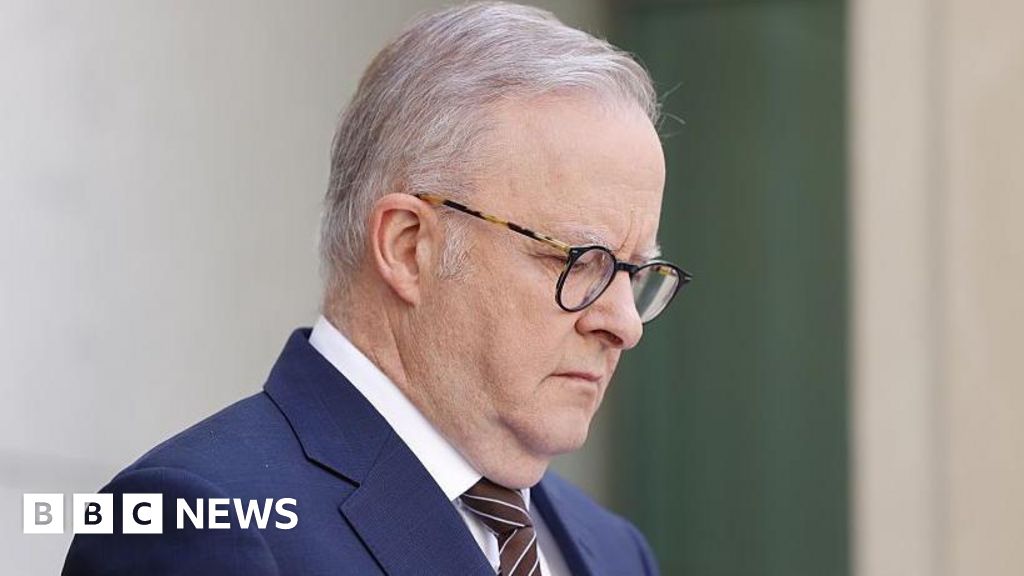
Australia will launch a national gun buyback scheme, Prime Minister Anthony Albanese has announced, as the country continues to come to terms with the deadly attack on a Jewish holiday event at Sydney’s Bondi Beach that left 15 people dead.
Albanese called the plan the country’s biggest gun buyback since 1996 – the year of Australia’s deadliest mass shooting in modern history, the Port Arthur massacre in the island state of Tasmania – and said authorities will purchase surplus, newly-banned and illegal firearms.
Recommended Stories
list of 3 itemsend of list
“Right now, there are more guns in Australia than there were during Port Arthur. We can’t allow that to continue,” Albanese told a news conference on Friday, adding that there are currently more than four million firearms in the country.
“Non-citizens have no need to own a gun. And someone in suburban Sydney has no need to own six … The terrible events of Bondi show we need to get more guns off our streets,” he said.
Albanese added that authorities in Australia’s states and territories will be tasked with collecting the weapons and processing payments for surrendered firearms under the scheme. Federal police will then be responsible for destroying them.
“We expect hundreds of thousands of firearms will be collected and destroyed through this scheme,” Albanese added.
Aided by some of the toughest gun restrictions globally, Australia has one of the lowest gun homicide rates in the world.
Restrictions were tightened after a lone gunman, armed with semiautomatic weapons, killed 35 people at the Port Arthur tourist site almost 30 years ago.
The massacre shocked the country, with authorities soon after launching a major gun amnesty and buyback scheme that removed more than 650,000 newly-prohibited firearms from circulation.
‘We need to do more to combat this evil scourge’
Sunday’s shooting in Sydney’s Bondi Beach area – in which two attackers, named as father and son Sajid Akram and Naveed Akram, went on a shooting spree and killed 15 people – has had a similarly jolting impact on Australian society as the Port Arthur massacre and prompted self-reflection.
Albanese said 50-year-old Sajid – who was shot dead at the scene – and 24-year-old Naveed – who was charged with “terrorism” and murder offences after he awoke from a coma on Tuesday – were inspired by “Islamic State ideology”.
On Thursday, Albanese announced tougher hate speech laws as he acknowledged the country had experienced a rising tide of anti-Jewish hate since the Hamas-led October 7, 2023, attacks on Israel, and Israel’s genocidal war on Gaza.
Albanese said rising anti-Semitism in Australia “culminated on Sunday in one of the worst acts of mass murder that this country has ever seen”.
“It was an attack on our Jewish community – but it was also an attack on the Australian way of life,” he said.
“Australians are shocked and angry. I am angry. It is clear we need to do more to combat this evil scourge, much more,” he added.
The prime minister also announced on Friday that Australia will hold a national day of reflection this Sunday – one week after the mass shooting.
Albanese urged Australians to light candles at 6:47pm (07:47 GMT) on Sunday, December 21 – “exactly one week since the attack unfolded”.
“It is a moment to pause, reflect, and affirm that hatred and violence will never define who we are as Australians,” he told reporters.
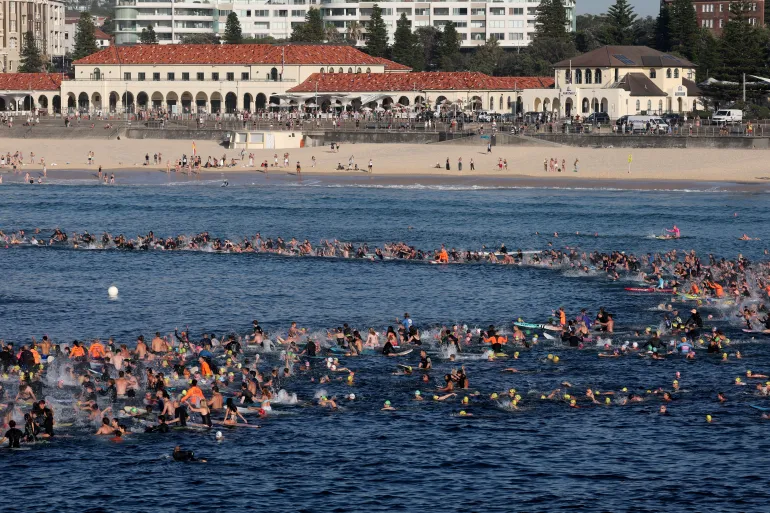
Earlier on Friday, hundreds of people plunged into the ocean off Bondi Beach in another gesture to honour the dead.
Swimmers and surfers paddled into a circle as they bobbed in the gentle morning swell, splashing water and roaring with emotion.
“They slaughtered innocent victims, and today I’m swimming out there and being part of my community again to bring back the light,” security consultant Jason Carr told the AFP news agency.
“We’re still burying bodies. But I just felt it was important,” the 53-year-old said.
“I’m not going to let someone so evil, someone so dark, stop me from doing what I do and what I enjoy doing,” he said.
Surfers and swimmers congregate in the surf at Bondi Beach as they participate in a tribute for the victims of Sunday’s Bondi Beach attack, in Sydney, on December 19, 2025 [David Gray/AFP]
Why the TikTok star and disability advocate wants the world to rethink what it means to be disabled.
Why does the public understanding of disability lag so far behind reality? TikTok influencer and disability activist Imani Barbarin lays this out for her audiences on social media, where she has amassed nearly a million followers across platforms. In this episode, Barbarin shares her perspectives on disability at the intersection of issues, including COVID and the genocidal war on Gaza.
Greg Biffle’s plane caught fire after crash-landing at a regional airport, state authorities said. Other victims have not yet been identified.
Published On 18 Dec 202518 Dec 2025
Share
A former NASCAR driver has been identified as one of seven people who died in a plane crash in the southern United States.
Authorities said Greg Biffle and members of his family died when a private jet crashed on Thursday while trying to land at Statesville Regional Airport, north of Charlotte, North Carolina.
Recommended Stories
list of 3 itemsend of list
Flight records showed the plane was registered to a company run by Biffle.
“Although the post-crash fire prevents us from releasing a definitive list of the occupants at this time, it is believed that Mr Gregory Biffle and members of his immediate family were occupants of the airplane,” state police said.
Further details about the victims were not immediately available.
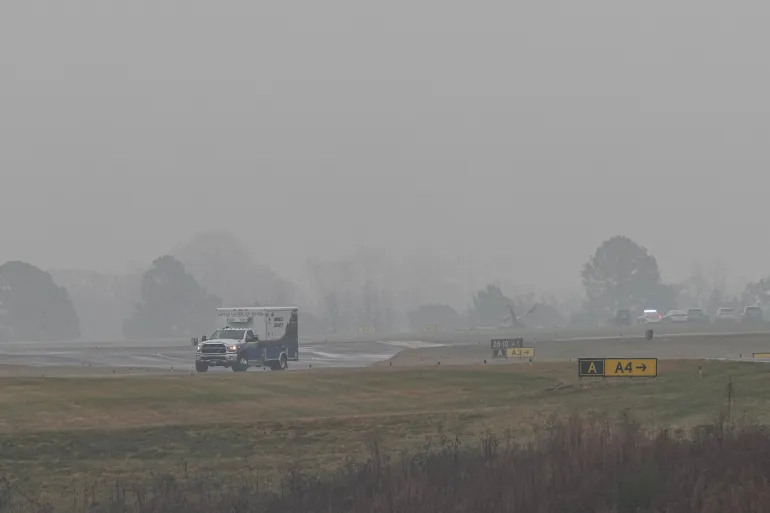
First responders tend to the scene of a reported plane crash at a regional airport in Statesville, North Carolina [Matt Kelley/The Associated Press]
Throughout his 16-year career, Biffle won more than 50 races across the three racing-circuit types offered by NASCAR, a US-based association for car races.
He placed first in 19 races at the Cup Series, considered NASCAR’s top level. He also won the Craftsman Truck Series championship in 2000 and the Xfinity Series title in 2002.
Biffle’s plane had taken off from the airport shortly after 10am local time on Thursday (15:00 GMT), but it then returned to North Carolina and was attempting to land there, according to tracking data posted by FlightAware.com.
Video from WSOC-TV showed first responders rushing onto the runway as flames burned near scattered wreckage from the plane.
The National Transportation Safety Board (NTSB) and the Federal Aviation Administration (FAA) were investigating the crash.
All told, the NTSB has investigated 1,331 crashes in the US in 2025.
Dec. 18 (UPI) — The U.S. Department of Health and Human Services announced new regulations on Thursday that restrict the ability for transgender minors to access gender-affirming healthcare.
The regulations work to “carry out President Trump’s executive order directing HHS to end the practice of sex-rejecting procedures on children that expose young people to irreversible harm,” a press release said.
The new rules will ban hospitals from “performing sex-rejecting procedures on children under age 18 as a condition of participation in Medicare and Medicaid programs.”
“These actions will ensure that the federal government in no way funds directly gender transition procedures on minors and also does not fund facilities that perform these procedures,” a department official told reporters Thursday.
The department said what it calls “sex-rejecting procedures” on children, including puberty blockers, hormones and surgery, “expose them to irreversible damage, including infertility, impaired sexual function, diminished bone density, altered brain development, and other irreversible physiological effects.”
HHS Secretary Robert F. Kennedy Jr. and other department officials will offer details about the moves later Thursday.
Gender-affirming care is a holistic approach to treating gender-dysphoria and is supported by every major medical association as treatment for both adults and children.
It includes a range of therapies, from psychological and behavioral to medical interventions, with surgeries for minors being exceedingly rare.
The medical practice, however, has been a target for conservatives for years amid a larger campaign that civil rights organizations see as a threat to the rights of LGBTQ Americans.
St. Louis pediatrician Dr. Kenneth Haller called HHS’ actions “anti-science” during a Human Rights Campaign press briefing. He pointed out that these efforts still allow the treatments for children with other conditions that affect hormone production.
Haller said that as long as the condition doesn’t change a child’s gender, “these people don’t have a problem with [prescribing hormones]. That same care for kids who are transgender is what they say is wrong. There’s no science behind it.”
HHS said the Food and Drug Administration would send warning letters to manufacturers and sellers of breast binders for minors alleging they are doing illegal marketing, the department official said.
“Illegal marketing of these products for children is alarming, and the FDA will take further enforcement action such as import alerts, seizures, and injunctions if it continues,” FDA Commissioner Dr. Marty Makary said in a statement.
The Human Rights Campaign said these rules infringe on the rights of families.
“Families deserve the freedom to go to the doctor and get the care that they need and to have agency over the health and wellbeing of their children,” said Kelley Robinson, president of the Human Rights Campaign, in a statement. “But these proposed actions would put [President] Donald Trump and RFK Jr. in those doctor’s offices, ripping healthcare decisions from the hands of families and putting it in the grips of the anti-LGBTQ+ fringe.”
And Advocates for Trans Equality told UPI in an emailed statement that are a “discriminatory attack” that lacks credible medical or financial basis.
“These sets of rules mark a serious escalation in this administration’s ongoing efforts to dismantle healthcare programs and services for trans youth,” Fiadh McKenna, A4TE senior staff attorney, said in the statement.
“Targeting healthcare for trans people is unlawful and discriminatory; no one should be denied healthcare because of who they are.”
The new CMS rules will be finalized after a 60-day comment period on the Federal Register, the department official said.
Trump has issued several executive orders against transgender people. In May, the Pentagon began removing transgender service members from the military. In March, the Department of Veterans Affairs began phasing out medical treatments for gender dysphoria. In February, Trump signed an executive order banning transgender women from participating in women’s sports. In January, Trump signed an executive order that restricts gender-affirming care for minors.
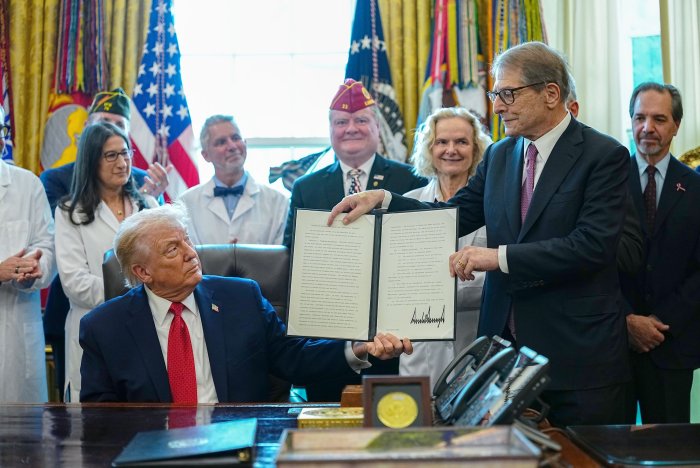
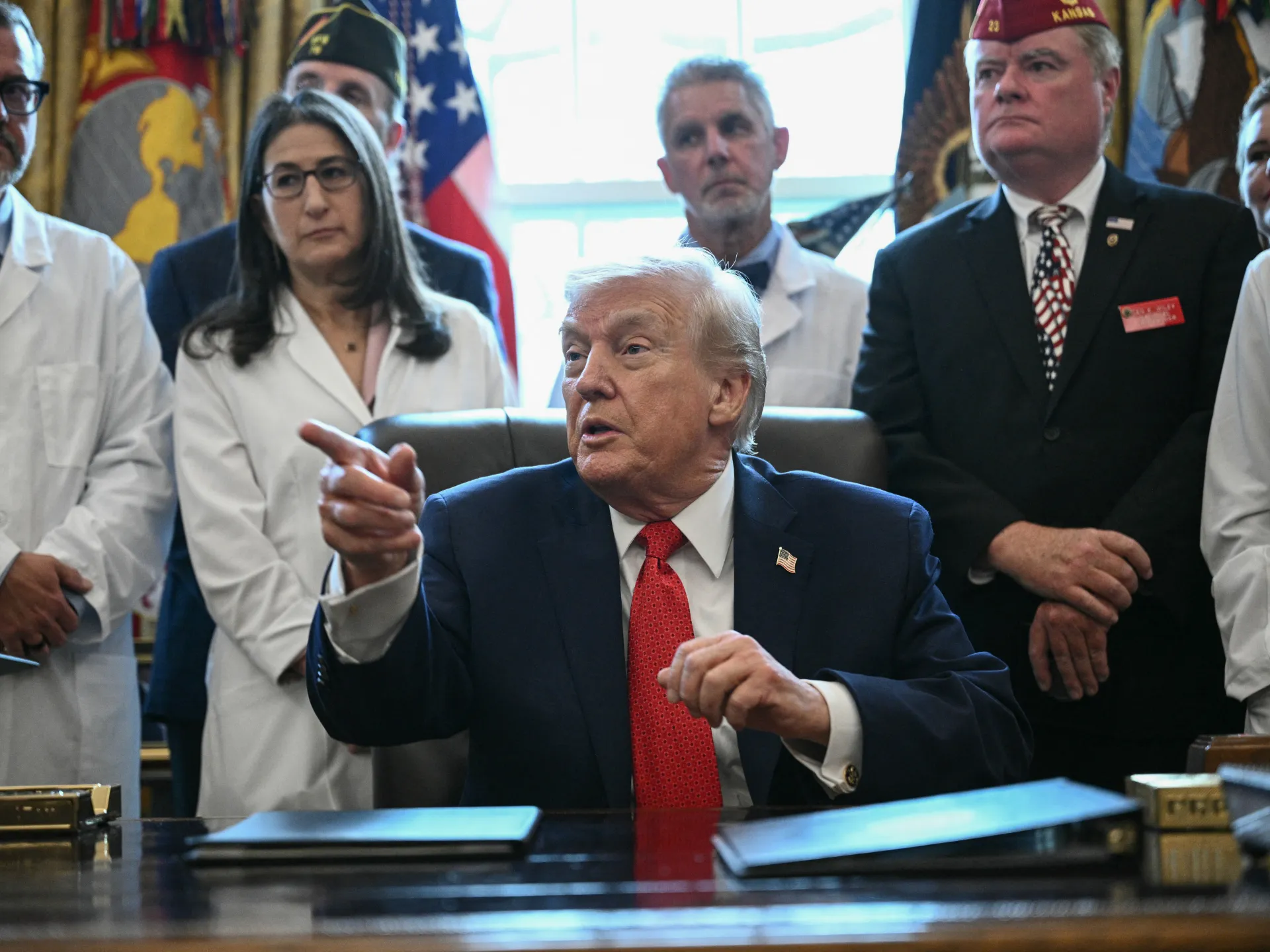
President Donald Trump holds a signed executive order reclassifying marijuana from a schedule I to a schedule III controlled substance in the Oval Office of the White House on Thursday. Photo by Aaron Schwartz/UPI | License Photo
EU delays Mercosur trade deal until January amid farmer protests and opposition from France and Italy.
The European Union has delayed a massive free-trade deal with South American countries amid protests by EU farmers and as last-minute opposition by France and Italy threatened to derail the agreement.
European Commission chief spokesperson Paula Pinho confirmed on Thursday that the signing of the trade pact between the EU and South American bloc Mercosur will be postponed until January, further delaying a deal that had taken some 25 years to negotiate.
Recommended Stories
list of 4 itemsend of list
Commission President Ursula von der Leyen was expected to travel to Brazil on Saturday to sign the deal, but needed the backing of a broad majority of EU members to do so.
The Associated Press news agency reported that an agreement to delay was reached between von der Leyen, European Council President Antonio Costa and Italian Prime Minister Giorgia Meloni – who spoke at an EU summit on Thursday – on the condition that Italy would vote in favour of the agreement in January.
French President Emmanuel Macron had also pushed back against the deal as he arrived for Thursday’s summit in Brussels, calling for further concessions and more discussions in January.
Macron said he has been in discussions with Italian, Polish, Belgian, Austrian and Irish colleagues, among others, about delaying the signing.
“Farmers already face an enormous amount of challenges,″ the French leader said.
The trade pact with Argentina, Brazil, Bolivia, Paraguay and Uruguay would be the EU’s largest in terms of tariff cuts.
But critics of the deal, notably France and Italy, fear an influx of cheap commodities that could hurt European farmers, while Germany, Spain and Nordic countries say it will boost exports hit by United States tariffs and reduce reliance on China by securing access to key minerals.
Brazil’s President Lula says Italy’s PM Meloni asked for ‘patience’
The EU-Mercosur agreement would create the world’s biggest free-trade area and help the 27-nation European bloc to export more vehicles, machinery, wines and spirits to Latin America at a time of global trade tensions.
Al Jazeera’s Dominic Kane, reporting from Berlin, said Germany, Spain and the Nordic countries were “all lobbying hard in favour of this deal”. But ranged against them were the French and Italian governments because of concerns in their powerful farming sectors.
“Their worry being that their products, such as poultry and beef, could be undercut by far cheaper imports from the Mercosur countries,” Kane said.
“So no signing in December. The suggestion being maybe there will be a signing in mid-January,” he added.
“But there must now be a question about what might happen between now and mid-January, given the powerful forces ranged against each other in this debate,” he added.
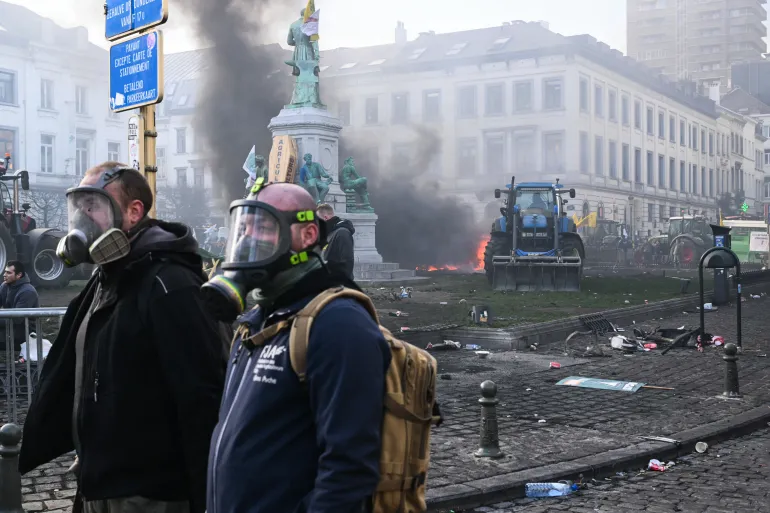
Farmers wear gas masks at the Place du Luxembourg near the European Parliament, during a farmers’ protest on December 18, 2025 [Nicolas Tucat/AFP]
Mercosur nations were notified of the move, a European Commission spokeswoman said, and while initially reacting with a now-or-never ultimatum to its EU partners, Brazil opened the door on Thursday to delaying the deal’s signature to allow time to win over the holdouts.
Brazil’s President Luiz Inacio Lula da Silva said Italy’s Meloni had asked him for “patience” and had indicated that Italy would eventually be ready for the agreement.
The decision to delay also came hours after farmers in tractors blocked roads and set off fireworks in Brussels to protest the deal, prompting police to respond with tear gas and water cannon.
Protesting farmers – some travelling to the Belgian capital from as far away as Spain and Poland – brought potatoes and eggs to throw and waged a furious back-and-forth with police while demonstrators burned tyres and a faux wooden coffin bearing the word “agriculture”.
The European Parliament evacuated some staff due to damage caused by protesters.
These are the key developments from day 1,394 of Russia’s war on Ukraine.
Published On 19 Dec 202519 Dec 2025
Share
Here is where things stand on Friday, December 19:
Fighting
Three people, including two crew members of a cargo vessel, were killed in overnight Ukrainian drone attacks on the Russian port of Rostov-on-Don and the town of Bataysk in the country’s southern Rostov region, local governor Yury Slyusar said.
Russian strikes near Ukraine’s Black Sea port of Odesa killed a woman in her car and hit infrastructure. Odesa’s Governor Oleh Kiper said a Russian drone killed a woman crossing a bridge in her car, and three children were injured in the incident.
Kiper also asked residents whose homes have been affected by extended power outages to be patient and to end blocking roads in protest against the blackouts.
“As a result of enemy attacks, the energy infrastructure in Odesa region has suffered extensive damage,” Kiper said.
About 180,000 consumers have been left without electricity across five Ukrainian regions after Russian attacks, Ukraine’s acting energy minister, Artem Nekrasov, said.
Nekrasov said the southern regions of Mykolaiv and Zaporizhia, the central regions of Cherkasy and Dnipropetrovsk, and the northeastern region of Sumy have been impacted.
Russia fired the Oreshnik at Ukraine for the first time in November 2024, and Russian President Vladimir Putin has boasted that the missile is impossible to intercept and has destructive power comparable to that of a nuclear weapon.
Sanctions
European Union leaders have agreed in principle at a summit in Brussels to work on financing Ukraine in 2026 and 2027 through the use of frozen Russian assets rather than EU borrowing, Poland’s Prime Minister Donald Tusk said.
EU leaders were still trying to overcome differences over the plan, with talks in Brussels focused on seeking to reassure Belgium, which holds most of the frozen assets, and other concerned countries, that Europe would share the legal and financial risks resulting from the initiative.
A new draft of the deal offered Belgium and other countries unlimited guarantees for damages should Moscow successfully sue them for using Russian assets to finance Ukraine.
Diplomats said the deal could be a problem for some governments, who would need parliamentary approval. The new draft also offered EU countries and institutions, whose assets may be seized by Russia in retaliation, the possibility to offset such damages against Russian assets held by the EU.
The text of the draft deal also offered a mechanism of unconditional, irrevocable, on-demand guarantees that the EU would swiftly repay the Russian central bank assets in all circumstances should the need arise.
Russia’s central bank has said it will extend legal action beyond its lawsuit against Belgium-based depository Euroclear and sue European banks in a Russian court over attempts the EU’s plans to use frozen Russian assets as loans for Kyiv.
Britain has imposed more sanctions targeting Russian oil companies, including 24 individuals and entities, in what it described as a move against Russia’s largest remaining unsanctioned oil companies: Tatneft, Russneft, NNK-Oil and Rusneftegaz.
Peace talks
Ukrainian peace negotiators are en route to the United States and plan to meet Washington’s negotiating team on Friday and Saturday, Ukrainian President Volodymyr Zelenskyy has said.
US President Donald Trump said he believes talks to end the war in Ukraine are “getting close to something” as Trump envoys Steve Witkoff and Jared Kushner plan to meet a Russian delegation in Miami this weekend.
Aid
The Ukraine-US reconstruction fund, established as part of a Trump-pushed minerals deal the two countries signed in April, has approved its asset policies and is poised to begin reviewing its first investment opportunities in 2026, the US body overseeing the fund said.
The Development Finance Corporation (DFC) said the fund’s second meeting “reached final consensus necessary to bring the fund to full operational status”. Potential deals could focus on critical minerals extraction and energy development as well as on maritime infrastructure, the DFC said.
Ukraine is facing a foreign aid shortfall of 45-50 billion euros ($53-$59bn) in 2026, President Zelenskyy said, adding that if Kyiv did not receive a first tranche of a loan secured by Russian assets by next spring, it would have to cut drone production.
Ukraine has clinched a long-awaited deal to restructure $2.6bn of growth-linked debt, with creditors overwhelmingly accepting a bonds-and-cash swap offer – a key step for the country to emerge from the sovereign default it suffered in the wake of Russia’s full-scale invasion in 2022.
Politics and diplomacy
President Zelenskyy said he saw no need to change Ukraine’s constitution enshrining its aim to become a NATO member state. A block on Ukraine joining the military alliance has been a core Russian demand to end its war.
“To be honest, I don’t think we need to change our country’s constitution,” Zelenskyy said. “Certainly not because of calls from the Russian Federation or anyone else,” he said.
Earlier this week, Zelenskyy said Ukraine could compromise on NATO membership if given bilateral security guarantees with protections similar to NATO’s Article 5, which considers an attack on one member as an attack against all.
Ukraine’s Deputy Foreign Minister Sergiy Kyslytsya met Chinese foreign ministerial aide Liu Bin in Beijing, where the pair “discussed ways to strengthen trade and economic cooperation, and issues of co-operation within international organisations”, the Foreign Ministry said.
Russian affairs
Sergei Yeremeyev, a Belarusian man accused by Russia of blowing up two trains in Siberia for Ukraine, has been jailed for 22 years. Yeremeyev was found guilty of carrying out an act of terrorism and of planting explosives on two freight trains in 2023.
British man Hayden Davies, who fought for Ukraine against Russia, has been sentenced to 13 years in a maximum security prison camp after being convicted of being a paid mercenary, Russian prosecutors said. The 30-year-old was tried by a court in a part of Russian-controlled Donetsk.
The Australian government has announced a gun buyback scheme in the wake of the Bondi Beach attack – its deadliest mass shooting in decades.
The scheme is the largest since the Port Arthur massacre in 1996, which left 35 people dead and prompted Australia to introduce world-leading gun control measures.
Fifteen people were killed and dozens injured on Sunday when two gunmen, believed to have been motivated by “Islamic State ideology”, opened fire on a Jewish festival at the country’s most iconic beach.
On Friday police said a group of men who were arrested in Sydney after travelling from the state of Victoria had “extremist Islamic ideology”.
Police allege Sunday’s attack, which they have declared a terrorist incident, was committed by a father-son duo. Naveed Akram, 24, has been charged with 59 offences, including 15 counts of murder and one of committing a terrorist act. His father Sajid was killed during the attack.
The day after the shooting, national cabinet – which includes representatives from the federal government and leaders from all states and territories – agreed to tighten gun controls.
Speaking to media on Friday, Prime Minister Anthony Albanese said there are now more than 4 million firearms in Australia – more than at the time of the Port Arthur massacre.
“We know that one of these terrorists held a firearm licence and had six guns, in spite of living in the middle of Sydney’s suburbs… There’s no reason why someone in that situation needed that many guns.
“We need to get more guns off our streets.”
Earlier on Friday, a senior New South Wales police officer told national broadcaster ABC seven men arrested by counter terrorism police in Sydney on Thursday evening may have been on their way to Bondi.
Tactical officers swarmed on the group, who had travelled from Victoria and were known to police there, in dramatic scenes in the suburb of Liverpool.
NSW Police Deputy Commissioner David Hudson said “some indication” that Bondi was one of the locations they were considering visiting, but “with no specific intent in mind or proven at this stage”.
Rarely used national security powers were relied upon to swoop before their plans developed.
“We made the decision that we weren’t going to … take any chances in relation to what they might be doing,” he said.
Officers found a knife, but no guns or other weapons, Mr Hudson added.
Dec. 18 (UPI) — A Romanian court on Thursday sentenced American rapper Wiz Khalifa to nine months in prison for using marijuana during a music festival last year.
Citing local news outlets Agerpres and CanCan, USA Today reported the Constanța Court of Appeal issued the final ruling for “committing the crime of possession of high-risk drugs, without right, for own consumption.
The ruling by the appellate court came after the country’s prosecutor’s office — DIICOT Constanța Territorial Service — appealed an earlier sentence that saw Khalifa fined about $829.
The court said it strengthened the punishment because Khalifa sent “a message of normalization of illegal conduct” and encouraged “drug use among young people.”
The court called his actions “ostentatious.”
Sources close to the situation told TMZ that the rapper’s lawyers are appealing the sentence.
Khalifa was sentenced in absentia, and it’s unclear if officials in Romania will seek to have Khalifa extradited to serve his sentence.
Romanian criminal expert Vlad Zaha told the BBC that there’s little chance the United States would extradite Khalifa. He described the sentence as “unusually harsh.”
“Given the defendant’s wealth and connections, Romania’s lack of real negotiating power on extradition, and the legal and political status of cannabis in the U.S., it is highly unlikely that Wiz Khalifa will be sent to serve a prison sentence in Constanța, even though a formal judicial request will be submitted to the United States,” Zaha said.
Khalifa was briefly detained in July 2024 after he smoked marijuana during his set at the Beach Please! Festival.
The musician addressed his arrest in a post on X after his release from custody.
“Last night’s show was amazing. I didn’t mean any disrespect to the country of Romania by lighting up onstage,” he wrote. “They were very respectful and let me go. I’ll be back soon. But without a big … joint next time.”
Kendrick Lamar headlines the Super Bowl LIX Halftime Show at Caesars Superdome in New Orleans on February 9, 2025. Photo by John Angelillo/UPI | License Photo
Weekly insights and analysis on the latest developments in military technology, strategy, and foreign policy.
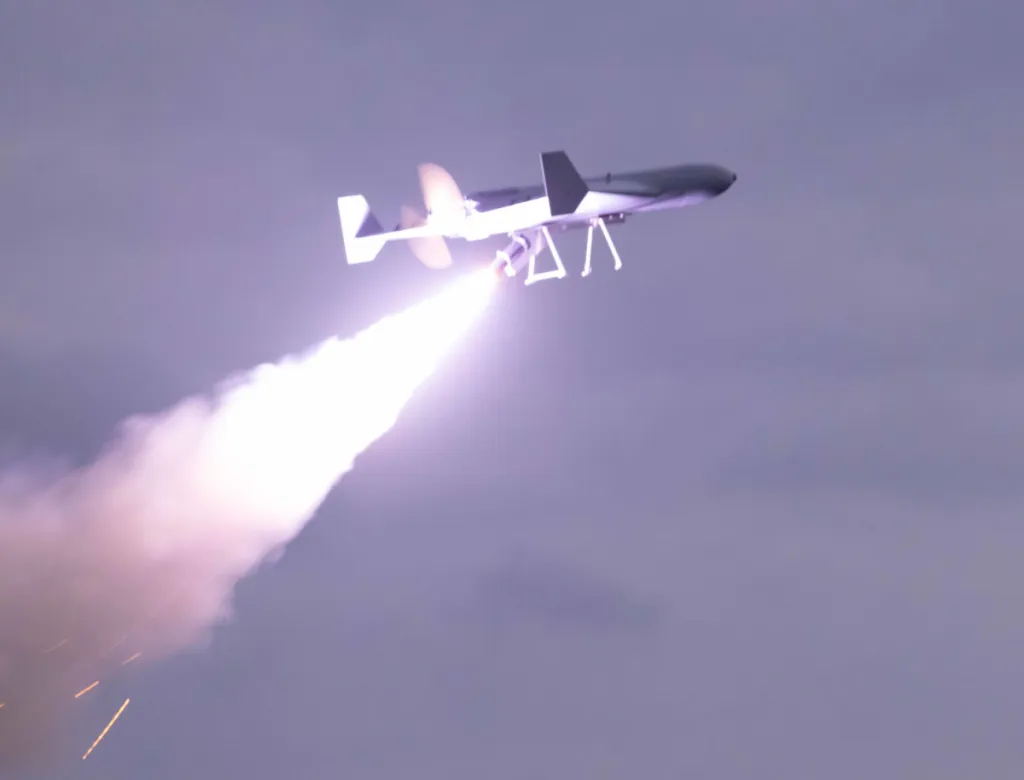
The U.S. Navy personnel in the Middle East have test-launched a Low-Cost Uncrewed Combat Attack System (LUCAS) long-range kamikaze drone from the Independence class Littoral Combat Ship (LCS) USS Santa Barbara. Described as a first-of-its-kind achievement, this comes two weeks after the U.S. military announced it had established Task Force Scorpion Strike (TFSS) in the region, armed with the LUCAS drones from SpektreWorks. Being able to employ the one-way attack drones from the sea, as well as from sites on land, opens the door to new operational possibilities on top of what was already a major new addition to the U.S. military’s long-range strike arsenal.
TWZ has previously explored in great depth the arguments for arming Navy ships with various types of uncrewed aerial systems to provide additional layers of defense, as well as enhanced strike, electronic warfare, intelligence-gathering, and networking capabilities, which you can find here. Just earlier this year, we also laid out a detailed case for why America’s armed forces should be heavily investing in rapidly-producible long-range kamikaze drones — Shahed-136 clones primarily — just like LUCAS, as you can read here.
Personnel from U.S. Naval Forces Central Command’s (NAVCENT) Task Force 59 conducted the rocket-assisted launch of the LUCAS drone from the stern flight deck of the USS Santa Barbara on December 16, according to an official release. The ship was operating in the Arabian Gulf, more commonly known as the Persian Gulf, at the time. Established in 2021, Task Force 59 has been leading efforts to expand the Navy’s operational use of uncrewed platforms, as well as new artificial intelligence (AI) capabilities, in the Middle East. The LUCAS drone itself had been provided by TFSS, which falls under the auspices of U.S. Special Operations Command Central (SOCCENT), the regional headquarters for special operations activities under U.S. Central Command (CENTCOM).
“Bravo Zulu. U.S. Navy forces in the Middle East are advancing warfighting capability in new ways, bringing more striking power from the sea and setting conditions for using innovation as a deterrent.” – Adm. Brad Cooper, CENTCOM Commander https://t.co/TgQ4WLbph3pic.twitter.com/WUiAVojTht
The official release from NAVCENT does not provide specific details about capabilities demonstrated during the test, such as how far the LUCAS drone flew, how it was controlled or directed, and whether it hit a mock target of some kind at sea or on land at the end of its flight.
TWZ reached out to CENTCOM, which declined to provide more granular information. We have also reached out to NAVCENT and SpektreWorks.
The LUCAS drone seen right after launch from the stern flight deck of the USS Santa Barbara. NAVCENT/C5F/U.S. Army Spc. Kayla Mc Guire
General details about the LUCAS drones the U.S. military now has deployed in the Middle East remain limited. It is known that SpektreWorks directly reverse-engineered the design from Iran’s Shahed-136, and initially with an eye toward its use as a threat-representative target for training and test purposes. At some 10 feet long and with a wingspan of around eight feet, LUCAS is slightly smaller than the Iranian drone. SpektreWorks has also publicly provided specifications for the related target drone, called the FLM 136, which has roughly half the range and payload capacity as the Shahed-136. However, it is unclear whether this reflects the capabilities found on operationalized configurations. LUCAS is also said to have a unit cost of around $35,000.
The video below includes a montage of clips from Iranian state media showing Shahed-136s being employed during an exercise.
Баражуючий іранський боєприпас «Shahed 136»
Pictures of the LUCAS drones the U.S. military has released so far show a modular, reconnaissance design that could also be used for surveillance and reconnaissance missions, as well as in the decoy role. AsTWZ has previously written:
“We see two variants of LUCAS. One is not of particular note, it seems geared to strike the static targets we have become accustomed to for this type of weapon. The other features two very interesting details. It has what appears to be a gimbaled camera system mounted on its nose and, most importantly, a miniature beyond-line-of-sight satellite datalink mounted on its spine. This is a major development that would allow these weapons to not only be controlled dynamically after launch at great distances, but also to hit moving targets and targets of opportunity.”
A previously released picture showing LUCAS drones at a base within the CENTCOM area of operations. Both of the known configurations of the LUCAS drone deployed in the Middle East are visible here. Courtesy Photo
“In addition, this capability would help enable swarm tactics, where the drones work to attack targets cooperatively with their progress monitored and altered in real-time by human operators, regardless of whether they have the satellite terminal or not. This is made possible by providing simpler, lighter line-of-sight datalinks on the drones equipped with warheads only, which then connect line-of-sight to the drone carrying the satellite communications terminal, acting as a force-multiplying networking hub. This also means you can have many simple drones paired with a much smaller number of more costly ones equipped with cameras and networking equipment, but achieve the same overall effect as if they all had the more advanced capabilities. This modularity which is ‘greater than the sum of its parts’ is a central tenet of emerging drone warfare TWZ highlighted a decade ago.“
A closer look at the more advanced camera and networking-equipped variant of LUCAS. Courtesy Photo
…
“Seeing as swarms can be tailored to various objectives, with mixing and matching BLOS networking enabled units with strikers, and placing them in real time to minimize risk and maximize effect, America’s Shaheds should be significantly more survivable and effective. The ability to work together, reacting to their environment, and leverage real-time intelligence gathered by the full gamut of U.S. and allied assets, are even larger advantages. This is in addition to pairing them with combined arms tactics, from electronic warfare to kinetic strikes, to ensure they get to their target areas. Even if some die to air defenses, that can be viewed as a win, depending on what engages them. Consuming costly and finite effectors is a feature, not a bug, for these relatively cheap weapons, as you can read all about in our larger feature.“
All of this is further magnified by the ability to employ LUCAS drones from any ship with sufficient deck space, as well as launchers on land, which could be semi-fixed or mobile. This is something TWZ highlighted explicitly in our past feature on the prospect of integrating drone swarms onto Navy ships.
Observations for years now of how Iran and its proxies, as well as Russia, have been employing variants and derivatives of the Shahed-136 have underscored their ability to be sent along often circuitous routes to attack targets from unexpected vectors. Even without the addition of more dynamic targeting and fully networked swarming capabilities, this creates immense challenges for defenders. This is only further compounded by the breadth of areas targeted simultaneously and the sheer volume of drones that can be launched in mass barrages, owing in large part to their relatively low cost.
U.S. officials have themselves been quick to highlight the new operational capabilities LUCAS offers, especially in light of the newly announced test launch from the USS Santa Barbara.
Another picture of the LUCAS drone being test-launched from the USS Santa Barbara. NAVCENT/C5F/U.S. Army Spc. Kayla Mc Guire
“A cutting-edge, low-cost attack drone asset, launched from a naval vessel that can sail and operate wherever international law allows, is a tremendous new capability to employ in the region,” Navy Capt. Timothy Hawkins, CENTCOM’s top spokesperson, told TWZ.
“U.S. Navy forces in the Middle East are advancing warfighting capability in new ways, bringing more striking power from the sea and setting conditions for using innovation as a deterrent,” Navy Adm. Brad Cooper, commander of CENTCOM, also said in a statement.
“This first successful launch of LUCAS from a naval vessel marks a significant milestone in rapidly delivering affordable and effective unmanned capabilities to the warfighter,” Vice Adm. Curt Renshaw, commander of NAVCENT and U.S. Fifth Fleet, added in his own statement accompanying the official release. “This achievement demonstrates the power of innovation and joint collaboration in this critical region.”
“This platform will undoubtedly enhance regional maritime security and deterrence,” Renshaw added.
Conducting the test in the Arabian Gulf also underscores previous statements from CENTCOM about how the deployment of LUCAS in the Middle East specifically offers a new way to challenge Iran.
USS Santa Barbara seen sailing in the Arabian Gulf (Persian Gulf) around the time of the LUCAS test. NAVCENT/C5F
“We are now at a point where not only are we building them in mass, but we have already based them in [the] Middle East for the first time,” a U.S. official told TWZ earlier this month when the establishment of TFSS was announced. “In essence, we are able to flip the script on Iran.”
As we mentioned at the time, the benefits that kamikaze drones like LUCAS offer to U.S. forces also extend well beyond the Middle East. Separate U.S. Marine Corps testing of LUCAS drones at the U.S. Army’s Yuma Proving Ground (YPG) in Arizona points to plans to field long-range kamikaze drones more broadly across America’s armed forces.
A LUCAS drone seen being tested at Yuma Proving Ground. US Army/Mark Schauer
As an aside, using an Independence class LCS for the recent maritime LUCAS test launch highlights another potential mission for these ships, as well as the Navy’s Freedom class LCSs. Both types of LCS have chronically underdelivered for the Navy, and the service has spent considerable energy searching for ways to get more operational utility out of the vessels. Last year, then-Navy Secretary Carlos Del Toro announced plans to arm “many” Independence and Freedom class LCSs with new containerized missile launchers as a new way to boost their firepower, as you can read more about here. Giving these ships the ability to launch waves of low-cost, long-range kamikaze drones would be another way to approach this goal.
American Shahed 2? You bet! Meet the MQM-172 “Arrowhead”, an enhanced US copy of the Iranian Shahed-136 kamikaze drone. This is apparently the second Shahed clone; the first, called LUCAS (Low-Cost Uncrewed Combat Attack System), was developed by Arizona-based SpektreWorks and… pic.twitter.com/ptI5iq9vk9
China is testing the LOONG M9, a new loitering munition from LOONG UAV that closely resembles the Iranian Shahed-136.
The drone reportedly carries a 50 kg payload, has a 200 kg takeoff weight, and reaches speeds up to 223 km/h with a range of 1,620 km and 8–9 hours of endurance.… pic.twitter.com/cFBe1ElJRS
Whatever plans the rest of the U.S. military may have now for drones like LUCAS, the recent at-sea test launch from the USS Santa Barbara shows that American forces in the Middle East are already working to expand their ability to employ this already important new capability at least in that region.
Who: Tottenham Hotspur vs Liverpool What: English Premier League Where: Tottenham Hotspur Stadium in London, United Kingdom When: Saturday December 20, at 5:30pm (17:30 GMT) How to follow: We’ll have all the build-up on Al Jazeera Sport from 17:00 GMT in advance of our text commentary stream. Click here to follow our live coverage.
Defending champions Liverpool will seek back-to-back Premier League wins for the first time since September when they visit Tottenham on Saturday, but the Reds’ woes are far from a distant memory.
Recommended Stories
list of 4 itemsend of list
The pressure building on manager Arne Slot, who last year won the title in his first season in charge, was mounting after a run of nine defeats in 12.
The public fallout between the Anfield club and their star forward, Mohamed Salah, has overshadowed the Slot situation – but it has not gone away. Spurs similarly had a sticky run of six defeats in 10 games during October and November and it has hardly improved since.
Al Jazeera Sport takes a look at a game that sees both managers concerned for their immediate futures.
What is the latest on Mohamed Salah’s Liverpool future?
Salah has now departed for Egypt duty at the 2025 Africa Cup of Nations, but it has not changed his situation at Anfield.
Ever since the 33-year-old claimed he had been “thrown under the bus” by the Reds for their woeful season – after he was dropped to the bench for three consecutive games – rumours had been rife that his time on Merseyside was coming to an end.
The forward did return to the bench for the visit of Brighton in the Premier League last week but his time away at AFCON is likely to be surrounded by speculation that the January transfer window will see a switch to Saudi Arabia.
What happened in Tottenham’s last game?
Tottenham were soundly beaten 3-0 at Nottingham Forest last Sunday, in a game that saw rumours of Thomas Frank’s demise as Spurs manager increase.
Callum Hudson-Odoi scored the first two goals for the home side before Ibrahim Sangare ended any hopes of a Spurs comeback in the 79th minute.
What happened in Liverpool’s last game?
Liverpool put aside the Salah saga and the speculation about Slot’s future with a 2-0 win against Brighton at Anfield last Saturday.
Hugo Ekitike scored both goals, the opener in the first minute of the match, while Salah was an early first-half substitute and assisted for the second from a corner kick.
Whether that was Salah’s last game as a Red remains to be seen.
How have Tottenham fared in the Premier League this season?
Tottenham began their Premier League campaign, Frank’s first in charge, with a run of only one defeat in their opening seven games. The North Londoners have since lost five of their last nine in the league.
The run of six defeats in 10, in all competitions, has been followed by two wins, and the defeat by Forest, in their last four in all competitions. It is just one win in seven, however, in the league – a run that has seen Spurs slip into the bottom half of the table.
How have Liverpool fared in the Premier League this season?
Liverpool won their opening seven games of the season in all competitions, excluding the preseason Community Shield defeat on penalties against Crystal Palace.
Four straight defeats followed, which began the run of nine defeats in 12. In Premier League terms, the Reds have only won three of 11 games – losing six. On the back of winning their first five league games of the season, the Anfield club have been able to hold onto a top-half position in the league, and they start the latest round of matches in seventh position – 10 points of leaders Arsenal, who travel to Everton Saturday evening.
How much pressure is on Tottenham manager Thomas Frank?
Tottenham lifted the UEFA Europa League last season, but that was not enough to stop Ange Postecoglou from being axed at the end of the campaign. The recent run of matches has resulted in huge pressure being placed on Frank.
The biggest rumour to mount has been that former Spain and Barcelona midfielder, Xavi, is being lined up to replace Frank.
Spurs have been renowned for being a sacking club, with Frank being the fifth permanent manager since Mauricio Pochettino was sacked in 2019.
Should Frank be shown the door, his would not be the shortest tenure of a Spurs manager in recent times – Nuno Espirito Santo lasted only four months and two days during his 2021 stint in charge.
What happened the last time Tottenham played Liverpool?
Liverpool thumped Tottenham 5-1 in the Premier League at Anfield in April when the sides last met.
Dominic Solanke gave Spurs a 12th-minute lead before Luis Diaz, Alexis Mac Allister and Cody Gakpo responded for the Reds by the break.
Mohamed Salah and a Destiny Udogie own goal completed the rout in the second period.
What happened in the corresponding fixture between Tottenham and Liverpool last year?
It was a Premier League double for Liverpool last season as they won the first meeting of the last campaign with a nine-goal thriller at Tottenham on December 22.
The 6-3 win for the Reds saw Diaz and Salah both hit braces in a game where the away side led 3-1 at the break, and 5-1 by the 61st minute.
When did Tottenham last beat Liverpool?
Tottenham did actually manage to beat Liverpool last season in the first leg of their League Cup semifinal. The 1-0 home win wasn’t enough for Spurs, however, as the Reds had the last laugh, winning 4-0 in the return fixture at Anfield.
Lucas Bergvall scored the only goal in London, while the aggregate score was level at the break in the second leg after Gakpo’s first-half strike. Salah, Dominik Szoboszlai and Virgil van Dijk settled matters in the second period.
When did Tottenham last beat Liverpool in the Premier League?
Tottenham’s last league win against Liverpool came in September 2023, courtesy of a 2-1 home.
Curtis Jones saw red in the 26nd minute with Son Hueng-min netting Spurs’ first 10 minutes later.
Gakpo levelled for the Reds on the stroke of half-time but the second half went from bad to worse as Diogo Jota was given his marching orders in 69th minute before Joel Matip put through his own net in the final minute of the game.
Head-to-head
This is the 186th meeting between the sides, with Liverpool winning 90 times and Tottenham emerging victorious on 50 occasions.
The first match was in November 1909 on the old Division One (now the Premier League) with Spurs winning 1-0 in London. Liverpool won the return match that season 2-0 in March 1910.
Tottenham team news
James Maddison, Destiny Udogie, Dominic Solanke and Dejan Kulusevski are all injured, while Kota Takai and Radu Dragusin are still deemed short of match fitness as they make their returns from knocks.
Yves Bissouma and Pape Matar Sarr are both at the Africa Cup of Nations, meaning Frank is set to be without eight players for Liverpool’s visit.
Liverpool team news
Salah is the number one absentee for Liverpool, although the Egyptian did start the last four league games on the bench.
Cody Gakpo, Giovanni Leoni and Wataru Endo are all injured while Conor Bradley is suspended.
Dominik Szoboszlai and Joe Gomez both picked up knocks in the Brighton game and are a doubt, but Jeremie Frimpong is close to a return following a hamstring injury.
Predicted Tottenham starting lineup
Vicario; Porro, Romero, Van de Ven, Spence; Palhinha, Bergvall; Kudus, Simons, Kolo Muani; Richarlison
Predicted Liverpool starting lineup
Alisson; Bradley, Konate, Van Dijk, Kerkez; Mac Allister, Gravenberch; Chiesa, Jones, Wirtz; Ekitike
The Central Economic Conference meeting in Beijing in December 2025 proposed that “adhering to opening up to the outside world and promoting win-win cooperation in various fields” should be one of the main tasks of China’s economic work in the coming year. In 2025, China issued the “Action Plan for Stabilizing Foreign Investment in 2025,” and simultaneously, the 8th China International Import Expo 2025 was held in Shanghai. It was also agreed that the Hainan Free Trade Port would officially launch island-wide independent customs operations on December 18, 2025. This would bring numerous opportunities and momentum to support China’s continued opening up for global economic development.
The year 2026 marks the launch of China’s 15th Five-Year Plan. The Central Economic Conference was held in Beijing in December 2025, a significant historical juncture as the 14th Five-Year Plan drew to a close and the 15th began. This held particular significance, as the world looked to China’s economic planning for the coming year for inspiration and opportunities. China’s continued opening up in 2025 represents a vital engine for the global economy, contributing approximately 30% to global growth.
– The opportunities and momentum generated by these policies are evident in the following areas:
1) Deepening Institutional Opening through the Hainan Free Trade Port
The launch of independent customs operations at Hainan Port on December 18, 2025, marked a milestone, transforming the port into a special customs zone governed by high-level international trade regulations. With China’s ambitious trade facilitation plan, the percentage of duty-free goods in Hainan has risen from 21% to 74%, attracting significant investment. The island has already attracted more than 1.2 million enterprises.
The “2025 Foreign Investment Stabilization Action Plan” aims to boost international investor confidence through practical measures, including opening new sectors by expanding pilot programs in telecommunications, healthcare, and education and supporting manufacturing and services by lifting restrictions on foreign investment across the entire manufacturing sector and encouraging investment in high-tech industries and green development. This has yielded numerous positive results for the Chinese economy, with China registering more than 49,000 new foreign-funded companies in the first half of 2025, representing a year-on-year increase of over 16%.
3) China International Import Expo (CIIE 2025)
The eighth edition of the expo in Shanghai solidified China’s position as a global launchpad for new products, achieving record-breaking figures. The expo saw record initial deals worth US$83 billion, a 4.5% increase over the previous year. With broad international participation, more than 4,500 companies from 138 countries participated, showcasing 461 new products and technologies.
4) The Strategic Direction of the Chinese Economy for 2026 and Beyond
The Central Economic Work Conference, held in Beijing in December 2025, affirmed that the main task for the coming year, 2026, is to ensure a strong start to the 15th Five-Year Plan (2026-2030) while achieving mutually beneficial cooperation. This will be accomplished by China focusing on aligning its domestic regulations with high-level international economic and trade standards in areas such as government procurement, e-commerce, and finance. This should coincide with achieving sustainable growth in the Chinese economy, especially given the International Monetary Fund’s upward revision of its growth forecast for China to 5% for 2025, which underscores the resilience of the Chinese economy in the face of global shocks.
Accordingly, we understand the extent of China’s aspirations to achieve new developmental and economic leaps during 2026, with numerous promising future opportunities available to China. It possesses the capacity to simultaneously improve the quality and scale of development, achieve a strong launch for its 15-year plan, and offer more ambitious investment and development opportunities to the world.
The FTC had accused the grocery delivery giant of charging fees to consumers after promising ‘free delivery’.
Published On 18 Dec 202518 Dec 2025
Share
Instacart has agreed to pay $60m in refunds to settle allegations brought by the United States Federal Trade Commission (FTC) that the online grocery delivery platform deceived consumers about its membership programme and free delivery offers.
According to court documents filed in San Francisco on Thursday, Instacart’s offer of “free delivery” for first orders was illusory because shoppers were charged other fees, the FTC alleged.
Recommended Stories
list of 4 itemsend of list
The agency also accused Instacart of failing to adequately notify shoppers that their free trials of its Instacart+ subscription service would convert to paid memberships and of misleading consumers about its refund policy.
“The FTC is focused on monitoring online delivery services to ensure that competitors are transparently competing on price and delivery terms,” said Christopher Mufarrige, who leads the FTC’s consumer protection work.
An Instacart spokesperson said the company flatly denies any allegations of wrongdoing, but that the settlement allows the company to focus on shoppers and retailers.
“We provide straightforward marketing, transparent pricing and fees, clear terms, easy cancellation, and generous refund policies — all in full compliance with the law and exceeding industry norms,” the spokesperson said.
The shopping platform is currently under scrutiny after a recent study by nonprofit groups found that individual shoppers simultaneously received different prices for the same items at the same stores.
The FTC is investigating the company and has demanded information about Instacart’s Eversight pricing tool, the news agency Reuters reported on Wednesday.
Instacart has said that retailers are responsible for setting prices, and that pricing tests run through Eversight are random and not based on user data.
Lindsay Owens, the executive director of the Groundwork Collaborative, an economic think tank, criticised the grocery platform for using artificial intelligence (AI) to tweak its prices.
“At a time when families are being squeezed by the highest grocery costs in a generation, Instacart chose to run AI experiments that are quietly driving prices higher,” Owens said in written remarks provided to Al Jazeera.
She also called on the administration of US President Donald Trump to take action to prevent such price manipulation from continuing into the future.
“While the FTC’s investigation is welcome news, it must be followed with meaningful action that ends these exploitative pricing schemes and protects consumers,” Owens said. “Instacart must face consequences for their algorithmic price gouging, not just a slap on the wrist.”
On Wall Street, Instacart’s stock is taking a hit on the heels of the settlement, finishing out the day down 1.5 percent.
The executive order calls on the US attorney general to expedite federal reclassification, creating fewer barriers for studies.
Published On 18 Dec 202518 Dec 2025
Share
United States President Donald Trump has signed an executive order to federally reclassify marijuana as less dangerous.
The move on Thursday requires Attorney General Pam Bondi to expedite the process under the Drug Enforcement Administration for reclassifying marijuana.
Recommended Stories
list of 3 itemsend of list
In the US, drugs and other chemical substances are divided into a five-tier classification system, with Schedule I representing the most restricted tier and Schedule V the least.
Marijuana was previously in the Schedule I category, where it was classed alongside potent narcotics like heroin and LSD. With Thursday’s order, it would be fast-tracked down to Schedule III, in a class with ketamine and anabolic steroids.
Trump said the change “is not the legalisation” of marijuana, and he added that it “in no way sanctions its use as a recreational drug”.
The change, however, will make it easier to conduct research on marijuana, as studies on Schedule III drugs require far less approval than for Schedule I substances.
Speaking earlier in the week, Trump told reporters the change was popular “because it leads to tremendous amounts of research that can’t be done unless you reclassify, so we are looking at that very strongly”.
The change is in line with several states that have moved to legalise marijuana for both medical and recreational use. That has created a patchwork of state-level regulations at odds with federal law, wherein marijuana remains illegal.
Former US President Joe Biden had taken several steps to lessen federal penalties related to marijuana, including a mass pardon for those handed harsh sentences for simple possession.
Such convictions had disproportionately affected minority communities and fuelled mass incarceration in the US.
The Biden administration had also begun the process of reclassifying marijuana to Schedule III, but the effort was not completed before the Democratic president left office in January.
Trump has faced some pushback from within his party about the classification shift. Earlier this year, 20 Republican senators signed a letter urging the president to keep the more severe restrictions.
The group argued that marijuana continues to be dangerous and that a shift would “undermine your strong efforts to Make America Great Again”, a reference to Trump’s campaign slogan.
Meanwhile, public support for legalising marijuana for recreational use has nearly doubled in recent years, increasing from 36 percent support in 2005 to 68 percent in 2024, according to Gallup polls.
Hyundai Rotem has made a deal to sell T 54 K2 main battle tanks like the one shown and 141 K808 armored personnel carriers to Peru with an expected value that exceeds $1.4 billion, File Photo by Yonhap
Dec. 18 (UPI) — Peru signed a strategic agreement with South Korean defense firm Hyundai Rotem for the future acquisition of tanks and armored vehicles — a deal that, if finalized, could become South Korea’s largest land-defense export to a Latin American country.
The agreement involves the sale of 54 K2 main battle tanks and 141 K808 armored personnel carriers, with an expected value that exceeds $1.4 billion, RPP Noticias reported. It would mark the first sale of this type of South Korean military equipment in the region.
Peru’s Ministry of Defense said in a statement that the agreement also includes technological cooperation, financing options and the promotion of industrial projects linked to the defense sector, in line with the country’s plans to modernize and strengthen its military capabilities.
Peruvian lawmaker and former admiral Jorge Montoya told UPI that military cooperation between the two countries began about a decade ago through contacts between Peruvian shipyards and Hyundai.
“For the past 40 years, Peru has acquired weapons from Germany. However, after a series of economic and technological assessments, the decision was made to change suppliers to Hyundai,” Montoya said. “A cooperation agreement has also been signed with them for the development of submarine units.”
Montoya said the goal of the agreement is to ensure a defense capability suited to the country’s realities.
“We are not seeking to compete with any country in the region, because other countries spend twice as much on defense as we do,” he said. “Peru allocates the smallest share of GDP to defense, just 0.8%. All countries are ahead of us, including Bolivia.”
He added that Peru’s extensive borders require modern capabilities for the armed forces.
The framework agreement sets the stage for deliveries beginning in 2026, with the possibility of local assembly starting in 2029. The plan includes joint industrial projects involving Peru’s Army Weapons and Ammunition Factory and Hyundai Rotem.
Maj. Gen. Jorge Arevalo, commander of the Army’s Logistics Command and a board member of the state-owned arms manufacturer, recently confirmed that South Korean partners are planning an initial $270 million investment to build an industrial complex in Peru where K2 tanks and armored vehicles would be assembled, Peru 21 reported.
Peru’s Prime Minister Ernesto Alvarez said the Army is recovering lost capacity to transport troops in armored vehicles, a process that also involves acquiring front-line tanks to replace Soviet-era T-55 models that he said no longer have deterrent capability.
Alvarez also confirmed that Peru this week received a second batch of three UH-60 Black Hawk helicopters donated by the United States under an agreement signed in October last year for a total of nine aircraft.
New plaques have been installed in US President Donald Trump’s ‘Presidential Walk of Fame’ at the White House that attack many of his predecessors and make questionable claims about his own achievements.
A Hanukkah menorah is projected onto the sails of the Sydney Opera House in memory of the victims of a shooting at Bondi Beach, in Sydney. On Thursday, police detained seven men believed to be part of a planned “violent attack.” Photo by NSW Premier’s Office/UPI | License Photo
Dec. 18 (UPI) — Sydney police have detained seven men in a suburb Thursday with officers reportedly ramming a car and detaining the men after a tip about a planned “violent attack.”
The arrests came just a few days after 15 people were killed on Bondi Beach in Australia at a Hanukkah gathering.
The seven men were believed to be traveling from Melbourne to Bondi. The intercepted cars had Victoria plates, which is the state that includes Melbourne, 550 miles from Sydney.
“At this point in time, police have not identified any connection to the current police investigation of the Bondi terror attack,” a New South Wales police press release said.
“Police subsequently intercepted two cars as part of the investigation. As investigations continue, seven men are assisting police with their inquiries,” the release said.
Police didn’t release any more details about the men or the attack plans.
The men were stopped in Liverpool, a suburb southwest of Sydney.
Social media images showed a white hatchback with body damage from a collision that was blocked off by police tape at a Liverpool intersection, The Guardian reported.
Other images showed several heavily armed police in camouflage gear, and men with their hands zip-tied behind their backs lined up against a nearby fence.
Though police said there is no link to the Bondi shooting, Thursday morning Australian Federal Police Commissioner Krissy Barrett said to expect more raids in the wake of the Bondi attack.
“In the coming days, the New South Wales Joint Counter Terrorism Team will execute further search warrants to support our investigation. There is a lot of material to be examined, and the AFP continues to work with both domestic and international partners to build a more complete picture of the movements and who the alleged offenders had contact with, both in Australia and offshore,” she said.
Former President Joe Biden presents the Presidential Citizens Medal to Liz Cheney during a ceremony in the East Room of the White House in Washington, on January 2, 2025. The Presidential Citizens Medal is bestowed to individuals who have performed exemplary deeds or services. Photo by Will Oliver/UPI | License Photo