News

Richard Moth to lead Roman Catholic church in England, Wales

Pope Leo XIV waves from the popemobile as he arrives for the weekly General Audience in St. Peter’s Square in Vatican City on May 21. He appointed Bishop Richard Moss as the new leader of the Roman Catholic church in England on Friday. Photo by Angelo Carconi/EFE

Dec. 19 (UPI) — Pope Leo XIV on Friday named Bishop Richard Moth as archbishop of the Roman Catholic Church in England and Wales with about 6 million Catholics.

Moth, 67, will replace Cardinal Vincent Gerard Nichols as archbishop of Westminster, the Holy See Office said. His formal appointment will be on Feb. 14, the Guardian reported.

“I am moved greatly by the trust that Pope Leo has placed in me, in appointing me to the diocese of Westminster,” said Moth, who was bishop of Arundel and Brighton since 2015.

Earlier this year, Nichols, 80, offered to resign when he turned 75 but was asked by the late Pope Francis to remain. He was a member of the conclave that named a new pontiff in May.

Moth said Nichols has “given dedicated service to the diocese and will be missed greatly.”

Nichols said he was delighted about his successor.

“I remember being present in Westminster Cathedral on 29 September 2009 for the episcopal ordination of Bishop Richard as bishop of the forces,” Nichols said. “So today I can say: ‘Welcome back, dear Bishop Richard. You are most welcome indeed. ‘”

Moth served the territory in southern England covering the counties of Sussex and Surrey, which is not part of Westminster. His new diocese includes most of London north of the Thames and the county of Hertfordshire.

Moth said he is looking forward to his new role.

“My first task will be to get to know the priests and people of Westminster and I look forward now to serving them,” Moth said. “With them, and building on the firm foundations that have been laid by so many down the years, I look forward to continuing the great adventure that is the life of the church and witness to the gospel.”

Moth was born in southern Africa’s Zambia in 1958, grew up in Kent in southeastEngland, completed his primary and secondary studies in Catholic schools in Kent and became an ordained priest in 1982.

Before becoming bishop of Arundel and Brighton, Moth was bishop of the military forces for six years. He also leads governors at St. Mary’s University in Twickenham, and is a member of the liaison bishop for prisons.

Moth has been an oblate of Pluscarden Abbey, a community of Catholic Benedictine monks in Scotland, for more than 40 years. He also is a member of the Equestrian Order of the Holy Sepulchre of Jerusalem.

He has been involved in numerous issues.

Moth asked clergy and parishioners to write to their ministers to express their concerns about assisted dying.

He also called for empathy for “those who come to this country for their safety,” noting Jesus’ family fled to Egypt as refugees.

And he worked on social justice issues in Britain.

There are 726 active archbishops worldwide for 1.4 billion Catholics.

On Thursday, the pope named Bishop Ronald A. Hicks, 58, of Joliet, Ill., as New York’s new archbishop, ending the 16-year tenure of Cardinal Timothy Dolan, 75.

Former President Joe Biden presents the Presidential Citizens Medal to Liz Cheney during a ceremony in the East Room of the White House in Washington, on January 2, 2025. The Presidential Citizens Medal is bestowed to individuals who have performed exemplary deeds or services. Photo by Will Oliver/UPI | License Photo

Source link

Ukraine Strikes Russia-Linked Tanker In The Mediterranean With ‘Bomber Drone’

In a significant escalation of the ‘tanker war’ between Russia and Ukraine, which has so far played out mainly in the Black Sea, Ukrainian aerial drones have struck a tanker belonging to Russia’s so-called ‘shadow fleet’ in the Mediterranean. The latest incident comes after a tit-for-tat series of attacks, and a warning earlier this month from Russian President Vladimir Putin that he would “cut Ukraine off from the sea” in response to Kyiv stepping up its campaign against Russian commercial shipping. 

A source from within the Security Service of Ukraine (SBU), the government’s main internal security agency, told TWZ that “a new, unprecedented special operation” was carried out “more than 2,000 kilometers” (1,243 miles) from Ukrainian territory.

A video appeared online allegedly showing a drone attack on a Russian shadow fleet tanker in the Mediterranean sea.

Reportedly, it was a QENDIL tanker that transports Russian oil that was empty at the moment of the strike. There are reports that the vessel was critically… pic.twitter.com/G50Sf579If

— Anton Gerashchenko (@Gerashchenko_en) December 19, 2025

The target was the Oman-flagged crude oil tanker Qendil, empty at the time of the attack and sailing from the Indian port of Jamnagar, where it had been unloaded on December 1.

“Accordingly, this attack did not pose any threat to the ecological situation in the region,” the SBU said.

Before unloading, the tanker had left Russia’s Black Sea port of Novorossiysk on November 4, sailing through the Bosphorus and Mediterranean, then passing the Suez Canal en route to India. The vessel was built in 2006 and has a capacity of 115,338 deadweight tonnes.

Russian tanker hit in Ukrainian drone strike

A Russian oil tanker tied to Moscow’s so-called shadow fleet has sustained critical damage after being struck by Ukrainian aerial drones in the Mediterranean Sea, according to reports. #MarineTraffic data shows the tanker Qendil… pic.twitter.com/jb82QT40S7

— MarineTraffic (@MarineTraffic) December 19, 2025

According to Lloyd’s List Intelligence vessel tracking, the attack likely occurred when the tanker was heading west in the Mediterranean between Malta and Crete, which would put it around 930 miles from Ukraine. According to AIS data, the vessel made a U-turn immediately before midnight and then turned toward the east, for unknown reasons, changing its destination to Port Said in Egypt.

The SBU explained that aerial drones were used as part of a “multi-stage” operation that was conducted by forces from its Special Group “Alpha.” The same group was responsible for yesterday’s aerial drone attack on Belbek Air Base in Crimea, which you can read more about here.

The SBU shared a video with us that purports to show the attack on the tanker. Here, munitions can be seen dropped onto the deck from a hexacopter-type aerial drone, indicating a short-range attack, with ‘bomber drones’ likely having been launched from a nearby vessel. The launch of these drones from a neighboring country would only be possible if the target was half a dozen or so miles off the coast.

The SBU claims that the tanker “suffered critical damage and cannot be used for its intended purpose.” The video evidence suggests that damage was inflicted on the tanker’s topside infrastructure, although it’s unclear how severe this was.

“Russia used this tanker to circumvent sanctions and earn money that went to the war against Ukraine,” the agency added in a statement. “Therefore, from the point of view of international law and the laws and customs of war, this is an absolutely legitimate target for the SBU. The enemy must understand that Ukraine will not stop and will strike it anywhere in the world, wherever it may be.”

In a statement, the security firm Vanguard said that the attack reflected “a stark expansion of Ukraine’s use of uncrewed aerial systems against maritime assets associated with Russia’s sanctioned oil export network.”

The EU and the United Kingdom sanction Qendil, since it is considered part of the shadow fleet, a term for vessels used by Russia (as well as by Iran and Venezuela) to evade sanctions with deceptive practices. These include changing flags and complex chains of ownership, often using shell companies.

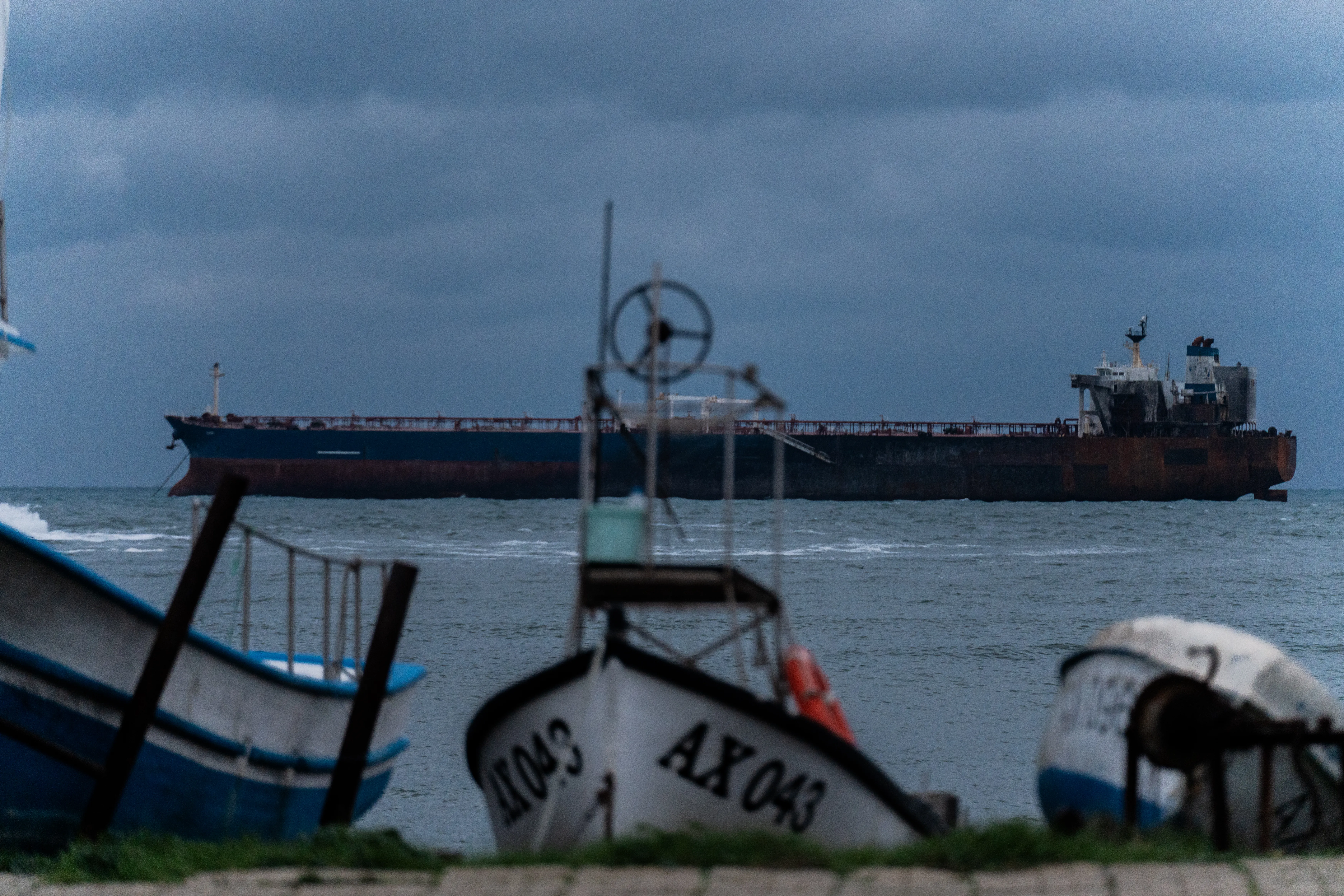
AHTOPOL, BULGARIA - DECEMBER 8: The Kairos oil tanker, a Gambian-flagged vessel believed to be part of Russia's shadow fleet, remains anchored on December 8, 2025 in Ahtopol, Bulgaria. Last week, the ship was sailing from Egypt toward the Russian port of Novorossiysk when it caught fire after an alleged attack by Ukrainian naval drones. Bulgarian maritime authorities are planning the evacuation of the remaining crew. The tanker was sanctioned by the European Union in July for its involvement in Russia's so-called shadow fleet, a clandestine network of vessels that help the country skirt price-capping sanctions on Russian oil sales, penalties that were imposed after the 2022 invasion of Ukraine. (Photo by Hristo Rusev/Getty Images)
The oil tanker Kairos, a Gambian-flagged vessel believed to be part of the Russian shadow fleet, remains anchored on December 8, 2025, in Ahtopol, Bulgaria. The ship was sailing from Egypt toward the Russian port of Novorossiysk when it caught fire after an alleged attack by Ukrainian naval drones. Photo by Hristo Rusev/Getty Images Hristo Rusev

It might not be a coincidence that the attack took place on the day of Russian President Vladimir Putin’s annual end-of-year press conference. During this, Putin said that Russia would respond to recent Ukrainian attacks on shadow fleet tankers.

Since the start of the full-scale invasion of Ukraine, Russia has relied heavily on the shadow fleet, estimated to number more than 1,000 ships, to circumvent sanctions and export crude oil, bringing much-needed revenue.

Putin said today that Russia would “definitely respond” to Ukraine’s campaign against its shadow fleet. “Ultimately, this will not lead to the expected result,” he said. “It will not disrupt any supplies, but will only create additional threats,” Putin added.

Ukraine has previously used drone strikes to target Russian shadow tankers in the Black Sea.

As we have previously reported, Ukraine carried out three attacks on Russian-connected oil tankers in the Black Sea in late November and early December. This campaign has drawn a response in kind from Russia, using a Shahed-type drone, as you can read about here.

Ukraine’s SBU security service says its Sea Baby naval drones today struck another Russian “shadow fleet” tanker in the Black Sea.

Video from an SBU source purports to show the oil tanker “Dashan” being hit by the attack drone and explosions in the stern area. “The vessel,… pic.twitter.com/mtfBqYe1gQ

— Christopher Miller (@ChristopherJM) December 10, 2025

However, the first confirmed Ukrainian strike on a Russian-linked vessel this far from the Black Sea theater is a significant development. It is highly likely that the clandestine anti-ship war waged between Iran and Israel — something we have reported on for years now —likely provided a template for this.

The ability to use short-range drones to prosecute attacks in the Mediterranean indicates that vessels could be under threat elsewhere in European waters or even beyond. Beyond that, we could see Ukraine start to use longer-range systems, including one-way attack drones equipped with Starlink terminals, in the future.

Regardless, this development not only makes it potentially harder for Russia to export oil but also means that other commercial shipping will have to be aware of the increasing risks and potentially take measures to enhance their protection.

While the attack on Qendil appears to be the first of its kind in the Mediterranean, a further geographical expansion of Kyiv’s campaign against the Russian shadow fleet should not be ruled out.

Contact the author: thomas@thewarzone.com

Thomas is a defense writer and editor with over 20 years of experience covering military aerospace topics and conflicts. He’s written a number of books, edited many more, and has contributed to many of the world’s leading aviation publications. Before joining The War Zone in 2020, he was the editor of AirForces Monthly.


Howard is a Senior Staff Writer for The War Zone, and a former Senior Managing Editor for Military Times. Prior to this, he covered military affairs for the Tampa Bay Times as a Senior Writer. Howard’s work has appeared in various publications including Yahoo News, RealClearDefense, and Air Force Times.


Source link

Putin says he’s ready to continue war with Ukraine in annual address

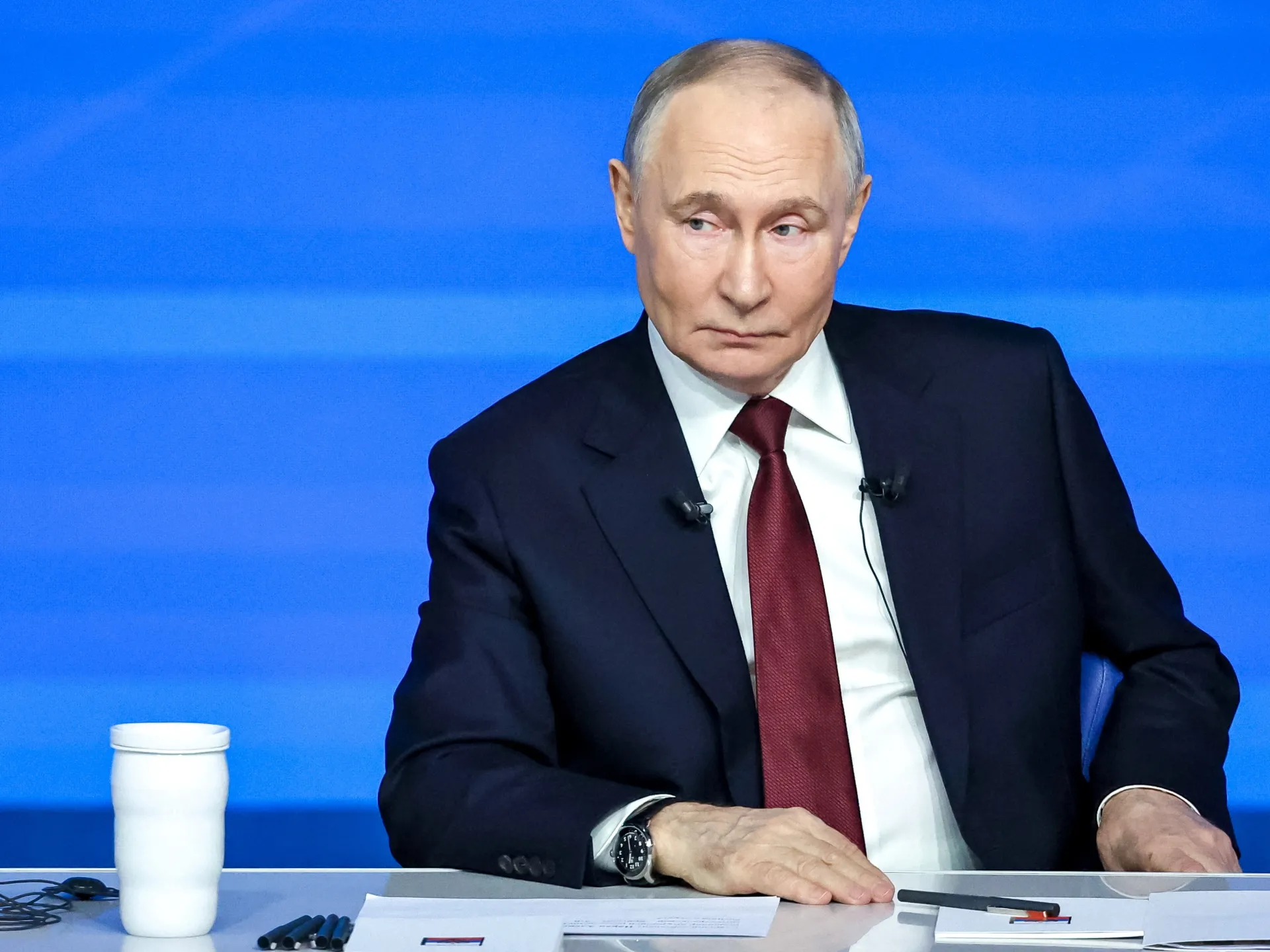
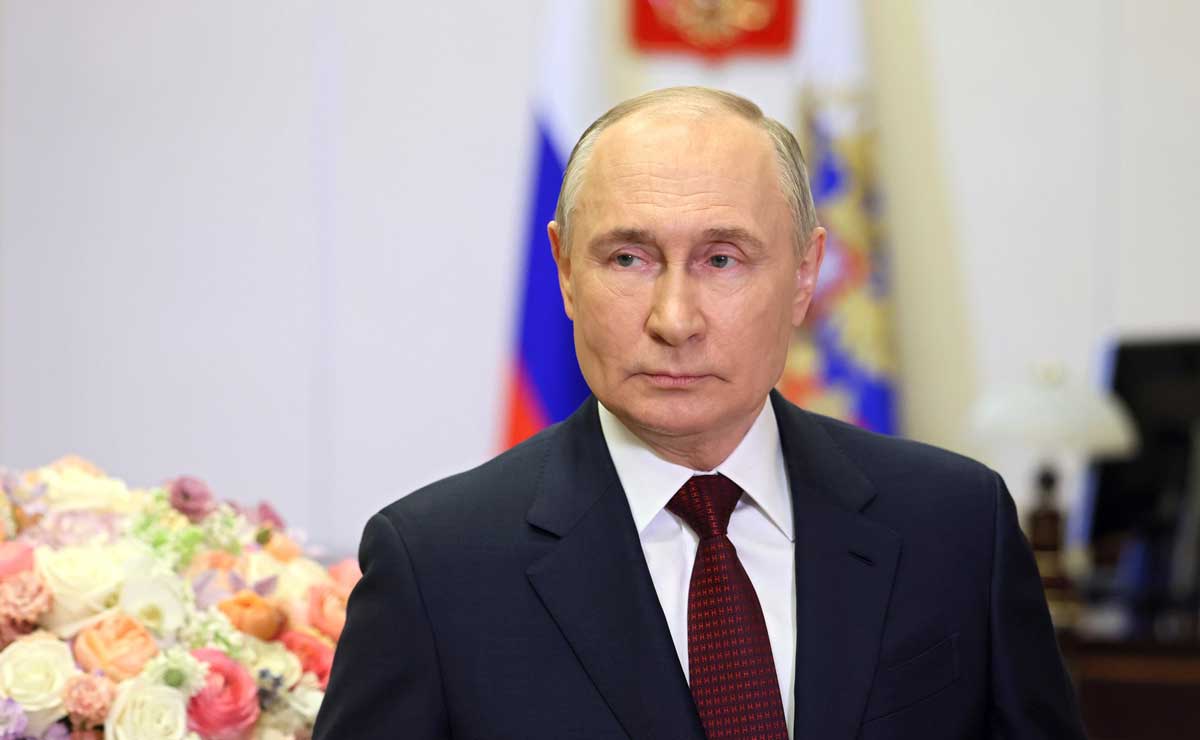
Russian President Vladimir Putin speaks during his annual live broadcast press conference with Russian federal, regional, and foreign media in Moscow. Photo by Sergei Ilnitsky/EPA

Dec. 19 (UPI) — Russian President Vladimir Putin said he was determined to continue the war in Ukraine until his conditions are met, which include taking Ukrainian territory.

Putin spoke at his annual press conference and touted Russia’s recent gains in the region.

“The strategic initiative is completely in the hands of the Russian forces,” Putin said. He added that Russia is “ready to end the conflict peacefully” if Ukraine cedes large areas of its eastern territories.

Ukrainian President Volodymyr Zelensky has said Ukraine won’t give up its land, which is set by the country’s constitution.

Russia has also demanded that Ukraine give up its bid to join NATO and said that if NATO members sent troops, Russia would view them as “legitimate targets.”

“The ball is entirely in the court of our Western opponents,” he said, adding that Russia had agreed to compromises proposed by the United States in its peace plan negotiated by the President Donald Trump administration.

Earlier this week, Zelensky was asked if Kyiv would give up its attempts to join NATO. He said Ukraine’s “position remains unchanged.”

“The United States don’t see us in NATO, for now,” he said. “Politicians change.”

European leaders have agreed to continue funding Ukraine in its fight against Russia with a two-year, $105 billion loan for munitions in the ongoing war.

European leaders couldn’t agree on their first choice to arm Ukraine using frozen Russian state assets to back the loan.

The plan to use frozen Russian assets fell apart in the final moments after Belgium pushed back, fearful that it would be at legal and financial risk. The bank holding the assets is in Belgium, and Russia has sued to block the plan.

European leaders announced Thursday that they will instead use money from the EU budget. The new plan could be more costly and difficult to mobilize.

Former President Joe Biden presents the Presidential Citizens Medal to Liz Cheney during a ceremony in the East Room of the White House in Washington, on January 2, 2025. The Presidential Citizens Medal is bestowed to individuals who have performed exemplary deeds or services. Photo by Will Oliver/UPI | License Photo

Source link

Macron: Europe Must Engage Putin If U.S. Peace Talks Fail

French President Emmanuel Macron indicated that Europe may need to directly engage with Russian President Vladimir Putin if U.S.-led efforts toward a Ukraine peace deal fail. European leaders have been dissatisfied with their exclusion from peace talks led by the Trump administration and have been focused on supporting Ukraine’s negotiating position from afar. During remarks in Brussels, Macron emphasized the necessity for a solid peace agreement with security guarantees, suggesting that without this, Europe should prepare to re-establish direct dialogue with Russia. This comes after EU leaders decided to provide Ukraine with a 90 billion euro loan, utilizing the EU’s budget rather than frozen Russian assets, amid internal divisions.

Macron argued that the EU cannot afford to lose its communication channels with Moscow, particularly as U.S. officials prepare for talks with Russian negotiators. Most EU nations, except Hungary and Slovakia, have halted communication with Putin since the invasion of Ukraine. Macron highlighted the need for a strategic approach to facilitate renewed discussions with Russia, warning that continued inaction might leave EU leaders isolated and marginalized in negotiations.

Moreover, some EU leaders expressed concerns about diminishing public support for sustaining Ukrainian resistance to the ongoing war. The summit’s outcome aims to support Ukraine financially, reflecting a recognition of the war’s broader implications for European security, despite worries about increasing political pressure and potential public fatigue regarding the conflict. Danish Prime Minister Frederiksen noted that Putin is likely counting on a combination of war fatigue and societal uncertainty to undermine European resolve.

With information from Reuters

Source link

Argentina creates nuclear office to become ‘Saudi Arabia of uranium’

Argentina’s nuclear plan will roll out in stages. The first phase involves building small modular reactors, or SMRs, at the Atucha Nuclear Power Plant site, already underway, to ensure nationwide energy supply and reduce power outages. Photo by CNEA/EPA

BUENOS AIRES, Dec. 19 (UPI) — Argentina has formally created the Secretariat of Nuclear Affairs, a significant structural shift in the country’s national energy strategy under President Javier Milei, aimed at positioning Argentina as a global energy leader and attracting large-scale investment.

In announcing the move, the government highlighted the country’s strengths for developing a nuclear plan, including its pool of highly trained human capital and vast, low-temperature lands in Patagonia seen as suitable for hosting artificial intelligence data centers. These advantages, officials said, allow for a combination of clean nuclear energy and cutting-edge technology.

The plan will roll out in stages. The first phase involves building small modular reactors, or SMRs, at the Atucha Nuclear Power Plant site, already underway, to ensure nationwide energy supply and reduce power outages.

SMRs produce stable and low-cost electricity, making them well-suited to power AI data centers, and would position Argentina as a regional hub for digital innovation and nuclear energy exports.

In the second phase, the government plans to develop uranium reserves to meet domestic demand and turn Argentina into an exporter of high-value nuclear fuels.

The Economy Ministry summed up the strategy in a recent statement, saying the government aims to “turn Argentina into the ‘Saudi Arabia of uranium.'”

This ambitious goal is based on the country’s uranium reserves, estimated at 36,483 tons identified and concentrated in provinces such as Mendoza, San Juan and Chubut, according to a report by the National Mining Secretariat.

Those reserves could generate significant export volumes and position Argentina as a key supplier in a growing global market driven by the energy transition.

However, physicist Alberto Baruj urged caution.

“Argentina has enough uranium for its reactors for decades. It does not have the extraordinary reserves found in other countries. Talking about being the Saudi Arabia of uranium is an exaggeration that I cannot support from a technical standpoint,” Baruj told UPI.

Baruj said Argentina could export uranium, thanks to its processing capacity. However, “it makes no sense to do so with raw ore. It would be far more convenient to process it for use in domestic reactors, including small modular reactors such as the domestically designed CAREM.”

The new nuclear institutional framework will also be tasked with leading policy on the exploitation of rare earth elements, minerals critical for batteries, cellphones and green technology, as well as nuclear minerals, in coordination with other government agencies.

It will promote collaboration among mining companies, provincial governments and private actors to increase production of these resources and drive investment, working alongside the Mining Secretariat to advance nuclear mining projects, material processing and technological applications.

“The Secretariat of Nuclear Affairs is taking on roles that previously belonged to the National Atomic Energy Commission, which blurs the agency’s place within the institutional structure,” a respected nuclear sector source who requested anonymity told UPI.

In their view, amid a budget crisis at the commission, the creation of a new body “further endangers what has historically been the center of Argentina’s nuclear activity. The inclusion of rare earth exploitation comes as a surprise within a nuclear affairs secretariat.”

Baruj also questioned the need for the new agency, saying its stated purpose, coordinating the nuclear sector, already falls by law under the National Atomic Energy Commission.

“It is possible that with the creation of the Secretariat, the government is seeking greater political control over the sector,” Baruj said. But, he added, creating a new secretariat is unnecessary if each institution fulfilled its assigned role.

“The massive loss of technical personnel with extraordinary capabilities must be reversed. But above all, the salary issue must be resolved, because the commission pays the lowest wages in the entire science and technology sector,” he said.

Baruj said the priority should be to ensure continuity of key projects such as completion of the RA-10 multipurpose reactor, its associated neutron beam laboratory, the CEARP Proton Therapy Center and the heavy water industrial plant.

“Argentina’s nuclear sector has sufficient capacity and depth to take on and carry out these projects. What is lacking, precisely, is political will,” he said.Based o

Source link

Rogue tankers in Singapore: What are shadow fleets and who uses them? | Energy News

Singapore has reported a growing number of “rogue” or “shadow fleet” tankers operating off its shores in and around one of the world’s busiest maritime corridors.

According to Lloyd’s List Intelligence data cited by international maritime authorities, at least 27 such ships transited the Singapore Strait in early December, with another 130 clustered nearby around Indonesia’s Riau Archipelago.

Recommended Stories

list of 4 itemsend of list

While traffic through the strait remains dense and appears outwardly routine – more than 80,000 vessels pass through it each year – ship-spotters and analysts say the profile of some of the ships using these waters has recently changed.

Why are so many ‘rogue’ tankers appearing near Singapore?

Conflict in Ukraine and the Middle East has sparked a surge in Western sanctions on oil exports from countries such as Russia and Iran. The European Commission and the United States Trump administration have both recently renewed or extended sanctions against Venezuelan oil, as well.

As a result, a parallel, unofficial maritime network has emerged to keep sanctioned oil moving.

The Singapore Strait is a vital artery for global maritime trade, carrying about one-third of the world’s traded goods at some point along their journeys. For tankers at sea, it is almost unavoidable – the strait is a natural gateway between the Indian Ocean and the South China Sea, also a busy trade artery.

The Maritime and Port Authority monitors vessel movements within Singaporean waters. But international law limits what action it can take once ships move into the high seas – in effect, international waters – allowing shadow fleets to thrive in regulatory grey zones.

In recent weeks, suspect shipping activity has been noted just beyond Singapore’s territorial waters – roughly 22.2 kilometres from its coast – in international waters, just outside of the city state’s law enforcement reach.

What are ‘shadow fleets’ and how do they avoid sanctions?

As a result of record sanctions by Western governments in recent years over Russia’s war in Ukraine, Iran’s nuclear programme and, most recently, United States President Donald Trump’s campaign against Venezuela, the number of falsely flagged ships globally has more than doubled this year to more than 450, most of them tankers, according to the International Maritime Organization database.

All vessels at sea are required to fly a flag showing the legal jurisdiction governing their operations in international waters. The body which grants ship nationalities is the UN Convention on the Law of the Sea (UNCLOS).

A shadow ship, or “ghost” ship, is typically an ageing vessel with obscure ownership. These vessels frequently change flags – for instance, when the US seized the tanker, Skipper, off the coast of Venezuela earlier this month, the government of Guyana, Venezuela’s neighbour, said it was “falsely flying the Guyana flag”, and clarified that it was not registered in the country.

Operators of shadow ships also falsify registration details, broadcast false geo-location codes, or even switch off tracking systems altogether to evade detection and skirt UNCLOS laws.

These vessels typically carry sanctioned oil and other restricted goods such as military equipment. They often conduct risky ship-to-ship transfers of cargo under the cover of night to avoid detection. This can create serious safety and environmental risks.

Additionally, most of the tankers are owned by shell companies in jurisdictions such as Dubai, where rapid buying and selling by anonymous or newly formed firms can take place, making it even harder to trace their origins.

Jennifer Parker, a specialist in maritime law at Australia’s University of New South Wales, said the increasing number of shadow fleets presents a “real challenge”.

Parker told Al Jazeera that “finding out who owns them and who insures them has been incredibly difficult because of the [murky] paper trail around them”.

She added that “often they would do what is called bunkering, which is the process of transferring fuel at sea between ships. So that makes it hard to track where that ship has actually come from and where that oil has come from.”

She added: “Sometimes, what they do is actually mix oil, so you will have a legitimate ship that will do a ship-to-ship transfer at sea with a shadow fleet and they will mix the oil so it becomes hard to really trace where that oil has come from … to avoid sanctions.”

What sort of problems do these tankers cause?

When ageing, uninsured vessels are involved in accidents, it can lead to environmental disasters like oil spills.

According to Bunkerspot, a specialist maritime publication, a shadow tanker spill, which can cause enormous damage to water, wildlife and local coastlines, can cost up to $1.6bn in response and cleanup alone.

Last December, Russian authorities scrambled to contain an oil spill in the Kerch Strait caused by two 50-year-old tankers which had been damaged during a heavy weekend storm. The scale of the environmental damage and the associated cleanup costs remain unclear.

In addition to vessel collisions, they can cause environmental damage through chemical leaks and illegal waste dumping.

Kerch
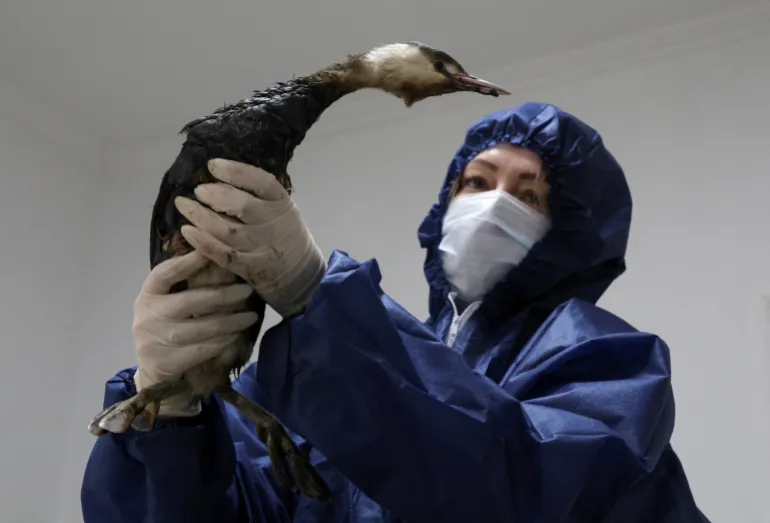
A volunteer cleans up a bird covered in oil following an oil spill by two tankers damaged in a storm in the Kerch Strait, at a veterinary clinic in the Black Sea resort city of Saky, Crimea, on January 8, 2025 [Alexey Pavlishak/Reuters]

Who uses shadow fleets the most?

Russia is the primary beneficiary of ghost fleet trading. Moscow has largely maintained its oil exports despite Western sanctions, ensuring steady revenue for its war in Ukraine. Though not to the same extent, Iran and Venezuela also sell fossil fuels using ghost fleets.

China and India, currently the largest buyers of Russian crude, benefit from steep discounts, often purchasing oil well below the Western-imposed $60 per barrel price cap, which was imposed in December 2022 following Russia’s invasion of Ukraine.

Tracking by S&P Global and Ukrainian intelligence shows that Russia relied heavily on its shadow tanker fleet in 2025. India has been the main destination, importing about 5.4 million tonnes (or 55 percent of Russian crude oil sales via shadow tankers) between January and September.

China has taken a smaller but still significant share of about 15 percent. Overall, most Russian seaborne crude now moves outside Group of Seven (G7)-compliant shipping, underscoring the shadow fleet’s central role in this trade.

What actions have governments taken against shadow fleets?

To avoid enforcement of sanctions, many shadow tankers have moved out of major shipping lanes. In part, this is down to European authorities now requiring physical inspections during ship-to-ship transfers, making it riskier for these vessels to operate on conventional routes.

For instance, Denmark, Sweden, Poland, Finland and Estonia recently began carrying out insurance checks on tankers transiting the Gulf of Finland and the waters between Sweden and Denmark. This is aimed at ensuring compliance with 2022 sanctions on Russian oil.

Meanwhile, in July 2025, the United Kingdom imposed measures – such as restrictions on access to UK ports, insurance and financial services – on 135 shadow fleet vessels and two linked firms, aiming to reduce Russia’s shipping capacity and cut its energy earnings.

In the US, President Donald Trump has warned that comparable measures will follow if Russia refuses to agree to a ceasefire in Ukraine, raising the prospect of closer transatlantic coordination with the UK and Europe against shadow fleets.

Source link

Tens of thousands flee DR Congo to Burundi amid rebel takeover of key city | Conflict News

UN refugee agency says women and children arriving ‘exhausted and severely traumatised’ after fleeing eastern DRC.

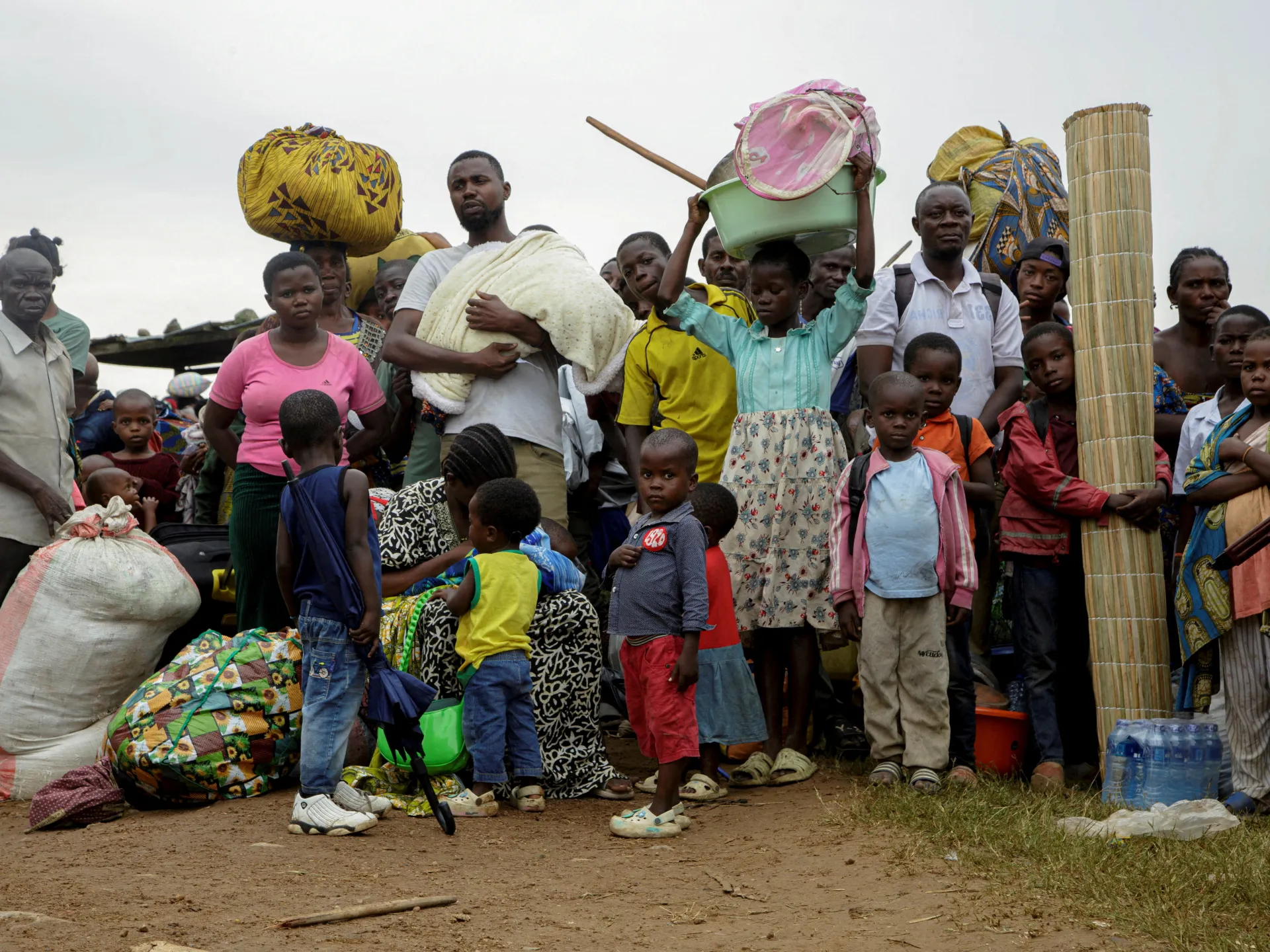
More than 84,000 people have fled to Burundi from the eastern Democratic Republic of the Congo (DRC) amid a Rwanda-backed rebel offensive near the countries’ shared border, according to the latest United Nations figures.

The UN refugee agency (UNHCR) said on Friday that Burundi had reached a “critical point” amid the influx of refugees and asylum seekers fleeing a surge in violence in the DRC’s South Kivu province.

Recommended Stories

list of 3 itemsend of list

“Thousands of people crossing the border on foot and by boats each day have overwhelmed local resources, creating a major humanitarian emergency that requires immediate global support,” UNHCR said, noting that more than 200,000 people had now sought refuge in Burundi.

“Women and children are particularly affected, arriving exhausted and severely traumatised, bearing the physical and psychological marks of terrifying violence. Our teams met pregnant women, who shared that they had not eaten in days.”

The exodus began in early December when the M23 rebel group launched an assault that culminated in the capture of Uvira, a strategic city in the eastern DRC that is home to hundreds of thousands of people.

Refugees started crossing into Burundi on December 5, with numbers surging after M23 seized control of Uvira on December 10. On Wednesday, M23 said it was withdrawing after international condemnation of its attack on the city.

In Burundi, displaced families face difficult conditions at transit points and makeshift camps with minimal infrastructure, the UN said.

Many have sheltered under trees without adequate protection from the elements, and a lack of clean water and proper sanitation.

About half of those displaced are children less than the age of 18, along with numerous women, including some who are pregnant.

Ezechiel Nibigira, the Burundian president of the Economic Community of Central African States (ECCAS), reported 25,000 refugees in Gatumba in western Burundi, and nearly 40,000 in Buganda in the northwest, most of them “completely destitute”.

Augustin Minani, the administrator in Rumonge, told the AFP news agency that the situation was “catastrophic” and said “the vast majority are dying of hunger.”

Refugees recounted witnessing bombings and artillery fire, with some seeing relatives killed and others forced to abandon elderly family members who could not continue the journey.

M23 withdrawal

M23 announced earlier this week it would begin withdrawing from Uvira, with the group’s leadership calling the move a “trust-building measure” to support United States- and Qatari-led peace efforts.

However, the Congolese Communications Minister Patrick Muyaya dismissed the announcement as a “diversion”, alleging it was meant to relieve pressure on Rwanda.

Local sources reported that M23 police and intelligence personnel remained deployed in the city on Thursday.

The offensive extended M23’s territorial gains this year after the group captured the major cities of Goma in January and Bukavu in February.

The rebel advance has given M23 control over substantial territory in the mineral-rich eastern DRC and severed a critical supply route for Congolese forces along the border with Burundi.

M23 launched the Uvira offensive less than a week after the presidents of the DRC and Rwanda met with US President Donald Trump in Washington, DC, to reaffirm their commitment to a peace agreement.

The rebels’ takeover of the city drew sharp criticism from Washington, with officials warning of consequences for what they described as Rwanda’s violation of the accord. Rwanda denies backing M23.

The fighting has killed more than 400 civilians in the DRC and displaced more than 200,000 since early December, according to regional officials and humanitarian organisations.

The broader conflict across the eastern part of the country, where more than 100 armed groups operate, has displaced more than seven million people, the UN refugee agency says.

Source link

Moscow’s narrative wobbles as Ukraine takes back Kupiansk | Russia-Ukraine war News

Ukrainian military successes and Russian narratives clashed this week, as Moscow’s assertion of inevitable victory flew in the face of facts on the ground.

Ukraine steadily took back control of almost all of its northern city of Kupiansk after isolating Russian forces within it, belying Russian claims to have seized it.

Russian forces were also unable to dislodge Ukrainian defenders from the eastern city of Pokrovsk to back up Moscow’s claims of total control.

And Moscow attempted to deny Ukraine’s successful use of an underwater unmanned vehicle to severely damage a Kilo-class submarine, despite visual evidence.

Ukrainian forces operating in the northern Kharkiv region said they had cut Russian logistics to Kupiansk, surrounded a vanguard of 200 Russians inside it, and cleared Russian forces out of forests north of the city on December 12.

Geolocated footage showed Ukrainian forces advancing in the city the following day and taking back the southern suburb of Yuvileynyi, pushing Russian troops to the northern and western suburbs.

The Russian position had become more precarious by Monday. Ukrainian forces said they prevented reinforcements from entering the city through a gas pipeline, a tactic Russia had used in the siege of Chasiv Yar, and the isolated Russian troops were being supplied solely by drone. Ukraine’s General Staff said its forces were still repelling Russian attacks on Friday.

Russia’s Ministry of Defence insisted it had control of the situation. “Units of the Zapad Group of Forces exercise reliable control over all districts of liberated Kupiansk,” it said on Monday, claiming that Ukraine’s efforts to enter the city from the south were being suppressed.

“The only thing that can be said for sure is that the Russian Armed Forces are still holding part of the centre and north of Kupiansk, but most of it is already either in the grey zone or under the control of the Armed Forces of Ukraine,” wrote a Russian military reporter on the Telegram messaging app.

On Wednesday this week, Colonel General Oleksandr Syrskii, Ukraine’s Army commander-in-chief, told a Ramstein-format of Ukraine’s allies that his forces had taken back 90 percent of Kupiansk. At the same time in Moscow, Russian Defence Minister Andrei Belousov was telling Russian President Vladimir Putin that “the enemy is unsuccessfully trying to regain” the city.

“The Russian Defense Minister, Belousov, continues to lie that Russia controls Kupiansk,” wrote Andrii Kovalenko, head of Ukraine’s Center for Countering Disinformation, on Telegram. “In reality, most of the city is controlled by the Ukrainian Defense Forces, which are continuing to clear it of Russians. However, all of Putin’s officials, from [commander-in-chief Valery] Gerasimov, who was the first to lie about controlling the city, to Belousov, continue to lie in the presence of Putin himself.”

Contrary to the available evidence, Belousov also insisted that Russia had seized Pokrovsk, which Russia calls Krasnoarmeysk, and was on the cusp of vanquishing neighbouring Myrnohrad, which Russia calls Dimitrov. Both towns are in the eastern Donetsk region, and are almost surrounded by Russian forces to the north, south and east.

“Russian soldiers continue to inflict fire damage on Ukrainian troops in Dimitrov, the last stronghold of the Armed Forces of Ukraine in Krasnoarmeysk agglomeration,” Belousov told Putin.

But Syrskii told allies that Ukrainian forces had regained about 16 square kilometres (6 square miles) in the northern part of Pokrovsk and 56sq km (22sq miles) west of the city. “Logistics in Myrnograd are complex, but the operations continue,” he wrote.

Russia had claimed complete control over Pokrovsk on December 2 and was sticking to its story.

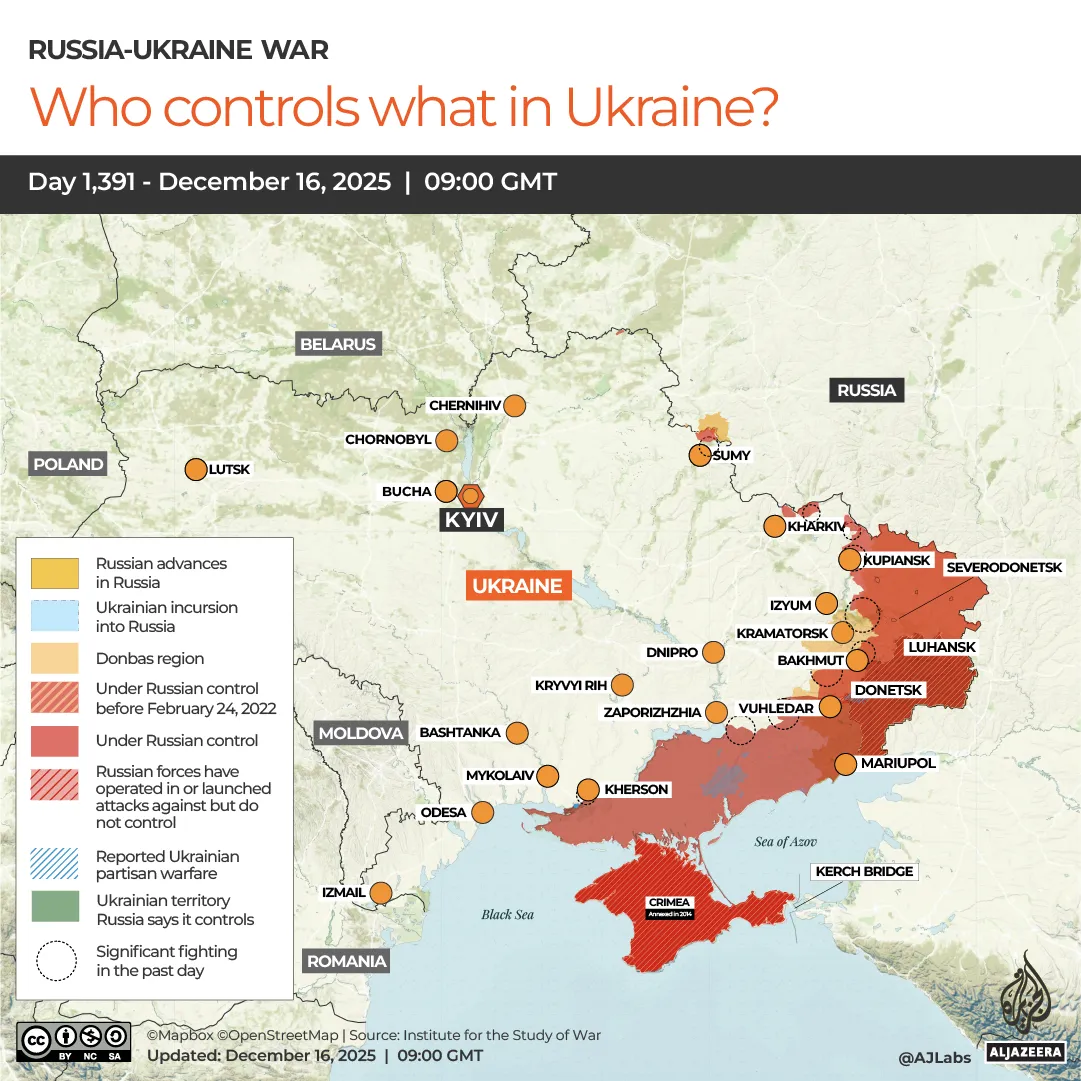
INTERACTIVE-WHO CONTROLS WHAT IN UKRAINE-1765877913
(Al Jazeera)

Submarine and oil refinery explosions

A third point of contention was Ukraine’s successful use of an underwater unmanned vehicle (UUV) to strike a Russian Kilo-class submarine on Monday (December 15), in what is considered the first such attack in military history.

Video of the Russian fleet at anchor in the port of Novorossiysk on the Black Sea shows a huge explosion in the stern section of the submarine.

Ukraine’s State Security Service later claimed credit for the attack.

However, Russia’s Defence Ministry said: “Not a single ship or submarine as well as the crews of the Black Sea Fleet stationed in the bay of the Novorossiysk naval base were damaged as a result of the sabotage.”

The ministry published footage of what it said was the attacked submarine, in which it appeared undamaged above the surface, but the video did not show the stern section.

Ukraine’s long-range strikes against Russia scored other successes, on which Russia did not comment.

Ukraine struck the oil refinery in Yaroslavl, northeast of Moscow, on December 12. On Sunday, Ukrainian drones struck the Afipsky refinery in Krasnodar Krai and the Uryupinsk oil depot in Volgograd, causing explosions in both locations. They also struck the Dorogobuzhskaya power plant in Smolensk.

Kupiansk
A Ukrainian Presidential Press Service photo shows President Volodymyr Zelenskyy as he awards a serviceman of the 14th Separate Mechanized Brigade of the Armed Forces of Ukraine during his visit to the front-line town of Kupiansk on December 12, 2025 [Ukrainian Presidential Press Service/Handout via Reuters]

United States and Ukrainian negotiating teams met for two days in Berlin on Sunday and Monday. Russian officials said they would be briefed next week on the results of those talks.

But even as it claimed to be interested in ongoing peace negotiations, Russia clearly signalled that it plans to continue aggressive operations next year.

“The key task for the next year is to maintain and increase the pace of the offensive,” said Belousov in Putin’s presence on Wednesday, at an expanded meeting of the Defence Ministry Board.

“It wasn’t us who started the war in 2022; it was the destructive forces in Ukraine, with the support of the West – essentially, the West itself that unleashed this war,” Putin said. “We are only trying to finish it, to put an end to it.”

Putin said “the goals of the special military operation will certainly be achieved,” and “Russia will achieve the liberation of its historical lands by military means,” suggesting there was little room for compromise on Moscow’s side.

Putin’s Deputy Foreign Minister Sergey Ryabkov signalled the same thing in an interview with ABC on Tuesday. He said Europe and Ukraine expected a “deep and very wrong” revision of Russian peace proposals, and ruled out conceding seized Ukrainian land.

“We are not able in any form to compromise on this, because it would be, in our view, a revision of a very fundamental element of our statehood, set forth through our constitution,” Naryshkin said.

INTERACTIVE-WHO CONTROLS WHAT IN EASTERN UKRAINE copy-1765877906
(Al Jazeera)

Russian losses outpace recruitments

Russia has attempted to give the impression that it has inexhaustible manpower with which to prosecute the war it started in Ukraine.

Belousov said almost 410,000 Russians volunteered for military service, exceeding expectations for 2025.

That translates to 32,800 per month. “Data from the Ukrainian General Staff on Russian losses indicate that Russian forces suffered an average of 34,600 casualties per month between January and November 2025 – suggesting that Belousov’s recruitment numbers are not quite replacing Russian losses,” wrote the Institute for the Study of War, a Washington-based think tank.

Ukrainian President Volodymyr Zelenskyy suggested most of these casualties were deaths. “[Putin] spends around 30,000 soldiers’ lives on the front every month. Not wounded – 30,000 killed each month… We have drone footage confirming these deaths,” he told Dutch parliamentarians.

Syrski also doubted Russian recruitment quotas were sufficient.

“The number of Russian troops has long been around 710,000,” he wrote on Telegram. “However, the enemy has not been able to increase this figure, despite active recruitment in Russia, because our soldiers are ‘reducing’ the number of occupiers by a thousand every day through deaths and injuries.”

INTERACTIVE-WHO CONTROLS WHAT IN SOUTHERN UKRAINE-1765877909
(Al Jazeera)

Source link

Rams fall apart and lose to Seahawks

From Gary Klein: Short week, strange and bad trip.

It started with Rams star receiver Puka Nacua ripping NFL referees and making an antisemetic gesture on a livestream.

It ended with an epic fourth-quarter collapse.

And a potentially catastrophic fall from the No. 1 seed in the NFC.

The Rams were on the verge of enduring a quick turnaround, a distracting controversy, and a flight delay but they could not hold on to the No. 1 seed in the NFC.

The Rams’ 38-37 overtime defeat by the Seattle Seahawks on Thursday night at Lumen Field continued a cascade of ill-timed news for coach Sean McVay and a team regarded as a Super Bowl contender.

The Rams’ record fell to 11-4. The Seahawks displaced them atop the NFC West. And the road to home-field advantage for the playoffs now includes some major roadblocks.

Thank the Rams defense: It forced three turnovers but blew a 16-point fourth-quarter lead.

“This one’s a tough one right there,” coach Sean McVay said of the loss. “Never seen anything like some of the things that occurred.”

McVay was referencing a two-point conversion attempt by the Seahawks in the fourth quarter, which was initially ruled an incomplete pass that left the Rams with a 30-28 lead.

Continue reading here

Rams summary

NFL standings

————

From Gary Klein: As the Rams prepared for their game on Thursday night against the Seattle Seahawks, star receiver Puka Nacua, the Rams and the NFL issued statements related to Nacua performing a gesture “antisemitic in nature” during a livestream.

In a post on Instagram, Nacua apologized for the gesture he made while appearing on a livestream with Adin Ross and N3on. The livestreamers, with Nacua out of earshot, discussed whether Nacua would get in trouble if he performed a move that references an offensive stereotype about Jewish people. Ross is Jewish, but he often performs the move and teaches others how to do it in his livestreams.

They suggested Nacua perform the gesture the next time he celebrated after scoring a touchdown.

“At the time, I had no idea this act was antisemetic in nature and perpetuated hateful stereotypes against Jewish people,” Nacua wrote in his post. “I deeply apologize to anyone who was offended by my actions as I do not stand for any form of racism, bigotry or hate of another group of people.”

Continue reading here

NFL Week 16 picks: Rams defeat Seahawks; Broncos edge Jaguars

Lakers win high-scoring game

From Broderick Turner: When Brice Sensabaugh drilled a wide-open three pointer in the third quarter, Lakers coach JJ Redick quickly called a timeout and began to gesture with both hands toward his players, clearly showing his displeasure with their defense.

The Lakers responded.

They especially picked up their defensive intensity for an important spurt in the fourth quarter, slowing down the Utah Jazz and in the process the Lakers’ offense took off, the two converging at the right time to push them to a 143-135 win Thursday night at the Delta Center.

“Obviously we know this Utah team can score points at a very high rate, but it was very imperative that we got stops,” said LeBron James, who had another productive night with 28 points, 10 assists and seven rebounds. “We had to get stops to start that fourth and then it allowed our offense to click.”

Continue reading here

Lakers box score

NBA standings

Clippers lose again

Shai Gilgeous-Alexander scored 32 points before resting in the fourth quarter, and the Oklahoma City Thunder bounced back from a rare loss to beat the Clippers 122-101 on Thursday night.

The Thunder lost to the San Antonio Spurs last Saturday for just their second defeat of the season, ending their team-record, 16-game win streak. They recovered on Thursday after some much-needed rest and improved to 25-2 overall and 13-0 at home.

Gilgeous-Alexander made 13 of 24 shots and had seven rebounds and six assists. It was his 98th consecutive game with at least 20 points, adding to the second-longest streak in NBA history.

Continue reading here

Clippers box score

NBA standings

Londynn Jones has career game for USC

From Antony Solorzano: It was a game to remember for Londynn Jones. She played with confidence and showed her dribbling skills and displaying her all-around skills as she finished the game with a career-high 28 points in the USC women’s basketball team’s 86-39 win over Cal Poly on Thursday night at Galen Center.

In the first part of the game, Jones was perfect on offense while aggressively defending every time the Mustangs had the ball. When Cal Poly attacked, she came up with steals and completed the play with a field goal, sometimes even adding one more point on a foul.

“I’m just happy we’re figuring it out, starting to finally put the pieces together,” she said. “I know that’s something we’ve been emphasizing in practice, just watching films and putting the pieces together.”

Continue reading here

USC box score

Big Ten standings

————

From Ryan Kartje: With three key players out because of injury and USC in desperate need of depth, the Trojans are taking the rare step of adding reinforcements at the midseason mark.

Point guard Kam Woods, who last played at Robert Morris, was added to the Trojans’ roster and cleared to play on Thursday, despite the fact that USC is already a dozen games into the basketball season.

Woods could make an immediate impact for coach Eric Musselman, having averaged 14.9 points, 5.2 assists and 4.7 rebounds per game last year at Robert Morris, where he played alongside current Trojan, Amarion Dickerson. Woods is expected to step into the rotation right away with USC, after the Trojans lost starting point guard Rodney Rice for the season.

Continue reading here

Greg Biffle dies

A business jet crashed Thursday while trying to return to a North Carolina airport shortly after takeoff, killing all seven people aboard, including retired NASCAR driver Greg Biffle and his family, authorities said.

The Cessna C550 erupted into a large fire when it hit the ground. It had departed Statesville Regional Airport, about 45 miles north of Charlotte, but soon crashed while trying to return and land, the North Carolina State Highway Patrol said.

The cause of the crash wasn’t immediately known, nor was the reason for the plane’s return to the airport in drizzle and cloudy conditions.

Biffle was on the plane with his wife, Cristina, and children Ryder, 5, and Emma, 14, according to the highway patrol and a family statement. Others on the plane were identified as Dennis Dutton, his son Jack, and Craig Wadsworth.

Biffle, 55, won more than 50 races across NASCAR’s three circuits, including 19 at the Cup Series level. He also won the Trucks Series championship in 2000 and the Xfinity Series title in 2002.

Continue reading here

Snowboarding in Australia?

From Kevin Baxter: Growing up just outside Melbourne, Australia, Scotty James was more likely to spot the Loch Ness Monster or Big Foot as he was to spot snow. For him, the Winter Olympics seemed about as accessible as Mars.

“It is very unique, being an Australian in winter sports,” he said. “We’re very few and far between.”

Unique, but not impossible. Because if he qualifies for February’s Milano-Cortina Olympics, as expected, James will become the first Australian man to represent the country in five separate Winter Olympics. If he reaches the podium in the men’s halfpipe, his specialty, he will become the most decorated winter Olympian in Australian history with three medals.

Yet it almost didn’t happen. If his father Phil, a passionate snowboarder, hadn’t talked a Vancouver ski-shop worker into selling 3-year-old Scotty a miniature display board during a family vacation to Canada decades ago, James still might be watching the Winter Olympics on TV.

Continue reading here

Kings end winless streak

Adrian Kempe scored twice in the second period, and the Kings beat the Tampa Bay Lightning 2-1 on Thursday night.

Anton Forsberg stopped 31 shots to help the Kings snap a four-game skid (0-2-2) and get just their third win in nine games (3-4-2).

Oliver Bjorkstrand scored for the Lightning and Andrei Vasilevskiy finished with 18 saves. Tampa Bay has lost three straight (0-2-1) and seven of its last nine (2-6-1).

Continue reading here

Kings summary

NHL standings

THIS DAY IN SPORTS HISTORY

1913 — Heavyweight champion Jack Johnson fights to a 10-round draw with Battling Jim Johnson in Paris.

1917 — The NHL begins play. Joe Malone of the Montreal Canadiens scores five goals in a 9-4 victory over the Ottawa Senators. Harry Hyland of the Montreal Wanderers scores five goals in a 10-9 victory over the Toronto Maple Leafs.

1943 — Harry Lumley, at 17 years and 38 days old, becomes the youngest goaltender in NHL history when he plays for the Detroit Red Wings in a 6-2 loss to the New York Rangers at Madison Square Garden.

1948 — The Cleveland Browns complete an undefeated season beating the Buffalo Bills 49-7 in AAFC championship game.

1948 — The Philadelphia Eagles beat the Chicago Cardinals 7-0 in a major snowstorm for the NFL title. Philadelphia’s Bucko Kilroy recovers a fumble on the 17-yard line in the fourth period, and Steve Van Buren later scores from the 5.

1976 — The Pittsburgh Steelers beat the Baltimore Colts 40-14 in an AFC playoff game. Ten minutes after the game, Donald Kroner, a former charter pilot, crashes a rented, low-wing, Piper Cherokee into the upper deck of Memorial Stadium. No one is seriously hurt as most of the capacity crowd of 60,020 left the one-sided contest early or were heading down the exit ramps.

1987 — Boston and St. Louis combine for the fastest two goals in NHL history. Ken Linseman puts the Bruins ahead 6-5 with 10 seconds left in the third period. Doug Gilmour of Boston wins the faceoff and shoots the puck into an empty net two seconds later to wrap up a 7-5 win over the Blues at Boston Garden.

1990 — Los Angeles Raiders running back Bo Jackson is named to the AFC team, as a reserve, becoming the first athlete chosen for All-Star games in two sports.

2001 — Marshall, led by Byron Leftwich, comes back from a 38-8 halftime deficit to beat East Carolina 64-61 in double-overtime in the GMAC Bowl for the highest scoring bowl game in history.

2007 — New York Islanders forward Chris Simon is banned for 30 games, drawing the longest suspension in NHL history again. Simon’s latest infraction was stepping on Pittsburgh’s Jarkko Ruutu with his skate during a Dec. 15 game. This is the seventh suspension of Simon’s career.

2009 — Michael Phelps helps his American team trounce a group of European all-stars in the Duel in the Pool, anchoring a relay to one of the eight world records the U.S. sets over the two-day meet in Manchester, England.

2010 — Philadelphia’s DeSean Jackson returns a punt 65 yards for a touchdown as time expires in the Eagles’ 38-31 comeback win at the New York Giants. It’s the only game-winning punt-return touchdown in NFL history as the Eagles come back from a 31-10 fourth-quarter deficit. It marks the ninth time in NFL history in which a team trailed by at least 21 points in the fourth quarter and wins the game.

2010 — The Detroit Lions stop their record road skid at 26 games with a 23-20 overtime win at Tampa Bay. It’s the first road win since Oct. 28, 2007, when they beat the Bears 16-7 at Chicago.

2017 — Freshman Trae Young has 26 points and ties an NCAA Division I record with 22 assists as No. 17 Oklahoma rolls past Northwestern State 105-68.

2017 — North Carolina coach Sylvia Hatchell becomes the third women’s Division I coach to register her 1,000th career victory after the Tar Heels beat Grambling State 79-63.

2017 — Geno Auriemma wins his 1000th game as top-ranked UConn beat Oklahoma 88-64 in the Hall of Fame women’s Holiday Showcase. Auriemma becomes the fourth women’s coach to reach the 1,000-win mark, joining Pat Summitt, Tara VanDerveer and Sylvia Hatchell, who earned her milestone victory earlier in the day.

2018 — Houston Rockets set NBA single-game record with 26 three-pointers in 136-118 victory over Washington Wizards;

Compiled by the Associated Press

Until next time…

That concludes today’s newsletter. If you have any feedback, ideas for improvement or things you’d like to see, email me at houston.mitchell@latimes.com. To get this newsletter in your inbox, click here.
Source link

UN-backed experts say Gaza food supplies improving but 100,000 still in ‘catastrophic conditions’

UN-backed food security experts have found improvements in nutrition and food supplies in Gaza since the ceasefire but say 100,000 people were still experiencing “catastrophic conditions” last month.

In August, the Integrated Food Security Phase Classification (IPC) found that half a million people – about a quarter of Gaza’s population – were living in areas suffering from famine.

Since a fragile ceasefire came into force in October, the UN and other humanitarian agencies have been able to increase food getting into Gaza.

Israel’s foreign ministry said the report was “deliberately distorted” and “doesn’t reflect the reality in the Gaza Strip”.

The latest IPC analysis suggests that a month ago, half a million Gazans were still facing emergency conditions and more than 100,000 were still under the highest level of food insecurity – IPC Phase 5 – experiencing “catastrophic conditions”.

It projects that number will continue to decrease but stressed the situation remains “highly fragile”.

IPC Phase 5 signifies the most extreme level of food insecurity , labelled “Famine” for an area or “Catastrophe” when referring to households. The report said no areas in Gaza were now classified as “in Famine”.

Israel rejected the original findings of famine by the IPC – which monitors and classifies global hunger crises – and has continued to criticise its methodology.

Cogat, the Israeli military body which controls Gaza’s crossings, said the number of trucks with food aid entering each week went beyond what the UN had determined it needed.

“The report relies on severe gaps in data collection and on sources that do not reflect the full scope of humanitarian assistance,” the body said in a statement.

The IPC said acute malnutrition was at critical levels in Gaza City and serious in Deir al-Balah and Khan Younis.

In the coming months the situation is expected to remain severe but the number of people facing the most severe conditions is predicted to fall to 1,900 by April, according to the report.

But it added that if there were renewed hostilities the entire Strip would be at risk of famine.

Israel’s Prime Minister Benjamin Netanyahu said earlier this month that the second phase of the US-brokered peace plan – which would see Israel withdraw troops further from Gaza and Hamas disarm – was close but key issues still needed to be resolved.

The IPC said key drivers of food insecurity included restricted humanitarian access, displacement of more than 730,000 people and the destruction of livelihoods – including more than 96% of crop land in Gaza being destroyed or inaccessible.

Israel imposed a total blockade on aid deliveries to Gaza at the start of March this year, which was eased in May, saying it wanted to put pressure on the armed group Hamas to release hostages remaining in Gaza at the time.

Ahead of this IPC report Cogat said the body had not engaged with the US or Israel and its methodology, “reinforcing a false narrative, driven in part by Hamas-sourced claims, while ignoring the actual humanitarian conditions on the ground”.

It also denied Israel was preventing winter and medical supplies from entering the territory and that there was a shortage of drinking water.

Unwra, the UN agency for Palestinian refugees, said while the report stated Gaza was no longer in famine, the situation remained “critical”.

“Overall living conditions in the Gaza Strip are still catastrophic, made worse by the winter weather,” it said in a statement, adding there must be “sustained, expanded, and consistent humanitarian and commercial access”.

Source link

Democrats release more Epstein file photos ahead of Friday deadline

Convicted sex offender Jeffrey Epstein victim Haley Robson speaks during a press conference with other victims on the Epstein Files Transparency Act outside the U.S. Capitol in Washington, DC, in November. The House Oversight Committee is investigating as many as 95,000 photos of Epstein with high profile politicians and power brokers. File Photo by Bonnie Cash/UPI | License Photo

Dec. 18 (UPI) — Congressional Democrats released 68 photos from the Jeffrey Epstein estate on Thursday, bringing the total number to more than 95,000 that have been turned over to the House Oversight Committee investigating names on a list of prominent people who were associated with the now deceased sex offender.

Epstein, the former financier and friend of the ultra-wealthy and politically powerful, was convicted of sexual behavior with minor girls. He later died by suicide in a Manhattan prison while awaiting trial.

To date, only a small fraction of the photos have been released to the public, but those that have been released featured President Donald Trump, top Republican strategist Steve Bannon, former President Bill Clinton, former Treasury Secretary Lawrence Summers, Microsoft co-founder Bill Gates and movie mogul Woody Allen, among other high-profile people, in candid shots with Epstein.

While not dyeing their association with the convicted sex offender, all have denied wrongdoing. None have been charged.

The latest trove of photographs was released prior to a Friday deadline, when the Justice Department will be required to release all of the government’s Epstein files with a few exceptions.

Rep. Robert Garcia, D-Calif., said the committee is reviewing materials from the Epstein estate and working with victims shown in the photographs who are not identified or threatened.

“Certainly the most disturbing photos are certainly the ones that are more sexual in nature,” Garcia said during a Thursday briefing on the Capitol steps. “We’re having a conversation about the best way to deal with those and talking to the lawyers and the survivor groups, because we want to be very cautious of the trauma that the survivors are going through.”

The new law says the photos must be published online and in a publicly searchable database.

The White House has accused Garcia and other Democrats of releasing “cherry-picked photos with random reactions to try to create a false narrative” with the intention of putting Trump in a negative light.

Source link

Nigerian Amputees Struggle With Prosthetics Not Made for Them

When Wura Hope paints her nails, she paints her prosthesis too. Pink glows on her dark skin like fine art. But her right foot is pale, yellowish-tan, the generic colour of many imported prosthetics. It contrasts with her melanin-rich skin and does not offer the aesthetics she desires.

Wura is a model, fashion designer, and vendor of Ankara fabrics. She also interns at a bank. Sometimes, she doesn’t want the spotlight that comes with being an amputee. But with a prosthetic foot so different from the rest of her body, curious eyes are unavoidable. As a result, she fully covers up her leg.

The unease Wura feels today traces back to when she was 11. One of her daily chores was filling the water tank of the large generator her parents used at their home in Abuja, in Nigeria’s North Central. One day, the propeller caught her long dress and badly injured her right leg. An infection followed, and the leg was eventually amputated. 

The 28-year-old barely remembers life with two legs. She has lived with one for so long that she even forgets she has a physical challenge. 

“Like, I literally forget,” said Wura.

Every word she says seems to arrive with a smile. And when her lips spread, they show her teeth like fresh corn peeking through a half-opened husk. She’s grateful to be walking again after many years on crutches. 

Her current prosthesis is her third. The first, donated by an Indian charity in 2014, was heavy and rigid. The second caused blisters around her stump that took days to heal. The one she uses now is lighter and has a knee joint that makes walking easier. But it is far from perfect. In hot weather, the liner squeaks against her sweaty stump and sometimes threatens to slip off. When that happens, she has to find a restroom, take it off, clean it, let it dry for a few minutes, and put it back on.

“Sometimes in the market, I’ll be looking for somewhere private to clean my liner,” she told HumAngle. 

Moments like this remind Wura of her disability, turning long-distance walking into a nightmare. 

The struggle is not just Wura’s; it is a shared reality for many who wear devices designed for colder climates. Thirty-year-old Eva Chukwunelo knows it well. She finds her stump in a pool of sweat after walking just a few metres. But in March this year, she walked seamlessly from Washington Park to the Brooklyn Bridge in New York, a distance of more than two kilometres. Back home in Abuja, she would have stopped multiple times to pull off her prosthesis, drain the sweat from its liner, and wait for her stump to dry. 

In Abuja, March is one of the hottest months, but it is cold in New York, giving chills rather than sweat. Most advanced prosthetic devices come from temperate countries, where they may be designed with little consideration for Africa’s heat and humidity. 

Silicon liners, the technology used by both Wura and Eva, were invented in Iceland and initially called the Icelandic Roll-On Silicone Socket. Made from medical-grade silicone RTVs, they do not absorb sweat. As moisture gathers inside, it simply coats the stump, making every step increasingly uncomfortable. The material is soft and generally reliable, but it does not match Africa’s weather realities. 

“So I felt like if you’re wearing a silicone liner, you cannot do so well in a hot environment,” Eva said.

As for the skin covers, they are either too black or not black at all, wrote Eva in the Nov. 5 dispatch of The Amputee LifeStyle, the newsletter where she documents the lived experiences of amputees.

“Somewhere between ‘too white’ and ‘too black’, African amputees are left underrepresented,” she noted. “So yes, we walk again. But sometimes, we walk in discomfort.”

Smiling woman with a prosthetic leg sits in open car trunk, wearing a cap and "Out On A Limb 2023" shirt, showing peace signs.
The more money you have, the lighter it becomes. Photo: Eva Chukwunelo

Eva was also born with two legs. As a child, she was always running, climbing trees, playing football, or dancing. Even after she was diagnosed with osteomyelitis, a severe bone infection, she stayed active in school and continued playing with friends. But her left foot soon developed ulcers, prompting concerns about activities that could expose her to germs. The leg began to decay right from between the big toe and the second. When gangrene—the death of body tissue due to lack of blood flow or severe bacterial infection—set in, the only option was amputation.

Eva was just 16. She imagined a future spent on crutches, or confined to a wheelchair, or, even worse, reduced to begging like the lepers who often took shelter under the flamboyant trees outside her parents’ house. She had never heard of prosthetics, a life-changing technology that dates as far back as ancient Egypt. But everything shifted the day her doctor invited a prosthetist into the room.

“The first time I walked again, it felt like a miracle,” she wrote in her newsletter.

Her first two prosthetic devices were heavy, rigid, and, in her words, ugly. They helped her walk, but she was never comfortable enough to let her live freely. Until she got her third device, which came with a silicon liner, she never felt confident leaving her left leg uncovered in public. The fourth was lighter. The fifth, lighter still and more advanced, each upgrade was a small step toward ease, though never quite the perfect match she longed for.

“I think the more money you have, the lighter it becomes,” Eva told HumAngle.

Africa’s difference is not just in climate and skin tones. Like Nigeria, most African countries trail far behind Europe in minimum wage and purchasing power. And for many amputees across the continent, this means the most advanced and most comfortable prosthetic devices are far beyond reach. 

On the day 18-year-old Adeola Olailo lost one of her legs in an accident in Ekiti State, South West Nigeria, she had hoped to hawk groundnuts after school. Selling groundnuts and fried pork was how she supported her parents, who struggled to make ends meet. And she was good at it. But when a car veered off the road and ploughed into the students walking home, Adeola lost a limb on the spot, and her family lost a vital source of income. It took repeated media reports and the state government’s intervention for her to receive a locally made prosthesis, one she has now outgrown.

For amputees like Adeola, a matching device must be affordable, too. She dreams of a waterproof leg that aligns with her height, matches her complexion, and lets her jump, walk without pain, run, and dance again, especially now that she is preparing for university. But a prosthesis that can do even a fraction of these may cost up to ₦5 million, an amount far beyond the reach of her household. And like most imports, when the naira slips, the price soars.

Taiwo Akinsanya, founder of Dynalimb, a Nigerian company working to expand access to quality prosthetics, said there are still many barriers to creating truly Nigerian or African-centred devices. One of the biggest, he explained, is the education system that does not encourage home-grown innovation, often producing graduates who take pride in their ability to apply foreign products rather than pioneer new ones for local realities.

“We were taught in medical school to take the approach of what is currently being done in the current market and keep applying it to a number of patients,” he said.

Access and affordability, he added, are also limited by Nigeria’s heavy reliance on foreign manufacturers for key prosthetic components. 

“We were trying to develop a locally made prosthetic device here in Nigeria. We did it, and it worked. The major constraint we had was that the raw materials, such as steel, used to produce the metallic part of the prosthetic device, were imported, which made European products more affordable than we wanted to achieve here.”

Every imported part raises the overall cost, making locally assembled devices expensive and out of reach for many amputees. Meanwhile, Dynalimb’s mission was to make prosthetic devices accessible and affordable. They had to scrap the innovation.

Of the estimated 65 million amputees in the world, about five million live in Africa. Many are victims of diabetes, road traffic accidents, industrial mishaps, congenital conditions, and conflict-related injuries. Yet most struggle with prosthetic devices never designed with their bodies, climates, or lifestyles in mind. An even larger number have no access to prosthetics at all.

Amid numerous infrastructural constraints and inadequate government support, African innovators are working hard to adapt foreign inventions to local realities and, in some cases, to build African-centred devices from scratch. Earlier this year, South Africa’s Prosthetic Engineering Technologies launched silicone liners “engineered for the unique challenges of African terrain and climate”. The liners, according to the company, are locally manufactured to reduce costs and improve access. In Nigeria, Immortal Cosmetic Art is creating hyper-realistic prosthetic skin covers for people of colour, an innovation that has already been celebrated both locally and abroad. But the effects of these breakthroughs are yet to be felt at scale. And African amputees, tired of struggling in devices not made for them, want even more.

“My leg is black, but the prosthesis is not,” Adeola said about why she always wears knee-high socks. 

“I think it’s time we start designing prosthetics that understand Africa. Products that consider the climate, materials that can breathe, and sweat and heat. Products that match our tones, so people stop asking why your leg looks ‘imported’,” Eva wrote in her International Prosthetic and Orthotics Day newsletter.

Once, Wura received a dark prosthetic foot from a company that imported devices from China. When she painted the nails, it looked “very, very pretty.” It felt like it truly belonged to her. But the joy didn’t last.

“I don’t know what they sell to us here,” she told HumAngle. “I don’t think that foot lasted six months. I like it when the colour of my socket is dark. Because I’m a dark person, my foot should also be dark.”

Person with a prosthetic leg stands on a tiled floor, wearing black shorts. Their toenails are painted yellow.
When she painted the nails, it looked “very, very pretty”.  Photo: Hope Wura

Taiwo said there are no perfect prosthetics. An artificial limb, he said, will always be an artificial limb. But for amputees like Wura, Eva, and Adeola, progress begins with a limb that matches their skin and survives their weather.

Source link

Putin takes aim at Zelenskyy in annual Q&A, says he won’t negotiate on land | Russia-Ukraine war News

Russian leader underscores Kremlin’s hardline stance on peace talks as Trump pushes for deal to end war.

Russian President Vladimir Putin, speaking at his highly choreographed annual question-and-answer session in Moscow, has said his Ukrainian counterpart Volodymyr Zelenskyy refuses to discuss territorial concessions.

The comments were made on Friday during the “Results of the Year” event, where Putin fielded questions from millions of Russians on topics ranging from domestic policy to the war.

Recommended Stories

list of 3 itemsend of list

Putin’s remarks are the latest in a drumbeat of often-repeated maximalist Russian positions nearly four years after he ordered troops into the neighbouring country, as United States President Donald Trump intensifies diplomatic efforts to broker a peace deal between Moscow and Kyiv.

The issue of territory gained, lost, to be ceded or not, delves into the heart of the matter on one of the most contentious issues in the talks to end the war so far.

“We know from statements from Zelenskyy that he’s not prepared to discuss territory issues,” Putin told attendees at the event in the capital’s Gostiny Dvor exhibition hall. Zelenskyy has indeed stated that clearly, but Ukraine’s constitution also forbids the ceding of land.

Putin has demanded Ukraine cede all territory in four key regions his forces have captured and occupied, along with Crimea, which Moscow seized and annexed in 2014.

He also wants Ukrainian troops to withdraw from parts of eastern Ukraine that Russian forces have not yet taken in the eastern Donetsk region, where fighting remains attritional – conditions Kyiv has rejected outright.

Putin projected confidence about battlefield progress, saying Russian forces had “fully seized strategic initiative” and would make further gains before the year ends.

Moscow’s larger army has made steady advances in recent months, seizing between 12 and 17 square kilometres (4.5 and 6.6 square miles) daily in 2025, according to Western assessments.

The Russian president also attacked Western handling of frozen Russian assets, labelling plans to use them for Ukraine as “robbery” rather than theft because it was being done openly.

“Whatever they stole, they’ll have to give it back someday,” he said, pledging to pursue legal action in courts he described as “independent of political decisions”.

European Union leaders agreed to provide a hefty $105bn interest-free loan to Ukraine to meet its military and economic needs in its war with Russia for the next two years, EU Council President Antonio Costa said.

The leaders decided early on Friday ‍to borrow cash on capital markets to fund Ukraine’s defence against Russia rather than use frozen Russian assets, diplomats said.

The annual event, which Putin has held in different formats since 2001, drew about three million questions from Russians via phone, text and online platforms. An artificial intelligence system processed the queries to identify common themes.

Putin’s comments come at a pivotal moment, and are watched closely by Western officials who will want to get a read on how he intends to present the situation on the ground to the Russian public.

Trump has launched a major diplomatic push to end nearly four years of fighting, but negotiations have stalled over sharply conflicting demands from Moscow and Kyiv.

US officials estimate that Russia and Ukraine have suffered more than two million casualties since Moscow launched its invasion in February 2022. Neither side discloses reliable loss figures.

Source link

Putin set to signal war or peace stance at year-end news conference

Russian President Vladimir Putin is expected to address the future of the war in Ukraine when he speaks at his marathon end-of-year news conference on Friday. Russia’s invasion of Ukraine in February 2022 triggered the most severe confrontation between Moscow and the West since the Cold War, following years of conflict in eastern Ukraine. The annual “Results of the Year” event, held in various formats since 2001, allows Putin to field wide-ranging questions from journalists and citizens, covering domestic pressures such as inflation as well as foreign policy, nuclear weapons and the war that the Kremlin still calls a “special military operation”.

Why it matters
Putin’s remarks are likely to be closely parsed in Washington and European capitals for clues about whether Moscow is open to negotiations or prepared for a prolonged conflict. U.S. President Donald Trump has said he wants to be remembered as a peacemaker but has struggled to bring the war to an end, fuelling concern in Kyiv and Europe that any U.S.-brokered deal could sideline European interests or weaken Ukraine. With millions of casualties reported by U.S. officials and continued territorial gains by Russian forces, the stakes include not only the future of Ukraine but also the stability of Europe’s security order.

Russia is seeking to consolidate gains and redefine its relationship with the West, while Ukraine and its European allies remain wary of concessions that could reward aggression. The United States plays a central role as a potential broker, with Trump’s approach diverging from that of his predecessor, Joe Biden. The European Union, which has just agreed to jointly borrow funds to support Ukraine’s defence, faces long-term financial and security implications depending on how the war evolves. China is an indirect but important actor, given Moscow’s growing alignment with Beijing.

What’s next
Putin’s statements could clarify whether Russia is willing to engage in serious peace talks or intends to press ahead militarily, despite the economic and human costs. Any hint of compromise may open the door to renewed diplomatic efforts led by Washington, while a hardline stance would point to a longer, bloodier conflict with rising risks of escalation. Markets, governments and militaries will be watching closely for signals that could shape the next phase of the war.

With information from Reuters.

Source link

USFK commander says DMZ should not become ‘politicized,’ amid bill to ease access

USFK Commander Gen. Xavier Brunson said Friday that the DMZ should not be “politicized,” as debate swirls around a South Korean bill calling for government control of non-military access. In this July photo, Brunson speaks at a ceremony in Goyang marking U.N. Forces Day. Photo by Yonhap

The commander of the U.S. Forces Korea (USFK) said Friday that the Demilitarized Zone (DMZ) should not be “politicized,” voicing opposition to a bill in South Korea that seeks to grant the government control of non-military access to the buffer zone.

The remarks by USFK Commander Gen. Xavier Brunson, who also doubles as commander of the U.N. Command (UNC), followed a recent UNC statement in opposition to the pending bill.

He said the armistice agreement that ended the 1950-53 Korean War should remain the barometer governing behavior. Under the armistice, the UNC currently has the authority to approve or deny access to the DMZ.

“What we want to try to make sure that we do is, number one, we don’t allow that area to become politicized … we signed an agreement to say that we will maintain this buffer here,” Brunson said in an episode of security-focused podcast series “War on the Rocks.”

Brunson noted that South Korea recently proposed military talks with North Korea to discuss how to clarify the Military Demarcation Line in the DMZ in a bid to prevent possible clashes near the inter-Korean border, but emphasized that all actions should be based on the armistice agreement.

“What governs our behavior is the armistice, and we’ve got to adhere to the standards put forward in the armistice. And as long as we do that, there won’t be any challenges,” he said. “What we can’t do is seek to change the way we do business in abrogation of a legal document, which is the armistice.”

The USFK commander’s call urging the need to adhere to the armistice came just days after the UNC issued a rare statement underscoring its role as the “administrator” of the DMZ, which stretches about 250 kilometers in length and 4 km in width, and has served as a buffer between the two Koreas since the end of the Korean War.

Speaking on Seoul’s plan to seek a conditions-based handover of wartime operational control from Washington within President Lee Jae Myung’s five-year term ending in 2030, Brunson said the United States has no intention to “hold this up at all.”

He still emphasized that the bilaterally agreed-upon conditions should be met for the transfer.

“We’ve got to make sure that we’ve met all those conditions whether they be operational, whether they be material based, whether it might be something as simple as protection that those things are all in place before we go and do this,” he said.

Against such a backdrop, Brunson touted how South Korea’s “thriving” defense industry and participation in multinational drills like Talisman Sabre, held in Australia, have strengthened its capabilities as well as role in the wider Indo-Pacific region and called on the country to further “pull away from the Peninsula and become more engaged.”

“I’ve talked a lot about the centrality and importance of the Republic of Korea to the entirety of the Indo-Pacific by virtue of their economy, by virtue of the size of their military, by virtue of their ability to continue to develop technologies,” he said, referring to South Korea by its formal name.

“They are just preeminently important to peace in the Indo-Pacific.”

Copyright (c) Yonhap News Agency prohibits its content from being redistributed or reprinted without consent, and forbids the content from being learned and used by artificial intelligence systems.

Source link

Gaza’s tech workers code from rubble as Israel’s war destroys digital life | Israel-Palestine conflict News

In a territory where 81 percent of buildings lie damaged or destroyed, a small community of young Palestinians is fighting to preserve what remains of Gaza’s digital world.

Coders, repair technicians and freelance workers are labouring under impossible conditions to keep the besieged enclave connected to the outside world.

Recommended Stories

list of 3 itemsend of list

Against all odds, Gaza’s youths continue to adapt. They work offline, code in notebooks, store solar power whenever the sun is out, and wait for rare moments of connectivity to send their work to clients around the world.

In a war that has taken nearly everything, digital skills have become a form of survival – and resilience.

Many now also rely on online work to make a living. But even that fragile lifeline is now hanging by a thread after more than two years of Israel’s genocidal war.

Gaza coders
Palestinians work on laptops and mobile devices in Gaza despite widespread destruction of telecommunications infrastructure [Al Jazeera]

According to the Palestinian Central Bureau of Statistics, Israeli forces have “deliberately and systematically destroyed” the telecommunications infrastructure.

“We just always look for another way to get connected, always find another way,” said Shaima Abu Al Atta, a coder working from a displacement camp. “This is what actually gave us purpose because if we didn’t do this, we would just die surviving and not doing anything. We would die internally.”

Before the war erupted in October 2023, Gaza had a modest but vibrant tech scene. Innovation hubs hosted coding bootcamps, and hundreds of freelancers worked remotely for international clients. Much of that ecosystem now lies in ruins.

Shareef Naim, an engineer who led a technology hub, described what was lost. His building housed more than 12 programmers with contracts for companies outside Gaza, he said. “The team was very active,” Naim told Al Jazeera.

Today, the structure is destroyed, though some team members are still trying to work from tents and emergency shelters.

Gaza coders
Technicians in Gaza work to repair telecommunications equipment amid severe shortages of spare parts and electricity [Al Jazeera]

Computer technician A’aed Shamaly says, “The main challenge is electricity. Today, electricity is not available all the time, and if it is available, it is unstable,  and there will be a lot of cuts. Prices are also high.”

Electricity, when available at all, is unstable and prohibitively expensive, $12 per kilowatt compared with $1.50 for 10 kilowatts before the war, he said. “There are no spare parts,” he added, so technicians must scavenge components from broken equipment pulled from bombed buildings.

The scale of destruction is staggering. According to the United Nations Satellite Centre (UNOSAT), approximately 198,273 structures across Gaza have been damaged, with 123,464 completely destroyed. The telecommunications sector has been particularly hard hit.

Data from the Palestinian Central Bureau of Statistics reveals that 64 percent of mobile phone towers were out of service as of early April 2025. In Rafah, coverage has collapsed to just 27 percent, down from near-universal access before the war.

During the war, connectivity watchdog NetBlocks documented repeated disruptions, including what it called a “near-total telecoms blackout” in January 2024 that lasted for days.

Israel has long restricted Gaza to outdated 2G mobile technology while allowing 4G in the occupied West Bank.

The telecommunications sector’s value has cratered from $13m in 2023 to just $1.5m in 2024, an 89 percent collapse. Estimated losses exceed half a billion dollars, while reconstruction is projected to cost at least $90m.

Gaza coders
Palestinians struggle to maintain internet connectivity in Gaza, where most telecommunications infrastructure has been destroyed [Al Jazeera]

The consequences ripple across Gaza’s economy and society.

Remote work was a crucial income source in a territory where unemployment exceeded 79 percent even before October 2023. Now, erratic internet access has pushed many freelancers into joblessness just as Israeli-induced famine has sent food prices soaring.

The telecommunications collapse has also paralysed the banking system, preventing money transfers and leaving families unable to access cash. Healthcare has been disrupted, with the World Health Organization documenting deaths caused by the inability to contact emergency services in time.

Even during the fragile ceasefire that took effect in October 2025, Israel has blocked essential repair equipment from entering Gaza. The restrictions form part of what analysts describe as a deliberate strategy to maintain control over Palestinian digital infrastructure and suppress the flow of information to the outside world.

The future remains deeply uncertain, as efforts to push a fragile ceasefire forward appear to stall and Israel threatens the possibility of returning to full-scale war.

Source link

The Age of Water: How radioactivity is costing lives in a Mexican town | Documentary

After three girls die of cancer in a town in Mexico, a group of mothers and a scientist investigate the water supply.

When three young girls die from leukaemia within a year in a Mexican town, the authorities insist that the water is not contaminated. A teacher and local mothers demand answers and form an action group to investigate the cause. When they team up with a scientist, they find out their water is highly radioactive.

Corporate agriculture for export has depleted the aquifers, leaving behind an ancient layer of groundwater that is poisoning their town. This revelation prompts national outrage and leads the government to cut off the town’s water supply, while some officials still claim that the water is safe.

As the community turns against the women, they face a difficult choice. They must either give up their activism or keep fighting for clean water and environmental justice.

The Age of Water is a documentary film by Isabel Alcantara Atalaya and Alfredo Alcantara.

Source link

US to host Qatari, Turkish and Egyptian officials for Gaza ceasefire talks | Israel-Palestine conflict News

The United States Middle East envoy, Steve Witkoff, will hold talks in Miami, Florida, with senior officials from Qatar, Egypt and Turkiye as efforts continue to advance the next phase of the Gaza ceasefire, even as Israel repeatedly violates the truce on the ground.

A White House official told Al Jazeera Arabic on Friday that Witkoff is set to meet representatives from the three countries to discuss the future of the agreement aimed at halting Israel’s genocidal war on Gaza.

Recommended Stories

list of 3 itemsend of list

Axios separately reported that the meeting, scheduled for later on Friday, will include Qatari Prime Minister and Foreign Minister Sheikh Mohammed bin Abdulrahman bin Jassim Al Thani, Turkish Foreign Minister Hakan Fidan and Egyptian Foreign Minister Badr Abdelatty.

At the same time, Israel’s public broadcaster, quoting an Israeli official, said Prime Minister Benjamin Netanyahu is holding a restricted security consultation to examine the second phase of the ceasefire and potential scenarios.

That official warned that Israel could launch a new military campaign to disarm Hamas if US President Donald Trump were to disengage from the Gaza process, while acknowledging that such a move was unlikely because Trump wants to preserve calm in the enclave.

Despite Washington’s insistence that the ceasefire remains intact, Israeli attacks have continued almost uninterrupted, as it continues to renege on the terms of the first phase, as it blocks the free flow of desperately needed humanitarian aid into the besieged Palestinian territory.

According to an Al Jazeera analysis, Israeli forces carried out attacks on Gaza on 58 of the past 69 days of the truce, leaving only 11 days without reported deaths, injuries or violence.

In Washington, Trump said on Thursday that Netanyahu is likely to visit him in Florida during the Christmas holidays, as the US president presses for the launch of the agreement’s second phase.

“Yes, he will probably visit me in Florida. He wants to meet me. We haven’t formally arranged it yet, but he wants to meet me,” Trump told reporters.

Qatar and Egypt, who are mediating and guaranteeing the truce after a devastating two-year genocide in Gaza, have urged a transition to the second phase of the agreement. The plan includes a full Israeli military withdrawal and the deployment of an international stabilisation force (ISF).

Fragile truce, entrenched occupation

Qatar’s prime minister warned on Wednesday that daily Israeli breaches of the Gaza ceasefire are threatening the entire agreement, as he called for urgent progress towards the next phase of the deal to end Israel’s genocidal war on the besieged Palestinian enclave.

Sheikh Mohammed made the appeal following talks with United States Secretary of State Marco Rubio in Washington, where he stressed that “delays and ceasefire violations endanger the entire process and place mediators in a difficult position”.

The ceasefire remains deeply unstable, and Palestinians and rights groups say it is a ceasefire only in name, amid Israeli violations and a rapidly deteriorating humanitarian situation in Gaza.

Since the truce took effect on October 10, 2025, Israel has repeatedly breached the agreement, killing hundreds of Palestinians.

Gaza’s Government Media Office says Israel committed at least 738 violations between October 10 and December 12, including air strikes, artillery fire and direct shootings.

Israeli forces shot at civilians 205 times, carried out 37 incursions beyond the so-called “yellow line”, bombed or shelled Gaza 358 times, demolished property on 138 occasions and detained 43 Palestinians, the office said.

Israel has also continued to block critical humanitarian aid while systematically destroying homes and infrastructure.

Against this backdrop, Israel Hayom quoted an Israeli security official as saying the so-called “yellow line” now marks Israel’s new border inside Gaza, adding that Israeli forces will not withdraw unless Hamas is disarmed. The official said the army is preparing to remain there indefinitely.

The newspaper also reported that Israeli military leaders are proposing continued control over half of Gaza, underscoring Israel’s apparent intent to entrench its occupation rather than implement a genuine ceasefire.

Compounding the misery in Gaza, a huge storm that recently hit the Strip has killed at least 13 people as torrential rains and fierce winds flooded tents and caused damaged buildings to collapse.

Israel’s two-year war has decimated more than 80 percent of the structures across Gaza, forcing hundreds of thousands of families to take refuge in flimsy tents or overcrowded makeshift shelters.

Source link

North Korea increasingly uses Kim’s Workers’ Party title, report says

Russia’s President Vladimir Putin (center R) and North Korea’s leader Kim Jong Un (center L) leave after their meeting in Beijing, China, on Wednesday, September 3, 2025. File Photo by Kremlin Press Office/UPI | License Photo

Dec. 18 (Asia Today) — North Korean media increasingly refer to Kim Jong Un as general secretary of the ruling Workers’ Party rather than chairman of the State Affairs Commission, a shift a South Korean government-affiliated research report said reflects a further consolidation of party-centered rule.

The National Institute for Strategic Studies said in a report released Thursday that the 8th Central Committee, which has functioned as North Korea’s main decision-making body over the past five years, has reinforced a governance model centered on the Workers’ Party as the country prepares for its 9th Party Congress, expected in early 2026.

Senior research fellow Kim In-tae wrote that the committee’s efforts to regularize and institutionalize party leadership organs resemble Kim Il Sung-era governance from the 1960s through the 1980s. He said the policy decision-making structure shows a more pronounced concentration of the “single-leader system,” according to the report.

Kim said the increased use of the Workers’ Party title suggests the regime has further strengthened party-centered state management.

The report said the 8th Central Committee, launched in 2021, held 13 plenary meetings at an average interval of about 4.6 months, more than double the number held under the 7th Central Committee, which convened six plenary meetings.

It also said the volume of agenda items submitted for discussion rose sharply, from 14 items during the 7th term to 68 items during the 8th term.

The report contrasted Kim Jong Il’s “military-first” approach under the National Defense Commission during the economic crisis known as the “Arduous March” in the 1990s and 2000s with Kim Jong Un’s return to a Workers’ Party-centered governance structure, which it said has been further refined.

On the second five-year plan for national economic development expected to be presented at the next party congress, the report projected it would be framed as a stage of “qualitative development” aimed at advancing what it called “comprehensive socialist development” across the economy.

The report said the period leading up to a party congress, typically held every five years, is a crucial political season in North Korea’s system. It said Kim is likely to use the congress to reinforce his leadership structure while pursuing economic development goals, nuclear-centered military capabilities and international standing.

– Reported by Asia Today; translated by UPI

© Asia Today. Unauthorized reproduction or redistribution prohibited.

Source link