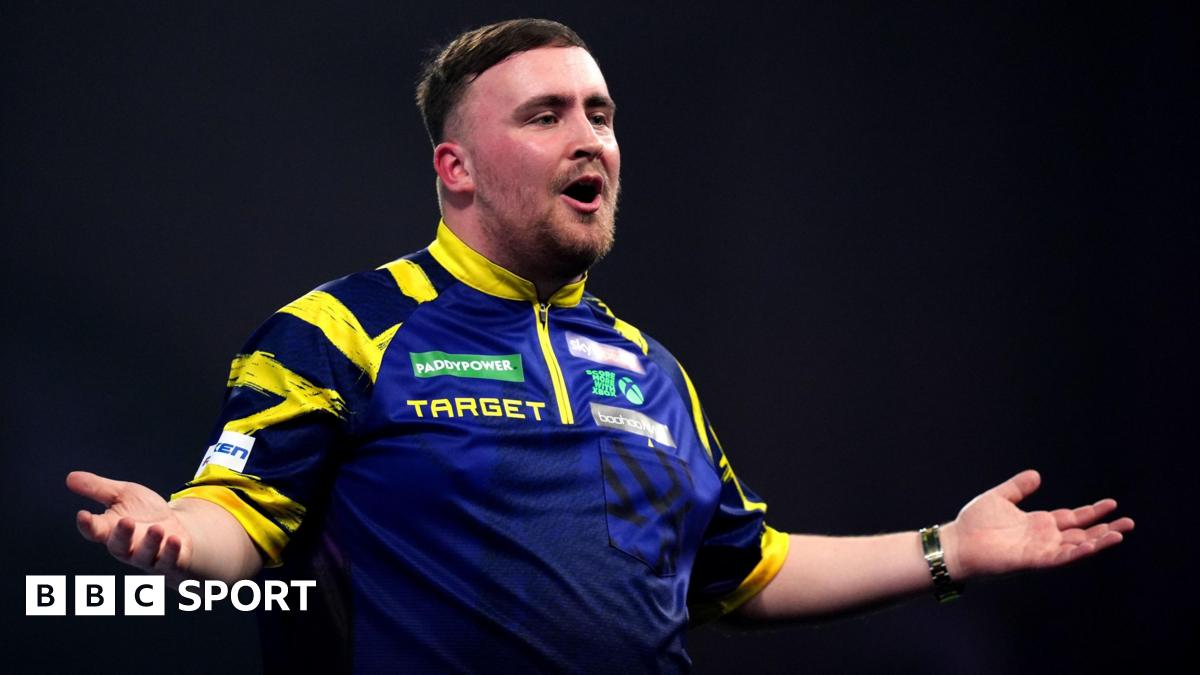
Nathan Aspinall became the latest seed to fall at the PDC World Championship, but 20-year-old Charlie Manby continued his dream run by reaching the last 16.
Aspinall, who reached the semi-finals in 2019 and 2020, lost 4-3 in a final-set thriller against the Netherlands’ Kevin Doets.
The 15th seed won the first and third sets, but was pegged back on both occasions, only to seize control again with a stunning 170 checkout to claim the fifth set.
However, from there, Doets took over, reeling off sixth consecutive legs to seal a sixth straight win over Aspinall and set up a last-16 tie against world number two Luke Humphries on Tuesday.
Manby, who is playing in the tournament for the first time, overcame Ricky Evans 4-2.
The bricklayer from Huddersfield struggled on his doubles early on, taking out just four of 30 attempts in the first three sets as he went 2-1 down.
Scoring was never an issue though and his accuracy on the checkouts improved, alongside a drop-off from Evans, as he sealed a place in round four and a minimum £60,000 in prize money.
He will face the Netherlands’ Gian van Veen in the next round in what will be his toughest test so far, with the 10th seed having the tournament-high match average of 108.28 in his second-round win.
After the match, Evans posted on Facebook that he had received death threats as well as hate and fat jokes.
Another debutant also progressed with Somerset’s Justin Hood beating Ryan Meikle 4-1.
He raced into a 3-0 lead before Meikle pulled a set back but Hood sealed his place and said afterwards that he would not have to work in 2026 after also confirming at least £60,000 in prize money.
He has climbed to a provisional 63rd in the world rankings already and said post-match he still has aspirations to open a Chinese restaurant one day.
He will face 11th seed Josh Rock in the last 16, after the Northern Irishman overcame Callan Rydz 4-2 in the final third-round tie.
Rydz was emotional throughout following the death of his grandfather since his previous match.
GENEVA — The United States on Monday announced a $2-billion pledge for U.N. humanitarian aid as President Trump’s administration slashes U.S. foreign assistance and warns United Nations agencies to “adapt, shrink or die” in a time of new financial realities.
The money is a small fraction of what the U.S. has contributed in the past but reflects what the administration believes is still a generous amount that will maintain America’s status as the world’s largest humanitarian donor.
“This new model will better share the burden of U.N. humanitarian work with other developed countries and will require the U.N. to cut bloat, remove duplication, and commit to powerful new impact, accountability and oversight mechanisms,” Secretary of State Marco Rubio said on social media.
The pledge creates an umbrella fund from which money will be doled out to agencies and priorities, a key part of U.S. demands for drastic changes across the U.N. that have alarmed many humanitarian workers and led to severe reductions in programs and services.
The $2 billion is only a sliver of traditional U.S. humanitarian funding for U.N.-coordinated programs, which has run as high as $17 billion annually in recent years, according to U.N. data. U.S. officials say only $8 billion to $10 billion of that has been in voluntary contributions. The United States also pays billions in annual dues related to its U.N. membership.
“The piggy bank is not open to organizations that just want to return to the old system,” Jeremy Lewin, the State Department official in charge of foreign assistance, said at a press conference Monday in Geneva. “President Trump has made clear that the system is dead.”
The State Department said “individual U.N. agencies will need to adapt, shrink, or die.” Critics say the Western aid cutbacks have been shortsighted, driven millions toward hunger, displacement or disease, and harmed U.S. soft power around the world.
A year of crisis in aid
The move caps a crisis year for many U.N. organizations, including its refugee, migration and food aid agencies. The Trump administration has already cut billions in U.S. foreign aid, prompting the agencies to slash spending, aid projects and thousands of jobs. Other traditional Western donors have reduced outlays, too.
The U.S. pledge for aid programs of the United Nations — the world’s top provider of humanitarian assistance and biggest recipient of U.S. humanitarian aid money — takes shape in a preliminary deal with the U.N. Office for the Coordination of Humanitarian Affairs, or OCHA, run by Tom Fletcher, a former British diplomat and government official.
Fletcher, who has spent the past year lobbying U.S. officials not to abandon U.N. funding altogether, appeared optimistic at the deal’s signing in Geneva.
“It’s a very, very significant landmark contribution. And a month ago, I would have anticipated the number would have been zero,” he told reporters. “And so I think, before worrying about what we haven’t got, I’d like to look at the millions of people whose lives will be saved, whose lives will be better because of this contribution, and start there.”
Even as the U.S. pulls back its aid contributions, needs have ballooned worldwide: Famine has been recorded this year in parts of conflict-ridden Sudan and Gaza, and floods, drought and natural disasters that many scientists attribute to climate change have taken many lives or driven thousands from their homes.
The cuts will have major implications for U.N. affiliates like the International Organization for Migration, the World Food Program and refugee agency UNHCR. They have already received billions less from the U.S. this year than under annual allocations from the Biden administration — or even during Trump’s first term.
Now, the idea is that Fletcher’s office — which has aimed to improve efficiency — will become a funnel for U.S. and other aid money that can be redirected to those agencies, rather than scattered U.S. contributions to a variety of individual appeals for aid.
Asked by reporters if the U.S. language of “adapt or die” worried him, Fletcher said, “If the choices are adapt or die, I choose adapt.”
U.S. seeks aid consolidation
U.S. officials say the $2 billion is just a first outlay to help fund OCHA’s annual appeal for money. Fletcher, noting the upended aid landscape, already slashed the request this year. Other traditional U.N. donors like Britain, France, Germany and Japan have reduced aid allocations and sought reforms this year.
“This humanitarian reset at the United Nations should deliver more aid with fewer tax dollars — providing more focused, results-driven assistance aligned with U.S foreign policy,” U.S. Ambassador to the United Nations Mike Waltz said.
At its core, the changes will help establish pools of funding that can be directed either to specific crises or countries in need. A total of 17 countries will be initially targeted, including Bangladesh, the Democratic Republic of the Congo, Haiti, Syria and Ukraine.
Two of the world’s most desperate countries, Afghanistan and Yemen, are not included, with U.S. officials citing aid diversion to the Taliban and Houthi rebels as concerns over restarting contributions.
Also not mentioned on the list are the Palestinian territories, which officials say will be covered by money stemming from Trump’s as-yet-incomplete Gaza peace plan.
The U.N. project, months in the making, stems from Trump’s longtime view that the world body has great promise but has failed to live up to it and has — in his eyes — drifted too far from its original mandate to save lives while undermining American interests, promoting radical ideologies and encouraging wasteful, unaccountable spending.
“No one wants to be an aid recipient. No one wants to be living in a UNHCR camp because they’ve been displaced by conflict,” Lewin said. “So the best thing that we can do to decrease costs, and President Trump recognizes this and that’s why he’s the president of peace, is by ending armed conflict and allowing communities to get back to peace and prosperity.”
Keaten and Lee write for the Associated Press. Lee reported from Washington. AP writer Farnoush Amiri contributed to this report from New York.
EVERYONE deserves a luxury holiday, but few of us have the wallet to fund it.
Unless, that is, you opt for one particular country that takes just three hours to fly to from the UK, with year-round t-shirt temperatures and some VERY cheap all-inclusive hotels.
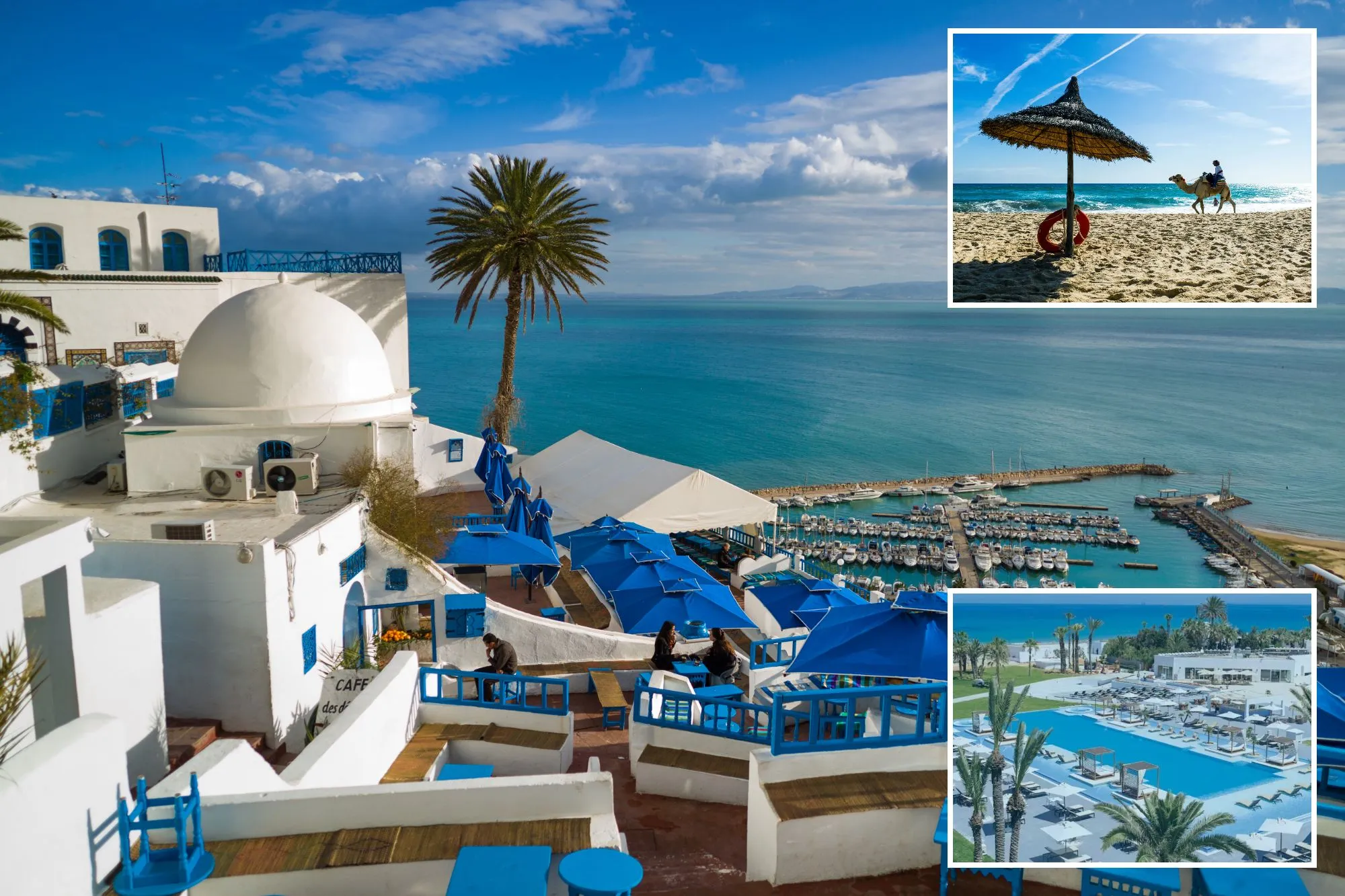
Sousse is a resort city in Tunisia on the Gulf of HammametCredit: AlamyThe breath-taking Sidi Bou Said is located just north of Tunis, and there are plenty of luxury affordable hotels nearbyCredit: Getty
If you want to get away from the obvious – and the crowds – without sacrificing any indulgence, Tunisia hits the right note.
And when you compare it to Spain, the top holiday destination for British tourists, welcoming 17.8 million of us in 2024, Tunisia has far fewer.
It may be a lesser-visited country, but it has big bargains for holidaymakers.
According to TravelSupermarket, Tunisia offers some of the very cheapest 5-star holidays on the market, averaging at £614pp.
Seven nights’ all-inclusive stay at the 5-star Hotel Tour Khalef costs as little as £553 with TUI, including return flights from London Gatwick.
In sunny Sousse, seven nights’ B&B at the 5-star Movenpick Resort & Marine Spa Sousse is available from just £233 pp with Thomas Cook. Price includes return flights from Southend.
If you settle for four stars, you can make it even cheaper. Seven nights’ B&B at the 4-star Iberostar Waves Averroes in Hammamet is bookable from £173 pp with Holiday Best, including return flights from London Luton.
Meanwhile, seven nights’ half board at the 5-star Iberostar Selection Kuriat Palace in Monastir is bookable from £239 pp with Loveholidays, including return flights from London Southend.
Here you have the wide sands of Monastir Beach and a wide range of activities on offer, from jet skiing to parasailing.
Aghir in Djerba boasts bright turquoise watersCredit: AlamyYou can stay at the 5-star Hotel Tour Khalef for just £553 with TUICredit: TUI
If you’re looking for something off the beaten track, you could stretch your legs in the landscaped gardens of Falaise Park, set on the cliffside.
Or head 34 miles down the road to Moknine to see local artisans making traditional earthenware jars and jugs.
Despite its relatively small size (roughly the same as Greece), Tunisia packs a punch.
With the blue of the Med meeting the heat of North Africa, it’s perfect for a sun-kissed break.
Its most famous beaches include Hammamet, Sousse, Monastir and Mahdia, which have long stretches of golden sand backed by palm trees and all-inclusive resorts.
There’s also Djerba, an island just off the south coast of Tunisia that is still relatively undiscovered by Brits.
It has a Mediterranean feel, with cobbled streets lined with white-washed buildings, blue window shutters and vibrant pink bougainvillea.
And despite its resemblance to trendy Greek islands, it’s also a great-value option, with a cup of strong coffee setting you back just 25p.
If you venture away from the coast, you’ll find a photographer’s dream – Pink Flamingo Lake.
Ignored by most tourists, it turns pink at sunset as flamingos feed in the shallows.
Back on the mainland, further north, the hilltop village of Sidi Bou Said would also be right at home on a Greek isle.
Hammamet is home to many of Tunisia’s 5-star resortsCredit: GettyTourists can even take camel rides along the beach in Cape BonCredit: Alamy
The town is picture postcard pretty with its blue-and-white painted houses and panoramic sea views.
Grab a mint tea on the terrace at Café des Nattes (£2) or queue at the doughnut stand for the freshly made Tunisian treats, which cost just 40p.
The capital, Tunis, is found on the northeastern coast.
It’s home to an ancient Medina, Roman Mosaics and plenty of bars and restaurants.
While most tourists wander the main souks of the Medina, the historic Jewish quarter, Hara is often overlooked.
Visit the last surviving synagogue, explore the tailoring shops and try Jewish-Tunisian pastries made with dates and semolina.
Other alternative takes on the capital include watching an independent film at the art-deco Cinema Le Rio, which is barely visited by tourists, or visiting Mornag, a major wine-producing region.
You can’t leave Tunisia without discovering more about its ancient civilisations.
Stroll through Cap Bon to discover traditional Tunisian ceramics and potteryCredit: AlamyThe bright white buildings and clear waters of Tunisia are reminiscent of Greek islandsCredit: Getty
It’s a fascinating melting pot of Berber, Phoenician, Roman, Byzantine, Arab and French influences – with nine UNESCO World Heritage Sites.
The country has some of the best Roman sites outside Italy, including Dougga, a Roman city on a hilltop surrounded by olive groves.
There’s also El Djem Amphitheatre, the largest colosseum in North Africa, where Ridley Scott shot parts of his Oscar-winning movie Gladiator.
It is better preserved – and far less crowded – than its more famous cousin in Rome.
Nearby, the small theatre ruins and restored underground villas are even quieter, yet still beautifully conserved.
Most tourists dip into Berber culture with a quick stop in Matmata’s cave houses, used as a filming location for Star Wars.
But you can take a deeper dive by trekking the Dahar Trails and exploring the hidden granary forts around Tataouine.
The Great Mosque in Sousse has a courtyard open to touristsCredit: GettyYou can stay at the 5-star Movenpick Resort & Marine Spa Sousse from £233 pp with Thomas CookCredit: Thomas Cook
Tunisia’s long wellness tradition means you’re perfectly placed for a spot of pampering.
Try swapping lounging on the beach for some natural hot springs relaxation.
On the northern cliffs of Cap Bon, Korbous Hot Springs flow straight into the sea – join locals who come for therapeutic dips.
Benefits of soaking in the mineral-rich waters include improved circulation, pain and stress reduction and better skin health.
IF you’re ready to look ahead to 2026 and start planning your family trips for spring and summer, you might be looking at big names like Butlin’s, Haven and Eurocamp.
My family of five has had some great breaks at all three, but prices can quickly add up – especially if you need to travel during the school holidays. So how can you bag a bargain and get away for less?
If you’re planning your 2026 holiday, here’s how to save even more money on a cheap breakCredit: Not known, clear with picture desk
Here’s my top tips for shaving some money off your booking, so you’ll have more cash to splash when you’re on your break.
Before you book
There’s a few tricks of the trade that work across all three brands, whether you are sucker for a staycay or fancy a foreign foray.
The first thing to do is to check out any discount schemes available to you, to to see what savings they offer.
A Blue Light Card, which is available to teachers, emergency services and military personnel, offers money off holidays at Butlin’s, Haven and Eurocamp.
Costing £5 for two years, I usually save about £20 to £30 per break, which all adds up if you’re going on a few getaways over the course of the year.
If you have roadside cover with the AA or are in a scheme like Kids Pass, they often have holiday discounts – including £50 off at Haven currently.
Cashback sites like Quidco or Topcashback are also a great way to claw back a bit of holiday cash.
By signing up to one of these websites, you get a percentage of your spend back by clicking through a link to book at Butlin’s, Haven or Eurocamp.
You can also sometimes get an added bonus on top, especially during sales periods like Black Friday or the January sales.
I’ve had a payout of almost £50 on a Butlin’s booking before, although it can take several months for cashback to be tracked and appear in your account, so this method isn’t instant as an upfront discount.
Supermarket loyalty schemes partner with some holiday chains and are a good way of making money you spend on your food shop work harder for you.
If you’ve saved a stash of Tesco Clubcard points, these can be converted into vouchers to use at either Eurocamp or Butlin’s and are worth double what they would be if spent in store.
So if you’ve got £10 of points, you’ll get a voucher worth £20 to spend.
Bear in mind that using Clubcard vouchers can tie you in to paying the list price for your holiday, so you do need to be a bit savvy and work out if a discount code would save you more than your Clubcard points are worth.
If you don’t shop at Tesco, you could collect Nectar points when you’re booking with Eurocamp and those points can then be spent on Eurostar or British Airways to travel abroad at a later date.
Travel writer Catherine Lofthouse and her family have stayed at Haven, Butlin’s and Eurocamp, using a range of discount voucher sites available to everyday BritsCredit: Supplied
Price promises and spreading the cost
There’s lots to be said for booking early and spreading the cost of your holidays, whichever of the big names you’re using.
I’m currently paying a bit each month towards holidays at both Haven and Butlin’s in 2026, because both of them have a price promise that means you’ll get money back if your holiday costs less at a later date.
You do need to keep checking to see if you’ve bagged the best price, but if you’ve booked direct and find your holiday cheaper on either Haven or Butlin’s websites, they will refund you the difference.
I’ve seen some people enjoy payouts of hundreds of pounds using the price promise, so it is worth keeping an eye out in the run-up to your break.
If you’re booking Eurocamp, you can also pay in instalments.
If you book for 2026 before the end of January, you’ll put down a 15 per cent deposit when booking, then pay 10 per cent when you reach 150 days before your departure.
The remainder is then split in two payments at three months before your break and 56 days before departure.
Return guests can get a discount, particularly if you’re booking more than one break in the same season, so that’s worth a look before you book.
Butlin’s have a price drop promise tooCredit: Alamy
Saving big bucks at Butlin’s
There’s lots of ways to save at Butlin’s, so you just need to give yourself time to look at all the options and pick which one is right for you.
With three sites (at Bognor Regis, Minehead and Skegness) and lots of different types of accommodation, including room-only and self-catering, there can be a huge disparity in prices for the same week, depending on your destination.
I also find it’s worth checking out the last-minute deals at Butlin’s, as the prices do drop as you get closer to the departure date.
But if you like to get a booking in your diary sooner rather than later, you can make the most of the repeat booking discount while on site or within 30 days of a recent stay at Butlin’s.
My Haven holiday hacks
Once you’ve booked a break, it does pay to keep checking the offers section of the website to see what comes up, particularly before the Haven holiday season starts up in March.
There’s been great deals by bulk-buying activities or food and drink in recent years, so I’m looking forward to seeing what Haven introduces this year.
My favourite from recent trips was a bulk-buy bundle where you got the cheapest session free if you spent £45 or more on activities in one go.
That meant that if you booked three spaces on a £20 activity, you would actually only end up paying £40, as one of the spaces would be free.
There have also been some fantastic food and drink offers, including a preloaded card that you could use in the bars and restaurants, which was topped up by an extra 10 per cent if you bought it before your break.
I’ll be keeping an eye out in the next month or so to see if either of those offers return this year in time for my summer staycay.
Haven parks are a bargain in the UK but there are ways to save even moreCredit: Haven
Saving your euros at Eurocamp
We’ve had some lovely trips abroad to holiday parks in the Netherlands, Spain and France, but Eurocamp is just one way of booking these sites.
It’s worth considering whether you can get a better deal by booking direct with the individual park or if you’d prefer to pay a bit extra for some of the perks that come with a Eurocamp booking.
This includes extras such as a holiday rep who speaks English or the ability to change your dates, destination or accommodation once you’ve booked.
We enjoyed an October half-term stay at Duinrell in the Netherlands a few years ago and only paid £80 for the week.
But we did discover that you had to pay extra to get into the swimmingpool on site.
So it may have been better to book direct with Duinrell, as then entry to the waterpark would have been included and we could have chosen from tents, caravans and lodges for our accommodation.
Another top tip is to check out the Sun £9.50 holidays abroad, which we made the most of when we had younger children and were still travelling a lot in term time.
While we booked through the Sun, the actual booking is then passed to a holiday provider like Eurocamp if you’re going abroad or Parkdean if you’re staying in the UK.
So you can sometimes get the same accommodation and facilities as you would for a Eurocamp holiday but for a fraction of the price, if you pick a break where you only pay £9.50 per person without any added extras.
Bear in mind that you sometimes need to pay extra to add bed linen or towels to your booking abroad.
You can bring your own if you don’t want to pay, but that’s only really an option if you’re traveling by car and not by plane, when you’re trying to keep luggage to a minimum.
So whether you off to the summer sun abroad or you’re on a Brit bucket-and-spade break, now could be the perfect time to get your family getaway booked for 2026, whatever your budget.
Conor McDermott-Mostowy would like to compete at the Milano Cortina Winter Olympic Games. And he certainly has the talent, desire and ambition to do so.
What he lacks is the money.
“You could definitely reach six figures,” David McFarland, McDermott-Mostowy’s agent, said of what the speedskater needs annually to live and train while chasing his Olympic dream.
In the last year, finding that money has been increasingly difficult because McDermott-Mostowy is gay. Since President Trump returned to the White House in January, bringing with him an agenda that is hostile to diversity, equity and inclusion, sponsors who once embraced LGBTQ+ athletes and initiatives have turned away from the likes of McDermott-Mostowy, with devastating effect.
“There’s definitely been a noticeable shift,” said McFarland, who for decades has represented straight and gay athletes in a number of sports, from the NFL and NBA to professional soccer. “Many brands and speaking opportunities that previously highlighted LGBTQ athletes are now being pulled back or completely going away.”
“And these aren’t just symbolic partnerships,” he added. “They’re vital income opportunities that help athletes fund training, fund their competition and their livelihoods.”
The impact is being felt across a wide range of sports where sponsorship dollars often make the difference between winning and not being able to compete. But it’s especially acute in individual sports where the athletes are the brand and their unique traits — their size, appearance, achievements and even their gender preferences — become the things that attract or repel fans and financial backers.
“What’s most frustrating is that these decisions are rarely about performance,” McFarland said. “They’re about perceptions in the LGBTQ community. And that kind of fear-driven retreat harms everyone involved because, beyond the human costs, it’s also very short-sighted. The LGBTQ community and its allies represent a multitrillion-dollar global market with immense buying power.”
Travis Shumake, the only openly gay driver on the NHRA circuit, ran a career-high five events in 2022 and said he once had deals with major brands such as Mission Foods, Procter & Gamble and Kroger while using a rainbow-colored parachute to slow his dragster.
Kroger is the only one whose support has yet to shrink and as a result, Shumake had to keep his car in its trailer for the final eight months of the year.
And when he did race, his parachute was black.
Travis Shumake competes at the NHRA Nationals at Las Vegas Motor Speedway in November 2024.
(Marc Sanchez / Icon Sportswire via Getty Images)
“It was looking very optimistic and bright,” said Shumake, who spends about $60,000 for an engine and as much as $25,000 for each run down the dragstrip. “Being the only LGBTQ driver would have been very profitable. I ended last season with plans to run six to eight races. Great conversations were happening with big, big companies. And now it’s, I did one race, completely based on funding.”
“When you’re asking for a $100,000 check,” he added, “it’s very tough for these brands to take that risk for a weekend when there could be a large backlash because of my sexual identity.”
A sponsorship manager for a Fortune 500 company that had previously backed Shumake said he was not authorized to discuss the decision to end its relationship with the driver.
Daniel T. Durbin, director of the Institute of Sports, Media and Society at the USC Annenberg school, said there could be several reasons for that. A shrinking economy has tightened sponsorship budgets, for example. But there’s no doubt the messaging from the White House has had a chilling effect.
“It certainly makes the atmosphere around the issue more difficult because advertising and promotion tied to social change has come under fire by the Trump administration,” Durbin said.
In addition, corporate sponsors that once rallied behind diversity, whether out of conviction or convenience, saw the election results partly as a repudiation of that.
“We may be pissing off 50% of the population if we go down this path. Do we really want to do that with our brand?” Durbin said of the conversations corporations are having.
Backing away from causes such as LGBTQ+ rights doesn’t necessarily mean those corporations were once progressive and are now hypocritical. For many, the only color of the rainbow they care about is green.
“You’re trying to give people a philosophy who don’t have a philosophy,” Durbin said. “And even if they believe in causes, they’re not going to self-destruct their company by taking up a cause they believe in. They’re going to take it up in part because they think it’s positive for the bottom line.
“That’s the way it works.”
As a result, others have had to step up to try to help fill the funding gap. The Out Athlete Fund, a 501(c)(3) organization, was recently created to provide financial assistance and other support to LGBTQ+ athletes. McDermott-Mostowy was the first to get a check, after a November event in West Hollywood raised more than $15,000.
“We’re here to help cover their costs because a lot of other people aren’t doing it,” said Cyd Zeigler, a founding board member of the group and co-founder of OutSports, a sports-news website focused on LGBTQ+ issues.
That kind of retrenching, from deep-pocketed corporate sponsors to individuals giving their spare change, is threatening to derail the careers of athletes such as McDermott-Mostowy, who relies on his family and a modest U.S. Olympic & Paralympic Committee stipend for most of his living and training expenses. And since he’ll turn 27 before the Milano Cortina Olympic Games open in February, he may not be able to wait for the pendulum to swing back to have another chance at being an Olympian.
“I’m 99% sure I qualify for [food] stamps,” said McDermott-Mostowy, who medaled in the 1,500- and 500-meter events in October’s national championships, making him a strong contender for the U.S. heading into the Olympic long track trials Jan. 2-5 in Milwaukee. “What really saves us every year is when we travel. Almost all of our expenses are paid when we’re coming [with] the team.
“If I didn’t make the World Cup one year, I would be ruined.”
McDermott-Mostowy’s past success and his Olympic potential are what he pitches to sponsors, not that he’s gay. But that’s what makes him stand out; if he qualifies for Milano Cortina, he would be one of the few gay athletes on the U.S. team.
“I have always been very open about my sexuality. So that wasn’t really a debate,” he said.
“I have definitely heard from my agent that, behind closed doors, a lot of people are like ‘Oh, we’d love to support queer athletes. But it’s just not a good time to be having that as our public face.’”
The debate isn’t a new one, although it has evolved over the years. Figure skater Amber Glenn, who last year became the first out queer woman to win the U.S. championship, remembers gender preferences being a big topic of discussion ahead of the 2014 Games in Russia, where public support for LGBTQ+ expression is banned.
“At that point I wasn’t out, but I was thinking, ‘What would I do? What would I say?’” Glenn said. “Moving forward I hope that we can make it where people can compete as who they are and not have to worry about anything.
“Figure skating is unique. We have more acceptance and more of a community in the queer space. That’s not the case for all sports. We’re definitely making progress, but we still have a long way to go.”
Conor McDermott-Mostowy hopes to be competing for the U.S. in speedskating at the Milano Cortina Olympic Games in February.
(Dean Mouhtaropoulos / Getty Images)
In the meantime, athletes such as McDermott-Mostowy and Shumake may have to find ways to re-present themselves to find new sources of support.
“It’s not like I’m going back in the closet,” said Shumake, who has decided to rent out his dragster to straight drivers next year rather than leave it parked and face bankruptcy. “It’s just that maybe it’s not the main storyline at the moment. I’m trying a bunch of different ways to tell the story, to rebrand.”
“It’s been weird to watch,” added Shumake, who once billed himself as the fastest gay guy on Earth. “I know it will swing back. I also fear, did I make the right choices when I had a partnership with Grindr and I had rainbow parachutes? Like did I come on too strong?
“I’ve chosen to go the gay race car driver route and it’s just a little bit of a slowdown. I don’t think I need to blame myself. It’s just a fear people are having at the moment.”
A fear that’s proving costly to the athletes who can least afford to pay.
Last week, the Deputy Chief of Staff for Policy and Homeland Security offered a sharply different account of Venezuela’s 1976 oil nationalization. It is provocative, but it does not hold up to the record.
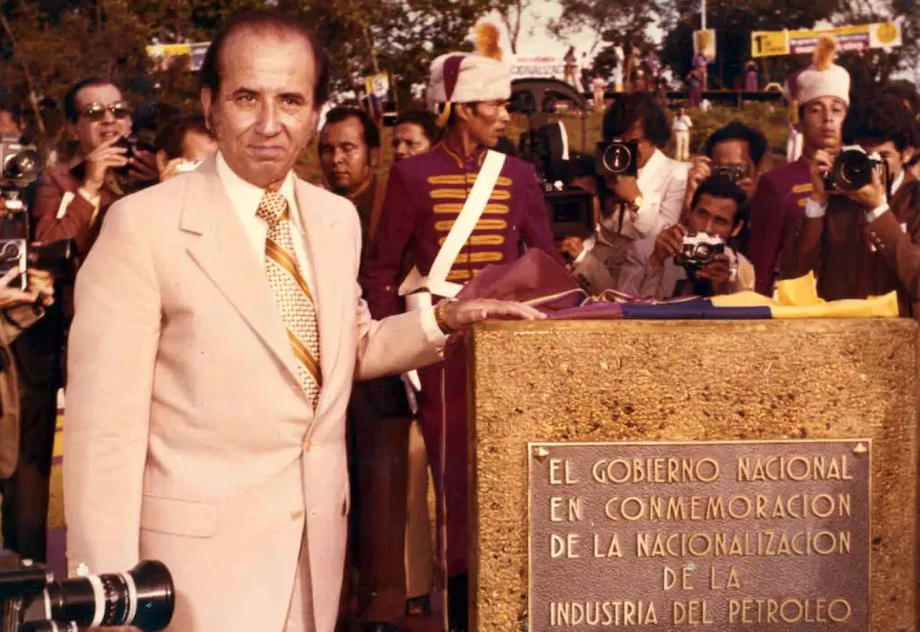
President Carlos Andrés Pérez (1974-1979) proclaimed the takeover of the petroleum industry on January 1, 1976. The announcement occurred at the Mene Grande oilfield in Zulia. Crucially, the transfer from private control to a state-run model went smoothly. The major multinationals were compensated, invited to work with the new state-owned company, Petróleos de Venezuela (PDVSA), as service and technology providers, and the process triggered no diplomatic incident with the United States. A brief look at the facts does not support claims of “theft of American wealth and property,” since “the tyrannical expropriation” was precisely engineered to avoid the kind of rupture Miller describes.
The nationalization of the Venezuelan petroleum industry responded to global events unfolding in the Middle East around 1970. To be sure, Venezuelan politicians had long dreamed of granting the state full control over the most important sector of the country’s economy. However, plans for an eventual state takeover of the oil fields remained nebulous, a goal set for a distant future. Muammar Qaddafi (1969-2011) in Libya, of all figures, provided Venezuelan lawmakers with a concrete horizon for materializing full control over the hydrocarbon sector. The Libyan strongman unilaterally increased royalties and taxes on multinationals, with Iran pursuing a similar approach. OPEC then formalized this push for higher prices at its December meeting that year. What followed in 1971 sent shock waves across the world: Libya nationalized its oil industry, followed by Algeria and Iraq. This process quickly expanded to the rest of the Middle East, setting the backdrop for the fuel shortages of that decade and the energy crisis of 1973.
This global context greeted President Rafael Caldera (1969-1974), a Christian Democrat of COPEI, who was intent on capitalizing on these favorable winds. Soon, every political faction in Congress sought to outdo the other in displaying their anti-corporate credentials. Caldera stood at the top as the most nationalist of the pack, passing an unprecedented package of bills and decrees destined to expand government control over the industry significantly. By the time he handed power to Carlos Andrés Pérez from Acción Democrática (AD), de facto state control over the entire industry was already in place. Nationalization became the only politically safe position when the electoral campaign of 1973 started. Once elected, Carlos Andrés Pérez authorized the creation of a Presidential Commission in charge of studying the state takeover and proposing a bill to that effect, to be approved by Congress in 1975. Ordinary Venezuelans shared this renewed fervor for ownership over the national riches of the country, though in a conflicted way.
Polls by the weekly political magazine Resumen showed broad support for nationalization. Yet respondents also rated working conditions at the foreign oil companies very favorably and many wanted foreign capital to remain involved after the takeover because they trusted the firms’ experienced managers. At the same time, they doubted the state’s capacity to run complex industries, while still believing it could improve over time and that a state-run oil sector was in the nation’s interest. That nuance rarely appeared in Congress.
The nationalization became a fait accompli without antagonism with the U.S. government or the multinationals
COPEI and a constellation of center-left and leftist organizations pushed for an immediate, total takeover without any foreign role. Some opposed compensation altogether and even welcomed a showdown if necessary, seeing local employees working for these multinationals as threats to a “genuine” nationalization of the industry. Venezuelan managers soon came under attack from politicians accused of having “their minds colonized” by the American and British firms. They were also viewed as “centers of anti-Venezuelan activity.” Insults in the press and public spaces galvanized domestic employees to take action. Led by Venezuelan mid-level managers such as Gustavo Coronel from Royal Dutch Shell, the managerial class came together to form Agrupación de Orientación Petrolera (AGROPET). The nonprofit aimed to help the country prepare to take full responsibility for the hydrocarbon sector.
From March 1974 through 1975, AGROPET ran a public campaign for an orderly, compensatory nationalization built on continuity, not a politicized break. Their activities included appearing on radio programs, giving TV interviews, publishing in newspapers, and participating in public forums, including congressional meetings, and talks with members of the Presidential Commission mandated by President Pérez. The irony of this body is that it gathered representatives from prominent sectors of society. And yet the Commission excluded the people who actually ran the industry.
AGROPET quickly steered the nationalization debate back toward a technocratic solution. The organization’s pivotal moment came in January 1975, when its leaders met with President Pérez and laid out what became the blueprint for the 1976 nationalization. They argued for an industry built on administrative efficiency, technological progress, apoliticism, and sound management not a politicized rupture. Their model envisioned a holding company with four affiliates that would absorb concessionaire operations. The new organizational culture would blend practices inherited from the Creole Petroleum Corporation and Shell, and the nationalized industry would retain ties to its foreign predecessors. Under this proposal, Petróleos de Venezuela (PDVSA) became, in effect, the direct descendant of the multinationals that built Venezuela’s modern oil industry. It perpetuated the business philosophy of the multinationals. Persuaded by Venezuelan managers, Pérez sided with the technocrats and sent an amended nationalization bill to Congress, crucially allowing foreign capital to return under Article 5. The AD-dominated legislature defended the bill and enacted it in August 1975. Two months later, Creole and the other firms accepted a compensation package of about $1 billion for their expropriated assets.
The nationalization became a fait accompli without antagonism with the U.S. government or the multinationals. It constituted less a watershed than a continuation of relationships the Venezuelan state and foreign oil companies had built across the twentieth century on new terms. PDVSA quickly signed service and technology agreements with the very companies it had expropriated. What’s more striking is that this smooth outcome became, in part, an unintended consequence of Venezolanization: the deliberate integration of Venezuelans at every level of the corporate ladder, a policy initiated by Creole and Shell in the 1940s. Unusual in the industry at the time, it stood out as a strand within a broader set of corporate social responsibility practices these companies implemented in Venezuela. Locals trained through that system helped make the transition to state control orderly and broadly beneficial.
For much of the political opposition, however, the outcome felt bittersweet. They denounced its chucuta nature (a “half-baked” nationalization) and framed Article 5 as outright betrayal. Many wanted the kind of dramatic showdown associated with Cárdenas in Mexico, Mossadegh in Iran, or Velasco Alvarado in Peru, cases where claims of expropriation and “theft” of U.S. property could at least be mounted. Venezuela in 1976 stood far away from that drama, and once the transfer was complete, business continued as usual despite the lamentations of certain congressmen. Venezuela’s 1976 oil nationalization was engineered to preclude confrontation. Getting the history right matters. If the current U.S. administration wants to cite this episode to justify pressure, escalation, or exceptional measures, it has chosen a poor example, precisely because the process avoided the kind of rupture Mr. Miller invokes. So, por este camino no es.
HomeInsuranceHurricane Melissa Devastation Saddles Jamaica With Multi-Billion-Dollar Bill
Jamaica faces an $8 billion-plus price tag to repair the damage caused by Hurricane Melissa. Wind gusts hit a record-breaking 252 miles per hour between October and November.
The catastrophe claimed 45 lives, 15 remain missing, and a further nine cases are under investigation.
Prime Minister Andrew Holness stated that repairs will be equivalent to 30% of Jamaica’s GDP. However, the World Bank’s and Inter-American Development Bank’s estimates of $8.8 billion would amount to 41% of GDP. That makes Melissa the most expensive hurricane in Jamaica’s history. Housing insurance alone could total between $2.4 billion and $4.2 billion. The Office of Disaster Preparedness and Emergency Management recorded 156,000 homes damaged and 24,000 considered total losses.
According to Verisk Analytics, “Many neighborhoods in St Elizabeth parish … are reporting significant damage, with 80% to 90% and, in certain cases, 100% of roofs destroyed.”
The Cost of Recovery
Jamaica is looking to its insurers and multilaterals for immediate financial relief. The Caribbean Catastrophe Risk Insurance Facility (CCRIF) made two payments totaling $91.9 million. The World Bank added another $150 million.
A further package of aid from the World Bank is forthcoming. This will include emergency finance redeploying existing project funds to speed up repairs and private-sector assistance via the International Finance Corporation. The CCRIF’s payout will come from Jamaica’s cyclone and excessive rainfall parametric insurance policies.
Holness promises that the government will spend each dollar carefully.
“We will spend to relieve human suffering, but every dollar that is spent will be accounted for,” he told reporters while touring disaster sites, “and not just from an accounting point of view, meaning adding up the dollar spent. It will be accounted for from an efficiency point of view, which is really the greater accountability. Every dollar spent, every aid given, every commitment made, will be used in a way that quickly advances the recovery, but at the end of it makes Jamaica stronger.”
Are top-drawer college football teams and their name, image and likeness collectives simply trying to protect themselves from willy-nilly transfers or are they bullying players to stay put with threats of lawsuits?
Adding liquidated damage fee clauses to NIL contracts became all the rage in 2025, a year that will be remembered as the first time players have been paid directly by schools. But some experts say such fees cannot be used as a cudgel to punish players that break a contract and transfer.
It’s no surprise that the issue has resulted in a lawsuit — make that two lawsuits — before the calendar flipped to 2026.
Less than a month after Georgia filed a lawsuit against defensive end Damon Wilson II to obtain $390,000 in damages because he transferred to Missouri, Wilson went to court himself, claiming Georgia is misusing the liquidated damages clause to “punish Wilson for entering the portal.”
Wilson’s countersuit in Boone County, Mo., says he was among a small group of Bulldog stars pressured into signing the contract Dec. 21, 2024. The lawsuit also claims that Wilson was misused as an elite pass rusher, that the Georgia defensive scheme called for him to drop back into pass coverage. Wilson, who will be a senior next fall, led Missouri with nine sacks this season.
Georgia paid Wilson $30,000, the first monthly installment of his $500,000 NIL deal, before he entered the transfer portal on Jan. 6, four days after Georgia lost to Notre Dame in a College Football Playoffs quarterfinal.
Bulldogs brass was not pleased. Wilson alleges in his lawsuit that Georgia dragged its feet in putting his name in the portal and spread misinformation to other schools about him and his contractual obligations.
“When the University of Georgia Athletic Association enters binding agreements with student-athletes, we honor our commitments and expect student-athletes to do the same,” Georgia spokesperson Steven Drummond said in a statement after the school filed the lawsuit.
Wilson’s countersuit turned that comment on its head, claiming it injured his reputation because it implies he was dishonest. He is seeking unspecified damages in addition to not owing the Bulldogs anything. Georgia’s lawsuit asked that the dispute be resolved through arbitration.
A liquidated damage fee is a predetermined amount of money written into a contract that one party pays the other for specific breaches. The fee is intended to provide a fair estimate of anticipated losses when actual damages are difficult to calculate, and cannot be used to punish one party for breaking the contract.
Wilson’s case could have far-reaching implications because it is the first that could determine whether schools can enforce liquidated damage clauses. While it could be understandable that schools want to protect themselves from players transferring soon after receiving NIL money, legal experts say liquidated damage fees might not be the proper way to do so.
This year is on course to become one of the worst years of this century for job cuts, comparable only to the Great Financial Crisis of 2008 and 2009 and the year of the pandemic, 2020.
Corporations are primarily attributing hundreds of thousands of recently announced layoffs to higher operating costs caused by US tariffs. Still, many feel that a workforce-rebalancing strategy to fund investments in artificial intelligence may also be to blame.
Last October, US job losses topped 153,000, the highest level since 2003. In November, the US gained 64,000 jobs, more than expected, but the unemployment rate climbed to a four-year high of 4.6%.
According to The Challenger Report, a leading indicator of the US labor market, American companies laid off over a million employees in the first 10 months of 2025. That’s the highest number since the pandemic-related recession five years ago, and up 65% from the same period last year.
The huge wave of redundancies, begun in January with the Trump Administration’s restructuring of government agencies, is now expanding to most sectors.
The latest round of announcements came from tech giants Intel, Microsoft, IBM, and Verizon, which collectively announced the axing of over 50,000 jobs. Online retail giant Amazon slashed 30,000 positions, while international courier UPS let go of 48,000 employees.
Other major industry players that have significantly reduced their workforce include Accenture (11,000 cuts), Procter & Gamble (7,000), PwC (5,600), Salesforce (4,000), American Airlines (2,700), Paramount (2,000), and General Motors (1,700).
The trend isn’t limited to American firms. In Europe, companies across various sectors also disclosed extensive staff reductions this year, with Nestlé cutting 16,000 jobs, Bosch 13,000 jobs, Novo Nordisk 9,000 jobs, Audi 7,500 jobs, Volkswagen 7,000 jobs, Siemens 5,600 jobs, Lufthansa 4,000 jobs, Lloyds Bank 3,000 jobs.
Asia-Pacific is also affected, with India’s Tata Consultancy dismissing 12,000 employees, Japan’s Nissan dismissing 11,000, and Australia’s second-largest bank, ANZ, dismissing 3,500.
Fears are spreading that this might be the start of an unprecedented, massive recession caused by AI expansion. If Amazon and Palantir dismissed the claim, Nvidia CEO Jensen Huang lately emphasized that “100% of everybody’s jobs will be changed” by AI.
And in a extraordinary step, after axing 1,500 jobs this year, traditional brick-and-mortar retailer Walmart delisted from the NYSE this month and move to tech-focused Nasdaq. The move highlights Walmart’s ‘tech-powered approach’, with decade-long investments in warehouse-automation and its current strong push towards AI.
We live in an interdependent world where no country or region is exempt from the effects of developments elsewhere. The transition into autocracies in other countries is not the exception. Autocratisation has escalated into a global wave. According to the latest V-Dem report, 45 countries are currently moving towards autocracy, up from just 16 in 2009, while only 19 are democratising. By 2024, 40% of the world’s population lived in autocratising countries.
Autocratic expansion represents a threat to liberal democracies in Europe and beyond, as political science’s only near-lawlike finding holds: democracies do not wage war against each other. In contrast, an autocratic Russia invades Ukraine and might quite possibly very soon attack the rest of Europe, as NATO’s General Secretary Mark Rutte alerted in Berlin on December 12: “We are Russia’s next target, and we are already in harm’s way… we must act to defend our way of life now”.
The link between democracy and peace was also at the centre of this year’s Nobel Peace Prize ceremony. In his address, Jørgen Watne Frydnes, Chair of the Norwegian Nobel Committee, emphasised that democracy is not only essential for peace within national borders, but also for peace beyond them. The award to Venezuelan opposition leader María Corina Machado, who insisted that the prize belongs to all Venezuelans, underscored that message.
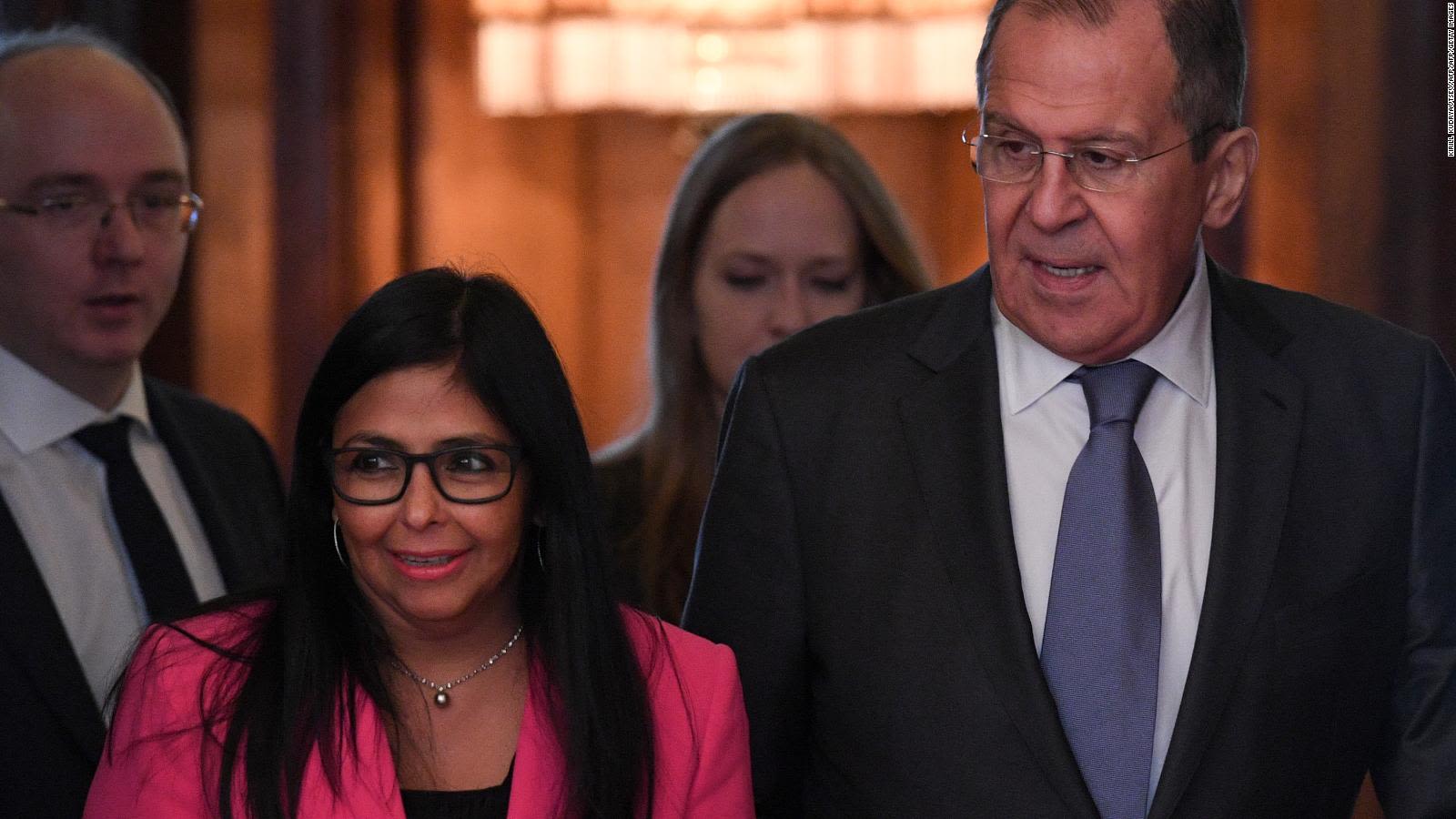
Russia illustrates this connection with unusual clarity, and the Maduro regime is a close ally of the regime directly threatening Europe. Since Chávez, under whose rule Venezuelan democracy collapsed no later than between 2002 and 2007 (according to V-Dem), the Venezuelan regime has deepened its ties with China and Russia. The latter, particularly, became an important partner in the military and security realms. By providing weapons, equipment and intelligence support, Russia secured a geopolitically strategic foothold in South America. This allows Putin to project power into the Western hemisphere and to undermine US and European strategic interests.
Venezuela’s partnership with Russia follows a foreign policy logic of influence projection within the United States’ regional sphere, much as Washington has done in Eastern Europe. This relationship has taken the form of military cooperation, with Venezuela—alongside Nicaragua—becoming one of Russia’s main partners in Latin America.
A democratic Venezuela could reintegrate into Mercosur, opening an additional market under the forthcoming EU-Mercosur agreement—one of the EU’s tools for diversifying trade partners and reducing excessive economic dependencies.
While earlier cooperation included a visit of nuclear-capable Russian bombers to Venezuela in 2018, more recent ties have focused on military diplomacy: high-level defence meetings, training exchanges, and joint participation in initiatives such as the International Army Games. But despite Russia’s growing resource constraints following its invasion of Ukraine, reports of the construction of a new ammunition factory in Maracay (Aragua) and the presence of Russian “Wagner” mercenaries in Venezuela exemplify the possibility of going back to further military cooperation. The ammunition factory would specifically produce a version of the AK-130 assault rifle (developed in the Soviet Union) and a “steady supply” of 7.62mm ordnance under Russian license in spite of sanctions to avoid Russian ammunition exports.
Beyond the military sphere, Venezuela currently cooperates with Russia to mitigate the effects of Western sanctions. Together with Iran, both countries share shadow shipping networks that allow sanctioned oil exports to continue flowing, primarily towards China (surprise! Another autocratic country).
Thus, from a European Security perspective, Venezuela isn’t really a distant or marginal case. A Russia-aligned autocracy in South America strengthens Moscow’s global reach at a time when Europe is already struggling to contain Russian aggression on its own continent. Supporting democratic survival or democratisation abroad is not only a normative commitment, but a strategic interest: Europe’s democratic stability—and its own way of life—are reinforced when democracies elsewhere endure.
Democratisation in Venezuela could bring concrete benefits. It would weaken Russia’s standing among authoritarian partners that depend on its support and reduce diplomatic alignment against European priorities in multilateral forums. Such alignment was evident, for example, in the 2014 UN resolution condemning Russia’s annexation of Crimea, where several Latin American governments sided with Moscow. Moreover, a democratic Venezuela could reduce the US’ attention diversion from the Russia war on Ukraine, and it could weaken Russia’s potential leverage when looking for US-concessions, in exchange for their own concessions in Venezuela.
But this is also about not missing opportunities. A democratic Venezuela could reintegrate into Mercosur, opening an additional market under the forthcoming EU-Mercosur agreement—one of the EU’s tools for diversifying trade partners and reducing excessive economic dependencies.At a time when economic strength has become an existential priority for Europe amid rising geopolitical tensions, this matters. Before Mercosur, and in the more immediate period following a transition, Venezuela would require substantial investment to rebuild its economy. Historical economic and social ties already exist, shaped in large part by post–Second World War European migration to the country.
Repression is not confined to Venezuelan citizens. More than 80 foreign political prisoners have been reported, including Europeans from Italy, Spain, Poland, Portugal, Hungary, Ukraine and the Czech Republic.
In the path towards the stabilisation of Venezuela as a partner to democracies—instead of being a source of autocratic threat—the democratic mandate expressed by Venezuelans on 28 July 2024, when we elected Edmundo González Urrutia as president, is a crucial element to consider. González has since identified María Corina Machado as his intended vice-president in a potential transition.
In regards to the question about how to get there, the equation toward a democratic Venezuela does not only include measures to weaken the Maduro regime’s repressive capacity, but also strengthening democratic actors inside and outside the country. Many of these active citizens often move within resource-limited bounds—juggling work, precarious living situations and scarce resources for essential tools such as websites, digital security, travel for advocacy, and organisational infrastructure. Migrants in early integration phases do not necessarily count with abundant financial resources, yet they invest what they have into their democratic efforts.
At the same time, the regime’s repressive reach extends beyond Venezuela’s borders. Recent transnational attacks like the murder attempt against Luis Alejandro Peche and Yendri Velásquez in Colombia, the attempted attack on Vente Venezuela’s Alexander Maita, and the assassination of Ronald Ojeda in Chile highlight efforts to intimidate political mobilization even outside the country.
But repression is not confined to Venezuelan citizens. More than 80 foreign political prisoners have been reported until this month, including Europeans from Italy, Spain, Poland, Portugal, Hungary, Ukraine and the Czech Republic. Thus, limiting the regime’s repressive capacity is vital to incentivize crucial pro-democracy mobilization.In summary, Europe faces a choice. Supporting Venezuelan democratisation is not only a matter of global democratic solidarity, human rights, or European soft power in Latin America. It is a matter of self-preservation. The collapse of Venezuela’s once-stable 40-year democracy and Russia’s war on Ukraine both serve as reminders that democracy—and the peace it sustains—is not a given. It must be embodied, defended, and actively built when necessary.
In banking as in other industries, AI is rapidly becoming a core business driver. The biggest gains will come from a foundational rethink of operations, not marginal improvements.
The financial sector is undergoing a profound transformation, powered by AI. Banks’ strategic integration of AI is moving beyond simple efficiency gains to make the technology a core business driver, focused on hyper-personalization, augmentation of human talent, and robust governance.
The real opportunity, says Andy Schmidt, vice president and global industry lead for Banking at CGI, [our AI in Finance judging partner], lies not in simply applying AI to existing workflows, but in fundamentally rebuilding processes with AI at the core.
A key aspect of this transformation is the shift towards an ultra-personalized and predictive customer experience. AI is moving past rudimentary chatbots to become an “agentic, conversational assistant” that can proactively anticipate a customer’s needs: from preventing payment failures by automatically increasing card limits to providing tailored financial guidance and real-time product recommendations.
Going forward, this intensified focus on customer experience will be a significant component of return on investment (ROI), Schmidt predicts.
“The real value comes in improved customer experience,” he stresses. “Being able to onboard customers more quickly, being able to transition from opportunity to revenue more quickly, and optimizing the customer experience so that they remain satisfied and stay with the bank over time.”
Schmidt highlights success stories in wealth and personal finance where GenAI drives personalization recommendations. DBS Bank’s harnessing of AI, for example, has drastically accelerated customer journeys, demonstrating the potential for significant scale and opportunity.
Human-AI Augmentation
The case for AI adoption in banking centers on strategic augmentation, were AI becomes a co-pilot for human experts. The goal is to automate repetitive and low-value tasks, freeing up human capital to focus on such complex, high-value activities as strategic decision-making, advisory sales, and conflict resolution.
Further driving this internal empowerment is the democratization of GenAI tools across the workforce, accelerating research, analysis, and data synthesis. Crucially, banks must commit to the principle of human oversight, ensuring that for complex matters, a human being is always in the loop and remains the final decision-maker.
AI’s role in risk management is evolving from reactive analysis to real-time, predictive analytics. By continuously monitoring vast internal and external data streams, AI can anticipate potential risks and perform complex what-if scenario planning. This capability couples with enhanced fraud detection, where sophisticated AI, including neural networks, provides real-time surveillance and prevention across massive transaction volumes.
AI is also streamlining the traditionally costly and time-consuming realm of regulatory compliance. Schmidt emphasizes the value of AI in bringing “transparency, auditability, and repeatability to key processes, especially when it comes to compliancerelated processes like KYC [know your customer].” Relatedly, AI is automating tasks like credit report preparation and enhancing the rigor of due diligence on complex M&A transactions.
Maximizing ROI Gain
A significant lesson emerging from AI deployment is that the most substantial returns come from a foundational rethink of operations, not marginal improvements. The financial industry is recognizing that “adding AI to existing processes will make them marginally better,” Schmidt notes, but that “optimizing processes to leverage AI will make them dramatically better.” The best way to realize the benefits of AI transformation, he adds, is in “examining these long-standing processes, optimizing them, and fundamentally rebuilding them. The goal is to integrate AI at the core of the process, rather than sprinkling it on top as an afterthought.”
With every aspect of AI adoption, however, the best approach is to proceed in stages. For those beginning their AI journey, Schmidt suggests adopting large language models (LLMs) as a starting point before transitioning to more specialized, purpose-built models. The effective integration of AI requires continuous change management to sustain capabilities and maximize ROI over time.
Methodology
The Global Finance AI In Finance award winners are chosen based on entries provided by financial institutions. Entrants are judged on the impact, adoption, and creativity that AI brings to both systems and services. Winners are chosen from entries submitted by banks and evaluated by a world-class panel of judges at CGI, a leading multinational IT and business consulting-services firm. CGI is a trusted AI expert that combines data science and machine slearning capabilities to generate new insights, experiences, and business models powered by AI. The editors of Global Finance are responsible for the final selection of all winners.
Meet The Winners
Global Winners
Consumer Winners
Corporate Winners
Winner Insights
Gökhan Gökçay, executive VP of Technology at Akbank
Nimish Panchmatia, Chief Data & Transformation Officer, DBS
Artificial intelligence is transforming the banking industry, streamlining operations, improving risk management, and enhancing the customer experience.
Banks are leveraging this burgeoning tech to automate routine tasks, analyze complex data, detect fraud, and deliver personalized financial advice—all with greater speed and accuracy. For consumers, this translates to more efficient services, faster responses, and smarter financial solutions.
The winners below set the standard in AI-driven innovation by using AI to automate back-office operations, accelerate credit assessments, detect fraud in real time, and deliver personalized financial recommendations.
Others leverage AI to monitor customer journeys, identify pain points, and provide seamless virtual assistance. These innovations not only streamline operations but also give consumers faster, smarter, and more tailored banking services, setting a new standard for the industry.
Best Payments
AkBank
Best Chatbots & Virtual Assistants
CaixaBank
Best Enhanced Customer Experience
DBS Bank
Best Personalized Financial Advice
QIB
Best Private Banking
Bank of Georgia
Best Fraud Detection and Prevention
Banamex
Best Credit Assessment
Banamex
Best Risk Management
BBVA
Best Fintech
CTBC
Best Payments
Akbank
Aiming to enhance back-office efficiency and reduce friction, Akbank implemented an AI-driven solution in 2024, training an open-source LLM on over 100,000 banking documents. The custom-tailored LLM tool reinforces secure and compliant operations within the bank’s own data centers and is accelerating back-office automation, significantly improving accuracy, security, and overall efficiency, and underscoring the bank’s dedication to AI innovation and regulatory compliance.
Akbank is utilizing this AI-driven model primarily to automate payment order processing for both customers and regulatory institutions; it also plays an important role in automating back-office transaction orders, significantly reducing the need for manual intervention.
Best Chatbots & Virtual Assistants
CaixaBank
CaixaBank’s employees now have access to NOA, a GenAI-powered assistant designed to provide accurate answers to internal questions using NLP. The tool is a first for CaixaBank, setting a new standard for AI-driven operational efficiency at CaixaBank. Unlike traditional knowledge management systems, it eliminates the need for manual searching by directly retrieving precise information from the bank’s extensive internal documentation. In so doing, NOA has fundamentally altered the process by which 45,000 CaixaBank personnel access information, reducting the necessity for escalating issues and enhancing query resolution efficiency. The system currently handles more than 8 million queries a year, reducing response times and elevating the overall employee experience. User adoption has been swift, attributed to NOA’s intuitive interface and seamless integration within workflows.
Best Enhanced Customer Experience
DBS Bank
DBS Bank pioneered an industry-first Negative Customer Impact (NCI) Control Tower in 2024 that enhances service management by identifying customer pain points and “silent sufferers” in real time. It focuses on key customer journeys to detect performance anomalies early, enabling an effective and timely response while minimizing customer impact.
The NCI Control Tower provides crucial transparency on customer behavior and client performance data to platform and business owners, facilitating ongoing improvement of the customer journey. This comprehensive approach, covering a broad spectrum of service performance dimensions, significantly enhances DBS’s resilience and response capabilities. Since its launch, NCI teams have scaled across more than 15 customer-facing channels, encompassing the delivery of more than 300 customer journeys.
Best Personalized Financial Advice
QIB
QIB’s upgraded AI-driven Next Best Offer (NBO) 2.0 recommendation engine uses deep learning on customer behavior, transactions, and financial patterns to deliver personalized, real-time financial product recommendations. Its key feature is non-intrusive, seamless integration into QIB’s mobile app, providing tailored product information without disrupting core banking.
The AI algorithms evolve, improving accuracy and engagement over time. NBO 2.0 analyzes over 1,600 customer attributes—including demographics, holdings, transactions, and interaction data over five years—to pinpoint the customer’s financial journey stage and suggest the most appropriate products. It also provides valuable data for product portfolio refinement.
Best Private Banking
Bank of Georgia
Bank of Georgia (BoG) is setting a new standard in client acquisition with a dual strategy for identifying and converting high-potential, affluent clients who primarily bank elsewhere. By leveraging these external sources, BoG can detect “invisible” high-income individuals who have minimal engagement with the bank’s current ecosystem: a significant improvement over traditional identification methods that rely on publicly available external data. This fusion of AI and strategic intelligence provides a tailored approach to building the client base, making BOG a leader in data-driven banking innovation.
Best Fraud Detection And Prevention
Banamex
Banamex is employing AI and machine learning, specifically including neural networks, for real-time fraud detection and prevention. The bank reports a 70% reduction in attempted fraud since it integrated AI throughout its operations in March 2024. Banamex combines rules-based systems, data mining, and neural networks to activate a unified system capable of instantaneous analysis and response to potentially fraudulent activities.
A critical element involves implementing the FICO Falcon Fraud Manager solution. The real-time processing capabilities of the tool’s neural network models mitigate fraud-related losses and enhance detection accuracy by identifying fraud at the point of sale, prior to transaction completion. Its AI infrastructure processes voluminous amounts of transaction data in real time to discern patterns, anomalies, and deviations from behavioral norms, enabling it to promptly flag and potentially inhibit suspicious transactions.
Best Credit Assessment
Banamex
Banamex is leveraging AI to revolutionize its credit assessment process, shifting from slow, traditional methods to real-time evaluations. AI algorithms analyze vast datasets, incorporating up to 200 variables—including traditional financial metrics and potential alternative sources like geolocation—to create a comprehensive, multidimensional, and more accurate view of the applicant’s creditworthiness. This dynamic model significantly improves decision-making speed, the bank reports, particularly for high-volume tasks, and enhances overall operational efficiency by automating data processing and analysis.
AI and data analytics deliver tangible customer benefits as well. Faster credit approvals and personalized services, driven by AI insights, elevate the overall customer experience and thereby help Banamex maintain a competitive advantage in Mexico’s rapidly evolving financial sector.
Crucially, AI-powered credit assessment contributes to the goal of financial inclusion by providing the opportunity to enter the formal banking system to prospects with limited or no established financial history. Typically, the options available to low-income individuals or those operating only in the informal economy are limited in capacity, come with substantially higher annual percentage rates, and may involve tough collection practices. Access to financing from a formal player like Banamex can be a life-changing event for these applicants.
Best Risk Management
BBVA
BBVA utilizes Mexico’s extensive transfer network, analyzing both direct and indirect data including recurring client-to-nonclient transactions, to accurately estimate client income. This enables effective assessment of those with limited banking activity, optimizing the credit offer based on true financial stability.
Transfer analysis is the foundation of a sophisticated relationship model that identifies financial links and inherited assets and detects irregular activities like triangular movements and simulated income, enhancing accuracy and mitigating fraud. This enables BBVA to offer better-tailored financial products, promoting responsible and secure credit access.
The model is applied across BBVA’s entire client portfolio—those holding existing credit products and those not—providing a valuable tool for business units needing insights into clients’ economic standing and repayment capacity. Integrating multiple data sources—including credit bureau reports, investments, transactions, relationship graphs, and payroll—ensures thorough evaluation, reducing risk and optimizing credit allocation. This multisource approach yields precise opportunity identification, ensuring BBVA’s marketing campaigns align with its risk appetite while minimizing exposure to clients who lack financial capacity.
A critical component is assigning a predicted income range, refining the bank’s marketing campaigns to align with a predetermined risk level. This leads to enhanced prediction stability and optimized credit offers, ultimately maximizing profitability and reducing default risk.
Best Fintech
CTBC
CTBC Bank’s AI Cheque Check is notable as Taiwan’s first AI-based check recognition system, achieving over 90% accuracy in interpreting traditional Chinese handwriting, the bank reports, by integrating advanced handwriting recognition and centralized processing.
Initially developed for internal use, it has significantly boosted check processing efficiency and accuracy across CTBC Bank’s branch network, eliminating the manual verification bottlenecks inherent in traditional processing, thereby accelerating check clearance and minimizing human error.
AI Cheque Check uniquely combines optical character recognition, structured transaction data, and AI-driven compliance checks to ensure smooth automation while maintaining crucial regulatory accuracy. It benefits the Taiwanese bank’s customers as well by speeding up transaction times and improving service quality.
Gökhan Gökçay, executive VP of Technology at Akbank, explains how his bank—named the World’s Best Consumer AI Bank—uses AI and partnerships to tailor service and secure data.
Global Finance: What impact has Akbank’s AI-powered digital assistant had on customer loyalty, and how does it contribute to your 96% digital migration rate for sales?
Gökhan Gökçay: Akbank Assistant has become a cornerstone of our customer engagement strategy by delivering fast, personalized, and seamless banking experiences across all channels. By enabling customers to complete more than 200 types of transactions autonomously and resolving 250,000 monthly support sessions through the “Help Me” module, it has significantly enhanced convenience and satisfaction.
The Assistant’s proactive and context-aware guidance, combined with human-like voice interaction, has fostered stronger emotional connections and loyalty. This trust and ease of use have been key drivers in Akbank’s remarkable 96% migration rate of transactions, including sales and inquiries, to digital channels.
Moreover, the Assistant’s recommendation engine, powered by advanced analytics and large language models, has increased product conversion rates from 2% to 18%, demonstrating that intelligent personalization directly translates into customer engagement and business growth. Customers now engage with our digital platforms over 700 million times daily, reflecting a deep behavioral shift toward mobile-first, AI-supported banking.
GF: Akbank uses AI to provide “Banking IQ” insights to customers, such as cash flow analysis and spending patterns. How do these insights directly translate into better financial habits for your customers, and what is your approach to turning these insights into proactive, personalized product recommendations?
Gökçay: Through AI-powered “Banking IQ” insights, Akbank analyzes customer cash flow, spending patterns, and savings behavior to provide meaningful, actionable financial guidance. These insights empower customers to make smarter financial decisions, such as optimizing savings, avoiding overdrafts, or rebalancing investments, based on real-time data.
The same infrastructure supports our agentic recommendation engine, enabling customers to better understand their financial habits, stay in control of their goals, and develop long-term financial wellness, turning data into trusted everyday advice that drives healthier financial behavior.
GF: Given your use of AI to create hyper-personalized customer experiences, how do you balance the drive for personalization with customer data privacy concerns, and what specific measures are in place to ensure compliance and maintain customer trust?
Gökçay: At Akbank, personalization is built on trust, transparency, and ethical responsibility. All AI systems are designed in full compliance with Turkey’s banking and data protection regulations. In 2025, we introduced the Akbank Responsible AI Manifesto, publicly affirming our commitment to ethical and responsible AI. The manifesto defines a set of nonnegotiable principles—fairness, transparency, accountability, inclusiveness, and data privacy—that guide every stage of our AI lifecycle, from model design to deployment.
Our dedicated AI governance framework continuously monitors model behavior, bias, and data use, while regular audits ensure compliance with both regulatory and ethical standards. By embedding these principles into our technology, we ensure that personalization always empowers customers, strengthens trust, and reinforces our long-term human-centered AI vision.
GF: Can you describe how Akbank LAB collaborations with fintechs and tech companies accelerate AI innovation, and what role these external partnerships play in Akbank’s overall long-term AI strategy?
Gökçay: Akbank LAB acts as the innovation bridge connecting our bank’s internal R&D ecosystem with fintechs, startups and global technology pioneers. Established in 2016, Akbank LAB has become one of the world’s leading financial innovation centers, recognized as part of Global Finance’s Innovators 2025 list.
Collaborations with companies like Personetics and Jasper accelerate the development of advanced personalization, conversational intelligence, and generative AI capabilities. However, Akbank’s open innovation approach goes beyond specific partnerships. We value every collaboration that enhances or personalizes our customers’ experience. We believe in the power of the ecosystem where shared innovation drives transformation and progress across the financial landscape.
The cheapest destinations for package holidays in summer 2026 have been revealed, with five Spanish getaways making the list, with a seven-night stay starting from £864 per person
Five Spanish destinations were revealed as the cheapest for summer 2026(Image: Getty Images)
As we near the end of 2025, there’s no better time to think about booking your sun-soaked getaway for next year, and some popular holiday hotspots have been revealed as the cheapest.
Whether you’re dreaming of a well-deserved trip under the Mediterranean sun on a golden sand beach or time spent wandering around European streets soaking up a city’s vibrant culture, there’s a bundle of desirable holiday destinations on offer. In a bid to help you choose your next getaway, the experts at Which? have revealed the 10 cheapest destinations to book for a package holiday for the summer of 2026.
For the results, they compared the prices of 5,393 package holidays from Jet2holidays and easyJet Holidays. This was based on a seven-night stay, including flights, departing on or around August 2, with two people sharing a room with various board types.
The winner
With its white-sand beaches and sprawling resorts, Which? found Costa Blanca along Spain’s Mediterranean coastline as the cheapest option for a package for next year. Known as the White Coast, it boasts popular resorts like Benidorm, Alicante, and Altea, each offering its own unique allure.
For a stay in Costa Blanca during the peak of summer, Which? found that it would cost, on average, £864 per person for a seven-night package. This was the only destination they found to be less than £900 for a week’s stay in August.
The second-cheapest package holiday was to Tuscany in central Italy, famed for its rolling hills, Renaissance art, and cities like Florence, Siena, and Pisa. A week’s stay in the gorgeous Italian region would cost £929pp per week, including flights and accommodation – what’s not to love?
This is in stark contrast to the Italian region of Sardinia, which would cost around £1,508pp for the same stay, saving you a whopping £579. Tuscany is said to be more affordable due to its wide range of accommodations available, from self-catering to bed-and-breakfast, room-only, as well as all-inclusive and full-board packages.
Ranked as the third cheapest for a summer getaway was the stunning Agadir coast in Morocco, known for its sprawling sand beaches and as a major resort destination. With plenty of accommodation options along the coast, with beach days at its core, a stay here would cost £946pp.
Following the research from Which? they found that six of the cheapest holiday hotspots for 2026 were in Spain, with Tenerife, Fuerteventura, and Gran Canaria also on the list. Elsewhere, Zante in Greece, with its pristine blue waters, fruity landscapes and lively nightlife, also made the top 10.
Here are the cheapest package holiday destinations for 2026, as outlined by Which? The results show the average price, per person, for a seven-night package stay.
Costa Blanca, Spain – £864
Tuscany, Italy – £929
Agadir coast, Morocco – £946
Dalaman area, Turkey – £1,048
Tenerife, Canary Islands – £1,073
Fuerteventura, Canary Islands – £1,119
Gran Canaria, Canary Islands – £1,121
Costa Brava, Spain – £1,125
Costa Dorada, Spain – £1,133
Zante, Greece – £1,142
Do you have a travel story to share? Email webtravel@reachplc.com
Walking out of a Skid Row market, Harold Cook, 42, decides to play a game.
How long after opening YouTube will it take for him to see an ad asking him to join the latest wave of sex abuse litigation against Los Angeles County?
“I can literally turn my phone on right now, something’s going to pop up,” said Cook, opening the app.
Within a few seconds, a message blares: “They thought you’d never speak up. They figured you was too young, too scared, too Black, too brown, too alone. … L.A. County already had to cough up $4 billion to settle these cases. So why not you?”
Since the historic April payout to resolve thousands of claims of sex abuse in county-run facilities, law firms have saturated L.A.’s airwaves and social media with campaigns seeking new clients. For months, government officials have quietly questioned who is financing the wall-to-wall marketing blitz.
The ad Cook heard was from Sheldon Law Group, one of several law firms active in sex abuse litigation in California that receive backing from private investors, according to loan notices and SEC filings. The investors, which often operate through Delaware companies, expect to profit from the payouts to resolve the cases.
Sheldon, based in Washington, D.C., has been one of the most prolific L.A. advertisers. The firm has already gathered roughly 2,500 potential clients, according to a list submitted to the county. The lawsuits started being filed this summer, raising the prospect of another costly settlement squeezed out of a government on the brink of a fiscal crisis.
“We act in the best interests of our clients, who are victims in every sense of the word and have suffered real and quite dreadful injuries,” a spokesperson for Sheldon Law Group said in a statement. “Without financial and legal support, these victims would be unable to hold the responsible parties, powerful corporate or governmental defendants, accountable.”
The financing deals have raised alarms among lawmakers, who say they want to know what portion of the billions poised to be diverted from government services to victims of horrific sex abuse will go to opaque private investors.
Kathryn Barger, a member of the L.A. County Board of Supervisors, said she was contacted by a litigation investor who sought to gauge whether sex abuse litigation could be a smart venture. “This is so predatory,” Barger told The Times.
(Juliana Yamada/Los Angeles Times)
“I’m getting calls from the East Coast asking me if people should invest in bankrupting L.A. County,” Supervisor Kathryn Barger said. “I understand people want to make money, but I feel like this is so predatory.”
Barger said an old college friend who invests in lawsuits reached out this spring attempting to gauge whether L.A. County sex abuse litigation could be a smart venture. Barger said the caller referred to the lawsuits as an “evergreen” investment.
“That means it keeps on giving,” she said. “There’s no end to it.”
The county has spent nearly $5 billion this year on sex abuse litigation, with the bulk of that total coming from the $4-billion deal this spring — the largest sex abuse settlement in U.S. history.
The April settlement is under investigation by the L.A. County district attorney office following Times reporting that found plaintiffs who said they were paid by recruiters to join the litigation, including some who said they filed fraudulent claims. All were represented by Downtown LA Law Group, which handled roughly 2,700 plaintiffs.
Downtown LA Law Group has denied all wrongdoing and said it “only wants justice for real victims.” The firm took out a bank loan in summer 2024, according to a financing statement, but a spokesperson said they had no investor financing.
Lawyers who take the private financing say it’s a win-win. Investors make money on high-interest rate loans while smaller law firms have the capital they need to take on deep-pocketed corporations and governments. If people were victimized by predators on the county’s payroll, they deserve to have a law firm that can afford to work for free until the case settles. Money for investors, they emphasize, comes out of their cut — not the clients’.
But critics say the flow of outside money incentivizes law firms to amass as many plaintiffs as possible for the wrong reasons — not to spread access to justice, but rather ensure hefty profit for themselves and their financial backers.
“The amount of money being generated by private equity in these situations — that’s absurd,” said former state lawmaker Lorena Gonzalez, who wrote the 2019 bill that opened the floodgate for older sex abuse claims to be filed. “Nobody should be getting wealthy off taxpayer dollars.”
For residents of L.A.’s poorest neighborhood, ads touting life-changing payouts have started to feel inescapable.
Waiting in line at a Skid Row food shelter, William Alexander, 27, said his YouTube streaming is punctuated by commercials featuring a robotic man he suspects is AI calling on him to sue the county over sex abuse.
Across the street, Shane Honey, 56, said nearly every commercial break on the news seems to feature someone asking if he was neglected at a juvenile hall.
In many of the ads, the same name pops up: Sheldon Law Group.
Austin Trapp, a case worker in Skid Row, was among several people in the neighborhood who said ads seeking people to join sex abuse litigation against L.A. County have become increasingly common.
(Gina Ferazzi/Los Angeles Times)
Sheldon’s website lists no attorneys, but claims the firm is the “architect” behind “some of the largest litigations on Earth.” They list their headquarters online at a D.C. virtual office space, though the owners on their most recent business filing list their own addresses in New York. The firm’s name appears on websites hunting for people suffering from video game addiction, exposure to toxins from 9/11, and toe implant failure.
Sheldon Law Group was started by the founder of Legal Recovery Associates, a New York litigation funding company that uses money from investors including hedge funds to recruit large numbers of plaintiffs for “mass torts,” cases where many people are suing over the same problem, according to interviews with former advisers, court records and business filings.
Those clients are gathered for one of their affiliated law firms, including Sheldon Law Group, according to two people involved in past transactions.
Ron Lasorsa, a former Wall Street investment banker who said he advised Legal Recovery Associates on setting up the affiliate law firms, told The Times it was built to make investors “obscenely rich.”
“It’s extremely profitable for people who know what the hell they’re doing,” Lasorsa said.
The idea, he says, emerged from a pool cabana at a Las Vegas legal conference called Mass Torts Made Perfect in fall 2015.
A man visiting friends on Skid Row holds up his phone showing an ad recruiting clients for sex abuse case in Los Angeles County on December 11, 2025 in Los Angeles, California.
(Gina Ferazzi/Los Angeles Times)
Lasorsa had just amassed 14,000 clients for personal injury lawsuits in one year using methods that, he now says, were legally dubious. A favorite at the time: using call centers in India that had access to Americans’ hospital records and phoning the patients to see if they were feeling litigious.
Near the pool at a Vegas hotel, Lasorsa said Howard Berger, a former hedge fund manager barred by the SEC from working as a broker, asked if he could turbocharge the caseload of Legal Recovery Associates, where he worked as a consultant.
Lasorsa said he soon teamed up with the founders of LRA — Gary Podell, a real estate developer, and Greg Goldberg, a former investment manager — to create “shell” law firms based in Washington. The nation’s capital is one of the few places where non-lawyers can own a law firm, profiting directly from case proceeds.
Goldberg, who is not licensed to practice law in D.C., would become a partner in at least six D.C. law firms including Sheldon Law Group by 2017, according to a contract between Legal Recovery Associates and a hedge fund that financed the firms’ cases.
Sheldon, which said it was responding on behalf of Podell, said in a statement that all their partners are lawyers, though declined to name them. Goldberg did not respond to a repeated request for comment.
The Sheldon spokesperson said Legal Recovery Associates is a separate entity that engages in its “own business and legal activities.”
Investors typically make money on litigation by providing law firms with loans, which experts say carry interest rates as high as 30%, representing the risk involved. If the case goes south, investors get nothing. If it settles, they make it all back — and then some.
Lasorsa said he helped the company gather 20,000 claims using the same Indian call centers before a bitter 2019 split. He later accused the owners of unethical behavior, which led to a half-million dollar settlement and a non-disparagement agreement that he said he decided to breach, leading to a roughly $600,000 penalty he has yet to pay, according to a court judgment.
Lasorsa was also ordered to delete any disparaging statements he’d made, according to the judgment.
D.C. law firms with non-lawyers as partners must have the “sole purpose” of providing “legal services,” according to the district’s bar. Some attorneys have argued no such service was provided by the firms associated with Legal Recovery Associates.
Troy Brenes, an Orange County attorney who co-counseled with one of the firms over flawed medical devices, accused the company of operating a “sham law firm” as part of a 2022 court battle over fees.
“The sole purpose … appears to have been to allow non-lawyers to market for product liability cases and then refer those cases to legitimate law firms in exchange for a portion of the attorney fees without making any effort to comply with the D.C. ethics rules,” Brenes wrote.
A spokesperson for Sheldon and LRA noted in a statement that “no court or arbitration panel has ever concluded” that its business structure violates the law.
In the medical device cases, the affiliate firm, which was responsible for funding the marketing campaign, took 55% of recoverable attorney fees, according to an agreement between the two firms. The profit divide mirrors the 55/45 breakdown between Sheldon Law Group and James Harris Law, a two-person Seattle firm they have partnered with on the L.A. County sex abuse cases, according to a retainer agreement reviewed by The Times.
A person on Skid Row in downtown L.A. shows an ad on their phone seeking plaintiffs to joint a lawsuit over sexual abuse in juvenile halls.
(Gina Ferazzi/Los Angeles Times)
This summer, ads linking to a webpage with the name of James Harris appeared online, telling potential clients they could qualify in 30 seconds for up to $1 million. When a Times reporter entered a cell-phone number on one of the ads, a representative who said they worked for the firm’s intake department called dozens of times.
After The Times described these marketing efforts in a story, Harris emphasized in an email that he did not know about the ads or the persistent calls and said they were done by his “referring firm.” The landing page the ads led to was replaced with the name of Sheldon Law Group.
Harris said his firm and Sheldon, which he described as “functioning as a genuine and independent co counsel law firm,” have “been highly selective and have only prosecuted cases that we believe are legally and factually meritorious.”
“I continue to believe that lawyer advertising, when conducted ethically and without misleading claims, serves as a vital tool for raising public awareness about legal rights and available recourse, particularly for survivors of abuse seeking justice,” he said.
Over the last five years, experts say, the practice of funding big mass tort cases has boomed in the U.S.
Of the five main firms in L.A. County’s initial $4-billion sex abuse settlement, two took money from outside investors shortly before they began suing the county, according to public loan filings.
The loans to both Herman Law, a Florida-based firm that specializes in sex abuse cases, and Slater Slater Schuman, a New York-based personal injury firm, came from Delaware-registered companies. Deer Finance, a New York City litigation funding firm that connects investors with lawyers, is listed on business records for both companies.
The loan documents do not specify which of the firms’ cases were funded, but show each deal was finalized within months of the firms starting to sue L.A. County for sex abuse. Neither firm responded to questions about how the outside funding was used.
Slater, which received the loan in spring 2022, represents more L.A. County plaintiffs than any other firm, by far.
Slater’s caseload surged after the county signaled its plan to settle for $4 billion in October 2024. Several of the main attorneys on the case told The Times they stopped advertising at that point, reasoning that any new plaintiffs would now mean less money for the existing ones.
The next month, Slater Slater Schulman ran more than 700 radio ads in Los Angeles seeking juvenile detention abuse claims, according to X Ante, a company that tracks mass tort advertisements.
By this summer, the number of claims jumped from roughly 2,100 to 3,700, according to court records, catapulting Slater far beyond the caseload of any other firm.
This fall, another Delaware-registered company took out a lien on all of Slater’s attorney fees from the county cases, according to an Oct. 6 loan record. The law firm assisting with the transaction declined to comment.
“These are extraordinarily complex cases and litigating these cases effectively requires resources,” said an outside attorney representing Slater in a statement, responding to questions from The Times.
The firm, which also represents roughly 14,000 victims in the Boy Scouts sex abuse cases, was singled out by the judge overseeing the litigation this fall for “procedural and factual problems” among its plaintiffs. The firm was one of several called out by insurers in the litigation for using hedge fund money to “run up the claim number.”
The firm has said they’re working “tirelessly” to address the issues and justice for survivors is its top priority.
April Mannani, who says she was assaulted in the 1990s by an officer while she was housed at MacLaren Children’s Center, said she feels lawyers on the sex abuse cases are putting profits ahead of the best interests of clients.
(Jimena Peck/For The Times)
Many plaintiffs told The Times they were discouraged to see how much money stood to be made for others off their trauma.
April Mannani, 51, sued L.A. County after she said she was raped repeatedly as a teenager at MacLaren Children’s Center, a shelter now notorious for abuse. Mannani accepts that her lawyers are entitled to a cut for their work on the case, but said she was disheartened watching the numbers of cases suddenly skyrocket this year. With the district attorney investigating, a pall has been cast over the entire settlement.
“We’ve been made fools of and we were used for financial gain,” she said. “They all just see it as a money grab.”
That firm that represents her, Herman Law, has filed roughly 800 cases against L.A. County. Herman Law took out a loan in 2021 from a Delaware-registered company affiliated with Deer Finance, according to a loan notice. The firm said they use traditional bank loans for “overall operations.”
Herman Law is the most prolific filer of county sex abuse cases outside of L.A. County since the state changed the statute of limitations.
Herman Law has filed about half of these roughly 800 sex abuse lawsuits that have been brought outside of L.A. County, according to data reviewed by The Times.
Herman Law has sued several tiny counties, where public officials say they’ve been inundated with advertisements on social media and TV looking for plaintiffs. Some counties say they threw out relevant records long ago and have no way to tell if the alleged victim was ever in local custody.
A judge fined Herman Law about $9,500 last month for failing to dismiss Kings County from a lawsuit despite presenting no evidence the county ever had custody of the victim, calling the claim “factually frivolous” and “objectively unreasonable.” An attorney for Herman Law said in a court filing the client believed she’d been in a foster home there, and the lack of records didn’t conclusively establish anything.
“There are not records. There’s nothing that exists,” said Jason Britt, the county administrative officer for Tulare County, which has been sued at least eight times by Herman Law. “Counties at some point are not gonna be able to operate because you’re essentially going to bankrupt them.”
The firm said its clients are always its top priority.
“No lender or financial relationship has ever influenced, directed or played any role in legal strategy, client decisions or case outcomes, including any matters involving the Los Angeles County,” the firm said. “Herman Law’s work is driven solely by our mission to advocate for survivors in their pursuit of justice and healing.”
Joseph Nicchitta, L.A. County’s acting chief executive officer, said he believed the region’s social safety net was now “an investment opportunity.” In an October letter to the State Bar, he called out the “explosive growth” of claims, arguing a handful of firms were “competing to bring as many cases as possible” to the detriment of their existing clients.
He estimated that attorney fees in the lawsuit would amount to more than $1 billion. “It begs reform,” he wrote.
In mid-November, the Hong Kong government priced an approximately HK$10 billion ($1.3 billion) tokenized green bond offering. It is the first global government issuance to permit settlement via digital fiat currencies and one of the largest digital bonds issued globally.
The Hong Kong Monetary Authority, the territory’s de facto central bank and bank regulator, issued the bond in four tranches across several currencies. The Hong Kong dollar and yuan tranches can be settled using e-HKD and e-CNY, digital versions of those currencies based on blockchain technology, alongside traditional settlement methods.
Sovereign tokenized bonds indicate financial centers no longer compete on just cost or liquidity, “they are now competing on infrastructure,” says Dor Eligula, co-founder of BridgeWise. “Hong Kong’s move accelerates a shift toward markets where data is auditable in real-time, and settlement becomes a feature rather than a friction. That ultimately reshapes the global hierarchy of capital markets.”
“Riding on our established strengths in financial services, this issuance will further consolidate Hong Kong’s status as a leading green and sustainable finance hub,” said Christopher Hui Ching-yu, secretary for financial services and the treasury, in the November 11 announcement.
Specifically, investors purchasing the HK$2.5 billion, two-year tranche would receive 2.5% in annual interest for two years. The 2.5 billion yuan ($351 million), five-year tranche yielding 1.9% annually, with the $300 million, three-year tranche returning 3.6%, and the €300 million ($348 million) four-year tranche paying 2.5% annually.
The offering drew total demand of more than HK$130 billion, with subscriptions from a range of international institutional investors, including multinational banks, investment banks, insurers, and asset management firms, according to an HKMA prepared statement.
The current bond offering will finance and refinance projects under the government’s Green Bond Framework. The government issued two batches of tokenized green bonds—an HK$800 million batch in February 2023 and another worth around HK$6 billion in February 2024.
The latest issuance extends the tenor up to five years. Compared with previous issuances, the number of investors has also “expanded markedly,” according to the HKMA.
DETROIT — In the frantic final firefight of the 1992 presidential campaign, this battered industrial city may have been ground zero.
In the last days before today’s vote, President Bush and Bill Clinton crossed paths over and over again through a narrow band of critical Rust Belt and Great Lakes states–from New Jersey and Pennsylvania to Ohio and Wisconsin. But no state occupied more of their attention than Michigan.
Into this battlefield, the two major contenders have fired television and radio ads, mailings, surrogate speakers and repeated visits of their own–to the point where even veteran local observers have been overwhelmed. Their efforts–reinforced by Ross Perot’s national television barrage–have put the campaign on everyone’s lips.
“There’s a lot of strong feelings on it this year,” said LeAnn Kirrmann, a Republican activist from Grand Ledge, as she waited for Bush to arrive at a rally near here Sunday.
That appears to be the case across the nation, as voters render their verdict on this stormy, vituperative and often path-breaking campaign. Polls show the percentage of voters paying close attention to the campaign has soared this fall, and most experts expect a large turnout–a dramatic conclusion to a campaign that has regularly produced moments of high drama.
“It’s a mortal lock that turnout is going up,” said GOP pollster Bill McInturff.
After tightening significantly last week, national polls show Clinton again holding a comfortable lead over Bush, with Perot lagging behind. Few observers are entirely certain that a campaign that has been consistently unpredictable doesn’t hold one or two more surprises. But a Bush comeback at this stage would rank as the most dramatic reversal of fortune in the final hours of a presidential race.
In their final maneuvering, both Bush and Clinton targeted this state for contrasting reasons that underscore the length of the odds facing the President.
The widespread economic uneasiness in Michigan–symbolized by the continuing turmoil of General Motors Corp., which led to a management shake-up Monday–has always made the state an uphill climb for Bush despite its Republican leanings in recent presidential campaigns.
It remains a daunting challenge for the President now: The latest statewide tracking poll for a Detroit TV station, released Monday night, showed Clinton leading with 46%, Bush with 30% and Ross Perot at 16%.
Facing such numbers, Bush might have written off Michigan in a different year to spend his last campaign hours elsewhere. But the President has been forced to pound relentlessly at the state because there appears to be no way he can win the necessary 270 electoral votes without Michigan’s 18.
That reality defines Clinton’s stake in the state. Although Clinton–with his strong base on both coasts–can probably win today without carrying Michigan, he has invested so heavily here precisely because he knows Bush cannot.
“That’s Clinton’s great advantage,” said Democratic strategist Tad Devine. “He can focus on trying to take just one link out of Bush’s chain.”
Clinton’s intense focus on Michigan represents the reversal of a traditional Republican tactic. Because the GOP base in the South and West left Democrats so little room to maneuver in past presidential campaigns, Republicans have typically been able to dictate the battlefield in the election’s final hours.
In past years, the Republicans devoted enormous resources to a single conservative-leaning state–usually Ohio–confident that if they won there, the Democrats could not reach an Electoral College majority.
This year, though, it is Clinton who has the lead and the flexibility to choose where to fight. He has selected Michigan as his version of Ohio.
“That is a pretty fair analogy,” said David Wilhelm, Clinton’s campaign manager. “Michigan is a linchpin to our Electoral College strategy; it is a state that if we win, it destroys almost any chance that Bush will be reelected.”
With the state playing such a central role in the strategies of both candidates, their efforts here have been enormous. “Some of us,” said Don Tucker, the Democratic chairman in populous Oakland County, “have started to think Clinton and Bush are running for President of Michigan.”
When Clinton arrived in Detroit on Monday for a lunchtime airport rally, it marked his third visit to the area in five days and his sixth trip to the state in two weeks.
On Sunday, Bush roused the faithful with a scathing attack on Clinton at a rally in Auburn Hills, just north of here–his third run at the state in eight days.
Last Thursday, voters from around the state were able to ask Bush questions in a televised town meeting from Grand Rapids. The next night Clinton flew to the Detroit suburbs to hold his own televised town meeting.
When Clinton forces made their final buy of television time last week, they estimated they were placing enough commercials on the air so that each Michigan resident would see them 14 times through Election Day.
Bush, both sides figure, is on the air even more heavily–especially with a foreboding spot about Clinton’s record as governor that might be titled “Apocalypse Arkansas.” From both sides, acerbic radio advertisements blare incessantly.
As for Perot, local observers say his ad assault has been less visible than in some other states. But his promises to shake up Washington have won him a strong following.
At one point early last week, Republican polls showed Perot surging over 20% in this state. With most of Perot’s gains coming from Clinton, that tightened the Michigan race considerably.
But, as has happened throughout the country, Perot’s support has slipped here since he accused the White House last week of engineering dirty tricks that forced his withdrawal from the race in July. Initially, the voters deserting Perot disproportionately moved to Bush, but now Clinton is winning his share of those voters and consolidating his lead.
“The President is unlikely to close the gap in Michigan on Election Day,” said GOP pollster Steve Lombardo.
Even with Clinton’s lead in the polls, Democrats here remain edgy. Almost without exception, they are haunted by the memory of 1990, when then-Gov. James J. Blanchard led Republican John Engler by 10 percentage points in the final polls–and then was swept from office by a strong Republican effort to get out their vote, coupled with a poor turnout in Detroit.
Democrats are insistent that won’t happen again. Registration is up in Detroit, and Mayor Coleman A. Young has put his shoulder into the Clinton effort. One local official estimated this weekend that 65% of registered Detroit voters could come to the polls today, compared to just 54% four years ago.
Unions are pushing hard too: The UAW has been distributing to members copies of a Flint newspaper article reporting that Ross Perot owns a Mercedes-Benz and other foreign cars. In Michigan, that’s not much different than burning a flag.
Republican efforts to turn out the vote are just as intense. In Oakland County alone, GOP volunteers made more than 150,000 calls last weekend, said Jim Alexander, the county GOP chairman.
Local observers say religious conservatives and anti-abortion activists are mounting powerful drives; thousands of copies of the Christian Coalition’s voter guide on the presidential candidates were distributed at Bush’s rally in Auburn Hills on Sunday.
Beyond its impact on the Electoral College, voting in Michigan should help answer some of the key questions on which the results will pivot around the nation. Among them:
* Can Clinton reclaim the so-called Reagan Democrats–the blue-collar ethnics who deserted the party during the 1970s and 1980s over taxes, the economy and the perception that Democrats favored minorities?
Stressing such issues as welfare reform and his support for the death penalty, Clinton has aggressively courted voters in Macomb County, a Detroit suburb renowned as the breeding ground of Reagan Democrats.
Republicans have fired back with targeted mailers hitting Clinton on trust and taxes. And Perot could be a formidable competitor in Macomb County and similar neighborhoods for the votes of working-class residents disgusted with Bush and the gridlock in Washington.
* Can Bush hold suburban Republicans and independents who favor abortion rights? Four years ago, he carried the generally affluent Detroit suburb of Oakland County by 109,000 votes. But the hard-right line on social issues at the Republican Convention did not play well there, and Democrats are optimistic that Clinton’s centrist message will allow him to make significant inroads, not only in Oakland County but in similar places in New Jersey, Illinois and Pennsylvania.
* Can Clinton get the high turnout he needs from blacks after a campaign so heavily focused on wooing white swing voters in the suburbs? The answer will affect the result not only here but in other industrial states, such as Ohio and Pennsylvania, as well as Southern battlegrounds like Georgia and Louisiana.
* Will young voters show up today? One reason Clinton’s margin diminished in some national surveys last week is those polls included very few young people among their likely voters–and Clinton, the first baby boomer to top a national ticket, has been running very well with the young.
In 1988, just 36% of eligible voters age 18 to 24 actually turned out. Mike Dolan, field director for Rock the Vote, a nonpartisan national effort to register and turn out young voters, predicts as many as half of them may vote this year.
Such a spike in turnout would be a huge boost for Clinton; in this state, for example, he has courted students at rallies at both the University of Michigan and Michigan State University.
One cloud on the Democratic horizon is the possibility of rain today in Michigan and much of the Midwest. Conventional wisdom holds that rain could dampen turnout in Detroit and other urban centers and pinch Clinton’s vote.
But many on both sides believe that interest in this campaign is so high that even rain won’t cool it off. “With all of the attention to the race this year,” Alexander said, “I don’t know if even rain is going to matter.”
The holidays have arrived once again. You know, that annual festival of goodwill, compulsory spending and the dawning realization that Santa and Satan are anagrams.
Even in the best of years, Americans stagger through this season feeling financially woozy. This year, however, the picture is bleaker. And a growing number of Americans are feeling Grinchy.
Unemployment is at a four-year high, with Heather Long, chief economist at Navy Federal Credit Union, declaring, “The U.S. economy is in a hiring recession.” And a new PBS News/NPR/Marist poll finds that 70% of Americans say “the cost of living in the area where they live is not very affordable or not affordable at all.”
Is help on the way? Not likely. Affordable Care Act subsidies are expiring, and — despite efforts to force a vote in the House — it’s highly likely that nothing will be done about this before the end of the year. This translates to ballooning health insurance bills for millions of Americans. I will be among those hit with a higher monthly premium, which gives me standing to complain.
President Trump, meanwhile, remains firmly committed to policies that will exacerbate the rising cost of getting by. Trump’s tariffs — unless blocked by the Supreme Court — will continue to raise prices. And when it comes to his immigration crackdown, Trump is apparently unmoved by the tiresome fact that when you “disappear” workers, prices tend to go up.
Taken together, the Trump agenda amounts to an ambitious effort to raise the cost of living without the benefit of improved living standards. But if your money comes from crypto or Wall Street investments, you’re doing better than ever!
For the rest of us, the only good news is this: Unlike every other Trump scandal, most voters actually seem to care about what’s happening to their pocketbooks.
Politico recently found that erstwhile Trump voters backed Democrats in the 2025 governor’s races in New Jersey and Virginia for the simple reason that things cost too much.
And Axios reports on a North Carolina focus group in which “11 of the 14 participants, all of whom backed Trump last November, said they now disapprove of his job performance. And 12 of the 14 say they’re more worried about the economy now than they were in January.”
Apparently, inflation is the ultimate reality check — which is horrible news for Republicans.
Trump’s great talent has always been the audacity to employ a “fake it ‘till you make it” con act to project just enough certainty to persuade the rest of us.
His latest (attempted) Jedi mind trick involves claiming prices are “coming down tremendously,” which is not supported by data or the lived experience of anyone who shops.
Trump may dismiss the affordability crisis as a “hoax” and a “con job,” but voters persist in believing the grocery scanner.
In response, Trump has taken to warning us that falling prices could cause “deflation,” which he now says is even worse than inflation. He’s not wrong about the economic theory, but it hardly seems worth worrying about given that prices are not falling.
Apparently, economic subtlety is something you acquire only after winning the White House.
Naturally, Trump wants to blame Joe Biden, the guy who staggered out of office 11 months ago. And yes, pandemic disruptions and massive stimulus spending helped fuel inflation. But voters elected Trump to fix the problem, which he promised to do “on Day One.”
Lacking tangible results, Trump is reverting to what has always worked for him: the assumption that — if he confidently repeats it enough times — his version of reality will triumph over math.
The difficulty now is that positive thinking doesn’t swipe at the register.
You can lie about the size of your inauguration crowd — no normal person can measure it and nobody cares. But you cannot tell people standing in line at the grocery store that prices are falling when they are actively handing over more money.
Pretending everything is fine goes over even worse when a billionaire president throws Gatsby-themed parties, renovates the Lincoln Bedroom and builds a huge new ballroom at the White House. The optics are horrible, and there’s no doubt they are helping fuel the political backlash.
But the main problem is the main problem.
At the end of the day, the one thing voters really care about is their pocketbooks. No amount of spin or “manifesting” an alternate reality will change that.
Folks, who was supposed to be watching grandpa last night? Because he got out, got on TV and … It. Was. Not. Good.
For 18 long minutes Wednesday evening, we were subjected to a rant by President Trump that predictably careened from immigrants (bad) to jobs (good), rarely slowing down for reality. But jumbled between the vitriol and venom was a vision of American healthcare that would have horror villainess M3GAN shaking in her Mary Janes — a vision that we all should be afraid of because it would take us back to a dark era when insurance couldn’t be counted on.
Trump’s remarks offered only a sketchy outline, per usual, in which the costs of health insurance premiums may be lower — but it will be because the coverage is terrible. Yes, you’ll save money. But so what? A cheap car without wheels is not a deal.
“The money should go to the people,” Trump said of his sort-of plan.
The money he vaguely was alluding to is the government subsidies that make insurance under the Affordable Care Act affordable. After antics and a mini-rebellion by four Republicans also on Wednesday, Congress basically failed to do anything meaningful on healthcare — pretty much ensuring those subsidies will disappear with the New Year.
That’s bad enough. But Trump would like to make it worse.
The Affordable Care Act is about much more than those subsidies. Before it took effect in 2014, insurance companies in many states could deny coverage for preexisting conditions. This didn’t have to be big-ticket stuff like cancer. A kid with asthma? A mom with colitis? Those were the kind of routine but chronic problems that prevented millions from obtaining insurance — and therefore care.
Obamacare required that policies sold on its exchange did not discriminate. In addition, the ACA required plans to limit out-of-pocket costs and end lifetime dollar caps, and provide a baseline of coverage that included essentials such as maternity care. Those standards put pressure on all plans to include more, even those offered through large employers.
Trump would like to undo much of that. He instead wants to fall back on the stunt he loves the most — send a check!
What he is suggesting by sending subsidy money directly to consumers also most likely would open the market to plans without the regulation of the ACA. So yes, small businesses or even groups of individuals might be able to band together to buy insurance, but there likely would be fewer rules about what — or whom — it has to cover.
Most people aren’t savvy or careful enough to understand the limitations of their insurance before it matters. So it has a $2-million lifetime cap? That sounds like a lot until your kid needs a treatment that eats through that in a couple of months. Then what?
Trump suggested people pay for it themselves, out of health savings accounts funded by that subsidy check sent directly to taxpayers. Because that definitely will work, and people won’t spend the money on groceries or rent, and what they do save certainly will cover any medical expenses.
“You’ll get much better healthcare at a much lower price,” Trump claimed Wednesday. “The only losers will be insurance companies that have gotten rich, and the Democrat Party, which is totally controlled by those same insurance companies. They will not be happy, but that’s OK with me because you, the people, are finally going to be getting great healthcare at a lower cost.”
He then bizarrely tried to blame the expiring subsidies on Democrats.
Democrats “are demanding those increases and it’s their fault,” he said. “It is not the Republicans’ fault. It’s the Democrats’ fault. It’s the Unaffordable Care Act, and everybody knew it.”
It seems like Trump just wants to lower costs at the expense of quality. Here’s where I take issue with the Democrats. I am not here to defend insurance companies or our healthcare system. Both clearly need reform.
But why are the Democrats failing to explain what “The money should go to the people” will mean?
I get that affordability is the message, and as someone who bought both a steak and a carton of milk this week, I understand just how powerful that issue is.
Still, everyone, Democrat or Republican, wants decent healthcare they can afford, and the peace of mind of knowing if something terrible happens, they will have access to help. There is no American who gladly would pay for insurance each month, no matter how low the premium, that is going to leave them without care when they or their loved ones need it most.
Grandpa Trump doesn’t have this worry, since he has the best healthcare our tax dollars can buy.
But when he promises to send a check instead of providing governance and regulation of one of the most critical purchases in our lives, the message is sickening: My victory in exchange for your well-being.
Following tense negotiations among the 27 member states, Commission President Ursula von der Leyen on Thursday pushed the signature of the contentious Mercosur agreement to January to the frustration of backers Germany and Spain.
The trade deal dominated the EU summit, with France and Italy pressing for a delay to secure stronger farmer protections, while von der Leyen had hoped to travel to Latin America for a signing ceremony on 20 December after securing member-state support.
Without approval, the ceremony can no longer go ahead. There is not set date.
“The Commission proposed that it postpones to early January the signature to further discuss with the countries who still need a bit more time,” an EU official told reporters.
After a phone call with Brazilian President Luiz Inácio Lula da Silva, Prime Minister Giorgia Meloni said she supported the deal, but added that Rome still needs stronger assurances for Italian farmers. Lula said in separate comments that Meloni assured him the trade deal would be approved in the next 10 days to a month.
The Mercosur agreement would create a free-trade area between the EU and Argentina, Brazil, Paraguay and Uruguay. But European farmers fear it would expose them to unfair competition from Latin American imports on pricing and practices.
Meloni’s decision was pivotal to delay
“The Italian government is ready to sign the agreement as soon as the necessary answers are provided to farmers. This would depend on the decisions of the European Commission and can be defined within a short timeframe,” Meloni said after speaking with Lula, who had threatened to walk away from the deal unless an agreement was found this month. He sounded more conciliatory after speaking to Meloni.
Talks among EU leaders were fraught, as backers of the deal – concluded in 2024 after 25 years of negotiations – argued the Mercosur is an imperative as the bloc needs new markets at a time in which the US, its biggest trading partner, pursues an aggressive tariff policy. Duties on European exports to the US have tripled under Donald Trump.
“This is one of the most difficult EU summits since the last negotiation of the long-term budget two years ago,” an EU diplomat said.
France began pushing last Sunday for a delay in the vote amid farmers’ anger.
Paris has long opposed the deal, demanding robust safeguards for farmers and reciprocity on environmental and health production standards with Mercosur countries.
The agreement requires a qualified majority for approval. France, Poland and Hungary oppose the signature, while Austria and Belgium planned to abstain if a vote were held this week. Ireland has also raised concerns over farmer protections.
Italy’s stance was pivotal.
However, supporters of the agreement now fear prolonged hesitation could prompt Mercosur countries to walk away after decades of negotiations for good.
After speaking with Meloni, Lula said he would pass Italy’s request on to Mercosur so that it can “decide what to do.”
An EU official said contacts with Mercosur were “ongoing,” adding: “We need to make sure that everything is accepted by them.”
Warner Bros. Discovery has sharply rejected Paramount’s latest offer, alleging the Larry Ellison family has failed to put real money behind Paramount’s $78-billion bid for Warner’s legendary movie studio, HBO and CNN.
Paramount “has consistently misled WBD shareholders that its proposed transaction has a ‘full backstop’ from the Ellison family,” Warner Bros. Discovery’s board wrote in a Wednesday letter to its shareholders filed with the Securities & Exchange Commission.
“It does not, and never has,” the Warner board said.
For Warner, what was missing was a clear declaration from Paramount that the Ellison family had agreed to commit funding for the deal. A Paramount representative was not immediately available for comment Wednesday.
The Warner auction has taken a nasty turn. Last week, Paramount launched a hostile takeover campaign for Warner after losing the bidding war to Netflix. Warner board members unanimously approved Netflix’s $72-billion deal for the Warner Bros. film and television studios, HBO and HBO Max.
In its letter, the Warner board reaffirmed its support for Netflix’s proposal, saying it represented the best deal for shareholders. Warner board members urged investors not to tender their shares to Paramount.
Board members said they were concerned that Paramount’s financing was shaky and the Ellison family’s assurances were far from ironclad. Warner also said Paramount’s proposal contained troubling caveats, such as language in its documents that said Paramount “reserve[d] the right to amend the offer in any respect.”
The Warner board argued that its shareholders could be left holding the bag.
Paramount Chief Executive David Ellison has argued his $78-billion deal is superior to Netflix’s proposal.
(Evan Agostini / Evan Agostini/invision/ap)
Paramount Chairman David Ellison has championed Paramount’s strength in recent weeks saying his company’s bid for all of Warner Bros. Discovery, which includes HBO, CNN and the Warner Bros. film and television studios, was backed by his wealthy family, headed by his father, Oracle co-founder Larry Ellison, one of the world’s richest men.
In its letter last week to shareholders, asking for their support, Ellison wrote that Paramount delivered “an equity commitment from the Ellison family trust, which contains over $250 billion of assets,” including more than 1 billion Oracle shares.
In regulatory filings, Paramount disclosed that, for the equity portion of the deal, it planned to rely on $24 billion from sovereign wealth funds representing the royal families of Saudi Arabia, Qatar and Abu Dhabi as well as $11.8 billion from the Ellison family (which also holds the controlling shares in Paramount). This week, President Trump’s son-in-law Jared Kushner’s Affinity Partners private equity firm pulled out of Paramount’s financing team.
Paramount’s bid would also need more than $60 billion in debt financing.
Paramount has made six offers for Warner Bros., and its “most recent proposal includes a $40.65 billion equity commitment, for which there is no Ellison family commitment of any kind,” the Warner board wrote.
“Instead, they propose that [shareholders] rely on an unknown and opaque revocable trust for the certainty of this crucial deal funding,” the board said.
Throughout the negotiations, Paramount, which trades under the PSKY ticker, failed to present a solid financing commitment from Larry Ellison — despite Warner’s bankers telling them that one was necessary, the board said.
“Despite … their own ample resources, as well as multiple assurances by PSKY during our strategic review process that such a commitment was forthcoming – the Ellison family has chosen not to backstop the PSKY offer,” Warner’s board wrote.
Board members argued that a revocable trust could always be changed. “A revocable trust is no replacement for a secured commitment by a controlling stockholder,” according to the board letter.
David Ellison has insisted Paramount’s Dec. 4 offer of $30 a share was superior to Netflix’s winning bid. Paramount wants to buy all of Warner Bros. Discovery, while Netflix has made a deal to take Warner’s studios, its spacious lot in Burbank, HBO and HBO Max streaming service.
Paramount’s lawyers have argued that Warner tipped the auction to favor Netflix.
Paramount, which until recently enjoyed warm relations with President Trump, has long argued that its deal represents a more certain path to gain regulatory approvals. Trump’s Department of Justice would consider any anti-trust ramifications of the deal, and in the past, Trump has spoken highly of the Ellisons.
However, Warner’s board argued that Paramount might be providing too rosy a view.
“Despite PSKY’s media statements to the contrary, the Board does not believe there is a material difference in regulatory risk between the PSKY offer and the Netflix merger,” the Warner board wrote. “The Board carefully considered the federal, state, and international regulatory risks for both the Netflix merger and the PSKY offer with its regulatory advisors.”
The board noted that Netflix agreed to pay a record $5.8 billion if its deal fails to clear the regulatory hurdles.
Paramount has offered a $5 billion termination fee.
Should Warner abandon the transaction with Netflix, it would owe Netflix a $2.8 billion break-up fee.
Warner also pointed to Paramount’s promises to Wall Street that it would shave $9 billion in costs from the combined companies. Paramount is in the process of making $3 billion in cuts since the Ellison family and RedBird Capital Partners took the helm of the company in August.