Ban could cut hundreds of thousands of Palestinians in Gaza off from essential care, Doctors Without Borders warns.
Israel faces mounting global condemnation as a ban on dozens of international aid organisations working to provide life-saving assistance to Palestinians in the war-ravaged Gaza Strip has come into effect.
On Thursday, a group of 17 human rights and advocacy organisations in Israel condemned the prohibition, saying it “undermines principled humanitarian action, endangers staff and communities, and compromises effective aid delivery”.
Recommended Stories
list of 3 itemsend of list
“Israel, as the occupying power, has an obligation to ensure adequate supplies to Palestinian civilians. Not only is it failing to fulfil that obligation, but it is also preventing others from filling the gap,” the groups said.
Israel has revoked the operating licences of 37 aid groups, including Doctors Without Borders, known by its French initials MSF, and the Norwegian Refugee Council, for failing to comply with new government regulations.
The new rules require international NGOs working in Gaza and the occupied West Bank to provide detailed information on staff members, as well as their funding and operations.
Israel has defended the move by accusing international organisations that work in Gaza of having links to Hamas and Palestinian Islamic Jihad – without providing any evidence.
But experts say the requirements contravene humanitarian principles and follow a longstanding Israeli government campaign to vilify and ultimately impede the work of aid groups providing assistance to Palestinians.
“The new registration framework violates core humanitarian principles of independence and neutrality,” the Israel-based rights groups, including B’Tselem and Physicians for Human Rights-Israel, said in Thursday’s statement.
“Conditioning aid on political alignment, penalizing support for legal accountability, and requiring the disclosure of sensitive personal data of Palestinian staff and their families all constitute a breach of duty of care and expose workers to surveillance and harm.”
‘Pattern of unlawful restrictions’
The ban comes as Israel has waged a genocidal war against Palestinians in the Gaza Strip, imposing restrictions on food, medicine and other humanitarian aid deliveries to the coastal territory.
Israeli violence has also soared in the occupied West Bank, with the military forcing tens of thousands of Palestinians out of their homes in what Human Rights Watch has described as war crimes and crimes against humanity.
Against that backdrop, United Nations human rights chief Volker Turk said earlier this week that Israel’s NGO ban is “the latest in a pattern of unlawful restrictions on humanitarian access” in the occupied Palestinian territory.
Doctors Without Borders said in a social media post that, as of Wednesday, it was still waiting on the renewal of its registration to operate in Gaza and the West Bank under the new Israeli rules.
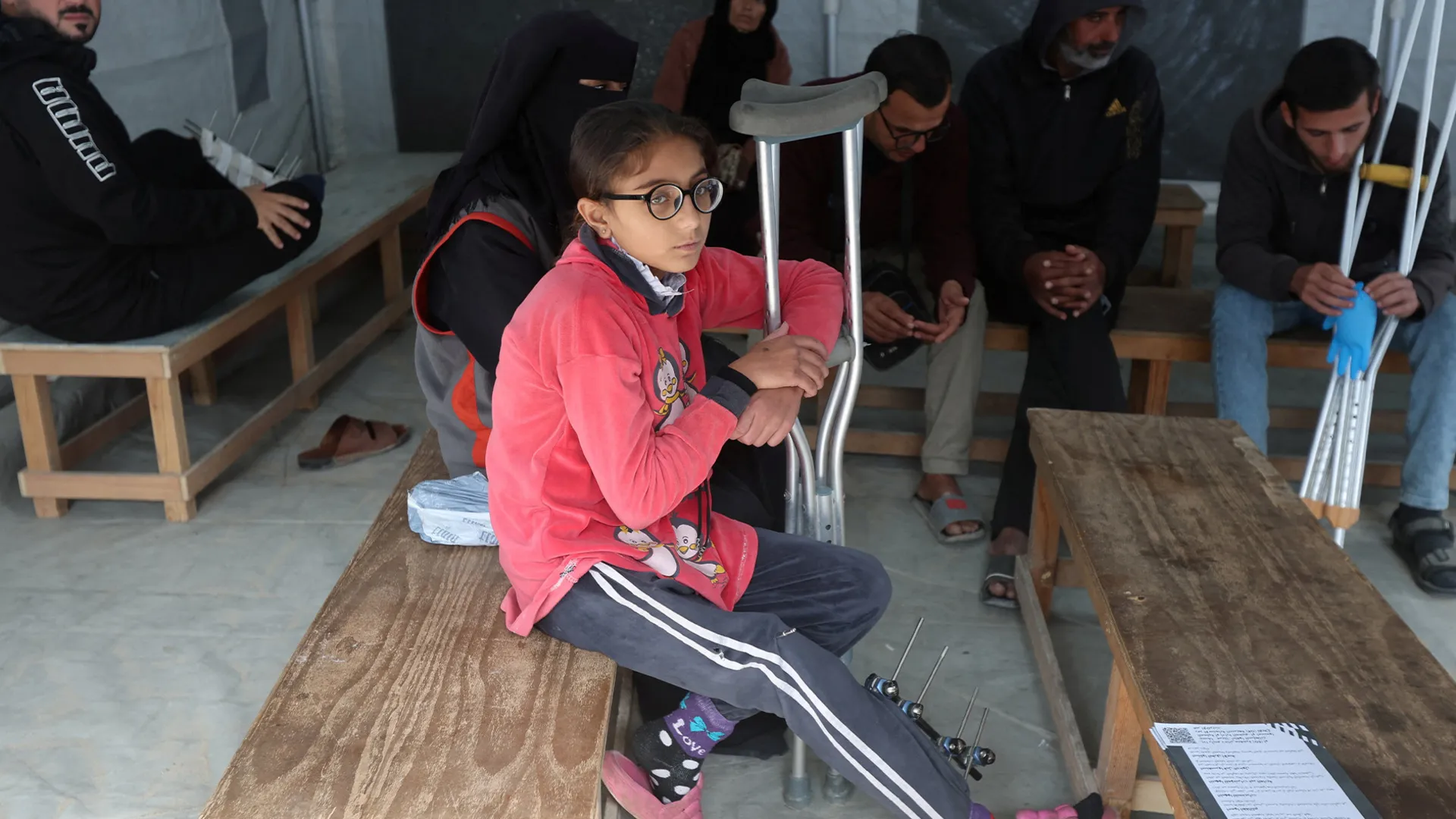
“The Palestinian health system is decimated, essential infrastructure is destroyed, and people struggle to meet basic needs. People need more services, not less,” MSF said.
“If MSF and other INGOs lose access, hundreds of thousands of Palestinians would be cut off from essential care.”
Former UN humanitarian chief Martin Griffiths, who sits on the board of the Norwegian Refugee Council, told Al Jazeera he was not optimistic about what will happen next.
“The reality is these agencies are essential to aid delivery – [and] aid delivery in particular in the Gaza Strip,” Griffiths said. “They are the last mile, the phrase used in humanitarian operations to those who actually deliver the aid to the people involved.”
Four members of the Palestine Action group, which has been proscribed as a terrorist organisation in the United Kingdom, are continuing with their hunger strikes in different prisons around the country.
Four other Palestine Action members have ended their hunger strikes – some after being hospitalised.
Recommended Stories
list of 4 itemsend of list
Here is what we know about the four remaining hunger strikers.
Why are the Palestine Action protesters on hunger strike?
Imprisoned Palestine Action members have been on hunger strikes in prisons around the UK for more than 50 days.
The Palestine Action members are being held on remand in prisons over their alleged involvement in break-ins at the UK subsidiary of Elbit Systems in Filton near Bristol, where equipment was reportedly damaged, and at a Royal Air Force base in Oxfordshire, where two military aircraft were sprayed with red paint.
The prisoners deny the charges against them, which include burglary and violent disorder.
Of the four still on hunger strikes, three were imprisoned in November 2024 for their alleged involvement in break-ins at the UK subsidiary of Israeli weapons group Elbit Systems in Filton near Bristol, where equipment was reportedly damaged. One has been in prison since July 2025 for alleged involvement in damage at a Royal Air Force base in Oxfordshire, where two military aircraft were sprayed with red paint.
Palestine Action, a protest group launched in July 2020, describes itself as a movement “committed to ending global participation in Israel’s genocidal and apartheid regime”.
The UK parliament voted in favour of proscribing the group on July 2, 2025, classifying it as a “terrorist” organisation and bringing it into the same category as armed groups like al-Qaeda and ISIL (ISIS). Critics decried the move, arguing that while members of the group have caused damage to property, they have not committed acts of violence that amount to terrorism.
More than 1,600 arrests linked to support for Palestine Action were made in the three months following the ban’s introduction. The ban has been challenged in court.
The hunger strikers have five key demands: immediate bail, the right to a fair trial – which they say includes the release of documents related to “the ongoing witch-hunt of activists and campaigners” – ending censorship of their communications, “de-proscribing” Palestine Action and shutting down Elbit Systems, which operates several UK factories.
“The UK government has forced their bodies to a breaking point,” pro-Palestine activist Audrey Corno told Al Jazeera Mubasher.
“A promise to the government is that the prisoners’ resistance and the people’s resistance against the genocide [in Gaza], Israel’s occupation and apartheid of genocide will not stop until it ends.”
Who are the remaining hunger strikers?
Heba Muraisi, Kamran Ahmed, Teuta Hoxha and Lewie Chiaramello are the four people, aged between 20 and 31, who are continuing their hunger strikes.
Heba Muraisi
Muraisi, 31, was on day 60 of her hunger strike on Thursday. She is being held in HMP [His Majesty’s Prison] New Hall in Wakefield, a prison in West Yorkshire about 180 miles (290km) north of London.
Muraisi was arrested in November 2024 for her alleged role in an August 2024 raid on the Israel-based Elbit Systems in Bristol, which is believed to have cost the Israeli weapons manufacturer more than $1.34m.
According to social media posts, Muraisi is of Yemeni origin. However, Al Jazeera could not independently verify this.
She was transferred to the West Yorkshire prison in October 2025 from HMP Bronzefield in Surrey, about 18 miles from the UK capital.
“Heba is demanding to be transferred back to HMP Bronzefield. She was transferred very suddenly, very far away from her entire support network and family, which is based in London. She’s been experiencing consistent medical negligence. Her body is, as you’d imagine, increasingly weak,” Corno said.
In a statement shared with Al Jazeera on December 29, Muraisi said: “I’ve been force-fed repression and I’m stuffed with rage and that’s why I’m doing what I’m doing now. I am bringing acute awareness to the unjust application of UK laws by our Government and I’m glad that people can now see this after a year of imprisonment and human rights violations. Keep going, keep fighting.”
Muraisi’s trial is set for June 2026, according to the protest group Prisoners For Palestine.
Heba Muraisi [Courtesy of Prisoners for Palestine]
Kamran Ahmed
Ahmed, 28, was also arrested in November 2024 and is being held in HMP Pentonville in north London. He was also arrested for his alleged involvement in the raid on Elbit Systems in Bristol. Ahmed has been on a hunger strike for more than 50 days.
According to a report by Middle East Eye, Ahmed is a mechanic.
Ahmed was hospitalised for a third time on December 20 after he refused food, his sister, Shahmina Alam, told Al Jazeera.
“We know that he’s rapidly been losing weight in the last few days, losing up to half a kilogramme [1.1lbs] a day,” Alam told Al Jazeera in late December.
Ahmed, who is 180cm (5′11′), entered prison at a healthy 74kg (163lbs), but his last recorded weight was 60kg (132lbs).
“Kamran has been hospitalised for the fourth time recently,” Corno said.
Kamran Ahmed [Courtesy of Prisoners for Palestine]
Teuta Hoxha
Hoxha, 29, was on day 54 of her hunger strike on Thursday. She is being held at HMP Peterborough. She was also arrested in November 2024 on allegations of involvement in the Elbit Systems raid.
According to Prisoners for Palestine, Hoxha was moved from HMP Bronzefield on the day UK parliamentarians voted to proscribe Palestine Action – July 2, 2025.
Corno told Al Jazeera that she is in regular contact with Hoxha and that she has been having heart palpitations. “She’s not been able to sleep through the night for weeks on end. I can see her memory start to deteriorate.”
In a statement published on the Prisoners for Palestine website, Hoxha said: “This is a witch hunt, not a fair fight, and that behind the arrests of dissenting voices under counterterrorism powers, holding us on remand without trial for nearly two years and targeting protesters who condemn Palestinian suffering, is the palpably desperate attempt to force us all under the imperial boot of submission.”
Teuta Hoxha [Courtesy of Prisoners for Palestine]
Lewie Chiaramello
Chiaramello, 22, has type 1 diabetes and hence, he has been fasting every other day. He is on day 28 of his hunger strike.
He has been held in HMP Bristol since July 2025 in connection with an incident at RAF Brize Norton, according to Prisoners for Palestine, and faces charges of conspiring to enter a restricted area for purposes harmful to the UK’s safety and interests, as well as conspiracy to commit criminal damage. His trial is set for January 18, 2027.
On June 20, a group of Palestine Action activists broke into RAF Brize Norton, the largest Royal Air Force base in Oxfordshire, and sprayed two military planes with red paint, causing an estimated $9.4m worth of damage.
“He’s been having to manage his insulin intake on his own with no medical supervision,” Corno said.
Lewie Chiaramello [Courtesy of Prisoners for Palestine]
Who else has been on a hunger strike?
Four other imprisoned Palestine Action activists have ended their hunger strikes, mostly after being hospitalised.
This includes Qesser Zuhrah, 20 and Amu Gib, 30, who are being held at Bronzefield prison in Surrey. The pair began their hunger strikes on November 2 to coincide with the Balfour declaration of 1917, when Britain pledged to establish a national home for the Jewish people in Palestine.
Umar Khalid, 22, who has muscular dystrophy, ended his hunger strike after 13 days. Jon Cink ended his hunger strike after 41 days when he was hospitalised. Qesser Zuhrah ended her hunger strike after 48 days and was hospitalised. Amy Gib was also hospitalised.
Demonstrators in Turkiye demand global pressure on Israel, calling the so-called ceasefire ‘a slow-motion genocide’ against Palestinians.
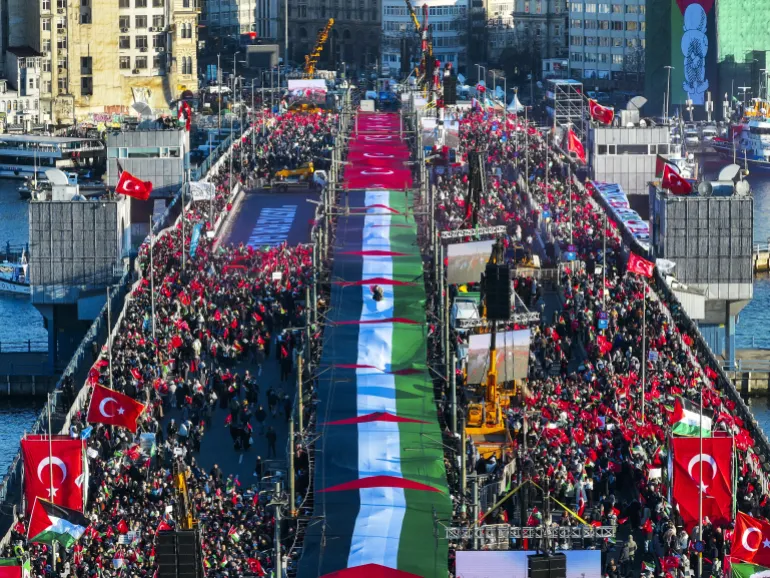
Hundreds of thousands of people are marching through Istanbul in a sweeping show of solidarity with Palestinians, condemning Israel’s genocide in Gaza and rejecting claims that a ceasefire has brought meaningful relief.
Protesters, many waving Palestinian and Turkish flags, converged on the city’s historic Galata Bridge on Thursday despite freezing temperatures.
The march, organised by civil society groups under the National Will Platform alongside Turkish football clubs, rallied under the slogan: “We won’t remain silent, we won’t forget Palestine.”
More than 400 civil society organisations joined the mobilisation, underscoring the scale of public anger at Israel’s ongoing assault on Gaza. Several major football clubs urged their supporters to attend, helping turn the rally into one of the largest pro-Palestine demonstrations Turkiye has seen since Israel’s war began.
Galatasaray football club chair Dursun Ozbek described Israel’s actions as a moral reckoning for the world.
“We will not get used to this silence,” Ozbek said in a video message shared on X. “Standing shoulder to shoulder against oppression, we come together on the same side for humanity.”
An aerial view of boats carrying Palestinian flags around Galata Bridge [Muhammed Enes Yildirim/Anadolu via Getty Images]
‘A slow-motion genocide’
Sinem Koseoglu, Al Jazeera’s Turkiye correspondent, reported from the Galata Bridge that Palestine remains a point of national consensus. She said the issue cuts across political lines, uniting supporters of the governing AK Party with voters from major opposition parties.
“Today people are trying to show their support on the very first day of the new year,” Koseoglu said, as crowds packed the bridge and surrounding streets.
Police sources and the Anadolu state news agency said about 500,000 people took part in the march.
The rally included speeches and a performance by Lebanese-born singer Maher Zain, who sang “Free Palestine” to a sea of raised flags.
For many demonstrators, the protest was also a rejection of Israel’s ceasefire narrative.
“These people here do not believe in the ceasefire,” Koseoglu said. “They believe the current ceasefire is not a real ceasefire, but a slow motion of the genocide.”
Thousands of people have gathered across Istanbul to march in solidarity with Palestinians, calling for an end to the genocidal war on Gaza, on January 1, 2026 [Muhammed Ali Yigit/Anadolu via Getty Images]
Turkiye has cut trade with Israel and closed its airspace and ports, but Koseoglu said protesters want sustained international pressure rather than symbolic measures.
“The main idea here is to show their solidarity with the Palestinian people and let the world not forget about what’s going on in Gaza,” she said, warning that many see the ceasefire as “very fragile”.
Turkiye has positioned itself as one of Israel’s sharpest critics and played a role in brokering a ceasefire announced in October by United States President Donald Trump.
Yet the pause in fighting has failed to halt bloodshed, with more than 400 Palestinians killed by Israel since the ceasefire took effect, and aid still being withheld from entering the besieged Strip.
Israel currently occupies the Palestinian side of the crossing, choking Gaza of a vital humanitarian entry point.
Published On 1 Jan 20261 Jan 2026
Share
Israel is preparing to reopen the Rafah crossing between the Gaza Strip and Egypt in both directions after Prime Minister Benjamin Netanyahu returns from a visit to the United States, according to Israeli media reports.
Israel’s Kan 11 news reported on Wednesday that the expected decision comes as a result of pressure from US President Donald Trump.
Recommended Stories
list of 3 itemsend of list
For Palestinians in Gaza, the Rafah crossing had long been the only connection to the outside world.
That was until May 2024, when Israeli forces occupied the Palestinian side of the crossing, destroying its buildings, preventing travel and causing a severe humanitarian crisis, especially for patients.
It marked the first time in 20 years that Israeli forces directly controlled the border crossing as they deployed soldiers in a military buffer zone all across the Philadelphi Corridor, where they remain today.
The first phase of Trump’s 20-point plan – imposed by the US administration in October – to end Israel’s genocidal war on Gaza had called for Israeli authorities to let humanitarian aid into the territory and open “the Rafah crossing in both directions”.
Israel, however, has continued to restrict the entry of aid, while a military unit called Israel’s Coordination of Government Activities in the Territories (COGAT) announced in December that the “Rafah Crossing will open in the coming days exclusively for the exit of residents from the Gaza Strip to Egypt”.
The announcement caused concern among mediators, with the foreign ministers of Egypt, Indonesia, Jordan, Pakistan, Qatar, Saudi Arabia, Turkiye and the United Arab Emirates issuing a joint statement that expressed “deep concern” and expressed their “complete rejection of any attempts to displace the Palestinian people from their land”.
Israel’s Kan news reported that discussions about reopening the crossing in both directions had been held before Netanyahu met with Trump in the US, but the move was postponed.
It added that an unnamed US source believed that the announcement about the opening of the crossing would take place in the coming days.
Netanyahu has reached the end of his latest trip to the US, with Trump hailing him as a “hero” and saying Israel – and by extension its prime minister – had “lived up to the plan 100 percent” in reference to the US president’s peace plan.
However, reports emerged last week that suggested US officials are growing frustrated over Netanyahu’s apparent “slow walking” of the 20-point ceasefire plan, suspecting that the Israeli prime minister might be hoping to keep the door open to resuming hostilities against the Palestinian group Hamas at a time of his choosing.
Israel is revoking the licenses of 37 international organisations, forcing them to stop operations in Gaza. Al Jazeera’s Hani Mahmoud explains how the new restrictions will worsen an already dire humanitarian crisis.
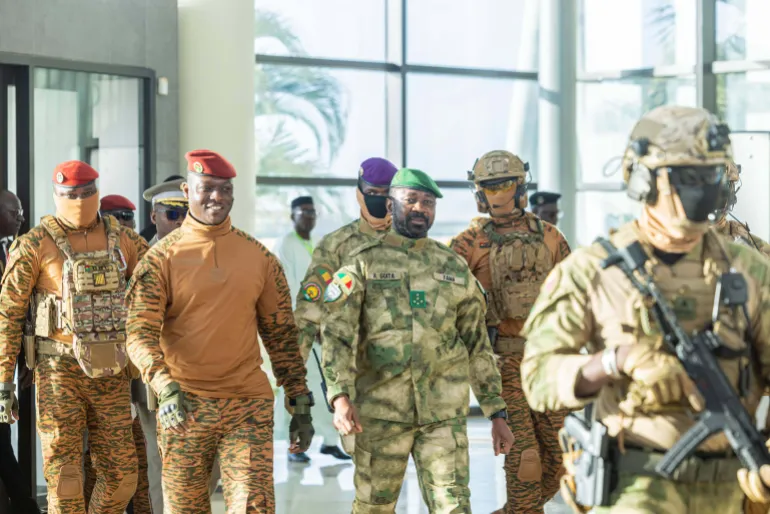
Mali and Burkina Faso have announced they are imposing full visa bans on United States citizens in retaliation for US President Donald Trump’s ban on US visas for their citizens this month.
The two West African countries, which are both governed by the military, on Tuesday became the latest African nations to issue “tit-for-tat” visa bans on the US. These follow Trump’s new visa restrictions, which now apply to 39 countries in Africa, Asia, the Middle East and Latin America. The White House said they were imposed on “national security” grounds.
Recommended Stories
list of 4 itemsend of list
“In accordance with the principle of reciprocity, the Ministry of Foreign Affairs and International Cooperation informs the national and international community that, with immediate effect, the Government of the Republic of Mali will apply the same conditions and requirements to US nationals as those imposed on Malian citizens,” the Malian ministry said in a statement.
Burkina Faso’s foreign minister, Karamoko Jean-Marie Traore, in a separate statement similarly cited a reciprocity rule for his country’s visa ban.
Which countries have issued bans on visas for US citizens?
The US directive issued on December 16 expanded full US visa bans to citizens of five nations other than Mali and Burkina Faso: Laos, Niger, Sierra Leone, South Sudan and Syria.
Travellers holding travel documents issued by the Palestinian Authority were also banned from entering the US under the order.
The US cited the countries’ poor screening and vetting capabilities, information-sharing policies, visa overstay rates and refusal to take back their deported nationals for the ban.
Trump’s order also noted countries were additionally assessed based on whether they had a “significant terrorist presence”.
The US ban takes effect on Thursday.
Mali, Burkina Faso and neighbouring Niger have been plagued by violence from armed groups linked to al-Qaeda and ISIL (ISIS) for years. The violence in those countries has displaced millions of civilians.
On Friday, Niger banned entry for US citizens, also citing the US ban on its citizens. The country is also military-led like its neighbours Mali and Burkina Faso. All three formed the Alliance of Sahel States in July 2024 to tackle security problems and improve trade relations.
In its own reciprocal move, Chad stopped issuing visas to US citizens on June 6 with an exception for US officials. Only US citizens who were issued visas before June 9 are now allowed entry into Chad.
The country was on an initial list of 12 nations whose citizens the Trump administration issued a full visa ban on from June 9.
Burkina Faso President Ibrahim Traoré, second from left, walks alongside Malian President Assimi Goïta during an Alliance of Sahel States summit on security and development in Bamako, Mali, on December 23, 2025 [Handout/Mali government information centre via AP]
Which countries are affected by the US visa bans?
Citizens of 39 countries are now under full or partial entry restrictions to the US, according to the US-based Council on Foreign Relations think tank.
Those fully banned are:
Afghanistan
Burkina Faso
Chad
Equatorial Guinea
Eritrea
Haiti
Iran
Laos
Libya
Mali
Myanmar
Niger
Republic of Congo
Sierra Leone
Somalia
South Sudan
Sudan
Syria
Yemen
Holders of travel documents issued by the Palestinian Authority are also fully banned.
Those partially restricted are:
Angola
Antigua and Barbuda
Benin
Burundi
Cuba
Dominica
Gabon
The Gambia
Ivory Coast
Malawi
Mauritania
Nigeria
Senegal
Tanzania
Togo
Tonga
Turkmenistan
Venezuela
Zambia
Zimbabwe
Is Trump specifically targeting African countries with visa bans?
Trump’s approach to Africa regarding visa entries in his second term as US president is similar to that of his first administration when he issued a “Muslim ban”, which included citizens of three African nations – Somalia, Sudan and Libya – as well as Yemen, Syria, Iraq and Iran.
In later updates to the ban, Sudan was removed while Chad was added.
Most countries under US entry restrictions since Trump took office on January 20 are in Africa. Of the 39 affected countries, 26 are African nations.
How have US-Africa trade relations fared under Trump?
Tradewise, the US has shifted away from its preferential African Growth and Opportunity Act (AGOA) trade programme to a tariff-based regime that has also been applied to most other countries around the world under Trump’s tariffs policy.
From 2000, AGOA provided African nations with duty-free access to US markets, bolstering African exports to the US of a wide range of goods, from wine to cars.
AGOA created an estimated 300,000 jobs in African countries and indirectly sustained another 1.2 million jobs, according to the US-based Center for Strategic International Studies.
However, AGOA expired in September after the US Congress failed to renew it. Although the Trump administration said it supported a one-year extension, no steps have been announced to revive the programme.
Instead, African countries now face often steep tariffs as the US sometimes justifies them on political grounds.
South African President Cyril Ramaphosa met with Trump at the White House in May and explained that crime in the country targets the population at large – not just its white citizens – but was unable to persuade Trump.
Trump’s administration is also prioritising its access to critical rare earth minerals, used to develop high-tech devices, in a bid to remain competitive with China, which mines about 60 percent of the world’s rare earth metals and processes 90 percent of them.
Trump took up a mediator role in the conflict between the Democratic Republic of the Congo (DRC) and neighbouring Rwanda this year after the DRC government proposed a minerals deal with the US. The US and United Nations accuse Rwanda of backing a rebellion by the M23 armed group in the eastern DRC.
Trump did not commit to US military intervention in the DRC but successfully secured a peace pact between the two countries on December 4 after applying diplomatic pressure on Rwanda.
Aid groups have since reported rising hunger in northern Nigeria, Somalia and northeastern Kenya.
Health observers and analysts have also raised the alarm about the risk of undoing work to prevent and contain the spread of HIV in Lesotho and South Africa.
In northern Cameroon, officials have reported a spike in malaria deaths as drug supplies fall. This month, the US unilaterally pledged $400m in health funding to the country over the next five years on the condition that Cameroon raises its own annual health spending from $22m to $450m.
African nations were also most affected when Trump recalled 30 career diplomats appointed by former President Joe Biden from 29 countries last week.
Fifteen of them had been stationed in African nations: Algeria, Burundi, Cameroon, Cape Verde, Gabon, Ivory Coast, Egypt, Madagascar, Mauritius, Niger, Nigeria, Rwanda, Senegal, Somalia and Uganda.
Meanwhile, the US has continued to intensify strikes against armed groups linked to ISIL and al-Qaeda, similar to those during Trump’s first term as president from 2017 to 2021.
In Somalia, the US launched strikes in September targeting al-Shabab and the ISIL affiliate in Somalia Province, according to the US-based New America Foundation think tank.
The US also targeted ISIL- and al-Qaeda-linked groups in northwestern Nigeria for the first time on Thursday.
While those strikes were carried out in collaboration with the Nigerian government, a war of narratives prevailed between the two countries.
The US claims to be “saving” Nigerian Christians, who it alleges are experiencing a genocide.
Nigerian authorities, on the other hand, deny claims of genocide and say people of all religions have been badly affected by armed groups operating in the country.
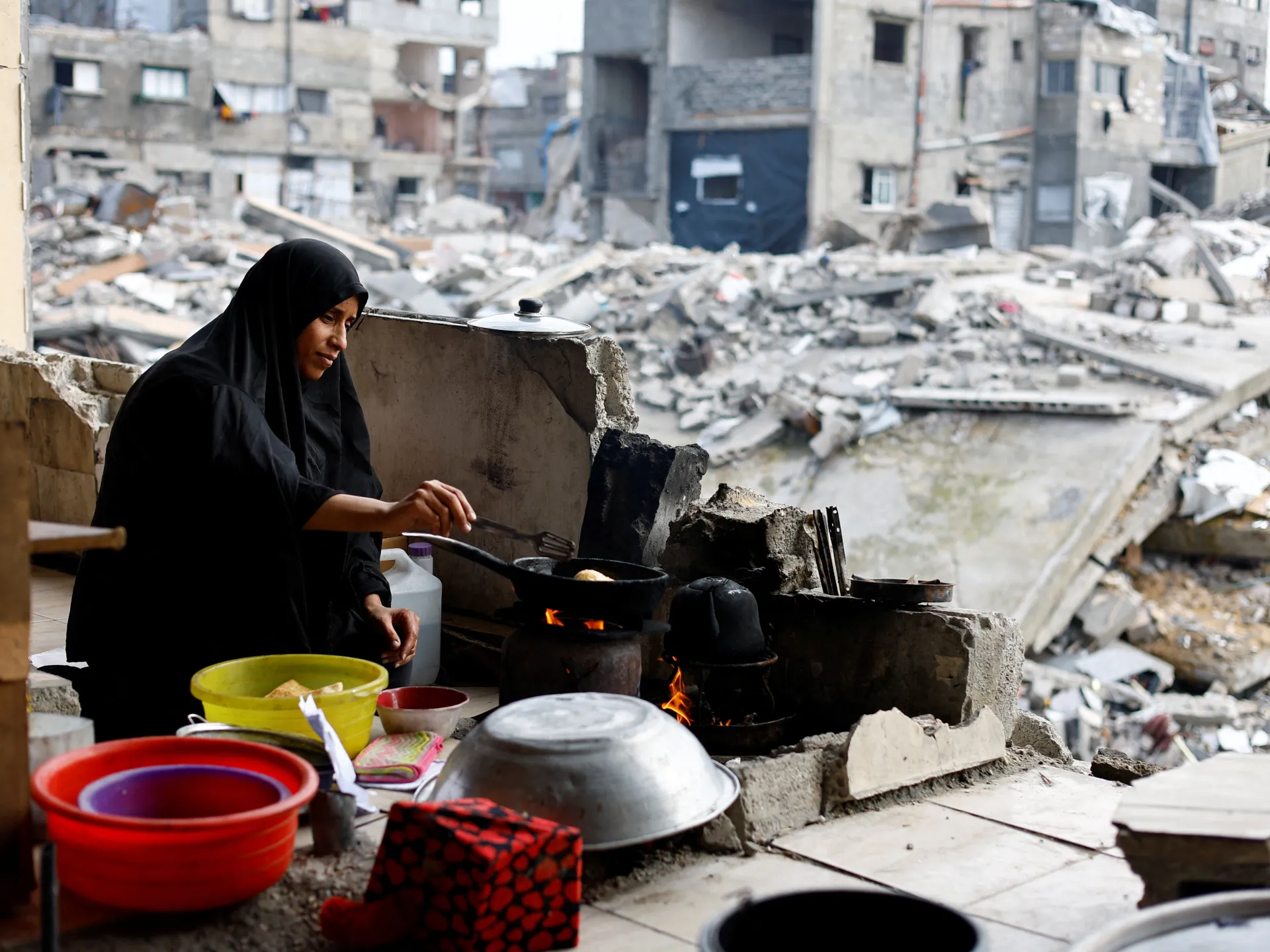
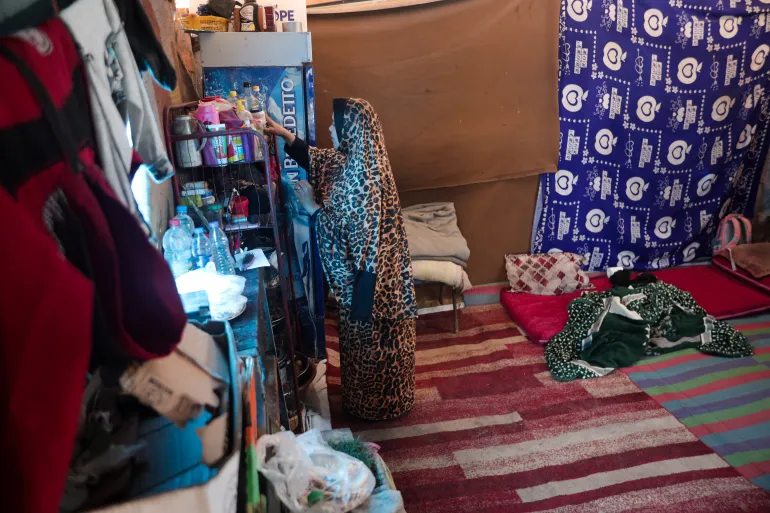
Deir el-Balah and Nuseirat, Gaza Strip – In her tent made of fabric sheets with a roof covered in white plastic tarp, Sanaa Issa tries to steal a quiet moment with her daughters.
Sanaa spoke to Al Jazeera as the new year approached, and with a ceasefire officially in place in Gaza. But, lying on a wet blanket in a tent with rain pouring down, Sanaa doesn’t have a huge amount to be positive about.
Recommended Stories
list of 3 itemsend of list
“We didn’t know whether to blame the war, the cold, or the hunger. We’re moving from one crisis to another,” Sanaa told Al Jazeera, describing a harsh year she, and other displaced Palestinians like her, have faced in the Gaza Strip.
Amid worsening humanitarian conditions, the once-ambitious hopes of Palestinians in Gaza, dreams of a better future, prosperity, and reconstruction, are gone. In their place are basic human needs: securing flour, food and water, obtaining tents to shield them from the cold, accessing medical care, and simply surviving bombardments.
For Palestinians like Sanaa, hope for the new year has been reduced to a daily struggle for survival.
Sanaa is a 41-year-old mother of seven, who has been solely responsible for raising her children after her husband was killed in an Israeli strike in November 2024, at the end of the first year of Israel’s genocidal war on Gaza.
“Responsibility for the children, displacement, securing food and drink, making tough decisions here and there. Everything was required of me at once,” Sanaa, who fled with her family from al-Bureij to Deir el-Balah, both in central Gaza, said.
Sanaa’s biggest challenge in 2025 was securing “a loaf of bread” and getting her hands on even a kilogram of flour every day for her family.
“During the famine, I slept and woke up with one wish: to get enough bread for the day. I felt I was dying while my children were starving before me, and I could do nothing,” she said bitterly.
The search for flour eventually saw Sanaa decide to go to the US-backed GHF aid distribution points that opened at the end of May across Gaza.
“At first, I was scared and hesitant, but the hunger we live through can force you to do things you never imagined,” Sanaa said, describing her weekly visits to the aid points.
Visiting the sites, which the US and Israel supported as alternatives to long-established aid organisations, was inherently dangerous. More than 2,000 Palestinians were killed in and around GHF sites, according to the United Nations, before the GHF officially ended its mission in late November.
But going to the sites wasn’t just a risk to Sanaa’s life, it was a path that “took away her dignity”, leaving lasting scars.
On one occasion, Sanaa was hit by shrapnel in her arm while waiting for aid at the Netzarim distribution point in central Gaza, and her 17-year-old daughter was injured in the chest at the Morag point east of Rafah.
But her injuries didn’t stop her from trying again, although she began to go alone, leaving her children behind in relative safety.
During the famine in Gaza, Sana’a’s greatest wish was to provide a loaf of bread for her seven children, amid a six-month-long Israeli blockade that prevented food and goods from entering [Abdelhakim Abu Riash/Al Jazeera]
Desperation
The war in Gaza led to severe interruptions in food and humanitarian aid, the last of which began in late March 2025, eventually leading to the declaration of a famine. It continued until October 2025, gradually easing after the ceasefire announcement.
During this period, the United Nations officially declared a state of famine, confirming that parts of Gaza had entered catastrophic hunger stages, with acute shortages in food, water, and medicine, and high rates of malnutrition among children and pregnant women.
Thousands of residents had to search for food using dangerous methods, including by waiting for long hours at the GHF sites.
“Hunger lasted a long time; it wasn’t a day or two, so I had to find a solution,” Sanaa said. “Each time, people crowded in their hundreds of thousands. Some would spend the night there, hundreds of thousands of displaced people – men, women, children, old and young.”
“The scenes were utterly humiliating. Bombing and heavy gunfire on everyone, not to mention the pushing and fighting among people over aid.”
The crowds meant that Sanaa often returned to her tent empty-handed, but the rare times she brought back a few kilos of flour felt like “a festival”, she recalled.
“One time, I got five kilos [11 pounds] of flour. I cried with joy returning to my children, who hadn’t tasted bread for days,” she added.
Sanaa sits with her children inside their tent, holding on to the hope that living conditions will improve in the coming year [Abdelhakim Abu Riash/Al Jazeera]
Sanaa divided the five kilos over two weeks, sometimes mixing it with ground lentils or pasta dough. “We wanted to recite a spell over the flour so it would multiply,” she said with dark humour.
A heavy silence followed as Sanaa adjusted the plastic tarp over her tent against the strong wind, then said:
“We witnessed humiliation beyond measure? All this for what? For a loaf of bread!” she added with tearful eyes. “If we were animals, perhaps they would have felt more pity for us.”
Despite the hardships she has endured and continues to face, Sanaa has not lost hope or her prayers for Gaza’s future.
“Two years are enough. Each year has been harder than the previous one, and we are still in this spiral,” she added. “We want proper tents to shelter us in winter, a gas cylinder to cook instead of burning wood, we want life and reconstruction.”
“Our basic rights have become distant wishes at year’s end.”
Batoul Abu Shawish, 20, lost her entire family in an Israeli strike that targeted their home in Nuseirat during the ceasefire in November 2025 [Abdelhakim Abu Riash/Al Jazeera]
The only survivor
Sanaa’s husband was one of the more than 71,250 Palestinians killed by Israel during the war.
Twenty-year-old Batoul Abu Shawish can count her father, mother, two brothers and two sisters – her whole immediate family – among that number.
Batoul comes into the new year wishing for only one thing: to be with her family.
Her heartbreaking loss came just a month before the end of the year, on November 22.
Despite the ceasefire, an Israeli bomb struck the home her family had fled to in central Gaza’s Nuseirat refugee camp.
“I was sitting with my two sisters. My brothers were in their room, my father had just returned from outside, and my mother was preparing food in the kitchen,” she recalled, eyes vacant, describing the day.
“In an instant, everything turned to darkness and thick dust. I didn’t realise what was happening around me, not even that it was bombing, due to the shock,” Batoul added, as she stood next to the ruins of her destroyed home.
She was trapped under the debris of the destroyed home for about an hour, unable to move, calling for help from anyone nearby.
“I couldn’t believe what was happening. I wished I were dead, unaware, trying to escape the thought of what had happened to my family,” Batoul said.
“I called for them one by one, and there was no sound. My mother, father, siblings, no one.”
After being rescued, she was found to have severe injuries to her hand and was immediately transferred to hospital.
“I was placed on a stretcher above extracted bodies, covered in sheets. I panicked and asked my uncle who was with me: ‘Who are these people?’ He said they were from the house next to ours,” she recalled.
As soon as Batoul arrived at the hospital, she was rushed into emergency surgery on her hand before she could learn about what had happened to her family.
“I kept asking everyone, ‘Where is my mom? Where is my dad?’ They told me they were fine, just injured in other departments.”
“I didn’t believe them,” Batoul added, “but I was also afraid to call them liars.”
The following day, her uncles broke the news to Batoul that she had lost her mother and siblings. Her father, they told her, was still in critical condition in the intensive care unit.
“They gathered around me, and they were all crying. I understood on my own,” she said.
“I broke down, crying in disbelief, then said goodbye to them one by one before the funeral.”
Batoul’s father later succumbed to his injuries three days after the incident, leaving her alone to face her grief.
“I used to go to the ICU every day and whisper in my father’s ear, asking him to wake up again, for me and for himself, but he was completely unconscious,” Batoul said as she scrolled through photos of her father on her mobile phone.
“When he died, it felt as if the world had gone completely dark before my eyes.”
Batoul al-Shawish holds a photo on her phone showing her with her family, including her father, mother, and siblings Muhammad, Youssef, Tayma, and Habiba [Abdelhakim Abu Riash/Al Jazeera]
‘Where is the ceasefire?’
Israel said that it conducted the strikes in Nuseirat in response to an alleged gunman crossing into Israel-held territory in Gaza, although it is unclear why civilian homes in Nuseirat were therefore targeted.
According to Gaza’s Government Media Office and the Ministry of Health, around 2,613 Palestinian families were completely wiped out during the war on the Gaza Strip up until the announcement of the ceasefire in October 2025.
Those families had all of their members killed, and their names erased from the civil registry.
The same figures indicate that approximately 5,943 families were left with only a single surviving member after the rest were killed, an agonising reflection of the scale of social and human loss caused by the war.
These figures may change as documentation continues and bodies are recovered from beneath the rubble.
For Batoul, her family was anything but ordinary; they were known for their deep bond and love for one another.
“My father was deeply attached to my mother and never hid his love for her in front of anyone, and that reflected on all of us.”
“My mother was my closest friend, and my siblings loved each other beyond words. Our home was full of pleasant surprises and warmth,” she added.
“Even during the war, we used to sit together, hold family gatherings, and help one another endure so much of what we were going through.”
The understandable grief that has overtaken Batoul leaves no room for wishes for a new year or talk of a near future, at least for now.
One question, however, weighs heavily on her: why was her peaceful family targeted, especially during a ceasefire?
“Where is the ceasefire they talk about? It’s just a lie,” she said.
“My family and I survived bombardment, two years of war. An apartment next to our home in eastern Nuseirat was hit, and we fled together to here. We lived through hunger, food shortages, and fear together. Then we thought we had survived, that the war was over.”
“But sadly, they’re gone, and they left me alone.”
Batoul holds onto one wish from the depths of her heart: to join her family as soon as possible.
At the same time, she carries an inner resignation that perhaps it is her fate to live this way, like so many others in Gaza who have lost their families.
“If life is written for me, I will try to fulfil my mother’s dream that I be outstanding in my field and generous to others,” said Batoul, a second-year university student studying multimedia, who is currently living with her uncle and his family.
“Life without family,” she said, “is living with an amputated heart, in darkness for the rest of your life, and there are so many like that now in Gaza.”
Batoul al-Shawish stands in front of the rubble of her destroyed home, where she was trapped for about an hour before being rescued [Abdelhakim Abu Riash/Al Jazeera]
It all began more than a decade ago. Saudi Arabia and the United Arab Emirates were the pillars of a coalition created to fight the Houthis who had taken control in Yemen.
Over the years, that mission failed. Then the UAE set out to pursue its own long-term interests by supporting and arming a group called the Southern Transitional Council (STC) in the south of Yemen.
Recommended Stories
list of 3 itemsend of list
But Riyadh stepped in to disrupt what it saw as a national security threat after the STC seized control of areas close to its borders.
The UAE was given 24 hours’ notice to withdraw – an ultimatum it agreed to.
So what does all this mean for the future of Yemen?
Presenter: James Bays
Guests:
Abdul-aziz Al Ghashian – Senior non-resident fellow at Gulf International Forum
Alkharder Sulaiman – Southern Transitional Council spokesman
Andreas Krieg – Associate professor at the School of Security Studies, King’s College London
Ivorians to face Burkina Faso in last 16 while Cameroon meet South Africa and Mozambique play Nigeria.
Published On 31 Dec 202531 Dec 2025
Share
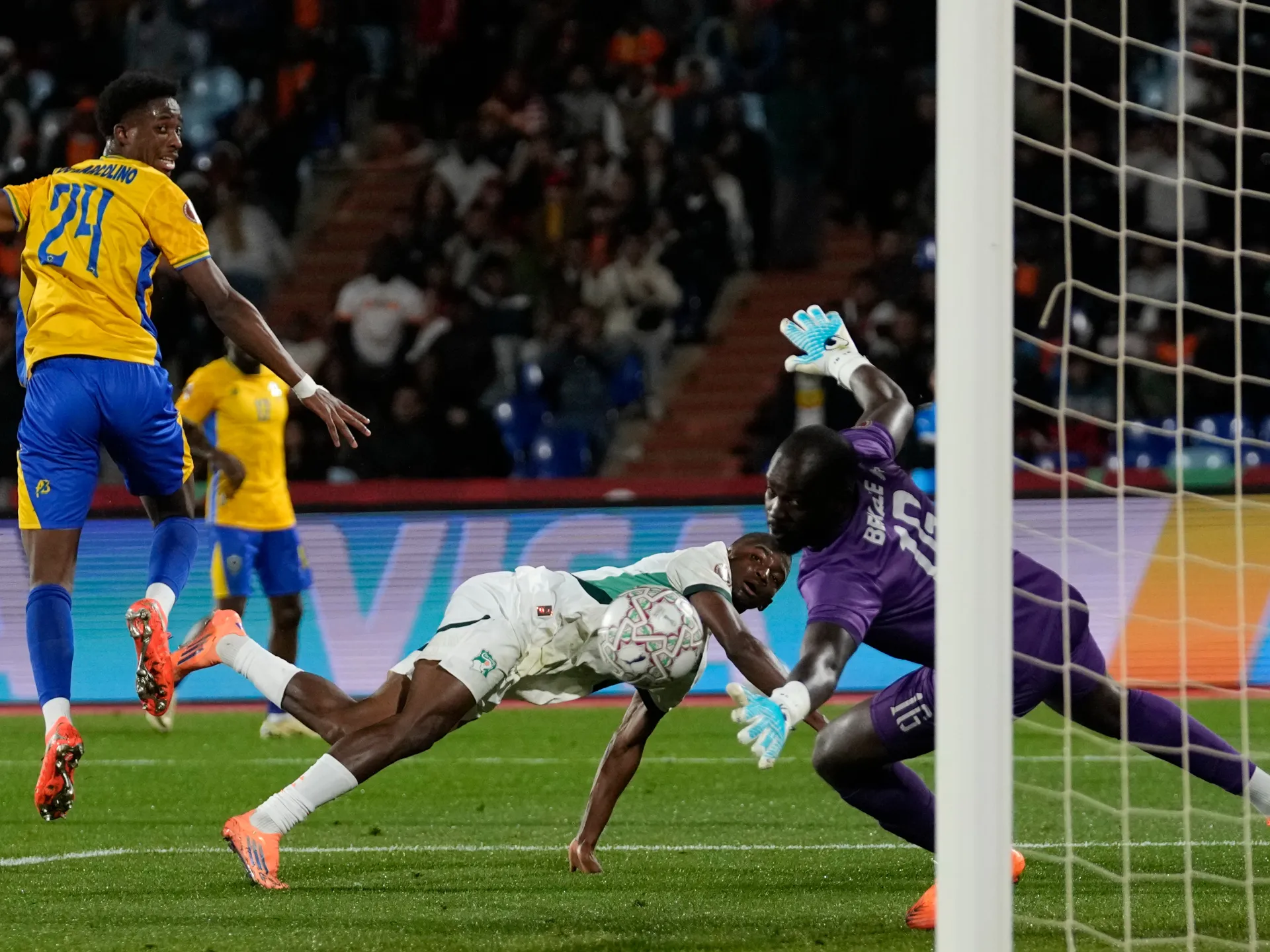
Substitute Bazoumana Toure scored in stoppage time for Ivory Coast, who came from two goals down to beat Gabon 3-2 in Marrakesh and top Group F at the Africa Cup of Nations.
Cameroon also fell behind on Wednesday, against Mozambique in Agadir, but a thunderbolt from Christian Kofane delivered a 2-1 victory.
Recommended Stories
list of 4 itemsend of list
Defending champions Ivory Coast and Cameroon finished level on seven points, and both had a plus-two goal difference. The Ivorians topped the table because they scored five goals and Cameroon four.
The results completed the last 16 lineup. Ivory Coast will face Burkina Faso, Cameroon meet South Africa and Mozambique face Nigeria.
In Marrakesh, Gabon rocked Ivory Coast by building a two-goal lead midway through the first half before the title-holders cut the deficit just before the break to trail 2-1 at half-time.
Guelor Kanga struck after 11 minutes for the Gabonese Panthers, whose best-known footballer, Pierre-Emerick Aubameyang, had returned to France for treatment of a thigh injury.
The 2015 African player of the year scored in a 3-2 loss to Mozambique three days ago that eliminated Gabon from the race to be among the 16 qualifiers for the knockout stage.
Ivory Coast fell further behind on 21 minutes when Los Angeles-based Denis Bouanga claimed his first goal of the tournament.
Ivorian Jean-Philippe Krasso netted on 44 minutes after being set up by Wilfried Zaha, the former Crystal Palace winger recalled for the AFCON after missing the triumphant 2024 campaign.
The defending champions took off captain Franck Kessie and Zaha halfway through the second half, but Amad Diallo, who scored in the first two group matches, remained on the bench.
Manchester United winger Diallo was finally introduced on 76 minutes, replacing Oumar Diakite, who was walking a disciplinary tightrope having been yellow-carded.
It was another substitute, Evann Guessand, who equalised with six minutes of regular time left. The Aston Villa striker was a late inclusion in the squad when injured Sebastien Haller withdrew.
In the southern coastal city of Agadir, Cameroon legends Roger Milla and Samuel Eto’o were among the crowd that saw Mozambique take a surprise lead on 23 minutes.
Geny Catamo from leading Portuguese club Sporting unleashed a low shot that bounced in front of goalkeeper Devis Epassy and flew just inside the left post.
The lead lasted five minutes before five-time champions Cameroon levelled when Feliciano ‘Nene’ Jone conceded an own goal.
Facing two unmarked Cameroonian attackers, goalkeeper Ivane Urrubal blocked the ball, which ran loose to Frank Magri.
Magri hit the post and Nene, attempting to clear, managed only to steer the ball into the Mozambican net.
Cameroon had the ball in the net again 10 minutes later, but the scorer, Germany-based 19-year-old Christian Kofane, was ruled offside.
The teen made up for his disappointment by putting the Indomitable Lions ahead on 55 minutes with a fierce shot from outside the box that flew into the net off the underside of the crossbar.
New Year’s Eve celebrations are unfolding across the world as countries move into 2026 one time zone at a time.
The first major cities to mark the new year welcomed midnight with fireworks over their waterfronts, and large crowds gathered at public viewing points.
As the night continues, countries across the Americas will close out the global transition with events stretching from Rio de Janeiro’s beaches to Times Square in New York City and beyond.
This gallery shows how people are marking the start of 2026 around the world.
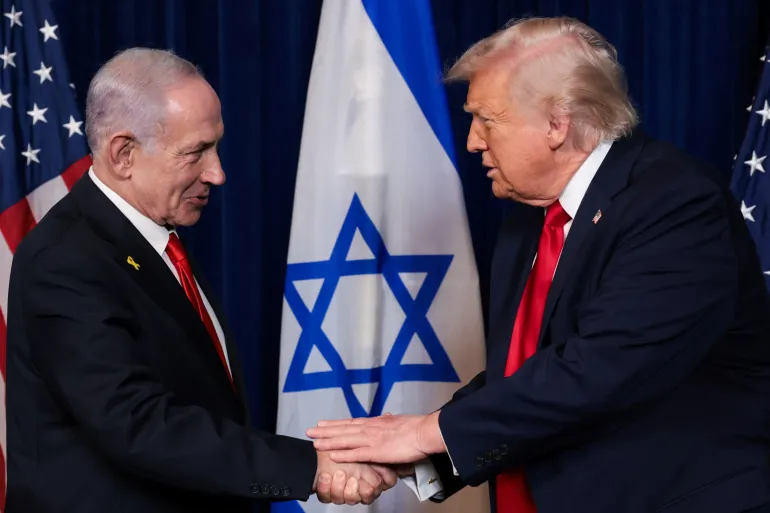
Israeli Prime Minister Benjamin Netanyahu has reached the end of his latest trip to the United States and appears to have gained what he wants from President Donald Trump.
Trump hailed Netanyahu after their meeting on Monday, calling him a “hero” and saying Israel – and by extension its prime minister – had “lived up to the plan 100 percent” in reference to the US president’s signature Gaza ceasefire.
Recommended Stories
list of 4 itemsend of list
That is despite reports emerging last week that US officials were growing frustrated over Netanyahu’s apparent “slow walking” of the 20-point ceasefire plan – imposed by the US administration in October – suspecting that the Israeli prime minister might be hoping to keep the door open to resuming hostilities against the Palestinian group Hamas at a time of his choosing.
Under the terms of that agreement – after the exchange of all captives held in Gaza, living and dead, aid deliveries into the enclave and the freezing of all front lines – Gaza would move towards phase two, which includes negotiations on establishing a technocratic “board of peace” to administer the enclave and the deployment of an international security force to safeguard it.
US President Donald Trump, right, called Israeli Prime Minister Benjamin Netanyahu a ‘hero’ during his visit to Trump’s Florida estate on December 29, 2025, saying he had lived up to Trump’s ceasefire plan ‘100 percent’ [Jonathan Ernst/Reuters]
So far, Netanyahu has not allowed in all of the required aid that Gaza desperately needs and is also maintaining that phase two cannot be entered into until Hamas returns the body of the last remaining captive. He has also demanded that Hamas disarms before Israel withdraws its forces, a suggestion fully endorsed by Trump after Monday’s meeting.
Hamas has repeatedly rejected disarmament being forced upon it by Israel, and officials have said that the question of arms was an internal Palestinian matter to be discussed between Palestinian factions.
So is Netanyahu deliberately trying to avoid entering the second phase of the agreement, and why would that be the case?
Here are four reasons why Netanyahu might be happy with things just as they are:
He’s under pressure from his right
Netanyahu’s ruling coalition is, by any metric, the most right wing in the country’s history. Throughout the war on Gaza, the support of Israel’s hardliners has proven vital in shepherding the prime minister’s coalition through periods of intense domestic protest and international criticism.
Now, many on the right, including National Security Minister Itamar Ben-Gvir and Finance Minister Bezalel Smotrich, oppose the ceasefire, protesting against the release of Palestinian prisoners and insisting that Gaza be occupied.
Netanyahu’s defence minister, Israel Katz, has also shown little enthusiasm for honouring the deal his country committed to in October. Speaking at a ceremony to mark the expansion of the latest of Israel’s illegal settlements in the occupied West Bank, Katz claimed that Israel’s forces would remain in Gaza, eventually clearing the way for further settlements.
Katz later walked his comments back, reportedly after coming under pressure from the US.
Israeli Defence Minister Israel Katz [Menahem Kahana/AFP]
He doesn’t want an international force in Gaza
Allowing an international force to deploy to Gaza would limit Israel’s operational freedom, constraining its military’s ability to re-enter Gaza, conduct targeted strikes or pursue Hamas remnants within the enclave.
So far, despite the ceasefire, Israeli forces have killed more than 400 people in the enclave since agreeing to halt fighting on October 10.
Politically, agreeing to an international stabilisation force, particularly one drawn from neighbouring states, would broaden what Israel has often seen as a domestic war into an international conflict with many of the strategic, diplomatic and political decisions over that conflict being made by actors outside of its control.
It could also be framed domestically as a concession forced by the US and international community, undermining Netanyahu’s repeated claims of maintaining Israeli sovereignty and strategic independence.
“If Netanyahu allows a foreign military force into Gaza, he immediately denies himself a large degree of his freedom to operate,” Israeli political analyst Nimrod Flaschenberg said from Berlin. “Ideally, he needs things to remain exactly where they are but without alienating Trump.”
Smoke rises from an Israeli strike on Gaza’s Bureij refugee camp on October 19, 2025, in one of the near-daily attacks Israel has carried out since the ceasefire went into effect [Eyad Baba/AFP]
He wants to resist any progress towards a two-state solution
While not explicitly mentioning a two-state solution, the ceasefire agreement does include provisions under which Israel and the Palestinians commit to a dialogue towards what it frames as a “political horizon for peaceful and prosperous co-existence”.
Netanyahu, however, has been arguing against a two-state solution since at least 2015 when he campaigned on the issue.
More recently, at the United Nations in September, he branded the decision to recognise a Palestinian state “insane” and claimed that Israel would not accept the establishment of a Palestinian homeland.
Israeli ministers have also been at work ensuring that the two-state solution remains a practical impossibility. Israel’s plan to establish a series of new settlements severing occupied East Jerusalem – long considered the future capital of any Palestinian state – from the West Bank would make the establishment of a feasible state impossible.
This isn’t just an unfortunate consequence of geography. Announcing the plans for the new settlements in August, Smotrich said the project would “bury the idea of a Palestinian state”.
Israeli Finance Minister Bezalel Smotrich holds a map near the settlement of Maale Adumim showing a land corridor known as E1, in which Israel plans to build thousands of settler homes and which Smotrich says would ‘bury the idea of a Palestinian state’ [Menahem Kahana/AFP]
A resumption of war would benefit him
Netanyahu faces numerous domestic threats, from his own corruption trial to the potentially explosive issue of forcing conscription on Israel’s ultra-religious students. There is also the public reckoning he faces for his own failures before and during the Hamas-led attacks on southern Israel on October 7, 2023, all of which will fall within a critical election year for the prime minister.
Each of these challenges risks fracturing his coalition and weakening his hold on power. All of them, however, could be derailed – or at least politically blurred – by a new conflict either with Hamas in Gaza, Hezbollah in Lebanon or possibly even with Iran.
Renewed fighting would allow him to once more present himself as a wartime leader, limit criticism and rally both his allies and adversaries around the well-worn flag of “national emergency”.
Saudi Arabia’s strike on Mukalla port has triggered tensions with its partner in the Arab coalition in Yemen and its Gulf Arab neighbour, the United Arab Emirates.
The coalition spokesman, Major-General Turki al-Maliki, said two ships entered the port of Mukalla, carrying more than 80 vehicles and containers of weapons and ammunition destined for the Southern Transitional Council (STC), without informing Saudi Arabia or the internationally recognised Yemeni government.
There are serious differences between the two allies in Yemen, and now it is at its peak and perhaps a turning point that would impact Yemen.
The Yemeni government has lost control of events following a military escalation between Saudi Arabia and the UAE in Hadramout governorate, where Mukalla lies, in December.
The Presidential Leadership Council (PLC) is divided into two factions, each loyal to one party in this conflict. The difference had been simmering for years away from the spotlight until it exploded publicly over the past few days.
Saudi Arabia and the UAE are key members of the Arab military coalition in Yemen, formed to confront the Houthis, who took full control of the capital, Sanaa, by force in 2015 and later imposed their own government.
This conflict of interest between Saudi Arabia and the UAE has been escalating gradually since the UAE-backed Southern Transitional Council (STC) formed in 2017 as a separatist political and military force seeking an independent state in the south – South Yemen – an independent state between 1967 and 1990.
Earlier in December, the STC forces crossed red lines by controlling all southern governorates, including Hadramout and al-Mahra governorates. That did not go down well in Saudi Arabia, which considered the move a threat to its national security.
Hadramout also represents economic depth for Yemen with its oil and gas resources and related infrastructure, and also has a vital border crossing with Saudi Arabia, making it part of the equation for border security and trade.
The latest public fallout between Saudi Arabia and the UAE will cast a dark shadow over the situation in Yemen politically, economically, and militarily. The Yemeni political circles were divided into two camps, with the government members each following one of the external parties to the conflict – Saudi and Emirati.
The clearest outcome of the differences would be seen in the eight-member PLC, an internationally recognised body, which is already divided into camps loyal to Saudi Arabia and the UAE.
One camp is headed by Rashad al-Alimi, the PLC president, and includes Sultan al-Arada, Abdullah al-Alimi Bawazir, and Othman Hussein Mujalli. The second is led by the head of the STC force, Aidarus al-Zoubaidi, and includes Abdul Rahman al-Mahrami (also known as Abu Zaraa), Tariq Mohammed Saleh, and Faraj Salmin al-Bahsani.
The leaders of both camps issued two different statements regarding the calls made by al-Alimi for the UAE to withdraw from Yemen following the Saudi strike on the ships carrying weapons to the STC. One was in favour of the UAE’s exit from Yemen, and the other was against — showing they are representing the interests of regional players and at the same time confirming that Yemen is a venue for a proxy war.
Within the Yemeni political landscape, the quick developments and successive events are pushing Yemen into a new phase of an internal war among political and military components that make up the legitimate government, with new internal fighting among many armed factions.
It is also taking the focus away from the Houthi rebellion in the north, which controlled Sanaa and the most populous provinces in Yemen.
The main goal for the legitimate Yemeni government and the Saudi-led Arab coalition was to confront the Houthis’ takeover. Now, the country is on the brink of collapse and a new phase of turmoil after more than a decade of armed conflict, which could help the Houthis to expand their influence beyond their current areas of control.
The latest event will weaken the Saudi-led coalition further and cast doubt over its cohesion and ability to achieve its declared joint goals for Yemen.
The views expressed in this article are the author’s own and do not necessarily reflect Al Jazeera’s editorial stance.
In 2025, Israel carried out thousands of attacks in Gaza and the occupied West Bank, with at least 10,600 attacks recorded across multiple countries including Lebanon, Iran, Syria, Yemen and Qatar.
The operation follows a series of clashes and attacks linked to ISIL, which is feared to be making a resurgence.
Published On 31 Dec 202531 Dec 2025
Share
Turkiye’s government says it has detained more than 100 ISIL (ISIS) suspects in nationwide raids, as the group shows signs of intensified regional activity after a period of relative dormancy.
Turkiye’s Interior Minister Ali Yerlikaya announced the Wednesday morning arrests in a social media post, saying Turkish authorities rounded up 125 suspects across 25 provinces, including Ankara.
Recommended Stories
list of 3 itemsend of list
The operation is the third of its kind in less than a week during the holiday season, and follows a deadly shootout on Tuesday between Turkish police and suspected ISIL members in the northwestern city of Yalova.
“Those who seek to harm our brotherhood, our unity, our togetherness … will only face the might of our state and the unity of our nation,” wrote Yerlikaya.
Tuesday’s clash killed three Turkish police and six suspected ISIL members, all Turkish nationals. A day later, Turkish security forces arrested 357 suspected ISIL members in a coordinated crackdown.
‘Intensifying’ anti-ISIL operations
Al Jazeera’s Sinem Koseoglu, reporting from Istanbul earlier this week, said Turkish forces have “intensified their operations” against ISIL sleeper cells during the holiday period, a time when the group has previously staged attacks in the country.
In 2017, when the group still held large swaths of neighbouring Syria and Iraq before being vanquished on the battlefield, ISIL attacked an Istanbul nightclub during New Year’s celebrations, killing 39 people. Istanbul prosecutor’s office said Turkish police had received intelligence that operatives were “planning attacks in Turkiye against non-Muslims in particular” this holiday season.
On top of maintaining sleeper cells in Turkiye, ISIL is still active in Syria, with which Turkiye shares a 900-kilometre (560-mile) border, and has carried out a spate of attacks there since the ouster of former President Bashar al-Assad last year.
The United States military has waged extensive strikes against ISIL in central and northeastern Syria this month, killing or capturing about 25 fighters from the group over the past two weeks, according to the US Central Command.
An Al Jazeera Arabic investigation obtains recordings of Suheil al-Hassan discussing Israeli support, regrouping efforts.
An Al Jazeera Arabic investigation has uncovered a plot by the aides of ousted leader Bashar al-Assad to destabilise Syria, featuring leaked recordings that suggest coordination with Israel.
The revelations, set to be broadcast on the programme Al-Mutahari, or The Investigator, on Wednesday evening, are based on more than 74 hours of leaked audio recordings and hundreds of pages of documents obtained in the investigation.
The leaks implicate al-Assad’s high-ranking officers, specifically Suheil al-Hassan, the brigadier-general who commanded the notorious Quwwat al-Nimr (Tiger Forces), an elite unit in the former regime’s army.
‘Israel will stand with you’
The investigation uncovers attempts by these officers to regroup, gather funding, and secure weapons to undermine stability in the country following the ousting of al-Assad.
In one of the most significant recordings, a source — identified in the leaks as a hacker or intermediary — is heard assuring al-Hassan of Israeli backing.
“The State of Israel, with all its capabilities, will stand with you,” the source tells al-Hassan.
“There is a level higher than me, Mr Rami is the one who coordinates,” al-Hassan is heard saying. “And I have dangerous intelligence information.”
It has been a year since a lightning offensive by allied rebel groups, led by current President Ahmed al-Sharaa, ended the Assad dynasty’s 54-year reign, forcing Bashar al-Assad into Russian exile.
Yet, as the regime collapsed, Israel seized on the instability by significantly escalating its military campaign in Syria, targeting much of its neighbour’s military infrastructure, including main airports, air defence systems, fighter planes, and other strategic facilities, as well as occupying more of Syria’s Golan Heights, and bombing the capital, Damascus, in July.
Over the past year, Israel has launched more than 600 air, drone or artillery attacks across Syria, averaging nearly two a day, according to a tally by the Armed Conflict Location and Event Data (ACLED).
‘The feeling of the coast’
The recordings also feature Ghiath Dalla, a former brigadier-general in al-Assad’s forces, who appears to validate al-Hassan’s position as a representative of the regime’s traditional strongholds.
“My Master, Suheil the Tiger, spoke the feeling of the whole mountain and the whole coast,” Dalla is heard saying, referring to the coastal and mountainous regions that were long considered the heartland of support for the al-Assad family.
The leaked conversations also capture al-Hassan expressing disdain for current developments, referred to as “the flood”.
“Our prayers for you all are that this foolishness, this evil, and this blackness called the flood ends,” al-Hassan says in the recording.
Investigation to air
The full extent of the plot will be detailed in the upcoming episode of The Investigator, hosted by Jamal el-Maliki.
Parts of the leaks are airing on Al Jazeera’s platforms on Wednesday, with the complete investigation scheduled for release in mid-January.
Hassan Sheikh Mohamud says his country believes the move is linked to Israel’s plans to forcibly displace Palestinians from Gaza.
Somali President Hassan Sheikh Mohamud has told Al Jazeera that Israel’s “unexpected and strange” recognition of Somaliland may have implications for Palestinians in Gaza.
“Somaliland has been claiming the secession issue for a long time, over the past three decades, and no one country in the world has recognised it,” Mohamud told Al Jazeera in an exclusive interview from Istanbul, Turkiye, on Tuesday.
Recommended Stories
list of 4 itemsend of list
“For us, we’ve been trying to reunite the country in a peaceful manner,” the Somali leader added. “So, after 34 years, it was very unexpected and strange that Israel, out of nowhere, just jumped in and said, ‘We recognise Somaliland’.”
Israel last week became the first and only country to formally recognise Somaliland, a breakaway region in northwest Somalia, bordering the Gulf of Aden.
Somalia’s president also told Al Jazeera that, according to Somali intelligence, Somaliland has accepted three Israeli conditions in exchange for Israeli recognition: the resettlement of Palestinians, the establishment of an Israeli military base on the coast of the Gulf of Aden, and Somaliland joining the Abraham Accords. The accords are a set of pacts establishing the normalisation of ties between Israel and several Arab states. The UAE, Bahrain, Morocco and Sudan have signed onto the accords.
Mohamud also said that Somalia has intelligence indicating there is already a certain level of Israeli presence in Somaliland, and Israeli recognition of the region is merely a normalisation of what was already happening covertly.
Israel will resort to forcibly displacing Palestinians to Somalia, and its presence in the region is not for peace, the Somali leader added.
A 20-point plan released by the administration of US President Donald Trump ahead of a ceasefire between Israel and Hamas in Gaza said that “no one will be forced to leave Gaza, and those who wish to leave will be free to do so and free to return”.
However, Israel has reportedly continued to explore ways to displace Palestinians from the besieged and occupied territory, including in mysterious flights to South Africa, which has formally accused Israel of committing genocide in Gaza.
Israel is also seeking to control strategically important waterways connecting vital seas of commercial and economic significance, namely the Red Sea, the Gulf and the Gulf of Aden, Mohamud said.
The Somali leader was in Turkiye on Tuesday, where he gave a joint news conference with Turkish President Recep Tayyip Erdogan, with the two leaders warning that Israel’s recognition of the breakaway region could destabilise the Horn of Africa.
Somaliland declared independence from Somalia in 1991, but had failed to gain recognition from any United Nations member state, before Israel changed its position last Friday.
Israel’s move was swiftly condemned, including by most members of the UN Security Council at an emergency meeting convened in New York on Monday.
The United States was the only member of the 15-seat body that defended Israel’s move, although it stressed that the US’s position on Somaliland remained unchanged.
The UAE says it’s withdrawing all ‘counterterrorism’ units from Yemen after a Saudi-led coalition launched air strikes on a port in southern Yemen. Riyadh has accused the Emiratis of shipping weapons and military vehicles to aid Yemen’s separatist movement, an accusation Abu Dhabi denies.
Somali President Hassan Sheikh Mohamud has accused Israel of violating international law and of ‘illegal aggression’.
Turkish President Recep Tayyip Erdogan has condemned Israel’s decision to recognise Somaliland as a sovereign state, calling the move “illegitimate and unacceptable”.
At a joint news conference with Somali President Hassan Sheikh Mohamud in Ankara on Tuesday, Erdogan warned that Israel’s recognition of the breakaway region of Somalia could destabilise the Horn of Africa.
Recommended Stories
list of 4 itemsend of list
He added that Turkiye and Somalia were deepening energy cooperation after promising signs from joint offshore exploration efforts.
“Preserving the unity and integrity of Somalia in all circumstances holds special importance in our view. Israel’s decision to recognise Somaliland is illegitimate and unacceptable,” Erdogan said.
“The Netanyahu government has the blood of 71,000 of our Palestinian brothers and sisters on its hands. Now it is trying to destabilise the Horn of Africa as well, after its attacks on Gaza, Lebanon, Yemen, Iran, Qatar and Syria,” he added, referring to Israel’s genocidal war on Gaza.
Israel became the first and only country to formally recognise Somaliland last Friday, describing the move as being in the spirit of the Abraham Accords, which normalised ties between Israel and several Arab nations.
Somalis step on an image depicting Israeli Prime Minister Benjamin Netanyahu during a demonstration in Mogadishu [Feisal Omar/Reuters]
‘Illegal aggression’
Somaliland unilaterally declared independence from Somalia in 1991, following the collapse of the central government after a civil war. Despite maintaining its own currency, passport and army, it has failed to gain international recognition.
Standing alongside Ergogan, Mohamud accused Israel of “illegal aggression”, saying the recognition breaches the United Nations charter and African Union agreements.
“Israel is exporting its problems in Gaza and Palestine, and it is trying to divert the attention of the entire world, including the Arab and Islamic world,” he later told Al Jazeera in an interview.
“Israel will resort to forcibly displacing Palestinians in Somalia. It also wants to control strategically important waterways that connect vital seas, both commercially and economically, between the Red Sea, the Gulf, and the Gulf of Aden.”
Destabilising Africa
Mohamud warned that the move would have international consequences and also said it could mark the beginning of instability in the Horn of Africa, particularly in Somalia.
He recalled that Turkiye had previously played a mediating role between Somalia and Somaliland and continues to support efforts to resolve the dispute peacefully.
Abdinor Dahir, an independent researcher, said that Turkiye has invested heavily in Somalia, supporting its security forces and political process, while mediating talks between Somalia and Somaliland.
Israel’s recognition “threatens Turkiye’s economic interests” and presence in the country and “poses a direct challenge to Somalia’s sovereignty”, he told Al Jazeera.
Dahir warned that Somalia, which has endured years of civil war and continues to fight armed groups including al-Shabab and ISIL (ISIS), has made progress on security, which could be undermined by the move.
The recognition risks “destabilising the wider African region, and could transfer the Middle East conflict into the Horn of Africa”, he said.
Israel says it will suspend more than two dozen humanitarian organisations, including Doctors Without Borders, for failing to meet its new rules for aid groups working in the war-ravaged Gaza Strip.
Organisations facing bans starting on Thursday didn’t meet new requirements for sharing information on their staffs, funding and operations, Israeli authorities said.
Recommended Stories
list of 4 itemsend of list
Other major organisations affected include the Norwegian Refugee Council, CARE International, the International Rescue Committee and divisions of major charities such as Oxfam and Caritas.
Israel accused Doctors Without Borders, known by its French acronym MSF, of failing to clarify the roles of some staff members, alleging they cooperated with Hamas.
“The message is clear: Humanitarian assistance is welcome. The exploitation of humanitarian frameworks for terrorism is not,” Diaspora Affairs Minister Amichai Chikli said.
MSF – one of the largest medical groups operating in Gaza, where the health sector has been targeted and largely destroyed – said Israel’s decision will have a catastrophic impact on its work in the enclave, where it supports about 20 percent of the hospital beds and one-third of births. The organisation also denied Israel’s accusations about its staff.
“MSF would never knowingly employ people engaging in military activity,” it said.
International organisations said Israel’s rules are arbitrary. Israel said 37 groups working in Gaza didn’t have their permits renewed.
‘Appalling conditions’
Aid organisations help with a variety of social services, including food distribution, healthcare, mental health and disability services, and education.
Amjad Shawa from the Palestine NGOs Network said the decision by Israel is part of its ongoing effort “to deepen the humanitarian catastrophe” in Gaza.
“The limitations on the humanitarian operations in Gaza are in order to continue their project to push out the Palestinians, deport Gaza. This is one of the things Israel continues doing,” Shawa told Al Jazeera.
Israel’s move comes as at least 10 countries expressed “serious concerns” about a “renewed deterioration of the humanitarian situation” in Gaza, describing it as “catastrophic”.
“As winter draws in civilians in Gaza are facing appalling conditions with heavy rainfall and temperatures dropping,” Britain, Canada, Denmark, Finland, France, Iceland, Japan, Norway, Sweden and Switzerland said in a joint statement.
“1.3 million people still require urgent shelter support. More than half of health facilities are only partially functional and face shortages of essential medical equipment and supplies. The total collapse of sanitation infrastructure has left 740,000 people vulnerable to toxic flooding.”
The countries urged Israel to ensure international NGOs can operate in Gaza in a “sustained and predictable” way and called for the opening of land crossings to boost the flow of humanitarian aid.
Israel’s Ministry of Foreign Affairs called the joint statement “false but unsurprising” and “part of a recurring pattern of detached criticism and one-sided demands on Israel while deliberately ignoring the essential requirement of disarming Hamas”.
‘Needs in Gaza are enormous’
Four months ago, more than 100 aid groups accused Israel of obstructing life-saving aid from entering Gaza and called on it to end its “weaponisation of aid” as it refused to allow aid trucks to enter the battered Gaza Strip.
More than 71,000 Palestinians have been killed since Israel launched its genocidal war on Gaza in October 2023. Hundreds have died from severe malnutrition and thousands more from preventable diseases because of a lack of medical supplies.
Israel claims it’s upholding the aid commitments laid out in the latest ceasefire, which took effect on October 10, but humanitarian groups dispute Israel’s numbers and say a lot more aid is desperately needed in the devastated enclave of more than two million Palestinians.
Israel changed its registration process for aid groups in March, which included a requirement to submit a list of staff, including Palestinians in Gaza.
Some aid groups said they didn’t submit a list of Palestinian staff for fear those employees would be targeted by Israel.
“It comes from a legal and safety perspective. In Gaza, we saw hundreds of aid workers get killed,” said Shaina Low, communications adviser for the Norwegian Refugee Council.
Desperately needed lifelines
The decision not to renew aid groups’ licences means their offices in Israel and occupied East Jerusalem will close and organisations won’t be able to send international staff or aid into Gaza.
“Despite the ceasefire, the needs in Gaza are enormous, and yet we and dozens of other organisations are and will continue to be blocked from bringing in essential lifesaving assistance,” Low said. “Not being able to send staff into Gaza means all of the workload falls on our exhausted local staff.”
Israel’s decision means the aid groups will have their licences revoked on Thursday and, if they are located in Israel, they will need to leave by March 1, according to the ministry.
This isn’t the first time Israel has tried to crack down on international humanitarian organisations. Throughout the war, it accused the United Nations agency for Palestinian refugees, UNRWA, of being infiltrated by Hamas and Hamas of using UNRWA’s facilities and taking its aid. The UN has denied that.
In October, the International Court of Justice issued an advisory opinion saying Israel must support UN relief efforts in Gaza, including those conducted by UNRWA.
The court found Israel’s allegations against UNRWA – including that it was complicit in the Hamas-led October 7, 2023, attacks on Israel – were unsubstantiated.
The court also said Israel, as the occupying power, must ensure the “basic needs” of the Palestinian population of Gaza are met, “including the supplies essential for survival”, such as food, water, shelter, fuel and medicine.
A number of countries halted funding for UNRWA after Israel’s accusations, jeopardising one of Gaza’s most desperately needed lifelines.
Elsewhere in Group C, Tanzania scrape through to the knockout stages for the first time after 1-1 draw with Tunisia.
Published On 30 Dec 202530 Dec 2025
Share
Raphael Onyedika has scored twice, and Paul Onuachu has netted his first international goal in four years as already-qualified Nigeria overcame 10-man Uganda 3-1 to maintain a 100 percent record after the group stage and send the East African side home.
Nigeria finished top of Group C on Tuesday with nine points, followed by Tunisia in second with four and Tanzania, who reached the round of 16 as one of the four best third-placed sides after their 1-1 draw with Tunisia, also on Tuesday.
Recommended Stories
list of 4 itemsend of list
It was a dominant performance from Nigeria despite resting several regulars, having already been assured of the top spot in the group.
After Onuachu missed a simple chance midway through the first half, he found the back of the net after 28 minutes.
Fisayo Dele-Bashiru showed quick feet on the left, and his pass in to Onuachu was perfect for the big forward to finish. The goal was the striker’s first for Nigeria since 2021.
Uganda were reduced to 10 men in the 56th minute when substitute goalkeeper Salim Jamal Magoola used his hands about 9 metres (10 yards) outside his area to stop a Victor Osimhen shot.
Magoola had been a halftime replacement for injured starter Denis Onyango, so Uganda had to use their third goalkeeper in the game as Nafian Alionzi was brought on for midfielder Baba Alhassan.
Nigeria scored their second goal in the 62nd minute when Onyedika took Samuel Chukwueze’s pass and drilled his shot low through the legs of Alionzi.
Onyedika netted his second five minutes later with a side-footed finish, Chukwueze again the provider with a pass from the right.
Uganda got a consolation goal with 15 minutes left as the Nigerian defence momentarily went to sleep and Rogers Mato had time and space from Allan Okello’s pass to lift the ball over the keeper and into the net.
Nevertheless, Nigeria have impressed in the group stage, having been losing finalists two years ago and following the shock of missing out on 2026 World Cup qualification.
Meanwhile, Tanzania reached the knockout stage of the Africa Cup of Nations for the first time, 45 years after their maiden appearance, by coming from behind to draw 1-1 with fellow qualifiers Tunisia in Rabat.
Feisal Salum’s powerful shot three minutes into the second half was enough to secure the draw after Tunisia had been ahead with a 43rd-minute penalty converted by Ismael Gharbi.
It was only Tanzania’s second point of the tournament but proved enough for them to advance as one of the four best third-placed finishers.
Tanzania have been trying since 1980 to advance beyond the group stage and have still to win a match in four appearances.








![During the famine, Sana’a’s greatest wish was to provide a loaf of bread for her seven children, amid a six-month-long blockade that prevented food and goods from entering [Abdelhakim Abu Riash/Al Jazeera]](https://i0.wp.com/www.aljazeera.com/wp-content/uploads/2025/12/873A1745-1767205773.jpg?w=640&ssl=1)
![Sana’a sits with her children inside their tent, holding on to hope that living conditions will improve in the coming year [Abdelhakim Abu Riash/ Al Jazeera]](https://i0.wp.com/www.aljazeera.com/wp-content/uploads/2025/12/873A1784-1767206217.jpg?w=640&ssl=1)
![Batoul Abu Shawish, 20, lost her entire family in an Israeli strike that targeted their home in Nuseirat during the ceasefire in November 2025 [Abdelhakim Abu Riash/ Al Jazeera]](https://i0.wp.com/www.aljazeera.com/wp-content/uploads/2025/12/873A1950-1767206334.jpg?w=640&ssl=1)
![Batoul holds a photo on her phone showing her with her family, including her father, mother, and siblings Muhammad, Youssef, Tayma, and Habiba [Abdelhakim Abu Riash/Al Jazeera]](https://i0.wp.com/www.aljazeera.com/wp-content/uploads/2025/12/873A2057-1767206534.jpg?w=640&ssl=1)
![Batoul stands in front of the rubble of her destroyed home, where she was trapped for about an hour before being rescued when it was hit [Abdelhakim Abu Riash/ Al Jazeera]](https://i0.wp.com/www.aljazeera.com/wp-content/uploads/2025/12/873A1970-1767206634.jpg?w=640&ssl=1)




![Israeli far-right Finance Minister Bezalel Smotrich holds a map of an area near the settlement of Maale Adumim, a land corridor known as E1, outside Jerusalem in the occupied West Bank, on August 14, 2025, after a press conference at the site. [Menahem Kahana/AFP]](https://i0.wp.com/occasionaldigest.com/wp-content/uploads/2025/12/AFP__20250814__69HV6DR__v1__HighRes__IsraelPalestinianConflictSettlementPolitics-1755194568.jpg?w=640&ssl=1)
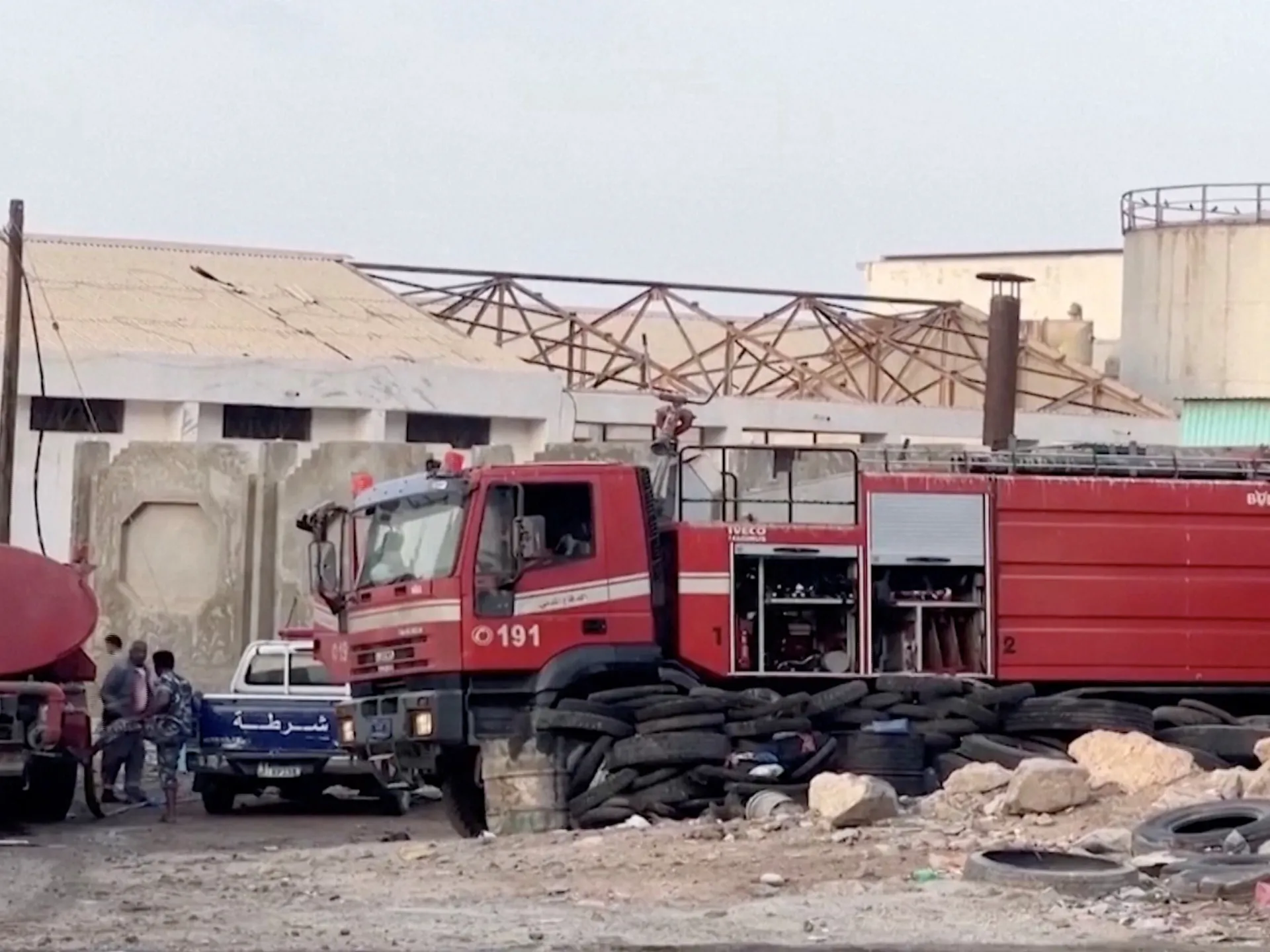
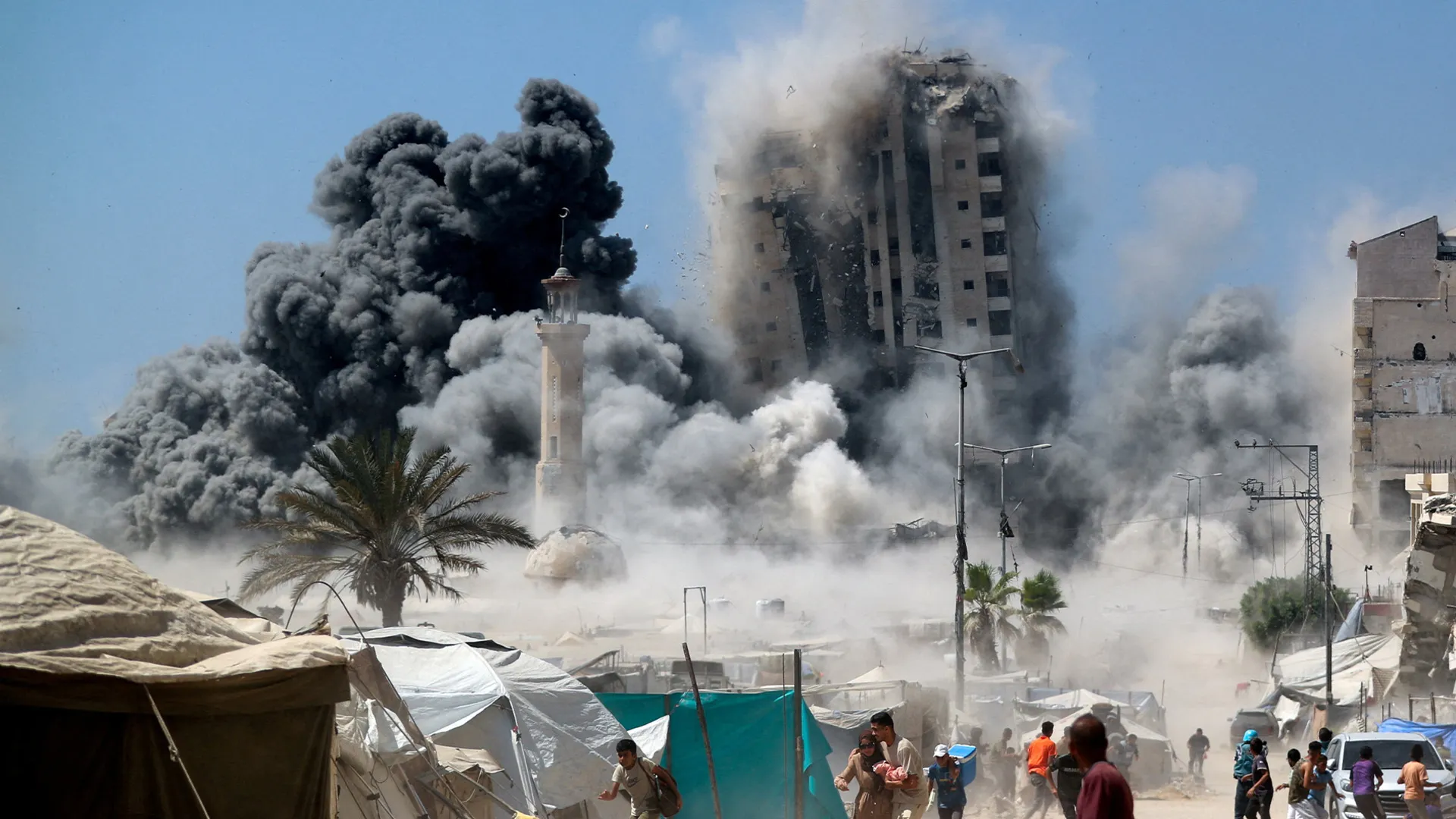
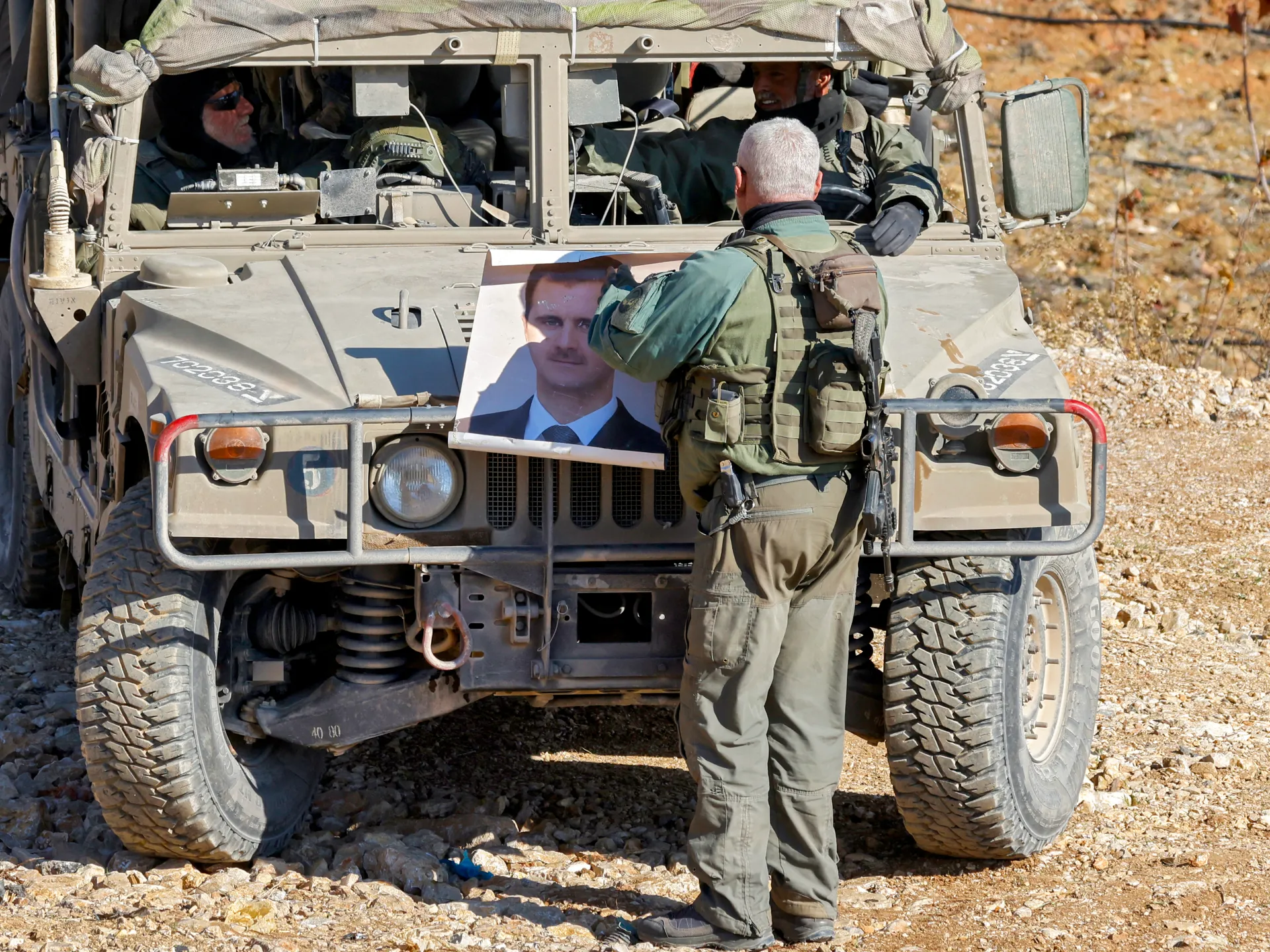
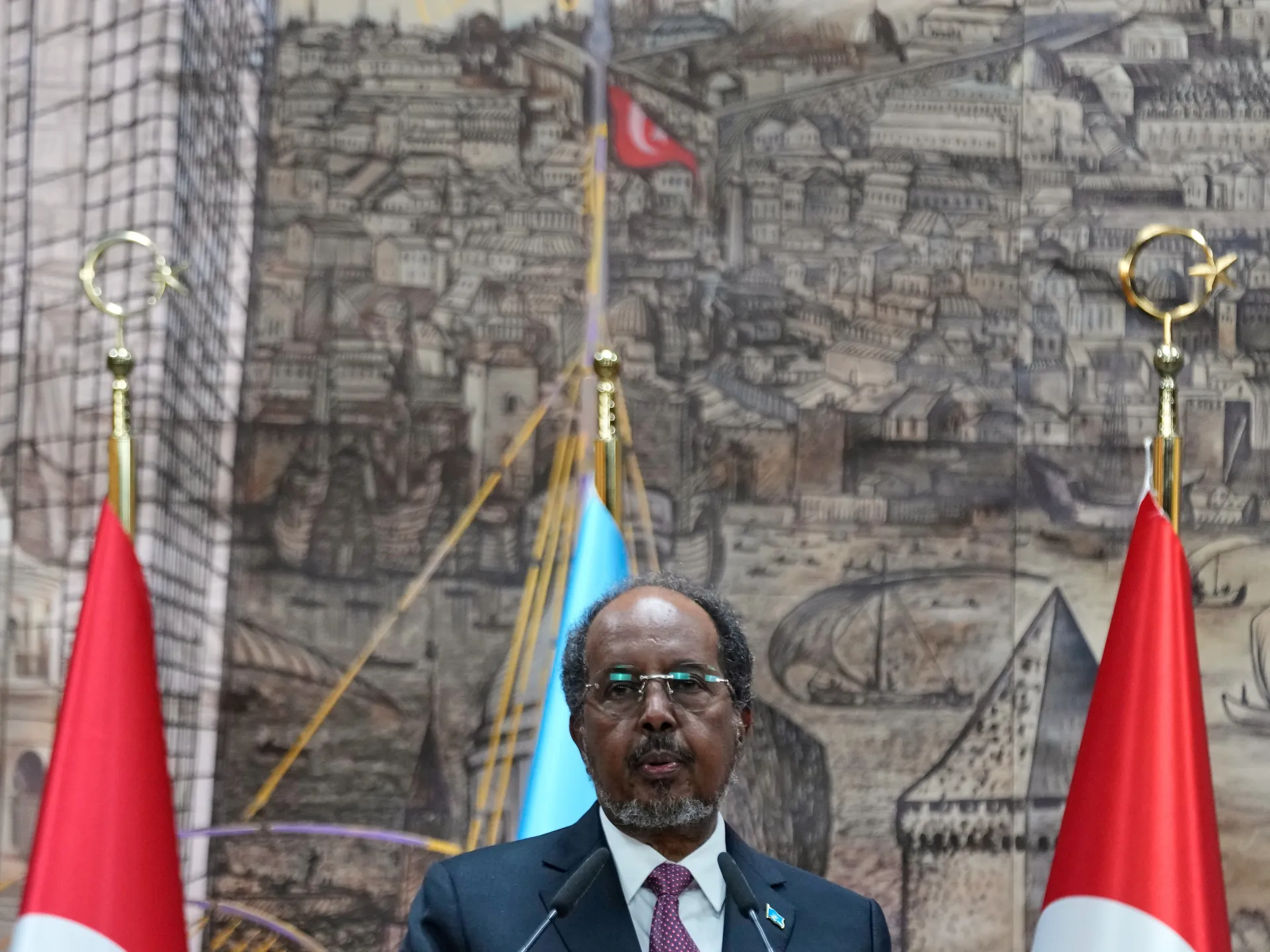
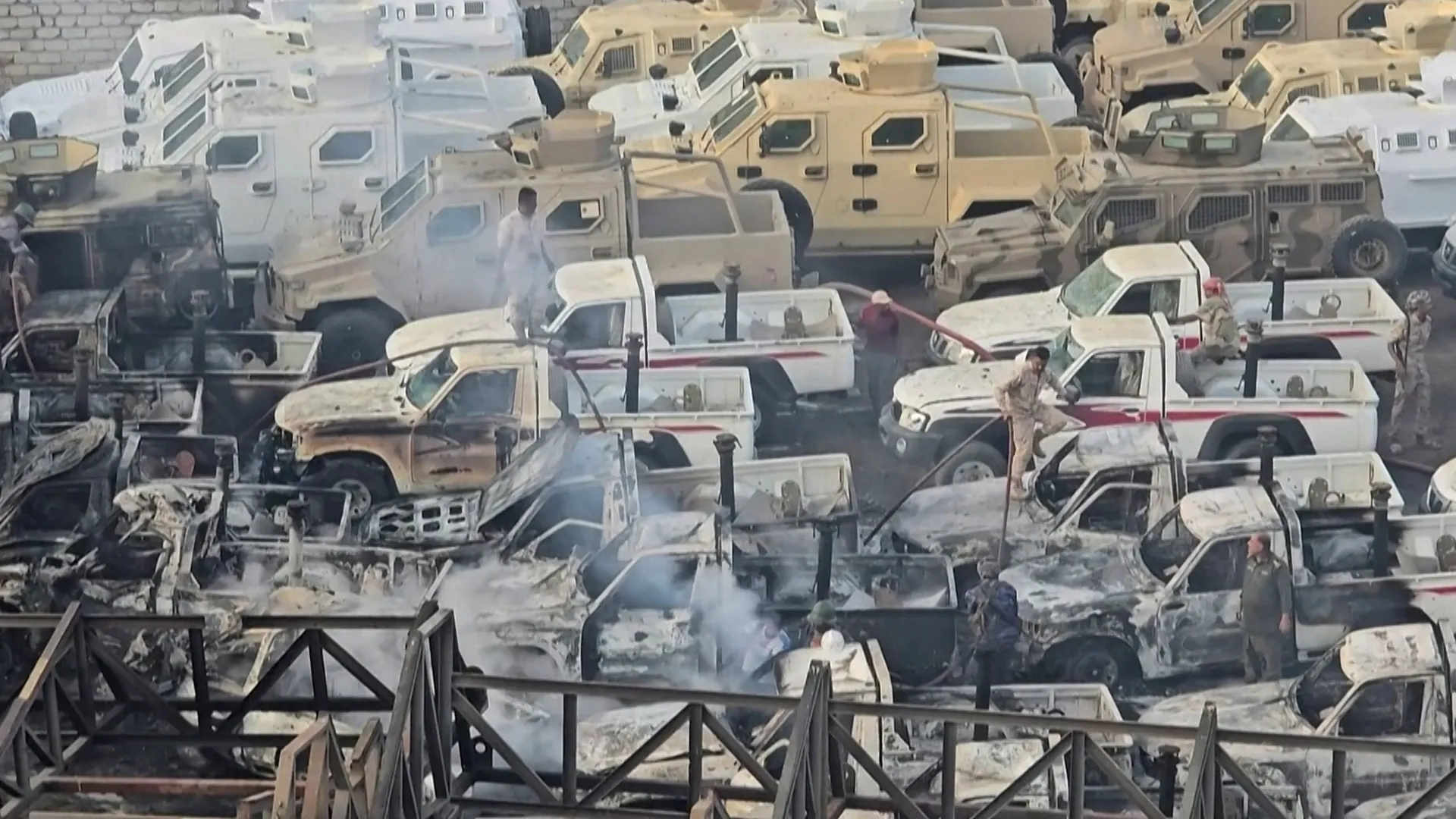
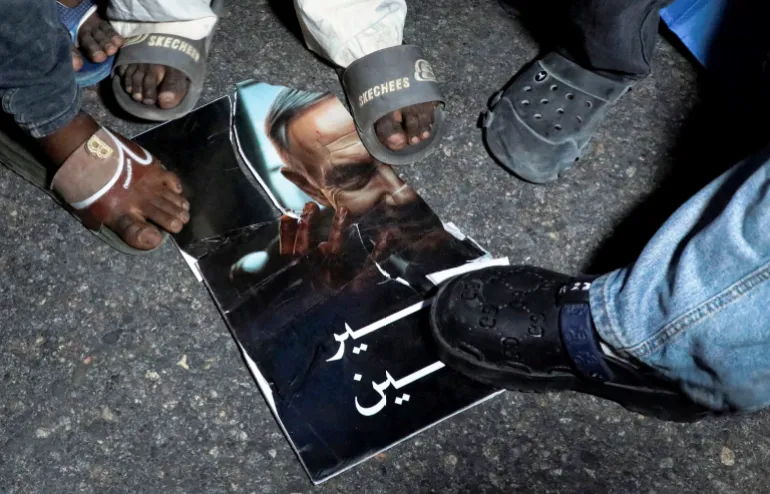

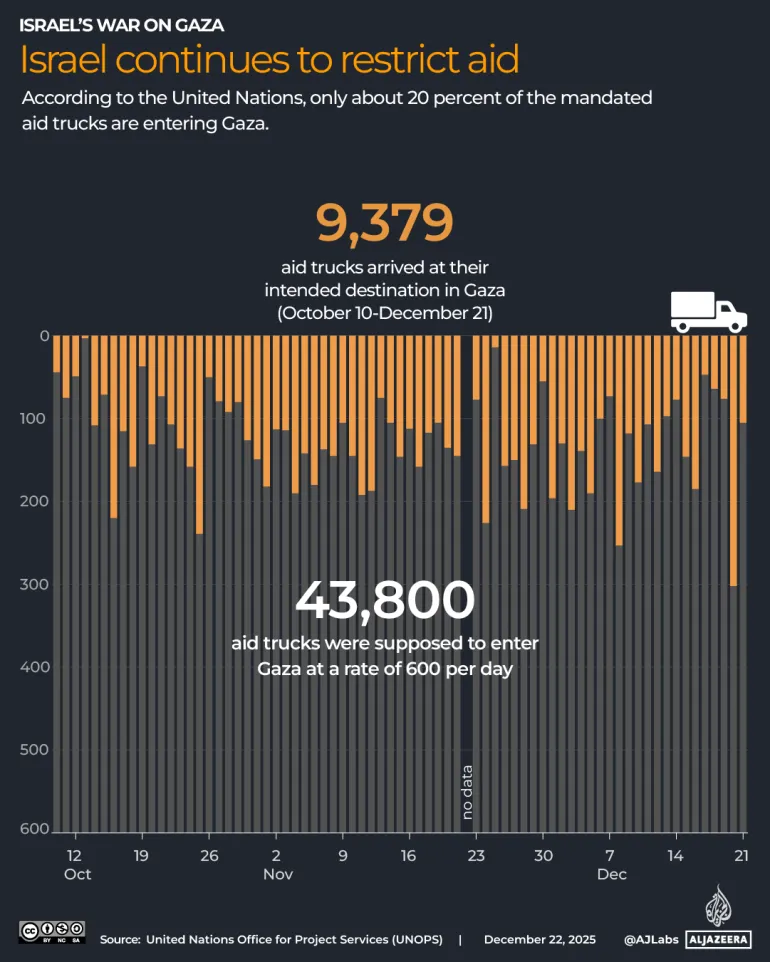

![[Al Jazeera]](https://i0.wp.com/www.aljazeera.com/wp-content/uploads/2025/04/Interactive_Gaza_foodaid_timeline-1742987531-1744365779.webp?w=640&ssl=1)