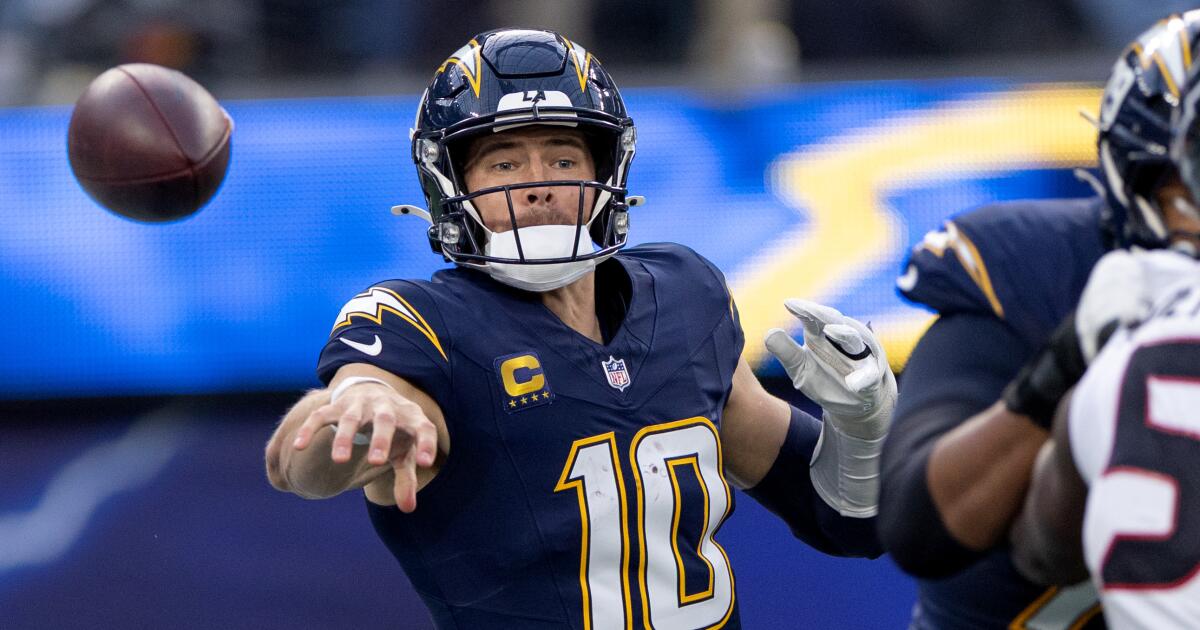
With the Chargers’ 20-16 loss to the Houston Texans on Saturday putting them out of contention for the AFC West title, the move to rest Herbert is a logical one. Herbert is still recovering from surgery he underwent Dec. 1 to stabilize a fracture in his left (non-throwing) hand.
Herbert was sacked five times by the Texans, and he appeared to be wincing in pain after taking a hit in the first half. He didn’t miss a snap, however, connecting on 21 of 32 passes for 236 yards and a touchdown. He also rushed for 37 yards.
Herbert might not be the only starter who sits for the Chargers, but Harbaugh didn’t say who might be joining Herbert on the sideline.
“The guys that have the most bruises and need the most healing, we’ll pull them back. Justin Herbert would be one,” Harbaugh told reporters Monday. “We’ll see how the rest of the week goes with who all they are. They’ll be some situations where some starters are backups.”
Former third-overall pick Trey Lance will start against the Broncos at Mile High on Sunday, with DJ Uiagalelei serving as backup, Harbaugh said. The Chargers are battling to secure the No. 5 playoff seed in the AFC playoffs.
Herbert has passed for 3,727 yards and 26 touchdowns for the 11-5 Chargers, who had won four straight games before falling to the Texans for the second time this calendar year — they lost to Houston in last season’s wild-card playoffs.
Although a win over the Broncos would give the Chargers a season sweep over the AFC West, the Chargers need Herbert to be at his healthiest with potential wild-card road matchups against either the New England Patriots and Jacksonville Jaguars looming.
It may have taken a little longer than some antsy fans wanted, but Bob Chesney is on the way to Westwood after completing his final season at James Madison.
In reality, James Madison’s result against Oregon in the opening round of the College Football Playoff on Saturday was always going to be a win-win for the Bruins.
If the Dukes upset the Ducks, then the buzz around Chesney and his new employer would have only intensified. (Did you notice the free publicity the school received on the broadcast 13 minutes before kickoff when it was mentioned that Chesney was on his way to UCLA?)
If the Dukes lost, then Chesney could thank his team for a historic season and pack his things for the West Coast to get started on his latest program revival.
Sign up for UCLA Unlocked
A weekly newsletter offering big game takeaways, recruiting buzz and everything you need to know about UCLA sports.
He’ll get to do just that in the wake of James Madison’s 51-34 setback at Autzen Stadium. It’s expected that Chesney will bring a big chunk of his staff with him while retaining a sprinkling of UCLA coaches in a variety of roles. Dukes offensive coordinator Dean Kennedy and defensive coordinator Colin Hitschler are among those who will join Chesney at his new stop, the coaches likely bringing with them at least a handful of James Madison players.
Several showed they could play at the Big Ten level given their performance against the Ducks.
Running back Wayne Knight, who will be a redshirt senior next season, should be a top target after displaying both speed and power while rushing for 110 yards — more than twice the 52 yards that USC managed on the ground as a team during the Trojans’ 42-27 loss to the Ducks in November.
While he also has another season of eligibility, quarterback Alonza Barnett III is probably not joining Chesney at UCLA given counterpart Nico Iamaleava’s decision to return in 2026. Barnett has already used his redshirt season, so it wouldn’t make sense for him to travel across the country just to be a backup in his final college season after having led another team to the CFP.
Others with remaining eligibility who impressed included wide receiver Landon Ellis (making several big catches, one going for 50 yards on a double pass), tight end Lacota Dippre (hurdling a defender while scoring on a reverse), wide receiver George Pettaway (making a 24-yard touchdown catch on a wheel route) and cornerback Justin Eaglin (intercepting a Dante Moore pass).
Kennedy’s offense was unquestionably the showpiece of an aggressive approach that also included two onside kicks, a fake punt and no hesitation to go for it on fourth downs. The Dukes showed plenty of imagination on the way to rolling up 509 yards. There were countless trick plays and formations — many including bunched receivers and tight ends — that kept the defense guessing what they were going to do.
Chesney didn’t sound a happy-to-be-there tone in either his halftime or postgame interviews, revealing a strong desire to do better on such a big stage. But there was nothing to be ashamed about after James Madison outscored Oregon, 28-17, in the second half despite a massive talent discrepancy.
Now, after getting a closeup view of what’s needed to compete in the upper tier of the Big Ten, Chesney will get a chance to start restocking his new roster before the calendar flips to 2026.
Keeping the band together
Part of Chesney’s winning formula in his rise from Division III to the CFP has involved staff continuity.
Kennedy’s connection with Chesney goes back to a flurry of job-seeking letters that Kennedy sent to college football coaches around the country while he was a young assistant at Florida.
Chesney not only responded but also donated to two charities with ties to Kennedy’s family after doing some research on the persistent assistant. A year later, Chesney hired Kennedy when a quarterbacks coach vacancy opened on his staff at Holy Cross prior to the 2022 season.
Kennedy earned a promotion to offensive coordinator the following season before accompanying Chesney to James Madison.
Hitschler’s ties to Chesney go all the way back to the Division III level. In 2011, Hitschler was Chesney’s defensive line coach and co-special teams coordinator at Salve Regina before the duo reconnected at James Madison before the recently completed season.
Both Kennedy and Chesney presided over units that were among the best in the country last season, James Madison ranking No. 11 nationally in points scored (37.1 per game) and No. 15 in points allowed (18.4). Kennedy is known for designing creative offenses that spread the field, breaking out flea-flicker and Statue of Liberty plays to help the Dukes post 70 points against North Carolina in 2024 while tying a record for the most points ever given up by the Tar Heels.
Both coordinators possess something their boss doesn’t – experience coaching at the Power Four level. Kennedy was a graduate assistant at Mississippi State and Florida before earning a promotion to offensive quality control coach and later assistant quarterbacks coach with the Gators.
Hitschler was co-defensive coordinator and safeties coach at Wisconsin in 2023 before taking a job as co-defensive coordinator and defensive backs coach at Alabama in 2024. Hitschler also has NFL experience as a training camp assistant with the Philadelphia Eagles and a player personnel assistant with the Kansas City Chiefs.
A generous man of mystery
Zachary Rosenfeld teared up recently when he saw a tweet about the $1-million gift to UCLA football from the estate of the late Richard Shtiller.
His “someday” had finally arrived.
Having previously worked in fundraising for UCLA’s athletic department before leaving to run his own sales company, Rosenfeld cultivated a relationship with Shtiller that helped secure that donation. There were hundreds of phone calls leading to four conversations, one in-person meeting and a handsome payoff that the football team can put to good use under its new coach.
Richard Shtiller
(Courtesy of the Shtiller family)
For most of the time Rosenfeld corresponded with Shtiller, he didn’t know much about the intensely private man or his generosity when it came to helping his alma mater. The most Shtiller offered was a vague assurance when Rosenfeld inquired about a seven-figure gift that Shtiller first teased in the summer of 2015.
At the time, Rosenfeld was an intern with UCLA athletics who was given the unfortunate task of fielding calls about increased donation requirements for football season tickets. One of those who called to complain was Shtiller, who approached the conversation with what seemed like a massive bargaining chip.
“What if I told you,” Shtiller said, “that I had $1 million to UCLA football in my will.”
Rosenfeld jokingly told Shtiller that he didn’t believe him, putting him on hold so that he could confer with a boss. By the time Rosenfeld picked the phone back up, Shtiller had hung up.
It was the start of a sometimes playful, sometimes frustrating relationship. After Rosenfeld was hired full-time by UCLA the following year, he made it his mission to get to know Shtiller. He called Shtiller’s Beverly Hills law office at least once a week, usually getting voicemail.
They finally met in person during a chance encounter at a football practice in 2016, Shtiller greeting Rosenfeld with a cheerful brush of his face.
“It’s Richard Shtiller, Zach,” he said. “You’re my noodge. You’ve been calling my office every day.”
Those calls continued, sometimes a year going by before they would reconnect. Rosenfeld eventually sent Shtiller information on the proper legal terminology to include in his will in case he really was going to donate all that money to UCLA football, never knowing if it would amount to anything.
During their final conversation upon Rosenfeld’s departure from UCLA athletics in 2019, Rosenfeld kidded Shtiller about never securing that big donation.
“Well,” Shtiller said, “maybe someday.”
That was the last time they spoke. Six years later, Rosenfeld learned that Shtiller was a man of his word upon his passing earlier this year. Not only did Shtiller give the money he had promised, he also used the terminology Rosenfeld had suggested to insert in his will so that it got to the right place.
Along the way, Shtiller provided Rosenfeld a lesson in perseverance while also giving back to a program that had given him so much joy even after going more than a quarter of a century without so much as a conference title.
“It was a reminder,” Rosenfeld said, “that even in the depths of rock bottom, UCLA football still means something to many of us.”
What’s it all worth?
(Luke Hales / Getty Images)
UCLA prides itself on being one of the top athletic departments in the country.
There’s those 125 NCAA championships — behind only Stanford’s 137 — a combination of academic and athletic success that few big-time schools can match, and the association with legendary figures such as John Wooden, Kareem Abdul-Jabbar and Jackie Robinson, among many others.
But how much is it all worth when it comes to cold, hard cash?
Not as much as you might think.
In a CNBC valuation of U.S. college athletic programs, UCLA ranked No. 52, with a valuation of $539 million. The Bruins trailed schools such as Purdue, Virginia Tech and North Carolina State that are not as widely known for broad-based athletic excellence.
There were some common themes among the leaders.
The top five schools — Texas ($1.48 billion), Ohio State ($1.35 billion), Texas A&M ($1.32 billion), Georgia ($1.16 billion) and Michigan ($1.16 billion) — all have thriving football programs and massive donor bases, not to mention at least $239 million in revenue in 2024. By comparison, UCLA reported $119 million in revenue for the same year, according to the report.
Among the 18 Big Ten teams, UCLA ranked No. 16, ahead of only Maryland (No. 53) and Rutgers (No. 56). USC ranked No. 8, largely on the strength of $242 million in revenue and a football team that continues to flirt with the College Football Playoff under coach Lincoln Riley.
What can be done about it?
Two words: Bob Chesney.
If UCLA’s new football coach wins at a high level and fills his home venue — be it the Rose Bowl or SoFi Stadium — then those metrics could look vastly different in just a few years.
Some real finds
UCLA had three men’s soccer players selected in the second round of the Major League Soccer SuperDraft last week, becoming the school’s 85th, 86th and 87th picks in league history — the most of any college program.
Junior defender Tre Wright was picked No. 33 by Real Salt Lake, graduate left back Schinieder Mimy was taken No. 38 by the New England Revolution and senior midfielder Tarun Karumanchi was selected No. 49 by the Columbus Crew.
UCLA coach Ryan Jorden, in his seventh year, has had nine players drafted by MLS teams.
Opinion time
With James Madison reaching the College Football Playoff in Chesney’s second and final season, how many players do you hope the new Bruins coach brings with him to Westwood?
We asked, “How does the rest of the men’s basketball season play out for the Bruins?”
After 388 votes, the results:
The team plays better before another early tournament exit, 68.9% Everything comes together and the team makes a deep tournament run, 17.7% The bubble is burst and the team misses the tournament, 13.4%
Do you have a comment or something you’d like to see in a future UCLA newsletter? Email me at ben.bolch@latimes.com, and follow me on X @latbbolch. To order an autographed copy of my book, “100 Things UCLA Fans Should Know & Do Before They Die,” send me an email. To get this newsletter in your inbox, click here.
It’s impossible to sum up the full impact that Gabriel has had on generations of Mexicans and Mexican Americans. It’s more than the songs or the stage persona or the me vale attitude to what you thought about his sexuality. It’s the fact that for many of us he’s a connection to our families (raise your hand if your mom made you clean the house while blasting his music), to our homeland and to our culture. He gave us a shared language that affords us the opportunity to rejoice or grieve as a community.
There are profiles written about the man that are worth your time — I recommend this one published in The Times in 1999 — but for this newsletter we turned it over to our community to tell us how El Divo de Juárez forever changed their lives.
Juan Gabriel and the LGBTQ community
Juan Gabriel when asked if he was gay: “Lo que se ve no se pregunta”
(Julio Salgado / For The Times)
Luis Octavio remembers the first time he saw Gabriel. He was sitting with his family and the singer was about to perform on the weekly Mexican variety show “Siempre en Domingo.”
But all he could focus on was the sequins Gabriel was wearing.
“It gave me a little bit of hope that maybe my jotería would be accepted just the way my abuela, my abuelo, the tíos and everybody else who saw him on that screen accepted his and saw past his flamboyance,” said Octavio, co-founder of the drag bar El Place and one of the organizers of Boyle Heights’ first pride event.
Gabriel’s sexual orientation has always been an open secret. It has always been assumed that he was gay, but it was rarely discussed, with one glaring exception.
During a 2002 interview with news program “Primer Impacto,” reporter Fernando del Rincón asked Juanga point-blank if he was gay. With daggers in his eyes, Gabriel responded with “Lo que se ve, no se pregunta.” What is seen is not asked.
Octavio told me this interview always stood out for him — he described it as iconic, which, yeah, it is — because it told Mexican queer people that being who they were was more than enough and that you didn’t owe anything to anyone.
It’s a sentiment that Nomi B, a drag queen who hosts “Noche de Gringaderas” at El Place, certainly relates to.
“We all knew he was a sister,” she said.
“I admire that he kept his life private and he was like, ‘I don’t care what you think or say about me. I’m going to keep my life private and you’re going to enjoy my music no matter what.’”
Our daily news podcast
If you’re a fan of this newsletter, you’ll probably love our new daily podcast, “The Times,” hosted by columnist Gustavo Arellano, along with reporters from across our newsroom. Every weekday, it takes you beyond the headlines. Subscribe on Apple Podcasts and follow on Spotify.
‘Abrázame que el tiempo es malo y muy cruel amigo’
In 2000, Juan Gabriel released “Abrazame Muy Fuerte,” an operatic banger that makes the case that time is cruel, unforgiving and finite for humans. Because of this, he begs his subject to pend much of that time embraced in each other’s arms. The song was a huge hit and was used as the theme song for a telenovela that shared the same name.
A few years later, it also became my parents’ song.
Around that time, my mom developed a brain tumor. The doctors didn’t know yet if it was malignant, but my family assumed the worst. The prospect of losing our anchor became very real. My dad took it the hardest, and because he is the embodiment of the closed-off macho who tries very hard not to emote, he didn’t have an outlet to let out what he was going through.
So he did what any Mexican would do: He turned to Juan Gabriel.
I was away at college when this happened, but my sister would tell me that he’d play the song nonstop, sometimes sitting next to my mom on the couch with his eyes closed in prayer. It must’ve worked because the tumor ended up benign. Decades later, my mom is the healthiest she’s ever been.
During the pandemic, that song took on an added meaning for me. It was late last year and my parents and I decided to take a road trip. “Abrazame Muy Fuerte” came on. All three of us started singing along, and it wasn’t long before we started bawling. The painful memory came back, but with it came the realization that we still had time and we were spending it together.
That’s the thing about Juan Gabriel’s music. These aren’t just songs. They’re memories. They’re feelings we can’t express, and even if we could, why would we when Juanga’s already done it better?
When I decided to write about Gabriel, I knew that I wanted others to share some of their favorite songs. I asked friends and colleagues to contribute a song for this Spotify playlist and to write a few lines about why they picked that tune.
Artist Julio Salgado: “I wanted to illustrate a mom teaching her son to clean while listening to Juan Gabriel. I totally took this from my own experience as my mom had no tolerance for boys just sitting around and not cleaning when we were growing up.”
(Julio Salgado / For The Times)
“Querida”— He’s just so dramatic! Like, “Yes, b—!” (Nomi B, drag queen)
“Amor Eterno” — If there’s a song that defines who Juan Gabriel is, it’s “Amor Eterno.” Since he wrote the song for Rocio Durcal, it’s Juan Gabriel as a song writer. As a singer, his emotion has made it the quintessential Mexican song about heartbreak, regret, and ultimately, trying to make sense out those emotions. With the song’s lyrics and emotions — along with Juan Gabriel being from the Juárez-El Paso borderland — it’s little wonder why “Amor Eterno” was played and sang everywhere in the days following the El Paso massacre. (Roberto José Andrade Franco, writer-at-large at Texas Highways)
“La Frontera” — When I first moved to the U.S. I felt like I didn’t belong here because I didn’t speak perfect English and nobody could pronounce my name. Listening to that song and how he talked about how everybody’s happy at the border and how everyone’s different, it made me feel safe. (Luis Octavio, co-founder of Boyle Heights drag bar “El Place”)
“Inocente Pobre Amigo” — Juan Gabriel was the first poet in my life, a staple at my parents’ home in South Gate, California. My mother owned all of his albums. And when I went away to study literature at the University of Chicago, I took them with me.
I was back in California, walking around in Boyle Heights, when he passed. I got the news alert. Then, all along César E. Chávez Avenue, shop owners blasted his songs. Juan Gabriel wrote hundreds. I know all of them.
For beginners, I recommend “Inocente Pobre Amigo,” which recounts a heartbreaking disillusion but, above all, is a song about valuing yourself. Go on YouTube. Find the version that was recorded during Juan Gabriel’s first concert in Mexico City’s Palace of Fine Arts. Watch him perform with his hands on his hips, glistening in black and gold sequins. Hear him crack jokes with the audience and watch the mariachis on stage try to muffle their laugh. Recall that some elitists thought his work was too lowbrow for the venue.
When Juan Gabriel passed in 2016, his ashes were taken to that same place. For hours on end, hundreds of thousands of people poured in to pay their last respects. I wish I’d been one of them. (Julia Barajas, Los Angeles Times staff writer)
“El Noa Noa”— It’s a song about a place where you can go and be who you are. The ambience of the bar might be different than what people are used to, but it’s about everyone being welcomed and letting them feel like they can be happy. (Melissa Befierce, Mother of Haus of Befierce and events coordinator at El Place)
“No Tengo Dinero”— For me, Juan Gabriel’s songs are tied to memories of me riding on my grandfather’s truck with my aunt and my grandmother on the roads of Campeche where we lived for a few years. Juan Gabriel’s “No Tengo Dinero” is one of his iconic songs because for many it’s always a struggle to have money, but if at least we have love, we know we’ll be alright. (Denise Florez, Los Angeles Times multiplatform editor)
“Have You Ever Seen the Rain? (Gracias al Sol)” — My mom and tías have always been huge Juan Gabriel fans. I grew up in El Paso and he of course has immensely close ties to Juárez, where his career took off. His music is the soundtrack of my childhood. There was a brief time when it was around so much, it annoyed me. But when I moved away from home, that soundtrack became so powerful and comforting. It instantly connected me with my family. My sister, mom and I have sung (poorly) along to “Querida” hundreds of times at this point. But that’s going to be almost everyone’s favorite song. It’s just kind of perfect JuanGa. But the one I’ll choose for this playlist is what I believe is the only cover he ever did: “Have You Ever Seen the Rain? (Gracias al Sol).” In the video, he’s wearing amazing rainbow-colored pants and having so much fun. He brings joy to his work and it’s infectious. He’s also a great singer, so it stays on my playlist along with the much older hits. (Iliana Limón Romero, Los Angeles Times deputy sports editor)
“Hasta Que Te Conocí” — Later brilliantly covered by Ana Gabriel, it is the perfect song about love gone sour, heightened by lyrics that are pure melodrama. (Carolina Miranda, Los Angeles Times columnist)
“Así Fue” — He was never more brilliant, more heartbreaking, more JuanGa than in that song. (Gustavo Arellano, Los Angeles Times columnist)
“Costumbres” — Here’s an extremely on brand story: During one of my family’s chaotic Christmas parties, we were all doing what we usually do—drinking tequila and singing along to a playlist of Juan Gabriel, Rocío Durcal, Alejandro Fernández and, well, you know the vibes. As always, “Costumbres” comes on, the Rocío version, and my trash-talking sister starts to sing loudly, drunkenly, and off-key: No cabe duda que es verdad que la costumbre es más grande que el amor. She looks at me and says, “That’s f— real, dude. La costumbre really is más grande que el amor.” She then scowls at her husband across the room and screams over the music, “F— you, [name redacted]!”
That is the power of “Costumbres.” That’s actually the power of 99.9% of songs written by Juan Gabriel. However, “Costumbres” is god-tier in his canon of songs that have an unbelievable ability to drag your soul. We dance to “Noa Noa,” weep to “Amor Eterno,” raise our arms up to “Querida,” and strongly consider divorce to “Costumbres.”
“Costumbres” is sung from the perspective of a person telling their partner their love has been replaced by resentment, but habit and the comfort of a warm, familiar body keeps them together no matter how many times they try to walk away. Juan Gabriel’s love songs have an uncanny ability to swim in the thick nuances of romance, its brutal pains and exhilarating joys, and as is the case with “Costumbres” the harsh realities of committing your life to someone. He seemingly had a direct line to our deepest fears about love, and expressed poetically something even as mundane as being over it but staying anyway. To quote my sister, that’s f— real, dude. And it’s why “Costumbres” along with so many other songs he penned are elevated to a place of cultural veneration and soundtrack of the most affecting moments of our lives. (Alex Zaragoza, senior culture writer at Vice)
Fernandomania @ 40: El Campeón.
The latest installment of our multi-part documentary series “Fernandomania @ 40” is out today. You can watch here.
When Fernando Valenzuela took the mound in Game 3 of the 1981 World Series, the New York Yankees had a commanding 2-0 lead over the Dodgers and Tommy Lasorda’s crew was facing the real possibility of a third World Series loss in five years to their East Coast rivals. In the end, the Dodgers won the game, 5-4, largely due to the gritty performance of their rookie left-hander. Valenzuela gave up nine hits and seven walks in a 146-pitch complete-game, spurring the team to a World Series victory and cementing his pitching legacy in Los Angeles.
Your support helps us deliver the news that matters most. Become a subscriber.
Yesterday was the MLS vs. Liga MX All Star Game at the Banc of California Stadium near downtown Los Angeles, but the most important soccer match that took place that day happened hours earlier at a park in Pasadena. That’s where members of the #LigaMXEng community got together to celebrate the beautiful game (and come to terms with how out of shape many of us actually are).
What’s #LigaMXEng? It’s a Twitter hashtag where podcasters, reporters, and fans from around the country congregate to talk about Liga MX, the most popular soccer league in the United States. More importantly, it’s entirely in English, the primary language for many of us. It’s that last part that does it for me.
What comes next is a mystery, but I’d like to share a note of appreciation as 2025 fades into history.
If you came to Greater Los Angeles from Mexico, by way of Calexico, Feliz Navidad.
If you once lived in Syria, and settled in Hesperia, welcome.
If you were born in what once was Bombay, but raised a family in L.A., happy new year.
I’m spreading a bit of holiday cheer because for immigrants, on the whole, this has been a horrible year.
Under federal orders in 2025, Los Angeles and other cities have been invaded and workplaces raided.
Immigrants have been chased, protesters maced.
Livelihoods have been aborted, loved ones deported.
With all the put-downs and name-calling by the man at the top, you’d never guess his mother was an immigrant and his three wives have included two immigrants.
Not to be outdone, Homeland Security chief Kristi Noem proposed a travel ban on countries that are “flooding our nation with killers, leeches and entitlement junkies.”
The president’s shtick is to rail mostly against those who are in the country without legal standing and particularly those with criminal records. But his tone and language don’t always make such distinctions.
The point is to divide, lay blame and raise suspicion, which is why legal residents — including Pasadena Mayor Victor Gordo — have told me they carry their passports at all times.
In fact, thousands of people with legal status have been booted out of the country, and millions more are at risk of the same fate.
In a more evolved political culture, it would be simpler to stipulate that there are costs and benefits to immigration, that it’s human nature to flee hardship in pursuit of better opportunities wherever they might be, and that it’s possible to enact laws that serve the needs of immigrants and the industries that rely on them.
But 2025 was the year in which the nation was led in another direction, and it was the year in which it became ever more comforting and even liberating to call California home.
The state is a deeply flawed enterprise, with its staggering gaps in wealth and income, its homelessness catastrophe, housing affordability crisis and racial divides. And California is not politically monolithic, no matter how blue. It’s got millions of Trump supporters, many of whom applauded the roundups.
But there’s an understanding, even in largely conservative regions, that immigrants with papers and without are a crucial part of the muscle and brainpower that help drive the world’s fourth-largest economy.
That’s why some of the state’s Republican lawmakers asked Trump to back off when he first sent masked posses on roundups, stifling the construction, agriculture and hospitality sectors of the economy.
When the raids began, I called a gardener I had written about years ago after he was shot in the chest during a robbery attempt. He had insisted on leaving the hospital emergency room and going back to work immediately, with the bullet still embedded in his chest. A client had hired him to complete a landscaping job by Christmas, as a present to his wife, and the gardener was determined to deliver.
When I checked in with the gardener in June, he told me he was lying low because even though he has a work permit, he didn’t feel safe because Trump had vowed to end temporary protected status for some immigrants.
“People look Latino, and they get arrested,” he told me.
He said his daughter, whom I’d met two decades ago when I delivered $2,000 donated to the family by readers, was going to demonstrate in his name. I met up with her at the “No Kings” rally in El Segundo, where she told me why she wanted to protest:
“To show my face for those who can’t speak and to say we’re not all criminals, we’re all sticking together, we have each other’s backs,” she said.
Mass deportations would rip a $275-million hole in the state’s economy, critically affecting agriculture and healthcare among other industries, according to a report from UC Merced and the Bay Area Council Economic Institute.
“Deportations tend to raise unemployment among U.S.-born and documented workers through reduced consumption and disruptions in complementary occupations,” says a UCLA Anderson report.
I’m a California native whose grandparents were from Spain and Italy, but the state has changed dramatically in my lifetime, and I don’t think I ever really saw it clearly or understood it until I was asked in 2009 to address the freshman convocation at Cal State Northridge. The demographics were similar to today’s — more than half Latino, 1 in 5 white, 10% Asian and 5% Black. And roughly two-thirds were first-generation college students.
I looked out on thousands of young people about to find their way and make their mark, and the students were flanked by a sprinkling of proud parents and grandparents, many of whose stories of sacrifice and yearning began in other countries.
That is part of the lifeblood of the state’s culture, cuisine, commerce and sense of possibility, and those students are now our teachers, nurses, physicians, engineers, entrepreneurs and tech whizzes.
If you left Taipei and settled in Monterey, said goodbye to Dubai and packed up for Ojai, traded Havana for Fontana or Morelia for Visalia, thank you.
Bill Plaschke writes, “If the Trojans truly want to return to greatness, being selected for the CFP is the goal. Not beating Notre Dame. Not even beating UCLA.” That’s 100% wrong.
As a USC alum (1965) and longtime fan, those are the only things that do matter. I have often said that if USC beats UCLA or Notre Dame, the coach deserves another season. To give up this grand tradition in pursuit of the arguably artificial and profit-driven CFP would be an unforgivable sin.
Noel Park Rancho Palos Verdes
A USC national football championship without playing Notre Dame rings hollow — an asterisked title, a meal that never satisfies, a taste you can’t quite wash away. It may shine in the record books, but it will always feel unfinished to those who know what real college football tradition demands. Earth to Lincoln Riley: an undefeated season is still a loss without playing the Fighting Irish. What’s next? If UCLA becomes competitive, then there will be no crosstown game?
Jeff Black Los Angeles
So the Fighting Irish own a series edge of 53-37, have won 3 in a row, 7 of the last 8, and 11 of the last 15 games. Yet Bill Plaschke now claims that Notre Dame is running away from the series and is afraid of “Ole SC.” To paraphrase the late, great Jim Healy, Plaschke is on the Leonard Tose highway!
Jerome M. Jackson El Segundo
Notre Dame is the Burger King of college football — always having it their way. From backdoor deals with the corrupt [CFP] guaranteeing a playoff spot if they finish ranked in the top 12 to refusing to join a conference so that they can pocket all bowl game money, the Irish are treated like college football royalty. Glad USC told the Irish toddlers they can’t have ice cream for breakfast!
Mark S. Roth Playa Vista
“USC and Notre Dame recognize how special our rivalry is to our fans …” A joint statement by the athletic directors of the two schools. Really? Fake news!
Wayne Muramatsu Cerritos
No USC-Notre Dame football game! Who’s next to be cut from the Notre Dame football schedule, Navy? Oh wait, the Irish can’t afford to drop Navy. That might hurt their chance$ at a playoff berth.
We might rarely get to see snowfall in Los Angeles, but logging onto social media in December means the arrival of a different kind of flurry. The one where our friends, both close and parasocial, excitedly share the year-end music-listening data dumps of their Spotify Wrapped.
Spotify Wrapped only represents the culmination of our listening habits on a single music platform, but every shared Wrapped post seems to come with some self-evident clarity about our personal identity. Spotify Wrapped bares our souls and provides us the opportunity to see ourselves deconstructed via our musical inclinations. By most accounts, it’s an irresistible delight. Oh, Spotify, you rascal, you’ve got us pegged.
Maybe it’s not such a bad idea to take that temperature check.
But listening to music can be a passive experience — one enjoyed in tandem with folding laundry, or driving a car. To really learn about ourselves and how our year has been, we might want to turn elsewhere, to a habit with more intention. I’m talking, of course, about reading.
While there’s apps for tracking our reading habits, like StoryGraph or Goodreads, I’m devoted to a wholly analogue tracking method that’s helped me churn through books faster and with more intent than ever before: the book stack.
Starting every January, whenever I finish a book, I place it sidelong atop a shelf in the corner of my living room. With each new book I conquer, the stack gets taller, eventually becoming a full tower by December. A book stack, low on analytics, can’t tell me the total number of pages I’ve read, or how many minutes I spent reading, but it’s a tangible monument to my year’s reading progress. Its mere presence prods me into reading more. It calls me a chump when the stack is low and cheers for me when it reaches toward the ceiling.
My first book stack started in 2020, a wry joke to demonstrate the extra time we could all devote to reading books during a pandemic. The joke barely worked. I ended up reading just 19 books that year, only a few more than I had the previous year (though it could’ve been more if one of those books wasn’t “Crime and Punishment”).
Still, the book stack model gamified my reading habits and now I give books time I didn’t feel I had before. I bring books to bars, movie theaters and the DMV. If ever I have to wait around somewhere, you better believe I’ll come armed with a book.
The pandemic may have waned, but my book stack count continued to climb, peaking in 2023 after reading 52 books, averaging one per week.
But, hey, it’s about quality, not quantity, right? If there’s a quality to be gleaned from my 2025 book stack, you’d see that I’ve been looking for hot tips on how to survive times of extreme authoritarian rule. Some were more insightful than others.
In the stack was Carl Bernstein and Bob Woodward’s “All the President’s Men,” a landmark true story about two intrepid reporters who brought down the president of the United States by repeatedly bothering people at their homes for information. Fascinating as it is, it also feels like a relic from a time when doing something like that could still work. Philip Roth’s “The Plot Against America” tells the story of a Jewish New Jersey family in an alternate timeline where an “America First” Charles Lindbergh beats Franklin Roosevelt in the 1940 presidential election, ignoring the threat of Hitler in Europe and giving way to a rise in antisemitism at home. Roth paints a dreary portrait of how that scenario could have played out, but the horrors are resolved by something of a deus ex machina rather than by any one character’s bold, heroic actions. Then there’s Anthony Doerr’s Pulitzer Prize-winning “All the Light We Cannot See,” about the converging stories of a German boy enlisted in Hitler’s army and a blind French girl during World War II. Sadly, this novel reads less like a book about living under fascist rule than a thirsty solicitation to become source material for Steven Spielberg’s next movie.
Each of these titles have merit, but this year’s book stack had two gems for anyone who wants to know how best to resist tyranny. Pointedly, there was Timothy Snyder’s tidy pocket-sized handbook “On Tyranny” filled with 20 short but fortifying chapters of practical wisdom like “Do not obey in advance,” “Defend institutions” and “Believe in truth.” Each is applicable to our current moment, informed by historical precedent set by communist and fascist regimes of the past century. This book — well over a million copies sold — came out at the start of Trump’s first term in 2017, so I came a little late to this party. The fact that Snyder himself moved to Canada this year should give us all pause.
Practical advice can also be found in great fiction, and on that front I found comfort and instruction in Hans Fallada’s “Alone in Berlin” (a.k.a. “Every Man Dies Alone”), based on the true story of a married couple living in Berlin during World War II who wrote postcards urging resistance against the Nazi regime and secretly planted them in public places for random people to discover. Under their extreme political conditions, this small act of civil disobedience means risking death. Not only is the story riveting, there’s also great pleasure in seeing the mayhem each postcard causes and how effective they are at exposing the subordinate class of fascists for what they truly are: nitwits.
Also notable in “Alone in Berlin” is the point of view of both the author and his fictional heroes. Neither a target of persecution, nor a military adversary, Fallada nevertheless endured the amplified hardships of living under Nazi rule during World War II. His trauma was still fresh while writing this book and it’s evident in his prose. He survived just long enough to write and publish “Alone in Berlin” before dying in 1947 at the age of 53.
If I’ve learned anything from these books, it’s that it’s in our best interest to not be afraid. Tyrants feed on fear and expect it. A citizenry without fear is much harder to control. That’s why we need to raise our voices against provocations of our rights, always push back, declare wrong things to be wrong, get in the way, annoy the opposition, and allow yourself to devote time to do things for your own enjoyment.
And in that spirit, my book stack also includes a fair amount of palate cleansers in the mix: Jena Friedman’s “Not Funny,” short stories by Nikolai Gogol, Jhumpa Lahiri’s “The Namesake” (whose main character is named after Gogol), and a pair of Kurt Vonnegut novels. Though it’s hard to read Vonnegut without stumbling upon some apropos nuggets of wisdom, like this one from his novel “Slapstick:” “Fascists are inferior people who believe it when somebody tells them they’re superior.”
Zachary Bernstein is a writer, editor and songwriter. He’s working on his debut novel about a poorly managed remote island society.
Christmas is behind us, and the New Year is bearing down on us with alarming speed. It’s hard to believe that it has been almost a full year since the devastating fires erupted in Altadena and the Pacific Palisades, sending many of us, our neighbors and friends fleeing to far corners of the state to escape the flames and smoke.
That tragic week marked the beginning of 2025 and the dawn of the second Trump term, ushering in a year that would challenge us in more ways than could have been imagined at the end of 2024.
As I look back on all the stories that The Times’ arts team covered over the last 12 months, it’s notable that the fires and Trump’s effect on the arts dominated the top of the most-read list. But there were also joyful stories about the people, shows and trends that shaped the cultural narrative of the endlessly surprising mid-2020s.
Without further ado, here are the top 10 most-read arts stories of 2025.
I’m arts and culture writer Jessica Gelt wishing you a happy, safe and healthy new year. Here’s your arts news for the week.
Our critics
Art critic Christopher Knight’s recent retirement reminded us how fortunate we are to have the finest critics covering the arts in Southern California. Here are a few of our most read pieces of criticism from 2025.
The new David Geffen Galleries, opening in 2026, are composed entirely of Brutalist concrete.
Countdown NYE The giant intergalactic rave, promising alien contact, four stages and all-night debauchery, moves to the L.A. Convention Center for its 11th edition with headliners including John Summit, Above & Beyond, Pryda, Madeon, Slander, Sub Focus, Crankdat and Wuki. 7 p.m.-5 a.m. Los Angeles Convention Center, 1201 S. Figueroa St., downtown L.A.. countdownnye.com
A preview of last year’s New Year’s Eve LA Midnight Countdown at Gloria Molina Grand Park.
(Jason Armond / Los Angeles Times)
Countdown to 2026 Gloria Molina Grand Park’s free, all-ages New Year’s Eve celebration, reportedly the largest on the West Coast, rings in the holiday with live music and performances on the Get Down Stage (hosted by Shaun Ross, featuring Ashley Younniä, Clax10 and DJ Wayne Williams) and the Countdown Stage, hosted by DJ Gingee featuring Ceci Bastida, Bardo and Ruby Ibarra. 8 a.m.-1 p.m. Wednesday. 200 N. Grand Ave., downtown L.A. grandparkla.org
New Year’s Eve with El DeBarge The R&B crooner of such hits “All This Love,” “I Like it,” “Stay With Me” and “Rhythm of the Night” helps the new live jazz venue inaugurate a new tradition. 8 and 11 p.m. Wednesday. Blue Note LA, 6372 W. Sunset Blvd. bluenotejazz.com
The Roots ring in the New Year at Walt Disney Concert Hall.
(Los Angeles Philharmonic Assn.)
New Year’s Eve with the Roots Philly’s finest take a break from “Tonight Show” duties to bring their eclectic blend of hip-hop to L.A. for two shows to close out the year. 7 and 10:30 p.m. Wednesday. Walt Disney Concert Hall, 111 S. Grand Ave., downtown L.A. laphil.com
Queen Mary New Year’s Eve Party in timeless elegance aboard the iconic ocean liner (safely moored in Long Beach to ensure there’s a morning after) with its Masquerade Soirée, live music, performances, casino games and fireworks. 8 p.m. Wednesday. 1126 Queens Highway, Long Beach. queenmary.com
Culture news and the SoCal scene
Eugène Grasset, “Vitrioleuse (The acid thrower)” (detail), 1894, from the periodical L’Estampe Originale, album 6, April–June 1894. Printed by Auguste Delâtre. Lithograph, hand stenciled in five colors. 22 7/8 x 18 in.
(UCLA Grunwald Center for the Graphic Arts, Hammer Museum. Bequest of Elisabeth Dean.)
A great gift The UCLA Grunwald Center for the Graphic Arts marks its 70th anniversary in 2026 and the Hammer Museum is presenting a two-part exhibition drawn from the center’s more than 45,000 prints, drawings, photographs, and artist’s books. Part one of “Five Centuries of Works on Paper: The Grunwald Center at 70” features nearly 100 works ranging from the Renaissance to contemporary art and includes pieces by Albrecht Dürer, Rembrandt van Rijn, Vassily Kandinsky, Käthe Kollwitz, Ansel Adams, Elizabeth Catlett, Corita Kent, Bridget Riley, Ed Ruscha and Vija Celmins. The exhibit opened Dec. 20 and runs through May 17. Part two is scheduled from June 7-Oct. 25.
Fred Grunwald, a shirt factory owner, began collecting art in Germany in the 1920s with a focus on German Expressionism. After the Nazis seized most of the original collection, he and his family immigrated to the U.S. in 1939. Grunwald started a new shirt factory and resumed his collecting in Los Angeles, expanding his interests to include prints from 19th and 20th century Europe, 19th century Japan and contemporary America. In 1956, Grunwald donated his extensive collection to UCLA so it would be accessible to students. His wife and children continued making gifts to the Grunwald Center after his death in 1964.
Enjoying this newsletter? Consider subscribing to the Los Angeles Times
“There is very strong evidence that all three pieces came out of Cambodia, out of a context of war and violence and the dissolution of order,” said Chase F. Robinson, the NMAA’s director. “All three can be connected with problematic dealers, and no evidence emerged that gave us any confidence that the pieces came out in anything other than those circumstances. So after a lot of internal research and several visits to Cambodia, we worked closely with both the Ministry of Culture and Fine Arts as well its legal representative Edenbridge, shared the information we had, and came to the conclusion that all three pieces should be returned.”
The three returned artifacts are a 10th century sandstone head whose ornate carved designs match others at the temple of Pre Rup; a four-foot-tall sandstone sculpture of the goddess Uma, also from the 10th century, whose detailing ties it to the temple of Phnom Bakheng; and a bronze statue of Prajnaparamita, the goddess of transcendental wisdom, from around 1200.
— Kevin Crust
And last but not least
Once you’ve slept off the New Year’s Eve festivities and had your fill of football, settle in Thursday at 8 p.m. for PBS SoCal’s broadcast of the Vienna Philharmonic’s annual concert from the city’s historic Musikverein. The ensemble will be conducted for the first time by Yannick Nézet-Séguin and feature performances by the Vienna State Ballet and location segments hosted by “Downton Abbey’s” Hugh Bonneville.
Hello! I’m Mark Olsen. Welcome to another edition of your regular field guide to a world of Only Good Movies.
Even as the year winds down, there are still some exciting new releases hitting theaters.
Few films this year are arriving on quite the wave of expectation behind Josh Safdie’s “Marty Supreme,” in part because of the unhinged, go-for-broke promo push from its star Timothée Chalamet. The film tells the story of Marty Mauser, a shoe salesman in 1950s New York who dreams of becoming a champion table tennis player and will stop at nothing to make it happen.
As Amy Nicholson put it in her review, “Like Marty, Chalamet was raised in New York City, and since he arrived on the scene, there’s never been a doubt he’ll win an Oscar. The only question is, when? To Chalamet’s credit, he’s doing it the hard way, avoiding sentimental pictures for pricklier roles about his own naked ambitions. … The movie’s moxie makes it impossible not to get caught up in Marty’s crusade. We’re giddy even when he’s miserable.”
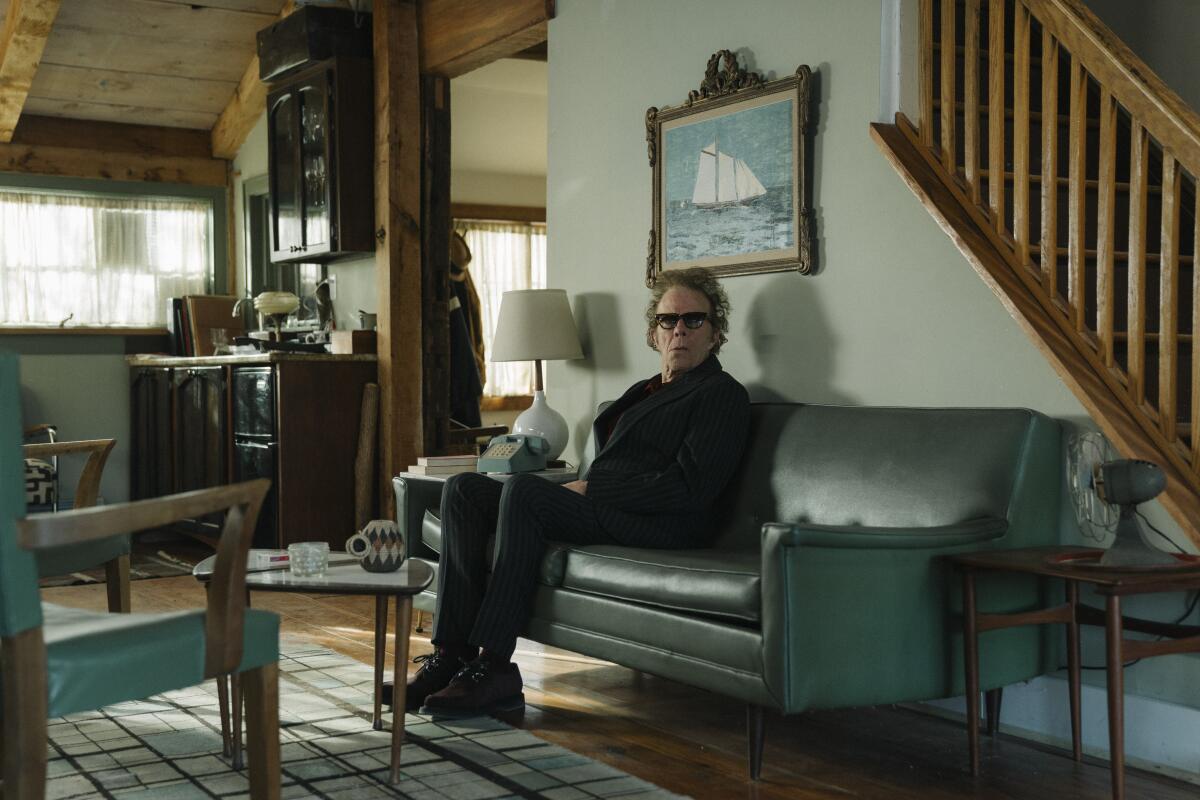
The surprise winner of the Golden Lion at this year’s Venice Film Festival, Jim Jarmusch’s “Father Mother Sister Brother” is a gently enigmatic film revolving around, as the title suggests, parents and siblings. Told in three separate stories — set in New Jersey, Dublin and Paris — the film stars Adam Driver, Tom Waits, Mayim Bialik, Cate Blanchett, Vicky Krieps, Charlotte Rampling, Luka Sabbat and Indya Moore.
Tom Waits in Jim Jarmusch’s movie “Father Mother Sister Brother.”
(Atsushi Nishijima / Mubi)
In his review, Tim Grierson wrote, “The film’s persistent brittleness may make some viewers antsy. That’s partly the point, but hopefully, they’ll soon be swept away by the movie’s melancholy undertow. … Eventually, we learn to look past Jarmusch’s deceptively mundane surfaces to see the fraught, unresolved issues within these guarded families. The characters occasionally expose their true selves, then just as quickly retreat, fearful of touching on real conflict.”
Tim Grieving spoke to composer Daniel Blumberg, who won an Oscar earlier this year for “The Brutalist,” about his work on “The Testament of Ann Lee,” director Mona Fastvold’s portrait of the founder of the Shaker religious movement. Singing and dance were an integral part of the Shakers’ spiritual practice, so the music for the film was of special importance.
“Ann Lee was very radical and extreme,” said Blumberg, “and Mona is as well.”
De Los also recently published a list of the 25 best Latino films of 2025 as picked by Carlos Aguilar. His favorites include Amalia Ulman’s “Magic Farm,” Pasqual Gutierrez and Ben Mullinkosson’s “Serious People,” Diego Céspedes’ “The Mysterious Gaze of the Flamingo,” Petra Costa’s “Apocalypse in the Tropics” and Kleber Mendonça Filho’s “The Secret Agent.”
All three of this year’s Envelope roundtables are now available to watch: actors, actresses and directors.
New Year’s Eve at the movies
Daniel Day-Lewis and Vicky Krieps in the movie “Phantom Thread.”
(Laurie Sparham / Focus Features)
When people talk about holiday films, they typically mean Christmas. But what if the movies that featured a New Year’s Eve scene were sneakily better? To judge by the titles playing around town this week, an argument could be made.
Take for example Kathryn Bigelow’s “Strange Days.” An exciting techno-thriller set during the last two days of then-future 1999, it’s about a hustler (Ralph Feinnes) who finds himself in way over his head. The film builds to a huge millennial New Year’s Eve street party filmed in downtown Los Angeles. Still something of a rarity on streaming, “Strange Days” will be showing in 35mm at the New Beverly on Friday afternoon and then at the Aero on Wednesday 31, early enough in the evening to leave time for more fun after.
Then there is Paul Thomas Anderson’s achingly romantic and bitingly funny “Phantom Thread,” in which the controlling fashion designer Reynolds Woodcock (Daniel Day-Lewis) initially refuses to leave the house on New Year’s Eve, but then races to be with his muse and lover Alma Elson (Vicky Krieps) after she goes out without him. The movie will be showing on New Year’s Day in 70mm at the Aero.
Anderson’s 1997 “Boogie Nights,” which will show in 35mm at Vidiots on the afternoon of Dec. 31, features a very different take on New Year’s Eve. In a pivotal sequence, many of the film’s characters converge on a NYE party to ring in the transition form 1979 to 1980. It does not go well.
jack Lemmon and Shirley MacLaine in 1960’s “The Apartment.”
(Bettmann Archive / Getty Images)
Billy Wilder’s “The Apartment” will play in 35mm at the New Beverly on Saturday and Sunday and also at the American Cinematheque’s Los Feliz Theater on Dec. 30. In the film Jack Lemmon is a lonely office drone who finds his complex relationship with a co-worker (Shirley MacLaine) ultimately coming to a head on a fateful New Year’s Eve.
Rob Reiner’s 1989 “When Harry Met Sally…” will likely be playing several times over the next weeks in tribute to the filmmaker. Starring Meg Ryan and Billy Crystal as two friends trying to figure out if their relationship can (or should) be something more, the film features not one but two memorable New Year’s Eve scenes. It will be playing at the New Beverly on Tuesday, Wednesday and Thursday.
Katie Holmes, left, and Sarah Polley in the movie “Go.”
(Tracy Bennett / Columbia Pictures)
Doug Liman’s “Go,” from a screenplay by John August, is not strictly speaking a New Year’s Eve movie, but it does take place in the sort of liminal zone of ongoing partying that occurs during holiday time. With a cast that includes Sarah Polley, Katie Holmes, Timothy Olyphant and many more, the film revolves around a few grocery store co-workers, some low-stakes drug dealing, questionable choices and a lot of miscommunication. The movie shows at Vidiots on Tuesday.
In a review of the film, Kevin Thomas wrote, “When all is said and done, ‘Go’ is a film about people going too far, which works precisely because its makers know when to hold back. ‘Go’ keeps us guessing … but it never forgets it’s a comedy; if it was too serious it would burst like a bubble. So uniformly skilled and talented is the film’s cast, which has 15 featured players, that it is impossible to single out any one. ‘Go’ is perfectly titled: Exhilarating and sharp, it never stops for a second.”
Points of interest
The Marx Brothers’ eternal comic mayhem
Chico Marx, left, Groucho Marx, Harpo Marx and Margaret Dumont in the movie “Animal Crackers.”
(Universal)
It has become a tradition around town for theaters to show Marx Brothers movies at the holidays, and who are we to argue with that? For pure whimsy and comedy that hits somewhere deep in the unconscious, the Marx Brothers are still pretty much unbeatable.
The New Beverly played some Marx Brothers movies on Christmas Day. For those who still want more, Vidiots will be showing 1935’s “A Night at the Opera,” directed by Sam Wood and including the famous stateroom scene in which more and more people cram into a single room on an ocean liner.
On New Year’s Day, the Aero will show 1933’s “Duck Soup,” directed by Leo McCarey, in which the brothers take over the fictional nation of Freedonia. That will be followed by 1930’s “Animal Crackers,” directed by Victor Heerman, in which Groucho Marx plays African explorer Rufus T. Firefly.
Eric Rohmer’s ‘The Green Ray’
A scene from Eric Rohmer’s “The Green Ray.”
(Janus Films)
Initially released as “Summer” in the U.S., Eric Rohmer’s “The Green Ray” won Venice’s Golden Lion in 1986. The film follows Delphine (Marie Rivière, who co-wrote the script with Rohmer), a single woman in Paris, as she struggles to find someone to go on a holiday trip with her, leading to a series of serio-comic misadventures. The film will show Thursday in 35mm at the American Cinematheque’s Los Feliz Theater.
Reviewing the film in 1986, Michael Wilmington asked if watching a Rohmer film is really, to quote Gene Hackman on Rohmer movies in “Night Moves,” like watching paint peel? “Not at all,” Wilmington wrote. “‘Summer’ is one of the masterpieces of 1986. It’s one of the most finely wrought, stimulating films of an erratic year. It’s intellectual in the best sense: engaging you emotionally and mentally. It moves faster, wastes less time, and has more to offer than most movies now on view — and those who are skipping it are missing one of the year’s real treats.”
Has there been a year this decade when we’ve been sad to see it go?
I thought about that while reading our “25 ways to banish this no good, very bad year” list, which contains some terrific ideas, and I’d be very happy to watch you jump into the Pacific on New Year’s Day, if you feel so inclined. But they’re all predicated on the idea that this year has given off a stench that needs to be smothered, the same way you’d cleanse your dog in tomato juice after an encounter with a skunk.
And this is true. Even Game 7 of the World Series can’t erase the heartache that 2025 has inflicted upon us, though props to Kiké Hernández for doing his best to distract from the headlines.
I’m Glenn Whipp, columnist for the Los Angeles Times and host of The Envelope newsletter, wishing you and yours a better new year. It’s a low bar. I’m optimistic we can jump it.
Sign up for The Envelope
Get exclusive awards season news, in-depth interviews and columnist Glenn Whipp’s must-read analysis straight to your inbox.
Did anyone really want to see a third “Avatar” movie?
Sure, someone must have. It sold $89 million in tickets last weekend, though that number fell short of analysts’ forecast for James Cameron’s three-hour movie. For comparison, 2022’s “Avatar: The Way of Water” brought in $134 million in its opening weekend. That movie, like the series’ 2009 first film, built its $2-billion-plus box office over time.
“Avatar: Fire and Ash” may well do the same.
Still, doesn’t it feel like there should be more excitement to go see a movie that might gross $2 billion worldwide? Maybe you were among the first in line to see it last Friday. No judgment. I’ve seen every Cameron movie in a theater, a streak I suspect will continue as long as he’s making films.
The thing is, Cameron himself is giving the distinct impression that he’s ready to move on from “Avatar,” even though he has already written scripts for the fourth and fifth entries in the franchise. He has other projects in the works, adapting “Ghosts of Hiroshima,” which revolves around the true story of the only survivor of both atomic bombs dropped on Japan. And he has teased a “Terminator” reboot.
Cameron is 71, a kid compared to Ridley Scott (88) and Martin Scorsese (83), but still … the clock is ticking.
Do you want him devote another three years (or more) to the lush, gorgeous world of Pandora?
Maybe if “Avatar: Fire and Ash” had spent less time repeating the same themes — and, sometimes, the same scenes — almost beat for beat from the “The Way of Water,” I’d feel differently. The new movie is, of course, a visual feast, though with just three years between the second and third films, the technological advances don’t feel as awe-inspiring this time around. Cameron remains adept at world-building and creating tense action set pieces. He’s also unrivaled at serving up lumpy dialogue, and the new film has serious pacing issues. “Fire and Ash” feels every bit like a 197-minute movie.
When I did my last set of Oscar best picture power rankings on Nov. 3, I put “Fire and Ash” at No. 10, sight unseen. This was in part because Cameron is Cameron and deserves respect and also because would-be contenders like “A House of Dynamite,” “Springsteen: Deliver Me From Nowhere,” “The Smashing Machine” and “After the Hunt” weren’t connecting with voters.
But the franchise fatigue with “Avatar” feels real. It’ll still probably win the visual effects Oscar and pick up a nomination for sound. But I suspect it’s going to fall just outside the 10 movies nominated for best picture.
If that happens, will anyone cry “snub”? Likely not. “Avatar: Fire and Ash” can still inspire wonder, but for the first time in his career, Cameron is spinning his wheels. It feels like he’s ready to return to Earth.
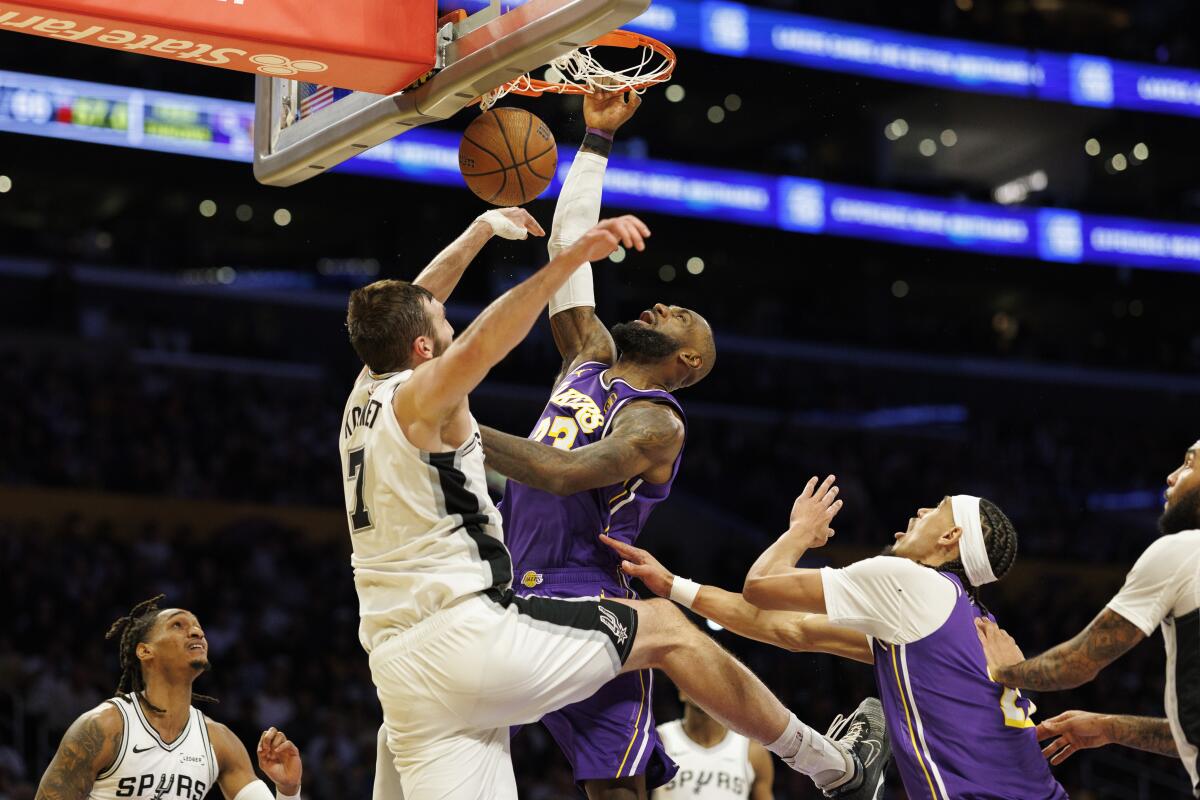
The Lakers felt good about their starting lineup Thursday when Luka Doncic and Rui Hachimura returned from injury to restore their normal starting unit for only the seventh time this season.
But the good times didn’t last long. Coming out of halftime down 10 points to the Houston Rockets, the Lakers announced Austin Reaves wouldn’t play in the second half because of left calf soreness.
With another apparent setback for Reaves adding to the Lakers’ desperate search for continuity, the team put up another inconsistent performance on defense in a 119-96 loss to the Rockets at Crypto.com Arena.
The Lakers, who’ve lost three in a row for the first time this season, allowed the Rockets to shoot 53% from the field. Amen Thompson led the way with 26 points and Kevin Durant scored 25 as the Rockets out-rebounded the Lakers 48-25.
Reaves missed three games with a left calf strain before returning against Phoenix on Tuesday. He scored 17 points off the bench in the Lakers’ loss to the Suns.
Against the Rockets, Reaves started and played 15 minutes in the first half, scoring 12 points on five-for-eight shooting.
Reaves entered Thursday averaging 27.3 points per game, ranking him 11th in league scoring.
Doncic, who had been out with a lower left leg contusion, had 25 points and seven assists and LeBron James had 18 points. Hachimura (right groin injury management) didn’t score in his 28 minutes.
With so many players rotating through the lineup because of injuries, the Lakers have struggled to find solutions to their defensive issues.
They entered Thursday allowing 117.4 points per game, 19th most in the league. They were allowing the 26th highest field-goal percentage (48.4) and the highest three-point shooting percentage (40.1). They were next-to-last in rebounds, averaging 40.1 per game.
That was a real issue against the Rockets team that entered the game first in offensive rebounds (16.1).
And in this game, the Rockets got 17 offensive rebounds.
The Lakers didn’t have key role players Jaxson Hayes (left ankle soreness) and Gabe Vincent (lumbar back strain), adding to their woes.
“It’s the modern NBA where there’s injuries and then there’s not a lot of time to practice,” Lakers coach JJ Redick said. “So, when you have continuity, you can kind of capture what you’re trying to do and you feel comfortable and good about it.”
From a design shop in Valencia with “murderous” dolls to a studio in Dublin to the Coachella Valley Music and Arts Festival, our photographers have been everywhere this year. They’ve captured key figures in the worlds of music, film and television in somber moments, moments of levity and everything in between. They share behind-the-scenes anecdotes about the shoots and reveal how they got “the” shot.
Britt Lower, Adam Scott and Dichen Lachman (above)
By Jason Armond in Los Angeles
When I received this assignment, my goal was to create a photo that not only mirrored the show’s dystopian surrealness but also captured the intricate relationship triangle between Britt Lower, Adam Scott and Dichen Lachman’s characters.
Initially, it took a little time for everyone on set to see my vision, but once I shared a test image, everyone understood and was excited to collaborate. The entire shoot lasted around eight minutes, but that brief window was all we needed.
After publication, the images quickly went viral. Many viewers assumed the photos were AI-generated or composited, but every detail was achieved in camera.
At the end of the shoot, someone from Lower’s team accidentally stepped on the mirror, shattering it. Someone joked about bad luck, but thankfully, this superstition did not come true, and a few months later, Lower won the lead actress in a drama series Emmy for her role in “Severance.”
Richard Kind
By Christina House at Sunset Gower Studios in Hollywood
Richard is one of a kind — no pun intended. He was singing and joking with us, telling stories. We were set up outside under the beating sun and he was wearing a vest with a wool coat, so we were trying to work quickly! I always love seeing behind the scenes of how films are made. I decided to pull back and include the lights and my assistant Jonathan’s hands to give it that working set feel.
Cynthia Erivo
By Jason Armond in Los Angeles
Cynthia Erivo’s portrait session took place in a studio near Beverly Hills, where she had recently finished recording her latest album. My initial plan was to photograph her seated beside a vintage piano, but she had a different vision. This is why I always prepare at least three setup options for entertainment portraits. I quickly adapted and moved to my next setup, which featured a striking geometric wooden wall in the studio. As I adjusted the lighting, I noticed her stunning wardrobe with two waist-high slits that revealed her tattoos. At that moment, I understood her preference for standing, as it allowed her to express her style and personality fully. I adjusted the lighting to complement Erivo’s sultry and confident presence. Her choice to stand brought a dynamic quality to the image. The resulting image speaks for itself; Erivo brought the scene to life and needed almost no direction. I simply pressed the camera’s shutter button.
Bella Ramsey
By Bexx Francois at the London in West Hollywood
Rather than chasing an expression, I was interested in stillness and repetition; how a simple gesture could feel amplified when echoed across a frame. I wanted Bella’s profile to be both the anchor and the rhythm of the image. She was immediately open to leaning into something more abstract. It was a real-time compositional gamble, guided by instinct and trust. We made several variations, but it was her side profile that ultimately struck the strongest balance between classic portraiture and interpretation.
Lee Jung-jae and Hwang Dong-hyuk
By Justin Jun Lee at the “Squid Game Experience” in New York
From the moment I walked in, I felt completely immersed in the design of the space. It truly felt like I was stepping onto an actual film set from one of the “Squid Game” challenges. The iconic giant doll Young-hee from the “Red Light, Green Light” game immediately stood out to me. My goal was for the images to carry a sense of tension and intensity that mirrors the tone of the show, and I believe that came through in the mood, expressions and presence of both Lee Jung-jae and Hwang Dong-hyuk.
Yungblud
By Hon Wing Chiu at the Hollywood Palladium
(Hon Wing Chiu / For The Times)
I was limited to photographing only the first three songs at the Hollywood Palladium, so I chose to shoot two songs up close and save the last one for a gamble from the back of the crowd. Most of the time I could barely see past the fans, but I hoped the final song would give me something unexpected.
When Yungblud hit the stage, the whole room exploded. The lights were changing every second, and he never stopped moving — running, jumping, connecting with the crowd like the stage could barely contain him. The fans were screaming, reaching, completely locked into the moment. I captured what I could up front, then switched lenses and waited for one last chance.
During that final song, everything suddenly came together. Yungblud stepped right to the very edge of the stage, almost close enough for the fans to touch him. Their hands shot into the air, trying to reach him, and he threw his arm upward with full force, like he was lifting the whole room with him. For a split second, the lights, the crowd and his energy aligned perfectly. I hit the shutter, hoping I caught it.
It wasn’t the peak of the entire concert, but it was the peak of the moment I was allowed to shoot — and it became the image I had been chasing all night.
Olivia Cooke and Robin Wright
By Jennifer McCord in London
I’d only seen the trailer for “The Girlfriend” at the time of the shoot but knew I wanted something that contained the idea of untrustworthy narrators that seemed to be threaded throughout.
Paul Thomas Anderson
By Christina House at the Aster in Hollywood
I had been made aware that PTA does not love being photographed. I had worked with him once before so I knew he was really nice but a bit camera shy. When he finished up his interview with columnist Glenn Whipp, he came to meet me in the neighboring hotel room where I had a chair positioned next to a window. I shared my idea on framing the image; I was shooting it from the bedroom closet to give some depth and he liked it. We took a few frames, talked about our dogs (his dog is trained to bring him his L.A. Times newspaper every morning) and he apologized for being difficult on his way out, to which I immediately replied that he was the complete opposite of that.
Fernanda Torres (‘I’m Still Here’)
By Annie Noelker in Los Angeles
I remember her just being so classy, elegant and lovely. Her whole team was so kind and we shot out on the balcony of the hotel room for maybe 10 minutes. It was effortless and such a satisfying collaborative experience.
Adrien Morot, Kathy Tse and M3GAN dolls
By Carlin Stiehl in Valencia
It’s always a treat when you step into the creative world of a mastermind, especially when it comes to the magic behind our favorite films. You might expect that seeing the process up close would spoil the mystique, like a magician revealing their tricks, but in the case of Adrien and Kathy, it only deepened the sense of wonder. The “M3GAN” dolls were so lifelike, and the real sell wasn’t their eyes that draw you in, but the skin. The dolls’ lifelike texture and softness, and the rows of faces on worktables waiting to be painted, created a diabolical scene out of a skin-harvesting, flesh-mask horror film. Yet the insanity was where the true genius hid, because in many ways, I could believe it was real. Hence, the inspiration for the photo: a take on the quintessential family-style portrait — the ones you kind of cringe at when you walk into someone’s home, radiating manufactured happiness. The dolls were like their children so I thought, let’s get the kids together with Mom and Dad and show how beautiful their doted-on children are for our guests.
Saagar Shaikh and Asif Ali
By Bexx Francois on the Disney Studios lot in Burbank
I came in with a loose mood board, a few traditional pose ideas alongside some comedic “scenarios” that had a 50/50 chance of making it to my memory cards. Their Hulu series “Deli Boys” was a comedy after all, maybe they’d be down to lean into play. When Saagar and Asif arrived, I showed them my wish list. Instant cosign. Once we nailed the first “scenario,” pure improv took over, with Asif and Sagaar seamlessly falling into the mock-conflict of their on-screen characters; hence, Asif being hoisted 3 feet in the air. By the time we called wrap, everyone was in tears.
Dan Brown
By Cheryl Senter in Rye Beach, N.H.
Two things: I always follow my gut and never wear pink. A few days before the assignment I had this gut feeling that I wanted a portrait of the bestselling author with a wall of mirrors. The day of the assignment I decided to wear a hot pink shirt I had picked up at a thrift store instead of my black-on-black attire. At Dan’s house I spent an hour with his assistant scoping out a few locations — no wall of mirrors. Before I left I asked Dan if he had a wall of mirrors. Dan smiled and led me to a very tiny circular bathroom that had a tall, curved pocket door made of copper. It was a tight space with the door shut. My pink shirt came in handy. I could easily see if I was in any of the mirrors. At one point Dan looked at me and started laughing as I tried to make myself wafer thin. Then I started laughing. Dan’s assistant waiting outside asked softly, “Is everything OK?”
Penn Badgley
By Matt Seidel in Los Angeles
This was a classic celebrity shoot: Our scheduled 30 minutes collapsed into seven so we had to move fast. I shook Penn’s hand and told him I had two goals: Get the shot and get him back on schedule. There was no time to over-direct so I gave him one piece of character direction and let him run. I didn’t want Joe Goldberg from the TV series “You.” I didn’t want Penn Badgley, sexy serial killer. I wanted the real Penn Badgley saying goodbye, closing a chapter, integrating the shadow of the role and stepping into the light of what’s next.
Spike Lee
By Victoria Will in New York
Nothing says Brooklyn like Spike Lee, so it made sense to photograph him where he is most recognized, in Fort Greene near his well-known office. The relationship between Spike and Brooklyn is longstanding and reciprocal, shaped by history, presence and place. That familiarity was evident as nearly every pedestrian waved or said hello, many greeting him like an old friend. And there wasn’t one person that he did not acknowledge. True class.
Sombr
By Evelyn Freja at Pier 17 in New York
The photo was taken on an empty construction floor of the pier where he had a concert that night. I remember it was a very quick session right before he went on because he had gotten a cold and was trying to save his energy to perform. Despite his health, he (and his entire team) was so kind and gracious, which made the shoot go easy. I decided to light the warehouse with a red light to lend the energy of his music to this shoot and a very moody light for Sombr to reflect the ambience of his songs.
Elle Fanning
By Christina House at the Toronto International Film Festival
I had photographed Elle a few years back. She’s a sweetheart and so good at posing so she doesn’t need a lot of direction. For this particular photo, it was taken at our portrait studio at the Toronto International Film Festival. It’s a fast-paced flow of folks coming in and out for portraits, an organized chaos at times, but you would never know that by the calm on her face. She’s a pro.
Lena Dunham and Megan Stalter
By the Tyler Twins in New York
The playlist was ‘90s (Alanis Morissette, the Cranberries, Jewel), and the vibe was easy and celebratory. Megan and Lena have a genuine chemistry and were both very relaxed in front of the camera. Our shared ties to Ohio made for good conversation. It truly felt like we were shooting friends.
Domhnall Gleeson
Jennifer McCord in Dublin
This was shot in a studio in Dublin (studio shoots for assignments always feel super rare!) with just me, Domhnall and his makeup artist Lucy. We played the latest Fontaines D.C. album and the shoot was super chill and lovely. I’m always appreciative when an actor is up for being collaborative and trying different things — this was one of the last shots we took. The rest of the images feel quite energetic, so it was nice to also get this more intimate-feeling frame at the end.
Karol G
By Bexx Francois in El Segundo
When time with an artist is limited, anxiety threatens to grab the wheel. But once Karol G walked on set, everything went quiet. And delicate. She had such a kindness about her. And an effortless beauty. I was inspired by classic Irving Penn; using walls to guide the eyes toward the center. We used a V-flat as our “set.” Even with a wind blower only 6 feet away throwing gusts of drama in her direction, Karol remained in command of her space and performance. And still connected where and how needed — with piercing intention.
Benson Boone and Brian May
By Allen J. Schaben at the Coachella Valley Music and Arts Festival
Shooting Benson Boone’s trademark leaping acrobatics at his Coachella debut this year gave me the chance to bridge the gap between musical generations. The performance of “Bohemian Rhapsody” was made even more significant by the presence of Queen’s legendary guitarist, Brian May. My challenge was positioning myself to capture the moment while navigating a sea of spectators’ heads, hands, arms and cellphones. I dropped to a low angle to create a fan’s perspective, capture the height of his leap and ensure both artists were in the frame. Then it happened — somewhere between a cymbal crash and a guitar wail. Boone sprinted onto the piano and launched into the air above May, and in a split second, it was over. Moments like this are what make my job rewarding, and this performance by Boone and May will live on as a legendary one in my memory.
Marianne Jean-Baptiste and Mike Leigh (‘Hard Truths’)
By Christina House at Shutters on the Beach in Santa Monica
Marianne and Mike had such lovely chemistry together. They were chatty so I thought I’d give them an action to follow and this is where we landed. This was taken in a hotel boardroom with a seamless backdrop.
Mariska Hargitay
By Victoria Will in New York
I’ve had the good fortune of photographing Mariska Hargitay many times over the years, which brings a level of trust and collaboration. She gives both generously. On this occasion, she was as she always is: grounded, confident and present, with an easy sense of humor.
Wesley Schultz and Jeremiah Fraites of the Lumineers
By Robert Gauthier at the Sunset Marquis in West Hollywood
The Lumineers was a memorable shoot for me. To make this photo I crawled into a thicket of ferns at the Sunset Marquis Hotel. As I crouched behind a rippling fountain, stretching and contorting my body to attain the correct angle, I began to wonder, “Do the Lumineers think I’m some kind of a lunatic?”
Luis Guzmán, Jenna Ortega and Catherine Zeta-Jones
By Jennifer McCord in London
I’m such a big fan of “Wednesday” as a show and of all three of these actors, so this was truly a joy. As always with these assignments, we had limited time but thankfully we were shooting at the wonderful Raffles in London and Luis, Catherine and Jenna were so wonderful.
Mark Hoppus of Blink-182
By Robert Gauthier in Los Angeles
Mark Hoppus’ home is a photographer’s dream. A Midcentury Modern with interesting angles, surfaces, colors and light. He was patient and willing to pose wherever I found inspiration. We settled on a few places, including beneath a skylight that streamed natural light into a hallway. It’s a simple image. One might say it was just another one of all the small things.
Stephen Graham
By Sophia Spring in London
This was shot in a little makeshift studio I set up in a boardroom at Netflix HQ in London. We were capturing these portraits of Stephen ahead of the release of “Adolescence.” At the time all I knew about the show was the vague story outline of Stephen’s character as the father of a boy arrested for murder, and so I was keen that the portraits channel the visceral and complex tone of the show. After a quick hello I explained to Stephen what I was after, and for the next 20 minutes he proved why he is the world-class actor we know him as — he brought such an intensity and commitment to our short shoot. I was thrilled to see his well-deserved Emmy win a few months later.
True Whitaker
By Christina House at the London Hotel in West Hollywood
True is a warm and friendly human. She greeted me and my assistant with a hug. I could tell she was feeling a little under the weather that day but she didn’t ask for any special treatment, and kindly and happily took direction. It was a pleasure to meet the “I Love LA” star. I used window light to keep a soft yet moody feel.
Jessie Murph
By Annie Noelker in Los Angeles
We shot Jessie at NeueHouse Venice Beach (rest in peace) and there was this skylight in the backroom, where the sun cast this magnificent glow. The time of day was just perfect and oh so lucky. I had Jessie stand in the glow and look up, with just a little reflector under her chin and we captured this beautiful, still moment of reflection and calm before the insane year the singer-songwriter has had.
Danielle Brooks
By Bexx Francois in Los Angeles
I had just flown in from New York, where only days earlier I was sitting in a movie theater with my nephews, ages 6 and 11, watching “Minecraft” and enjoying their faces light up from the screen. In 2022, I saw Danielle Brooks in the Broadway revival of “The Piano Lesson,” a performance that had me on my feet in applause. And now my nephews were being introduced to her talent in a different context. When the assignment to photograph the actress landed in my inbox soon after, it was an instant yes. Unbeknownst to her, I was quietly geeking out behind the camera. I wanted to capture her in the same bliss she gave my nephews in that theater together.
Laverne Cox and George Wallace
By the Tyler Twins in New York
Laverne Cox arrived fully prepared in vintage Thierry Mugler. We bonded over a shared love of fashion history; she’s an expert! George Wallace, her onscreen father in the Prime Video comedy “Clean Slate,” brought a warmth that was easy to capture. Their father-daughter dynamic unfolded naturally, with Laverne playfully striking poses around him.
Tonatiuh
By Christina House at Hollenbeck Park in Los Angeles
This was a meaningful place for him since he grew up in the area. He seemed at ease and I sensed it felt good to return to a place he called home during what I can imagine is a very busy and surreal time for him — promoting the movie “Kiss of the Spider Woman” with Jennifer Lopez. Grounding yourself is so important. There’s a pond at the center of the park. We headed in that direction and made a few frames with this beautiful, natural sunlight. He mentioned that the scar on the left side of his face is not something he is ashamed of so he was comfortable being photographed on that side.
Laurence Fishburne
By Jason Armond in Los Angeles
When I photographed Laurence Fishburne for his role in the spy thriller “The Amateur,” I approached the session with a storyteller’s mindset. Even in my celebrity portraiture, I aim to capture a narrative. For this shoot, I chose dramatic lighting to reflect the suspenseful tone of the film. Fishburne had recently suffered a broken toe, so he needed to remain seated throughout most of the session. What could have been a limitation became a creative opportunity. I concentrated on close-up portraits, letting Fishburne’s intense expressions and moments of exuberant laughter bring the images to life.
Fujii Kaze
By Jason Armond in El Segundo
During awards season, I photograph many celebrities each week, which challenges me to find new and creative approaches for every session. For me, the key to transforming the ordinary into something extraordinary is always staying open to inspiration wherever it appears. My shoot with J-pop star Fujii Kaze at the L.A. Times offices embodied this idea. On my way to the studio, I noticed a stack of black chairs in the hallway and instantly recognized their potential. Those unassuming chairs became the backdrop for a striking, environmental portrait. Following my instincts allowed me to create something truly unique.
Michael Koman and Greg Daniels
By Jason Armond in El Segundo
When I was assigned to photograph Michael Koman and Greg Daniels, the creators of “The Paper,” I knew I wanted the images to capture the quirkiness of their show. Early on, I decided to build a set entirely out of newspapers. Since our shoot was at the L.A. Times offices, I gathered piles of old papers and envisioned Michael and Greg in a flurry of pages, an energetic and playful nod to their show’s spirit. The idea worked beautifully.
After the session, I led Koman and Daniels on a brief tour of the newsroom. Daniels eagerly asked about every detail of the newsroom’s daily operations and how each area was used. His sincere curiosity stood out, revealing his dedication to his craft.
Before Koman and Daniels left, I jokingly offered my services as a show consultant. I have yet to receive a callback, so for now, I am more than happy to continue my work at the L.A. Times.
Billy Crudup
By Bexx Francois in Los Angeles
We arrived at the Netflix offices and started making our way to our shoot location. Out the corner of my eye, I noticed this teddy bear chair in one of the waiting rooms we were passing by. Its design was charismatic and made me smile. I instantly requested it be brought to set. We tried one to two traditional chairs in its stead before committing to its playfulness. If it made us smile during test shots, hopefully it would do the same once “Jay Kelly” star Billy Crudup arrived on set. And indeed, it did. We spent the most time joking and capturing candid moments with Billy comfortably leaning into that furry hug. It produced one of my favorite photos from our time together.
Cyndi Lauper
By Larsen&Talbert at Jack Studios in New York
From the very beginning, it felt more like a collaboration than an assignment.
Once we knew what she’d be wearing, we gathered around the rolls of seamless paper together, weighing color options like painters choosing a palette. Blue immediately stood out. We agreed, started setting up and everything was moving smoothly — until a few minutes later when Cyndi Lauper came running back into the room.
“We can’t do blue!” she said, laughing. “My hair is blue today.”
She was absolutely right.
Without hesitation, we pivoted to our second choice: orange. Against her blue hair and bold, pink doll-head suit, the orange backdrop crackled with energy — it was perfect.
Some subjects need a lot of coaxing and direction. Not Cyndi. She knows exactly how to move, how to hold a pose and how to communicate with a camera. She doesn’t wait to be told what to do — she gives you something. Our job was simply to stay sharp and ready, capturing whatever magic she sent our way.
It was effortless, intuitive and joyful — the kind of shoot that reminds you why collaboration matters, and why icons become icons in the first place.
Jinkx Monsoon and BenDeLaCreme
By Dutch Doscher at Blonde Studios in New York
When I got the assignment, I was immediately excited and had this image in my head of placing them inside a colorful candy cane circus. I had no idea how I was going to pull that off until Broderson Backdrops came through with the perfect 25-by-25-foot backdrop. I showed the idea to their publicist and got an immediate, enthusiastic yes. From there, the gold outfits came into focus and everything started to click.
They were incredibly easygoing and completely comfortable playing to the camera. You can sometimes wonder if a duo like that is more of a work relationship, but once you’re in the room with them, it’s clear it’s a deep friendship. That connection made the shoot feel effortless, and I think that’s what ultimately comes through in the photograph.
Why this column stuck with me: I chose “I’m Fighting Parkinson’s One Punch At A Time” because it was a story that took four years to write but one that has resonated immediately and endlessly.
When I was diagnosed with Parkinson’s disease in the winter of 2021, I decided to keep the diagnosis a secret. Initially I didn’t even tell my own three children. I didn’t want people feeling sorry for me, or looking at me differently or, worse, treating me differently. I wanted to continue with my normal life while fighting the disease in private.
As part of this fight, I attended a boxing class for Parkinson’s patients. The class was filled with 80-year-old women pounding on a heavy bag, 75-year-old men dancing across the floor, elderly and trembling people working hard to stave off the effects of PD. They quickly became my heroes, and deserved to be illuminated as inspirations to others. I finally realized that I could tell their story and maybe push others to come out of the PD shadows and seek the same therapy.
And, well, if I was going to write about others with Parkinson’s disease, I would have to come clean about myself. So, with help from boxing instructor Jody Hould and sports editor Iliana Limón Romero, I did. And I’m glad I did. I’ve since heard from countless people that the story moved them to admit their illness and begin boxing therapy or other types of PD workouts. My diagnosis was a punch in the gut. But thanks in part to the encouragement that came from this story, I’m fighting back.
Welcome back to this week’s Lakers newsletter, where we’re making our interview lists and checking them twice. I have something to share: I never celebrated Christmas growing up. We didn’t do presents, trees, decorating or any of that.
What we did was basketball.
From spending Christmas Day eating my mom’s home-cooked meals and watching the NBA, I will now be at Crypto.com Arena covering the game my parents will inevitably ask about later. Talk about a special holiday gift.
All things Lakers, all the time.
LeBron James rounds into form
At this stage of LeBron James’ career, it’s not enough to just evaluate the Lakers superstar’s performance in a vacuum. So when coach JJ Redick was asked in Utah before James played his 10th game of the season whether the 21-time All-NBA honoree was “looking more like himself,” Redick didn’t have a straightforward answer.
“Well, I think you have to contextualize it,” Redick told reporters. “[He’s] ‘looking like himself’ as a 41-year-old coming off [a knee injury] and sciatica.”
Redick is premature in calling James a 41-year-old — his birthday is not until next week — but James is at least back to a version of himself. About a month since his season debut, James is starting to round into form, moving past the informal training camp and preseason period after sciatica kept him out all offseason.
James is averaging 27.6 points, 6.2 assists and 7.2 rebounds in the last five games during which the Lakers (19-8) went 3-2. His shooting percentage improved to 53.8% compared to 41.3% in his first six games.
But James is in a new era of his play. His usage rate is the lowest it’s ever been. Redick commended the superstar’s willingness to play off the ball more with Luka Doncic and Austin Reaves emerging as the team’s primary ballhandling options.
There are moments when James’ age is showing. A second jump that isn’t as quick as it once was. A dunk that looks more deliberate than explosive. Then he turns back the clock by bulldozing Luke Kornet on a vicious one-handed dunk. James, always one of the league’s best in transition, still leads the Lakers with 6.4 transition points per game.
Lakers star LeBron James dunks over San Antonio Spurs center Luke Kornet at Crypto.com Arena on Dec. 10.
(Gina Ferazzi / Los Angeles Times)
“The thing about LeBron — it’s why he’s so great — is he can play with anybody,” Clippers coach Tyronn Lue said. “So it doesn’t matter who’s on the floor, but he’s always going to be effective.”
James showed he can still carry the team for stretches when Doncic suffered a left leg bruise during the first half against the Clippers, and the shorthanded Lakers, who entered the game without three starters, still chopped the Clippers’ 22-point lead to seven in the fourth quarter.
Doncic (leg) will remain out for Tuesday’s game against Phoenix, along with Rui Hachimura (groin) and Gabe Vincent (back). Reaves (calf) is questionable as his absence has surpassed one week.
The Lakers have been short at least one player for almost every game this season, Deandre Ayton pointed out Monday after practice as he prepared to return from a two-game absence because of an elbow injury. The injuries, highlighted by James’ 14-game absence, has made Redick feel like this team’s primary identity at the quarter mark of the season is “chaos.”
Yet leadership from players such as James has helped the Lakers find calm amid the confusion.
“This is not a quiet team,” Ayton said. “… We communicate. That’s what brings closure, where you know the guy might not be out there, or superstars might not be out there, but they with us in spirit.”
James was a vocal leader even while injured. When he returned to the court, his energy was infectious in practice, Reaves said, who often marvels at how James, despite playing in a record 23rd NBA season, still feels like one of the biggest kids in the gym.
So a month after his return, when asked in Utah about how James looked in the context of his age and recent injury history, Redick didn’t hesitate to follow up.
“Pretty damn good,” Redick said.
Holiday spirit
Lakers star LeBron James stands on the court during player introductions before a game against the Utah Jazz at Crypto.com Arena on Nov. 18.
(Gina Ferazzi / Los Angeles Times)
While the NFL tried to use Beyoncé to take over Christmas last year, the games were all laughers. The NBA, meanwhile, planted its flag with a thrilling slate that had four of five games decided by six or fewer points.
“I love the NFL,” James said into the ABC camera last year after the Lakers won a 115-113 nail-biter over the Golden State Warriors. “But Christmas is our day.”
The Lakers are playing on Christmas for the 27th season in a row. James is slated for his 20th Christmas Day game, but even he’s grown tired of his personal tradition.
“I’d much rather be at home with my family,” James said. “But it’s the game. It’s the game I love. It’s the game I watched when I was a kid on Christmas Day, watching a lot of the greatest to play the game on Christmas. It’s always been an honor to play it. Obviously, I’m going to be completely honest, I would like to be home on the couch with my family all throughout the day. But my number is called, our numbers are called, so we have to go out and perform. And I look forward to it.”
The Lakers are 25-26 on Christmas Day. This year’s lineup is delicious. The Lakers at home against Houston — the only team in the league besides Oklahoma City ranked in the top five in offensive and defensive rating — is the prime-time entree. The 11:30 a.m. PST appetizer between San Antonio and Oklahoma City could be the star of the night.
Outside of James’ slightly Grinchy mood about playing, the Lakers were getting into the holiday spirit last week. Doncic gifted e-bikes to everyone in the organization, 103 in total. Jarred Vanderbilt and Jaxson Hayes held charity events. Vanderbilt and his foundation held a holiday giveback at the Boys & Girls Club last Friday while Hayes had giveaways in Compton and his native Cincinnati.
“Stuff like that just fills my heart up and makes me feel better,” Hayes said. “… Stuff like that, I just feel like it’s why God put us here, we’re here to help others.”
On tap
Records and stats current entering Monday’s games
Dec. 23 at Suns (15-13), 6 p.m. PST
Nine days after the Lakers barely survived a dramatic fourth-quarter Phoenix comeback attempt, the Lakers and Suns run it back. In the midst of a challenging portion of their schedule that featured games against Western Conference front-runners Oklahoma City, Denver and Houston, the Suns have lost seven of their last nine games, including three of their last four.
Dec. 25 vs. Rockets (17-9), 5 p.m.
Entering Monday’s game against the Clippers, the Rockets lost three of their last four games. All the losses — to Denver, New Orleans and Sacramento — came in overtime. Kevin Durant is averaging 25.3 points while center Alperen Sengun is putting together a career year with 23.2 points, 9.2 rebounds and 6.9 assists.
Dec. 28 vs. Kings (7-22), 6:30 p.m.
The Kings scored an improbable victory over the Rockets to break a six-game losing streak but remain in the Western Conference cellar. The Lakers needed a career-high 51 points from Austin Reaves to survive against the Kings on Oct. 26 without Doncic or James.
Status report
Lakers star Luka Doncic controls the ball during a loss to the Clippers on Dec. 20. Doncic sustained a left leg contusion in the game.
(Jae C. Hong / Associated Press)
Luka Doncic: left leg contusion
Doncic suffered the injury when he was kneed in the leg by the Clippers’ Bogdan Bogdanovic. He sat out of the second half and was seen on the practice court Monday with a wrap around his left calf. He is out for Phoenix, but is day to day.
Austin Reaves: left calf strain
Reaves was a partial participant in practice Monday and remained day to day. He passed the initial estimated one-week mark since being diagnosed with a mild left calf strain on Dec. 12.
Deandre Ayton: right elbow soreness
The center appeared to suffer the injury when he got tangled up with Phoenix’s Mark Williams on Dec. 14 and missed two games but will return against the Suns on Tuesday.
Rui Hachimura: right groin soreness
Redick said Hachimura started feeling pain in his hip after the game at Utah on Dec. 18. The coach expects Hachimura to be sidelined for three to five days, which leaves a Christmas Day return possible.
Gabe Vincent: low back soreness
Vincent will not be reevaluated until at least Christmas after a back issue first popped up before the game at Utah.
Favorite thing I ate this week
A meal worth savoring at Santa Monica’s Elephante: (clockwise from top) the pizza bianco, vodka sauce pasta and squash agnolotti.
(Thuc Nhi Nguyen / Los Angeles Times)
I finally crossed an essential L.A. dining experience off of my list this week. I visited Elephante in Santa Monica and very much understand the appeal.
Everyone talks about the whipped eggplant, which we got, but the vodka sauce pasta was my favorite because the pasta was perfectly cooked and the sauce had a slight smoky kick from the Calabrian chile. We also ordered the pizzo bianco, which is finished with a drizzle of hot honey and a squeeze of fresh lemon juice. An order of the squash agnolotti pasta that features sage, brown butter and walnut pesto completed the spread.
From Thuc Nhi Nguyen:Austin Reaves returned from a left calf strain that sidelined him for three games, but the Lakers’ second-leading scorer did nothing to fix the team’s most glaring weakness.
The Lakers’ defense collapsed in a 132-108 loss to the Suns on Tuesday at Mortgage Matchup Center, giving up a season-high field goal percentage (59%) and tying their mark for most points allowed this season. Led by a combined 17-for-29 shooting from star guard Devin Booker (21 points) and Dillon Brooks (25 points), the Suns easily eclipsed the 56.5% they shot against the Lakers on Dec. 1.
“The theme with our team again is like these young teams that move, we just can’t move,” said coach JJ Redick, whose team is 1-2 against the Suns (16-13). “So it’s like we’re stuck in mud.”
The Lakers (19-9) remain in the top half of the competitive Western Conference, but with blowout losses to Atlanta, Oklahoma City and San Antonio, L.A. is clinging to a plus-1.1 in point differential. They lost consecutive games for the first time Tuesday and limped into a marquee Christmas Day matchup against the Houston Rockets with a multitude of injuries.
Playing without Luka Doncic, who is day to day with a left leg contusion he sustained Saturday against the Clippers, LeBron James led the Lakers with 23 points on seven-for-14 shooting. Deandre Ayton had a 12-point, 10-rebound double-double while Reaves came off the bench for the first time in two seasons and scored 17 points with two assists and three turnovers.
Redick said Reaves was not on an official minutes restriction after his weeklong absence, but that the team would monitor his workload “in real time.”
“It’s hard for me to start, at the rotation that Bron has, for me to stay around that 20-25 minute mark,” said Reaves, who played 21 minutes and 46 seconds. “So [coming off the bench] got brought up in my shooting time. I said I was open to whatever. Definitely felt weird coming off the bench, but it’s basketball at the end of the day.”
Mick Cronin tinkers with UCLA’s lineup ahead of rout
UCLA forward Tyler Bilodeau makes a move to the basket against UC Riverside forward Osiris Grady on Tuesday.
(Jan Kim Lim / UCLA Athletics)
From Ben Bolch: Facing an overmatched opponent that allowed him to freely tinker with his lineups, UCLA coach Mick Cronin tried plenty of mixing and matching Tuesday afternoon.
Perhaps the biggest takeaway was that a three-guard lineup might be the way to go after the continued struggles of centers Xavier Booker and Steven Jamerson II.
“We’ve got to find a way to play our best players and win, whoever they are, because it’s not Little League,” Cronin said after his team’s 97-65 victory over UC Riverside at Pauley Pavilion. “You’ve either got to give us some rebounding and defense or somebody else has got to play.”
The leading candidates for a larger role based on what happened against the Highlanders appear to be reserves Trent Perry, Jamar Brown and Brandon Williams.
Kings coach Jim Hiller watches from the bench during a 3-2 loss to the Seattle Kraken at Crypto.com Arena on Tuesday night.
(Luke Hales / Getty Images)
From Kevin Baxter: January has traditionally been the harshest time of the year for the Kings, who haven’t had a winning record in that month the last three seasons. But winter grew dark and gloomy a little earlier than usual because December has hardly been a walk in the park.
With Tuesday’s 3-2 loss to the Seattle Kraken, the Kings head into the NHL’s three-day Christmas break having lost six of their last seven. And things aren’t getting easier any time soon: when the team returns to the ice Saturday, it will play host to the Ducks, who lead the Pacific Division in wins, before closing out 2025 Monday on the road against the Colorado Avalanche, who lead the NHL in wins.
“It’s not going the way we all want to,” forward Kevin Fiala said. “But you know, that’s going to happen for everybody. So it’s us who have to do something about it. Who can pull us out of it? Nobody else.
“I’m not worried. Like, I’m sure we’re gonna get out of this. But it’s not acceptable right now.”
Leonard shot 16 for 23 from the field and four for five from long distance as the Clippers won consecutive games for just the second time this season. The Clippers were coming off a 103-88 win over the Lakers on Saturday that broke a five-game skid. The Clippers also won consecutive games Oct. 24-26, against Phoenix and Portland.
Harden, who shot seven for 14 from the field and three for eight from long distance, was helped by 12-for-13 shooting from the line.
John Collins and Kobe Sanders added 13 points apiece and Kris Dunn scored 11 for the Clippers (8-21), who shot 54% (20 for 37) from three-point range.
Stafford, 37, has passed for a league leading 4,179 yards and 40 touchdowns, with five interceptions, for a Rams team that is 11-4 and currently seeded sixth for the NFC playoffs. The Rams play at the Atlanta Falcons on Monday night in the second-to-last game of the regular season. Stafford also made the Pro Bowl in 2014 and 2023.
Quarterbacks Sam Darnold of the Seattle Seahawks and Dak Prescott of the Dallas Cowboys also made the NFC roster.
Herbert, receiving Pro Bowl recognition for the second time, is the third player in NFL history to begin a career with six consecutive seasons with at least 3,000 yards passing and 20 touchdowns.
Lindsey Vonn qualifies for the Winter Olympics at 41
U.S. skier Lindsey Vonn competes in a World Cup super-G race in Val d’Isere, France, on Sunday.
(Pier Marco Tacca / Associated Press)
From Steve Henson: It’s been one surprise after another lately from Lindsey Vonn. And the announcement that the 41-year-old slopes queen has qualified for the Milano Cortina Olympics in February isn’t the last of it.
It might have been her post on Instagram that stated unequivocally that this will be the end.
“I am honored to be able to represent my country one more time, in my 5th and final Olympics!” Vonn said.
Vonn’s remarkable and inspiring comeback from injuries and a seven-year hiatus from top-level competitive skiing has injected the U.S. team narrative with an irresistible story line. That her quest will culminate in the mountains of northern Italy just two months from now will make it must-watch television and social media video.
Venus Williams competes in a quarterfinal doubles match at the U.S. Open in September.
(Heather Khalifa / Associated Press)
From Andrew J. Campa: Tennis legend Venus Williams wed Danish model and actor Andrea Preti over the weekend in Florida, the new bride announced in a shared post.
An Instagram post from Vogue Magazine’s Weddings section announced the nuptials, with the message garnering more than 30,000 likes as of Tuesday afternoon.
“We all love each other so much,” Williams, 45, said in the Vogue post. “It was just the happiest, most beautiful, sweetest day.”
The post was scant on details other than the event took place over five days in and around the couple’s home in Palm Beach Gardens.
An aerial view of the Centenario Stadium in Montevideo, Uruguay, shown during 1930 World Cup tournament.
(Associated Press)
From Kevin Baxter: Next summer’s World Cup will be the largest, most complex and most lucrative sporting event in history, with 48 teams playing 104 games in three countries. The tournament is expected to draw a global TV audience of nearly 5 billion and FIFA, the event’s organizer, is hoping for revenues of between $10 billion-$14 billion — which is why lower-bowl tickets for Iran-New Zealand at SoFi Stadium cost nearly $700.
All that seemed unlikely after the first tournament in 1930, when the idea of a soccer World Cup was nearly killed in the cradle, the victim from lack of planning, lack of money and lack of interest. That the competition survived, much less thrived, is nothing short of a miracle, says English writer and podcaster Jonathan Wilson, author of the deeply researched “The Power and Glory: The History of the World Cup.”
“1930, it’s incredibly amateurish in many ways,” Wilson said. “It’s got that sort of almost like a school sports day feel to it.”
1950 — Cleveland’s Otto Graham throws four touchdown passes, despite icy footing in Municipal Stadium, and Lou Groza kicks a 16-yard field goal with 28 seconds left to give the Browns a 30-28 victory over the Los Angeles Rams and the NFL title in their first year in the league.
1961 — George Blanda’s 35-yard touchdown pass to Billy Cannon gives the Houston Oilers a 10-3 victory over the San Diego Chargers for their second AFL title.
1967 — New York’s Joe Namath becomes the first player to throw for 4,000 yards in a season. Namath passes for 343 yards and four touchdowns to lead the Jets to a 42-31 win at San Diego. Namath finishes the year with 4,007 yards.
1997 — In one of the biggest upsets in college basketball, Division II American-Puerto defeats the No. 12 Arkansas Razorbacks 64-59 in the Puerto Rico Holiday Classic.
2000 — Marshall Faulk breaks Emmitt Smith’s NFL record for touchdowns, scoring three times to give him 26 for the St. Louis Rams. Faulk’s three touchdowns and 220 yards fuels a 26-21 victory over the New Orleans Saints.
2003 — Steven Jackson ties a bowl game record with five touchdowns, and Oregon State’s defense overwhelms mistake-plagued New Mexico in a 55-14 win at the Las Vegas Bowl.
2006 — Colt Brennan sets the NCAA single-season record for touchdown passes at 58, throwing five in the second half to lead Hawaii to a 41-24 victory over Arizona State in the Hawaii Bowl. Brennan, 33-of-42 for 559 yards, breaks the previous mark of 54 set by Houston’s David Klingler in 1990.
2011 — David Akers kicks his way into the NFL record book and the San Francisco 49ers hold off Seattle for a 19-17 win. Akers makes four field goals to give him 42 this season, breaking the NFL mark of 40 set by Neil Rackers in 2005 with Arizona.
2014 — Western Kentucky holds on to defeat Central Michigan 49-48 in a wild inaugural Bahamas Bowl. Central Michigan trails 49-14 entering the fourth quarter before Cooper Rush engineers a comeback. He throws four touchdown passes in the final minutes, and the Chippewas get the ball back at their own 25 with one second remaining. Rush completes a pass to Jesse Kroll, and the ball is lateraled three times before Titus Davis dove into the pylon for a touchdown with no time remaining. CMU elects to go for two, only to have the pass drop incomplete.
2016 — With a 41-3 rout of the New York Jets, Bill Belichick earns his 200th regular-season victory in New England, making him the fifth coach in NFL history to reach the milestone with one team.
2016 — Cleveland survives a last-second field-goal attempt and gets its first victory after 14 losses by beating the San Diego Chargers 20-17. When San Diego’s Josh Lambo misses a 45-yard field-goal attempt as time expires, the Browns (1-14) win for the first time in 377 days.
Until next time…
That concludes today’s newsletter. If you have any feedback, ideas for improvement or things you’d like to see, email me at houston.mitchell@latimes.com. To get this newsletter in your inbox, click here.
An allegedly intoxicated driver who hit and killed high school tennis star Braun Levi in Manhattan Beach was charged with murder Tuesday, authorities said.
Jenia Resha Belt, 33, of Los Angeles also faces charges of gross vehicular manslaughter while intoxicated and driving with a suspended license, said Pamela Johnson, a spokesperson for the L.A. County district attorney’s office.
Around 12:46 a.m. on May 4, Belt struck Braun, who was walking near Sepulveda Boulevard and 2nd Street, authorities said.
Belt, who was arrested at the scene, had a blood alcohol level nearly twice the legal limit and was driving on a suspended license from a prior DUI arrest, according to court records. Four passengers inside the car fled the area after the collision.
Belt was released in June and then apprehended again months later.
Braun’s parents, who lost their home in the Palisades fire and relocated to the South Bay, filed a $200-million wrongful death lawsuit against Belt in November.
Their son was a standout at Loyola High School and had been slated to play tennis at the University of Virginia. The Levis started the Live Like Braun Foundation in his memory.
Belt is in custody on $2 million bail and is scheduled to be arraigned Wednesday, Johnson said.
Los Angeles County Dist. Atty. Nathan Hochman and Jennifer Levi, Braun’s mother, plan to discuss the charges at a news conference Monday.
Times staff writer Clara Harter contributed to this report.
WASHINGTON — The Supreme Court ruled against President Trump on Tuesday and said he did not have legal authority to deploy the National Guard in Chicago to protect federal immigration agents.
Acting on a 6-3 vote, the justices denied Trump’s appeal and upheld orders from a federal district judge and the 7th Circuit Court of Appeals that said the president had exaggerated the threat and overstepped his authority.
The decision is a major defeat for Trump and his broad claim that he had the power to deploy military forces in U.S. cities.
In an unsigned order, the court said the Militia Act allows the president to deploy the National Guard only if U.S. military forces were unable to quell violence.
“At this preliminary stage, the Government has failed to identify a source of authority that would allow the military to execute the laws in Illinois. The President has not invoked a statute that provides an exception to the Posse Comitatus Act,” the court said.
Conservative Justices Clarence Thomas, Samuel A. Alito Jr. and Neil M. Gorsuch dissented.
The 9th Circuit Court of Appeals had allowed the deployments in Los Angeles and Portland, Ore., after ruling that judges must defer to the president.
But U.S. District Judge Charles Breyer ruled Dec. 10 that the federalized National Guard troops in Los Angeles must be returned to the control of California Gov. Gavin Newsom.
Trump’s lawyers had not claimed in their appeal that the president had the authority to deploy the military for ordinary law enforcement in the city. Instead, they said the Guard troops would be deployed “to protect federal officers and federal property.”
The two sides in the Chicago case, like in Portland, told dramatically different stories about the circumstances leading to Trump’s order.
Democratic officials in Illinois said small groups of protesters objected to the aggressive enforcement tactics used by federal immigration agents. They said police were able to contain the protests, clear the entrances and prevent violence.
By contrast, administration officials described repeated instances of disruption, confrontation and violence in Chicago. They said immigration agents were harassed and blocked from doing their jobs, and they needed the protection the National Guard could supply.
Trump Solicitor Gen. D. John Sauer said the president had the authority to deploy the Guard if agents could not enforce the immigration laws.
“Confronted with intolerable risks of harm to federal agents and coordinated, violent opposition to the enforcement of federal law,” Trump called up the National Guard “to defend federal personnel, property, and functions in the face of ongoing violence,” he told the court in an emergency appeal filed in mid-October.
Illinois state lawyers disputed the administration’s account.
“The evidence shows that federal facilities in Illinois remain open, the individuals who have violated the law by attacking federal authorities have been arrested, and enforcement of immigration law in Illinois has only increased in recent weeks,” state Solicitor Gen. Jane Elinor Notz said in response to the administration’s appeal.
The Constitution gives Congress the power “to provide for calling forth the militia to execute the laws of the union, suppress insurrections and repel invasions.”
The Militia Act of 1903 says the president may call up and deploy the National Guard if he faces an invasion, a rebellion or is “unable with the regular forces to execute the laws of the United States.”
Trump’s lawyers said that referred to police and federal agents. But after taking a closer look, the court concluded it referred to the regular military forces. By that standard, the president’s authority to deploy the National Guard comes only after the military has failed to quell violence.
But on Oct. 29, the justices asked both sides to explain what the law meant when it referred to the “regular forces.”
Until then, both sides had assumed it referred to federal agents and police, not the military.
Trump’s lawyers stuck to their position. They said the law referred to the “civilian forces that regularly execute the laws,” not the military.
If those civilians cannot enforce the law, “there is a strong tradition in this country of favoring the use of the military rather than the standing military to quell domestic disturbances,” they said.
State attorneys for Illinois said the “regular forces” are the “full-time, professional military.” And they said the president could not “even plausibly argue” that the U.S. soldiers were required to enforce the law in Chicago.
California Atty. Gen. Rob Bonta and Newsom filed a brief in the Chicago case that warned of the danger of the president using the military in American cities.
“On June 7, for the first time in our Nation’s history, the President invoked [U.S. law] to federalize a State’s National Guard over the objections of the State’s Governor,” they said.
“President Trump and Defense Secretary Hegseth transferred 4,000 members of California’s National Guard — one in three of the Guard’s total active members — to federal control to serve in a civilian law enforcement role on the streets of Los Angeles and other communities in Southern California.”
That has proved to be “the opening salvo in an effort to transform the role of the military in American society,” they said. “At no prior point in our history has the President used the military this way: as his own personal police force, to be deployed for whatever law enforcement missions he deems appropriate.
“What the federal government seeks is a standing army, drawn from state militias, deployed at the direction of the President on a nationwide basis, for civilian law enforcement purposes, for an indefinite period of time,” they said.
The year was 1923, and thousands of people a month were flooding into Los Angeles in hopes of finding a job in the nascent film business.
Many planned to start as background actors, dreaming they’d be discovered by a director and finally get their big break. These behind-the-scenes actors would wander from studio lot to studio lot, lining up in hopes of being cast.
But the chaos of aspiring actors searching for jobs eventually became too much. Even silent screen star Mary Pickford took to warning wide-eyed newcomers that they should save enough money to survive for five years before coming out to Hollywood.
Out of calls to create safeguards around this fledgling business, and more order around background acting opportunities, emerged the Central Casting Corp.
Central Casting — now so eponymous that its name has become a cultural phrase — celebrated its 100th anniversary earlier this month.
I recently spoke with Mark Goldstein, president and chief executive of the Burbank-based company, to talk about changes in the industry, including the threat of artificial intelligence, runaway production and the role of a background actor in 2025.
Goldstein acknowledged the tough environment for background performers, also commonly known as extras, who populate restaurants, parks and other film and TV scenes to make the environment seem more realistic — all without saying a word.
After the lows of the pandemic, and then the explosion of content during the peak TV era, one of the main challenges for Central Casting’s members is just finding new roles, he said.
“There’s been a little bit of a pullback in production over the last year,” said Goldstein, who serves as president and CEO of Central Casting as well as production finance and management tools firm Entertainment Partners, which owns the agency. “It’s really just constantly finding the right roles for people.”
In Southern California, of course, jobs have been more scarce as production has flowed to other states and countries offering steeper film incentives.
Then there is the advent of computer-generated imagery, which has lessened the need for massive crowd scenes that were once standard.
“Before [CGI] technology, we may fill up an arena, like we may fill a 5,000-person shoot or a 10,000-person shoot,” Goldstein said.
Remember the long lines for casting calls?
No more.
More recently AI has been a key concern for background actors, though Goldstein said he doesn’t think the new digital tools and the rise of synthetic characters will eliminate the need for background actors.
“There’s a lot of conversation [about] is it human or technology? And we kind of view it as human and technology,” he said. “The consumer wants believability, and so there’ll be situations where it’s really important to have the human role involved, but there may be other situations where AI and technology can be helpful.”
He added: “We have legendary people that started their career because they wanted to follow their dream to become an actor in Hollywood,” he said, ticking off the names of famous alumni such as Clark Gable, Carole Lombard, Eva Longoria, Will Ferrell and Brad Pitt. “And we don’t see that changing.”
Despite the challenges, aspiring actors still register with Central Casting every day, Goldstein said. The company has 200,000 background actors in its database, with more than 20,000 new names added a year. About 3,000 are placed in roles each day, the company says.
One of those is Jaylee Maruk, 38, who signed up with Central Casting in 2009 and has worked steadily ever since.
Maruk works often on “Grey’s Anatomy” and has credits on Hulu’s “Paradise” and Apple TV’s “Shrinking.” She once stood in for Greta Lee in Apple TV‘s “The Morning Show.”
You’re reading the Wide Shot
Samantha Masunaga delivers the latest news, analysis and insights on everything from streaming wars to production — and what it all means for the future.
“What I love about doing background is it really gives a solid foundation about what it’s like to be on set and what the expectations are,” Maruk said.
But she worries about her future, especially with the rise of AI and the migration of production.
“Productions will pack up and leave,” she said. “They’ll go somewhere cheaper, and it’s becoming harder and harder for us. That’s really the biggest concern, trying to entice and support productions staying here.”
Towns in far-off countries like Hungary and Turkey can be made to look just like places in America, she says. And they can cast local residents instead of U.S.-based performers like Maruk. After all, background actors don’t have speaking roles, so not speaking English isn’t a problem.
“We want our work to be here,” said the Lake Balboa resident. “Our families are here, our lives are here.”
Last year, I got a glimpse into the world of background acting when I covered the annual Los Angeles Union Background Actors Awards. Though tongue-in-cheek at times — the awards themselves are called Blurries — the ceremony and winners’ speeches also highlighted these actors’ key roles in Hollywood.
I met background actors who had done the job for years, including one who got his first role as a 12-year-old in “Hello, Dolly!” Many talked about the difficulty of the last few years and the desire for respect for their professional work. Some were full-time background actors; others did the work part time. All were passionate about what they did.
“It really is just preparedness and luck, as they say,” Maruk said. “And also just having a lot of motivation and resilience.”
Stuff We Wrote
Film shoots
Number of the week
James Cameron’s “Avatar: Fire and Ash” brought in $89 million in the U.S. and Canada during its opening weekend. Globally, the film made $346 million, with big hauls in China and France.
That opening total came in at the lower end of box office analysts’ expectations and is also less than the massive opening weekend for its predecessor film, 2022’s “Avatar: The Way of Water,” which grossed $134 million in its domestic debut. But “Avatar” films tend to build momentum at the box office over subsequent weekends, so the Na’vi aren’t vanquished yet.
In addition to “Avatar,” this past weekend also saw strong performances from Angel Studios’ animated “David,” as well as Lionsgate’s thriller “The Housemaid,” pushing the year-to-date domestic box office total a slim 1% above the same time period last year. That’s helpful for theaters but doesn’t bode well for the box office’s overall performance this year.
Finally …
My colleague Josh Rottenberg looks at what movie stardom will mean in an age of AI. In that story, he has an interview with the creator of Tilly Norwood, the AI-generated character that recently sparked a furious debate in Hollywood about the role of synthetics in film and TV.
“USC and Notre Dame recognize how special our rivalry is to our fans, our teams, and college football, and our institutions will continue working towards bringing back The Battle for the Jeweled Shillelagh,” the schools said in a joint statement Monday. “The rivalry between our two schools is one of the best in all of sport, and we look forward to meeting again in the future.”
Discussions between the rivals broke down in recent weeks, shortly after the College Football Playoff field was announced, a person familiar with negotiations not authorized to speak publicly told The Times.
In the wake of Notre Dame being left out of the 12-team field, Yahoo reported that College Football Playoff officials came to an agreement with the school in March 2024 that assured the Irish of a playoff berth if they were ranked among the top 12 at season’s end starting in 2026. That agreement, if applied this year, would have meant slotting Notre Dame in the field over Miami, which defeated the Irish to open the season.
The two schools nearly announced a continuation of the series around the time of their October matchup in South Bend, Ind. A person familiar with the negotiations told The Times that USC was ready then to compromise and stick with the rivalry’s usual cadence over the next two seasons, with Notre Dame coming to the Coliseum in 2026.
But at the time USC officials were not aware Notre Dame reached an agreement with CFP officials that guaranteed the Irish a playoff spot if they finish in the top 12 of the final rankings starting in 2026, the person said. To USC officials the agreement felt like “a material advantage” to the Irish, whose place as an independent and scheduling flexibility already afforded them a considerable edge in positioning for the playoff over other programs, like USC, that are tethered to a conference.
From columnist Bill Plaschke: The world of college football may be awash in uncertainty, but the last several weeks have proven one thing beyond a shadow of a doubt.
Nobody runs like Notre Dame.
When the Irish got jobbed by the College Football Playoff committee and insanely were left out of the CFP, they refused to play another game this season.
Notre Dame ran from the Pop Tarts Bowl.
Then came Monday’s announcement that Notre Dame no longer will regularly play USC, essentially ending a 100-year-old rivalry because the Irish didn’t want to change the dates of the game.
Notre Dame ran from the Trojans.
Call them the Fightin’ Chickens, a once-proud Irish program that demands acquiescence or it will take its ball and go home.
Nico Iamaleava has agreed to return to UCLA for next season, giving the Bruins a top-level quarterback as part of their new coach’s bid for a quick turnaround from a 3-9 season under his predecessor and an interim coach.
Iamaleava announced his intentions on Instagram, posting a highlight video alongside a caption reading, “NO PLACE LIKE HOME. Back with my brothers. Same vision. Same goals. Same grind. Locked in. Time to work!”
The possible benefits go beyond improving Iamaleava’s NFL draft stock with a strong season. Another important plus could be the reputational boost associated with staying put after Iamaleava left Tennessee during spring practice in 2025 as part of an emotionally charged falling out with the Volunteers that sparked widespread criticism.
Chargers quarterback Justin Herbert warms up before a win over the Eagles on Dec. 8.
(Robert Gauthier / Los Angeles Times)
From Sam Farmer: The Chargers got an early Christmas present Monday night courtesy of San Francisco, and they’re still hoping for more under the tree.
With the 49ers beating the Indianapolis Colts, 48-27, the Chargers secured a postseason wild-card berth. The AFC West title is still in play too, and even the top seed in the AFC.
The NFL on Monday suspended Perryman without pay for two games for repeated violations of rules designed to protect player health and safety, including an incident during Sunday’s win over the Dallas Cowboys.
In the second quarter Perryman was penalized for unnecessary roughness after delivering a blow to the helmet of Ryan Flournoy while the Cowboys receiver was on the ground following a catch. The play violated a rule prohibiting the use of any part of the helmet or face mask to initiate forcible contact to an opponent’s head or neck area.
Why the Rams fired their special teams coordinator
Rams special teams coordinator Chase Blackburn interacts with coach Sean McVay during a game against the Seattle Seahawks in November 2024. Blackburn was fired by the Rams following the team’s loss to the Seahawks on Thursday night.
(Steph Chambers / Getty Images)
From Gary Klein:Rams coach Sean McVay worked with Ben Kotwica for three NFL seasons in Washington when McVay was the team’s offensive coordinator and Kotwica was the special teams coordinator.
“I know his capacity, I know the accountability, I know the core belief that he has,” McVay said of Kotwica, who has been a Rams assistant this season after working as the Denver Broncos defensive coordinator the previous two. “This late in the year, you’re not naive to, you’re going to keep a lot of the foundational things.
“But I think there’s some things that we want to have reflected in our style of play, and the way we go about our overall approach that I think will be improved.”
From Broderick Turner: As Lakers coach JJ Redick talked after practice Monday about the long list of players who would be listed as day-to-day for Tuesday night’s game at Phoenix, he at least knew that center Deandre Ayton will be back after missing two games because of left elbow soreness.
Redick said Luka Doncic (left leg contusion), Austin Reaves (mild left calf strain) and Rui Hachimura (right groin soreness) were day-to-day. Gabe Vincent (lower back tightness), however, is expected to be out longer.
A few hours later, Reaves was upgraded to questionable, while Doncic, Hachimura and Vincent were officially ruled out for the Suns game.
Redick said Doncic was injured when he was kneed by Clippers guard Bagdan Bogdanovic during Saturday night’s loss at Intuit Dome.
LA28 track to meet revenue goals for 2028 Olympics
From Thuc Nhi Nguyen: John Slusher shouldn’t admit this. When the former Nike executive signed on to oversee LA28’s commercial operations last year, he looked at the private organizing committee’s lofty financial goals with some concern. Sales were “incredibly slow.” There was momentum around the first Olympics in L.A. in more than 40 years, but not many results.
Yet.
Weeks after celebrating his one-year anniversary with the group responsible for organizing and delivering the 2028 Games, Slusher and his team delivered a $2-billion present.
After announcing 15 partnerships in 2025, LA28 met its goal of reaching $2 billion in corporate sponsorship by this year, which Slusher said puts the group well on track to meet or exceed its $2.52-billion goal for domestic partnerships that serves as the largest line item funding the 2028 Games.
Kings struggle to stop Blue Jackets on power play in loss
From the Associated Press: Mason Marchment scored two power-play goals, Kirill Marchenko had one, and the Columbus Blue Jackets beat the Kings 3-1 on Monday night.
Jet Greaves made 23 saves and Damon Severson had two assists as Columbus snapped a four-game road losing streak.
Columbus was without defenseman Zach Werenski, who is day to day with a lower body injury sustained blocking a shot against the Ducks on Saturday. Werenski leads the Blue Jackets in goals, assists and points, and his 14 goals are tied with Washington’s Jakob Chychrun for most in the NHL by a defenseman.
From the Associated Press: Jordan Eberle scored the tiebreaking goal midway through the third period and added an empty-netter in the final minute, and the Seattle Kraken beat the Ducks 3-1 on Monday night.
Frederick Gaudreau also scored and Kaapo Kakko had two assists for the Kraken. Philipp Grubauer stopped 39 shots.
Matty Beniers set up the go-ahead goal when he slid the puck past defender Radko Gudas and onto the stick of a wide-open Eberle, who snapped a shot from the left circle into the upper-right corner of the net for a 2-1 Kraken lead with 9:56 left.
Montreal’s Howie Morenz scores his 251st goal to become the NHL’s career goal-scoring leader. Morenz’s goal caps the Canadiens’ 3-0 victory over the Detroit Red Wings.
1951 — Norm Van Brocklin’s 73-yard touchdown pass to Tom Fears in the fourth quarter gives the Los Angeles Rams a 24-17 victory over the Cleveland Browns for the NFL title.
1962 — Tommy Brooker kicks a 25-yard field goal 17:54 into overtime, giving the Dallas Texans a 20-17 victory over Houston for the AFL title.
1972 — The Pittsburgh Steelers beat the Oakland Raiders 13-7 on Franco Harris’ “Immaculate Reception,” in an AFC Divisional playoff game. On 4th-and-10 on their own 40-yard line with 22 seconds remaining and no time outs. Terry Bradshaw, under pressure, throws a pass over the middle to Oakland’s 35-yard line which is deflected by Oakland’s Jack Tatum. Running back Franco Harris catches the deflection at the Raiders’ 43-yard line and runs down the left sideline for a touchdown.
1978 — Bryan Trottier has five goals and three assists to lead the New York Islanders to a 9-4 victory over the Rangers. Trottier sets an NHL record with three goals and three assists in the second period.
1982 — Chaminade, an NAIA school, beats top-ranked Virginia and 7-foot-4 center Ralph Sampson, 77-72, for one of the biggest upsets in college basketball history. The game is played at Honolulu’s International Center in front of 3,383 fans.
1996 — Barry Sanders of the Detroit Lions rushes for 175 yards in a 24-14 loss to San Francisco to finish with 1,553 yards for the season. It’s Sanders’ third straight season with at least 1,500 yards rushing, a first in the NFL.
2007 — The New England Patriots set an NFL record with their 15th win, the best start in league history, with a 28-7 victory over the Miami Dolphins 28-7.
2007 — Chris Johnson sets an NCAA bowl record with 408 all-purpose yards, and Ben Hartman kicks a 34-yard field goal as time expires to give East Carolina a 41-38 victory over No. 24 Boise State in the Hawaii Bowl.
2008 — The Boston Celtics set a franchise record with their 19th consecutive victory, beating the Philadelphia 76ers 110-91. The Celtics improve to 27-2 — the best start for a two-loss team in NBA history. The 19-game winning streak breaks the Celtics record set in 1981-82.
2012 — New Orleans quarterback Drew Brees passes for 446 yards and three touchdowns in the Saints’ 34-31 overtime win at Dallas. Brees, with 4,781 passing yards, becomes the first player in NFL history to record at least 4,500 yards in three consecutive seasons.
2013 — Andrew Luck throws for 205 yards to break a single-season rookie record, and his touchdown pass to Reggie Wayne late in the fourth quarter puts Indianapolis in the playoffs with a 20-13 win over Kansas City. Luck, with 4,183 yards, surpasses Cam Newton’s year-old record of 4,051 yards passing by a rookie in the second quarter.
2022 — Washington Capitals center Alex Ovechkin scores two goals to move past Gordie Howe on most NHL career goals list in 4-1 win over visiting Winnipeg Jets.
Compiled by the Associated Press
Until next time…
That concludes today’s newsletter. If you have any feedback, ideas for improvement or things you’d like to see, email me at houston.mitchell@latimes.com. To get this newsletter in your inbox, click here.
The line at Holbox during the midweek lunch hour has become a cultural sensation, a queue of locals and visitors trailing past the automatic doors and around the parking lot like devotees angling for the latest iPhone series or limited-release sneakers. Believe the lauds, including ours when we named Holbox as The Times’ 2023 Restaurant of the Year. Gilberto Cetina’s command of mariscos is unmatched in Southern California – his ceviches, aguachiles and tostadas revolutionary in their freshness and jigsaw-intricate flavors. The smoked kanpachi taco alone — clinched with queso Chihuahua and finished with salsa cruda, avocado and drizzles of peanut salsa macha — is one of the most sophisticated things to eat in Los Angeles.
Holbox could be considered for the top ranking on its own strength. But in a year when disasters tore at our city, honoring the power of community feels more urgent than ever. Cetina’s seafood counter doesn’t thrive in a vacuum. Holbox resides inside the Mercado La Paloma in South L.A. The mercado is the economic-development arm of the Esperanza Community Housing Corp., a nonprofit organization founded in 1989 that counts affordable housing and equitable healthcare among its core missions. When the mercado was in the incubation stage, Esperanza’s executive director Nancy Ibrahim interviewed would-be restaurateurs about their challenges and hopes in starting a business. Among the candidates was Cetina’s father, Gilberto Sr., who proposed a stall serving his family’s regionally specific dishes from the Yucatán. Their venture, Chichén Itzá, was among the eight startups when the mercado opened in a former garment factory nearly 25 years ago, in February 2001.
Step into the 35,000-square-foot market today, and the smell of corn warms the senses. Fátima Juárez chose masa as her medium when she began working with Cetina at Holbox in 2017. Komal, the venue she opened last year with her husband, Conrado Rivera, is the only molino in L.A. grinding and nixtamalizing heirloom corn varieties daily. Among her deceptively spare menu of mostly quesadillas and tacos, start with the extraordinary quesadilla de flor de calabaza, a creased blue corn tortilla, bound by melted quesillo, arrayed with squash blossoms radiating like sunbeams.
Wander farther, past the communal sea of tiled tables between Holbox and Komal, to find jewels that first-timers or even regular visitors might overlook.
Taqueria Vista Hermosa, run by Raul Morales and his family, is the other remaining original tenant. Order an al pastor taco, or Morales’ specialty of Michoacan-style fish empapelado smothered in vegetables and wrapped in banana leaf. The lush, orange-scented cochinita pibil is the obvious choice next door at still-flourishing Chichén Itzá, but don’t overlook crackling kibi and the brunchy huevos motuleños over ham and black bean puree. The weekends-only tacos de barbacoa de chivo are our favorites at the stand called Oaxacalifornia, though we swing through any time for the piloncillo-sweetened café de olla and a scoop of smoked milk ice cream from its sibling juice and snack bar in the market’s center. Looking for the comfort of noodles? Try the pad see ew at Thai Corner Food Express in the far back.
The everyday and the exquisite; the fast and the formal (just try to score a reservation for Holbox’s twice-a-week tasting menu); a food hall and sanctuary for us all. Mercado La Paloma embodies the Los Angeles we love.
Columbus was without defenseman Zach Werenski, who is day to day with a lower body injury sustained blocking a shot against the Ducks on Saturday. Werenski leads the Blue Jackets in goals, assists and points, and his 14 goals are tied with Washington’s Jakob Chychrun for most in the NHL by a defenseman.
However, newcomer Marchment made up for it, scoring twice in the first period, giving him three goals in two games since being acquired from Seattle on Friday. He opened the scoring 4:07 into the game with a wrist shot off Forsberg’s blocker, before making it 2-0 with 23.5 seconds remaining in the first period when Boone Jenner’s shot took a double deflection and went in off Marchment’s shoulder.
Kuzmenko got the Kings on the scoreboard with 1:19 remaining in the second, but Marchenko added a third power-play tally for the Blue Jackets with 5:46 remaining in the third. The three goals with the man-advantage were a season high, and it was the third time the Blue Jackets had multiple power-play goals.
The Kings were playing for the first time since trading third-line center Phillip Danault to Montreal on Friday, but newly promoted bottom six centers Alex Turcotte and Samuel Helenius struggled to make a consistent impact with frequent penalties creating a choppy game flow.
Up next for the Kings: vs. Seattle at Crypto.com Arena on Tuesday.
California joined 21 other states and the District of Columbia Monday in a lawsuit that seeks to prevent the federal Consumer Financial Protection Bureau from being defunded and closed by the Trump administration.
The legal action filed in U.S. District Court in Eugene, Ore. accuses Acting Director Russell Vought of trying to illegally withhold funds from the agency by unlawfully interpreting its funding statute. Also named as defendants are the agency itself and the Federal Reserve’s Board of Governors.
“For California, the CFPB has been an invaluable enforcement partner, working hand-in-hand with our office to protect pocketbooks and stop unfair business practices. But once again, the Trump administration is trying to weaken and ultimately dismantle the CFPB,” California Attorney General Rob Bonta said, in a press conference to announce the 41-page legal action.
The agency did not immediately respond to a request for comment.
Established by Congress in 2010 after the subprime mortgage abuses that gave rise to the financial crisis, the agency is funded by the Federal Reserve as a method of insulating it from political pressure.
The Dodd-Frank Act statute requires the agency’s director to petition for a reasonable amount of funding to carry out the CFPB’s duties from the “combined earnings” of the Federal Reserve System.
Prior to this year that was interpreted to mean the Federal Reserve’s gross revenue. But an opinion from the Department of Justice claims that should be interpreted to mean the Federal Reserve’s profits, of which it has none since it has been operating at a loss since 2022. The lawsuit alleges the interpretation is bogus.
“Defendant Russell T. Vought has worked tirelessly to terminate the CFPB’s operations by any means necessary — denying Plaintiffs access to CFPB resources to which they are statutorily entitled. In this action, Plaintiffs challenge Defendant Vought’s most recent effort to do so,” the federal lawsuit states.
The complaint alleges the agency will run out of cash by next month if the policy is not reversed. Bonta said he and other attorney generals have not decided whether they will seek a restraining order or temporary injunction to change the new funding policy.
It also dropped a lawsuit against Zelle that accused Wells Fargo, JP Morgan Chase, Bank of America and other banks of rushing the payments app into service, leading to $870 million in fraud-related losses by users. The app denied the allegations.
Monday’s lawsuit also notes that the agency is critical for states to carry out their own consumer protection mission and its closure would deprive them of their statutorily guaranteed access to a database run by the CFPB that tracks millions of consumer complaints, as well as to other data.
Vought was a chief architect of Project 2025, a Heritage Foundation blueprint to reduce the size and power of the federal bureaucracy during a second Trump admistration. In February, he ordered the agency to stop nearly all its work and has been seeking to drastically downsize it since.
The lawsuit filed Monday is the latest legal effort to keep the agency in business.
“It is deflating, and it is unfortunate that Congress is not defending the power of the purse,” said Colorado Attorney General Philip Weiser, during Monday’s press conference.
“At other times, Congress vigilantly safeguarded its authority, but because of political polarization and fear of criticizing this President, the Congress is not doing it,” he said.
Alfred Hitchcock never won an Oscar for directing. Neither did Stanley Kubrick nor Robert Altman nor Sidney Lumet nor Federico Fellini nor Orson Welles.
It’s a group almost as distinguished as the list of winners.
But we’re likely going to cross one name off that ignominious list this year — Paul Thomas Anderson.
I’m Glenn Whipp, columnist for the Los Angeles Times and host of The Envelope newsletter. I already gave away who’s on top of our Oscar power rankings for director. How does the rest of the list shake out? Let’s take a look.
Sign up for The Envelope
Get exclusive awards season news, in-depth interviews and columnist Glenn Whipp’s must-read analysis straight to your inbox.
1. Paul Thomas Anderson, ‘One Battle After Another’
Anderson has three Oscar nominations for directing — “There Will Be Blood,” “Phantom Thread” and “Licorice Pizza.” That feels light. He has 11 Oscar nominations in all, including five as a writer and three as a producer. He has never won. That feels wrong. So with “One Battle After Another,” he checks off both of the main boxes that Oscar winners often possess — he directed the year’s best movie and he’s well overdue for an honor. Like Sean Baker for “Anora” last year, Anderson likely will come home with an armful of Oscars, as he also produced and wrote the movie.
2. Jafar Panahi, ‘It Was Just an Accident’
Panahi has never been nominated for an Oscar, though his films have won the top prizes at the Venice Film Festival (“The Circle”), the Berlin Film Festival (“Taxi”) and, this year, the Cannes Film Festival (“It Was Just an Accident”). That movie’s withering takedown of the cruelty and corruption of authoritarianism packs a punch; it’s also unexpectedly funny in its clear-eyed social critique. Panahi has been imprisoned by the Iranian government many times for speaking out and was recently again sentenced, in absentia, to a year in prison on charges of “propaganda activities against the system.” Like we needed another reason to celebrate the man and his work.
3. Ryan Coogler, ‘Sinners’
(Eli Ade / Warner Bros. Pictures)
Coogler has two Oscar nominations, but they aren’t what you might expect. He was nominated for producing “Judas and the Black Messiah,” the thrilling 2021 historical drama looking at the politics of race. And he earned a songwriting nod for the Rihanna ballad “Lift Me Up” from “Black Panther: Wakanda Forever.” Coogler should have landed an adapted screenplay nomination for the first “Black Panther” movie, a more inventive, world-building work than the umpteenth remake of “A Star Is Born.” But that’s the past. Coogler, like Anderson, figures to be feted in multiple categories at the upcoming Oscars and may well bring home the prize for original screenplay.
4. Chloé Zhao, ‘Hamnet’
(Agata Grzybowska / Focus Features)
Zhao owns two Oscars for directing and producing “Nomadland,” the empathetic and searching portrait of America that felt like a balm when it premiered during the pandemic. After an ill-fitting detour into the Marvel Cinematic Universe with “Eternals,” Zhao came all the way back with “Hamnet,” a deeply felt look at love, loss and the cathartic power of art. Even those who find it overwrought laud the movie’s climactic sequence, a performance of “Hamlet” at the Globe Theatre. I’d argue the ending works so well because of the care Zhao took earlier in establishing the wonder and joy of the family’s life. “Hamnet,” to my damp eyes, is her best film.
5. Joachim Trier, ‘Sentimental Value’
(Lewis Joly / Invision / AP)
From here, you could shuffle the five through eight slots and make a good case for any of these directors landing the fifth slot in the field. Trier has much to recommend his subtle interweaving of past and present, hope and hurt in “Sentimental Value.” He received a screenplay nomination for his last movie, “The Worst Person in the World,” also starring Renate Reinsve. The directors branch boasts a strong contingent of voters from all over the world, a group that could easily nominate the filmmakers behind two of the year’s most celebrated international feature contenders. Plus, “Sentimental Value’s” salty view of Hollywood is bound to appeal to this bunch.
6. Guillermo del Toro, ‘Frankenstein’
The affable, movie-loving Del Toro has won many fans inside and outside the industry over the years, along with Oscars for directing and producing the 2017 best picture winner “The Shape of Water” and for “Pinocchio,” the enchanting 2022 movie that snagged animated feature. “Frankenstein” is far from his best work, but it probably has enough admirers to land a best picture nomination and mentions in several other categories. Director, though? If Del Toro didn’t make the cut for “Nightmare Alley,” he’s probably a near-miss for this one too.
7. Josh Safdie, ‘Marty Supreme’
(Atsushi Nishijima / A24)
It’s “Marty Supreme” week! The movie finally arrives on Christmas and, over the holidays, we’ll begin to have the sorts of conversations that will shed some light on the movie and its Oscar chances beyond the certain nominations for best picture and lead actor Timothée Chalamet. Is the title character, a single-minded ping-pong player oblivious to anything but his own advancement, a jerk? Or is he just like any other man in his 20s? Is the film’s last shot a sign of growth or a man contemplating his own death sentence? We’ll have time to discuss and, yes, revel in the unhinged chaos Safdie unleashes here.
8. Clint Bentley, ‘Train Dreams’
(Daniel Schaefer / BBP Train Dreams)
And finally, we arrive at the man behind “Train Dreams,” a contemplative film about an ordinary man puzzling through loss, guilt, the mundane and the magnificent. It’s the anti-”Marty Supreme” — quiet, painterly, a tad slow, sure, but hypnotic in the way it evokes a bygone America. Just the second movie Bentley has directed, following the little-seen 2021 drama “Jockey,” it has built a devoted following since landing on Netflix last month.