Latin America

Colombia’s ELN rebels prepare for battle amid Trump ‘intervention’ threat | Donald Trump News

ELN conducts military drills, orders civilians indoors, as Trump warns drug-producing nations face potential attack.

Colombia’s largest remaining rebel force has told civilians living under its authority to stay at home for three days while it stages military drills in response to burgeoning United States threats.

The National Liberation Army (ELN), a left-wing rebel group, ordered the lockdown on Friday, instructing residents to keep off major routes and rivers from Sunday morning as fighters conduct what the group describes as preparations to defend the country against “imperialist intervention”.

Recommended Stories

list of 3 itemsend of list

The announcement follows warnings from President Donald Trump that nations manufacturing and exporting cocaine to the US could face military strikes or even land attacks.

“It is necessary for civilians not to mix with fighters to avoid accidents,” the ELN said.

Colombia’s Defence Minister Pedro Sanchez rejected the rebel directive as “nothing more than criminal coercion”, pledging that government troops would maintain presence “in every mountain, every jungle, every river”.

The move underscores a deepening confrontation between Washington and Bogota as Trump escalates rhetoric against Colombian President Gustavo Petro.

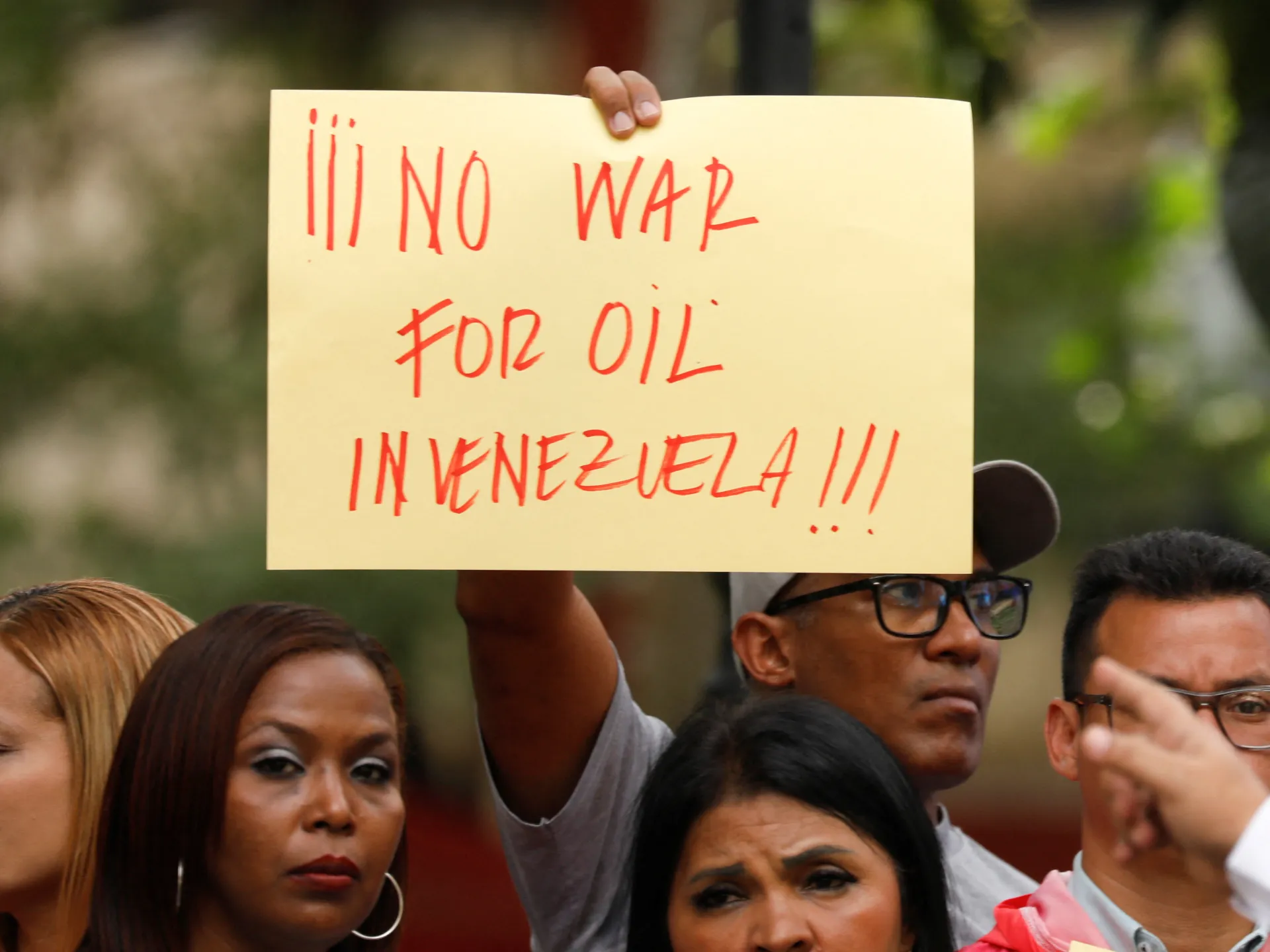
Earlier this week, Trump told business executives that Petro had “better wise up, or he’ll be next”, citing cocaine production as justification for potential action, and alluding to the US military build-up near Venezuela amid threats to remove its President Nicolas Maduro.

In recent days, the Trump administration has imposed new sanctions on Venezuela, targeting three nephews of President Nicolas Maduro’s wife, Cilia Flores, as well as six crude oil tankers and shipping companies linked to them, as Washington steps up pressure on Caracas, following the US seizure of a Venezuelan oil tanker.

Petro has responded to Trump’s actions, including sanctioning the Colombian president, with equal defiance, warning Trump earlier this month against “waking the jaguar” and insisting any assault on Colombian territory would amount to a declaration of war.

The left-wing president has invited his US counterpart to witness laboratory demolitions firsthand, claiming his administration destroys drug facilities every 40 minutes. In late November, the government hailed what it said was its largest cocaine bust in a decade.

The rebel group, ELN, which fields roughly 5,800 fighters, maintains control over significant drug-producing areas, including the Catatumbo region along the Venezuelan frontier.

Al Jazeera correspondent Teresa Bo, who visited ELN-held territory in November, found the group exercising unchallenged authority, with fighters openly displaying banners declaring “Total peace is a failure” and no government soldiers visible.

Commander Ricardo, a senior figure interviewed during that visit, suggested the rebels might join wider resistance should Trump attack Venezuela. Such an intervention could provoke an armed response across Latin America, he warned, describing US actions as violations of regional self-determination.

The organisation has attempted peace negotiations with Colombia’s last five governments without success.

Discussions with Petro’s administration collapsed after the ELN launched a January assault in Catatumbo that killed more than 100 people and forced thousands from their homes.

Despite claiming ideological motivation, the group derives substantial income from narcotics trafficking, competing with former FARC fighters who refused to disarm under a 2016 peace settlement for control of coca cultivation zones and smuggling corridors.

Relations between Colombia and the US have deteriorated sharply since Trump returned to office.

Washington has imposed personal sanctions on Petro, cancelled his visa after he joined a pro-Palestinian demonstration in New York, and removed Colombia from its list of reliable counter-narcotics partners.

Meanwhile, Trump has deployed the nation’s largest aircraft carrier and nearly 15,000 troops to the Caribbean and has ordered more than 20 military strikes in recent months against alleged drug trafficking vessels in the Caribbean and off Latin America’s Pacific coast, killing more than 80 people.

Human rights groups, some US Democrats, and several Latin American countries have condemned the attacks as unlawful extrajudicial killings of civilians.

Source link

Bolivia jails ex-president Arce on corruption charges ahead of trial | Corruption News

Former leader denies charges over alleged diversion of funds meant for Indigenous development projects

A Bolivian judge has ordered former President Luis Arce to remain in detention for five months while prosecutors investigate allegations he embezzled millions of dollars from a fund meant for Indigenous communities.

Arce, who left office just a month ago, appeared before Judge Elmer Laura in a virtual hearing on Friday, two days after his arrest on the streets of La Paz.

Recommended Stories

list of 2 itemsend of list

The judge rejected appeals from Arce’s legal team for his release and ruled he must await trial in one of the capital’s largest prisons, citing the seriousness of charges that “directly affect state assets and resources allocated to vulnerable sectors”.

No trial date has been set.

The accusations centre on Arce’s time as economy minister under former President Evo Morales between 2006 and 2017, when authorities say he oversaw the diversion of approximately $700m from a state fund created to channel natural gas revenues into development projects for Indigenous peoples and peasant farmers.

Interior minister of the new right-wing government, Marco Antonio Oviedo, has described the 62-year-old former president as “the principal person responsible” for approving transfers of large sums into personal accounts of government officials for projects that were never completed.

Arce maintained his innocence during Friday’s hearing, saying he had no personal involvement in managing the fund and dismissing the case as politically motivated. “I’m a scapegoat,” he told the judge. “The accusations are politically motivated.”

His defence lawyers had requested his release on health grounds, noting his previous battle with kidney cancer.

However, Judge Laura denied the appeal and exceeded the prosecution’s request of three months’ detention by ordering five months in a state prison rather than a juvenile facility.

The case first emerged almost a decade ago in 2015 when the Indigenous fund was shut down amid corruption allegations, but investigations stalled during the years of Movement Toward Socialism governance.

The probe was revived after conservative President Rodrigo Paz took office last month, ending nearly two decades of left-wing rule in Bolivia.

Paz campaigned on promises to root out corruption at the highest levels as Bolivia grapples with its worst economic crisis in 40 years. His vice president, Edmand Lara, celebrated Arce’s arrest on social media, declaring that “everyone who has stolen from this country will return every last cent”.

Former ministers in Arce’s administration have condemned the arrest as an abuse of power and political persecution against the Movement Toward Socialism party.

If convicted, Arce faces up to six years in prison.

Source link

Admiral hands over leadership of command overseeing the Trump administration’s boat strikes

A U.S. Navy admiral who oversees military operations in Latin America handed off command responsibilities Friday as scrutiny increases over the Trump administration’s deadly strikes on alleged drug boats in the region.

Adm. Alvin Holsey has retired one year into a posting that typically lasts three to four years and transferred leadership duties to his top military deputy, Air Force Lt. Gen. Evan Pettus, during a ceremony at U.S. Southern Command headquarters near Miami.

In farewell remarks, Holsey did not mention the military operations or the reasons for his early retirement. But he urged his successor to uphold longstanding partnerships in the region by standing firmly behind the shared values of democracy and support for the rule of law.

“To be a trusted partner, we must be credible, present and engaged,” Holsey said.

Holsey’s shock retirement was announced by the Pentagon in October, over a month into the Trump administration’s strikes on suspected drug boats in the Caribbean Sea and the eastern Pacific Ocean that have killed at least 87 people. With the campaign facing growing scrutiny by Congress, Holsey briefed key lawmakers earlier this week.

Long-term replacement for Holsey hasn’t yet been named

The ceremony Friday was more subdued than past retirements, held outdoors amid a small crowd of mostly Southern Command staff and without Defense Secretary Pete Hegseth, because President Trump has yet to nominate Holsey’s replacement.

Gen. Dan Caine, chairman of the Joint Chiefs of Staff, made no mention of the military operations in Latin America as he thanked Holsey for his 37 years of service. Caine referred to Holsey as a “stoic” leader and “quiet professional” who always leads with his heart and head.

“It’s never been about you, it’s been about people, it’s been about others,” Caine said. “You’ve never said ‘I’ in all the conversations we’ve had. You’ve always said ‘we.’ … The impact you’ve had will last for a long time.”

Holsey is departing as Congress is scrutinizing the boat attacks, including one that killed two survivors clinging to the wreckage of an initial strike. Secretary of State Marco Rubio, Hegseth and other top officials have given classified briefings on Capitol Hill this week.

Holsey also spoke this week to key lawmakers overseeing the U.S. military by classified video call. Sen. Jack Reed, the top Democrat on the Senate Armed Services Committee, said afterward that Holsey answered senators’ questions but that “there are still many questions to be answered.” Reed later added that Holsey did not give a reason for his retirement other than saying it was a personal decision.

Boat strike scrutiny increases

Experts in the rules of warfare, human rights groups and even some of Trump’s allies in Congress have questioned the legality of the attacks on those accused of ferrying drugs. For decades, they were arrested at sea by the Coast Guard and brought to the U.S. for criminal prosecution.

The 22 known strikes against alleged drug-smuggling vessels are being supported by a giant flotilla of U.S. warships, attack helicopters, thousands of troops and even the nation’s most advanced aircraft carrier.

Trump’s Republican administration has defended its aggressive tactics, designating several drug cartels in Latin America as foreign terrorist organizations and declaring that the U.S. is in armed conflict with those criminal organizations, relying on a legal argument that gained traction after the Sept. 11, 2001, attacks.

The campaign has ramped up pressure on Venezuelan President Nicolás Maduro, who has been charged with narcoterrorism in the U.S. In a sharp escalation Wednesday, U.S. forces seized a sanctioned oil tanker that the Trump administration has accused of smuggling illicit crude. Sale of that oil on global energy markets is critical to Maduro’s grip on power.

Maduro has insisted the real purpose of the U.S. military operations is to force him from office.

Holsey’s departure is the latest in a long line of sudden retirements and firings that have befallen the military’s top ranks since Hegseth took charge of the Pentagon.

A native of rural Fort Valley, Ga., whose father and several uncles served in Vietnam, Holsey relinquished his command to Pettus to a soulful rendition of “Midnight Train to Georgia.”

Pettus, a fighter jet pilot with combat experience in Afghanistan and Iraq, had been serving as Holsey’s top deputy since late 2024. However, it’s unclear how long the Arkansas native will remain in the job. Whomever Trump nominates must be confirmed by the Senate.

Goodman writes for the Associated Press.

Source link

Mexico’s aerospace sector is growing. Will it be undercut in USMCA review? | Aviation

Monterrey, Mexico – In April, Mexican President Claudia Sheinbaum announced the country’s aerospace industry could see sustained annual growth of as much as 15 percent over the next four years, and attributed the sector’s expansion to a robust local manufacturing workforce, increasing exports, and a strong presence of foreign companies.

But with the review of the United States-Mexico-Canada Agreement (USMCA) coming up – the free-trade treaty between the three countries that helped Mexico’s aerospace sector to grow and flourish – the industry’s future is no longer certain.

Recommended Stories

list of 4 itemsend of list

Stakeholders warn that ensuring investment stability and strengthening labour standards are essential to protecting the sector’s North American supply chain.

Mexico is striving to become one of the top 10 countries in aerospace production value, a goal outlined in Plan Mexico, the country’s strategic initiative to enhance global competitiveness in key sectors.

As the sixth-largest supplier of aerospace parts to the US, the industry has benefited significantly from the USMCA, which fostered regional supply chain integration, said Monica Lugo, director of institutional relations at the consulting firm PRODENSA.

However, the integration is no guarantee of business continuing to grow as the country is at an “unprecedented moment” with US President Donald Trump and his wide-ranging tariff policies.

Lugo, a former USMCA negotiator, said that recent tariffs on materials like steel and aluminium — critical to the aerospace sector— have eroded trust in the US as a reliable partner. She predicts that if current conditions continue, the sector risks losing capital, investments and jobs.

“Having this great uncertainty – one day it’s on, the next it’s off, who knows tomorrow – and based on no specific criteria, but rather on the president’s mood, creates chaos and severely damages the country and the economy,” she said.

On December 4, Trump suggested the US might let the USMCA expire next year, or negotiate a new deal. This follows comments by US Trade Representative Jamieson Greer to US news outlet Politico that the administration is considering separate deals with Canada and Mexico.

A booming aerospace sector

The Mexican aerospace market is valued at $11.2bn, and is expected to more than double to $22.7bn by 2029, Sheinbaum said, citing data from the Mexican Aerospace Industry Federation (FEMIA). Home to global companies like Bombardier, Safran, Airbus, and Honeywell, Mexico has established itself as a key player in the global aerospace market and is now the world’s twelfth-largest exporter of aerospace components.

Marco Antonio Del Prete, secretary of sustainable development in Queretaro, attributes this success in part to heavy investment in education and training. In 2005, the Queretaro government promised Canada’s Bombardier that it would invest in education and set up the Aeronautical University, which now offers programmes ranging from technical diplomas to master’s degrees in aerospace manufacturing and engineering.

“Since Bombardier’s arrival, an educational and training system was created that allows us to develop talent in a very efficient way, let’s say, fast track,” Del Prete told Al Jazeera.

Bombardier has served as an anchor, propelling Queretaro’s rise as a high-skilled manufacturing hub for parts and components.

While the Bombardier plant in Queretaro originally focused on wiring harnesses, it has evolved to specialise in complex aerostructures, including the rear fuselage for the Global 7500, Bombardier’s ultra-long-range business jet, and key components for the Challenger 3500, the mid-sized business jet.

Marco Antonio Carrillo, a research professor at the Autonomous University of Queretaro (UAQ), pointed out that the area’s wide educational offerings have cultivated a powerful workforce, which has gained significant attention from aeroplane makers, mainly from the US, Canada and France.

“This development [of Queretaro] has been, if you look at it in terms of time, truly explosive,” Carrillo said.

Mexico also aims to join France and the US as the third country capable of fully assembling an engine for Safran.

But the International Association of Machinists and Aerospace Workers (IAM) Union, which represents more than 600,000 workers in Canada and the US, is worried that progress could lead to more advanced manufacturing and assembly work to eventually shift to Mexico, given the local investment in aeronautical universities and training.

“Right now they’re [Mexican workers] doing more entry-level type things, but our concern is that later on, larger pieces of the aerospace operation will go to Mexico,” Peter Greenberg, the IAM’s international affairs director, told Al Jazeera.

High-skilled, low-cost workforce

Of the three countries in the USMCA agreement, Mexico’s biggest attraction has been its low-cost manufacturing.

Edgar Buendia and Mario Duran Bustamante, economics professors at the Rosario Castellanos National University, cite Mexico’s low labour costs and geographical proximity to the US as the country’s key advantages. This is partly why the US has intensified pressure on the Mexican government, including during the initial USMCA negotiations in 2017, to raise wages to level the playing field and reduce unfair competition.

“Most US companies have incentives to move their production here in Mexico, given the [low] wages and the geographic location. So, to prevent that from happening, the United States is pressuring Mexico to raise labour standards, ensure freedom of association, and improve working conditions,” Buendia told Al Jazeera, things that will benefit Mexican workers even as employer-dominated labour groups worry that they may lose their advantage.

The IAM originally opposed the USMCA’s predecessor, NAFTA. Greenberg said that while they acknowledge USMCA will continue, US and Canadian workers “would probably be perfectly happy” if the agreement ended as the NAFTA deal had led to plants being shuttered and workers being laid off as jobs moved from the US and Canada to low-cost Mexico.

“There is a need for stronger incentives to keep work in the United States and Canada. We want to see the wages in Mexico go up so that it doesn’t become automatically a place where companies go to because they know they will have lower wages and workers who do not have any bargaining power or strong units,” Greenberg added.

Under Sheinbaum’s Morena party, Mexico has raised the minimum wage from 88 pesos ($4.82) in 2018 to 278.8 pesos ($15.30) in 2025, with the rate in municipalities bordering the US reaching 419.88 pesos ($23). On December 4, Sheinbaum announced a 13 percent rise in the minimum wage — and 5 percent for the border zone— set to begin in January 2026.

Despite these increases and the competitiveness of wages in the aerospace sector, researchers agree that a significant wage gap persists between Mexican workers and their US and Canadian counterparts.

“The wage gap is definitely abysmal,” said Javier Salinas, a scholar at the UAQ Labor Center, specialising in labour relations in the aerospace industry. “The [aerospace] industry average is between 402 [Mexican pesos] and 606, with the highest daily wage being 815. [But] 815, converted to US dollars, is less than $40 for a single workday.”

By contrast, Salinas estimates that a worker in the US earns an average of about 5,500 pesos, or $300, per day.

‘Protection unions’

The USMCA required Mexico to end “protection unions”, a longstanding practice where companies sign agreements with corrupt union leaders — known as “sindicatos charros” — without the workers’ knowledge. This system has been used to prevent authentic union organising, as these sindicatos often serve the interests of the company and government authorities rather than the workers.

Salinas argues that despite the 2019 labour reform, it remains difficult for independent unions to emerge. Meanwhile, “protection unions” continue to keep wages low to maintain competitiveness.

“But imagine, a competitiveness based on precarious or impoverished working conditions. I don’t think that’s the way forward,” Salinas said.

Even with new labour courts and laws mandating collective bargaining, organising in Mexico remains dangerous. Workers attempting to create independent unions frequently face firing, threats, or being blacklisted by companies.

Humberto Huitron, a lawyer specialising in collective labour law and trade unionism, explains that Mexican workers, including in the aerospace sector, often lack effective representation. “There’s discrimination during hiring or recruitment. They don’t hire workers who are dismissed for union activism,” he said.

Beyond demanding that Mexico enforce its labour reform, the IAM is calling for the expansion and strengthening of the Rapid Response Mechanism (RRM), which allows the US to take action against factories if they fail to uphold freedom of association and collective bargaining rights.

While not in the aerospace sector, the US recently invoked the RRM against a wine producer in Queretaro. Previous such actions in the state had been limited to the automotive sector.

“No one knows exactly what is going on in all of the factories in Mexico,” Greenberg said.

According to FEMIA, there are 386 aerospace companies operating in 19 states. These include 370 specialised plants that generate 50,000 direct jobs and 190,000 indirect jobs.

Del Prete, however, assured Al Jazeera that, in Queretaro, unions are independent and “they have their own organisation.”

Salinas points out that in Queretaro, there has not been a strike in decades, adding, “Imagine the control of the workforce: 29, 30 years without a single strike in the private sector.”

Source link

A ‘fearful’ country? Crime concerns grip Chile ahead of presidential race | Elections News

Domino effect

Chile has nearly 15.8 million registered voters, and this year, for the first time since 2012, all of them are required by law to vote in the presidential race.

Kast is believed to have the upper hand in Sunday’s run-off.

Though he came in second place during the first round of voting in November, he is expected to sweep up additional support from conservative candidates who did not make the cut-off for the second vote.

But some voters expressed scepticism about the emphasis on crime in this year’s race.

Daniela Ocaranza, a mother who lives in a low-income neighbourhood in Santiago, considers the heightened focus on crime to be a ploy.

She volunteers at an organisation that fights for affordable housing, and she thinks politicians are leveraging the uptick in crime to convince the voters to put more resources into security.

“Crime has increased,” Ocaranza acknowledged. “But this happens in all countries.”

She said the media is partly to blame in raising fears. It shows “you the same crime 30 times a day — morning, noon and night — so the perception is that there is more”.

“But there are many other things that are more important,” Ocaranza stressed, pointing to issues like education, healthcare and pensions. They are areas that she sees best addressed by Jara, whom she will be voting for on Sunday.

For his part, Johnson said politicians draw up hardline policies to appease residents who want urgent action taken.

But he noted that research has shown punitive measures don’t typically produce results. In the meantime, he warned that the outsized fears about crime can have real-world ramifications.

“Today, there are fewer people consuming art, going out to see theatre, going out to restaurants. So it doesn’t just limit someone’s quality of life but also economic development,” Johnson said.

“Fear is extremely harmful. It might even be more hurtful than the actual crime.”

Source link

US sanctions family of Venezuela’s Maduro, 6 oil tankers in new crackdown | Nicolas Maduro News

The Trump administration has imposed new sanctions on Venezuela, targeting three nephews of President Nicolas Maduro’s wife, Cilia Flores, as well as six crude oil tankers and shipping companies linked to them, as Washington steps up pressure on Caracas.

Two of the sanctioned nephews were previously convicted in the United States on drug trafficking charges before being released as part of a prisoner exchange.

Recommended Stories

list of 3 itemsend of list

The US is also targeting Venezuela’s oil sector by sanctioning a Panamanian businessman, Ramon Carretero Napolitano, whom it says facilitates the shipment of petroleum products on behalf of the Venezuelan government, along with several shipping companies.

The US Treasury Department said on Thursday that the measures include sanctions on six crude oil tankers it said have “engaged in deceptive and unsafe shipping practices and continue to provide financial resources that fuel Maduro’s corrupt narco-terrorist regime”.

Four of the tankers, including the 2002-built H Constance and the 2003-built Lattafa, are Panama-flagged, with the other two flagged by the Cook Islands and Hong Kong.

The vessels are supertankers that recently loaded crude in Venezuela, according to internal shipping documents from state oil company PDVSA.

‘An act of piracy’

In comments on Thursday night, Trump also repeated his threat to soon begin strikes on suspected narcotics shipments making their way via land from Venezuela to the US.

His remarks followed the US seizure of an oil tanker off Venezuela’s coast.

White House Press Secretary Karoline Leavitt said the US would take the tanker to a US port.

“The vessel will go to a US port, and the United States does intend to seize the oil,” Leavitt said during a news briefing. “However, there is a legal process for the seizure of that oil, and that legal process will be followed.”

Maduro condemned the seizure, calling it “an act of piracy against a merchant, commercial, civil and private vessel,” adding that “the ship was private, civilian and was carrying 1.9 million barrels of oil that they bought from Venezuela”.

He said the incident had “unmasked” Washington, arguing that the true motive behind the action was the seizure of Venezuelan oil.

“It is the oil they want to steal, and Venezuela will protect its oil,” Maduro added.

Maduro’s condemnation came as US officials emphasised that the latest sanctions also targeted figures close to the Venezuelan leader.

Nicolas Maduro
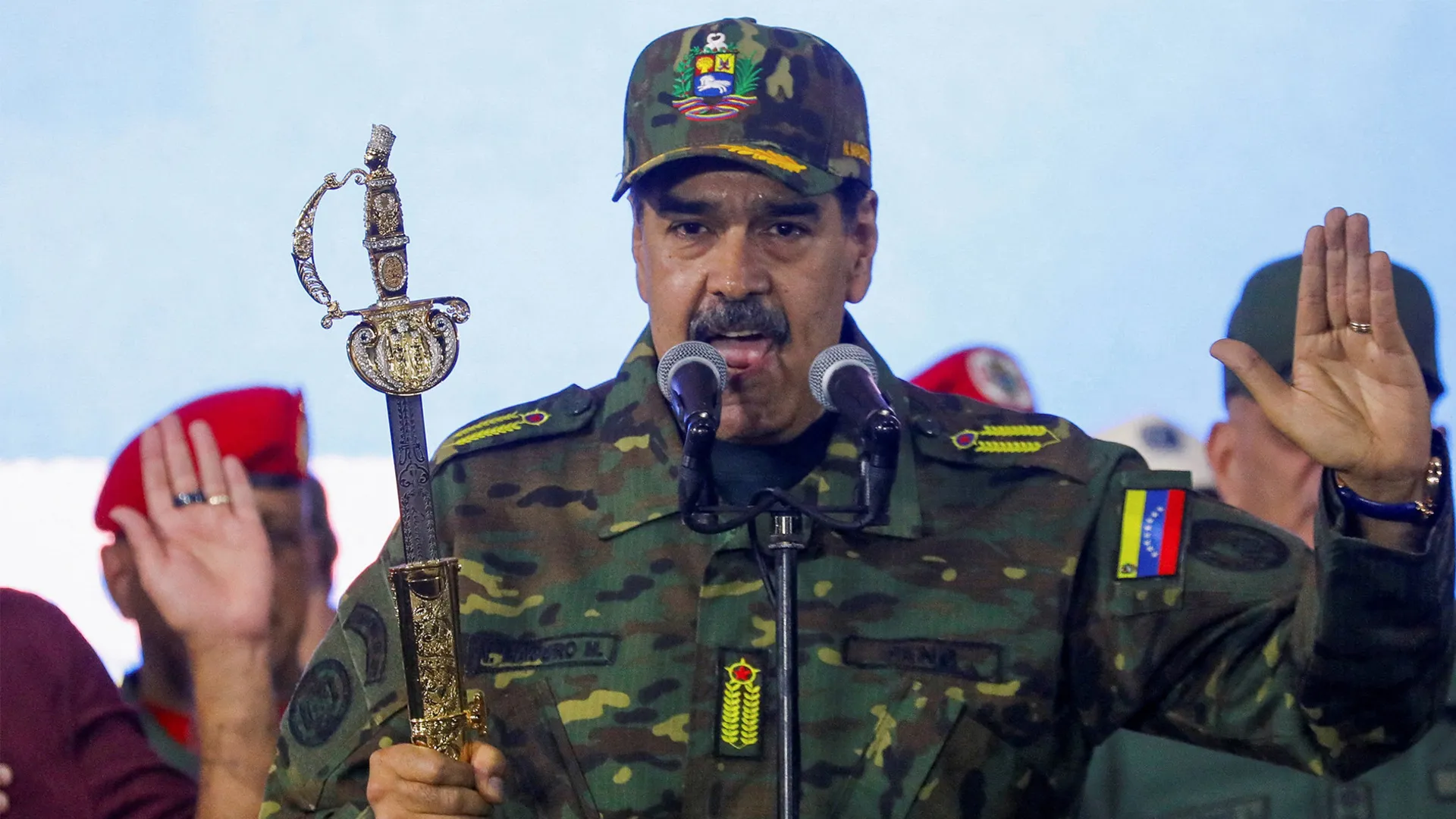
Venezuela’s President Nicolas Maduro holds a sword which belonged to Ezequiel Zamora, a Venezuelan soldier [FILE: Leonardo Fernandez Viloria/Reuters]

Maduro’s relatives targeted

Franqui Flores and Efrain Antonio Campo Flores, nephews of Venezuelan first lady Cilia Flores, were also sanctioned. The two became known as the “narco nephews” after their arrest in Haiti in 2015 during a US Drug Enforcement Administration sting.

They were convicted in 2016 on charges of attempting to carry out a multimillion-dollar cocaine deal and sentenced to 18 years in prison, before being released in a 2022 prisoner swap with Venezuela.

A third nephew, Carlos Erik Malpica Flores, was also targeted. US authorities allege he was involved in a corruption scheme at the state oil company.

Maduro and his government have denied links to criminal activity, saying the US is seeking regime change to gain control of Venezuela’s vast oil reserves.

Beyond the individuals targeted, the US is also preparing to intercept additional ships transporting Venezuelan oil, the Reuters news agency reported, citing sources.

Asked whether the Trump administration planned further ship seizures, White House spokesperson Leavitt told reporters she would not speak about future actions but said the US would continue executing the president’s sanctions policies.

“We’re not going to stand by and watch sanctioned vessels sail the seas with black market oil, the proceeds of which will fuel narcoterrorism of rogue and illegitimate regimes around the world,” she said on Thursday.

Wednesday’s seizure was the first of a Venezuelan oil cargo amid US sanctions that have been in force since 2019. The move sent oil prices higher and sharply escalated tensions between Washington and Caracas.

White House Press Secretary Karoline Leavitt
White House Press Secretary Karoline Leavitt holds a news briefing [Jonathan Ernst/Reuters]

Source link

Venezuela’s Machado taunts Maduro government after dramatic exit to Oslo | Nicolas Maduro News

Venezuelan opposition leader and Nobel Peace laureate Maria Corina Machado has declared that authorities in her home country would have attempted everything possible to prevent her journey to Norway, after she emerged publicly for the first time in nearly a year.

Machado greeted supporters from an Oslo hotel balcony in the early hours of Thursday following a high-risk exit from Venezuela, where she had been in hiding since January.

Recommended Stories

list of 2 itemsend of list

The journey, which purportedly included navigating 10 military checkpoints and crossing the Caribbean by fishing vessel, brought her to the Norwegian capital to collect her Nobel Peace Prize.

During a news conference at Norway’s parliament, the 58-year-old right-wing opposition figure delivered sharp criticism of President Nicolas Maduro’s administration, asserting that the government deploys national resources to suppress its population.

When questioned about an oil tanker seized by Washington on Wednesday, she argued this demonstrated how the regime operates. Asked whether she would support a United States invasion, Machado claimed Venezuela had already been invaded by Russian and Iranian agents alongside drug cartels.

“This has turned Venezuela into the criminal hub of the Americas,” she said, standing alongside Norwegian Prime Minister Jonas Gahr Stoere.

“What sustains the regime is a very powerful and strongly funded repression system. Where do those funds come from? Well, from drug trafficking, from the black market of oil, from arms trafficking and from human trafficking. We need to cut those flows.”

The trip reunited her with family members she had not seen in almost two years, including her daughter, who accepted the Nobel Peace Prize on her behalf at Wednesday’s ceremony.

Aligned with Trump 

The political leader has welcomed international sanctions and US military intervention in Venezuela, a move her critics say harkens back to a dark past.

The US has a long history of interference in the region, particularly in the 1980s, when it propped up repressive right-wing governments through coups, and funded paramilitary groups across Latin America that were responsible for mass killings, forced disappearances and other grave human rights abuses.

Venezuelan authorities cited Machado’s support for sanctions and US intervention when they barred her from running for office in last year’s presidential election, where she had intended to challenge Maduro. Machado has accused Venezuela’s president of stealing the July 2024 election, which was criticised by international observers.

Praising the Trump administration’s approach, Machado said the president’s actions had been “decisive to reach the point where we are right now, in which the regime is weaker than ever.”

She insisted she would return home but did not say when. “I’m going back to Venezuela regardless of when Maduro goes out. He’s going out, but the moment will be determined by when I’m finished doing the things that I came out to do,” she told reporters.

Her escape comes as tensions between Washington and Caracas have intensified sharply. The Trump administration has positioned major naval forces in the Caribbean and conducted strikes against alleged drug vessels since September. The US seized what Trump called a “very large” oil tanker off the coast of Venezuela, on Wednesday.

Machado has aligned herself with right-wing hawks close to Trump who argue that Maduro has links to criminal gangs that pose a direct threat to US national security, despite doubts raised by the US intelligence community.

The Trump administration has ordered more than 20 military strikes in recent months against alleged drug-trafficking vessels in the Caribbean and off Latin America’s Pacific coast, killing more than 80 people.

Human rights groups, some US Democrats, and several Latin American countries have condemned the attacks as unlawful extrajudicial killings of civilians.

The Wall Street Journal (WSJ) reported that Machado’s two-month escape operation involved wearing a disguise and departing from a coastal fishing village on a wooden boat bound for Curacao before boarding a private aircraft to Norway.

US forces were alerted to avoid striking the vessel, the WSJ reported, as they had one with similar boats in recent months. Machado confirmed receiving assistance from Washington during her escape.

Maduro, in power since 2013 following the death of Hugo Chavez, says Trump is pushing for regime change in the country to access Venezuela’s vast oil reserves. He has pledged to resist such attempts.

A United Nations report released on Thursday accused Venezuela’s security forces of crimes against humanity over more than a decade.

Venezuelan Minister of the Interior Diosdado Cabello said Machado left the country “without drama” but provided no details.

Source link

‘Act of piracy’ or law: Can the US legally seize a Venezuelan tanker? | Donald Trump News

United States President Donald Trump has said that the US has seized a sanctioned oil tanker close to the coast of Venezuela, in a move that has caused oil prices to spike and further escalates tensions with Caracas.

“We’ve just seized a tanker on the coast of Venezuela, large tanker, very large, largest one ever, actually, and other things are happening,” Trump said on Wednesday.

Recommended Stories

list of 1 itemend of list

The Venezuelan government called the move an act of “international piracy”, and “blatant theft”.

This comes as the US expands its military operations in the region, where it has been carrying out air strikes on at least 21 suspected drug-trafficking vessels since September. The Trump administration has provided no evidence that these boats were carrying drugs, however.

Here is what we know about the seizure of the Venezuelan tanker:

What happened?

The US said it intercepted and seized a large oil tanker off the coast of Venezuela, marking the first operation of its kind in years.

The last comparable US military seizure of a foreign tanker occurred in 2014, when US Navy SEALs boarded the Morning Glory off Cyprus as Libyan rebels attempted to sell stolen crude oil.

The Trump administration did not identify the vessel or disclose the precise location of the operation.

However, Bloomberg reported that officials had described the ship as a “stateless vessel” and said it had been docked in Venezuela.

Soon after announcing the latest operation on Wednesday, US Attorney General Pam Bondi released a video showing two helicopters approaching a vessel and armed personnel in camouflage rappelling onto its deck.

“Today, the Federal Bureau of Investigation, Homeland Security Investigations and the United States Coast Guard, with support from the Department of War, executed a seizure warrant for a crude oil tanker used to transport sanctioned oil from Venezuela and Iran,” Bondi said.

She added that “for multiple years, the oil tanker has been sanctioned by the United States due to its involvement in an illicit oil-shipping network supporting foreign terrorist organisations”.

Experts said the method of boarding demonstrated in the video is standard practice for US forces.

“The Navy, Coast Guard and special forces all have special training for this kind of mission, called visit, board, search, and seizure – or VBSS,” Mark Cancian, a retired Marine Corps colonel and senior adviser at the Center for Strategic and International Studies, told Al Jazeera.

“It is routine, especially for the Coast Guard. The government said it was a Coast Guard force doing the seizure, though the helicopter looks like a Navy SH-60S.”

Which vessel was seized?

According to a Reuters report, British maritime risk firm Vanguard identified the crude carrier Skipper as the vessel seized early Wednesday off Venezuela’s coast.

MarineTraffic lists the Skipper as a very large crude carrier measuring 333m (1,093 feet) in length and 60m (197 feet) in width.

The tanker was sanctioned in 2022 for allegedly helping to transport oil for the Lebanese armed group, Hezbollah, which is backed by Iran, and Iran’s Quds Force.

The Skipper departed Venezuela’s main oil terminal at Jose between December 4 and 5 after loading about 1.8 million barrels of Merey crude, a heavy, high-sulphur blend produced in Venezuela.

“I assume we’re going to keep the oil,” President Trump said on Wednesday.

Before the seizure, the tanker had transferred roughly 200,000 barrels near Curacao to the Panama-flagged Neptune 6, which was headed for Cuba, according to satellite data analysed by TankerTrackers.com.

According to shipping data from Venezuela’s state-owned oil and gas company Petroleos de Venezuela (PDVSA), the vessel also transported Venezuelan crude to Asia in 2021 and 2022.

Where did the seizure take place?

The US said it seized the oil tanker in the Caribbean Sea.

US officials have said the action occurred near Venezuelan territorial waters, though they have not provided precise coordinates.

MarineTraffic data shows the vessel’s tracker still located in the Caribbean.

INTERACTIVE US seizes oil tanker off Venezuela coast map-1765444506

Cancian noted that “seizing sanctioned items is common inside a country’s own territory. It is unusual in international waters”.

He added: “Russia has hundreds of sanctioned tankers sailing today, but they have not been boarded.”

Experts say it is unclear whether the seizure was legal, partly because many details about it have not been made public.

Still, the US could make use of various arguments to justify the seizure if needs be.

One is that the boat is regarded as stateless. Under the UN Convention on the Law of the Sea (UNCLOS), ships need “a nationality”.

The government of Guyana, Venezuela’s neighbour, said the Skipper was “falsely flying the Guyana flag”, adding that it is not registered in the country.

If a vessel flies a flag it is not registered under, or refuses to show any flag at all, states have the “right of visit”, allowing their officials to stop and inspect the ship on the high seas – essentially meaning international waters.

If doubts about a ship’s nationality remain after checking its documents, a more extensive search can follow.

In previous enforcement actions against sanctioned ships, the US has seized not the ship itself but the oil on board. In 2020, it confiscated fuel from four tankers allegedly carrying Iranian oil to Venezuela.

US law also allows the Coast Guard, which carried out this operation, to conduct searches and seizures on the high seas in order to enforce US laws, stating that it “may make inquiries, examinations, inspections, searches, seizures, and arrests upon the high seas” to prevent and suppress violations.

But some legal experts argue that the US has overstepped, as it “has no jurisdiction to enforce unilateral sanctions on non-US persons outside its territory”, according to Francisco Rodriguez, a senior research fellow at the Center for Economic and Policy Research (CEPR).

Rodriguez said the US is relying on maritime rules for stateless vessels “as an entryway to justify enforcing US sanctions outside of US territory”.

“To the extent that the US is able to continue to do so, it could significantly increase the cost of doing business with Venezuela and precipitate a deepening of the country’s economic recession,” he warned in a CEPR article.

How has Venezuela responded to the seizure?

Venezuela’s Foreign Ministry stated that “the true reasons for the prolonged aggression against Venezuela have finally been exposed”.

“It is not migration, it is not drug trafficking, it is not democracy, it is not human rights – it was always about our natural resources, our oil, our energy, the resources that belong exclusively to the Venezuelan people,” the statement said.

The ministry described the incident as an “act of piracy.”

The government added that it will appeal to “all” international bodies to denounce the incident and vowed to defend its sovereignty, natural resources, and national dignity with “absolute determination”.

“Venezuela will not allow any foreign power to attempt to take from the Venezuelan people what belongs to them by historical and constitutional right,” it said.

Venezuela's President Nicolas Maduro
Venezuela’s President Nicolas Maduro gestures towards supporters, during a march to commemorate the 1859 Battle of Santa Ines in Caracas, Venezuela, on December 10, 2025 [Gaby Oraa/ Reuters]

What are the potential consequences for Venezuela’s oil exports?

Experts say the seizure could produce short-term uncertainty for Venezuelan oil exports, largely because “this has been the first time [the United States has]… seized a shipment of Venezuelan oil”, Carlos Eduardo Pina, a Venezuelan political scientist, told Al Jazeera.

That may make shippers hesitate, though the broader impact is limited, Pina said, since “the US allows the Chevron company to continue extracting Venezuelan oil”, and US group Chevron holds a special waiver permitting it to produce and export crude despite wider sanctions.

Chevron, which operates joint ventures with PDVSA, said its operations in Venezuela remain normal and continue without disruption.

The US oil major, which is currently responsible for all Venezuelan crude exports to the US, increased shipments last month to 150,000 barrels per day (bopd), up from 128,000 bpd in October.

Inside Venezuela, Pina warned the move could spark financial panic, however: “It could instil fear, trigger a currency run… and worsen the humanitarian crisis.”

How will this affect US-Venezuela relations?

Diplomatically, Pina said he views the action as a political message to Venezuelan President Nicolas Maduro, noting its timing – “the same day that [opposition leader] Maria Corina Machado was awarded the Nobel Prize” – and calling it “a gesture of strength… to remind that [the US is present in the Latin American region].”

Maduro has long argued that the Trump administration’s strikes on boats in the Caribbean and eastern Pacific are not, in fact, aimed at preventing drug running, but are part of a plan to effect regime change in Venezuela. Trump has authorised CIA operations in Venezuela and has given conflicting messages about whether he would consider a land invasion.

Analysts see this latest action as part of a broader strategy to pressure the Maduro government.

“This is certainly an escalation designed to put additional pressure on the Maduro regime, causing it to fracture internally or convincing Maduro to leave,” said Cancian.

“It is part of a series of US actions such as sending the Ford to the Caribbean, authorising the CIA to move against the Maduro regime, and conducting flybys with bombers and, recently, F-18s.”

Cancian added that the broader meaning of the operation depends on what comes next.

“The purpose also depends on whether the US seizes additional tankers,” he said. “In that case, this looks like a blockade of Venezuela. Because Venezuela depends so heavily on oil revenue, it could not withstand such a blockade for long.”


Source link

Machado in Oslo, but will not attend Nobel Peace ceremony to receive award | Politics News

The build-up to the ceremony has been tinged with shadowy intrigue, after the Nobel institute earlier said Machado’s whereabouts were unknown.

Venezuelan opposition leader Maria Corina Machado will not receive the Nobel Peace Prize in person at an award ceremony in Oslo but she will be in the European city, the director of the Norwegian Nobel Institute has said.

Machado, 58, was due to receive the award on Wednesday at Oslo City Hall in the presence of Norway’s monarchs and Latin American leaders, including fellow right-wing politicians Argentinian President Javier Milei and Ecuadorean President Daniel Noboa.

Recommended Stories

list of 4 itemsend of list

The opposition leader of the Vente Venezuela party was awarded the prize in October, with the Nobel committee praising Machado’s role in the country’s opposition movement and her “steadfast” support for democracy.

Machado, who holds many right-wing views, dedicated it in part to United States President Donald Trump, who has said he, himself deserved the honour and was infuriated that he did not.

“Although she will not be able to reach the ceremony and today’s events, we are profoundly happy to confirm that Machado is safe and that she will be with us in Oslo,” the institute stated.

She is expected to reach Oslo “sometime between this evening and tomorrow morning,” the institute’s director Kristian Berg Harpviken told the AFP news agency on Wednesday, shortly before the 1pm (12:00 GMT) ceremony, at which her daughter, Ana Corina Sosa Machado, is set to accept the award in her place.

“I will be in Oslo, I am on my way,” Machado stated in an audio recording released by the institute.

The announcement was part of a sequence of events more befitting of cloak-and-dagger intrigue, as the institute had earlier stated Machado’s whereabouts were unknown. A planned news conference a day earlier was also cancelled due to her absence.

Machado has a decade-long travel ban on her and has spent more than a year in hiding.

Alignment with right-wing hawks

The political leader has welcomed international sanctions and US military intervention in Venezuela, a move her critics say harkens back to a dark past.

The US has a long history of interference in the region, particularly in the 1980s when it propped up repressive right-wing governments through coups, and funded paramilitary groups across Latin America that were responsible for mass killings, forced disappearances and other grave human rights abuses.

Venezuelan authorities cited Machado’s support for sanctions and US intervention when they barred her from running for office in last year’s presidential election, where she had intended to challenge President Nicolas Maduro. Machado has accused Maduro of stealing the July 2024 election.

Shortly after her Nobel win in October, Machado also voiced support for Israel in a phone call with Prime Minister Benjamin Netanyahu, during its ongoing genocidal war in Gaza.

Machado has previously pledged to move Venezuela’s embassy in Israel to Jerusalem, as Trump did with the US diplomatic presence during his first term in office, if her movement comes to power. This would be on par with other right-wing Latin American leaders who have taken pro-Israel stances, including Argentina’s Milei and former Brazilian President Jair Bolsonaro.

Machado has aligned herself with right-wing hawks close to Trump who argue that Maduro has links to criminal gangs that pose a direct threat to US national security, despite doubts raised by the US intelligence community.

The Trump administration has ordered more than 20 military strikes in recent months against alleged drug-trafficking vessels in the Caribbean and off Latin America’s Pacific coast.

Human rights groups, some US Democrats and several Latin American countries have condemned the attacks as unlawful extrajudicial killings of civilians.

Maduro, in power since 2013 following the death of Hugo Chavez, says Trump is pushing for regime change in the country to access Venezuela’s vast oil reserves. He has pledged to resist such attempts.

Venezuela’s armed forces are planning to mount a guerrilla-style resistance in the event of a US air or ground attack, according to sources with knowledge of the efforts and planning documents seen by the Reuters news agency.

Source link

Flavio Bolsonaro retracts suggestion of a ‘price’ to end 2026 election bid | Elections News

Former President Jair Bolsonaro has endorsed his eldest son’s campaign to be Brazil’s next president in the 2026 race.

Far-right Senator Flavio Bolsonaro has reaffirmed his commitment to running in Brazil’s 2026 presidential race, despite criticism that he appeared to be openly haggling over whether to remain a candidate.

On Tuesday, Bolsonaro met with reporters outside federal police headquarters in the capital Brasilia, where his father, former President Jair Bolsonaro, is serving a 27-year sentence for attempting to foment a coup.

Recommended Stories

list of 3 itemsend of list

The younger Bolsonaro said he conveyed to his father that he would not shrink from the 2026 race.

“I told him this candidacy is irreversible,” Flavio said. “And in his own words, ‘We will not turn back.’ Now it is time to talk to people, so we can have the right people on our side.”

The senator also attempted to clear up the comments that sparked the initial controversy.

On Sunday, Flavio raised eyebrows when he told Brazilian media that he could exit the race — for the right “price”.

“There’s a possibility I won’t go all the way,” Flavio said at the time. “I have a price for that. I will negotiate.”

He declined to name what that price would be, but his comments were widely interpreted to be a reference to his father’s imprisonment.

In September, a panel on Brazil’s Supreme Court convicted Jair of five charges related to his attempts to overturn the 2022 presidential election, including one count of seeking the violent abolition of the democratic rule of law.

Jair lost the 2022 race to current Brazilian President Luiz Inacio Lula da Silva, a left-wing leader who has announced he will run for a fourth term in 2026.

In November, the Supreme Court panel ordered Jair to be taken into custody to begin his sentence, after the ex-president admitted to damaging his ankle monitor.

Separately, in 2023, Brazil’s Supreme Electoral Tribunal ruled that Jair should be barred from holding public office for eight years, as a penalty for misusing the presidential office to spread election falsehoods.

Since his detention, Jair has backed his eldest son’s candidacy in the 2026 race. Liberal Party (PL) president Valdemar Costa Neto also confirmed on Friday that Jair’s endorsement meant that Flavio would indeed lead the party’s ticket.

Flavio has since received other right-wing endorsements, including from Sao Paulo Governor Tarcisio de Freitas, who was previously considered a frontrunner to represent the PL.

But Flavio’s comments on Sunday have thrown his nascent candidacy into doubt.

Critics, including from Lula’s Workers Party, have seized upon Flavio’s suggestion of a “price” to question his ethics and commitment.

“No one launches a candidacy one day, and the next day says, ‘Look, I can negotiate,’” Edinho Silva, the president of the Workers Party, told reporters. “It’s not just me. No one would take it seriously.”

But Flavio on Tuesday dismissed the attacks and reaffirmed he would stay in the race, while fighting for his father’s freedom.

“My price is Bolsonaro free and on the ballot,” he said. “In other words, there is no price.”

Source link

Cuba sentences ex-economy minister to life in prison for espionage | Corruption News

Top court sentences Alejandro Gil in the highest profile case against an ex-official in Cuba in decades.

Cuba’s top court has sentenced former Economy Minister Alejandro Gil to life in prison for espionage following a closed-door trial, in one of the country’s highest-profile cases in decades.

In a statement on Monday, the Supreme Popular Tribunal said Gil also received a second concurrent prison sentence of 20 years on corruption charges.

Recommended Stories

list of 4 itemsend of list

These include bribery, falsification of documents and tax evasion.

Gil, who served as economy minister from 2018 to 2024, was once a close confidant of President Miguel Diaz-Canel.

The 61-year-old politician was sacked in February 2024 and had not been seen or heard from until the trials.

The court did not give details about what exactly the former minister did or who he was spying for.

It said Gil had engaged in “corrupt and deceitful actions” and that he had abused the powers of his office “to obtain personal benefits”. It also said he received money from foreign companies and bribed other public officials to legalise the acquisition of assets.

“He failed to follow work procedures with the classified official information he handled, he stole it, damaged it, and finally made it available to the enemy,” it added.

Gil has the right to appeal the sentence within 10 days.

The former minister’s case is the highest profile among officials who have fallen from grace since 2009, when then-Vice President Carlos Lage and Foreign Minister Felipe Perez Roque were dismissed.

Their case involved leaks of sensitive information, although they were not sentenced.

Gil was the public face of monetary and financial reforms in 2021 in Cuba, including trying to unify the country’s currency system. But Cuba, already affected by an economic crisis and shortage of some products, saw an inflationary spiral.

Source link

Honduras issues arrest warrant for ex-president Hernandez after US pardon | Crime News

The arrest warrant for the country’s former president comes amid a closely-fought election.

Honduras’s top prosecutor has issued an international arrest warrant for former President Juan Orlando Hernandez, intensifying legal and political turmoil just days after the ex-leader walked free from a United States prison.

Attorney General Johel Antonio Zelaya announced the move on Monday in a post on X, saying he instructed the Agencia Técnica de Investigación Criminal, the main investigative body of the Public Prosecutor’s Office, and urged Interpol “to execute the international arrest warrant against former President Juan Orlando Hernández”.

Zelaya’s announcement comes as Hernandez was released from a 45-year prison sentence in the US after President Donald Trump pardoned him.

Recommended Stories

list of 4 itemsend of list

Hernandez’s wife, who insists he is innocent, said he will not return to Honduras immediately due to safety concerns and that he is currently in a “safe place” in the US.

Hernandez was extradited to the US in 2022, where New York prosecutors had accused him of three drug- and weapons-related offences and alleged he used his presidency to transform Honduras into a “narco-state”.

US prosecutors later secured a conviction, saying Hernandez played a central role in moving cocaine through Honduras and onward to the United States. He was handed a 45-year prison sentence on the back of “one of the largest and most violent drug trafficking conspiracies in the world”, according to prosecutors.

At the same time, Hernandez has been at the centre of investigations in his country that have targeted current and former politicians suspected of diverting public money. In 2023, along with several former officials, he was charged with involvement in the alleged misappropriation of more than $12m in state funds for his political campaign.

Trump’s decision to pardon Hernandez came as he urged Hondurans to rally behind presidential candidate Nasry “Tito” Asfura, a member of Hernandez’s right-wing National Party, in the country’s November 30 presidential election.

“I will be granting a Full and Complete Pardon to Former President Juan Orlando Hernandez who has been, according to many people that I greatly respect, treated very harshly and unfairly”, Trump wrote in a social media post last week.

With 97 percent of ballots counted, Asfura held 40.52 percent of the vote, remaining ahead of centrist rival Salvador Nasralla by roughly 42,100 votes.

The tally had already been halted temporarily on Friday with 88 percent of ballots processed. According to the National Electoral Council (CNE), about 16 percent of tally sheets contained irregularities requiring further review, an issue it attributed to the company managing the vote-counting system.

International observers have urged authorities to speed up the counting process and take steps to reassure voters of its integrity.


Source link

Honduran election authorities resume vote tallies amid allegations of fraud | Elections News

Central American nation on edge after voting plagued by fraud claims and a recent history of contested elections.

Election officials in Honduras have released updated voting results from the country’s November 30 election, following a three-day pause in tallies amid allegations of fraud and inconsistencies.

With 89 percent of ballots tallied on Monday, the conservative candidate Nasry Asfura held a slim lead of 40.21 percent over centrist contender Salvador Nasralla, who has 39.5 percent.

Recommended Stories

list of 3 itemsend of list

Rixi Moncada, a leftist candidate with the governing LIBRE party, is trailing in third place, with 19.28 percent.

“After carrying out the necessary technical actions (with external auditing), the data is now being updated in the results,” Ana Paola Hall, president of the National Electoral Council (CNE), said in a social media post.

Allegations of fraud had dominated the lead-up to the election, and statements from United States President Donald Trump-backed have likewise stirred controversy.

In the final days before the election, Trump indicated that he may not be able to work with anyone but Asfura. That, in turn, led to an outcry from other candidates who accused the US leader of election meddling.

The electoral body stated that about 14 percent of the tally sheets showed inconsistencies and would be reviewed. Hall added in her post that candidates must “stay alert and, where applicable, file the corresponding challenges in accordance with the law”.

Following a coup in 2009, Honduras experienced a period of repression and disputed elections that left many sceptical about the legitimacy of the electoral process. Security forces killed at least 16 people when they opened fire on protesters following a contested vote in 2017, with about 30 killed in protests across the country.

The prolonged vote-counting has fuelled concerns that similar clashes might erupt.

The opposition has also criticised Trump’s stated preference for Asfura as a form of interference, given his threat that US support could be withdrawn if he did not win.

Trump has previously written, “If he [Asfura] doesn’t win, the United States will not be throwing good money after bad.”

Moncada, the Libre candidate, has said she will not recognise the results that took place under “interference and coercion”. Nasralla has also said that Trump’s interference may have cost him votes.

Accusations of impropriety are widespread, with a conservative member of the CNE panel accusing a LIBRE member of “intimidation”, and Nasralla saying that “the corrupt ones are the ones holding up the counting process”.

Rights groups and civil society organisations have called for patience and transparency.

Source link