A study by booking platform Omio has analysed temperature data across European cities to find which have the warmest weather in January 2026
This article contains affiliate links, we will receive a commission on any sales we generate from it. Learn more
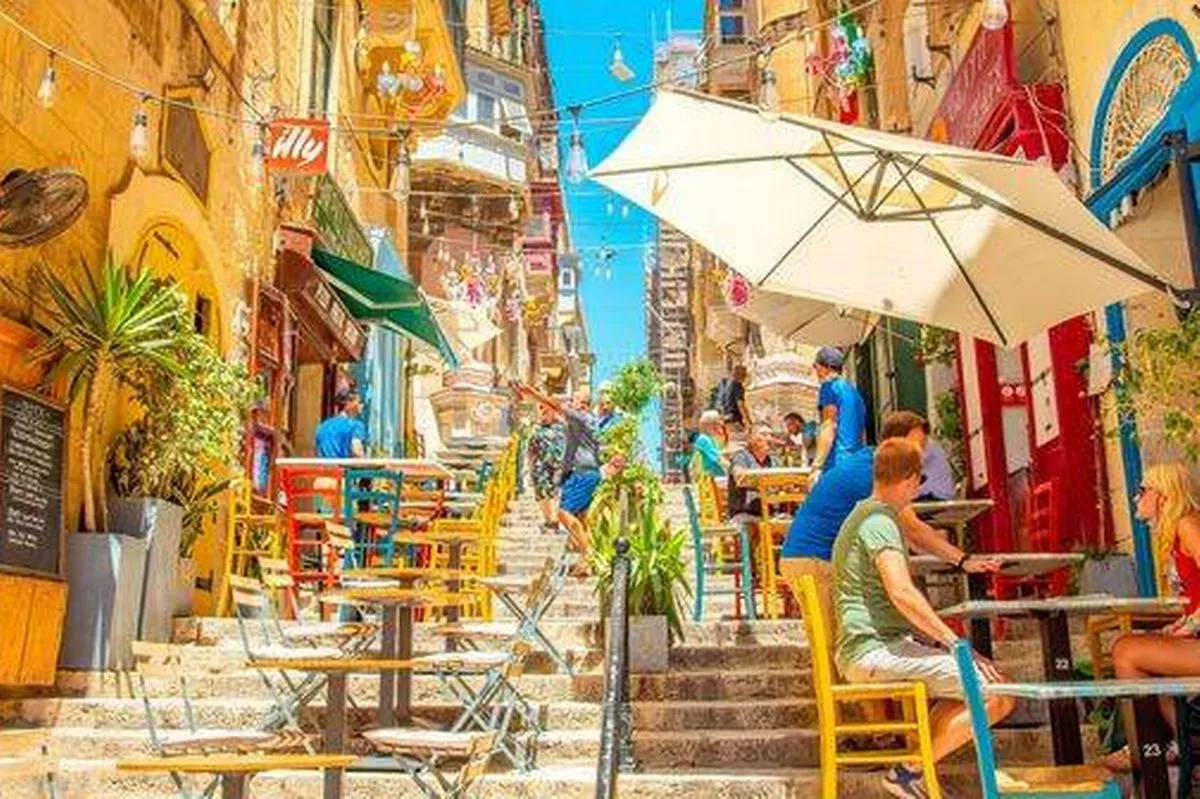
The ‘Caribbean of Europe’ named warmest place to go on holiday in January 2026(Image: Getty)
A fresh analysis from travel booking site Omio has crunched temperature figures for European destinations to pinpoint which cities boast the warmest climate.
Malta’s stunning capital, Valletta, sees the mercury climb to 16C throughout January, offering “bright blue skies and Mediterranean sea views,” positioning it as an ideal warm getaway that’s only a short flight from British airports.
Travel specialists noted: “Whether wandering the historic harbour of the Port of Valletta, taking the ferry to neighbouring islands, or dining above the coastline at the famous Panorama Restaurant, Valletta’s winter days feel more like early spring.”
One recent visitor to Valletta gushed about the destination on Tripadvisor, dubbing it “the Caribbean in Europe“. He said: “We recently had the pleasure of visiting Valletta, Malta’s enchanting capital, and what an experience it was! I felt compelled to share the magic we encountered on this journey, especially for those planning their first visit to Valletta.
“As we wandered the streets of Valletta, we were surprised to find that the city had a Caribbean-esque vibe, an intriguing blend that made our exploration even more fascinating. The narrow streets, historical buildings, and the laid-back atmosphere added an unexpected but delightful twist to our trip.”
Nicosia in Cyprus also boasts average January highs of 16C. The travel gurus explained: “Cyprus’ capital is the continent’s strongest bet for warm afternoons, al fresco dining and long strolls, where travellers can walk through centuries of history, from the iconic Venetian walls to Büyük Han.
“With direct transport connections and smooth onward travel, Nicosia offers an effortless mid-winter reset for travellers craving daylight and mild weather.”
Top 10 European cities with the warmest temperature in January
Booking a trip abroad can come with a hefty price tag, but one traveller was left baffled by the cost of food while visiting a European supermarket, as he claimed, ‘food costs more than the flight’
08:33, 24 Dec 2025Updated 11:53, 24 Dec 2025
A traveller was left baffled by the food prices in an Iceland supermarket(Image: TikTok/@jesusansal)
Food in one European country is so expensive that some tourists are packing food in their suitcases.
Iceland is a prime spot to catch the awe-inspiring Northern Lights, offering a spectacular getaway with its stunning Nordic landscapes, mountainous backdrops, and hot springs.
Yet, the European destination is notoriously pricey, to the extent that holidaymakers have resorted to packing their suitcases with food just to avoid the extortionate prices.
One traveller visited the Nordic island in the North Atlantic earlier this year and visited a local supermarket to see just how much the cost of food really was. In a video, @jesusansal explained that tourists often travel to Iceland with their own food stashed in their luggage because “food costs more than the flight.”
He videoed himself heading into a supermarket, and said: “Let’s see if it’s as expensive as people say”. And it didn’t take long before he found some costly everyday items that are almost double the price of what we’d find in an English supermarket.
Firstly, he found that a small pack of strawberries would set him back 800 Icelandic króna, which is around £4.75. For lunch, there was a baguette on offer for 1,065 króna, which is approximately £6.32, or a cheese sandwich for 750 króna (£4.45).
Elsewhere, a medium-sized bottle of olive oil costs 1,300 króna (£7.72), while instant noodles would set someone back 800 króna (£4.75) – a considerable hike compared to the 45p packs you can find in Tesco. “Mari, this is so expensive,” the TikToker said as he walked around the Iceland supermarket, but it didn’t end there.
He also found slices of Serrano ham for 500 króna (£2.97) and a small jar of the traditional Icelandic delicacy, hákarl, for 1,300 króna (£7.72). When it comes to making a basic breakfast during a stay in Iceland, the influencer found that it would cost someone around 2,000 króna (£11.87), which includes a couple of doughnuts, water, and juice.
Research from The Drinks Business found that Iceland is the most expensive place in Europe to purchase a bottle of wine, with the average cost of a mid-range wine setting someone back £18.30. This is compared to the European average of around £7.17 for the same quality of wine.
Having been left baffled by the prices of essential items, the Spanish traveller ended his video with: “Iceland may have spectacular views, but it’s quite expensive.” And he’s not the only one who feels this way.
Commenting on his TikTok video, one follower wrote: “What surprised me most was definitely the bread.” Another asked: “Can you get a mortgage at the supermarket?”
However, others noted the reason behind the higher prices could be due to their higher salaries. One commented: “In Iceland, the basic monthly salary is €6,000, so I even consider it cheap.”
One more added: “Well, the ham seems cheap to me, and the individual hams there will be five times more expensive than ours.” Another compared the prices to those in Europe and said: “The price of oil and ham is almost the same as in Spain.”
While you can find cheap flights to Iceland and affordable accommodation during your stay, the cost of food items can quickly add up. However, if you keep a budget for food each day and have this in mind before your trip, it’s still well worth a visit.
Do you have a travel story to share? Email webtravel@reachplc.com
Algeria’s parliament has begun debating a draft law that would criminalise France’s colonial rule from 1830 to 1962. Al Jazeera’s Nada Qaddourah explains what we know about the bill.
The Ukrainian military says its forces have withdrawn from the battle-scarred town of Siversk in the eastern Donetsk region after heavy fighting with Russian forces.
In a statement on Telegram on Tuesday, Ukraine’s General Staff said that Russian troops had a “significant advantage” in manpower and equipment and had exerted constant pressure on the defending Ukrainian troops by staging small-unit assaults in difficult weather conditions.
Recommended Stories
list of 4 itemsend of list
Ukraine’s decision to withdraw its forces was made to “preserve the lives of our soldiers and the combat capability of the units”, the General Staff said.
Heavy losses were inflicted on Russian forces before the order to retreat was given, and Siversk remains “under the fire control of our troops”, and “enemy units are being blocked to prevent their further advance,” the General Staff added.
Ukraine’s DeepState military monitoring site reported late on Tuesday that Russian forces had occupied Siversk as well as Hrabovske, a village in Ukraine’s Sumy region close to the border with Russia.
Russian Lieutenant General Sergei Medvedev had told Russian President Vladimir Putin on December 11 that troops had taken Siversk, where fighting has been fierce in recent months, but Ukrainian officials denied the Russian reports at the time.
Ukraine’s military said at the time that Russian troops were “taking advantage of unfavourable weather conditions” to launch attacks, but were mostly being “destroyed on the approaches”.
The Kyiv Independent news site said that, despite Siversk’s modest size – it had a pre-war population of 10,000, and now, just a few hundred civilians remain – the town was key to the defence of northern Donetsk.
The town had helped shield the larger Sloviansk and Kramatorsk areas, “the main bastions of Ukraine’s so-called ‘fortress belt’”, which Russia has been unable to conquer since the start of fighting, the Kyiv Independent said.
Donetsk is one of three Ukrainian regions at the centre of Russia’s territorial demands, which are the stumbling blocks to reaching an agreement on a ceasefire. Ukraine’s leaders have said they will not concede their country’s territory taken during Moscow’s invasion.
Russian forces had already seized an estimated 19 percent of Ukrainian territory as of early December, including Crimea, which Moscow annexed in 2014, all of the Luhansk region, and more than 80 percent of Donetsk, according to the Reuters news agency.
Russian forces also control about 75 percent of the Kherson and Zaporizhia regions, and small parts of the Kharkiv, Sumy, Mykolaiv and Dnipropetrovsk regions, according to Reuters.
A 28-point peace plan first put forward by the administration of US President Donald Trump last month says that a negotiated settlement would see Crimea, Luhansk and Donetsk “recognised as de facto Russian, including by the US”.
Ukrainian President Volodymyr Zelenskyy recently said that the United States is pushing for Ukraine to withdraw its forces from the Donetsk region to establish a “free economic zone” in the area, which he said the Russian side is referring to as a “demilitarised zone”.
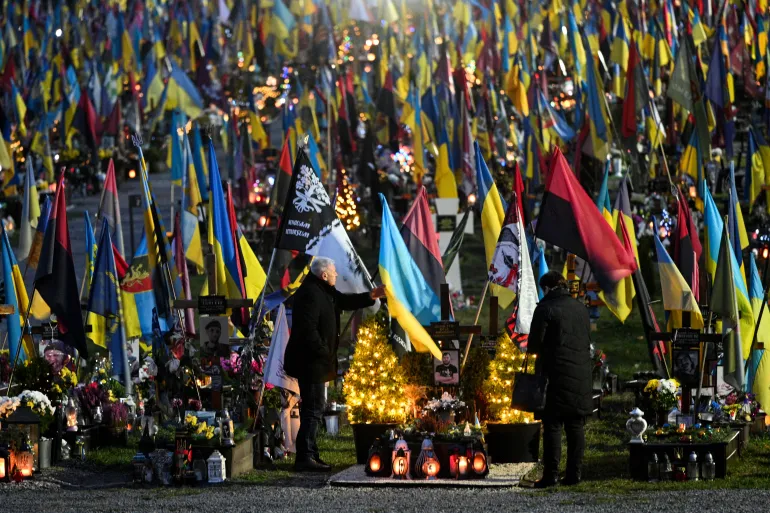
People visit the graves of fallen Ukrainian soldiers, decorated with Christmas trees and New Year’s decorations, at the Lychakiv Military Cemetery, in Lviv, Ukraine on Tuesday [Yuriy Dyachyshyn/AFP]
Pope saddened as fighting continues over Christmas
The latest setback for Kyiv on the battlefield came as Zelenskyy said on Tuesday that Russian forces had launched another “massive attack” on Ukraine on Monday night, killing at least three people, including a four-year-old girl, across 13 regions targeted with drones and missiles.
In Russia, Ukrainian drone attacks killed four people in the Belgorod region over the past two days, local officials said.
Pope Leo expressed disappointment on Tuesday that Russia had apparently refused to agree to a ceasefire on December 25, the date many Christians celebrate Christmas.
“I will make an appeal one more time to people of goodwill to respect at least Christmas Day as a day of peace,” Leo said, speaking to reporters outside his residence in Castel Gandolfo, Italy.
“Maybe they will listen to us, and there will be at least 24 hours, a day of peace, across the world,” he said.
While most people in Ukraine and Russia are Christians, many are Orthodox, meaning they observe Christmas on January 7.
Russian President Vladimir Putin announced an unexpected 30-hour unilateral truce a day before Easter this year, a rare pause in Russia’s war on Ukraine, which has now continued for close to three years, after Russia’s full-scale invasion in February 2022.
The United States has imposed visa bans on five Europeans, including a former European Union commissioner, accusing them of pressuring tech firms to censor and suppress “American viewpoints they oppose”.
In a statement on Tuesday, US Secretary of State Marco Rubio characterised the individuals as “radical activists” who had “advanced censorship crackdowns” by foreign states against “American speakers and American companies”.
Recommended Stories
list of 4 itemsend of list
“For far too long, ideologues in Europe have led organized efforts to coerce American platforms to punish American viewpoints they oppose,” he said on X.
“The Trump Administration will no longer tolerate these egregious acts of extraterritorial censorship,” he added.
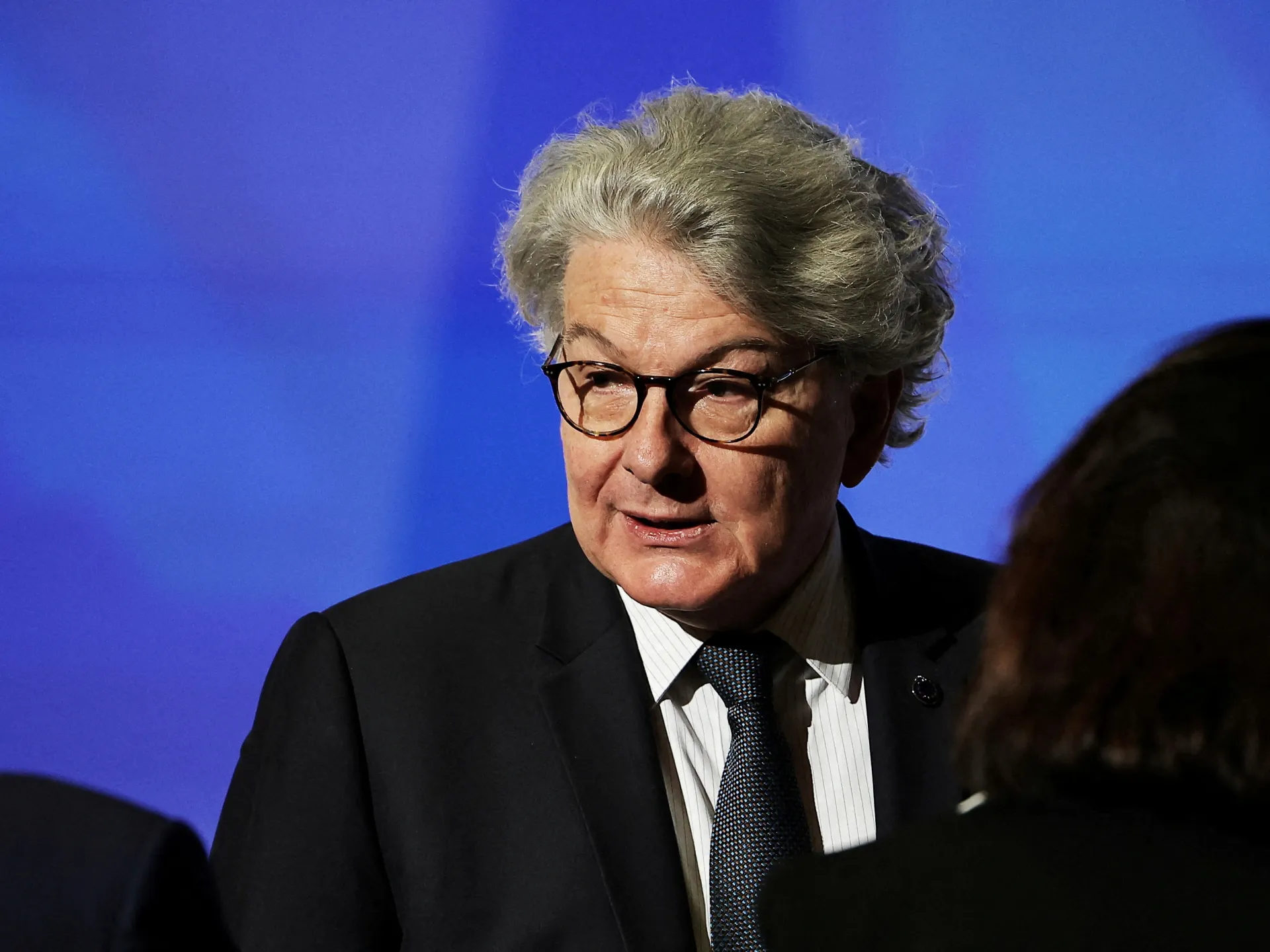
The most prominent target was Thierry Breton, who served as the European commissioner for the internal market from 2019-2024.
Sarah Rogers, the undersecretary for public diplomacy, described the French businessman as the “mastermind” of the EU’s Digital Services Act (DSA), a landmark law intended to combat hateful speech, misinformation and disinformation on online platforms.
Rogers also accused Breton of using the DSA to threaten Elon Musk, the owner of X and a close ally of US President Donald Trump, ahead of an interview Musk conducted with Trump during last year’s presidential campaign.
‘Witch hunt’
Breton responded to the visa ban in a post on X, slamming it as a “witch hunt” and comparing the situation with the US’s McCarthy era, when officials were chased out of government for alleged ties to communism.
“To our American friends: Censorship isn’t where you think it is,” he added.
The others named by Rogers are: Imran Ahmed, chief executive of the Centre for Countering Digital Hate; Josephine Ballon and Anna-Lena von Hodenberg, leaders of HateAid, a German organisation, and Clare Melford, who runs the Global Disinformation Index (GDI).
French Minister for Europe and Foreign Affairs Jean-Noel Barrot “strongly” condemned the visa restrictions, stating that the EU “cannot let the rules governing their digital space be imposed by others upon them”. He stressed that the DSA was “democratically adopted in Europe” and that “it has absolutely no extraterritorial reach and in no way affects the United States”.
Ballon and von Holdenberg of HateAid described the visa bans as an attempt to obstruct the enforcement of European law on US corporations operating in Europe.
“We will not be intimidated by a government that uses accusations of censorship to silence those who stand up for human rights and freedom of expression,” they said in a statement.
A spokesperson for the GDI also called the US action “immoral, unlawful, and un-American”, as well as “an authoritarian attack on free speech and an egregious act of government censorship”.
The punitive measures follow the Trump administration’s publishing of a National Security Strategy, which accused European leaders of censoring free speech and suppressing opposition to immigration policies that it said risk “civilisational erasure” for the continent.
The DSA in particular has emerged as a flashpoint in US-EU relations, with US conservatives decrying it as a weapon of censorship against right-wing thought in Europe and beyond, an accusation Brussels denies.
The legislation requires major platforms to explain content-moderation decisions, provide transparency for users and grant researchers access to study issues such as children’s exposure to dangerous content.
Tensions escalated further this month after the EU fined Musk’s X for violating DSA rules on transparency in advertising and its methods for ensuring users were verified and actual people.
Washington last week signalled that key European businesses – including Accenture, DHL, Mistral, Siemens and Spotify – could be targeted in response.
The US has also attacked the United Kingdom’s Online Safety Act, which imposes similar content moderation requirements on major social media platforms.
The White House last week suspended the implementation of a tech cooperation deal with the UK, saying it was in opposition to the UK’s tech rules.
These are the key developments from day 1,399 of Russia’s war on Ukraine.
Published On 24 Dec 202524 Dec 2025
Share
Here is where things stand on Wednesday, December 24:
Fighting
Russian forces began a “massive attack” on Ukraine on Monday night, killing three people and targeting 13 regions with 650 drones and 30 missiles, Ukrainian President Volodymyr Zelenskyy said in a post on X.
Those killed in the overnight attack included a four-year-old girl in the central Zhytomyr region, Governor Vitalii Bunechko said on Telegram. “Doctors struggled to save the child’s life, but in the end, they were unable to save her,” Bunechko said, adding that five people were also injured in the attack.
Russian forces also launched drones and missiles at the Vyshhorod district of Ukraine’s Kyiv region, killing a woman and injuring three people, Governor Mykola Kalashnyk said.
In Ukraine’s western Khmelnytskyi region, one person was killed by Russian shelling, Governor Serhii Tiurin said.
Russian drone attacks on Kyiv’s Sviatoshynskyi district left five people injured, said Tymur Tkachenko, the head of the Kyiv City Military Administration.
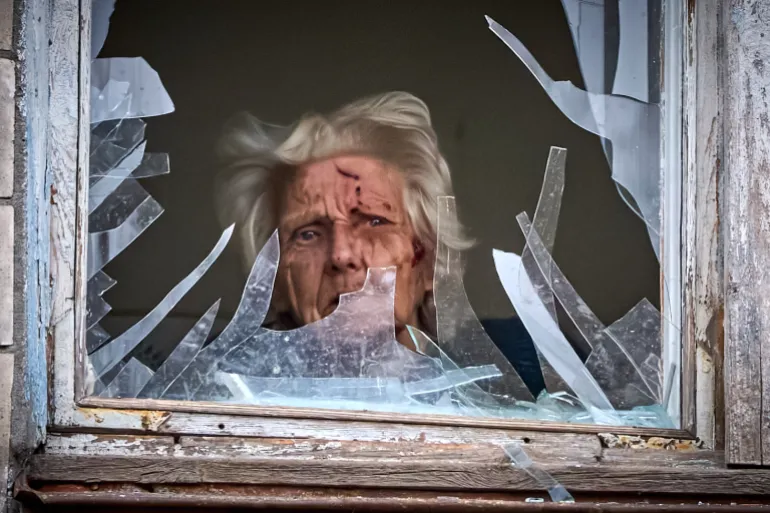
An injured elderly woman looks out of her broken window after an apartment building was hit by a Russian drone during an aerial attack in Kyiv, Ukraine, on Tuesday [Efrem Lukatsky/AP Photo]
Ukraine’s Ministry of Energy said that “emergency power outages” were introduced in several regions across the country due to Russian forces targeting energy infrastructure. The ministry said that it was working to restore electricity to the Rivne, Ternopil and Odesa regions. The ministry said that the situation was “most difficult” in the border regions, “as restoring electricity is complicated by continuous fighting”.
Ukraine’s General Staff said Ukrainian troops have withdrawn from the Donetsk region’s Siversk area after heavy fighting, noting that Moscow’s forces had a “significant advantage” there.
Ukraine’s Ministry of Foreign Affairs said that Ukrainian F-16 fighter pilots shot down 621 of 673 Russian “aerial targets” on Tuesday night, including 34 of 35 cruise missiles.
In Russia, a Ukrainian drone strike on a car killed three men in the Belgorod region on Monday, the region’s emergency response team reported.
Another Ukrainian drone attack in Belgorod on Tuesday killed one person and injured three, the region’s operational headquarters said on Telegram.
Russian forces shot down 56 Ukrainian drones in a day, as well as a guided bomb, Russia’s Ministry of Defence said, according to the state news agency TASS.
Ceasefire
Zelenskyy said in his nightly address, “We sense that America wants to reach a final agreement” to end the war in Ukraine, and that “there is full cooperation” from the Ukrainian side.
In an earlier post on X, Zelenskyy said that “several draft documents have now been prepared”, following talks in Miami. “In particular, these include documents on security guarantees for Ukraine, on recovery, and on a basic framework for ending this war,” he said.
Pope Leo said that Russia’s apparent refusal to agree to a ceasefire on December 25 is “among the things that cause me much sadness”.
“I will make an appeal one more time to people of goodwill to respect at least Christmas Day as a day of peace,” Leo told reporters outside his residence in Castel Gandolfo, Italy.
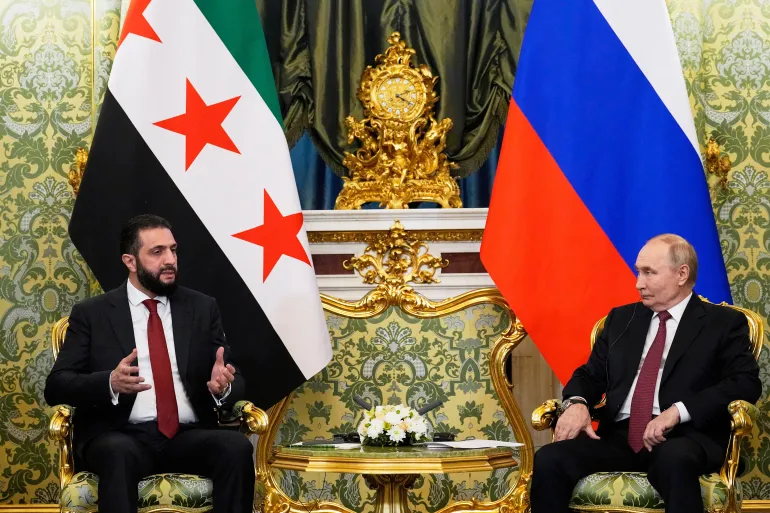
Talks held between Foreign Minister Asaad Hassan Al-Shaibani, Defence Minister Murhaf Abu Qasra and the Russian president.
Syria’s foreign and defence ministers met Russian President Vladimir Putin in Moscow and held discussions on expanding “strategic cooperation in the military industries sector”, Syrian state media has reported.
The Syrian Arab News Agency (SANA) said that Putin’s meeting on Tuesday with Syrian Minister of Foreign Affairs Asaad Hassan Al-Shaibani and Minister of Defence Murhaf Abu Qasra focused on political, economic and military issues of “mutual interest”, but that “particular emphasis” was on defence.
Recommended Stories
list of 4 itemsend of list
According to SANA, Putin and the Syrian ministers discussed a range of defence-related matters, including developing military cooperation to strengthen the Syrian army’s capabilities and modernising its equipment, transferring expertise and cooperation in research and development.
“During the meeting, both sides reviewed ways to advance military and technical partnership in a manner that strengthens the defensive capabilities of the Syrian Arab Army and keeps pace with modern developments in military industries,” SANA reported.
The two sides also discussed political and economic issues, including the “importance of continued political and diplomatic coordination between Damascus and Moscow in international forums”, according to the news agency.
On the economic front, the talks addressed expanding Syrian-Russian cooperation, including in reconstruction projects, infrastructure development and investment in Syria.
Putin also reaffirmed Russian “steadfast support” for Syria and its territorial integrity, while renewing “Moscow’s condemnation of repeated Israeli violations of Syrian territory, describing them as a direct threat to regional security and stability”.
The ministers’ visit to Moscow is the latest by Syria’s new authorities since the removal from power last December of the country’s longtime ruler and Moscow’s former ally in Damascus, Bashar al-Assad.
Russia was a key supporter of al-Assad during Syria’s nearly 14-year civil war, providing vital military aid that kept the Assad regime in power, including Russian air support that rained air strikes on rebel-held areas.
Despite al-Assad and his family fleeing to Russia after the toppling of his regime, Moscow is eager to build good relations with the new government in Damascus.
Moscow, in particular, is hoping to secure agreements to continue operating the Khmeimim airbase and the Tartous naval base on Syria’s Mediterranean coast, where Russian forces continue to be present.
In October, Syria’s new president, Ahmed al-Sharaa, visited Russia, where he said his government would honour all the past deals struck between Damascus and Moscow, a pledge that suggested that the two Russian military bases were secure in the post-Assad period.
Putin said at the time of al-Sharaa’s visit that Moscow was ready to do all it could to act on what he called the “many interesting and useful beginnings” discussed by the two sides on renewing relations.
Russian state media on Tuesday quoted the country’s Ministry of Foreign Affairs spokeswoman, Maria Zakharova, as saying that Russian Foreign Minister Sergey Lavrov would also hold talks with his Syrian counterpart, Al-Shaibani, during the Syrian delegation’s visit.
During a visit to Moscow in July, Al-Shaibani said his country wanted Russia “by our side”.
“The current period is full of various challenges and threats, but it is also an opportunity to build a united and strong Syria. And, of course, we are interested in having Russia by our side on this path,” Al-Shaibani told Lavrov at the time.
Syrian President Ahmed al-Sharaa speaks during a meeting with Russian President Vladimir Putin at the Kremlin in Moscow, Russia, on October 15, 2025 [Pool: Alexander Zemlianichenko via Reuters]
Other countries, including Brazil, Colombia, Ireland, Mexico, Spain and Turkiye, have already joined the case in The Hague.
Published On 23 Dec 202523 Dec 2025
Share
Belgium has formally joined the case launched by South Africa at the International Court of Justice (ICJ) alleging Israel is committing genocide in the Gaza Strip.
In a statement on Tuesday, the ICJ – The Hague-based highest court of the United Nations – said Belgium had filed a declaration of intervention in the case.
Recommended Stories
list of 4 itemsend of list
Other countries, including Brazil, Colombia, Ireland, Mexico, Spain and Turkiye, have already joined the proceedings.
South Africa brought the case in December 2023, arguing that Israel’s war in Gaza violates the 1948 UN Convention on the Prevention and Punishment of the Crime of Genocide.
Israel has rejected the allegations and criticised the case.
While a final ruling could take years, the ICJ issued provisional measures in January 2024 ordering Israel to take steps to prevent acts of genocide in Gaza and to allow unimpeded access for humanitarian aid.
The court’s orders are legally binding although it has no direct mechanism to enforce them.
The ICJ also said Israel’s presence in occupied Palestinian territory is unlawful and its policies amount to annexation.
Israel has continued its assaults in Gaza and the occupied West Bank despite the rulings and growing international criticism while advancing plans to seize large parts of Palestinian territory.
Meanwhile, the United States and several of its European allies continue to provide military and financial support to Israel.
Washington has rejected the merits of South Africa’s case, and US lawmakers have criticised the country and issued threats against it.
The US has also imposed sanctions on members of the International Criminal Court (ICC), which has issued arrest warrants against Israeli Prime Minister Benjamin Netanyahu and former Defence Minister Yoav Gallant.
Belgium was also among a group of countries that recognised the State of Palestine in September. Nearly 80 percent of UN member states now recognise Palestine.
Since a ceasefire began on October 10, the Palestinian Ministry of Health in Gaza said, Israel has killed at least 406 Palestinians and injured 1,118 in the enclave. Since the start of the war on October 7, 2023, the ministry said, at least 70,942 Palestinians have been killed and 171,195 wounded.
The 50-year-old comedian is already facing similar charges, including rape and sexual assault, involving four women.
Published On 23 Dec 202523 Dec 2025
Share
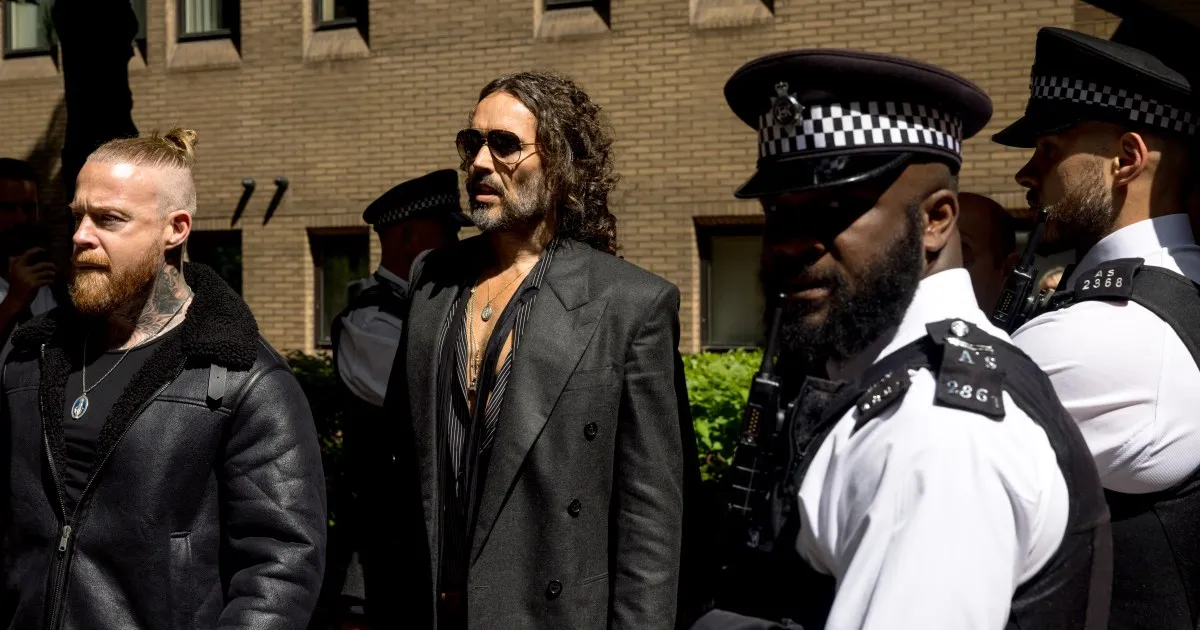
British authorities have brought new counts of rape and sexual assault against comedian Russell Brand, who is already facing similar charges involving four women.
The United Kingdom’s Crown Prosecution Service (CPS) said on Tuesday that the new charges – one count of rape and one of sexual assault – against Brand were in relation to two further women. The alleged offences took place in 2009, the CPS said.
Recommended Stories
list of 3 itemsend of list
Brand, 50, had already been charged in April with two counts of rape, two counts of sexual assault and one count of indecent assault. The charges were brought after an 18-month investigation launched when four women alleged they had been assaulted by the comedian.
Prosecutors said these offences took place from 1999 to 2005, one in the English seaside town of Bournemouth and the other three in London.
Brand pleaded not guilty to those charges in a London court.
He is expected to appear at Westminster Magistrates’ Court on January 20 in relation to the two new charges. A trial has also been scheduled for June 16 and is expected to last four to five weeks.
The Get Him to the Greek actor, known for risque stand-up routines and battles with drugs and alcohol, has dropped out of the mainstream media in recent years. He built a large following online with videos mixing wellness with conspiracy theories as well as discussions about religion.
When the first group of charges was announced in April, Brand said he welcomed the opportunity to prove his innocence.
“I was a fool before I lived in the light of the Lord,” he said in a social media video. “I was a drug addict, a sex addict and an imbecile. But what I never was, was a rapist. I’ve never engaged in nonconsensual activity. I pray that you can see that by looking in my eyes.”
Detective Chief Inspector Tariq Farooqi said the women involved in the case “continue to receive support from specially trained officers”.
He added the police investigation was ongoing and urged “anyone affected by this case or anyone with information to come forward”.
Police say there is ‘insufficient evidence’ to bring charges after investigating comments made at Glastonbury festival.
Published On 23 Dec 202523 Dec 2025
Share
British police have said they will take no further action over comments made by punk-rap duo Bob Vylan about the Israeli military during a performance at the Glastonbury music festival in June.
Avon and Somerset Police said on Tuesday that the remarks did not meet the criminal threshold required for prosecution “for any person to be prosecuted”.
Recommended Stories
list of 4 itemsend of list
During the performance, the group’s lead singer – Pascal Robinson-Foster, known by his stage name Bobby Vylan – led chants of “death, death” directed at the Israeli military over its genocidal war in Gaza.
Police said there was “insufficient evidence to provide a realistic prospect of conviction”. The force added that it interviewed a man in his mid-30s and contacted about 200 members of the public as part of the investigation.
The chant, which was livestreamed by the BBC as part of its Glastonbury coverage on June 28, prompted a widespread backlash. The broadcaster later apologised for transmitting what it described as “such offensive and deplorable behaviour”, and its complaints unit found the BBC had breached editorial guidelines.
Avon and Somerset Police said it had considered the intent behind the words, the wider context, relevant case law and freedom of expression issues before concluding the investigation.
“We believe it is right this matter was comprehensively investigated, every potential criminal offence was thoroughly considered, and we sought all the advice we could to ensure we made an informed decision,” the statement said.
“The comments made on Saturday 28 June drew widespread anger, proving that words have real-world consequences.”
Following the performance, the United States revoked the visas of Bob Vylan, forcing the cancellation of a planned US tour scheduled to begin in October.
Bob Vylan have launched defamation proceedings against Irish broadcaster RTE, alleging it falsely claimed they led anti-Semitic chants during the Glastonbury performance.
In July, the British police also dropped an investigation into the Irish-language rap group Kneecap after chants of “Free Palestine” during a performance.
Detectives sought advice from the Crown Prosecution Service and decided to take no further action, citing “insufficient evidence to provide a realistic prospect of conviction for any offence”.
Police arrest three people outside insurer of Israeli arms maker Elbit, including Thunberg for holding placard.
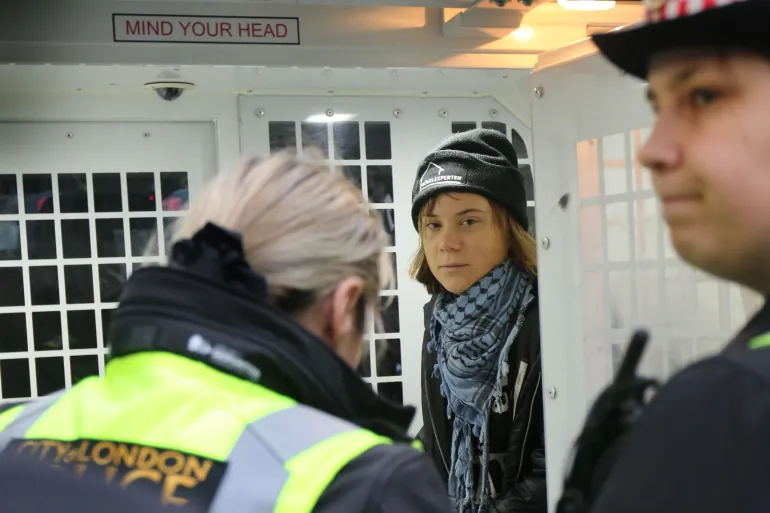
British police have arrested Swedish activist Greta Thunberg and two other people at a pro-Palestine protest in central London, according to campaign group Defend Our Juries.
The group said Thunberg was arrested on Tuesday at the Prisoners for Palestine protest held in the heart of London’s Square Mile financial district outside the offices of Aspen Insurance, which provides coverage for Israeli defence contractor Elbit Systems.
Recommended Stories
list of 3 itemsend of list
The group said Thunberg had arrived after the protest began, and it shared video footage of the activist holding a sign reading, “I support the Palestine Action prisoners. I oppose genocide.” Thunberg has called Israel’s war in Gaza a genocide and has twice joined flotilla campaigns to try to break Israel’s siege of Gaza.
The City of London Police, which polices the financial district, confirmed that a 22-year-old woman, a description corresponding to Thunberg, was arrested for displaying a placard “in support of a proscribed organisation (in this case Palestine Action) contrary to Section 13 of the Terrorism Act 2000”.
This is the latest protest in solidarity with activists from the Palestine Action group, six of whom are currently on hunger strike in British prisons with two now hospitalised. The direct action group has been proscribed as a “terrorist organisation” by the United Kingdom’s government.
Defend Our Juries said Tuesday’s protest was held to draw attention to Aspen Insurance’s “complicity in genocide” and to express solidarity with prisoners affiliated with Palestine Action.
Thunberg is seen after her arrest for holding a placard expressing support for Palestinian Action prisoners and condemnation of Israel’s genocide [Handout/Defend Our Juries]
Two others, a man and a woman, were also arrested at the protest although they had “glued themselves nearby”, according to the City of London Police, which described damage with “hammers and red paint” to “a building on Fenchurch Street”, where the offices of Aspen Insurance are located.
Defend Our Juries confirmed the damage, saying in a news release that two activists “covered the front of the building with symbolic blood-red paint, using re-purposed fire extinguishers” before attaching themselves to the front of the building in the aim of “drawing attention to Aspen’s complicity in Genocide, disrupting their business, and closing down the building”.
The group said Aspen Insurance, a global insurer and reinsurer, was targeted because of its affiliation with Elbit Systems UK, a subsidiary of Elbit Systems, which is Israel’s largest arms producer. It describes its drones as “the backbone” of the Israeli military.
Palestine Action protesters had targeted one of the UK subsidiary’s operations in Bristol last year. Among their five key demands, the group’s hunger strikers want the manufacturer, which has several UK factories, to be shut down.
Defend Our Juries said in its news release that Deputy Prime Minister and Justice Minister David Lammy has “refused to speak to legal representatives of the hunger-strikers, or their families”.
A few days earlier, Thunberg had voiced solidarity with the hunger strikers on Instagram, saying: “It is up to the state to intervene, and put an end to this by meeting these reasonable demands that pave the way for the freedom of all those who choose to use their rights trying to stop a genocide, something the British state has failed to do themselves.”
A Palestine Action spokesperson said in relation to her arrest that it was not clear whether police had “made another one of their mistakes in interpreting the crazy ban on Palestine Action” or whether they had “turned anyone expressing support for prisoners locked up beyond the legal time limit for taking action to stop a genocide into alleged terrorists”.
London, United Kingdom – Lawyers of imprisoned hunger-striking activists linked to the protest group Palestine Action have put the British government on notice as the justice secretary refuses to meet them.
Imran Khan & Partners, which represents the collective, wrote a pre-claim letter to the government on Monday, warning that they would seek a High Court case should officials fail to respond by Tuesday afternoon.
Recommended Stories
list of 4 itemsend of list
Eight activists, aged between 20 and 31, have participated in a rolling strike that began on November 2. There are rising fears that one or more of them could soon die in jail.
In recent days, their relatives and loved ones have told Al Jazeera of their deteriorating health and repeated hospital admissions.
Their lawyers have long called for a meeting with Justice Secretary David Lammy to discuss welfare and prison conditions, believing such an intervention could be life-saving.
But the government has so far refused, saying hunger strikes are not an unusual phenomenon in prisons and that policies to provide adequate medical care to anyone refusing food are being followed.
“Our clients’ food refusal constitutes the largest co-ordinated hunger strike in British history since 1981,” the lawyers wrote, referring to the Irish Republican inmates led by Bobby Sands. Sands and nine others died of starvation, one on day 46 of the protest.
“As of today’s date, [the current] strike has lasted up to 51 days, nearly two months, and poses a significant risk to their life with each passing day,” the lawyers wrote.
The detainees are being held in five prisons over their alleged involvement in break-ins at the United Kingdom’s subsidiary of the Israeli defence firm Elbit Systems in Bristol and a Royal Air Force base in Oxfordshire. They deny the charges against them, such as burglary and violent disorder.
Amu Gib, Heba Muraisi, Teuta Hoxha and Kamran Ahmed are on day 52, 51, 45 and 44 of their protests, respectively. Lewie Chiaramello, who is diabetic and refuses food every other day, began his protest 30 days ago.
Qesser Zuhrah, Jon Cink and Umer Khalid have ended their strike.
All eight will have spent more than a year in prison before their trials take place, well beyond the UK’s usual six-month pre-trial detention limit.
The hunger strikers’ five demands include immediate bail, the right to a fair trial and the de-proscription of Palestine Action, which accuses the UK government of complicity in Israel’s war crimes in Gaza. The UK government banned Palestine Action in July, branding it a “terror” group, a label that applies to groups such as ISIL (ISIS). The protesters have called for an end to alleged censorship in prison, accusing authorities of withholding mail, calls and books. They are also urging that all Elbit sites be closed.
‘Engage with each one’
Leading human rights barrister Michael Mansfield has backed calls for the government to intervene.
“It’s a simple proposition, engage with each one,” he told Al Jazeera. “That’s your job [as government], that’s what you’re there for. You are safeguarding people’s health, welfare and life.”
In a letter addressed to Lammy, he wrote, “Fundamental human rights in the United Kingdom are being destroyed in this quagmire of disinterest and populist politics, the most important being the presumption of innocence and the right to a fair trial by means of preparation and due process.
“There has to be an equality of arms which can hardly be achieved when a defendant is held in oppressive and lengthy periods of remand.”
Families of the prisoners have alleged mistreatment in prison, saying some detainees have been verbally abused and left without care in dangerous health conditions. The Ministry of Justice has denied these accusations and says it cannot comment on individual cases.
“Government takes action when it chooses to,” Mansfield wrote. “There could be no more appropriate time than now with the life-endangering protest by the hunger strikers. The delay is grotesque in some cases, up to two years with trial dates being set in 2027.”
Nida Jafri, a friend of hunger striker Amu Gib, plans to deliver Mansfield’s letter – and one of her own – in hand to the Ministry of Justice on Tuesday.
“These people are on remand – not convicted, still awaiting full legal process,” reads Jafri’s letter. “They are weak, in pain, and visibly wasting away. The absence of adequate medical observation or humane treatment under prison or hospital care is not only unacceptable; it breaches fundamental rights to health, dignity, and life.”
“This [killing in Moscow] is a mode of warfare which would be referred to as, quote-unquote, irregular.”
The killing of a top Russian general is a “direct message” to senior Russian military leaders from Ukraine, says Marina Miron, of King’s College London.
Liverpool manager Arne Slot says star forward Alexander Isak will be on the sidelines until at least late February.
Published On 23 Dec 202523 Dec 2025
Share
Alexander Isak is expected to be out of action for two months after fracturing his leg against Tottenham, with Liverpool manager Arne Slot accusing Tottenham’s Micky van de Ven of making a “reckless challenge”.
The Sweden striker was injured in a tackle from the defender in the act of scoring the opening goal in Saturday’s 2-1 victory and limped off the pitch.
Recommended Stories
list of 3 itemsend of list
Liverpool said in a statement on Monday that the forward had had an operation on an ankle injury that included a fibula fracture.
“It’s going to be a long injury, for a couple of months,” Slot told reporters on Tuesday, “So, yeah, that’s a big, big, big disappointment for him. And as a result, also of course for us.”
Slot described Van de Ven’s tackle as “reckless”.
“I think I said a lot about the tackle of Xavi Simons [sent off earlier in the game for Spurs], which for me was completely unintentional, and I don’t think you will ever get an injury out of a tackle like that.
“The tackle of Van de Ven, if you make that tackle 10 times, I think 10 times there’s a serious chance that a player gets a serious injury.”
Isak, centre, gets injured in a challenge with Tottenham Hotspur’s Dutch defender #37 Micky van de Ven at the Tottenham Hotspur Stadium in London, on December 20, 2025 [Justin Tallis/AFP]
Isak’s challenging year continues
Isak’s injury is the latest setback for the forward after he signed from Newcastle for a British record 125 million pounds ($168m) in September.
A dispute with Newcastle meant he did not have a proper preseason programme and arrived at Liverpool well behind his teammates in terms of fitness.
His season was then interrupted by a groin injury.
The 26-year-old has scored just three goals in 16 appearances since completing his protracted move to Anfield.
Isak’s absence will be a major blow for Reds boss Slot, with Mohamed Salah at the Africa Cup of Nations and Cody Gakpo not ready to return from a muscle injury until early in the new year.
It leaves Slot with Hugo Ekitike, who has five goals in his past four games, and the little-used Federico Chiesa as his only senior forwards.
Liverpool, whose Premier League title defence collapsed after a shocking run of results, have climbed to fifth in the table after extending their unbeaten league run to five games.
Isak’s injury raises the prospect of Liverpool moving to boost their attack in the January transfer window, with Bournemouth winger Antoine Semenyo linked with a move to Anfield.
It may also change the conversation around Salah, who had been linked with a move to Saudi Arabia following his recent claim that he had been thrown under the bus by the club and no longer had a relationship with Slot.
Salah’s rant, which came after he was left on the bench for three successive matches, prompted Liverpool to leave him out of the squad for a Champions League match at Inter Milan.
But he returned to action as a substitute against Brighton before leaving for international duty.
Kyiv, Ukraine – Have you been on a plane during severe turbulence, fearing that the shaking aircraft is about to fall apart and tumble down? Brief moments of weightlessness stop your breath, perhaps you whisper prayers and remember everyone you love.
That’s the feeling you get during a Russian air raid in Kyiv, Ukraine, and there have been more than 1,800 of them since Russia’s full-scale invasion began in 2022.
Recommended Stories
list of 4 itemsend of list
These days, they are bigger, scarier and longer than ever, because each one involves hundreds of drones and dozens of missiles.
They begin after dark and sometimes last in waves until dawn. Whooshing missiles tear up the night sky in two. Drones buzz like horror movie chainsaws or giant mosquitoes out of childhood flu nightmares.
What’s really harrowing is to hear two or three drones at once – I sardonically call it “stereo” and “Dolby surround” – while the arrhythmia of bass drum-like air defence explosions coincides with your heartbeat.
Each boom and thud chokes your body with adrenaline, and some shake your house, but after a couple of hours, your brain gives up, and you fall asleep processing the booms into nightmares.
And in the morning, you fall awake – feeling hungover and disoriented – and read about the consequences. You’re glad when no one is killed, and still sad because several people are usually wounded, and several apartment buildings are damaged.
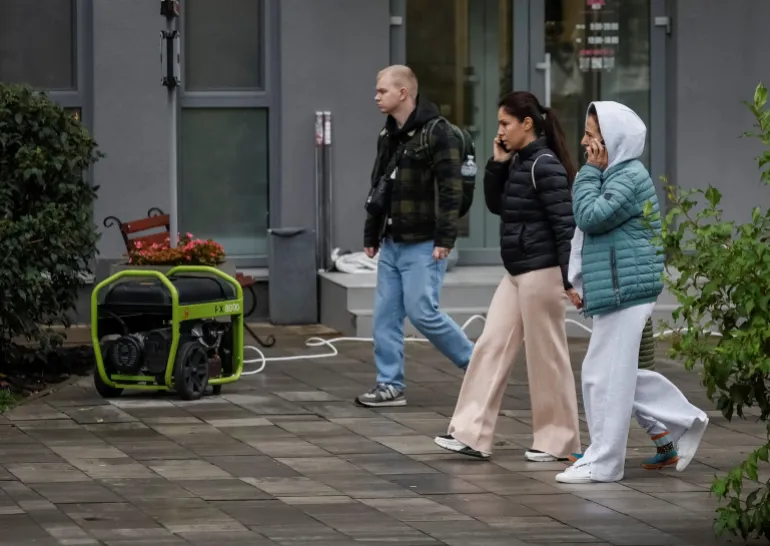
People walk near a petrol-run generator, used to generate electricity for a medical clinic during a power blackout, after critical civil infrastructure was hit by Russian missile and drone attacks in Kyiv, Ukraine, October 10, 2025 [Gleb Garanich/Reuters]
Sometimes, I think about the people who operate the drones and launch the missiles. How they come back to their families after the night shift, what they tell their children and, most importantly, themselves.
But I prefer the memory of a crowd of high school graduates who walked past my house in June, at dawn, after their prom night that coincided with an especially long and loud air raid.
Their laughter and happiness about the sunrise, the clouds of blossoming trees around them, the rugs of flowers and grass under their feet, and the future ahead of them made them sound immortal. It was a sound that defied Russian President Vladimir Putin.
In recent months, blackouts have been the most inevitable part of each air raid. It feels as though keeping millions awake and horrified during the raids is only part of Moscow’s strategy of terrorising Ukraine.
Moscow’s logic appears simple: if you do not want to surrender, you will freeze. It methodically destroys power stations, transmission and central heating lines to keep millions without electricity, light and heat.
And then there are “planned outages”. There are usually three a day, lasting between two and eight hours.
You can hear an outage because even the sounds in your ears barely register, such as the fridge’s purring or the flow of hot water in the heating system, are gone. You can see an outage because the neighbourhood lights go out, making the stars in the night sky closer and brighter.
How to survive darkness
What saves you from darkness and disconnection is gadgets.
Apart from smartphones with energy-saving modes, wi-fi hotspots and flashlights, there are laptops, tablets, wireless speakers and vacuum cleaners running on batteries.
There are also inexpensive rechargeable lamps – I have 10 of them. Three are pint-sized and bright enough for my mother to read. Three more are motion-activated, which means she can safely use the bathroom any time, and the cat is perpetually amazed.
There is a cap lamp that makes me look like a miner and helps me cook or find something in the basement, and two tiny lamps that can be stuck into a power bank and just glow in a corner.
And there is a Christmas garland in the kitchen that makes each outage feel festive.
But the most important device, the symbolic hearth of my powerless house, is a $1,200, 20kg (40lbs) battery that can keep us warm and energised for up to 12 hours.
I live on the outskirts of Kyiv in a remodelled summer house that has its own pump and a natural gas-powered heating system. Both need electricity, along with the two 50-litre (13-gallon) water heaters.
But boiling water and microwaving meals is too energy-consuming, so we stick to frying pans and an old-fashioned whistling kettle that scares the cat.
And when the power is back on, there is no room for procrastination.
You need to recharge all the lamps and devices, start a washing machine, wash dishes, and go out for groceries without risking your life while crossing the road with the traffic lights off.
The electricity’s comeback may be deceptive – sometimes, it’s too weak. I recently tried to microwave a bowl of soup, twice, but it remained cold.
And for extreme emergencies, I have a gasoline-fuelled generator. It’s loud, shaky and stinky, and you need an entire canister of gas worth $30 for it to keep it going all night.
But such generators keep Ukraine running.
You can see them next to shops, offices and apartment buildings. Some are chained to trees or walls to prevent theft, and some are too huge and heavy to be carried away.
During a recent music festival celebrating Ukrainian composers, a giant diesel generator powered the concert hall.
My internet provider turns them on seconds after an outage begins, so I am online no matter what.
You also need to be prepared when you go out.
After covering the 2008 Russian war in Georgia, I used to drive everyone around me mad with my I-have-to-be-ready-for-any-emergency obsession.
Now, all of Ukraine feels the same obsession.
The phone has to be fully charged. There has to be a power bank in my backpack – along with a basic first aid kit, a lighter (I don’t smoke), extra batteries for the Dictaphone, pens and a pencil to take notes in subzero temperatures, when ballpen ink freezes.
A couple of months ago, I used the lighter at Kyiv’s Independence Square, dotted with hundreds of tiny Ukrainian flags next to photos of fallen soldiers.
I helped a man with a toddler light a tiny candle that he wanted to place next to the photo of his younger brother.
“He’s the toddler’s father,” the man said, and all I could utter was “God rest his soul” as I walked away, hiding tears and putting the lighter back.
These are the key developments from day 1,398 of Russia’s war on Ukraine.
Published On 23 Dec 202523 Dec 2025
Share
Here is where things stand on Tuesday, December 23:
Fighting
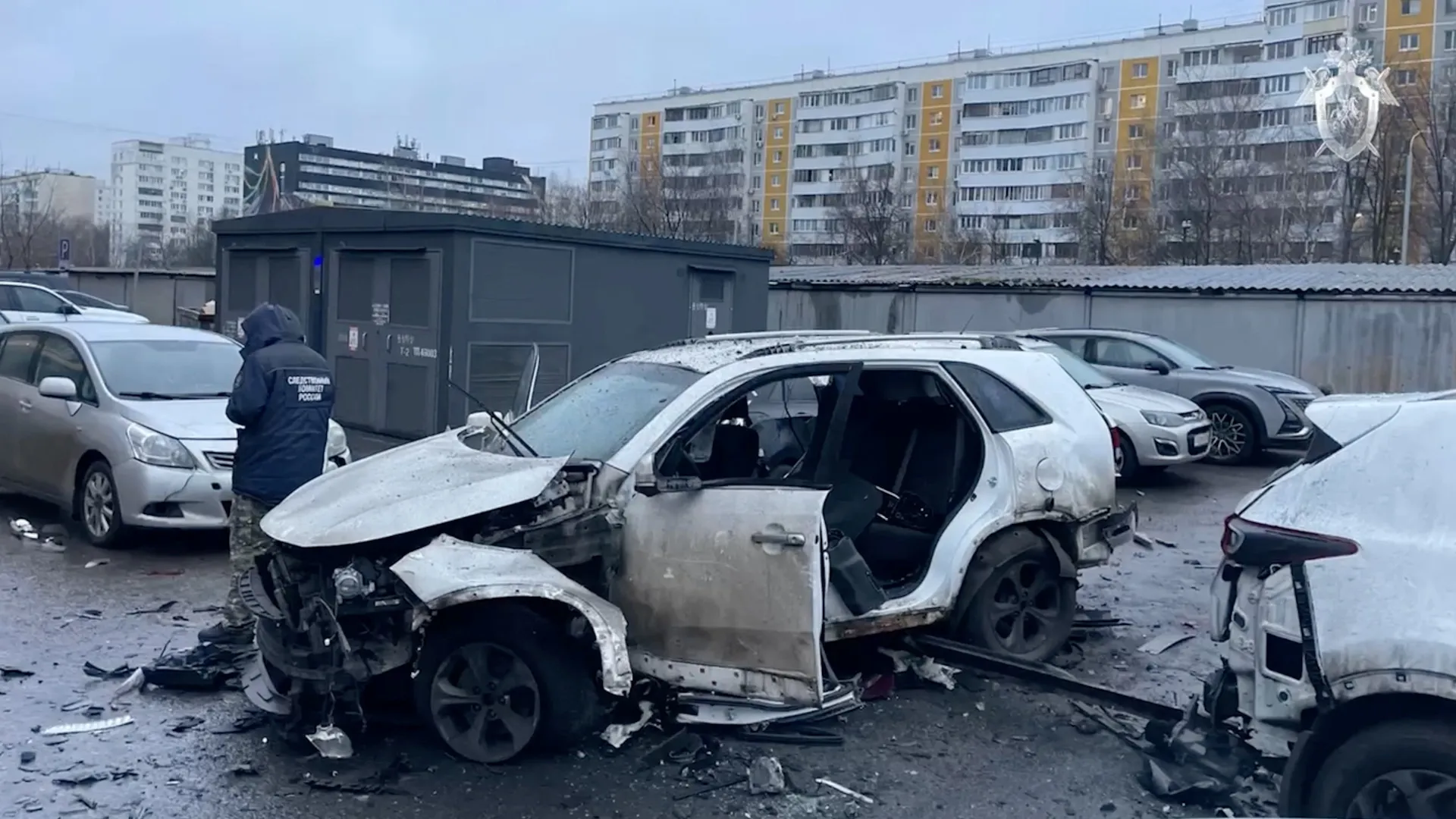
A car bomb killed Russian Lieutenant General Fanil Sarvarov in southern Moscow, the third such killing of a senior Russian military officer in just more than a year. Russian investors pointed the finger at Ukraine. Kyiv has not commented on the incident.
Russian forces struck Ukraine’s Black Sea port of Odesa late on Monday, damaging port facilities and a ship in the second such attack on the region in less than 24 hours, according to Ukrainian officials.
Ukrainian Deputy Prime Minister Oleksii Kuleba said on the Telegram app that the latest attack on Odesa is part of Russia’s attempt “to disrupt maritime logistics by launching systematic attacks on port and energy infrastructure”.
Kuleba said the attack also caused damage to energy infrastructure, disrupting electricity supply to more than 120,000 customers in the Odesa region. One person was hurt in the attack, the Ministry of Internal Affairs said.
Ukrainian President Volodymyr Zelenskyy confirmed media reports that residents of Hrabovske village, straddling the border with Russia in Ukraine’s Sumy region and home to 52 people, were taken by Russian troops. Zelenskyy said that 13 Ukrainian servicemen were among those taken.
Ukraine’s military said it hit a Tamanneftegaz oil terminal in Russia’s Krasnodar region in an overnight attack, causing explosions and a fire. The Ukrainian General Staff said the oil terminal was part of Russia’s energy infrastructure that supported the financing and logistics of Russian troops fighting in Ukraine.
A Ukrainian drone attack also damaged two vessels in the same region. All crew on the ships at the Volna terminal have been safely evacuated, according to regional authorities.
Russia’s Ministry of Defence said it had captured Vilcha village in Ukraine’s eastern Kharkiv region. The claim could not be immediately verified.
Politics and diplomacy
US President Donald Trump said that talks to end the war in Ukraine are going “OK”, amid questions about their progress, with Moscow and Kyiv still far apart on some key matters.
Zelenskyy, meanwhile, described the negotiations in Miami as “very close to a real result”. He also told a gathering of Ukrainian diplomats that the peace process “all looks quite worthy”, even as he conceded that “not everything is ideal with this, but the plan is there”.
Separately, in his nightly video address to the nation, Zelenskyy said the key issue in the talks was to determine whether the US was able to “get a response from Russia; real readiness on the part of that country to focus on something other than aggression”. He said that continued pressure on the Kremlin was vital to reduce Moscow’s capacity to wage war.
The Kremlin said talks between Russia and the US in Miami on ways to resolve the conflict in Ukraine should not be seen as a breakthrough. Kremlin spokesman Dmitry Peskov told the Izvestia news outlet that the discussions were expected to continue in a “meticulous” expert-level format.
Peskov also questioned the reliability of the sources cited in a Reuters news agency report, which said that the US intelligence community believes Putin wants to seize all of Ukraine and reclaim parts of Europe that belonged to the former Soviet bloc. Peskov told reporters in Moscow that if the report was accurate, then the US’s intelligence conclusions were wrong.
Russian Deputy Foreign Minister Sergey Ryabkov declared that Moscow is ready to confirm in a legal agreement that it has no intention of attacking either the European Union or the US-led NATO military alliance, the state RIA news agency reported.
Military aid
The Czech Republic’s National Security Council will debate the future of a Czech-led, Western-financed scheme organising artillery ammunition supplies for Ukraine on January 7, Prime Minister Andrej Babis said. The scheme also brings together foreign donors, including Germany, Denmark and the Netherlands.
Regional security
Swedish customs released the Russian ship Adler, which it boarded over the weekend to perform an inspection, with marine tracking data showing the vessel was on the move again. Swedish customs declined to say what cargo the Adler had been carrying. The Adler is under EU sanctions, while the vessel and its owners, M Leasing LLC, are both subject to US sanctions, suspected of involvement in weapons transport.
United States President Donald Trump has issued a new warning to Nicolas Maduro, saying “it would be smart” for the Venezuelan leader to leave power, as Washington escalates a pressure campaign against Caracas.
The warning on Monday came as Russia pledged “full support” for Maduro’s government, and China condemned the US’s seizure of two oil tankers off the coast of Venezuela.
Recommended Stories
list of 4 itemsend of list
Trump, speaking at his Mar-a-Lago resort in Florida alongside his top national security aides, Secretary of State Marco Rubio and Secretary of Defense Pete Hegseth, suggested that he remains ready to further escalate his four-month pressure campaign.
When asked if the goal was to force Maduro from power, Trump told reporters: “Well, I think it probably would… That’s up to him what he wants to do. I think it’d be smart for him to do that. But again, we’re gonna find out.”
“If he wants to do something, if he plays tough, it’ll be the last time he’s ever able to play tough,” he added.
Trump levied his latest threat as the US coastguard continued for a second day to chase a third oil tanker that it described as part of a “dark fleet” that Venezuela uses to evade US sanctions.
“It’s moving along, and we’ll end up getting it,” Trump said.
The US president also promised to keep the ships and the nearly 4 million barrels of Venezuelan oil the coastguard has seized so far.
“Maybe we’ll sell it. Maybe we’ll keep it. Maybe we will use it in the strategic reserves,” he said. “We’re keeping it. We’re keeping the ships also.”
Maduro fires back
Trump’s campaign against Venezuela’s vital oil sector comes amid a large US military buildup in the region with a stated mission of combating drug trafficking, as well as more than two dozen strikes on alleged drug trafficking vessels in the Pacific Ocean and Caribbean Sea near the South American nation.
Critics have questioned the legality of the attacks, which have killed more than 100 people.
Venezuela denies any involvement in drug trafficking and insists that Washington is seeking to overthrow Maduro to seize the country’s oil reserves, which are the world’s largest.
It has condemned the US’s vessel seizures as acts of “international piracy”.
Maduro fired back at Trump hours after the latest warning, saying the US president would be “better off” if he focused on his own country’s problems rather than threatening Caracas.
“He would be better off in his own country on economic and social issues, and he would be better off in the world if he took care of his country’s affairs,” Maduro said in a speech broadcast on public television.
The exchange of words came on the eve of a United Nations Security Council meeting on Tuesday to discuss the growing crisis.
Russia’s Minister of Foreign Affairs Sergey Lavrov, in a phone call with his Venezuelan counterpart, Yvan Gil, slammed the US’s actions and expressed support for Caracas.
“The ministers expressed their deep concern over the escalation of Washington’s actions in the Caribbean Sea, which could have serious consequences for the region and threaten international shipping,” the Russian Ministry of Foreign Affairs said in a statement.
“The Russian side reaffirmed its full support for and solidarity with the Venezuelan leadership and people in the current context,” it added.
US blockade
China also condemned the US’s latest moves as a “serious violation of international law”.
“China opposes any actions that violate the purposes and principles of the United Nations Charter and infringe upon the sovereignty and security of other countries,” said Lin Jian, a spokesperson for the Chinese Foreign Ministry.
“Venezuela has the right to develop independently and engage in a mutually beneficial cooperation with other nations. China understands and supports Venezuela’s stance in safeguarding its legitimate rights and interests,” he added.
Last week, Rubio brushed aside Moscow’s stated support for Caracas.
Washington, he said, was “not concerned about an escalation with Russia with regards to Venezuela” as “they have their hands full in Ukraine”.
US-Russia relations have soured in recent weeks as Trump has voiced frustration with Moscow over the lack of a resolution on the war in Ukraine
Gil, on Monday, also read a letter on state television, signed by Maduro and addressed to UN member nations, warning that the US blockade “will affect the supply of oil and energy” globally.
“Venezuela reaffirms its vocation for peace, but also declares with absolute clarity that it is prepared to defend its sovereignty, its territorial integrity and its resources in accordance with international law,” he said.
“However, we responsibly warn that these aggressions will not only impact Venezuela. The blockade and piracy against Venezuelan energy trade will affect oil and energy supply, increase instability in international markets, and hit the economies of Latin America, the Caribbean, and the world, especially in the most vulnerable countries.”
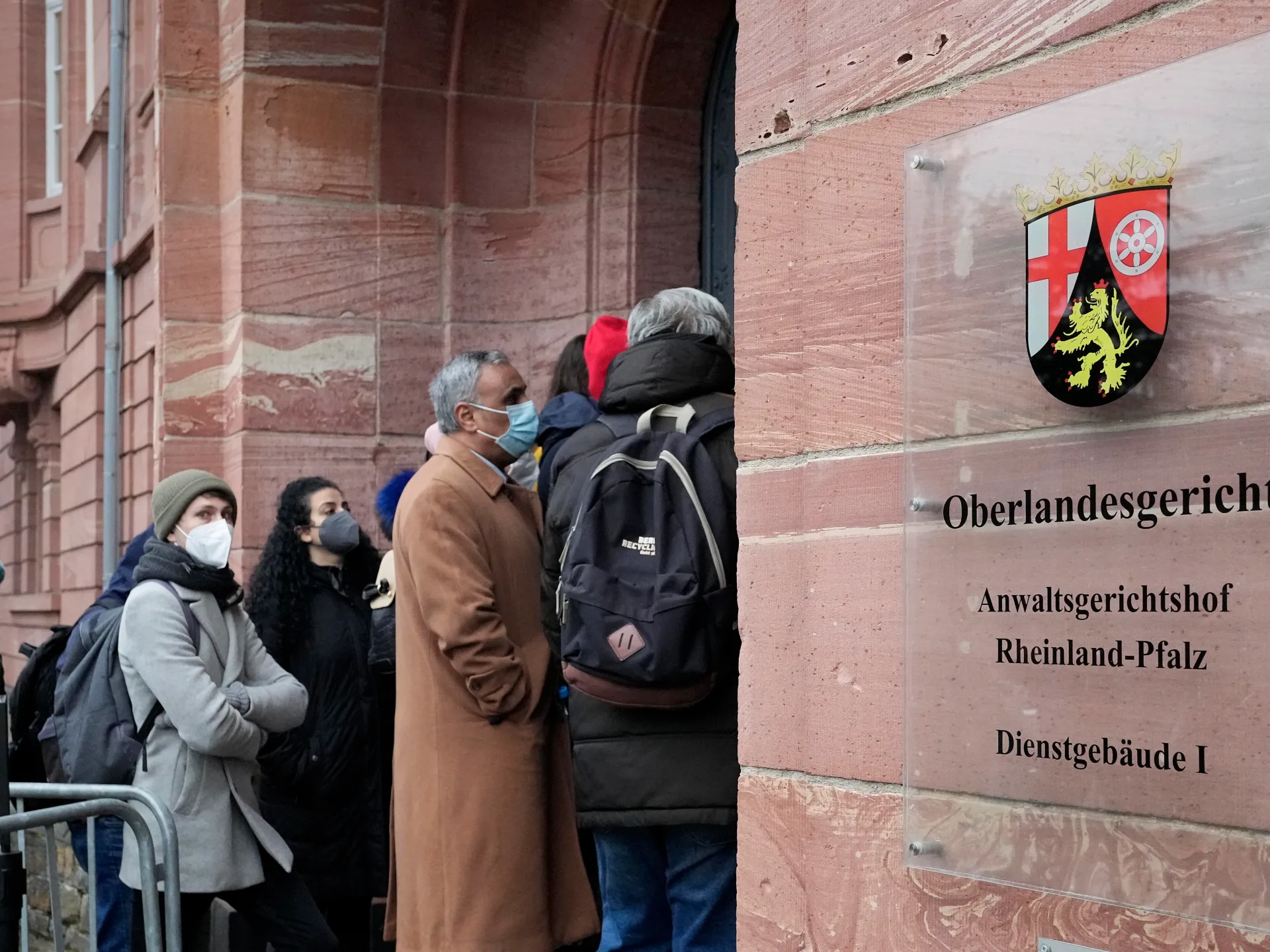
Prosecutors accuse the official, named as Fahad A, of torturing dozens of prisoners in jail run by Syrian intelligence.
Published On 22 Dec 202522 Dec 2025
Share
German prosecutors have charged a former Syrian security official with crimes against humanity, accusing him of torturing dozens of prisoners at a Damascus jail while ex-President Bashar al-Assad was in power.
Germany’s Federal Public Prosecutor General’s office announced the indictment on Monday, alleging the ex-prison guard, named only as Fahad A, took part in more than 100 interrogations between 2011 and 2012 in which prisoners were “subjected to severe physical abuse”.
Recommended Stories
list of 3 itemsend of list
The abuse included electric shocks, cable beatings, forced stress positions and suspensions from the ceiling, according to a statement by the prosecutor’s office.
“As a result of such mistreatment and the catastrophic prison conditions, at least 70 prisoners died,” said the statement, noting the former guard is also charged with murder.
The official was arrested on May 27 and formally indicted on December 10.
He is being held in pre-trial detention, the German prosecutor’s office added.
Syrians have demanded justice for crimes committed under the decades-long rule of al-Assad, who was removed from power in December 2024 after a rapid rebel offensive.
The Assad regime, which was accused of mass human rights abuses, including the torture of detainees and enforced disappearances, fell after nearly 14 years of civil war.
Universal jurisdiction
In Germany, prosecutors have used universal jurisdiction laws to seek trials for suspects in crimes against humanity committed anywhere in the world.
Based on these laws, several people suspected of war crimes during the Syrian conflict have been arrested in the last few years in Germany, which is home to about one million Syrians.
In June, a court in Frankfurt handed a life sentence to a Syrian doctor convicted of carrying out acts of torture as part of al-Assad’s crackdown on dissent.
The doctor, Alaa Mousa, was accused of torturing patients at military hospitals in Damascus and Homs, where political prisoners were regularly brought for supposed treatment.
Witnesses described Mousa pouring flammable liquid on a prisoner’s wounds before setting them alight and kicking the man in the face, shattering his teeth. In another incident, the doctor was accused of injecting a detainee with a fatal substance for refusing to be beaten.
One former prisoner described the Damascus hospital where he was held as a “slaughterhouse”.
Presiding judge, Christoph Koller, said the verdict underscored the “brutality of Assad’s dictatorial, unjust regime”.
A Russian general was killed in Moscow on Monday when an explosive device detonated underneath his car. Authorities say they are investigating whether Ukrainian special services were involved.
Four residents of Pari, a low-lying Indonesian island, filed the complaint in January 2023.
Published On 22 Dec 202522 Dec 2025
Share
A Swiss court has agreed to hear a legal complaint against cement giant Holcim, accusing the company of failing to do enough to cut carbon emissions.
NGO Swiss Church Aid (HEKS/EPER), which is supporting the complainants, said on Monday that the court had decided to admit the legal complaint. Holcim confirmed the decision and said it plans to appeal.
Recommended Stories
list of 4 itemsend of list
The complaint was filed in January 2023 by four residents of Pari, a low-lying Indonesian island that has suffered repeated flooding as rising global temperatures drive up sea levels. The case was submitted to a court in Zug, Switzerland, where Holcim has its headquarters.
According to HEKS, this is the first time a Swiss court has admitted climate litigation brought against a big corporation.
If successful, it would also be the first case seeking to hold a Swiss company legally responsible for its contribution to global warming, the group has previously said.
The lawsuit is also among the first climate cases brought by people in the Global South directly affected by climate change and forms part of a growing push for compensation for “loss and damage”, campaigners backing the case said.
The nongovernmental organisation supporting the plaintiffs said Holcim was selected because it is one of the world’s largest carbon dioxide emitters and the biggest so-called “carbon major” based in Switzerland.
A study commissioned by HEKS and conducted by the United States-based Climate Accountability Institute found that Holcim emitted more than 7 billion tonnes of carbon dioxide between 1950 and 2021 – about 0.42 percent of total global industrial emissions over the period.
Holcim has said it is committed to reaching net-zero emissions by 2050 and is following a science-based pathway to meet that goal. The company says it has cut direct CO2 emissions from its operations by more than 50 percent since 2015.
The plaintiffs are seeking compensation for climate-related damage, financial contributions to flood protection measures on Pari Island, and a rapid reduction in Holcim’s carbon emissions.
Cement production accounts for about 7 percent of global carbon dioxide emissions, according to the Global Cement and Concrete Association.
London, United Kingdom – Two Palestine Action-affiliated remand prisoners on hunger strike have been taken to hospital, according to a family member and a friend, adding to fears that the young Britons refusing food in protest could die at any moment.
Twenty-eight-year-old Kamran Ahmed, who is being held at Pentonville prison in London, was hospitalised on Saturday, his sister, Shahmina Alam, told Al Jazeera.
Recommended Stories
list of 4 itemsend of list
Amu Gib, 30, who has not eaten food for 50 days at HMP Bronzefield in Surrey, was taken to hospital on Friday, said the Prisoners for Palestine group and friend Nida Jafri, who is in regular contact with them. Gib uses the pronoun they.
Ahmed and Gib are among six detainees protesting across five prisons over their alleged involvement in break-ins at the United Kingdom’s subsidiary of the Israeli defence firm Elbit Systems in Bristol and a Royal Air Force base in Oxfordshire.
They deny the charges against them, such as burglary and violent disorder.
“It’s day 42 [of Ahmed’s hunger strike], and at this point, there’s significant risk of organ damage,” said his sister, Alam. “We know that he’s rapidly been losing weight in the last few days, losing up to half a kilogram [1.1lbs] a day.”
Ahmed’s last recorded weight was 60kg (132lbs).
When Al Jazeera first interviewed Alam on December 12, Ahmed, who is 180cm (5′ 11”), weighed 64kg (141lbs), having entered prison at a healthy 74kg (163lbs). On Thursday, Alam told journalists at a news conference in London that he weighed 61.5kg (136lbs).
Ahmed’s speech was slurred in a call with the family on Friday, said Alam. He is said to be suffering from high ketone levels and chest pains.
“Honestly, I don’t know how he’s going to come out of this one,” said Alam.
It is the third time Ahmed has been hospitalised since he joined the hunger strike.
Shahmina Alam with her younger brother, Kamran Ahmed, a Palestine Action-linked hunger striker [Courtesy of the Alam family]
‘Critical stage’
The hunger strikers’ demands include immediate bail, the right to a fair trial and the de-proscription of Palestine Action, which accuses the UK government of complicity in Israel’s war crimes in Gaza. The UK government banned Palestine Action in July, branding it a “terror” group, a label that applies to groups such as ISIL (ISIS).
The protesters have called for an end to their alleged censorship in prison, accusing authorities of withholding mail, calls and books. They are also urging that all Elbit sites be closed.
The six are expected to be held for more than a year until their trial dates, well beyond the UK’s six-month pre-trial detention limit.
Qesser Zuhrah, a 20-year-old who has refused food for 50 days, is also in hospital, having lost 13 percent of her body weight, according to her lawyers. The other protesters are Heba Muraisi, Teuta Hoxha and Lewie Chiaramello, who is diabetic and refuses food every other day.
There was no immediate comment from either Pentonville or HMP Bronzefield.
‘I’m scared’
Gib called their friend, Jafri, on Thursday from prison, telling her they needed a wheelchair to attend a doctor’s appointment where their vital signs would be checked.
Prison staff at first “refused” to provide a wheelchair, and later, after offering one, “refused to push” it, Jafri said. “So they laid there with … no check of their vitals on day 47 of their hunger strike,” Jafri said.
When they are hospitalised, the prisoners are unable to call their loved ones, as they can from jail.
Jafri told Al Jazeera, “I’m scared they’re there alone with no phones and no calls allowed.”
Gib, who has lost more than 10kg (22lbs), is below the normal range for most health indicators, which is “highly concerning” for their immune system, their lawyers have said.
Prison officials have “failed to provide [Gib] with thiamine [a vitamin] consistently, and Amu is feeling the effects on their cognitive function”, the lawyers said.
Gib’s eyes are also “sore with the bright [prison] lights”, Jafri said.
Amu Gib (left) with their friend, Nida Jafri [Courtesy: Nida Jafri]
The lawyers have demanded a meeting with Secretary of State for Justice David Lammy, hoping his intervention could be life-saving. Thousands of everyday Britons, hundreds of doctors and dozens of MPs have urged Lammy to heed their call. But so far, he has refused, leading critics to accuse the UK government of wilfully ignoring the issue.
The UK media have also been accused of downplaying the protest and its dangers.
The protest is said to be the largest coordinated hunger strike in UK prisons since 1981, when Irish Republican inmates led by Bobby Sands refused food.
“In contrast to the robust media coverage of the Irish hunger strikes in the 1980s, the Palestine Action hunger strikes have been largely met with media silence,” wrote Bart Cammaerts, a professor of politics and communication at the London School of Economics.
“What will it take for the British media to pay attention to the plight of jailed pro-Palestinian activists? The death of an activist? Or the awakening of a moral conscience?”

















![Shahmina Alam with Kamran Ahmed - Palestine Action linked hunger striker [Courtesy of Alam family]](https://i0.wp.com/www.aljazeera.com/wp-content/uploads/2025/12/WhatsApp-Image-2025-12-15-at-15.26.19-1-1765801678.jpg?w=640&ssl=1)
