Louisiana Gov. Jeff Landry, left, is deploying up to 350 Louisiana National Guard members to New Orleans through February to ensure safety and assist the Trump administration’s federal immigration law enforcement efforts there. File Photo by Samuel Corum/UPI | License Photo
Dec. 25 (UPI) — Up to 350 Louisiana National Guard members began deploying this week in New Orleans and will stay through February to help maintain peace and safety during New Year’s and special events.
The deployment also comes amid efforts to locate and deport those who illegally are in the United States.
“These National Guard troops will support federal law enforcement partners, including the Department of Justice and the Department of Homeland Security, as they enforce federal law and counter high rates of violent crime in New Orleans and other metropolitan areas in Louisiana,” Defense Department spokesman Sean Parnell said in a prepared statement on Tuesday.
Louisiana Gov. Jeff Landry maintains his command and control of the state’s National Guard, whose mission is to enhance safety.
He said the troops will be fully deployed ahead of New Year’s Eve and will stay in New Orleans at least through February.
The deployment was announced after the Supreme Court on Tuesday struck down President Donald Trump’s effort to deploy the Illinois National Guard in Chicago over the protests of Illinois Gov. J.B. Pritzker and Chicago Mayor Brandon Johnson.
The troops will be tasked with ensuring safety in the French Quarter during New Year’s celebrations and during the Sugar Bowl and Mardi Gras.
“We know how to make cities safe, and the National Guard complements cities that are experiencing high crime,” Landry said during an appearance on The Will Cain Show.
He cited President Donald Trump’s National Guard deployment in Washington, D.C., as an example of how the troops can make cities safer for residents and visitors.
“When he wanted to send the National Guard into Washington, D.C., Louisiana was one of the first to raise its hand and say our troops will go there,” Landry said. “And the city is so much better.”
Istanbul officials on Thursday announced they detained 115 suspected members of ISIS who were planning terror attacks in Turkey aimed at mostly non-Muslim people at Christmas and New Year events, such as the Christmas mass at Saint Antuan Church pictured in 2022. File Photo by Erdem Sahin/EPA
Dec. 25 (UPI) — Police in Turkey detained 115 people on Thursday suspected of planning to stage terror attacks at Christmas and New Year’s Day celebrations in the country.
The Istanbul Provincial Police Department, on instruction from the city’s Chief Public Prosecutor’s Office, carried out 124 raids targeting 137 suspected members of ISIS, officials said in a press release.
“These suspects were identified as being in contact with conflict zones within the scope of terrorist organization activities,” the prosecutor’s office said in a press release posted to X.
The suspects, prosecutors said, were “planning attacks and issuing calls for action targeting our country — specifically aimed at non-Muslim individuals — within the context of upcoming Christmas and New Year events.”
Officials apprehended 115 of the 137 suspects and seized pistols, cartridges and “numerous organization documents” during the raids.
The Turkish National Intelligence Organization had earlier captured what it said is a senior ISIS figure who is suspected of being sent to carry out a suicide attack in Turkey, the Daily Sabah reported.
Other ISIS operators had as a result been investigated in Turkey after spending time in the Afghanistan-Pakistan border region where they trained and planned for potential security attacks, according to Turkish intelligence figures.
Turkey, which shares a border with Syria, where ISIS continues to operate, has worked with Syria’s new president, as well as officials in the United States and Europe, to investigate and root what is left of the terrorist group, the BBC reported.
A young girl sits in front of a nativity scene in Manger Square, outside the Church of Nativity, in the biblical town of Bethlehem, West Bank, on December 23, 2025. Photo by Debbie Hill/UPI | License Photo
Dec. 25 (UPI) — The remains of two Iowa National Guard soldiers killed in an ambush in Syria arrived at the Iowa National Guard base in Des Moines, with funeral services for both scheduled for this weekend.
The bodies of Staff Sgt. William Nathaniel Howard and Staff Sgt. Edgar Brian Torres-Tovar were carried off a KC-135 on Wednesday afternoon at the base as Gov. Kim Reynolds, Sen. Joni Ernst, U.S. Rep. Zach Nunn, leaders from the Guard and their families looked on, Iowa Public Radio and KCCI Des Moines reported.
“Today’s honorable transfer of Sgt. Howard and Sgt. Torres-Tovar marks their return to Iowa,” Reynolds said in a post on X. “They can now be laid to rest after making the ultimate sacrifice in defense of our nation.”
Today’s honorable transfer of Sgt. Howard and Sgt. Torres-Tovar marks their return to Iowa. They can now be laid to rest after making the ultimate sacrifice in defense of our nation. Please join me in continuing to pray for their families and honor the service and legacy of these… pic.twitter.com/zlXpziDdYI— Gov. Kim Reynolds (@IAGovernor) December 24, 2025
Howard and Torres-Tovar, who were promoted to the rank of staff sergeant posthumously, and a civilian U.S. interpreter were killed in an attack in Palmyra, Syria, on Dec. 13, in a lone gunman attack.
Their flag-draped caskets were saluted by Ernst, Nunn and Guard leaders before their families had a moment alone with them.
Iowa state and Des Moines police officers then escorted processions to Marshalltown, where Howard’s visitation and funeral will be held on Saturday, and south Des Moines, where Torres-Tovar’s visitation will be held Sunday, ahead of his funeral and burial on Monday.
Three other Guard members were also injured in the attack, two of whom are receiving treatment in the United States, while the other was treated in Syria.
President Donald Trump holds a signed executive order reclassifying marijuana from a schedule I to a schedule III controlled substance in the Oval Office of the White House on Thursday. Photo by Aaron Schwartz/UPI | License Photo
PHOENIX — It’s not the lineups, the injuries or necessarily the system. The cause of the Lakers’ defensive demise is a thousand little decisions gone wrong.
“It comes down to just making the choice,” coach JJ Redick said after the Lakers gave up 132 points in a blowout loss to the Phoenix Suns on Tuesday. “It’s making the choice. There’s shortcuts you can take or you can do the hard thing and you can make the second effort or you can sprint back or you can’t. It’s just a choice and there’s a million choices in a game, and you’re very likely not gonna make every choice correctly. But can you make the vast majority of ‘em correctly? It gives you a chance to win.”
Coming off back-to-back losses for the first time this season, the Lakers (19-9) are ranked 28th in defensive rating in the last 14 games entering a Christmas Day showcase against the Houston Rockets at 5 p.m. PST at Crypto.com Arena.
The Lakers, without any individual shutdown defenders, need a perfectly executed team defense to compete. But 15 different starting lineups in 28 games has delayed some of the team’s ability to build continuity. The Lakers have had their full complement of 14 standard contract players for two games.
Forward Rui Hachimura (groin) and Luka Doncic (leg) could return Thursday. Guard Gabe Vincent, one of the team’s top defensive options on the perimeter, will miss his fourth game with lower-back soreness. Center Jaxson Hayes tweaked his left ankle in the second quarter of Tuesday’s loss and didn’t return.
The Rockets (17-10) limp into the Christmas Day blockbuster with their own struggles. The team thought to be one of the few who could challenge Oklahoma City in the West has lost five of its last seven games. Three of the losses were in overtime and four came against teams currently out of the play-in picture, including Tuesday’s loss to the Clippers.
Led by Kevin Durant’s 25.2 points, the Rockets are a statistical anomaly in the sped up, possession-maximizing modern NBA. They have the third-ranked offense in the league despite being one of the slowest. They shoot the fewest three-pointers per game, but make them at a 40% clip that ranks second, and dominate the glass with NBA-leading 48.7 rebounds and 16.1 offensive rebounds per game.
Houston’s physicality and expertise on the boards could be especially worrisome for a team that still has to consciously choose defense on a possession-by-possession basis instead of consistently living up to a standard of playing hard.
“There’s really no defense, no scheme we can do when we’re giving up offensive rebounds in crucial moments like we are, our [opponents] are getting wherever they want on the court,” guard Marcus Smart said after Tuesday’s loss. “And there’s no help, there’s no resistance, there’s no urgency. … It’s on us.”
The Suns grabbed 12 offensive rebounds against the Lakers on 35 missed shots, an offensive rebounding rate of 34.3%. After the Suns scored a three-pointer by twice grabbing offensive rebounds off tipped balls, Lakers players had an animated discussion in a timeout with Smart was gesturing toward center Deandre Ayton about tipping rebounds. Ayton, who finished with 10 rebounds and 12 points, and Smart ended the timeout with a high-five.
“[I need to] just continue to talk to guys, even though sometimes they might not want to hear it,” said Smart, a free-agent addition the Lakers coveted for his leadership and tenacity on defense. “Especially when we losing, nobody wants to hear it, myself included, but also understand that it’s integral for us to hear those things, to see and to be able to talk to one another and figure it out as players on the court, because we’re the ones out there.”
Redick intentionally built in moments for players to connect and communicate during every timeout this season before coaches speak. The strategy was meant to encourage players to take a larger leadership role. “Championship communication” was one of the team’s three pillars.
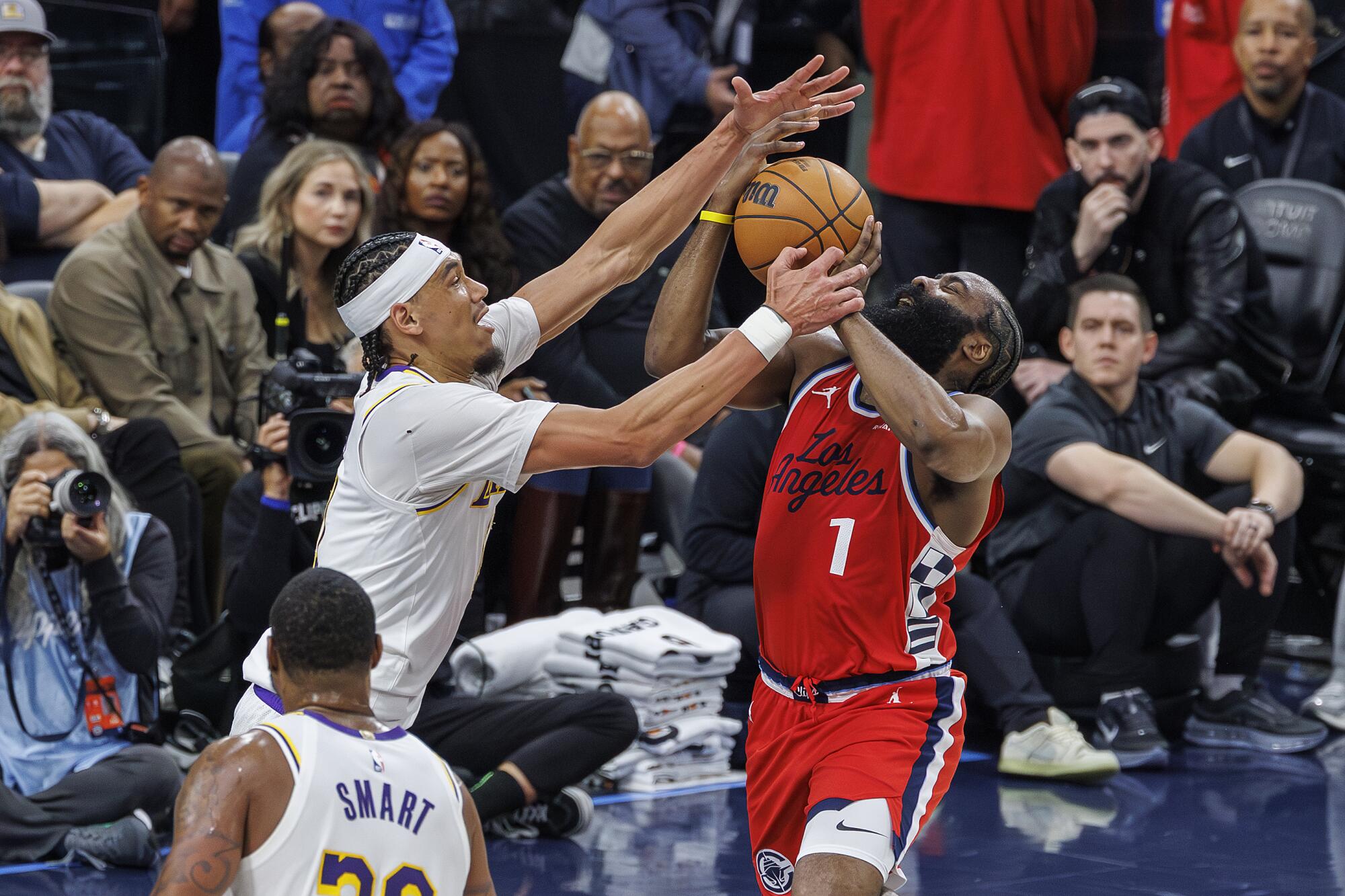
Lakers center Jaxson Hayes, left, foulds Clippers guard James Harden on a layup during their game Saturday.
(Gina Ferazzi / Los Angeles Times)
Along with “championship shape,” Redick also asked his team to build “championship habits.” Living up to the mantras is easier said than done.
“It’s not the easy choice,” Redick said. “It’s human nature. … We do it on a daily basis. We make easy choices cause it’s comfortable. Comfortable doesn’t win.”
Chargers quarterback Justin Herbert runs with the ball against the Dallas Cowboys on Dec. 21.
(Julio Cortez / Associated Press)
Saturday, 1:30 p.m. TV: CBS, NFL Network.
Line: Chargers by 1½. O/U: 39½.
Houston has been a hard matchup for the Chargers, and can turn up the heat on Justin Herbert. But Jim Harbaugh’s team has found new ways to win, and is capable of outscoring the Texans, who are really struggling in the red zone. Low-scoring and physical.
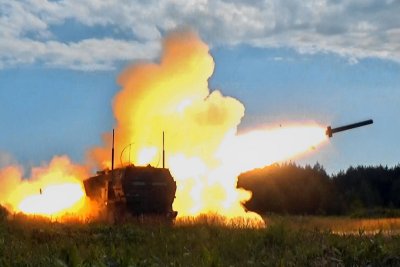
NEWS BRIEF The United States launched large-scale retaliatory airstrikes against more than 70 Islamic State targets across central Syria on Friday, responding to a deadly attack on American personnel earlier in the week. The operation, supported by Jordanian fighter jets and involving U.S. F-15s, A-10s, Apache helicopters, and HIMARS rockets, was described by Defense Secretary […]
A U.S. military helicopter hovers over an oil tanker seized early Saturday morning in international waters near Venezuela. Photo Courtesy of the U.S. Coast Guard
Dec. 20 (UPI) — The U.S. Coast Guard led another seizure of an oil tanker in international waters near Venezuela on Saturday after President Donald Trump declared a blockade of Venezuela.
The U.S. Navy and other federal entities participated in the seizure of the oil tanker, which is not among those sanctioned by the federal government, the Wall Street Journal, CBS News and CNN reported.
Armed U.S. personnel on military helicopters descended onto the tanker’s deck during the early morning hours on Saturday and seized it, Homeland Security Sec. Kristi Noem said in a social media post.
In a pre-dawn action early this morning on Dec. 20, the US Coast Guard with the support of the Department of War apprehended an oil tanker that was last docked in Venezuela.
The United States will continue to pursue the illicit movement of sanctioned oil that is used to fund… pic.twitter.com/nSZ4mi6axc— Secretary Kristi Noem (@Sec_Noem) December 20, 2025
No one aboard the oil tanker resisted, and the United States seized it for carrying sanctioned Venezuelan oil.
The seized tanker displayed a Panamanian flag and was carrying Venezuelan oil that it was to offload in Asia.
Much of Venezuela’s oil is shipped to China, which has privately owned teapot refineries that often buy and refine illicit oil from Venezuela, Iran and other sanctioned nations.
The president on Tuesday ordered a “total and complete blockade” of all sanctioned oil tankers as they enter or leave Venezuelan waters.
Saturday’s raid shows the blockade could affect any vessel that carries Venezuelan oil, as affirmed by Noem.
The United States on Wednesday seized a sanctioned oil tanker after it departed a Venezuelan port and diverted it to Texas, where Trump said the United States could keep the oil in its hold.
That tanker, The Skipper, was flying the flag of Venezuela’s neighbor, Guyana, officials for which said the vessel is not among those registered there.
Such activities are typical of a shadow fleet that uses deceptive tactics to hide where respective vessels are located and transport illicit oil, which often benefits Iran, Russia and other sanctioned states.
Venezuelan President Nicolas Maduro‘s government called The Skipper’s seizure an act of “piracy” and “robbery” and said the blockade is a “grotesque threat” that violates international law, according to CBS News.
Maduro’s regime accuses the United States of trying to “appropriate the oil, land and minerals of the country through gigantic campaigns of lies and manipulations.”
The blockade and tanker seizures are in addition to U.S. military strikes on alleged drug boats carrying illicit drugs destined for the United States and Europe.
Both tactics are efforts to isolate the Maduro regime, which Trump seeks to force out of power by depriving it of its primary revenue sources.
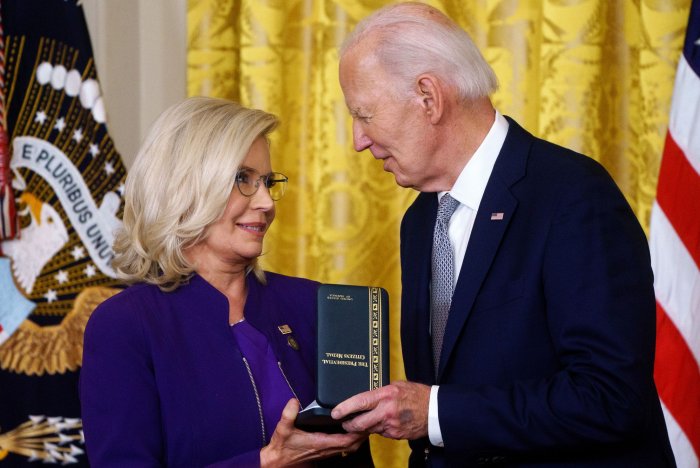
Former President Joe Biden presents the Presidential Citizens Medal to Liz Cheney during a ceremony in the East Room of the White House in Washington, on January 2, 2025. The Presidential Citizens Medal is bestowed to individuals who have performed exemplary deeds or services. Photo by Will Oliver/UPI | License Photo
Dec. 20 (UPI) — Officials for the European Union have agreed to loan $105 billon to Ukraine to help it stay financially solvent over the next two years amid Russian attacks in the Odesa region.
The money is in lieu of an allocation to Ukraine from frozen Russian assets equal to nearly $246 billion and being held in Belgium, the BBC reported.
The funds are equal to about two-thirds of the amount that Ukraine will need to pay its bills and give it a stronger bargaining position as peace talks continue with the aim of ending the Ukraine War that started when Russia invaded its neighbor on Feb. 24, 2022, according to The New York Times.
Ukrainian President Volodymyr Zelensky said the loan is interest-free and only would be repaid if Russia were required to pay reparations to Ukraine.
The allocation of €90 billion by Europe, which in any case is linked to Russian assets, is an unprecedented decision, and it will also have an impact on the peace negotiations. Ukraine will be in a stronger position.
The funds are earmarked for 2026-2027, and we are counting on…— Volodymyr Zelenskyy / Володимир Зеленський (@ZelenskyyUa) December 20, 2025
News of the E.U. allocation comes after a Russian missile strike near Odesa that killed eight and injured 27 others on Friday night, CNN reported.
Russian missiles struck a port facility in Pivdenne, and some of those killed and wounded were on a bus that was struck during the attack.
The missile strikes were part of an ongoing aerial campaign against the Odesa region over the past nine days and caused a power outage in Odesa, which is located on the Black Sea and about 300 miles south of Kyiv.
Two bridges in southern and northern Odesa were knocked out in recent strikes and are being repaired.
Russian forces also are targeting the energy infrastructure in Ukraine and have used drones and missiles to damage or destroy many targets in recent months.
President Donald Trump holds a signed executive order reclassifying marijuana from a schedule I to a schedule III controlled substance in the Oval Office of the White House on Thursday. Photo by Aaron Schwartz/UPI | License Photo
UCLA had just put on a dazzling offensive display when a help-wanted sign went up in the postgame news conference.
The search for assistance came from a coach who knows his team can score but will need a lot better effort on the other side of the ball to get to where it wants to go this season.
“My biggest challenge with this team,” Mick Cronin said after the Bruins needed an epic scoring surge in the second half to post a relief of a 108-87 victory over Cal Poly, “is finding a guy or two or three that their mind is on defense.”
Nobody filled that role Friday night during a first half that led to scattered boos serenading the Bruins on their way to the locker room inside Pauley Pavilion.
UCLA was trailing by two points after putting in a low effort and playing just a sprinkling of defense against a mid-major team with a losing record from the Big West Conference.
The Cal Poly logo on the front of the opponents’ jerseys did not elicit the same sort of spirited effort the Bruins had given against more brand-name foes, continuing a troubling trend going back to the season opener.
“I definitely think that’s fair to say,” UCLA guard Skyy Clark said after notching a season-high 30 points while making six of 10 three-pointers and becoming the first Bruin in school history to make at least six three-pointers in back-to-back games. “That’s just something we gotta harp on as a team.”
The Bruins could exhale after going with a smaller lineup that produced 65 points in the second half, the most in a half by UCLA since it splurged for 66 in the second half against George Mason on Dec. 22, 1994.
But plenty of worries linger, most of them on the defensive end for a team that has given up an average of 78.2 points over its last six games.
This was another case of UCLA simply outgunning an opponent, the Bruins shooting 57.4% to Cal Poly’s 51% during a game in which defense was played only in spurts. How do the Bruins explain giving up 45 points in the first half?
“We’ve got too many guys who are conscientious objectors defensively,” Cronin said. “And if I can’t get those guys to quit protesting — they don’t say anything, but until they really believe that’s the way to win … ”
UCLA (9-3) prevailed only after Cronin went with a three-guard lineup, replacing center Xavier Booker with Jamar Brown to start the second half in an effort to combat the Mustangs’ drive-and-kick offense that stationed practically everyone behind the three-point line. With a more mobile lineup, the Bruins proceeded to go on a 15-0 run to transform a two-point deficit into a 60-47 lead, removing any doubt about the game’s outcome.
Clark continued his recent scoring spree and received plenty of help from forward Tyler Bilodeau (24 points and eight rebounds) and point guard Donovan Dent (16 points, 11 assists and five steals) as the Bruins notched a second consecutive victory.
UCLA guard Donovan Dent, center, dribbles past Cal Poly guards Guzman Vasilic, left, and Kieran Elliott to score during the second half Friday night.
(Damian Dovarganes / Associated Press)
Cayden Ward scored 21 points for Cal Poly (5-8), which had been given a 2% chance of winning, according to the metrics of basketball analyst Ken Pomeroy.
By the game’s midpoint, the possibility of a massive upset had crept uncomfortably upward for UCLA.
Giving up open shots as part of a lackluster defensive effort wasn’t nearly the worst of it for the Bruins.
Trent Perry twice fouled a three-point shooter, once prompting Cronin to yell, “Get over here!” after Perry sent Cayden Ward to the free-throw line for three shots. A new low came late in the first half when Brown fouled Hamad Mousa on a three-pointer that went in, Mousa making the free throw to complete a four-point play.
“Buddy, it’s the worst play in basketball, and I’ve gone literally years with that happening zero times,” Cronin said. “Nobody coaches that more than me. You are not allowed to foul a jump shooter if you play for me, never. Never. If you’re that close, that means the shot is contested. You could deduce that, right? So I don’t care if he makes it, he’s taking a contested shot. Jumping toward the guy, you’re going to land in his space.”
Brown was immediately replaced by Perry, whose defensive inattentiveness quickly reemerged when Ward beat him off the dribble for a one-handed dunk. Things improved considerably the rest of the way. Cronin said he continued to be pleased with Clark’s defense and was satisfied with the second-half effort of forward Eric Dailey Jr., who limited Mousa to only two of his 14 points after halftime.
Cronin suggested that he wanted this team to prioritize defense the way the Bruins did after halftime of their victory over Michigan State in the opening round of the 2021 NCAA tournament, which sparked a flurry of lockdown efforts leading to five consecutive wins.
“From that point on, it took a halfcourt shot to stop us from trying to win the title,” Cronin said, alluding to Jalen Suggs’ buzzer-beater in a national semifinal. “But if that wouldn’t have changed, we weren’t going anywhere, so you just keep trying to stay relentless with it.”
How does Cronin get his team to make that change?
“You play the guys who will do what you tell them to do,” Cronin said. “If you play guys who are conning you with their effort defensively, not only are you going to lose, then the other guys will start doing it because they think you’re a fraud because you’re playing them anyway.”
Applications are being accepted. The next opportunity to fill a heightened role comes Tuesday against UC Riverside.
Once again, Bill Plaschke has literally jinxed another Southern California sports team with his proclamation questions regarding the Rams:
Who’s going to beat them?
Who’s going to stop the unstoppable offense?
Who’s going to score on the persistent defense?
Who’s going to outwit the coaching genius?
I have the answers, and it’s not just Seattle. It’s their special teams, their defensive backs and it’s coach Sean McVay’s play-calling. Well, maybe the referees … but that’s for another day.
Thanks again for the poison-pen article, Bill.
Gary Grayson Ventura
Just four days after Bill Plaschke promised that the Rams would win the Super Bowl, the team blew a big lead and lost in a stinker to the Seahawks. Like my mother told me when I was a kid: Be honest, respect others, and bet against Plaschke — you’ll win every time!
Jack Wolf Westwood
Can we quit the Rams praise now? They can’t tackle anyone that gets past the line of scrimmage. Coach Sean McKay and defensive coordinator Chris Shula went into a shell as the Rams lost the game to the Seahawks and any chance of a long playoff run.
Russell Hosaka Torrance
How many more times do we need to see Emmanuel Forbes chasing a receiver because of a blown coverage or missing an assignment and giving up a big play. The secondary is the weak link in the Rams defense and he’s absolutely a broken link. Chris Shula, please put someone else back there. The mascot Rampage would be a better choice than Forbes.
Bill Plaschke’s Rams encomium is puzzling. During the course of the game I watched, Detroit moved through the Rams defense like Sherman through Georgia. This was, at best, park football. The first team that exploits the Rams defense as the Lions did and consistently moves the ball on offense will defeat the Rams.
Skip Nevell Eugene, Ore.
Just when the Rams thought that they solved their kicking situation, they lost another game because of a missed field goal. After the game, they must have been kicking themselves.
Jeff Hershow Woodland Hills
It looks like the Bills are going to win the Super Bowl, because Plaschke wrote, “The Bills? Not ever.”
Dec. 19 (UPI) — The U.S. military struck several ISIS-connected targets in Syria on Friday in retaliation for the shooting deaths of two U.S. soldiers and their interpreter last week.
The military used artillery, attack helicopters and fighter jets to hit targets in central Syria during Operation Hawkeye, which is named after the two slain soldiers’ home state of Iowa.
The strikes were expected to take place into early Saturday morning as part of a retaliation campaign against ISIS in Syria, The Times reported.
A lone ISIS sniper killed Iowa National Guardsmen Sgt. William Howard, 29, and Sgt. Edgar Torres Tovar, 25, and civilian interpreter Ayad Mansoor Sakat, 54. Three other Iowa National Guardsmen also were wounded.
The ISIS sniper ambushed the soldiers while they were “supporting a key leader” in Palmyra, Syria, CBS News reported.
The sniper had been a member of the Syrian security forces, but he was scheduled to be dismissed from his duties due to extremist views, U.S. and Syrian officials said.
ISIS remains a factor in Syria, where it has lost much of its prior territorial control after the ouster of former Syrian President Bashar al-Assad on Dec. 8, 2024, by opposition forces led by Hay’at Tahrir al-Sham.
The collapse of the Assad regime largely ended a 14-year civil war in Syria, and he has been replaced by current Syrian President Ahmed al-Sharaa.
Sharaa met with Trump at the White House last month and on Friday welcomed the lifting of U.S. sanctions against the Syrian government that were placed during the Assad regime.
Lifting the sanctions makes it possible for investments to be made in Syria, which has struggled to recover from its civil war.
Former President Joe Biden presents the Presidential Citizens Medal to Liz Cheney during a ceremony in the East Room of the White House in Washington, on January 2, 2025. The Presidential Citizens Medal is bestowed to individuals who have performed exemplary deeds or services. Photo by Will Oliver/UPI | License Photo
The recent decision by the United States Navy (USN) to cancel the Constellation-class frigate program after eight years of development and billions of dollars in investment represents a significant setback in US naval modernization drive. The Constellation-class was meant to become a modern, multi-mission combat vessel capable of relieving operational pressure from Arleigh Burke-class destroyers and narrowing the growing numerical advantage of the China’s People’s Liberation Army Navy (PLAN). Instead, continuous design changes, and subsequent delays changed what was supposed to be an easy-to-construct warship platform into a costly and significantly delayed project. After failure of several major projects like Zumwalt destroyer and Littoral Combat Ships (LCS), the cancellation of the Constellation-class frigate project has degraded Washington’s efforts to sustain the naval balance of power against rapidly expanding naval fleet of PLAN.
The Constellation-class project was a product of USN’s urgent need to fill the gap left behind Oliver Hazard Perry-class (OHP) frigates which were phased out from USN services in 2015. The OHPs, despite lack of built-in vertical launch system (VLS), were regarded for their reliability, and versatility in missions ranging from open-ocean escorting to anti-submarine warfare (ASW) and anti-surface warfare (ASuW). The retired hulls of OHPs were purchased by navies of several US allies including Australia, Bahrain, Chile, Egypt, Pakistan, Spain, Taiwan, and Turkiye. Their withdrawal from USN created a capability void that the Littoral LCS program – comprising of Freedom class and Independent class vessels – was expected to fill. However the LCS encountered numerous mechanical failures in hulls and propulsion system, cost overruns, and capability gaps that rendered it unsuitable for missions in contested naval environments.
As USN halted further procurement and early retirement of LCS, it attempted to follow a new approach, i.e., opt for a proven design tailored to meet USN requirements. Franco-Italian FREMM frigate design was chosen as the baseline for a modern, affordable American Constellation-class frigate. At initial stage, it appeared a sound idea. The FREMM platform had already proven itself in European naval forces, and the USN specific variant was modified to carry 32 Mk-41 VLS cells capable of firing SM-series interceptors and even Tomahawk cruise missiles, alongside Naval Strike Missiles. This program committed to be a potent yet affordable and rapid addition in USN fleet while retaining 85 percent commonality with original design. But as USN continued to impose new requirements, complications in construction, and alteration in designing began to inhibit the efficiency of the program. Constellation-class frigate undertook major size increment than parent FREMM design, stretching from 466 feet to nearly 500 and increasing to over 7,200 tons. Instead of leveraging a proven design, USN trapped itself with a pseudo-original design which now shared mere 15 percent commonality with the original design. By 2024, the first frigate was already three years behind schedule, and the program’s cost enlarged well beyond initial estimations. Faced with increasing costs, long delays, and design complications, the USN eventually axed the Constellation-class frigate program too, leaving behind a significant gap in USN surface fleet which this frigate was supposed to fill.
USN now wants a new frigate class structured on proven American design by 2028. Reportedly, the design of US Coast Guard (USCG) Legend Class cutter will be used as baseline to develop a USN specific variant. These 4,600 tons class ships are capable of conducting blue water operations and support 57mm deck gun, Phalanx CIWS, and flight deck with hanger to support rotary wing operations. Its USN specific frigate version can accommodate a 16-cell Mk-41 VLS module, 8x Harpoon/NSM cruise missiles in canisters, RIM-116 Sea RAM, and torpedo tubes. Using an American proven design for mass producing USN specific frigate of relatively smaller size and low tonnage will allow USN to produce and commission larger number of hulls in relatively less time. But on flip side, this new frigate class will be far less capable than recently cancelled Constellation-class as they are unlikely to carry Aegis CMS, and will have significantly less range, endurance, and weapon load-out.
Nowhere is this challenge more evident than in the rapid growth of China’s naval power. PLAN is now commissioning highly capable naval combatants including flat-deck aircraft carrier (Fujian), next generation destroyers (Type-055 and Type-52DL) and frigates (Type-54B), and new class of conventional as well as nuclear submarines. Chinese coast guard, and maritime militia collectively operate more than 750 vessels – more than twice the number of hulls under US control. While the US Navy still retains qualitative advantages, especially in nuclear submarines and carrier aviation, trends in shipbuilding capacity significantly favor Beijing. China commands more than half of global commercial ship production, while the US share barely registers at a tenth of a percent. This allows China to mass produce modern warships for PLAN at a pace the United States cannot simply match.
Although USN plans to expand its fleet from 296 manned warships to 381 manned warships and 134 unmanned vessels by 2045, but so far trends of decline hull strengths have been observed. Ticonderoga class cruisers are gradually retiring, next-generation DDG(X) destroyers are still in far future, Ford class nuclear aircraft-carriers and Columbia-class ballistic missile submarines (SSBNs) are facing delays, and Arleigh Burke Flight-III destroyers are not producing at rate faster enough to accommodate these growing gaps. Unmanned vessels are sometimes perceived as a viable solution to fill-up the gaps but these vessels cannot replace manned warships on one-on-one basis. In sum, aforementioned projects expose the persistent limitations of ship production capacity of US shipyards. The Congressional Budget Office estimates that reviving the shipbuilding sector to meet the USN long-term needs would require annual investments of more than $40 billion for three consecutive decades—a staggering commitment that would require political consensus and sustained strategic vision.
The cancellation of the Constellation-class frigate, just like past projects of Zumwalt and LCS- thus represents a persistent crisis in US naval build-up. As China accelerates its naval production and expands power projection into the Indo-Pacific, the United States finds itself struggling to revive its own shipbuilding capacity. Whether Washington can reverse this trajectory will depend on its ability to reform procurement processes, invest in industrial capacity, and adopt realistic designs aligned with strategic needs. Without such changes USN risks entering the next decade with too few ships to meet global demands.
Former UCLA football star Myles Jack was arrested on suspicion of deadly conduct Tuesday after an incident in which Texas police say he fell from a second-story window.
The former Jacksonville Jaguars and Pittsburgh Steelers linebacker faces charges of deadly conduct, including the third-degree felony of discharge of a firearm and the Class-A misdemeanor of discharge of a firearm in certain municipalities.
The Frisco Police Department said in a news release that officers visited a residence Tuesday at approximately 5:40 a.m. in response to a welfare concern and upon arrival heard gunshots from inside. A perimeter was established and several nearby residences were evacuated as the area was secured.
During the incident, a second-story window was broken and Jack allegedly climbed outside, then fell to the ground. He was taken into custody at 7:12 a.m. and transported to a hospital where he was treated for non-life-threatening injuries sustained in the fall. A search of the residence found no one else inside.
Charges were filed with the Denton County Sheriff’s Office. Jail records show Jack posted $100,000 bail. The investigation remains ongoing and no further details have been released.
Jack was a standout linebacker for the Bruins who also saw significant playing time at running back. He was named the Pac-12 freshman player of the year on defense and offense in 2013. After a knee injury ended his college career three games into his junior season, Jack was selected by the Jaguars in the second round of the 2016 draft. He played six seasons with the Jaguars and two with the Steelers.
In 2023, Jack and his mother, LaSonjia Jack, were announced as the majority owners of the Allen Americans, an ECHL minor league hockey team in the Ottawa Senators organization.
USFK Commander Gen. Xavier Brunson said Friday that the DMZ should not be “politicized,” as debate swirls around a South Korean bill calling for government control of non-military access. In this July photo, Brunson speaks at a ceremony in Goyang marking U.N. Forces Day. Photo by Yonhap
The commander of the U.S. Forces Korea (USFK) said Friday that the Demilitarized Zone (DMZ) should not be “politicized,” voicing opposition to a bill in South Korea that seeks to grant the government control of non-military access to the buffer zone.
The remarks by USFK Commander Gen. Xavier Brunson, who also doubles as commander of the U.N. Command (UNC), followed a recent UNC statement in opposition to the pending bill.
He said the armistice agreement that ended the 1950-53 Korean War should remain the barometer governing behavior. Under the armistice, the UNC currently has the authority to approve or deny access to the DMZ.
“What we want to try to make sure that we do is, number one, we don’t allow that area to become politicized … we signed an agreement to say that we will maintain this buffer here,” Brunson said in an episode of security-focused podcast series “War on the Rocks.”
Brunson noted that South Korea recently proposed military talks with North Korea to discuss how to clarify the Military Demarcation Line in the DMZ in a bid to prevent possible clashes near the inter-Korean border, but emphasized that all actions should be based on the armistice agreement.
“What governs our behavior is the armistice, and we’ve got to adhere to the standards put forward in the armistice. And as long as we do that, there won’t be any challenges,” he said. “What we can’t do is seek to change the way we do business in abrogation of a legal document, which is the armistice.”
The USFK commander’s call urging the need to adhere to the armistice came just days after the UNC issued a rare statement underscoring its role as the “administrator” of the DMZ, which stretches about 250 kilometers in length and 4 km in width, and has served as a buffer between the two Koreas since the end of the Korean War.
Speaking on Seoul’s plan to seek a conditions-based handover of wartime operational control from Washington within President Lee Jae Myung’s five-year term ending in 2030, Brunson said the United States has no intention to “hold this up at all.”
He still emphasized that the bilaterally agreed-upon conditions should be met for the transfer.
“We’ve got to make sure that we’ve met all those conditions whether they be operational, whether they be material based, whether it might be something as simple as protection that those things are all in place before we go and do this,” he said.
Against such a backdrop, Brunson touted how South Korea’s “thriving” defense industry and participation in multinational drills like Talisman Sabre, held in Australia, have strengthened its capabilities as well as role in the wider Indo-Pacific region and called on the country to further “pull away from the Peninsula and become more engaged.”
“I’ve talked a lot about the centrality and importance of the Republic of Korea to the entirety of the Indo-Pacific by virtue of their economy, by virtue of the size of their military, by virtue of their ability to continue to develop technologies,” he said, referring to South Korea by its formal name.
“They are just preeminently important to peace in the Indo-Pacific.”
Copyright (c) Yonhap News Agency prohibits its content from being redistributed or reprinted without consent, and forbids the content from being learned and used by artificial intelligence systems.
SALT LAKE CITY — When Brice Sensabaugh drilled a wide-open three pointer in the third quarter, Lakers coach JJ Redick quickly called a timeout and began to gesture with both hands toward his players, clearly showing his displeasure with their defense.
They especially picked up their defensive intensity for an important spurt in the fourth quarter, slowing down the Utah Jazz and in the process the Lakers’ offense took off, the two converging at the right time to push them to a 143-135 win Thursday night at the Delta Center.
The Lakers gave up 41 points in the first quarter and a season-high 78 at the half. They allowed 57 points in the second half and put the Jazz away by scoring 41 points in the fourth quarter.
“Obviously we know this Utah team can score points at a very high rate, but it was very imperative that we got stops,” said LeBron James, who had another productive night with 28 points, 10 assists and seven rebounds. “We had to get stops to start that fourth and then it allowed our offense to click.”
But even with the Lakers building a 12-point lead in the fourth, the Jazz continued to put stress on L.A.’s defense, getting within four points late in the game.
The Lakers’ Lebron James dunks over the Jazz’s Kyle Filipowski at Delta Center Thursday night in Salt Lake City, Utah.
(Alex Goodlett / Getty Images)
The Lakers had answers every time, keeping the game in their hands behind Luka Doncic’s triple-double — 45 points, 14 assists and 11 rebounds.
His 45-point triple-double and five steals made Doncic just the second player in NBA history to accomplish that feat since steals became official in 1973-74. Detroit Cade Cunningham (46 points, 12 rebounds, 11 assists, five steals) is the other player to do so, producing that against the Wizards on Nov. 2025 in overtime.
Doncic was 14-for-28 from the field, four-for-12 from three-point range and had just one turnover in 39 minutes and 33 seconds of play.
Doncic also was the first Laker to have a 40-point triple-double since Magic Johnson in 1981.
“I think, honestly, I could do so much more,” Doncic said. “But I think that one turnover is the best stat-wise on this stat sheet. So, we had seven turnovers, which is impressive for us and we won the game. And again, that’s what matters. But I think we locked in a lot in the second half. We did a great job.”
The Lakers got a scare when James went down holding his left knee after a collision with Utah’s Walter Clayton Jr.
James was dribbling the basketball near the three-point arc when Clayton went for a steal, but instead his knee hit the inside of James’ knee, knocking the Laker to the floor with 7:52 left in the second quarter.
James eventually got up and continued to play, taking a rest with 4:53 left in the half.
James described what happened on the play.
“Just a little bolt to the knee, like a sharp pain to the knee,” James said. “Got kneed on the the inside, like the medial side of the knee. And just kind of wanted to take my time a little bit as it calmed down or whatever the case may be. Or hoping it calmed down. Told Mike (Mancias) my trainer, I said, ‘We dodged a bullet there.’ ”
The Lakers were already without starters Austin Reaves (left calf strain) and Deandre Ayton (left elbow soreness), but then they added key role player Gabe Vincent (lower back tightness) to the injury list, leaving them without three main players entering the game at Utah. Vincent will be reevaluated in a week.
Lakers guard Luka Doncic celebrates after making a play during the second half of a win over the Jazz Thursday night at Delta Center in Salt Lake City.
(Alex Goodlett / Getty Images)
Jaxson Hayes started at center in place of Ayton and Smart started at guard for Reaves.
Injuries also hit the Jazz, as star forward Lauri Markkanen, the ninth-highest scorer (27.8) in the NBA this season, was out because of a right groin injury.
Smart had 17 points, which included him going three-for-four from three-point range in the fourth quarter.
Hayes had 16 points, making all seven of his field goals.
Redick talked to his team at halftime about their poor defensive effort and he did again in the third quarter during that timeout.
His message was simple.
“The players gotta go out and do it,”: Redick said. “So it’s not, I don’t know if it sparked ‘em or not, and I just know that after that they were better.”
Polish Prime Minister Donald Tusk attends the EU Council Summit in Brussels, Belgium, Thursday. EU leaders are meeting to discuss the latest developments in Ukraine, the EU’s next multiannual financial framework, the EU enlargement process, and the geoeconomic situation in the European Union. EPA/OLIVIER MATTHYS
Dec. 18 (UPI) — European leaders have agreed to continue funding Ukraine in its fight against Russia with a two-year, $105 billion loan to provide the embattled nation with munitions and other material in the ongoing war, the latest battle of which has dragged on since 2022.
The plan to use frozen Russian assets to back the loan fell apart in the final moments, a schism that risked making the EU appear indecisive at a critical moment in negotiations.
European leaders announced Thursday that they will instead use money from the EU budget to fund Ukraine’s defense effort. As a result, the backup plan could be more costly and difficult to mobilize than the original plan to leverage the stash of Russian money currently frozen in Europe.
European leaders said since the end result is the same, getting funds to Kyiv, they celebrated it as a victory.
“This will address the urgent financial needs of Ukraine,” Antonio Costa, the president of the European Council, said at a media briefing in Brussels.
Partly because of a cut in funding from the United States, Ukraine is facing a $160 billion shortfall over the next two years, according to forecasts by the International Monetary Fund. The EU sought to fill about $105 billion of that gap.
Costa added that the EU will reserve its right to use frozen Russian assets for continued funding in the future.
Weekly insights and analysis on the latest developments in military technology, strategy, and foreign policy.
A key Russian airbase in occupied Crimea has been targeted by a Ukrainian drone strike, according to Ukraine. Authorities in Kyiv claim that drones hit a MiG-31BM Foxhound interceptor, as well as elements of an S-400 air defense system, at Belbek Air Base, near Sevastopol.
The Security Service of Ukraine (SBU), the government’s main internal security agency, reported that a successful drone strike operation was carried out overnight by forces from its Special Group “Alpha.” Russian officials, including the governor of Sevastopol, claim that the attack was repelled with 11 drones downed and resulted in no damage.
Minus russian MiG-31 jet 🔥 Last night, the warriors from the @ServiceSsu Alpha Special Operations Center struck a russian MiG-31 fighter jet with a full combat load at the Belbek military airfield in temporarily occupied Crimea. An S-2 Pantsir air defense system, an S-400 air… pic.twitter.com/qEsjJwrd0o
The SBU has published a series of video stills showing the attack, with footage taken from the perspective of the long-range one-way attack drones heading toward their targets. Based on the imagery, the drones could well be the same fiber-optic types that have been launched from Ukrainian drone boats.
Further videos were posted to social media by residents of Crimea, showing explosions and attempts by Russian troops to shoot down the drones. At this point, it should be noted that, without the full videos of the strikes, we cannot be sure whether the drones detonated or the degree of damage they might have caused.
According to the SBU, damage was recorded to a MiG-31, a 92N6 (NATO reporting name Grave Stone) long-range multifunction radar that is part of the S-400 system, two Nebo-SVU long-range surveillance radars, and a Pantsir-S2 surface-to-air missile system.
Ukraine claims that the targeted MiG-31 was carrying a full combat load, although the available video reveals that it carries no armament under its wings. Potentially, it carries air-to-air missiles below the fuselage, but the forward-mounted examples are also not visible. While it looks like a real aircraft rather than a decoy, it remains possible that it may have been a non-operational example. However, recent satellite imagery assessed by TWZ shows a MiG-31 sporadically at the base in recent weeks, sometimes sitting out in the open.
MiG-31. SBU
It’s worth noting, too, that the reported 92N6 system (seen below) was covered with camouflage and/or anti-drone netting, making its positive identification harder. It could also have been a 96L6 (Cheese Board) all-altitude detection radar, also associated with the S-400 air defense system.
SBU
It’s a cheeseboard, its been axtive at Belbek for a long time, you made a good id, you can recognise it because the radar array has a round base and on the gravestone its rectangular pic.twitter.com/f4RDqfaoYY
As to the estimated value of these items of equipment, the SBU put a figure of $30-50 million on the MiG-31, depending on configuration and armament, $30 million on the 92N6, $60-100 million for each of the Nebo-SVUs, and $12 million for the Pantsir-S2.
“The SBU continues its effective work to destroy air defense systems in Crimea that cover important military and logistical facilities of the occupiers,” the agency said in a statement on its Telegram channel. “The elimination of components of this echeloned system significantly weakens the enemy’s defense and military capabilities in the Crimean direction.”
Belbek plays a key role in Russia’s war in Ukraine and, as such, has been targeted by Ukraine in the past.
The significance of the airbase, in particular, lies in the fact that its aircraft and air defenses help extend coverage deeper into Ukraine, as well as providing critical screening for the nearby Russian naval base at Sevastopol, and also extend this coverage far out into the Black Sea.
Several photos recently posted on the “warhistoryalconafter” TG channel showing a VKS Su-27P/S. Visible AAMs include an R-73, R-27ET & R-27ER. Photos appear to be from Belbek (thanks to @StefanB2023 for IDing the base) – the jet is presumably assigned to the 38th IAP based there. pic.twitter.com/e6Dm4fGjfX
Belbek Air Base was used by Ukraine before Russia annexed Crimea in 2014. Today, it is home to the 38th Fighter Aviation Regiment (38 IAP, in Russian nomenclature), a unit that you can read more about here. When Moscow launched its full-scale invasion of Ukraine, Belbek received an influx of additional combat aircraft deployed from units in Russia. These have included examples of the Su-30SM and Su-35S, as well as Su-34 Fullback strike fighters, and MiG-31s.
MiG-31s, together with the very long-range air-to-air missiles they carry, have been a particular threat to the Ukrainian Air Force.
In October 2022, during take-off from Belbek, a MiG-31BM departed the runway, crashed, and was completely burned out. The navigator/weapons system officer ejected successfully from the rear cockpit, while the pilot was killed.
The airbase’s value means that it has received new hardened aircraft shelters and additional construction to help shield aircraft from drone attacks and other indirect fire. This is part of a broader push by the Russian military to improve physical defenses at multiple airfields following the launch of the full-scale invasion of Ukraine.
A view of the central section of Belbek, showing hardened aircraft shelters. Google Earth
Notably, the MiG-31 was targeted while standing in the open, unprotected. Its twin cockpit canopies were open, suggesting it was being prepared for a sortie or had recently returned from one.
As well as previous drone attacks, Ukrainian forces have employed U.S.-supplied Army Tactical Missile System (ATACMS) short-range ballistic missiles with cluster munition warheads against the base, with a notably destructive ATACMS barrage in May of last year. That attack resulted in two MiG-31s being burnt out, confirmed in post-strike satellite imagery. Since then, however, the use of hardened aircraft shelters at Belbek will have made the resident aircraft less vulnerable to the effects of ATACMS armed with cluster munitions, in particular.
The Russian Aerospace Forces began the current conflict with around 130 MiG-31s in active service, a small number of them adapted to carry Kinzhal aero-ballistic missiles. The two aircraft destroyed previously at Belbek are the only confirmed combat losses, though thast ight change when more details of the latest drone strike become available.
Russian MiG-31 Downs Ukrainian Su-25 from high altitude
And here are the first photos from the ground showing the aftermath of Ukrainian strikes with ATACMS missiles on Russia’s Belbek Air Base in the Crimea last night.
— Status-6 (Military & Conflict News) (@Archer83Able) May 15, 2024
The targeting of Belbek again overnight, which Ukraine claims caused significant damage to prized air defense assets, shows that Ukraine is continuing to apply pressure on Russian forces in Crimea and is using a variety of weapons to achieve this.
NEWS BRIEF Ukrainian drone strikes killed three people, including two crew members of a Russian-flagged oil tanker, in overnight attacks on the port of Rostov-on-Don and the town of Bataysk in southern Russia. The strikes mark a continued escalation in Kyiv’s campaign targeting Russian energy infrastructure and maritime assets, as both sides trade accusations of […]
After an amazing comeback against a really strong New England team last Sunday, the Bills are emboldened and Josh Allen is on an MVP pace. Cleveland relies on its stout defense, but that unit didn’t show up in Week 15 against Chicago, surrendering 31 points. Buffalo, which is 7-2 outside the division, wins this going away.
Dec. 18 (UPI) — The United States has approved a massive $11.1 billion arms deal with Taiwan, the self-government Asian island announced Thursday.
The U.S. Congress was informed of the sale on Wednesday, the president’s office said in a statement.
The package includes eight items, such as HIMARS rocket systems, TOW missiles, Javelin anti-tank missiles, anti-armor loitering munition systems, spare attack helicopter parts and the Taiwan Tactical Network military communication platform and Tactical Awareness Kit, among other lethal equipment.
Taiwan’s foreign ministry said in a statement that it “welcomed” the announcement and expressed its “sincere appreciation for the United States’ long-standing support for regional security and Taiwan’s self-defense.
The arms sale is the second to Taiwan of President Donald Trump’s second administration and comes as China increases its military pressure on the self-governing island.
Hours prior to the deal being announced, Taiwan’s Ministry of National Defense said 40 sorties of Chinese fighter jets and eight navy vessels were detected operating around the island. Of the fighter jets, 26 had crossed the median line and entered Taiwan’s northern, central, southwestern and eastern Air Defense Identification Zone.
A day earlier, 23 sorties of fighter jets were detected and nine fighter jets and seven navy vessels were spotted a day before that.
China views Taiwan as a breakaway province and has vowed to take it back by force if necessary. Taiwan is a self-governing island that Beijing has never ruled.
The office of Taiwanese President Lai Ching-te said the arms deal highlights the close partnership between the two countries and demonstrates “the importance the U.S. government attaches to Taiwan’s national defense needs.”
Presidential Office spokesperson Karen Kuo added that due to increasing security concerns, Taiwan will raise defense spending to more than 3% of GDP next year and aims for it to be 5% by 2030.
“Taiwan will continue to reform national defense, strengthen whole-of-society defense resilience, demonstrate our determination for self-defense and maintain peace through strength,” Kuo said.
The U.S.-Taiwan Business Council said it was a record single U.S. security package for Taiwan and was in response to the threat posed by China and a potential Beijing ground invasion.
“We continue to see the prioritization of platforms and munitions that address a D-Day-style attack on the island,” USTBC President Rupert Hammond-Chamber said in a statement.
More than two months after a ceasefire between Israel and Hamas ended two years of intense fighting in Gaza, both sides claim the other has violated the agreement, and there is no progress on the more challenging steps that follow.
The ceasefire involves three main documents. The most comprehensive is a 20-point plan by former U. S. President Donald Trump, which proposes that Hamas disarm and cease its governing role in Gaza, accompanied by an Israeli withdrawal. Although a more limited agreement was made on October 9, it mainly focused on hostages, a halt to hostilities, partial Israeli withdrawal, and a boost in aid. This agreement was supported by a United Nations Security Council resolution that aimed to set up a transitional governing body and an international force in Gaza.
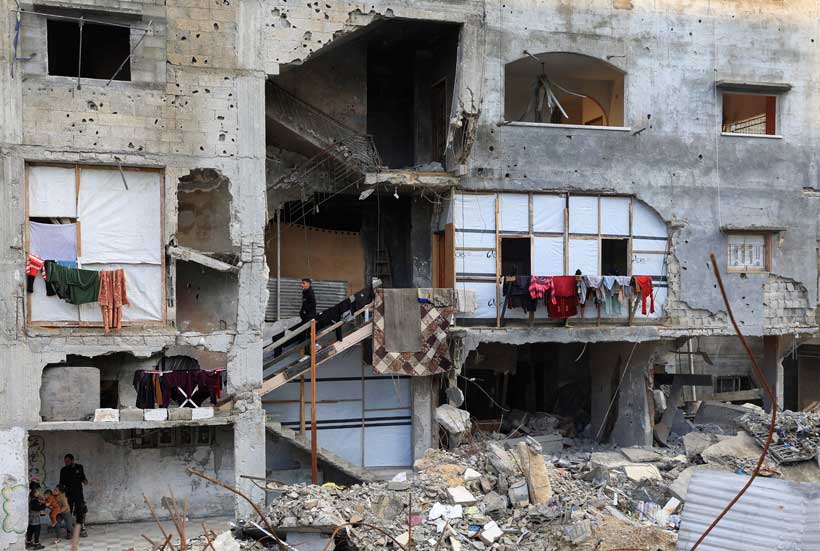
The results of the ceasefire have seen all surviving hostages returned and hundreds of Palestinian prisoners released. However, the return of deceased hostages has been slow. Aid distribution has become contentious, with Hamas claiming that fewer aid trucks are entering Gaza than promised. Aid organizations report a significant shortfall in necessary supplies, while Israel asserts it is fulfilling its commitments under the truce. The Rafah border crossing with Egypt remains closed, with Israel stating it will only open it once the last hostage’s body is returned. The living conditions in Gaza are dire, with many residents constructing makeshift shelters from debris, and a large number of children suffering from malnutrition, worsened by floods affecting temporary shelters and sanitation.
Some violence persists, as Palestinian militants have attacked Israeli forces, resulting in casualties on both sides. A proposed international stabilisation force intended to maintain order in Gaza is still undefined, with disagreements over its composition and tasks. Plans for a Palestinian governing body, independent of Hamas, have also not been clarified. The Palestinian Authority, which governs parts of the West Bank, is expected to implement reforms before taking a role in Gaza, but no details have been shared.
The possibility of lasting peace remains uncertain. Israel suggests military action may resume if Hamas does not disarm, yet a return to full-scale war does not seem imminent. Both Israelis and Palestinians are skeptical about the long-term success of the Trump plan and fear it may lead to a continued, unresolved conflict. Many Israelis are concerned about the potential for Hamas to rearm, while Palestinians worry about ongoing Israeli control and lack of resources for rebuilding Gaza.
Trust between Israelis and Palestinians is at a low point, with the two-state solution, considered vital for lasting peace, appearing increasingly distant. Despite international support for Palestinian statehood, Israeli leadership continues to reject this notion, raising doubts about future negotiations and outcomes.
WASHINGTON — The Senate gave final passage Wednesday to an annual military policy bill that will authorize $901 billion in defense programs while pressuring Defense Secretary Pete Hegseth to provide lawmakers with video of strikes on alleged drug boats in international waters near Venezuela.
The annual National Defense Authorization Act, which raises troop pay by 3.8%, gained bipartisan backing as it moved through Congress. It passed the Senate on a 77-20 vote before lawmakers planned to leave Washington for a holiday break. Two Republicans — Sens. Rand Paul and Mike Lee — and 18 Democrats voted against the bill.
The White House has indicated that it is in line with President Trump’s national security priorities. However, the legislation, which ran more than 3,000 pages, revealed some points of friction between Congress and the Pentagon as the Trump administration reorients its focus away from security in Europe and toward Central and South America.
The bill pushes back on recent moves by the Pentagon. It demands more information on boat strikes in the Caribbean, requires that the U.S. maintain its troop levels in Europe and sends some military aid to Ukraine.
But overall, the bill represents a compromise between the parties. It implements many of Trump’s executive orders and proposals on eliminating diversity and inclusion efforts in the military and grants emergency military powers at the U.S. border with Mexico. It also enhances congressional oversight of the Department of Defense, repeals several years-old war authorizations and seeks to overhaul how the Pentagon purchases weapons as the U.S. tries to outpace China in developing the next generation of military technology.
“We’re about to pass, and the president will enthusiastically sign, the most sweeping upgrades to DOD’s business practices in 60 years,” said Sen. Roger Wicker (R-Miss.), the chair of the Senate Armed Services Committee.
Still, the sprawling bill faced objections from both Democratic and Republican leadership on the Senate Commerce Committee. That’s because the legislation allows military aircraft to obtain a waiver to operate without broadcasting their precise location, as an Army helicopter had done before a midair collision with an airliner in Washington, D.C., in January that killed 67 people.
“The special carve-out was exactly what caused the January 29 crash that claimed 67 lives,” Sen. Ted Cruz (R-Texas), the chair of the Senate Commerce Committee, said at a news conference this week.
Cruz said he was seeking a vote on bipartisan legislation in the next month that would require military aircraft to use a precise location sharing tool and improve coordination between commercial and military aircraft in busy areas.
Boat strike videos
Republicans and Democrats agreed to language in the defense bill that threatened to withhold a quarter of Hegseth’s travel budget until he provided unedited video of the strikes, as well as the orders authorizing them, to the House and Senate Committees on Armed Services.
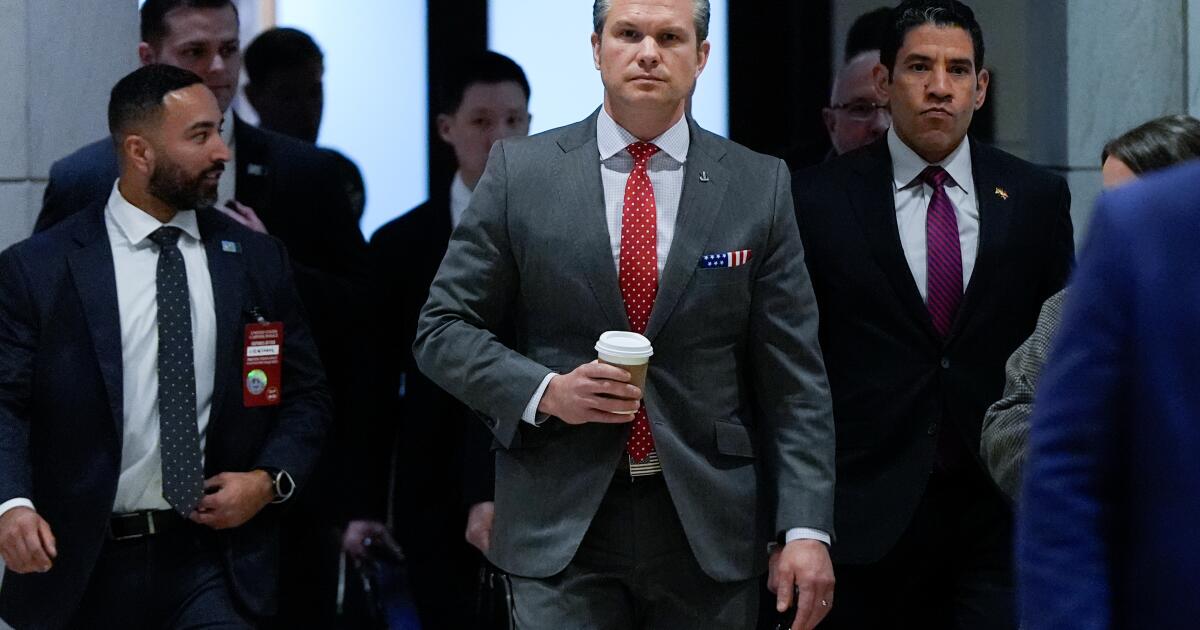
Hegseth was on Capitol Hill on Tuesday ahead of the bill’s passage to brief lawmakers on the U.S. military campaign in international waters near Venezuela. The briefing elicited contrasting responses from many lawmakers, with Republicans largely backing the campaign and Democrats expressing concern about it and saying they had not received enough information.
The committees are investigating a Sept. 2 strike — the first of the campaign — that killed two people who had survived an initial attack on their boat. The Navy admiral who ordered the “double-tap” strike, Adm. Frank “Mitch” Bradley, also appeared before the committees shortly before the vote Wednesday in a classified briefing that also included video of the strike in question.
Several Republican senators emerged from the meeting backing Hegseth and his decision not to release the video publicly, but other GOP lawmakers stayed silent on their opinion of the strike.
Democrats are calling for part of the video to be released publicly and for every member of Congress to have access to the full footage.
“The American people absolutely need to see this video,” said Sen. Richard Blumenthal (D-Conn.). “I think they would be shocked.”
Congressional oversight
Lawmakers have been caught by surprise by the Trump administration several times in the last year, including by a move to pause intelligence sharing with Ukraine and a decision to reduce U.S. troop presence in NATO countries in eastern Europe. The defense legislation requires that Congress be kept in the loop on decisions like those going forward, as well as when top military brass are removed.
The Pentagon is also required, under the legislation, to keep at least 76,000 troops and major equipment stationed in Europe unless NATO allies are consulted and there is a determination that such a withdrawal is in U.S. interests. Roughly 80,000 to 100,000 U.S. troops are usually present on European soil. A similar requirement keeps the number of U.S. troops stationed in South Korea at 28,500.
Lawmakers are also pushing back on some Pentagon decisions by authorizing $400 million for each of the next two years to manufacture weapons to be sent to Ukraine.
Cuts to diversity and climate initiatives
Trump and Hegseth have made it a priority to purge the military of material and programs that address diversity, anti-racism or gender issues, and the defense bill codifies many of those changes. It would repeal diversity, equity and inclusion offices and trainings, including the position of chief diversity officer. Those cuts would save the Pentagon about $40 million, according to the Republican-controlled House Armed Services Committee.
The U.S. military has long found that climate change is a threat to how it provides national security because weather-related disasters can destroy military bases and equipment. But the bill makes $1.6 billion in cuts by eliminating climate change-related programs at the Pentagon.
Repeal of war authorizations and Syria sanctions
Congress is writing a closing chapter to the war in Iraq by repealing the authorization for the 2003 invasion. Now that Iraq is a strategic partner of the U.S., lawmakers in support of the provision say the repeal is crucial to prevent future abuses. The bill also repeals the 1991 authorization that sanctioned the U.S.-led Gulf War.
The rare, bipartisan moves to repeal the legal justifications for the conflicts signal a potential appetite among lawmakers to reclaim some of Congress’ war powers.