defense

Angels insurers may play role in Skaggs wrongful death trial

Four years after the family of deceased Angels pitcher Tyler Skaggs filed a wrongful death suit against the Angels, and two months into often contentious testimony in an Orange County Superior Court courtroom, jurors are set to begin deliberations on whether Skaggs’ widow and parents deserve hundreds of millions of dollars.

During closing statements Monday, plaintiffs lawyer Daniel Dutko argued that the Angels were negligent in failing to supervise Eric Kay, the drug-addicted team communications director who gave Skaggs the fentanyl that killed him in 2019.

However, Angels lawyer Todd Theodora insisted that Skaggs was a selfish, secretive opioid addict who for years manipulated Kay into obtaining drugs for him. Theodora told the jury that the Angels didn’t owe the Skaggs family any award.

“He died when he was doing things we teach our children and grandchildren not to do — do not chop up and snort pills from the street,” Theodora said.

But it’s not just Skaggs’ family and the Angels who have a lot riding on the jury’s decision. Among those powerful stakeholders who have been watching the proceedings closely are the agencies that insure the Angels.

According to people with knowledge of the Angels’ defense, the team is insured by several companies that each provide coverage with various limits, and it’s possible that those insurers could facilitate a case settlement even before the jury reaches its verdict.

“Insurance companies are in the business of mitigating risk; they don’t like uncertainty,” said Brian Panish, a Los Angeles personal injury lawyer who was not involved in the case but has won several landmark jury verdicts. “They calculate risk and proceed from there. In this case we are talking about multiple insurance companies, a tower of insurance.”

Even though the insurance companies represent the Angels, they ultimately could reduce risk for the Skaggs family and their lawyers through an 11th-hour settlement.

Legal experts say that in cases where enormous sums of money are at stake, the two sides can reach what is called a high-low agreement, with the insurance companies promising to pay plaintiffs an agreed-upon sum even if the jury awards nothing. In exchange the plaintiffs accept an agreed-upon cap to their award — even if the jury thought they deserved more.

A nightmare outcome for the Skaggs family would be the jury awarding them nothing, meaning that in addition to widow Carli Skaggs and parents Debbie Hetman and Darrell Skaggs leaving empty-handed, their high-powered legal team that has spent thousands of hours on the case wouldn’t be paid. Their contingency fee — typically 35% to 40% of an award — would be zero.

A high-low agreement with the Angels would ensure that Skaggs’ lawyers are paid and the family gets some money even if the jury denies them anything.

Both sides are scrambling to assess risk before the jury returns a verdict. Another source of information for the Angels has been a “shadow jury,” a half-dozen or so people hired by the insurance companies to sit in on the trial and provide feedback to the Angels lawyers on their reactions to the testimony.

Next could come negotiations with little time to spare.

“Who is going to blink first?” Panish said. “The posturing and maneuvering is over. The hay is in the barn. The bricks have been laid. I’d be very surprised if they aren’t talking already.”

A person with knowledge of backroom negotiations between the two sides said one insurance company with a relatively low limit on its coverage of the Angels — near the bottom of the tower — has blocked progress toward a settlement. The insurance companies eventually made a “lowball offer” more than a month ago that was rejected by the Skaggs family.

“If a settlement proposal is within the insurance policy limits, there will be pressure on the defense to settle,” Panish said. “But if it is above the limits, say coverage is for $50 million and the demand is $100 million, the insurance companies can’t force the Angels to settle because they would have to pay the excess amount.”

The facts regarding Skaggs’ death are not in dispute. An autopsy concluded the 27-year-old left-hander accidentally died of asphyxia after aspirating his own vomit while under the influence of fentanyl, oxycodone and alcohol the night of July 1, 2019, when the Angels were in Texas for a three-game series against the Rangers.

Kay provided Skaggs with the counterfeit oxycodone pill laced with fentanyl and is serving 22 years in federal prison for his role in the death.

The Skaggs family legal team, led by attorneys Rusty Hardin, Shaun Holley and Dutko, argued that several Angels employees knew about Kay’s own years-long addiction to opioids and ignored team and Major League Baseball policies by failing to report or punish Kay.

Dutko said Kay was operating within his scope of employment when he gave Skaggs and several other players opioid pills — a stance vigorously opposed by Theodora. Dutko referred to testimony that Kay did anything he could to please players — obtaining Viagra prescriptions and marijuana vape pens for them, booking tee times and massages, and humoring them by taking a fastball off his knee and eating pimples off the back of star outfielder Mike Trout.

“From Viagra to vape pens to opioids. Eric Kay’s job responsibility was to get the players anything they wanted,” Dutko said.

Theodora continually portrayed Skaggs as a conniving drug addict who callously pressured Kay to obtain pills for him and doled out pills to teammates, even pressuring Kay to deliver opioids shortly after the longtime employee and admitted drug addict came out of rehab.

On Monday, Theodora reviewed testimony from five of Skaggs’ teammates dating back to 2011 and argued that not only had Skaggs’ drug use escalated over a nine-year period, but that Skaggs had introduced Kay to them and personally obtained pills for the players.

“It’s called the chain of distribution,” Theodora said.

The Skaggs family is seeking not only lost earnings and emotional distress damages but also punitive damages. California law doesn’t allow punitive damages in a wrongful death case, but precedent going back to the O.J. Simpson case makes an exception if the person suffered property damage before death. Skaggs lawyers believe Kay was responsible for fentanyl contaminating the pitcher’s iPad, which was confiscated and never returned to the family.

“The jury first must find the defendant liable for economic and emotional distress damages, and then a second deliberation will determine if punitive damages are appropriate,” said Edson K. McClellan, an Irvine lawyer who specializes in high-stakes civil and employment litigation. “The purpose of punitive damages is to send a message to the defendant: Don’t do this again.”

McClellan said a purpose of closing statements is to “sway hearts,” to persuade jurors who might not have made up their minds. Both sides gave impassioned arguments that the case they presented over two months validated a verdict in their favor.

Source link

Trinidad and Tobago OKs U.S. military flights for logistical support

Dec. 15 (UPI) — Trinidad and Tobago announced Monday that it will open up its airport to U.S. military flights as tensions escalate between the United States and Venezuela.

The country’s foreign ministry announced it has “granted approvals” to military jets to use its airports, adding that the United States said the flights would be “logistical in nature, facilitating supply replenishment and routing personnel rotations.”

“The Ministry of Foreign and CARICOM Affairs maintains close engagement with the United States Embassy in Trinidad and Tobago,” an announcement from Trinidad and Tobago said.

“The honorable prime minister, Kamla Persad-Bissessar, has affirmed the government’s commitment to cooperation and collaboration in the pursuit of safety and security for Trinidad and Tobago and the wider region. We welcome the continued support of the United States.”

At its closest point, Trinidad is just 7 miles from Venezuela.

The country allowed the USS Graverly to dock Oct. 26 and conducted joint military drills with the U.S. 22 Marine Expeditionary Unit in October and November.

The U.S. military also installed a high-tech radar unit, AN/TPS-80 G/ATOR at the ANR Robinson International Airport in Crown Point, on Tobago, ostensibly to combat drug trafficking.

Persad-Bissessar initially denied reports of Marines being in Trinidad and Tobago. She retracted those statements last month, saying there were Marines working on the radar, runway and road.

Some on the island have expressed concern that it could be used as a launchpad for fighting with Venezuela, but Persad-Bissessar has denied that. She has voiced support of the U.S. attacks on boats in the Caribbean.

The United States has placed a large number of ships in the Caribbean, including warships, fighter jets, Marines and the USS Gerald R. Ford to show force against Venezuelan President Nicolas Maduro, a foe of President Donald Trump.

Source link

New chief of Britain’s MI6 warns of threat from Russian hybrid warfare

The use of hybrid warfare tactics was the most dangerous aspect of the threat posed by an “aggressive, expansionist and revisionist” Russia, MI6 chief Blaise Metreweli was set to say Monday in her first speech since taking over at Britain’s spy agency in October. File photo courtesy U.K. Foreign Office/EPA-EFE

Dec. 15 (UPI) — Incoming spy chief Blaise Metreweli will use her first speech as head of MI6, Britain’s foreign intelligence service, to warn of the grave threat from Russia, particularly from its use of hybrid warfare.

The agency’s first woman head was set to warn of what she called “an acute threat posed by an aggressive, expansionist and revisionist Russia” and that its use of cyberattacks and drones meant “the frontline was everywhere.”

Metreweli, who took over from the outgoing “C,” Sir Richard Moore, on Oct. 1, will detail incidents of hacking and flying of drones near vital infrastructure by Russian proxies as examples of its use of hybrid tactics.

Russia has been waging this type of low-grade war on Ukraine‘s Western allies since Russia’s full-scale invasion in 2022, according to analysts, flying drones into NATO airspace neighboring Ukraine, disrupting flights by allegedly flying drones near European airports and cutting undersea cables.

In Britain, this has included recruiting Britons to spy for it, allegedly paying individuals to carry out an arson attack on a factory in London owned by Ukrainians and pointing lasers at RAF jets tracking Russian spy ships.

Speaking at MI6 HQ in central London, Metreweli was expected to vow Britain would not let up its campaign to impede Russian President Vladimir Putin’s aggression against Ukraine, noting recent sanctions imposed on Russian organizations and individuals the government believes were involved in information warfare.

“The export of chaos is a feature not a bug in the Russian approach to international engagement; and we should be ready for this to continue until Putin is forced to change his calculus,” she is expected to say.

As expected, Metreweli, who previously served as MI6’s technology and innovation lead, made famous by the character “Q” in the James Bond movie franchise, will stress the key role technology must play going forward.

She will urge intelligence officers to become technology experts “not just in our labs, but in the field, in our tradecraft.”

“We must be as comfortable with lines of code as we are with human sources, as fluent in Python [the computer progamming language] as we are in multiple languages.”

In September, MI6 launched Silent Courier, a secure messaging platform on the dark web, enabling spies to anonymously upload information useful to British intelligence from anywhere in the world. A YouTube video tutorial accompanied the launch.

Britain was, Foreign Secretary Yvette Cooper said “bolstering their efforts with cutting-edge tech so MI6 can recruit new spies for the United Kingdom — in Russia and around the world.”

The service also carried the following disclaimer from the Foreign Office.

“MI6 advises individuals accessing its portal to use trustworthy VPNs and devices not linked to themselves, to mitigate risks which exist in some countries.

“Do not use a name, phone number or other data linked to your real identity when creating this account,” it added.

Source link

Lakers blow 20-point lead but win after Suns’ Dillon Brooks ejected

LeBron James missed the first free throw that would have tied it. Then, bailed out by a foul with 3.9 seconds remaining, he missed the second. A long-awaited swish finally quieted a restless Phoenix crowd.

The Lakers squandered a 20-point, fourth-quarter lead and survived only after the Suns’ Devin Booker fouled James on a three-pointer with 3.9 seconds left, pulling out a 116-114 win on Sunday.

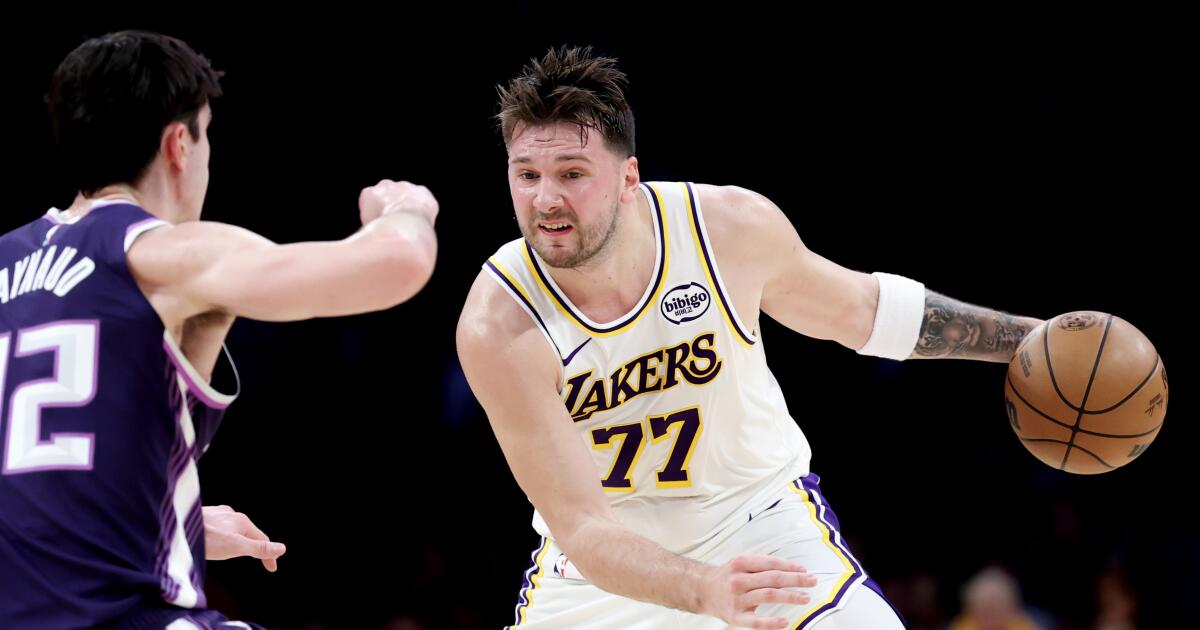
Luka Doncic led the Lakers with 29 points, James added 26 and Deandre Ayton had 20 points and 13 rebounds against his old team. Playing without Austin Reaves (calf strain), the Lakers attempted 43 free throws in a testy game that featured five technical fouls and one late ejection.

Dillon Brooks hit the go-ahead three-pointer with 12.2 seconds left to complete the Suns’ comeback, but he was ejected after he bumped chests with James and got his second technical foul. Brooks received a technical in the first quarter and James drew a technical in the third after a perceived slight from Brooks, who slapped a loose ball toward James during a pause in the action.

Brooks had 18 points and missed most of the third quarter after picking up his fifth foul.

The Lakers finished that quarter on a 15-0 run, largely off hustle plays from Jake LaRavia. The forward who has averaged 5.1 points in the last 10 games, including two scoreless outings, played more than eight minutes in the first half and had nothing to show for it besides two missed shots and a foul. He made just one shot in the third quarter and watched an easy layup roll around the rim and pop out. But he made an impact on defense with two steals, a block and four rebounds in the quarter.

His defense led to the offensive highlight of the third as he stole a pass and shoveled the ball to Jaxson Hayes in transition. The 7-foot center cocked the ball behind his head on a violent, two-handed dunk over Oso Ighodaro and finished the three-point play from the free-throw line.

Hayes had 12 points and nine rebounds off the bench. After getting just five bench points from anyone not named Marcus Smart in losing their last game to the San Antonio Spurs, the Lakers (18-7) got a balanced 30-point lift from their reserves, including seven from Jarred Vanderbilt, who played his first significant minutes in a month.

Vanderbilt had been relegated to the bench since the return of James, but brought a much-needed lift Sunday as the team hoped to rediscover its defensive mentality. The forward was active on defense, had seven rebounds in 15 minutes off the bench and even hit a three-pointer.

But the Lakers fell out of their rhythm when that second unit went to the bench in the fourth quarter. With their starting five in for the final three minutes, the Lakers let a 111-97 lead evaporate as they missed shots, gave up threes and committed fouls and turnovers.

Source link

From Sinai to Seoul: What the Six-Day War Teaches About a Future North Korean Blitzkrieg

In June 1967, when the sun was rising over the Eastern Mediterranean Sea, Israeli fighter squadrons skimming through the coastlines at low altitude struck Egyptian airbases with a devastating blow. Within barely a couple of hours, most of the Egyptian air forces were destroyed. Operation Focus was not a mere initiation of the Six-Day War, but it determined the final outcome of the war. When the ground offensives advanced across the Sinai, Gaza, the West Bank, and the Golan Heights, Israel had already established its critical military superiority, namely, air supremacy. The Six-Day War remains a typical case of how a short, incisive, and highly compressed conflict could overturn the premise of regional deterrence and restructure the long-term strategic reality.

Almost 60 years later, a very different state is studying similar lessons. Based on its nuclear and missile capabilities and deepened defense cooperation with the Russians, nuclear-armed North Korea is refining tools that could enable its own version of a swift and high-impact attack. North Korea’s KN-23 and KN-24 series—quasi-ballistic missiles modeled upon the Russian Iskander-M—have irregular, low-altitude trajectories that are designed to complicate missile defense. Through their recent use by Russia against Ukraine, North Korea has gained invaluable live-fire battlefield data, accelerating improvements in precision, reliability, and mobility during flight. In addition, thanks to Russian assistance—advanced technology, training assistance, and potential space-oriented targeting support—North Korea is securing capabilities that were unattainable in the past.

The strategic risk lies not in whether Pyongyang could literally replicate Operation Focus. Instead, the genuine risk lies in Kim Jong-un drawing wrongful lessons from the Six-Day War and the Russia-Ukraine War: that surprise, speed, and concentrated firepower could overwhelm the opponent before activating an effective response. If Pyongyang is convinced that a blitzkrieg is achievable or judges that nuclear blackmail could suppress the US and Japan’s intervention for a certain timeframe, the incentives for war could increase.

Ways That North Korea Could Attempt a Six-Day War-Style Blitzkrieg

Such perception—that momentum has changed—endangers the nowadays Korean Peninsula. North Korea’s nuclear capabilities are expanding both in terms of magnitude and precision. Meanwhile, North Korea’s SRBM and MLRS systems could strike almost all major airbases and C2 nodes located within South Korea. North Korean SOF, who have long trained themselves with penetration operations via tunnels, submarines, and UAV drops, are carefully analyzing Russian tactics used in the Russia-Ukraine War, ranging from loitering munition to precision targeting of critical infrastructures. Pyongyang may imagine that by combining missile salvos, swarm drones, electronic jamming, SOF penetration, and nuclear escalation, it could paralyze South Korea’s initial response in the first few hours of the war and create a meaningful fissure in alliance coherence.

Here the Six-Day War offers a second powerful lesson. The opening phase of the war has greater importance than other phases. In 1967, Israel’s preemptive strike wiped out Arab air forces on the ground, granting unlimited air dominance to the IDF. Although North Korea could not attain air superiority, it could attempt something functionally similar—denying the US, Japan, and South Korea’s ability to conduct operations normally in the initial hours of the war. This could include simultaneous missile saturation on air defense batteries, fuel depots, hardened aircraft shelters, runways, and long-range sensors. Meanwhile, missiles with irregular trajectories might avoid radar detection and try to penetrate interception layers comprised of PAC-3, L-SAM, THAAD, and Aegis destroyers. Swarm drones could overwhelm short-range air defense or neutralize petroleum, oil, and lubricant (POL) depots and movable C2 vehicles. Cyber operations and GPS jamming would complement such a kinetic assault, creating friction and delays in the alliance response cycle.

Eventually, Pyongyang could conduct its own version of Operation Focus ‘in reverse,’ not to secure air dominance but to prevent opponents from achieving air supremacy. This is to enable North Korea to conduct SOF penetration, a limited armored push in and around the DMZ, and nuclear blackmailing to prevent reinforcement. Such an operation would be based on the similar logic—the ideal mixture of shock, speed, and confusion—that Israel showcased in Sinai and the Golan Heights.

Deterring Blitzkrieg: Lessons for the US, Japan, and South Korea

By using the Six-Day War as a reference, the US, Japan, and South Korea could figure out ways to deter North Korea’s aforementioned provocations. Israel’s victory in 1967 was not achieved solely by air supremacy but also through resilience in its mobilization system and the adaptability of its reserve forces. Once securing air dominance, the IDF swiftly mobilized its reserve forces, stabilized major frontlines, and executed critical maneuvers before Arab countries coordinated with one another. Meanwhile, North Korea might use an intensive SOF operation in the initial phase of the war to wreak havoc on South Korea—recreating the chaos that Israel’s opponents had to experience in 1967—by attacking leadership, transportation centers, and communication nodes.

The solution is clear. If South Korea could prevent internal paralysis in the first 24 to 48 hours of the war, North Korea’s ambitious surprise attack would be largely unsuccessful. Therefore, Seoul should treat protection against SOF, city defense, and civil-military resilience at a level equivalent to ‘air superiority.’ This means diffusion of C2, reinforcement of police and reserve forces, hardening communication, and ensuring that local governments could fully function even under missile strikes and SOF infiltration. Irrespective of the high intensity of an opening barrage, state function should be able to survive, maintain consistency, and prepare for countermeasures.

The political aftermath of the 1967 war is also an important lesson. Israel’s swift victory engendered long-term strategic burdens: the occupation problem, regional backlash, and disputes on legitimacy. It well demonstrates that a short and decisive war could create unpredictable, long-term spillover effects. Applying it to the Korean Peninsula, the US and its allies should have a clear picture regarding North Korea’s failed surprise attack or a regime change. Issues like securing WMD, China’s intervention, refugee flow, humanitarian stabilization, and restructuring North Korea’s political order cannot be managed in an impromptu manner.

The strategic task for Washington, Tokyo, and Seoul is to deny Pyongyang any illusion of a short war. Deterrence should be based on the confidence that North Korea cannot achieve within 6 hours what Israel achieved in 6 days. To make that happen, integration of missile defense systems, real-time intelligence sharing, enhancing the survivability of air bases, diffusion of key assets, and rapid counter-strike capabilities are necessary. Moreover, the US and its allies should establish a political foundation that could withstand a war of attrition—a type of conflict that North Korea cannot tolerate.

Source link

Ukraine may give up NATO dreams for end of war, Zelensky says

Dec. 14 (UPI) — Ukrainian President Volodymyr Zelensky said Sunday that his country may give up its dreams of NATO ascension, at least temporarily, for an end to the war and security guarantees from the United States and Europe, reports said.

Zelensky, who has said that NATO ascension is unlikely because of Russian opposition, held that Ukraine would still seek security guarantees similar to the bloc’s Article 5 clause for mutual protection for members under attack.

His comments were made to journalists in a private WhatsApp chat and were reported by The New York Times and Financial Times.

“This is already a compromise on our part,” Zelensky said.

German Chancellor Friedrich Merz will host talks Sunday between Zelensky, as well as Steve Witkoff and President Donald Trump‘s son-in-law, Jared Kushner, at the Federal Chancellery.

Zelensky added that he has not yet received a response from the Trump administration on revised peace proposals sent last week, the reports said.

Under that peace plan, The New York Times reported, Ukraine said any decision to give up Ukrainian territory would need to be put to a vote and it removed a measure put in place by American negotiators preventing it from ever joining NATO, indicating that Zelensky holds on to hope Ukraine could join the defense alliance in the future.

Yuri Ushakov, the foreign policy adviser to President Vladimir Putin, said on state television Sunday that Russia would have “sharp objections” if the United States adopted any Ukrainian or European suggestions for the plan.

Both Ukraine and Russia have seemingly rejected a proposal from the Trump administration that would create a sort-of demilitarized zone in parts of eastern Ukraine that it still holds, requiring only Ukrainian troops to withdraw from the buffer area.

Zelensky said Sunday he did not consider it fair that Russian troops were not also asked to withdraw deeper into the occupied territories.

“We stand where we stand,” he said. “That is precisely a ceasefire.”

Source link

UCLA’s defense wilts, Bruins lose key game against Gonzaga

They tried a zone defense. They tried moving Tyler Bilodeau back to center. They double- and triple-teamed in the post. They showed one defense to start a possession, only to shift into another.

Nothing the UCLA Bruins did to combat their lack of rim protection worked for more than a couple of possessions at a time.

And so a coach known for defense had to watch his team get bludgeoned inside once again while giving up an unusually frightening number of easy baskets.

“We just couldn’t get the job done defensively,” Bruins coach Mick Cronin said.

UCLA forward Tyler Bilodeau looks to shoot under pressure from Gonzaga guard Adam Miller and center Graham Ike.

UCLA forward Tyler Bilodeau looks to shoot under pressure from Gonzaga guard Adam Miller (23) and center Graham Ike (15) Saturday in Seattle.

(Jason Redmond / Associated Press)

There doesn’t appear to be a quick defensive fix in sight for No. 25 UCLA after it suffered an 82-72 setback against No. 8 Gonzaga on Saturday night at Climate Pledge Arena in the West Coast Hoops Showdown, the Bruins faltering late in their final bid to secure a signature nonconference triumph.

UCLA was overmatched inside, the Bulldogs frontcourt tandem of Graham Ike (25 points) and Braden Huff (21 points) finding success at the rim far too often as a result of being able to make left-handed moves that should have come as no surprise.

“Our problem,” Cronin said, “is we can’t follow the scouting report, we don’t play smart.”

It also didn’t help that UCLA’s late-game execution was once again pitiful, point guard Donovan Dent doing too little once he reached the rim thanks to a flurry of missed shots and bad passes.

“I had a couple of silly turnovers that I just can’t have happen,” said Dent, whose 12 points and 10 assists were partially offset by his four turnovers. “Two [turnovers] for layups; we said turnovers for touchdowns are going to kill us.”

UCLA (7-3) lost despite shooting 49% and making seven of 15 three-pointers because the Bulldogs (10-1) shot 50%, took 13 more free throws and grabbed seven more rebounds. Cronin said the free-throw discrepancy came as a result of his team being out of position defensively.

Bilodeau’s 24 points were nothing more than a footnote after his teammates failed to get him the ball in enough favorable positions, particularly when he was being guarded by a smaller defender. UCLA forward Eric Dailey Jr. also developed an overreliance on jump shots while finishing with a quiet six points and five rebounds in 34 minutes.

Early in the second half, one stretch portended a different ending.

UCLA guard Donovan Dent dribbles in front of Gonzaga center Graham Ike and guard Mario Saint-Supéry Saturday in Seattle.

UCLA guard Donovan Dent (2) dribbles in front of Gonzaga center Graham Ike, right, and guard Mario Saint-Supéry (17) Saturday in Seattle.

(Jason Redmond / Associated Press)

A faint “U-C-L-A!” chant broke out among the heavily pro-Gonzaga crowd after the Bruins went on a 9-0 run sparked by defense.

A Dent steal led to a Brandon Williams layup in transition, a Dailey steal allowed him to throw down a reverse dunk on the fast break and then a Bilodeau block resulted in a Dent layup.

The Bruins were suddenly up by a point and their defensive woes from earlier in the game were momentarily forgotten.

But soon Bilodeau picked up his third foul and departed, leading to a Gonzaga push in which the Bulldogs outscored the Bruins 10-4 to retake control. Dent said the Bulldogs’ switching into a zone for about three minutes baffled the Bruins’ offense.

Cronin also lamented that Williams — who had been playing some strong post defense off the bench — sprained his ankle and had to depart after only five minutes.

This was a game that UCLA needed to win as an NCAA tournament resume builder given a previous lack of meaningful victories and a relatively bad loss to California. The Bruins’ remaining nonconference games — against Arizona State, Cal Poly and UC Riverside — can do little to boost their prospects, meaning they will need an elite showing in Big Ten play to earn a good seeding come March.

Gonzaga center Graham Ike shoots the ball as UCLA forward Steven Jamerson II defends Saturday in Seattle.

Gonzaga center Graham Ike shoots the ball as UCLA forward Steven Jamerson II defends Saturday in Seattle.

(Jason Redmond / Associated Press)

UCLA went back to an old look in the last few possessions before halftime, putting Bilodeau at center. There seemed like little choice given starting center Xavier Booker’s inability to protect the rim and backup Steven Jamerson’s three fouls that sent him back to the bench.

Bilodeau compounded matters by committing a silly foul near midcourt with only four seconds left before halftime, sending Gonzaga’s Mario Saint-Supery to the free throw line for the points that gave the Bulldogs a 45-40 lead at the game’s midpoint.

“We showed zone, we went man, they’ve got no clue, there’s four seconds, just back up and the guy takes a desperation shot,” Cronin said of what should have transpired on the play. “What are you jumping him for? Like, it’s just basic basketball and we were struggling with it. We’ve got good kids and they’re trying, we’ve just got to play smarter.”

How does Cronin’s team go about doing that?

“Teach, watch film, keep teaching, stay relentless — we’ve got to stay relentless,” he said.

Gonzaga guard Jalen Warley, right, drives as UCLA forward Xavier Booker defends him during the first half Saturday.

Gonzaga guard Jalen Warley, right, drives as UCLA forward Xavier Booker defends him during the first half Saturday.

(Jason Redmond / Associated Press)

Cronin said it was essential to build a culture of players knowing why they win, something that’s become far more difficult in an era of free agency with constant player movement.

“It’s hard,” Cronin said of forging that culture. “It’s a lot easier if you’ve got more money.”

The Bruins’ bad habits kept them from enjoying more success against Gonzaga after finally breaking through last year, a three-point victory at the Intuit Dome momentarily pushing aside memories of heartbreaking heaves in the NCAA tournament that were part of four consecutive victories by the Bulldogs.

Cronin said he hoped the series would get extended, though that’s probably low on his list of concerns at the moment. At the top is getting back to playing some competent defense.

Source link

Trump’s National Security Strategy: Reaction and Realization

The first National Security Strategy of the United States of America was released in 1950 under President Truman. It set firm strategic goals based on the containment doctrine to limit the influence of communist ideology in the global order. This first national security strategy marked the beginning of limited global policing in US geopolitics, but it was less pragmatic and more principled realism.  American interests became specific to liberal internationalism and focused only on areas facing the spread of the communist threat.

The Core Security Thinking of the US

The core security thinking of Americans was to preserve their sphere of influence from any adversarial influence or intervention, echoing the Monroe Doctrine. The initial period had this core, and the first national security strategy laid the groundwork for this security thinking. In 1988, the scope of core security thinking expanded, and elements of realism advanced further, with the US beginning to engage in deterrence calculations and global outreach to build collective military alliances against the Soviets. Most importantly, the strategy also focused on strengthening the economy. The core security thinking in the US’s national security strategy by the late 1980s began to realize that, while the Monroe Doctrine is important, US strategic interests must also require adopting flexibility in its confrontational approach, guided by liberal internationalism and the containment of communism.

Pragmatism and Realism

After the Soviet disintegration, US National Security Strategy focused on navigating a multipolar world by reinforcing the idea of collective security under the H.W. Bush Administration. The 1991 and 1993 US National Security strategies expanded on the concepts that started to emerge in the late 1980s—deterrence and engagement. In the 1990s, this strategy was continued through Powell’s four pillars: strong defense, forward presence, alliances, and coalition-building. The national security strategy designs suggest that elements of pragmatism and distinctions of pure realism gradually began to take center stage in the US national security approach.

Strategy in Crises

The National Security Strategy changed after 9/11, possibly in response to shifted security priorities. The previous approach of principled realism, which involved pragmatic and defensive tactics, now showed a slight shift, with the US’s national security strategy emphasizing more openly offensive realism and dogmatism. By the mid-2000s, the US had reactionary national security strategies, moving away from the approach that began to develop in the late 1980s. Key shifts in security strategies after 2001 included the doctrine of preemption and unilateral actions, but another significant change was a major shift in the collective engagement perspective, differing from earlier ideas of shared strategic responsibilities among allies.

After 9/11, the US called on allies, particularly in NATO, to bear a greater share of the burden for collective defense efforts, shifting away from reliance solely on the US. The core security thinking, rooted in peace through engagement, shifted during the 1990s toward peace through strength. Another aspect, after the Monroe Doctrine, peace through strength, gained a label of permanence in the US National Security Strategy, though its effectiveness and emphasis varied over time.

Trump’s National Security Strategy: Rebooting and Readjustments

Trump’s 2025 national security strategy resembles his 2017 National Security Strategy. The nationalist ideals of America First and the focus on economic engagement—which is the main security approach this time—are a mix of realizations and reactions. The first reaction to the current global situation is reasserting the Monroe Doctrine, dubbed “Trump Corollary,” and the second is showing the will for peace through strength by deterrence. Even if conflicts occur, the strategy emphasizes engaging in conflict with strategic skill to quickly win wars with little to no casualties. The realization part of the strategy is the US increasing its understanding of collective efforts and economic strength. The strategy highlights stronger partnerships with countries like India for the Indo-Pacific.

Reaction and Challenge

The realistic approach in this strategy is flexible realism, aiming not at domination but at maintaining a balance of power, while not fully adopting defensive realism. The United States has embraced both offensive and defensive realism. Over the past ten years, the US National Security Strategy under Obama, Trump 1.0, and Biden has incorporated elements of defensive realism along with principled realism, with the US gradually increasing its efforts to balance power through the promotion of liberal and pro-democratic values—examples include its Middle East policy and the revival of QUAD in 2017. However, a notable development in the 2025 strategy is the US’s willingness to undertake offensive actions to maximize security, such as Operation Midnight Hammer against Iran and expanding operations in Latin America against Venezuela. Another prominent aspect of this strategy is the US’s focus on Europe’s burden-sharing, attempting to lighten its responsibilities and emphasizing that Europe should stand on its own, while the US remains a facilitator in Europe’s development. However, it is no longer willing to assume a broader role—similar to sentiments after 9/11. This strategy likely reflects the challenges posed by a rising China, Russia’s multipolar approach, and increasing strategic competition in multilateral arenas. The Trump approach—as mentioned in the strategy—is not just a reboot of the US National Security strategy after the 2000s but with some realizations.

Realization

There is a growing realization, as highlighted earlier, that the US can no longer sustain a confrontational approach and aggressive, offensive realism. The Trump strategy for 2025 recognizes the need to incorporate elements from both the late Cold War and post-Cold War periods. The latter was characterized by defensive realism and principal realism features—approaches that the US emphasized during the Clinton years, when embracing multilateralism, economic diplomacy, and regional collective engagements became central to US national security strategy, paving the way for more pragmatic interventions. A similar recognition of Clinton’s policy of enlargement through engagement is reflected in Trump 2.0 National Security Strategy—Shifting from Aid to Trade with Africa, which exemplifies this focus on promoting economic diplomacy and broadening engagement.

The US National Security Strategy 2025 reflects the nation’s understanding of how to adapt its engagement with the global order while maintaining realism. This time, US security thinking appears to find a balance between engagement and deterrence, which in previous years often seemed to conflict.

Source link

Jarred Vanderbilt hoping for an opportunity to help Lakers on defense

Perhaps Jarred Vanderbilt and his ability to defend can help the Lakers and their reeling defense.

Perhaps Vanderbilt can return to the rotation to help the Lakers’ defensive woes while guard Austin Reaves is out for approximately a week because of a mild left calf strain.

And perhaps Vanderbilt and the Lakers can get some immediate results for shoring up their defensive shortcomings when they face the Suns in Phoenix on Sunday afternoon.

The 6-foot-8 Vanderbilt is hopeful that his opportunity will come against the Suns and he turns that into a positive for the Lakers.

“Oh, yeah, I’m pretty eager,” he said after practice Saturday. “I mean, obviously, I think a lot of the stuff we lack, I think I can help provide on that end.”

In the last 10 games, Vanderbilt had only a three-minute stint against the Philadelphia 76ers because Jake LaRavia took a shot to the face that loosened a tooth.

The return of LeBron James and Vanderbilt’s offensive deficiencies left him out of the rotation. During much of that time the Lakers were winning, which meant Vanderbilt spent time on the bench.

In 15 games, Vanderbilt is three for 10 (26.6%) from three-point range. He was asked how he has been handling things.

“Good,” Vanderbilt said. “Controlling what I can control. Keep showing up to work, doing my part, supporting the team.”

Vanderbilt was asked if coach JJ Redick or any assistants have spoken to him about his role.

“Kind of here and there, I guess,” Vanderbilt said.

Vanderbilt was seen after practice Saturday working with an assistant coach on his shooting, just like he did after practice Friday and like he has done while not playing.

Redick said Reaves, who played against the San Antonio Spurs on Wednesday night, wasn’t sure when the calf became an issue, and “we’re obviously gonna be cautious with it.”

“It’s a mild strain, Grade 1, and he’ll be out for a week,” Redick said, adding, “I would venture to say every player is a little bit different, but players now are becoming more cautious — to use that word again — more cautious when they get those diagnosis with the calf. Everything looks clean. It’s not in the deep part.”

The Lakers have looked at the last 10 games during the film sessions as a barometer for their defensive problems. But in reality, the Lakers have not been very good on defense all season while producing a 17-7 record because of their stellar offense.

“It’s been a trending thing even when we was winning, so I think like you said, the defense still wasn’t there, but we was just outscoring everybody,” Vanderbilt said. “So, I think obviously during the loss, it’s an appropriate time to address certain things just so it won’t keep lingering and get worse.”

The Lakers are 18th in the NBA in points given up (116.8), 22nd in opponents’ field-goal percentage (48.1%) and 27th in opponents’ three-point shooting (38.2%).

They will face a Suns team that defeated them Dec. 1 at Crypto.com Arena. The Lakers were unable to stop Collin Gillesipie, who had 28 points and was eight for 14 from three-point range, and Dillon Brooks, who had 33 points.

It hasn’t gotten better in the ensuing days. The Spurs loss was the Lakers’ third in the last five games.

“Nobody likes to go watch film after you get your ass kicked,” guard Marcus Smart said. “It’s tough because the film never lies. And it exposed us a lot, which we already knew. We were just winning a lot of games. So it was mitigated that way, but it was straight to it: We have to be able to guard.

“The scouting report against us is we’re not guarding people. And if we want to be great in this league and do what we’re trying to do, you have to be able to guard, especially in the West. These guys are no joke, and they’re coming. And especially [if] you got the Lakers across your jersey. They’re definitely coming with everything they have. So you can’t be expecting any surprises. And that’s what it was. It wasn’t no sugarcoating anything. It was, ‘This is what we got to do.’ We’ve been asked. Let’s fix it.”

Source link

Cambodia closes Thai border crossings amid ongoing fighting

Two Thai F-16 fighter jets dropped seven bombs in Pursat Province, Cambodia, and damaged a bridge amid escalating tensions that caused Cambodian officials to close border crossings on Saturday. Photo by Agence Kampuchea Presse/EPA

Dec. 13 (UPI) — Cambodian officials closed all border crossings from Thailand as fighting continues between the two nations despite a claimed cease-fire.

The Cambodian Defense Ministry said Thai forces had not stopped bombing targets in Cambodia on Saturday, the Wall Street Journal reported.

The border crossings with Thailand will remain closed until further notice, ministry officials said.

President Donald Trump on Friday night announced a cease-fire agreement had been reached between Thai and Cambodian officials after he spoke with them.

They agreed to “cease shooting effective this evening” and resume an agreement signed in October, Trump said in a social media post, adding that “both countries are ready for peace,” as reported by the BBC.

Leaders from the respective nations did not say they reached a cease-fire, though.

“Thailand will continue to perform military actions until we feel no more harm and threats to our land and people,” Thai Prime Minister Anutin Charnivirakul said, as reported by The New York Times.

Cambodian Prime Minister Hun Manet confirmed speaking with Trump regarding a cease-fire but did not say an agreement had been reached.

Officials in both nations reported that bombing and artillery fire continued on Saturday, and Thai officials told media that four of the nation’s soldiers had been killed.

Thai officials said a rocket attack launched from Cambodia injured several civilians, while the four military deaths raised the total since Monday to 15, along with 270 wounded and six civilians injured.

Cambodian officials have not updated that nation’s casualty reports for Saturday after reporting Thai fighter-bombers struck hotels and a bridge. They said 11 civilians had been killed and 59 injured as of Friday.

The fighting forced the evacuation of an estimated 700,000 civilians on both sides of the Thai-Cambodia border, which extends about 500 miles from Laos in the East to the Gulf of Thailand in the west.

Source link

Southern Command leader Adm. Alvin Holsey relinquishes command

Admiral Alvin Holsey relinquished his leadership of U.S. Southern Command on Friday ahead of his pending retirement after serving 37 years in the Navy. Photo by Mariano Macz/EPA

Dec. 12 (UPI) — U.S. Southern Command leader Adm. Alvin Holsey relinquished his command on Friday amid his pending retirement from the Navy after 37 years of service.

Holsey announced his pending retirement in October without giving a reason, CBS News reported.

He relinquished his command over military forces in South America during a ceremony Friday at Southern Command headquarters.

“We have worked hard and tirelessly to build relationships and understand requirements across the region,” Holsey said during a command-change ceremony.

“That work must continue across the whole government to deliver at the point of need to respond to shared threats in our neighborhood — the time is now.”

Joint Chiefs of Staff Chairman Gen. Dan Caine bestowed the Defense Distinguished Service Medal upon Holsey during the ceremony and included a citation that was signed by Defense Secretary Pete Hegseth.

“One of Adm. Holsey’s most significant achievements was the transformation of USSOUTHCOM into a more agile, capable and operationally present force,” U.S. Southern Command officials said Thursday in a news release, as reported by The Hill.

“Under his leadership, the command expanded from roughly 3,500 personnel to nearly 15,000 personnel in direct support of operations in the region,” the release said.

“The operational impact was immediately felt, with the expanded U.S. presence across the region, improving responsiveness and strengthening deterrence.”

Holsey initially was scheduled to lead Southern Command for four years, but stepped down amid the U.S. military buildup in the region after taking command in November 2024.

Holsey and Hegseth have had disagreements regarding strikes on alleged drug vessels and other actions that have raised tensions between the United States and Venezuelan President Nicolas Maduro, according to CBS News.

The U.S. military has targeted at least 22 vessels in strikes that have killed at least 87 crew members deemed “narco-terrorists” by the Trump administration and Hegseth since the strikes began in September.

Hegseth also accused Holsey of moving too slowly in developing options to ensure the United States has unhindered access to the Panama Canal, which President Donald Trump has said the nation should reclaim from Panama, according to The Wall Street Journal.

Air Force Lt. Gen. Evan Pettus is scheduled to replace Holsey as acting commander of Southern Command.

Source link

Finland Orders Latest US Air-to-Air Missiles for F-35 Fleet

NEWS BRIEF Finland has announced it will procure Advanced Medium Range Air-to-Air Missiles (AMRAAM) from the United States, a key step in arming its fleet of 64 F-35 fighter jets as Helsinki continues to bolster its air defenses against Russia. The missiles, described as the latest and most advanced variant, are scheduled to be delivered […]

The post Finland Orders Latest US Air-to-Air Missiles for F-35 Fleet appeared first on Modern Diplomacy.

Source link

Kim Jong Un touts defense policy, overseas troop deployment at key party meeting

North Korean leader Kim Jong Un praised his country’s military modernization efforts at a key ruling party meeting, state-run media reported Friday. In this photo, Kim is seen speaking Tuesday during the second day of the plenary meeting of the Workers’ Party Central Committee. Photo by KCNA/EPA

SEOUL, Dec. 12 (UPI) — North Korean leader Kim Jong Un praised his country’s military modernization efforts as addressing security challenges “effectively and correctly” at a key ruling party meeting, state-run media reported Friday.

Kim said the regime’s push to strengthen defense capabilities was the “exact” direction to ensure North Korea’s security amid shifting geopolitical dynamics, according to the official Korean Central News Agency.

The comments came as the three-day enlarged plenary meeting of the Workers’ Party of Korea’s Central Committee wrapped up on Thursday. The session reviewed this year’s policy implementation results and laid groundwork for a key party congress set for early next year.

During his remarks, the North Korean leader also highlighted the deployment of troops to Russia as a major achievement of the country’s defense strategy.

“The signal military gains made by … the Korean People’s Army in the overseas military operations over the past nearly one year demonstrated to the world the prestige of our army and state,” Kim said.

Pyongyang has provided significant support for Moscow’s war effort in Ukraine, sending thousands of shipping containers of munitions and deploying 15,000 troops to assist Russian forces in the Kursk region, according to Seoul’s National Intelligence Service.

In exchange, experts assess that Russia is transferring advanced military technology to Pyongyang, including assistance with space launch vehicles, reconnaissance satellites and air defense systems.

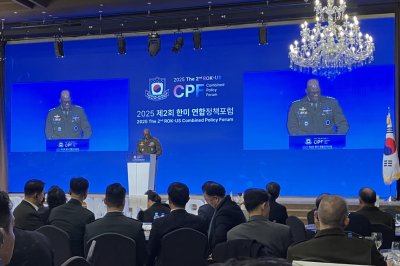
On Friday, the commander of U.S. Forces Korea warned of the expanding threat posed by North Korea as it deepens military cooperation with Russia.

“Russian-DPRK collaboration is real — it is not a quid pro quo relationship,” Gen. Xavier Brunson said during a webinar.

The Democratic People’s Republic of Korea is the official name of North Korea.

“There are things we know are happening right now that give me pause as I look at what might face us down the road, whether that be training, or techniques and procedures they’re learning from the front,” Brunson said.

The ruling party’s Ninth Congress, expected in early 2026, is widely expected to outline a new five-year economic plan and recalibrate Pyongyang’s military and foreign policy priorities.

Analysts say that the event may also cement a hard-line posture toward South Korea. In 2024, North Korea officially designated the South as a “hostile state,” according to state media, while Kim publicly rejected the long-held goal of reunification.

Source link

A Gathering Storm: The Escalating U.S.-Venezuela Military Confrontation

For the first time since the termination of the Cold War, a major military crisis is heating up in the Caribbean. Since early September 2025, United States aerial combat drones have been patrolling and targeting the suspected smuggler boats in the international waters of the Caribbean Sea. These strikes were initially portrayed as kinetic measures to choke off the drug trade through the Caribbean Sea. According to US officials, by 04 December, 22 strikes have been conducted and 87 narco-terrorists have been killed. However, it’s worthy to note that the majority of cocaine production is centered in Colombia, Peru, Bolivia, and Mexico and enters into the United States through an inland or Pacific route—not through the Caribbean Sea. Out of 22 strikes, only 10 have been conducted in the Pacific waters.

Washington’s political ambitions eventually became evident in October once it forward deployed a naval flotilla at the strike range to Venezuela. Currently, eight US Navy vessels are operating in the Caribbean Sea. The USS Gerald Ford aircraft carrier, with its vast combat aviation wing comprising F-35C Lightning IIs, F/A-18 E/F Super Hornets, and a variety of support fixed- and rotary-wing aircraft, is currently stationed in the US Virgin Islands. Other forward-deployed naval vessels include the MV Ocean Trader command vessel and the USS Iwo Jima amphibious assault ship with over 4,000 marines. These ships are supported by two Ticonderoga-class cruisers, two Arleigh Burke-class destroyers, and the USS Newport News, a Los Angeles-class nuclear attack submarine (SSN), each equipped with Tomahawk cruise missiles. The presence of this naval flotilla suggests that the USN has mustered enough capability to not only launch aerial and cruise missile strikes but also conduct amphibious operations at the Venezuelan coast. In parallel, Venezuelan airspace has been declared ‘closed’ by the Trump administration. Such assertive measures are not meant for anti-narcotic operations but perhaps for regime change either through coercive diplomacy or through direct military action. Whatever the case may be, it’s evident that for the first time in decades, the United States is apparently preparing for a direct military conflict in its own hemisphere.

Understanding how this crisis escalated requires looking back at the recent history of bilateral tensions. The fractures began to appear in US-Venezuela relations from 1999, when Hugo Chávez came to rule on a wave of anti-American populism and nationalized the country’s oil industry. Within three years, mutual relations collapsed so abruptly that first Washington imposed sanctions and then briefly removed Chávez from power through a CIA-backed coup. Chávez regained the rule in a matter of a few days. This move, however, further intensified anti-American sentiments in the Venezuelan public. Chávez made subversion of Washington a political identity; his successor Nicolás Maduro turned it into state doctrine. In 2019, Washington even declared Juan Guaidó, the opposition leader of Venezuela, as the country’s ‘legitimate president.’ Besides the open political signaling of the White House, the CIA also attempted another coup to topple the Maduro regime but again failed to achieve the requisite results.

Maduro successfully exploited continuous intervention by the United States to augment its political narrative at the public level and managed to earn a third consecutive term in 2025. However, the results of elections were regarded as dubious and were generally dismissed as fraudulent, further degrading relations with the West.

For Venezuela, oil has attracted more trouble than prosperity. The country has more than 300 billion barrels of proven oil reserves—more than Saudi Arabia (267 billion barrels)—yet it produces less than 10 percent of its 1990s highest productivity rate. The Venezuelan crude oil is ultra-heavy (8-12° API) and has very high sulfur content. Such dense oil is not only very challenging to refine—both economically and technologically—but also very hard to transfer and cannot be pumped through pipelines without imported diluents. In a nutshell, despite possessing the largest proven oil reserves, Venezuela cannot refine and export its black gold without significant foreign assistance. The current oil infrastructure, developed during the Cold War, is gradually crumbling. Pipelines are either blocked or leaking, and refineries are now operating below 15 percent capacity. Approximately 58 billion USD worth of investment is required to repair and revive the current infrastructure. Being a struggling economy, Venezuela simply does not have the financial capacity to do so. Meanwhile, the majority of technical expertise has been eroded due to brain drain. For example, PDVSA once employed more than 40,000 engineers but now has a total strength of only 12,000 with a large portion of untrained manpower. Currently, while Gulf nations are earning huge revenue from oil exports, Venezuela stands isolated as an oil superpower that cannot even power itself.

The aforementioned factors have imparted grave consequences on the Venezuelan economy. Its national GDP has shrunk from about 300 billion USD to a mere 110 billion USD approximately. More than half of the population is living in poverty, and unemployment has crippled public development. Roughly 28 percent of the total population is in need of humanitarian assistance. These financial woes have compelled common Venezuelan citizens to seek refuge outside the country. Currently, nearly 8 million locals have left the country and are living as refugees in neighboring countries, including Columbia, Peru, Brazil, and even the United States.

To survive internal implosion, Caracas has sought external assistance from Washington’s strategic competitors, including Russia, China, and even Iran. Both Russia and Venezuela are signatories of the 10-year Strategic Partnership Treaty, which was ratified in Oct-Nov 2025 with the overarching objective of combating unilateral coercive measures. Russia has provided military assistance and technical support for the training of troops and maintenance of military equipment, which is predominantly of Soviet origin. China has repeatedly provided diplomatic support and financial loans to support Venezuela’s energy infrastructure. Both Russia and China have vetoed resolutions at the UN Security Council for imposing stringent sanctions against Venezuela. With Iran, Venezuela also shares a strong relation, which was formalized by a 20-year agreement in 2022. Their domains of cooperation include trade, repairing of energy infrastructure, modernization of the defense force, and technology sharing for refinement of crude oil. For the United States, these collaborations are meant to develop a foothold in Latin America by Russia, China, and Iran—something Washington considers intolerable.

When the Trump administration returned in 2025, within weeks, it scrapped Chevron’s license, eliminating Venezuela’s last stable revenue stream. The most significant escalation came on July 25, 2025, when the US Treasury designated Venezuela’s military leadership—the Cartel de los Soles—as a global terrorist organization. No foreign military in American history had ever received such a label. Simultaneously, the reward for the arrest of President Nicolás Maduro has been doubled to 50 million USD by the Trump administration on federal charges of narcoterrorism and conspiracy to import cocaine. And now, with a fully equipped US naval strike force sailing in the Caribbean Sea, the situation is getting increasingly volatile. The Venezuelan military simply does not possess the capability to defend against such a strike force.

If hostilities break out, then instead of placing boots on the ground, the United States is likely to conduct targeted strikes at key assets, impose and sustain a naval blockade, and eventually undermine the Venezuelan military’s and nation’s loyalty to Maduro through coercive diplomacy. The current crisis illustrates that although the Trump administration claims to have taken numerous initiatives to end conflicts and promote trade & collaboration in the Eastern Hemisphere, it will show little to no tolerance for the growing influence of Moscow and Beijing in the Western Hemisphere. Under the Monroe Doctrine, the United States seeks to sustain its control in the Western Hemisphere, including Latin America. For Trump, an example can be crafted out of Venezuela to demonstrate the potential consequences of deepening collaboration with Moscow and Beijing in Washington’s backyard.

Source link

U.S. calls on Houthis to release detained mission staff

Houthi supporters shout slogans during a protest against Israel in Sana’a, Yemen, on August 29. On Wednesday, the United States called on the militant group to release former and current mission staff detained by the Houthis. File Photo by Yahya Arhab/EPA

Dec. 10 (UPI) — The United States late Wednesday called on Yemen-based Houthis to release all current and former staff the rebels have kidnapped, amid ongoing legal proceedings alleging international spy cells operating in the Middle Eastern country under the cover of humanitarian aid.

It was unclear how many current and former staff, all Yemeni nationals, of the U.S. Mission to Yemen were in Houthi custody. The United Nations has said 59 of its staff and dozens of diplomatic mission, NGO and civil society personnel have been detained by the Iran-proxy militia.

“The Iran-backed Houthis, a designated Foreign Terrorist Organization, have intensified their campaign of intimidation and abuse against Yemeni citizens affiliated with international organizations and foreign governments,” State Department spokesperson Thomas Pigott said in a statement.

“The Houthis’ arrests of those staff, and the sham proceedings that have been brought against them, are further evidence that the Houthis rely on the use of terror against their own people as a way to stay in power.

“We call for the immediate and unconditional release of the Mission staff.”

The Houthis have detained and are trying the workers they allege are members of foreign espionage cells linked to United States, Britain, Israel and Saudi Arabia.

Late last month the Houthi-controlled Foreign Ministry warned the United States against interfering in its judicial independence, saying it only confirms Washington’s involvement in espionage against them.

U.N. Secretary-General Antonio Guterres said he is “gravely concerned” about the arbitrary detention of his 59 personnel and the dozens of others in Houthi captivity and condemns their referral to a special criminal court.

Some of the U.N. personnel have been held by the Houthis for years without any due process and in violation of international law, he said, adding that they are immune from legal process for all acts performed in their official capacity.

In late August, 11 U.N. employees were abducted by Houthi-controlled authorities after they raided World Food Program facilities in the capital Sanaa. The raid followed Israeli airstrikes that killed the Houthis’ prime minister, Ahmed al-Wawai, along with several other ministers.

Hans Grundberg, U.N. special envoy for Yemen, said then that there were 23 U.N. workers in Houthi captivity.

On Tuesday, Volker Turk, the U.N. high commissioner for human rights, said one of his colleagues who has been detained by the Houthis since November 2021 has been presented before the Special Criminal Court on “fabricated charges of espionage connected to his work.”

“This is totally unacceptable and a grave human rights violation,” he said.

“Our colleagues, along with dozens of other U.N. and humanitarian staff, have been detained while bravely carrying out their work assisting the people of Yemen, and held in intolerable conditions ever since,” he said in a statement.

The U.N., he said, has received reports that numerous detained staff have been mistreated.

“Their suffering, and that of their families, has gone on far too long,” he said. “Their safety and well-being are at grave risk.”

Stephane Dujarric, spokesman for U.N. secretary-general, told reporters during a Tuesday press conference that they have not been able to speak with any of their detained staff but are in constant communication with the Houthis trying to secure their release.

“We don’t want them to be in this court, and we want them to be released,” he said.

The U.S. Embassy in Yemen said Wednesday that the “sham trials” are evidence of the Houthis’ weakness.

“The Houthis continue to use intimidation to distract from their inability to govern legitimately,” it said on X.

“We call for the immediate release of these unjustly held Yemeni citizens, so that they can return to their families after years of illegal detention.”

The U.N., along with humanitarian and non-governmental organizations, operate in Yemen as its 12-year civil war between the Houthi militants and the internationally recognized Yemeni government has made it one of the world’s worst humanitarian crises.

Source link

Macron’s Warning, Bremen’s Wallet: Europe’s New Space-Defense Era

When French President Emmanuel Macron inaugurated France’s Space Command in Toulouse on 12 November 2025 and declared that “space is no longer a sanctuary; it has become a battlefield,” few expected such swift validation. Two weeks later, at the ESA Ministerial Council in Bremen on 26–27 November, member states delivered the largest budget in the agency’s history—€22.1 billion for 2026–2028, a 30% increase over the previous cycle—with an unprecedented focus on security, defense, and strategic autonomy. The Bremen decision has transformed Macron’s stark warning from rhetoric into funded reality and confirmed that Europe is finally awakening to the fact that the next decisive domain of great-power competition lies far above the Earth’s atmosphere.

Paris is preparing to invest about €4.2 billion in military space activities from 2026 to 2030 and around €16 billion in civilian and dual-use programs by the end of the decade. The ambition is to strengthen Europe’s resilience in orbit, reduce dependence on non-European systems, and create an industrial base capable of supporting long-term security objectives.

French planners are betting on a new generation of proximity‑inspection satellites to anchor this strategy, with demonstration flights envisaged in the second half of the decade and operational testing to follow. These satellites can approach, observe, and, if required, interdict suspicious objects in orbit. France is also exploring non‑kinetic tools—lasers and electromagnetic systems among them—designed to disrupt hostile platforms without creating debris. Paris has rejected destructive anti-satellite testing and argues that Europe must enhance space security without undermining international norms.

The European Union is entering this field late. Russia and China have already developed advanced inspection and interference capabilities. In September 2025, German Defence Minister Boris Pistorius revealed that two Russian Luch or Olymp satellites were shadowing Intelsat platforms used by the Bundeswehr. The episode underscored Europe’s lack of awareness and defensive capacity in orbit.

In Brussels, officials are floating the idea of a “European Space Shield”—a more integrated architecture to protect satellites and align EU and NATO postures. Success will depend on the willingness of member states to coordinate procurement, share data, and harmonize strategic objectives. Europe’s current system remains fragmented and is often slowed by national industrial preferences.

Macron has also called for reform of the European Space Agency’s geographic return rule, which distributes contracts according to member-state contributions rather than technical merit. The French position is that this rule limits innovation and prevents Europe from responding quickly to fast-moving threats in orbit.

There are challenges. Even non-kinetic defenses can be misinterpreted as escalatory. The orbital environment is crowded, vulnerable to miscalculation, and poorly regulated. France has therefore paired its military investments with calls for new rules of behavior and a European proposal for an orbital code of conduct. Such a framework would help prevent misunderstandings and promote transparency.

The ESA Ministerial Council that concluded in Bremen on 27 November delivered what many had doubted was possible: a €22.1 billion envelope for 2026–2028 that explicitly prioritizes space security, resilient navigation (FutureNAV), Earth-observation continuity, and dual-use technologies. Germany increased its contribution by nearly a third despite domestic fiscal constraints, while the package includes more than €1 billion for programs directly supporting defense and sovereignty. Crucially, ministers opened the door to greater flexibility on the controversial “geographic return” rule for critical security projects—a French demand that had been resisted for years. Bremen did not create a fully unified European space-defense policy overnight, but it transformed Macron’s Toulouse rhetoric into funded reality and gave the proposed European Space Shield its first serious financial and political tailwind.

Satellites underpin critical EU functions, including climate monitoring, secure communications, trade logistics, and border management. Rivals are developing tools that can dazzle, jam, or disable them. Europe cannot assume that these systems will remain safe without deliberate action.

Macron’s announcement in Toulouse should be seen as a strategic warning. Europe has the capacity to protect its interests in orbit, but only if it acts with coherence and political determination. The challenge for the European Union is not technological. It is the ability to work collectively and with a sense of urgency. In an era in which conflict begins long before military forces deploy, the EU’s strategic autonomy may depend on decisions made far above the atmosphere.

Source link

‘Largest tanker ever seized’ held by U.S. off the coast of Venezuela

Dec. 10 (UPI) — The United States seized a large oil tanker off the coast of Venezuela amid ongoing tensions between President Donald Trump and Venezuelan President Nicolas Maduro.

The tanker was seized during a “judicial enforcement action on a stateless vessel” that had docked in Venezuela, Bloomberg reported.

“Today, the Federal Bureau of Investigation, Homeland Security Investigations and the United States Coast Guard, with support from the Department of War, executed a seizure warrant for a crude oil tanker used to transport sanctioned oil from Venezuela and Iran,” Attorney General Pam Bondi said in a late-afternoon post on X.

U.S. officials sanctioned the oil tanker several years ago due to its “involvement in an illicit oil shipping network supporting foreign terrorist organizations,” Bondi explained.

“This seizure, completed off the coast of Venezuela, was conducted safely and securely — and our investigation alongside the Department of Homeland Security to prevent the transport of sanctioned oil continues.”

U.S. military personnel seized the tanker by fast-roping from a helicopter to board it, Bloomberg reported.

Trump earlier confirmed the tanker’s seizure at the start of a 2 p.m. EST roundtable at the White House.

“We’ve just seized a tanker off the coast of Venezuela — the largest tanker ever seized,” Trump said at the start of the roundtable meeting.

He said “it was seized for a very good reason” and the “appropriate people” would address the matter when asked for more information by a reporter.

The vessel’s seizure occurred as the Trump administration has been applying pressure on Maduro, whom Trump has accused of being a narco-trafficker and of stealing the country’s 2024 presidential election by declaring himself the winner.

The Trump administration has designated Cartel de los Soles aka Cartel of the Sun a foreign terrorist organization that includes many Venezuelan military and government officials among its leadership.

Defense Secretary Pete Hegseth has ordered a carrier strike group to join other U.S. Navy vessels in the Caribbean Sea amid ongoing strikes against small craft departing Venezuela and other nations that are alleged tobe carrying illicit drugs.

The oil tanker’s seizure and the presence of the U.S. military in international waters near Venezuela are likely to discourage oil companies from transporting Venezuelan crude oil.

“Shippers will likely be much more cautious and hesitant about loading Venezuelan crude going forward,” Kpler oil analyst Matt Smith told CNBC.

Rystad Energy’s Jorge Leon, who is in charge of the firm’s geopolitical analysis, told Bloomberg the U.S. seizure of a “Venezuelan tanker” is a “clear escalation from financial sanctions to physical interdiction.”

The seizure “raises the stakes for Caracas and anyone facilitating its exports,” Leon said.

The Trump administration also has advised international airlines to be cautious when approaching Venezuela, which has caused many to suspend operations there.

President Donald Trump walks on the South Lawn of the White House after arriving on Marine One in Washington on Tuesday. Trump said people were “starting to learn” the benefits of his tariff regime. Photo by Graeme Sloan/UPI | License Photo


Source link

House to debate military funding bill; some GOP members unhappy

Dec. 10 (UPI) — The House of Representatives will vote on Wednesday on the bipartisan $900 billion defense policy bill, though some lawmakers take issue with some of its provisions.

The 3,086-page bill authorizes $8 billion more in spending than President Donald Trump had asked for.

“This year’s National Defense Authorization Act helps advance President Trump and Republicans’ Peace Through Strength Agenda by codifying 15 of President Trump’s executive orders, ending woke ideology at the Pentagon, securing the border, revitalizing the defense industrial base, and restoring the warrior ethos,” House Speaker Mike Johnson said in a statement.

The bill would codify the use of active-duty troops at the U.S.-Mexico border, create a “Golden Dome” to protect the U.S. from aerial attacks and ban diversity, equity and inclusion programs at the Department of Defense. The bill would also create a 3.8% raise for all service members.

It includes a ban on transgender women competing in sports at military academies.

The annual legislation has normally been approved with bipartisan support. But several Republicans have voiced dissent.

“I think that it’s in trouble because it’s not the version we sent over,” Rep. Anna Paulina Luna, R-Fla., told The Hill. She said she was disappointed with the bill because it authorizes funds for the Ukraine Security Assistance Initiative. It includes $400 million for military help to Ukraine in fiscal years 2026 and 2027.

Last week, Rep. Elise Stefanik, R-N.Y., criticized Johnson for blocking a provision requiring the FBI to tell Congress when it begins counterintelligence investigations on candidates running for federal office. It was later added.

Rep. Marjorie Taylor Greene, R-Ga., said on X that the bill will “fund foreign aid and foreign country’s wars.” She also accused Republican leadership of breaking a promise to include a ban on creating a central bank digital currency. Hardline conservatives have argued that the digital currency could be used to spy on Americans.

“Conservatives were promised that an anti-Central Bank Digital Currency language, authored by Tom Emmer, the whip, would be in the NDAA,” Rep. Keith Self, R-Texas, said on Fox Business Monday. “There are red lines that we need to put in here.”

Emmer, R-Minn., said about leaving the anti-CBDC segment out, “they’ll understand what is going on, and they’ll be fine,” The Hill reported.

Rep. Andy Harris, R-Md., said he doesn’t like that the bill allows “8 billion more than we should have.”

Defense Secretary Pete Hegseth will see his travel budget cut under the bill until the Pentagon releases the footage of strikes against alleged drug boats near Venezuela. His travel budget would be reduced by 25% until he shares “unedited video of strikes conducted against designated terrorist organizations in the area of responsibility of the United States Southern Command.”

It also requires him to submit some overdue reports before getting his travel budget back.

“That was a bipartisan shot across the bow to Donald Trump to hand over the tapes, done by Republicans. I salute them for their courage for bucking Trump and bucking Hegseth,” Senate Minority Leader Chuck Schumer, D-N.Y., said on the Senate floor Tuesday.

President Donald Trump walks on the South Lawn of the White House after arriving on Marine One in Washington on Tuesday. Trump said people were “starting to learn” the benefits of his tariff regime. Photo by Graeme Sloan/UPI | License Photo

Source link

U.S. sanctions network recruiting Colombians to fight in Sudan

Dec. 10 (UPI) — The United States has blacklisted a network of four Colombians and four entities accused of recruiting former Colombian military personnel to fight in Sudan’s civil war.

The sanctions were announced Tuesday by the U.S. Treasury, which said the network was aiding the Rapid Support Forces, a breakaway paramilitary unit that has been accused of committing ethnic cleansing and genocide in the nearly 1,000-day-old conflict.

The RSF has been waging war against the Sudanese Armed Forces since April 2023. According to the Treasury, the RSF has recruited hundreds of former Colombian military personnel since September 2024.

The Colombian soldiers provide the RSF with tactical and technical expertise. They serve as infantry, artillerymen, drone pilots, vehicle operators and instructors, with some even training children, according to the Treasury.

“The RSF has shown again and again that it is willing to target civilians — including infants and young children. Its brutality has deepened the conflict and destabilized the region, creating the conditions for terrorist groups to grow,” John Hurley, undersecretary for the Treasury for Terrorism and Financial Intelligence, said in a statement.

Colombian soldiers have aided the RSF in its late October capture of El Fasher in North Darfur following an 18-month assault, while committing alleged war crimes along the way, including mass killings, sexual violence and ethnically targeted torture.

The Treasury identified and sanctioned Alvaro Andrew Quijano Becerra, a 58-year-old retired Colombian military officer, who is accused by the United States of playing a leading role in the network from the United Arab Emirates. His Bogota-founded International Services Agency was also sanctioned for seeking to fill drone operator, sniper and translator roles for the RSF via its website, group chats and town halls.

Colombia-based employment agency Maine Global Corp., Colombia-based Comercializadora San Bendito and Panama-based Global Staffing S.A. were the other three entities sanctioned.

The other three individuals blacklisted were Claudia Viviana Oliveros Forero, Quijano’s 52-year-old wife; Mateo Andres Duque Botero, 50, the manager of Maine Global; and Monica Munoz Ucros, 49, Maine Global’s alternate manager and manager of Comercializadora San Bendito.

“Today’s sanctions disrupt an important source of external support to the RSF, degrading its ability to use skilled Colombian fighters to prosecute violence against civilians,” State Department spokesperson Thomas Pigott said in a statement.

Sanctions freeze U.S.-based assets of those named while barring U.S. persons from doing business with them.

Source link

US Core Security Interests – The Trump Corollary

“The threat that I worry the most about vis-a-vis Europe is not Russia, it’s not China, it’s not any other external actor. What I worry about is the threat from within,” Vice President JD Vance at the Munich Security Conference, February 14, 2025.

America’s new National Security Strategy (NSS) marks an ideological and substantive shift in U.S. foreign policy. The administration of President Donald Trump is attempting to define a new “America First” foreign policy doctrine that is deeply pragmatic. It invokes the Monroe Doctrine but with a “Trump Corollary.” The agenda of previous administrations to spread democracy around the world through foreign military interventions is no longer the aim. Foreign policy choices will be made based on what makes the United States more powerful and prosperous. This is a truly pivotal moment in the way the US will navigate world affairs.

This NSS is a real, painful, shocking wake-up call for Europe. It is a moment of significant divergence between Europe’s view of itself and Trump’s vision of as well as for Europe. If Europe had any doubt that the Trump administration is fully committed to a tough love strategy, it now knows it with certainty. The administration is asking — demanding, really — that Europe polices its own part of the world and, most importantly, pays for it itself. The strategy—which has been long overdue—chastises Europe for losing its European character. The orientation behind the words seems to indicate that the US sees Europe as evolving into a rigid, intransigent, globalist entity. And the latter is apparent given the EU’s reaction to the new NSS as illustrated by Brussels and the establishment elite of France, Germany, Poland and the Baltics: one of shock and dismay as met Vice President JD Vance’s Munich speech.

The continent of Europe is plagued with immigration issues and a predilection towards censorship, according to the US president’s newly issued National Security Strategy (NSS).

Europe is facing potential “civilizational erasure” as EU policymakers encourage censorship, stifling of political dissent, and turning a blind eye to mass immigration.

The landmark and strongly worded document released on Friday says that while the EU is showing worrying signs of economic decline, its restive cultural environment and internal political instability pose an even greater threat.

The strategy cites as serious concerns EU-backed immigration policies, suppression of political opposition, curbs on speech, collapsing birthrates, and “loss of national identities and self-confidence.” It warns that Europe could become “unrecognizable in 20 years or less.”

Over-regulation

The document argues that many European governments are “doubling down on their present path,” while the US wants Europe “to remain European” and abandon what it termed “regulatory suffocation.”  The latter is an apparent reference to America’s push back against the EU over its strict digital market guidelines, which Washington claims discriminate against US-based tech giants such as Microsoft, Google, and Meta.

Secretary of State Marco Rubio on Friday denounced the European Commission’s $140 million fine against Elon Musk’s social media platform X, calling it an attack on American tech companies and “the American people.”

Rubio wrote on X, “The European Commission’s $140 million fine isn’t just an attack on @X, it’s an attack on all American tech platforms and the American people by foreign governments. The days of censoring Americans online are over.”

Rubio’s comments reflected others within the Trump administration, including Vice President JD Vance, who also posted on the social media platform that the Commission was punishing X for not engaging in censorship.

“The EU should be supporting free speech, not attacking American companies over garbage,” he wrote.

Immigration

Another one of Washington’s key objectives is “cultivating resistance to Europe’s current trajectory within European nations,” the paper adds.

Trump’s strategy notes that the rise of “patriotic European parties” offers “cause for great optimism,” in a reference to growing bloc-wide support for right-wing Euroskeptic parties calling for strict immigration limits.

The document proclaims that “the era of mass migration is over.”  It argues that large inflows have strained resources, increased violence, and weakened social cohesion, adding that Washington is seeking a world in which sovereign states “work together to stop rather than manage” migration flows.

Normalizing relations with Russia

President Trump’s security strategy for the US also calls for a swift end to the Ukraine conflict and preventing further escalation in Europe.

To this end, the US has placed the restoration of normal ties with Russia at the center of its newly released National Security Strategy, presenting both aims as among America’s core interests.

The 33-page report outlining President Donald Trump’s foreign-policy vision was released by the White House last Friday.

“It is a core interest of the United States to negotiate an expeditious cessation of hostilities in Ukraine,” the paper states, “in order to stabilize European economies, prevent unintended escalation or expansion of the war, and reestablish strategic stability with Russia.”

It notes that the Ukraine conflict has left “European relations with Russia… deeply attenuated,” resulting in destabilization of the entire region.

The report criticizes EU leaders for “unrealistic expectations” regarding the outcome of the conflict, arguing that “a large European majority wants peace, yet that desire is not translated into policy.”

The US, it says, is ready for “significant diplomatic engagement” to “help Europe correct its current trajectory,” reestablish stability, and “mitigate the risk of conflict between Russia and European states.”

In contrast with the US national strategy during Trump’s first term, which emphasized competition with Russia and China, the new strategy shifts the focus to the Western Hemisphere and to protecting the homeland, the borders, and regional interests. It calls for resources to be redirected from distant theaters to challenges closer to home and urges NATO and European states to shoulder primary responsibility for their own defense.

The document also calls for an end to NATO expansion—a demand that Russia has repeatedly voiced, calling it a root cause of the Ukraine conflict, which Moscow views as a Western proxy war.

Overall, the new strategy signals a shift away from global interventionism toward a more transactional foreign policy, arguing that the US should act abroad only when its interests are directly at stake.

President Donald Trump’s new National Security Strategy puts the Western Hemisphere at the center of US foreign policy and revives the Monroe Doctrine of 1823, appending it with a “Trump Corollary.”

The document invokes the legacy of the Monroe Doctrine but pushes it further. It states that the US will block “non-Hemispheric competitors” from owning or controlling “strategically vital assets” in the Americas, including ports, energy facilities, and telecommunications networks. It describes the Western Hemisphere as the top regional priority, above Europe, the Middle East, and the Indo-Pacific, and ties that status to controlling migration, drug flows, and foreign influence before they can reach US territory—clearly a fundamental and much-needed break with the foreign policies of recent presidential administrations.

Source link

Lincoln Riley reflects on how his rise started at the Alamo Bowl

Welcome back to the Times of Troy newsletter, where we’re left wondering if anyone will remember the Alamo (Bowl) after this bowl season.

USC will face Texas Christian in its first trip to the Alamo Bowl on Dec. 30, the night before the quarterfinals of the College Football Playoff kick off. Throw in the fact that the Horned Frogs finished in seventh place in the Big 12, and you don’t exactly have a marquee, made-for-TV matchup.

But for USC’s coach, the Alamo Bowl should carry a certain significance — if only for the fact that it’s where his reputation as a budding offensive mastermind was born.

Fight on! Are you a true Trojans fan?

Sixteen years ago this December, Lincoln Riley was on his way to a team meeting ahead of Texas Tech’s bowl game, when defensive coordinator Ruffin McNeill pulled him aside. Mike Leach, the Red Raiders’ head coach had been suspended for the bowl for allegations of player mistreatment — and would be fired days later. McNeill, the interim coach, wanted Riley to call plays for him.

Riley was 26, and reeling from the news about his mentor.

“An opportunity arose out of a not-very-positive situation,” Riley said Sunday.

It turned out to be a life-changing one for the Red Raiders’ receivers coach. McNeill already knew that Riley was a savvy young coach. But right away, McNeill told me in 2022, his sense of how to lead in such an adverse situation was special.

“I just remember him very confidently taking over the duties,” McNeill said. “He was the youngest guy on the staff, and he had to galvanize the staff immediately. He was the youngest guy on staff, and he did it with no hesitation.”

Then came the game. It was the first time Riley had been on the sideline for a game, having spent most of his time for Texas Tech in the booth. But his confidence came across right away, McNeill said.

After a chaotic few weeks in which Texas Tech could have unraveled, the Red Raiders instead put up 571 yards, its second-highest output of the entire season. Trailing midway through the fourth quarter, Texas Tech mounted two touchdown drives in the final eight minutes. On the second, Riley convinced McNeill to go for it twice on fourth down to ice the game. They converted both.

Years later, McNeill was still in awe of Riley’s performance that night.

“I wish I would’ve recorded the play-calling he did that night,” McNeill said. “I’ve heard him call a lot of games. But that night was amazing to me.”

Years later, with Riley set to return to the scene of his special night, it wasn’t lost on him how every step he’s taken since as a coach started in San Antonio.

“If you’re fortunate enough to get some pretty cool opportunities in this business,” Riley said Sunday, “you have to have some nights like that where you look back and say, you know, if this didn’t happen, would we have gotten these opportunities? Would we have coached at some of these places or experienced what we have?

“That’s definitely one for me that I still remember, like it was just yesterday.”

Texas Christian … by the numbers

TCU quarterback Josh Hoover.

TCU quarterback Josh Hoover.

(Eric Christian Smith / Associated Press)

Weeks of bowl projections went out the window when the Alamo Bowl picked TCU with its Big 12 selection. So what should you know about the Horned Frogs?

242.8. The number of passing yards allowed per game by TCU this season.

3,472. The number of passing yards from TCU quarterback Josh Hoover this season, sixth-most in the nation.

This game is shaping up to be a barnburner through the air. The Horned Frogs have been even worse defending the pass down the stretch, having allowed at least 280 passing yards in four of their past six games. Of those six teams only one (Baylor) has a passing attack anywhere near as dynamic as USC.

Both quarterbacks could put up huge numbers. Jayden Maiava threw for 41 fewer yards than Hoover this season, but also five fewer interceptions.

3.93. TCU’s yards per rush attempt this season, which ranks 97th nationally. USC’s biggest vulnerability has been defending the run, but that shouldn’t be a problem in the bowl game. TCU bookended its season with two big games on the ground — 258 yards against North Carolina and 238 against Cincinnati. But during the 10 games in between, the Horned Frogs averaged just 109.5 yards rushing per game, which would rank in the bottom 15 in college football.

9. The number of rushing touchdowns allowed by TCU this season. While the Horned Frogs have struggled to defend the pass, they’ve been stout against the run. Only 10 teams in college football have allowed fewer rushing scores.

The Biletnikoff case for Lemon

Makai Lemon makes a catch while under pressure from Iowa defensive back Zach Lutmer.

Makai Lemon makes a catch while under pressure from Iowa defensive back Zach Lutmer.

(Mark J. Terrill / Associated Press)

The nation’s top receiver will be named next Friday, and while I wouldn’t begrudge anyone for suggesting fellow finalist Jeremiah Smith of Ohio State is the better pro prospect — objectively, he is — I think it’s quite clear Makai Lemon has had a better overall season than any pass-catcher in college football.

Let’s start with the basic numbers, even though those only tell part of the story: Lemon had 79 catches to lead the Big Ten, seven more than Smith and 15 more than any other conference wideout before the Big Ten championship game. He had 1,156 yards — 214 more than Smith, who was third in the Big Ten, and 11 receiving touchdowns, which tied with Smith for the conference lead.

The deeper you go into the details, the more the numbers favor Lemon. No one is more dangerous with the ball in his hands as he averaged 6.4 yards after the catch per reception this season. That’s almost two full yards more than Smith.

Lemon outperformed Smith on contested catches, pulling down 66% compared to just 46% for Smith. He was also harder to bring down, forcing 20 missed tackles to Smith’s 13.

It’s no disrespect to Smith, who will be a top-10 NFL draft pick soon enough. But Lemon has been the better receiver on the field this season. And he should get the hardware to prove it.

USC defensive back Bishop Fitzgerald carries the football while running across a field while flanked by teammates.

Bishop Fitzgerald scores a touchdown after intercepting a pass against the Missouri State Bears.

(Luke Hales/Getty Images)

—Notre Dame was left out of the Playoff. So now what? Before we consider what this means for the rivalry, I should note that I think it was the wrong decision for the committee to keep the Irish out of the field after Alabama had just been trounced in the SEC title game. But now that it has happened, you can imagine the feelings of schadenfreude around USC. The snub of the Irish only proves how much they need a non-conference opponent like USC, as my colleague Bill Plaschke pointed out before the final CFP rankings. If only there was a collective of similar teams that Notre Dame could have joined to help boost its strength of schedule. Oh well.

—The Big Ten media voted five Trojans onto the all-conference team. Lemon was obviously on the first team, as was safety Bishop Fitzgerald. Tight end Lake McRee made the second team after his best season yet at USC, and wideout Ja’Kobi Lane made the third team despite dealing with injuries through a large chunk of the year. Kicker Ryon Sayeri also made the third team after coming out of nowhere as a walk-on. Any one of USC’s running backs would’ve made the top three teams, if they’d started the full season. Maybe there was a case, at one point, for Maiava; though, the top three of Julian Sayin, Fernando Mendoza and Dante Moore are pretty competitive at quarterback. Otherwise, it seems like no Trojans had much of a case that they were left out.

After the Miller brothers, King and Kaylon, were standouts of the 2025 season, USC is adding a third brother to the mix. Kayne Miller, a running back at Calabasas High, signed last week with USC as a preferred walk-on, starting from the bottom just like his brothers did. King and Kaylon should be getting scholarships come January, and Kayne will have the perfect blueprint to follow in their footsteps.

Penn State hired Iowa State’s Matt Campbell as its head football coach after a roller coaster search process that tiptoed along the edge of disaster. But after all that, the Nittany Lions actually ended up with the guy who likely would’ve been USC’s coach, had Riley turned the job down in 2022. Now we’ll get to see how Campbell translates to the Big Ten after all.

Olympic sports spotlight

Aside from a loss to No. 1 Nebraska last month, USC women’s volleyball hadn’t lost a match since Oct. 11 — nearly two full months — when the fourth-seeded Trojans welcomed Cal Poly to Galen Center in the second round of the NCAA tournament last week.

But the Trojans immediately dropped their first two sets Friday. And despite winning the next two, the hole they’d dug proved to be too deep.

The upset defeat put a damper on what was an otherwise strong season for the Trojans, who finished 25-7 and 15-5 in the Big Ten.

Portal polling

Transfer portal season is fast approaching, and while USC is planning to be more selective in this cycle, there are still spots to fill with portal players.

With those needs in mind, I want you to tell me what you think: Which of these five options would you put at the top of USC’s transfer portal wish list?

— A No. 1 wide receiver

— A shutdown cornerback

— Reinforcements at linebacker

— A run stopper on the interior

— A standout edge rusher

Click here to take part in our survey.

In case you missed it

No. 16 USC will face surprise opponent TCU in Alamo Bowl

Plaschke: Don’t kill college football’s best tradition. Compromise to keep USC vs. Notre Dame

No. 24 USC gives up 18-point lead, falling to Washington for first loss

UCLA and USC football transfer portal tracker: Who’s in and who’s out?

USC star freshman Alijah Arenas could return to action as soon as January

USC is back. Trojans lock in national No. 1 recruiting class for first time since 2006

Here’s the advice Lane Kiffin received from former USC boss Pete Carroll before LSU move

What I’m watching this week

Sarah Snook, left, and Dakota Fanning, who star in the Peacock miniseries "All Her Fault."

Sarah Snook, left, and Dakota Fanning, who star in the Peacock miniseries “All Her Fault.”

(Victoria Will / For The Times)

If you’re looking for twists and turns this holiday season, look no further than Peacock’s “All Her Fault,a show whose plot you could not possibly have seen coming from the pilot episode. The show, which stars Sarah Snook of “Succession,” follows a wealthy family in the wake of their young son being kidnapped. But nothing, as you might imagine, is exactly as it seems.

Credit goes to my wife, who first recommended it and nudged me at every mention of the mental load mothers deal with on a daily basis, which the show points to often.

Until next time …

That concludes today’s newsletter. If you have any feedback, ideas for improvement or things you’d like to see, email me at ryan.kartje@latimes.com, and follow me on X at @Ryan_Kartje. To get this newsletter in your inbox, click here.

Source link

Explainer: Behind the Thailand-Cambodia Border Clashes

Fighting has re erupted between Thailand and Cambodia along their disputed border, with both nations blaming each other. Thailand has conducted air strikes on Cambodian military sites, marking a significant challenge to a ceasefire arranged by U. S. President Donald Trump in July. The conflict began early on a Monday, with clashes reported in five locations. Thailand’s army claimed it was attacked and accused Cambodia of using heavy weaponry against civilian areas. Meanwhile, Cambodia’s defense ministry stated they had not retaliated and were adhering to the ceasefire despite provocations.

The Thai air force launched strikes to deter further escalation and reduce Cambodia’s military strength. In response to the renewed conflict, both countries are relocating thousands of people to shelters. Malaysia’s Prime Minister, who helped negotiate the ceasefire, has called for restraint to maintain peace.

This recent fighting follows serious conflict in July that resulted in significant casualties and displacement before Trump’s intervention. While it’s unclear what triggered the latest violence, tensions have been high since a Thai soldier was injured by a landmine, which Thailand alleges was planted by Cambodia. Thailand has stated that it will not return to de-escalation measures until Cambodia issues an apology, a claim Cambodia disputes.

Militarily, Thailand possesses a much larger and better-funded armed force compared to Cambodia. Thailand has about 245,000 soldiers and a defense budget that is four times greater than Cambodia’s, which has around 75,000 troops. Thailand’s air force is also significantly stronger.

The long-standing border dispute can be traced back over a century. The border, initially mapped during French colonial rule in 1907, has been contested, especially regarding ownership of historical sites like the Preah Vihear temple. The International Court of Justice awarded the temple to Cambodia in 1962, but disputes over surrounding land continue. Nationalist sentiments have added to the tensions, particularly regarding a proposed joint exploration of energy resources, which conservative factions in Thailand warn could lead to territorial losses.

In recent months, skirmishes at the border and diplomatic mishaps have contributed to escalating hostilities, including the ousting of Thailand’s Prime Minister following a failed attempt to ease tensions after a leaked private conversation with a former Cambodian leader.

With information from Reuters

Source link