Conflict

Palestine Action: Prison hunger strikes that shaped history | Israel-Palestine conflict News

Four members of the advocacy group Palestine Action have pledged this week to continue their hunger strike amid grave medical warnings and the hospitalisations of their fellow protesters.

The group’s members are being held in five prisons in the United Kingdom over alleged involvement in break-ins at a facility of the UK’s subsidiary of the Israeli defence firm Elbit Systems in Bristol and a Royal Air Force base in Oxfordshire. They are protesting for better conditions in prison, rights to a fair trial, and for the UK to change a July policy listing the movement as a “terror” group.

Recommended Stories

list of 4 itemsend of list

Palestine Action denies charges of “violent disorder” and others against the eight detainees. Relatives and loved ones told Al Jazeera of the members’ deteriorating health amid the hunger strikes, which have led to repeated hospital admissions. Lawyers representing the detainees have revealed plans to sue the government.

The case has brought international attention to the UK’s treatment of groups standing in solidarity with Palestinians amid Israel’s genocidal war in Gaza. Thousands of people have rallied in support of Palestine Action every week.

Hunger strikes have been used throughout history as an extreme, non-violent way of seeking justice. Their effectiveness often lies in the moral weight they place upon those in power.

Historical records trace hunger strikes back to ancient India and Ireland, where people would fast at the doorstep of an offender to publicly shame them. However, they have also proved powerful as political statements in the present day.

Here are some of the most famous hunger strikes in recent world history:

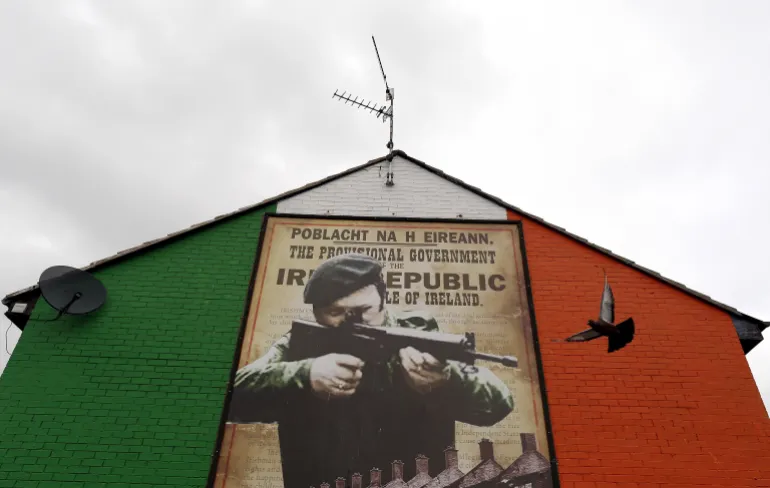
IRA mural
A pigeon flies past a mural supporting the Irish Republican Army in the Ardoyne area of north Belfast, September 9, 2015 [Cathal McNaughton/Reuters]

Irish Republican Movement hunger strikes

Some of the most significant hunger strikes in the 20th century occurred during the Irish revolutionary period, or the Troubles. The first wave was the 1920 Cork hunger strike, during the Irish War of Independence. Some 65 people suspected of being Republicans had been held without proper trial proceedings at the Cork County Gaol.

They began a hunger strike, demanding their release and asking to be treated as political prisoners rather than criminals. They were joined by Terence MacSwiney, the lord mayor of Cork, whose profile brought significant international attention to the independence cause. The British government attempted to break up the movement by transferring the prisoners to other locations, but their fasts continued. At least three prisoners died, including MacSwiney, after 74 days.

Later on, towards the end of the conflict and the signing of the Good Friday Agreement, imprisoned Irish Republicans protested against their internment and the withdrawal of political prisoner status that stripped them of certain rights: the right to wear civilian clothes, or to not be forced into labour.

They began the “dirty protest” in 1980, refusing to have a bath and covering walls in excrement. In 1981, scores of people refused to eat. The most prominent among them was Bobby Sands, an IRA member who was elected as a representative to the British Parliament while he was still in jail. Sands eventually starved to death, along with nine others, during that period, leading to widespread criticism of the Margaret Thatcher administration.

India’s Mohandas Karamchand Gandhi, who was later popularly known as Mahatma Gandhi, used hunger strikes as a tool of protest against the British colonial rulers several times. His fasts, referred to as Satyagraha, meaning holding on to truth in Hindi, were considered by the politician and activist not only as a political act but also a spiritual one.

Gandhi’s strikes sometimes lasted for days or weeks, during which he largely sipped water, sometimes with some lime juice. They achieved mixed results – sometimes, the British policy changed, but at other times, there were no improvements. Gandhi, however, philosophised in his many writings that the act was not a coercive one for him, but rather an attempt at personal atonement and to educate the public.

One of Gandhi’s most significant hunger strikes was in February 1943, after British authorities placed him under house arrest in Pune for starting the Quit India Movement back in August 1942. Gandhi protested against the mass arrests of Congress leaders and demanded the release of prisoners by refusing food for 21 days. It intensified public support for independence and prompted unrest around the country, as workers stayed away from work and people poured out into the streets in protest.

Another popular figure who used hunger strikes to protest against British rule in colonial India was Jatindra Nath Das, better known as Jatin Das. A member of the Hindustan Socialist Republican Association, Das refused food while in detention for 63 days starting from August 1929, in protest against the poor treatment of political prisoners. He died at the age of 24, and his funeral attracted more than 500,000 mourners.

Palestinian kids wave their national flag and hold posters showing Khader Adnan
Palestinian kids wave their national flag and hold posters showing Khader Adnan following his death on May 2, 2023 [Majdi Mohammed/AP Photo]

Palestinian prisoners in Israeli prisons

Palestinians held, often without trial, in Israeli jails have long used hunger strikes as a form of protest. One of the most well-known figures is Khader Adnan, whose shocking death in May 2023 after an 86-day hunger strike drew global attention to the appalling treatment of Palestinians by the Israeli government.

Adnan, who was 45 when he starved to death at the Ayalon Prison, leaving behind nine children, had repeatedly been targeted by Israeli authorities since the early 2000s. The baker from the occupied West Bank had once been part of the Palestinian Islamic Jihad group as a spokesperson, although his wife later stated publicly that he had left the group and that he had never been involved in armed operations.

However, Adnan was arrested and held without trial multiple times, with some estimates stating that he spent a cumulative eight years in Israeli prisons. Adnan would often go on hunger strike during those detentions, protesting against what he said was usually a humiliating arrest and a detention without basis. In 2012, thousands in Gaza and the West Bank rallied in a non-partisan show of support after he went 66 days without food, the longest such strike in Palestinian history at the time. He was released days after the mass protests.

In February 2023, Adnan was once again arrested. He immediately began a hunger strike, refusing to eat, drink, or receive medical care. He was held for months, even as medical experts warned the Israeli government that he had lost significant muscle mass and had reached a point where eating would cause more damage than good. On the morning of May 2, Adnan was found dead in his cell, making him the first Palestinian prisoner to die in a hunger strike in three decades. Former Palestinian Information Minister Mustafa Barghouti described his death as an “assassination” by the Israeli government.

Hunger strikes at Guantanamo

Following the 2002 opening of the Guantanamo Bay detention camp of the United States in Cuba, where hundreds of “terror” suspects were held prisoners, often with no formal charges, they used hunger strikes in waves to protest against their detention. The camp is notorious for its inhumane conditions and prisoner torture. There were 15 detainees left by January 2025.

The secret nature of the prison prevented news of earlier hunger strikes from emerging. However, in 2005, US media reported mass hunger strikes by scores of detainees – at least 200 prisoners, or a third of the camp’s population.

Officials forcefully fed those whose health had severely deteriorated through nasal tubes. Others were cuffed daily, restrained, and force-fed. One detainee, Lakhdar Boumediene, later wrote that he went without a real meal for two years, but that he was forcefully fed twice a day: he was strapped down in a restraining chair that inmates called the “torture chair”, and a tube was inserted in his nose and another in his stomach. His lawyer also told reporters that his face was usually masked, and that when one side of his nose was broken one time, they stuck the tube in the other side, his lawyer said. Sometimes, the food got into his lungs.

Hunger strikes would continue intermittently through the years at Guantanamo. In 2013, another big wave of strikes began, with at least 106 of the remaining 166 detainees participating by July. Authorities force-fed 45 people at the time. One striker, Jihad Ahmed Mustafa Dhiab, filed for an injunction against the government to stop officials from force-feeding him, but a court in Washington, DC rejected his lawsuit.

Protests against apartheid South Africa

Black and Indian political prisoners held for years on Robben Island protested against their brutal conditions by going on a collective hunger strike in July 1966. The detainees, including Nelson Mandela, had been facing reduced food rations and were forced to work in a lime quarry, despite not being criminals. They were also angry at attempts to separate them along racial lines.

In his 1994 biography, Long Walk to Freedom, Mandela wrote that prison authorities began serving bigger rations, even accompanying the food with more vegetables and hunks of meat to try to break the strike. Prison wardens smiled as the prisoners rejected the food, he wrote, and the men were driven especially hard at the quarry. Many would collapse under the intensity of the work and the hunger, but the strikes continued.

A crucial plot twist began when prison wardens, whom Mandela and other political prisoners had taken extra care to befriend, began hunger strikes of their own, demanding better living conditions and food for themselves. Authorities were forced to immediately settle with the prison guards and, a day later, negotiate with the prisoners. The strike lasted about seven days.

Later, in May 2017, South Africans, including the then Deputy President Cyril Ramaphosa, who was imprisoned in a different facility during apartheid, supported hunger-striking Palestinian prisoners by participating in a collective one-day fast. At the time, late Robben Island veteran Sunny “King” Singh wrote in the South African paper Sunday Tribune that hunger strikes in the prison never lasted more than a week before things changed, and compared it with the protracted situation of Palestinian strikers.

“We were beaten by our captors but never experienced the type of abuse and torture that some of the Palestinian prisoners complain of,” he wrote. “It was rare that we were put in solitary confinement, but this seems commonplace in Israeli jails.”

Source link

Russia-Ukraine war: List of key events, day 1,401 | Russia-Ukraine war News

These are the key developments from day 1,401 of Russia’s war on Ukraine.

Here is where things stand on Friday, December 26:

Fighting

  • Officials in Russia’s Krasnodar region reported a huge fire following a Ukrainian drone strike on two storage tanks holding oil products in the southern Russian port of Temryuk. The blaze spread across roughly 2,000 square metres (some 21,500 square feet).
  • Long-range Ukrainian drones targeted oil storage facilities at Temryuk port, as well as a gas processing plant in Russia’s Orenburg region, Ukraine’s SBU security service said.
  • Ukraine’s General Staff said its military also struck the Novoshakhtinsk oil refinery in Russia’s Rostov region using Storm Shadow missiles, triggering several explosions.
  • The General Staff described the Russian refinery as a major supplier of oil products in southern Russia that supports Moscow’s military operations in Ukraine.
  • Russia’s Ministry of Defence announced that its forces had taken control of the settlement of Sviato-Pokrovske in eastern Ukraine’s Donetsk region, according to reports from Russian state news agencies.

Regional security

  • Poland sent fighter jets to intercept a Russian reconnaissance aircraft flying near its airspace over the Baltic Sea and said dozens of objects entered Polish airspace from Belarus overnight, warning the incidents during the holiday season may signal a provocation.
  • Russia’s Ministry of Foreign Affairs accused the United States of encouraging what it called “piracy” in the Caribbean and Pacific Ocean by blockading Venezuela, while expressing hope that US President Donald Trump’s pragmatism could prevent further escalation.
  • Moscow also reiterated its support for Venezuelan President Nicolas Maduro’s government and its efforts to safeguard national sovereignty amid threats by the US to remove Maduro from power.

Peace talks

  • Ukrainian President Volodymyr Zelenskyy said he spoke with Donald Trump’s special envoy Steve Witkoff and son-in-law, Jared Kushner, for about an hour on how to end the war with Russia and “how to bring the real peace closer”.

  • “Of course, there is still work to be done on sensitive issues,” the Ukrainian leader said. “But together with the American team, we understand how to put all of this in place. The weeks ahead may also be intensive. Thank you, America!”
  • Russia believes negotiations with the US to end the war in Ukraine are making gradual progress, Russian Foreign Ministry spokeswoman Maria Zakharova said. She described the talks as slow-moving but advancing steadily.

Politics and diplomacy

  • Kremlin spokesman Dmitry Peskov said President Vladimir Putin had sent the US president a Christmas greeting along with a congratulatory message.
  •  Russia said it had put forward a proposal to France concerning Laurent Vinatier, a French researcher imprisoned under Russia’s foreign agent laws, adding that the next steps in the Frenchman’s case now rest with Paris.

Sanctions

  • Russia’s target of producing 100 million tonnes of liquefied natural gas annually has been pushed back by several years due to international sanctions, the country’s Deputy Prime Minister Alexander Novak said in comments aired on state television.

Source link

What are the consequences of Israel’s expanding illegal settlements? | Israel-Palestine conflict News

Israel is escalating the confiscation of Palestinian land in the occupied West Bank.

Israel has carried out the biggest land grab in the occupied West Bank since the signing of the Oslo Accords more than three decades ago.

Its right-wing government has accelerated the confiscation of Palestinian land to build new settlements, which are illegal under international law.

Recommended Stories

list of 3 itemsend of list

At the same time, Israeli settler attacks are increasing and intensifying.

For many Palestinians, this means all hopes of peace are dashed and, with them, the prospects of an independent state.

So what are Israel’s plans in the West Bank? And what are the implications of its policies?

Presenter:

Dareen Abughaida

Guests:

Xavier Abu Eid – political analyst and former adviser to the PLO negotiation team

Daniel Levy – president of the US/Middle East Project and a former Israeli negotiator

Yariv Oppenheimer – Israeli human rights activist and board member of the Peace Now advocacy group

Source link

Five people killed in firefight on Tajik-Afghan border, Tajikistan says | Border Disputes News

The incident is the third of its kind in recent weeks in which Tajik border guards and civilians have been killed.

Five people have been killed in a firefight between border guards and intruders on Tajikistan‘s border with Afghanistan, the Tajik border protection agency says.

Heavily armed raiders from Afghanistan crossed into Tajikistan at the village of Kavo in the Shamsiddin Shokhin district on Tuesday and were located on Wednesday, according to a statement by the border agency published by Tajik news agency Khovar.

Recommended Stories

list of 3 itemsend of list

The border agency said the men attacked a guard post, killing two border guards, and three of the intruders died in the ensuing gun battle.

The agency said the incident was the third of its kind in recent weeks in which Tajik border guards and civilians were killed.

The border guards secured the weapons and ammunition used by the intruders, including grenades, three M-16 rifles, a Kalashnikov assault rifle, three foreign-made pistols with silencers, 10 hand grenades, a night-vision scope, explosives and other ammunition at the scene, the agency said.

“The terrorists refused to obey orders from Tajik border guards to surrender and offered armed resistance. They intended to carry out an armed attack on one of the border posts of the Border Troops of the State Committee for National Security of the Republic of Tajikistan,” the statement said.

Chinese citizens working for a mining company in the region have also been among those killed.

The latest incident demonstrated “the Taliban government’s failure to fulfil their international obligations and repeated commitments to ensuring security and stability along the state border with the Republic of Tajikistan and to combating members of terrorist organisations, reflecting serious and recurring irresponsibility”, the statement added.

It agency said that it expected an apology from the Afghan leadership.

Tajikistan will defend its territorial integrity against “terrorists and smugglers” by all means, it added.

Afghanistan has not yet commented on the incident.

Drugs from Afghanistan are smuggled into Central Asia across the largely unsecured 1,340km (830-mile) border. Russian forces are stationed in Tajikistan and have in the past participated in joint exercises with Tajik forces to help secure the border.

Source link

Majority of Russians expect Ukraine war to end in 2026, state survey finds | Russia-Ukraine war News

‘Main reason for optimism’ is a belief that war in Ukraine will end in 2026 with Moscow’s ‘objectives’ achieved,’ pollster says.

A majority of Russians expect the war in Ukraine to end in 2026, a state-owned research centre said, as Russian forces make advances on the battlefield and efforts intensify to reach a ceasefire deal between Kyiv and Moscow.

VTsIOM, Russia’s leading public opinion research centre, said on Wednesday that its annual survey of sentiment around the outgoing year and expectations for the coming year found Russians are viewing 2026 with “growing optimism”.

Recommended Stories

list of 4 itemsend of list

“Expectations for next year traditionally look much more optimistic … In other words, while the negative perception of the current situation persists, Russians have become more likely to accept (or believe, hope?) future improvements this year, but they still do so with caution,” the organisation said in a review of its survey findings released online.

In a year-end presentation, VTsIOM deputy head Mikhail Mamonov said 70 percent of 1,600 people surveyed ​viewed 2026 as being a more “successful” year for Russia than this year, with 55 percent of respondents linking hope for a better year ‍to a possible end to what Russia officially calls its “special military operation” in Ukraine.

“The main reason for optimism is the possible completion of the special military operation and the achievement of the stated objectives, in line with the national interests outlined by the president,” Mamonov ‍said at the ⁠presentation.

Mamonov pointed to the Russian military’s ongoing offensive in Ukraine, Washington’s reluctance to finance the Ukraine war and the European Union’s inability to fully replace the ‌United States’ role in Ukraine – financially and militarily – as key factors behind the prospects for an eventual deal to end the fighting.

At the conclusion of the conflict, reintegration of Russian military veterans into society and the reconstruction of Russian-controlled regions of Ukraine, as well as Russian border areas, will be the main priorities, Mamonov added.

While the actual level of Russian public fatigue with the war is difficult to measure due to strict state controls on the media, expressions of public dissent as well as the prosecution of those who criticise Moscow’s war on its neighbour, approximately two-thirds of Russians support peace talks, according to independent pollster Levada, the highest number since the start of the war in 2022.

Ukrainian President Volodymyr Zelenskyy said in comments released on Wednesday that he would be willing to withdraw troops from Ukraine’s eastern industrial heartland as part of a plan to end the war, if Moscow reciprocated by also pulling back its forces and allowed the area to become a demilitarised zone monitored by international forces.

In comments to reporters about an overarching 20-point plan that negotiators from Ukraine and the US had hammered out in Florida in recent days, Zelenskyy also said that a similar arrangement could be possible for the area around the Zaporizhzhia nuclear power plant, which is currently under Russian control.

Russia has given no indication that it will agree to any kind of withdrawal from land it has seized in Ukraine and has long insisted that Kyiv must give up the remaining territory it still holds in the Donbas industrial area before any discussions on the cessation of fighting.

Russia has captured most of Luhansk and about 70 percent of Donetsk – the two regions that make up the Donbas.

Zelenskyy also said that figuring out the future control of the Donbas as part of the plan was “the most difficult point”, and creating a demilitarised economic zone in the region would require difficult discussions on how far troops would be required to move back and where international forces would be stationed.

Such discussions should be held at the leaders’ level, he said.

Source link

Russia-Ukraine war: List of key events, day 1,400 | Russia-Ukraine war News

These are the key developments from day 1,400 of Russia’s war on Ukraine.

Here is where things stand on Thursday, December 25:

Fighting

  • An explosion in Moscow killed three people, including two police officers, just days after a car bomb killed a high-ranking Russian general in the same area of the capital.
  • An official from Ukraine’s military intelligence, known as GUR, told The Associated Press news agency that the attack had been carried out as part of a Ukrainian operation and the two police officers were targeted for taking part in Russia’s war in Ukraine.
  • ‍Russian air ‍defence units downed 16 Ukrainian drones en route to Moscow throughout Wednesday, the capital’s Mayor Sergei Sobyanin said.
  • Sobyanin said the drones were repelled ​over a period of about 17 hours, and emergency ‍crews were examining fragments where the drones hit the ground, but no damage was reported.
  • Two of four major airports ‍servicing Moscow were forced to limit operations for a time due to the drone attacks, Russia’s civil aviation authority said on Telegram.
  • Russia’s Ministry of Defence said its aerial defence units destroyed 172 Ukrainian drones overnight, nearly half of them over regions bordering Ukraine.
  • Ukraine said its drones ​had struck the Yefremov synthetic rubber plant ‌in Russia’s Tula region, south of Moscow, and a storage facility for marine drones in Russian-occupied Crimea.
  • Tula regional governor, Dmitry Milyaev, said ‌debris from a downed Ukrainian drone ignited a fire at an industrial ‌site, and Russian air defence units destroyed 12 Ukrainian drones over the region.
  • A sunflower oil spill, caused by Russian aerial bombardments, has contaminated the shoreline around the southern Ukrainian city of Odesa, killing wildlife and triggering warnings from conservationists, the AFP news agency reports.
  • “The cause was damage to sunflower oil tanks as a result of massive enemy attacks on port infrastructure, causing some of the oil to spill,” Odesa Governor Oleh Kiper said in a statement. The Pivdenny port in the region was temporarily closed on Wednesday to help with the cleanup.
  • A Russian-backed court in occupied Ukraine sentenced a Colombian man to 19 years in prison for fighting for Kyiv’s army.
  • Russia’s Prosecutor General said the Supreme Court in the Russian-controlled area of Ukraine’s Donetsk region sentenced Oscar Mauricio Blanco Lopez, 42, to 19 years in jail. The Colombian arrived in Ukraine in May 2024 to sign up with the Ukrainian army and had been “taken prisoner by Russian servicemen” in December 2025.

Ceasefire talks

  • Ukrainian President Volodymyr Zelenskyy revealed for the first time details of an agreement between the United States and Ukrainian negotiators on ending the war with Russia. The 20-point plan, agreed on by US and Ukrainian negotiators after marathon talks, is now being reviewed by Moscow.
  • As part of the plan, President Zelenskyy said Ukraine would be willing to withdraw troops from the country’s eastern industrial heartland if Moscow also pulled back and the area becomes a demilitarised zone monitored by international forces.
  • A similar arrangement could be possible for the area around the Zaporizhzhia nuclear power plant, which is currently under Russian control, Zelenskyy said. The Ukrainian leader said that any peace plan would need to be put to a referendum in Ukraine.
  • Asked about the latest development in ceasefire talks, Kremlin spokesperson Dmitry Peskov said Moscow would decide its position based on information received by Russian presidential envoy Kirill Dmitriev, who met with US envoys in Florida over the weekend.
  • Russia has given no indication that it will agree to any kind of withdrawal from land it has seized in Ukraine. Moscow has also insisted that Ukraine relinquish the remaining territory it still holds in the Donbas. Russia has captured most of Luhansk and about 70 percent of Donetsk – the two areas that make up the Donbas.


Politics and diplomacy

  • A majority of Russians expect the war in Ukraine to end in 2026, Russia’s state pollster VTsIOM said, in a sign that the Kremlin could be testing public reaction to a possible peace settlement as diplomatic efforts ⁠to end the conflict intensify.
  • During the pollster’s year-end presentation, VTsIOM Deputy Head Mikhail Mamonov said 70 percent of the 1,600 respondents ​saw 2026 as a more “successful” year for Russia than 2025, while for 55 percent that hope ‍was linked to a possible end to Russia’s war in Ukraine.
  • A Russian court has scheduled the first public hearing in a criminal case against German sculptor Jacques Tilly, who is accused of discrediting the Russian military through his satirical Carnival floats depicting Russia’s President Vladimir Putin.
  • The court in Moscow said the trial will begin on December 30 and proceedings will be held in absentia, as Tilly – who faces up to 10 years in jail or a fine – is not in Russia.
  • Zelenskyy said in his Christmas address on Wednesday that despite marking the holiday at a “difficult” time, the nation’s unity remains intact. “Ukrainians are together tonight,” Zelenskyy said, adding the country had “without a doubt” been changed by the war. “It hardly matters what dishes are on the table – what matters is who is at the table,” he said.
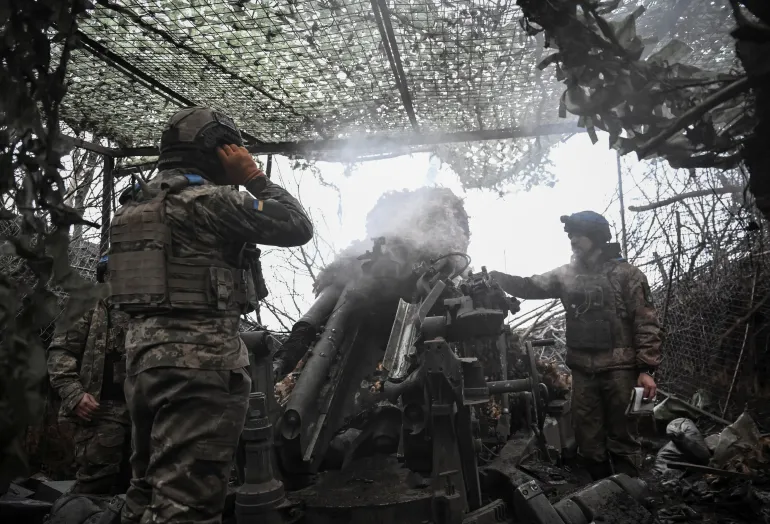
Artillerymen of the 44th Separate Artillery Brigade in Ukraine's Dnipropetrovsk region
Artillerymen of the 44th Separate Artillery Brigade fire a M777 Howitzer towards Russian troops, amid Russia’s attack on Ukraine, in Dnipropetrovsk region, Ukraine, on December 24, 2025 [Reuters]

Regional security

  • France’s ‍President Emmanuel Macron said he spoke ⁠with NATO ​chief Mark Rutte to ‍discuss the situation in Ukraine and ‍the work undertaken ⁠by the “coalition of the willing”. “Starting in January in Paris, we ​will ‌continue the work begun within this framework to provide ‌Ukraine with solid security ‌guarantees, a ⁠prerequisite for a robust and lasting peace,” Macron ‌said on social media.
  • Democratic senators in the US have urged President ‍Donald Trump to ‍reverse a recall of nearly 30 career ambassadors, warning the move leaves a dangerous leadership vacuum that allows adversaries like Russia and China to expand their influence. The Trump administration in recent days has ordered career diplomats serving across Europe, Asia, Africa and Latin America back to Washington to ensure US missions abroad reflect its “America First” priorities.

Economics

  • Kazakhstan’s exports of its flagship CPC Blend of oil will be their lowest in 14 months in December, as bad weather delays efforts to repair Russian loading infrastructure after Ukrainian drone strikes last month, two sources told the Reuters news agency.
  • On November 29, Ukrainian drones hit the Caspian Pipeline Consortium terminal located near ‍Russia’s Black Sea port ⁠of Novorossiysk, leaving just one out of three jetties operational and prolonging export delays. Poor weather has added to the difficulty of carrying out maintenance work necessary to allow exports to recover.
  • Ukraine’s Ministry of Finance said ‍it ‍completed the settlement of a deal to restructure $2.6bn of growth-linked debt.


Source link

Explosion rocks crowded mosque in Nigeria, killing several people: Reports | Armed Groups News

The blast tore through a mosque in Maiduguri as worshippers gathered for evening prayers, witnesses say.

An explosion has ripped through a mosque in northeastern Nigeria as worshippers gathered for their evening prayers, killing and wounding several people, according to media reports.

The blast took place at about 6pm on Wednesday (17:00 GMT) in the city of Maiduguri in Borno State, the Reuters and AFP news agencies reported, citing witnesses.

Recommended Stories

list of 3 itemsend of list

Police spokesman Nahum Daso confirmed the explosion and told AFP that an explosive ordnance team was already on site at the mosque in Maiduguri’s Gamboru market.

There was no official word on casualties.

But mosque leader Malam Abuna Yusuf told the AFP at least eight people had died, while a militia leader, Babakura Kolo, put the figure at seven.

Another witness, Musa Yusha’u, told AFP that he saw “many victims being taken away for medical treatment”.

The cause of the blast was not immediately known, but it occurred ‍in a ⁠city that has been at the heart of an armed rebellion waged by Boko Haram and ISIL’s (ISIS) offshoot in the region, the Islamic State West Africa Province, for nearly two decades.

The conflict has killed at least 40,000 people and displaced about two million from their homes since 2009, according to the United Nations.

Though the violence has waned since its peak about a decade ago, it has spilt into neighbouring Niger, Chad and Cameroon.

Concerns are also growing about a resurgence of violence in parts of the northeast, where armed groups remain capable of mounting deadly attacks despite years of sustained military operations.

Maiduguri itself – once the scene of nightly gun battles and bombings – has been calm in recent years, with the last major attack recorded in 2021.

Source link

UN experts condemn US naval blockade of Venezuela as illegal aggression | Donald Trump News

UN experts criticise US blockade for endangering human rights and call for an investigation into alleged violations.

Four United Nations human rights experts have condemned the partial naval blockade of Venezuela by the United States, finding it an illegal armed aggression and calling on the US Congress to intervene.

“There is no right to enforce unilateral sanctions through an armed blockade,” the UN experts said in a joint statement on Wednesday.

Recommended Stories

list of 3 itemsend of list

The US has deployed a major military force in the Caribbean and intercepted oil tankers as part of a naval blockade against Venezuelan vessels it considers to be under sanctions.

A blockade is a prohibited use of military force against another country under the UN Charter, they added.

“It is such a serious use of force that it is also expressly recognised as illegal armed aggression under the General Assembly’s 1974 Definition of Aggression,” the experts said. “The illegal use of force, and threats to use further force at sea and on land, gravely endanger the human right to life and other rights in Venezuela and the region.”

US President Donald Trump accuses Venezuela of using oil, the South American country’s main resource, to finance “narcoterrorism, human trafficking, murders and kidnappings”.

Caracas denies any involvement in drug trafficking. It says Washington is seeking to overthrow its president, Nicolas Maduro, to seize Venezuela’s oil reserves, the largest in the world.

Since September, US forces have launched dozens of air strikes on boats that Washington alleges were transporting drugs. It has yet to provide evidence for those accusations. More than 100 people have been killed.

‘US Congress should intervene’

“These killings amount to violations of the right to life. They must be investigated and those responsible held accountable,” the experts said.

“Meanwhile, the US Congress should intervene to prevent further attacks and lift the blockade,” they added.

They called on countries to take measures to stop the blockade and illegal killings and bring the perpetrators to justice.

The four who signed the joint statement are: Ben Saul, special rapporteur on protecting human rights while countering “terrorism”; George Katrougalos, an expert on promoting a democratic and equitable international order; development expert Surya Deva; and Gina Romero, special rapporteur on the right to freedom of peaceful assembly and association.

Source link

Russian forces seize embattled Siversk town as Ukrainian troops withdraw | Russia-Ukraine war News

The Ukrainian military says its forces have withdrawn from ​​the battle-scarred town of Siversk in the eastern Donetsk region after heavy fighting with Russian forces.

In a statement on Telegram on Tuesday, Ukraine’s General Staff said that Russian troops had a “significant advantage” in manpower and equipment and had exerted constant pressure on the defending Ukrainian troops by staging small-unit assaults in difficult weather conditions.

Recommended Stories

list of 4 itemsend of list

Ukraine’s decision to withdraw its forces was made to “preserve the lives of our soldiers and the combat capability of the units”, the General Staff said.

Heavy losses were inflicted on Russian forces before the order to retreat was given, and Siversk remains “under the fire control of our troops”, and “enemy units are being blocked to prevent their further advance,” the General Staff added.

Ukraine’s DeepState military monitoring site reported late on Tuesday that Russian forces had occupied Siversk as well as Hrabovske, a village in Ukraine’s Sumy region close to the border with Russia.

Russian Lieutenant General Sergei Medvedev had told Russian President Vladimir Putin on December 11 that troops had taken Siversk, where fighting has been fierce in recent months, but Ukrainian officials denied the Russian reports at the time.

Ukraine’s military said at the time that Russian troops were “taking advantage of unfavourable weather conditions” to launch attacks, but were mostly being “destroyed on the approaches”.

The Kyiv Independent news site said that, despite Siversk’s modest size – it had a pre-war population of 10,000, and now, just a few hundred civilians remain – the town was key to the defence of northern Donetsk.

The town had helped shield the larger Sloviansk and Kramatorsk areas, “the main bastions of Ukraine’s so-called ‘fortress belt’”, which Russia has been unable to conquer since the start of fighting, the Kyiv Independent said.

Donetsk is one of three Ukrainian regions at the centre of Russia’s territorial demands, which are the stumbling blocks to reaching an agreement on a ceasefire. Ukraine’s leaders have said they will not concede their country’s territory taken during Moscow’s invasion.

Russian forces had already seized an estimated 19 percent of Ukrainian territory as of early December, including Crimea, which Moscow annexed in 2014, all of the Luhansk region, and more than 80 percent of Donetsk, according to the Reuters news agency.

Russian forces also control about 75 percent of the Kherson and Zaporizhia regions, and small parts of the Kharkiv, Sumy, Mykolaiv and Dnipropetrovsk regions, according to Reuters.

A 28-point peace plan first put forward by the administration of US President Donald Trump last month says that a negotiated settlement would see Crimea, Luhansk and Donetsk “recognised as de facto Russian, including by the US”.

Ukrainian President Volodymyr Zelenskyy recently said that the United States is pushing for Ukraine to withdraw its forces from the Donetsk region to establish a “free economic zone” in the area, which he said the Russian side is referring to as a “demilitarised zone”.

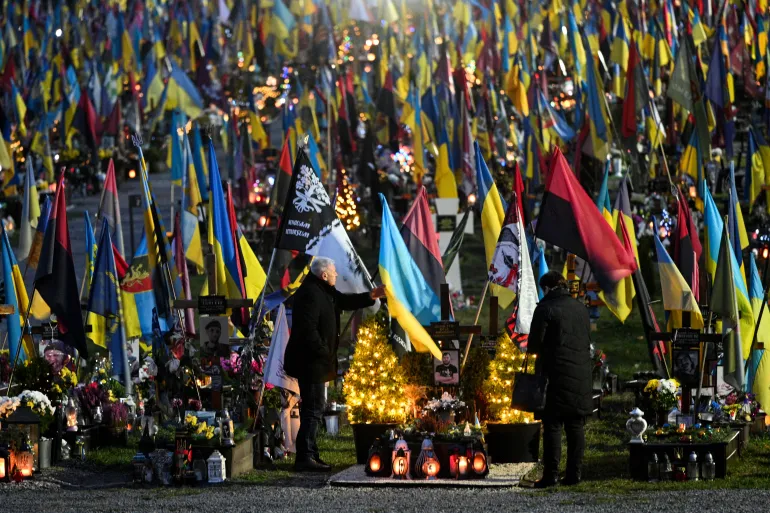
People visit the graves of fallen Ukrainian soldiers decorated with Christmas trees and New Year's decorations at the Lychakiv Military Cemetery, on the day before Christmas Eve, in Lviv on December 23, 2025, amid the Russian invasion of Ukraine. (Photo by YURIY DYACHYSHYN / AFP)
People visit the graves of fallen Ukrainian soldiers, decorated with Christmas trees and New Year’s decorations, at the Lychakiv Military Cemetery, in Lviv, Ukraine on Tuesday [Yuriy Dyachyshyn/AFP]

Pope saddened as fighting continues over Christmas

The latest setback for Kyiv on the battlefield came as Zelenskyy said on Tuesday that Russian forces had launched another “massive attack” on Ukraine on Monday night, killing at least three people, including a four-year-old girl, across 13 regions targeted with drones and missiles.

In Russia, Ukrainian drone attacks killed four people in the Belgorod region over the past two days, local officials said.

Pope ‍Leo ‍expressed disappointment on Tuesday that Russia had apparently refused to agree to a ceasefire on December 25, the date many Christians celebrate Christmas.

“I will make ​an appeal one ‌more time to people of goodwill to respect at least Christmas ‌Day as a day of ‌peace,” Leo said, speaking to reporters outside his residence in Castel Gandolfo, Italy.

“Maybe they will listen to us, and there ‌will be at least 24 hours, a day of peace, ‍across the world,” he said.

While most people in Ukraine and Russia are Christians, many are Orthodox, meaning they observe Christmas on January 7.

Russian President Vladimir Putin announced an unexpected 30-hour unilateral truce a day before Easter this year, a rare pause in Russia’s war on Ukraine, which has now continued for close to three years, after Russia’s full-scale invasion in February 2022.

Source link

Russia-Ukraine war: List of key events, day 1,399 | Russia-Ukraine war News

These are the key developments from day 1,399 of Russia’s war on Ukraine.

Here is where things stand on Wednesday, December 24:

Fighting

  • Russian forces began a “massive attack” on Ukraine on Monday night, killing three people and targeting 13 regions with 650 drones and 30 missiles, Ukrainian President Volodymyr Zelenskyy said in a post on X.
  • Those killed in the overnight attack included a four-year-old girl in the central Zhytomyr region, Governor Vitalii Bunechko said on Telegram. “Doctors struggled to save the child’s life, but in the end, they were unable to save her,” Bunechko said, adding that five people were also injured in the attack.
  • Russian forces also launched drones and missiles at the Vyshhorod district of Ukraine’s Kyiv region, killing a woman and injuring three people, Governor Mykola Kalashnyk said.
  • In Ukraine’s western Khmelnytskyi region, one person was killed by Russian shelling, Governor Serhii Tiurin said.
  • Russian drone attacks on Kyiv’s Sviatoshynskyi district left five people injured, said Tymur Tkachenko, the head of the Kyiv City Military Administration.
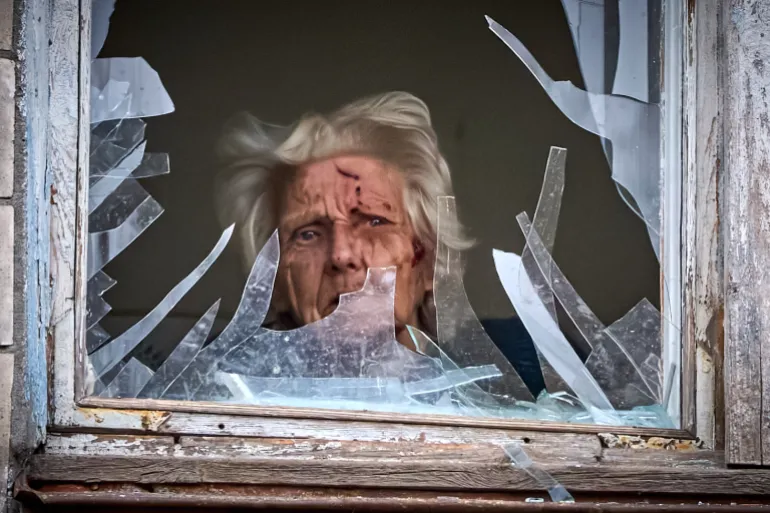
An injured elderly woman looks out of her broken window as an apartment building was hit by a Russian drone during an aerial attack in Kyiv, Ukraine, Tuesday, Dec. 23, 2025. (AP Photo/Efrem Lukatsky)
An injured elderly woman looks out of her broken window after an apartment building was hit by a Russian drone during an aerial attack in Kyiv, Ukraine, on Tuesday [Efrem Lukatsky/AP Photo]
  • Ukraine’s Ministry of Energy said that “emergency power outages” were introduced in several regions across the country due to Russian forces targeting energy infrastructure. The ministry said that it was working to restore electricity to the Rivne, Ternopil and Odesa regions. The ministry said that the situation was “most difficult” in the border regions, “as restoring electricity is complicated by continuous fighting”.
  • Ukraine’s General Staff said Ukrainian troops have withdrawn from the Donetsk region’s ​​Siversk area after heavy fighting, noting that Moscow’s forces had a “significant advantage” there.
  • Ukraine’s Ministry of Foreign Affairs said that Ukrainian F-16 fighter pilots shot down 621 of 673 Russian “aerial targets” on Tuesday night, including 34 of 35 cruise missiles.
  • In Russia, a Ukrainian drone strike on a car killed three men in the Belgorod region on Monday, the region’s emergency response team reported.
  • Another Ukrainian drone attack in Belgorod on Tuesday killed one person and injured three, the region’s operational headquarters said on Telegram.
  • Russian forces shot down 56 Ukrainian drones in a day, as well as a guided bomb, Russia’s Ministry of Defence said, according to the state news agency TASS.

Ceasefire

  • Zelenskyy said in his nightly address, “We sense that America wants to reach a final agreement” to end the war in Ukraine, and that “there is full cooperation” from the Ukrainian side.
  • In an earlier post on X, Zelenskyy said that “several draft documents have now been prepared”, following talks in Miami. “In particular, these include documents on security guarantees for Ukraine, on recovery, and on a basic framework for ending this war,” he said.
  • Pope ‍Leo said that Russia’s apparent refusal to agree to a ceasefire on December 25 is “among the things that cause me much sadness”.
  • “I will make ​an appeal one ‌more time to people of goodwill to respect at least Christmas ‌Day as a day of ‌peace,” Leo told reporters outside his residence in Castel Gandolfo, Italy.

Source link

Syria ministers discuss military cooperation with Putin in Russia: Report | Vladimir Putin News

Talks held between Foreign Minister Asaad Hassan Al-Shaibani, Defence Minister Murhaf Abu Qasra and the Russian president.

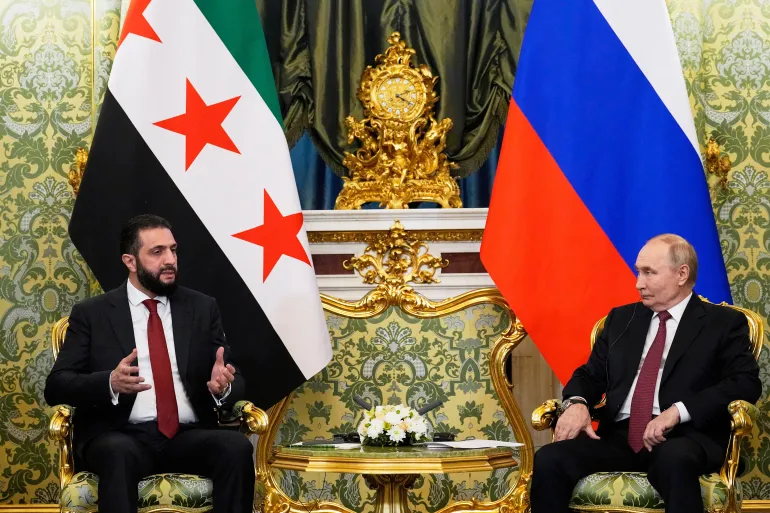
Syria’s foreign and defence ministers met Russian President Vladimir Putin in Moscow and held discussions on expanding “strategic cooperation in the military industries sector”, Syrian state media has reported.

The Syrian Arab News Agency (SANA) ⁠said that Putin’s meeting on Tuesday with Syrian Minister of Foreign Affairs Asaad Hassan Al-Shaibani and Minister of Defence Murhaf Abu Qasra ‌focused on political, economic and military issues of “mutual interest”, but that “particular emphasis” was on defence.

Recommended Stories

list of 4 itemsend of list

According to SANA, Putin and the Syrian ministers discussed a range of defence-related matters, including developing military cooperation to strengthen the Syrian army’s capabilities and ‌modernising its equipment, transferring expertise and cooperation in research and development.

“During the meeting, both sides reviewed ways to advance military and technical partnership in a manner that strengthens the defensive capabilities of the Syrian Arab Army and keeps pace with modern developments in military industries,” SANA reported.

The two sides also discussed political and economic issues, including the “importance of continued political and diplomatic coordination between Damascus and Moscow in international forums”, according to the news agency.

On the economic front, the talks addressed expanding Syrian-Russian cooperation, including in reconstruction projects, infrastructure development and investment in Syria.

Putin also reaffirmed Russian “steadfast support” for Syria and its territorial integrity, while renewing “Moscow’s condemnation of repeated Israeli violations of Syrian territory, describing them as a direct threat to regional security and stability”.

The ministers’ visit to Moscow is the latest by Syria’s new authorities since the removal from power last December of the country’s longtime ruler and Moscow’s former ally in Damascus, Bashar al-Assad.

Russia was a key supporter of al-Assad during Syria’s nearly 14-year civil war, providing vital military aid that kept the Assad regime in power, including Russian air support that rained air strikes on rebel-held areas.

Despite al-Assad and his family fleeing to Russia after the toppling of his regime, Moscow is eager to build good relations with the new government in Damascus.

Moscow, in particular, is hoping to secure agreements to continue operating the Khmeimim airbase and the Tartous naval base on Syria’s Mediterranean coast, where Russian forces continue to be present.

In October, Syria’s new president, Ahmed al-Sharaa, visited Russia, where he said his government ‍would honour all the past deals struck between Damascus and Moscow, a pledge that suggested that the two Russian military bases were secure in the post-Assad period.

Putin said ‍at the time of al-Sharaa’s visit ⁠that Moscow was ready to do all it could to act on what he called the “many interesting and useful beginnings” discussed by the two sides on renewing relations.

Russian ‌state media on Tuesday quoted the country’s Ministry of Foreign Affairs spokeswoman, Maria Zakharova, as saying that Russian Foreign Minister Sergey Lavrov would also hold talks with ‍his Syrian counterpart, Al-Shaibani, during the Syrian delegation’s visit.

During a visit to Moscow in July, Al-Shaibani said his country wanted Russia “by our side”.

“The current period is full of various challenges and threats, but it is also an opportunity to build a united and strong Syria. And, of course, we are interested in having Russia by our side on this path,” Al-Shaibani told Lavrov at the time.

Russia's President Vladimir Putin and Syria's President Ahmed al-Sharaa speak during a meeting at the Kremlin in Moscow, Russia, October 15, 2025. Alexander Zemlianichenko/Pool via REUTERS
Syrian President Ahmed al-Sharaa speaks during a meeting with Russian President Vladimir Putin at the Kremlin in Moscow, Russia, on October 15, 2025 [Pool: Alexander Zemlianichenko via Reuters]

Source link

Belgium joins South Africa’s genocide case against Israel at ICJ | Israel-Palestine conflict News

Other countries, including Brazil, Colombia, Ireland, Mexico, Spain and Turkiye, have already joined the case in The Hague.

Belgium has formally joined the case launched by South Africa at the International Court of Justice (ICJ) alleging Israel is committing genocide in the Gaza Strip.

In a statement on Tuesday, the ICJ – The Hague-based highest court of the United Nations – said Belgium had filed a declaration of intervention in the case.

Recommended Stories

list of 4 itemsend of list

Other countries, including Brazil, Colombia, Ireland, Mexico, Spain and Turkiye, have already joined the proceedings.

South Africa brought the case in December 2023, arguing that Israel’s war in Gaza violates the 1948 UN Convention on the Prevention and Punishment of the Crime of Genocide.

Israel has rejected the allegations and criticised the case.

While a final ruling could take years, the ICJ issued provisional measures in January 2024 ordering Israel to take steps to prevent acts of genocide in Gaza and to allow unimpeded access for humanitarian aid.

The court’s orders are legally binding although it has no direct mechanism to enforce them.

The ICJ also said Israel’s presence in occupied Palestinian territory is unlawful and its policies amount to annexation.

Israel has continued its assaults in Gaza and the occupied West Bank despite the rulings and growing international criticism while advancing plans to seize large parts of Palestinian territory.

Meanwhile, the United States and several of its European allies continue to provide military and financial support to Israel.

Washington has rejected the merits of South Africa’s case, and US lawmakers have criticised the country and issued threats against it.

The US has also imposed sanctions on members of the International Criminal Court (ICC), which has issued arrest warrants against Israeli Prime Minister Benjamin Netanyahu and former Defence Minister Yoav Gallant.

Belgium was also among a group of countries that recognised the State of Palestine in September. Nearly 80 percent of UN member states now recognise Palestine.

Since a ceasefire began on October 10, the Palestinian Ministry of Health in Gaza said, Israel has killed at least 406 Palestinians and injured 1,118 in the enclave. Since the start of the war on October 7, 2023, the ministry said, at least 70,942 Palestinians have been killed and 171,195 wounded.

Source link

Is Israel’s government waging war on Al Jazeera and the media? | Israel-Palestine conflict News

The Israeli government is cracking down on critical media outlets, giving it unprecedented control over how its actions are presented to its citizens.

Among the moves is the so-called Al Jazeera Law, which allows the government to shut down foreign media outlets on national security grounds. On Tuesday, the Israeli parliament approved the extension of the law for two years after it was introduced during Israel’s genocidal war on Gaza to essentially stop Al Jazeera’s operations in Israel.

Recommended Stories

list of 4 itemsend of list

Separately, the government is also moving to shut down the popular Army Radio network, one of two publicly funded Israeli news outlets. The radio station is often criticised by the Israeli right wing, which views Army Radio as being biased against it.

Israelis are still reliant on receiving their news from traditional outlets with about half relying on broadcast news for information on current affairs and about a third similarly relying upon radio stations.

The tone of the media that is allowed to publish and broadcast is important. According to analysts inside Israel, the selective broadcasting of Palestinian suffering during Israel’s war on Gaza has helped sustain the carnage and reinforced a sense of grievance that allows for Israel’s continued assaults on Gaza as well as regional countries, such as Syria, Yemen and Lebanon.

Despite what observers characterise as a media environment firmly rigged in its favour, the far-right government of Prime Minister Benjamin Netanyahu, which contains ministers convicted of “terrorism” offences and others who have repeatedly called for the illegal annexation of the occupied West Bank, is looking nevertheless to bypass legal checks on its control of the media and bring more of Israel’s information feed under its control.

Let’s take a closer look.

Because the government believes it is too critical.

Israeli politicians have long complained about how the war in Gaza has been covered in both the international and domestic media.

But the government added a new accusation in November, partly blaming the media for the Hamas-led attacks on southern Israel on October 7, 2023.

“If there hadn’t been a media entirely mobilised to encourage refusal [to volunteer to reserve duty] and reckless opposition to the judicial reform, there wouldn’t have been such a rift in the nation that led the enemy to seize the opportunity,” Communications Minister Shlomo Karhi said as he introduced a bill to increase government control of the news environment, referring to attempts by the Israeli government to reduce the independence of the judiciary.

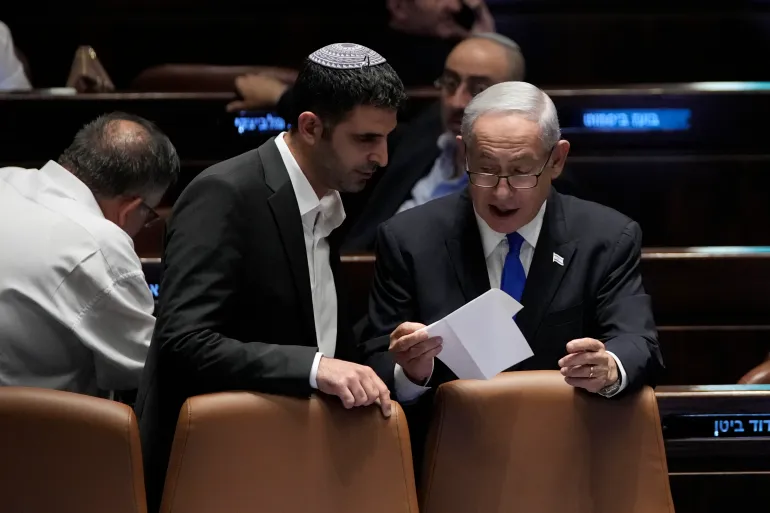
Israel's Prime Minister Benjamin Netanyahu, right, speaks to Minister of Communications Shlomo Karhi at the Knesset, Israel's parliament
Israeli Prime Minister Benjamin Netanyahu, right, speaks to Minister of Communications Shlomo Karhi in the Knesset in West Jerusalem [File: Maya Alleruzzo/AP Photo]

In addition to the ‘Al Jazeera Law’, there are three items of legislation under way: a plan to privatise Israel’s public broadcaster, Kan, the move to abolish Army Radio, and an initiative to bring the media regulator under government control.

Both Army Radio and Kan, the other state-funded outlet with editorial independence, have carried numerous reports critical of the government.

This week, Kan aired an interview with Netanyahu’s former spokesperson Eli Feldstein, who told the broadcaster that the prime minister had instructed him to develop a strategy to help evade responsibility for the October 7 attacks.

Meanwhile, Israeli Defence Minister Israel Katz, justifying the move to shut down Army Radio, said on Monday that the outlet had become a platform to attack the Israeli military and its soldiers.

Israel is also potentially changing the way it regulates its media. In November, the Israeli parliament pressed ahead with a bill that would abolish existing media regulators and replace them with a new authority appointed by the government, potentially allowing for even greater state interference.

Israel's Attorney General Gali Baharav-Miara listens on as she attends a cabinet meeting at the Bible Lands Museum in Jerusalem on June 5, 2024. GIL COHEN-MAGEN/Pool via REUTERS
Israeli Attorney General Gali Baharav-Miara attends a cabinet meeting at the Bible Lands Museum in Jerusalem [Gil Cohen-Magen/Pool via Reuters]

Lastly, Israel has also codified into law the emergency legislation banning foreign media outlets whose output it disagrees with. It was first enacted as emergency legislation in May 2024 when Israel used it to ban Al Jazeera from its territory, and it was then used in the same month to halt the activity of The Associated Press after the government accused the United States-based news agency of sharing footage with Al Jazeera.

Under the new law, the communications minister – with the prime minister’s sign-off and the backing of a ministerial committee – may halt a foreign broadcaster’s transmissions if the prime minister accepts a professional assessment that the outlet poses a security threat. The minister can also shut the broadcaster’s offices, confiscate equipment used to produce its content and block access to its website.

Have the moves been criticised?

The International Federation of Journalists (IFJ) and the United Kingdom’s National Union of Journalists have criticised Israel’s decision to legislate against foreign media platforms it deems a security threat.

In a statement, IFJ General Secretary Anthony Bellanger said: “Israel is openly waging a battle against media outlets, both local and foreign, that criticise the government’s narrative: that is typical behavior of authoritarian regimes. We are deeply concerned about the Israeli parliament passing this controversial bill, as it would be a serious blow to free speech and media freedom, and a direct attack on the public’s right to know.”

The attempt to shutter Army Radio has also been heavily criticised with Israeli Attorney General Gali Baharav-Miara declaring the move unlawful and accusing Netanyahu’s coalition of making public broadcasting “weakened, threatened and institutionally silenced and its future shrouded in mist”.

Baharav-Miara has also criticised the move to place media regulation under government control, saying the bill “endangers the very principle of press freedom”.

Not very.

The Israeli media have overwhelmingly been a consistent cheerleader of the Israeli government’s actions in Gaza, where more than 70,000 Palestinians have been killed by Israel, and in the occupied West Bank.

The suffering of Palestinians is rarely shown, and when it is, it is often justified.

Even as Israel has killed more than 270 journalists and media workers in Gaza, the Israeli media have provided cover for the actions of its government and military.

That means Israelis often don’t recogise the hypocrisy of their government’s statements.

An example came in June after Iran struck an evacuated hospital during the 12-day war between Israel and Iran. The Israeli government called the incident a war crime, and the Israeli media reflected that outrage.

But the attack came after Israel had been accused by a variety of organisations, including the United Nations, of systematically destroying Gaza’s healthcare system with medical workers targeted for arrest and frequently tortured despite their protection under international law.

“The Israeli media … sees its job as not to educate – it’s to shape and mould a public that is ready to support war and aggression,” journalist Orly Noy told Al Jazeera from West Jerusalem in the wake of the strike on the Israeli medical centre. “It genuinely sees itself as having a special role in this.”

Source link

Israeli forces demolish shops in raids near occupied East Jerusalem | Israel-Palestine conflict News

Commercial premises among buildings facing demolition as military incursions intensify near Qalandiya and Kafr Aqab.

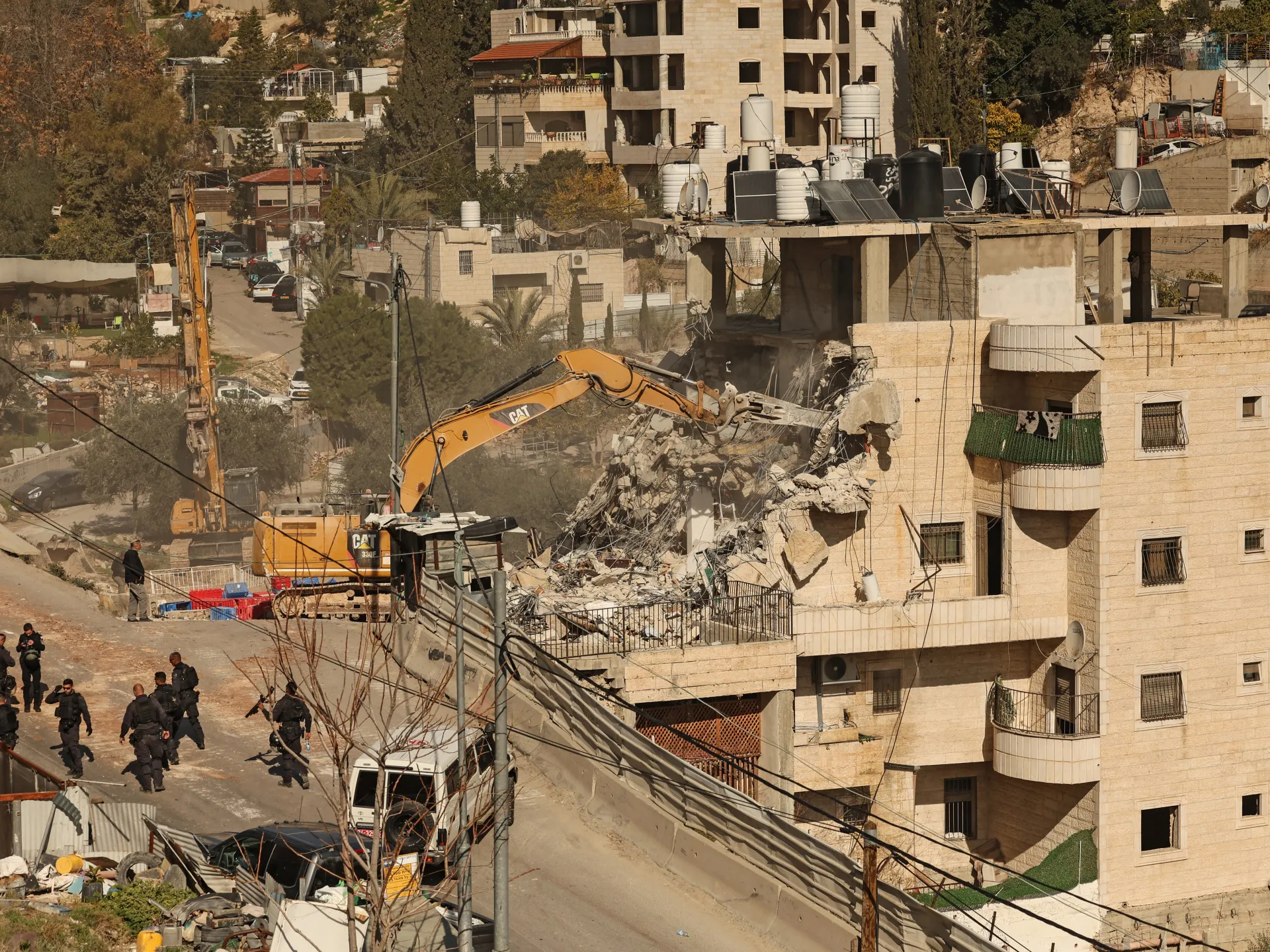
Israeli forces have begun demolishing shops in the vicinity of the Qalandiya refugee camp, north of occupied East Jerusalem, as part of a wider military incursion across several Palestinian neighbourhoods, witnesses and medical officials say.

The raids, which began early on Tuesday, have extended into the nearby town of Kafr Aqab, where Israeli troops deployed in large numbers, carried out house searches and forcibly evicted residents from their homes, according to local media reports.

Recommended Stories

list of 3 itemsend of list

The Palestine Red Crescent Society said its medical teams treated at least three people injured during the raids in Qalandiya and Kafr Aqab. The injuries included a bullet wound to the thigh, wounds caused by shrapnel from live ammunition, and injuries resulting from physical assault.

The Jerusalem governorate reported that at least three Palestinians were injured by Israeli forces’ gunfire, in addition to dozens of cases of suffocation caused by the firing of tear gas and stun grenades, the Palestinian Wafa news agency reported.

Several Palestinians were detained during the large-scale incursion that was also accompanied by the deployment of military vehicles and bulldozers.

Among those arrested are Anan Mohammed Taha and his father, Mohammed Taha, residents of the Qalandiya refugee camp, Wafa said.

‘Intimidation’ and ‘anxiety’

Residents said Israeli forces ordered several families to evacuate their homes, with at least three houses converted into temporary military outposts in Kafr Aqab. Homeowners were reportedly told the operation would continue until at least Wednesday morning.

Israeli forces also stormed the youth club inside the Qalandiya refugee camp and turned the facility into a military base, according to Al Jazeera Arabic’s correspondent.

Journalists covering the operation were also targeted, including Al Jazeera Arabic reporters, with Israeli forces firing stun grenades and tear gas canisters in their direction during the raid in Kafr Aqab.

According to the Jerusalem governorate authorities, stun grenades were also fired directly towards students in the area as they were returning home from school, while private surveillance cameras were seized.

Al Jazeera’s Nida Ibrahim, reporting from Kafr Aqab, said Israeli forces are continuing to “intimidate” Palestinians.

“They have raided Palestinian stores, Palestinian shops, and they’ve destroyed some of the plaques, some of the advertisement billboards that were here”, in an attempt to further cripple the Palestinian economy, Ibrahim said.

“This is part of the anxiety that Palestinians live through day in and day out as these Israeli raids continue on a daily basis,” she added.

Israeli incursions across the West Bank average “60 raids per day”, Ibrahim said.

In addition to the demolitions, Israeli forces confiscated goods from commercial shops in the Qalandiya refugee camp, Kafr Aqab and parts of northern Jerusalem, citing alleged unpaid municipal taxes.

Most Palestinians living in these areas hold Jerusalem residency identification cards. Residents say they are subject to high municipal taxes while receiving few basic services.

Separately, confrontations were also reported in the town of Beit Furik, east of Nablus in the occupied West Bank, after Israeli forces stormed the area.

Source link

Israel will never fully withdraw from Gaza, defence minister says | Israel-Palestine conflict News

Israel Katz says military units will be established inside the Palestinian enclave, in contravention of the truce agreement.

Israeli Defence Minister Israel Katz has said the Israeli military will never fully withdraw from the Gaza Strip and that an army unit will be established inside the Palestinian enclave.

Speaking on Tuesday, Katz said Israeli forces would remain deployed throughout Gaza, despite a United States-backed peace plan signed by Israel and Hamas in October that calls for a full Israeli military withdrawal and rules out the re-establishment of Israeli civilian settlements in the territory.

Recommended Stories

list of 4 itemsend of list

“We are located deep inside Gaza, and we will never leave all of Gaza,” Katz said. “We are there to protect.”

“In due course, we will establish Nahal [an Israeli infantry brigade] outposts in northern Gaza in place of the settlements that were uprooted,” Katz added, according to Israeli media.

Hours later, he issued a statement in English to the Reuters news agency, saying Nahal units would be stationed in Gaza “only for security reasons”. The Israeli media reported that US officials were displeased with Katz’s initial comments and demanded clarification.

Nahal units are military formations that combine civilian service with army enlistment and have historically played a role in the creation of Israeli communities.

Katz was speaking at a ceremony in the occupied West Bank marking the approval of 1,200 housing units in the illegal Israeli settlement of Beit El.

Addressing settlement expansion in the West Bank, Katz said: “Netanyahu’s government is a settlements government … it strives for action. If we can get sovereignty, we will bring about sovereignty. We are in the practical sovereignty era.”

“There are opportunities here that haven’t been here for a long time,” he added.

Israel is expected to head into an election year in 2026, with illegal settlement expansion a key political issue. Far-right and ultranationalist members of Prime Minister Benjamin Netanyahu’s coalition have repeatedly said they intend to reoccupy Gaza and expand illegal settlements in the West Bank.

Under international law, all Israeli settlements in the occupied West Bank are illegal. The transfer of an occupying power’s civilian population into occupied territory is considered a war crime under the Rome Statute of the International Criminal Court.

Meanwhile, violence by Israeli forces and settlers has continued across the West Bank, while killings continue in Gaza despite the ceasefire. Palestinian officials say more than 1,100 Palestinians have been killed, about 11,000 wounded and more than 21,000 arrested.

The Palestinian Ministry of Health said that since a ceasefire began on October 11, at least 406 Palestinians have been killed and 1,118 injured. Since the start of Israel’s war on October 7, 2023, the ministry said, 70,942 Palestinians have been killed and 171,195 wounded.

Source link

British police detain Greta Thunberg at pro-Palestinian protest in London | Israel-Palestine conflict News

Police arrest three people outside insurer of Israeli arms maker Elbit, including Thunberg for holding placard.

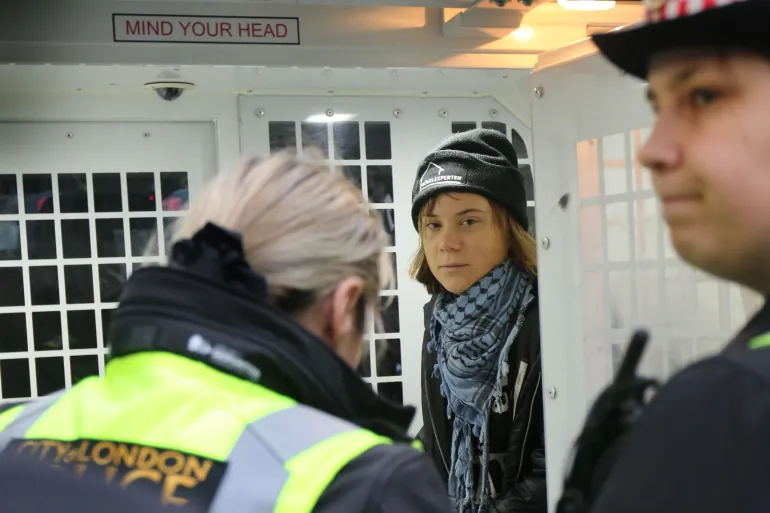
British police have arrested Swedish activist Greta Thunberg and two other people at a pro-Palestine protest in central London, according to campaign group Defend Our Juries.

The group said Thunberg was arrested on Tuesday at the Prisoners for Palestine protest held in the heart of London’s Square Mile financial district outside the offices of Aspen Insurance, which provides coverage for Israeli defence contractor Elbit Systems.

Recommended Stories

list of 3 itemsend of list

The group said Thunberg had arrived after the protest began, and it shared video footage of the activist holding a sign reading, “I support the Palestine Action prisoners. I oppose genocide.” Thunberg has called Israel’s war in Gaza a genocide and has twice joined flotilla campaigns to try to break Israel’s siege of Gaza.

The City of London Police, which polices the financial district, confirmed that a 22-year-old woman, a description corresponding to Thunberg, was arrested for displaying a placard “in support of a proscribed organisation (in this case Palestine Action) contrary to Section 13 of the Terrorism Act 2000”.

This is the latest protest in solidarity with activists from the Palestine Action group, six of whom are currently on hunger strike in British prisons with two now hospitalised. The direct action group has been proscribed as a “terrorist organisation” by the United Kingdom’s government.

Defend Our Juries said Tuesday’s protest was held to draw attention to Aspen Insurance’s “complicity in genocide” and to express solidarity with prisoners affiliated with Palestine Action.

Greta Thunberg arrested at pro-Palestinian protest in London
Thunberg is seen after her arrest for holding a placard expressing support for Palestinian Action prisoners and condemnation of Israel’s genocide [Handout/Defend Our Juries]

Two others, a man and a woman, were also arrested at the protest although they had “glued themselves nearby”, according to the City of London Police, which described damage with “hammers and red paint” to “a building on Fenchurch Street”, where the offices of Aspen Insurance are located.

Defend Our Juries confirmed the damage, saying in a news release that two activists “covered the front of the building with symbolic blood-red paint, using re-purposed fire extinguishers” before attaching themselves to the front of the building in the aim of “drawing attention to Aspen’s complicity in Genocide, disrupting their business, and closing down the building”.

The group said Aspen Insurance, a global insurer and reinsurer, was targeted because of its affiliation with Elbit Systems UK, a subsidiary of Elbit Systems, which is Israel’s largest arms producer. It describes its drones as “the backbone” of the Israeli military.

Palestine Action protesters had targeted one of the UK subsidiary’s operations in Bristol last year. Among their five key demands, the group’s hunger strikers want the manufacturer, which has several UK factories, to be shut down.

Defend Our Juries said in its news release that Deputy Prime Minister and Justice Minister David Lammy has “refused to speak to legal representatives of the hunger-strikers, or their families”.

A few days earlier, Thunberg had voiced solidarity with the hunger strikers on Instagram, saying: “It is up to the state to intervene, and put an end to this by meeting these reasonable demands that pave the way for the freedom of all those who choose to use their rights trying to stop a genocide, something the British state has failed to do themselves.”

A Palestine Action spokesperson said in relation to her arrest that it was not clear whether police had “made another one of their mistakes in interpreting the crazy ban on Palestine Action” or whether they had “turned anyone expressing support for prisoners locked up beyond the legal time limit for taking action to stop a genocide into alleged terrorists”.

Source link

Palestine Action hunger strikers launch legal action against UK government | Israel-Palestine conflict News

London, United Kingdom – Lawyers of imprisoned hunger-striking activists linked to the protest group Palestine Action have put the British government on notice as the justice secretary refuses to meet them.

Imran Khan & Partners, which represents the collective, wrote a pre-claim letter to the government on Monday, warning that they would seek a High Court case should officials fail to respond by Tuesday afternoon.

Recommended Stories

list of 4 itemsend of list

Eight activists, aged between 20 and 31, have participated in a rolling strike that began on November 2. There are rising fears that one or more of them could soon die in jail.

In recent days, their relatives and loved ones have told Al Jazeera of their deteriorating health and repeated hospital admissions.

Their lawyers have long called for a meeting with Justice Secretary David Lammy to discuss welfare and prison conditions, believing such an intervention could be life-saving.

But the government has so far refused, saying hunger strikes are not an unusual phenomenon in prisons and that policies to provide adequate medical care to anyone refusing food are being followed.

“Our clients’ food refusal constitutes the largest co-ordinated hunger strike in British history since 1981,” the lawyers wrote, referring to the Irish Republican inmates led by Bobby Sands. Sands and nine others died of starvation, one on day 46 of the protest.

“As of today’s date, [the current] strike has lasted up to 51 days, nearly two months, and poses a significant risk to their life with each passing day,” the lawyers wrote.

The detainees are being held in five prisons over their alleged involvement in break-ins at the United Kingdom’s subsidiary of the Israeli defence firm Elbit Systems in Bristol and a Royal Air Force base in Oxfordshire. They deny the charges against them, such as burglary and violent disorder.

Amu Gib, Heba Muraisi, Teuta Hoxha and Kamran Ahmed are on day 52, 51, 45 and 44 of their protests, respectively. Lewie Chiaramello, who is diabetic and refuses food every other day, began his protest 30 days ago.

Qesser Zuhrah, Jon Cink and Umer Khalid have ended their strike.

All eight will have spent more than a year in prison before their trials take place, well beyond the UK’s usual six-month pre-trial detention limit.

The hunger strikers’ five demands include immediate bail, the right to a fair trial and the de-proscription of Palestine Action, which accuses the UK government of complicity in Israel’s war crimes in Gaza. The UK government banned Palestine Action in July, branding it a “terror” group, a label that applies to groups such as ISIL (ISIS). The protesters have called for an end to alleged censorship in prison, accusing authorities of withholding mail, calls and books. They are also urging that all Elbit sites be closed.

‘Engage with each one’

Leading human rights barrister Michael Mansfield has backed calls for the government to intervene.

“It’s a simple proposition, engage with each one,” he told Al Jazeera. “That’s your job [as government], that’s what you’re there for. You are safeguarding people’s health, welfare and life.”

In a letter addressed to Lammy, he wrote, “Fundamental human rights in the United Kingdom are being destroyed in this quagmire of disinterest and populist politics, the most important being the presumption of innocence and the right to a fair trial by means of preparation and due process.

“There has to be an equality of arms which can hardly be achieved when a defendant is held in oppressive and lengthy periods of remand.”

Families of the prisoners have alleged mistreatment in prison, saying some detainees have been verbally abused and left without care in dangerous health conditions. The Ministry of Justice has denied these accusations and says it cannot comment on individual cases.

“Government takes action when it chooses to,” Mansfield wrote. “There could be no more appropriate time than now with the life-endangering protest by the hunger strikers. The delay is grotesque in some cases, up to two years with trial dates being set in 2027.”

Nida Jafri, a friend of hunger striker Amu Gib, plans to deliver Mansfield’s letter – and one of her own – in hand to the Ministry of Justice on Tuesday.

“These people are on remand – not convicted, still awaiting full legal process,” reads Jafri’s letter. “They are weak, in pain, and visibly wasting away. The absence of adequate medical observation or humane treatment under prison or hospital care is not only unacceptable; it breaches fundamental rights to health, dignity, and life.”

Source link

Why is Russia escalating attacks on Ukraine’s Odesa? | Russia-Ukraine war News

Russian forces have struck Ukraine’s southern Black Sea port of Odesa, damaging port facilities and a ship, the region’s governor says.

The attack late on Monday followed another at the weekend when Moscow carried out a sustained barrage of drones and missile attacks on the wider area around Odesa, which is home to ports crucial to Ukraine’s overseas trade and fuel imports. They followed Russian threats to cut “Ukraine off from the sea”.

Recommended Stories

list of 4 itemsend of list

The escalation in Russia’s assault on Odesa, Ukraine’s biggest port city, has unfolded as Washington steps up diplomatic efforts to bring an end to the war. Ukrainian officials met members of a US delegation on Friday in Florida while US envoys held talks with Russian representatives on Saturday.

“The situation in the Odesa region is harsh due to Russian strikes on port infrastructure and logistics,” Ukrainian President Volodymyr Zelenskyy told reporters in Kyiv on Monday. “Russia is once again trying to restrict Ukraine’s access to the sea and block our coastal regions.”

What happened in the latest Russian attack on Odesa?

On Tuesday, the head of the Odesa Regional Military Administration, Oleh Kiper, said Russian strikes overnight had damaged a civilian cargo vessel and a warehouse in a district of Odesa while the roof of a two-storey residential building had caught fire.

Meanwhile, strikes on Saturday on the port of Pivdennyi near Odesa damaged storage reservoirs, Ukrainian Deputy Prime Minister Oleksii Kuleba said. Those came just one day after a ballistic missile strike, also in Pivdennyi, had killed eight people and wounded at least 30.

These are just the latest strikes in an escalation of hostilities in the area over the past few weeks.

Last week, Russia launched one of its largest aerial assaults of the war on the Black Sea region, damaging energy infrastructure and causing a power outage in Odesa, leaving hundreds of thousands of residents without electricity for several days.

Russia’s Ministry of Defence did not immediately comment on the strikes, but the Kremlin has previously described Ukraine’s economic infrastructure as a “legitimate military objective” during the nearly four-year war.

On the Telegram messaging app, Kuleba said on Friday that Russian forces were targeting power infrastructure and a bridge over the Dniester River near the village of Mayaky, southwest of Pivdennyi, which was struck five times in 24 hours.

That bridge links parts of the region separated by waterways and serves as the primary westbound route to border crossings with Moldova. It is currently out of operation. Kuleba said the route normally carries about 40 percent of Ukraine’s fuel supplies.

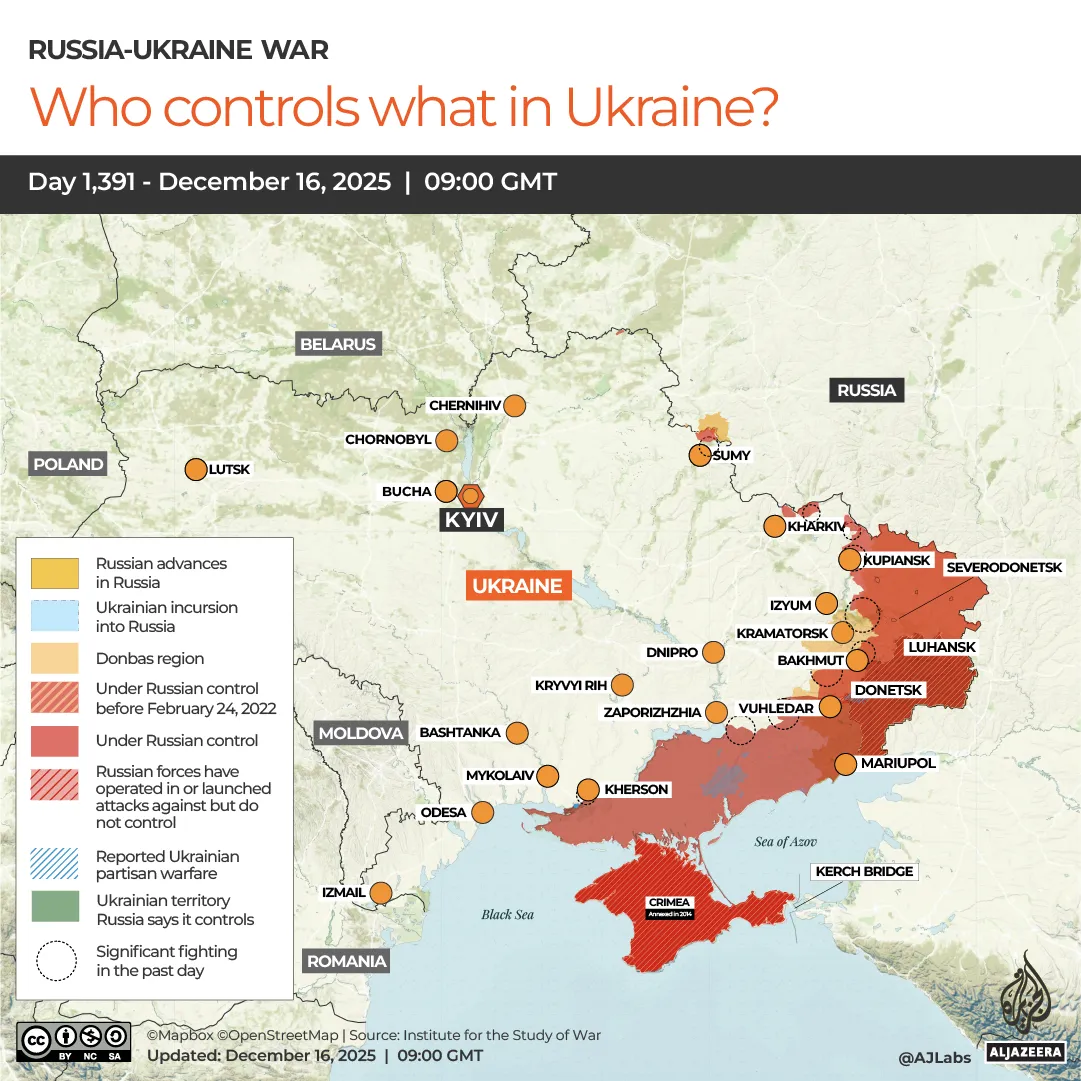
INTERACTIVE-WHO CONTROLS WHAT IN UKRAINE-1765877913
(Al Jazeera)

Why is Russia targeting Odesa?

“The focus of the war may have shifted towards Odesa,” Kuleba said, warning that the “crazy” attacks could intensify as Russia tries to weaken Ukraine’s economy.

Russian President Vladimir Putin has previously said Moscow wants to restrict Ukraine’s Black Sea access in retaliation for Kyiv’s recent drone attacks on Russia’s sanctions-evading “shadow fleet” of vessels, which carry a variety of commodities.

Ukraine said those vessels are used to illegally export sanctioned oil, which provides Russia with its main source of revenue for financing its full-scale invasion of its neighbour.

How important is the port of Odesa to Ukraine?

Odesa’s port has long been central to Ukraine’s economy. Called a “pearl by the sea”, Odesa is Ukraine’s third most populous city after Kyiv and Kharkiv.

Black Sea ports – including Odesa and two others close by, Pivdennyi and Chornomorsk – and Mykolaiv to the east handled more than 70 percent of Ukraine’s exports before the war.

But Odesa’s role as a trading hub has grown in recent years as ports in the Zaporizhia, Kherson and Mykolaiv regions have been occupied by Russia.

Since the war began in February 2022, Ukraine has continued to rank among the world’s top five exporters of wheat and corn – largely through Odesa.

By targeting Odesa’s shipping facilities with missiles and drones, Ukrainian officials said, Putin aims to destroy Ukrainian trade and business infrastructure.

Zelenskyy, who has previously accused Russia of “sowing chaos” on the people of Odesa, said: “Everyone must see that without pressure on Russia, they have no intention of genuinely ending their aggression.”

What would it mean for Ukraine if Odesa were destroyed?

If the port of Odesa were badly damaged, the economic impact for Ukraine would be severe. The city and its surrounding areas would suffer major job losses in the shipping and logistics industries, seriously squeezing local incomes. Meanwhile, port-dependent businesses would falter and investment would fall away.

Nationally, Ukraine’s export capacity would be hit hard. As a key gateway for grain and other commodities, disruptions there would raise transport costs, slow shipments and reduce export volumes, choking foreign currency earnings and piling pressure on the hryvnia, Ukraine’s currency.

Elsewhere, farmers would suffer from lower prices for their produce as well as storage bottlenecks with knock-on effects across rural economies. The government would also lose customs revenue just as reconstruction costs would rise, weakening the country’s overall economic resilience.

What other acts of maritime warfare have Ukraine and Russia engaged in during the war?

Over the past six months, maritime warfare between Ukraine and Russia has intensified. Both sides have targeted naval and commercial assets across the Black Sea and beyond.

Ukrainian forces have increasingly used underwater drones and unmanned surface vessels to strike ships tied to Russia’s shadow fleet.

Several shadow fleet tankers, including the Kairos and Virat, were hit by Ukrainian naval drones in the Black Sea near Turkish waters in late November.

Kyiv has expanded its reach elsewhere, claiming drone strikes in the Mediterranean on December 19 on the Qendil, a Russian-linked tanker, marking an expansion in Kyiv’s maritime operations.

At the same time, Russian forces have ramped up attacks on commercial targets, including a Turkish-flagged ship carrying trucks and other freight near Odesa with drone attacks on December 13.

These actions reflect a shift towards what is referred to as “asymmetric naval warfare”, in which drones and improvised systems play a growing role in disrupting each side’s economic and military support networks at sea, experts said.

Source link

‘Peace prospects dire’: More tensions as M23 fights on in DRC despite deal | Conflict News

When Qatar helped secure a peace deal to end ongoing conflict between the M23 rebel group and Democratic Republic of the Congo’s (DRC) government last month, there was hope among many Congolese that a permanent ceasefire would soon emerge to end the fighting that has uprooted close to a million people in the country’s troubled east, and give war-racked communities some respite as the new year rolls in.

Since late 2021, the group, which the United States and the United Nations say is backed by Rwanda, has clashed with the Congolese army in heavy offensives that have killed at least 7,000 people this year alone. Several regional attempts at resolution have failed. Still, when M23 representatives and Congolese government officials met for negotiations in Doha and proceeded to sign a peace deal in November, exhausted Congolese dared to hope. This deal, some reckoned, could be different.

Recommended Stories

list of 3 itemsend of list

So when the rebels launched yet another offensive and temporarily seized the strategic city Uvira this month, hopes for lasting peace were painfully crushed, as some concluded that those at the helm of the talks were playing politics.

“It’s clear that they don’t have any will to end this conflict,” Congolese lawyer and political analyst Hubert Masomera told Al Jazeera from the M23-held eastern city of Goma, blaming both sides. “Despite the number of deaths and the extent of the destruction, there is still procrastination over the implementation of the peace agreements and compliance with the ceasefire. People here feel abandoned to their sad fate.”

Fears that the conflict will not only continue, but that it could soon take on a regional dimension, are deepening, too – a sensitive prospect in a DRC where two civil wars in the past were prompted by its neighbours.

Uvira, the newly captured city the rebels then withdrew from as a “trust-building measure” following US pressure last week, is a major transport and economic hub in the huge South Kivu province. It’s strategically located on the border with Rwanda and is just 30 kilometres from the Burundian capital, Bujumbura. The city was the last eastern stronghold of the Congolese army and its allies – local “Wazalendo” militias and about 3,000 Burundian soldiers. Early this year, M23 also seized control of South Kivu’s capital city, Bukavu, as well as Goma, the capital of North Kivu province.

Experts say M23’s advance on Uvira widens the group’s area of control significantly, puts it at the mouth of the mineral-rich Katanga region, and positions Rwandan proxies right at Burundi’s doorstep at a time when both governments are ramping up a war of words and accusing each other of backing rebels.

Rwanda, for its part, continues to distance itself from accusations that it backs M23.

FILE PHOTO: A view shows the remains of a vehicle hit by heavy and light weapons during the fighting in the town that led to the fall of Goma into the hands of the M23 rebels, eastern Democratic Republic of Congo, February 5, 2025. REUTERS/Arlette Bashizi/File Photo
A view shows the remains of a vehicle hit by heavy and light weapons during the fighting in the town that led to the fall of Goma to M23 rebels, on February 5, 2025 [File: Arlette Bashizi/Reuters]

DRC conflict’s complex history

The recent scenes in eastern DRC appear like an eerie playback of a tragic tale, conflict monitors say.

Similar peace negotiations in late 2024, led by the African Union and Angola, seemed ready to deliver peace ahead of a new year. But they collapsed after a highly anticipated meeting between the presidents of Rwanda and DRC was called off. Both sides accused each other of foiling the talks.

“There’s a sense of deja vu,” Nicodemus Minde, East Africa analyst at the Institute for Security Studies (ISS), said. “It’s symbolic because we were exactly here last year … the prospects for peace are dire.”

Conflict in the DRC has long been mired in a complex mix of ethnic grievances, poor governance and interference from its much smaller neighbours. It goes back to the 1994 genocide of Tutsis and moderate Hutus in Rwanda, which displaced millions into neighbouring eastern DRC, making them a minority there. Rwanda has since viewed the DRC as a hiding place for Hutu genocidaires, however, and its hot pursuit of them toppled a government in Kinshasa and led to the first and second Congo wars (1996-2003). The UN also accused the Rwandan and allied Ugandan forces of looting the DRC’s vast mineral wealth, including gold, coltan and tin, during the conflict.

Scores of militias emerged as governments armed and counter-armed civilians in the wars, many of which are still active in the DRC. The M23 itself is only the latest iteration of a Tutsi militia that fought in the Congo wars, and whose fighters integrated into the DRC army. In 2012, these fighters revolted, complaining of poor treatment by the Congolese forces. Now, the M23 claims to be fighting the marginalisation of ethnic Tutsis, some of whom say they are systematically denied citizenship, among other complaints. The M23 and its allied Congo River Alliance (AFC) have not stated goals of taking Kinshasa, even though members of the group have at times threatened to advance on the capital. Officially, the rebels claim to be “liberating” eastern DRC communities.

In 2012, M23 initially emerged with enough force to take the strategic city of Goma, but was forced back within a year by Congolese forces and a special UN intervention force of troops from South Africa, Tanzania and Malawi. When the M23 resurfaced in late 2021, though, it was with much more ferocity, boosted by about 4,000 Rwandan troops in addition to its own 6,000 fighters, according to the UN. Lightning and intensely bloody offensives have since seen it control vast swaths of territory, including the major cities of Goma, Bukavu – and now, Uvira.

On the map, M23 appears to be eking out a slice of Congolese territory wedged between the DRC and neighbouring Rwanda, Uganda and Burundi. If it gains control of the two Kivus in their entirety, it would lord over a resource-rich area five times Rwanda’s size with easy access to Kigali and Kampala.

“They are trying to create some sort of buffer zone which the neighbouring countries, particularly Rwanda but also Uganda, have an interest in controlling,” analyst Paul-Simon Handy, also of the ISS, told Al Jazeera.

Kigali officially denies backing M23, but justifies its actions based on accusations that the DRC supports a Hutu rebel group, the Democratic Forces for the Liberation of Rwanda (FDLR). The FDLR did exist for many years in the DRC, but it simply no longer poses a significant threat to Kigali, analyst Minde said.

Rwanda’s tensions with Burundi have similar historic correlations, as Hutus who perpetrated the 1994 genocide similarly fled there, and Kigali alleges the government continues to back rebels. In 2015, Burundi accused Rwanda of sponsoring an abortive coup in Bujumbura. Kigali denies this.

drc
US President Donald Trump hosts the signing ceremony of a peace deal with the president of Rwanda, Paul Kagame, left, and the president of the Democratic Republic of the Congo, Felix Tshisekedi, right, at the United States Institute of Peace in Washington, DC, on December 4, 2025 [Andrew Caballero-Reynolds/AFP]

Does the US deal have a chance?

Several African countries have attempted to help solve the crisis, militarily and diplomatically, but all have failed. The regional bloc, the East African Community, of which the DRC is a part, deployed about 6,500 Kenyan-led peacekeepers to stabilise eastern DRC, as Kenyan diplomats developed a Nairobi Peace Process in 2022 that was meant to see several rebel groups agree to a truce. The agreement collapsed only a year later, however, after Congolese President Felix Tshisekedi grew frustrated over the force’s refusal to launch offensives against M23.

Then, the Southern African Development Community (SADC), of which the massive DRC is also a part, deployed troops from South Africa, Tanzania and Malawi in May 2023. There was hope that the trio, which proved crucial in driving back the first M23 insurrection, would again record success. They appeared no match for the new M23, though, and withdrew this June.

Meanwhile, the Angola-led Luanda Peace Process collapsed after President Joao Lourenco stepped back in March, citing frustration with both sides amid constant finger-pointing.

Qatar and the US stepped in to broker peace in June this year, using a unique two-pronged approach. The Doha peace talks, on the one hand, have focused on negotiations between the DRC and M23, while the Washington talks focus on the DRC and the Rwanda governments. Some experts warned that Washington’s motivation – aside from President Donald Trump’s fixation on being a global peacemaker figure – was a clause in the deal that guarantees US extraction of rare earth minerals from both countries. The agreement was unlikely to hold on that basis, rights groups said.

After a few no-shows and wobbles, the M23 finally agreed to the Doha framework on November 15. The agreement includes eight implementation protocols, including one on ceasefire monitoring and another on prisoner exchange. On December 4, President Trump sat next to a smiling Paul Kagame and Tshisekedi as all three signed the US-peace deal in Washington, which mandated both Rwanda and DRC to stop supporting armed groups. There were pockets of fighting as the signatures were penned, but all was supposed to be largely peaceful from then on.

What happened in Uvira barely a week after was the opposite. The Congolese government said at least 400 people were killed and 200,000 others displaced as M23 fighters pressed on the city. Thousands more were displaced into Burundi, which already homes some 200,000 Congolese refugees. Fleeing Uvira residents shared accounts of bombed villages, summary killings and widespread sexual violence by both sides, according to medical group Doctors Without Borders (MSF).

Is there hope for peace?

Even though M23 began withdrawing from Uvira on Thursday, analysts are still scrambling to understand what the group was hoping to achieve by taking the city, shattering the peace agreements and angering Washington.

US Secretary of State Marco Rubio directly scolded Rwanda after Uvira’s capture, saying Kigali had violated the deal. Last week, Deputy Secretary of State Christopher Landau met with DRC Foreign Minister Therese Kayikwamba Wagner in Washington and promised that the US “is prepared to take action to enforce adherence” from Rwanda.

What that action looks like is unclear, but what’s certain, Minde said, was that the agreement seemed to favour Kigali more than Kinshasa.

“If you look at the agreement, the consequences [of either party breaching] were not forthright, and this points to the weakness of the deal,” he said, adding that there is much more at stake for DRC if there is a breach, including escalating conflict and mass displacement within the country. But that was not taken into account, the analyst explained.

Uvira’s fall, albeit on hold, is not only a blow to Trump’s peacemaker reputation but also sharpens tensions between Burundi and Rwanda, with analysts saying it could lead to direct clashes.

Bujumbura accuses Kigali of supporting the antigovernment Red Tabara rebels – a charge Rwanda and the rebels deny – and tensions between the two governments have led to border closures since last year. Last week, M23 announced that it captured hundreds of Burundian soldiers during the Uvira offensive.

Fears of a regional spillover also prompted the UN Security Council to extend the mandate of the MONUSCO peacekeeping mission for a year, ahead of its December 20 expiration. The 11,000 troop force has been in place since 1999, but has a complicated relationship with the DRC government, which says it has not done enough to protect civilians. MONUSCO forces initially began withdrawing in 2024, but then paused that move in July amid the escalating M23 offensive. Ituri, the force’s headquarters, is held by M23, meaning the troops are unable to do much.

Amid the chaos, the finger pointing, and the political games, it’s the Congolese people who are feeling the most despair at the turn of events so close to the new year, analysts say. After more than three decades of war that has turned the green, undulating hills of eastern DRC into a perpetual battlefield, Masameko in Goma said it’s locals, more than anyone else, with the most at stake.

“People have suffered enough and need to breathe, to sleep with the certainty that they will wake up tomorrow,” he said. “[They need] to live in their homes without fear of a bomb falling on them. That is all the people in this part of the republic need.”

Source link

‘We have nothing’: Endless pain for displaced civilians fleeing Sudan war | Sudan war News

People escaping fighting, lack of essential supplies in Heglig area faced with tough humanitarian conditions in search for shelter and safety.

Kosti, Sudan – The flow of displaced people fleeing the fighting in Sudan shows no sign of slowing – the latest hailing from Heglig.

In early December, the paramilitary Rapid Support Forces (RSF) seized the strategic Heglig oilfield in West Kordofan province after its rival, the Sudanese Armed Forces (SAF), withdrew from the area.

Nearly 1,700 displaced people, most of them children and women, escaped the fighting in the southern region and the lack of basic necessities.

Some of them were fortunate enough to board trucks as they fled from their towns and villages in the area. After an arduous journey, the displaced people arrived at their new home – the Gos Alsalam displacement camp in Kosti, a city in the White Nile province.

“We left without anything … we just took some clothes,” said an elderly woman who appeared exhausted and frail.Sudan map

Inside the camp, the people arriving are faced with extremely harsh humanitarian conditions. Tents are being pitched in haste, but as the number of displaced people grows, so do the immense humanitarian needs. Yet, humanitarian support remains insufficient to cover even the bare minimum.

“We have no blankets or any sheets, nothing. We are old people,” said a displaced elderly woman.

‘I gave birth in the street’

Nearly three years of war between the RSF and SAF have forced 14 million people to flee their homes in a desperate attempt to find shelter and safety away from the heavy fighting that has killed tens of thousands.

Some 21 million across the country are facing acute hunger, in what the United Nations calls the world’s largest humanitarian crisis.

In a small corner of the Gos Alsalam camp, Umm Azmi sits next to her newborn baby. She recalled how she was overtaken by labour on the road and delivered her baby in the open air without any medical assistance.

“I was trying for nine months … but I gave birth in the street – the condition is very difficult,” the mother said.

“I had just given birth, and I had nothing to eat. Sometimes we eat anything we find in the streets,” she added.

Source link

Ugandan police tear gas crowd at Bobi Wine campaign event | Government

NewsFeed

Footage shows security forces dispersing crowds with tear gas at rallies for Ugandan presidential candidate Robert Kyagulanyi, also known as Bobi Wine, in Kampala. The pop star-turned-politician is campaigning ahead of Uganda’s January 2026 elections, as officials warn against interference.

Source link

Can diplomacy end the conflict between Thailand and Cambodia? | Conflict News

The neighbouring countries hold their first direct meeting in regional push for peace.

Fighting has escalated between Cambodia and Thailand, forcing hundreds of thousands of civilians to flee their homes on both sides of the neighbouring countries’ border.

Now, the Association of Southeast Asian Nations (ASEAN) is taking the lead in attempts to end the violence and reach a peace deal.

Recommended Stories

list of 4 itemsend of list

All this comes after an attempt by United States President Donald Trump to end the war failed.

The Thai and Cambodian foreign ministers are set to meet in the coming days in hopes of reaching what Thailand has called a “true ceasefire”.

But without any letup in the long-running conflict, what will it take to bring it to an end?

Presenter: Dareen Abughaida

Guests:

Chheang Vannarith – Chairman of Angkor Social Innovation Park and a former assistant to Cambodia’s defence minister in 2011 and 2012

Ilango Karuppannan – Adjunct senior fellow at the Nanyang Technological University and former Malaysian High Commissioner to Singapore

Phil Robertson – Director of Asia Human Rights Labour Advocates and former deputy director of Human Rights Watch’s Asia Division

Source link