Dec. 31 (UPI) — The nation’s new jobless claims exceeded expectations with fewer than 200,000 reported for the week ending on Saturday, marking the third straight week that new jobless claims fell.
The number of new jobless claims fell by about 16,000 and posted a seasonally adjusted 199,000, the Labor Department announced on Wednesday.
The term “seasonally adjusted” refers to a statistical method in which seasonal effects, such as weather and holidays, are factored to better show the direction in which the nation’s job market is moving.
Last week’s decline was the third straight week and the seventh of the past eight in which seasonally adjusted new jobless claims declined across the country, MarketWatch reported.
Economists responding to a Wall Street Journal poll had estimated 220,000 new jobless claims for the week.
The prior week’s new jobless claims were revised up by 1,000, from an initial estimated of 214,000 to the adjusted total of 215,000.
The Labor Department reported 269,953 unadjusted new jobless claims last week, which was up by 5,333 and 25 from the prior week ending on Dec. 20. Economists had predicted an increase of 26,612 for a 10.1% increase last week.
The unadjusted new jobless claims for last week were down from 283,488 during the same period in 2024.
Meanwhile, the number of people with previously established unemployment claims fell by 47,000 to 1.87 million for the week that ended on Dec. 20.
The number of continuing claims had risen since the pandemic due to a slowdown in hiring, but they have not grown in number in recent months, according to MarketWatch.
While new and existing jobless claims are down, some economists cautioned that the slow hiring pace since the summer might herald an economic slowdown.
The nation’s total unemployment rate rose to 4.6% in November, which was its highest rate since September 2021.
The states with the five highest unemployment rates for the week ending on Dec. 13 were Washington state at 2.5%, followed by New Jersey, 2.4%; Massachusetts and Minnesota, 2.2%, each; and California, Illinois and Rhode Island at 2.1%, each.
The United States is the second-largest destination for Chilean cherry exports after China, with shipments exceeding 3.9 million 5-kilogram boxes in 2024. File Photo by Benjamin Hernandez/EPA
SANTIAGO, Chile, Dec. 31 (UPI) — The start of Chile’s new cherry export season is delivering strong results in the United States, where exporters are pursuing a strategy to expand consumption during the Northern Hemisphere winter.
Although the season formally began in December, the first shipments were sent Oct. 20 due to an early harvest, and figures so far are positive, Claudia Soler, executive director of the Cherries Committee of Fruits from Chile, told UPI.
Soler said that as of Dec. 22, Chile had exported 18,282 metric tons of cherries to the United States, about 20,150 tons, representing a 63% increase compared with the same period last season.
The United States is the second-largest destination for Chilean cherry exports after China, with shipments exceeding 3.9 million 5-kilogram boxes in 2024.
Chilean exporters, together with U.S.-based companies, are now working to boost consumption among American consumers, taking advantage of the earlier start of the season for the premium fruit.
Soler said the largest retail chains began promotions Dec. 15.
“They are very important to generate early-season momentum. This year, in particular, we are starting promotions much earlier,” she said.
“In the United States, a significant volume of domestic cherries is consumed during the summer — close to 40 million 5-kilogram boxes. That means there is enormous potential, because the market is still not fully aware that cherries are available during the winter season,” she said.
“We are seeking to increase visibility, awareness and consumption of Chilean cherries during the winter months,” she added, positioning the fruit as an option available from December through February.
“It is a delicious, healthy and premium snack. To achieve this, work is being done both with retailers through in-store promotions and e-commerce platforms, and directly with consumers through social media, traditional media and influencer partnerships,” she said.
North American apple grower and distributor Honeybear Brands, one of the largest importers of Chilean cherries, told Portal Frutícola it expects to import between 125 and 150 cherry shipments this year through the ports of Washington state and Philadelphia, helping to reduce logistics costs and improve stock availability.
Chuck Sinks, Honeybear Brands’ president of sales and marketing, said the company is receiving “slightly better sizing than last year, with good flavor and consistency.”
“We only bring in Chilean fruit. We feel it is a superior product compared with other growing regions in South America,” he said, noting that older consumers account for the bulk of demand.
“Buyers tend to be over 55 years old, live in two-person households and a large share of purchases come from households with annual incomes of around $100,000 or more,” Sinks said.
Chile is the world’s leading producer and exporter of cherries. In 2024, exports totaled $3.091 billion. For the 2025-26 season, production had been forecast at 131 million boxes, equivalent to 655,000 metric tons, compared with 625,000 metric tons in the previous season.
However, initial downward adjustments are being made due to weather conditions.
“According to an internal analysis conducted by the Cherry Committee in late November, exports were revised down by between 10% and 15% compared with the October estimate,” Soler said.
She said the previous season was challenging in terms of profitability due to a combination of factors. Still, “we believe that in China, the United States and other key markets for Chile, there remains significant room to grow consumption.”
According to the Monthly Trade Report from the studies department of Chile’s Subsecretariat for International Economic Relations, the new fresh cherry export season began in November, with shipments totaling $300 million that month, nearly tripling exports from November 2024, which reached $106 million.
People ride the subway past a euro adoption poster in Sofia, Bulgaria, Monday. Bulgaria is set to become the 21st member of the eurozone on Jan. 1, transitioning from the national lev to the euro amid public concerns that the move could trigger immediate price hikes and a higher cost of living. Photo by Borislav Troshev/EPA
Dec. 31 (UPI) — Bulgaria will begin using the euro as its currency on Thursday, and the country hopes it will bring an economic boost, despite concerns.
Bulgaria joined the European Union in 2007, but it’s only now adopting the currency after strong debate and political turbulence.
It’s the 21st country to join the eurozone, and lawmakers in Brussels and Sofia hope it will boost the economy of the EU’s poorest nation.
European Commission President Ursula von der Leyen called the move one of the EU’s greatest achievements.
“This milestone reflects years of hard work and commitment, overcoming challenges,” she said in a statement. “The euro will bring benefits for the Bulgarian people making payments and travel easier. It will bring new opportunities for Bulgarian businesses, allowing them to seize better the advantages of our common single market. It will further strengthen Bulgaria’s voice in Europe. This step is good for Bulgaria, and it strengthens Europe as a whole. It makes our economy more resilient and competitive globally. Congratulations, Bulgaria! You can be proud of what you achieved.”
The country has had dual displays of prices — in the euro and the Bulgarian lev — since August, and that will continue until August 2026. Consumers can use both currencies beginning Jan. 1 through Jan. 31. On Feb. 1, they must only use the euro. The price displays are a way for consumers to monitor prices and a stopgap to prevent retailers from price gouging.
Bulgarians can exchange their currency at banks and post offices for free until July. After that, they can charge for exchanges.
The country is still divided on whether switching to the euro is a good move.
A recent survey by the Bulgarian ministry of finance showed that 51% of citizens wanted to adopt the euro, and 45% were against it, The Guardian reported.
In June, a fight broke out in the parliament when the measure was adopted by the European Commission. Parliament members from the Revival Party blocked the podium. They also organized protests against euro adoption. Revival is a far-right, pro-Russian political party.
Petar Ganev, senior research fellow at the Institute for Market Economics in Sofia, told The Guardian that the division on the euro highlights the country’s broader political tension.
“This is not surprising. The country is divided on almost everything that you can imagine,” Ganev said. “And after the political instability, we ended up in a very hostile political environment.”
Bulgaria has endured a four-year political crisis with seven parliamentary elections and widespread corruption, which has caused a lack of trust in the government.
Valdis Dombrovskis, European Commission economy minister, said in a November speech in Sofia that the adoption of the euro was especially important during Russia’s war with Ukraine, rising geopolitical tensions and global economic uncertainty.
“Most European countries — including Bulgaria — are far too small to shape today’s world on their own. They only stand to gain necessary weight by fully integrating into the European Union’s larger political and economic structures,” he said.
“The euro area is not just a group of countries sharing a common currency,” Dombrovskis said in his speech. “It is a powerful symbol to the world of European integration, economic stability, and geopolitical strength. It gives Europe a collective economic weight that allows it to shape global trade, investment, and financial markets.”
The latest Eurobarometer, a survey conducted by the EU in Autumn 2025, showed that 74% of Europeans said their country has benefited from being a member of the EU, and 59% are optimistic about the future of the EU.
Many Bulgarians fear that prices will spike during the transition. The average monthly income is about $1,500 in the country, so rising prices could be detrimental to some. But the European Commission has said there is no evidence that inflation will rise.
Victor Papazov, macroeconomist and adviser to the Revival party, claimed Bulgaria was heading for a crisis similar to what Greece endured in 2009.
“Any person in their right mind would oppose adopting the euro,” Papazov said in a written statement to The Guardian. “Joining now will make things worse and faster. In my opinion there is not a single serious positive in adopting the euro.”
Maria Valentinova, 35, a pharmacist from Sofia, told The Guardian that she is glad her young son will grow up in the eurozone. She said the currency “will be good for the economy of the country in the long run.”
Valentinova called the transition period “a bit stressful” but said, “I think it will be a good thing in the end.”
Ganev said Bulgarians will get used to the new currency quickly. “What will happen to our country and if we are going to be a good example in the eurozone or a bad example … depends entirely on us.”
Revelers enjoy the confetti that is tossed in the air as part of the annual New Year’s Eve Confetti Test in Times Square in New York City on December 29, 2025. Photo by John Angelillo/UPI | License Photo
What started as a niche corner of the internet has evolved into a multibillion-dollar industry.
In 2025, prediction markets have become a substantial instrument for speculation and the forecasting of real-world events in both finance and media. Two major players in the sector, Polymarket and Kalshi, have amassed a combined volume of over $37 billion (€31.5bn) in wagers placed this year, according to the 2026 Digital Assets Outlook Report.
A prediction market is essentially a platform where people bet on what they think will happen, and the price of the bet becomes a forecast. For example, instead of asking people directly or through on-the-street interviews who they expect will win an election, you let people put money on their answer.
The market price tells you what outcome people collectively think is most likely, and the forecast updates in real time, which is why some believe prediction markets capture collective thinking better than polls.
The sheer amount of capital flowing through these exchanges has triggered a gold rush. This month, Kalshi secured a Series E funding round of $1 billion(€850mn) valuing the platform at $11 billion (€9.4bn).
Polymarket hit a milestone back in October when Intercontinental Exchange (ICE), the parent company of the New York Stock Exchange, announced a strategic investment of up to $2 billion (€1.7bn) and valued the platform at $8 billion (€6.8bn). Additionally, ICE became the distributor of Polymarket’s data to institutional investors globally.
The overall interest from financial institutions is undeniable. Terrence Duffy, the CEO of CME Group, the world’s leading derivatives exchange, described prediction markets as “a legitimate domain of speculation and information aggregation that our clients are demanding” during their third-quarter earnings call.
EU-based or homegrown prediction markets have yet to take off, and EU regulations have kept the existing ones largely offshore.
From beating polls to signing partnerships
As platforms, prediction markets function similarly to a financial exchange. Users buy and sell binary contracts, betting yes or no, on the outcomes of unknown future events such as election results, corporate earnings reports and sports scores.
Typically, these contracts pay out $1 if the event occurs and $0 if it does not. For example, if a contract is priced at $0.50 it implies that the collective belief of the participants is pricing a 50% probability of an event occurring.
The relevance of prediction markets was cemented after the 2024 US presidential election and the 2025 German snap election. In both cases, these platforms functioned as real-time scoreboards, consistently pricing outcomes and delivering predictions that were nearly as reliable or even more so than traditional polling.
This perceived accuracy has now forced legacy media to adapt.
Earlier this month, CNN set a global precedent by partnering with Kalshi to integrate live prediction market data into its broadcasts. A couple days later, CNBC made a similar announcement.
Before the recent partnerships, several media outlets were already starting to incorporate these predictions into their regular news stories, such as interest rate decisions and legislative votes, granting them similar editorial weight to conventional polling.
Hyper-commodification, insider trading and outcome manipulation
Critics of prediction markets argue that they have effectively gamified everyday human outcomes, drawing a dangerously thin line between serious forecasting and high-stakes gambling.
This gamification has accelerated a phenomenon some call “hyper-commodification”, which refers to the process of turning every aspect of social life into a commodity that becomes subject to market forces.
In its worst form, the phenomenon encourages gambling, creates new opportunities for insider trading and incentivises manipulating the outcomes of real-world events.
In early December, a Polymarket trader nicknamed “AlphaRaccoon” sparked controversy after winning 22 out of 23 bets related to Google’s 2025 Year in Search rankings.
The trader netted over $1 million (€850,000) in 24 hours, and was later accused of being a Google employee who used internal access to proprietary search data to find out the most searched terms ahead of the company’s announcement.
The incident raised concerns about the integrity of prediction markets, especially since the fact that users can be anonymous makes it more difficult for those engaging in insider trading to be immediately weeded out.
In late October, Coinbase CEO Brian Armstrong, who leads one of the largest crypto assets exchanges, turned the company’s third-quarter earnings call into ademonstration of the risks of outcome manipulation in prediction markets.
Users on Polymarket and Kalshi had thousands of dollars riding on whether Brian Armstrong would use specific buzzwords and the CEO intentionally paused the call to enunciate a list of those words. Within seconds, the implied probability of those terms being mentioned spiked from roughly 15% to 100%.
Armstrong later tweeted that the exercise was “spontaneous” but for regulators it served as a stark example of the dangers of prediction markets being manipulated and losing their advantages as neutral forecasting tools.
The EU’s regulatory firewall
In the European Union, the crackdown on prediction markets began in late 2024 when the French National Gaming Authorityblocked Polymarket, ruling that its operation constituted unlicensed gambling.
In the following months, Belgium, Poland and Italy also issued bans.
The Romanian National Gambling Office (ONJN) blacklisted Polymarket in October after it hosted wagers on the Romanian 2025 presidential election held in May. In this case, the volume traded exceeded $600 million and the President of ONJN stated that “regardless of whether you bet in lei or crypto, if you bet money on a future result, under the conditions of a counterpart bet, we are talking about gambling that must be licensed.”
However, there are still many EU member states where prediction markets are accessible, such as Germany and Spain. The broader EU regulatory landscape remains fragmented, with no unified framework in place.
As we head into 2026, prediction markets also face the full implementation of the EU’s Markets in Crypto-Assets (MiCA) regulation, as most of these platforms make use of blockchain technology.
By July of next year, the grandfathering period ends for securing a Crypto-Asset Service Provider licence. According to the European Securities and Markets Authority, MiCA contains strict market abuse regimes that will apply to any prediction market using crypto assets.
The new reality is that every world event is being priced in real-time and the EU must decide if it will be a part of this era or opt for an outright ban.
Dec. 28 (UPI) — More than 30 years after New York City switched from tokens to the magnetic swipe of a MetroCard to ride its subways and buses, the card’s era is about to end.
Starting on Jan. 1, 2026, transiting residents and tourists alike will be required to move into the 21st century by using a contactless form of paying fares by tapping a phone, credit card or other device as they enter stations and buses.
Although the contactless system was introduced in 2019, 94% of subway and bus trips in the city already use the OMNY system for their travel payments, ABC News reported.
“New Yorkers have embraced tap and ride and we’re proud to see that as more and more people return to the city, they are choosing mass transit,” Shanifah Rieara, chief customer officer for New York City’s Metropolitan Transit Authority (MTA), said in a press release.
“As the end of MetroCard sales nears, we are focusing on reaching the remaining 6% to make the switch and unlock the benefits and convenience of tap and ride technology,” Rieara said.
According to the MTA, the last day to purchase or reload a MetroCard will be Dec. 31, while the last day to use one of the magnetic swipe cards will be some time in mid-2026.
The OMNY system offers three ways for riders to pay: with their phone using a digital wallet or contactless bank card, as well as a physical OMNY card that works with the digital system.
MTA said that by eliminating MetroCards and move to a single method of fare collection, the agency expects to save at least $20 million, as well as gain the ability to offer customer promotions and fare discounts more easily.
From 1953 until 1994, the New York City subway system’s main method for paying were dime-sized tokens with a hole in the middle shaped like a “Y,” which the MTA at the time said made it easier to increase fares without having to accept a variety of coinage, CNN reported.
In 1983, as other large cities had started using magnetic swipe technology for their public transportation systems’ payments, the MTA started moving toward the reloadable cards that have been an essential part of life for New Yorkers for more than three decades.
Pope Leo XIV celebrates the Christmas vigil Mass on Christmas eve on Wednesday in St. Peter’s Basilica in Vatican City, Vatican. Photo by Stefano Spaziani/UPI | License Photo
Tehran, Iran – Iran’s currency has been registering new lows amid ongoing economic turmoil that is also reflected in a planned budget for next year that effectively shrinks public spending.
Each United States dollar was priced at about 1.36 million rials in the open market on Wednesday in Tehran, its highest rate ever, before the Iranian currency slightly regained ground on Thursday.
Recommended Stories
list of 3 itemsend of list
The embattled national currency has been rapidly declining over recent weeks as the US and its Western allies pile on their sanctions and diplomatic pressure, and the threat of another war with Israel lingers.
President Masoud Pezeshkian this week sent his administration’s finalised proposed budget to the hardline-dominated parliament for the upcoming Iranian calendar year, which starts in late March. The budget will then have to be greenlit by the 12-member Guardian Council before being ratified into law in the coming weeks.
The presented budget nominally grew by just over 5 percent compared with last year, but inflation currently stands at about 50 percent – indicating that the government envisions lower spending while managing a so-called “resistance economy” as it faces a massive budget crunch yet again.
But minimum wages are to be raised far below the inflation rate, too, at only 20 percent, meaning that Iranians are once more guaranteed to have far less spending power next year as the embattled national currency sinks.
Iranians view decorations as they prepare to celebrate the Yalda feast, an ancient tradition marking the onset of winter and the longest night of the year, in Tehran, Iran, on December 20, 2025 [Abedin Taherkenareh/EPA]
At the same time, the budget says the government sees taxes rising by a massive 62 percent next year, as authorities try to gradually decrease dependence on oil revenues amid US efforts to drive down Iranian exports, which are carried by a shadow fleet of ships mostly to China.
At the current exchange rate, the whole budget is worth about $106bn, several times lower than the projected 2026 budgets of regional players like Turkiye, Saudi Arabia and Israel.
Iran’s rent-distributing multi-tier exchange rate system is still at play, with the government proposing allocating a rate for customs duties, import valuation and budget accounting tables, and another closer to the open market rate used for oil revenue realisation.
An earlier subsidised exchange rate, which was far lower than the open market rate, has now been abandoned. Any excess cash resulting from this is expected to be doled out to low-income Iranians in the form of electronic coupons that can be used to buy essential items like food.
For the first time, the budget is drafted in new rials as four zeros are expected to be removed from the ailing national currency by the time the budget is operational for next year.
After years of back and forth, the parliament in October approved the government plan to lop off four zeros. The move is only cosmetic and will not help with the runaway inflation, but proponents argued it was necessary after years of currency devaluation.
Budget spells grim outlook
Several major factors have already been raising alarm over how bad the economic situation could become next year.
Iranians online reacted poorly to the fact that the government predicts wages will be far outpaced by inflation and tax collection. Others were concerned that eliminating the subsidised rate for essential goods could cause another price shock in the short term.
Many shared a video of Pezeshkian from last year running for president, when he said during a televised interview that the stark disparity between wage increases and inflation is a “grave injustice” being done to the Iranian people.
“Unfortunately, so long as we do not resolve the structural issues, we are making labourers and government workers poorer by the day while those with money get bigger and bigger,” Pezeshkian said at the time.
“This inflation is an additional tax on the poor and the disenfranchised.”
Iranian women shop in a local market as the value of the Iranian rial drops, in Tehran, Iran, on December 20, 2025 [Majid Asgaripour/WANA (West Asia News Agency) via Reuters]
But successive governments have failed to eliminate budget deficits or rein in banks teetering on the brink of insolvency, therefore relying on the central bank to print more money to run the country and, in turn, exacerbate inflation.
Earlier in December, the government proceeded with increasing the price cap of petroleum despite repeated assurances it had no plans to that effect this year. The move has already led to increased transport costs, which will end up taking inflation higher.
There are now four price tiers for petroleum, with the cheapest and lowest quality that is available to most Iranians costing up to 50,000 rials per litre (about $1.19) and higher quality imported fuel delivered this week at 800,000 rials per litre ($19).
Hamid Pourmohammadi, who heads the Plan and Budget Organization of Iran, insisted that the government has devised a 20-point plan to be unveiled soon that will reduce pressure on the livelihoods of Iran’s 90 million population.
“The government is trying to adopt an active approach to address the economic challenges of the people, businesses and economists, so there is no perception of complacency in these economic conditions,” he said.
Shinhan Card headquarters in Seoul. The company has reported massive data leaks. Photo by Yonhap
SEOUL, Dec. 26 (UPI) — Shinhan Card, one of the country’s top credit card issuers, reported a massive data leak Tuesday.
The Seoul-based company said more than 190,000 cases of potential data exposure have been identified that involve merchant partners’ personal and business information.
The incident seems to stem from employee actions rather than an external cyberattack. Against this backdrop, Shinhan Card CEO Park Chang-hun issued a formal apology.
“We would like to express our deepest apologies,” he said. “Upon discovering the incident, we immediately took measures to block any further leaks and completed a thorough review of our internal processes.”
“To ensure the protection of personal information in the future, we will conduct a full investigation into the cause and circumstances of the leak and strictly discipline the employees involved,” he said.
Despite the steps, criticism intensified as a series of security failures have taken place throughout this year.
In late November, the country’s leading online retailer, Coupang, acknowledged that the names, email addresses, phone numbers and delivery addresses of 33.7 million customers had been leaked.
The New York Stock Exchange-listed corporation could face fines amounting to a maximum of 3% of its related revenue, which is levied by the state-run Personal Information Protection Commission.
Since Coupang logged sales of some $28 billion in 2024, potential fines could surpass $800 million.
Earlier this year, SK Telecom admitted that a cyberattack had breached its network, exposing sensitive data and compromising critical information of about 23 million subscribers.
As a result, the top mobile operator was fined $92 million and ordered to suspend adding new customers for nearly two months, in accordance with government guidelines.
Criticizing companies that failed to protect customer information, Prime Minister Kim Min-seok vowed to more than triple the fines for similar violations.
“Urgent legislative tasks, such as the introduction of punitive administrative fines, will be swiftly advanced so that they can be passed as soon as possible,” Kim said at a government meeting Wednesday.
“For repeated and serious violations, we will introduce punitive fines of up to 10% of a company’s total revenue and strengthen the obligation to notify individuals of personal data breaches,” he said.
When corporate data leaks are reported, the South Korean government is quick to lash out at companies. However, critics argue that the government and state-operated organizations have failed to adequately protect their own data.
In 2021, the Atomic Energy Research Institute, the state-run outfit responsible for nuclear power research, was breached by a suspected North Korean state-backed group through a virtual private network server.
Last year, police found that North Korean hackers had stolen data from the National Court Administration during June 2021 and January 2023. The compromised data exceeded 1 terabyte, equivalent to more than 1.5 billion pages of documents, including personal information.
Despite these threats, the government is reluctant to spend more money to mitigate cybersecurity risks.
For example, the Seoul administration cut the 2026 budget for the operation and maintenance of integrated security control centers run by local governments by almost 30% compared with this year.
It also reduced the 2026 budget for reinforcing security and protection facilities at government complexes by more than 40%.
This contrasts with the 8.1% year-on-year increase in the national budget for 2026.
“When hacking incidents occur, harsh penalties are imposed on private enterprises. For government agencies, however, it seemingly ends up with only a slap on the wrist. Such asymmetric punishments are not difficult to understand,” economic commentator Kim Kyeong-joon, formerly vice chairman at Deloitte Consulting Korea, told UPI.
“Moreover, the government is required to strengthen the country’s cybersecurity infrastructure. And leaks of public data or documents are even more dangerous when they are related to national defense. I wonder whether our government is doing enough in these areas,” he said.
Park Tae-hwan, head of the AhnLab CyberSecurity Center, called for stronger efforts to counter online threats and data breaches. AhnLab is the country’s leading cybersecurity vendor.
“Following a series of cyber intrusion incidents of late, regulations centered on bigger fines and punitive measures have come to the forefront, raising the burden on companies,” Park told UPI.
“To enable a meaningful shift in perception, a parallel policy approach is needed, like one that provides incentives to companies with strong security practices, thus encouraging greater voluntary investment in cybersecurity by the private sector,” he said.
Trading sports cards is a game of negotiation for Greg Petikyan. Within seconds, he talked to multiple vendors at Frank and Son Collectible Show last month offering the same card: a 2025 Panini Donruss Saquon Barkley Downtown.
The first deal consisted of a 3-for-1 exchange, with an additional couple of hundred dollars to sweeten the deal or a straight purchase for $460. As the vendor looked through his phone for the value of the cards he asked for, Petikyan told him he’ll circle back.
Instead, the entrepreneur offered it to Eric Mitchel, another booth owner, across the aisle and sold it. A rectangular cardboard collectible with the Super Bowl-winning running back in front of the Philadelphia skyline sold for $300.
What about the other deal?
“Too late,” Petikyan said. “I’ll still buy those cards I asked for.”
Customers browse and shop for cards at vendor Eric Mitchel’s booth at Frank and Son Collectible Show.
(Ronaldo Bolanos / Los Angeles Times)
Nothing personal, just business.
Trading and collecting cards, an industry valued at $14.9 billion in 2024, is estimated to reach $52.1 billion within the next decade, according to Market Decipher report. The sports memorabilia business, as a whole, is estimated to reach a value of $271.2 billion by 2034.
E-commerce platforms like Fanatics Live and Whatnot have turned business transactions involving the cards of sports legends into entertainment and helped grow the market. Heritage Auctions sold the most expensive card in August. The collectible known as the “holy grail” by basketball collectors was a 2007-08 Upper Deck Exquisite Collection Dual Logoman Autographs Michael Jordan and Kobe Bryant card.
The one-of-one sold for $12.932 million, a sum that topped a Mickey Mantle card that went for $12.6 million in August 2022. The Jordan-Bryant card is the second-most expensive sports collectible of all time, trailing Babe Ruth’s 1932 World Series Jersey, which he wore when he called his shot, that cost $24.12 million.
Last Friday, Heritage Auctions set a sales record for the year by crossing the $2 billion mark. The cards sold that day included a 2003 Upper Deck Exquisite Collection Dual Logoman Jordan-Bryant card for $3,172,000 — this one was not autographed.
The trading card business has grown so much, the ecosystem has created specialized markets within it. Collectors can chase a specific team; stick to vintage cards; complete a set of prints with mistakes; chase specific relics of their favorite team; or even just buy cards to resell them for the sole purpose of buying more to flip.
“I know for a fact, a lot of men like to show off their collection,” Adam Campbell, sports cards specialist with Heritage Auction, said. “People love to have good, cool collections,” he added.
The type of chase can change the direction of a business transaction, said George Peña, 53, another booth owner at Frank and Son, an old Sam’s Club that now houses more than 200 vendors selling and showcasing collectible merchandise three days a week.
Kids go into his booth and negotiate with him. Most of the time he doesn’t necessarily need a card from them but engages with them to give them the experience.
“Family members get all excited for them,” Peña said.
But when dealing with people like Petikyan, the stakes change.
“Negotiations are a little different with those kinds of people because they want to make money and we want to make money,” he said as he quipped with Petikyan.
Some collectors have turned into investors because the value of cards is so volatile. It changes in real time — it’s fast, unpredictable and relentless. The moment Dodgers designated hitter and pitcher Shohei Ohtani hit three home runs and struck out 10 batters in Game 4 of the 2025 NLCS, the value of his cards went up. But it cuts both ways — the moment Cleveland Guardians pitcher Emmanuel Clase was indicted on federal charges for wire fraud conspiracy and bribery, the value of his cards dipped.
“The value of cards is not based on anything else, whatsoever, except for hype and buzz” Campbell said. “[It’s] entirely arbitrary.”
Vendor Marion Owens completes a transaction at Frank and Son Collectible Show last month. Owens has been selling cards since 1992.
(Ronaldo Bolanos / Los Angeles Times)
Collecting trading cards has been a part of the culture since Goodwin Tobacco Company released the first set of individual players’ baseball cards in 1886. The N167 Old Judge sets were inserted into tiny cigarette boxes to increase sales and to make sure the cards were not damaged in transit.
Since the tobacco industry started the trade, sports cards have endured changes through generations, each defined by specific characteristics.
The vintage era, before the 1980s, ushered in simpler designs, lower print runs and sets featuring the legends of all the sports. Then came the junk wax period, marked by mass overproduction that devalued the product. The current ultra modern era evolved the market into investments, scarcity, and digitized the business with websites like Arena Club, which repackages pre-graded cards as slab packs.
No matter the changes, there remains a common thread within collectors throughout the years: opening packages and feeling a bump of euphoria when a chase card, a sought-after item, appears.
“It’s the best feeling ever, imagine getting a $1,000 card for like 20, 30 bucks?” Petikyan said. “It’s like hitting a lotto ticket, but better, because it could go up in value depending on the player.”
Petikyan, 27 from Montebello, runs a page called Strictly Pullz on the shopping app Whatnot where he opens boxes and auctions the items within them. Any card pulled from a team that’s purchased by the individual will be shipped to them. On occasion, he inserts a card with higher value to hype a specific set.
To some, the business is intertwined with collecting.
“I’ll use some of the money that I am able to make on the business side, to add to my personal collection,” Mitchel said. “Finding items for the personal collection, I wouldn’t find if I wasn’t out for the business part of it.”
Regardless of motivation, pulling a card worth more than the price paid for will remain priceless.
“I just bought a pack and I pulled a card worth $1,000,” Campbell said, speaking as a collector. “It can change your whole day, and maybe your whole week, maybe a whole month or even a whole year every time you open a pack.”
But, collecting cards is more than just the value of each, Campbell said.
“Do this because you like sports, do this because you love collecting.”
BP announced Wednesday that it’s selling its majority ownership of Castrol to pay debts. File Photo by Neil Hall/EPA
Dec. 24 (UPI) — BP is selling its majority stake in Castrol to U.S. investment company Stonepeak in an effort to pay down its debt.
The company is selling its $10 billion, 65% ownership in the lubricants business to the investment firm. It will keep a 35% stake in the business through a joint venture.
The deal is expected to close at the end of 2026, the company said.
BP will use the $6 billion in proceeds to pay down some of its $26 billion in debt, the company said.
“We concluded a thorough strategic review of Castrol that generated extensive interest and resulted in the sale of a majority interest to Stonepeak,” said Interim CEO Carol Howle in a statement. “And with this, we have now completed or announced over half of our targeted $20 billion divestment program, with proceeds to significantly strengthen BP’s balance sheet. The sale marks an important milestone in the ongoing delivery of our reset strategy. We are reducing complexity, focusing the downstream on our leading integrated businesses and accelerating delivery of our plan. And we are doing so with increasing intensity – with a continued focus on growing cash flow and returns, and delivering value for our shareholders”
BP announced last week that Meg O’Neill would become CEO of BP in April. Murray Auchincloss stepped down as CEO and board director. Howle is interim CEO until O’Neill takes over.
O’Neill, an American raised in Boulder, Colo., is CEO of Woodside Energy.
Maurizio Carulli, analyst at the investment company Quilter Cheviot, called the Castrol deal “a positive step forward for BP, reinforcing its ongoing strategy reset and the aim to reduce its net debt and refocus its downstream business,” The Guardian reported.
Dec. 24 (UPI) — Italy’s antitrust authority accused Mark Zuckerberg-owned Meta Platforms of antitrust violations Wednesday and ordered it to immediately suspend its WhatsApp business solution terms to support access by artificial intelligence competitors.
Officials for Italy’s Autorita Garante Della Concorrenza e del Mercato (the Italian Antitrust Authority) accused Meta Platforms Inc. officials of abuse of a dominant position regarding Meta’s integration of its Meta AI into WhatsApp.
The accusation arises from the messaging app more prominently displaying the Meta AI service on WhatsApp than competing AI services and the pending exclusion of Meta AI competitors from WhatsApp as of Jan. 15.
“Meta’s conduct appears to constitute an abuse, since it may limit production, market access or technical developments in the AI Chatbot services market to the detriment of consumers,” AGCM officials said.
Wednesday’s order applies to Meta Platforms Inc., Meta Platforms Ireland Ltd., WhatsApp Ireland Ltd. and Facebook Italy Srl.
The antitrust authority is working with the European Commission to ensure Meta’s conduct is addressed effectively.
It began investigating the matter in July to determine if Meta engaged in an illegal abuse of a dominant position and expanded the investigation to include the new WhatsApp business solution terms that were added Oct. 15.
Investigators determined Meta’s conduct rises to the level of abuse that could limit production, market access or technical developments in the AI chatbot services market.
Such abuse could harm consumers and Meta’s competitors, while undermining contestability, the authority said.
Meta Platforms owns Facebook, Instagram and WhatsApp and is controlled by majority shareholder Zuckerberg.
Clouds turn shades of red and orange when the sun sets behind One World Trade Center and the Manhattan skyline in New York City on November 5, 2025. Photo by John Angelillo/UPI | License Photo
Dec. 24 (UPI) — The National Highway Traffic Safety Administration opened an investigation into Tesla Model 3 sedans, which might have a deadly flaw in the emergency door release mechanism.
The NHTSA investigation covers about 180,000 Model 3 sedans and is in reaction to recent media reports and a defect petition that suggest the occupants of the Tesla sedans and first responders had trouble using the emergency door release mechanisms after a crash, Electrek reported.
The NHTSA Office of Defects Investigation’s probe into the matter applies to the 2022 model year Tesla Model 3 sedans and their electronic door handles.
“The petition cites that the mechanical door release is hidden, unlabeled and not intuitive to locate during an emergency,” the ODI said.
The problem might have contributed to several deaths in fatal crashes, according to media reports.
The front manual emergency door release latch is located ahead of the window switches, which many passengers accidentally pull instead of using the door-opening button, which could damage the door window.
The rear doors are more complicated to open, which makes it important for Model 3 owners to learn how to use the emergency door mechanisms and to explain how to their passengers.
Instructions are included in the owner’s manual. A Tesla dealership can show owners how to use the mechanisms and afterward show their passengers how to use them in an emergency and to prevent damaging windows via accidental deployments.
Those who are unsure of whether their Tesla Model 3 sedan is subject to the investigation can do a search on the NHTSA recall page by entering their respective state and license plate number or the vehicle identification number or year, make and model.
The results will reveal if the vehicle is subject to a recall in this matter or any other.
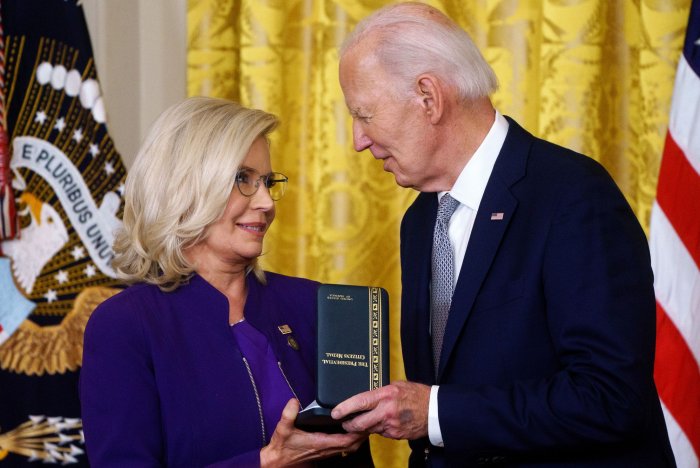
Former President Joe Biden presents the Presidential Citizens Medal to Liz Cheney during a ceremony in the East Room of the White House in Washington, on January 2, 2025. The Presidential Citizens Medal is bestowed to individuals who have performed exemplary deeds or services. Photo by Will Oliver/UPI | License Photo
OXNARD — A father who has become the sole caretaker for his two young children after his wife was deported. A school district seeing absenteeism similar to what it experienced during the pandemic. Businesses struggling because customers are scared to go outside.
These are just a sampling of how this part of Ventura County is reckoning with the aftermath of federal immigration raids on Glass House cannabis farms six months ago, when hundreds of workers were detained and families split apart. In some instances, there is still uncertainty about what happened to minors left behind after one or both parents were deported. Now, while Latino households gather for the holidays, businesses and restaurants are largely quiet as anxiety about more Immigration and Customs Enforcement raids lingers.
“There’s a lot of fear that the community is living,” said Alicia Flores, executive director of La Hermandad Hank Lacayo Youth and Family Center. This time of year, clients usually ask her about her holiday plans, but now no one asks. Families are divided by the U.S. border or have loved ones in immigration detainment. “They were ready for Christmas, to make tamales, to make pozole, to make something and celebrate with the family. And now, nothing.”
At the time, the immigration raids on Glass House Farms in Camarillo and Carpinteria were some of the largest of their kind nationwide, resulting in chaotic scenes, confusion and violence. At least 361 undocumented immigrants were detained, many of them third-party contractors for Glass House. One of those contractors, Jaime Alanis Garcia, died after he fell from a greenhouse rooftop in the July 10 raid.
Jacqueline Rodriguez, in mirror, works on a customer’s hair as Silvia Lopez, left, owner of Divine Hair Design, waits for customers in downtown Oxnard on Dec. 19, 2025.
(Genaro Molina/Los Angeles Times)
The raids catalyzed mass protests along the Central Coast and sent a chill through Oxnard, a tight-knit community where many families work in the surrounding fields and live in multigenerational homes far more modest than many on the Ventura coast. It also reignited fears about how farmworker communities — often among the most low-paid and vulnerable parts of the labor pool — would be targeted during the Trump administration’s intense deportation campaign.
In California, undocumented workers represent nearly 60% of the agricultural workforce, and many of them live in mixed-immigration-status households or households where none are citizens, said Ana Padilla, executive director of the UC Merced Community and Labor Center. After the Glass House raid, Padilla and UC Merced associate professor Edward Flores identified economic trends similar to the Great Recession, when private-sector jobs fell. Although undocumented workers contribute to state and federal taxes, they don’t qualify for unemployment benefits that could lessen the blow of job loss after a family member gets detained.
“These are households that have been more affected by the economic consequences than any other group,” Padilla said. She added that California should consider distributing “replacement funds” for workers and families that have lost income because of immigration enforcement activity.
An Oxnard store owner who sells quinceañera and baptism dresses — and who asked that her name not be used — says she has lost 60% of her business since the immigrant raids this year at Glass House farms.
(Genaro Molina/Los Angeles Times)
Local businesses are feeling the effects as well. Silvia Lopez, who has run Divine Hair Design in downtown Oxnard for 16 years, said she’s lost as much as 75% of business after the July raid. The salon usually saw 40 clients a day, she said, but on the day after the raid, it had only two clients — and four stylists who were stunned. Already, she said, other salon owners have had to close, and she cut back her own hours to help her remaining stylists make enough each month.
“Everything changed for everyone,” she said.
In another part of town, a store owner who sells quinceañera and baptism dresses said her sales have dropped by 60% every month since August, and clients have postponed shopping. A car shop owner, who declined to be identified because he fears government retribution, said he supported President Trump because of his campaign pledge to help small-business owners like himself. But federal loans have been difficult to access, he said, and he feels betrayed by the president’s deportation campaign that has targeted communities such as Oxnard.
“There’s a lot of fear that the community is living,” said Alicia Flores, executive director of La Hermandad Hank Lacayo Youth and Family Center in downtown Oxnard, on Dec. 19, 2025.
(Genaro Molina/Los Angeles Times)
“Glass House had a big impact,” he said. “It made people realize, ‘Oh s—, they’re hitting us hard.’ ”
The raid’s domino effect has raised concerns about the welfare of children in affected households. Immigration enforcement actions can have detrimental effects on young children, according to the American Immigration Council, and they can be at risk of experiencing severe psychological distress.
Olivia Lopez, a community organizer at Central Coast Alliance United for a Sustainable Economy, highlighted the predicament of one father. He became the sole caretaker of his infant and 4-year-old son after his wife was deported, and can’t afford child care. He is considering sending the children across the border to his wife in Mexico, who misses her kids.
In a separate situation, Lopez said, an 18-year-old has been suddenly thrust into caring for two siblings after her mother, a single parent, was deported.
Additionally, she said she has heard stories of children left behind, including a 16-year-old who does not want to leave the U.S. and reunite with her mother who was deported after the Glass House raid. She said she suspects that at least 50 families — and as many as 100 children — lost both or their only parent in the raid.
“I have questions after hearing all the stories: Where are the children, in cases where two parents, those responsible for the children, were deported? Where are those children?” she said. “How did we get to this point?”
Robin Godfrey, public information officer for the Ventura County Human Services Agency, which is responsible for overseeing child welfare in the county, said she could not answer specific questions about whether the agency has become aware of minors left behind after parents were detained.
“Federal and state laws prevent us from confirming or denying if children from Glass House Farms families came into the child welfare system,” she said in a statement.
The raid has been jarring in the Oxnard School District, which was closed for summer vacation but reopened on July 10 to contact families and ensure their well-being, Supt. Ana DeGenna said. Her staff called all 13,000 families in the district to ask whether they needed resources and whether they wanted access to virtual classes for the upcoming school year.
Even before the July 10 raid, DeGenna and her staff were preparing. In January, after Trump was inaugurated, the district sped up installing doorbells at every school site in case immigration agents attempted to enter. They referred families to organizations that would help them draft affidavits so their U.S.-born children could have legal guardians, in case the parents were deported. They asked parents to submit not just one or two, but as many as 10 emergency contacts in case they don’t show up to pick up their children.
Rodrigo is considering moving back to Mexico after living in the U.S. for 42 years.
(Genaro Molina/Los Angeles Times)
With a district that is 92% Latino, she said, nearly everyone is fearful, whether they are directly or indirectly affected, regardless if they have citizenship. Some families have self-deported, leaving the country, while children have changed households to continue their schooling. Nearly every morning, as raids continue in the region, she fields calls about sightings of ICE vehicles near schools. When that happens, she said, she knows attendance will be depressed to near COVID-19 levels for those surrounding schools, with parents afraid to send their children back to the classroom.
But unlike the pandemic, there is no relief in knowing they’ve experienced the worst, such as the Glass House raid, which saw hundreds of families affected in just a day, she said. The need for mental health counselors and support has only grown.
“We have to be there to protect them and take care of them, but we have to acknowledge it’s a reality they’re living through,” she said. “We can’t stop the learning, we can’t stop the education, because we also know that is the most important thing that’s going to help them in the future to potentially avoid being victimized in any way.”
Jasmine Cruz, 21, launched a GoFundMe page after her father was taken during the Glass House raid. He remains in detention in Arizona, and the family hired an immigration attorney in hopes of getting him released.
Each month, she said, it gets harder to pay off their rent and utility bills. She managed to raise about $2,700 through GoFundMe, which didn’t fully cover a month of rent. Her mother is considering moving the family back to Mexico if her father is deported, Cruz said.
“I tried telling my mom we should stay here,” she said. “But she said it’s too much for us without our dad.”
Many of the families torn apart by the Glass House raid did not have plans in place, said Lopez, the community organizer, and some families were resistant because they believed they wouldn’t be affected. But after the raid, she received calls from several families who wanted to know whether they could get family affidavit forms notarized. One notary, she said, spent 10 hours working with families for free, including some former Glass House workers who evaded the raid.
“The way I always explain it is, look, everything that is being done by this government agency, you can’t control,” she said. “But what you can control is having peace of mind knowing you did something to protect your children and you didn’t leave them unprotected.”
For many undocumented immigrants, the choices are few.
Rodrigo, who is undocumented and worries about ICE reprisals, has made his living with his guitar, which he has been playing since he was 17.
While taking a break outside a downtown Oxnard restaurant, he looked tired, wiping his forehead after serenading a pair, a couple and a group at a Mexican restaurant. He has been in the U.S. for 42 years, but since the summer raid, business has been slow. Now, people no longer want to hire for house parties.
The 77-year-old said he wants to retire but has to continue working. But he fears getting picked up at random, based on how abusive agents have been. He’s thinking about the new year, and returning to Mexico on his own accord.
“Before they take away my guitar,” he said, “I better go.”
Dec. 23 (UPI) — U.S. consumers showed steady confidence this holiday season, with retail spending up 4.2% from last year, according to preliminary data via Visa released Tuesday.
Despite ongoing economic challenges, shoppers continued to buy especially tech and personal items. The analysis — based on Visa payments data from Nov. 1 over a seven‑week period — excluded auto, gas and restaurant categories and wasn’t adjusted for inflation.
Michael Brown, principal U.S. economist at Visa, said the “underlying surprise” was that U.S. consumer spending “is holding up reasonably well in light of softer consumer confidence than we had this time last year and a number of headwinds and concerns about inflation.”
In-store purchases made up 73% of total spending, though online sales rose by 7.8% and were the main source of growth fueled by convenience and early holiday deals.
Brown said the 2025 holiday season signaled a clear change in shopping habits, driven in part by artificial intelligence reshaping how consumers discover products and compare prices.
“We are seeing consumers use AI in a big way in comparison shopping and then helping to narrow down that perfect gift,” Brown told CNBC.
Electronics saw the strongest gains, with sales up 5.8%, driven by demand for newer, high-powered devices linked to the AI boom.
Apparel and other accessories rose 5.3% and general merchandise retailers offering one-stop shopping recorded a 3.7% increase.
But home-focused categories lagged. Spending on building materials and garden supplies slipped 1% and furniture and home furnishings were nearly flat edging up just 0.8%.
Although overall retail growth appears solid, the figures are not adjusted for inflation, meaning actual inflation‑adjusted gains were likely smaller once Consumer Price Index data was fully factored in.
Meanwhile, a recent survey found that 41% of Americans intended to cut back on holiday spending this year, which was up six points from 2024.
“This is the first holiday shopping season where roughly half of the consumers in that survey responded that they are going to leverage AI for one of those two tasks,” Brown added.
New Yorkers gather for near Times Square at SantaCon NYC on Saturday as part of the annual worldwide event where thousands dress as Santa or other festive characters for a day of drinking, parading through city streets and celebrating the holidays. Photo by John Angelillo/UPI | License Photo
Colorado Gov. Jared Polis (R) talks with President Donald Trump in the Cabinet Room of the White House in Washington, D.C., on May 13, 2020. On Monday, Polis called on Trump to reverse his recent decision to deny the state disaster relief for recent flooding and fire damage. File Pool Photo by Doug Mills/UPI | License Photo
Dec. 22 (UPI) — Colorado lawmakers have called on President Donald Trump to reverse a recent decision denying state disaster aid requests in the wake of “life-threatening flooding and historic wildfires.”
In a statement Sunday, Colorado Gov. Jared Polis announced Trump had rejected the state’s requests for help and accused the president of playing “political games.” He said the state would be appealing the decision.
“Coloradans impacted by the Elk and Lee fires and the flooding in Southwestern Colorado deserve better than the political games President Trump is playing,” Polis said.
“I call on the president’s better angels, and urge him to reconsider these requests. This is about the Coloradans who need this support, and we won’t stop fighting for them to get what they deserve,” the Democratic governor added.
Polis declared a disaster emergency on Aug. 3, for the Elk Fire and added the Lee Fire three days later. He filed an executive order by the end of August as the state revealed initial damage estimates from the fires and mudslides totaled more than $27 million.
In October, Polis declared a disaster emergency to unlock $6 million in state funding for flood response and recovery in Western Colorado.
Democratic Sen. Michael Bennet said, “Trump’s decision to deny Colorado’s request for critical federal assistance is unacceptable.”
“Communities in Western Colorado are in serious need of help after the life-threatening flooding and historic wildfires earlier this year,” Bennet added. “Trump continues to use Coloradans for political games; it is malicious and obscene.”
While a president can tap additional federal assistance with a major disaster under the Stafford Act, the Trump administration has recently denied some states’ requests for aid as it works to downsize the Federal Emergency Management Agency.
The White House said Monday, “there is no politicization to the president’s decisions on disaster relief.” White House spokeswoman Abigail Jackson explained Trump’s decision, adding that the administration sent two firefighting planes to Colorado to help fight the fires.
“The president responds to each request for federal assistance under the Stafford Act with great care and consideration,” Jackson said, “ensuring American tax dollars are used appropriately and efficiently by the states to supplement — not substitute, their obligation to respond to and recover from disasters.”
Dec. 22 (UPI) — Paramount Skydance amended its hostile bid to take over Warner Bros. Discovery, guaranteeing the backing of Larry Ellison.
“Larry Ellison has agreed to provide an irrevocable personal guarantee of $40.4 billion of the equity financing for the offer and any damages claims against Paramount,” the company said in a press release. Ellison also agreed not to revoke the Ellison family trust or adversely transfer its assets during the pendency of the transaction.
Last week, WBD urged its shareholders not to accept Paramount’s bid, saying it wasn’t backed by billionaire Larry Ellison, father of Paramount’s CEO.
Paramount didn’t raise its bid of $30 a share, saying it believes the bid is superior. But it did raise its proposed reverse breakup fee to match Netflix’s offer.
“What we’ve done in this amended filing is we’ve cleared the brush of obfuscation around the offer,” said Gerry Cardinale, founder and managing partner of RedBird Capital Partners, on CNBC’s Squawk Box on Monday.
RedBird is an investor in Paramount Skydance and has committed to financing the proposed purchase.
Cardinale said the bid is backed by 1.2 billion Oracle shares in an irrevocable trust.
“Like we’ve done through the six bids that we’ve made, we are being responsive to what their concerns are,” Cardinale said.
Warner Bros. Discovery shares jumped 4% in early trading Monday, while Paramount shares rose almost 6%, CNBC reported. Netflix shares dipped slightly.
“Paramount has repeatedly demonstrated its commitment to acquiring WBD. Our $30 per share, fully financed all-cash offer was on Dec. 4, and continues to be, the superior option to maximize value for WBD shareholders,” David Ellison said in a statement. “Because of our commitment to investment and growth, our acquisition will be superior for all WBD stakeholders, as a catalyst for greater content production, greater theatrical output, and more consumer choice. We expect the board of directors of WBD to take the necessary steps to secure this value-enhancing transaction and preserve and strengthen an iconic Hollywood treasure for the future.”
Dec. 22 (UPI) — Beijing unveiled tariffs as high as 42.7% on imports of European Union dairy products on Monday, saying the subsidies Brussels provided to producers in the 27-country bloc were the cause of “substantial damage” to China’s dairy industry.
The import taxes of between 21.9% and 42.7%, which come into force Tuesday following a 16-month-long anti-subsidy probe by China’s Ministry of Commerce, will affect France’s famous Roquefort, other blue, fresh and processsed cheeses as well as whole and unsweetened milk and cream.
“The investigating authority has preliminarily determined that imported dairy products originating from the European Union were subsidized, causing substantial damage to the relevant dairy product industry in China, and that there is a causal relationship between the subsidies and the substantial damage,” the ministry said in a statement.
It said that the highest levy would be applied to the products of firms that had failed to cooperate with the investigation with firms that had been cooperative only subject to a rate of 28.6%.
Firms named in the ministry list hailed from across the bloc with France, the Netherlands and Belgium heavily represented. Italian and Spanish producers also feature. Most companies were hit with a rate of 28.6% or 29.7%.
The Netherlands’ Friesland Campina and its subsidiary in neighboring Belgium were both hit with the top 42.7% rate along with an “Other EU Companies” grouping, which is not specified. It is unclear if this group is all EU companies not named in the document that export to China.
The EU criticized the action, saying it was neither justified nor warranted.
The move came just over a year after the EU hit China’s massive EV sector with import tariffs of as high as 36.3%, alleging unfair competition due to subsidies provided to the industry by the Chinese government.
Among the big three EV makers — BYD, Geely and SAIC — BYD and Geely were slapped with duties of 17% and 19.3% respectively, along with a 21.3% tariff on other “cooperating companies.”
The top rate was applied to SAIC together with other EV makers deemed not to have cooperated with the EU’s investigation.
The EV tariffs also saw Beijing launch anti-competition probes into Europe’s brandy and pork products industries, leading to accusations the EU was dumping surplus pork production in the Chinese market.
In September, Beijing imposed short-lived tariffs of between 15.6% and 62.4% on EU pork and pig by-product imports, but revised them down to between 4.9% and 19.8% on Tuesday.
JEFFERSON CITY, Mo. — To tax tips or not? That is a question that will confront lawmakers in states across the U.S. as they convene for work next year.
The Trump administration is urging states to follow its lead by enacting a slew of new tax breaks for individuals and businesses, including deductions for tips and overtime wages, automobile loans and business equipment.
In some states, the new federal tax breaks will automatically apply to state income taxes unless legislatures opt out. But in many other states, where tax laws are written differently, the new tax breaks won’t appear on state tax forms unless legislatures opt in.
In states that don’t conform to the federal tax changes, workers who receive tips or overtime, for example, will pay no federal tax on those earnings but could still owe state taxes on them.
States that adopt all of Trump’s tax cuts could provide hundreds of millions of dollars in annual savings to certain residents and businesses. But that could financially strain states, which are being hit with higher costs because of new Medicaid and SNAP food aid requirements that also are included in the GOP’s big bill that Trump signed this summer.
Most states begin their annual legislative sessions in January. To retroactively change tax breaks for 2025, lawmakers would need to act quickly so tax forms could be updated before people begin filing. States also could apply the changes to their 2026 taxes, a decision requiring less haste.
So far, only a few states have taken votes on whether to adopt the tax breaks.
“States in general are approaching this skeptically,” said Carl Davis, research director at the nonprofit Institute on Taxation and Economic Policy.
Treasury presses states to act
The bill Trump signed July 4 contains about $4.5 trillion of federal tax cuts over 10 years.
It creates temporary tax deductions for tips, overtime and loan interest on new vehicles assembled in the U.S. It boosts a tax deduction for older adults. And it temporarily raises the cap on state and local tax deductions from $10,000 to $40,000, among other things. The law also provides numerous tax breaks to businesses, including the ability to immediately write off 100% of the cost of equipment and research.
Forty-one states levy individual income taxes on wages and salaries. Forty-four states charge corporate income taxes.
Treasury Secretary Scott Bessent this month called on those states “to immediately conform” to the federal tax cuts and accused some Democratic-led states that haven’t done so of engaging in “political obstructionism.” Though Bessent didn’t mention it, many Republican-led states also have not decided whether to implement the tax deductions.
“By denying their residents access to these important tax cuts, these governors and legislators are forcing hardworking Americans to shoulder higher state tax burdens, robbing them of the relief they deserve and exacerbating the financial squeeze on low- and middle-income households,” Bessent said.
Some tax analysts contend that there’s more for states to consider. The tax break on tips, for example, could apply to nearly 70 occupational fields under a proposed rule from the Internal Revenue Service. But that would still exclude numerous low-wage workers, said Jared Walczak, vice president of state projects at the nonprofit Tax Foundation.
“Lawmakers need to consider whether these are worth the cost,” Walczak said.
Tips and overtime tax breaks
Because of the way state tax laws are written, the federal tax breaks for tips and overtime wages would have carried over to just seven states: Colorado, Idaho, Iowa, Montana, North Dakota, Oregon and South Carolina. But Colorado opted out of the state tax break for overtime shortly before the federal law was enacted.
Michigan this fall became the first — and so far only — state to opt into the tax breaks for tips and overtime wages, effective in 2026. The overtime tax exemption is projected to cost the state nearly $113 million and the tips tax break about $45 million during its current budget year, according to the state treasury department.
Michigan lawmakers offset that by decoupling from five federal corporate tax changes the state’s treasury estimated would have reduced state tax revenues by $540 million this budget year.
Republican state Rep. Ann Bollin, chair of the Michigan House Appropriations Committee, said the state could not afford to embrace all the tax cuts while still investing in better roads, public safety and education.
“The best path forward is to have more money in people’s pockets and have less regulation — and this kind of moved in that direction,” she said.
Arizona could be among the next states to act. Democratic Gov. Katie Hobbs has called upon lawmakers to adopt the tax breaks for tips, overtime, seniors and vehicle loans, and follow the federal government by also increasing the state’s standard deduction for individual income taxpayers. Republican state House leaders said they stand ready to pass the tax cuts when their session begins Jan. 12.
Corporate tax breaks
In addition to Michigan, lawmakers in Delaware, Illinois, Pennsylvania and Rhode Island have passed measures to block some or all of the corporate tax cuts from taking effect in their states.
A new Illinois law decoupling from a portion of the corporate tax changes could save the state nearly $250 million, said Democratic state Sen. Elgie Sims, chair of the Senate Appropriations Committee. He said that could help ensure continued funding for schools, healthcare and other vital services.
Illinois Gov. JB Pritzker, an outspoken Democratic opponent of Trump, also cited budget concerns for rejecting the corporate tax cut provision. He said states already stand to lose money because of other provisions in Trump’s big bill, such as a requirement to cover more of the costs of running the Supplemental Nutrition Assistance Program, known as SNAP.
“The decoupling is an effort to try to hold back the onslaught from the federal government to make sure that we can support programs like the one we’re announcing today,” Pritzker told reporters at a December event publicizing a grant to address homelessness in central Illinois.
Lieb writes for the Associated Press. AP writer John O’Connor in Springfield, Ill., contributed to this report.
The incident marks the second time in recent weeks that the US has seized an oil tanker near Venezuela.
Published On 20 Dec 202520 Dec 2025
Share
The United States has seized an oil tanker off the coast of Venezuela in international waters, according to officials quoted by international news agencies.
The incident comes just days after US President Donald Trump announced a “blockade” of all sanctioned oil tankers entering and leaving Venezuela.
Recommended Stories
list of 3 itemsend of list
This also marks the second time in recent weeks that the US has seized a tanker near Venezuela and comes amid a large US military build-up in the region as President Donald Trump continues to ramp up pressure on Venezuelan President Nicolas Maduro.
Three officials, who were speaking to the Reuters news agency on the condition of anonymity, did not say where the operation was taking place but added the Coast Guard was in the lead.
Two officials, speaking to The Associated Press news agency, also confirmed the operations. The action was described as a “consented boarding”, with the tanker stopping voluntarily and allowing US forces to board it, one official said.
Al Jazeera’s Heide Zhou-Castro said that there was no official confirmation from the US authorities on the operation.
“We are still waiting for confirmation from the White House and Pentagon on the details, including which ship, where it was located, and whether or not this ship was beneath the US sanctions,” she said.
A man protests the opening of Shein’s first physical store in BHV building in Paris on Nov. 5. On Friday, a Paris court declined a government request to suspend the website’s operation in France. File Photo by Teresa Suarez/EPA
Dec. 19 (UPI) — A Paris court denied an effort by the French government to suspend the fashion website Shein from operating in the country after it was found to be selling “childlike” sex dolls.
The court called the three-month suspension “disproportionate,” but said the site must implement strong age-verification protocols to sell any “sexual products that could constitute pornographic content.” It said the fine for each breach would be $11,700.
Shein, based in Singapore, issued a statement on Nov. 4 saying it had removed the dolls and permanently banned “all seller accounts linked to illegal or non-compliant sex-doll products.”
The court noted that the company removed the items and that the issue was only for a small number of the hundreds of thousands of items on the site.
A Shein spokesperson told Euro News that the platform will not reopen in France right away. It’s doing an internal audit to find weaknesses in its marketplace operations.
Paris senator Marie-Claire Carrère-Gée of the conservative Les Républicains party told Euro News that “the issue with Shein or Temu goes far beyond these specific products. It is an entire business model that violates consumer rights, destroys our companies and jobs, and tramples on human rights, including environmental protection.”
The Paris prosecutor’s office has begun a criminal investigation and assigned it to France’s Office for the Protection of Minors. It includes other online retailers, including AliExpress, Temu, Wish and eBay.
The company opened its first-ever brick-and-mortar store in Paris on Nov. 5, soon after the controversy began. The store opened to chaos, as shoppers lined up to get in and protesters shouted at them, “Shame!”
The European Commission has requested information from Shein but hasn’t launched an investigation. It has begun investigating AliExpress and Temu.
Former President Joe Biden presents the Presidential Citizens Medal to Liz Cheney during a ceremony in the East Room of the White House in Washington, on January 2, 2025. The Presidential Citizens Medal is bestowed to individuals who have performed exemplary deeds or services. Photo by Will Oliver/UPI | License Photo
Aero,exico remain Mexico’s flagship carrier, but faces competition from low-cost carriers. File Photo by Jose Mendez/EPA
Dec. 19 (UPI) — Mexican low-cost airlines Volaris and Viva Aerobus announced an agreement to create a new holding company through a merger of equals — a deal aimed at expanding low-fare air travel and strengthening Mexico’s air connectivity with the United States and Latin America.
The transaction will combine the parent companies of Volaris and Viva into a single entity, while each airline will continue to operate independently under its own brand, air operator certificate, leadership structure and route network.
Once the deal closes, shareholders of each company will hold 50% of the new group on a fully diluted basis. Viva shareholders will receive newly issued shares of Volaris’ holding company, while Volaris shareholders will retain their existing shares, according to DF SUD.
The boards of both airlines unanimously approved the transaction. The deal is subject to regulatory and shareholder approvals and is expected to close in 2026. Shares of the holding company will continue to trade on the Mexican Stock Exchange and the New York Stock Exchange.
The new group would become Mexico’s largest low-cost airline platform and a regional player with growing relevance for travelers seeking cheaper options across North America and Latin America.
Volaris shares jumped more than 20% after the announcement, driven by expectations of operational efficiencies and cost reductions.
Volaris is a publicly traded company backed by U.S.-based Indigo Partners, which also controls Frontier Airlines in the United States and JetSmart in Chile.
Viva Aerobus is privately held and controlled by Mexican transportation group IAMSA, led by businessman Roberto Alcantara Rojas, who will serve as chairman of the new holding company
Both airlines operate all-Airbus fleets and focus on a low-cost, point-to-point business model. Their main competitor in Mexico’s domestic market is Aeromexico, the country’s flag carrier.
The agreement comes amid a complex period for Mexican aviation and air relations with the United States. In October, the U.S. Department of Transportation rejected more than a dozen routes proposed by Mexican airlines, citing disputes over slot management at Mexico City’s main airport and the relocation of cargo operations to a more distant terminal.
In November, President Claudia Sheinbaum said Mexican airlines would give up some airport slots to U.S. competitors. U.S. airlines currently account for more than half of international passenger traffic between the two countries, while Mexican carriers represent less than 30%.
Industry analysts say the creation of the new holding could strengthen Mexico’s position in the regional market without, for now, triggering a full operational merger that could face stronger regulatory opposition.
Dec. 19 (UPI) — Sales of previously owned homes rose 0.5% in November from October, reflecting a slowdown, due to high mortgage rates, high prices and less supply.
Home sales were 1% lower than November 2024, according to the National Association of Realtors. Sales came in at an annualized rate of 4.13 million units.
The numbers are based on closings, so contracts may have been signed in the preceding months when rates dipped slightly.
Supply fell in November after rising most of the year. The association said there were 1.43 million homes for sale at the end of the month, which is down 5.9% from October, but up 7.5 percent year-over-year.
That’s a 4.2-month supply. A six-month supply is considered balanced between buyer and seller.
The average 30-year fixed-rate mortgage rate was 6.24%, down from 6.25% in October and 6.81% from a year ago, showing slow change in rates.
The median existing-home price for all housing types was $409,200, up 1.2% from a year ago.
The median time on the market for properties was 36 days, up from 34 days last month and 32 in November 2024.
“Existing-home sales increased for the third straight month due to lower mortgage rates this autumn,” said the Association of Realtors’ Chief Economist Lawrence Yun in a statement. “However, inventory growth is beginning to stall. With distressed property sales at historic lows and housing wealth at an all-time high, homeowners are in no rush to list their properties during the winter months.”
Month-over-month sales increased in the Northeast and South, showed no change in the West, and fell in the Midwest. Year-over-year sales showed no change in the Northeast and South, and decreased in the Midwest and West.
“Wage growth is outpacing home price gains, which improves housing affordability. Still, future affordability could be hampered if housing supply fails to keep pace with demand,” Yun said. “As has been the case throughout the year, single-family home sales outperformed condominium sales in November. The typical price of a sold condo was 13.5% lower than the typical price of a single-family home. However, the purchase price does not include the condominium association fees, which are rising and making these purchases more expensive.”
Former President Joe Biden presents the Presidential Citizens Medal to Liz Cheney during a ceremony in the East Room of the White House in Washington, on January 2, 2025. The Presidential Citizens Medal is bestowed to individuals who have performed exemplary deeds or services. Photo by Will Oliver/UPI | License Photo
The FTC had accused the grocery delivery giant of charging fees to consumers after promising ‘free delivery’.
Published On 18 Dec 202518 Dec 2025
Share
Instacart has agreed to pay $60m in refunds to settle allegations brought by the United States Federal Trade Commission (FTC) that the online grocery delivery platform deceived consumers about its membership programme and free delivery offers.
According to court documents filed in San Francisco on Thursday, Instacart’s offer of “free delivery” for first orders was illusory because shoppers were charged other fees, the FTC alleged.
Recommended Stories
list of 4 itemsend of list
The agency also accused Instacart of failing to adequately notify shoppers that their free trials of its Instacart+ subscription service would convert to paid memberships and of misleading consumers about its refund policy.
“The FTC is focused on monitoring online delivery services to ensure that competitors are transparently competing on price and delivery terms,” said Christopher Mufarrige, who leads the FTC’s consumer protection work.
An Instacart spokesperson said the company flatly denies any allegations of wrongdoing, but that the settlement allows the company to focus on shoppers and retailers.
“We provide straightforward marketing, transparent pricing and fees, clear terms, easy cancellation, and generous refund policies — all in full compliance with the law and exceeding industry norms,” the spokesperson said.
The shopping platform is currently under scrutiny after a recent study by nonprofit groups found that individual shoppers simultaneously received different prices for the same items at the same stores.
The FTC is investigating the company and has demanded information about Instacart’s Eversight pricing tool, the news agency Reuters reported on Wednesday.
Instacart has said that retailers are responsible for setting prices, and that pricing tests run through Eversight are random and not based on user data.
Lindsay Owens, the executive director of the Groundwork Collaborative, an economic think tank, criticised the grocery platform for using artificial intelligence (AI) to tweak its prices.
“At a time when families are being squeezed by the highest grocery costs in a generation, Instacart chose to run AI experiments that are quietly driving prices higher,” Owens said in written remarks provided to Al Jazeera.
She also called on the administration of US President Donald Trump to take action to prevent such price manipulation from continuing into the future.
“While the FTC’s investigation is welcome news, it must be followed with meaningful action that ends these exploitative pricing schemes and protects consumers,” Owens said. “Instacart must face consequences for their algorithmic price gouging, not just a slap on the wrist.”
On Wall Street, Instacart’s stock is taking a hit on the heels of the settlement, finishing out the day down 1.5 percent.