Discover the latest happenings and stay in the know with our up-to-date today news coverage. From breaking stories and current events to trending topics and insightful analysis, we bring you the most relevant and captivating news of the day.
The Australian government has announced a gun buyback scheme in the wake of the Bondi Beach attack – its deadliest mass shooting in decades.
The scheme is the largest since the Port Arthur massacre in 1996, which left 35 people dead and prompted Australia to introduce world-leading gun control measures.
Fifteen people were killed and dozens injured on Sunday when two gunmen, believed to have been motivated by “Islamic State ideology”, opened fire on a Jewish festival at the country’s most iconic beach.
On Friday police said a group of men who were arrested in Sydney after travelling from the state of Victoria had “extremist Islamic ideology”.
Police allege Sunday’s attack, which they have declared a terrorist incident, was committed by a father-son duo. Naveed Akram, 24, has been charged with 59 offences, including 15 counts of murder and one of committing a terrorist act. His father Sajid was killed during the attack.
The day after the shooting, national cabinet – which includes representatives from the federal government and leaders from all states and territories – agreed to tighten gun controls.
Speaking to media on Friday, Prime Minister Anthony Albanese said there are now more than 4 million firearms in Australia – more than at the time of the Port Arthur massacre.
“We know that one of these terrorists held a firearm licence and had six guns, in spite of living in the middle of Sydney’s suburbs… There’s no reason why someone in that situation needed that many guns.
“We need to get more guns off our streets.”
Earlier on Friday, a senior New South Wales police officer told national broadcaster ABC seven men arrested by counter terrorism police in Sydney on Thursday evening may have been on their way to Bondi.
Tactical officers swarmed on the group, who had travelled from Victoria and were known to police there, in dramatic scenes in the suburb of Liverpool.
NSW Police Deputy Commissioner David Hudson said “some indication” that Bondi was one of the locations they were considering visiting, but “with no specific intent in mind or proven at this stage”.
Rarely used national security powers were relied upon to swoop before their plans developed.
“We made the decision that we weren’t going to … take any chances in relation to what they might be doing,” he said.
Officers found a knife, but no guns or other weapons, Mr Hudson added.
By the end of the 15th century, Portuguese explorers, such as Vasco da Gama, had discovered a new sea route to India, making Goa an attractive base for the new trade routes. In 1510, the Portuguese overthrew the ruling Bijapur sultan Yusuf Adil Shah with the help of a local ally, establishing a permanent settlement in Goa. This was the beginning of Portuguese rule in Goa that would last for over 450 years.
Goa prospered, becoming the largest city in Asia for a time, with a population of over 40,000. It became known as ‘Rome of the East’ and boasted over 300 churches.
By the middle of the 18th century, Portuguese Goa had expanded to most of its present-day state limits. Though they lost other possessions in India, the borders of Portguese control stabilised, forming the Estado da Índia Portuguesa or State of Portuguese India, of which Goa was the largest territory.
After India gained its independence from the British in 1947, India requested that Portuguese colonies on the Indian subcontinent be ceded to India. In line with the approach of the Estado Novo government regarding its overseas territories, Portugal refused to negotiate on the sovereignty of its Indian territories. The Portuguese argued that India had no rights to this territory because the Republic of India did not exist at the time when Goa came under Portuguese rule
On 19 December 1961, the Indian Army invaded with Operation Vijay. The operation took 36 hours and ended with the surrender of the Portuguese Governor General Vassalo da Silva and the annexation of Goa, and of Daman and Diu islands into the Indian union. Goa, along with Daman and Diu, was organised as a centrally administered union territory of India.
On 30 May 1987, the union territory was split, and Goa became India’s twenty-fifth state, with Daman and Diu remaining a union territory.
Weekly insights and analysis on the latest developments in military technology, strategy, and foreign policy.
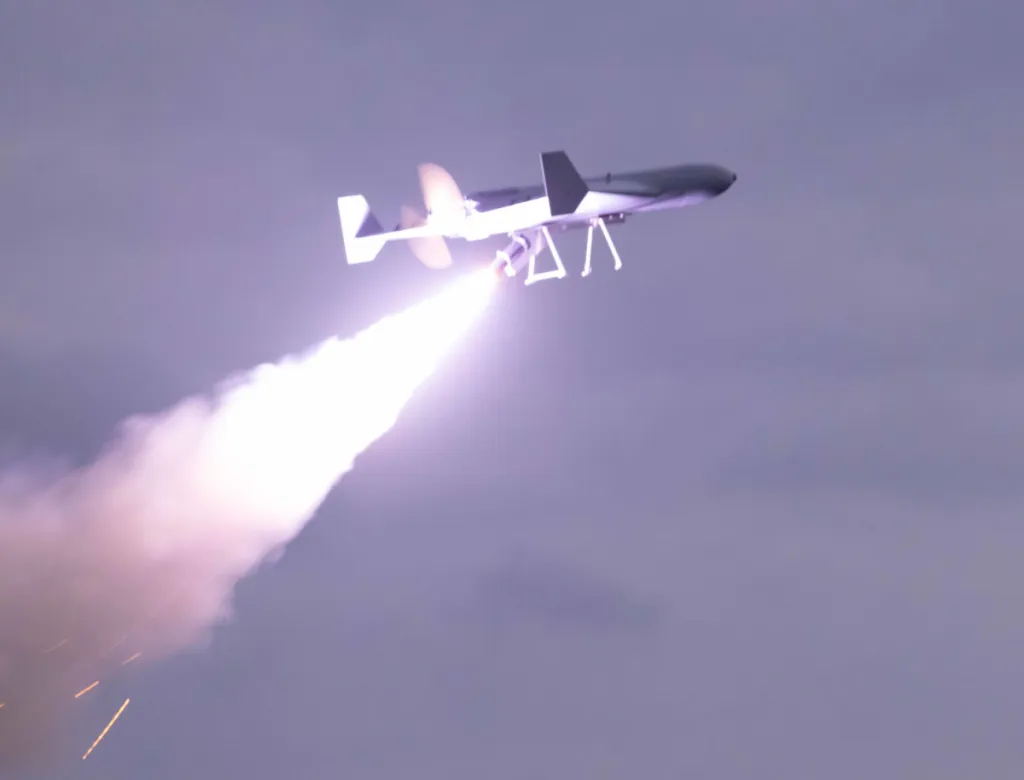
The U.S. Navy personnel in the Middle East have test-launched a Low-Cost Uncrewed Combat Attack System (LUCAS) long-range kamikaze drone from the Independence class Littoral Combat Ship (LCS) USS Santa Barbara. Described as a first-of-its-kind achievement, this comes two weeks after the U.S. military announced it had established Task Force Scorpion Strike (TFSS) in the region, armed with the LUCAS drones from SpektreWorks. Being able to employ the one-way attack drones from the sea, as well as from sites on land, opens the door to new operational possibilities on top of what was already a major new addition to the U.S. military’s long-range strike arsenal.
TWZ has previously explored in great depth the arguments for arming Navy ships with various types of uncrewed aerial systems to provide additional layers of defense, as well as enhanced strike, electronic warfare, intelligence-gathering, and networking capabilities, which you can find here. Just earlier this year, we also laid out a detailed case for why America’s armed forces should be heavily investing in rapidly-producible long-range kamikaze drones — Shahed-136 clones primarily — just like LUCAS, as you can read here.
Personnel from U.S. Naval Forces Central Command’s (NAVCENT) Task Force 59 conducted the rocket-assisted launch of the LUCAS drone from the stern flight deck of the USS Santa Barbara on December 16, according to an official release. The ship was operating in the Arabian Gulf, more commonly known as the Persian Gulf, at the time. Established in 2021, Task Force 59 has been leading efforts to expand the Navy’s operational use of uncrewed platforms, as well as new artificial intelligence (AI) capabilities, in the Middle East. The LUCAS drone itself had been provided by TFSS, which falls under the auspices of U.S. Special Operations Command Central (SOCCENT), the regional headquarters for special operations activities under U.S. Central Command (CENTCOM).
“Bravo Zulu. U.S. Navy forces in the Middle East are advancing warfighting capability in new ways, bringing more striking power from the sea and setting conditions for using innovation as a deterrent.” – Adm. Brad Cooper, CENTCOM Commander https://t.co/TgQ4WLbph3pic.twitter.com/WUiAVojTht
The official release from NAVCENT does not provide specific details about capabilities demonstrated during the test, such as how far the LUCAS drone flew, how it was controlled or directed, and whether it hit a mock target of some kind at sea or on land at the end of its flight.
TWZ reached out to CENTCOM, which declined to provide more granular information. We have also reached out to NAVCENT and SpektreWorks.
The LUCAS drone seen right after launch from the stern flight deck of the USS Santa Barbara. NAVCENT/C5F/U.S. Army Spc. Kayla Mc Guire
General details about the LUCAS drones the U.S. military now has deployed in the Middle East remain limited. It is known that SpektreWorks directly reverse-engineered the design from Iran’s Shahed-136, and initially with an eye toward its use as a threat-representative target for training and test purposes. At some 10 feet long and with a wingspan of around eight feet, LUCAS is slightly smaller than the Iranian drone. SpektreWorks has also publicly provided specifications for the related target drone, called the FLM 136, which has roughly half the range and payload capacity as the Shahed-136. However, it is unclear whether this reflects the capabilities found on operationalized configurations. LUCAS is also said to have a unit cost of around $35,000.
The video below includes a montage of clips from Iranian state media showing Shahed-136s being employed during an exercise.
Баражуючий іранський боєприпас «Shahed 136»
Pictures of the LUCAS drones the U.S. military has released so far show a modular, reconnaissance design that could also be used for surveillance and reconnaissance missions, as well as in the decoy role. AsTWZ has previously written:
“We see two variants of LUCAS. One is not of particular note, it seems geared to strike the static targets we have become accustomed to for this type of weapon. The other features two very interesting details. It has what appears to be a gimbaled camera system mounted on its nose and, most importantly, a miniature beyond-line-of-sight satellite datalink mounted on its spine. This is a major development that would allow these weapons to not only be controlled dynamically after launch at great distances, but also to hit moving targets and targets of opportunity.”
A previously released picture showing LUCAS drones at a base within the CENTCOM area of operations. Both of the known configurations of the LUCAS drone deployed in the Middle East are visible here. Courtesy Photo
“In addition, this capability would help enable swarm tactics, where the drones work to attack targets cooperatively with their progress monitored and altered in real-time by human operators, regardless of whether they have the satellite terminal or not. This is made possible by providing simpler, lighter line-of-sight datalinks on the drones equipped with warheads only, which then connect line-of-sight to the drone carrying the satellite communications terminal, acting as a force-multiplying networking hub. This also means you can have many simple drones paired with a much smaller number of more costly ones equipped with cameras and networking equipment, but achieve the same overall effect as if they all had the more advanced capabilities. This modularity which is ‘greater than the sum of its parts’ is a central tenet of emerging drone warfare TWZ highlighted a decade ago.“
A closer look at the more advanced camera and networking-equipped variant of LUCAS. Courtesy Photo
…
“Seeing as swarms can be tailored to various objectives, with mixing and matching BLOS networking enabled units with strikers, and placing them in real time to minimize risk and maximize effect, America’s Shaheds should be significantly more survivable and effective. The ability to work together, reacting to their environment, and leverage real-time intelligence gathered by the full gamut of U.S. and allied assets, are even larger advantages. This is in addition to pairing them with combined arms tactics, from electronic warfare to kinetic strikes, to ensure they get to their target areas. Even if some die to air defenses, that can be viewed as a win, depending on what engages them. Consuming costly and finite effectors is a feature, not a bug, for these relatively cheap weapons, as you can read all about in our larger feature.“
All of this is further magnified by the ability to employ LUCAS drones from any ship with sufficient deck space, as well as launchers on land, which could be semi-fixed or mobile. This is something TWZ highlighted explicitly in our past feature on the prospect of integrating drone swarms onto Navy ships.
Observations for years now of how Iran and its proxies, as well as Russia, have been employing variants and derivatives of the Shahed-136 have underscored their ability to be sent along often circuitous routes to attack targets from unexpected vectors. Even without the addition of more dynamic targeting and fully networked swarming capabilities, this creates immense challenges for defenders. This is only further compounded by the breadth of areas targeted simultaneously and the sheer volume of drones that can be launched in mass barrages, owing in large part to their relatively low cost.
U.S. officials have themselves been quick to highlight the new operational capabilities LUCAS offers, especially in light of the newly announced test launch from the USS Santa Barbara.
Another picture of the LUCAS drone being test-launched from the USS Santa Barbara. NAVCENT/C5F/U.S. Army Spc. Kayla Mc Guire
“A cutting-edge, low-cost attack drone asset, launched from a naval vessel that can sail and operate wherever international law allows, is a tremendous new capability to employ in the region,” Navy Capt. Timothy Hawkins, CENTCOM’s top spokesperson, told TWZ.
“U.S. Navy forces in the Middle East are advancing warfighting capability in new ways, bringing more striking power from the sea and setting conditions for using innovation as a deterrent,” Navy Adm. Brad Cooper, commander of CENTCOM, also said in a statement.
“This first successful launch of LUCAS from a naval vessel marks a significant milestone in rapidly delivering affordable and effective unmanned capabilities to the warfighter,” Vice Adm. Curt Renshaw, commander of NAVCENT and U.S. Fifth Fleet, added in his own statement accompanying the official release. “This achievement demonstrates the power of innovation and joint collaboration in this critical region.”
“This platform will undoubtedly enhance regional maritime security and deterrence,” Renshaw added.
Conducting the test in the Arabian Gulf also underscores previous statements from CENTCOM about how the deployment of LUCAS in the Middle East specifically offers a new way to challenge Iran.
USS Santa Barbara seen sailing in the Arabian Gulf (Persian Gulf) around the time of the LUCAS test. NAVCENT/C5F
“We are now at a point where not only are we building them in mass, but we have already based them in [the] Middle East for the first time,” a U.S. official told TWZ earlier this month when the establishment of TFSS was announced. “In essence, we are able to flip the script on Iran.”
As we mentioned at the time, the benefits that kamikaze drones like LUCAS offer to U.S. forces also extend well beyond the Middle East. Separate U.S. Marine Corps testing of LUCAS drones at the U.S. Army’s Yuma Proving Ground (YPG) in Arizona points to plans to field long-range kamikaze drones more broadly across America’s armed forces.
A LUCAS drone seen being tested at Yuma Proving Ground. US Army/Mark Schauer
As an aside, using an Independence class LCS for the recent maritime LUCAS test launch highlights another potential mission for these ships, as well as the Navy’s Freedom class LCSs. Both types of LCS have chronically underdelivered for the Navy, and the service has spent considerable energy searching for ways to get more operational utility out of the vessels. Last year, then-Navy Secretary Carlos Del Toro announced plans to arm “many” Independence and Freedom class LCSs with new containerized missile launchers as a new way to boost their firepower, as you can read more about here. Giving these ships the ability to launch waves of low-cost, long-range kamikaze drones would be another way to approach this goal.
American Shahed 2? You bet! Meet the MQM-172 “Arrowhead”, an enhanced US copy of the Iranian Shahed-136 kamikaze drone. This is apparently the second Shahed clone; the first, called LUCAS (Low-Cost Uncrewed Combat Attack System), was developed by Arizona-based SpektreWorks and… pic.twitter.com/ptI5iq9vk9
China is testing the LOONG M9, a new loitering munition from LOONG UAV that closely resembles the Iranian Shahed-136.
The drone reportedly carries a 50 kg payload, has a 200 kg takeoff weight, and reaches speeds up to 223 km/h with a range of 1,620 km and 8–9 hours of endurance.… pic.twitter.com/cFBe1ElJRS
Whatever plans the rest of the U.S. military may have now for drones like LUCAS, the recent at-sea test launch from the USS Santa Barbara shows that American forces in the Middle East are already working to expand their ability to employ this already important new capability at least in that region.
The Central Economic Conference meeting in Beijing in December 2025 proposed that “adhering to opening up to the outside world and promoting win-win cooperation in various fields” should be one of the main tasks of China’s economic work in the coming year. In 2025, China issued the “Action Plan for Stabilizing Foreign Investment in 2025,” and simultaneously, the 8th China International Import Expo 2025 was held in Shanghai. It was also agreed that the Hainan Free Trade Port would officially launch island-wide independent customs operations on December 18, 2025. This would bring numerous opportunities and momentum to support China’s continued opening up for global economic development.
The year 2026 marks the launch of China’s 15th Five-Year Plan. The Central Economic Conference was held in Beijing in December 2025, a significant historical juncture as the 14th Five-Year Plan drew to a close and the 15th began. This held particular significance, as the world looked to China’s economic planning for the coming year for inspiration and opportunities. China’s continued opening up in 2025 represents a vital engine for the global economy, contributing approximately 30% to global growth.
– The opportunities and momentum generated by these policies are evident in the following areas:
1) Deepening Institutional Opening through the Hainan Free Trade Port
The launch of independent customs operations at Hainan Port on December 18, 2025, marked a milestone, transforming the port into a special customs zone governed by high-level international trade regulations. With China’s ambitious trade facilitation plan, the percentage of duty-free goods in Hainan has risen from 21% to 74%, attracting significant investment. The island has already attracted more than 1.2 million enterprises.
The “2025 Foreign Investment Stabilization Action Plan” aims to boost international investor confidence through practical measures, including opening new sectors by expanding pilot programs in telecommunications, healthcare, and education and supporting manufacturing and services by lifting restrictions on foreign investment across the entire manufacturing sector and encouraging investment in high-tech industries and green development. This has yielded numerous positive results for the Chinese economy, with China registering more than 49,000 new foreign-funded companies in the first half of 2025, representing a year-on-year increase of over 16%.
3) China International Import Expo (CIIE 2025)
The eighth edition of the expo in Shanghai solidified China’s position as a global launchpad for new products, achieving record-breaking figures. The expo saw record initial deals worth US$83 billion, a 4.5% increase over the previous year. With broad international participation, more than 4,500 companies from 138 countries participated, showcasing 461 new products and technologies.
4) The Strategic Direction of the Chinese Economy for 2026 and Beyond
The Central Economic Work Conference, held in Beijing in December 2025, affirmed that the main task for the coming year, 2026, is to ensure a strong start to the 15th Five-Year Plan (2026-2030) while achieving mutually beneficial cooperation. This will be accomplished by China focusing on aligning its domestic regulations with high-level international economic and trade standards in areas such as government procurement, e-commerce, and finance. This should coincide with achieving sustainable growth in the Chinese economy, especially given the International Monetary Fund’s upward revision of its growth forecast for China to 5% for 2025, which underscores the resilience of the Chinese economy in the face of global shocks.
Accordingly, we understand the extent of China’s aspirations to achieve new developmental and economic leaps during 2026, with numerous promising future opportunities available to China. It possesses the capacity to simultaneously improve the quality and scale of development, achieve a strong launch for its 15-year plan, and offer more ambitious investment and development opportunities to the world.
The executive order calls on the US attorney general to expedite federal reclassification, creating fewer barriers for studies.
Published On 18 Dec 202518 Dec 2025
Share
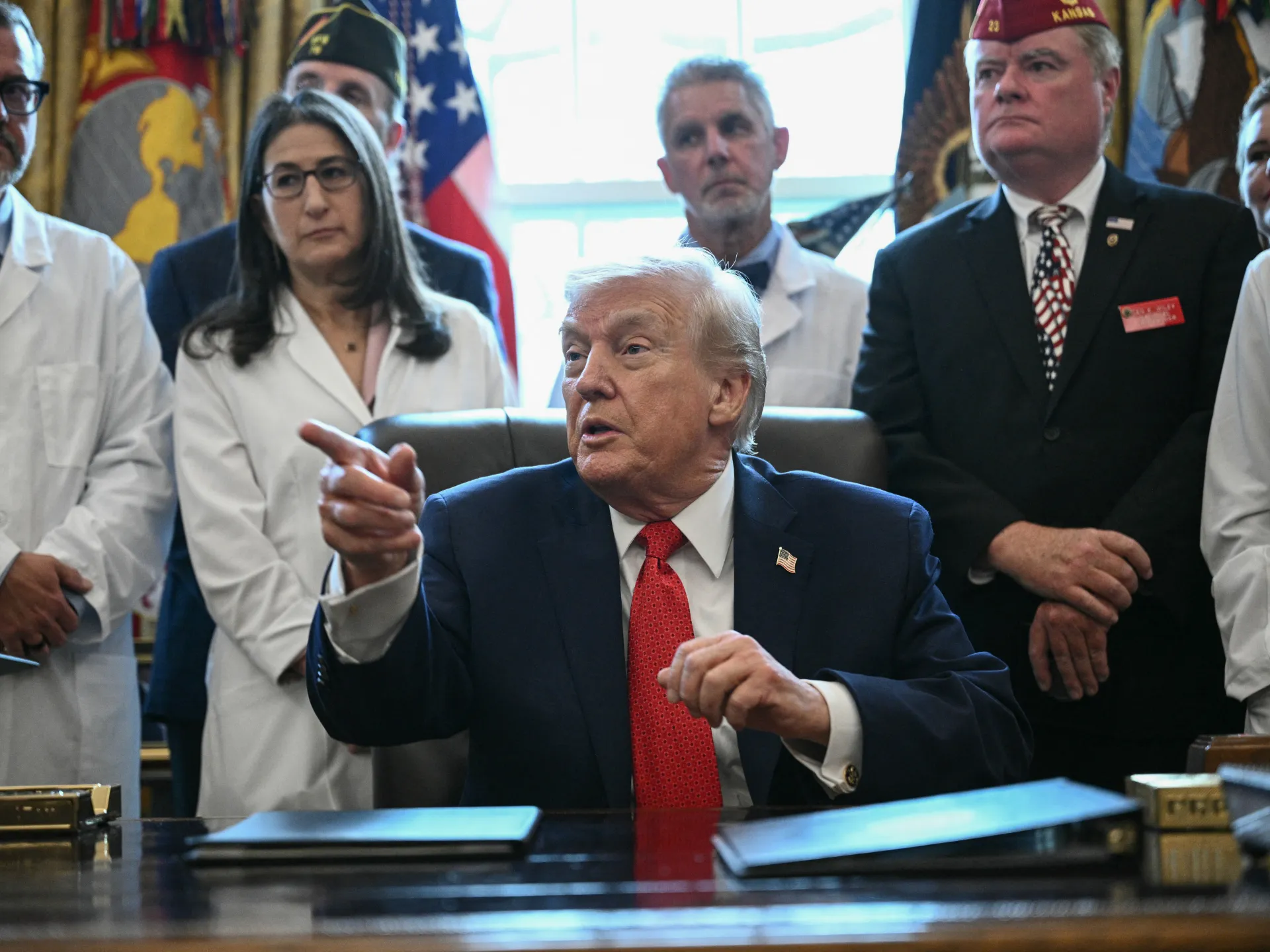
United States President Donald Trump has signed an executive order to federally reclassify marijuana as less dangerous.
The move on Thursday requires Attorney General Pam Bondi to expedite the process under the Drug Enforcement Administration for reclassifying marijuana.
Recommended Stories
list of 3 itemsend of list
In the US, drugs and other chemical substances are divided into a five-tier classification system, with Schedule I representing the most restricted tier and Schedule V the least.
Marijuana was previously in the Schedule I category, where it was classed alongside potent narcotics like heroin and LSD. With Thursday’s order, it would be fast-tracked down to Schedule III, in a class with ketamine and anabolic steroids.
Trump said the change “is not the legalisation” of marijuana, and he added that it “in no way sanctions its use as a recreational drug”.
The change, however, will make it easier to conduct research on marijuana, as studies on Schedule III drugs require far less approval than for Schedule I substances.
Speaking earlier in the week, Trump told reporters the change was popular “because it leads to tremendous amounts of research that can’t be done unless you reclassify, so we are looking at that very strongly”.
The change is in line with several states that have moved to legalise marijuana for both medical and recreational use. That has created a patchwork of state-level regulations at odds with federal law, wherein marijuana remains illegal.
Former US President Joe Biden had taken several steps to lessen federal penalties related to marijuana, including a mass pardon for those handed harsh sentences for simple possession.
Such convictions had disproportionately affected minority communities and fuelled mass incarceration in the US.
The Biden administration had also begun the process of reclassifying marijuana to Schedule III, but the effort was not completed before the Democratic president left office in January.
Trump has faced some pushback from within his party about the classification shift. Earlier this year, 20 Republican senators signed a letter urging the president to keep the more severe restrictions.
The group argued that marijuana continues to be dangerous and that a shift would “undermine your strong efforts to Make America Great Again”, a reference to Trump’s campaign slogan.
Meanwhile, public support for legalising marijuana for recreational use has nearly doubled in recent years, increasing from 36 percent support in 2005 to 68 percent in 2024, according to Gallup polls.
New plaques have been installed in US President Donald Trump’s ‘Presidential Walk of Fame’ at the White House that attack many of his predecessors and make questionable claims about his own achievements.
Legislators have been publishing photos related to convicted sex offender as Justice Department faces Friday deadline to release more.
Published On 18 Dec 202518 Dec 2025
Share
Democrats in the United States House of Representatives have released dozens more photos from the estate of financier and convicted sex offender Jeffrey Epstein.
The release on Thursday comes a day before the Department of Justice faces a deadline to release a more comprehensive set of files related to Epstein, who died in a New York jail in 2019 while awaiting sex-trafficking charges.
Recommended Stories
list of 3 itemsend of list
In a statement, Democrats on the House Oversight Committee said they would “continue releasing photographs and documents to provide transparency for the American people”.
“It’s time for the Department of Justice to release the files,” they said.
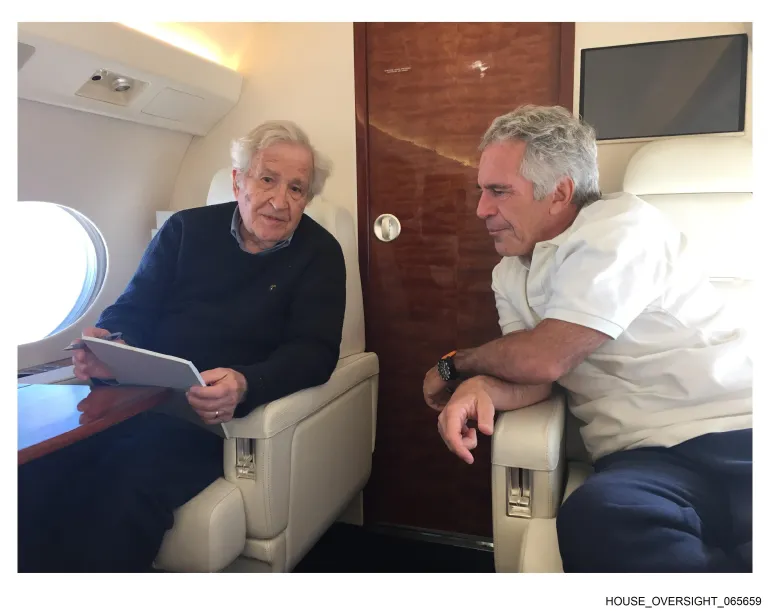
The latest trove includes photos of Epstein with public intellectual Noam Chomsky, as well as images of billionaire Bill Gates, filmmaker Woody Allen and former Donald Trump strategist Steve Bannon at Epstein’s compound.
One release shows a screenshot of a text exchange in which an unknown sender appears to discuss recruiting young women.
“I have a friend scout she sent me some girls today. But she asks 1000$ per girl. I will send u girls now. Maybe someone will be good for J?” the post says.
An undated photo released by Democrats on the House Oversight Committee on Thursday, December 18, 2025, shows professor and political activist Noam Chomsky with Jeffrey Epstein.
Other images show women’s passports and the body of an unidentified woman with messages written on her skin, next to Vladimir Nabokov’s Lolita, a novel about a man’s sexual obsession with a child.
Like a trove of images released last week, the materials released on Thursday were not accompanied by any further context or details. Last week’s images also showed Bannon, Allen, and Gates, as well as former US President Bill Clinton and former Israeli Prime Minister Ehud Barak.
Another image showed US President Trump surrounded by three young women, his hand clutching the waist of the woman to his right.
Trump has acknowledged a prior relationship with Epstein, but has denied taking part in the sex abuse ring that Epstein ran. He said the two men had a falling out years before Epstein’s arrest.
In emails previously released by House Democrats, Epstein said that Trump “knew about the girls”. In another, Epstein described Trump as “the dog that hasn’t barked”.
The president had initially opposed a more complete release of files related to Epstein, but faced mounting pressure, including from within his own Make America Great Again (MAGA) base.
Speculation has focused on the influential figures in Epstein’s orbit, and any involvement they made have had in his crime. The intrigue has been fueled by the murky circumstances surrounding Epstein’s death in a New York jail cell, which was ruled a suicide.
Last month, Trump pivoted on the issue, signing into law a bill requiring the Justice Department to publish materials connected to the Epstein investigation.
However, the Justice Department has remained silent on whether it will meet Friday’s deadline outlined in the law, dubbed the Epstein Files Transparency Act.
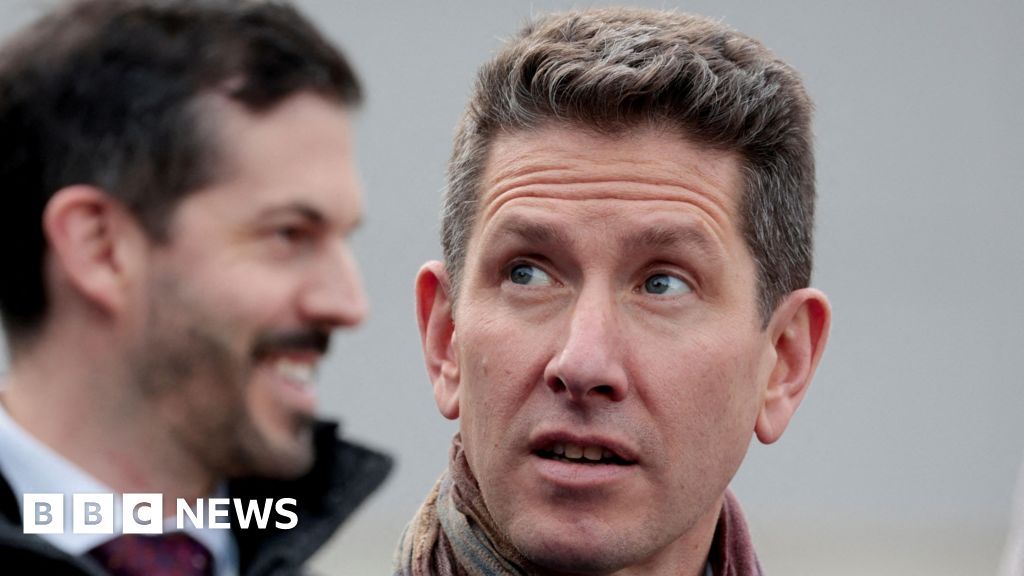
The UK has named career diplomat Christian Turner as its new ambassador to the US, Downing Street has confirmed.
Turner has spent nearly 30 years working across Whitehall and the Foreign Office.
He will now become the man tasked by Prime Minister Sir Keir Starmer with building links to the Trump administration.
The previous ambassador Peter Mandelson was sacked by Starmer after evidence, including emails and photos emerged, showing his continued association with the paedophile Jeffery Epstein.
Lord Mandelson has repeatedly said he regrets his relationship with Epstein, who died in jail in 2019 while awaiting trial on sex trafficking offences.
The Foreign Office said in a statement that King Charles had formally appointed Turner, and the UK would now seek official approval for his appointment from the US.
Turner said he was “honoured” to be nominated for the role.
“At a pivotal time for the transatlantic relationship, I look forward to working with President Trump’s administration, and leaders in Congress, business and society to strengthen that bond in the years ahead,” he added.
In a statement released by the Foreign Office, Starmer said: “The United Kingdom and United States have a very special relationship, and Christian’s extensive experience as an outstanding diplomat will support this uniquely close bond and ensure it continues to flourish.”
Turner’s previous roles include political director at the Foreign Office, British High Commissioner to Pakistan, and Foreign Office Director for the Middle East and North Africa. He also previously worked in 10 Downing Street as Private Secretary to the Prime Minister.
Before entering government, he worked in television documentaries.
Foreign Secretary Yvette Cooper said Turner would bring “exceptional diplomatic experience and deep understanding” to the role.
Weekly insights and analysis on the latest developments in military technology, strategy, and foreign policy.
A key Russian airbase in occupied Crimea has been targeted by a Ukrainian drone strike, according to Ukraine. Authorities in Kyiv claim that drones hit a MiG-31BM Foxhound interceptor, as well as elements of an S-400 air defense system, at Belbek Air Base, near Sevastopol.
The Security Service of Ukraine (SBU), the government’s main internal security agency, reported that a successful drone strike operation was carried out overnight by forces from its Special Group “Alpha.” Russian officials, including the governor of Sevastopol, claim that the attack was repelled with 11 drones downed and resulted in no damage.
Minus russian MiG-31 jet 🔥 Last night, the warriors from the @ServiceSsu Alpha Special Operations Center struck a russian MiG-31 fighter jet with a full combat load at the Belbek military airfield in temporarily occupied Crimea. An S-2 Pantsir air defense system, an S-400 air… pic.twitter.com/qEsjJwrd0o
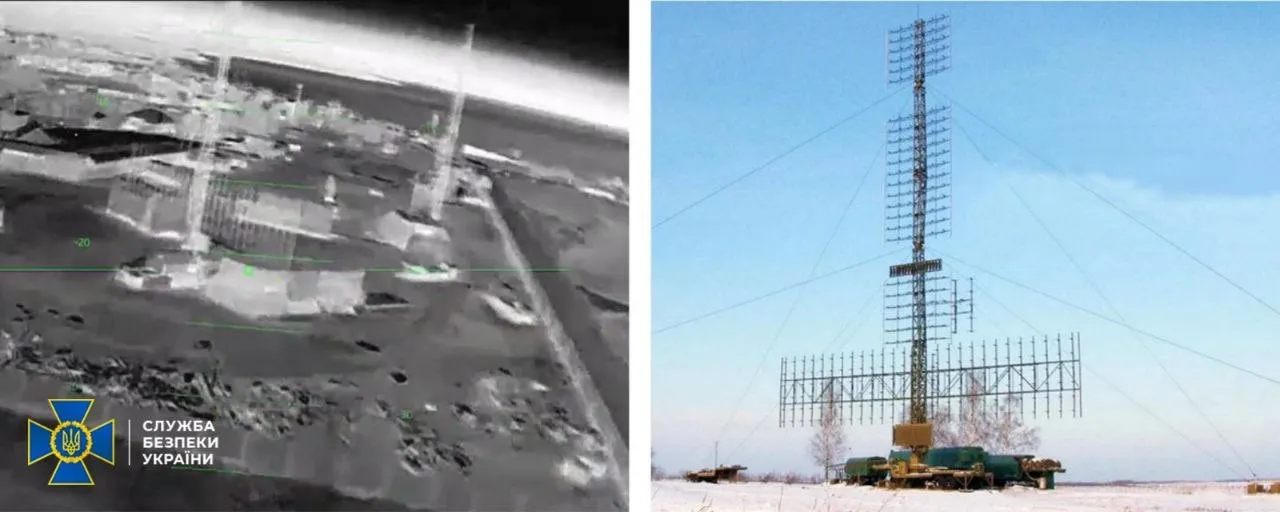
The SBU has published a series of video stills showing the attack, with footage taken from the perspective of the long-range one-way attack drones heading toward their targets. Based on the imagery, the drones could well be the same fiber-optic types that have been launched from Ukrainian drone boats.
Further videos were posted to social media by residents of Crimea, showing explosions and attempts by Russian troops to shoot down the drones. At this point, it should be noted that, without the full videos of the strikes, we cannot be sure whether the drones detonated or the degree of damage they might have caused.
According to the SBU, damage was recorded to a MiG-31, a 92N6 (NATO reporting name Grave Stone) long-range multifunction radar that is part of the S-400 system, two Nebo-SVU long-range surveillance radars, and a Pantsir-S2 surface-to-air missile system.
Ukraine claims that the targeted MiG-31 was carrying a full combat load, although the available video reveals that it carries no armament under its wings. Potentially, it carries air-to-air missiles below the fuselage, but the forward-mounted examples are also not visible. While it looks like a real aircraft rather than a decoy, it remains possible that it may have been a non-operational example. However, recent satellite imagery assessed by TWZ shows a MiG-31 sporadically at the base in recent weeks, sometimes sitting out in the open.
MiG-31. SBU
It’s worth noting, too, that the reported 92N6 system (seen below) was covered with camouflage and/or anti-drone netting, making its positive identification harder. It could also have been a 96L6 (Cheese Board) all-altitude detection radar, also associated with the S-400 air defense system.
SBU
It’s a cheeseboard, its been axtive at Belbek for a long time, you made a good id, you can recognise it because the radar array has a round base and on the gravestone its rectangular pic.twitter.com/f4RDqfaoYY
As to the estimated value of these items of equipment, the SBU put a figure of $30-50 million on the MiG-31, depending on configuration and armament, $30 million on the 92N6, $60-100 million for each of the Nebo-SVUs, and $12 million for the Pantsir-S2.
“The SBU continues its effective work to destroy air defense systems in Crimea that cover important military and logistical facilities of the occupiers,” the agency said in a statement on its Telegram channel. “The elimination of components of this echeloned system significantly weakens the enemy’s defense and military capabilities in the Crimean direction.”
Belbek plays a key role in Russia’s war in Ukraine and, as such, has been targeted by Ukraine in the past.
The significance of the airbase, in particular, lies in the fact that its aircraft and air defenses help extend coverage deeper into Ukraine, as well as providing critical screening for the nearby Russian naval base at Sevastopol, and also extend this coverage far out into the Black Sea.
Several photos recently posted on the “warhistoryalconafter” TG channel showing a VKS Su-27P/S. Visible AAMs include an R-73, R-27ET & R-27ER. Photos appear to be from Belbek (thanks to @StefanB2023 for IDing the base) – the jet is presumably assigned to the 38th IAP based there. pic.twitter.com/e6Dm4fGjfX
Belbek Air Base was used by Ukraine before Russia annexed Crimea in 2014. Today, it is home to the 38th Fighter Aviation Regiment (38 IAP, in Russian nomenclature), a unit that you can read more about here. When Moscow launched its full-scale invasion of Ukraine, Belbek received an influx of additional combat aircraft deployed from units in Russia. These have included examples of the Su-30SM and Su-35S, as well as Su-34 Fullback strike fighters, and MiG-31s.
MiG-31s, together with the very long-range air-to-air missiles they carry, have been a particular threat to the Ukrainian Air Force.
In October 2022, during take-off from Belbek, a MiG-31BM departed the runway, crashed, and was completely burned out. The navigator/weapons system officer ejected successfully from the rear cockpit, while the pilot was killed.
The airbase’s value means that it has received new hardened aircraft shelters and additional construction to help shield aircraft from drone attacks and other indirect fire. This is part of a broader push by the Russian military to improve physical defenses at multiple airfields following the launch of the full-scale invasion of Ukraine.
A view of the central section of Belbek, showing hardened aircraft shelters. Google Earth
Notably, the MiG-31 was targeted while standing in the open, unprotected. Its twin cockpit canopies were open, suggesting it was being prepared for a sortie or had recently returned from one.
As well as previous drone attacks, Ukrainian forces have employed U.S.-supplied Army Tactical Missile System (ATACMS) short-range ballistic missiles with cluster munition warheads against the base, with a notably destructive ATACMS barrage in May of last year. That attack resulted in two MiG-31s being burnt out, confirmed in post-strike satellite imagery. Since then, however, the use of hardened aircraft shelters at Belbek will have made the resident aircraft less vulnerable to the effects of ATACMS armed with cluster munitions, in particular.
The Russian Aerospace Forces began the current conflict with around 130 MiG-31s in active service, a small number of them adapted to carry Kinzhal aero-ballistic missiles. The two aircraft destroyed previously at Belbek are the only confirmed combat losses, though thast ight change when more details of the latest drone strike become available.
Russian MiG-31 Downs Ukrainian Su-25 from high altitude
And here are the first photos from the ground showing the aftermath of Ukrainian strikes with ATACMS missiles on Russia’s Belbek Air Base in the Crimea last night.
— Status-6 (Military & Conflict News) (@Archer83Able) May 15, 2024
The targeting of Belbek again overnight, which Ukraine claims caused significant damage to prized air defense assets, shows that Ukraine is continuing to apply pressure on Russian forces in Crimea and is using a variety of weapons to achieve this.
NEWS BRIEF Ukrainian drone strikes killed three people, including two crew members of a Russian-flagged oil tanker, in overnight attacks on the port of Rostov-on-Don and the town of Bataysk in southern Russia. The strikes mark a continued escalation in Kyiv’s campaign targeting Russian energy infrastructure and maritime assets, as both sides trade accusations of […]
Kitsch Liao, associate director at the Atlantic Council Global China Hub, says Beijing’s reaction to the largest US arms sale to Taiwan is an information warfare tactic.
Thousands protest as EU leaders clash over trade pact farmers fear will flood Europe with cheaper South American goods.
Published On 18 Dec 202518 Dec 2025
Share
Hundreds of tractors have clogged the streets of Brussels as farmers converged on the Belgian capital to protest against the contentious trade agreement between the European Union and South American nations they say will destroy their livelihoods.
The demonstrations erupted on Thursday as EU leaders gathered for a summit where the fate of the Mercosur deal hung in the balance. More than 150 tractors blocked central Brussels, with an estimated 10,000 protesters expected in the European quarter, according to farm lobby Copa-Cogeca.
Recommended Stories
list of 2 itemsend of list
It made for a twin-tracked day of febrile tension outside and inside at the EU summit as leaders were perhaps more focused on a vote to determine whether they are able to use nearly $200bn in frozen Russian assets to support Ukraine over the next two years.
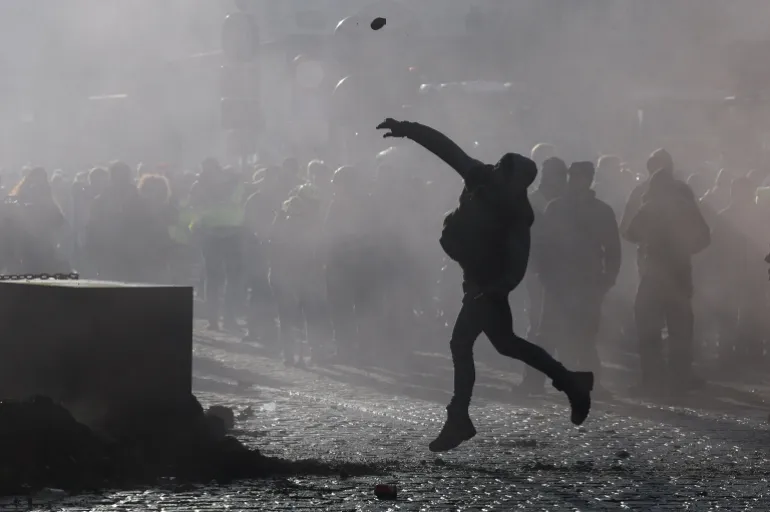
Outside the gilded halls on the streets, farmers hurled potatoes and eggs at police, set off fireworks and firecrackers, and brought traffic to a standstill.
Authorities responded with tear gas and water cannon, setting up roadblocks and closing tunnels around the city. One tractor displayed a sign reading: “Why import sugar from the other side of the world when we produce the best right here?”
“We’re here to say no to Mercosur,” Belgian dairy farmer Maxime Mabille said, accusing European Commission chief Ursula von der Leyen of trying to “force the deal through” like “Europe has become a dictatorship”.
A protester throws an object, as farmers protest against the EU-Mercosur free-trade deal in Brussels, Belgium [Yves Herman/Reuters]
Protesters fear an influx of cheaper agricultural products from Brazil and neighbouring countries would undercut European producers. Their concerns centre on beef, sugar, rice, honey and soya beans from South American competitors facing less stringent regulations, particularly on pesticides banned in the EU.
“We’ve been protesting since 2024 in France, in Belgium and elsewhere,” said Florian Poncelet of Belgian farm union FJA. “We’d like to be finally listened to.”
France and Italy now lead opposition to the deal, with President Emmanuel Macron declaring that “we are not ready” and the agreement “cannot be signed” in its current form.
France has coordinated with Poland, Belgium, Austria and Ireland to force a postponement, giving critics sufficient votes within the European Council to potentially block the pact.
However, Germany and Spain are pushing hard for approval. German Chancellor Friedrich Merz warned that decisions “must be made now” if the EU wants to “remain credible in global trade policy”, while Spanish Prime Minister Pedro Sanchez argued the deal would give Europe “geo-economic and geopolitical weight” against adversaries.
The agreement, 25 years in the making, would create the world’s largest free-trade area covering 780 million people and a quarter of global gross domestic product (GDP).
Supporters say it offers a counterweight to China and would boost European exports of vehicles, machinery and wines amid rising US tariffs.
Despite provisional safeguards negotiated on Wednesday to cap sensitive imports, opposition has intensified. Von der Leyen remains determined to travel to Brazil this weekend to sign the deal, but needs backing from at least two-thirds of EU nations.
Brazil’s President Luiz Inacio Lula da Silva issued an ultimatum on Wednesday, warning that Saturday represents a “now or never” moment, adding that “Brazil won’t make any more agreements while I’m president” if the deal fails.
US President Donald Trump has said the US owns rights to Venezuelan oil and land. The claims follow the US seizure of Venezuelan oil and the declaration of a naval blockade. But is any of this true? Soraya Lennie explains.
A Briton who fought in Ukraine has been sentenced to 13 years in a maximum-security prison, the Russian Prosecutor-General’s office has said.
Hayden Davies, a former British soldier who Russia has called a mercenary, was reportedly captured in Ukraine’s Donbas region in late 2024 or early 2025 while serving with the country’s foreign legion.
He was tried in a Russian-controlled court in the city of Donetsk, which is currently occupied by Moscow.
The UK Foreign, Commonwealth & Development Office (FCDO) said it strongly condemned the sentencing of Mr Davies “on false charges”, adding he was a prisoner of war.
It said: “We remain in close contact with Mr Davies’ family and are providing consular support.”
The FCDO said that under international law, prisoners of war cannot be prosecuted for participating in hostilities.
It added: “We demand that Russia respect these obligations, including those under the Geneva Conventions, and stop using prisoners of war for political and propaganda purposes.”
In a statement, Russian prosecutors said Mr Davies joined the Ukrainian army in August 2024 and “took part in military operations against the Russian armed forces on the territory of [Donetsk Region]”.
In court footage released by prosecutors, a man with a British accent speaks via a translator from inside a barred cage, which is standard practice for many Russian hearings.
The man said he was a member of the Ukrainian Army’s foreign legion and travelled to Ukraine by bus via Poland.
He said he was paid $400 (£300) or $500 a month as a salary. When asked if he pleaded guilty to the charge, the man said “yeah” and nodded his head.
It is not clear whether he was speaking under duress.
Earlier this year, the FCDO also criticised the case brought against James Anderson, another Briton captured fighting with Ukraine forces, after he was jailed for 19 years for terrorism and mercenary activity.
The 22-year-old was the first British national to be convicted by Russia during the war.
A YEAR of simmering flirtation, suggestive Slack messages and provocatively reloaded printers spectacularly detonated last night at the Wexford Consulting Christmas event.
Survivors reported the impact of free prosecco on bloodstreams only accustomed to a light lunch unleashed 12 months of hungover Tuesday erections and bored mid-meeting fantasies, culminating in a sex-crazed bacchanal at a Brentwood bowling alley.
Digital alignment co-ordinator Tom Booker said: “It was likeEyes Wide Shuton a mixed use retail/hospitality estate by a ringroad.
“All the repressed desires – Grace bending over, Gareth’s tank top phase, Chloe’s anecdote about water aerobics – burst forth in a riotous flood of festive lust. Turns out paper hats and a DJ playingSexyBack,and Gareth from audit becomes Caligula.
“Doran and Amelia – of ‘we’re just friends, we just have lunch together’ – were rutting in an alcove. Jo from HR was waiting her turn for each of them. I was going down on Carly from sale, who has a minge so comely I wish I could mention it in her performance review.
“And the buffet? I didn’t realise Harry from operations would be the sushi platter, and I’m afraid I made quite a pig of myself. At one point there were three of us tonguing his balls. He’s a promising young man.”
Workplace psychologist Helen, not her real name, said: “The Christmas party exists not to celebrate a year of productivity, but to make employees so divided and ashamed they’re incapable of confronting management for another 12 months.”
Saturday, Dec. 13, 2025, was meant to be a pivotal civic exercise across Borno State, northeastern Nigeria, as residents were expected to elect chairpersons and councillors responsible for local development, basic services, and community representation. Instead, what unfolded across parts of the state bore little resemblance to a functioning democratic process.
Umar Ali, a resident of Gamboru in Maiduguri, stepped out that morning expecting to vote, but could not locate any polling unit nearby. “We thought it was just a delay, but there was no election activity at all,” he said.
His experience was replicated across the city and other neighbouring council wards. HumAngle observed that many polling units listed by the Borno State Independent Electoral Commission (BOSIEC) were deserted, with neither officials nor voters in sight. In locations where officials were present, there was only a handful of voters, often confined to near-empty compounds.
An exception was Ajari II polling unit in Mafa Ward, where Borno State Governor Babagana Zulum cast his vote, which recorded a higher turnout than most other locations observed.
In several neighbourhoods, residents watched the day pass from outside their homes or went about their chores. Conversations revealed frustration, distrust, and a widespread perception that the outcome had already been predetermined.
“This is not an election. It is a selection,” said Musa Ali, who declined to approach the polling unit closest to his house. He accused the government of determining the results in advance. “They already know what they are doing,” he argued.
For many residents, the only indication that an election was taking place was the restriction of movement imposed across the state. “If not for the ban, you would not even know voting is going on,” said 22-year-old Fatima Alai.
On some of the empty streets, children and even young adults turned it into football fields.
Borno State has over 2.5 million registered voters, with about 2.4 million Permanent Voter Cards collected, as of February 2023. Yet participation in local government elections remains low. It is unclear how many people voted in the Dec. 13 elections. However, this trend is not unique to Borno or even to the current election cycle.
Across Nigeria, turnout in local government elections is consistently lower than in national polls. Analysts and residents alike attribute this to weak service delivery at the council level, the routine imposition of candidates by political parties, and the limited credibility of state-run electoral commissions. For many citizens, local elections appear disconnected from accountability or tangible improvements in daily life.
Malpractice in plain sight
Beyond voter apathy, HumAngle observed troubling procedural violations at multiple polling units. At a polling unit in Bulama Kachallah II, in Maiduguri, HumAngle observed electoral officials stamping ballot papers and depositing them into the ballot box in the absence of voters. This continued between 9:00 a.m. and 1:00 p.m., when we left the unit.
A similar scene played out at another polling unit in nearby Bulama Kachallah I. BOSIEC officials wearing identification tags, alongside unidentified individuals, openly filled out ballot papers and inserted them into the boxes.
When approached, a party agent who was present at the scene told HumAngle, “Ba ruwan ka,” meaning, “It is none of your business.”
A group of young men were seen stamping on ballot papers at a polling unit in Maiduguri. Photo: Abubakar Muktar Abba/HumAngle.
Despite these irregularities, BOSIEC Chairperson Tahiru Shettima maintained that the process met democratic standards. “I think the commission has done its best and the election was free, fair, inclusive, and transparent,” he said.
Two days after the exercise, BOSIEC announced that the ruling APC won all 27 chairpersonship seats in the state. The election was contested by six political parties, including the New Nigeria People’s Party, Social Democratic Party, Labour Party, and People’s Redemption Party.
Notably absent was the Peoples’ Democratic Party (PDP), the state’s leading opposition force. In the days leading up to the election, the PDP formally boycotted the process, citing concerns about the legitimacy and fairness of the electoral process, the high costs associated with the expression-of-interest and nomination forms, and a lack of trust in BOSIEC’s capacity to conduct credible elections.
The African Democratic Congress (ADC), a national opposition coalition, was also missing from the ballot. A member of the party, who asked not to be named, claimed that “the state government had been a big challenge”. He said that when the party attempted to launch its Borno State chapter in November, security operatives disrupted the event, alleging that the government had not been notified. According to him, this interference contributed to the ADC’s absence from the December local council election.
The electoral commission rejected these criticisms. Shettima said BOSIEC had consulted with stakeholders, including political parties, on logistics and nomination fees, and insisted that participation was voluntary. “We cannot force any political party to take part in the election,” he told journalists.
Public reactions on social media, meanwhile, suggested a contrasting reality to official claims. Tanko Wabba, a Facebook user, wrote: “We didn’t see the election [ballot] box in our street,” reflecting frustration over missing polling units and highlighting a gap between official claims and citizens’ experiences.
Weakened local governance
For more than a decade, local council elections were not held in Borno State due to the Boko Haram insurgency. During that period, councils were administered by caretaker committees appointed by the state government. Elections resumed in 2020, with another round held in January 2024.
While those elections were described by the media as largely peaceful, turnout was characterised as average at best. Analysts cited voter fatigue, lingering security concerns, and persistent doubts about the relevance and autonomy of local councils.
Under Nigeria’s Constitution, local governments constitute the third tier of government, operating under the state’s supervision. Democratically elected councils are mandated to manage basic services such as roads, markets, sanitation, health clinics, business and vehicle licensing, local fees, education, and support for agriculture and health in coordination with the state.
Executive authority at the local level rests with the chairperson and vice chairperson, who implement council policies through supervisory councillors and the civil service. In practice, however, councils often have limited autonomy. State governments frequently override their authority by appointing caretaker committees—often ruling party loyalists—and retaining control of local government finances through joint state–local government accounts.
Autonomy debates and unresolved tensions
In July 2024, Nigeria’s Supreme Court ordered that allocations from the federation account meant for local governments must be disbursed to them directly, rather than the joint account created by the state government. The court restrained governors from collecting, withholding, or tampering with these funds, declaring such actions unconstitutional, null, and void.
The Minister of State for Defence, Bello Mohammed Matawalle, welcomed the ruling, saying it would allow local governments to manage their own finances, strengthen accountability to voters, and improve service delivery and development.
However, the Nigerian Governors’ Forum opposed the decision. The governors argued that full local government autonomy does not align with Nigeria’s federal structure and said the ruling failed to address longstanding issues of weak administration and executive excesses at the council level.
“The desire for decentralisation must be backed by a commitment to delegate resources, power, and tasks to local-level governance structures that are democratic and largely independent of central government,” said Victor Adetula, a Professor of Political Science at the University of Jos.
Against this backdrop of contested authority and fragile credibility, the conduct of Borno’s local government elections raises deeper questions—not just about electoral integrity, but about whether local democracy in the state can meaningfully deliver the governance and development it promises.
Dealmakers in 2025 enjoyed a near-record year for mergers and acquisitions, despite a turbulent spring that threatened hopes of a broader revival. So far this year, there were 70 global deals valued at more than $10 billion each, 22 of them in the fourth quarter, according to Dealogic. Total deal value has surpassed $4.8 trillion, up 41% from 2024, though the number of deals fell 6% to 38,395, marking the second-largest year ever behind 2021.
The spike in mega deals reflects a growing focus on scale. “M&A today is all about the mega deals, the race for scale,” said Anu Aiyengar, JPMorgan’s global head of advisory and M&A. There were at least four deals above $50 billion, with two notable bids for Warner Bros. Discovery totaling over $80 billion and Paramount Skydance’s $108 billion hostile offer.
Drivers of Late-Year Rally
A more permissive regulatory environment in the U.S., coupled with a calmer macroeconomic outlook, is encouraging companies to pursue transformative deals. With antitrust scrutiny easing under the Trump administration, boards and executives are seizing opportunities for strategic acquisitions, according to Frank Aquila, partner at Sullivan & Cromwell.
Dealmakers also say valuations are rising, prompting companies to pay higher multiples while expecting their own stocks to maintain relative strength. “Valuations have been bid up and we’ve seen clients be more aggressive in terms of multiples,” said Lazard’s Mark McMaster.
Technology and AI Influence
Technology deals, particularly those tied to artificial intelligence, have played a prominent role. OpenAI raised $40 billion in funding led by SoftBank, and Aligned Data Centers was acquired for $40 billion. Morgan Stanley’s John Collins said companies are pursuing scale to invest in AI-driven changes, both in tech and across other industries.
Cross-Border and Global Trends
Cross-border M&A activity surged in 2025, reaching $1.24 trillion, the highest since 2021. U.S. and UK companies were the most targeted, while U.S., France, and Japan were the most acquisitive. Multinational companies, particularly from Europe and Japan, are investing in the U.S. to capitalize on the world’s largest market. China and Japan are also seeing strong outbound activity, with Japanese deal values boosted by high-profile transactions like OpenAI and Toyota Industries.
Corporate divestitures are rising, up 30% in volume from last year, exemplified by Holcim’s $30 billion spin-off of its North American business, Amrize. Private equity is also regaining momentum, with global buyouts reaching $1.1 trillion, a 51% increase from 2024.
Outlook for 2026
Dealmakers expect the M&A rally to continue into 2026, with $50 billion–$70 billion deals already in the pipeline and a $100 billion tech transaction not ruled out. Analysts see a multi-year run of high-value deals, fueled by scale-seeking corporations, AI-related opportunities, cross-border expansion, and corporate restructuring. While caution remains in politically uncertain markets like the UK, the global appetite for transformative deals appears set to drive another strong year for mergers and acquisitions.
Israeli Prime Minister Benjamin Netanyahu has announced ‘the largest gas deal in Israel’s history’, worth around $35 billion, with Egypt. Cairo has been a vocal critic of Israel’s genocide in Gaza, but experts say the country is facing an energy crisis.
Kylian Mbappe scored two goals to help Real Madrid overcome a stubborn challenge from third-division side Talavera.
Published On 18 Dec 202518 Dec 2025
Share
Kylian Mbappe scored twice and Real Madrid beat third-division club Talavera 3-2 in the round of 32 of the Copa del Rey on Wednesday.
Mbappe converted a 41st-minute penalty and sealed the victory late in the second half with a shot from outside the area for his 10th goal in his last six matches in all competitions with Madrid. The French forward was also involved in the play that led to an own-goal by Manuel Farrando in first-half stoppage time.
Recommended Stories
list of 4 itemsend of list
“He was decisive,” Madrid coach Xabi Alonso said. “Kylian has that knack for scoring. The third goal was key, which is why we kept him on the pitch and why he started.”
Talavera cut Madrid’s lead with goals by Nahuel Arroyo in the 80th and Gonzalo Di Renzo in second-half stoppage time, but Madrid held on to avoid the upset that would have put Alonso under increased pressure following a series of disappointing results recently.
A tough save by Madrid goalkeeper Andriy Lunin in the final minute was key to securing Madrid’s win.
Madrid struggled late but had been in control from the start despite playing without a few regular starters.
“In the first half, we controlled the game well and took the lead, but not making it 3-0 left the game open, and it remained that way until the end,” Alonso said. “The second half was competitive. We looked for the third goal earlier and had chances, but it wasn’t to be. It was an exciting tie. It’s a special competition. Objective achieved, and on to the next game.”
Madrid closes 2025 at Sevilla in the Spanish league on Saturday.
Mbappe puts Real Madrid 3-1 up against Talavera in the 88th minute [Susana Vera/Reuters]
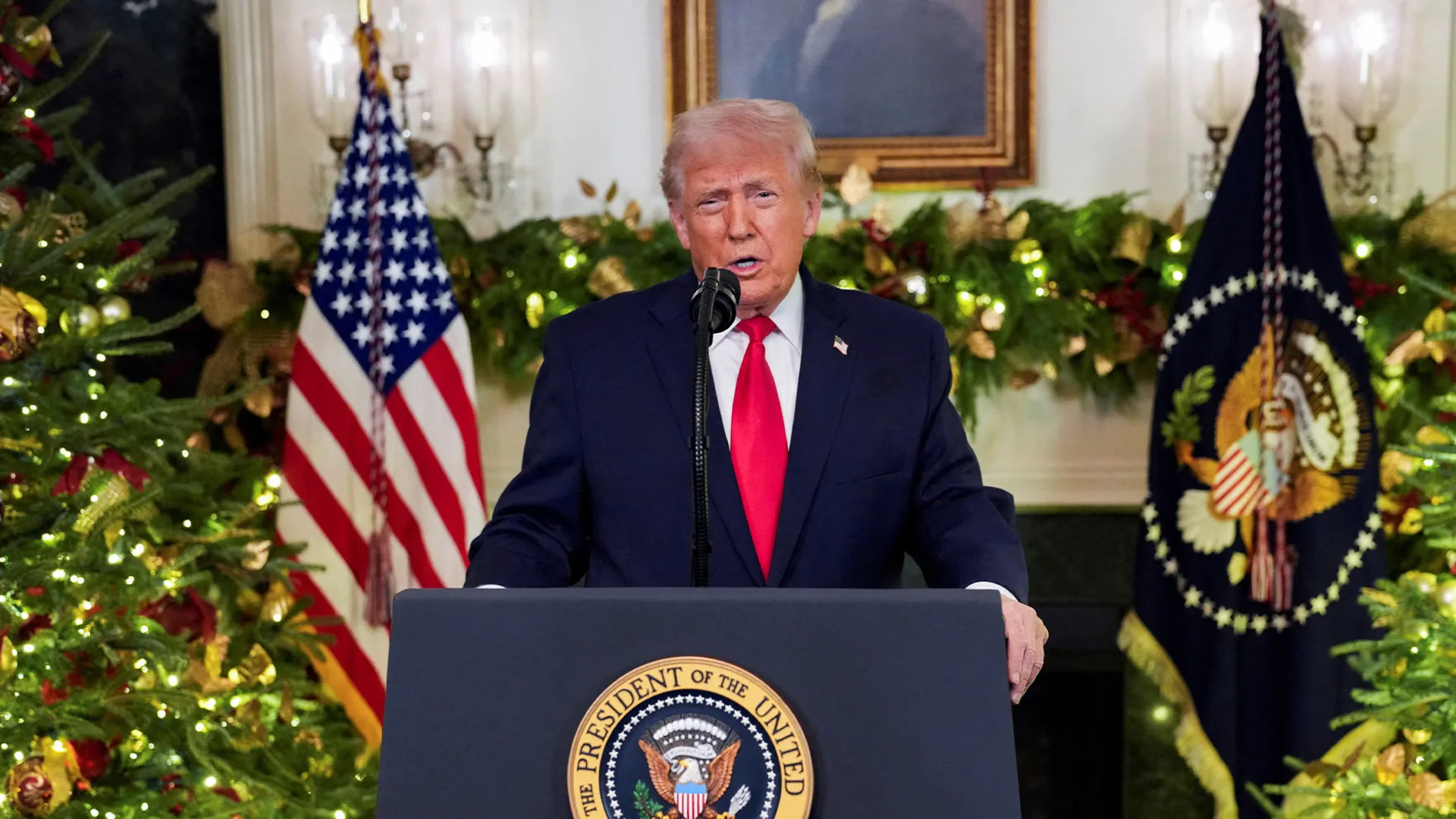
In a national address, US President Donald Trump claimed the Gaza truce he helped broker brought peace to the Middle East “for the first time in 3,000 years.” Trump’s statement comes despite ongoing Israeli ceasefire violations and near-daily attacks on Gaza.
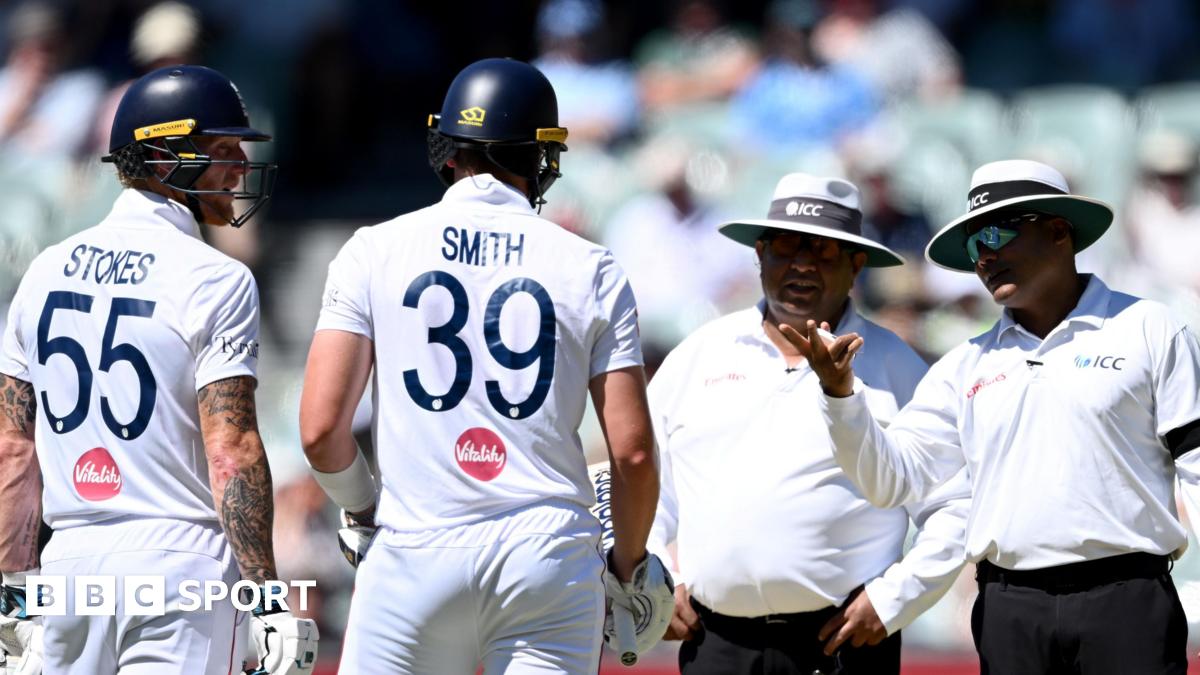
The controversy on the second day follows Alex Carey being given not out on Wednesday, when England reviewed a caught-behind decision with the Australia wicketkeeper on 72.
He was given not out because the spike which appeared on the technology was out of sync with the pictures, but that was later revealed to have been an error by the operator.
The first incident on day two occurred in the 44th over, with England 149-5.
Australia appealed for a catch after a ball to Smith looped to Usman Khawaja at slip and the on-field umpires sent the decision to the TV umpire to check if the ball had carried.
TV umpire Chris Gaffaney then deliberated over various replays, first checking whether the ball had hit Smith’s glove or helmet.
Again the technology appeared inconclusive but Gaffaney deemed the ball had hit Smith’s helmet.
The hosts’ fielders were visibly disgruntled and one Australian was heard saying “Snicko needs to be sacked” over the stump microphone.
In any case it appeared the ball did not carry to Khawaja.
More contentious was the second decision, which ultimately resulted in Smith’s dismissal.
He attempted a pull shot to Pat Cummins but Australia appealed confidently for a thin snick.
Smith appeared certain he had not hit the ball and was ready to review the decision had it been given out on the field.
Again on-field umpire Nitin Menon suggested he was not sure if the ball had carried so sent the decision for Gaffaney to review.
As the players came together to await the decision, Nathan Lyon was heard asking non-striking batter Ben Stokes if he heard anything.
Gaffaney said “there is nothing obvious there” after viewing an initial replay but Snicko showed a rough spike within a frame of the ball passing the toe of Smith’s bat – the leeway allowed in such scenarios.
Smith was given out. Both he and Stokes seemed frustrated with the decision.
Police in the UK have said they will arrest people who hold placards or chant the phrase “globalise the intifada,” arguing that the slogan now carries heightened risk in the wake of recent attacks on Jewish communities, Anadolu reports.
The term “intifada,” an Arabic word meaning “uprising,” came into widespread use during the Palestinian uprising against Israeli occupation of the West Bank and Gaza Strip in 1987.
In a joint statement, London’s Metropolitan Police and Greater Manchester Police said the move followed Sunday’s mass shooting at Bondi Beach in Sydney, Australia.
Fifteen people were killed on Sunday when two suspected shooters—father and son—opened fire along the beach in Sydney, the New South Wales capital and Australia’s largest city by population.
The two forces also referred to a knife attack at the Heaton Park Hebrew Congregation Synagogue in Manchester, northern England, on Oct. 2, in which two people were killed.
“Violent acts have taken place, the context has changed—words have meaning and consequence. We will act decisively and make arrests,” the police said.
They added: “We know communities are concerned about placards and chants such as ‘globalise the intifada,’ and those using it at future protests or in a targeted way should expect” the two forces “to take action.”
The statement said frontline officers would be briefed on what police described as an “enhanced approach,” and that powers under the Public Order Act would be used, “including conditions around London synagogues during services.”
“Visible patrols and protective security measures around synagogues, schools, and community venues have been stepped up in London and Greater Manchester. We are intensifying investigations into hate crime, and Counter Terrorism Policing continues to operate 24/7 to identify and disrupt threats,” it added.
The UK’s chief rabbi told the BBC this week that chants of “globalise the intifada” had helped lead to the two attacks.
UK Prime Minister Keir Starmer said in parliament on Wednesday that his government has increased funding for Jewish security.
“I’m pleased to do that, but I’m sad to do that,” he said, adding that he has ordered a review of protest and hate crime laws.