Politics Desk

Ex-Trump DOJ lawyers say ‘fraudulent’ UC antisemitism probes led them to quit

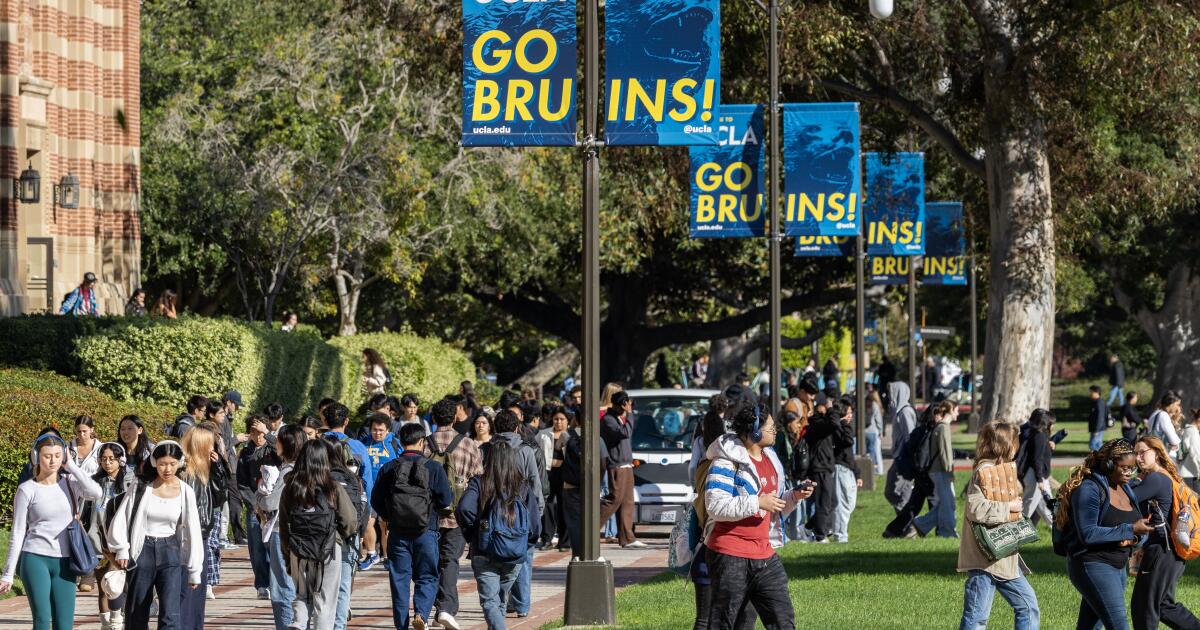
Nine former Department of Justice attorneys assigned to investigate alleged antisemitism at the University of California described chaotic and rushed directives from the Trump administration and told The Times they felt pressured to conclude that campuses had violated the civil rights of Jewish students and staff.

In interviews over several weeks, the career attorneys — who together served dozens of years — said they were given the instructions at the onset of the investigations. All nine attorneys resigned during the course of their UC assignments, some concerned that they were being asked to violate ethical standards.

“Initially we were told we only had 30 days to come up with a reason to be ready to sue UC,” said Ejaz Baluch, a former senior trial attorney who was assigned to investigate whether Jewish UCLA faculty and staff faced discrimination on campus that the university did not properly address. “It shows just how unserious this exercise was. It was not about trying to find out what really happened.”

In spring 2024, increasingly tumultuous protests over Israel’s war in Gaza racked UCLA. Jewish students and faculty reported “broad-based perceptions of antisemitic and anti-Israeli bias on campus,” a UCLA antisemitism task force found. A group later sued, charging that UCLA violated their civil rights, and won millions of dollars and concessions in a settlement.

UCLA avoided trial, but the suit — along with articles from conservative websites such as the Washington Free Beacon — formed a basis for the UC investigations, the former DOJ lawyers said.

“UCLA came the closest to having possibly broken the law in how it responded or treated civil rights complaints from Jewish employees,” Baluch said. “But we just did not have enough information from our investigation to warrant suing UCLA.”

“To me, it’s even clearer now that it became a fraudulent and sham investigation,” another lawyer said.

A DOJ spokesperson did not respond to a request for comment. When it announced findings against UCLA in late July, Assistant Atty. Gen. Harmeet K. Dhillon — the DOJ civil rights chief — said the campus “failed to take timely and appropriate action in response to credible claims of harm and hostility on its campus.” Dhillon said there was a “clear violation of our federal civil rights laws.” Atty. Gen. Pam Bondi said UCLA would “pay a heavy price.”

The former DOJ attorneys’ description of their Trump administration work offers a rare view inside the government’s UC probe. For months, university officials have said little publicly about their ongoing talks with the DOJ. Their strategy has been to tread cautiously and negotiate an out-of-court end to the investigations and financial threats — without further jeopardizing the $17.5 billion in federal funds UC receives.

Four attorneys said they were particularly troubled by two matters. First, they were asked to write up a “j-memo” — a justification memorandum — that explained why UC should face a lawsuit “before we even knew the facts,” one attorney said.

“Then there was the PR campaign,” the attorney said, referring to announcements beginning with a Feb. 28, 2025, press release saying investigators would be visiting UCLA, UC Berkeley, USC and seven other universities nationwide because the campuses “have experienced antisemitic incidents since October 2023.”

“Never before in my time across multiple presidential administrations did we send out press releases essentially saying workplaces or colleges were guilty of discrimination before finding out if they really were,” said one attorney, who requested anonymity for fear of retaliation.

Jen Swedish, a former deputy chief on the employment discrimination team who worked on the UCLA case, said “virtually everything about the UC investigation was atypical.”

“The political appointees essentially determined the outcome almost before the investigation had even started,” said Swedish, referring to Trump administration officials who declared publicly that punishing colleges for antisemitism would be a priority. She resigned in May.

The lawyers spoke out because their formal connections to the DOJ recently ended. Many said they believed the Trump administration had compromised the integrity of the department with what they viewed as aggressive, politically motivated actions against UC and other elite U.S. campuses.

“I think there were absolutely Jewish people on campuses that faced legitimate discrimination. But the way we were pushed so hard to investigate, it was clear to so many of us that this was a political hit job that actually would end up not helping anyone,” said one attorney who worked on UC Davis and UCLA and interviewed students.

In a statement, a UC spokesperson said, “While we cannot speak to the DOJ’s practices, UC will continue to act in good faith and in the best interests of our students, staff, faculty, and patients. Our focus is on solutions that keep UC strong for Californians and Americans.”

The government has not sued UC.

But in August, the DOJ demanded that the university pay a $1.2-billion fine and agree to sweeping, conservative-leaning campus policy changes to settle federal antisemitism accusations. In exchange, the Trump administration would restore $584 million in frozen grant funding. At the time, Gov. Gavin Newsom called the proposal “extortion.”

Last month, after UC faculty independently sued, U.S. District Judge Rita F. Lin ruled that the “coercive and retaliatory” proposal violated the 1st Amendment. Lin blocked the fine and the demands for deep campus changes.

“Agency officials, as well as the president and vice president, have repeatedly and publicly announced a playbook of initiating civil rights investigations of preeminent universities to justify cutting off federal funding, with the goal of bringing universities to their knees and forcing them to change their ideological tune,” Lin said.

Her ruling does not preclude UC from negotiating with the administration or reaching other agreements with Trump.

Protests roiled campuses in spring 2024

The federal investigations largely focused on the tumultuous pro-Palestinian campus protests that erupted at UC campuses. On April 30, 2024, a pro-Israel vigilante group attacked a UCLA encampment, resulting in injuries to student and faculty activists. Police failed to bring the situation under control for hours — a melee former Chancellor Gene Block called a “dark chapter” in the university’s history.

During the 2023-24 UC protests, some Jewish students and faculty described hostile climates and formal antisemitism complaints to the schools increased. Some Jews said they faced harassment for being Zionists. Others said they encountered symbols and chants at protests and encampments, such as “From the river to the sea, Palestine will be free,” which they viewed as antisemitic. Jews were also among the leading encampment activists.

In June 2024, Jewish UCLA students and faculty sued UC, saying the encampment blocked them from accessing Dickson Court and Royce Quad. The four blamed the university for anti-Jewish discrimination, saying it enabled pro-Palestinian activists to protest. On July 29, 2025, UC agreed to pay $6.45 million to settle the federal suit.

In response to the demonstrations and suit, UC overhauled its free speech policies, banning protests that aren’t preapproved from vast portions of campus. It said it would strictly enforce existing bans on overnight encampments and the use of masks to hide identity while breaking the law, and agreed to not prohibit campus access to Jews and other legally protected groups.

Inside the investigations

The nine former DOJ lawyers worked between January and June researching whether UC campuses mishandled complaints of antisemitism filed by Jewish students, faculty and staff tied to pro-Palestinian encampments. They were involved with two areas under the DOJ’s Civil Rights Division — employment litigation and educational opportunities — tasked with looking into potential discrimination faced by UC employees and students.

The attorneys described an at times rushed process that concentrated legal staffing on probing antisemitism at UC campuses, to the detriment of other discrimination cases focused on racial minorities and people who are disabled.

At one point, attorneys said, more than half of the dozens of lawyers in the employment litigation section were assigned solely or nearly exclusively to UC campuses, with some told specifically to research the UCLA David Geffen School of Medicine and other campus divisions. As lawyers begin to quit, the attorneys said, additional staff was brought in from other DOJ teams — those focused on tax law and immigrant employment law.

When five lawyers in the mid-spring reported minimal findings at Berkeley, Davis and San Francisco campuses, they were reassigned to UCLA.

“It was like UCLA was the crown jewel among public universities that the Trump administration wanted to ‘get,’ similar to Harvard for privates,” said another attorney, who requested anonymity because they feared retaliation for speaking out. “There were meetings where managers — who were career employees like us — would convey that political appointees and even the White House wanted us all on UCLA.”

Dena Robinson, a former senior trial attorney, investigated Berkeley, Davis and Los Angeles campuses.

“I was someone who volunteered on my own to join the investigation and I did so because of some of my lived experience. I’m a Black woman. I’m also Jewish,” she said. But she described concerns about fast and shifting deadlines. “And I am highly skeptical of whether this administration actually cares about Jewish people or antisemitism.”

Lawyers described similar views and patterns in the Educational Opportunities Section, where UC investigations were concurrently taking place.

A 10th attorney, Amanda Huckins, said she resigned from that section to avoid being assigned to UC.

“I did not want to be part of a team where I’m asked to make arguments that don’t comport with the law and existing legal precedent,” she said.

Huckins had been away from the job for a little more than two months when she read findings the DOJ released July 29 saying that UCLA acted with “deliberate indifference” to Jewish students and employees and threatened to sue the university if it did not come to a settlement.

In those findings, the DOJ said, “Jewish and Israeli students at UCLA were subjected to severe, pervasive, and objectively offensive harassment that created a hostile environment by members of the encampment.” As evidence, it cited 11 complaints from Jewish or Israeli students regarding discrimination between April 25 and May 1, 2024.

It was “as if they only talked to particular students and used public documents like media reports,” Huckins said, adding that the evidence publicly presented seemed thin. In a “normal investigation,” attorneys research “different layers of document and data requests and interviews at every level of the university system.” Those investigations, she said, can take at least a year, if not longer.

What investigators encountered

Attorneys described site visits at several UC campuses over the spring, including meetings with campus administrators, civil rights officers, police chiefs and UC lawyers who attended interviews — including at least one with UCLA Chancellor Julio Frenk.

The lawyers said UC leaders were cooperative and shared campus policies about how civil rights complaints are handled as well as information detailing the way specific cases were treated, such as those of faculty who said they faced harassment.

“There were thousands and thousands of pages of documents and many interviews,” said Baluch, referring to Berkeley, Davis and UCLA. “There may have been harassment here and there, but there was not a lot that rose to the level of the university violating federal law, which is a pretty high bar.”

“We identified certain incidents at Berkeley and at Davis that were kind of flash points. There were a couple of protests that seemed to get out of hand. There were the encampments. There was graffiti. But we just did not see a really hostile work environment,” said another attorney who visited those campuses. “And if there was a hostile environment, it seemed to have been remediated by the end of 2024 or even May or June for that matter.”

However, at UCLA, Baluch said he and team members found “problems with the complaint system and that some of the professors were genuinely harassed and to such a severe level that it violates Title VII.” Eventually, he said “we successfully convinced the front office that we should only be going after UCLA.”

Where UC and Trump administration stand today

When Harvard faced major grant freezes and civil rights violation findings, it sued the Trump administration. UC has so far opted against going to court — and is willing to engage in “dialogue” to settle ongoing investigations and threats.

“Our priorities are clear: protect UC’s ability to educate students, conduct research for the benefit of California and the nation, and provide high-quality health care,” said UC spokesperson Rachel Zaentz. “We will engage in good-faith dialogue, but we will not accept any outcome that cripples UC’s core mission or undermines taxpayer investments.”

The calculation, according to UC sources, is simple. They want to avoid a head-on conflict with Trump because UC has too much federal money on the line. They point to Harvard — which suffered major grant losses and federal restrictions on its patents and ability to enroll international students after publicly challenging the president.

“Our strategy before was to lay low and avoid Trump any way we could,” said a UC official, who was not authorized to speak on the record. “After the UCLA grants were pulled and the settlement offer came in, the tactic shifted to ‘playing nice’” without agreeing to its terms.

In public remarks to the board of regents last month at UCLA, UC President James B. Milliken said “the stakes are enormous” and presented data on funding challenges: Under Trump, more than 1,600 federal grants have been cut. About 400 grants worth $230 million remained suspended after faculty court wins.

UC “is still facing a potential loss of more than a billion dollars in federal research funding,” Milliken said.

“The coming months may require even tougher choices across the university,” he said.

No information about a possible UC-Trump settlement has been released. But some former DOJ lawyers said they believe a settlement is inevitable.

“It’s devastating that these institutions are feeling pressured and bullied into these agreements,” said Huckins, speaking of deals with Columbia, Brown, Cornell and other campuses. “I would love it if more schools would stand up to the administration … I recognize that they’re in a hard spot.”

To Baluch, who worked on the UCLA case, it appeared that the DOJ had the upper hand.

“Cutting grants is a huge hit to a university. And the billion-dollars fine is a lot. I see why these universities feel backed into a corner to settle,” he said. “The threats, they are working.”
Source link

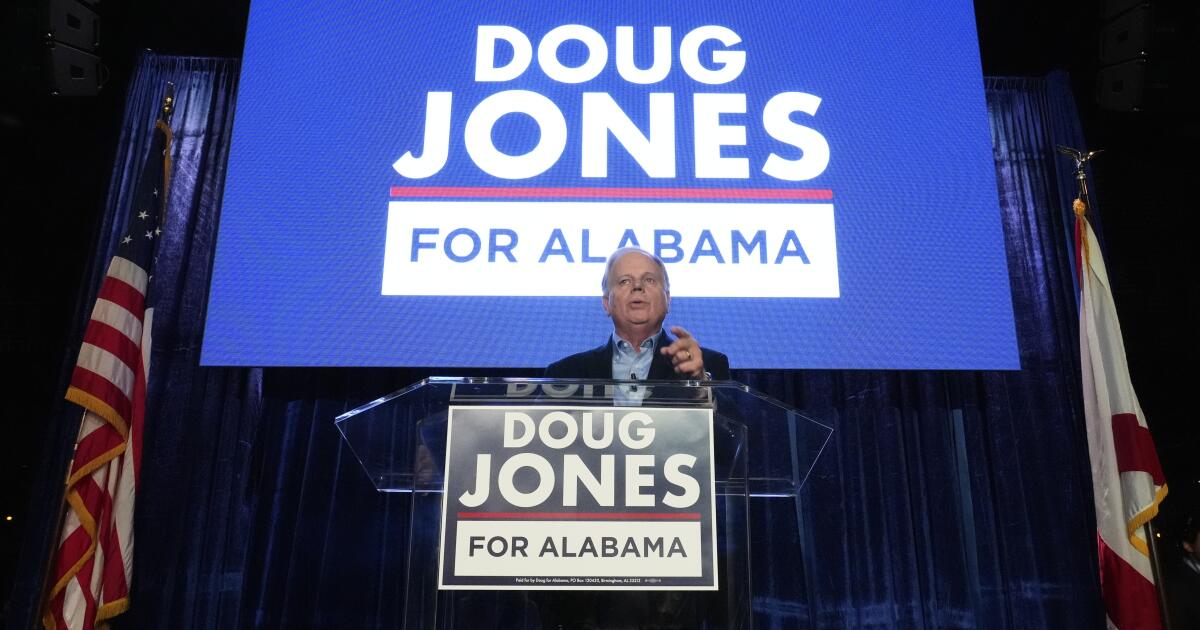
Democratic former Sen. Doug Jones launches campaign for Alabama governor

Former U.S. Sen. Doug Jones, the last Democrat to hold statewide office in Alabama, kicked off his campaign for governor Friday, saying voters deserve a choice and a leader who will put aside divisions to address the state’s pressing needs.

“With your help we can finish what we began. We can build the Alabama we’ve always deserved,” Jones told a packed crowd at a Birmingham campaign rally featuring musician Jason Isbell.

He said the state has urgent economic, healthcare and educational issues that are not being addressed by those in public office.

The campaign kickoff came on the eighth anniversary of Jones’ stunning 2017 Senate win over Republican Roy Moore, and Jones said Alabama proved back then that it can defy “simplified labels of red and blue.”

“You stood up and you said something simple but powerful: We can do better,” Jones said. “You said with your votes that our values, Alabama values, are more important than any political party, any personality, any prepackaged ideology.”

His entry into the race sets up a possible rematch with Republican Sen. Tommy Tuberville, who defeated Jones by 20 points in the 2020 Senate race and is also now running for governor. Both parties will have primaries in May before the November election.

Before running for office, Jones, a lawyer and former U.S. attorney, was best known for prosecuting two Ku Klux Klansmen responsible for Birmingham’s infamous 1963 church bombing.

In an interview with the Associated Press, Jones said families are having a hard time with things like healthcare, energy bills and making ends meet.

“People are struggling,” he said. “They are hurting.”

Jones used part of his speech to describe his agenda if elected governor. He said it is time for Alabama to join most states in establishing a state lottery and expanding Medicaid. Expanding Medicaid, he said, would protect rural hospitals from closure and provide healthcare coverage to working families and others who need it.

He criticized Tuberville’s opposition to extending Affordable Care Act subsidies in the Senate. Jones said many Alabama families depend on those subsidies to buy health insurance “to keep their families healthy.”

Alabama has not elected a Democratic governor since Don Siegelman in 1998.

When Tuberville ousted Jones in 2020, the Democrat won about 40% of the vote, which has been the ceiling for Alabama Democrats in recent statewide races.

Retired political science professor Jess Brown said Jones lost in 2020 despite being a well-funded incumbent, and that’s a sign that he faces an uphill battle in 2026.

“Based on what I know today, at this juncture of the campaign, I would say that Doug Jones, who’s a very talented and bright man, is politically the walking dead,” Brown said.

Jones acknowledged being the underdog and said his decision to run stemmed in part from a desire that Tuberville not coast into office unchallenged.

Jones pointed to recent Democratic victories in Georgia, Mississippi and other red states as cause for optimism.

Tuberville, who formerly led the football program at Auburn University, had “no record except as a football coach” when he first ran, Jones said. And “now there are five years of being a United States senator. There are five years of embarrassing the state.”

Jones continued to question Tuberville’s residency, saying he “doesn’t even live in Alabama, and if he does, then prove me wrong.” Tuberville has a beach house in Walton County, Fla., but has repeatedly said Auburn is his home.

Tuberville’s campaign did not immediately respond to a request for comment but has previously noted his commanding defeat of Jones five years ago. The Republican senator spent part of Friday with Defense Secretary Pete Hegseth in Huntsville to mark the official relocation of U.S. Space Command from Colorado to Alabama.

Jones’ 2017 victory renewed the hopes, at least temporarily, of Democratic voters in the Deep South state. Those gathered to hear him Friday cheered his return to the political stage.

“I’m just glad that there’s somebody sensible getting in the race,” Angela Hornbuckle said. “He proved that he could do it as a senator.”

Chandler writes for the Associated Press.

Source link

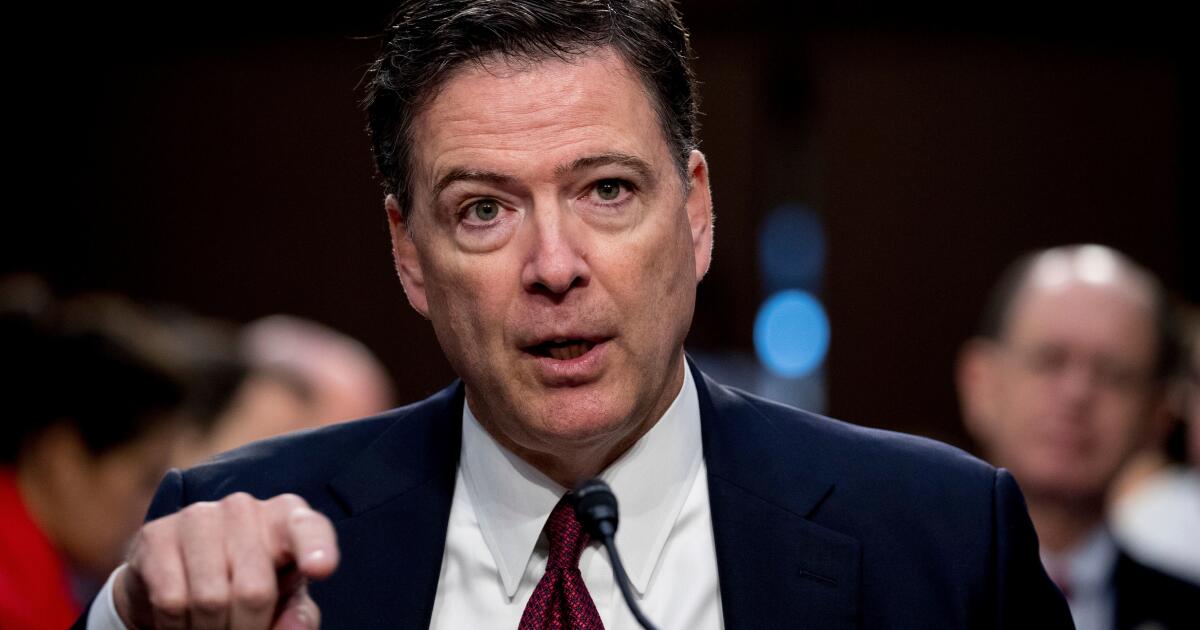
Justice Department faces hurdle in seeking case against Comey

The Justice Department violated the constitutional rights of a close friend of James B. Comey and must return to him computer files that prosecutors had hoped to use for a potential criminal case against the former FBI director, a federal judge said Friday.

The ruling from U.S. District Judge Colleen Kollar-Kotelly not only represents a stern rebuke of the conduct of Justice Department prosecutors but also imposes a major hurdle to government efforts to seek a new indictment against Comey after an initial one was dismissed last month.

The order concerns computer files and communications that investigators obtained years earlier from Daniel Richman, a friend of Comey’s and Columbia University law professor, as part of a media leak investigation that concluded without charges. The Justice Department continued to hold onto those files and conducted searches of them this fall, without a new warrant, as they prepared a case charging Comey with lying to Congress five years ago.

Richman alleged that the Justice Department violated his 4th Amendment rights by retaining his records and by conducting new warrantless searches of the files, prompting Kollar-Kotelly to issue an order last week temporarily barring prosecutors from accessing the files as part of its investigation.

The Justice Department said the request for the return of the records was merely an attempt to impede a new prosecution of Comey, but the judge again sided with Richman in a 46-page order Friday that directed the Justice Department to give him back his files.

“When the Government violates the Fourth Amendment’s prohibition on unreasonable searches and seizures by sweeping up a broad swath of a person’s electronic files, retaining those files long after the relevant investigation has ended, and later sifting through those files without a warrant to obtain evidence against someone else, what remedy is available to the victim of the Government’s unlawful intrusion?” the judge wrote.

One answer, she said, is to require the government to return the property to the rightful owner.

The judge did, however, permit the Justice Department to file an electronic copy of Richman’s records under seal with the Eastern District of Virginia, where the Comey investigation has been based, and suggested prosecutors could try to access it later with a lawful search warrant.

The Justice Department alleges that Comey used Richman to share information with the news media about his decision-making during the FBI’s investigation into Hillary Clinton’s use of a private email server. Prosecutors charged the former FBI director in September with lying to Congress by denying that he had authorized an associate to serve as an anonymous source for the media.

That indictment was dismissed last month after a federal judge in Virginia ruled that the prosecutor who brought the case, Lindsey Halligan, was unlawfully appointed by the Trump administration. But the ruling left open the possibility that the government could try again to seek charges against Comey, a longtime foe of President Trump. Comey has pleaded not guilty, denied having made a false statement and accused the Justice Department of a vindictive prosecution.

The Comey saga has a long history.

In June 2017, one month after Trump fired Comey as FBI director — while the agency was investigating Russia’s interference in the 2016 presidential election and its ties to the Trump campaign — he testified that he had given Richman a copy of a memo he had written documenting a conversation he had with Trump and had authorized him to share the contents of the memo with a reporter.

After that testimony, Richman permitted the FBI to create an image, or complete electronic copy, of all files on his computer and a hard drive attached to that computer. He authorized the FBI to conduct a search for limited purposes, the judge noted.

Then, in 2019 and 2020, the FBI and Justice Department obtained search warrants to obtain Richman’s email accounts and computer files as part of a media leak investigation that concluded in 2021 without charges. Those warrants were limited in scope, but Richman has alleged that the government collected more information than the warrants allowed, including personal medical information and sensitive correspondence.

In addition, Richman said the Justice Department violated his rights by searching his files in September, without a new warrant, as part of an entirely separate investigation.

“The Court further concludes that the Government’s retention of Petitioner Richman’s files amounts to an ongoing unreasonable seizure,” Kollar-Kotelly wrote. “Therefore, the Court agrees with Petitioner Richman that the Government has violated his Fourth Amendment right against unreasonable searches and seizures.”

Tucker writes for the Associated Press.

Source link

Justice Department sues four more states for access to detailed voter data

The U.S. Justice Department is suing four more states as part of its effort to collect detailed voting data and other election information across the country.

The department filed federal lawsuits against Colorado, Hawaii, Massachusetts and Nevada on Thursday, accusing them of “failing to produce statewide voter registration lists upon request.” So far, 18 states have been sued, including California, along with Fulton County in Georgia, which was sued over records related to the 2020 election, which President Trump continues to falsely claim he won.

The Trump administration has characterized the lawsuits as part of an effort to ensure the security of elections, and the Justice Department says the states are violating federal law by refusing to provide the voter lists and information about ineligible voters.

The lawsuits have raised concerns among some Democratic officials and voting rights advocates who question exactly how the data will be used, and whether the department will follow privacy laws to protect the information. Some of the data sought include names, dates of birth, residential addresses, driver’s license numbers and partial Social Security numbers.

“States have the statutory duty to preserve and protect their constituents from vote dilution,” Assistant Atty. Gen. Harmeet K. Dhillon of the Justice Department’s Civil Rights Division said in a press release. “At this Department of Justice, we will not permit states to jeopardize the integrity and effectiveness of elections by refusing to abide by our federal elections laws. If states will not fulfill their duty to protect the integrity of the ballot, we will.”

Colorado Secretary of State Jena Griswold, a Democrat, said her office declined to provide unredacted voter data.

“We will not hand over Coloradans’ sensitive voting information to Donald Trump. He does not have a legal right to the information,” Griswold said Thursday after the lawsuit was filed. “I will continue to protect our elections and democracy, and look forward to winning this case.”

Nevada Secretary of State Francisco Aguilar, also a Democrat, said the Justice Department hasn’t provided clear answers about how the data will be used, and he has a duty to follow state law and protect voters’ sensitive information and access to the ballot.

“While these requests may seem like normal oversight, the federal government is using its power to try to intimidate states and influence how states administer elections ahead of the 2026 cycle,” Aguilar said in a news release. “The Constitution makes it clear: elections are run by the states.”

In a Sept. 22 letter to the Justice Department, Hawaii Deputy Solicitor Gen. Thomas Hughes said state law requires that all personal information required on a voter registration district other than a voter’s full name, voting district or precinct and voter status must be kept confidential. Hughes also said the federal law cited by the Justice Department doesn’t require states to turn over electronic registration lists, nor does it require states to turn over “uniquely or highly sensitive personal information” about voters.

An Associated Press tally found that the Justice Department has asked at least 26 states for voter registration rolls in recent months, and in many cases asked states for information on how they maintain their voter rolls. In addition to California, other states being sued by the Justice Department include Michigan, Minnesota, New York, New Hampshire, Pennsylvania, Delaware, Maryland, New Mexico, Rhode Island, Vermont and Washington. Nearly all the states are Democrat-led, and several are crucial swing states.

The bipartisan Wisconsin Elections Commission voted 5 to 1 on Thursday against turning over unredacted voter information to the Trump administration. The lone dissenter was Republican commissioner Robert Spindell, who warned that rejecting the request would invite a lawsuit. But other commissioners said it would be illegal under Wisconsin law to provide the voter roll information, which includes the full names, dates of birth, residential addresses and driver’s license numbers of voters.

Boone writes for the Associated Press. AP writer Scott Bauer in Madison, Wis., contributed to this report.

Source link

Republican charged in Abramoff probe

The founder of a Republican environmental organization was charged Wednesday with tax evasion and obstruction of justice as part of the continuing federal criminal investigation into lobbying practices in the Jack Abramoff corruption scandal.

Italia Federici, president of the Council of Republicans for Environmental Advocacy, allegedly failed to pay more than $77,000 in federal income taxes from 2001 to 2003. She was also cited for making “false and fictitious” statements before the Senate Indian Affairs Committee in 2005, which was investigating Abramoff’s representation of Native American tribes.

The Justice Department declined to discuss the matter further; a hearing on the case has been set for Friday.

Federici’s lawyers said Wednesday that she would plead guilty to both charges. Federici “regrets her failure … to pay her individual income taxes” and “regrets her past trust and confidence in Jack Abramoff,” said a statement by Jonathan N. Rosen and Noam B. Fischman.

Federal investigators have alleged that Federici acted as Abramoff’s liaison to the Interior Department in helping tribes get meetings with top officials in return for high fees charged by the lobbyist. He is now serving a nearly six-year prison term.

According to the charges filed Wednesday, Federici founded the environmental council in 1997 in Colorado with the help of Gale A. Norton, who later became secretary of the Interior under President Bush.

The charges said that much of the seed money for the group came from an inheritance that Federici received and that over the years she often paid herself back by directly withdrawing funds from the group’s bank account “through ATM and teller transactions.”

From 2001 through 2003, the charges state, she received a taxable income of $233,955, and failed to pay the $77,243 in taxes she owed.

The second charge dealt with her interview by Senate Indian Affairs Committee investigators in October 2005 and her testimony before the panel a month later. The committee was investigating the relationships among Federici, Abramoff and J. Steven Griles, then the Interior Department’s deputy secretary.

Griles was convicted in March of lying in the Abramoff investigation. He acknowledged in a plea agreement that he had falsely told the committee Abramoff had no special access to his office. He also admitted failing to fully disclose his romantic involvement with Federici and said that it was she who introduced him to Abramoff. Federici was identified only as “Person A” in court documents in that case. Griles faces five years in prison.

In her testimony to the Senate panel, Federici insisted she believed Abramoff’s tribal clients had donated $500,000 over three years to her organization because they were generous — not because they wanted to use her connections to help them beat competing tribes trying to win casino licenses.

When the committee’s then-chairman, Sen. John McCain (R-Ariz.), said he saw a “clear connection” between the donations and Abramoff, she denied that there was any quid pro quo.

She also insisted that Griles was not pushed to deny licenses to competing tribes. “I never asked Steve to put the kibosh on anything,” she testified.

Federici also testified in support of Abramoff. “I had no reason

Some Senate committee members suggested they did not believe her.

“I come from a really small town,” Sen. Byron L. Dorgan (D-N.D.) told her. “But I think I can spot a pretty big lie from time to time.”

richard.serrano@latimes.com

Source link

The Phone Call – Los Angeles Times

Al Gore, who had phoned George W. Bush to concede the election after midnight, phoned again at 2:30 a.m. CST. According to several news reports, which varied in detail, the conversation went like this:: Gore: “The state of Florida is too close to call.” Bush, incredulous: “Are you saying what I think you’re saying? Let me make sure that I understand. You’re calling back to retract that concession?” Gore: “Don’t get snippy about it! … Let me explain … I don’t think we should be going out making statements with the state of Florida still in the balance.” Bush then explains to Gore that the research of his brother, Florida Gov. Jeb Bush, showed W. had won.

Gore, coolly: “I don’t think this is something your brother can take care of.” Or: “With all due respect to your brother, he is not the final arbiter of who wins Florida.’ Or: “Let me explain something. Your younger brother is not the ultimate authority on this.” Bush: “Do what you have to do.”

Source link

L.A. vs. LA28: Could the city sue over the cost of the Olympics?

Good morning, and welcome to L.A. on the Record — our City Hall newsletter. It’s Noah Goldberg, with an assist from David Zahniser, giving you the latest on city and county government.

With the 2028 Summer Olympics creeping closer, the Los Angeles City Council still has not come to an agreement with the private committee overseeing the Games over who will pay for the additional city services required to host athletes and spectators from around the world.

With hundreds of millions of taxpayer dollars at stake, the city has blown past its own Oct. 1 deadline for hammering out an “Enhanced City Resources Master Agreement” contract with LA28 and is now considering filing suit.

City officials indicated the potential for a lawsuit against LA28 Monday during a meeting of the council’s ad hoc Olympics committee. In closed session, the committee conferred “with its legal counsel relative to possible initiation of litigation,” according to the meeting agenda.

But after a lengthy closed-door meeting, the committee broke without moving any closer to suing LA28.

“There was no recommendation to move forward on litigation,” said Councilmember Bob Blumenfield, who sits on the Olympic committee, in a brief interview with The Times after the closed session.

Although it remains unclear exactly why the city might sue LA28, the stakes of the negotiations between the two parties are high.

The Olympics have repeatedly been billed as a “zero cost” event for Los Angeles, with the city’s costs reimbursed by LA28 and the federal government. But depending on how “enhanced services” are defined, the city, which is facing financial headwinds, could end up bearing significant costs for services, including security, trash removal, traffic control and paramedics, that will go well beyond what it provides on typical days.

One of the biggest expenses will be security, with the LAPD, as well as a host of other local, state and federal agencies, working to keep athletes and spectators safe during the 17-day Olympics and the two-week Paralympics.

During a presentation before the council committee on Monday, City Administrative Officer Matt Szabo used the Dodgers’ 2024 World Series victory parade as an example of a similar, albeit much smaller scale, situation.

The baseball team reimbursed the city nearly $2 million for police, fire department, transportation and other services to pull off the parade safely.

Monday’s developments provided a small glimpse into the secretive negotiations between the two sides. Coupled with the missed October deadline to finalize an agreement, it was apparent that the negotiations were not going completely smoothly.

A senior city official, who requested anonymity to discuss sensitive negotiations, said the city is not at an “irresolvable impasse” with LA28 but that litigation is very much on the table in an effort to make sure the city is fully reimbursed.

The city and LA28 are meeting daily to try to hash out an agreement, the source said, characterizing the negotiations as “intense and focused.”

“All parties are working actively at the table to finalize the [ECRMA] that will ensure reimbursement of the city’s costs required by the 2028 Games,” the city and LA28 said in a joint statement to The Times.

Szabo told the council committee that it’s more important to get a good deal than an on-time deal.

“This needs to be the right agreement for the city,” Szabo said.

The city also hopes to recoup some costs from the federal government. President Trump’s “Big Beautiful Bill” included $1 billion to reimburse state and local governments for security, planning and other Olympics-related costs. But exactly what the money can be used for won’t be known until next year, Szabo said.

But the unpredictability of the Trump administration has left the city and LA28 wary about whether all the security costs will be reimbursed, said Council President Marqueece Harris-Dawson.

“With this administration, you don’t know what the hell is going to happen, right?” Harris-Dawson said during the Los Angeles Current Affairs Forum Luncheon on Thursday. “So both of us [the city and LA28] are looking at a $1.5-billion bill, and we’re like, ‘Yeah, I’m not paying it. You’re gonna pay it.’”

So far, Harris-Dawson said, the federal government has been “good” about putting money aside for the Games. But that could change, Harris-Dawson said.

“I could show up here 10 days from now and the world could have turned on its head, because you just never know how the guy’s gonna wake up in the morning, or what he’s gonna see on TV to make him react,” he said of Trump. “So … it’s day to day, but on this particular issue, so far so good.”

Outside of security, LA28 should cover costs like staffing, expenses and equipment related to the Games, Szabo said.

Some don’t have high expectations that the costs will be completely footed by others. In a July letter to the city, retired civil rights attorney Connie Rice said she had heard from city employees worried that L.A. would be left with a massive bill.

What if LA28 dissolves after the Olympics — how would the city force it to provide reimbursement? Security and other city services typically extend beyond the Olympic venue itself — how large of a radius around the venue would be included in the reimbursement?

These are questions Rice feels the city has not yet answered.

“I have seen 10th-graders plan their prom better than the city is planning these Olympics,” Rice said in an interview.

You’re reading the L.A. on the Record newsletter

State of play

— RECRUIT-GATE: Months of tension between Los Angeles Mayor Karen Bass and members of the City Council burst into public view Friday when the council rebuffed the mayor’s request to significantly increase police hiring. The council instead agreed to a more modest increase, which could ramp up if the city finds money for more police recruits.

— JUST A COUPLE HUNDRED MILLION OFF: L.A. County officials justified their $200-million purchase of the Gas Company Tower by claiming that seismic retrofits of their old 1960s headquarters would cost $700 million. But experts hoping to save the building now say the retrofits could cost under $150 million, using standard techniques applied to other historic L.A. buildings.

— STEP DOWN: The chief executive of Weingart Center, Kevin Murray, resigned from the L.A. County Affordable Housing Solutions Agency board amid a federal real estate investigation. Federal prosecutors say a Cheviot Hills property was purchased for $11.2 million, then flipped to Weingart for $27.3 million. Weingart used public money to finance the purchase and conversion of the site into homeless housing.

— ED1 FOREVER: The L.A. City Council approved an ordinance on Tuesday formalizing Mayor Karen Bass’ Executive Directive 1, which fast-tracks planning department approval of 100% affordable housing projects. That initiative, which began as an emergency order issued by Bass in 2022, will now be a permanent part of city law.

— CROSSWALK VIGILANTE: An activist with People’s Vision Zero was arrested and cited while painting a crosswalk at an intersection in Westwood on Sunday. The arrest marks the latest clash between the city of Los Angeles and traffic safety advocates who are frustrated by delays in marking pedestrian crossings and are taking it upon themselves to do the work they say can’t wait.

— END OF WATCH(DOG): L.A. County Inspector General Max Huntsman, who served as chief watchdog over the L.A. County Sheriff’s Department for 12 years, is retiring. In a farewell letter, he laid into county leaders, saying they ignored his office’s efforts at oversight.

QUICK HITS

  • Where is Inside Safe? The mayor’s signature program to combat homelessness went to Downtown L.A., South L.A., Exposition Park, Hollywood, Silver Lake, North Hills, Pacoima, Woodland Hills, Shadow Hills and Van Nuys this week, bringing more than 70 people inside.
  • On the docket next week: The city’s Ethics Commission will meet Wednesday. The City Council is on recess until Jan. 7.

Stay in touch

That’s it for this week! Send your questions, comments and gossip to LAontheRecord@latimes.com. Did a friend forward you this email? Sign up here to get it in your inbox every Saturday morning.

Source link

What happens to CNN is President Trump gets his way?

President Trump wants a very different kind of CNN if the cable news channel’s parent Warner Bros. Discovery changes hands.

As details emerge on the battle between Netflix and Paramount over control of the historic movie studio and its streaming and TV assets, Trump acknowledged he’s made it clear he wants new ownership and leadership at the network that has been the prime target in his attacks on the mainstream media over the last decade.

“I think the people that have run CNN for the last long period of time are a disgrace,” Trump told reporters Wednesday. “I don’t think they should be entrusted with running CNN any longer. So I think any deal should — it should be guaranteed and certain that CNN is part of it or sold separately.”

White House Press Secretary Karoline Leavitt echoed Trump’s sentiment Thursday from her lectern after a testy exchange with CNN anchor Kaitlan Collins. “Their ratings have declined, and I think the president rightfully believes that network would benefit from new ownership with respect to this deal,” Leavitt said.

Trump has said he will be “involved” in the government‘s regulatory review of a WBD deal. Injecting the president’s animus toward CNN — which goes back to his presidential campaign in 2016 — into the process has insiders at the network worried that journalistic independence will be sacrificed for the sake of a Warner Bros. Discovery deal.

CNN declined to comment.

A Wall Street Journal report said Paramount Chief Executive David Ellison has signaled to Trump administration officials he would make “sweeping changes” to CNN if his company took control. (A representative for Ellison declined comment.)

Ellison has said he would combine CNN’s newsgathering operations with Paramount’s CBS News, where conservative-friendly Bari Weiss has been installed as editor in chief. Such a move would follow the $16-million settlement Paramount reached with Trump earlier this year resolving a dispute over a “60 Minutes” interview featuring then-Vice President Kamala Harris.

But Trump said he wants to see a new CNN owner even if Netflix prevails. Netflix’s $72 billion offer does not include CNN or WBD’s other basic cable properties. Paramount has countered with a $78 billion offer.

What Trump desires is more favorable news coverage. But pandering to the White House could have a dubious outcome from a business standpoint for the next CNN owner.

The cable news landscape has evolved over the last decade as the country’s politics have become more polarized and tribal.

The trend helped the conservative-leaning Fox News and progressive MS NOW (formerly MSNBC), both of which have seen their audiences grow over that time even as the number of pay-TV homes has declined dramatically.

CNN has tried to stake out the middle ground, although its aggressive coverage of Trump’s first term created a perception it had moved left, especially as more commentary was added to its prime time programs.

CNN already saw the impact of attempting to bring more right-leaning voices to its program under Chris Licht, the executive brought in to run the network in 2022. He was under a mandate from Warner Bros. Discovery Chief Executive David Zaslav, who publicly said the network needed to appeal more to conservative audiences.

The network experienced an immediate exodus of viewers, putting it in third place behind MS NOW. CNN was generating $1.2 billion in profit earlier in the decade. This year, the figure is expected to be in the range of $675 million.

Jon Klein, a digital entrepreneur and former CNN president, said it would be folly for his former network to blatantly court conservatives again.

“You’re not going to convince all those Fox News viewers that suddenly CNN is friendly to them and their way of life,” he said. “These are much older viewers who don’t change their habits so easily. There has been mistrust that has been fostered over many years.”

Klein noted that even upstart right-wing networks that provide unwavering support of Trump — Newsmax and OAN — haven’t made a dent in Fox News’ dominance. MS NOW would be the beneficiary of any rightward shift by CNN, he added.

“It would accelerate the ratings slide and they become completely irrelevant,” said another former CNN executive who did not want to comment publicly.

Fox News does more than provide largely sympathetic coverage and commentary for Trump. Rupert Murdoch’s network has worked at forging a deep connection with viewers, which has made it the ratings leader since 2002.

The lineup of highly paid Fox News personalities is reliably in sync with the audience’s values and the hot-button issues that keep them tuned in. Viewer loyalty has helped the network attract hundreds of new advertisers in recent years, with some integrating patriotic messages into their marketing efforts.

“Fox is an incredibly well-oiled machine,” Klein said.

Klein said CNN and other legacy news organizations are better off focusing on developing an effective digital strategy to insure their future as traditional TV viewing declines, instead of chasing ideological balance.

Attempting to satisfy Trump’s desire for more positive coverage is a slippery slope. While Paramount appointed an ombudsman to CBS News and brought in Weiss — moves aimed at clearing the regulatory path for its merger with Skydance Media — Trump is still lashing out at coverage he doesn’t like.

After a “60 Minutes” interview with Rep. Marjorie Taylor Greene (R-Ga.) aired Dec. 7, in which she was highly critical of Trump, the president said the program is “worse” under new ownership.

The only significant move to attract conservative viewers under Weiss is her prime time interview with the widow of slain right-wing activist Charlie Kirk that airs Saturday.

“I think the prevailing wisdom over there is this notion that at least if they stay out of the clutches of Paramount, some rich philanthropist will buy them and they’ll be fine,” said the former CNN executive.

But if Netflix gets WBD without CNN, there is no guarantee it would not end up with a Trump-friendly owner if the network were spun off separately. The rank and file may wish for Laurene Powell Jobs, chair of the Atlantic, but could end up with a deep-pocketed right winger.

CNN Chairman Mark Thompson’s message to the troops is keep calm and carry on. “I know this strategic review has been a period of inevitable uncertainty across CNN and indeed the whole of WBD,” Thompson told staff in a recent memo. “Of course, I can’t promise you that the media attention and noise around the sale of our parent will die down overnight. But I do think the path to the successful transformation of this great news enterprise remains open.”

Trump’s anger toward CNN has become more personal as time has gone on. He has insulted reporters during press briefings and reportedly has told people he wants to see the firing of anchors Erin Burnett and Brianna Keilar.

Oddly enough, it was Burnett’s journalism that provided Trump with video for his most effective commercial of his 2024 campaign.

Burnett conducted the 2020 interview with Kamala Harris where the former vice president expressed her support for providing medical care to prisoners undergoing gender-affirming care. A clip of the segment was used in the commercial that said “Kamala’s for they/them, President Trump is for you.”

Source link

What RFK Jr.’s hep B vaccine rollback means for California

For most American infants, the hepatitis B shot comes just before their first bath, in the blur of pokes, prods and pictures that attend a 21st century hospital delivery.

But as of this week, thousands of newborns across the U.S. will no longer receive the initial inoculation for hepatitis B — the first in a litany of childhood vaccinations and the top defense against one of the world’s deadliest cancers.

On Dec. 5, the Centers for Disease Control and Prevention’s powerful vaccine advisory panel voted to nix the decades-old birth-dose recommendation.

The change was pushed by Health and Human Services Secretary Robert F. Kennedy Jr. and his “Make America Healthy Again” movement, which has long sought to rewrite the CDC’s childhood vaccine schedule and unwind state immunization requirements for kindergarten.

California officials have vowed to keep the state’s current guidelines in place, but the federal changes could threaten vaccine coverage by some insurers and public benefits programs, along with broader reverberations.

“It’s a gateway,” said Jessica Malaty Rivera, an infectious disease epidemiologist in Los Angeles. “It’s not just hepatitis B — it’s chipping away at the entire schedule.”

Democratic-led states and blue-chip insurance companies have scrambled to shore up access. California joined Hawaii, Oregon and Washington in forming the West Coast Health Alliance to maintain uniform public policy on vaccines in the face of official “mis- and dis-information.”

“Universal hepatitis B vaccinations at birth save lives, and walking away from this science is reckless,” California Gov. Gavin Newsom said in a statement. “The Trump administration’s ideological politics continue to drive increasingly high costs — for parents, for newborns, and for our entire public-health system.”

The issue is also already tied up in court.

On Tuesday, the Supreme Court sent a lawsuit over New York’s vaccine rules back to the 2nd U.S. Circuit Court of Appeals for review, signaling skepticism about the stringent shots-for-school requirements pioneered in California. On Friday, public health officials in Florida appeared poised to ax their schools’ hepatitis B immunization requirement, along with shots for chickenpox, a dozen strains of bacterial pneumonia and the longtime leading cause of deadly meningitis.

Boosters of the hep B change said it replaces impersonal prescriptions with “shared clinical decision-making” about whether and how to vaccinate, while preserving the more stringent recommendation for children of infected mothers and those whose status is unknown.

Critics say families were always free to decline the vaccine, as about 20% did nationwide in 2020, according to data published by the CDC. It’s the only shot on the schedule that children on Medicaid receive at the same rate as those with private insurance.

Rather than improve informed consent, critics say the CDC committee’s decision and the splashy public fight leading up to it have depressed vaccination rates, even among children of infected mothers.

“Hepatitis B is the most vulnerable vaccine in the schedule,” said Dr. Chari Cohen, president of the Hepatitis B Foundation. “The message we’re hearing from pediatricians and gynecologists is parents are making it clear that they don’t want their baby to get the birth dose, they don’t want their baby to get the vaccine.”

Much of that vulnerability has to do with timing: The first dose is given within hours of birth, while symptoms of the disease might not show up for decades.

“The whole Day One thing really messes with people,” Rivera said. “They think, ‘This is my perfect fresh baby and I don’t want to put anything inside of them.’ ”

U.S. surgeon general nominee Casey Means called the universal birth dose recommendation “absolute insanity,” saying in a post on X last year that it should “make every American pause and question the healthcare system’s mandates.”

“The disease is transmitted through needles and sex exclusively,” she said. “There is no benefit to the baby or the wider population for a child to get this vaccine who is not at risk for sexual or IV transmission. There is only risk.”

In fact, at least half of transmission occurs from mother to child, typically at birth. A smaller percentage of babies get the disease by sharing food, nail clippers or other common household items with their fathers, grandparents or day-care teachers. Because infections are often asymptomatic, most don’t know they have the virus, and at least 15% of pregnant women in the U.S. aren’t tested for the disease, experts said.

Infants who contract hepatitis B are overwhelmingly likely to develop chronic hepatitis, leading to liver cancer or cirrhosis in midlife. The vaccine, by contrast, is far less likely than those for flu or chickenpox to cause even minor reactions, such as fever.

“We’ve given 50 billion doses of the hepatitis B vaccine and we’ve not seen signals that make us concerned,” said Dr. Su Wang, medical director of Viral Hepatitis Programs and the Center for Asian Health at the Cooperman Barnabas Medical Center in New Jersey, who lives with the disease.

Still, “sex and drugs” remains a popular talking point, not only with Kennedy allies in Washington and Atlanta, but among many prominent Los Angeles pediatricians.

“It sets up on Day One this mentality of, ‘I don’t necessarily agree with this, so what else do I not agree with?’” said Dr. Joel Warsh, a Studio City pediatrician and MAHA luminary, whose recent book “Between a Shot and a Hard Place” is aimed at vaccine-hesitant families.

Hepatitis B also disproportionately affects immigrant communities, further stigmatizing an illness that first entered the mainstream consciousness as an early proxy for HIV infection in the 1980s, before it was fully understood.

At the committee meeting last week, member Dr. Evelyn Griffin called illegal immigration the “elephant in the room” in the birth dose debate.

The move comes as post-pandemic wellness culture has supercharged vaccine hesitancy, expanding objections from a long-debunked link between the measles-mumps-rubella vaccine and autism to a more generalized, equally false belief that “healthy” children who eat whole foods and play outside are unlikely to get sick from vaccine-preventable diseases and, if they do, can be treated with “natural” remedies such as beef tallow and cod liver oil.

“It’s about your quality of life, it’s about what you put in your body, it’s about your wellness journey — we have debunked this before,” Rivera said. “This is eugenics.”

Across Southern California, pediatricians, preschool teachers and public health experts say they’ve seen a surge in families seeking to prune certain shots from the schedule and many delay others based on “individualized risk.” The trend has spawned a cottage industry of e-books, Zoom workshops by “vaccine friendly” doctors offering alternative schedules, bespoke inoculations and post-vaccine detox regimens.

CDC data show state exemptions for kindergarten vaccines have surged since the height of the COVID-19 pandemic, with about 5% of schoolchildren in Georgia, Florida and Ohio, more than 6% in Pennsylvania and nearly 7% in Michigan waved out of the requirement last year.

In Alaska and Arizona, those numbers topped 9%. In Idaho, 1 in 6 kindergartners are exempt.

California is one of four states — alongside New York, Connecticut and Maine — with no religious or personal-belief exemptions for school vaccines.

It is also among at least 20 states that have committed to keep the hepatitis B birth dose for babies on public insurance, which covers about half of American children. It is not clear whether the revised recommendation will affect government coverage of the vaccine in other states.

Experts warn that the success of the birth-dose reversal over near-universal objection from the medical establishment puts the entire pediatric vaccination schedule up for grabs, and threatens the school-based rules that enforce it.

Ongoing measles outbreaks in Texas and elsewhere that have killed three and sickened close to 2,000 show the risks of rolling back requirements, experts said.

Hepatitis is not nearly as contagious as measles, which can linger in the air for about two hours. But it’s still fairly easy to pick up, and devastating to those who contract it, experts said.

“These decisions happening today are going to have terrible residual effects later,” said Rivera, the L.A. epidemiologist. “I can’t imagine being a new mom having to navigate this.”

Source link

L.A. City Councilman John Lee violated gift laws on lavish Vegas jaunt, judge says

Los Angeles City Councilman John Lee repeatedly violated the city’s gift laws in 2016 and 2017, accepting freebies during a lavish trip to Las Vegas and at multiple restaurants in L.A., a judge said in a filing released Friday.

In a 59-page proposed decision, Administrative Law Judge Ji-Lan Zang concluded that Lee committed two counts of violating a law governing the size of gifts a city official can receive and three counts of violating a law requiring that such gifts be publicly disclosed.

Zang recommended a $43,730 penalty for Lee, who represents the northwest San Fernando Valley and was chief of staff to then-City Councilmember Mitchell Englander at the time of the alleged violations. However, the judge did not agree with allegations by city ethics investigators that Lee misused his position or helped Englander misuse his position.

In 2020, federal prosecutors accused Englander of accepting $15,000 in cash from businessman Andy Wang, lying to FBI agents and obstructing their investigation into the 2017 Vegas trip. Englander ultimately pleaded guilty to a single count of providing false information to the FBI and was sentenced to 14 months in prison.

The five-member Los Angeles City Ethics Commission is scheduled to make a determination on Wednesday, deciding both the number of violations Lee committed and any financial penalties to impose on him.

The commission has the power to accept or reject Zang’s recommendations. Ethics investigators have recommended that the commission take a more punitive approach by fining Lee about $138,000 and holding him responsible for all 10 counts.

The Lee case revolves around gifts — mostly food and alcohol but also hotel stays, transportation and $1,000 in gambling chips — provided by three men who have sought to do business with City Hall: Wang, who peddled Italian cabinets, “smart home” technology and facial recognition software; architect and developer Chris Pak; and lobbyist Michael Bai.

The judge issued her report six months after a multi-day hearing on the allegations against Lee, who replaced Englander on the council in 2019.

During those proceedings, Lee denied that he improperly accepted gifts, saying he made a good faith effort to pay his own way and, in some cases, declined to eat during meals. For example, he testified that he did not remember eating during his meetings at Yxta and Water Grill, both of which are in downtown L.A.

Zang, in her report, called those denials “not credible,” describing his testimony as “evasive and self contradictory.” She said Lee’s testimony also was in conflict with information he gave the FBI during its investigation into Englander, as well as testimony from other witnesses.

“It strains credulity to believe that [Lee] would join Englander, Bai, and Wang for lunch at Yxta and dinner at Water Grill without eating any food during the meals,” she wrote.

Ethics investigators have accused Lee of receiving an assortment of gifts during the 2017 Vegas trip with Englander and several others. Lee and a group of friends stayed at the Aria hotel and spent an evening at the Hakkasan Nightclub, according to the city’s allegations.

At the hotel restaurant, Blossom, Wang ordered a dinner worth nearly $2,500 for the group, which included Englander, Lee and several others, sending out servings of shark fin soup, Peking duck and Kobe beef, according to the judge’s summary of events.

Lee testified that he arrived at the restaurant in time for a dessert of bird’s nest soup, tasting it and deciding he did not like it, the judge said in her filing.

At Hakkasan later that night, Wang purchased three rounds of bottle service for the group for around $8,000 apiece, while Pak paid for a fourth round at a cost of $8,418.75.

“Each round of bottle service was served with fanfare, as female VIP hostesses brought bottles of alcohol to the table with flashing lights,” the judge wrote.

That night, at least 20 other club patrons went to Wang’s booth and drank alcohol at the table, according to the judge’s filing.

Lee was never charged by federal prosecutors and has said he was unaware of wrongdoing by Englander. In a filing submitted last week, his attorneys said that investigators incorrectly calculated the value of the gifts, including the bottles of alcohol, whose contents were distributed among many people.

Lee gave Wang $300 in cash as reimbursement for his drinks, withdrawing money from an ATM in Las Vegas to cover those expenses, his lawyers said.

In their reply to the city, Lee’s attorneys contend that the statute of limitations has expired on the city ethics counts. They have also pushed back on the recommendation from city ethics investigators that Lee pay a $138,000 penalty.

“Such inflated numbers are not grounded in reason, have no basis in the record, no support in the governing law, and no place in a fair and impartial enforcement system,” they wrote in their filing.

Englander previously agreed to pay $79,830 to settle a similar Ethics Commission case over the gifts he received.

Ethics investigators have accused Lee of committing 10 counts of violating city laws — two counts of accepting gifts in excess of the legal limit, three counts of failing to report those gifts on his public disclosure forms, four counts of misusing his position and one count of aiding and abetting Englander’s misuse of his position.

In 2016, the legal limit on gifts to city officials was $460 per donor. The following year, it was $470.

In Englander’s 2020 federal indictment, Lee was mentioned not by name, but instead referred to as “City Staffer B.” Despite his legal troubles, he won reelection in 2024.

Source link

Trump says he is likely to support ending blanket federal ban on marijuana

President Trump said he likely will support a congressional effort to end the federal ban on marijuana, a major step that would reshape the pot industry and end the threat of a Justice Department crackdown.

Trump’s remarks put him sharply at odds with Atty. Gen. Jeff Sessions on the issue. The bill in question, pushed by a bipartisan coalition, would allow states to go forward with legalization unencumbered by threats of federal prosecution. Sessions, by contrast, has ramped up those threats and has also lobbied Congress to reduce current protections for medical marijuana.

Trump made his comments to a gaggle of reporters Friday morning just before he boarded a helicopter on his way to the G-7 summit in Canada. His remarks came the day after the bipartisan group of lawmakers proposed their measure.

One of the lead sponsors is Sen. Cory Gardner (R-Colo.), who is aligned with Trump on several issues but recently has tangled with the administration over the Justice Department’s threats to restart prosecutions in states that have legalized marijuana.

“I support Sen. Gardner,” Trump said when asked about the bill. “I know exactly what he’s doing. We’re looking at it. But I probably will end up supporting that, yes.”

The legislative proposal, which is also championed by Sen. Elizabeth Warren (D-Mass.), would reshape the legal landscape for marijuana if it becomes law.

California and eight other states, as well as Washington, D.C., have legalized all adult use of marijuana. An additional 20 states permit marijuana for medical use.

But even as states legalize, marijuana has remained a risky and unstable business because of federal law making it illegal. Concerns about federal law enforcement seizures have inhibited most lenders from working with marijuana businesses. And investors have also proceeded cautiously.

“If you are in the marijuana business … you can’t get a bank loan or set up a bank account because of concern over the conflict between state and federal law,” Gardner said at a news conference Thursday to unveil the new bill. “We need to fix this. It is time we take this industry out of the shadows, bring these dollars out of the shadows.”

He called it a “public hypocrisy” that the firms are expected to pay taxes yet are barred from participation in the financial system.

A lifting of the federal prohibition also would bolster efforts to create uniform testing and regulatory standards for marijuana, and potentially free scientists to pursue research into the medical uses of marijuana.

Trump’s support could potentially have a major impact, providing political cover for Republicans who worry about being tagged as soft on drugs. Still, the proposal faces a tough road in Congress.

Even though most lawmakers now represent areas where pot is legal for at least medical use — and public opinion polls show majorities of Democratic and Republican voters nationwide favor legalization — congressional leaders have shown little appetite for loosening restrictions. The House is blocking the District of Columbia from permitting sales of recreational pot, even after its voters chose to legalize. A 2014 budget amendment that protects medical marijuana businesses from Drug Enforcement Administration raids is perpetually under attack.

“It faces tremendous head winds,” John Hudak, a marijuana policy expert at the Brookings Institution in Washington, said, referring to the Gardner-Warren bill.

Trump said he is likely to support the federal legalization effort despite a warning against it from a coalition of narcotics officer groups.

“We urge you to see through the smoke screen and reject attempts to encourage more drug use in America,” they wrote in a letter to Trump Thursday.

The marijuana industry continues to be whipsawed by mixed messages from the administration.

In January, the Justice Department sent pot businesses into a panic by rescinding an Obama-era policy that restricted prosecutors from targeting sellers who operate legally under state laws. Sessions warned at the time that any pot business could find itself in the crosshairs of prosecutors — regardless of whether marijuana was legal in their state.

The move enraged Gardner, who said the administration had earlier given him assurances that there would be no such raids, at least in his state. At Gardner’s behest, Trump in April ordered an abrupt retreat from the announced crackdown. Trump made the order without even consulting Sessions, a sign of their tense relationship.

But prosecutors did back off. During this administration, there have apparently been no federal raids or seizures of pot companies for sales that are legal under state law.

“Remarkably little, if anything, has changed,” said John Vardaman, a former Justice Department attorney who helped draft the Obama-era rules, known as the Cole memo, after former Deputy Atty. Gen. James M. Cole, who issued it. “Almost every U.S. attorney in states where marijuana is legal has decided to apply the same principles as the Cole memo,” said Vardaman, now an executive at Hypur, which sells banking compliance software to marijuana companies.

Banking is the area in which the Gardner bill could most help pot companies.

The Senate proposal, and a companion bipartisan measure in the House, would amend the Controlled Substances Act so that its marijuana provisions do not apply to any person or business that is in compliance with state laws. To put bankers at ease, it specifies that such marijuana sales would not be considered trafficking and do not amount to illegal financial transactions.

“The very people you want involved in this market are the ones who have been most reluctant to get involved because of the banking issue,” said Vardaman. “If you address that, you would have enormous beneficial effects for the industry.”

While Trump’s comments were welcomed by marijuana activists, they remain on edge, especially because of Trump’s spotty record at actually pushing legislation through Congress.

“We have seen this president voice his support for a lot of things related to cannabis, but he has done absolutely nothing to move legislation,” said Hudak. “This is just more empty rhetoric from a president who is vague on this issue.”

Gardner is hoping he can persuade more of his conservative colleagues to join the crusade by framing the issue as one of state’s rights. Several Republicans, including Reps. Dana Rohrabacher of Costa Mesa and Don Young of Alaska, are demanding an end to federal marijuana laws that intrude on the states. Their movement is slowly growing in Congress.

“This is a chance for us to express that federalism works,” said Gardner, who like some other Republicans was not a proponent of marijuana but took up the cause after his state’s voters endorsed legalization, “to take an idea that states have led with and provide a solution that allows them to continue to lead.”

evan.halper@latimes.com

Follow me: @evanhalper


UPDATES:

2:10 p.m.: This article was updated with additional analysis and reaction.

This article was originally published at 8:50 a.m.


Source link

Helms Stirs Furor With Warning to President : Politics: Senator says Clinton ‘better watch out’ if he visits N. Carolina bases. He later admits to ‘mistake.’

Sen. Jesse Helms (R-N.C.) set off a bipartisan tempest Tuesday by warning that President Clinton had “better watch out” for his safety if he travels to military bases in North Carolina, prompting the White House to suggest that Helms be denied chairmanship of a key Senate committee.

After GOP leaders delicately distanced themselves from Helms’ provocative remarks and Democrats loudly demanded an apology, the fiercely combative lawmaker, who is in line to chair the Senate Foreign Relations Committee, conceded that his comments had been “a mistake.”

But he stopped well short of a genuine apology. “Of course, I didn’t expect to be taken literally,” he said in a prepared statement.

In an interview published Tuesday morning in the Raleigh (N.C.) News & Observer, the 73-year-old conservative asserted that Clinton is extremely unpopular among armed forces personnel stationed at the six military bases in his home state.

“Mr. Clinton better watch out if he comes down here,” the newspaper quoted Helms as saying. “He’d better have a bodyguard.”

The President, asked about Helms’ remarks during a White House news conference, called them “unwise and inappropriate.” While asserting his authority in matters of foreign affairs, he said that it is up to Republicans to decide who will speak for them.

“The President oversees the foreign policy of the United States and the Republicans will decide in whom they will repose their trust and confidence,” Clinton said.

It was a vintage performance for Helms, a conservative ideologue who has built a career based on pugnacious rhetoric and flamboyant attacks. But his critique of Clinton prompted soul-searching among some Republicans who fear that Helms, by his intemperate remarks, will bolster Democratic charges that the GOP is a party of extremists.

“Jesse,” said a former senior official in the George Bush Administration, “has been for most Republicans an embarrassment.”

Helms’ comments were published on the 31st anniversary of President John F. Kennedy’s assassination, adding to the embarrassment of Republican lawmakers. Most declined to comment directly, noting only that each of the Senate’s 100 members speaks only for him or herself.

No such restraint was observed by Sen. Christopher J. Dodd (D-Conn.), who is locked in a race to lead the Senate’s new minority Democrats. He called on Helms to issue a formal apology to the President and to members of the armed forces, whose loyalty and patriotism, Dodd said, were called into question by Helms.

“To suggest on this day of all days . . . that an American President’s life might be in jeopardy (if he) were to visit an American military base, would suggest that my colleague from North Carolina doesn’t seem to know what country he’s living in,” Dodd said. “This is not a banana republic.”

It is not the first time that Helms has provoked a political furor. He once accused former Secretary of State George P. Shultz of “playing footsie with the Communists” by opposing apartheid in South Africa. In a floor debate over funding for AIDS research, he bluntly characterized homosexuals as “perverted.”

Helms often storms onto the Senate floor to rail against abortions and erotic art and regularly angers both Democratic and Republican colleagues by threatening to waylay measures that he dislikes by engaging in a one-man filibuster.

“This senator,” he once told fellow lawmakers, “did not come to Washington to gain popularity with his colleagues.”

His latest remarks came just four days after a television interview in which Helms questioned Clinton’s fitness to serve as commander in chief of the armed forces. Those comments drew muted criticism from Republicans and a vigorous denial from Gen. John M. Shalikashvili, chairman of the Joint Chiefs of Staff.

On Tuesday, the Secret Service, which is responsible for the President’s safety, confirmed that it is seeking a transcript of Helms’ interview with the News and Observer. But officials were quick to caution that they do not view Helms’ remarks as an effort to incite violence against the President.

Military officials in North Carolina, where Clinton visited in April, took pains to disassociate themselves from Helms’ comments.

“The President is the commander in chief. He is welcome on any base in the military that he chooses to visit,” said Capt. Bruce Sprecher, public affairs officer at Seymour-Johnson Air Force Base.

Responding to Helms’ newspaper interview, the White House publicly questioned his suitability for the Foreign Relations chairmanship. White House Chief of Staff Leon E. Panetta urged Sen. Bob Dole (R-Kan.), who is expected to be majority leader in the new Congress, to ignore tradition and pass over Helms in choosing the next chairman.

“I think those comments are not only reckless but they are dangerous and irresponsible,” Panetta told a small group of reporters. “And I think they raise a very serious question as to whether (Helms) ought to assume the chairmanship of that committee. I think the Republican leadership needs to take a very hard look as to whether or not they want somebody with these kind of extreme views to chair one of the most important committees in the Congress of the United States.”

Panetta said that Helms’ remarks and Republican leaders’ response to them “will tell us an awful lot what kind of course we’re going to take in the next Congress.”

The reaction of Republican leaders generally fell short of the repudiation that Democrats are seeking. Neither Dole nor incoming House Speaker Newt Gingrich (R-Ga.), asked about the flap at a Republican Governors Assn. session in Williamsburg, Va., would criticize Helms directly. “The President’s welcome to come to any state,” said Dole. “That’s the way it should be, that’s the way it is, that’s the way it will be.”

Gingrich said that Republicans would welcome any Clinton visit as an opportunity to engage in debate over the nation’s future.

“I would hope that (Clinton) would feel that all Americans want to respect and honor the President and that they want to welcome their President in their neighborhood and their community any time he wishes to come and visit,” he said.

Some Republicans were more blunt in their criticism of Helms.

“I wish he hadn’t said it,” said Republican political consultant Lyn Nofziger. “If it did anything, it creates a little sympathy with the prez, and I’m not in favor of that. . . . It gives people something to shoot at. And it distracts a little. But is it a permanent damage? No.”

While some Republicans stewed, Senate insiders suggested that Helms’ legislative career likely would suffer little.

“There will be no effort to muzzle anyone,” said one key Republican aide. “That’s the way this body operates. These folks are very independent people. It would be very inappropriate for someone to try to quiet Sen. Helms. And there’s a great deal of deference to committee chairmen and seniority.”

Times staff writers John M. Broder and Ronald Brownstein contributed to this story.

Tracking a Controversy

President Clinton, during a press conference Tuesday afternoon, called remarks made by Sen. Jesse Helms (R-N.C.) “inappropriate and unwise.”

* Asked if Clinton was up to the commander in chief’s job: “No I do not. And neither do people in the armed forces.”

–CNN interview last week

* On the president visiting North Carolina: “Mr. Clinton better watch out if he comes down here. He’d better have a bodyguard.”

–interview with the News & Observer of Raleigh, N.C. on Monday

* On his earlier remarks: “I made a mistake last evening which I shall not repeat.

–statement issued Tuesday

The Helms File

Past remarks by Sen. Jesse Helms (R-N.C.), the incoming Senate Foreign Relations Committee chairman:

Nov. 4, 1993: “It was well-known that (Haitian President Jean-Bertrand) Aristide is a murderer. Yet somebody decided to return him to power, if necessary, at the risk of American lives. Who is making these decisions?”

–to Secretary of State Warren Christopher at a hearing of the Foreign Relations Committee

Aug. 5, 1993: “I’m going to make her cry. I’m going to sing ‘Dixie’ to her until she cries.”

–Sen. Carol Moseley-Braun, D-Ill., quoted Helms as saying to her a month after they had debated on the Senate floor over use of the Confederate flag

May 7, 1993: “She’s not your garden-variety lesbian. She’s a militant-activist-mean lesbian, working her whole career to advance the homosexual agenda.”

–on the nomination of a gay rights activist to a Department of Housing and Urban Development post

Oct. 30, 1990: “People can do what they want in the privacy of their own homes, but when they start marching in the street and say that homosexuality should be given special privileges and be treated as a normal lifestyle, you bet I say no.”

–during a campaign stop for his 1990 Senate campaign

Oct. 24, 1990: “What is really at stake is whether or not America will allow the cultural high ground in this nation to sink slowly into an abyss of slime to placate people who clearly seek or are willing to destroy the Judaic-Christian foundations of this republic.”

–talking about National Endowment for the Arts funding to certain artists

Source: Associated Press

Helms Takes It Back

This is a statement by Sen. Jesse Helms (R-N.C.) on Tuesday regarding his remarks about President Clinton:

I made a mistake last evening which I shall not repeat.

In an informal telephone interview with a local reporter I made an offhand remark in an attempt to emphasize how strongly the American people feel about the nation’s declining defense capability and other issues in which the President has been involved and for which he is responsible.

Of course I didn’t expect to be taken literally when, to emphasize the cost and concerns I am hearing, I far too casually suggested that the President might need a bodyguard, or words to that effect.

And let me say that President Clinton will of course be welcomed by me and other citizens of North Carolina and other states any time he chooses to visit us.

The reporter asked my opinion and I tried to be candid in my response. The President has serious problems with his records of draft avoidance, with his stand on homosexuals in the military and the declining defense capability of America’s armed forces–the secretary of defense recently acknowledged that three U.S. Army divisions are not now combat ready.

I reiterate that I now wish that I had engaged in a terse interview with the reporter. I did not. As is my custom, we had an informal conversation from which he extracted an informal quote that should not have been taken literally, let alone published.

I do not fault him. I fault myself. From now on, such contacts as I may have with the media will be entirely formal.

Source: Associated Press

Source link

Divided council gives modest boost to LAPD hiring, amid tensions with mayor

Months of tension between Los Angeles Mayor Karen Bass and members of the City Council burst into public view Friday when the council rebuffed the mayor’s request to significantly increase police hiring.

The face-off between the mayor and some council members has been brewing since the council voted in May as part of the city budget to reduce LAPD hiring to 240 officers this year — half of the 480 officers requested by Bass — in order to close a $1-billion budget shortfall and prevent layoffs of other city workers.

Then, when Bass signed the budget, she mentioned she had reached an agreement with Council President Marqueece Harris-Dawson to find additional money to restore police hiring. The duo said they would find the money within 90 days.

The 90 days came and went. Then another 90 came and went. All the while, the LAPD continued hiring.

As of this month, nearly halfway through the fiscal year, the LAPD has already brought on all 240 new hires accounted for in the budget. To continue hiring officers, the City Council would need to allocate more money.

Against that backdrop, Bass sent a letter to the council Wednesday, calling on them to fund up to 410 new hires over this fiscal year, which ends in July. Some council members balked, saying they feared the hiring would cause a continuing deficit, since the new police officers will be on the city payroll for decades to come.

Bass’ push was backed by Councilmember John Lee, who called on his colleagues to fund the 410 hires by peeling $4.4 million away from other parts of the city budget, including the Human Resources Benefits Fund, the Police Health and Welfare Fund and the Innovation Fund.

The cost of the extra hires would jump to $24 million next year, and it was not clear how the city would fund their salaries in coming years.

L.A. mayoral Karen Bass.

Karen Bass at a farmers market on Nov. 4, 2022.

(Irfan Khan / Los Angeles Times)

“Here we are, considering an unvetted funding proposal none of us saw until this morning,” said Councilmember Katy Yaroslavsky, who chairs the council’s Budget and Finance Committee.

Yaroslavsky has said she would support hiring the 410 new officers if funding is available. She said the Budget Committee has repeatedly reached out to the mayor and the council president to find funding solutions but did not receive a response until this week, right before the council goes on recess for the holidays.

Yaroslavsky introduced her own proposal Friday to hire one additional class of 40 police recruits in January for $1.7 million — bringing the number of police hires up to 280 this fiscal year. She also requested that the LAPD and the city administrative officer return in January with ways to pay for more police hiring that does not come from one-time sources.

The council passed Yaroslavsky’s plan in an 11 to 4 vote.

Harris-Dawson, who supported the mayor’s goal of 410 officers, said that tensions over police hiring date back a half century. He cited a 2003 dispute between then-Mayor James Hahn and then-Council President Alex Padilla, with the council voting to delay police hiring due to the city’s financial issues.

“What we’re going through today is consistent with how the city of L.A. runs,” he said.

Bass had hoped to keep the department from shrinking significantly this year. The LAPD is anticipating losing 552 officers to attrition. If no more officers are hired beyond the 240 already brought on, the department could fall to 8,386 officers, the lowest number since 1995.

“Stopping the hiring of new police officers will have drastic and lasting consequences for our city,” Bass wrote in her letter to the City Council.

The mayor cited the 2026 FIFA World Cup and the 2028 Olympics as reasons the city needs to grow its police force.

“We cannot knowingly and willingly increase the demands on our officers while reducing their workforce to the lowest levels in more than 20 years,” she said.

The city’s police union, the Los Angeles Police Protective League, supported Bass’ efforts to fund the 410 officers.

“Angelenos need this Council to understand that neighborhoods are clamoring for more police, not less, and it is time to end the political posturing and put their money where their mouths are and grow the force,” the union said in a statement Friday.

Times staff writers David Zahniser and Sandra McDonald contributed to this report.

Source link

Admiral hands over leadership of command overseeing the Trump administration’s boat strikes

A U.S. Navy admiral who oversees military operations in Latin America handed off command responsibilities Friday as scrutiny increases over the Trump administration’s deadly strikes on alleged drug boats in the region.

Adm. Alvin Holsey has retired one year into a posting that typically lasts three to four years and transferred leadership duties to his top military deputy, Air Force Lt. Gen. Evan Pettus, during a ceremony at U.S. Southern Command headquarters near Miami.

In farewell remarks, Holsey did not mention the military operations or the reasons for his early retirement. But he urged his successor to uphold longstanding partnerships in the region by standing firmly behind the shared values of democracy and support for the rule of law.

“To be a trusted partner, we must be credible, present and engaged,” Holsey said.

Holsey’s shock retirement was announced by the Pentagon in October, over a month into the Trump administration’s strikes on suspected drug boats in the Caribbean Sea and the eastern Pacific Ocean that have killed at least 87 people. With the campaign facing growing scrutiny by Congress, Holsey briefed key lawmakers earlier this week.

Long-term replacement for Holsey hasn’t yet been named

The ceremony Friday was more subdued than past retirements, held outdoors amid a small crowd of mostly Southern Command staff and without Defense Secretary Pete Hegseth, because President Trump has yet to nominate Holsey’s replacement.

Gen. Dan Caine, chairman of the Joint Chiefs of Staff, made no mention of the military operations in Latin America as he thanked Holsey for his 37 years of service. Caine referred to Holsey as a “stoic” leader and “quiet professional” who always leads with his heart and head.

“It’s never been about you, it’s been about people, it’s been about others,” Caine said. “You’ve never said ‘I’ in all the conversations we’ve had. You’ve always said ‘we.’ … The impact you’ve had will last for a long time.”

Holsey is departing as Congress is scrutinizing the boat attacks, including one that killed two survivors clinging to the wreckage of an initial strike. Secretary of State Marco Rubio, Hegseth and other top officials have given classified briefings on Capitol Hill this week.

Holsey also spoke this week to key lawmakers overseeing the U.S. military by classified video call. Sen. Jack Reed, the top Democrat on the Senate Armed Services Committee, said afterward that Holsey answered senators’ questions but that “there are still many questions to be answered.” Reed later added that Holsey did not give a reason for his retirement other than saying it was a personal decision.

Boat strike scrutiny increases

Experts in the rules of warfare, human rights groups and even some of Trump’s allies in Congress have questioned the legality of the attacks on those accused of ferrying drugs. For decades, they were arrested at sea by the Coast Guard and brought to the U.S. for criminal prosecution.

The 22 known strikes against alleged drug-smuggling vessels are being supported by a giant flotilla of U.S. warships, attack helicopters, thousands of troops and even the nation’s most advanced aircraft carrier.

Trump’s Republican administration has defended its aggressive tactics, designating several drug cartels in Latin America as foreign terrorist organizations and declaring that the U.S. is in armed conflict with those criminal organizations, relying on a legal argument that gained traction after the Sept. 11, 2001, attacks.

The campaign has ramped up pressure on Venezuelan President Nicolás Maduro, who has been charged with narcoterrorism in the U.S. In a sharp escalation Wednesday, U.S. forces seized a sanctioned oil tanker that the Trump administration has accused of smuggling illicit crude. Sale of that oil on global energy markets is critical to Maduro’s grip on power.

Maduro has insisted the real purpose of the U.S. military operations is to force him from office.

Holsey’s departure is the latest in a long line of sudden retirements and firings that have befallen the military’s top ranks since Hegseth took charge of the Pentagon.

A native of rural Fort Valley, Ga., whose father and several uncles served in Vietnam, Holsey relinquished his command to Pettus to a soulful rendition of “Midnight Train to Georgia.”

Pettus, a fighter jet pilot with combat experience in Afghanistan and Iraq, had been serving as Holsey’s top deputy since late 2024. However, it’s unclear how long the Arkansas native will remain in the job. Whomever Trump nominates must be confirmed by the Senate.

Goodman writes for the Associated Press.

Source link

California sues Trump administration over $100,000 fee for H-1B visas

California and a coalition of other states are suing the Trump administration over a policy charging employers $100,000 for each new H-1B visa they request for foreign employees to work in the U.S. — calling it a threat not only to major industry but also to public education and healthcare services.

“As the world’s fourth largest economy, California knows that when skilled talent from around the world joins our workforce, it drives our state forward,” said California Atty. Gen. Rob Bonta, who announced the litigation Friday.

President Trump imposed the fee through a Sept. 19 proclamation, in which he said the H-1B visa program — designed to provide U.S. employers with skilled workers in science, technology, engineering, math and other advanced fields — has been “deliberately exploited to replace, rather than supplement, American workers with lower-paid, lower-skilled labor.”

Trump said the program also created a “national security threat by discouraging Americans from pursuing careers in science and technology, risking American leadership in these fields.”

Bonta said such claims are baseless, and that the imposition of such fees is unlawful because it runs counter to the intent of Congress in creating the program and exceeds the president’s authority. He said Congress has included significant safeguards to prevent abuses, and that the new fee structure undermines the program’s purpose.

“President Trump’s illegal $100,000 H-1B visa fee creates unnecessary — and illegal — financial burdens on California public employers and other providers of vital services, exacerbating labor shortages in key sectors,” Bonta said in a statement. “The Trump Administration thinks it can raise costs on a whim, but the law says otherwise.”

Taylor Rogers, a White House spokeswoman, said Friday that the fee was “a necessary, initial, incremental step towards necessary reforms” that were lawful and in line with the president’s promise to “put American workers first.”

Attorneys for the administration previously defended the fee in response to a separate lawsuit brought by the U.S. Chamber of Commerce and the Assn. of American Universities, arguing earlier this month that the president has “extraordinarily broad discretion to suspend the entry of aliens whenever he finds their admission ‘detrimental to the interests of the United States,’” or to adopt “reasonable rules, regulations, and orders” related to their entry.

“The Supreme Court has repeatedly confirmed that this authority is ‘sweeping,’ subject only to the requirement that the President identify a class of aliens and articulate a facially legitimate reason for their exclusion,” the administration’s attorneys wrote.

They alleged that the H-1B program has been “ruthlessly and shamelessly exploited by bad actors,” and wrote that the plaintiffs were asking the court “to disregard the President’s inherent authority to restrict the entry of aliens into the country and override his judgment,” which they said it cannot legally do.

Trump’s announcement of the new fee alarmed many existing visa holders and badly rattled industries that are heavily reliant on such visas, including tech companies trying to compete for the world’s best talent in the global race to ramp up their AI capabilities. Thousands of companies in California have applied for H-1B visas this year, and tens of thousands have been granted to them.

Trump’s adoption of the fees is seen as part of his much broader effort to restrict immigration into the U.S. in nearly all its forms. However, he is far from alone in criticizing the H-1B program as a problematic pipeline.

Critics of the program have for years documented examples of employers using it to replace American workers with cheaper foreign workers, as Trump has suggested, and questioned whether the country truly has a shortage of certain types of workers — including tech workers.

There have also been allegations of employers, who control the visas, abusing workers and using the threat of deportation to deter complaints — among the reasons some on the political left have also been critical of the program.

“Not only is this program disastrous for American workers, it can be very harmful to guest workers as well, who are often locked into lower-paying jobs and can have their visas taken away from them by their corporate bosses if they complain about dangerous, unfair or illegal working conditions,” Sen. Bernie Sanders (I-Vt.) wrote in a Fox News opinion column in January.

In the Chamber of Commerce case, attorneys for the administration wrote that companies in the U.S. “have at times laid off thousands of American workers while simultaneously hiring thousands of H-1B workers,” sometimes even forcing the American workers “to train their H-1B replacements” before they leave.

They have done so, the attorneys wrote, even as unemployment among recent U.S. college graduates in STEM fields has increased.

“Employing H-1B workers in entry-level positions at discounted rates undercuts American worker wages and opportunities, and is antithetical to the purpose of the H-1B program, which is ‘to fill jobs for which highly skilled and educated American workers are unavailable,’” the administration’s attorneys wrote.

By contrast, the states’ lawsuit stresses the shortfalls in the American workforce in key industries, and defends the program by citing its existing limits. The legal action notes that employers must certify to the government that their hiring of visa workers will not negatively affect American wages or working conditions. Congress also has set a cap on the number of visa holders that any individual employer may hire.

Bonta’s office said educators account for the third-largest occupation group in the program, with nearly 30,000 educators with H-1B visas helping thousands of institutions fill a national teacher shortage that saw nearly three-quarters of U.S. school districts report difficulty filling positions in the 2024-2025 school year.

Schools, universities and colleges — largely public or nonprofit — cannot afford to pay $100,000 per visa, Bonta’s office said.

In addition, some 17,000 healthcare workers with H-1B visas — half of them physicians and surgeons — are helping to backfill a massive shortfall in trained medical staff in the U.S., including by working as doctors and nurses in low-income and rural neighborhoods, Bonta’s office said.

“In California, access to specialists and primary care providers in rural areas is already extremely limited and is projected to worsen as physicians retire and these communities struggle to attract new doctors,” it said. “As a result of the fee, these institutions will be forced to operate with inadequate staffing or divert funding away from other important programs to cover expenses.”

Bonta’s office said that prior to the imposition of the new fee, employers could expect to pay between $960 and $7,595 in “regulatory and statutory fees” per H-1B visa, based on the actual cost to the government of processing the request and document, as intended by Congress.

The Trump administration, Bonta’s office said, issued the new fee without going through legally required processes for collecting outside input first, and “without considering the full range of impacts — especially on the provision of the critical services by government and nonprofit entities.”

The arguments echo findings by a judge in a separate case years ago, after Trump tried to restrict many such visas in his first term. A judge in that case — brought by the U.S. Chamber of Commerce, the National Assn. of Manufacturers and others — found that Congress, not the president, had the authority to change the terms of the visas, and that the Trump administration had not evaluated the potential impacts of such a change before implementing it, as required by law.

The case became moot after President Biden decided not to renew the restrictions in 2021, a move which tech companies considered a win.

Joining in the lawsuit — California’s 49th against the Trump administration in the last year alone — are Arizona, Colorado, Connecticut, Delaware, Hawaii, Illinois, Maryland, Massachusetts, Michigan, Minnesota, North Carolina, New Jersey, New York, Oregon, Rhode Island, Vermont, Washington and Wisconsin.

Source link

L.A. Army vet who self-deported is focus of congressional hearing

The saga of a Los Angeles Army veteran who legally immigrated to the United States, was wounded in combat and self-deported to South Korea earlier this year, became a flashpoint during a testy congressional hearing about the Trump administration’s immigration policy.

Homeland Security Secretary Kristi Noem was grilled Thursday on Capitol Hill about military veterans deported during the immigration crackdown launched earlier this year, including in Los Angeles.

“Sir, we have not deported U.S. citizens or military veterans,” Noem responded when questioned by Rep. Seth Magaziner (D-R.I.).

Rep. Seth Magaziner (D-R.I.)

Rep. Seth Magaziner (D-R.I.) speaks during a hearing of the House Committee on Homeland Security on Thursday. He was joined on a video call by Sae Joon Park, a U.S. military veteran who self-deported to South Korea.

(Mark Schiefelbein / Associated Press)

An aide then held up a tablet showing a Zoom connection with Purple Heart recipient Sae Joon Park in South Korea. The congressman argued that Park had “sacrificed more for this country than most people ever have” and asked Noem if she would investigate Park’s case, given her discretion as a Cabinet member. Noem pledged to “absolutely look at his case.”

Park, reached in Seoul on Thursday night, said he was skeptical that Noem would follow through on her promise, but said that he had “goosebumps” watching the congressional hearing.

“It was amazing. And then I’m getting tons of phone calls from all my friends back home and everywhere else. I’m so very grateful for everything that happened today,” Park, 56, said, noting that friends told him that a clip of his story appeared on ABC’s “Jimmy Kimmel Live!” show Thursday night.

The late-night host featured footage of Park’s moment in the congressional hearing in his opening monologue.

“Is anyone OK with this? Seriously, all kidding aside, we deported a veteran with a Purple Heart?” Kimmel said, adding that Republicans “claim to care so much about veterans, but they don’t at all.”

Park legally immigrated to the United States when he was 7, grew up in Koreatown and the San Fernando Valley, and joined the Army after graduating from Notre Dame High School in Sherman Oaks in 1988.

Sae Joon Park

Sae Joon Park received a Purple Heart while serving in the Army.

(From Sae Joon Park)

The green card holder was deployed to Panama in 1989 as the U.S. tried to depose the nation’s de facto leader, Gen. Manuel Noriega. Park was shot twice and honorably discharged. Suffering post-traumatic stress disorder, he self-medicated with illicit drugs, went to prison after jumping bail on drug possession charges, became sober and raised two children in Hawaii.

Earlier this year, when Park checked in for his annual meeting with federal officials to verify his sobriety and employment, he was given the option of being immediately detained and deported, or wearing an ankle monitor for three weeks as he got his affairs in order before leaving the country for a decade.

At the time, Department of Homeland Security Assistant Secretary Tricia McLaughlin said Park had an “extensive criminal history” and had been given a final removal order, with the option to self-deport.

Park chose to leave the country voluntarily. He initially struggled to acclimate in a nation he hasn’t lived in since he was a child, but said Thursday night that his mental state — and his Korean-language skills — have improved.

“It hasn’t been easy. Of course, I miss home like crazy,” he said. “I’m doing the best I can. I’m usually a very positive person, so I feel like everything happens for a reason, and I’m just trying to hang in there until hopefully I make it back home.”

Among Park’s top concerns when he left the United States in June was that his mother, who is 86 and struggling with dementia, would die while he couldn’t return to the county. But her lack of awareness about his situation has been somewhat of a strange blessing, Park said.

“She really doesn’t know I’m even here. So every time I talk to her, she’s like, ‘Oh, where are you?’ And I tell her, and she’s like, ‘Oh, when are you coming home? Oh, why are you there?’” Park said. “In a weird way, it’s kind of good because she doesn’t have to worry about me all the time. But at the same time, I would love to be next to her while she’s going through this.”

Source link

Justice Department asks appeals court to block judge’s contempt inquiry in mass deportation case

The Justice Department on Friday asked an appeals court to block a contempt investigation of the Trump administration for failing to turn around planes carrying Venezuelan migrants to El Salvador in March.

The department also is seeking Chief Judge James Boasberg’s removal from the case, which has become a flashpoint in an escalating fight between the judiciary and the White House over court orders blocking parts of President Trump’s sweeping agenda.

The department wants the U.S. Court of Appeals for the District of Columbia Circuit to rule on its requests before Monday, when Boasberg is scheduled to hear testimony from a former government attorney who filed a whistleblower complaint.

Department officials claim Boasberg is biased and creating “a circus that threatens the separation of powers and the attorney-client privilege alike.”

“The forthcoming hearing has every appearance of an endless fishing expedition aimed at an ever-widening list of witnesses and prolonged testimony. That spectacle is not a genuine effort to uncover any relevant facts,” they wrote.

Boasberg, who was nominated to the bench by Democratic President Obama, has said that a recent ruling by the appeals court gave him the authority to proceed with the contempt inquiry. The judge is trying to determine whether there is sufficient evidence to refer the matter for prosecution.

Boasberg, who has been chief judge of the district court in Washington since March 2023, has said the Trump administration may have “acted in bad faith” by trying to rush Venezuelan migrants out of the country in defiance of his order blocking their deportations to El Salvador.

The Trump administration has denied any violation, saying the judge’s March 15 directive to return the planes was made verbally in court but not included in his written order.

Boasberg has scheduled a hearing on Monday for testimony by former Justice Department attorney Erez Reuveni, whose whistleblower complaint claims a top department official suggested the Trump administration might have to ignore court orders as it prepared to deport Venezuelan migrants.

The judge also scheduled a hearing on Tuesday for testimony by Deputy Assistant Atty. Gen. Drew Ensign. The Justice Department has said Ensign conveyed Boasberg’s March 15 oral order and a subsequent written order to the Department of Homeland Security.

“This long-running saga never should have begun; should not have continued at all after this Court’s last intervention; and certainly should not be allowed to escalate into the unseemly and unnecessary interbranch conflict that it now imminently portends,” department officials said in Friday’s court filing.

Kunzelman writes for the Associated Press.

Source link

New York is targeted in crackdown on immigrant commercial driver’s licenses

New York routinely issues commercial driver’s licenses to immigrants that may be valid long after they are legally authorized to be in the country, U.S. Transportation Secretary Sean Duffy said Friday. He threatened to withhold $73 million in highway funds unless the system is fixed and any flawed licenses are revoked.

State officials said they are following all the federal rules for the licenses and have been verifying drivers’ immigration status.

New York is the fourth state run by a Democratic governor Duffy has targeted in his effort to make sure truck and bus drivers are qualified to get commercial licenses. He launched the review after a truck driver who was not authorized to be in the U.S. made an illegal U-turn and caused a crash in Florida that killed three people in August. But the rules on these licenses have been in place for years.

The Transportation Department has said it is auditing these non-domiciled licenses nationwide, but so far no states run by Republican governors have been targeted. But Duffy said Friday that this effort is not political, and he hopes New York Gov. Kathy Hochul will take responsibility and work with him. He said it is about making sure everyone behind the wheel of an 80,000-pound truck is qualified and safe.

“Let’s hold hands and sing Christmas music and fix your system,” Duffy said. Instead, he said, the response appears to be trying to “dodge, divert and weave” without taking responsibility for the problems.

Widespread problems found in New York audit, feds say

Duffy said federal investigators found that more than half of the 200 licenses they reviewed in New York were issued improperly, with many of them defaulting to be valid for eight years regardless of when an immigrant’s work permit expires. And he said the state couldn’t prove it had verified these drivers’ immigration status for the 32,000 active non-domiciled commercial licenses it has issued. Plus, investigators found some examples of New York issuing licenses even when applicants’ work authorizations were already expired.

“When more than half of the licenses reviewed were issued illegally, it isn’t just a mistake — it is a dereliction of duty by state leadership. Gov. Hochul must immediately revoke these illegally issued licenses,” Duffy said.

New York has 30 days to respond to these concerns. State DMV spokesperson Walter McClure defended the state’s practices.

“Secretary Duffy is lying about New York State once again in a desperate attempt to distract from the failing, chaotic administration he represents. Here is the truth: Commercial Drivers Licenses are regulated by the Federal Government, and New York State DMV has, and will continue to, comply with federal rules,” McClure said.

Duffy has previously threatened to pull federal funding from New York if the state did not abandon its plan to charge drivers a congestion pricing fee in New York City and if crime on the subway system was not addressed. The Transportation Department also put $18 billion of funding on hold for two major infrastructure projects in New York, including a new rail tunnel beneath the Hudson River between New York City and New Jersey, because of concerns about whether the spending was based on unconstitutional diversity, equity and inclusion principles.

Previous efforts to restrict immigrant truck drivers

Immigrants account for about 20% of all truck drivers, but these non-domiciled licenses only represent about 5% of all commercial driver’s licenses. The Transportation Department also proposed new restrictions that would severely limit which noncitizens could get a license, but a court put the new rules on hold.

Duffy has threatened to withhold millions from California, Pennsylvania and Minnesota after the audits found significant problems under the existing rules, like commercial licenses being valid long after an immigrant truck driver’s work permit expired. That pressure prompted California to revoke 17,000 licenses. No money has been withheld so far from any state because, Duffy said, California has complied and the other two states still have more time to respond.

Trucking trade groups have praised the effort to get unqualified drivers and drivers who can’t speak English off the road, along with the Transportation Department’s actions last week to go after questionable commercial driver’s license schools. But immigrant advocacy groups have raised concerns these actions have led to harassment of immigrant drivers and prompted some of them to abandon the profession.

“For too long, loopholes in this program have allowed unqualified drivers onto our highways, putting professional truckers and the motoring public at risk,” said Todd Spencer, who is president of the Owner-Operator Independent Drivers Assn.

Funk writes for the Associated Press.

Source link

Somali flag flown outside Vermont school building over Trump ‘garbage’ slur brings threats

A small school district in Vermont was hit with racist and threatening calls and messages after a Somali flag was put up a week ago in response to President Trump referring to Minnesota’s Somali community as “ garbage.”

The Winooski School District began to display the flag Dec. 5 to show solidarity with a student body that includes about 9% people of Somali descent.

“We invited our students and community to come together for a little moment of normalcy in a sea of racist rhetoric nationally,” said Winooski School District Supt. Wilmer Chavarria, himself a Nicaraguan immigrant. “We felt really good about it until the ugliness came knocking Monday morning.”

The Somali flag was flown alongside the Vermont state flag and beneath the United States flag at a building that includes K-12 classrooms and administrative offices. Somali students cheered and clapped, telling administrators the flag flying meant a great deal to them, he said.

What ensued was a deluge of phone calls, voicemails and social media posts aimed at district workers and students. Some school phone lines were shut down — along with the district website — as a way to shield staff from harassment. Chavarria said videos of the event did not also show the U.S. and Vermont flags were still up and spread through right-wing social media apps, leaving out the important context.

“Our staff members, our administrators and our community are overwhelmed right now, and they are being viciously attacked. The content of those attacks is extremely, extremely deplorable. I don’t know what other word to use,” Chavarria said Tuesday.

Mukhtar Abdullahi, an immigrant who serves as a multilingual liaison for families in the district who speak Somali and a related dialect, said, “no one, no human being, regardless of where they come from, is garbage.” Students have asked if their immigrant parents are safe, he said.

“Regardless of what happens, I know we have a strong community,” Abdullahi said. “And I’m very, very, very thankful to be part of it.”

The district is helping law enforcement investigate the continued threats, Chavarria said, and additional police officers have been stationed at school buildings as a precaution.

Winooski, a former mill town of about 8,000 people, is near Burlington, about 93 miles south of Montreal.

Somali refugees came to the area beginning in 2003 as part of a U.S. government approved resettlement plan, according to the Somali Bantu Community Assn. of Vermont.

White House spokesperson Abigail Jackson called the calls and messages the school received “the actions of individuals who have nothing to do with” Trump.

“Aliens who come to our country, complain about how much they hate America, fail to contribute to our economy, and refuse to assimilate into our society should not be here,” Jackson said in an email late Thursday. “And American schools should fly American flags.”

Federal authorities last week began an immigration enforcement operation in Minnesota to focus on Somali immigrants living unlawfully in the U.S. Trump has claimed “they contribute nothing ” and said, “I don’t want them in our country.” The Minneapolis mayor has defended the newcomers, saying they have started businesses, created jobs and added to the city’s cultural fabric. Most are U.S. citizens and more than half of all Somali people in Minnesota were born in the U.S.

At the school district in Vermont, Chavarria said his position as superintendent gave him authority to fly the flag for up to a week without the school board’s explicit approval.

The school district also held an event with catered Somali food, and Chavarria plans to continue to find ways to celebrate its diversity.

“I felt sorrow for the students, the families, the little kids that are my responsibility to keep safe. And it’s my responsibility to make them feel like they belong and that this is their country and this is their school district. This is what we do,” he said.

Swinhart and Scolforo write for the Associated Press. Scolforo reported from Harrisburg, Penn.

Source link

Immigration crackdown leaves teens to care for siblings after parents get detained

Vilma Cruz, a mother of two, had just arrived at her newly leased Louisiana home this week when federal agents surrounded her vehicle in the driveway. She had just enough time to call her oldest son before they smashed the passenger window and detained her.

The 38-year-old Honduran house painter was swept up in an immigration crackdown that has largely targeted Kenner, a Latino enclave just outside New Orleans, where some parents at risk of deportation had rushed to arrange emergency custody plans for their children in case they were arrested.

Federal agents have made more than 250 arrests this month across southeast Louisiana, according to the Department of Homeland Security, the latest in a series of enforcement operations that have also unfolded in Los Angeles, Chicago and Charlotte, N.C. In some homes, the arrests have taken away parents who were caretakers and breadwinners, leaving some teenagers to grow up fast and fill in at home for absent mothers and fathers.

Cruz’s detention forced her son, Jonathan Escalante, an 18-year-old U.S. citizen who recently finished high school, to care for his 9-year-old sister, who has a physical disability. Escalante is now trying to access his mother’s bank account, locate his sister’s medical records and doctors, and figure out how to pay bills in his mother’s name.

“Honestly I’m not ready, having to take care of all of these responsibilities,” Escalante told the Associated Press. “But I’m willing to take them on if I have to. And I’m just praying that I get my mom back.”

Fearful families made emergency custody plans

The crackdown dubbed “Catahoula Crunch” has a goal of 5,000 arrests. DHS has said it is targeting violent offenders but has released few details on whom it is arresting. Records reviewed by AP found that the majority of those detained in the first two days of the effort had no criminal histories.

This week, Louisiana Lt. Gov. Billy Nungesser, a Republican, became the first state official to break with his party over the operations. He criticized them for undermining the regional economy by triggering labor shortages because even immigrants with valid work permits have stayed home out of fear.

“So I think there needs to be some clarity of what’s the plan,” Nungesser said. “Are they going to take every person, regardless if they got kids, and they’re going to leave the kids behind?”

DHS said Cruz locked herself in the car and refused to lower the window and exit the vehicle as ordered, which forced agents to break the window to unlock the door. She is being held in federal custody pending removal proceedings, officials said.

Immigrant rights groups say the operation is applying a dragnet approach to racially profile Latino communities.

In the weeks before the crackdown began, dozens of families without legal status sought to make emergency custody arrangements with relatives, aided by pro bono legal professionals at events organized by advocacy groups in Kenner and throughout the New Orleans region.

“Children are going to school unsure whether their parents will be home at the end of the day,” Raiza Pitre, a member of the Hispanic Chamber of Commerce of Louisiana, told a city council meeting Wednesday in Jefferson Parish, which includes Kenner.

Juan Proaño, CEO of the League of United Latin American Citizens, said he receives dozens of calls daily from Louisiana families worried about being separated from their children. His organization is helping Escalante navigate life without his mother, and he wants to prepare her son for the worst.

“He thinks she’ll be home in a couple of days, but it could be weeks or months, or she could be deported,” Proaño said.

Police chief praises enforcement crackdown

Cruz’s family was supposed to move into their new home next month. She leased it so that her son could finally sleep in his own room.

Kenner resident Kristi Rogers watched masked agents detain Cruz, a soon-to-be neighbor whom she had not yet met. Rogers said her heart went out to Cruz, and she wondered why she was targeted.

“I’m for them trying to clean up the criminals in our area, but I’m hoping that’s all they are detaining and deporting — the criminals,” Rogers said.

Jefferson and Orleans Parish court records did not reveal any criminal history for Cruz, and her son said she had a clean record.

In conservative Kenner, where Latinos make up about a third of residents and President Trump won the last three presidential elections, Police Chief Keith Conley said last week that the federal immigration operation is a “prayer answered.”

As evidence of violence committed by immigrants in his city, Conley shared around a dozen press releases issued since 2022 documenting crimes in which the suspect was identified as being in the U.S. illegally, including sex offenses, a killing, gang activity and shootings. He said residents were also at risk from immigrant drivers who are unlicensed and uninsured.

“I think that missions like this, by the government, are welcome because it’s going to change the landscape of the city and make improvements,” Conley said.

Teenagers try to protect younger siblings

Jose Reyes, a Honduran construction worker and landscaper whose family says he has lived in the U.S. for 16 years, stayed home for weeks to avoid federal agents. But the father of four had to pay rent, so last week he drove to the bank around the corner.

Unmarked vehicles began following Reyes and pulled up alongside his car as he parked in front of his house in Kenner. A video reviewed by AP showed several agents leaping out and removing Reyes from his car as his sobbing daughters screamed for mercy.

“We were begging that they let him go,” said his eldest daughter, 19-year-old Heylin Leonor Reyes. “He’s the one who provides for food, pays bills, pays the rent. We were begging them because they’re leaving a family totally in the dark, trying to figure out what to do, figuring out where to get money to get by.”

Asked about the arrest, DHS said Jose Reyes committed an unspecified felony and had previously been deported from the U.S. The agency did not elaborate.

His daughter, who works at a local restaurant, said her salary is not enough to keep a roof over the heads of her three younger siblings, two of whom she says were born in the U.S. and are American citizens. Her mother is caring for the youngest, a 4-year-old, who watched agents grab her father from the doorway.

Reyes said she is also seeking a lawyer for her father’s case. But they need to locate him first.

“We were not given that information,” Reyes said. “We were given absolutely nothing.”

Reyes has tried to shield her siblings from the stress surrounding their father’s detention.

Escalante has not yet told his sister about their mother’s arrest, hoping Cruz can be released before he has to explain her absence.

“I’m technically the adult of the house now,” he said. “I have to make these hard choices.”

Brook and Cline write for the Associated Press. Cline reported from Baton Rouge, La.

Source link

Powerful men in politics and media shown in new Epstein estate images

House Democrats on Friday released 19 photographs from Jeffrey Epstein’s private email server showing a collection of powerful men in politics, media and Hollywood in the convicted sex offender’s orbit.

The photographs do not reveal any wrongdoing, but offer more detail about who Epstein associated with.

The images show Steve Bannon, a former Trump adviser, meeting with Epstein at an office; Bill Gates standing by what appears to be Epstein’s private jet; former President Clinton with Epstein’s longtime associate Ghislaine Maxwell; Epstein with American filmmaker Woody Allen on a movie set; and President Trump with six unidentified women.

The images — which were released without information on the timing, location or context of the events portrayed — are the latest records from Epstein’s private estate to be released to the public, adding pressure on the Trump administration to follow through with a congressional mandate to publish all of its Epstein files by next week.

Image released by the Committee on Oversight and Government Reform from the Epstein estate.

An image released by a House committee shows former president Bill Clinton, center, with Jeffrey Epstein, right, and Ghislaine Maxwell, second from right.

(House Oversight Committee )

Trump has denied any involvement or knowledge of Epstein’s sex-trafficking operations, but thousands of emails released last month have suggested the president may have known more about his abuse than he had acknowledged.

The photographs released on Friday are part of more than 95,000 images that were recently turned over to a House committee in response to a set of subpoenas issued for records related to Epstein’s estate.

Rep. Robert Garcia, of Long Beach, the top Democrat on the House Oversight and Government Reform Committee, in a statement Friday said Democrats on the panel are reviewing the full set of photos and will continue to release them to the public in the days and weeks ahead.

“These disturbing photos raise even more questions about Epstein and his relationships with some of the most powerful men in the world,” Garcia said. “We will not rest until the American people get the truth. The Department of Justice must release all of the files, NOW.”

One of the images released by a House committee shows Steve Bannon, left, with Jeffrey Epstein.

One of the images released by a House committee shows Steve Bannon, left, with Jeffrey Epstein.

(House Oversight Committee )

Trump had tried to thwart the release of the what have become commonly known as the “Epstein files” for several months, but reversed course in November under growing pressure form his party.

The president then signed legislation that requires the Department of Justice to release its investigative files related to Epstein by Dec. 19. But his past resistance has led to skepticism among some lawmakers on Capitol Hill who question whether the Justice Department may try to conceal information.

“The real test will be, will the Department of Justice release the files or will it all remain tied up in investigations?” Rep. Marjorie Taylor Greene (R-Ga.) said last month.

Epstein, a convicted sex offender who is believed to have abused more than 200 women and girls, died by suicide in federal prison in 2019. His longtime associate, Maxwell, is serving a 20-year sentence for her role in a sex-trafficking scheme to groom and sexually abuse underage girls with Epstein.

Source link

Homeland Security says it doesn’t detain citizens. These Californians prove it has

Call it an accident, call it the plan. But don’t stoop to the reprehensible gaslighting of calling it a lie: It is fact that federal agents have detained and arrested dozens, if not hundreds, of United States citizens as part of immigration sweeps, regardless of what Kristi Noem would like us to believe.

During a congressional hearing Thursday, Noem, our secretary of Homeland Security and self-appointed Cruelty Barbie, reiterated her oft-used and patently false line that only the worst of the worst are being targeted by immigration authorities. That comes after weeks of her department posting online, on its ever-more far-right social media accounts, that claims of American citizens being rounded up and held incommunicado are “fake news” or a “hoax.”

“Stop fear-mongering. ICE does NOT arrest or deport U.S. citizens,” Homeland Security recently posted on the former Twitter.

Tuesday, at a different congressional hearing, a handful of citizens — including two Californians — told their stories of being grabbed by faceless masked men and being whisked away to holding cells where they were denied access to phones, lawyers, medications and a variety of other legal rights.

Their testimony accompanied the release of a congressional report by the Senate’s Permanent Subcommittee on Investigations in which 22 American citizens, including a dozen from the Golden State, told their own shocking, terrifying tales of manhandling and detentions by what can only be described as secret police — armed agents who wouldn’t identify themselves and often seemed to lack basic training required for safe urban policing.

These stories and the courageous Americans who are stepping forward to tell them are history in the making — a history I hope we regret but not forget.

Immigration enforcement, boosted by unprecedented amounts of funding, is about to ramp up even more. Noem and her agents are reveling in impunity, attempting to erase and rewrite reality as they go — while our Supreme Court crushes precedent and common sense to further empower this presidency. Until the midterms, there is little hope of any check on power.

Under those circumstances, for these folks to put their stories on the record is both an act of bravery and patriotism, because they now know better than most what it means to have the chaotic brutality of this administration focused on them. It’s incumbent upon the rest of us to hear them, and protest peacefully not only rights being trampled, but our government demanding we believe lies.

“I’ve always said that immigrants who are given the great privilege of becoming citizens are also some of the most patriotic people in this country. I know you all love your country. I love our country, and this is not the America that we believe in or that we fought so hard for. Every person, every U.S. citizen, has rights,” Rep. Robert Garcia (D-Long Beach) said as the hearing began.

L.A. native Andrea Velez, whose detention was reported on by my colleagues when it happened, was one of those putting herself on the line to testify.

Less than 5 feet tall, Velez is a graduate of Cal Poly Pomona who was working in the garment district in June when ICE began its raids. Her mom and teenage sister had just dropped her off when masked men swarmed out of unmarked cars and began chasing brown people. Velez didn’t know what was happening, but when one man charged her, she held up her work bag in defense. The bag did not protect her. Neither did her telling the agents she is a U.S. citizen.

“He handcuffed me without checking my ID. They ignored me as I repeated it again and again that I am a U.S. citizen,” she told committee members. “They did not care.”

Velez, still unsure who the man was who forced her into an SUV, managed to open the door and run to an LAPD officer, begging for help. But when the masked man noticed she was loose, he “ran up screaming, ‘She’s mine’” the congressional report says.

The police officer sent her back to the unmarked car, beginning a 48-hour ordeal that ended with her being charged with assault of a federal officer — charges eventually dropped after her lawyer demanded body camera footage and alleged witness statements. (The minority staff report was released by Rep. Richard Blumenthal of Connecticut, the highest-ranking Democrat on the Permanent Subcommittee on Investigations.)

“I never imagined this would be occurring, here, in America,” Velez told lawmakers. “DHS likes … to brand us as criminals, stripping us of our dignity. They want to paint us as the worst of the worst, but the truth is, we are human beings with no criminal record.”

This if-you’re-brown-you’re-going-down tactic is likely to become more common because it is now legal.

In Noem vs. Vasquez Perdomo, a September court decision, Supreme Court Justice Brett Kavanaugh wrote that it was reasonable for officers to stop people who looked foreign and were engaged in activities associated with undocumented people — such as soliciting work at a Home Depot or attending a Spanish-language event, as long as authorities “promptly” let the person go if they prove citizenship. These are now known as “Kavanaugh stops.”

Disregarding how racist and problematic that policy is, “promptly” seems to be up for debate.

Javier Ramirez, born in San Bernardino, testified as “a proud American citizen who has never known the weight of a criminal record.”

He’s a father of three who was working at his car lot in June when he noticed a strange SUV idling on his private property with a bunch of men inside. When he approached, they jumped out, armed with assault weapons, and grabbed him.

“This was a terrifying situation,” Ramirez said. But then it got worse.

One of the men yelled, “Get him. He’s Mexican!”

On video shot by a bystander, Javier can be heard shouting, “I have my passport!” according to the congressional report, but the agents didn’t care. When Ramirez asked why they were holding him, an agent told him, “We’re trying to figure that out.”

Like Velez, Ramirez was put in detention. A severe diabetic, he was denied medication until he became seriously ill, he told investigators. Though he asked for a lawyer, he was not allowed to contact one — but the interrogation continued.

After his release, five days later, he had to seek further medical treatment. He, too, was charged with assault of a federal agent, along with obstruction and resisting arrest. The bogus charges were also later dropped.

“I should not have to live in fear of being targeted simply for the color of my skin or the other language I speak,” he told the committee. “I share my story not just for myself, but for everyone who has been unjustly treated, for those whose voice has been silenced.”

You know the poem, folks. It starts when “they came” for the vulnerable. Thankfully, though people such as Ramirez and Velez may be vulnerable due to their pigmentation, they are not meek and they won’t be silenced. Our democracy, our safety as a nation of laws, depends on not just hearing their stories, but also standing peacefully against such abuses of power.

Because these abuses only end when the people decide they’ve had enough — not just of the lawlessness, but of the lies that empower it.

Source link