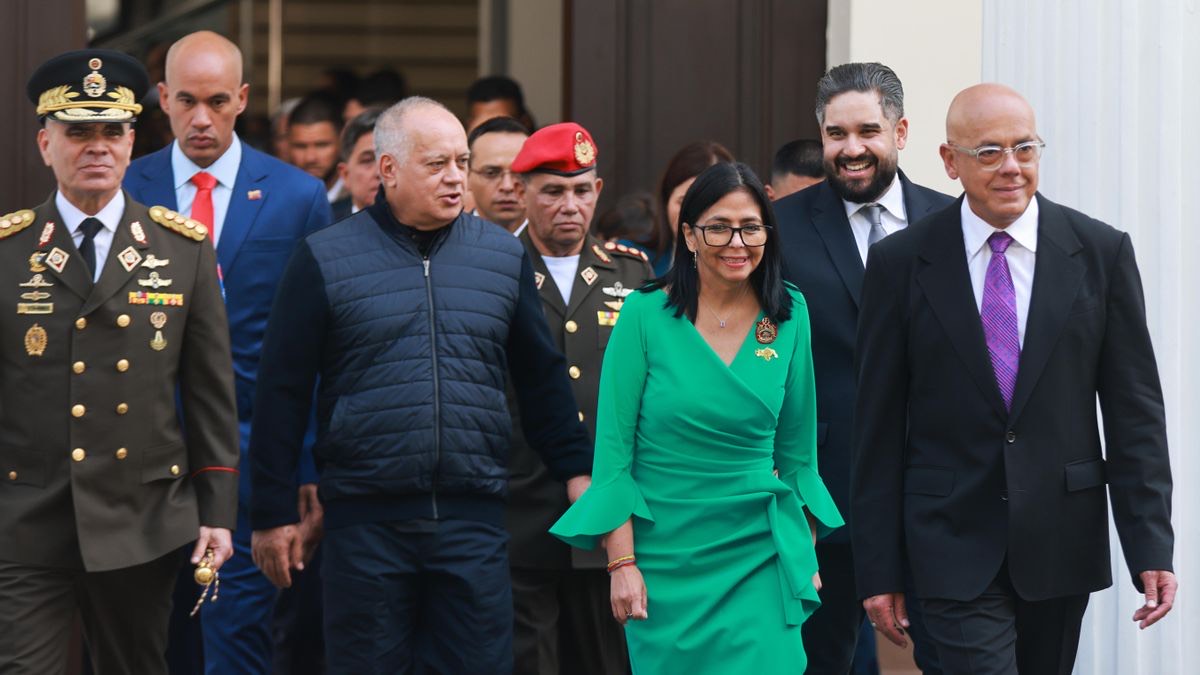
Maduro is out, Delcy Rodríguez is in, and yet Venezuela feels no more democratic than it did three days ago, when the former president was still boasting about air defenses and bunker walls.
The change itself was not entirely unexpected. In recent months, reporting had increasingly pointed to Rodríguez as the most viable figure to ensure continuity after Maduro, alongside speculation about negotiations involving her and her brother Jorge Rodríguez, including meetings in Doha facilitated by the Qatari government, that would have secured Maduro a negotiated exit and a prolonged, carefully managed transition.
In the end, that golden exile proved unnecessary. What followed was not a rupture, but an acceleration: the same transition logic, executed without the need for Maduro’s consent—or his presence. Still, calling this a “transition” rather than a decapitation feels increasingly strained when several of the figures flanking Rodríguez as she signaled her willingness to step in, should the Supreme Court so demand, carry the same international bounties Maduro once did, and in some cases appear in the very same indictments, now sharing docket space with far more famous recent arrivals.
If this were a democratic transition, power would be moving outward, toward institutions, parties, and voters. We would have seen the unconditional release of political prisoners. The winners of the July 28 election would not be calling for international protests demanding that their victory be respected. Instead, power has moved sideways and downward. The most visible winners of the post-Maduro moment are not opposition leaders, but many of Maduro’s former allies.
Even more telling is that while the armed forces appear to have retreated to their barracks, colectivos have rapidly expanded their role in Caracas from tolerated enforcers to de facto authorities. They patrol neighborhoods, gather intelligence, intimidate opponents, and perform basic law-enforcement functions with a confidence that suggests not stabilization, but delegation. Where, exactly, the United States is exerting the control President Trump claims to hold over Venezuela’s transition remains unclear, and, for now, largely the stuff of rumor.
Rodríguez may offer a fresher, more professional face at the head of the regime, but the internal knife-fighting, the power jockeying, and the coercive architecture remain firmly in place
This is not state collapse. It is state outsourcing. The arrested transition has reproduced Venezuela’s familiar condition of managed chaos, governed by actors who require neither legal mandates nor democratic legitimacy, only loyalty and force. For ordinary Venezuelans, the result is a familiar but sharpened experience of power: surveillance that feels more granular, coercion that feels more localized, and accountability that feels even more elusive.
The irony is that this consolidation is unfolding under the language of moderation and normalization. Rodríguez’s elevation has been framed as a stabilizing move, a technocratic turn after years of bombast and paranoia. Her record as economic vice president and minister is now being repackaged as evidence of competence, pragmatism, even reform. After denouncing Maduro’s “abduction” by U.S. forces on January 3, the very next day saw a remarkable pivot in the regime’s propaganda apparatus: Rodríguez was suddenly celebrated as Venezuela’s first female president, with a speed matched only by her plane’s return from Russia and landing in Venezuelan airspace, despite official claims that the skies were under U.S. control.
If colectivos are serious about rooting out traitors, they may find better luck checking phones in Miraflores and the Capitol than stopping cars on the highways of Caracas.
That speed matters. It reveals how thin chavismo’s ideological commitments have become, and how central narrative management now is to regime survival. Maduro was not the project; he was a vehicle. Once removed, the system adapted almost instantly, swapping revolutionary mythology for managerial language without altering the underlying mechanics of control.
For Washington, this appears, so far, to have been good enough. With Maduro gone, the Trump administration’s priorities seem to have shifted from political transformation to stabilization and risk management. A loud, autonomous opposition, once instrumental to regime pressure, is now framed less as a democratic partner than as a short-term liability. The result has not been repression, but marginalization: opposition figures are tolerated, even encouraged to remain visible, while being excluded from meaningful decision-making.
Meanwhile, the regime has solved a different problem, at least temporarily: how to continue governing under legal siege. Rodríguez’s inner circle overlaps heavily with the same network of officials who defined the Maduro years, many of whom face international indictments and bounties of their own. This is not fertile ground for the trust or guarantees required to sustain a regime as complex as Venezuela’s.
Whether Rodríguez’s presidency is a durable settlement or a trial arrangement remains unclear. So does the question many within chavismo are surely asking themselves: faced with continued pressure from Washington to “deliver,” will Rodríguez lean into the combative instincts that defined her domestic record, or will Maduro and Cilia Flores soon find themselves joined by more former comrades at MDC?
Transitions are meant to reset political and legal time. What has happened in Venezuela has merely rearranged it. Rodríguez may offer a fresher, more professional face at the head of the regime, but the internal knife-fighting, the power jockeying, and the coercive architecture remain firmly in place.
What emerges, then, is not a failed transition, but an arrested one. Politics has been paused in the name of order. Democracy has been deferred in the name of stability. Venezuela is governed as if perpetually on the verge of change, never quite authoritarian enough to provoke rupture, never democratic enough to allow arrival. Maduro is gone. Democracy, once again, is told to wait.