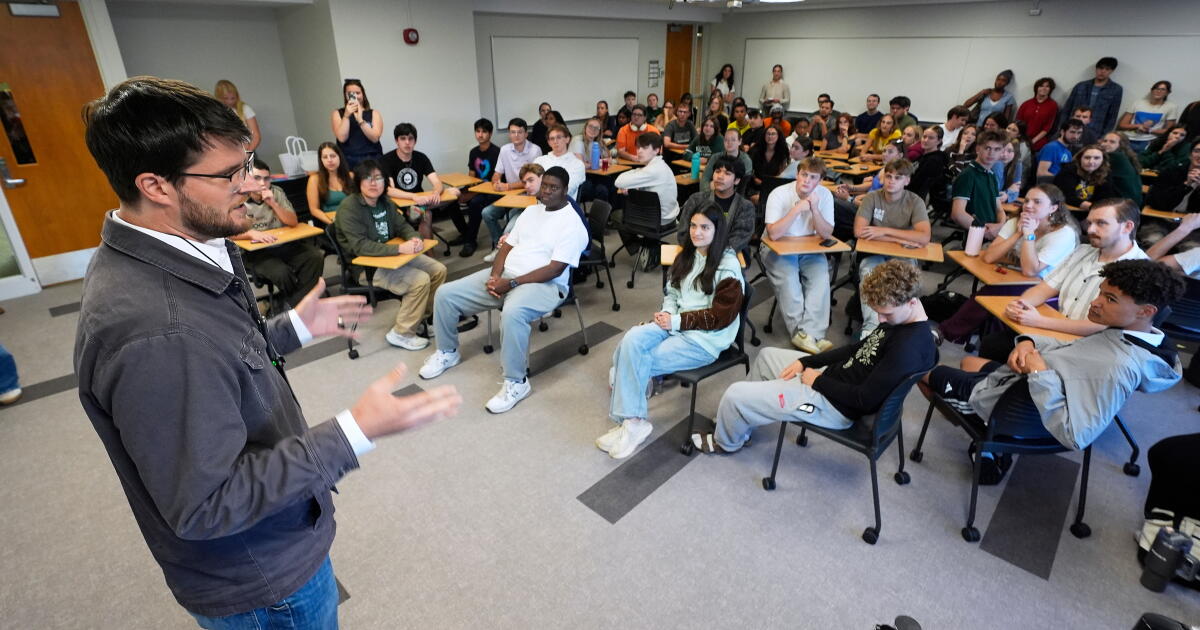
young people

Newsom signs bills that aim to make social media, AI chatbots safer for young people

California, home to the world’s largest tech companies, is placing more guardrails around social media and artificial intelligence as child safety concerns escalate.

On Thursday, California Gov. Gavin Newsom signed more than 10 bills aimed at keeping young people safe online.

From suicides to sextortion, parents and their children are wrestling with how social media and AI chatbots could be harming people’s mental and physical health. The anxiety comes as technology becomes more powerful, playing a bigger role in classrooms, offices and homes.

California lawmakers have tried to tackle online safety concerns for years and they’ve faced intense lobbying from tech companies with deep pockets. The state’s laws have a disproportionate impact on the global tech industry because so many of the field’s titans are based here.

“We cannot hand children technology engineered by some of the most sophisticated companies in the world, and then place the burden on kids to defend themselves against it,” said California First Partner Jennifer Siebel Newsom in a news conference Thursday in the San Francisco Bay Area.

The California governor, who has tried to strike a balance between safety concerns and supporting innovation, has rejected online safety bills in the past that he thought were too restrictive or premature.

The batch of new legislation includes Senate Bill 1119, which would require companion chatbot operators to assess risks, notify parents in certain cases if their child threatened to harm themselves, and take other safety steps.

Lawmakers named the bill Adam’s Law, after Adam Raine, a California teen who died by suicide in 2025 after conversing with OpenAI’s ChatGPT. The teen’s parents sued OpenAI, alleging in the lawsuit that ChatGPT provided information about suicide methods that the teen used. OpenAI and Pinterest publicly expressed support for the bill on Thursday.

Adam Raine’s mom, Maria, said in the news conference that the new law will help save lives and hopes that other states will enact similar legislation.

“Powerful AI companionship chatbots were unleashed on our kids with vastly inadequate protections. Adam was an early adopter of AI, and so many of us parents did not understand the dangers back then,” said Maria Raine, who came to the event with a photo of her son.

Suicide prevention and crisis counseling resources

If you or someone you know is struggling with suicidal thoughts, seek help from a professional or call 988. The nationwide three-digit mental health crisis hotline will connect callers with trained mental health counselors. Or text “HOME” to 741741 in the U.S. and Canada to reach the Crisis Text Line.

At the event, Democratic and Republican politicians shared their experiences as parents who have seen firsthand how technology affects children.

Assemblyman Josh Lowenthal (D-Long Beach) said parents are seeing anxiety and depression among children who grew up in front of screens.

“That anxiety is because the pace of technology is moving faster than government can put guardrails in, and that’s left families across the state struggling to figure out how to keep their kids safe,” Lowenthal said.

Lowenthal introduced Assembly Bill 1709, which Newsom also signed. It would bar certain online platforms from providing an “addictive feature” such as autoplay and feeds that display recommended content to users under 16 years old.

Tech industry groups opposed the bill, raising concerns that it could cut off access to social media’s benefits, such as people’s ability to connect with family and friends. Tech industry groups such as TechNet say that lawmakers should enforce current laws to strengthen parental controls rather than pass new ones.

NetChoice, which has sued California and other states to block the enforcement of new online safety laws, said in a statement that the group has First Amendment concerns about the new bills Newsom signed.

“The state cannot simply describe speech as addictive and then claim a right to regulate access to it,” said Zach Lilly, Director of Government Affairs at NetChoice. “Whether the governor and legislature choose to respect it, Californians have a right to express themselves, and NetChoice will continue to fight for that right.”

The new safety restrictions come as tech companies, including Meta, Google and others, face more scrutiny over how they design products. The companies have suffered several legal blows in courtrooms in California this year.

Meta, which owns Facebook and Instagram, agreed in August to pay up to $17 billion and make child-safety changes to resolve a multistate lawsuit. The lawsuit accused the tech company of designing and deploying harmful features while misleading the public about them.

As part of the settlement, Meta said it would impose time limits and mute notifications during certain hours for teens. Young people would also have the option to choose to view a non-algorithmic social media feed that isn’t personalized and disable autoplay.

Earlier this year, Meta and YouTube also lost a social media addiction lawsuit in Los Angeles.

While new legislation goes further than the settlements, some countries have passed stricter restrictions on social media. Last year, Australia started banning social media for children under 16, though enforcement has posed a challenge because teens are finding ways to get around the restriction.

Newsom, who pushed for federal regulation, said that he thinks California’s approach to social media is “better” than Australia’s because children are “all figuring out a way to game that system.”

“This is about the features themselves. This is about actually addressing the problem, the scrolling, the algorithms,” he said.

Safety concerns around technology have also heightened as companies double down on advancing artificial intelligence.

This week, a researcher for AI company Anthropic said he left the company over concerns that AI companies, including OpenAI, are “gambling with our lives” as they race ahead to improve AI that could surpass human intelligence.

The researcher, Jacob Coxon, shared a viral social media post that said: “People building AI earnestly believe that it could kill us all by the end of the decade.”

Newsom signaled the work to protect children isn’t over.

“We need to move, but one thing we’re not doing is we’re not sitting back and we’re not letting it rip,” he said.

Source link

The Earth is sizzling, but climate isn’t a hot topic for Democrats in this year’s campaigns

Climate change has been the backdrop to Charles Hughes’ entire life, from kindergarten lessons about disappearing habitats to wildfire smoke billowing through the air he breathed while growing up in Colorado. But now that he’s a college student in Massachusetts, he said global warming is rarely a top issue.

“Honestly, it doesn’t come up as much,” said Hughes, who chairs the state’s chapter of the College Democrats.

What a difference six years makes.

During President Trump’s first term and especially during the Democratic primaries to determine who would run against him in 2020, Democrats spoke constantly about climate change. They used it to rally young voters such as Hughes, fueling protests and sweeping demands to remake the economy with proposals like the Green New Deal.

But there has been a national shift in the conversation that is sharp enough for some researchers to coin the term “climate hushing” to describe it. The Searchlight Institute, a Democratic think tank, urged the party to stop mentioning climate change because it is not a priority for voters. The Sunrise Movement, a left-wing group that pushed global warming as a top issue for young people, switched its mission last fall to a broader mandate of fighting the Republican president.

The shift was encapsulated by the Democratic primary for U.S. Senate in Massachusetts on Tuesday as the incumbent, Ed Markey, 80, fended off a challenge from U.S. Rep. Seth Moulton, 47. Markey still talked about sponsoring the Green New Deal, but focused more on other issues to burnish his left-wing bona fides and prove to voters that he is not too old for the job.

It was the latest example of how climate change has been eclipsed by issues such as affordability, U.S. support for Israel and, above all, how to confront Trump.

“Six years ago, Green New Deal was every phrase out of Ed Markey’s mouth every chance he got,” said Mary Anne Marsh, a veteran Democratic strategist in Massachusetts. That wasn’t the case this cycle. “It’s about who’s best to fight. Period, full stop. Everything falls under that.”

‘People are increasingly freaked out about other issues’

Even if the political discussion on climate change has quieted, the planet has not. Scientists say there is an increasing chance that by the end of the year, 2026 could be the hottest year on record, or at least come close. A strengthening El Nino is forecast to be off the charts, spiking global temperatures.

Some advocates expect the issue to return to center stage if Democrats retake the U.S. House in November and climate-sparked disasters dominate the winter.

U.S. Sen. Sheldon Whitehouse of Rhode Island, a prominent Democratic voice on climate change, said in an interview that ignoring the issue is a major strategic “blunder.”

“Climate change has moved from the science department into the economics department,” he said. “It’s now battering people’s home insurance, property values, pocketbook concerns. So I think it’s a very powerful argument.”

Trump has falsely claimed climate change is “a hoax,” and his administration has undone policies one by one that would make it less damaging in the future.

The Sunrise Movement, founded in 2017 to mobilize young voters over climate issues, announced in October that it was shifting to a broader fight against “fascism.” The group’s executive director, Aru Shiney-Ajay, said that was a prescient move because of reports that federal agents infiltrated protest meetings during Trump’s immigration raids in Minneapolis.

“We just live in a significantly more authoritarian country. Because of that, a lot of the Democratic primaries are about more existential questions,” Shiney-Ajay, whose network generally backs left-wing Democrats, said in an interview. “It has felt less like people care less about climate and more like people are increasingly freaked out about other issues.”

About 6 in 10 Democrats say climate change is “a very big problem” for the country, according to a Pew Research Center poll from April. That is roughly the same as in 2016. Still, climate has often taken a back seat to other issues in Democratic voters’ priorities, such as inflation, healthcare affordability and the role of money in politics.

Affordability concerns have dominated the political debate this year.

McKenzie Wilson of Blue Rose Research, a Democratic data firm, said voters have called for sweeping changes in response to economic discontent, demonstrating a level of anger not seen in years.

“In that kind of environment it’s hard to think about long-term, existential problems,” Wilson said. “If we don’t talk and focus our attention on the number one thing the electorate wants to talk about, as we saw in 2024, we’re not going to be connecting with the electorate.”

‘Don’t say climate change’

That view was summed up by the Searchlight Institute, a Democratic think tank that last year released a provocative suggestion: “The First Rule About Solving Climate Change: Don’t Say Climate Change.”

It contended that voters saw it as such an intimidating, complex issue that Democrats were more likely to win by focusing on other subjects — thus enabling them to regain power and tackle the crisis that they were not talking about.

Leah Stokes, a political scientist at the University of California, Santa Barbara and author of “The Carbon Wave,” a book about Democratic President Joe Biden’s domestic agenda, said it was “galling” when politicians made the issue less of a priority.

“The climate crisis is accelerating and we can’t really not talk about it for like a decade, because the planet will be even more on fire if we do that,” she said.

Anthony Leiserowitz, director of the Yale Program on Climate Change Communication, agreed with those concerns.

“What happens over the course of the next decade will profoundly shape the habitability of the planet for literally thousands of years to come,” he said.

Some are making climate an affordability issue

Climate has come up as part of the national backlash to data centers, but it is only one part of the conversation about the projects’ impact. Many climate advocates are adjusting how they talk about the issue, stressing how green energy can lower prices and ease insurance costs.

“What we’re seeing right now is, whether you’re advocating for healthcare reform or climate action or some niche tech issue, everything is filtered through some cost frame,” said Jared Leopold, a veteran Democratic strategist who has long focused on climate change.

That is how the Green New Deal came up at a recent debate between Markey and Moulton, when a voter asked how each candidate would reduce energy prices. Notably, the questioner asked about increasing nuclear or gas generation, not clean energy, to deal with cost. Markey turned the opportunity into a slam against the president.

“There was a plan in place in order to have a strong, clean affordable energy future for our commonwealth,” Markey said, “and Trump attacked it.”

Tatishe Nteta, a political scientist at the University of Massachusetts Amherst, said that is how Markey has used climate change this election — to signal his willingness to fight Trump as well as his alliance with the left flank of the Democratic Party, which has run up a series of primary wins this year. But other issues have become even more useful in doing that.

“The definition in where you’re at in terms of a progressive candidate and a progressive elected official is your viewpoint on Israel,” Nteta said. “You’re not hearing this in most races, that I’m the candidate who’s going to protect and save our planet.”

Massachusetts’ summer has been the hottest that Eileen Cefail can recall in the 30 years she has worked in the Roofers Local 33 office. “The roofers are tough as nails, and they work so hard, and their work is so grueling,” she said. “This heat has been horrendous for them.”

Cefail is backing Markey in the primary, but climate, she said, was not the main reason.

“He’s always been a union guy,” Cefail said. “He’s just for the labor.”

Riccardi, McDermott and Willingham write for the Associated Press. Riccardi reported from Denver and McDermott from Providence, R.I. Associated Press writer Linley Sanders in Washington contributed to this report.

Source link

México Canta: Binational music competition embraces Mexican Americans

Long gone are the days of Mexican Americans’ alienation from Mexico — at least, if the Mexican government can help it.

On Sunday, hundreds of spectators gathered inside the Orpheum Theatre in downtown Los Angeles to watch the United States semifinals for “México Canta,” a binational music competition for rising artists from the U.S. and Mexico, organized by the latter’s Ministry of Culture.

Seven participants of Mexican descent from across the U.S. braved the stage with original songs, in what can only be described as a heartfelt singing contest, without the scorn of nitpicky judges or behind-the-scenes melodrama, but rather a zealous crowd made up of all age groups.

Voting was handed over to the public, as the segment broadcast live on public television across the United States and Mexico. Over 300,000 individuals tuned in to cast a vote to advance the top three contestants: Tiffany Galaviz, Joshua Soto and Rosalba Valdez. They will go on to compete in the grand finale of México Canta on Sept. 13 at the Auditorio Nacional in Mexico City for a chance at a record deal.

“There’s always that saying that if you’re Mexican American, you’re not Mexican enough, but I think that’s wrong,” said 18-year-old Soto, a Bronx native whose musical theater background and deep R&B groove gave depth to the bilingual country-corrido “Terco Callejero.”

“Ever since I was little, my parents always showed me my culture, my roots. It’s in my blood. It’s in the traditions that I follow and the music that I listen to every day,” added Soto, who is enrolled in New York University’s vocal performance program in music theater.

For 27-year-old semifinalist Valdez — a Chicagoan whose signature red hair and bedazzled fringe fit distinguished her onstage, as she sang her merengue-infused tune “Por Bonita” — being Mexican American is both a huge privilege and responsibility.

“When I was younger, I used to think the opposite, because of what our community went through,” said Valdez. “Now I see it as a superpower. [Being Mexican American is] something that I want more people to understand has power. We can create a lot of change when we realize the power that we have.”

Joshua Soto, Tiffany Galaviz and Rosalba Valdez

Over 300,000 individuals tuned in live to cast a vote for the top three contestants: Joshua Soto, Tiffany Galaviz and Rosalba Valdez

(Ronaldo Bolanos / Los Angeles Times)

Speaking to The Times, Mexico Secretary of Culture Claudia Curiel de Icaza, stressed the importance of binational programming — adding that she believed that the singing contest can unite young people across the U.S.-Mexico border.

“We cannot think that we are merely divided by territory. Culture transcends borders, music transcends borders,” she said. “We are separated, but ultimately there is an extremely intimate and rich cultural development because culture has been the space of resistance, of resilience.”

As host and singer, Majo Aguilar — granddaughter of Mexican film and music legends Antonio Aguilar and Flor Silvestre — ushered vocalists on and off the stage. Large screens lit up with educational stories of the legacy of Mexican nationals, such as Pedro J. González, one of the first Spanish radio broadcasters in the U.S.

The show also paid homage to American-born individuals who have elevated Mexican music: including Texas-born Gloria Ríos, who helped pioneer rock ’n’ roll in Mexico in 1956 and Arizona-born Linda Ronstadt, whose 1987 album “Canciones de Mi Padre” became the bestselling non-English language record in U.S. history.

This year, the contest placed an emphasis on música mexicana. According to Spotify, global streams of the genre have grown by 295% since 2021; in the U.S. alone, its popularity has grown by 162% since 2021.

In large part, its popularity has been driven by corrido tumbados, or songs which blend traditional Mexican folk with trap, often underscoring street life, “the hustle” and the riches that can follow.

Its most prominent acts include Junior H, Fuerza Regida and Peso Pluma. These were the biggest streaming Latin musicians in the U.S. in 2024, just below reggaeton superstar Bad Bunny — yet none of these popular música mexicana artists were recognized during the competition.

“Mexican music is among the most consumed worldwide and it’s a matter of choosing a genre where young people feel identified and music that transcends borders,” said Curiel de Icaza. “And no, we are not censoring it.”

México Canta began in 2025 as state-sponsored programming to promote musical narratives beyond themes of violence and drug-trafficking.

Besides banning the use of artificial intelligence and other audio alterations, the contest did not permit “songs that glorify violence or drug use.” Failure to comply with the rules would result in disqualification for contestants.

“More than banning, it’s about educating, guiding, and getting young people to stop listening to that music,” President Claudia Sheinbaum said in a news conference last year when the program was first introduced.

President of Mexico Claudia Sheinbaum speaks during the daily morning briefing at Palacio Nacional.

President of Mexico Claudia Sheinbaum speaks during the daily morning briefing at Palacio Nacional on Aug. 6, 2025, in Mexico City.

(Manuel Velasquez / Getty Images)

The singing competition comes at a time when 10 out of 32 Mexican states have implemented bans or limitations on corridos in public spaces; namely narcocorridos, or ballads that recount or glamorize elements of drug culture or organized crime.

Some lawmakers assert that the lyrics in these songs promote violence, including Mexico City lawmakers who, in May, passed a law barring the songs from being played at public events.

“The bans, which come amid President Trump’s hyper-focus on drug trafficking in Mexico, have sparked debates here about freedom of expression and state censorship and have raised provocative questions: Do narcocorridos merely reflect reality in a nation gripped by powerful drug gangs? Or do they somehow shape it?” wrote Times correspondent Kate Linthicum in a May 2025 article.

In May, the second edition of México Canta was announced during Sheinbaum’s daily news conference, generating online buzz when famed corrido tumbado singer Junior H vocalized support for the contest — while also lamenting his past musical choices.

“In my initial [career], some of the stories that I shared in my music didn’t add to the positive message that reflect my current compositions,” said Junior H, whose real name is Antonio Herrera Pérez, in the news conference. “I kept growing and I learned that music, besides being a form of expression, also implies a responsibility when millions of people hear you worldwide.”

The 25-year-old rose to fame through popular narcocorridos such as 2023’s “El Azul,” which is believed to be about Sinaloan drug lord Juan Jose Esparragoza Moreno; as well as his 2022 banda-fused track, “El Hijo Mayor,” which some speculate to be about the son of Joaquín “El Chapo” Guzmán.

“When you grow up, you have a career path and you see that you have an impact on young people, you start to mature and evolve your career,” Curiel de Icaza said of Junior H. “And you realize you want to go in a different direction, that’s when he understood and decided that it was better to focus on something else.”

During the news conference, Sheinbaum denounced the idea that the music contest was a form of censorship. Curiel de Icaza also refuted those claims: “We’re not prohibiting anything. Music will continue to exist, different voices exist and we’re not prohibiting or censoring songs.”

To help amplify the values of México Canta, organizers enlisted the help of Los Tigres del Norte, one of the most successful regional Mexican acts in the U.S. The night before the semifinals in L.A., Los Tigres performed with Gustavo Dudamel at the Hollywood Bowl.

The band closed Sunday’s competition with a performance of “México Sigue De Pie,” a new song that underscores the grit of the Mexican community. “They’re legendary,” Curiel de Icaza said of the band.

Coincidentally, the esteemed guests were early pioneers of narcocorridos: including their 1974 song “Contrabando y Traición,” which details a fictional drug trade tale of Emilio Varela and Camelia la Texana, as well as their 1978 track “La Banda del Carro Rojo,” which describes cocaine trafficking across the state lines.

But over the last decade, the band, too, has been advised by concert organizers in Mexico to avoid playing these types of songs when performing in certain venues, leading them to voice concern over the criticism of corridos — which they argue provide listeners with details over real-life truths, in the same way journalists engage in storytelling.

“We’re narrators of people’s lives,” bandleader Jorge Hernández told El País last year.


Source link