The Trump administration is considering trading a parcel of Yosemite National Park to a private commercial developer, according to administration officials, members of Congress and documents reviewed by The Times.
The proposed deal would allow the developer to build a road connecting adjacent property it already owns in the Stanislaus National Forest to a service road within Yosemite, providing any future development on that property with unique access to the famed public wilderness, documents show.
According to a Friday report by the news outlet NOTUS, Trump administration officials have been quietly pressuring the National Park Service to approve the deal for the land despite such pressure being highly unusual and previous proposals for the land being repeatedly denied under the Bush and Obama administrations and in court.
The Department of the Interior, which includes the National Park Service, acknowledged in a statement to The Times on Friday that a land deal is under consideration, but denied any inappropriate influence from the White House.
It said negotiations for the land will comply with all federal rules for federal lands, and that “no final decisions have been made.”
An attorney for the private developer said the deal has nothing to do with politics and is in fact an “environmentally friendly” solution, in that it would dramatically cut down on the amount of driving the future upscale development’s residents would have to do to access the park.
President Trump speaks to astronauts aboard the International Space Station as he visits NASA’s Mission Control Center on Aug. in Houston, Texas.
(Win McNamee / Getty Images)
Congressional Democrats — including Sens. Alex Padilla and Adam Schiff of California — are trying to block the deal, after being informed of it earlier this year by the Land and Water Conservation Fund. The fund was created by Congress in 1964 to safeguard natural areas and public lands, and often works to acquire lands to add to national parks.
A fact sheet on the project reviewed by The Times identified the parcel by a former name, the “Hazel Green Ranch,” and said the landowner is seeking to acquire an “interest” in land within the park in order to build a new road connecting “a planned commercial development” to Big Oak Flat Road, an existing federally owned road that “provides access to the park and is a major route to Yosemite Valley.”
The fact sheet said the National Park Service does not have the authority to grant that interest, but has been working with the landowner to facilitate an “exchange” of the land for some other, unidentified parcel of land that is beneficial to the U.S., as allowed under law for federal land swaps.
The project has been identified to lawmakers, without explanation, as a “priority.” Both Padilla and Schiff have objected to it, and Padilla’s office said it is working with Senate Appropriations Committee staff to block the deal.
“The Land and Water Conservation Fund exists to acquire land and interests in land in order to safeguard natural areas, water resources, and cultural heritage — and to provide recreation opportunities for all Americans,” Padilla said in a statement to The Times. “Projects should be chosen on merit, not on an applicant’s connections to high-ranking Trump administration officials.”
Schiff, in his own statement, said Yosemite is “one of California’s natural wonders, and must be protected from further development.”
He said the Trump administration “appears hellbent on moving forward in the face of opposition from the public, Congress and the courts,” and that “the only thing the administration cares about is whether there is money involved.”
The company behind the private development is Nevada-based real estate developer and investment firm Kingsbarn Realty Capital. According to Federal Election Commission records, Kingsbarn CEO Jeff Pori is a donor to Trump, the Republican National Committee and other Republican groups.
Lanny Davis, a former special counsel to President Clinton, represents Kingsbarn, and said the notion the project is moving forward due to Trump administration pressure and Pori’s political contributions despite being environmentally detrimental is false.
He said Kingsbarn wants to build “upscale, single-family houses” on its property, but hasn’t so far because residents would have to drive 28 miles using current roads to reach the park.
To cut that distance down and make the development more feasible, it asked the National Park Service to purchase an 11-mile strip of land within Yosemite to build a shorter, more direct access road, Davis said.
The Park Service responded by saying the company could not purchase park land directly, but could purchase other nearby land of equal or greater value, and then swap it for the park land, Davis said.
It is now working with the Interior Department to identify such land, and is “very close” to doing so, Davis said — calling it a “pro environmental solution” that follows federal law and has “nothing to do” with Pori’s politics.
The White House referred questions about the proposed deal to the Interior Department.
In its statement to The Times, the Interior Department said the NOTUS story “relies on anonymous allegations to manufacture a political narrative that simply is not true. There has been no political pressure to reach a predetermined outcome, and claims suggesting the Department is secretly working to hand over National Park Service land to a private developer are false.”
If a proposal does advance, the statement said, the department will follow established procedures with “transparency and public involvement consistent with federal law. Anonymous speculation does not change those facts.”
The department did not respond to a request for more details as to the proposal.
The land in question represents a tiny portion of the sprawling Yosemite National Park, which is nearly 750,000 acres in total — or roughly the size of Rhode Island. Still, slicing off any piece of the California wilderness — considered a crown jewel in the national park system — runs counter to promises from Trump and Interior Secretary Doug Burgum.
“My Administration is committed to protecting every acre of our lands and preserving the cleanest air and water in the world,” Trump said in a presidential message on Monday.
Ceding federal lands is also anathema to land preservation groups, which expressed dismay at the idea that any piece of Yosemite might be lost, no matter how small.
Aaron Weiss, executive director of the Center for Western Priorities, said that the NOTUS reporting was “consistent” with what his organization has been hearing “for several months” — and would be inconsistent with public desires for national park lands.
“The American people have consistently said that our public lands, especially our national parks, are not for sale,” he said. “If Secretary Burgum spent more time listening to Americans instead of indulging President Trump’s whims on the National Mall, he’d understand what a terrible idea this is.”
Jayson O’Neill, a spokesman for the group Save Our Parks, said the proposed deal as described by NOTUS represented the latest attempt by the Trump administration and Burgum to gut the Park Service and “then quietly cede treasured park land to private developers, thinking nobody’s watching.”
“National parks belong to the American people, not monied developers who are part of Trump’s donor class,” O’Neill said.
Mark Rose, senior Sierra Nevada program manager for the National Parks Conservation Assn., slammed the proposed land swap as a “secretive, backroom deal” and “an attack on the American people that own this national park.”
He said Yosemite is already facing overcrowding due to “run-away lodging” development outside its borders and the Trump administration’s decision to do away with the park’s reservation system, and a new development would “exacerbate the chaos.”
“The National Park Service needs to get back to prioritizing conservation, not helping bulldoze land, cut down towering trees and construct a luxury development that will harm Yosemite’s wildlife and increase wildfire risks,” Rose said.
When Sebastian Dollinger and his colleagues first drove into Yosemite National Park, they felt like they were entering the world at its finest — a prehistoric beauty of hulking rocks with every waterfall flowing in the valley.
It reminded Dollinger, who lives in Sweden, of the Swiss Alps in summer.
The moment didn’t last long.
As the group, in the park in early May for a fashion shoot for California luxury brand Robert Talbott, neared Mirror Lake in Yosemite Valley, Dollinger’s party felt like it had been overtaken by a massive swarm of bees as droves of other tourists buzzed around them, he said.
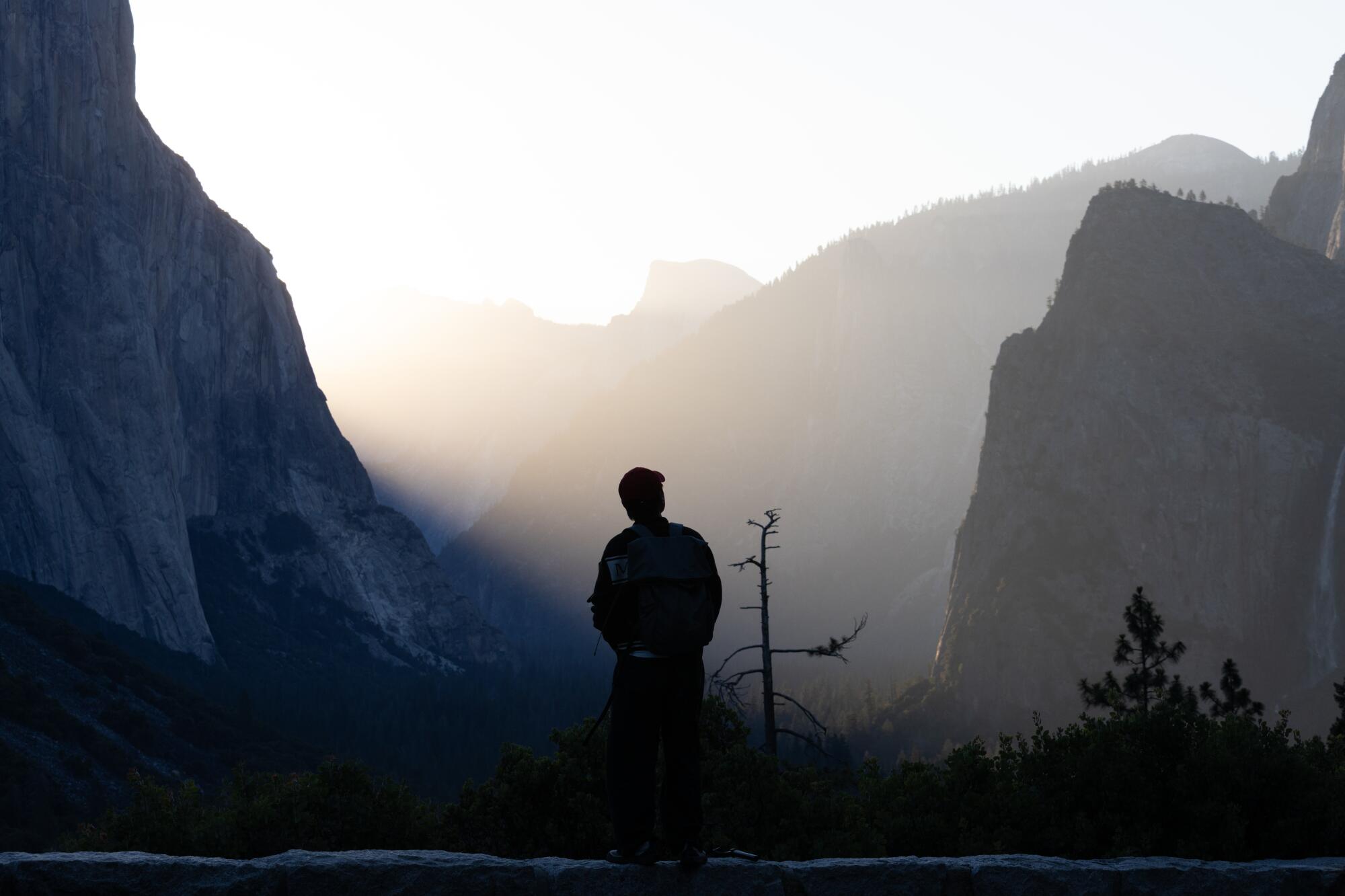
A tourist stands in front of an overlook near Yosemite Valley during a sunrise in mid-June in Yosemite National Park.
Tourists wait at the Yosemite Falls bus stop.
“I could have taken up climbing and gone up El Capitan just to escape the people,” Dollinger said, referencing Yosemite’s famous rock wall, “but I’m just a creative director.”
This summer, Yosemite is seeing a significant uptick in visitation, driven by the park’s internationally known splendor, its popularity on social media and a lack of its politicized reservation system. As droves of tourists flock to Yosemite, it raises the question: Is it still possible to have a fun time there despite the crowds?
Hopefully, yes, but that answer comes with a few heavy asterisks. Park-goers and local business owners say it’s crucial for those venturing into Yosemite this summer to plan their excursions outside peak times to avoid the worst of the crowds, and even then, pack their patience. The best-laid plans can still result in visitors facing significant lines at the park’s gate and restaurants, crowded hiking trails and a relentless search for parking.
By the end of June, Yosemite had seen at least 183,000 more visitors than last year, according to preliminary park visitor data. Just over 2 million people visited the park by the end of June, a 10% increase compared with last year’s visitation data.
Crowds pose for photos on the Mist Trail.
The increase in visitors is, in part, because the National Park Service is not using a timed-entry reservation system this year.
The National Park Service announced in February — after the agency under the Biden administration studiedextensively how to best implement a reservation system — that officials would instead use “targeted management.” This has included sending congestion alerts to visitors’ mobile phones and encouraging visitors to venture outside the valley, as it represents only a fraction of its almost 1,200 square miles of parkland.
When asked how the agency planned to address overcrowding in Yosemite this summer, a National Park Service spokesperson who declined to give their name to The Times said in an emailed statement that temporary traffic delays can occur during peak times but aren’t evidence of “operational failure.”
“They reflect the reality of managing one of the nation’s most visited national parks while keeping visitors safe and protecting park resources,” the spokesperson said. “Claims of widespread ‘overcrowding’ are not an accurate characterization of current park operations. Visitors have benefitted [sic] from expanded access for months now, and we are seeing operational efficiency from managing traffic only when and where necessary, rather than blanketing the park with restrictions for entire seasons.”
Dozens of tourists hike their way up the Mist Trail in mid-June, one of the more popular trails in Yosemite National Park.
Visitors like Dollinger say this new approach is not working.
“After we hiked for about three hours, we met a couple from Japan, and when I talked to them they were almost in tears,” said Dollinger, who has visited other state and national parks in California. “They saved for five years to do this trip, flew to San Francisco from Tokyo, stayed in San Francisco and hired a car, and went to the park for five days, which I can only describe as hell.”
Not every Yosemite visitor that The Times spoke to for this story had as bad of a time as Dollinger, but no one disputed crowds being an issue.
Chidumebi Ajaero, who lives in L.A., said he was “very concerned” when he and his friends left for their trip in mid-April over how crowded the park would be.
It was Ajaero’s first time to visit Yosemite after moving to California about 2½ years ago from Houston. He has been to other national parks and said he knows they can get “quite chaotic” when busy.
Tents set up in Upper Pines Campground on a June weekend in Yosemite National Park.
Ajaero and his friends arrived in Yosemite on a Friday afternoon and were surprised to find there was no line to enter the Big Oak Flat entrance.
They set their campsite up at Upper Pines, a campground in the valley, and headed out early on the Mist Trail, which takes hikers to Vernal and Nevada falls via its large stone steps. There were a considerable amount of people on the trail with them, he said.
“It’s not until you get to the waterfall itself and you have the steps, and everybody is taking pictures,” Ajaero said. “There’s actually a line to move up. You’re just waiting for your turn to step up” to capture the waterfall.
Ajaero said he’s glad he went before Memorial Day, when visitation started to increase more significantly.
But because of how curated Yosemite Valley is, with a grocery store, souvenir shops and restaurants, Ajaero said it felt more like an amusement park than his trips to Joshua Tree National Park, where visitors are far more on their own.
Hikers walk on a boardwalk designed to prevent erosion in sensitive meadows.
“I didn’t love it as much as the other because of the commercialized feeling of it, and just the fact it never felt you were alone in Yosemite,” he said. “I think there’s too much going on.”
How developed Yosemite should be for its visitors has been a debate since the park’s existence.
Michael W. Childers, author of “The Mountains Are Calling: Tourists and the Unmaking of Yosemite National Park” (Nebraska), said people often use the metaphor of not wanting to turn the park into Disneyland, but a more apt comparison is how closely Yosemite resembles a resort.
Concessionaires have been in Yosemite since its beginnings, as the federal government didn’t have the money to construct its own amenities in the 1850s, he said. Yosemite Hospitality, a subsidiary of hospitality giant Aramark, manages much of Yosemite’s lodging, dining and activities (including the park’s Starbucks inside the valley).
Childers, an associate professor of history at Colorado State University, said his concern is that, since the late 1970s, conservative intellectuals have pushed to privatize the park even further.
He said the chaos being created by the Trump administration through cutting park staff and ending the reservation system is “very intentional” in the quest to argue the only way to manage the park is to privatize Yosemite.
“If you privatize the entirety of a national park, that means that your only one measuring stick is profit, and arguably, national parks are not solely designed for profit,” said Childers, an environmental historian of the American West. “They’re for experience. They’re for democracy. They’re for preservation of natural resources.”
Vehicles stop to pay the fee at the El Portal entrance gate.
Vehicles line the road near El Capitan in Yosemite National Park.
One of park officials’ most significant management challenges started when tourists began entering Yosemite by automobile. Since 1913, people could enter in a personal vehicle, but visitation numbers remained reasonable until 1926 when the “All Year Highway,” a segment of the 140 Highway, opened.
This new thoroughfare created an easy and direct route to reach the park by car that avoided steep mountain roads, according to park history. The road’s opening resulted in a near doubling of total cars visiting the park in just one year, park staff said in an Instagram post.
“The summer of 1927 has clearly demonstrated that parking is one of the most urgent, menacing problems of the entire Yosemite Valley,” said Don Tresidder, president of the Yosemite Park & Curry Co., that year, according to the park.
And has thus remained for 100 years.
The first attempt in recent years to get a handle on car traffic was the reservation system, implemented initially to spread guests out during the COVID-19 pandemic in 2020 but rolled out in 2021, 2022 and 2024 as the park service tested how to best employ it to cut down on traffic and help more visitors enjoy the park.
“Over the past decade, many parks have seen significant increases in visitation and crowding in popular areas, especially during peak seasons,” the agency wrote in 2024 as it sought public comments on park management. “In some parks, the level of demand is exceeding the capacity for which infrastructure was designed or is outpacing the National Park Service’s ability to sustainably support visitation.”
The park service planned to use visitor feedback and research to guide how reservations would be rolled out in 2025. Environmental and park advocates argued for the reservation system, saying that it not only protected the wildlife and land, but also that it waspopular among guests.
But when Trump started his second term in office, not only did park management strategy change, so did the way the federal government viewed the park service. Hundreds of park workers were laid off, although some got their jobs back. Others took buyouts, and overall there was a 24% decline in permanent workers, according to the National Parks Conservation Assn.
One of the reservation system’s biggest critics is Rep. Tom McClintock (R-Elk Grove), who said the system was decimating the economies of local gateway communities, the term used for the small mountain towns around Yosemite.
Parking lots are filled to capacity during peak hours, creating traffic congestion in Yosemite National Park.
“This is not to say that crowding in the valley hasn’t been a big problem, but the solution is better management and more capacity, not restricting access,” McClintock said on the House floor in June, noting the park had more parking, rooms and campsites before the 1997 flood destroyed infrastructure that he said wasn’t replaced.
Under the timed-entry system, visitors could still enter the park without a reservation if they arrived early — before 6 a.m. in 2021 and 2022 and 5 a.m. in 2024 — or after 4 p.m., and would be required to pay an entry fee for a three-day pass allowing them to reenter outside of peak hours.
But entering the park early or late in the day still wasn’t doable for everyone, including Ronny Shields, a father of two children from Ventura.
Shields, a lifelong Southern California resident, struggled to book a reservation when Yosemite implemented the system until he finally snagged one in 2024. His family had a great time and was eager to return.
In early June, Shields, his wife and kids, ages 4 and 7, made the trek back to Yosemite, staying outside the park at Tenaya at Yosemite in Fish Camp. Shields had researched and found information online suggesting the nearby southern entrance was less crowded.
His family arrived on a Saturday afternoon and entered the park without a wait. They found the valley was quieter than they’d ever seen it as people left.
Tourists stand in a meadow with a perfect view of Yosemite Falls.
For the rest of their trip, they entered the park before 8 a.m. or after 3 p.m., except for one day when they entered later in the morning and waited 40 minutes to enter. The other times, they found no wait.
Once inside the park before 8 a.m., their first stop was the Bridalveil Fall Trail, a short trek that takes visitors right to the base of the thundering cascade. When Shields and his family left the trail about 9:30 a.m., they noticed other guests couldn’t find parking.
They faced the same problem after they went to get food and then tried to park near the Lower Yosemite Falls trailhead. After 20 minutes, they found a spot — and joined the masses.
The trail “doesn’t feel like a hike — it feels like you’re in a crowded mall, but I think that’s the nature of the beast because it’s very short and very scenic,” Shields said.
Comparing his two visits to Yosemite, Shields said he preferred not having to deal with the reservation system, but that came with some caveats. He noticed far more visitors, although he’d expected even more. He saw more trash, several guests going off trail and trampling plant life, and far fewer park rangers to tell them to stop.
He said he didn’t see any park staff in the outdoor areas, and instead, he and his wife made sure to take their kids into the park’s buildings so they could speak to the rangers.
Tourists swim and play in the Merced River in Yosemite National Park.
“It’s nice for the kids to be able to ask questions and learn from people that love it,” Shields said. “Even I learned something.”
Jennifer Liu, a Moreno Valley resident, was at the park the same time frame as the Shields family and was able to mostly avoid the crowds on her backpacking trip through the park’s backcountry.
Liu meandered through the park using a few different trails, including the Sunrise Lakes route, to reach her ultimate destination: Half Dome on her birthday. She left her backcountry campsite about 4:30 a.m. to reach Half Dome by 6 a.m., catching the sunrise at 8,800-feet elevation from the granite monolith.
“I got lucky — the clouds cleared out and there was a nice sunrise,” she said.
Not in a hurry, Liu stayed at the top for four hours. Her fellow hikers sang her happy birthday, and she witnessed a couple get engaged.
Sunset over the Half Dome lookout in Yosemite National Park.
“By 10, when I headed back down, that’s when the crowd was starting to pick up,” Liu said, adding that she was grateful there was still space to navigate the dome’s cable system without being rushed by others.
As a means of crowd control, the National Park Service has attempted to funnel people out of the valley, where the majority of tourists spend their time and into its less frequented locations.
Park officials have tried to rebrand Hetch Hetchy, a massive reservoir surrounded by glacier-carved rock walls, by claiming that “many have compared Hetch Hetchy’s grandeur to the more well-known Yosemite Valley,” according to a recent update on the park’s website. (Previous versions of the Hetch Hetchy page made no such claim, according to archived versions of the website viewed through the Internet Archive.)
The park service doesn’t cite a source for such claims. California naturalist John Muir compared the two valleys’ beauties, but that was before Hetch Hetchy Valley was transformed by the O’Shaughnessy Dam into a massive reservoir.
“John Muir lost the fight over Hetch Hetchy, and the dam was built. And people who live in San Francisco today drink the water of Hetch Hetchy,” historian William Cronon said in the Ken Burns national parks documentary. “Muir died feeling that he’d been defeated by that, and that was a great tragedy at the end of his life.”
Still, Hetch Hetchy has long been whispered among Yosemite regulars as a place to find a little quiet.
That’s changed too.
An empty road under El Capitan in Yosemite Valley National Park.
“We used to have these secret spots we could tell people about,” said Elisabeth Barton, owner of Yosemite Basecamp in Groveland, which offers lodging, trips by local outfitters, gear and more. “‘Go to Hetch Hetchy,’ you’d say quietly and look over your shoulder. ‘Go to this waterfall’ or ‘Do this hike.’ … One of the things we’re noticing is, very quickly on a weekend, [the park] is sending out that alert that Hetch Hetchy is full or that Hetch Hetchy has ‘extreme visitation.’ It’s weird.”
Barton, whose company runs a visitor center in downtown Groveland, said there’s not much she and her team can recommend for people coming Thursday through Sunday into the park. It will be crowded regardless.
On a recent Saturday, Barton met a hiker who was devastated he couldn’t easily enter the valley without dealing with crowds. Barton let him in on a less popular trip that involved a great swimming hole, fish tacos at Whoa Nellie Deli, an adventure around Mono Lake and a drive through a stunning mountain pass. She recommended that he take a long way to reenter the park, enabling him to see the valley at a time he’d miss the crowds.
He called her a week later and told her to never recommend that to anyone ever again. He’d had a great day until he tried to reenter the park and instead waited four hours at the Tioga Pass in a line that stretched for miles. “You’re right, it was beautiful,” he told her, “but to what end?”
“I just wasn’t prepared for that,” Barton said. “It just broke me.”
Even sacred sites — with signage directing visitors away from the area — have been trampled by crowds.
The American Indian Council of Mariposa County, also known as the Southern Sierra Miwuk Nation, fought for decades to establish Wahhoga Village, which is an ancient village site and the last place that Indigenous people lived in Yosemite Valley before being driven out by the National Park Service.
Today, Wahhoga Village includes a traditional roundhouse, traditional cedar bark houses known as umachas and the only cabin that the park service didn’t burn when it evicted the remaining families from the site in 1969.
Wahhoga is not listed on Yosemite maps and is not intended to be used by those who aren’t either authorized or invited by the council to be there, said Deborah Tucker, a council member whose father advocated for years for Wahhoga.
But, Tucker said, in recent weeks, tourists have been found picnicking in the site. Hikers were tromping right through the middle of the village, led by a user-generated route on a popular outdoors adventure app, she said.
And while there, someone peed all over the village’s grinding stones, which are used for processing acorns into flour, along with other foods, said Tucker, whose father is Paiute and Shoshone and her mother was Choinumni, a branch of Yokut, tribes indigenous to the region.
Tourist beat the heat and float on tubes in a river in Yosemite National Park.
Under the current administration, “it’s a free-for-all,” Tucker said. “You can come up there and do what you want, park where you want and you’re disrupting not just sacred sites but other park sites that the park service has [established],” leading to littering and other pollution, noise that harms the birds and speeding cars that threaten the safety of bears and other wildlife.
Tucker said because the current administration seems fixated on money over conservation, she hopes that when people visit the park this summer, they will at least hold themselves accountable, showing respect for the land and its inhabitants.
“Clean up after yourself, maybe clean up after one another, and don’t take anything home with you that you didn’t bring,” Tucker said when asked what she’d say to the park’s visitors. “Enjoy that experience, and [you’re] welcome to come back again.”