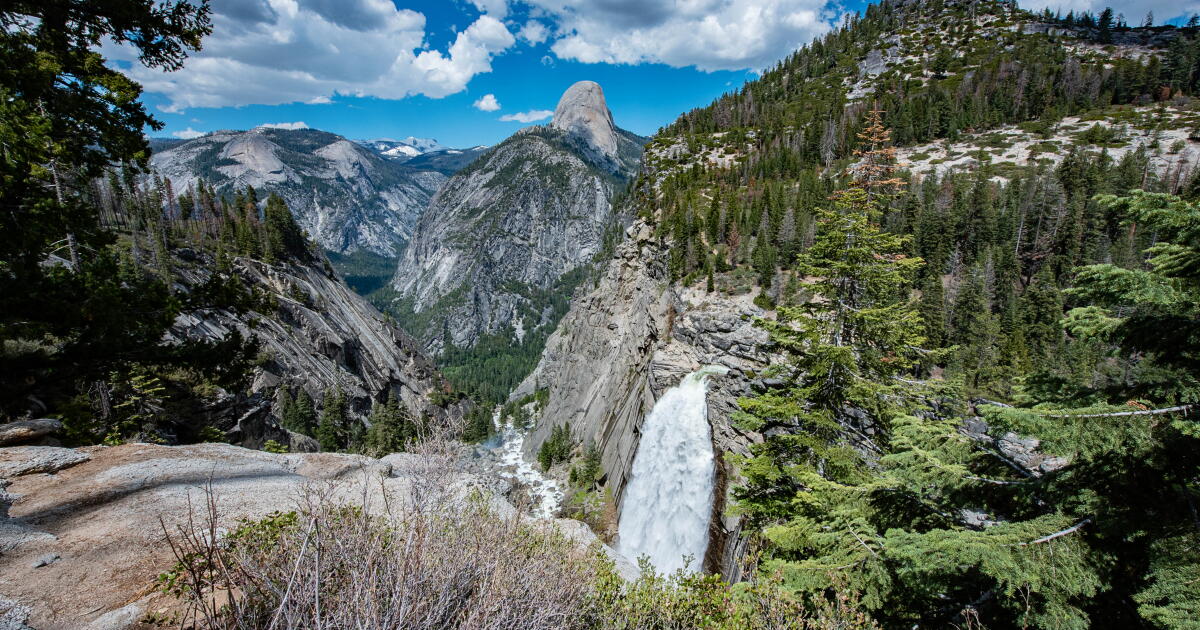
yosemite

Yosemite ditches reservations, drawing huge crowds in a free-for-all

People heading to Yosemite to escape urban congestion fumed this weekend as they waited in a seemingly endless line of cars at the park entrance.

Inside, they circled aimlessly around full parking lots, scanning for empty spots instead of majestic views.

Near the summit of Half Dome, on the infamous steel cables hikers use to ascend the final stretch of bare granite, another traffic jam formed, trapping people hundreds of feet in the air, according to social media posts.

Even before the summer rush, California’s most visited national park is seeing big crowds — the most people in a decade, according to National Park System data.

Critics of the free-for-all are blaming the influx on the Trump administration for abandoning a reservation requirement that, for the last few years, has helped control the number of visitors and preserve a sense of natural tranquility.

California’s nine national parks drew a record 12 million visitors in 2025, up more than 800,000 from the previous record set in 2019. Yosemite accounted for more than a quarter of those visits.

This year, the pace continues, with more than half a million visits to Yosemite so far. In March, the park recorded 236,000 visits, up more than 45% from the same month a year earlier.

Yosemite National Park is enormous, covering more than 1,100 square miles on the western slope of the Sierra Nevada mountain range. Even at the height of summer, an adventurous soul willing to hike a bit can spend weeks in the park and rarely see another person.

But Yosemite’s most famous and Instagrammable vistas — the towering, 3,000-foot granite wall of El Capitan, the thundering spectacles of Yosemite and Bridalveil falls — can be enjoyed from parking lots and picnic benches in the relatively cramped confines of Yosemite Valley.

Visitors don’t even have to get out of their cars to gaze in wide-eyed wonder at sights they will probably remember for the rest of their lives.

And that’s the problem.

Traffic in the valley, especially on summer weekends, had become legendary by the end of the 2010s, inspiring think pieces with headlines such as “Inside Yosemite’s Traffic Meltdown” and “The Siege of Yosemite Valley.”

In June 2020, to limit crowds in the early days of the COVID-19 pandemic, the park introduced a controversial system requiring a reservation before entering.

That left a lot of would-be visitors frustrated, but those lucky enough to snag a reservation were treated to the most peaceful, serene Yosemite Valley experience in years.

Since then, the reservation system has been tweaked repeatedly as administrators searched for a sweet spot between welcoming more visitors and retaining the peace of the great outdoors.

In February, the Trump administration, which had already slashed the national park system’s staff by about 25%, scrapped the reservation system and replaced it with “targeted management” of crowds.

“We are committed to visitor access, safety, and resource protection, and will continue active traffic management strategies to ensure a great visitor experience,” Yosemite Supt. Ray McPadden said at the time. “While reservation systems are one valuable management tool, our data demonstrates that a season-wide reservation requirement is not the most effective approach for the coming season.”

Tourists in Yosemite

A crowd of tourists gather to take pictures of the Yosemite Valley on March 23, 2025, in Yosemite National Park.

(George Rose / Getty Images)

But the new approach is already getting harsh reviews, and the busy season hasn’t even begun.

During “Firefall” in February — an annual phenomenon when sunlight lands on the water cascading from Horsetail Fall, making it glow orange and red, like molten lava — the crowds were reportedly nightmarish.

“I spent over an hour stuck in traffic leaving the park, and exiting felt more like leaving a major sporting event than it did visiting a national park,” Mark Rose, a senior program manager for the National Parks Conservation Assn., a nonprofit devoted to protecting the park system, wrote in a blog post.

“I saw an ambulance stuck in standstill traffic announcing over a megaphone for pedestrians and vehicles to move out of the way,” Rose wrote. “The views were incredible, but I don’t think I’d ever go back without a reservation system in place.”

It left Rose worried about a return to the bad old days of Yosemite traffic, when visitors would wait forever just to get to the gate, pay the $35 entrance fee and then run into road blocks, with signs turning them away because the valley was too crowded.

“That was not an unusual situation,” Rose said. “To wait in line for close to two hours to get into the park and then just be stuck driving around for hours trying to find any parking at any location within the park.”

Over the weekend, the wait in traffic to simply get through the park entrance was an hour and a half, according to Lorena Calvillo from Fresno, who posted pictures and video of the traffic on Yosemite National Park’s official Facebook page.

And once she got in?

“Gridlock. Cars everywhere. People everywhere. No parking. No space,” Calvillo wrote.

“This all comes right after the reservation system was lifted … and honestly, it showed,” she added. “Officials were literally telling people to avoid the Valley.”

Another visitor, Richard Smekal, posted about the conga line of climbers who packed onto the cables leading to the Half Dome summit. He shared a photo of the cables empty when he arrived at 9 a.m., and another taken two hours later.

“After I got down, I turned around and took the second photo,” he wrote. “The line was a continuous stream of people, barely moving — basically at a standstill.”

The cables can be deadly, especially in thunderstorms, when they become a slippery lightning rod. Being stuck there in a human traffic jam is a nightmare many experienced hikers and climbers would do anything to avoid.

A spokesperson for Yosemite did not respond to requests for comment.

Traffic is at a standstill on the Yosemite Valley floor.

Traffic is at a standstill on the Yosemite Valley floor in the summer of 2017 while a bus lane is empty and off-limits to visitors at Yosemite National Park.

(Brian van der Brug / Los Angeles Times)

Source link

National parks brace for summer surge as Trump administration proposes more staff cuts

When families flocked to Yosemite National Park during their recent spring breaks, some met two-hour waits at the entrance gates. At a lakeside spot in the North Cascades in Washington state, there hasn’t been enough staff to open the visitors center. And in Death Valley, water was shut off at two campgrounds.

National parks staff and advocates fear that such issues could only worsen this summer, as the park system faces the busy season with a dramatically reduced staff. At Yosemite, concerns are compounded by the National Park Service’s recent elimination of the park’s timed-entry reservation system, which led to the long spring-break lines.

“We’re definitely really nervous and anxious about the upcoming season, especially with the staff shortage we already have,” said a National Federation of Federal Employees union member at Yosemite who requested anonymity to speak candidly.

The National Park Service has lost nearly a quarter of its staff to buyouts, early retirements and other departures since the Trump administration took office last year, according to an estimate by the National Parks Conservation Assn. This month, the administration proposed cutting nearly 3,000 more positions in its 2027 budget. It also offered a recent new round of buyouts.

The push to cut the park system even further — ahead not only of peak season but of America’s 250th birthday, which the Trump administration has promoted in relation to national parks — has underscored ongoing questions about how smoothly parks can operate as warm weather and summer vacations draw tourists.

Interior Secretary Doug Burgum defended the budget proposal on Capitol Hill last week, telling senators that the visitor experience to parks can be improved even while spending and staff reductions are made.

He said the agency plans to hire 5,500 seasonal workers and asked Congress to approve funding for those employees to work for nine-month stints rather than six months.

“All of that’s going to help us get this thing in shape, even with an overall reduction,” Burgum said Wednesday.

He was met with skepticism by Democrats, who confronted him over the spending proposal.

“That is just a recipe for disaster,” Sen. Patty Murray (D-Wash.) told Burgum.

Congress will have the final say on the proposed cuts, but in the meantime, the reductions that have already occurred presented challenges last season and appear likely to do so again, said Cheryl Schreier, a retired superintendent of Mount Rushmore National Memorial and chair of the Coalition to Protect America’s National Parks.

Whether the parks will get enough qualified candidates to hire the number of seasonal workers needed is also “a really big concern,” she said. “It’s really important to have all of those individuals to be able to operate a park in a good fashion.”

Campers prepare food in Yosemite Valley last December. 9, 2025 in Yosemite, CA.

Campers prepare food in Yosemite Valley last December. 9, 2025 in Yosemite, CA.

(Eric Thayer/Los Angeles Times)

The lower staffing has prompted worry about parks’ capacity for emergency response, protection of the natural landscape and custodial maintenance. Fewer rangers could mean, for instance, fewer people to reach dehydrated, stranded or lost hikers, said Chance Wilcox, California desert director for the National Parks Conservation Assn.

A park service spokesperson said Friday that staffing decisions are made based on local conditions at each park and that the agency is “focused on ensuring parks remain open, accessible, and safe for visitors.”

About 323 million people visit America’s national parks annually, according to the Interior Department. While the parks can expect heavy traffic, a drop in international tourism and the rise in gas prices has injected additional uncertainty into the tourism industry this year.

The number of Canadians visiting the United States has dropped since Trump took office, according to the Canadian government — with the number of Canadians making car trips to the United States this March declining by 35% compared with March 2024.

The Interior Department also instituted a new $100-per-person fee for non-Americans entering 11 of the most popular parks, a move to raise money for the parks but an extra squeeze for Canadians coming across the border and other international visitors.

At the Senate and House hearings on the Interior budget, Burgum presented a vision of the national parks system as one where most employees should be working at a park and interacting with visitors, and said he was more focused on filling those roles than jobs in regional offices.

“Our goal is to have more people actually working in the parks,” he told senators.

An Interior Department spokesperson said the agency was “advancing high-priority improvements” across the system.

“Secretary Burgum has been clear that resources should be prioritized toward visitor-facing services, public safety, maintenance, and projects that improve the experience for the American people,” an Interior Department spokesperson said in a statement Friday.

Critics say that strategy displays a misunderstanding of how the 109-year-old agency functions. Employees who work on contracts, human resources, IT, communications and other organizational and administrative jobs are essential to keeping the parks running, Wilcox said.

“If everything were visitor- or front-facing, the entire agency would collapse from behind,” said Wilcox, of the National Parks Conservation Assn.

The decision to discontinue the reservation system at Yosemite — as well as at Arches and Glacier national parks — is another part of Interior’s mission to bring more people into the parks. The concept was “designed to expand public access” this summer, the park service said in announcing the policy in February. It kept the timed-entry reservation system in Rocky Mountain National Park for the peak season.

Visitors take pictures while walking through Muir Woods

Visitors take pictures while walking through Muir Woods National Monument on July 24, 2025 in Muir Woods National Monument, California.

(Justin Sullivan / Getty Images)

In addition to causing long lines, cramming too many people into the parks at once could lead to environmental damage, particularly if people park cars in natural areas, said Don Neubacher, a retired Yosemite superintendent and member of the Coalition to Protect America’s National Parks.

“It’s going to be mass chaos,” he said.

On a Saturday at the end of March, Jon Christenson of Coarsegold, Calif., drove to the park with his 38-year-old son. They were surprised to encounter a two-hour wait to get into the park, plus at least a half-hour hunt for parking after they made it through the gates, he said.

“It was almost like Disneyland. It was really uncomfortable from the standpoint of just so many people,” said Christenson, 82. “It’s kind of troubling to see that they’ve opened up the floodgates and now it’s kind of ruining the experience for everybody.”

Rangers there are doing multiple jobs, and last summer they helped clean bathrooms in the absence of custodial staff, the Yosemite union member said. Now they, too, are concerned about the potential for gridlock.

The worker asked summer visitors to bring patience: “The folks at the National Park Service … they will be grateful for any compassion and empathy.”

Source link