Yemeni

Contaminated petrol leaves Yemeni drivers struggling to make ends meet | Houthis News

Sanaa, Yemen – Yazan, 28, filled up his car at a petrol station in Sanaa and began a trip towards the city of Ibb to the south.

The journey would usually take about two and a half hours, but as he accelerated along the road, Yazan noticed that the car was struggling to pick up speed.

Recommended Stories

list of 3 itemsend of list

Yazan, who did not want to give his full name, explained that the harder he pressed the accelerator, the more the engine vibrated. The unusual engine noise and vibration forced him to stop several times on the road.

It eventually took Yazan six hours to reach his destination. He believes the problem was caused by contaminated petrol – fuel mixed with oil and impurities – that he bought in Sanaa.

“The petrol left numerous cars, including mine, with many faults,” Yazan told Al Jazeera. “We pay for the expensive petrol that damages our engines.”

Yazan is not alone. Other drivers in Sanaa have reported similar problems with contaminated and increasingly expensive petrol.

The cause of the issue is disputed. In June, the Sanaa-based Yemen Petroleum Company (YPC), run by the Houthis who have controlled northwest Yemen since 2014, said contaminated fuel was the result of inadequately equipped fuel storage facilities in Hodeidah.

Fuel storage tanks in the port city and the nearby Ras Isa oil terminal have been attacked by Israeli and United States air strikes since 2024, in response to Houthi attacks on Israel and shipping in the Red Sea.

The YPC said that the tanks allowed the company to remove impurities before pumping fuel to the market. With the facilities not functioning, the quality of the fuel is impacted.

But many Yemenis dispute that explanation. According to the Sana’a Center for Strategic Studies, restrictions on fuel imports have led the Houthis to partly rely on importing lower-quality Iranian fuel.

Mohammed Ansi, a Yemeni academic, said regular people were being exploited.

“Fuel shipments are being brought in without any accountability, oversight, or conscience – driven solely by the desire for profit and commissions,” he said.

Fuel imports fell sharply from January to May this year. Compared to the same period in 2025, they fell 73 percent through Houthi-controlled ports and 60 percent through ports controlled by the Yemeni government, according to the World Bank.

The drop is partly a result of the impact of the US-Israeli war on Iran on oil shipments passing through the Strait of Hormuz, as well as damage to Yemen’s ports from the various attacks it has faced.

Costly repairs

With the crisis continuing, its financial toll on families is mounting amid the escalating war in Yemen.

“Paying for expensive petrol and vehicle repair is a fresh war on our livelihoods. It is draining us,” said Yazan.

A few weeks ago, 20 litres (5.3 gallons) of petrol cost 9,500 Yemeni riyals ($18 at rates set by the Houthis) in Sanaa. The price has since risen to 11,400 Yemeni riyals ($21), an increase of 20 percent.

That is not taking into account the additional repair costs necessary if contaminated fuel gets into a vehicle’s engine.

Yemenis are already struggling to make ends meet, a situation that has gotten worse over a decade of war.

An April report by the International Monetary Fund (IMF) said that Yemen’s conflict has led to significant macroeconomic vulnerabilities and a marked decrease in income per capita, leaving more than half of the population in urgent need of humanitarian assistance.

Akram Naji, a taxi driver in Sanaa, is among those struggling to get by, and he is now having to figure out how to pay to fix his car.

Naji said he visited a mechanic in Sanaa’s Maeen district after he heard a strange noise coming from his vehicle’s engine.

“The mechanic identified mechanical problems, including a faulty fuel pump, clogged fuel injectors and reduced engine performance.”

Repairing the damage cost him 55,000 Yemeni riyals (about $100), he said.

“For many taxi drivers here like myself, paying this amount of money immediately is a challenge,” Naji said. “I had to not pay my rent in full and decreased my family’s daily expenses to cover the maintenance costs.”

Ali Beidhani, a mechanical engineer in Sanaa, explained what happens when the contaminated petrol enters a vehicle.

“As I observed, when this oily substance or impurities enter the engine along with the petrol, they accumulate in the combustion system,” Beidhani said. “As this substance is exposed to high temperatures, it becomes highly viscous, almost like glue. This leads to damage to engine valves, clogged fuel injectors, and engine vibrations.”

In severe cases, it can even lead to complete engine failure, Beidhani noted.

He said he had seen many drivers struggle to afford repairs.

“The repair cost could force drivers to borrow money or sell possessions like gold, especially if the engine gets damaged or completely fails. Those who rely on their vehicles to eke out a living suffer the most,” said Beidhani.

Deepening humanitarian crisis

Wafiq Saleh, an economic researcher and executive director of the Taiz Centre for Yemeni-Gulf Studies, told Al Jazeera that the spread of contaminated fuel heightens the misery of civilians in the war-torn country.

“Bus or taxi driver or delivery riders or farmers struggle every day to make ends meet. With the spread of contaminated petrol, their jobs are disrupted, and they may find themselves incapable of feeding their families,” said Saleh.

He argues that the authorities in Sanaa “bear full responsibility for importing substandard fuel or supplying the market with adulterated petrol, taking advantage of the lack of accountability”.

“The proliferation of adulterated fuel drains citizens’ savings and threatens the livelihoods of thousands of drivers. Breadwinners shift their focus from feeding their children to fixing their vehicle engines,” said Saleh.

Naji is now cautious whenever he approaches a petrol station to fill up his taxi. He checks the colour of the petrol, hoping to spot any signs of contamination.

“A fault in my car is like a wound in my child’s body; I cannot bear to see either go untreated,” he said.

Source link

Yemeni parliament approves law designating Houthis as ‘terrorists’ | Conflict News

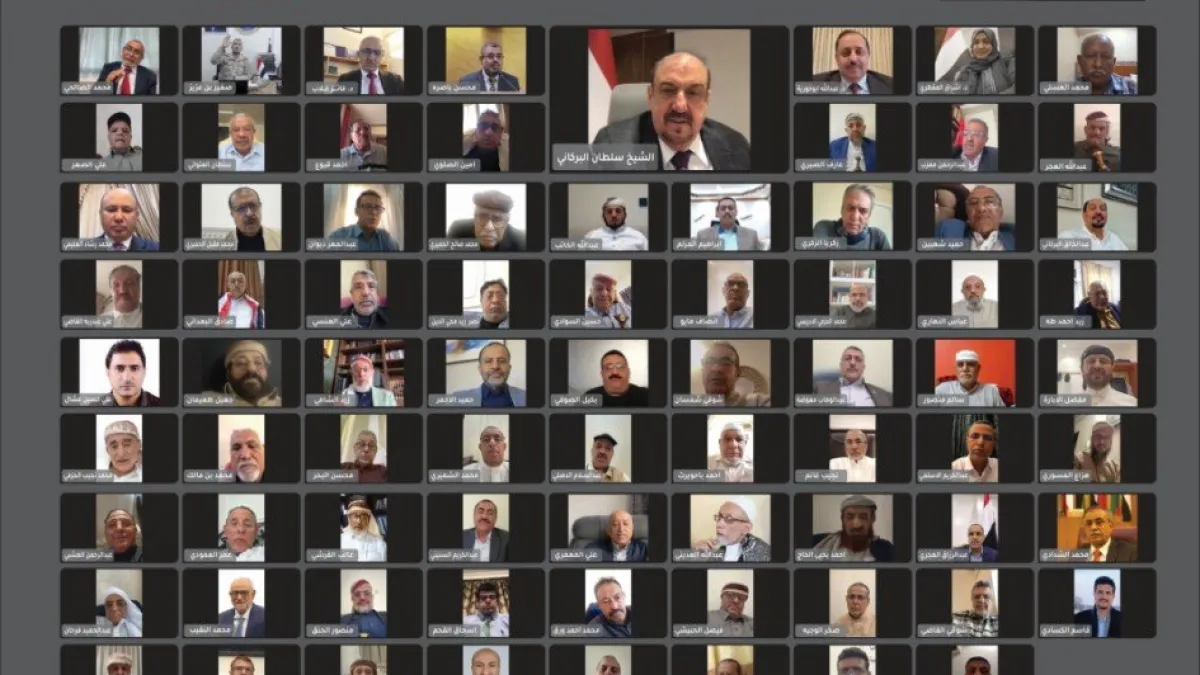
Yemen’s parliament has unanimously approved a law designating the Houthis as a “terrorist organisation” and criminalising the group’s activities and financing, as fighting intensifies between the group and forces loyal to the internationally recognised government.

The vote, held over two sessions by videolink on Monday, comes seven years after the measure was first proposed. Parliament said it had deferred the bill, first tabled at a session in the city of Seiyun in April 2019, to give peace efforts a chance.

Recommended Stories

list of 3 itemsend of list

It noted that the Houthis, also known as Ansar Allah, had attacked government-held areas of Yemen and Saudi Arabia, and accused the Iranian-backed group of brushing aside “all options for peace”.

Yemen’s cabinet approved the draft law on October 11. The country’s National Defence Council had designated the Houthis a “terrorist” organisation by executive decision in October 2022. The United States also lists the group as a “terrorist” organisation, and Saudi Arabia treats it as one.

What does the law say?

According to the state-run Saba news agency, the legislation was formally submitted to Rashad al-Alimi, head of the Yemeni Presidential Leadership Council, on Tuesday to be signed into law.

It runs to 55 articles and designates the group – including all of its political, military and civilian formations – “a terrorist organisation” and a “rebellious faction”.

It also toughens penalties for offences including seizing state authority, besieging cities, attacking civilians, laying landmines and attacking international shipping. Certain offences would carry the death penalty.

The law also sets out procedures to identify, trace, freeze and confiscate assets linked to the group and its affiliated entities.

Renewed fighting

The vote comes amid months of renewed hostilities after several years of relative calm on Yemen’s front lines. In late June, the Houthis announced an escalation against government forces and Saudi Arabia, saying the move was aimed at lifting what the group describes as a “blockade”.

In early September, a Houthi ground offensive on the western coast gave the group control of parts of Taiz and Hodeidah governorates after government forces withdrew from the port city of Mocha and the strategic Bab al-Mandeb area.

Government forces launched an operation called “Dawn of Yemen” in early October to retake Houthi-held territory, including the capital, Sanaa. It initially made limited gains in recapturing territory lost on the Red Sea coast, but on Sunday, pro-government forces withdrew from those areas, allowing the Houthis to advance further.

Heavy fighting continues in Marib, al-Jawf and Lahij governorates, and the Houthis are pressing to take the city of Taiz, which the government and rights groups say is under a tight siege. The Houthis have also stepped up attacks on targets in Saudi Arabia, while the Saudi-led coalition says it is striking facilities that fund the group’s war effort.

The Houthis seized Sanaa in September 2014. United Nations-sponsored talks and regional mediation have failed to end the war since then.

Implications for peace and aid

Ismail al-Suhaili, a political science professor and senior researcher at the Mokha Center for Strategic Studies, said the law marks a shift towards a tougher government position after the failure of peace efforts. Moving the designation from an executive decision to parliamentary legislation gives it wider legal force, he said.

He said it could complicate future negotiations by shifting their focus from power-sharing towards restoring state institutions, disarmament and UN Security Council Resolution 2216.

Al-Suhaili warned that the law could put additional pressure on banks, traders and companies operating between government- and Houthi-controlled areas and deepen Yemen’s financial split. Donors and aid organisations could also become reluctant to work in Houthi-held areas, which could disrupt the delivery of essential supplies to civilians. The Houthis, he said, could respond with further military escalation or with countermeasures targeting government leaders.

Tawfiq al-Hamidi, head of the SAM Organization for Rights and Liberties, told Al Jazeera the law was “a late step” but provides a legal basis for holding those responsible for abuses to account and compensating victims.

While the law narrows the space for political negotiations in favour of military action, al-Hamidi said, it does not entirely rule out a future settlement.

Source link

Yemeni army reports 661 attacks on Houthis as group advances towards Aden | News

The latest operations followed a series of battlefield setbacks for government-aligned forces.

Yemen’s army has said it carried out 661 attacks against Houthi positions across several fronts, killing or wounding 173 fighters, as government forces continue their military campaign amid Houthi territorial gains in the country’s southwest.

Military spokesperson Colonel Majed al-Nuzaili said on Monday that the operations, conducted as part of the ongoing “Dawn of Yemen” offensive, included 15 air strikes, 526 artillery attacks, 53 drone strikes and 67 rocket attacks.

Recommended Stories

list of 4 itemsend of list

In a statement on X, al-Nuzaili said the attacks had destroyed or damaged 71 military vehicles and pieces of equipment, as well as command-and-control centres, observation posts and fortifications.

He said government forces, backed by the Popular Resistance, were continuing to confront Houthi movements in the provinces of Taiz, Marib and al-Jawf, while operations were also under way on southern fronts.

The military said it would continue its offensive until it achieved its objectives, while taking precautions to protect civilians and civilian infrastructure.

The latest operations followed a series of battlefield setbacks for government-aligned forces, which have withdrawn from strategic positions near the Bab al-Mandeb Strait and are repositioning to defend Aden, the temporary capital of Yemen’s internationally recognised government.

Al Jazeera’s Yousef Mawry reported that the Houthis had cut off a key government supply route along the Red Sea coast, forcing troops to abandon several positions as concerns grew over a possible Houthi offensive towards Aden.

Parliament moves to outlaw Houthis

The military escalation coincided with a political development, as Yemen’s parliament unanimously approved a bill designating the Houthis a “terrorist organisation” and criminalising their activities, financing and supply of weapons.

According to the state-run Saba news agency, the bill provides for prosecuting those involved in violations attributed to the group, freezing and confiscating affiliated assets, and imposing tougher penalties for offences, including attacks on civilians, planting landmines and targeting international shipping.

The legislation will now be submitted to Rashad al-Alimi, chairman of Yemen’s Presidential Leadership Council, for enactment.

The latest developments come six weeks after government forces launched “Dawn of Yemen” on October 5, seeking to regain territory controlled by the Houthis, including the capital, Sanaa.

Source link

Houthis edge closer to Aden as Yemeni forces pull out of Bab al-Mandeb | Conflict News

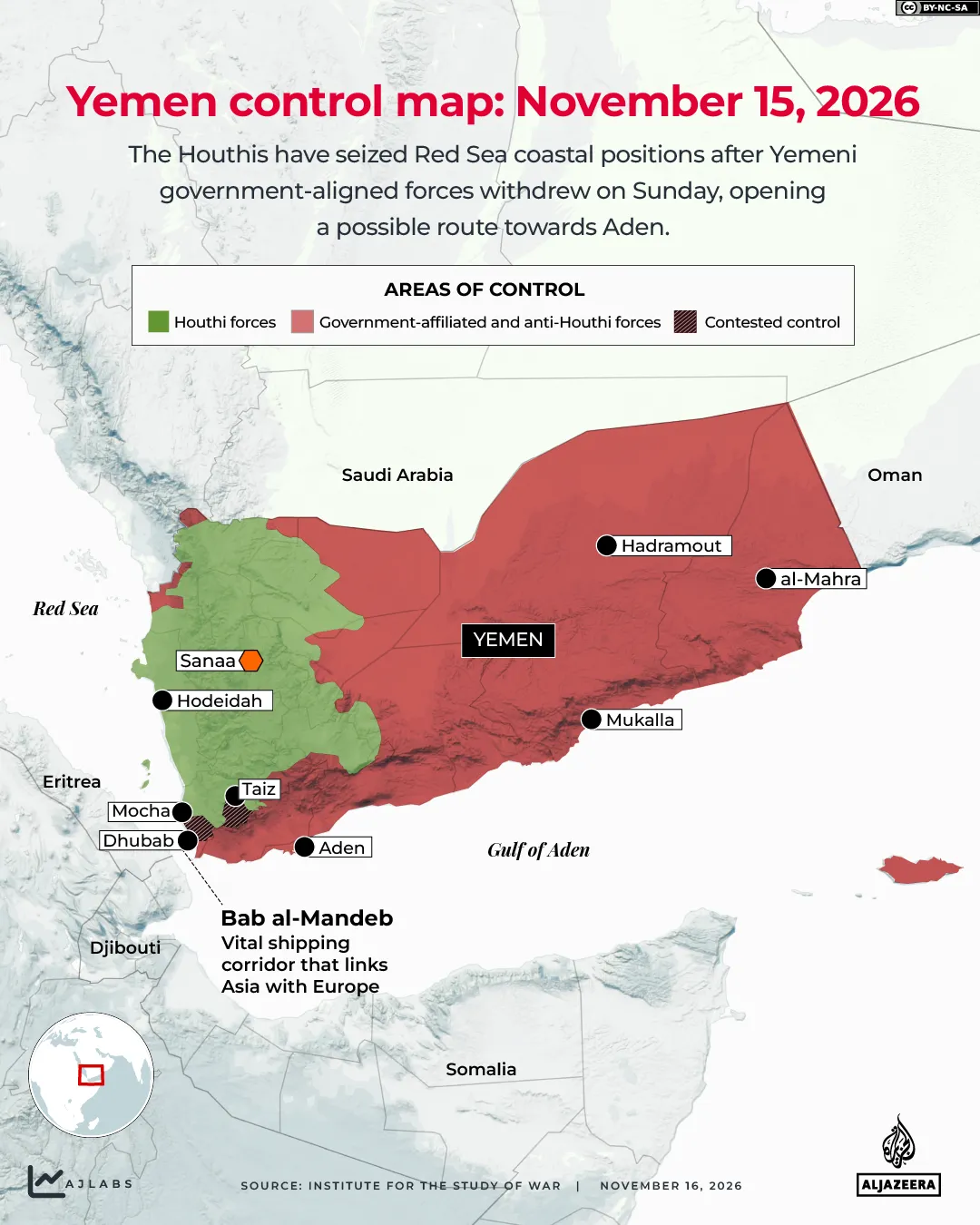
Forces aligned with the internationally recognised Yemeni government face a potentially catastrophic situation, as Houthi forces advance on the southern city of Aden and other strategic areas.

Yemeni government forces said on Sunday they had withdrawn from Dhubab airport and territory they held near the Bab al-Mandeb strait, southwest of Yemen, to defend Aden, the de facto seat of the government.

Recommended Stories

list of 3 itemsend of list

Retired Lebanese Brigadier-General Hassan Jouni, a military and strategic expert, said fighting is now focused on control over a mountainous triangle of territory in southern Yemen, which could decide the outcome of the war.

This area links Aden to Taiz, another city held by the government but encircled by the Houthis – an armed group also known as Ansar Allah (Arabic for Supporters of God) – and Bab al-Mandeb, a maritime chokepoint that connects the Red Sea to the Gulf of Aden.

“This triangle is the strategic centre of gravity for the war in Yemen as a whole,” Jouni told Al Jazeera.

On Sunday, government-aligned forces were withdrawn from Dhubab, which was recaptured from the Houthis in September, to avoid an imminent siege in the coastal strip by the Houthis and to help defend Aden, analysts say.

Houthi advances in this southwestern region now threaten to completely cut off the government’s coastal supply routes, Jouni said.

Interactive_YemenControlMap_NOV16_2026_Nov 16 2026-1794824231

The Yemen war began when the Houthis, a Zaidi Shia group close to Iran, captured the capital, Sanaa, in September 2014, forcing the government to flee south to Aden. Saudi Arabia launched an Arab coalition military campaign to aid the government in March 2015, launching thousands of air strikes against Houthi forces.

Following a relatively peaceful few years, fighting re-erupted in July when government forces’ jets bombed Sanaa international airport to prevent a Houthi delegation from landing in the Yemeni capital.

A Houthi offensive in September saw the government lose control of Yemen’s Red Sea coast, including the key port city of Mocha. Later Houthi advances also saw Taiz completely besieged by the Houthis.

Yemeni Armed Forces spokesperson Majed al-Nuzaili defended the retreat from Dhubab, saying it was part of a wider tactical manoeuvre.

“[The redeployment] is an extension of the heroic positions of the popular resistance and the southern forces in protecting the temporary capital Aden,” he said on X.

But Jouni believes the situation faced by government forces is grim, with the Houthis reaching Tor al-Baha, just 80km (50 miles) from Aden.

“The Houthi forces have reached this line, meaning that they are indeed in the defensive line area of the city of Aden. We do not say they have approached Aden, but the defence of the city of Aden begins in this area,” he told Al Jazeera.

“The basic combat direction now is in the vicinity of the besieged city of Taiz. On the other hand, of course, the Houthis will focus their attention now on approaching Aden and controlling the first defensive zone.”

Strategic affairs expert Ali al-Dahab gave a less optimistic assessment of the situation than the one presented by the government.

“What happened is a retreat or a withdrawal with the same meaning, and not a redeployment, because the withdrawal left a vast vacuum filled by the Houthis,” al-Dahab stated.

Regional escalation

The government’s “Operation Yemen Dawn” has responded to the situation with a dramatic increase in strikes on Houthi positions, including 900 targeting operations within 24 hours.

The Houthis have responded with ballistic missiles and drone attacks towards Mecca, Riyadh, and the Eastern province in Saudi Arabia. They have announced they will continue operations under a principle of “siege for siege, airport for airport, and escalation for escalation”.

Al-Dahab said this strategy is directed at Saudi Arabia, the Yemeni government’s key international ally, and not at authorities in Aden.

With their recent gains on the coast along Bab al-Mandeb, which has become increasingly significant to global maritime trade since the effective closure of the Strait of Hormuz amid the US-Israel war on Iran, the Houthis have significant geopolitical leverage.

“They now directly and completely control the western Yemeni coastal sector and part of the maritime extension towards Aden,” al-Dahab warned.

“The matter translates the Houthis’ gains in Bab al-Mandeb in large part to the benefit of Iran.”

Source link