yard

19 SoCal garden tours to inspire your L.A.-area yard

Scattered orange California poppies, California Lilac with bright blue blooms, and hummingbird sage with dark rose-lilac-colored flowers spontaneously tell us what we already know: Spring has arrived.

Southern California, especially Los Angeles, has many breathtaking botanical gardens and wildflower-lined hiking trails. But it’s also exciting to visit private home gardens that are rarely open to the public and find inspiration even if you don’t have space for a garden at home.

This year’s spring garden tours include a visit to a historic Midcentury Modern home designed by Buff, Straub and Hensman, complete with a river running through the property as part of the Garden Conservancy’s Open Days Tour. You can also check out a native garden at a Long Beach elementary school that is usually closed to visitors, or see how a young couple used a $5,000 turf rebate from the Los Angeles Department of Water and Power to transform their Inglewood yard during the Theodore Payne Foundation’s two-day Native Plant Garden Tour.

Whether you love gardening or simply enjoy beautiful landscapes and meeting other plant lovers, these tours offer plenty of ideas you can use long after your visit. From native plants to rose gardens, here are this spring’s local garden tours.

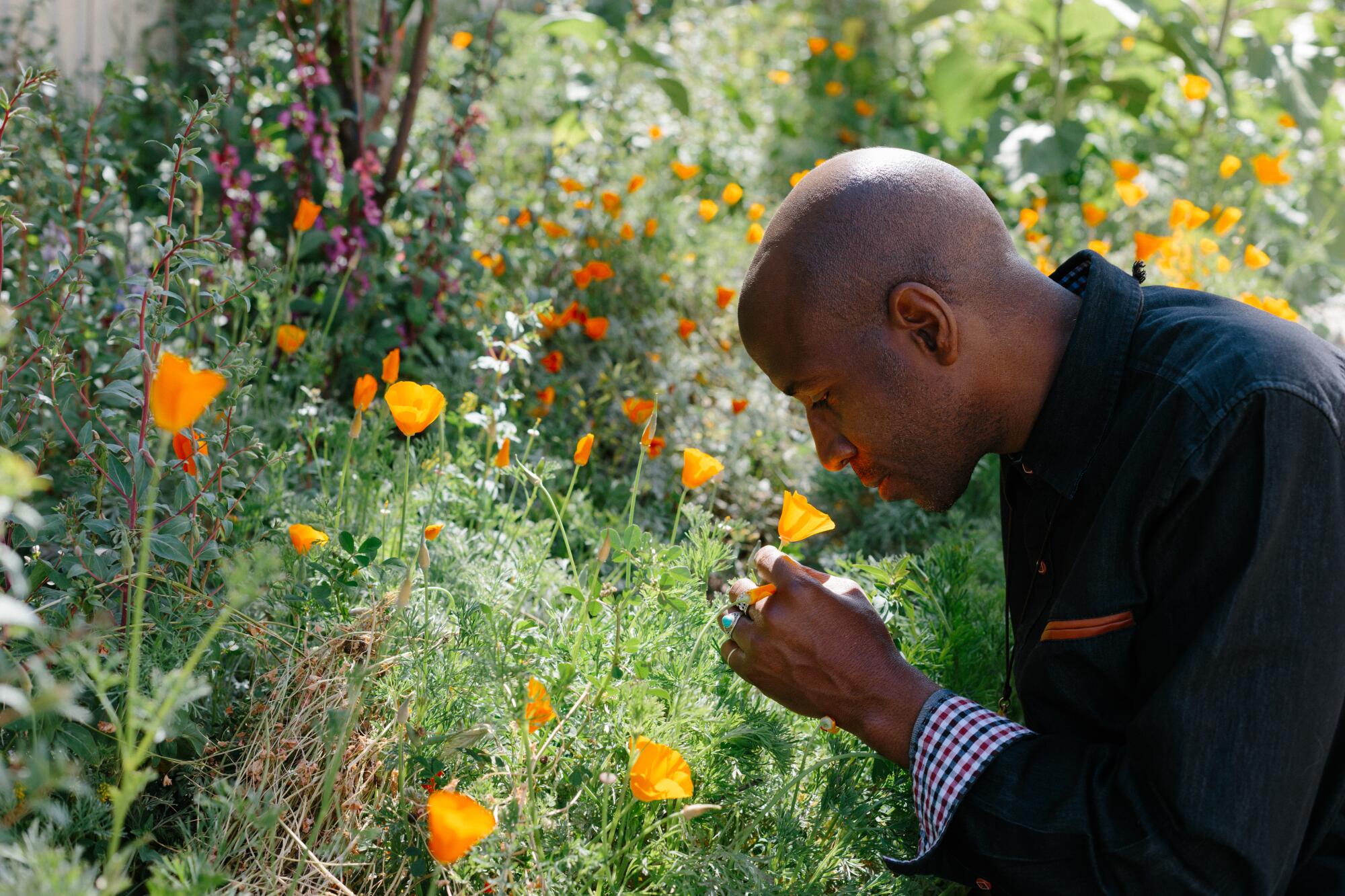
A man sniffs an orange poppy.

Blooming California poppies remind us that spring is here.

(Stella Kalinina / For The Times)

March 29
The Poppy Day Garden Tour raises money for the South Coast chapter of the California Native Plant Society. Visit 10 native plant gardens across the South Bay that support wildlife and help save water. The tour runs from 10 a.m. to 4 p.m. Tickets cost $15 in advance or $20 at the door, if available. Children and teens under age 18 get in free. For tickets and more information, visit cnps-south-coast.square.site.

The Creative Arts Group’s Art of the Garden Tour features self-guided visits to five gardens in Pasadena, Altadena and La Cañada Flintridge from 10:30 a.m. to 4 p.m. Tickets cost $45 in advance or $50 on the day of the event. This tour is the nonprofit’s biggest fundraiser of the year, supporting arts programs, exhibitions and classes for children and adults. Please note that photography, pets and children under age 12 are not allowed on the tours. You can also stop by the Creative Arts Group Gallery at 108 N. Baldwin Ave. in Sierra Madre to buy tickets in person and see artwork from more than 25 local artists. For more information, visit creativeartsgroup.org.

A woman stands in a garden filled with colorful native plants.

(Mariah Tauger / Los Angeles Times)

April 11-12
Theodore Payne Foundation’s Native Plant Garden Tour: Habitats That Heal is a showcase for 42 gardens across Los Angeles, each with at least half native plants. The self-guided tour runs from 10 a.m. to 5 p.m. on both days. On April 11, you can visit 20 gardens in neighborhoods in Sherman Oaks, Van Nuys, North Hollywood, Shadow Hills, Tujunga, Montrose, Burbank, Glendale, Eagle Rock, Highland Park, South Pasadena, Pasadena and Altadena. On April 12, the tour covers gardens in Santa Monica, Venice, West L.A., Del Rey, Baldwin Hills, Mid-City, Inglewood, South L.A., Beverly Hills, West Hollywood, Hollywood, Los Feliz, Glassell Park, Highland Park, Mt. Washington, El Sereno and Alhambra. Tickets cost $55, or $50 for members, and children under age 16 are free. If you buy a ticket, you’ll receive a guidebook in the mail, which also serves as your ticket. Starting March 26, tickets and maps are only available for purchase in person at the foundation office in Sun Valley from 8:30 a.m. to 4:30 p.m. Tuesday through Saturday. The office is closed on Sunday and Monday. For more information, visit nativeplantgardentour.org.

California Native Plant Society’s San Diego Native Garden Tour is a showcase of 31 private gardens across the city, including the CNPS San Diego Native Plant Teaching Garden, Southwestern College Botanical Garden, Paradise Hills and Native West Nursery. Each garden in the self-guided tour uses at least 60% California native plants, demonstrating how these gardens protect local biodiversity. The tour is from 9 a.m. to 4 p.m. Tickets are $45; children age 17 and under are free. Will call locations and instructions will be emailed after ticket purchase at eventbrite.com.

A "Welcome to California" sign is seen at Prisk Native Plant Garden in Long Beach.

A “Welcome to California” sign is seen at Prisk Native Plant Garden in Long Beach.

(Dania Maxwell / Los Angeles Times)

April 12 and 19
The Prisk Native Plant Garden Open House is celebrating its 30th year with an annual tour of the garden, which is usually closed to the public. You can visit from 1 to 4 p.m. both days at William F. Prisk Elementary School, 2375 Fanwood Ave. in Long Beach. The garden is located behind the school at East Los Arcos Street and Albury Avenue. Admission is free, but donations are welcome. For more information, visit facebook.com/prisknativegarden.

April 19
The Garden Conservancy Pasadena Open Days Tour welcomes you to visit four private gardens at historic homes. You can see Buff, Straub and Hensman’s Midcentury Modern Norton House, the 1916 Spanish Revival-style home called Mi Sueño del Sur, a Southern California Arts and Crafts garden, and the rose gardens of a historic Pasadena estate from the 1900s. The tour runs from 10 a.m. to 4 p.m. Tickets cost $10 per garden and are available online only. Children ages 12 and under can join the tour for free with an adult. For more information, visit gardenconservancy.org.

A view of a cactus plant in the middle of a desert scene.

Desert gardens with native plants at the Mojave Land Trust in Joshua Tree.

(Gina Ferazzi / Los Angeles Times)

The Morongo Basin Conservation Assn. is hosting its 15th Annual Desert-Wise Landscape Tour. This self-guided event runs from 9 a.m. to 4 p.m. and features four private gardens in Pioneertown and Yucca Valley, along with three demonstration gardens in Joshua Tree. Tickets cost $25, or $20 for members. You can find tickets and more information on the MBCA website, mbconservation.org. On the day of the tour, registration will only be available at the Mojave Desert Land Trust in Joshua Tree.

April 25
Habitat Garden Tours at Caroline Park and Ryan Bonaminio Park, the Riverside-San Bernardino Chapter of the California Native Plant Society is offering free tours of two large native plant gardens within city parks in Redlands and Riverside. Morning tours of the 16-acre Caroline Park in Redlands, which is dedicated to California native plants, will be held at 9 a.m., 10 a.m. and 11 a.m. Park near the corner of Mariposa Drive and Poppy Road, then enter the park using the trail to the left of the Caroline Park sign. Meet at the kiosk upon arrival. Afternoon tours at Ryan Bonaminio Park in Riverside, which features restored native plants from local floodplains and upland areas that support pollinators, will be held at 1 p.m. and 2 p.m. Park on the west end of the parking lot to access the decomposed granite path leading to the 1.17-acre habitat garden. The tours are free, and you are welcome to join at any scheduled time. For more information, visit: chapters.cnps.org/riversidesanbernardino.

April 25-26
The Floral Park Home & Garden Tour in North Santa Ana invites you to explore historic homes and gardens from the 1920s to the 1950s from 10 a.m. to 4 p.m. on both days. Along with the tours, you can enjoy the Street of Treasures Market, sample food from local restaurants and check out a car show. All proceeds help fund community scholarships and support nonprofit organizations. Tickets cost $45 if you buy them by April 20, or $50 at the door. For more details, visit floralparkhometour.com.

The Riverside Community Flower Show & Garden Tour: Garden Party features self-guided tours of six local gardens, with master gardeners on hand to answer your questions. Tours are open from 10 a.m. to 5 p.m. both days. You can also visit a free flower show at the Riverside Elks Lodge, 6166 Brockton Ave., from 9 a.m. to 5 p.m. Admission to the garden tour is $10, and children under 16 get in free. For more information, visit riversideflowershow.com.

A Craftsman style home on Mar Vista Ave in Bungalow Heaven in Pasadena.
Bungalow Heaven, a tree-lined neighborhood in Pasadena, is known for its substantial collection of Craftsman bungalows.

(Juliana Yamada / Los Angeles Times)

April 26
The 35th Annual Bungalow Heaven Home Tour features self-guided walks through eight homes, with volunteer docents ready to share each home’s history and architecture. Although the focus is on architecture, many of the homes in the landmark district have lovely landscaped backyards that guests are welcome to visit and admire. McDonald Park will be lively all day with music, a silent auction of unique items, homemade cookies and local food trucks for lunch. It’s from 10 a.m. to 4 p.m. Advance tickets are $25 at bungalowheaven.org and available until April 25 at 8 p.m. Tickets on the day of the tour are $30 and can be bought at McDonald Park, 1000 E. Mountain St., starting at 9:40 a.m. Part of the proceeds will go to San Gabriel Valley Habitat for Humanity to help those affected by the Eaton fire.

May 2
The Laguna Beach Garden Club’s 20th Gate & Garden Tour starts at the Bruce Scherer Waterwise and Fire-Safe Gardens, located at 306 3rd St. in Laguna Beach. Special buses will take ticket holders to visit several local gardens. You can buy Mexican food and artisanal margaritas and enjoy free homemade baked goods. Artists will be painting in some of the gardens, and if you wear a festive garden party hat, you’ll be entered in the club’s hat contest. Proceeds help fund school gardens, local scholarships and community projects. The tours run from 10 a.m. to 4 p.m. Please note that children are not allowed. Timed-entry tickets are $65.87 online, which includes entry between 10 a.m. and 2 p.m., plus one food item and one drink. Find tickets at eventbrite.com.

A welcome sign in a garden in Long Beach.

A welcome sign at one of the garden’s in last year’s Mary Lou Heard Memorial Garden Tour.

(Juliana Yamada / Los Angeles Times)

May 2-3
The Mary Lou Heard Memorial Garden Tour: Real Gardens by Real People features self-guided tours of 34 gardens spanning Long Beach to San Clemente from 10 a.m. to 5 p.m. both days. The tour is free, but donation jars will be set out at the gardens to support the Sheepfold, a crisis center for women and children that has long been the foundation’s annual tour beneficiary. For more information, visit heardsgardentour.com.

May 3
Inspired Garden Artistry invites you to the Blooms with a View Garden Tour, featuring 10 private home gardens in View Park, Windsor Hills, Ladera Heights and Baldwin Hills. The tour runs from 10 a.m. to 5 p.m. You can also enjoy the free Garden & Community Resource Expo at Ladera Park’s south entrance, 4750 W. 62nd St. during the same hours. The expo offers artisans, landscape architects, nurseries, local community services, food trucks, giveaways, a plant swap and fun activities for families. Tickets are $30 online until April 15 and $35 from April 16 through May 3. Kids ages 12 and under enter free. To learn more, visit inspiredgardenartistry.com.

Join the 28th Livingston Memorial Visiting Nurse Assn. & Hospice Camarillo Garden Tour and explore four beautiful Camarillo gardens from noon to 4 p.m. Artists from the Pastel Society of the Gold Coast will be giving demonstrations in at least two of the gardens. Tickets are $30 online, and all proceeds support the association’s hospice program in Camarillo. For more information, visit lmvna.org/gardentour.

May 9
The West Floral Park and Jack Fisher Park neighborhoods are hosting the 19th annual Open Garden Day, featuring tours of two tree-lined areas with vintage homes in North Santa Ana. Enjoy live music, art displays, garden talks and demonstrations, a classic car display, and free bottled water at the gardens. In the morning, you can buy coffee and doughnuts, and vendors will offer food and garden products from 9 a.m. to 4 p.m. Tours run from 9:30 a.m. to 3:30 p.m., with a shuttle service between the two tour loops to help reduce wait times. Tickets go on sale online starting March 20 for $20, or you can buy them for $25 on the day of the event at West Santa Clara and North Westwood avenues in Santa Ana. For more information, visit opengardenday.com.

Cleveland sage (purple) grows inside the north Westwood Greenway.
In 2024, visitors explored the garden of Dennis Mudd, the creator of Calscape, during the San Diego Native Garden Tour hosted by the California Native Plant Society.

(Silke Gathmann)

May 14
The 29th Newport Harbor Home & Garden Tour, hosted by Barclay Butera Interior Design, invites guests to explore six locally designed homes and gardens near Newport Harbor High School from 10 a.m. to 3 p.m. The day begins with a morning reception at 9 a.m., followed by a luncheon from 11 a.m. to 2 p.m., and ends with a reception at Barclay Butera from 2 to 5 p.m. This event raises funds for the Newport Harbor Educational Foundation to help support academic programs and faculty at Newport Harbor High School. Tickets are available online for $125 until April 24 at newportharborhometour.com.

May 16
The San Clemente Garden Club’s 2026 Garden Tour offers self-guided tours and live entertainment at several local gardens from 10 a.m. to 4 p.m. You can buy tickets online ahead of time for $40 each, or $35 each if you buy four or more. Tickets on the day of the event are $50. All proceeds help fund the club’s college scholarships, junior gardeners programs, local conservation groups and civic beautification projects in San Clemente. For more information, visit sanclementegardenclub.com.

Matilija poppy grows in Eric Augusztiny's drought-tolerant front yard.

A Matilija poppy grows in West Hills.

(Myung J. Chun / Los Angeles Times)

May 17
The Rossmoor Woman’s Club is hosting its 22nd Garden Tour, offering self-guided visits to five or six private gardens in the Rossmoor-Los Alamitos area of Orange County, just north of Seal Beach. The tour runs from 10 a.m. to 4 p.m. There will also be a marketplace with vendors and refreshments. Tickets cost $20 and will be available online in April or at the club’s outdoor marketplace at the Farmers & Merchants Bank, 12535 Seal Beach Blvd., on the day of the tour. All proceeds go to local charities and college scholarships for Los Alamitos High School students. For more information, visit rossmoorwomansclub.org.

Source link

Chargers sign former Cardinals defensive lineman Dalvin Tomlinson

p]:text-cms-story-body-color-text clearfix”>

Baltimore Ravens tight end Charlie Kolar warms up before a game against the Rams on Oct. 12.

Baltimore Ravens tight end Charlie Kolar warms up before a game against the Rams on Oct. 12.

(Nick Wass / Associated Press)

The Chargers didn’t hesitate to bolster their run-blocking options for new offensive coordinator Mike McDaniel, agreeing to terms with former Baltimore Ravens tight end Charlie Kolar.

Kolar and the Chargers agreed to a three-year, $24.3-million deal that includes $17 million in guarantees, NFL Media reported.

Widely considered the best run-blocking tight end available ahead of free agency, Kolar should help an uneven Chargers running attack that forced coach Jim Harbaugh to often rely too much on quarterback Justin Herbert — even when his running backs were healthy.

Kolar can also help complement tight end Oronde Gadsden II in the passing game when necessary, but he should mostly serve as a replacement for Will Dissly, who was released by the team last week. It’s also no coincidence that Kolar played for Harbaugh’s brother, John, in Baltimore and was drafted in 2022 when Chargers general manager Joe Hortiz was the director of player personnel for the Ravens.

Kolar, 27, had 10 catches for 142 yards and two touchdowns last season. In four seasons with the Ravens, he had 30 catches for 409 yards and four touchdowns.

Like most Chargers offseasons, it’s clear Hortiz is prioritizing ways to add to the Chargers’ offense while also bolstering its protection options. On Sunday, the team agreed to terms with Alec Ingold, reuniting the former Miami Dolphins fullback with McDaniel.

Source link

Makai Lemon’s combine podium didn’t bother NFL team executives

Makai Lemon got another chance Thursday to demonstrate his skills for NFL scouts.

About 50 of them — representatives from each of the 32 teams — gathered at USC to spend a few hours evaluating the school’s latest class of draft prospects. Lemon, who won the Biletnikoff Award last fall as college football’s top receiver, had everyone’s attention.

“Running good routes, catching the ball, running fast,” he said of his objectives for the day. “Whatever I showcase, let them know I can do it at a high level.”

It was a more comfortable setting than Indianapolis. At the scouting combine, Lemon’s performance at the podium drew scrutiny — not for anything he said, but for how he said it. He swayed. He was measured, unhurried, visibly unbothered. Some read it as detached. Others saw something else entirely.

“We don’t want a guy who’s phony and coached up,” said one team executive, speaking on condition of anonymity. “We want a guy to be his authentic self. As long as he’s not a jerk, we love it.”

Rams general manager Les Snead, who attended Thursday’s workout of 17 USC players, put it another way. “At the combine you’re usually getting some version of a personality,” he said. “A lot of times it’s, ‘This is my interview personality,’ and that’s not necessarily who they are 365 days a year.”

USC receiver Makai Lemon catches pass during a drill at the NFL combine in Indianapolis last month.

USC receiver Makai Lemon catches pass during a drill at the NFL combine in Indianapolis last month.

(Julio Cortez / Associated Press)

The other USC prospects who participated in Thursday’s workouts were receivers Ja’Kobi Lane, Jaden Richardson and Jay Fair; running back Eli Sanders; tight end Lake McRee; offensive linemen J’Onre Reed and DJ Wingfield; defensive linemen Anthony Lucas and Keeshawn Silver; linebacker Eric Gentry; cornerbacks DJ Harvey and DeCarlos Nicholson; safeties Bishop Fitzgerald and Kamari Ramsey; punter Sam Johnson; and long snapper Hank Pepper.

Former Trojan linebacker Mason Cobb, who was on the team in 2024, also participated.

Lemon’s credentials are not in dispute. He finished last season with 79 catches for 1,156 yards and 11 touchdowns. At 5-foot-11 and 192 pounds he’s not big for the position, and according to a school release ran the 40 in 4.46 seconds, which is fast but not blistering. But those aren’t his main strengths.

“One of the underrated aspects when you’re watching wide receivers is toughness, and he kind of oozes toughness,” said Daniel Jeremiah, lead draft analyst for NFL Network. “He catches everything. He’s super strong physically and super strong to the ball.”

The technical detail that stands out for Jeremiah: Lemon doesn’t leave his feet to catch unless he has to. He stays grounded, keeps himself in position to do something after the ball arrives. Receivers who lunge and cradle in the air have nowhere to go. Receivers who catch with their feet under them turn completions into more yards.

“He’s got a really good feel for the game,” Jeremiah said. “I think he’s going to be a high-volume guy. I think he’ll catch 90-plus balls every year and be the quarterback’s best friend.”

Snead, who has a history of finding productive receivers that others miss — among them Cooper Kupp and Puka Nacua — is skeptical of the 40 as a measuring stick.

“You rarely see a route in football where the receiver runs straight for 40 yards and then makes his break,” he said. “Even on a go route you’re usually trying to get an edge on the defender, so you’re not running straight. The 40 might tell you how many gears you have in your body. But sometimes you need to run a route in third gear and then shift into fourth or fifth, or decelerate.”

Jeremiah ranks Lemon among the two best receivers in this draft, giving a slight edge to Ohio State’s Carnell Tate, who projects as more of a down-the-field, big-play threat. Comparisons to Detroit’s Amon-Ra St. Brown (also a former USC player) and Tampa Bay’s Emeka Egbuka have circulated. Jeremiah sees those, but also reaches back to Jarvis Landry, the former Louisiana State standout who made five Pro Bowl appearances.

“I actually think Lemon is a better player than Jarvis Landry coming out,” Jeremiah said. “When you’re instinctive, you’re tough and you catch everything, that’s a pretty high floor. Absolute worst case, you’re going to have a steady, dependable, reliable player.”

Watching from the sideline Thursday was Marqise Lee, who won the Biletnikoff in 2012 — the only other USC player to do so — and was a second-round pick of the Jacksonville Jaguars in 2014. He has spent much of the past several months as a mentor to Lemon, and when the combine criticism arrived Lee wasn’t surprised by any of it.

“My biggest thing to him was just enjoy it,” Lee said. “I know he got a lot of backlash about the media stuff and things like that, but when you know the guy, he’s not a big talker. He’s calm, he’s all about business.”

Lee believes Lemon has the skills to thrive at the next level, but knows how much context matters once a player gets there.

“The league is different until you actually get there and get the opportunity to practice and go through it,” Lee said. “Some people have a hard time adapting. Once he gets on a team I’ll be texting him: ‘How’s the comfort level? How’s the offense?’ Because that stuff matters. Offensive coordinator, people loving you — all that matters.”

Lemon, for his part, already sounds like someone who has thought about this.

“I want to go in there and be myself,” he said. “Don’t want to try to be anybody else.”

Source link

Tight end Charlie Kolar reportedly joining Chargers on three-year deal

p]:text-cms-story-body-color-text clearfix”>

The Chargers aren’t hesitating when it comes to bolstering their run-blocking options for new offensive coordinator Mike McDaniel, reportedly agreeing to terms Monday with former Baltimore Ravens tight end Charlie Kolar.

Kolar and the Chargers agreed to a three-year, $24.3-million deal that includes $17 million in guarantees, NFL Media reported.

Widely considered the best run-blocking tight end available ahead of free agency, Kolar should help an uneven Chargers running attack that forced coach Jim Harbaugh to often rely too much on quarterback Justin Herbert — even when his running backs were healthy.

Kolar can also help complement tight end Oronde Gadsden II in the passing game when necessary, but he should mostly serve as a replacement for Will Dissly, who was released by the team last week. It’s also no coincidence that Kolar played for Harbaugh’s brother, John, in Baltimore and was drafted in 2022 when Chargers general manager Joe Hortiz was the director of player personnel for the Ravens.

Kolar, 27, had 10 catches for 142 yards and two touchdowns last season. In four seasons with the Ravens, he had 30 catches for 409 yards and four touchdowns.

Like most Chargers offseasons, it’s clear Hortiz is prioritizing ways to add to the Chargers’ offense while also bolstering its protection options. On Sunday, the team agreed to terms with Alec Ingold, reuniting the former Miami Dolphins fullback with McDaniel.

Source link

Toxic vapors beneath shuttered Watts scrap yard may be threatening a nearby high school

When a Los Angeles County judge ordered a notorious Watts scrap metal yard to permanently halt its operations last year, many residents and environmental advocates thought it might finally bring an end to the facility’s dangerous pollution. Instead, the shutdown may have only marked the beginning of what could be a lengthy process to erase decades of environmental degradation.

For nearly 75 years, S&W Atlas Iron & Metal had crushed car parts, shredded aluminum cans and processed an assortment of recyclable metals. Over that time, the facility and its owners racked up dozens of environmental violations and were eventually criminally convicted of crimes that endangered students next door at Jordan High School and residents of Watts.

Since Atlas’ court-ordered closure, the towering piles of scrap metal have largely disappeared from the 3-acre recycling facility. Jordan High’s campus hasn’t been rocked by explosions, pelted with shrapnel or blanketed in layers of toxic, metallic dust.

But one of the most serious, and remaining, threats has gone unnoticed until recently.

A contractor hired by Atlas recently measured a witch’s brew of toxic chemicals percolating in the soil and groundwater beneath the site at orders of magnitude above California’s standards, according to court documents. Around five feet underground, a soil probe detected the highest reading of vinyl chloride — just one of the several carcinogens at the site — more than 1.3 million times higher than the state benchmark.

“What they found were astronomical levels of these contaminants,” said Danielle Hoague, director of research for the Better Watts Initiative.

“I think it’s definitely a hidden danger. I don’t think that the community has been informed of what underlies Atlas. But I would assume that people are experiencing the health effects of this.”

You’re reading Boiling Point

The L.A. Times climate team gets you up to speed on climate change, energy and the environment. Sign up to get it in your inbox every week.

By continuing, you agree to our Terms of Service and our Privacy Policy.

State regulators are still hashing out the scope of the cleanup at the shuttered industrial site. But, more concerning, Watts residents and school district officials fear these contaminants may be migrating with groundwater, posing a risk to neighboring Jordan High School and Jordan Downs housing complex. If that is the case, the question is who will foot the bill to clean up this pollution?

“The cleanup of the Atlas site has been slow, and Atlas is proceeding with a lack of executed urgency,” an L.A. Unified School District spokesperson said in a statement.

Atlas “has failed to advise Los Angeles Unified promptly of contamination found just feet away from the school campus and the adjacent Jordan Downs Housing Development,” the spokesperson added.

Shutting down a source of pollution is only the first step in campaigns for cleaner air. It’s often equally burdensome, time-consuming and expensive to hold polluters accountable for cleaning up the legacy contamination at their own property. And it’s even more difficult to compel companies to decontaminate nearby properties that may have been affected by their operations.

In Lincoln Heights, decades passed after the closure of a massive dry-cleaning operation before residents learned of underground contamination spreading off-site, potentially threatening nearby homes and an elementary school. In Newport Beach, a sprawling aerospace and defense hub was converted into luxury homes three decades ago, and homeowners were only recently informed about residual toxic pollution. In Jurupa Valley, residents were alarmed to learn about toxic vapors seeping into their homes after contaminated groundwater migrated several miles from a former hazardous waste dump uphill.

In Watts, many residents were already aware of the danger posed by toxic metals produced by Atlas’ operations. At times, metallic dust left parts of Jordan High’s campus covered in an iridescent sheen, and the school district has in the past removed contaminated soil from the campus.

But it was far more difficult to predict that pollution could be spreading underground. Many of the chemicals found beneath Atlas evaporate at room temperature and sneak into buildings through cracks in foundations, floor drains or other gaps — a process known as vapor intrusion.

Over the past year, an LAUSD consultant conducted two rounds of air sampling at Jordan High. The levels of airborne chemicals the detected in gym’s basement suggest toxic vapors are infiltrating the building. However, the consultant has said more air sampling is necessary to determine whether it constitutes an unacceptable health risk.

So far, the district says the concentrations have not warranted closing school buildings yet.

In the meantime, the school district is pleading with the state regulators to get Atlas to commit to cleaning up the toxic fallout.

A Los Angeles County judge recently ordered an audit of Atlas’ finances, raising doubts about the company’s ability to pay potential damages.

But community leaders, like Timothy Watkins, president of the Watts Labor Community Action Committee, won’t be satisfied until the case moves from courtroom to cleanup.

“There’s no champion for us. So we have to find a way — with very, very limited resources — to get our story out in a way that begins to raise some kind of alarm and awareness of the danger here.”

More recent air news

New research suggests some air pollutants can significantly alter insect behavior, science journalist Gennaro Tomma writes in National Geographic. Smog-forming emissions can interfere with insect communication by breaking down pheromones, causing ant colonies to exhibit aggression toward their own members and neglect their larvae.

The Trump administration reversed a Biden-era rule limiting brain-damaging mercury emissions from coal plants, arguing compliance costs threatened energy reliability, Guardian environmental reporter Oliver Milman writes. The rollback allows some of the coal plants to avoid expensive upgrades, sparking debate over the trade-off between economic concerns and public health risks.

The California Air Resources Board set an Aug. 10 deadline for some of the nation’s largest companies to disclose their greenhouse gas emissions, according to the Sacramento Bee’s climate reporter Chaewon Chung. A pair of state laws enacted in 2023 required companies with more than $1 billion in annual revenue to adhere to the reporting requirements.

In other climate news

As Western states brace for deep cuts to their allotments of Colorado River water, one California water agency may be in a position to help. San Diego County Water Authority’s board recently voted to consider selling a portion of its water to Arizona and Nevada, reports Ian James for the LA. Times. The San Diego area is home to the nation’s largest desalination plant, allowing the agency to rely less on unpredictable reservoirs.

The escalating war in the Middle East has triggered the biggest oil and gas market disruption since 2022, driving a surge in energy prices and forcing a re-evaluation of energy security, Bloomberg reports. While high prices could bolster the case for deploying renewable energy, experts warn that worsening inflation — from higher energy costs — could ironically hamper the shift to clean energy.

A Southern California architect is challenging the notion that wildfire-resistant designs can’t also be visually stunning. L.A. Times wildfire reporter Noah Haggerty interviewed a Palisades fire survivor who is so confident about the design of his newly constructed Spanish-revival home, he asked the fire department if he could spark a controlled fire on his property.

This is the latest edition of Boiling Point, a newsletter about climate change and the environment in the American West. Sign up here to get it in your inbox. And listen to our Boiling Point podcast here.

For more air quality news, follow Tony Briscoe on X and LinkedIn.

Source link

Kyler Murray says he’s ‘sorry I failed us’ ahead of Cardinals release

On the day news broke that Kyler Murray had been informed his services would no longer be needed in Arizona, the longtime Cardinals quarterback sent out a message to the team and its fans that was more than just heartfelt.

It was heart-wrenching.

“I wanted nothing more than to be the one to end the 77 year drought for this organization,” Murray wrote Tuesday on X. “I am sorry I failed us. I wish this community and my brothers nothing but the best.”

A person familiar with the situation told the Associated Press that the Cardinals have told Murray they are letting him go at the beginning of the new league year on March 11. The team has not publicly announced the decision.

The Cardinals have won two NFL championships, both in the pre-Super Bowl era (1925, 1947). Hall of Fame quarterback Kurt Warner led the team to its lone Super Bowl appearance, a 27-23 loss to the Pittsburgh Steelers following the 2008 season.

Murray won the 2018 Heisman Trophy with Oklahoma and was drafted by Arizona at No. 1 overall the following spring. He was named the offensive rookie of the year in 2019 and made the Pro Bowl in each of the next two seasons.

Also in 2021, the Cardinals had their only winning season (11-6) and playoff appearance (a 34-11 loss to the Rams in the wild-card round) of Murray’s tenure. Before the 2022 season, Murray signed a $230.5-million, five-year contract extension with the Cardinals that included $160 million guaranteed.

Murray missed at least six games because of injury in three of the last four seasons. In 2025, a foot injury in Week 5 ended up keeping him out for the rest of the season, with backup Jacoby Brissett playing well in his place to create a quarterback controversy.

Murray compiled a record of 38-48-1 over seven seasons, completing 67.1% of his passes for 20,460 yards with 121 touchdowns and 60 interceptions. He has also rushed for 3,193 yards and 32 touchdowns.

“To everyone that supported me and showed kindness to my family and I during my time in AZ, from the bottom of my heart, thank you,” Murray wrote.

Brissett has one season left on his two-year, $12.5-million contract with the Cardinals. Murray, who is owed $36.8 million in guaranteed money next season, joins a free-agent quarterback class that also could include Malik Willis, Aaron Rodgers, Kirk Cousins, Marcus Mariota and others.

“I am no stranger to adversity,” Murray wrote. “I am prepared for whatever’s next. I trust in God and my work ethic. I truly believe my best ball is in front of me and I look forward to proving it.”

The Associated Press contributed to this report.

Source link