wounds

Garvaghy Road standoff brings Northern Ireland’s old wounds back to surface | Politics News

Portadown, Northern Ireland – On the Garvaghy Road in Northern Ireland, residents have spent days gathering to stand guard in their community.

They have linked arms and blocked their road, preparing to stop a Protestant Orange Order parade from attempting to march through this predominantly Catholic area for the first time in 28 years.

Recommended Stories

list of 3 itemsend of list

Some pitched tents. Others brought food and stayed through the night, keeping watch.

“We’ll be here as long as we have to be,” said one local woman, who asked not to be identified for fear of violent reprisals. “I’ve seen the fighting when those Orangemen come along here, and I’m not having it back here – none of us are.”

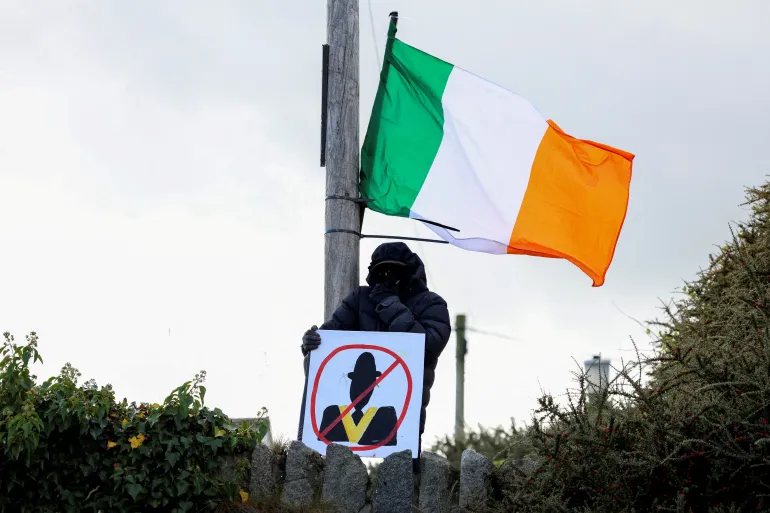
A demonstrator holds a placard, as people protest on the Garvaghy Road, a Catholic enclave in the largely Protestant town of Portadown, against the Protestant Orange Order's annual Drumcree parade, in Northern Ireland, September 27, 2026. REUTERS/Cathal McNaughton TPX IMAGES OF THE DAY
A demonstrator holds a placard, as people protest on the Garvaghy Road, a Catholic enclave in the largely Protestant town of Portadown, against the Protestant Orange Order’s annual Drumcree parade, in Northern Ireland, September 27, 2026 [Cathal McNaughton/Reuters]

The Orange Order, a Protestant organisation with a historically anti-Catholic tradition, has been banned from marching on Garvaghy Road for the last 28 years.

The High Court order has overturned that ban. Now, a small group of Orangemen gathers at Drumcree Church each day in their traditional regalia, ready to march.

But they have not been able to get beyond the end of the road. Police stand in their way, refusing them permission to pass and citing the risk of violence with so many protesters waiting a few hundred metres away.

This has infuriated the Orange Order, which has called for the Police Service of Northern Ireland chief constable, Jon Boutcher, to be removed. The group believe they have a legal right to march and accuse police of yielding to the protesters.

“We hold a positive determination issued by the Parades Commission and reinforced by the High Court judge,” Nigel Dawson, district master of the Portadown Orange Lodge, told Al Jazeera. “The chief constable must comply with the law.”

In the 1990s, there were protests and violence when the Orange Order tried to return from Drumcree Parish Church along the road.

When asked how much longer the Orangemen are prepared to wait, Dawson said, “I’ve been at Drumcree for 28 years.”

Dawson warned of a dangerous precedent in which “might makes right”.

If a protest is big enough, the police can refuse to uphold a court ruling, he said, adding, “We have the law on our side here.”

Ultan Larkin, a protester who travelled to Portadown from the neighbouring town of Armagh to show support for the Garvaghy Road residents, said, “The law is on their side, but justice is not on their side.

“There’s hurt here. There’s pain here. Just because you can doesn’t mean you should.”

The standoff has so far been peaceful. But history tells the story of why this confrontation has a real risk of escalation.

‘Justice is not on their side’

Garvaghy Road was one of the most potent flashpoints of The Troubles – a 30-year conflict between mostly Protestant unionists who fought for Northern Ireland to remain part of the UK, and predominantly Catholic republicans who want a united Ireland.

Orange marches through the Catholic area were usually accompanied by some of the worst sectarian violence Northern Ireland has seen.

The peace deal known as the Good Friday Agreement was signed in 1998, and it transformed Northern Ireland.

Large-scale violence largely ended, former enemies shared power in a devolved assembly at Stormont, and a generation grew up in an era of peace without soldiers manning checkpoints on their streets.

Following this peace process, the Orange Order was prevented from parading along Garvaghy Road – an effective ban that has lasted almost three decades, until now.

In an unexpected decision, the Northern Ireland Parades Commission allowed for a scaled-down Orange march to go ahead under strict conditions. Only 35 Orangemen could take part in the march, and they would have to do so in silence without their usual flutes and drums.

Residents of Garvaghy Road were appalled and legally challenged this ruling.

A High Court judge initially granted an injunction preventing the parade, but the Court of Appeal overturned that ruling late on Saturday, clearing the legal way for the march to proceed on Sunday morning.

A further High Court challenge was subsequently dismissed.

Ultan grew up during the Troubles. He was convicted for having a senior role in the Real IRA and was sentenced to four years in prison – a conviction quashed years later on appeal.

“We have to live together, and to do that we have to respect each other,” he said. “But where is the respect if you’re marching through a community that doesn’t want you and where the people of that community are asking you to march somewhere else?”

“On the Irish tricolour we have green, white, and orange. The green is for the Irish Catholics here, and the orange is for the Protestant community, with white symbolising peace. We all have our place.”

He said there are old wounds on Garvaghy Road.

“People here suffered a lot when the Orange marches came. They remember how bad things were here – the intimidation and that sort of thing – and some people just aren’t able to forgive that.”

Political fallout

The standoff has become a political crisis in Northern Ireland, affecting the power-sharing government that runs the country.

Sinn Fein First Minister Michelle O’Neill visited Garvaghy Road to stand beside the protesters, alongside Sinn Fein President Mary Lou McDonald.

The Democratic Unionist Party (DUP) accuses nationalist politicians of breaking the law by supporting a protest that blocked Garvaghy Road, and observers have questioned how the first minister can continue in her role when she has openly rejected a High Court ruling.

The confrontation is particularly awkward as the DUP and Sinn Fein are supposed to govern together, representing the two principal political traditions that emerged from the conflict as part of the peace process.

The language between them has become increasingly bitter, and in less than nine months, Northern Ireland faces an Assembly election.

For now, the DUP and Sinn Fein remain in government together, while accusing the other of threatening the political settlement that followed the Good Friday Agreement.

Meanwhile, attempts to find a resolution continue.

Northern Ireland Secretary Chris Bryant has met representatives of the two communities, but talks have so far failed to produce a breakthrough.

His future is also now on the line over this.

Bryant could revoke the Orange Order’s right to march, but he has not exercised this power. Unionists have threatened to call for his resignation if he tries. Irish nationalists say they will do likewise if this parade goes ahead.

Source link

Ukrainian knifeman kills one, wounds four at abbey in Poland | Crime News

Ukraine’s President Zelenskyy denounces ‘horrific crime’ after 31-year-old attacks clergy and worshippers in border town.

One person was killed and four others injured when a man armed with a knife attacked clergy and worshippers at a Catholic monastery in southern Poland.

Police said the 31-year-old attacker, a Ukrainian national, went on a stabbing spree at the 17th-century Benedictine abbey in Jaroslaw, some 30km (19 miles) from the border with Ukraine, on Thursday morning.

Recommended Stories

list of 2 itemsend of list

The suspect, who had entered Poland from Germany earlier in the day, reportedly grabbed a knife from the abbey’s kitchen and attacked four men and one woman, including a priest in a confessional, police said.

“Three of the victims are clergy members and two are laypeople; one person has died,” said prosecutor Bozena Harasz-Wołoszyn. Two others were in “critical, life-threatening condition”.

Polish media identified the man who died as a priest. Police did not immediately confirm the identity of the deceased.

Prosecutors said the attacker was headed for a nearby border crossing back into Ukraine but instead went to the abbey.

The motive remains unclear, and doctors will assess whether he was under the influence of alcohol, Harasz-Wołoszyn said.

In this handout photograph taken and released by Gazeta Jaroslawska on September 24, 2026, a man stands behind police tape at the site of a knife attack in Jaroslaw, eastern Poland.
A man stands behind police tape at the site of a knife attack in Jaroslaw, southeastern Poland, on Thursday [Gazeta Jaroslawska via AFP]

Leaders respond

Polish Prime Minister Donald Tusk said the “murderer” would be “punished with the full severity of Polish law”.

Ukrainian President Volodymyr Zelenskyy called the attack a “horrific crime”.

“The perpetrator of this evil must bear full responsibility in accordance with the law … We are shaken by this evil. Justice must be done.”

The mayor of Jaroslaw, Marcin Nazarewicz, declared a period of mourning until the end of the week.

Stabbings, particularly at religious sites, are extremely rare in Poland, one of Europe’s most Catholic countries.

Source link

Arab News | Russian drone strike on a passenger bus in Ukraine kills 5 people and wounds at least 7 others

KYIV: A Russian drone struck a passenger bus in southern Ukraine early Wednesday, killing five people and wounding at least seven in the latest in a series of Russian strikes on civilian transportation.

Ukrainian President Volodymyr Zelensky called the attack an atrocity with no military purpose.

The strike occurred in the Nikopol district of Ukraine’s Dnipropetrovsk region, near the war’s southern front line. Oleksandr Hanzha, head of the regional military administration, said that all five were killed at the scene while the seven wounded were receiving medical care.

Zelensky described the vehicle as a minibus and said in an X post that the strike had “no military rationale” and that it was “just another atrocity.” He said the strike was connected to Russia’s targeting of logistics and critical infrastructure that has continued “unabated.”

Zelensky said that a passenger train was also struck in the Mykolaiv region on Wednesday, damaging a railway station and a diesel locomotive. Nearly 170 passengers on board the train were evacuated before the strike. An electric locomotive in the northwestern city of Kovel was also struck, Zelensky said.

Ukraine requests locomotives from partners

Russian strikes on Ukraine’s rail network have resulted in more than 500 locomotives being damaged or completely destroyed since the beginning of the all-out war on Feb. 24, 2022, with more than half those strikes occurring this year, Ukrainian Foreign Minister Andrii Sybiha wrote on X on Tuesday.

Sybiha described such attacks as “systematic” and aimed at disrupting logistics across Ukraine. He said that Ukraine urgently needs replacements for damaged locomotives, and called on the country’s partners to assist in finding locomotives compatible with its 1,520-millimeter rail gauge and to assist in financing.

In another post on X on Wednesday, Sybiha said that Russian forces were striking passenger trains, locomotives, stations and railway routes “knowing exactly how essential they are for civilians, evacuations and Ukraine’s economy.”

“This is not collateral damage. It is a systematic hunt for people and an attempt to (paralyze) civilian life,” he wrote.

Zelensky says there is no truce on halting energy strikes

In an interview with CBS News on Tuesday, Zelensky pushed back against an earlier claim by US President Donald Trump that Ukraine and Russia had agreed to mutually cease attacks on each other’s energy infrastructure. Zelensky said that Ukraine was ready to enter such an agreement, if Russia stops striking Ukrainian energy facilities.

Trump said in a social media post Monday that such a truce had been reached, but didn’t offer details on the purported agreement. Previous efforts to broker even a partial ceasefire have repeatedly fallen apart within hours, with both sides accusing the other of violations.

In the CBS interview, Zelensky said that the possibility of an energy truce was discussed during a recent meeting in Kyiv with Trump’s representatives, Steve Witkoff and Jared Kushner, but that he had told them: “If the Russians are ready for an energy truce, that means there will be no attacks on energy facilities at all.”

Russia decorates ship captain who fired flares at Danish helicopter

Russia’s Defense Ministry said Wednesday that the captain of a Russian warship that fired two signal flares toward a Danish military helicopter on Monday, drawing ire from Denmark, has been awarded a medal for his “competent and resolute action.”

The ministry said in a statement that the Soobrazitelny corvette was on a mission in neutral waters in the Baltic Sea when its crew spotted the approaching helicopter, which failed to respond to calls made via the international communication channel.

“To prevent a provocation by the Danish helicopter, the corvette commander decided to fire two red signal flares, after which the helicopter left the area where the Russian warship was located,” the ministry said.

Russian Foreign Minister Sergey Lavrov said Wednesday that Moscow has no aggressive intentions toward Europe, but that if countries on the continent were to launch an attack on Russia, “it would be a completely different kind of war, and a very short one.”

Russian general killed in Ukrainian drone strike

The deputy head of the Russian armed forces’ military-political department, Lt. Gen. Apti Alaudinov, confirmed Wednesday that a decorated Russian general had been killed in the occupied Donetsk region.

Alaudinov, who didn’t provide details on the circumstances of Maj. Gen. Anton Grunis’ death, hailed the officer as “a hero” and “one of the most respected generals … a real man and officer and a great patriot.”

The confirmation of Grunis’ death came after Robert “Magyar” Brovdi, commander of Ukraine’s Unmanned Systems Forces, alleged on Wednesday that Grunis had been killed in occupied Donetsk by a Ukrainian drone while at a command post in the village of Kindrativka.

In July, Grunis reported to Russian President Vladimir Putin that his troops had captured the town of Kostiantynivka and he was later awarded the Hero of Russia medal. Ukraine has disputed that Kostiantynivka was fully taken by Russian forces.

Grunis had previously fought in Chechnya, a mainly Muslim republic whose bid for independence after the Soviet Union’s collapse led to years of war with Russian government forces. He also took part in Russia’s campaign in Syria.

In Ukraine, he commanded the 4th Guards Motorized Infantry Brigade.

Meanwhile, 17 other sites were damaged in Ukraine’s Kyiv region between Tuesday and Wednesday morning, according to the head of the Kyiv regional military administration, Tymur Tkachenko. Eight private homes, five vehicles, a municipal building, a hangar and a production facility were among the sites damaged, Tkachenko said on Telegram.

Zelensky said on X that the Kherson, Donetsk and Poltava regions had also come under attack.

In the northern city of Sumy, six people were injured in a Russian guided aerial bomb attack, including a 14-year-old girl, according to the head of the Sumy regional military administration Oleh Hryhorov. Two homes were destroyed and 10 others damaged in the strikes, along with damage to an educational facility, Hryhorov said, adding that two other men were hospitalized after a separate strike hit an industrial zone.

In the port city of Odesa, one person was killed in a Russian attack that sparked a fire at garages and damaged vehicles and private homes, Serhii Lysak, head of the city’s military administration, wrote on Telegram Wednesday.

Russia’s Defense Ministry said that its air defenses downed 71 Ukrainian drones overnight. In the Belgorod region, one person was killed and four others were wounded by Ukrainian strikes over the last 24 hours, according to acting governor Alexander Shuvayev.


Source link