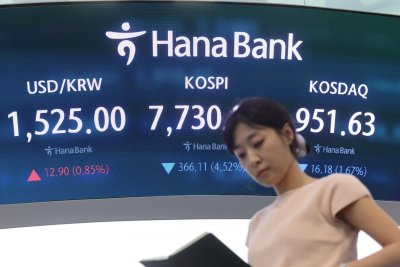
This photo, taken Wednesday, shows the trading room of Hana Bank in Seoul as South Korean stocks fell more than 4 percent amid escalating Middle East tensions and a tech sell-off. Photo by Yonhap
South Korean stocks plummeted more than 4 percent Wednesday amid escalating tensions between the United States and Iran and a tech slump fueled by concerns over the valuation of stocks related to artificial intelligence (AI). The local currency was trading lower against the U.S. dollar.
The benchmark Korea Composite Stock Price Index (KOSPI) shed 366.11 points, or 4.52 percent, to close at 7,730.82, almost eclipsing most of the over 8 percent surge from the previous day.
At one point, the index fell as low as 7,541.11.
Due to the sharp fall, the Korea Exchange had activated a sell-side sidecar for the index at 1:16 p.m., halting program trading for five minutes.
Trade volume was moderate at 457.5 million shares worth 39 trillion won (US$25.6 billion), with losers outnumbering winners 547 to 343.
Foreigners continued their sell-off for the 23rd consecutive session, dumping a net 2.77 trillion won, while retail investors and institutions purchased local shares worth 4.86 trillion won. Institutions sold 2.27 trillion won.
Market analysts said the KOSPI lost ground as tensions resurfaced in the Middle East after the U.S. struck Iran in response to the shooting down of an American Apache helicopter in the Strait of Hormuz and then Tehran hit back.
The risk-on appetite was also sapped by an overnight tech slide on Wall Street caused by concerns over the valuation of the AI stocks on news that Crusoe Energy Systems, a data center developer, suspended one of its projects upon the request of an unidentified big tech customer.
The tech-heavy Nasdaq composite closed 0.97 percent lower, and the S&P 500 dropped 0.26 percent, while the Dow Jones Industrial Average rose 0.17 percent.
Major tech shares led the market decline, with Broadcom losing 1.12 percent, Apple sliding 3.64 percent, Micron falling 1.4 percent and Nvidia down 0.2 percent.
Investors’ eyes are now on the upcoming release of the U.S. Consumer Price Index (CPI), which could give further clues on the U.S. Federal Reserve’s monetary policy amid bets on a hawkish pivot and the initial public offering of SpaceX later this week.
“The South Korean stock market was weighed down as risk aversion sentiment strengthened ahead of the U.S. CPI and Oracle’s earnings release, once triggering a sell-side sidecar,” Lee Kyoung-min, an analyst at Daishin Securities, said.
Lee said a hot inflation report could further contract the market sentiment, raising concerns over a possible U.S. rate hike.
In Seoul, market top-cap Samsung Electronics slid 6.06 percent to 302,500 won, while its chipmaking rival SK hynix plunged 7.54 percent to 2.05 million won.
AI investment firm SK Square shed 6.78 percent to 1.18 million won, and Samsung Electro-Mechanics shot down 8.38 percent to 1.8 million won.
Samsung Life Insurance dipped 6.36 percent to 368,000 won, and Samsung C&T plummeted 5.01 percent to 407,500 won.
Auto shares were also weak, with Hyundai Motor down 5.79 percent to 602,000 won, and its sister Kia losing 2.8 percent to 159,700 won. Hyundai Mobis dropped 4.2 percent to 570,000 won.
Internet portal operator Naver, which had recently rallied on news on its partnership with Nvidia, nosedived 11.67 percent to 227,000 won. Home appliances maker LG Electronics shot down 9.68 percent to 224,000 won.
Major shipbuilder HD Hyundai Heavy was among the few gainers, jumping 4.74 percent to 641,000 won.
Defense giant Hanwha Aerospace also climbed 1.48 percent to 1.03 million won.
The Korean won was quoted at 1,524.2 won against the U.S. dollar at 3:30 p.m., down 12.1 won from the previous session.
Bond prices, which move inversely to yields, closed mixed. The yield on three-year Treasurys added 2.5 basis points to 3.881 percent, and the return on the benchmark five-year government bonds dropped 3.2 basis points to 4.070 percent.
Copyright (c) Yonhap News Agency prohibits its content from being redistributed or reprinted without consent, and forbids the content from being learned and used by artificial intelligence systems.
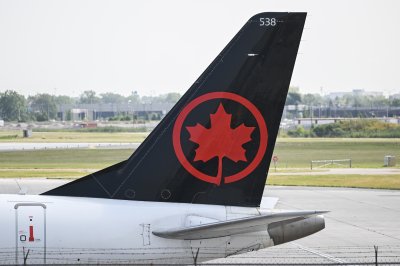
An Air Canada plane is shown in 2025 at a gate at Montreal-Trudeau International Airport in Montreal, Quebec, Canada. Police said a former Air Canada captain faces fraud charges after flying without the correct license for 17 years. File Photo by Graham Hughes/EPA
June 9 (UPI) — A former pilot and captain for Air Canada faces fraud charges after an investigation showed he flew hundreds of flights over 17 years without a proper license, police said Tuesday.
Wall, who’d started his career with Air Canada in 1998, did not obtain the required airline transport pilot license in 2009 when he was promoted to captain, Deputy Chief Nick Milinovich said at a press conference.
That license requires a series of written exams. Instead, Wall allegedly used fraudulent licenses for Air Canada and Transport Canada (the country’s federal transportation department)and then attempted to conceal that in a false police report, Milinovich said.
“This is very similar to a doctor who that is licensed to practice family medicine but is doing brain surgery in their office,” Milinovich said.
Air Canada said that Wall was immediately removed from duty when the fraud was discovered, The BBC reported. Airline officials said passengers were never at risk and that Wall was completely trained with a valid commercial pilot license, just not the ATPL.
Police said Wall flew several types of airplanes in a total of 900 domestic and international flights. The investigation through Transport Canada started when officials noticed inconsistencies with his license documentation in a routine evaluation. The Peel Regional Police then started a criminal investigation. The charges include fraud, forging documents and possession of counterfeit mark.
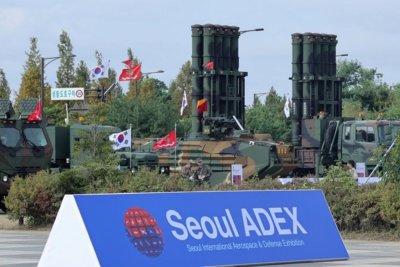
Cutting-edge weapons, such as the KAAV amphibious assault vehicle and the Bigung guided rocket, are on display at the Seoul International Aerospace and Defense Exhibition, or ADEX, that kicked off at KINTEX in Goyang, just northwest of Seoul. Photo by YONHAP / EPA
June 9 (Asia Today) — Military, industry and academic experts warned Tuesday that South Korea must urgently build an integrated air and missile defense system as drone swarms, artificial intelligence-enabled attacks and missile threats become more complex.
Experts said fragmented air defense weapons cannot respond effectively to modern battlefields where drone swarms are combined with ballistic and cruise missiles. They called for linking sensors, command decisions and interceptors into a unified system.
The Korea Association of Defense Industry Studies hosted the Future of Integrated Air and Missile Defense conference at the Daejeon Convention Center. The Missile Defense Forum organized the event and Northrop Grumman sponsored it.
The conference was held alongside the InLEX KOREA 2026 defense exhibition and drew officials from U.S. Forces Korea, foreign defense attachés, South Korean defense firms and overseas defense companies.
Kim Jin-ki, chairman of the Korea Association of Defense Industry Studies, said building an integrated air defense network is directly tied to national survival in modern and future warfare. He called for closer governance among the military, industry, academia and research institutions.
Rep. Yoo Yong-won, a member of the National Assembly’s defense committee, said South Korea must move faster to advance its missile defense system and secure next-generation air defense capabilities as global interest grows in the Cheongung-II missile interceptor system.
Kim Ki-won, a senior research fellow at the Korea Institute for Defense Analyses, said lessons from the Israel-Iran conflict and the Russia-Ukraine war point to a major shift in air defense strategy.
“Simply increasing the number of interceptors has limits when facing saturation attacks such as drone swarms,” Kim said.
He said South Korea needs AI-based intelligent engagement control and a smart defense network that links multiple sensors into one system.
Sean McLay, Asia-Pacific business development director at Northrop Grumman, said modern attacks are increasingly combining ballistic missiles, cruise missiles and drones.
McLay said South Korea should move away from platform-centered air defense systems and toward a network-centered integrated architecture that connects sensors, command and control and engagement assets.
Northrop Grumman developed the Integrated Battle Command System, which is used by the United States and Poland. The system is built around the concept of linking any sensor to the best available shooter, allowing commanders to match threat data with the most effective response.
Former Air Force 3rd Missile Defense Brigade commander Moon Oh-sun said South Korea’s individual air defense weapons have already reached a world-class level but remain limited by organizational barriers.
“To maximize combat effectiveness, we must break down the closed and isolated silo structure among the military branches,” Moon said. “Complete integration of information sharing and command decision systems is essential.”
Kim Dae-young, a military research fellow at the Korea Research Institute for National Strategy, said South Korea must also prepare for the reality that no missile defense system can intercept every threat.
Operating on the premise that “perfect interception does not exist,” Kim said South Korea should build a multilayered survival structure that allows national functions to continue even if missile defenses fail. He cited the need for public air raid shelters and other measures to help the country withstand attacks.
South Korean defense companies also presented domestic technology related to integrated air defense.
Jung Won-woo, head of LIG D&A’s air defense control development team, introduced integrated fire control network technology based on data distribution service middleware. His presentation focused on the transition from engagement control to integrated fire control.
The conference ended with a panel discussion chaired by Joo Kwang-sup, a visiting research fellow at the Sejong Institute and a retired Army brigadier general. Panelists discussed how South Korea can build an integrated air and missile defense system suited to future security conditions.
Han Kwon-hee, planning director at the Korea Association of Defense Industry Studies, said the association will work to ensure the ideas raised at the conference help strengthen South Korea’s integrated air defense capabilities and improve the global competitiveness of the country’s defense industry.
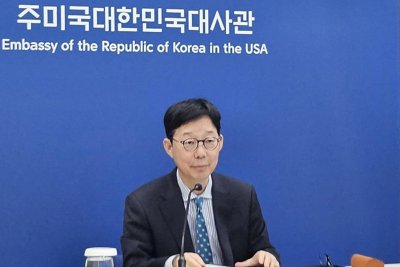
South Korean First Vice Foreign Minister Park Yoon-joo speaks during a press conference for South Korean correspondents at the South Korean Embassy in Washington, DC, USA, 20 May 2026. Photo by YONHAP / EPA
June 9 (Asia Today) — South Korea and the United States share the view that Seoul’s push to acquire nuclear-powered submarines would provide an important alliance capability, South Korea’s Foreign Ministry said Tuesday.
The ministry said the issue was discussed last week during the inaugural meeting to implement the South Korea-U.S. joint fact sheet, known as JFS, and that the talks proceeded on the premise that the submarines would be built in South Korea.
A Foreign Ministry official told reporters that the U.S. delegation did not raise any particular objection to domestic construction of the submarines.
U.S. President Donald Trump previously said on social media that South Korea’s nuclear-powered submarines would be built at Philly Shipyard in the United States, but officials from the two countries discussed the project on the premise of construction in South Korea, the official said.
“Both sides share the view that South Korea’s nuclear-powered submarines would be an important alliance capability for South Korea’s leading role in the defense of the Korean Peninsula,” the official said.
The official said the submarine plan is intended to strengthen security in response to conditions on the Korean Peninsula and is not aimed at any specific country.
On South Korea’s push to expand its uranium enrichment and spent fuel reprocessing rights, the official said the two sides agreed that strengthening their nuclear energy partnership serves their common interests and decided to begin full-scale talks on ways to make that happen.
South Korea faces the challenge of overcoming restrictions under its civil nuclear cooperation agreement with the United States, commonly known as the 123 Agreement, to expand enrichment and reprocessing rights.
Diplomatic circles have discussed options including a full or partial revision of the agreement or passage of separate special legislation.
“The joint fact sheet talks are aimed at strengthening South Korea-U.S. nuclear cooperation,” the Foreign Ministry official said. “In broad terms, this can be understood as looking at ways to adjust the current 123 Agreement.”
The launch meeting was held June 2-3 after a delay of about seven months. Foreign Ministry officials described the atmosphere as positive.
One official said the U.S. side gave the impression that it was serious about the talks. Another said the meeting proceeded in a constructive atmosphere.
Foreign Minister Cho Hyun also made an unannounced visit to a working lunch on the second day of the talks to encourage the delegations.
The government remains cautious, however, because of the details of the negotiations, concerns in the United States over nonproliferation norms and uncertainty surrounding Trump’s decision-making style.
“The overall perception of South Korea’s commitment to nonproliferation is the most important thing,” the Foreign Ministry official said. “We must make efforts to avoid sending unnecessary messages.”
President Lee Jae Myung’s remarks at his first-anniversary news conference Monday, where he criticized calls for South Korea to develop nuclear weapons as “truly irresponsible,” were seen as reflecting that concern.
The government is coordinating the schedule for follow-up talks with Washington.
The Foreign Ministry official said the two sides agreed to accelerate consultations. Several more full meetings led by the two countries’ national security councils are expected, along with frequent working-level talks by sectoral delegations.
England did almost everything right in their qualifying group, winning five of their six matches, including the victory over Spain at Wembley in April.
They also scored 13 goals, conceded just five – four of which came against Spain – and kept four clean sheets.
But it is not easy to qualify automatically and England were given a rough draw with world champions Spain in their group. The quest for top spot was always likely to come down to their head-to-head record.
That is what happened as England ultimately missed out because they were thumped in Majorca.
That humbling defeat – which showed the gulf between the two teams when Spain are at their best – was their downfall.
Wiegman opted for experience in the starting XI against Spain. Despite not featuring for England since October, and only returning from a four-month injury in April, midfielder Ella Toone was given the nod over Lucia Kendall and Laura Blindkilde Brown.
Chelsea’s Lucy Bronze started at right-back despite an injury in the build-up to the game.
In the end, England’s midfielders were too passive and easily controlled by Spain, while the usually explosive frontline of Alessia Russo, Lauren Hemp and Lauren James proved ineffective.
At the back, England struggled to live with Spain’s creativity and dynamism, with only Esme Morgan impressing in a generally dismal performance.
England’s sloppiness was compounded by the fact Spain produced one of their best performances to date and Wiegman could not come up with an answer for it.
Wiegman told BBC Radio 5 Live this week that she is “absolutely convinced” England can match Spain at their best if they are to meet again next year.
But that one crucial defeat showed just how difficult it is for England to qualify for major tournaments and why they cannot afford an ‘off day’ against the best teams.
“We have mixed feelings, of course. We were very disappointed with the way the game went [against Spain],” said midfielder Georgia Stanway, a scorer on Tuesday along with Jess Carter and Beth Mead.
“It’s very rare that you get 15 points and still not make it out of the group. I think that it shows our level, our consistency, but we know our performance wasn’t good enough against Spain.”
Wiegman said it was a “good thing” that there is more competition throughout Europe but admitted it was tough to miss out on such fine margins.
“The Nations League brought more competition in Europe. I think that’s really nice. We also noticed we have to play Spain so many times,” she said.
“I was excited for this group to play Iceland as we hadn’t played them. It’s something for Uefa to have a look at, at least. The good thing is there is a lot of competition.”
The Alibaba logo is displayed at a Alibaba office in Beijing, China, 09 June 2026. On 08 June, the Pentagon added Chinese companies Alibaba, BYD, and Baidu, among others, to a list of firms it said aid the Chinese military. Photo by JESSICA LEE / EPA
June 9 (Asia Today) — The U.S. Defense Department expanded its list of Chinese companies it says are linked to China’s military, adding about two dozen firms, including BYD, Alibaba, Baidu, WuXi AppTec and Unitree, according to U.S. media reports.
The annual list, known as the Section 1260H list of Chinese military companies, grew from last year as U.S. national security officials increased scrutiny of Beijing’s use of civilian technology to support military modernization.
The newly added companies span electric vehicles, e-commerce, cloud computing, artificial intelligence, biotechnology and robotics.
BYD is one of China’s leading electric vehicle makers. Alibaba operates e-commerce and cloud computing businesses, including in the United States. Baidu is active in internet search and artificial intelligence. WuXi AppTec is a major pharmaceutical and biotechnology services company, while Unitree is known for humanoid and quadruped robots.
The move shows the Trump administration is looking beyond semiconductors and AI chips as it assesses security risks tied to Chinese technology and industrial supply chains.
Chris McGuire, a fellow at the Council on Foreign Relations and former official at the State Department and National Security Council, said the action shows Washington is increasingly attentive to security risks from Chinese products in industries beyond semiconductors and AI.
China objected to the move.
A spokesperson for the Chinese Embassy in Washington said the Defense Department was overstretching the concept of national security and creating a discriminatory list targeting Chinese companies.
The updated list drew attention because it comes as Washington and Beijing have recently appeared to ease some trade tensions.
The United States had reportedly held back some measures against Chinese companies, including sanctions, high tariffs and cyber-related actions. An earlier version of the list expected in February was withdrawn ahead of a U.S.-China summit, according to U.S. media reports.
The summit, held in Beijing last month, focused heavily on trade issues.
Still, the Pentagon continues to view China as the United States’ main military competitor.
Craig Singleton, a senior fellow at the Foundation for Defense of Democracies, said the trade atmosphere may have improved after the summit, but Washington’s basic assessment has not changed.
He said U.S. officials still believe major Chinese civilian technology companies are connected to China’s military modernization.
Companies placed on the list are barred from doing business with the U.S. military. The designation does not automatically impose broad sanctions, but it can create reputational risk, reduce access to U.S. government-related business and increase scrutiny from investors and regulators.
The commercial effect can vary by company.
SZ DJI Technology, the Chinese drone maker placed on the list in 2022, has continued to maintain a strong position in the U.S. consumer drone market despite its designation.
The latest additions show that Washington’s concerns about China’s military-civil fusion strategy are expanding from advanced chips and AI models into broader technology and manufacturing ecosystems.
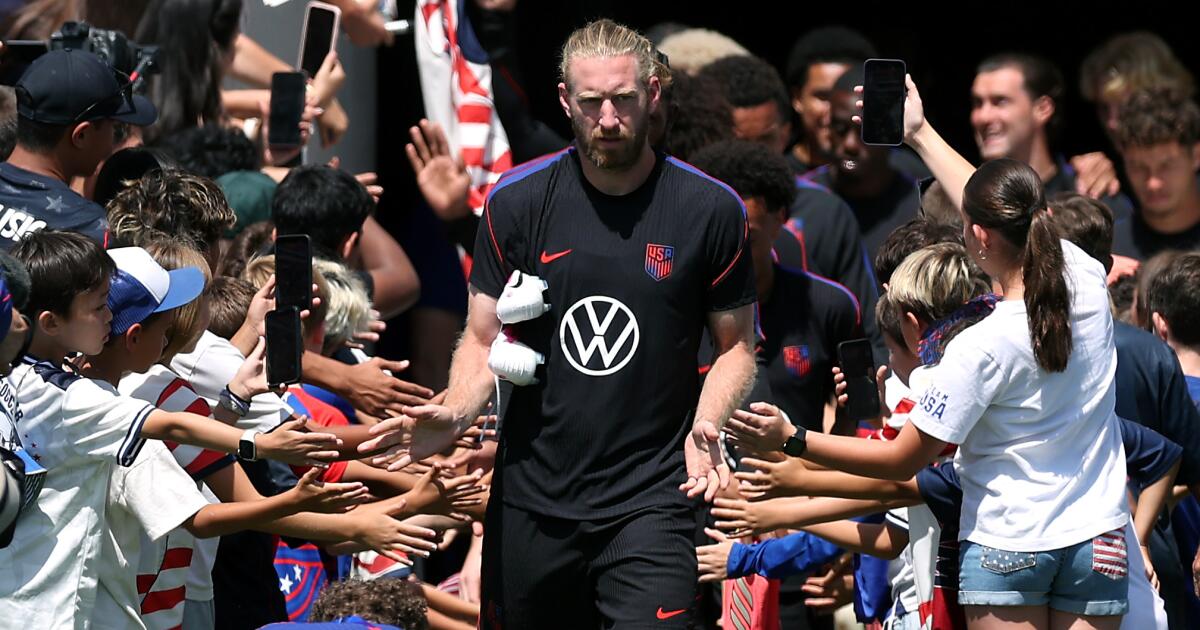
Tim Ream is the only player on the American World Cup team who was alive the last time the tournament was played in the U.S. But he was only 5, so the memories are kind of sketchy.
“I remember bits and pieces of 1994,” he said.
Still, it’s fallen on Ream, as both the captain and the oldest man on the roster, to prepare the team for what they’re about to experience when the U.S. opens play Friday at SoFi Stadium.
“I’ve tried to tell guys and tried to convey the message that this is a once-in-a-career [opportunity] and with that comes more expectation, more pressure,” he said. “But at the same time we have to enjoy it.
“It’s about just opening your eyes and taking everything in because this is unique, this is completely different from anything that any of us as players has experienced.”
Only 22 men in history have suited up for a home World Cup game on U.S. soil. Players including Alexi Lalas, Eric Wynalda, Cobi Jones and Marcelo Balboa parlayed that fame into broadcasting careers. Others have become coaches. Fifteen of them were inducted into the National Soccer Hall of Fame.
Ream, who played in the last World Cup in Qatar, said it’s difficult to compare the experience of that tournament with this one — especially since this one hasn’t started yet.
“It’s not our first rodeo, but it’s our first one on U.S. soil,” he said. “So it’s kind of our first rodeo in a way. It’s exciting.
“So take it in, enjoy it, embrace everything that it is. Because it’s so unique, it’s so special. And it’s not something that we will ever get to do again.”
Midfielder Cristian Roldan was also at the last World Cup, although he didn’t appear in a game. He says the energy is different this time around.
“You feel it when you’re there. You’re kind of isolated, you’re alone,” said Roldan, one of 13 players on this team who were also on the team in Qatar, half a world away. “But it’s different here. You see how many media members are here. You see how many people we’ve seen in training over the last few weeks. You feel that energy, you feel that support.
“Now it’s about translating that energy, that support, that pressure into something good.”
Goalkeeper Matt Turner agreed.
“This one, obviously, it’s a lot more tangible,” he told reporters Tuesday. “You guys are all here, right, real close to us. We have 5,000 fans for training yesterday. It’s very different. In Qatar, you’re in a lot more of a bubble.
“But us players, the ones that had the [World Cup] experiences, I think we’ve done a really good job of keeping that boundary.”
What’s lacking this time, Turner said, was the pressure of a qualifying campaign to bring the team together. Because the U.S. is one of the three host countries — alongside Mexico and Canada — it was assured a spot in 48-team field when it won the right to stage the tournament eight years ago. As a result it hasn’t played a competitive game in more than 11 months.
“The intensity of those games, the environments that you have to dip into and get results, you find out a lot about the players and find out a lot about the team,” he said. “This time around, it’s been different. We’ve had a lot of different looks, a lot of different players getting a chance to prove themselves and show themselves.
“It’s not anything bad or good. I just think it was a little bit different.”
Striker Folarin Balogun, one of 13 World Cup newbies on the U.S. team, said he doesn’t expect the gravity of the experience to hit him until he lines up for Friday’s opening game with Paraguay.
“It’s probably going to start to go more real to me when I’m preparing to go on to the pitch,” he said, sitting behind a table next to Ream. “I’m hearing the fans shouting and screaming, so I definitely think it’ll be real to me the closer I get.
“But you know, this is the first opportunity for me to play in the World Cup so I don’t really have any expectations.”
Balogun then looked over at a frowning Ream, who had just finished urging his teammates to be sure to stop and smell the flowers along this World Cup journey.
“Just trying to stay present, stay in the moment,” Balogun hastened to add. “You know, enjoying the experience. I think it can be a really memorable World Cup.”
Many of Argentina’s country’s leading shopping mall operators to expand capacity to meet growing demand for retail space. File Photo by Juan Ignacio Roncoroni/EPA
BUENOS AIRES, June 9 (UPI) — International fashion, luxury and sports brands are accelerating expansion into Argentina after years of absence, driving multimillion-dollar investments and prompting the country’s leading shopping mall operators to expand capacity to meet growing demand for retail space.
The renewed interest from foreign companies reflects Argentina’s changing economic environment since President Javier Milei took office.
Looser import restrictions and other market-opening measures have revived the appeal of a market that for years had been left out of the expansion plans of many international firms.
The expansion comes despite a challenging consumer environment. According to consulting firm Scentia, sales of mass-market consumer goods fell 3.8% year over year in April 2026 and were down 3.3% during the first four months of the year.
Federico Vaccarezza, an economist and professor in Austral University’s Faculty of Business Sciences, told UPI that international brands closely monitor sales data from Argentina’s leading shopping malls because they reflect the behavior of the consumers targeted by their products.
He noted that many of these brands are not seeking to reach the broader population, but rather higher-income consumers — a segment that has shown greater resilience in maintaining spending levels despite economic difficulties.
Vaccarezza said those groups represent roughly the top 10% to 20% of income earners in Argentina.
The international chains that have announced plans to enter Argentina are focusing their projects on Buenos Aires’ most exclusive shopping centers and key cities across the country. The trend includes companies entering the market for the first time, brands returning after years away and firms expanding existing operations.
International companies view Argentina as a long-term opportunity because of its market size, with more than 45 million residents, and expectations surrounding recent economic changes.
The influx of brands is already affecting the commercial real estate sector. Shopping mall operators report growing demand for retail space from foreign companies.
To meet that demand, several groups have accelerated expansion and construction projects. Chilean retailer Cencosud, one of Latin America’s largest retail groups, will invest $60 million to expand Unicenter, Argentina’s largest shopping mall, betting on rising demand for commercial space from international brands.
The project will add more than 215,000 square feet of space and 85 new stores by 2027.
“This expansion represents a concrete long-term commitment to Argentina,” Dolores Fernández Lobbe, country manager of Cencosud Argentina, told La Nación.
Meanwhile, IRSA, Argentina’s largest shopping mall operator and owner of some of the country’s most valuable retail assets, including Alto Palermo, Patio Bullrich, Alcorta Shopping and DOT, is moving forward with three new developments in the Buenos Aires area and the cities of La Plata and Mar del Plata. The company has not opened a new shopping center since 2015, when it inaugurated a project in the Patagonian province of Neuquén.
“Shopping mall customers are still there. What has changed is that competition on prices is now more intense,” IRSA President Eduardo Elsztain told La Nación.
According to business news outlet iProfesional, the expansion spans multiple sectors. Fashion, beauty, sports equipment, accessories and luxury goods are among the industries seeking to capitalize on Argentina’s new economic environment.
June is expected to be one of the busiest months for store openings. U.S.-based Skechers will open a new location, while Dolce & Gabbana will launch its first store in Argentina.
In July, Bullpadel, a company specializing in padel equipment, will enter the market. Padel has experienced rapid growth across Latin America in recent years.
U.S. apparel company Lucky Brand will enter Argentina through a partnership with local group Oxford. According to La Nación, the company plans an initial $1 million investment, will open its first store in July and aims to develop a network of 30 standalone stores across the country.
The company also plans to align prices with those in the U.S. market to compete with other brands in the segment.
Spanish fashion retailer Mango confirmed its return to Argentina through a franchise agreement with local group Grimoldi. The company plans to open five stores over the next five years, including a first location at Alto Palermo scheduled for September.
Vaccarezza said 2025 was a favorable year for Argentina’s shopping malls, although the trend began to weaken in 2026, with sales declining about 5% in the first quarter compared with the same period a year earlier.
The economist said looser import regulations and previously unmet demand help explain foreign companies’ interest in Argentina. He added that investment decisions by international brands are driven primarily by market-specific studies rather than broader economic indicators.
“It is a calculated risk. Companies have a clear understanding of the consumers they want to reach. The results will become evident later,” he said.
Economist and consultant Néstor Requelme expressed a similar view, saying the arrival of new international brands reflects recent economic changes and the presence of consumers with strong purchasing power.
Martín Burgos, an economist and researcher at the Latin American Faculty of Social Sciences, or Flacso, said the arrival of new companies could increase competition and help lower clothing prices in Argentina, a market that has historically been more expensive than many others.
“There is a policy aimed at reducing clothing prices. For years, apparel prices in Argentina were above international levels, and the easing of import restrictions is facilitating the arrival of these brands,” he told UPI.
However, Burgos agreed that many of the companies entering the country are primarily targeting higher-income consumers, one of the segments that has best withstood recent economic changes.
“The data show that overall consumption remains weak, but these brands are targeting consumers with greater purchasing power. For that reason, their expansion does not necessarily reflect a broad recovery in consumer spending,” he said.
The European Commission has demanded that Meta allow other AI companies access without charge while it investigates the company for antitrust violations. File Photo by Gian Ehrenzeller/EPA
June 9 (UPI) — The European Commission ordered Meta to allow competing artificial intelligence assistants to access WhatsApp while it investigates the company for antitrust violations.
The company must restore access by next week as it was until October, when the competition could use WhatsApp for free.
“In rapidly evolving markets, competition can be lost long before a final decision is adopted. This is why these interim measures will remain in place for the duration of the investigation, in order to prevent harm that would be almost impossible to repair,” Teresa Ribera, executive vice president for Clean, Just and Competitive Transition, said in a statement. “These interim measures will safeguard competition in the growing market for AI assistants, by preserving a key entry point to reach consumers in Europe — WhatsApp — and allowing AI companies to innovate, scale up and reach their full potential.”
The EC began its investigation in December around the same time Italy called foul of the alleged anti-competitive move by the company. Italy folded its complaint into the EC probe. After Brussels warned in February that it may force the company to open back up, in March Meta allowed the other companies in but began charging them fees. Brazil has levied similar complaints.
Meta has said WhatsApp’s business platform was not built to carry AI chatbots and that competitors can reach users through other channels.
“The European Commission has decided that OpenAI and some of the largest companies in the world can use the paid-for WhatsApp Business product for free. This is regulatory overreach subsidized by the many European companies that pay. We will appeal,” a Meta spokesperson told Politico.
Meta is also appealing a $228.34 million fine from the EU for violations of the Digital Markets Act.
If the company ignores the order, it can face fines of up to 10% of its annual revenue.
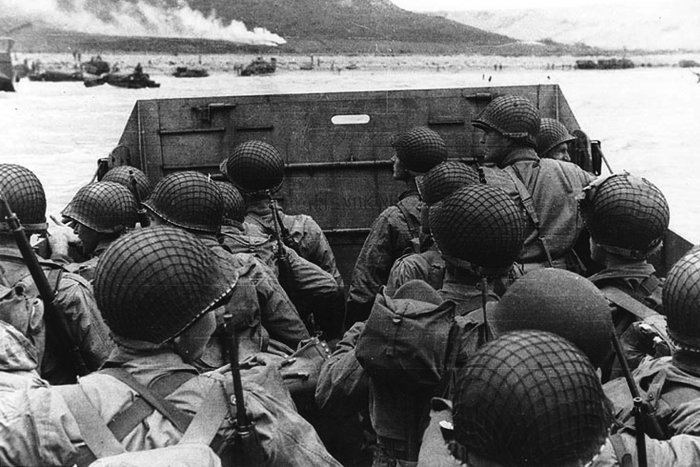
Troops in landing craft approach Omaha Beach on D-Day in Normandy, France, on June 6, 1944. D-Day was the largest seaborne invasion in history and turned the tide of World War II. Photo by UPI | License Photo
Estonian Prime Minister Kristen Michal, left, welcomes Ukrainian President Volodymyr Zelensky at a summit in Tallinn, Estonia, Tuesday. Photo by Valda Kalnina/EPA
June 9 (UPI) — Ukrainian President Volodymyr Zelensky and First Lady Olena Zelenska traveled to Talinn, Estonia, Tuesday to take part in the Ukraine-Nordic-Baltic Eight summit and meet with other regional leaders.
Zelensky is boosting diplomatic efforts as he pushes for more support for Ukraine’s war against Russia.
The Ukrainian president met Tuesday with Finnish Prime Minister Petteri Orpo, Latvian Prime Minister Andris Kulbergs and Swedish Prime Minister Ulf Kristersson, his spokesperson Sherhii Nykyforov told the Kyiv Independent. The meetings covered issues like strengthening Ukraine’s air defense and advancing the Prioritized Ukraine Requirements List program, which allows NATO allies to finance buying of U.S. weapons.
Zelensky also met with Estonian President Alar Karis and thanked the country and others in the region for their continued support.
Zelensky also emphasized the need to coordinate positions ahead of upcoming summits this summer, including the European Union, G7 and NATO summits.
“June and July this year may determine a lot,” he told reporters at a press conference.
“For a cease-fire to take place, in my view, it would be better to have a meeting at the leadership level. Who? Certainly Ukraine, Russia and definitely Europe,” the Ukrainian state news service Ukrinform reported Zelensky said. “It would be desirable for the United States of America to be there as well. Why Europe? Because we are in Europe — that is the answer. Because this is our land, this is our continent, and we must be certain that life will be safe tomorrow, no matter what.”
He added that Ukraine has the political will to negotiate, but Russia hasn’t shown that.
“The 21st package of EU sanctions is necessary. And today we also discussed that the Baltic Sea and the North Sea must not be a free zone for the Russian shadow fleet. And all decisions that curtail the activity of Russian tankers are decisions that benefit not only Ukraine but all of Europe,” the Ukrainian president said.
Zelensky recently sent a letter to Russian President Vladimir Putin asking to meet face to face for peace talks, but Putin declined.
Troops in landing craft approach Omaha Beach on D-Day in Normandy, France, on June 6, 1944. D-Day was the largest seaborne invasion in history and turned the tide of World War II. Photo by UPI | License Photo
June 9 (UPI) — Two U.S. Army helicopter crew members were rescued and brought to safety within two hours after their Apache gunship crashed near the Strait of Hormuz.
U.S. President Donald Trump said early Tuesday that the two service personnel were “fine” and promised a report on the incident would be released in the next 24 hours or so.
U.S. Central Command said the pair were in a stable condition with spokesperson Capt. Tim Hawkins telling NBC News that a Task Force 59 unmanned surface vessel found and recovered the soldiers — the first time the U.S. military had carried out such an operation with a drone boat.
A source told the New York Times that it was yet to be established whether the aircraft came under Iranian fire, sustained a technical malfunction or encountered another issue.
The loss of a Hellfire missile-armed AH-64 Apache — which patrol the strait, downing Iranian drones and preventing small boats from attacking shipping — is a first for the U.S. military since the conflict started Feb. 28.
At least eight U.S. fighter jets and other military aircraft, plus more than two dozen uncrewed aerial vehicles, have been lost in both enemy and friendly-fire incidents but Monday’s crash was the first loss of a helicopter.
The Apaches play a key tactical role alongside F/A-18 and F-35s fighter aircraft in U.S. Central Command’s mission to counter the blockade of the vital international shipping route, which Iran has effectively put out of bounds to the vast majority of oil tankers and other commercial vessels.
However, the helicopters have been patrolling closer to Iran, including its islands in the Hormuz Strait and Persian Gulf, as part of Centcom’s effort to maintain the pressure on Tehran amid protracted negotiations to resolve the 100-day-long conflict.
Tehran did not immediately claim responsibility for the incident, according to Iran’s semi-official Mehr News Agency.
The confirmation from the U.S. side came hours after Iran and Israel sides paused airstrikes on each other at the request of U.S. President Donald Trump, who urged them to “stop shooting” because an agreement with Tehran to end the war was very close.
“We’re in the final throes of what will be a very, very good deal that will not allow in any way, shape, or form nuclear weapons. The strait will open up right away.
Trump said the Strait of Hormuz would reopen to international shipping immediately after the agreement was signed, which could be before the weekend, adding that there was a chance it could be far earlier, “in one hour, if you want to know the truth.”
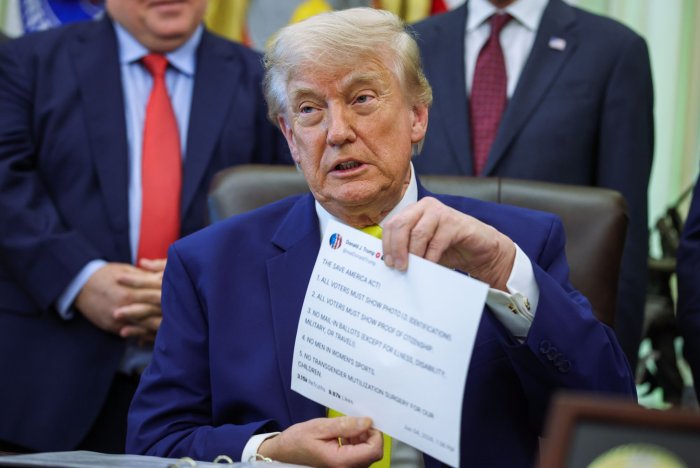
President Donald Trump discusses renovations to the Lincoln Reflecting Pool and makes an announcement on coal in the Oval Office at the White House on Thursday. Photo by Samuel Corum/UPI | License Photo
History tends to repeat itself at the World Cup. Such is the case with Mexico and South Africa, two teams that will face off in the World Cup opening match for the second time in history, just as they did in Johannesburg on June 11, 2010. The score that night was 1-1.
Many still remember Siphiwe Tshabalala and his powerful shot into the top corner that beat Mexican goalkeeper Óscar Pérez, and a celebration that remains etched in the collective memory of the soccer world. Unfortunately for the South African team that night, Rafa Márquez equalized for El Tri with 11 minutes remaining during what turned out to be a disappointing World Cup for the host nation.
Sixteen years later, the 2026 World Cup kicks off, curiously enough, with the same matchup, but with the roles reversed. Mexico is now the host at Azteca Stadium, known during this competition as Mexico City Stadium, at 7,216 feet above sea level. It will be the third World Cup the venue has hosted.
“It won’t be easy at all,” South Africa coach Hugo Broos said last December upon learning his team would debut against one of the hosts. “It’s a great thing to play in front of 80,000 people. We have nothing to lose.”
Mexico’s Giovani Dos Santos jumps on the back of Rafael Marquez after Mexico scored against South Africa during a World Cup group match on June 11, 2010, in Johannesburg, South Africa.
(Michael Steele / Getty Images)
On the Mexican side, the similarities to 2010 are striking — and not necessarily for the right reasons. Coach Javier Aguirre is back on El Tri’s bench — the same coach who led that campaign in South Africa — which, at first glance, might seem curious, though in practice it reflects the stagnation of a soccer team that has gone eight consecutive World Cups without advancing past the round of 16.
Former Barcelona player Márquez, who scored the equalizer, also remains connected to the national team, now as an assistant coach, with the mandate to take the reins of the team once the Aguirre era concludes after the World Cup. The squad has seen more than a dozen coaches come and go since 2010, including a qualification for Brazil 2014 that nearly ended in tragedy before a goal by the United States rescued the Mexican team and sealed its admission into the tournament.
“Javier [Aguirre] was a firefighter in 2002, he was a firefighter in 2010 and he stepped in as a firefighter again then — it’s the same old story,” said John Sutcliff, a journalist who has covered Mexico for more than 36 years. “[The federation officials] aren’t working in the best interest of the national team. There’s a lot of interest in bringing in foreigners [to the Mexican league] for business purposes and we don’t have players in Europe’s top leagues.”
Mexico’s recent record speaks for itself. It was eliminated in the World Cup round of 16 in 2010 by Argentina, by the Netherlands in 2014, by Brazil in 2018 and failed to even advance past the group stage in Qatar in 2022. Considered the “Giant of CONCACAF,” Mexico has remained dominant in its region since 2010, with five Gold Cups, although it has lost ground to the United States in the Nations League.
Outside the region, its participation in 2010 has been limited mainly to two editions of the Copa América held on U.S. soil, in which it has failed in both, reaching the quarterfinals in 2016 and being eliminated in the group stage in 2024.
“I think it’s been a roller coaster ride over these 16 years; for a moment it seemed like it was making progress, but then there were spectacular crashes,” said Gibrán Araige, a journalist who has followed El Tri through several World Cup cycles.
Mexico’s Raúl Jiménez celebrates with teammates after scoring against Serbia during a friendly at Nemesio Diez Stadium on June 4 in Toluca, Mexico.
(Agustin Cuevas / Getty Images)
For Araige, the level of the 2010 squad is similar to the current one, with players who are not yet established but have solid European experience.
Of the 26 players called up by Aguirre, 10 play in Europe, but few play for elite clubs or get significant playing time on their teams, mostly hampered by injuries, as is the case with Santi Giménez (AC Milan, Italy), César Huerta (Anderlecht, Belgium), Luis Chávez (Dinamo, Russia) and Edson Álvarez (Fenerbahçe, Turkey).
For its part, South Africa has not made significant progress since 2010.
After being eliminated in the group stage, finishing behind Uruguay and Mexico in a tournament held in its own country, it became the first host nation in a World Cup to fail to advance past that stage — a record that Qatar matched in 2022.
Bafana Bafana failed to qualify for the next three World Cups. In fact, this is the first time they have qualified since 2002, as they did not have to qualify in 2010, having hosted the tournament.
They were eliminated as group runners-up behind Ethiopia on the road to Brazil in 2014, they finished last in their group on the road to Russia in 2018 and finished second behind Ghana in the qualifiers for Qatar in 2022.
South African players run during a World Cup training session at Estadio Hidalgo on June 3 in Pachuca, Mexico.
(Manuel Velasquez / Getty Images)
They have also lacked consistency in the Africa Cup of Nations, missing the 2012 and 2017 editions.
Broos, who took over as South Africa’s head coach in 2021, sought to instill discipline and relied on local talent, which was vital in securing a spot in this year’s World Cup. During the qualifying round, South Africa won its group by finishing ahead of Nigeria and advanced despite starting the campaign with a loss due to an ineligible player used in a match against Lesotho.
Broos faced criticism for strategic errors early on, but ultimately built a competitive team that achieved historic qualification, aided by nine direct World Cup spots in the expanded tournament field.
“It’s a truly excellent group of players. We got through a very tough qualifying phase, which I think helped polish the team,” said Mark Gleeson, a journalist specializing in African soccer.
For Gleeson, South Africa missed a major opportunity to strengthen its league by failing to retain investors and wealthy clients after the 2010 World Cup and continued to operate in the same way — a trend reflected in the league’s stagnation and the scarcity of talent playing abroad.
Lwethu Makhanya (Philadelphia Union, USA), Ime Okon (Hannover 96, Germany), Mbekezeli Mbokazi (Chicago Fire, USA), Sphephelo Sithole (CD Tondela, Portugal) and Lyle Foster (Burnley, England) are among the few South African players competing abroad for a national team reliant on domestic soccer.
South Africa huddle during a training session at Estadio Hidalgo on June 3 in Pachuca, Mexico.
(Manuel Velasquez / Getty Images)
However, with the World Cup’s new 48-team format, the task of advancing proved less daunting for teams in the qualifying phase and at the World Cup, there will also be more opportunities to advance beyond the group stage because the best third-place finishers move on. That math could benefit South Africa even if it loses its opening match.
Should Bafana Bafana lose to Mexico, they would have to beat the Czech Republic in their second match on June 18 in Atlanta and would likely play for qualification on June 24 against South Korea in Monterrey.
“The Czechs are among the weakest in Europe, and there’s a good chance of beating them. Furthermore, South Korea is well below its own historical standards, as was evident in March with very poor results in high-pressure matches,” Gleeson said.
To prepare for the altitude in Mexico City, Broos, a former Belgian player who competed in the 1986 World Cup in Mexico, brought his team in early and, starting May 30, held training camp in Pachuca, a city at higher in elevation than the capital. Several of his players are already accustomed to some altitude from playing for clubs in Johannesburg, at 5,751 feet.
“South Africa has a chance; we can compete,” Tshabalala said in an interview after the draw. “I think the pressure will be on Mexico because they’re the hosts. That gives us a real opportunity to pull off an upset.”
A scoreless draw against Nicaragua in Johannesburg days before the World Cup isn’t exactly encouraging, but it also fits with the team’s expectations and the mindset of “having everything to gain and little to lose.”
“We have to enjoy it, and when you enjoy something, you can achieve great things,” said Broos.
The 2026 World Cup will launch with a series of historic opening ceremonies across North America, marking the first time the tournament has been launched simultaneously in three host countries.
The United States, Mexico and Canada will officially launch the biggest World Cup in history.
Recommended Stories
list of 4 itemsend of list
While the US hosted the tournament in 1994 and Mexico in 1970 and 1986, Canada will host the competition for the first time. Together, the three countries will open the tournament.
This World Cup will feature a record 104 matches spread across 16 host cities. The global event will run from the opening match in Mexico on Thursday, June 11, to the final on Sunday, July 19, in New York.
Here is what we know:
What are the 2026 FIFA World Cup opening ceremonies?
The three interconnected ceremonies staged across Mexico, Canada and the US are built around a shared theme designed to unite the three host nations while showcasing each country’s culture, identity and creative talent.
Each event will begin 90 minutes before the host nation’s opening match.
The ceremonies are being produced by Marco Balich, the creative director behind several Olympic opening ceremonies, including the 2026 Winter Games edition and major international sporting events. While each show will have its own distinct character, all three will be linked by a shared theme centred on football’s ability to unite people across borders.
Each host country will bring its own visual style to the ceremonies. Canada will be represented through a cultural mosaic, Mexico through papel picado, and the US through what Balich called “a super shiny, glowing cup”.
“The FIFA World Cup is a moment the world shares, and that begins with how we open it,” said FIFA President Gianni Infantino.
“Starting with Mexico City and continuing the next days with Toronto and Los Angeles, these ceremonies will bring together music, culture and football in a way that reflects both the individuality of each nation and the unity that defines this tournament. It is a powerful way to begin a truly global celebration.”
According to The Athletic, the ceremony in Mexico City is expected to run for about 16 minutes and 30 seconds, while the shows in Toronto and Los Angeles are scheduled to last approximately 13 minutes each.
Once the performances conclude, the pitch will be handed over to the teams for their pre-match warm-ups. Matchday protocol ceremonies, including the player walkouts and official introductions, will then begin 25 minutes before kickoff and are expected to last about 13 minutes.
Who is playing in the opening games?
Mexico will face South Africa in the first match of the tournament, which will take place following the opening ceremony in Mexico City.
Canada will play against Bosnia and Herzegovina in Toronto, marking a historic milestone as it will be the Canadian Men’s National Team’s first World Cup match played on home soil.
The US will take on Paraguay in their opening match following the celebration in Los Angeles.
When and where are the World Cup opening ceremonies?
Mexico City (June 11)
Mexico will launch the tournament at Mexico City Stadium (formerly known as the Estadio Azteca) 90 minutes before its opening match against South Africa, in a repeat of the 2010 opener.
The ceremony is expected to celebrate Mexican culture through Indigenous performers, contemporary folkloric acts and the traditional art of papel picado.
Artists featured on the Official FIFA World Cup Album are expected to perform, including Alejandro Fernandez, Belinda, Danny Ocean, J Balvin, Lila Downs, Los Angeles Azules, and Mana. The show will also include South African singer-songwriter Tyla.
Shakira is also expected to perform her Dai Dai – an Italian phrase meaning “let’s go” or “come on” – along with Burna Boy. Shakira is also set to co-headline the inaugural FIFA World Cup Final Halftime Show on July 19, alongside Madonna and K-pop band BTS.
Authorities have declared June 11 a public holiday in Mexico City, with schools closed and employers encouraged to allow remote work. Access to the stadium area will be restricted to ticket holders, accredited media and authorised personnel.
Opening day schedule in Mexico 9:00 (15:00 GMT): Stadium gates open 11:00 (17:00 GMT): Opening ceremony begins 12:10 (18:10 GMT): Team warm-ups 13:00 (19:00 GMT): Mexico vs South Africa kickoff
Toronto (June 12)
Canada’s ceremony will take place at Toronto Stadium before the country’s World Cup match against Bosnia and Herzegovina. The opening ceremony in Toronto will kick off at 1:30pm local time (17:30 GMT).
The ceremony will begin with a unique countdown designed to take viewers on a “journey across Canada”, highlighting moments that reflect the nation “from coast to coast to coast”.
Centred on the theme of a cultural mosaic, the event will highlight Canada’s diversity through music and performance, with artists including Alanis Morissette, Alessia Cara, Elyanna, Jessie Reyez, Michael Buble, Nora Fatehi, Sanjoy, Vegedream and William Prince.
The match immediately following the ceremony against Bosnia and Herzegovina is deeply significant, as it will be the first FIFA World Cup match to be played by the Canadian Men’s National Team on home soil.
FIFA President Gianni Infantino noted that the Toronto ceremony will be a “powerful reflection of Canada’s identity” and a “moment of pride, unity and anticipation” as the country steps onto football’s biggest stage.
Opening day schedule in Canada
13:30 (17:30 GMT): Opening ceremony begins. 15:00 (19:00 GMT): Canada vs Bosnia and Herzegovina kicks off.
After the ceremony concludes, the teams will complete their warm-ups before the official pre-match proceedings and kickoff at 3pm local time (19:00 GMT).
Los Angeles (June 12)
The US will host its opening celebration at the Los Angeles Stadium before facing Paraguay.
The ceremony will feature large-scale visuals, immersive storytelling and performances from global artists including Katy Perry, Future, Anitta, LISA, Rema and Tyla.
FIFA President Gianni Infantino highlighted that this specific artist lineup was chosen to reflect the cultural diversity and vibrant diasporas of the US, showcasing the nation’s considerable influence on global pop culture, music, and entertainment.
Opening day schedule in US
16:30 (23:30 GMT): Opening ceremony begins 18:00 (01:00 GMT June 13): The US vs Paraguay kicks off.
How can you watch the World Cup opening ceremony?
Fans in the US can watch the opening ceremonies through FIFA’s official broadcast partners. English-language coverage will be available on FOX and FS1, while Spanish-language coverage will air on Telemundo and Universo.
For free streaming, Tubi will simulcast the opening ceremonies and the opening matches, including Mexico vs South Africa on June 11 and the United States vs Paraguay on June 12.
All 104 World Cup matches will also be available through the FOX One app (subscription required), while Spanish-language viewers can stream every match on Peacock and the Telemundo app.
International broadcasters include:
Canada: CTV, TSN and RDS
Mexico: Televisa and TV Azteca
United Kingdom: BBC and ITV
How many fans are expected to attend and watch?
FIFA has not released an official number for the opening ceremonies. However, the three events are expected to fill their host venues in Mexico City, Toronto and Los Angeles, with a combined live attendance of roughly 200,000 spectators.
The ceremonies will also be broadcast worldwide as part of the opening match coverage, likely attracting a global television audience in the tens or hundreds of millions.
Are the hosting nations facing any challenges before the ceremony?
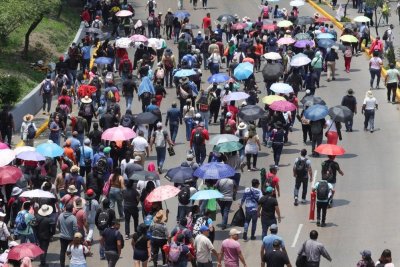
Yes. In Mexico City, ongoing protests by teachers’ unions and other groups have raised concerns about possible disruptions before the opening match between Mexico and South Africa.
Protesters have threatened to block major roads leading to Mexico City Stadium and other key locations. Authorities have responded with a large security operation and say the opening ceremony is not at risk, although organisers remain on alert as the tournament approaches.
In Los Angeles, officials have focused on security planning, crowd management and preparations for large-scale events across the city. Local authorities have also said they do not expect immigration enforcement operations at World Cup venues.
In Toronto, organisers are preparing for an influx of visitors, with transport agencies adding services and coordinating plans to reduce congestion. Across all three host nations, security and logistics remain key priorities as the tournament gets under way.
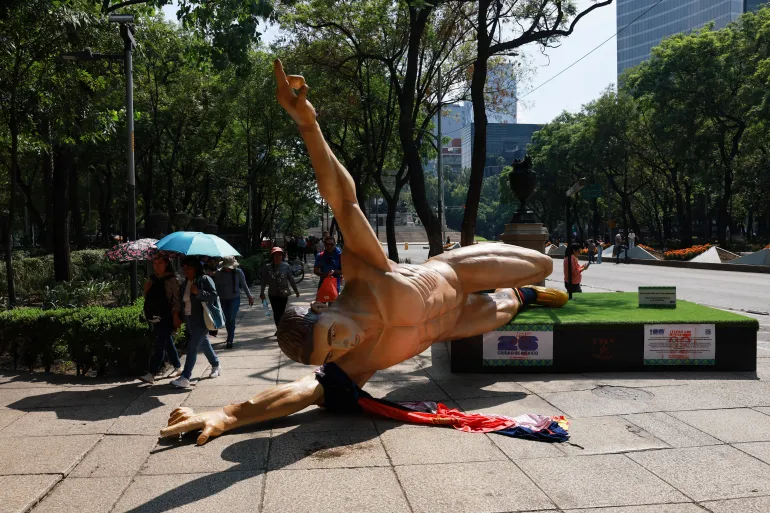
People walk near the fallen statue of a football player, placed along Avenida Reforma for the 2026 FIFA World Cup, that was vandalised by teachers from Mexico’s National Coordination of Education Workers (CNTE), following a protest demanding better wages and pensions, under the slogan “If there’s no solution, the ball won’t roll,” in Mexico City [Henry Romero/Reuters]
The FIFA World Cup begins on June 11. You can follow the action on Al Jazeera’s dedicated World Cup 2026 page with all the latest news, match build-up and live text commentary, and keep up to date with group standings, real-time match results and schedules.
The aftermath of an earlier Israeli airstrike on the southern Lebanese port of Tyre in May. On Tuesday, the Israel Defense Forces ordered residents, including for the first time those in Christian neighborhoods, to evacuate well to the north of the city for their safety as it prepared to target Hezbollah “elements, facilities and combat means.” File photo by Stringer/EPA
June 9 (UPI) — The Israel Defense Forces ordered residents of the Lebanese city of Tyre, including the Christian quarter and more than 10 refugee camps, to evacuate Tuesday, pending Israeli military action against targets of Iran-proxy Hezbollah.
IDF spokesman Avichay Adraee wrote on X that “out of concern for your safety,” residents should leave their homes immediately and move some 20 miles north beyond the Zahrani River and warned that anyone remaining south of the river was putting their life at risk.
“Your presence near Hezbollah elements or their facilities or combat means endangers your lives. As we warned in the past days, following Hezbollah elements’ actions inside the Christian Quarter in the city, the Israel Defense Forces will be compelled to act against their terrorist activities in the quarter in the near term,” said Adraee.
“Any building used by Hezbollah for military purposes may be subject to targeting. To ensure your safety — evacuate your homes immediately and move north beyond the Zahrani River. Attention — any movement south of the Zahrani River may endanger your lives,” he added.
The development came a day after Israel and Iran backed away from direct confrontation that flared up at the weekend over an Israeli strike on the southern suburbs of Beirut that prompted Tehran to fire as many as 30 missiles at Israel with Israel striking back against military targets in central and western Iran.
In standing down its military, Tehran warned that in the event Israel continued its attacks in Lebanon, including in the south, “much more severe and crushing measures will be on the way.”
Israeli Prime Minister Benjamin Netanyahu said in a post on X Monday evening that Israel had only halted hostilities because “after we struck the terror regime in Tehran, it ceased attacking us” and threatened to “respond with overwhelming force” if Iran made the mistake of attacking Israel again.
Netanyahu said that by firing into Israel over the past day, Iran and Hezbollah had attempted “to impose a new equation upon” where they believed they could fire at Israel from Lebanese territory and from Iran and Israel would not react.
“That did not happen, and it will not happen. Not on my watch! It is an equation I find intolerable and unacceptable,” wrote Netanyahu.
The sides halted their respective military strikes at the request of U.S. President Donald Trump who urged them to “stop shooting” because a deal ending the 100-day-long U.S.-Iran conflict was imminent.
Speaking on the tarmac at JFK Airport in New York on Monday night, Trump said the United States and Iran were very close to “a very good deal that will not allow in any way, shape, or form nuclear weapons.”
“And the [Hormuz] Strait will open up right away — they’ll open up immediately upon signing, which could be in two or three days,” said Trump.
He said he didn’t believe there were any sticking points.
Trump said the alternative was to return to bombing Iran but that would be counterproductive because it would mean the Strait of Hormuz remaining closed for many months and the needless deaths of many more people.
“Who wants to do that? I don’t. And we’ll have a signed document that’s actually stronger than doing the bombing,” he said.
President Donald Trump discusses renovations to the Lincoln Reflecting Pool and makes an announcement on coal in the Oval Office at the White House on Thursday. Photo by Samuel Corum/UPI | License Photo
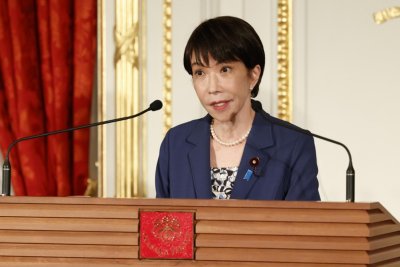
Japanese Prime Minister Sanae Takaichi speaks during a joint press conference with Philippine President Ferdinand Marcos Jr. (not pictured) at the Akasaka Palace state guest house in Tokyo, Japan, 28 May 2026. Photo by Rodrigo Reyes Marin / EPA
June 8 (Asia Today) — Japanese Prime Minister Sanae Takaichi’s government is moving forward with talks to revise Japan’s three core security documents, with defense spending, nuclear policy and artificial intelligence emerging as central issues.
The documents are Japan’s National Security Strategy, National Defense Strategy and Defense Buildup Program. They set the direction for diplomacy and defense policy for about the next decade, as well as defense spending and major equipment plans for five years.
Japan first adopted a National Security Strategy in 2013 under former Prime Minister Shinzo Abe. Former Prime Minister Fumio Kishida’s government revised all three documents in 2022.
Asahi Shimbun reported Monday that the Takaichi government’s review centers on eight issues: defense spending, Japan’s three non-nuclear principles, AI and drones, the defense industry, nuclear-powered submarines, ties with the United States, perceptions of China and economic security.
The largest issue is defense spending. The Kishida government’s 2022 documents called for raising defense-related spending to about 2% of gross domestic product by fiscal 2027. Takaichi’s government is seeking to reach that level in fiscal 2025 and then pursue another revision.
Asahi reported that the Trump administration has called on allies to raise defense spending to 3.5% of GDP, or 5% including related costs. If Japan applied the 3.5% target, annual defense spending could exceed 20 trillion yen, or about $125 billion.
Japan’s three non-nuclear principles are also under discussion. The principles commit Japan not to possess, produce or allow the introduction of nuclear weapons. The current National Security Strategy says Japan will maintain them.
Takaichi has questioned the realism of the principle barring the introduction of nuclear weapons, citing Japan’s reliance on U.S. nuclear deterrence. An Asahi poll conducted from March to April found that 75% of respondents supported maintaining the principles, compared with 21% who said they should be reviewed.
AI and drones are another major focus. Russia’s invasion of Ukraine and conflicts in the Middle East have raised the importance of low-cost drones, AI-based information processing, cyberattacks and cognitive warfare. Japan is considering expanding drone procurement, building domestic supply chains and using AI in defense.
The defense industry is also expected to be included in the review. Takaichi’s government views the sector as one of 17 priority areas in its growth strategy. Japan revised its defense equipment transfer guidelines in April, expanding the path for exports of weapons with lethal capabilities.
Government and ruling party officials are also discussing whether the state should own ammunition and other military supply plants while allowing private companies to operate them.
Whether Japan should introduce nuclear-powered submarines is another key question. China and Russia operate nuclear-powered submarines and North Korea is believed to be pursuing them. South Korea has also announced plans to deploy nuclear-powered submarines in the late 2030s.
Some Japanese officials and experts have argued for next-generation submarines that can remain submerged for long periods and travel long distances. Development costs, staffing and consistency with Japan’s Atomic Energy Basic Act remain challenges.
Relations with the United States and Japan’s view of China are also expected to shape the wording of the revised documents. The Trump administration is demanding greater defense burden-sharing from allies. If U.S. foreign policy priorities shift, Japan may need to adjust security plans that assume heavy reliance on Washington.
The 2022 documents described China as Japan’s “greatest strategic challenge.” Attention is now focused on how Japan will describe China after increased Chinese aircraft carrier operations, airspace incursions and concerns about a possible Taiwan contingency.
Economic security is expected to be treated as a separate pillar. Tensions in the Middle East, risks involving the Strait of Hormuz, dependence on energy and food imports and possible supply-chain disruptions are broadening Japan’s security debate. The Japanese government is emphasizing what it calls “collective autonomy” with allies and like-minded countries to maintain supply chains.
The Takaichi government is aiming to complete the revision by the end of the year. Asahi said the review could affect not only defense policy but also Japan’s national direction and public burden.
With its World Cup opener just four days away, the U.S. team moved into its temporary home in Irvine on Monday, where the players found thousands of new Southern California neighbors waiting in line to watch them kick a ball.
After the U.S. announced that Orange County Great Park would be its base for at least the group stage of the tournament, the City of Irvine held a raffle for passes to see the team train in its only public workout.
Thirty-two thousand people applied and 5,500 received access on a warm Monday morning to watch the team rush through a light 45-minute practice that was notable primarily because it was the first in which injured center back Chris Richards was fully involved. Richards tore two ligaments in his left ankle playing for Crystal Palace, his English club team, on May 17 and hadn’t played or fully trained since. The team is rushing to get him ready in the hopes he can play at some point in the three-game group stage.
But the practice was also notable because it was the first at Championship Soccer Stadium, about 50 miles southeast of SoFi Stadium in Inglewood, where the U.S. will open its World Cup on Friday against Paraguay.
“[The] environment and facilities are crazy. It’s more than we expect,” U.S. coach Mauricio Pochettino said of the venue. “We are so grateful.”
Championship Soccer Stadium is owned and managed by the city, which has leased it to the Orange County Soccer Club of the second-tier USL Championship. But the club was temporarily evicted in late April to make space for the national team — which is just fine with them.
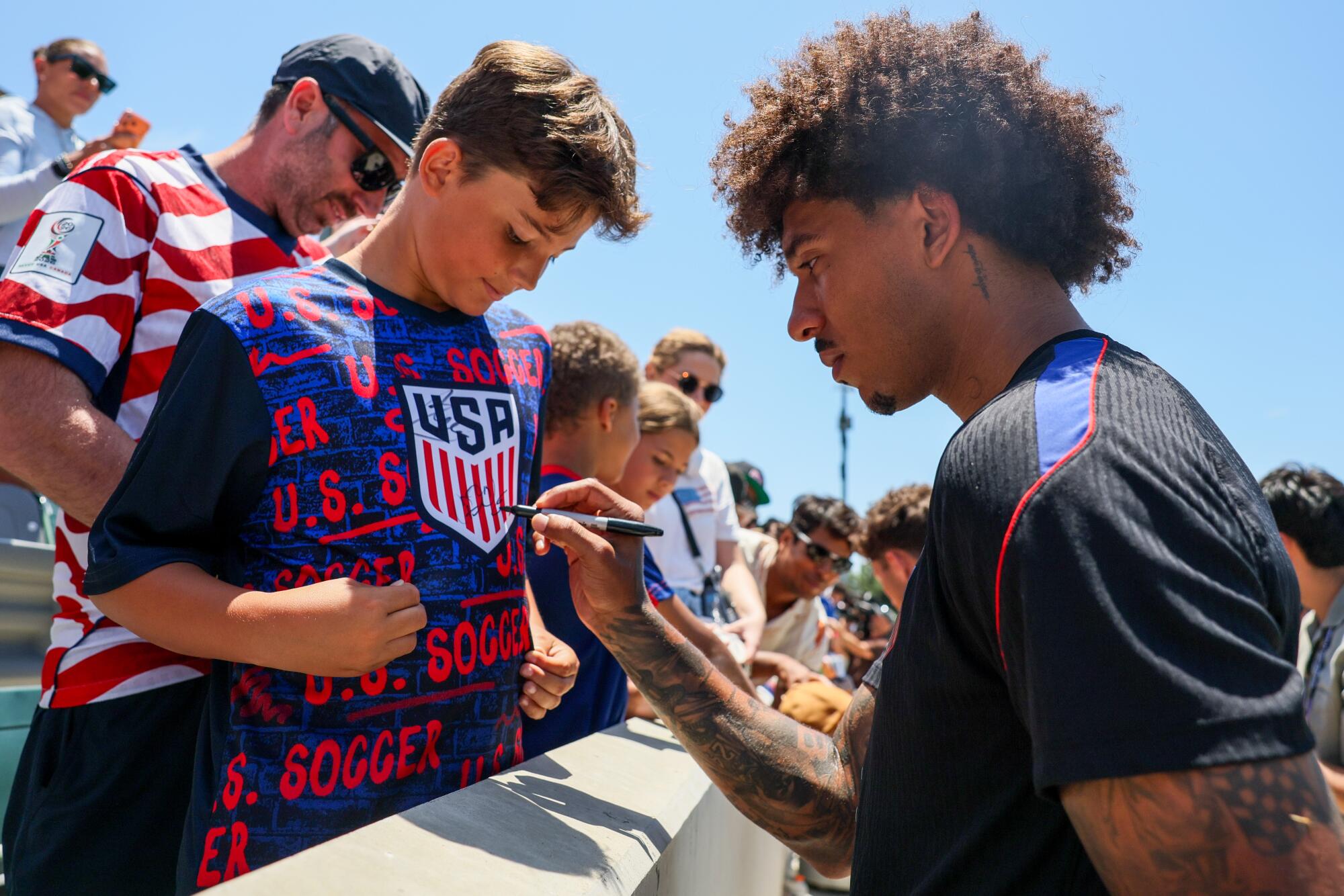
U.S. men’s soccer player Chris Richards autographs the shirt of a young fan during a team practice Monday.
(Ronaldo Bolaños / Los Angeles Times)
“How can you not be excited about the host nation training in your facility?” said Dan Rutstein, president of business operations of the Orange County club.
“We’re proud to be associated with the U.S. national team. We wouldn’t want to ever block anything, even if we could.”
(And they couldn’t, the city said.)
The Great Park is a sprawling 500-acre complex built on the site of the former Marine Corps Air Station El Toro, which closed in 1999 after 56 years training pilots for conflicts from World War II through the first Gulf War. In 2001, voters approved a proposal to convert the space into a public park and nature preserve, one which now includes, among other things, five sand volleyball courts, four basketball courts, 25 tennis courts, 12 softball and baseball fields, the ice arena where the Ducks practice and 25 soccer fields, including the pristine one FIFA just installed inside the 5,500-seat stadium.
“The idea was that this would be a quality facility, a great park that we hope will rival San Diego’s Balboa Park and other great parks across the country,” Irvine mayor Larry Agran said. “It took a lot of nurturing, a lot of time, a lot of work.”
Bringing the World Cup — or at least a World Cup team — to Irvine also took a lot of time and work. Agran said the city put out feelers about hosting a training base five years ago and made the first cut in 2024 when the Great Park was placed on a list of options distributed to tournament qualifiers.
Over the next two years, Rutstein said, about a dozen national teams sent representatives to have a look while Sam Zapatka, the operations manager of the USMNT, said he scouted 27 facilities from Seattle to San Diego. After his first visit to the Great Park, however, he said he stopped looking and in March, the team announced it would train in Irvine.
On Monday, when the players filed out of the stadium’s locker room, which FIFA expanded and upgraded, they were greeted by rhythmic clapping and chants of “USA! USA!”
1
2
3
4
1.U.S. men’s soccer player Weston McKennie takes part in a training session at Orange County Great Park.(Ronaldo Bolanos / Los Angeles Times)2.(Ronaldo Bolanos/Los Angeles Times)3.U.S. men’s national soccer team coach Mauricio Pochettino waves to fans attending practice on Monday.4.Pochettino speaks to players after drills at Orange County Great Park on Monday.(Ronaldo Bolanos / Los Angeles Times)
“I think we’ve all been, I wouldn’t say overwhelmed, but possibly surprised by the excitement and the buzz,” said captain Tim Ream, who led the team onto the field. “Pulling up here with 5,500 fans ready to watch a training session is incredible.
“We get to train in an actual stadium with a good pitch. The support, really, from all the kids out there is amazing. You want to feel like you have a good home base, right? So really, we’re looking forward to being here.”
Especially after 5,000 of your neighbors show up for the housewarming party.
Nvidia Chief Executive Jensen Huang, left, and Naver founder and board Chairman Lee Hae-jin greet attendees at Naver’s 1784 headquarters in Seongnam, south of Seoul, on Monday. Photo by Asia Today
June 8 (Asia Today) — Naver said Monday it will work with Nvidia to build a gigawatt-scale artificial intelligence factory, starting from its hyperscale data center in Sejong.
Naver founder and board Chairman Lee Hae-jin and Chief Executive Choi Soo-yeon met Nvidia Chief Executive Jensen Huang at Naver’s 1784 headquarters in Seongnam, south of Seoul, to discuss a joint business road map and global expansion strategy.
Huang greeted employees and visitors at the building, saying, “I love Naver.” He also joined a Naver Webtoon event and wrote, “Don’t worry! I have GPUs!” in a blank space on a display.
Naver and Nvidia said they agreed to pursue a joint project to build a large-scale global AI factory. The partnership goes beyond technology cooperation, covering demand development, investment and infrastructure construction across the value chain.
Naver will participate as a core partner sharing business results and risks.
The project will be based at Gak Sejong, Naver’s hyperscale data center. Naver plans to begin operating 55 megawatts of infrastructure in the first half of 2027, expand to 100 megawatts later that year and reach 200 megawatts in 2028. The company ultimately aims to build gigawatt-scale AI infrastructure.
Naver plans to use Gak Sejong to serve AI demand not only in South Korea but also in Asia, the Middle East and Europe.
The cooperation centers on combining Naver’s data-center and GPU cluster operation capabilities with Nvidia’s DSX platform. Nvidia DSX integrates chips, servers, software and data-center operating technologies for AI factories. The platform is designed to lower AI model training and inference costs and speed up infrastructure deployment.
Naver plans to use the technology to expand AI infrastructure services for companies, governments and industrial clients.
The companies also plan to broaden technical cooperation. Naver has been improving its HyperCLOVA X AI model by using Nvidia’s open large language model Nemotron. It is also working to develop a “Seoul world model” by combining Nvidia’s Cosmos world foundation model with Naver’s street-view and spatial modeling technologies.
The cooperation is expected to expand into physical AI, robotics and digital twins.
The meeting marked another step in the companies’ existing partnership. Lee and Huang met last year during the Asia-Pacific Economic Cooperation summit in Gyeongju to discuss cooperation on physical AI platforms.
Naver 1784 is considered a showcase for robotics, digital twins and cloud technologies. Huang was expected to review areas for expanded cooperation during his visit.
Naver is seeking to move beyond its role as an internet services company and become a global AI infrastructure provider. Huang recently introduced Naver Cloud as a key partner in the global AI ecosystem during Nvidia GTC Taipei 2026. Naver said it plans to accelerate its sovereign AI and AI data-center businesses through cooperation with Nvidia.
Naver shares also rose Monday. The stock closed at 279,000 won, or about $181, up 9.20% from the previous trading session, according to the Korea Exchange. Market analysts attributed the gain to investor expectations for the large-scale AI factory project and Naver’s global AI infrastructure expansion.
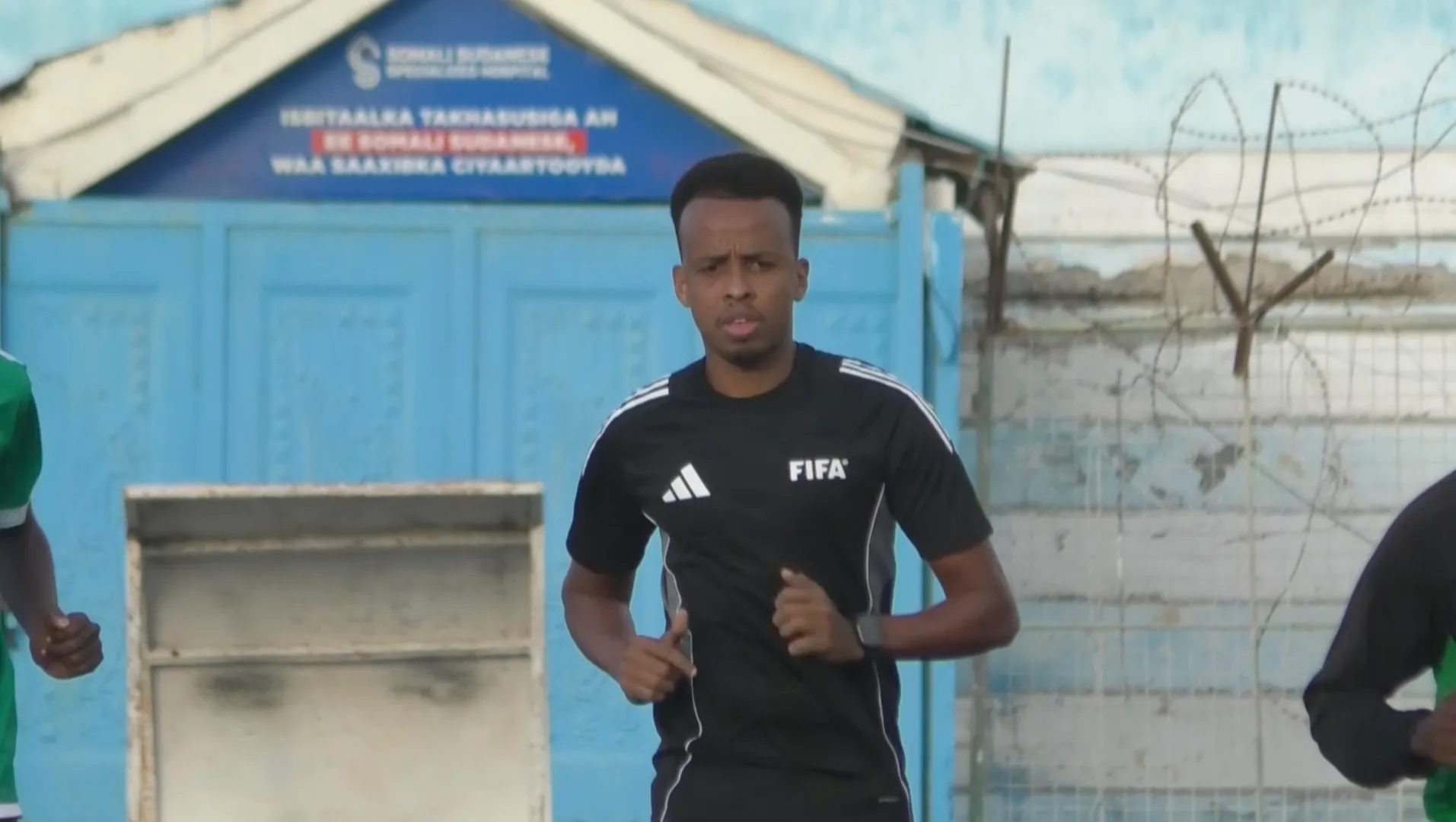
Award-winning Somali referee, Omar Abdulkadir Artan, has been removed from the World Cup roster after being denied entry to the United States despite holding a valid visa.
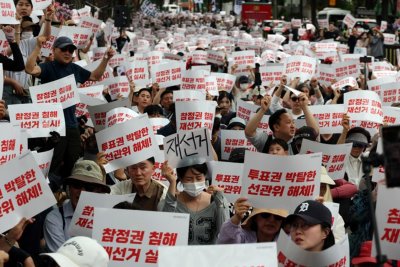
Protesters hold a rally in Seoul, South Korea, 06 June 2026, denouncing ballot paper shortages at some polling stations during the 03 June local elections and demanding a revote. Photo by YONHAP / EPA
June 8 (Asia Today) — A protest blockade outside a vote-counting site in Seoul’s Jamsil area entered its fourth day Monday, as demonstrators demanding a revote over a ballot shortage during the June 3 local elections increasingly raised claims of election fraud.
Until the weekend, protesters had mostly focused on voting rights and calls for a revote. By Monday, however, the atmosphere outside the Olympic Park Handball Gymnasium in Songpa District had shifted, with chants of “election fraud” mixed with demands for a new election.
At about 9 a.m., protesters could be heard chanting “fraudulent election, revote.” South Korean flags were visible throughout the crowd, along with many U.S. flags. Some protesters carried signs reading “Stop the Steal,” a slogan associated with challenges to the 2020 U.S. presidential election results.
One participant who said he had been at the site for four days said the mood began changing Sunday night as the size of the crowd grew and different groups joined the protest.
Police informally estimated that about 1,600 people were gathered near the gymnasium at 11 a.m., down sharply from about 8,000 around midnight. The age makeup also appeared to change. People in their 20s accounted for about 30% of the weekend crowd, while those in their 60s or older made up the largest share Monday morning, at 26.2%.
Tensions also rose among protesters. Some who insisted the crowd should only demand a revote were accused by others of being infiltrators from the Korean University Progressive Union, a left-leaning student group.
A brief scuffle broke out around 10:20 a.m. after six members of South Korea’s under-20 women’s national handball team entered the gymnasium to retrieve equipment stored inside before the World Championship in Shanxi, China, on June 24.
Police asked protesters to allow the athletes to enter. The athletes came out about four minutes later with their equipment, but some protesters tried to inspect the bags, saying ballot papers might be hidden inside. One person even demanded that the athletes remove their socks for inspection.
When another protester tried to stop the inspection, others accused him of being linked to the student group and a brief physical confrontation followed.
Revote seen as unlikely
Legal experts say a revote remains unlikely. Under the Public Official Election Act, a revote would require confirmation of a serious legal violation that could have affected the election result and a court ruling invalidating the election.
Legal observers widely say the ballot shortage may be considered a serious failure in election management, but it would be difficult to treat it immediately as grounds to invalidate the entire election.
The government is also focusing more on determining the facts and punishing those responsible than on discussing a revote.
President Lee Jae Myung expressed regret Sunday over the ballot shortage, saying the people’s right to vote is a constitutional right that must not be restricted or violated for any reason. He ordered a thorough investigation and punishment of those responsible and asked the National Assembly to pursue a parliamentary investigation. He did not comment separately on whether a revote should be held.
A joint investigation team involving prosecutors and police was formed Sunday. The investigation is expected to focus on whether election officials neglected their duties and who should be held responsible for the management failure.
The Seoul Metropolitan Police Agency’s serious crimes unit said Monday it had secured a group chat room used by election workers and was checking the facts with officials and citizens who were unable to vote because of the ballot shortage.
Political discussions on institutional reform are also continuing. Rep. Han Dong-hoon, an independent lawmaker, said Monday he plans to propose revisions to strengthen outside oversight of the National Election Commission and improve management of election commission employees.
Some lawmakers from both ruling and opposition parties have also raised the need for a parliamentary investigation and possible independent counsel probe.
The People Power Party said Monday it will file an election petition, a preliminary step before a lawsuit seeking to invalidate the Seoul mayoral election. The party plans to recruit 63 Seoul residents as joint petitioners by Wednesday and file the petition Thursday.
The shuttle of the Iran World Cup team between Mexico and the United States took root Sunday in Tijuana with an accessory.
The players arrived in Tijuana wearing gold-colored lapel pins on their jackets acknowledging victims of a missile strike on an elementary school that took place Feb. 28 at the outset of the war in their country.
The pins simply read “#168” — replicating the hashtag of the number of people killed in the daytime strike in Minab in southern Iran. Most of the victims were girls attending Shajareh Tayyebeh Elementary School.
The Iran delegation flew on a private jet from Turkey to Tijuana. Mehdi Taj, president of the Iran Football Federation, said two weeks ago that the training base would be in Mexico instead of Tucson.
FIFA has not given a reason for the change, although delays have occurred in processing U.S. visas for some Iranian players and other members of the delegation that allegedly have ties to the Revolutionary Guard.
Iran is preparing to play its three group-stage games in the United States, with the first scheduled June 15 against New Zealand at SoFi Stadium (called Los Angeles Stadium during the World Cup). Its second game, June 21 against Belgium, is also scheduled in L.A. and the third game will take place June 26 in Seattle against Egypt.
It is unclear whether FIFA — the governing body of the World Cup — would allow the pins to be worn by anyone on the sidelines during matches. That would include coaches and other team personnel in addition to players.
FIFA took no action in response to earlier displays of remembrance by the Iran players and has not commented on the legality of wearing the pins. FIFA regulations state that “equipment must not have any political, religious or personal slogans, statements or images.” The rule applies to players, coaches and officials on the sidelines during matches.
The Iran team twice acknowledged victims of the airstrike during the Iran national anthem before warmup matches in March. In the first, players held purple school backpacks decorated with bows. In the second, players held images of those who had died.
Before more recent warmup games, the Iran team stood with their right hands across their chests during the anthem. And earlier in March, some members of the Iran women’s soccer team remained quiet during the national anthem at an Asian Cup match, leading Iranian state TV to call them “wartime traitors.”
Video footage analyzed by investigative group Bellingcat appears to show a U.S. Tomahawk missile striking the school, which was adjacent to a compound associated with the Iranian Revolutionary Guard and barracks for its naval brigade. The United States has not accepted responsibility for the attack, although the military is investigating.
Upon arriving in Tijuana, Iran team captain Ehsan Hajsafi criticized FIFA about the delay in obtaining visas.
“First of all, we’re very happy that the team has finally arrived, and we’re delighted about that,” Hajsafi told reporters. “Thank God, the team’s condition is very good.
“With everything that happened, visas were eventually issued. Personally, however, I do have a complaint about FIFA. Why did it take so long? As far as I understand, visas were issued only to the players and a few members of the coaching staff.”
Ahead of the 2022 World Cup in Qatar, Hajsafi spoke boldly about the government crackdown on mass demonstrations in Iran.
“Before anything else, I would like to express my condolences to all of the bereaved families in Iran,” Hajsafi said. “They should know that we are with them, we support them and we sympathize with them. “We cannot deny the conditions — the conditions in my country are not good and the players know it also.”
Mexican teachers block an avenue during a national teachers’ strike organized by the National Coordination of Education Workers in Mexico City on Tuesday. The CNTE union vowed to maintain their national strike indefinitely over their demands, which include a salary increase and a reversal of the current pension and retirement frameworks. Photo by Madla Hartz/EPA
June 8 (UPI) — Thousands of teachers continue to block streets and maintain an encampment in Mexico City’s historic center just days before the opening match of the 2026 FIFA World Cup, as negotiations with the federal government remain deadlocked.
Mexican educators have sought to use the visibility of the tournament to pressure President Claudia Sheinbaum’s administration for higher wages and pension reforms.
The National Coordinator of Education Workers, known by its Spanish acronym CNTE, reaffirmed Sunday that it will continue its strike indefinitely and intensify demonstrations in the coming days despite calls from the federal government to end the work stoppage, according to Infobae.
“There are groups that want to provoke the Mexican government and are not necessarily teachers,” Sheinbaum said during her daily news conference. “What they want is repression. They want the national headline to be ‘Mexico represses teachers.’ They are not going to get that.”
The protests are concentrated around Mexico City’s Zócalo, the capital’s main public square, where FIFA has organized official fan activities.
Visitors seeking access to the FIFA Fan Festival must pass through the teachers’ encampment and additional security checkpoints, according to TV Noticias Telemundo.
The report said the historic center remains affected by the encampments, creating disruptions for tourists, residents and local businesses.
CNTE leaders are also considering extending demonstrations to Azteca Stadium, which is scheduled to host the World Cup opening match Thursday.
Interior Secretary Rosa Icela Rodríguez urged teachers Saturday to end the protests and continue negotiations, arguing that the demonstrations are affecting students, workers, merchants and tourism activity in the city center.
The CNTE rejected the government’s pension proposal as insufficient and announced that additional groups of teachers will join the protests this week.
Sheinbaum called Monday for patience while awaiting decisions in the coming days and said she remains confident that the opening of the 2026 World Cup “will be very good, without repression.”
The dispute comes as Mexico hopes the tournament will boost tourism and economic activity.
According to tourism industry estimates, the World Cup could generate as much as $3 billion in economic activity and attract more than 5 million international visitors.
Mexico City’s three host cities, Mexico City, Guadalajara and Monterrey, reported hotel occupancy rates of about 60% ahead of the tournament.
Nelly Carrasco Godínez, secretary of Culture and Tourism for the State of Mexico, said the state expects to receive about 1.6 million visitors in small historic towns and tourist destinations promoted during the World Cup. The expected economic impact is 1.4 billion pesos, or approximately $80 million.