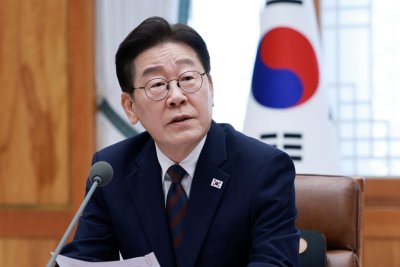
South Korean President Lee Jae Myung speaks during a Cabinet meeting at the presidential office Cheong Wa Dae in Seoul, South Korea, 10 February 2026. Photo by YONHAP / EPA
March 10 (Asia Today) — President Lee Jae-myung said Tuesday the government may prepare an early supplementary budget to cushion the economic impact of rising energy prices linked to the Middle East conflict.
Speaking at a Cabinet meeting in Seoul, Lee said additional fiscal measures could be necessary to support small businesses, struggling companies and vulnerable households if global energy shocks continue.
“To provide fiscal assistance and support for small business owners and vulnerable firms, we may inevitably need an early supplementary budget,” Lee said.
Lee also called for targeted support for lower-income households rather than a blanket reduction in fuel taxes as oil prices surge.
The president instructed officials to accelerate additional financial and fiscal measures, including a petroleum price cap system, adjustments to energy taxes and direct assistance to consumers.
“We must mobilize all national capabilities to minimize the impact of external shocks on people’s livelihoods, the economy and industry,” Lee said.
Deputy Prime Minister and Economy Minister Koo Yoon-cheol said the government could potentially finance the supplementary budget without issuing new government bonds.
He cited improving conditions in the semiconductor industry and increased fiscal resources linked to stronger activity in the stock market.
Lee also addressed concerns over reports that United States Forces Korea may remove some air defense assets from the country amid the regional conflict.
“If you ask whether this seriously undermines our deterrence strategy against North Korea, the answer is no,” Lee said.
He acknowledged that South Korea had expressed opposition to the partial withdrawal of air defense systems but noted that the United States may reposition some assets based on its broader military needs.
Foreign media have reported that systems such as the Terminal High Altitude Area Defense system and Patriot missile batteries could be redeployed.
Lee emphasized that South Korea’s defense spending remains among the highest in the world and said the country’s military readiness remains strong.
WASHINGTON — Russia is emerging as one of the few early economic beneficiaries of the war with Iran, as disruptions to energy infrastructure drive up demand for Russian exports and the world casts its gaze to the Middle East and away from Moscow’s war in Ukraine.
The U.S. and its European counterparts slapped severe sanctions on Russia in March 2022, barely a month into Russian President Vladimir Putin’s full-scale invasion of Ukraine. The effect was a stranglehold on Russia’s exports, depriving Putin’s war effort of at least $500 billion, experts say. But over the last week, as President Trump’s war in the Middle East choked energy markets worldwide, the White House began easing its restrictions on Moscow.
“It is traitorous conduct for you to help Russia,” California Rep. Ted Lieu (D-Torrance) said on X, demanding the Trump administration reverse course. “Russia is giving intelligence info to Iran that helps Iran target American forces.”
Crude droplets rained over Tehran after Israeli airstrikes decimated oil depots, draping the Iranian capital in a dense smog. Iranian counterattacks have also targeted refineries and oil fields in Saudi Arabia and Bahrain. Crude oil prices have surged, and traffic through the Strait of Hormuz has all but ceased, sending energy importers in search of alternate sources.
Those spikes are giving Russia, one of the world’s largest oil and gas exporters, a rare advantage. After spending a decade as the world’s most sanctioned nation over his aggression in Ukraine, Putin is finally starting to regain some leverage in global markets.
“In the current economic situation, if we refocus now on those markets that need increased supplies, we can gain a foothold there,” Putin said at a meeting at the Kremlin on Monday, according to Russian state media. “It’s important for Russian energy companies to take advantage of the current situation.”
On March 4, the Treasury Department issued a temporary 30-day waiver allowing Indian refiners to purchase Russian oil. The appeal by the Trump administration was described as a way to ease demand for Mideast oil, but was criticized as a reversal of sanctions placed against Putin meant to deny him the capital needed to fund his occupation of eastern Ukraine.
Now, Moscow is poised to press that advantage further, after Trump said Monday he will further lift sanctions on oil-producing countries to ease the trade friction and reintroduce additional oil and gas supplies. The only countries with U.S. oil sanctions are Russia, Iran and Venezuela.
“So, we have sanctions on some countries. We’re going to take those sanctions off until this straightens out,” Trump said at a news conference at his golf club in Doral, Fla. “Then, who knows, maybe we won’t have to put them on — they’ll be so much peace.”
Trump’s announcement followed an unscheduled hourlong call with Putin about the situation in the Middle East.
The war has also set the stage for Russia to make gains in Ukraine, as hostilities draw the global spotlight away from Kyiv and its struggle to hold back the bigger Russian army. U.S.-brokered talks between the two adversaries have been sidelined as Washington shifts focus to its war in Iran.
“At the moment, the partners’ priority and all attention are focused on the situation around Iran,” Ukrainian President Volodymyr Zelensky said on X. “We see that the Russians are now trying to manipulate the situation in the Middle East and the Gulf region to the benefit of their aggression.”
Putin is unlikely to intervene militarily on Iran’s behalf, according to Robert English, an international foreign policy expert at USC. Instead, Putin is expected to play his position carefully, reap the economic rewards, and keep focused firmly on Ukraine at a time when key air defense systems are diverted from Ukraine to the Persian Gulf.
“Russia is winning the Iran-U.S.-Israel war, at least so far. Oil and natural gas prices have soared, filling Putin’s Ukraine war chest,” he said. “Russia is gathering forces for a big spring offensive in Eastern Ukraine, and it’s not even front-page news.”
Ukraine has dispatched drone interceptors and ordered its anti-drone experts to pivot from their war with Russia to help Western allies help intercept Iranian attacks. Zelensky’s allegiance may not pay off, English said.
“When will Ukraine see the benefits of helping the U.S. with anti-drone technology? No time soon, apparently,” he said.
Even several weeks of interruption in Gulf energy supplies could bring the largest windfall to Russia, the Associated Press reported, citing energy analysts.
The economic turmoil caused by the war has exposed vulnerabilities in Europe’s energy system, particularly its lingering dependence on Russian fuel.
Despite sanctions, the European Union remains a major purchaser of Russian natural gas and crude oil. Russian gas accounted for approximately 19% of E.U. gas imports in 2025. Allied Europeans have agreed to completely stop importing Russian liquefied natural gas, oil and pipeline gas by late 2027.
Putin expressed no desire Monday to rescue the European market now that U.S.-Israeli escalations and Iranian retaliation have choked oil production and shipping. The Russian president instead proposed to divert volumes away from the European market “to more promising areas” like the Asia-Pacific region, Slovakia and Hungary, which he said were “reliable counterparties.”
European leaders have been criticized for being “stunned, sidelined, and disunited” since hostilities began in late February. Excluded from the initial military planning by the U.S. and Israel, Europe entered the conflict with gas storage at only 30% capacity, the lowest levels in years. Instead of bold action, English said, European leaders have quarreled over internal divisions and rivalries.
“Sky-high energy prices are the underlying cause of many of these frictions, as Europe struggles now more than ever to find affordable alternatives to the cheap Russian petroleum,” English said.
Antonio Costa, president of the European Council, told European leaders in Brussels on Tuesday that rising energy prices and the world’s shifting attention risk strengthening the Kremlin at a critical moment in the war in Ukraine.
“So far, there is only one winner in this war,” Costa said. “Russia.”
Twelve days ago the U.S., a World Cup host country, launched a full-scale bombing campaign against Iran, a country that has qualified to play in the tournament. That’s never happened before.
Five days later, that same World Cup host began military operations inside the borders of Ecuador, another World Cup qualifier, half a world away. That’s never happened before either.
With the tournament scheduled to kick off in three months, those events have soccer scholar Jonathan Wilson questioning whether it’s wise for the World Cup to go on at all.
“It seems to me, for each passing day, it’s less and less likely that the World Cup can happen,” he said.
That take seems unduly alarmist said David Goldblatt, a British sportswriter and sociologist who is a visiting professor at Pitzer College in Claremont. Anything short of a full-scale war inside the U.S. would not be enough to pull the plug on the tournament now, he said. Especially with FIFA expecting revenues of as much as $11 billion.
“I mean, it’s not a good look,” Goldblatt conceded. “And certainly when set against FIFA’s official pronouncements on its role in encouraging world peace and cosmopolitan celebrations of a universal humanity, none of that sits terribly easily.
“But in terms of actually running the World Cup, I don’t think it’s going to make very much difference at all.”
However, with the Trump administration open to engaging in more international conflicts, there’s little doubt this World Cup, the largest and most complex in history, will also be the most political in history as well.
Complicating things further is the fact the current conflict in the Middle East hasn’t been limited to just the U.S. and Iran. Iranian missiles have hit both Qatar and Saudi Arabia, among other countries, and Jordan has fired on U.S. assets.
Those three countries are World Cup qualifiers as well.
The fate of a soccer tournament pales in importance to the death and destruction the conflagration in the Middle East has produced, of course. But the need for unity is the very reason there’s a World Cup in the first place.
When French soccer administrator Jules Rimet founded the tournament 96 years ago, he believed soccer could be a tool for international peace. And in the early years of the tournament, Rimet, FIFA’s longest-serving president and a talented diplomat, was able to limit the impact of geopolitics on the World Cup, watering down Mussolini’s influence on the 1934 World Cup, for example, and steering the 1938 tournament away from Hitler’s Germany.
FIFA President Gianni Infantino has taken a far different approach, courting President Donald Trump’s support despite his growing number of global conflicts.
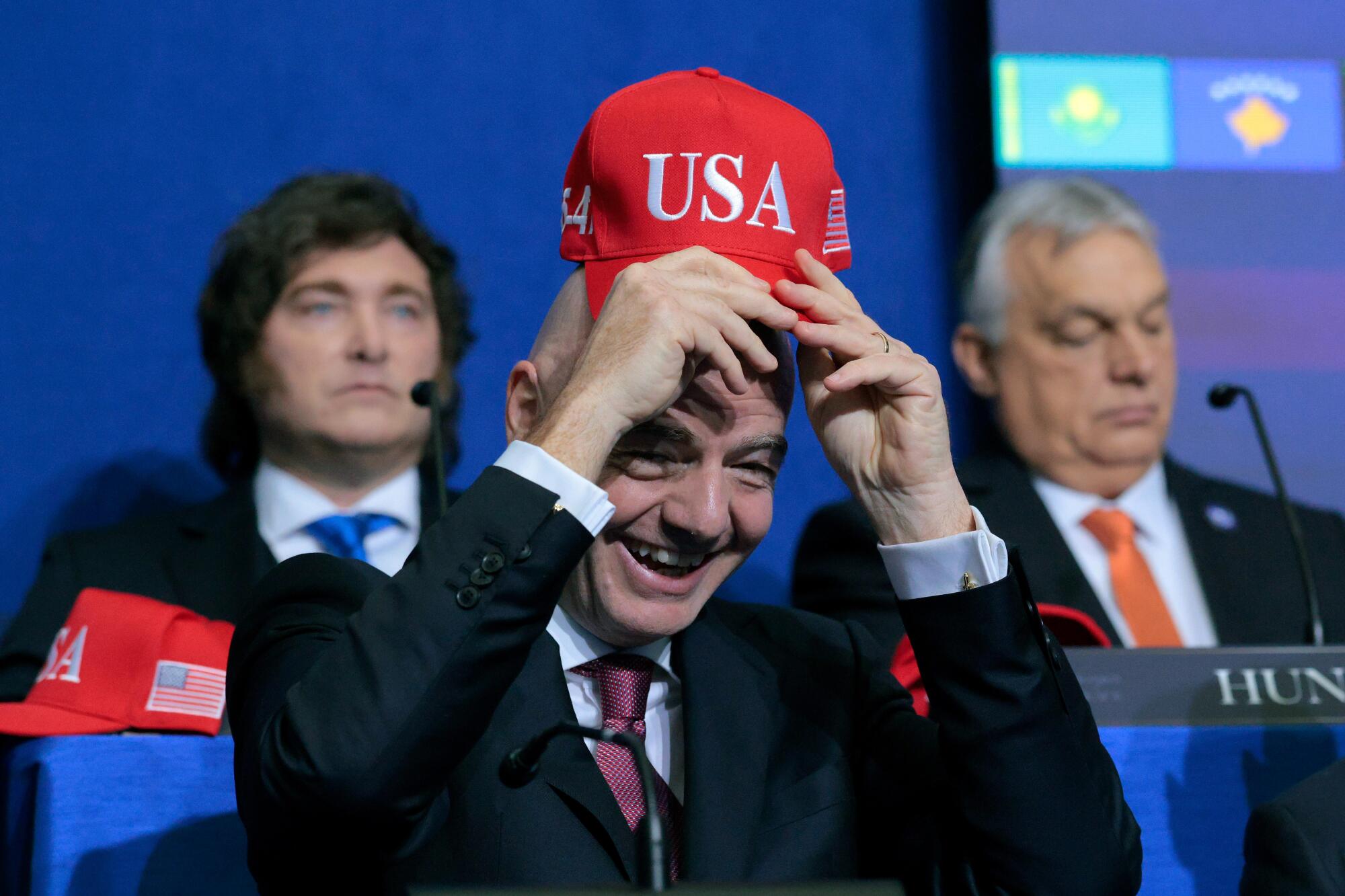
A week before bombs began falling on Iran, Infantino appeared at the inaugural meeting of Trump’s Board of Peace wearing a red cap with ‘USA’ on the front and the numbers ‘45-47’ — a reference to Trump’s non-consecutive presidencies. That act was so blatantly partisan, IOC president Kirsty Coventry said her organization would investigate whether Infantino, an IOC member, breached the terms of the group’s charter, which requires members to act independent of political interests.
FIFA president Gianni Infantino holds up a USA hat as he attends the inaugural meeting for the Board of Peace at the Institute of Peace in Washington on Feb. 19.
(Chip Somodevilla / Getty Images)
“Infantino has absolutely breached every FIFA protocol on neutrality,” said Wilson, author of “The Power and Glory: The History of the World Cup.”
“Absolute neutrality is always impossible and not desirable, but it has clearly gone way, way, way beyond. The peace prize looked grotesque at the time. It looks even worse now. And I can’t see how the future will look kindly on Infantino. I think Infantino has to some extent legitimized Trump.”
This is hardly new behavior from Infantino, who had close relationships with Vladimir Putin ahead of the 2018 tournament played in Russia and Qatar’s leaders ahead of the 2022 tournament despite their well-known human rights violations.
The list of countries Infantino is asking to overlook poor relations with the country hosting the majority of World Cup games this summer is growing.
Consider that Denmark, which administers Greenland, an autonomous territory Trump has also threatened to invade, can qualify for the tournament in a European playoff that will take place later this month. Then there’s World Cup qualifiers Haiti, Ivory Coast and Senegal, who aren’t at war with the U.S. but whose citizens have been banned from entering the country to cheer for their teams. That completely contradicts a promise from Infantino, who said “everybody will be welcome” at the 2026 World Cup.
“If I had a crystal ball I could tell you now what is going to happen,” Heimo Schirgi, the World Cup chief operating officer for FIFA, said Monday. “But obviously the situation is developing. It’s changing day by day and we are monitoring closely. [But] the World Cup will go on right? The World Cup is too big and we hope that everyone can participate that has qualified.”
Goldblatt, the Pitzer professor, said Infantino’s action are understandable since he has few cards to play against Trump.
President Trump speaks as he receives the FIFA Peace Prize as FIFA president Gianni Infantino applauds on Dec. 5 the Kennedy Center in Washington.
(Patrick Smith / Getty Images)
“What’s Infantino going to do? What levers can you pull?” he asked. “You can threaten to take it away. That’s not happening. Moral admonishment? Who’s going to take that from FIFA? It is a farcical idea that anybody thinks that the president of FIFA has any kind of collective moral authority or any role as a spokesperson for the progressive part of the world.
“They may fantasize that this is the case. But it is morally and politically absurd that any of us should expect that of these people. So if you are Infantino and that is the case, you know what works with Trump? What works is flattery. So of course he’s gone down that path.”
The games, Goldblatt said, will go on even if bombs are still falling. And that may not be an entirely bad thing.
“Football’s a great distraction. That’s partly why it’s so popular,” he said. “It will be virtually impossible, if the war continues, for that not to be a central element of like, the meaning and the purpose of what we’re all doing here.
“How we’ll feel and what it will look like, I don’t know. It will be very strange. Football is unpredictable and extraordinary. Something will happen that will warm our souls.”
⚽ You have read the latest installment of On Soccer with Kevin Baxter. The weekly column takes you behind the scenes and shines a spotlight on unique stories. Listen to Baxter on this week’s episode of the “Corner of the Galaxy” podcast.
Aaron Judge hit a two-run homer and Roman Anthony added a three-run blast in a big third inning to lead the United States to a 5-3 win over Mexico in the World Baseball Classic at Houston’s Daikin Park on Monday night.
The U.S. improved to 3-0 and will meet Italy (2-0) on Tuesday night, seeking to secure a spot in the quarterfinals in Houston this weekend.
Jarren Duran homered twice for Mexico (2-1), which will face Italy Wednesday night in the last game of Group B play.
The game was played in front of a sellout crowd of 41,628 that was decidedly pro-Mexico.
Reigning National League Cy Young Award winner Paul Skenes gave up one hit and struck out seven in four innings as the U.S. avenged an 11-5 loss to Mexico in the 2023 WBC.
The U.S. led by three entering the eighth inning before Duran took Matthew Boyd deep for his second homer. Boyd then hit Randy Arozarena on the arm with a pitch before striking out Jonathan Aranda.
Griffin Jax took over and induced a double-play grounder from Alejandro Kirk to end the inning.
Bryce Harper singled on a ball that hit reliever Jesus Cruz on the leg with no outs in the third inning. Judge followed with his drive to right field to put the Americans up 2-0 and give him two home runs in the tournament.
Kyle Schwarber singled and Cal Raleigh was hit by a pitch with one out before Anthony’s homer to right-center pushed the lead to 5-0.
Duran homered for a second straight game with his solo shot off Boyd that cut the lead to 5-1 with one out in the sixth. There were two on and two outs when Joey Meneses singled in a run to make it 5-2.
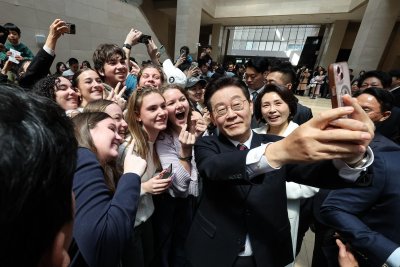
The number of foreign nationals residing in South Korea is nearly 1.7 million, government data showed Tuesday. In this February photo, foreigners pose with South Korean President Lee Jae Myung in Seoul. File Photo by Yonhap
The number of foreign nationals residing in South Korea approached 1.7 million as of May last year, government data showed Tuesday.
The total number came to 1.69 million as of last May, up 8.4 percent from a year earlier, according to data released by the Ministry of Data and Statistics. The figure refers to foreigners aged 15 and older who have resided in the country for more than 91 days.
By category, overseas Koreans with foreign nationalities accounted for the largest share, at 24.2 percent, followed by non-professional employment visa holders, at 19 percent, the data showed. International students accounted for 14 percent, and permanent residents accounted for 9.6 percent.
Among foreign nationals, ethnic Koreans with Chinese nationality accounted for 29.9 percent of the total, followed by those from Vietnam with 16 percent, the data showed.
The data also showed that 65.5 percent of foreign nationals had jobs as of May.
Among those employed, 10.8 percent of foreign workers said they were seeking new jobs, with most citing low income as the main reason.
About 32 percent of foreign nationals reported earning a monthly income between 2 million won (US$1,362) and 3 million won, the data showed.
The data also showed 12.9 percent of foreigners said they experienced financial difficulties over the past year.
Copyright (c) Yonhap News Agency prohibits its content from being redistributed or reprinted without consent, and forbids the content from being learned and used by artificial intelligence systems.
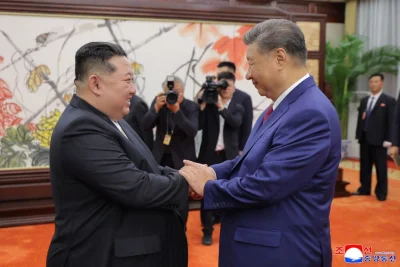
Train service linking Pyongyang and Beijing will resume this week for the first time in six years, sources said Tuesday. This September 2025 photo shows China’s president Xi Jinping (R) shaking hands with North Korean leader Kim Jong Un in Beijing. File Photo by KCNA/EPA
Train service linking Pyongyang and Beijing will resume this week for the first time since it was suspended six years ago due to the COVID-19 pandemic, sources said Tuesday.
The Beijing-Pyongyang train route will resume operations Thursday, running four times a week, on Monday, Wednesday, Thursday and Saturday, an official at China State Railway Group told Yonhap News Agency.
The train will depart from Beijing at 5:26 p.m. and arrive in Pyongyang at 6 p.m. the following day, stopping once at the Chinese border city of Dandong en route. The last two train cars will be reserved for passengers, according to sources.
The resumption marks the first cross-border train service between the two countries since operations were suspended following the outbreak of the pandemic.
Last year, North Korea resumed direct flight and train services between Pyongyang and Moscow, Russia’s capital.
The Chinese official said the upcoming Beijing-Pyongyang train will primarily serve diplomats and those on official business trips, while plans to accommodate general passengers will be considered if empty seats are available.
China’s foreign ministry said maintaining a regular passenger train service between China and North Korea takes on “significance” in facilitating exchanges of personnel between the two nations.
“China supports creating more convenient conditions for both sides’ exchanges of personnel by strengthening communication between relevant authorities of the two nations,” Guo Jiakun, spokesperson at the ministry, told a press briefing.
The move comes as North Korea and China appears to be seeking to promote cooperation amid the fluid international situation, highlighted by U.S.-Israeli strikes on Iran and the subsequent intensifying conflict in the Middle East.
North Korea also seems to be trying to expand cooperation with China as speculation arises that U.S. President Donald Trump may seek to resume diplomacy with North Korean leader Kim Jong-un on the occasion of his planned trip to Beijing on March 31-April 2.
North Korea’s ties with China, the North’s traditional ally and economic benefactor, became cool amid Pyongyang’s deepening military cooperation with Russia on the occasion of Moscow’s war with Ukraine.
Kim held summit talks with Chinese President Xi Jinping in Beijing in September last year on the occasion of a Chinese military parade and discussed ways to improve bilateral ties.
But relations between Pyongyang and Beijing do not appear to be restored in a full-fledged manner with no signs of high-level exchanges of personnel spotted.
“The government is closely monitoring the development of Korean Peninsula affairs, including North-China relations,” an official at South Korea’s foreign ministry said.
Copyright (c) Yonhap News Agency prohibits its content from being redistributed or reprinted without consent, and forbids the content from being learned and used by artificial intelligence systems.
Members of small business and self-employed groups, including the Korea Federation of Food Service Industry, the Korea Lodging Association and the Korea Federation of Micro Enterprises, call for passage of the Online Platform Act and the introduction of a total fee cap on delivery apps at the National Assembly in Seoul on Dec. 1, 2025. Photo by Yonhap News Agency
March 9 (Asia Today) —Guest commentary contributed to Asia Today by Park Ki-soon, Professor, Graduate School of Chinese Studies, Sungkyunkwan University.
Debate over platform regulation has been intensifying in South Korea. A prominent example is the proposed Online Platform Act (OPA). The bill includes provisions such as commission caps, a prior designation system, collective bargaining rights and class-action lawsuits – all framed as measures to protect merchants and ensure fair competition.
The intention itself is not necessarily misguided. Information asymmetry and unequal bargaining power do exist within the platform ecosystem. However, before deciding what to regulate, policymakers must carefully consider how regulation should be implemented. Good intentions do not always produce good outcomes.
The European Union (EU) enacted the Digital Markets Act (DMA) in 2022 and designated six companies – including Alphabet, Apple and Meta – as “gatekeepers,” subjecting them to strict ex-ante regulations. The law was introduced with the stated goal of promoting competition and protecting consumers.
Yet less than three years later, research is suggesting outcomes quite different from what policymakers expected.
A study examining 3,500 consumers in seven Central and Eastern European countries found that user behavior on Google and Facebook remained largely unchanged after the DMA took effect. Competition did not increase, while the complexity of online tasks rose by 39%.
Another study analyzing 4.1 million apps in the Google Play Store estimated that after the General Data Protection Regulation (GDPR) was implemented, one-third of all apps disappeared, the number of new apps was cut in half and consumer surplus declined by roughly one-third. Venture investment and startup formation also slowed significantly.
Commission caps have produced similarly disappointing results. After Apple lowered App Store fees in the EU, only 9% of apps reduced prices for consumers. Meanwhile, more than 86% of the fee savings flowed to developers outside the EU.
Rather than effectively restraining large corporations, platform regulations have often increased barriers to entry for smaller firms. In other words, regulations intended to curb market dominance may ironically end up protecting incumbent giants by making it harder for new competitors to enter.
South Korea faces an even more delicate situation than the EU.
In the search engine market, Naver and Google dominate, while KakaoTalk has become the country’s national messaging platform. Korean cultural content spreads globally through platforms such as YouTube and Netflix, and cosmetics exports reached $11.4 billion in 2025.
Except for China – which restricts foreign platforms – South Korea is often considered the world’s most platform-independent digital ecosystem. At the same time, this ecosystem is deeply interconnected with global platforms.
Under these circumstances, poorly designed regulations could also affect foreign investment by companies such as Netflix and Amazon Web Services (AWS) in Korea.
There are also diplomatic risks. The United States has expressed concern that the OPA’s prior designation system could disproportionately target American companies and potentially violate the non-discrimination principle under the Korea-U.S. Free Trade Agreement.
Washington has already criticized the EU’s DMA as a non-tariff barrier targeting U.S. Big Tech and has hinted at possible retaliatory measures. A similar dispute could arise if Korea adopts comparable regulatory frameworks.
Another concern is that excessive regulation could inadvertently benefit Chinese platforms.
Chinese e-commerce services such as AliExpress and Temu are already rapidly expanding their presence in the Korean shopping app market. If both domestic and global platforms are tightly constrained while Chinese platforms remain largely unaffected, the result would be the exact opposite of what regulators intend.
South Korea has previously fallen behind China in areas such as online banking due to a “regulate first, innovate later” approach. That experience should serve as a cautionary lesson.
Platform policy must be approached with prudence. Regulations designed without sufficient consideration of market dynamics risk doing more harm than good – weakening innovation, discouraging investment and ultimately undermining the very ecosystem they aim to protect.
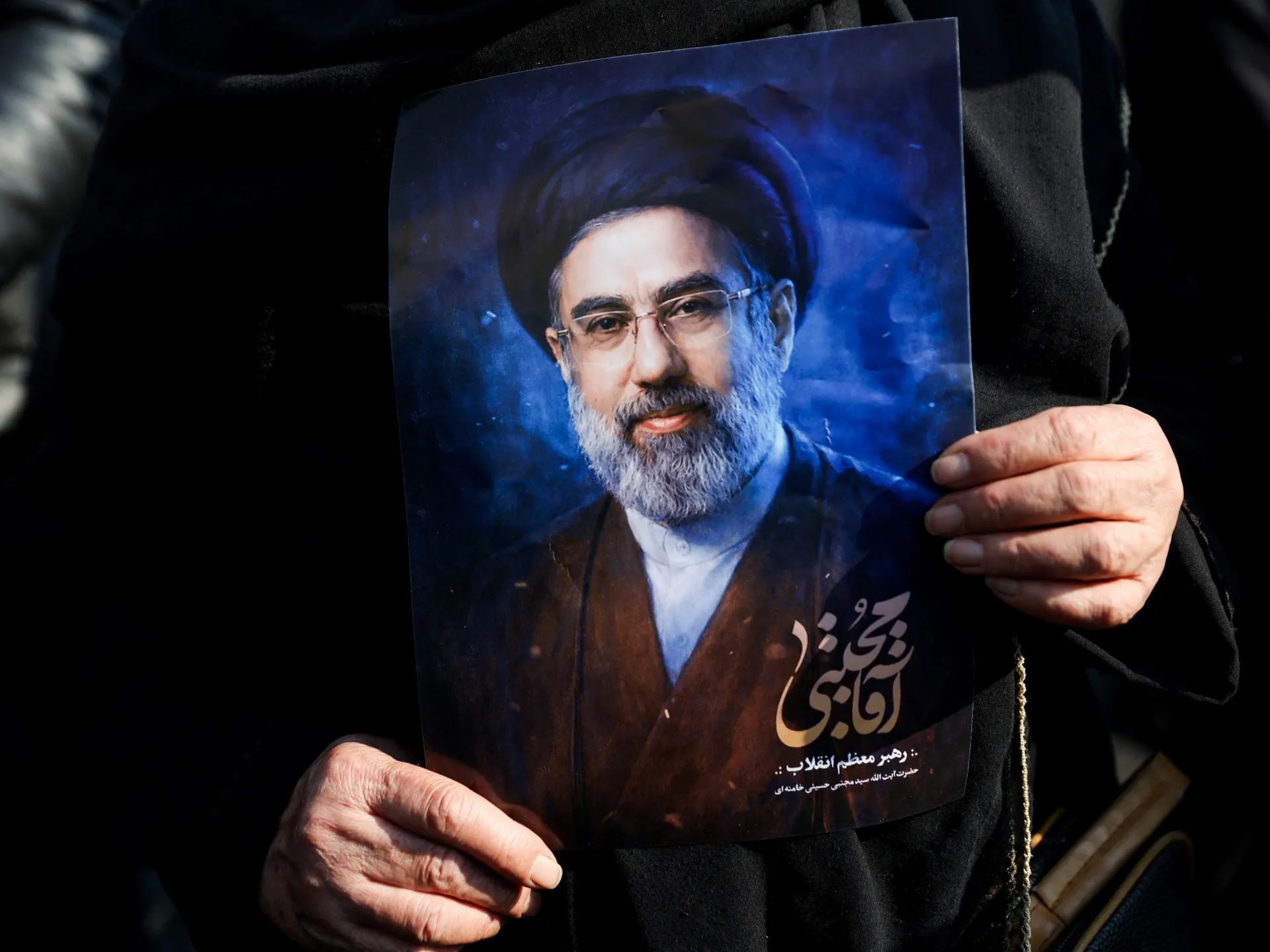
Iran’s new Supreme Leader Mojtaba Khamenei has never held a formal position in government, but his appointment as his late father’s successor amid the US-Israeli war on his country was not unexpected.
Iran’s Assembly of Experts appointed the 56-year-old mid-ranking religious scholar to the position on Sunday, just over a week after his late father, Ayatollah Ali Khamenei, was killed in United States-Israeli strikes.
Recommended Stories
list of 3 itemsend of list
Khamenei, who has strong ties with the Islamic Revolutionary Guard Corps (IRGC) and his late father’s still-influential office, is seen as a hardliner who will provide continuity in the country.
His appointment, which came after he lost both his father and his wife in strikes, was interpreted as a defiant choice signalling continuity as the Islamic Republic faces the biggest crisis in its 47-year history.
Khamenei received immediate backing from figures in Iran’s political and security establishment, including IRGC leaders, President Masoud Pezeshkian and Ali Larijani, secretary of the Supreme National Security Council.
Outside the country, reactions were mixed:
Oman
Oman was a mediator in recent talks between Iran and the United States, which collapsed when the US and Israel unleashed their war on Iran last month.
Oman’s Sultan Haitham bin Tariq Al Said on Monday sent a “cable of congratulations” to Khamenei on his appointment as Iran’s new supreme leader, according to the official Oman News Agency.
Iraq
Iraqi Prime Minister Mohammed Shia al-Sudani also congratulated Khamenei on his appointment on Monday.
“We express our confidence in the ability of the new leadership in the Islamic Republic of Iran to manage this sensitive stage, and continue to strengthen the unity of the Iranian people in facing the current challenges,” al-Sudani said in a statement.
He reaffirmed Iraq’s solidarity and support for Iran and “all steps aimed at ending the conflict and rejecting military operations against its sovereignty, in order to preserve the stability of other countries in the region”.
United States
US President Donald Trump had previously dismissed Mojtaba Khamenei as a “lightweight”, and insisted he should have a say in appointing a new Iranian leader, which Tehran rejected.
On Monday, Trump told NBC News, “I think they made a big mistake. I don’t know if it’s going to last. I think they made a mistake.”
Later on Monday, he told CBS News: “I have no message for him.”
Trump said he has someone in mind to lead Iran, but did not elaborate.
Israel
The Israeli military has already threatened to kill any replacement for the late Ali Khamenei.
Israel’s Foreign Ministry said Monday that Mojtaba Khamenei was a “tyrant” like his slain father, and would continue what it described as the Iranian “regime’s brutality”.
In a post on X featuring a picture of Mojtaba Khamenei and his father Ayatollah Ali Khamenei, holding guns, the ministry wrote: “Mojtaba Khamenei. Like Father Like Son”.
“Mojtaba Khamenei’s hands are already stained with the bloodshed that defined his father’s rule. Another tyrant to continue the Iranian regime’s brutality,” said the ministry.
Russia
Russian President Vladimir Putin on Monday pledged “unwavering support” to Iran.
“I would like to reaffirm our unwavering support for Tehran and solidarity with our Iranian friends,” Putin said in a message to Khamenei, adding that “Russia has been and will remain a reliable partner” to Iran.
“At a time when Iran is confronting armed aggression, your tenure in this high position will undoubtedly require great courage and dedication,” the Russian leader said.
China
China’s Foreign Ministry spokesman Guo Jiakun told reporters on Monday that Iran’s decision to appoint the younger Khamenei was “based on its constitution”.
“China opposes interference in other countries’ internal affairs under any pretext, and Iran’s sovereignty, security, and territorial integrity should be respected,” he said when asked about the threats against the new leader.
Beijing is a close partner of Tehran and condemned the killing of the former supreme leader, but it has also criticised the Iranian counterstrikes against Gulf states.
Yemen’s Houthis
Yemen’s Houthi rebels on Monday welcomed the appointment of the new supreme leader.
“We congratulate the Islamic Republic of Iran, its leadership and people, on the selection of Sayyid Mojtaba Khamenei as Supreme Leader of the Islamic Revolution at this important and pivotal juncture,” the group said in a statement on Telegram.
It called his selection “a new victory for the Islamic Revolution and a resounding blow to the enemies of the Islamic Republic and the enemies of the nation”.
Dozens of civilians, including children, wounded by an Iranian drone strike in Bahrain. France deploying warships to secure shipping commerce in the Strait of Hormuz. Australia taking heat from President Trump over its handling of the Iranian women’s soccer team. Markets across Asia plunging as the price of oil surged.
Lebanon reporting half a million people displaced by fighting between Israel and Hezbollah. The U.S. State Department telling nonessential staff to get out of Saudi Arabia after attacks there killed workers from India and Bangladesh. Ukrainian anti-drone experts turning their attention from their war with Russia to help intercept Iranian attacks. The defense minister of ever-neutral Switzerland saying his country believes the U.S.-Israeli war violates international law.
In less than two weeks, the Trump administration has instigated a truly global conflict — and with no quick and clear path to resolution, despite Trump insisting to congressional Republicans gathered at his Miami resort Monday that it would be a “short term excursion.”
“Short term! Short term!” Trump said in a bullish speech about the conflict, in which he said “the world respects us right now more than they have ever respected us before.”
“We’re counting down the minutes until they will be gone,” he said of Iran’s remaining leadership, while adding that the U.S. “will not relent” until Iran is “totally and decisively defeated.”
The war is not isolated to Iran, though it has certainly caused devastation there — with more than 1,300 deaths reported and toxic clouds from strikes on fuel depots hovering over Tehran, a city of some 10 million people.
The war’s effects also are not limited to the Middle East, though they are widespread there — as Israel has pushed into Lebanon and Iran has launched a wave of retaliatory strikes on U.S. allies across the Persian Gulf. The fighting has grounded regional air traffic, threatened desalination facilities that provide drinking water to millions and undermined the safe reputation of modern metropolises such as Dubai and Abu Dhabi.
Unlike the recent U.S. incursion into Venezuela to capture and oust President Nicolás Maduro, the U.S. war on Iran has been met with stiff resistance militarily, drawn in a slew of allies, reignited proxy battles, drastically destabilized the oil trade and shifted dynamics between the U.S. and other major powers such as China and Russia.
China, which gets upward of 50% of its crude oil imports through the Strait of Hormuz, has largely stayed out of the conflict, though China’s Foreign Minister Wang Yi said Sunday that the war “should never have happened” and “benefited no one.”
Trump said Monday that the U.S. is less harmed by strait disruptions, and was “really helping China” by securing the strait.
Russia, meanwhile, has emerged the lone winner of energy disruptions in the region, said Robert David English, a UCLA international policy analyst — as the Trump administration considers reducing oil sanctions on Russia to take pressure off of Mideast sources.
Trump said he had a “good talk” with Russian President Vladimir Putin about Iran on Monday. He also said the U.S. was going to suspend sanctions against other countries in order to alleviate strain on oil markets while the Iran conflict persists, but did not provide specifics.
The scope of the war has been dictated in part by Iran, which has historically limited its responses to U.S. strikes but warned after the U.S. bombed its nuclear sites last summer that it would treat any new attacks — large or small — as an act of war, and respond in kind.
Its strikes on U.S. facilities and allies throughout the region reflect that strategy, and are aimed in part at making the war more politically costly for the U.S. by straining global markets and its regional allies, experts said.
However, “you can’t attribute the increasingly global characteristics of the conflict solely to an Iranian strategy, because wars in this region tend to spill over the longer they last, with unintended consequences” including “bringing in all kinds of actors that don’t want to be involved,” said Kevan Harris, an associate professor of sociology who teaches courses on Iran and Middle East politics at the UCLA International Institute.
That can serve as a deterrent to starting wars in the region, he said, but “also makes them more difficult to wind down.”
The surge in oil prices to nearly $120 a barrel Monday — before a remarkable reversal to below $90 by the time U.S. stocks closed — is one of the furthest-reaching effects of the war, and one that clearly had Trump’s attention.
“Short term oil prices, which will drop rapidly when the destruction of the Iran nuclear threat is over, is a very small price to pay for U.S.A., and World, Safety and Peace. ONLY FOOLS WOULD THINK DIFFERENTLY!” Trump wrote on social media Sunday.
How long prices will remain elevated or volatile is a matter of debate, but Trump’s “short term” projections have been undercut by increasing strikes on oil and gas facilities in the region.
“If you can tolerate oil at more than $200 per barrel, continue this game,” Ebrahim Zolfaghari, a spokesperson for Iran’s Islamic Revolutionary Guard Corps, said Sunday.
Prices at the pump have surged for average Americans, some of whom were attracted to Trump’s candidacy because of his promises to avoid foreign wars and focus on driving down the cost of living for U.S. citizens.
Now, Trump and other administration officials are facing questions about their own role in putting the world at war, and offering various different justifications. They’ve asserted without proof that the U.S. faced an imminent threat of attack from Iran. Trump has repeatedly hinted that his goal was removing the government.
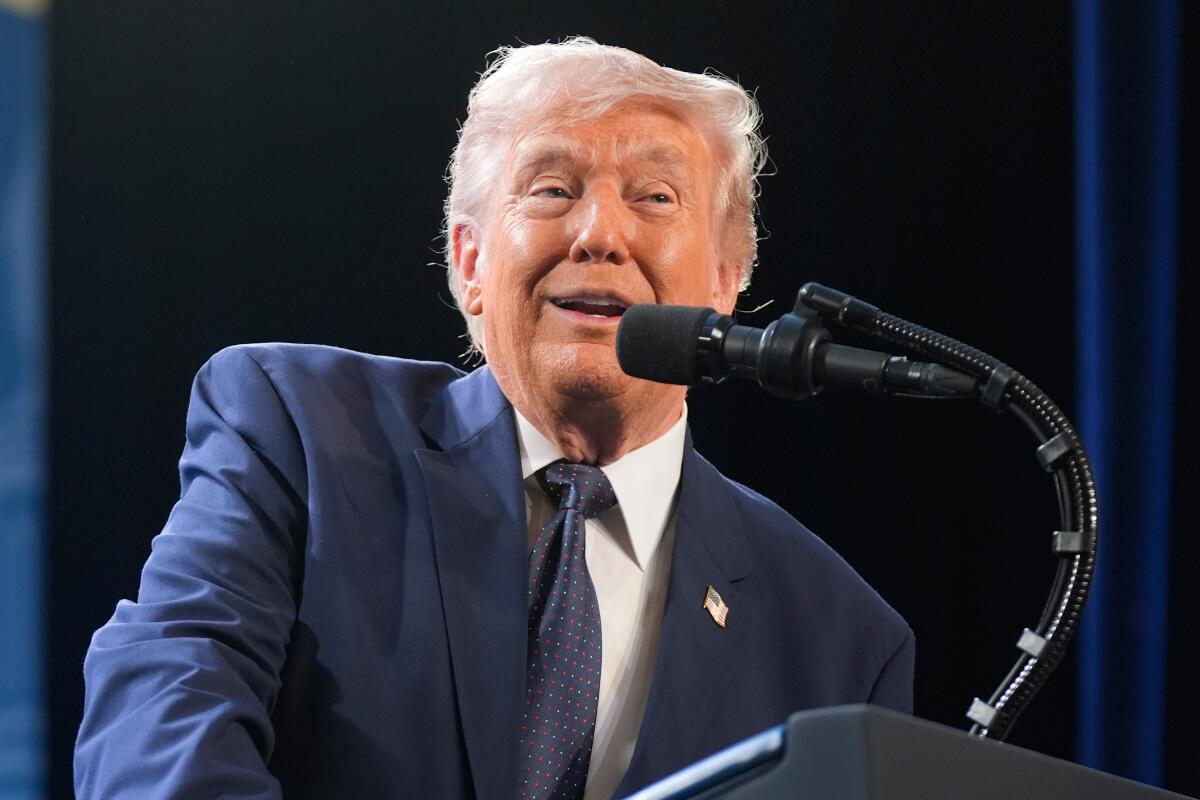
President Trump speaks at the Republican Members Issues Conference on Monday at Trump National Doral Miami in Doral, Fla.
(Mark Schiefelbein / Associated Press)
In the meantime, Iran has shown no signs of bowing to Trump, rejecting his calls for “surrender” and for him to have a say in naming their next leader. Iran installed Mojtaba Khamenei after Trump said the hard-liner son of the late Ayatollah Ali Khamenei would be “unacceptable.”
The choice was hailed by the president of Azerbaijan and the leader of Yemen’s Houthi rebels, among other allies.
To date, seven U.S. service members have been killed in the conflict, according to U.S. officials. Every day, U.S. taxpayers are on the hook for nearly $1 billion in war costs, according to one estimate. Democrats have slammed Trump for both.
“This war is coming from the same President that is building a $400 million ballroom in the White House. The same President that says $100 for a barrel for oil is worth it. The same President that doubled healthcare premiums for millions of Americans. But we have money for another endless war?” Sen. Alex Padilla (D-Calif.) wrote Monday on X.
Other world leaders focused on the global economic impact.
Traffic through the Strait of Hormuz, which transports about 20% of the world’s oil, has nearly halted, while producers in Saudi Arabia, Iraq, Kuwait and the United Arab Emirates ceased oil operations without open routes for export.
In response, French President Emmanuel Macron suggested French and other allied naval assets could escort oil tankers in the strait, shifting the security burden there from Washington onto Europe, leaving European vessels vulnerable to hostilities and potentially drawing the European Union deeper into the conflict.
Already, they’ve agreed to allow the U.S. to use bases in their territories, though the U.S. and Spain got into a spat after Spain rejected U.S. use of its bases and Trump threatened U.S. trade with the country.
Macron on Monday also threw additional military support behind Cyprus, following a meeting with Cypriot President Nikos Christodoulides and Greek Prime Minister Kyriakos Mitsotakis at a Cyprus air base.
France will dispatch an additional 11 warships to operate across the eastern Mediterranean, the Red Sea and the Strait of Hormuz, Macron said, after an Iranian drone struck a British military base on Cyprus on Monday.
“When Cyprus is attacked, it is Europe that is attacked,” Macron said.
Located just 150 miles from Israel in the eastern Mediterranean, the island of Cyprus has emerged as a strategic — and exposed — nerve center in the U.S. offensive against Iran. It hosts vital British military bases and acts as an intelligence, surveillance, and logistics hub in countering Iranian influence and proxy attacks.
Britain’s Defense Secretary John Healey said Monday that the United Kingdom was conducting air defense to support the UAE, and that Typhoon jets had taken out two drones — one over Jordan and the other headed to Bahrain.
Trump suggested Monday that the U.S. was on the path toward victory, but acknowledged it had not accomplished all of its goals.
“We’ve already won in many ways, but we haven’t won enough,” he said — adding the conflict will end “pretty quickly.”
He said Iran had been “very foolish, very stupid” when it attacked its neighbors, hurting its own chances of success in resisting the U.S.
“Their neighbors were largely neutral, or at least weren’t gonna be involved, and they got attacked,” Trump said. “And it had the reverse effect. The neighbors came onto our side, and started attacking them.”
Iran may still attempt to widen the conflict’s economic and geopolitical impact to keep up pressure and push for a ceasefire in its favor, but that could also backfire, said Benjamin Radd, a political scientist and senior fellow at the UCLA Burkle Center for International Relations.
“Iran’s becoming increasingly like North Korea in this sense,” he said, “isolating itself further.”
A seventh U.S. soldier has been killed in action during combat in Iran, less than 24 hours after the remains of six service members returned to the United States. The six died in a March 1 Iranian drone attack against a command center they were stationed at in Kuwait. The seventh was killed in Saudi Arabia. Photo by Leigh Vogel/UPI | License Photo
March 9 (UPI) — The U.S. military identified the seventh soldier killed in the fighting against Iran as Army Sgt. Benjamin N. Pennington, 26, of Glendale, Ky.
Pennington was injured during an attack on U.S. troops in Saudi Arabia on March 1 at Prince Sultan Air Base in Saudi Arabia and later died. He was assigned to 1st Space Battalion, 1st Space Brigade, a unit within Army Space and Missile Defense Command.
“Last night, a U.S. service member passed away from injuries received during the Iranian regime’s initial attacks across the Middle East,” U.S. Central Command said in a post on X.
The seven service members have been killed during the first week of Operation Epic Fury, which the United States and Israel launched on Feb. 28.
Since the beginning of the onslaught, Iran has launched retaliatory strikes at its neighbors, some of which host U.S. bases and assets that are being used in the war.
A March 1 retaliatory strike on an Army sustainment unit based in Kuwait killed six service members and injured 18 others, whose remains returned to the United States on Saturday.
Overall, Iran’s retaliatory strikes have killed at least 20 people across the region, The New York Times reported, while between 800 and 1,300 hundred people in Iran have died during the widening conflict.
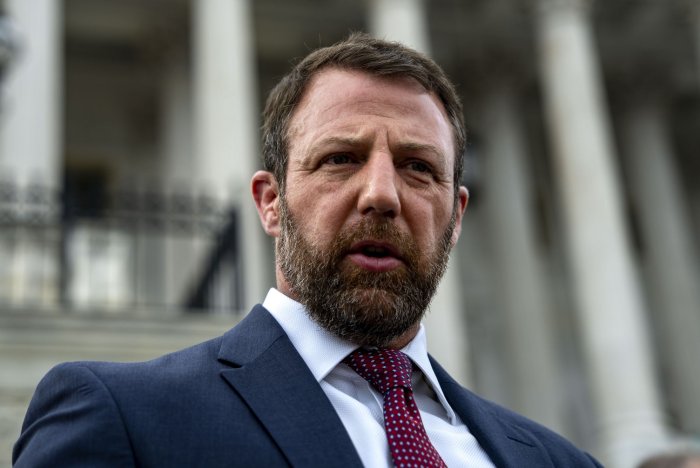
Sen. Markwayne Mullin, R-Okla., speaks to the press outside the U.S. Capitol on Thursday. Earlier today, President Donald Trump announced Mullin would replace Kristi Noem as Secretary of the Department of Homeland Security. Photo by Bonnie Cash/UPI | License Photo
1 of 2 | Glass doors were damaged at the site of incident at the U.S. embassy in Oslo, Norway, Sunday, after a loud bang was reported at the site. No injuries were reported and the police have launched an investigation. Photo by Fredrik Varfjell/EPA
March 9 (UPI) — Oslo, Norway, police have released images of a person suspected in the bombing outside the U.S. embassy in the city on Sunday.
Two images from surveillance video were released showing a person wearing all black with their face covered and carrying a backpack.
Police said the explosion, which shattered a glass door, was from an improvised device set at the entrance to the building. It caused minor damage and no injuries. Police said there are no developments on the person’s motive.
Police are also looking at a video posted on Google Maps around the time of the explosion. It showed the former Supreme Leader Ayatollah Ali Khamenei, who was killed by the U.S. and Israeli military action on Feb. 28.
Police are asking for anyone with information about the suspect or who noticed anything unusual between midnight and 2 a.m. CET to contact them. They said they have used dogs, drones and helicopters to investigate the scene.
On Sunday, police weren’t sure if the explosion was an attack.
Frode Larsen, head of the joint investigation and intelligence unit, told a press conference that it’s “natural to view this in the context of the current security situation, and that it is a targeted attack against the American embassy. But we have not locked ourselves into just that one hypothesis.”
Police searched the surrounding area, but didn’t find any other explosive devices.
March 9 (UPI) — G7 finance ministers were set to hold an emergency meeting first thing Monday to discuss oil prices after Brent crude surged above $100 per barrel, with an option to release strategic reserves to calm the market on the table.
The virtual meeting, due to get underway at 8.30 EST, comes amid fears that disruption to oil and gas shipments from the Gulf via the Strait of Hormuz, which Iran has closed, could continue for some time, sending energy prices soaring and rattling financial markets.
The joint release of “emergency reserves,” if agreed, would be coordinated by the International Energy Agency, according to the Financial Times.
If G7 nations do release oil reserves, it would be the first time in four years since a crisis triggered by Russia’s full scale invasion of Ukraine triggered similar price shocks, although gas was hit the worst.
Exacerbated by escalating attacks on Gulf countries’ oil fields, refineries and storage plants — impacting their ability to produce and store product, as well as export it — Bent crude jumped more than 25% in Asian trade Monday, hitting a $119.50 per barrel high, before falling back with the price of West Texas Intermediate making similar moves.
Investors also reacted to fears that the crisis will push inflation and borrowing costs higher, with negative impacts for the global economy.
The key Nikkei 225 index in Japan slumped by more than 5% to end Monday down 2,892 points lower, with the jitters spilling over into Europe when the markets there opened.
At lunchtime Monday, the FTSE 100 in London was down 1.4%, Germany’s DAX was down 1.6% and the CAC 40 in Paris was off by more than 2.2%.
Former IEA head Neil Atkinson warned that unless there was a resolution to the situation in the Gulf and flows of oil resumed “very soon” the world faced a “potentially game-changing and unprecedented energy crisis,” even if the reserves were made available.
“Though there are oil stocks around the world, the point is that if this closure of the Strait persists, those oil stocks if they are deployed will be depleted and we are going to be in a situation where, with the oil production actually shut in, in Iraq and possibly in Kuwait and maybe even in time in Saudi Arabia, that we are going to be in a crisis the likes of which we have never seen before,” Atkinson told CNBC.
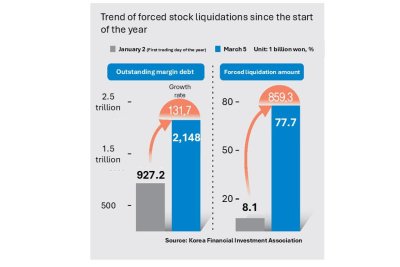
Trend of forced stock liquidations since the start of the year. Data from Korea Financial Investment Association. Graphic by Asia Today and translated by UPI
March 8 (Asia Today) — Forced stock sales in South Korea surged this week as rising market volatility triggered margin calls for investors who borrowed money to buy shares.
According to the Korea Financial Investment Association, forced liquidations totaled 77.7 billion won ($58 million) as of Wednesday, the eighth-largest amount recorded since the data began in 2006.
Outstanding margin balances also climbed to 2.15 trillion won ($1.6 billion), the highest level on record.
The sharp increase follows a strong rally in South Korean stocks earlier this year, driven largely by optimism surrounding artificial intelligence and semiconductor demand. However, geopolitical tensions in the Middle East have increased market volatility and halted the rally, prompting forced selling by heavily leveraged investors.
Margin balances occur when investors purchase stocks through brokerage accounts but fail to fully pay for the shares by the settlement deadline. If the funds are not repaid within two business days, brokerage firms may liquidate the holdings to recover the debt.
Analysts say the surge in forced sales highlights structural vulnerabilities in the South Korean stock market.
After tensions escalated in the Middle East, major East Asian markets including Japan, China, Taiwan and Hong Kong fell about 1% to 5% on the first trading day. South Korea’s market, however, dropped more than 12%, reflecting its heavier concentration in semiconductor stocks that had previously surged during the AI-driven rally.
The scale of outstanding margin balances has more than doubled since the start of the year. On the first trading day of 2026, unpaid balances totaled about 927.3 billion won ($690 million).
Because forced liquidations typically follow unpaid margin balances from the previous trading day, analysts warn that additional selling pressure could emerge if the outstanding balances remain elevated.
Yang Jun-seok said investors relying on borrowed funds should adopt a more cautious strategy.
“While the AI rally could continue supporting the broader market, volatility may increase due to developments related to Iran,” Yang said. “Investors using leverage are particularly vulnerable to market shocks and should consider exit strategies.”
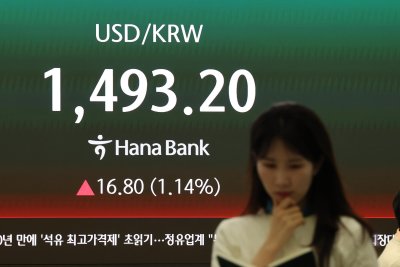
This photo, taken Monday, shows the trading room of Hana Bank in central Seoul as the South Korean won fell to a 17-year low against the U.S. dollar. The won was quoted at 1,495.5 won per dollar at the close of trading hours at the Korean Stock Exchange. Photo by Yonhap
The South Korean won fell to a 17-year low against the U.S. dollar Monday amid heightened market volatility as oil prices spiked following the expanding conflict in the Middle East.
The won was quoted at 1,495.5 won per dollar at 3:30 p.m., down 19.1 won from the previous session, marking the weakest level since March 12, 2009, when the won-dollar rate hit 1,496.5 won during the global financial crisis.
After opening at 1,493 won, the won-dollar rate touched 1,499.2 won at 10:22 a.m., the lowest intraday level since that day, when the rate reached 1,500 won.
Investor sentiment was dampened by instability in global energy prices. The U.S. benchmark West Texas Intermediate (WTI) crude surpassed US$100 per barrel for the first time since July 2022 on Sunday (U.S. time).
The recent decline in the won has also been driven by a broad dollar rally amid concerns that the U.S.-Israeli operation could escalate into a prolonged regional war.
Copyright (c) Yonhap News Agency prohibits its content from being redistributed or reprinted without consent, and forbids the content from being learned and used by artificial intelligence systems.
Ryu Je-gang, head of Policy Division 2 at the Korean Confederation of Trade Unions, speaks during an interview with Asia Today at the union’s office in Seoul on Feb. 23. Photo by Asia Today
March 8 (Asia Today) — A senior labor official said South Korea’s revised labor law should be implemented carefully, emphasizing precise enforcement rather than rapid expansion when it takes effect Monday.
Ryu Je-gang, head of Policy Division 2 at the Korean Confederation of Trade Unions, said the success of the legislation will depend largely on how enforcement decrees and interpretation guidelines function in practice.
“The success of the system depends less on the articles themselves and more on how enforcement rules work in the field,” Ryu said in an interview with Asia Today. “Refining the scope of application, criteria and support systems should take priority over expanding the law too quickly.”
The legislation, commonly known as the “Yellow Envelope Law,” revises Articles 2 and 3 of South Korea’s Trade Union Act and will take effect Monday.
Supporters say the amendment expands the concept of employer responsibility, allowing subcontracted workers to demand negotiations with a principal contractor even without a direct employment contract.
Ryu described the change as opening “the door for negotiations with the primary employer.”
Previously, restructuring measures such as mergers, divisions or asset transfers were often excluded from collective bargaining on the grounds they were management decisions, he said. The new framework could help address disputes related to layoffs and restructuring.
Business groups have warned the legislation could increase labor disputes by limiting corporate claims for damages or asset seizures against unions during strikes.
Ryu rejected those concerns, saying the provisions largely reflect existing court precedents rather than introducing entirely new rules.
“I do not expect a dramatic increase in labor disputes simply because of this change,” he said.
However, he acknowledged the law may face practical limitations. Workers will still need to prove employer responsibility, and procedures such as unified bargaining channels and requests to separate bargaining units could make negotiations difficult.
“The procedural barriers remain high,” he said. “If negotiations themselves are difficult, expanding labor disputes will not be easy.”
Ryu also warned the amendment may not fully protect some categories of workers, including special employment and platform workers who often lack traditional labor contracts.
In the short term, he said the law could lead to increased demands for negotiations with companies previously seen as responsible but not directly engaged in collective bargaining.
Over the longer term, however, the changes could help ease tensions created by complex subcontracting systems.
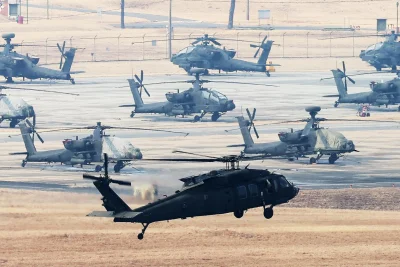
A UH-60 Blackhawk helicopter takes off from Camp Humphreys in Pyeongtaek on Monday as the United States and South Korea kick off their Freedom Shield joint military exercise. Photo by Yonhap
SEOUL, March 9 (UPI) — The United States and South Korea began their annual Freedom Shield joint military exercise on Monday, as speculation swirled that Washington may be shifting some military assets from the Korean Peninsula to the Middle East amid its widening conflict with Iran.
About 18,000 South Korean troops will participate in the exercise, which runs through March 19 and includes command-post simulations and field training drills. U.S. Forces Korea has not disclosed the number of American personnel involved.
The drills come as local media reports have raised questions about whether U.S. military equipment stationed in South Korea could be redeployed to support operations in the Middle East.
South Korea’s Yonhap News Agency reported Sunday that U.S. C-5 and C-17 transport aircraft landed at Osan Air Base in Pyeongtaek, south of Seoul, late last month before departing between Wednesday and Saturday.
The aircraft movements followed reports that U.S. Forces Korea relocated some Patriot missile defense systems to Osan from other American bases in the country.
Two Patriot batteries deployed with USFK were temporarily rotated to the Middle East in June last year during strikes targeting Iranian nuclear facilities, before returning to South Korea in October.
The Patriot system detects, tracks and intercepts drones, cruise missiles and short-range or tactical ballistic missiles at low- to mid-range altitudes. It forms a key component of South Korea’s layered missile defense network designed to counter threats from North Korea.
U.S. Forces Korea said last week it could not comment on the relocation or movement of its assets due to operational security.
South Korea’s Defense Ministry also declined to address the reports directly during a briefing Monday.
“There is constant communication between the U.S. military and our side,” ministry spokeswoman Jeong Bit-na told reporters. “We are always communicating closely to ensure that there are no security concerns or gaps.”
She added that the Freedom Shield exercise was proceeding as planned.
“The South Korea-U.S. joint exercise is being implemented normally regardless of the situation in the Middle East, and we are thoroughly implementing it as agreed and planned,” Jeong said.
The drills come as the administration of South Korean President Lee Jae Myung seeks to stabilize relations with Pyongyang, which routinely condemns the allies’ joint exercises as rehearsals for invasion.
The number of field training exercises during this year’s Freedom Shield has been reduced to 22, down from 51 conducted during the previous iteration of the drills under the conservative government of impeached former President Yoon Suk Yeol.
North Korea recently concluded a major congress of the ruling Workers’ Party, where leader Kim Jong Unpledged to expand the country’s nuclear arsenal and improve its delivery systems and operational capabilities.
At the same time, Kim appeared to leave the door open to future negotiations with the United States, saying there was “no reason” the two sides could not improve relations if Washington abandons what he described as its hostile policy.
Kim has previously said he has “fond memories” of U.S. President Donald Trump, whom he met three times during Trump’s first term. South Korean officials have pointed to Trump’s planned visit to China later this month as a possible opportunity to revive diplomacy with Pyongyang.
Kim has continued to take a hostile tone toward Seoul, however, recently describing South Korea as “the most hostile entity.”
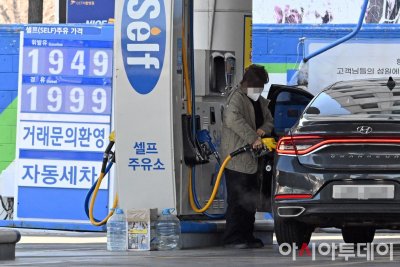
A driver refuels a vehicle at a gas station in Seoul on Saturday as global oil prices rise amid instability in the Middle East. According to the Korea National Oil Corporation’s Opinet system, the nationwide average gasoline price was 1,893.3 won ($1.41) per liter at 9 a.m., up 3.9 won from the previous day. Diesel averaged 1,915.4 won ($1.43) per liter, up 4.8 won. Photo by Asia Today
March 8 (Asia Today) — Gasoline prices in South Korea are approaching 2,000 won per liter as rising global oil prices linked to tensions in the Middle East push fuel costs higher, prompting debate over additional government tax cuts.
According to the oil price monitoring system operated by the Korea National Oil Corporation, the nationwide average gasoline price stood at 1,889.40 won ($1.41) per liter as of Friday.
In Seoul, the average price reached 1,941.71 won ($1.45) per liter, nearing the psychologically significant 2,000 won ($1.49) level and increasing pressure on consumers.
Fuel prices typically reflect international oil market changes with a delay of about two to three weeks. However, the recent sharp increase has raised expectations that the government may expand existing fuel tax reductions.
The government has already extended temporary tax cuts through the end of April. Gasoline currently benefits from a 7% fuel tax reduction, while diesel and liquefied petroleum gas butane receive 10% reductions.
Fuel taxes are one of the government’s most direct tools to ease inflation, as adjustments can quickly influence consumer prices.
South Korea previously expanded fuel tax cuts during earlier energy price surges. In 2022, when oil prices spiked following the Russia-Ukraine war, the government increased the reduction rate from about 30% to the legal maximum of 37%.
Officials are reportedly reviewing whether additional tax reductions are needed. Because fuel tax rates are set by enforcement decree, the government can implement changes relatively quickly after approval at a Cabinet meeting.
Bae Jun-young of the conservative People Power Party said fuel tax cuts should be expanded to provide meaningful relief for consumers.
“If tensions in the Middle East persist, the government should also consider raising the ceiling on the flexible fuel tax rate,” Bae said.
South Korean President Lee Jae Myung speaks during an emergency economy response meeting on Middle East tensions held at Cheong Wa Dae in Seoul on Monday. Photo by Yonhap
President Lee Jae Myung on Monday called for authorities to swiftly introduce a cap on local fuel prices, and preemptive responses to cope with surging gas prices and volatility in foreign exchange markets as the U.S.-led war with Iran has intensified in the Middle East.
Lee made the remarks during an interministerial meeting to assess the latest developments following U.S.-Israeli strikes on Iran and Tehran’s retaliatory attacks across the Middle East, which have prompted the price of Brent oil to surge through US$100 per barrel.
“As the crisis in the Middle East deepens, uncertainty in the domestic and global economic environment is expanding significantly, posing a considerable burden on the Korean economy relying heavily on global trade and energy imports from the Middle East,” Lee said.
Lee also called for preemptive responses Monday with worst-case scenarios in mind to address the economic fallout from heightened tensions in the Middle East, urging financial stability measures and the exploration of alternative energy routes.
“As it is difficult to predict how the situation will unfold, the government must prepare preemptive response measures with a sense of urgency, keeping even the worst-case scenario in mind,” he added.
Lee urged the government and the Bank of Korea to prepare additional preemptive measures to respond to rising volatility in financial and foreign exchange markets, instructing authorities to expand the 100 trillion-won ($66.8 billion) market stabilization program if necessary.
“We should identify hidden risks and meticulously prepare response measures.”
Lee also called for measures to address uncertainty surrounding energy supplies amid concerns over disruptions to shipping through the Strait of Hormuz, a major global shipping route.
“We will coordinate with strategic partner countries to promptly explore alternative routes that do not have to pass through the Strait of Hormuz,” he said.
In addition, he urged the government to crack down on collusion between refiners and gas stations, price fixing, and hoarding, calling for strict punishment of violators and the implementation of a price cap system on gasoline and diesel.
Copyright (c) Yonhap News Agency prohibits its content from being redistributed or reprinted without consent, and forbids the content from being learned and used by artificial intelligence systems.
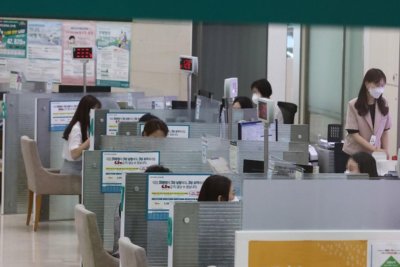
Customers visit a bank branch in Seoul, South Korea. Photo by YONHAP / EPA
March 8 (Asia Today) — South Korea plans to introduce a cap on student living expense loans after some university students began using the low-interest funds for stock and cryptocurrency investments.
The Korea Student Aid Foundation said the new loan cap system is expected to take effect next semester to reduce the risk of excessive borrowing among young people.
The agency currently offers living expense loans to undergraduate and graduate students at a fixed interest rate of 1.7%, significantly lower than typical commercial lending rates of about 3% to 4%.
Students who complete at least 12 credits in the previous semester and maintain an average grade of 70 or higher can apply. Borrowers may receive up to 2 million won ($1,490) per semester and are not required to provide documentation explaining how the funds are used.
Some students have used part of the loans as investment capital.
A 26-year-old student at Hankuk University of Foreign Studies said he invested part of his loan in semiconductor stocks.
“The interest rate is around 1% a year, so the burden is small,” he said. “If the investment return is higher than the interest, I felt there was no reason not to try.”
Another student at a four-year university in Jeju said he had previously invested loan funds in bitcoin during a price surge and made a profit. He said he continues to look for investment opportunities while stock markets remain strong.
Experts say the trend reflects both speculative investment behavior and financial pressures faced by young people.
Kim Dae-jong said the loans were originally intended to help students focus on their studies.
“Living expense loans are a public financial program designed to provide minimum support so students can concentrate on school,” Kim said. “Using them as investment funds is far removed from the program’s purpose.”
Loan delinquencies have also increased. According to the foundation, overdue balances rose from 19.2 billion won ($14.3 million) in 2021 to 38.7 billion won ($28.8 million) last year.
The number of delinquent borrowers nearly doubled during the same period, rising from 4,271 to 8,126.
Officials said most students still use the loans for living expenses and academic needs, but financial education programs are required before borrowers apply.
Students must complete an online financial education course that explains repayment obligations and the risks of excessive borrowing.
The foundation said the upcoming loan cap system aims to prevent excessive debt among students, since the loans must eventually be repaid after graduation.