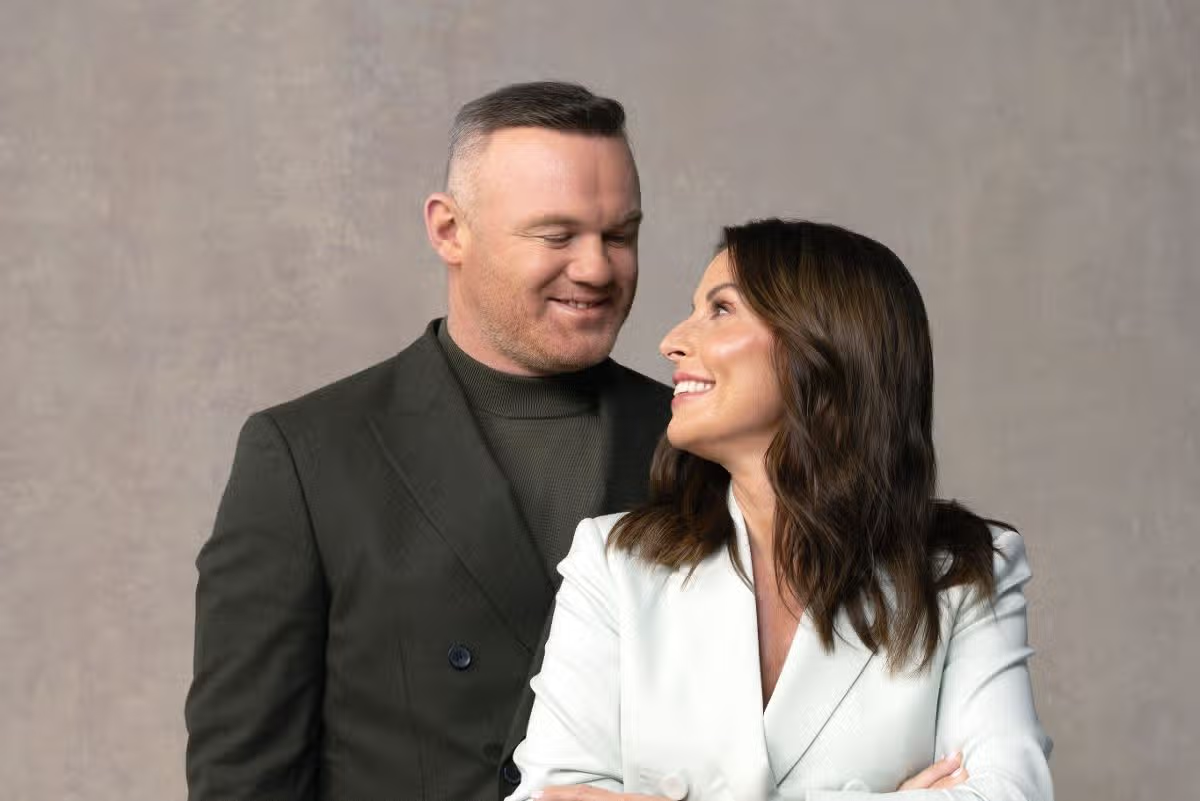
The Real Rooneys gives fans a real insight into the lives of Wayne and Coleen Rooney and also some surprising details of what goes on

Wayne and Coleen have opened their home to the Disney+ cameras
The Real Rooneys throws up some interesting and surprising scenes and a lot of nuggets of information and Wayne and Coleen which will be new for fans. Coleen says of the series: “We live in this in this extraordinary world, but we are normal at the end of the day.”
Wayne adds: “When you know you’re on TV or you’re doing something, you maybe tone things down a little bit, but at home with four young boys, that’s impossible. It’s real what you see.” Here are some of the more shocking and surprising things I spotted previewing the first four episodes…
WAYNE’S WINDOWLESS REQUEST
The Rooneys live in an incredible mansion with dozens of rooms and grounds which are big enough for them to race around in go karts, as we see on the show. But despite paying for the property, Wayne had just two slightly odd requests when it was built. He says: “I only wanted two things in here, a small little room with no windows, not because I am a psycho for playing PlayStation or watching a movie. And a snooker table. I didn’t really care what else.” Thanks to Coleen there is also other great rooms which have fun things in them like a swimming pool and a boxing ring.
COLEEN LUCKY TO BE ALIVE
Coleen’s mum reveals that her beloved daughter may never have met Wayne or survived beyond a brief childhood having been very ill as a small child.
Colette McLoughlin tells the cameras: “When Coleen was three, she got really sick. It turned out it was encephalitis, and her brain was swelling. She couldn’t walk. She couldn’t speak. She was stumbling her words. When we got to Alder High Hospital, she ended up in a coma. For 24 hours it was touch and go. She had to learn to walk again. All the coordination had gone, but I’m so grateful because she was alive.” This help she got at hospital is one of the reasons Coleen’s parents became foster carers.
WAYNE WATERWORKS AT TV SOAPS
Wayne admits now he is older he gets emotional about lots of things. The subject comes up when Kai’s football career is being discussed and he is asked if he will cry if his eldest son gets a scholarship at Manchester United. Wayne replies: “Probably. I cry at everything anyway. I’ve cried over some mad things, Coronation Street, X Factor, when Barry got pushed off the hill by Janine in EastEnders, I’m pretty sure I was crying.”
COLEEN CONSIDERED SPLIT FROM WAYNE
His bad behaviour down the years is well documented and Wayne is not perfect husband material in the series either. Like most married couples there are some rows and at one stage Coleen says: “There’s times where I think ‘Is the answer to see what it’s like if we were separated?’.”
She then adds: “But the we still care for each other, we still have good times. You know, we still love each other.”
At another point she tells Wayne: “It’s been a bit of a lads holiday for you, staying up all night. You can’t just keep doing what you do. It is not fair of everyone else. It is only you that can fix it because no one else is doing it. I’m just hoping that things change.”
KAI MOCKS HIS DAD
It seems Wayne struggles with early starts as he is shown sleeping through alarms and missing doing the school run on at least one occasion.
But one morning – seemingly the first time the Disney+ cameras are at the home – Wayne is seen up early, although he seems in need of coffee. His eldest son Kai is clearly not used to seeing his dad before school. With a grin he says: “Bro’s up for the cameras”.
Kai also states he is the best footballer in the family, and that he wants people to “know the name Kai Rooney” so he is a star footballer in his own right in the future.
WAYNE SOMETIMES HATES FAME
Wayne and Coleen take their two youngest children Kit, 10; and Cass, eight to Poland for an educational trip.
Initially it goes well and Wayne goes unrecognised but a trip on a horse drawn cart in Krakow blows his cover and he is soon swamped for autographs and selfies, and then family need to beat a sharp exit.
Afterwards Wayne reflects on what happened and says his level of fame has changed him as a person and he would love to be able to live unrecognised more often. He says: “I’m not a celebrity. People who know me know, know that I want to be as normal as possible.
“Back to when I was a kid, and you wanted to be a football player. That’s all I ever wanted to do, and didn’t care about fame or money or whatever. I just wanted to be a football player. I think I’d be such a better husband, dad, person, friend without it(fame). It affects places I go, things I do.
“I bought a mask I saw on TikTok[to use as a disguise], it looked incredible but it was terrible.”
WAYNE’S JEWISH ROOTS
As part of the break with Kit, 10; and Cass, the family visit Auschwitz because Kit asked to visit while learning about the Second World War at school.
Wayne tells the cameras: “I recently found out my mum’s mum, so me nan, her family were Polish Jews.”
He is told by producers that would make him technically jewish. Wayne replies: “I’m Catholic, but then I’ve always asked questions like, why aren’t we Jewish?”
Told it could make a whole spin off show he says with a grin: “Roo the jew!”
* Stream The Real Rooneys on Disney+ from September 24.
Like this story? For more of the latest showbiz news and gossip, follow Mirror Celebs on TikTok , Snapchat , Instagram , Twitter , Facebook , YouTube and Threads .