World Records

I travelled down the UK’s longest village and was left with one burning question

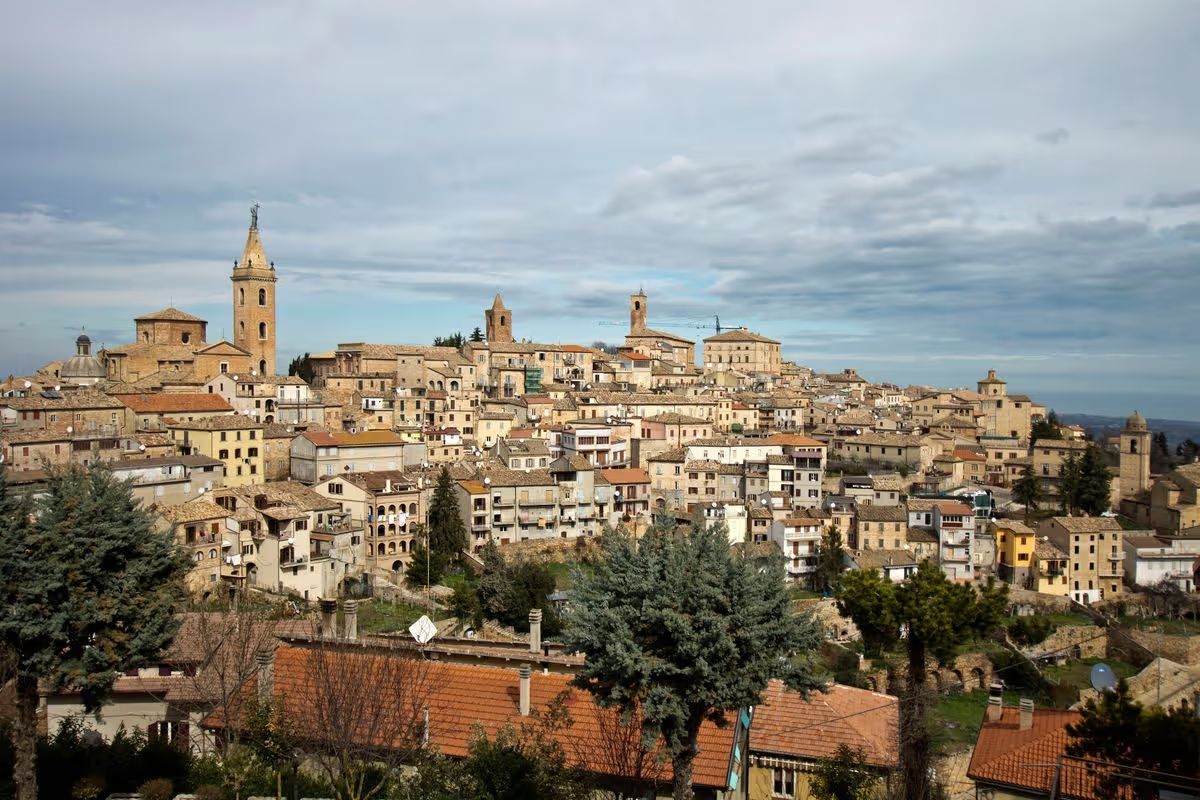
Tucked away in the English countryside is a village of record-breaking proportions. Milo Boyd went to check out if the rumours were true and if he could make it to the other end

“Is it true what they say about Meopham?” I asked the friendly landlady of the Railway Tavern.

“Of course it is,” she winked, before warning me that I better get going if I was going to make it before the sun went down.

Tucked away just over the Greater London boundary in Kent is a village of record-breaking proportions. It’s not the kind of record that can be found in the Guinness annuals, or is even known by some locals. “No mate,” the man in the kebab shop said when I asked if he knew. “I’ve not heard that one,” a dog walker told me.

Meopham is, according to some sources (including the publican), the longest village in the UK, maybe even in Europe, and possibly the World. From its northernmost tip over the railway tracks to the southernmost end by Wrotham, Meopham stretches seven miles. By way of comparison, Sunderland’s longest side is just under five miles. If you were running the London Marathon, you’d have a Meopham’s length between you and Buckingham Palace as you staggered through Canary Wharf.

READ MORE: I found a pretty UK village ‘taken over by tourists’ as locals say they’ve been forced outREAD MORE: I stayed at the UK’s best hotel – one thing makes it really stand out

On a cold Thursday in November, I set off south from the train station to see if I could take on this mammoth road trip from one end of Meopham to the other.

Straight away, I was met with a row of shops to my left, including the Railway Tavern (the first of four pubs) and a newsagent. A few hundred metres further along, a kebab shop, estate agents, and mechanics appear, followed by a school. Things really get going roughly two miles from the beginning of the village, when the tree-lined A-road opens up into a large green surrounded by two pleasant-looking pubs and crested with a well-poppied war memorial.

With the sun coming down and the temperature falling with it, I cycled on, up the hill, past mile three, four and five, clusters of houses, shops and stables popping up along the way. A little bit further and I had reached maximum altitude – 150 m above sea level – and with it, the end of the village.

There isn’t much to mark the transition from Meopham to whatever lies beyond. Merely a national speed limit road sign and a plastic skeleton hung in a bush, presumably left over from Halloween. But I had made it.

As I stood at the top of the village, gazing down at the countryside beyond, I was left with two prevailing thoughts. The first is that the majority of the UK’s villages are far less quaint than the bucolic image that comes to mind. Certainly, Meopham’s green is pleasant and its pubs look cosy, but the houses are gated whoppers and the road running down its centre delivers a constant smoggy roar that rips through any sense of tranquillity. Most of the British villages I’ve visited have the same problem: namely, too many cars.

The second is that maybe Meopham isn’t actually a single village, but four – Meopham Green, Culverstone, Dodmore and Hook Green – fused together at some point long ago by someone keen for it to be properly on the map.

It’s up to a parish council to officially denote its settlement as a village or not, and at some point in its past, that’s what happened in Meopham. It also happened in Brinkworth in Wiltshire, which makes the same lengthy claim. Although at 4.2 miles, I think we’re safe to ignore that.

All of this leads to a very obvious question: what makes a village a village, and a town a town?

In the settlement hierarchy, the humble hamlet sits at the bottom. It is fairly well established that a hamlet is a small, rural settlement, typically lacking a central church or a village hall. Once it gets a church, it becomes a village.

The progression from town to city is equally uncontroversial. After acquiring a cathedral, a university, and an array of other significant public buildings, large towns may be granted city status by the monarch through a royal charter. That honour was recently bestowed on Doncaster, Wrexham, Milton Keynes, and a few other hefty former towns.

However, what separates a village from a town is not as clear. While you might think the UK would have a solid definition by now, neither the National Planning Policy Framework nor the national planning practice guidance provides one. “Instead, we’re left with a delightful mix of historical interpretations, local authority classifications, and the occasional dictionary reference,” notes planning organisation Land Tech.

The House of Commons Library’s research briefing City & Town Classification of Constituencies & Local Authorities (2018) attempted to shed some light on the different classifications with the following population guides:

  • Villages and small communities: Under 7,500 residents
  • Small towns: 7,500 to 24,999 residents
  • Medium towns: 25,000 to 59,999 residents
  • Large towns: 60,000 to 174,999 residents
  • Cities: 175,000+ residents

However, this isn’t a hard and fast system, as many cities have tiny populations – such as the famously svelte St Davids in Wales – and the fact that recent Green Belt guidance from the Government carves out loads of exceptions for planning.

With all of this in mind, we have to wonder if we should hear the uncertainty in Meopham Parish Council’s voice when it reports that the village is “said to be the longest in England.” Would the cottage-dwelling Hook Green-ites in the very north of Meopham really count themselves the same as the mid-century modernists way down in Culverstone Green? I’m not so sure.

Source link

World’s longest train journey takes eight days but final destination is truly terrifying

The Trans-Siberian Railway is known around the world for its impressive length, but many don’t know that they can go further and enter one of the most dangerous countries on Earth

The world’s longest direct train journey takes eight days to reach its destination – and crosses into one of the world’s most secretive countries. Since June, direct passenger trains have been running from the Russian capital of Moscow all the way to North Korea’s Pyongyang.

Kim Jong-un’s hermit kingdom remains one of the most secretive – and feared – nations on Earth, with the tyrant’s iron fist seeing residents executed for the simple act of watching foreign TV.

That’s a staggering journey of 6,213 miles and makes it by far the longest train journey on Earth, according to the Guinness World Records.

A large portion of the trip uses the Trans-Siberian Railway, that runs across Russia from the capital Moscow in the west to Vladivostok in the east. Spanning a total of 9,288 kilometres (5,772 miles), that in itself is the longest single track in the entire world.

Passengers travelling from Russia to North Korea will travel in a specially-made carriage that is attached to the regular Trans-Siberian Railway service. Once arriving in Vladivostok, the carriage is then reattached to another train and carries on to Pyongyang.

These services were quite infrequent to begin with before being forced to grind to a total halt following the COVID-19 pandemic in 2020. Since then, however, the hermit kingdom has been trying to patch up its relationship with Russia, going as far as to send North Korean soldiers to fight in Ukraine.

Very few Westerners have dared to travel the full way from Moscow to Pyongyang. One group documented their trip back in 2018 and shared what the conditions on board have been like. As they boarded the train in Moscow, they explained that the dedicated Korean carriage was clear to see.

They claimed it was clear to see the train has not been kept in the best condition. “It was cold inside our compartment — no heating, maybe 10 degrees,” the travellers explained, adding that heating would not be turned on for several hours. “If it’s cold outside this period, the cars are individually heated with a coal stove, which is located in every car.

“However, individual heating requires that coal is available – and this was not the case in our North Korean sleeping car, but no problem, we had warm clothes.

“However, the water-boiler was working, so preparing tea, coffee and instant-noodles was possible.”

North Korea’s feared reputation is not without reason. The government is known to monitor all forms of communication by residents, to ensure there is no contact with the outside world. Thousands have been detained in “political prison camps” for “crimes” such as trying to flee the country or practising their religion.

Food is often withheld from the wider population, instead prioritising the elite and military. According to the UN, 10.7million, ore more than 40% of the entire population, are undernourished.

Source link

World’s longest straight road stretches for 150 miles without a single bend

The world’s longest straight road is in Saudi Arabia and is so long that a driver can travel for more than 150 miles without turning their steering wheel. Here’s everything you need to know about the highway

The world’s longest straight road is one which runs for around 150 miles without a single bend. The stretch of tarmac cuts through the Saudi Arabian Rub Al-Khali desert.

The Middle Eastern nation has become a major player in motorsport recently, playing host to the prestigious Dakar Rally, a Formula 1 Grand Prix, and the Extreme E off-road championship. The country’s vast expanses of desert have provided the perfect canvas for creating spectacular racing circuits and roads.

But it’s not just racing drivers who benefit from Saudi Arabia’s unique geography. Highway 10, which links Haradh to Al Batha, stands as one of the region’s most remarkable routes – open to ordinary motorists.

Originally constructed for King Fahd through the heart of the Rub Al-Khali desert, it holds the Guinness World Record as the planet’s longest corner-free stretch of road. Motorists can cruise for around 240km (149 miles) without needing to turn their steering wheel once.

The record was previously held by Australia‘s Eyre Highway, which measured roughly 146km (91.25 miles) without a turn.

According to Guinness World Records, despite its extraordinary length, the journey doesn’t take as long as you might expect, reports the Express.

They noted: “Built originally as a private road for King Fahd (SAU), the stretch of Highway 10 connecting Highway 75 in the Haradh area to Highway 95 in the west of Saudi Arabia is 240 km (149 mi) long.

“It cuts through the desert with no bends left or right, or any appreciable gradient up or down. The super-straight stretch has an estimated driving time of around 2 hr.”

Officials have warned against speeding or dangerous driving on the road, as the monotonous landscape and absence of turns can leave drivers feeling falsely secure.

It’s not the only instance of Saudi Arabia’s fixation with linear design. The nation has begun construction on a £1trillion “smart city” set to be built in the country’s Tabuk Province.

Neom’s 110-mile-long metropolis – dubbed The Line – consists of two enormously-long parallel structures.

It is the vision of Saudi Crown Prince Mohammed bin Salman, who aims to liberate the Middle-Eastern nation from its reliance on fossil fuels and establish a fresh economy centred on science and leisure.

However, some who have been involved with the scheme have privately described the proposals as “untethered from reality”.

The metropolis has also been labelled as potentially lethal. The mirrored-glass construction is essentially a “giant greenhouse,” according to prominent design scientist Melissa Sterry.

With global temperatures climbing, June 2024’s 40C heatwave in Saudi Arabia resulted in over 1,000 deaths among those undertaking the traditional Haj pilgrimage to Mecca.

Source link

World’s tallest bridge opens and cuts journey times from 2 hours to minutes

The Huajiang Grand Canyon Bridge in China has been officially opened and is now the highest bridge in the world – reducing the journey time for locals from two hours to just two minutes

China has unveiled a stunning new record-breaker after officially opening the world’s highest bridge in Guizhou province in the southwest of the country. The Huajiang Grand Canyon Bridge has slashed journey times from two hours down to just two minutes, according to local state media.

The remarkable structure boasts a deck-to-surface measurement of 625 metres – more than half a kilometre – making it tower above the previous record holder. It beats the Beipanjiang Bridge (Duge Bridge), also in China, which stands at 565.4 metres, by nearly 60 metres.

China’s rapid construction capabilities have recently drawn admiration from figures including Reform UK MP Zia Yusuf, who publicly expressed frustration on social media about the lengthy timescales for smaller infrastructure schemes in the United Kingdom.

Work on the Huajiang Grand Canyon Bridge commenced in January 2022 and was finished in under four years. The ambitious scheme resulted in a structure stretching almost 3km across a canyon dubbed the “Earth crack”.

The bridge measures 2,890 metres in total length and underwent rigorous testing before authorities gave the green light for public use.

As reported by ITV, before the bridge could be deemed safe for traffic, a dynamic load test was conducted, reports the Express.

This involved 96 lorries driving onto specific points of the structure in groups.

The new structure has now bagged the Guinness World Record for being the tallest bridge globally.

Now, globetrotters from all corners of the world are keen to witness the magnificent construction that officially opened its doors on 28 September 2025.

The Huajiang Grand Canyon Bridge boasts glass walkways for visitors to gaze down at the Beipan River, approximately 580 metres below.

It also features viewing platforms and a glass lift leading to its sky-high café, set to open in November this year.

For those seeking a thrill, they can bungee jump from the bridge.

State media have reported plans for professional BASE jumping events.

Source link