world leader

As world leaders converge on U.S., Trump seeks to demonstrate control

President Trump on Monday headed into a week full of high-stake meetings with world leaders after spending a 72-hour period banning reporters from the White House, mulling whether it was time to “blow … up” Iran, and proposing to house military drones and snipers in his triumphal arch in the nation’s capital.

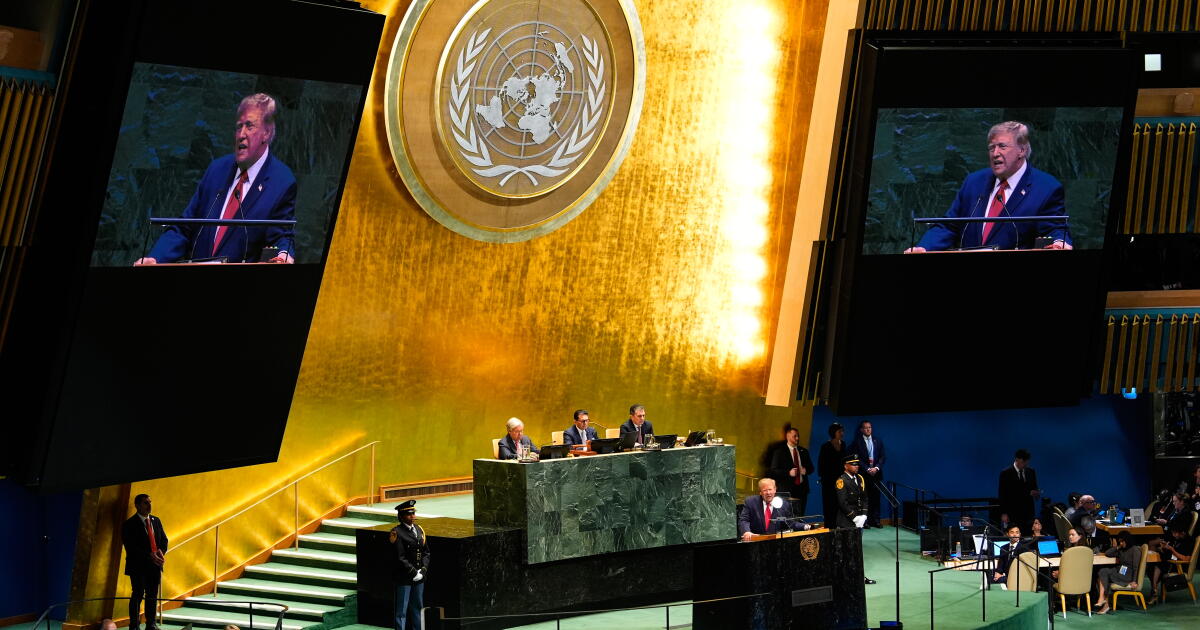
The weekend — which also included the announcement of a security deal over Greenland and the creation of a new “A.I. Force” — captured an American president operating unpredictably across multiple fronts even as each one drew friction. The actions now stand to color the backdrop of a week that will feature meetings with world leaders at the United Nations General Assembly in New York and a state visit by Chinese President Xi Jinping in Washington.

Each of those moves carries its own political weight ahead of the diplomatic talks, but also ahead of the midterm elections, where these topics are front and center in key races.

Trump’s handling of the Iran war, its subsequent shocks to the global economy, his push to fast-track the development of artificial intelligence and the Greenland agreement are likely to come up in meetings with world leaders. His deal with Denmark to bolster U.S. military presence in Greenland, a territory Trump has repeatedly tried to annex, is expected to be signed Tuesday in New York, though action is still needed by the Danish and Greenland governments before it can be enforced.

While all the details of the Greenland deal are not public yet, Trump has said it is a “dream come true for the United States of America.”

“This solution is a great one for the United States of America, Denmark, Greenland and all of our Allies,” Trump wrote on social media Friday. “We look forward to working with the wonderful people of Denmark and Greenland toward a magnificent future with respect to this large, and highly strategic, parcel of land. We will be very protective of it.”

In an interview Sunday, Trump also indicated that he was trying to make a decision on Iran as the war stretches into its eighth month. The president said he would “probably be open” to meeting with Iranian President Masoud Pezeshkian during the U.N. General Assembly.

“My question is, if and when do I blow the entire nation up?” Trump told Fox News. “They better behave.”

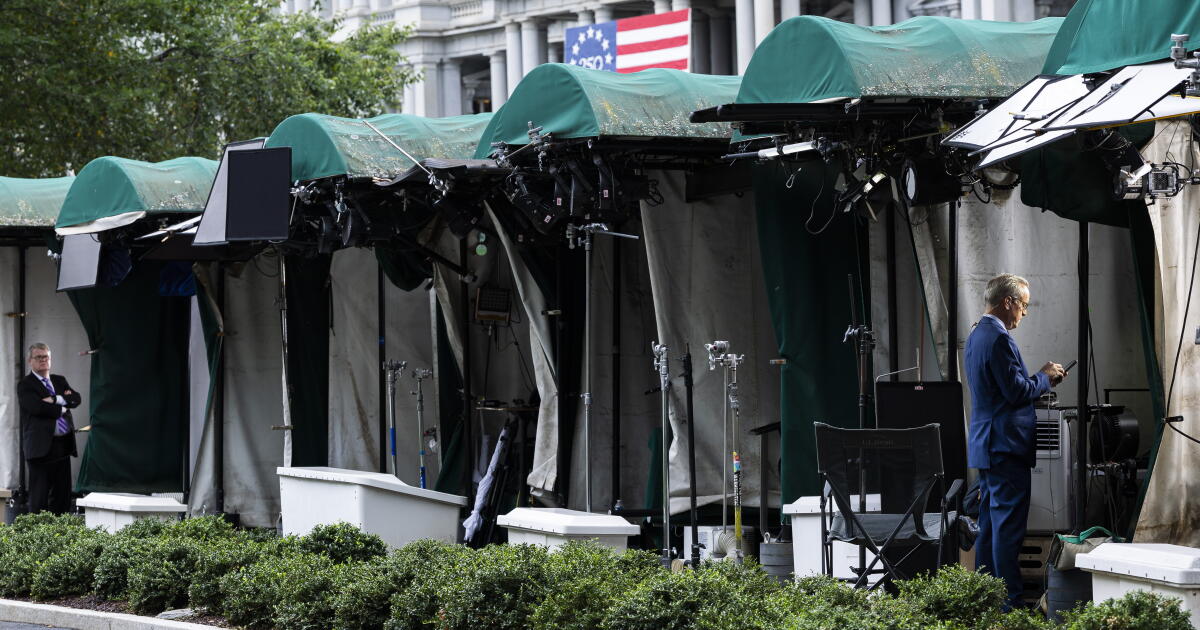
Of all the actions Trump took, the press dispute has become the most contentious and drawn an immediate legal response. Three major news outlets — CNN, MS NOW and Politico — sued the Trump administration Monday for banning their reporters from the White House grounds, and major television networks suspended their pool coverage of the president’s activities.

In a joint statement, the organizations said the White House has acted “without notice or process” and called the arbitrary decision a “blatant violation” of the 1st Amendment.

Trump, meanwhile, argued Monday that the banned news outlets are “corrupt” and a “threat to our national security.”

Vice President JD Vance defended the press ban.

“He’s not banning media outlets. What he’s doing is saying we’re not going to give you special access to the White House if you engage in what is effectively propaganda,” Vance said Monday, arguing that the three outlets push out “negative” coverage of Trump.

The tense showdown between Trump and the White House press corps led to audio problems during the president’s ribbon-cutting ceremony for a new helipad on the South Lawn. Without television cameras and microphones set up by the major TV networks, it was impossible to hear what Trump was saying through the White House’s official YouTube stream, signaling further technical difficulties in the week ahead.

Behind the public displays of control, news reports have painted a picture of a president increasingly frustrated by the lack of credit he feels he is owed. At a recent closed-door meeting, reported by the Wall Street Journal, Trump told advisors he was aggravated that his allies hadn’t lauded him enough for his efforts to take over the Kennedy Center or other accomplishments made during his second term.

Trump has tried to put his name on the building’s facade and run into resistance from Democrats, arts patrons and a federal judge who blocked the move last week. Trump was then photographed aboard Air Force One looking at a large printout appearing to show demolition plans for the center.

Over the weekend, Trump posted on social media a link to a news article that claimed he was seeking to fix “safety hazards” at the performance center. He then posted an image of him watching the Western Hemisphere with the words, “His Hemisphere,” and wrote that his proposed triumphal arch near the National Mall would be used as a military complex for drones and snipers.

Trump also announced that he would be creating the “A.I. force,” modeled after the Space Force he launched during his first term, to ensure the country does not “in any way hinder or stifle the growth of the industry.” The announcement came amid growing backlash to data centers and the fast-paced development of artificial intelligence, an issue that in recent weeks has prompted stark warnings about the technology’s power and its threats to humanity.

Tech executives, including Dario Amodei and Sam Altman, have even called for a slowdown on the technology’s advancement and last week, four leading AI companies — Anthropic, OpenAI, SpaceXAI and Google — faced a lawsuit claiming they made an illegal deal to slow the pace of their respective AI development.

Trump’s announcement over the weekend comes as lawmakers, including congressional Republicans in tight races, have called for new guardrails on the technology.

Despite technology becoming a political flashpoint during the midterms, Trump has dismissed concerns about AI as a hoax and asserted that those who oppose data centers are intent on being “backwards and poor.”

Sen. John Kennedy (R-La.) is among the lawmakers who have called for action on regulating the technology, and he has warned that not doing so could come at a cost on Nov. 3.

“We really need to send a memo around explaining we’ve got midterm elections coming,” Kennedy told Politico. “I may send that out.”

Source link

Vance talks about the end times and the attempted assassination of Trump in Christian podcast

Vice President JD Vance said in a podcast released Tuesday that if a 2024 assassination attempt had killed Donald Trump, he would have always wondered if it was part of a conspiracy and might not have accepted even another Republican as the next president.

Vance made the statement during a conversation with Christian podcaster Bryce Crawford. The vice president, who recently released a book detailing his own journey to Catholicism, also defended President Trump for posting an image of himself as Jesus and mused about whether artificial intelligence was a sign of the end times.

The conversation kicked off with a discussion of faith and the rush to scientifically explain away events that may be divinely touched. Vance cited the July 2024 assassination attempt in Butler, Pennsylvania, during which a bullet nicked Trump’s ear and a supporter was killed.

Trump has long talked about his survival as divinely guided, a theme Vance took up. The vice president said that if the bullet had killed Trump, “we would have had real civil strife in a way that I don’t know that the country could have ever come back from.”

Vance said many Trump supporters would have assumed a conspiracy had robbed them of their chosen president, and he said he would have also had those thoughts “in the back of my mind.”

“I would have assumed very dark forces had taken out Donald Trump, right as he was about to come back into the White House,” Vance said. “There would have just been an illegitimacy to our entire political system.”

Most of the hour-and-ten-minute conversation was an amiable chat about faith, Vance’s own spiritual journey, his Easter meeting with Pope Francis the day before the pontiff’s death last year, and human frailty and fallibility. But it occasionally touched on darker themes.

Crawford asked Vance whether, as vice president, he had ever been in a room that was “spiritually dark.”

“I’ve been in meetings with world leaders where various issues are being discussed, and somebody will say something or somebody will make an observation and I’ll feel some darkness about it, it sets off every spiritual alarm bell in my body,” Vance said. He added he also felt “a very dark spiritual energy” in Gettysburg, Pennsylvania, probably because of the carnage at the Civil War battlefield.

Vance cites AI during a discussion about ‘end times’

Crawford also asked Vance about his interest in the “end times,” which the vice president laughingly said had been more of an obsession in youth during the late 1990s, when people were abuzz about the possibility with the coming millennium. A chortling Vance recounted a story of a friend who was obsessed that the world would end in late 2007 and ran up major credit card debt.

“There are, like, things about the world that make me feel, like, not shocked if the Antichrist was walking among us, but, again I try not to focus too much on it,” Vance said. He cited “IT companies” and the use of artificial intelligence as a substitute for human interaction.

“I think that’s kind of satanic,” Crawford said when Vance recounted the story of one acquaintance using AI as a marriage counselor.

“Yeah, when you completely divorce the human from the social element that God made us for, OK that’s very, that’s very bad,” Vance said.

Crawford asked Vance about Trump’s post on social media of an AI-generated image of himself as Jesus earlier this year, which Crawford said offended him. Trump initially contended he thought the image was of him as a doctor, then took down the post amid widespread criticism from even some of his own backers.

Vance defended the president. “He did not mean to, like, mock or mimic God, that’s just not who he is,” Vance said, adding that the president often tries to keep things light and constantly makes jokes. “He’s a bit of a ballbuster, for those of us who work with him, and he just likes to have a good time. And I think that if people appreciated that, they would recognize, he’s not trying to offend people, he’s trying to keep things light.”

Riccardi writes for the Associated Press.

Source link