world cup

Which teams will make their debut at World Cup 2026? | World Cup 2026 News

Football’s world governing body, FIFA, has framed the 2026 World Cup’s expansion from 32 to 48 teams as a watershed moment for inclusivity, opening the door for nations that have never qualified before.

Indeed, four teams will be playing at their first World Cup in North America this summer: Cape Verde, Curacao, Jordan, and Uzbekistan.

Recommended Stories

list of 4 itemsend of list

Here is Al Jazeera’s short guide to the debutants at this year’s competition.

Cape Verde

  • FIFA world ranking: 69
  • World Cup fixtures (Group H): Spain (June 15, Atlanta), Uruguay (June 21, Miami, US), Saudi Arabia (June 26, Houston, US)
  • Player to watch: Garry Rodrigues

With a population of about 525,000, the small archipelago off the coast of Senegal will become the third-least populous country to participate in a World Cup after Curacao and Iceland.

Ryan Mendes is not even a household name in Turkiye, where he plays for second-tier Igdir, but Cape Verde’s 35-year-old captain was at the heart of their 3-0 win over Eswatini in October, which booked their place at the World Cup.

This was no freak occurrence as Cape Verde topped their group at the 2023 Africa Cup of Nations, which included Ghana, reaching the quarterfinals where they lost on penalties to South Africa.

Although they failed to reach AFCON 2025, they again topped their group in 2026 World Cup qualifying – this time finishing ahead of the once-mighty Cameroon.

“We have taken part in four African Cup of Nations tournaments, and we were also very close to qualifying for the 2014 World Cup,” Mendes told the AFP news agency.

“A lot has been achieved over the years. And today, we can say that this is the logical outcome.”

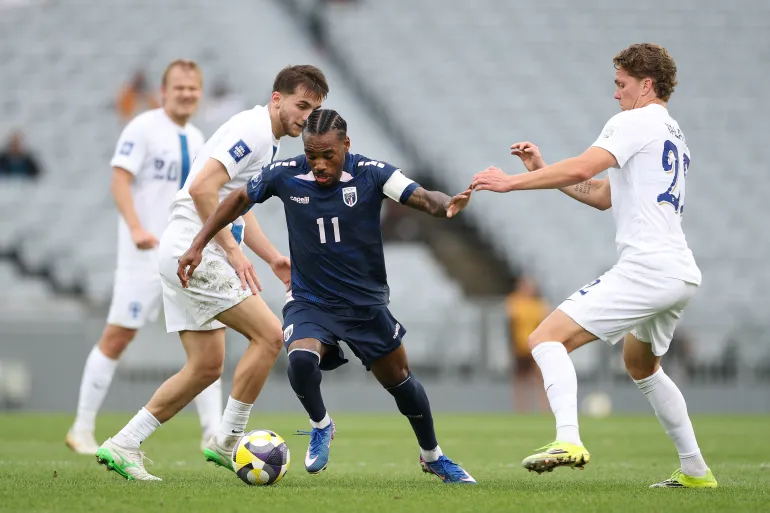
AUCKLAND, NEW ZEALAND - MARCH 30: Garry Rodrigues of Cape Verde is challenged by Onni Valakari of Finland during the FIFA Series match between Cape Verde and Finland at Eden Park on March 30, 2026 in Auckland, New Zealand. (Photo by Phil Walter/Getty Images)
Garry Rodrigues of Cape Verde is challenged by Onni Valakari of Finland during a match in March [Phil Walter/Getty Images]

Cape Verde rely heavily on their Portuguese colonial past for a supply of diaspora talent, and also have several Dutch-born players, as well as one from Ireland – the Shamrock Rovers defender Roberto Lopes. The Dublin-born 33-year-old has a Cape Verdean father and Irish mother and was reportedly recruited for Cape Verde via LinkedIn.

The team’s best-known player, however, is probably 35-year-old winger Garry Rodrigues; now at Cypriot club Apollon Limassol, he has had stints at the likes of Galatasaray and Olympiacos.

But even without mega-star names, Mendes is certain that the Blue Sharks can make a mark at the tournament.

“One thing’s for sure: we’re not going there just to play three games and come home,” he said.

Curacao

  • FIFA world ranking: 82
  • World Cup fixtures (Group E): Germany (June 14, Houston, US), Ecuador (June 20, Kansas City, US), Ivory Coast (June 25, Philadelphia, US)
  • Player to watch: Tahith Chong

“Small island, big dreams” reads a poster for the football team of the Caribbean island of Curacao – the smallest country ever, by population, to qualify for football’s World Cup.

Since Curacao clinched qualification with a hard-fought 0-0 draw against Steven McClaren’s Jamaica in November, the 160,000 inhabitants of the Dutch island famed for its eponymous sapphire liqueur are riding the crest of the Blue Wave, as the national side is dubbed.

The most famous person around the squad is Curacao’s boss Dick Advocaat, the 78-year-old former Netherlands, PSV and Rangers manager who guided the Curacaoans to qualification. He is set to become the oldest manager ever at a World Cup.

Meanwhile, as a self-governing entity within the Netherlands, the island owes its World Cup squad entirely to its Dutch-based diaspora, the president of Curacao’s football federation, Gilbert Martina, admitted.

“All the players on the national team play in foreign leagues,” he told AFP.

Perhaps the best-known player is former Dutch youth international Tahith Chong, now at Championship side Sheffield United. The only team member born on Curacao, Chong moved to the Netherlands at the age of 13.

The 26-year-old winger or attacking midfielder is known for his pace, dribbling and a wicked left foot.

The most famous Curacaoan is probably former Ajax and Barcelona star Patrick Kluivert, who was born to a Surinamese father and a mother from Curacao.

“It’s fantastic that the island is in the World Cup,” Kluivert, who coached the Curacaoan side between 2015 and 2016, told AFP.

“In my day, [football] was not that big on the island, but the players have given Curacao visibility. It’s important for the future, for the next generation.”

Jordan

  • FIFA world ranking: 63
  • World Cup fixtures (Group J): Austria (June 16, San Francisco, US), Algeria (June 22, San Francisco, US), Argentina (June 27, Dallas, US)
  • Player to watch: Musa Al-Taamari

Jordan head coach Jamal Sellami has called on ⁠his players to emulate ⁠Morocco’s shock run to the last four of the World Cup in 2022 as they prepare for their first appearance at the tournament.

“In big competitions, many teams can surprise. My country, Morocco, ‌reached the semifinals in the last World Cup,” Reuters quoted him as saying during a training camp in Antalya, Turkiye in late March. “That gives us belief.”

Despite their underdog status, the players say they are not going to the World Cup just to make up the numbers.

“For us, we are not going just for participation,” midfielder Noor Al-Rawabdeh added. “We are aiming to go as far ⁠as we can in the tournament.

“To be honest, sometimes we don’t sleep when we think about it,” he added. “It’s a dream come true for us.”

LUSAIL CITY, QATAR - FEBRUARY 10: Musa Al-Taamari of Jordan battles for possession with Akram Afif of Qatar during the AFC Asian Cup final match between Jordan and Qatar at Lusail Stadium on February 10, 2024 in Lusail City, Qatar. (Photo by Robert Cianflone/Getty Images)
Jordan’s Musa Al-Taamari, left, in action with Qatar’s Akram Afif during the AFC Asian Cup final in 2024, which Qatar won 3-1 [Robert Cianflone/Getty Images]

The Rennes winger Musa Al-Taamari is probably the team’s standout player – he was the key creative force as Jordan ⁠secured an automatic berth at the World Cup after finishing ⁠second behind South Korea in their Asian qualifying group.

Sellami said the camp in Antalya, which involved games against Costa Rica and Nigeria, was a key stage in building experience before facing elite opposition.

“We ‌are ‌preparing step by step. We’ve played against different football cultures,” he said.

“We are collecting experience and, Inshallah [God willing], we will surprise many people.”

Uzbekistan

  • FIFA world ranking: 50
  • World Cup fixtures (Group K): Colombia (June 17, Mexico City, Mexico), Portugal (June 23, Houston, US), DR Congo (June 27, Atlanta, US)
  • Player to watch: Abdukodir Khusanov

Uzbekistan FA Vice President Ravshan Irmatov is no stranger to the World Cup, having refereed at three finals, but believes the Central Asian country’s long-awaited qualification is merely the latest step in its football development.

“Qualifying for the World Cup has been a dream for 38 million people for 34 years,” Irmatov said. “You can understand how important it was for the Uzbek nation, we waited so long.”

Uzbekistan’s first qualification comes after seven attempts to secure a finals spot since the country was granted FIFA membership in 1994 following the break-up of the Soviet Union.

Slovenian coach Srecko Katanec guided a team built primarily on home-based talent to the cusp of the finals before health issues forced him to stand down, leaving Olympic team coach Timur Kapadze to secure the ticket for the 2026 tournament.

BURNLEY, ENGLAND - APRIL 22: Abdukodir Khusanov of Manchester City during the Premier League match between Burnley and Manchester City at Turf Moor on April 22, 2026 in Burnley, England. (Photo by Alex Livesey/Getty Images)
Abdukodir Khusanov became the first Uzbek to play in the Premier League when he joined City last year [File: Alex Livesey/Getty Images]

Captain Eldor Shomurodov, on loan at Istanbul Basaksehir from Roma, is the country’s top scorer with 44 goals in 90 games and scored 21 Turkish Super League goals this season.

But the team’s best-known player is probably Manchester City’s Abdukodir Khusanov. The 22-year-old centre back has become a key part of the defence this season, well-regarded for his positional play, pace, strength and quiet leadership.

Uzbekistan confirmed their place at the finals with a 0-0 draw against the United Arab Emirates in June, and since then, former Italian World Cup winner Fabio Cannavaro has taken over as coach.

“I’ll tell you what I always repeat to my players: for the first time you will play in a World Cup, you have nothing to lose,” Cannavaro was quoted as saying by The Mirror newspaper in March.

“Approach every match with maximum calm, enjoy yourselves as much as possible, and if you feel anxiety, let it be positive anxiety.”
Source link

Los Angeles World Cup stadium workers threaten strike over ICE deployment | World Cup 2026 News

Workers represented by a local union say ICE presence would create a climate of fear during the FIFA World Cup 2026.

Workers at the SoFi Stadium in Los Angeles have decided to go on strike if federal immigration enforcement agents are deployed at the venue when it hosts FIFA World Cup matches in June and July.

The UNITE HERE Local 11 – a labour union representing some 2,000 hospitality employees – on Monday demanded federal guarantees that Immigration and Customs Enforcement (ICE) would not be used during the matches scheduled at the stadium.

The venue, which will be known as the Los Angeles Stadium during the tournament, will host eight World Cup games, including the opening fixture for the United States on June 12.

Workers at the world’s most expensive sports arena say the ICE presence would create a climate of fear for themselves and for fans.

“ICE should have no role in these games,” said Isaac Martinez, a stadium cook, at a protest outside the venue.

“We do not want to live in fear coming to work, or fear being detained going home.”

“If we do not reach an agreement, my colleagues and I are ready to strike,” Martinez added, speaking on behalf of a workforce composed largely of food and beverage concession staff.

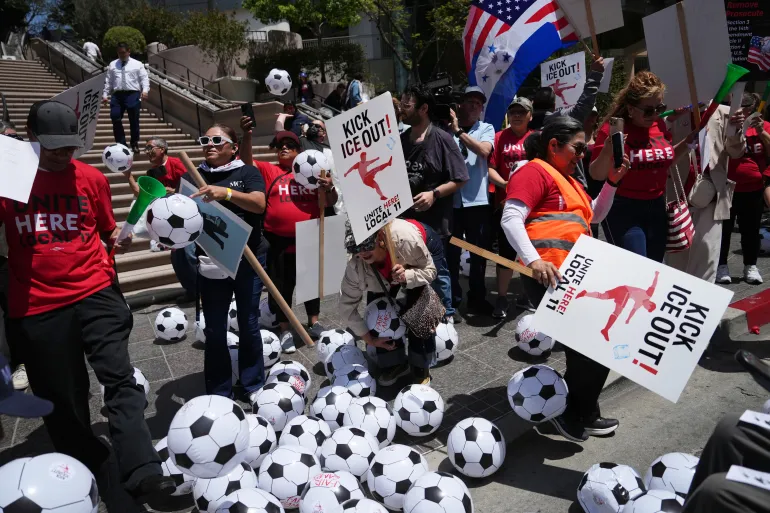
SoFi Stadium workers, belonging to union Local 11, picket outside of the FIFA Los Angeles World Cup 2026 Host Committee headquarters on May Day, Friday, May 1, 2026, in Los Angeles. (AP Photo/Jae C. Hong)
SoFi Stadium workers protest in Los Angeles on May Day [Jae C Hong/AP]

ICE has led the charge in President Donald Trump’s immigration crackdown.

Human rights groups have condemned the agency for its conduct during raids in several US cities, including Los Angeles last year.

In early 2026, ICE agents fatally shot two American protesters in Minneapolis.

Workers on Monday also raised alarms over FIFA’s accreditation process, which requires employees to submit personal data before the tournament, which runs from June 11 to July 19 across the US, Canada and Mexico.

“We ask FIFA not to share our information with ICE agencies, foreign countries, or intelligence services,” worker Yolanda Fierro said.

Protesters carrying plastic balls and signs reading “Kick ICE Out of the World Cup” drew support from Tom Steyer, a Democratic candidate in California’s gubernatorial race.

ICE’s mandate is border control, the financier-turned-politician said.

“Can anyone explain what that has to do with the World Cup? Nothing,” Steyer said.

“How is it possible that this is the agency that is going to be here when we know in fact they’re an absolute threat, a lawless threat, to workers in California?”

Source link

Artists, community welcome World Cup to Inglewood with murals and more

A lot has changed since Jacori Perry attended Morningside High School.

Perry is now a renowned artist who goes by the names Mr. Ace and AiseBorn.

The school is now known as Inglewood High School United.

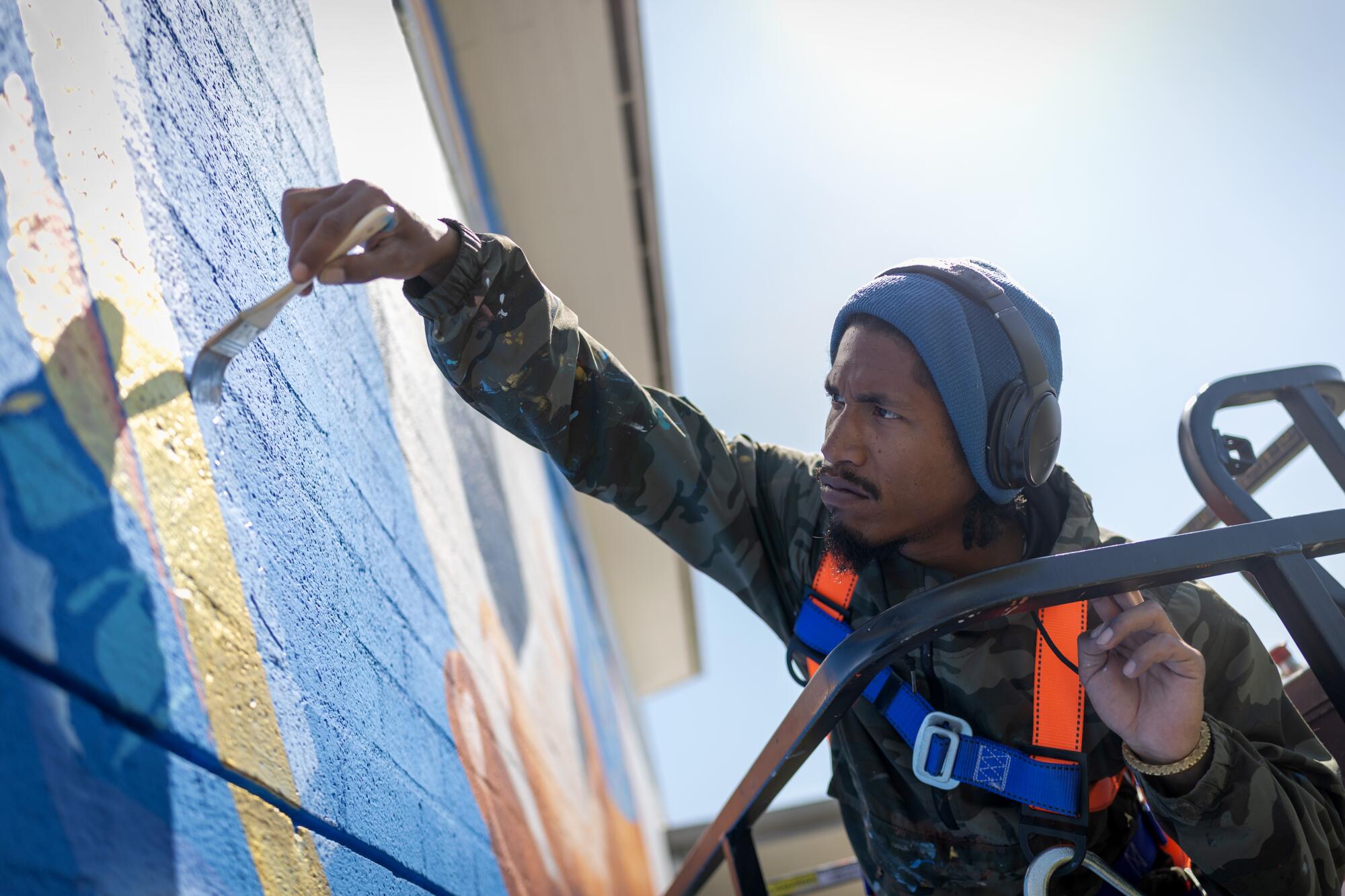
And the lecture hall on that campus now features a large, ornate mural of a soccer ball being grasped by the hands of two people — freshly painted by the 2004 Morningside graduate as the city of Inglewood prepares to host eight World Cup games at SoFi Stadium starting next month.

A man brushes paint onto a mural while harnessed to a lift above the ground.

Local artist Mr. Ace works on his mural at Inglewood High School United on May 11. The artist, whose real name is Jacori Perry, attended the school when it was known as Morningside High more than two decades ago.

(Eric Thayer / Los Angeles Times)

“If you told me that I would be back here painting one of the walls on this campus when I was in high school, I don’t think that I necessarily would have foreseen it,” Mr. Ace said as he put the finishing touches on his mural last week. “So I’m a little in amazement about just the way life works in that sense.”

He was one of several Los Angeles-based artists to participate in a Road to World Cup Community Day last month at Inglewood High United. Many of the artists — including Juan Pablo Reyes (“JP murals”), Michelle Ruby Guerrero (“Mr. B Baby”) and Angel Acordagoitia — sketched designs on portable panels (12-feet by 8-feet) and picnic tables for community members to paint.

The picnic tables will remain at the high school in front of Mr. Ace’s mural. The mobile murals will be placed throughout LAX to welcome visitors arriving for the World Cup.

Kathryn Schloessman, chief executive of the Los Angeles World Cup 2026 Host Committee, said in a news release that the event was “just one example of how the energy of the World Cup can be felt in neighborhoods across our region.”

“Students, artists, and volunteers came together to create a work of art that will live on well beyond the end of the tournament,” Schloessman said. “It’s a reflection of the creativity, diversity, and community pride that makes our region so special as we prepare to host the world for FIFA World Cup 2026.”

Community members were encouraged to take part in the painting process, no matter their skill level.

“We made it easy enough for people that have zero experience to a proficient level of experience, for them to all be involved,” said Reyes, who designed and helped paint two mural panels and three tables. “We did the sketch, and then I tried to dab a little bit of color — whatever color is supposed to be there, I dabbed a little bit of color right there, so they would have a guide. …

People stand on a scaffold and on the ground while painting a mural on a large panel.

Students and community members help paint a mural panel during a Road to World Cup Community Day event May 2 at Inglewood High School.

(Dawn M. Burkes / Los Angeles Times)

“I was right there, kind of supervising, making sure that everything went as planned. And if anybody has questions, they’re more than welcome to let me know about them. But, yeah, it’s pretty easy for them to kind of be involved and feel that sense of ownership and have a sense of pride that, ‘Yeah, I was part of that mural-creation process.’ It’s a rich experience for them.”

Acordagoitia sketched several tabletop designs for the public to paint at the event.

“They did great,” he said of the community members. “They helped a lot. They were asking questions. They got all the other colors correct. So, yeah, they were excited. A lot of kids were excited to see the live painting, because now kids are used to being on their phones. So that was a great experience for them.”

Acordagoitia also opted to paint a mural panel on his own because “it was a little more technical,” involving portraits of his 8-year-old son, a nephew and a friend.

“I wanted to focus more on the youth because that’s really our future,” he said. “So that’s, that’s the main thing about the mural, just about the kids, soccer, culture, community. It’s exciting for me, because I grew up playing soccer and to include soccer with art, it’s just a dream come true.”

Guerrero said “the community was a big help in filling in all the background colors that I need in order to build the detail and layers” on the two mural panels she designed.

“My whole style is based on culture. And I think that there’s a connection there with the World Cup and how I feel like it brings together all the culture and just, like, celebration,” Guerrero said. “It kind of goes hand in hand with the type of work I do, because my stuff is really festive, celebrating culture. And just as an L.A.-based artist, I think the collaboration made sense.”

The four artists also took part in another Road to World Cup Community Day in downtown L.A. at Gloria Molina Grand Park on March 14. At that event, the artists sketched designs on large sculptures shaped like soccer balls and on an oversized picnic table, also for community members to paint.

While Mr. Ace opted to paint his permanent mural at Inglewood High School United on his own, he was sure to include the community theme into his work.

“The idea was really centered around just creating something that was community-based — something that represented the World Cup but also represented some sense of community,” he said. “And so what I did was try to create something that was symbolic, very direct in terms of its relationship to soccer and figuring out through that how to create something simple that [brings] into that a sense of community. And that’s how I landed on the two hands holding the soccer ball.”

A man stands in a lift and paints on a wall with blue paint as part of a mural with an ornate design.

Local artist Mr. Ace works on his World Cup-themed mural at Inglewood High School United on May 11.

(Eric Thayer / Los Angeles Times)

Back when he was a student on that campus, Mr. Ace said he was always involved in art and knew he wanted a career as an artist. He struggled to come up with the right words to describe how it felt being back there creating a work of art to be shared with the students, all of the community and everyone who happens to see it on the way to a World Cup match.

“I guess there’s no words to really describe it,” he said. “I think if any artist gets the opportunity to paint at their own high school — especially if they’ve been doing large-scale works around the city, the country or the world — I think that is a little touching. When it’s attached to something like the World Cup … you know, a large part of my childhood was spent in Inglewood, so coming from my circumstances and life, I think it’s even more intriguing.”


Source link

Nearly 1,900 vanished in and around Guadalajara. Now the World Cup arrives

The highway from the Guadalajara city airport to downtown is newly paved and the city’s famous roundabout has gotten a $4-million facelift. The city is abuzz with renovation projects as Guadalajara prepares to host four World Cup soccer matches in June.

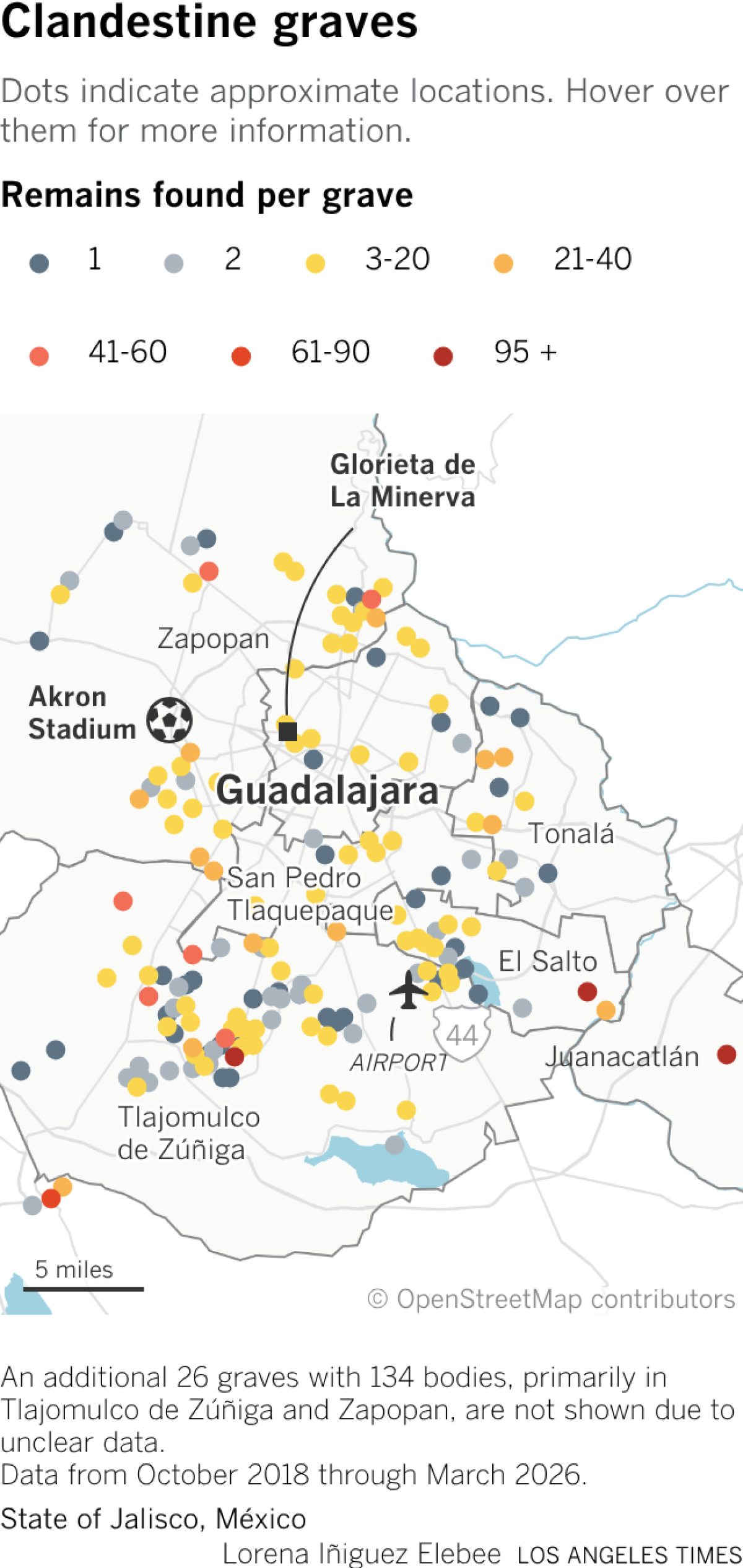
But there’s one thing the 3 million fans expected to flock to the city won’t see — the sites where hundreds of bodies have been found in clandestine graves dug by Mexico’s notorious New Generation Jalisco Cartel. Scores were discovered on the main route leading to Akron Stadium, where the games will be played.

One set of remains was that of a 17-year-old high school student who had gone out to sell his motorcycle to help his unemployed uncle. He disappeared. When his uncle began searching, he disappeared as well. At another site, the bones of a 34-year-old cellphone repairman were found. He was a father of two who’d simply ventured out to shop for used tennis shoes.

According to statistics compiled by the state of Jalisco, between 2018 and March of this year, 1,907 bodies were found in Guadalajara and surrounding cities.

The arrival of the World Cup is an opportunity for Mexico’s second-largest city to shine on the international stage, and the Jalisco state government launched an upbeat campaign highlighting the municipality where games will be played: “Zapopan, the heart of soccer,” the slogan goes.

Families searching for their loved ones sarcastically responded with, “Zapopan, the heart of clandestine graves.”

An aerial view of La Minerva roundabout fountain in Guadalajara

An aerial view of La Minerva roundabout fountain in Guadalajara, Mexico, taken on June 27, 2025.

(Ulises Ruiz / AFP via Getty Images)

Since January of 2025 alone, search groups and authorities have discovered 58 graves with 226 sets of remains inside city limits. Five graves were located within three miles of Akron Stadium.

Three graves with 15 bodies were found within a mile of the city’s iconic La Minerva roundabout, a huge traffic circle featuring fountains, greenery and a towering statue of the Roman goddess Minerva. Others were found not far from Chapultepec Street, a popular tourist destination.

a mother poses with a search card

Liliana Meza, mother of Carlos Maximiliano Romero Meza, who disappeared on Oct. 22, 2020, poses with a search card at the Glorieta de las Personas Desaparecidas in Guadalajara, Mexico, on Friday, May 15, 2026. Founders of the Luz de Esperanza Desaparecidos Jalisco collective created the cards, inspired by World Cup soccer stickers, to draw attention to missing persons cases ahead of the 2026 FIFA World Cup in Jalisco.

(Alejandra Leyva/For The Times)

Though tourists and tourist sites are rarely touched by cartel violence in Mexico, critics say the graves are an embarrassment for state and city administrators.

Amid all the cleanup, little official attention has gone to the growing number of clandestine graves that groups of persistent, family-funded search teams have found in recent months.

Large machinery and backhoes are working nonstop across the city ahead of the games, said Jaime Aguilar, a spokesperson for the group Warrior Searchers of Jalisco, which finds an average of two graves a month. “But when we ask for a backhoe to help in our searches, there is never one available,” he said.

Over the years, secret graves have been discovered in rural areas, at industrial sites, alongside roads, inside buildings and even in the heart of Guadalajara. The Jalisco state government tracks grave discoveries, but an analysis by The Times and Puente News Collaborative shows many have been concentrated in the Guadalajara area.

Flyers with photographs and identifying information about missing persons

Flyers with photographs and identifying information about missing persons, posted by search collectives, have become a common sight along the main streets of the city’s historic center, as seen here on Friday, May 15, 2026.

(Alejandra Leyva/For The Times)

Earlier this year, authorities found a blood-soaked safe house a mile from Akron Stadium where cartel enemies were tortured. One person was found buried there. Within a 10-mile radius, nearly 100 sets of remains were found in 500 trash bags buried in shallow graves.

The graves, and the potential discovery of more, worried Mexican President Claudia Sheinbaum. She feared that FIFA, the international soccer association in charge of the games, might move the Mexico games to the United States or Canada, the other countries co-hosting the games, because of the violence, said one Mexican official familiar with planning for the tournament.

That fear burst into the open in February, when Mexican special forces killed Nemesio “El Mencho” Oseguera Cervantes, leader of the hyper-violent New Generation Jalisco Cartel. Law enforcement officials said Guadalajara is a stronghold for the criminal group.

Cartel members responded to El Mencho’s death by setting fire to cars and buses and blocking major exits from Guadalajara. The city was briefly paralyzed. Gunmen burned 80 convenience stores and a host of pharmacies, flexing their power in the city.

In the days after the violence, FIFA officials met with the Mexican government to review security for the Guadalajara matches. Sheinbaum laid out a plan to send 100,000 security personnel, including Army soldiers and police officers, to stadiums in Guadalajara and the country’s two other host cities, Mexico City and Monterrey. FIFA determined it would not change the World Cup venues.

U.S. law enforcement has been advising Mexico on counter-terrorism methods, including training in repelling drone bombs, a weapon increasingly used by cartels to terrorize communities, attack adversaries and target military convoys. U.S. special forces have been training Mexican military teams to repel attacks at stadiums.

Flyers identifying information about missing persons are displayed throughout Guadalajara's historic center

Fliers with photographs and identifying information about missing persons are displayed throughout Guadalajara’s historic center alongside traditional city scenes and World Cup-related imagery.

(Alejandra Leyva / For The Times)

The Mexican government had already witnessed the Jalisco cartel’s proclivity for brazen killing. In December, some four miles from Akron Stadium, gunmen fired more than 3,000 bullets in broad daylight into the car of a director of a produce distribution center. The gun battle between his security guards and the cartel took place just a few blocks from a police station. It took officers nearly a half hour to arrive at the scene.

In recent years, Jalisco state has become a cartel killing ground, security experts say. Some graves discovered in the Guadalajara area contained a single body, some more than 40. A few had 95 or more.

In 2023, the remains of nine teenagers, chopped up and stuffed in trash bags, were found in a canyon in Zapopan. They had worked for a Jalisco cartel call center where telemarketers scammed Americans of millions of dollars in a time-share scheme. The teenagers are believed to have upset their employer.

Traffickers recruit young people, including minors, to serve as foot soldiers in their bloody quest to control drug-trafficking routes across Mexico. Some of those teenagers were lured by ads promising good-paying jobs, only to discover they were being funneled to a Jalisco cartel training camp an hour outside Guadalajara. There, as a test, Mexican security officials said, recruits were forced to kill fellow recruits.

Plaza Liberacion, the city's main public square

Plaza Liberacion, the city’s main public square, with flyers with photographs and identifying information about missing persons, on Friday.

(Alejandra Leyva/For The Times)

The cartel has recruited more than 45,000 minors across Mexico in recent years, said one Jalisco state representative.

While some of Guadalajara’s upscale neighborhoods have escaped the violence, families across the metropolitan area have seen hundreds of children disappear, some to reappear, dead, on cartel battlefields across Jalisco and in the states of Sinaloa and Michoacán, searchers said.

The Jalisco state government lists more than 16,000 reports of missing people — the most of any Mexican state. Nationwide more than 130,000 people are reported missing.

Despite the preparations and the buzz among the nation’s vast population of soccer fans, World Cup fever has not caught on among families of the disappeared and the search teams that each week fan out across Guadalajara, looking for new graves.

Natalia Leticia García’s son disappeared in 2017. She began her own search and launched a group to help find other victims. Eight years later, García’s group has located 26 graves. Some finds have been bags full of severed heads, others holding just arms. It is a cartel tactic, she said, to make it harder to piece together remains.

“It is cruel,” García said. Her son, César Ulises Quintero García, remains missing.

Fisher is a special correspondent. This article was co-published with Puente News Collaborative, a bilingual nonprofit newsroom that covers stories from Mexico and the U.S.-Mexico border.

Source link

Foreign World Cup ticket holders now exempt from steep U.S. bonds

The Trump administration is suspending a requirement that foreign visitors from countries that have qualified for the World Cup and have bought tickets for the soccer tournament pay as much as $15,000 in bonds to enter the United States, the State Department said Wednesday.

The department imposed the bond requirement last year for countries that it said had high rates of people overstaying their visas and other security issues as part of the Republican administration’s broader crackdown on immigration.

Travelers to the United States from 50 countries are required to pay the new bond, and five of those countries have qualified for the World Cup — Algeria, Cape Verde, Ivory Coast, Senegal and Tunisia.

Citizens from those five countries who have purchased tickets from FIFA are now exempt from the visa bond requirement. World Cup team players, coaches and some staff already had been exempt from the bond requirement as part of the administration’s orders to prioritize the processing of visas for the tournament.

“The United States is excited to organize the biggest and best FIFA World Cup in history,” Assistant Secretary of State for Consular Affairs Mora Namdar said. “We are waiving visa bonds for qualified fans who bought World Cup tickets” and opted in to the “FIFA Pass” system that allows expedited visa appointments as of April 15.

The waiver is a rare loosening of immigration requirements under the administration and will ease travel burdens for at least some visitors to the U.S. for the World Cup, which begins June 11 and is co-hosted by the United States, Canada and Mexico.

The administration has taken dramatic steps to restrict immigration in ways that critics say are incongruous with the type of unifying message that a global sporting event such as the World Cup is supposed to project.

For instance, the administration has barred travelers from Iran and Haiti, though World Cup players, coaches and other support personnel are exempt. Travelers from Ivory Coast and Senegal face partial restrictions under an expanded version of that travel ban, even without the visa bond exemption.

Foreign travelers also are facing new requirements to submit their social media histories, while the administration had deployed U.S. Immigration and Customs Enforcement agents at airports recently when Transportation Security Administration personnel were not being paid.

Those measures prompted Amnesty International and dozens of U.S. civil and human rights groups to issue a “World Cup travel advisory” that warns travelers about the climate in the U.S.

In a report this month, the main advocacy group for U.S. hotels blamed visa barriers and other geopolitical issues for “significantly suppressing international demand,” leading to hotel bookings for the soccer tournament that are far below what had initially been anticipated.

The American Hotel & Lodging Assn. said travelers are concerned about potentially lengthy visa wait times and increased fees, along with uncertainty about how they’re being processed to enter the U.S.

The bond requirements are part of the administration’s larger effort to clamp down on migrants who travel to the U.S. on temporary visas but then overstay them. Visa applicants from the affected countries are required to pay $5,000, $10,000 or $15,000 in bonds, which will be refunded if the traveler complies with the terms of the visa or if the visa application is denied.

As of early April, the number of World Cup fans affected by the bond requirement was believed to be relatively small, perhaps only about 250 people, according to U.S. officials who were not authorized to comment publicly and spoke on condition of anonymity. But they said that number was changing rapidly as more people buy tickets and some with tickets opt against traveling.

FIFA had requested the waiver, which had to be approved by the State Department and Department of Homeland Security, and was the topic of discussion at multiple meetings at the White House and elsewhere in Washington for several months, the officials said.

Kim and Lee write for the Associated Press.

Source link