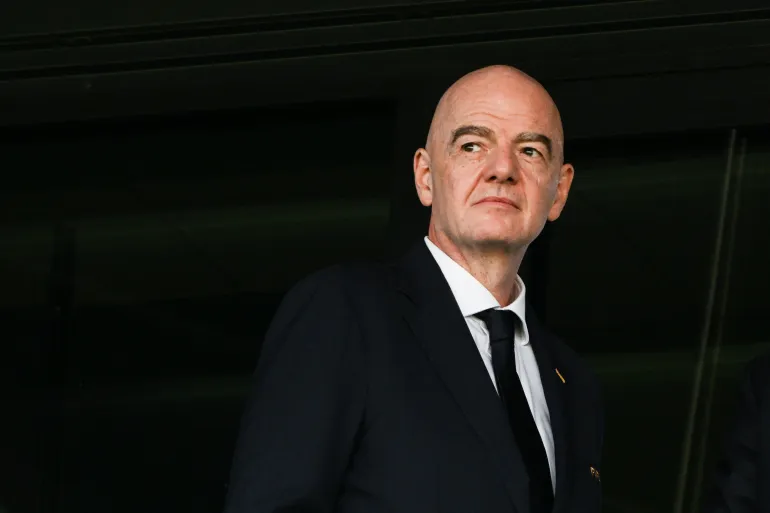
In a letter outlining 42 questions, UEFA gives FIFA until November 2 to release documents on Infantino’s aborted plans.
Published On 20 Oct 202620 Oct 2026
UEFA has given FIFA a deadline of November 2 to release documents relating to its president Gianni Infantino’s aborted attempts at a secretive investment plan for the World Cup and other governance issues.
The latest move in a power struggle between the global and continental governing bodies was revealed on Monday, days after European football’s top officials were disappointed by what they perceived as a lack of clarity from Infantino over the issues at a FIFA Council meeting last week.
Among the 42 questions to which UEFA is demanding answers are: Infantino’s personal remuneration package, financial payments made to singer Marc Anthony, the handling of USA striker Folarin Balogun’s disciplinary case, business and political relationships involving US President Donald Trump and his family, and the operational independence of FIFA’s judicial, electoral and ethics committees.
UEFA asked US federal courts to authorise subpoenas compelling the production of documents and sworn testimony about the abandoned investment plan called FIFA Forward Enterprise.
FIFA lawyers have claimed UEFA is harassing Infantino.
Al Jazeera reached out to FIFA for a comment but did not receive a response.
Deep dissatisfaction
The formal letter, signed by UEFA general secretary Theodore Theodoridis on behalf of European FIFA Council members, stated Infantino’s apology for his actions and subsequent explanation failed to address their core concerns.
“These explanations have not begun satisfactorily to address a number of fundamental questions raised by Council members. Others remain unanswered, and the information and documentation requested have not been [provided],” the letter said.
“The withdrawal of FFE, the recognition of mistakes, and the announcement of ‘potential governance reforms’ do not answer how the relevant decisions were taken or why the FIFA Council was not involved at the appropriate stage.”
According to media reports, the letter further said: “Any refusal to disclose information or documents should be justified individually, with a clear explanation of the specific grounds relied upon.”
Tight timeline
UEFA submitted 42 detailed questions to FIFA, demanding responses by November 2 — 16 days before the nomination deadline for the presidential election on March 18, 2027.
With the next FIFA Council meeting scheduled for December 16 in Doha, Qatar — after nominations close — UEFA insisted that answers cannot wait.
“These questions require answers now. They cannot be deferred until the next meeting of the FIFA Council — nor can future governance reforms substitute for scrutiny of decisions already taken and accountability for them,” the letter emphasised.
The earlier deadline would give federations time to assess FIFA’s answers — or its failure to answer — while they can still nominate or endorse a challenger.
Remember the FIFA Peace Prize awarded to United States President Donald Trump six months before the World Cup? Well, it is now close to being scrapped, which would make the US president its first and only winner.
Less than a year after FIFA President Gianni Infantino extolled Trump in the US capital while presenting the award at the World Cup 2026 draw, several members of the FIFA Council are questioning its merit and have demanded changes, including scrapping the award.
Recommended Stories
list of 3 itemsend of list
The calls for scrutiny come at a time when Infantino faces ongoing criticism for his World Cup sell-off plan, which also led to calls for his removal from office.
So what was the prize about, and why might it be scrapped? Here’s a look:
What is the FIFA Peace Prize?
On November 5, football’s global governing body announced a new annual award called the “FIFA Peace Prize – Football Unites the World”.
FIFA said the award was created to “reward individuals who have taken exceptional and extraordinary actions for peace”.
Trump thanked FIFA and called the award “one of the great honours of my life”.
He and Infantino are close allies, and the FIFA chief had made it clear that he thought Trump should have won the Nobel Peace Prize for his efforts to broker a ceasefire in Israel’s genocidal war on Gaza.
“This is your prize. This is your peace prize,” Infantino said at the glitzy, celebrity-studded ceremony at Washington, DC’s Kennedy Center.
Infantino has repeatedly spoken about football as a unifier for the world, but the prize is a departure from the federation’s traditional focus on sport.
Critics pointed out that the recognition came less than 24 hours after the Trump administration carried out a deadly air strike in the Caribbean.
Two months later, the US and Israel launched their war on Iran, assassinating Supreme Leader Ali Khamenei in Tehran and hitting nuclear and military sites around the country.
The US-Israel war on Iran has gone on for months with Trump saying this week that he will not attack Iran again before the November 3 midterm elections in the US.
Why might FIFA scrap the award?
Several FIFA member nations demanded the discontinuation of the award during Thursday’s FIFA Council meeting in Zurich, Switzerland, according to reports in British media.
Others called for the prize to no longer be handed out to politicians.
As a result, FIFA’s 22-member Football Social Responsibility Committee was tasked with assessing the merits of the award. It is expected to make a recommendation before the next council meeting in Doha, Qatar, on December 16.
Debbie Hewitt, a FIFA vice president and president of the English Football Association, told the media at the council briefing that the committee “will consider, first of all, how the peace prize came about, whether it should have come about, whether it should have been awarded in the way that it was, who made that decision and whether or not it should be taken out or whether it should be reformed”.
What has FIFA said?
Al Jazeera has reached out to FIFA for comment and was referred to Infantino’s statement on it: “For the FIFA Peace Prize, it was decided that the Football Social Responsibility Committee will be tasked to analyse it, provide a proposal, and also, there, a decision will be taken at the next FIFA Council meeting.”
Has the FIFA Peace Prize faced opposition?
Yes.
In October, the Norwegian Football Association (NFF) made parallel filings with FIFA committees in relation to three recent issues, one of which was related to the awarding of the FIFA Peace Prize.
“The purpose is to raise these issues formally with the appropriate bodies, to have them examined, relevant evidence obtained and accountability for the conclusions reached,” the NFF said in a statement.
The NFF has repeatedly raised questions about the award, and in April, its president, Lise Klaveness, said FIFA should scrap its peace prize to avoid getting drawn into politics.
“We want to see it abolished. We don’t think it’s part of FIFA’s mandate to give such a prize. We think we have a Nobel institute that does that job independently already,” Klaveness said.
Earlier, human rights group FairSquare filed a complaint with the FIFA Ethics Committee, accusing Infantino of breaching his duty of neutrality by supporting Trump.
Infantino has been under severe pressure since he announced a plan in July to open premium FIFA competitions, such as the World Cup, to private investors [Omar Marques/Getty Images]
‘Mockery’ of FIFA human rights policy
The criticism of the award isn’t limited to football associations.
In late April, Australia midfielder Jackson Irvine said football’s credibility as a force for good has been undermined by FIFA, and he accused FIFA of making a mockery of its human rights policy.
“As an organisation, you would have to say decisions like the one that we saw awarding this peace prize makes a mockery of what they’re trying to do with the human rights charter and trying to use football as a global driving force for good and positive change in the world,” Irvine told the Reuters news agency in an interview.
“Decisions like that feel like they just set us back in the perceived market of what football currently is, especially at the top level, where it’s becoming so disconnected from society and the grassroots of what the game actually is and means in our communities and in the world.”
Craig Mokhiber, a former United Nations official who has campaigned to suspend Israel from world football over its genocidal war in Gaza, called the award to Trump a “truly shameful development”.
Infantino has refused to take action against Israel, arguing that football “cannot solve geopolitical” issues.
“Not satisfied with two years of FIFA complicity in genocide in Palestine, Infantino and his cronies have now invented a new ‘peace prize’ in order to curry favour with Donald Trump,” Mokhiber told Al Jazeera.
He added that the award also aims to “obscure” Trump’s “disgraceful record” of support for Israel, his deadly strikes on vessels in the Caribbean Sea and “gross violations of human rights” inside the US.
Growing pressure on Infantino
The scrutiny around the FIFA Peace Prize follows the recent backlash Infantino has faced.
Infantino has been under fire since his announcement in late July that he wanted to open FIFA’s premium competitions, such as the World Cup, to private investors.
That plan was ultimately abandoned in the face of widespread criticism with a rebellion led by the European governing body UEFA, the Asian Football Confederation and CONCACAF, which runs the sport in North and Central America and the Caribbean.
Infantino has headed FIFA since 2016 and is running for re-election in March despite calls for him to stand down in the wake of the $4.2bn plan to sell a 20 per cent commercial stake in the World Cup.
Football’s global governing body is expected to change a rule that allowed a red card for USA forward Folarin Balogun to be controversially overturned during the World Cup, according to media reports on the agenda for Thursday’s FIFA council meeting in Zurich.
The decision-making body is convening for the first time since this year’s tournament, and a motion to prohibit such actions in the future will be top of the agenda. Members will also discuss the organisation’s funding, rules and other matters amid a turbulent time in the sport.
During the World Cup’s round-of-32 match, Balogun received a red card for stepping awkwardly on the right ankle of Tarik Muharemovic of Bosnia in a 2-0 win for the home team. It triggered an automatic one-game suspension.
However, United States President Donald Trump urged FIFA President Gianni Infantino to review the case, and Balogun’s red card was overturned, allowing him to play in the USA’s round-of-16 match against Belgium.
The decision to overturn Balogun’s red card ignited one of the tournament’s biggest controversies, with widespread criticism from football federations, former FIFA officials, experts and coaches.
The 37-member FIFA council is expected to vote on whether to prohibit disciplinary committees from overturning automatic match suspensions at the World Cup, but the Balogun controversy is unlikely to go away.
FIFA Vice President Debbie Hewitt is among the sport’s leaders who have asked Infantino to release all documents related to the case.
Thursday’s FIFA council meeting is the first since Infantino came under fire earlier this year for a now-shelved plan to sell a 20 percent stake in the World Cup’s commercial business to private investors.
Infantino has faced calls to resign from the leaders of three regional football confederations – UEFA (Europe), AFC (Asia) and CONCACAF (North and Central America and the Caribbean) – and their representatives will be present in Zurich for the FIFA meeting.
They will be joined by their counterparts from Africa, South America and Oceania.
Under the plan, Infantino proposed selling a minority stake in a FIFA commercial subsidiary to private investors, with a company launched by Joshua Kushner, the brother of Donald Trump’s son-in-law Jared Kushner, identified as the proposed lead investor.
The council will also address FIFA’s governance, with some of the sport’s most powerful figures determined to limit Infantino’s powers if they cannot force him out of office.
Infantino, 56, will stand for re-election in March 2027, with a November 18 deadline looming for potential candidates to submit their nominations.