SACRAMENTO — What’s so wrong about requiring every Californian to show a government ID before they’re allowed to vote? That’s what Proposition 39 backers ask. And it’s a fair question.
Here are some valid answers:
It would make California’s already notoriously slow vote count even more pokey.
It would be an added hassle for citizens attempting to exercise their voting right.
It would cost taxpayers a bundle, perhaps hundreds of millions of dollars each year.
It’s another solution by politicians to a problem that really doesn’t exist.
Practically everyone, regardless of political affiliation, must understand by now that there simply is no evidence of widespread — significant, meaningful — voter cheating in California or anywhere else in America. This despite conspiracy-theorists’ fruitless searching and President Trump’s lies about “rigged” elections.
It’s my belief that the main reason Republicans placed Proposition 39 on the California ballot was to boost GOP voter turnout in the Nov. 3 election. And recent independent polling shows that the measure does appeal strongly to Republicans — but not Democrats, who are united in opposition.
The proposition appears to be headed for defeat, largely because Democratic voters in this deep blue state equate it with the discredited president. Trump has turned into poison for Republican candidates in competitive races and any cause that reminds people of him.
You’re reading the L.A. Times Politics newsletter
Expert columnists cover the insights, legislation, players and politics you need to know.
By continuing, you agree to our Terms of Service, which include arbitration and a class action waiver. You agree that we and our third-party vendors may collect and use your information, including through cookies, pixels and similar technologies, for the purposes set forth in our Privacy Policy such as personalizing your experience and ads.
That’s why the Proposition 39 campaign last week released a new major TV ad that essentially asks voters to ignore the president.
This is how conservative consultant Jon Fleischman summarized the ad’s message to Democrats in his blog: “You can hate Trump and still back Voter ID.”
Require voters to show some government-issued identification each time they vote in person, such as a driver’s license or passport. Don’t have one? The state would issue a free ID card to any voter who asked.
Californians who cast mail ballots — more than 80% of voters — would be required to write the last four digits of a government ID number on the return envelope. The number would be determined when initially registering to vote.
The measure also would impose some basically noncontroversial mandates that make sense separately. It would require election officials to maintain accurate voter registration files, weeding out people who have moved or died and verifying citizenship. But counties already do that pretty well.
The contrived bogeyman for election fraud scaremongers is the undocumented immigrant community. But these people, living on the edge and hiding from the government, aren’t going to risk deportation by trying to vote in an election they couldn’t care less about. And political candidates aren’t going to waste their time and money on them. Their targets are the large numbers of apathetic legal voters who sit out elections.
Currently, Californians must provide identification when registering and swear under penalty of perjury — a felony — that they are U.S. citizens. And they must record their signatures when registering and scribble it on the back of the ballot envelope when voting by mail.
Requiring me to add a four-digit number on the back of my “absentee” ballot envelope means I’d have to register all over again to record the PIN. And then remember it every election. A pointless pain.
Assemblyman Carl DeMaio (R-San Diego), a conservative firebrand, instigated and authored Proposition 39. “I do believe that voter fraud is a real problem. Absolutely,” he told me.
But he said the proposition has two main goals: 1, to clean up voter files and make sure ballots are properly validated and counted. 2, to increase public confidence in the voting process. “We have a perception problem,” he says. “Voters have low trust” in the election system.
Republicans mistrust a lot; Democrats not so much.
A California poll released last week by the UC Berkeley Institute of Governmental Studies showed that 84% of Republican voters had a “major concern” about voter fraud. Only 21% of Democrats did.
Can anyone doubt who’s driving the Republicans’ anxiety? The bellicose president. “Mail-in voting means mail-in cheating,” Trump has reiterated. “It’s terrible what’s going on.”
This from the hypocrite who mails in his ballots.
Fortunately, Proposition 39’s crafters left mail ballots pretty much alone, except for requiring a nuisance PIN on the ballot envelope.
That “absolutely” will slow down vote counting, says Assemblywoman Gail Pellerin (D-Santa Cruz), who heads the Assembly Elections Committee and was the longtime chief elections official of Santa Cruz County. Under Proposition 39, officials not only would need to check voters’ signatures against those on file, but also their PINs.
And voting in person would drag while people dug for an ID and an official checked it, Pellerin says. Some people are bound to be denied their voting right by mistake, she asserts.
Tony Quinn, formerly a GOP redistricting consultant and a longtime political analyst, points out that a disproportionately high portion of in-person voters are Republicans. Proposition 39 is “imposing a burden on them,” he says. “I don’t think the authors realize who’s voting in person these days. They sense illegal aliens.”
The UC institute poll showed Proposition 39 being supported by 39% of likely voters and opposed by 52%. It was backed by 92% of Republicans, but Democrats were 80% against. And they outnumber Republicans by nearly 2-to-1 in California.
The proposition also trailed in a poll by the Public Policy Institute of California: 43% yes, 55% no.
In the PPIC poll, Republicans said 39 was by far the most interesting proposition on the ballot.
Trump’s influence? Among the paltry 27% of voters who approve of his job performance, 88% support Proposition 39. But of the 72% who disapprove of the president, 73% oppose the measure.
Trump is toxic.
Proposition 39 is more government regulation for no good reason.
Student protests at Lovely Professional University in northern India have turned violent following social media claims that a female student was raped at a girls’ hostel by a worker. The university has denied the allegations as rumours, while police have launched an investigation.
As war and sexual violence rage in eastern Democratic Republic of the Congo (DRC), women are joining pro-government Wazalendo fighters to defend their communities. However, the armed group itself faces serious accusations of human rights abuses, including gang rape.
SACRAMENTO — Riverside County Sheriff Chad Bianco got slapped down Thursday by the California Supreme Court in not one but two cases. Ouch.
First, the court told Bianco to return more than 600,000 ballots he had seized as part of an ill-conceived, conspiracy-laden “investigation” into voter fraud — making it clear it was the sheriff who was the criminal.
“The seizure of the ballots was unlawful,” the court wrote, before ordering Bianco to give them back to the registrar of voters and “refrain from further handling of the ballots except as necessary to comply with our order.”
Then the court, in a separate case, told Bianco he’s not a law unto himself, and in fact does have a boss in the form of the state Atty. Gen. Rob Bonta. Bonta had previously ordered Bianco to pause his investigation, and Bianco largely ignored him.
While the high-profile lawsuit about Bianco’s seizure of hundreds of thousands of ballots from last year’s special election on redistricting has grabbed headlines, the second case about the authority of the state attorney general to oversee all California sheriffs and district attorneys is equally powerful.
It’s the first time the court has weighed in on a long-running debate in California over whether elected sheriffs have to answer to anyone. Not only did Bianco lose for election deniers everywhere in the first case, he also managed to clarify for all California sheriffs in the second case that they are not as powerful as some would like to believe.
Combined, the two opinions by the state’s highest court give another layer of assurance to Golden State residents that the integrity of the November midterm elections is as secure as the state can make it — some welcome news in a national landscape where free and fair elections are increasingly at risk.
The quiet advocate
Before we get into what the ruling means for midterms in California, there are two overlooked bits that make these cases even more interesting.
First, gubernatorial candidate and former Atty. Gen. Xavier Becerra has been closely involved in the ballot-seizing case, but also pretty quiet about it.
Whenever a politician does something good and doesn’t advertise it, it always catches my attention. Politicians, especially ones running for office, aren’t big on modesty.
But Becerra has not spent a lot of time talking about this, even though he is actually a working attorney on this case, as an advisor to the UCLA Voting Rights Project. He came up with ideas, he participated — this wasn’t just a put-my-name-on-it role, I’ve been told by folks who know.
And it’s not the first time Becerra has helped the Voting Rights Project in a major endeavor. It was their work that helped define the legal arguments that made Proposition 50 happen. That’s last year’s ballot initiative that redrew California voting maps to favor Democrats, in response to a Texas effort to gerrymander in favor of Republicans. It was Proposition 50 ballots that Bianco seized.
“Today the California Supreme Court handed voters a great victory,” Becerra said in a statement from the voting project. “The Court knocked election deniers off their feet and strengthened our hand in election protection just ahead of the November vote. We must use every lever at our disposal to beat back voter interference and intimidation.”
That line about knocking election deniers is not hyperbole. In some far-right, conspiracy-rich circles, Bianco’s cowboy-saving-the-day routine was viewed as heroic. Maybe even something to emulate.
Across the country, there are rumblings — including from President Trump — about seizing ballots from past or future elections. While this ruling is firmly rooted in California law, most states have similar chains of custody when it comes to ballots. So it’s likely to at least make other would-be-Biancos pause.
In a later interview, Becerra told me that the Voting Rights Project was “the one thing I decided I would do after I came home from being secretary in Washington, D.C.,” whether he ran for office or not, “just because I so believe in the work that they do.”
He said as he campaigns this year, he’s seeing anxiety in minority communities from that interference and intimidation, maybe even fear that could pressure some legal voters to sit this one out.
“It makes it tough when you’ve got all these things standing in your way before you even get to thinking about going to vote,” Becerra said. “The Latino community, other communities, mostly under-served communities, I always tell them, we’re not rich. The way we win these things is by voting.”
The Liu concurrence
The second fact that caught my attention was a concurring opinion on the ballot case by Justice Goodwin Liu.
While the court was unanimous in its findings, Liu wrote his own opinion highlighting how the Riverside registrar of voters was “caught between a rock and a hard place” when the sheriff of his own county showed up with a warrant, guns and “enough trucks to remove several pallets of materials.”
That trifecta, Liu wrote, left the registrar little room for dissent — but that’s a problem.
Liu’s point seemed to be that with the current state of our president making election denial chic, our voting officials need to step up. He said the registrar should have come directly to the court for relief, and not left it to the Voting Rights Project and other plaintiffs.
“It is a lot to ask of our election officials that they not only do their jobs competently but also stand ready to sue anyone who unlawfully interferes with their duties,” Liu wrote. “Yet here we are.”
Since Bianco seized the ballots, state law has been changed. This session, legislators passed (and Gov. Gavin Newsom signed) at least 13 laws pertaining to election security, including making it a felony to break the chain of ballot custody, and ensuring that local election officials immediately contact the state in instances when that is threatened. Those laws will offer protection to election officials if a situation like this comes up again.
But Liu’s point is still valid. Being an election official is no longer a sleepy little job, but a front-line battle for democracy, and for “our democracy to flourish, our elections must be conducted in accordance with the law.”
As Bonta put it, “if you can imagine it, we are ready for it.”
I’m not quite that confident — and definitely concerned for contests outside of the Golden State — but Thursday’s rulings are a reminder that the law still holds, even when lawmen try to break it.
Love is the name. Fraud allegedly was his game. And the list of his victims — several of whom said they became romantically involved with him — continues to grow.
Daejon Labrayae Love, 35, and his accomplice Taylor Jamie Chan, 18, remain in federal custody after their arrest Aug. 24 in Boise, Idaho, on wire fraud and conspiracy to commit wire fraud charges. The FBI charged the two men with scamming at least 26 women in four states out of at least $1.3 million.
Since then many more women have come forward to say they were victims of Love’s schemes, which often involved him impersonating a San Francisco 49ers player. The FBI said it has identified 35 additional women who say they were defrauded, ratcheting up the number of alleged victims to more than 60.
The latest development is especially troubling. A woman told ESPN on Tuesday that she submitted a complaint about Love on the 49ers website eight months ago on Dec. 20, 2025, yet the team apparently did little with the information.
Gwen Herndon submitted a complaint/concern form, writing “there is a federal investigation surrounding a man pretending to be a 49ers player.” She named Love, saying he stole money from women.
“I wanted you to be aware of the situation and are hopefully proactive in denouncing his involvement on your team,” she wrote in the message, which was reviewed by ESPN.
Herndon said the only response she received from the 49ers came from a Levi’s Stadium guest services account a week after her report, encouraging her to contact law enforcement agencies with the information.
“We take reports of individuals misrepresenting themselves as members of the San Francisco 49ers very seriously,” the 49ers response said. “For safety and legal reasons, the team cannot comment on ongoing investigations or specific individuals…. Our internal team will also monitor any instances of impersonation and take action as appropriate to protect fans and the team’s reputation.”
A 49ers spokesperson declined to confirm that Herndon’s email was viewed by team officials, citing the ongoing FBI investigation.
Federal investigators, meanwhile, are working to verify that the 35 women who have come forward in recent days are in fact victims of Love and Chan, Portland FBI Special Agent in Charge Doug Olson said in a news conference.
“We were surprised how many people were victimized in such a short period of time and then to have that many more come forward,” Olson said. “It’s a large volume for just a couple of subjects. Our concern is that this fraud could be replicated by other individuals that are out there victimizing other people in similar schemes.”
The FBI alleges that from February 2022 until they were arrested, Love and Chan fraudulently solicited money from women in California, Oregon, Washington and Idaho.
Love portrayed himself on Instagram as a 49ers wide receiver who went undrafted but worked his way onto the roster. He met many of the women through dating apps and developed romantic relationships with several, according to the FBI. Chan falsely posed as Love’s financial adviser.
In an Instagram Story titled “NFL Journey,” Love held a 49ers helmet while driving and said, “I’m on my way to get my mom. I know I get a lot of fans who want to know how football works or how I got involved in the league…. If you know me and see me in person I’ll explain.”
Experts on interpersonal relationships say that a person can instantly assume someone is trustworthy who exudes warmth and confidence as a first impression — especially if they find the person attractive.
“When we meet someone for the first time, our brains are quietly trying to answer two big questions: Can I trust this person, and do they seem capable and confident?,” said Tammi Pickle, an executive at the personalized matchmaking agency Elite Connections. “Someone who comes across as confident might suddenly seem smarter, kinder, more successful and even more trustworthy simply because of the way they carry themselves.
“When we are attracted to someone, our brains have a tendency to fill in the blanks with positive assumptions. The catch? Those assumptions aren’t always accurate.”
Love quickly gained the trust of dozens of women, allegedly convincing them to give him large sums of money. The FBI said Love instructed several women who did not have cash to invest to take out personal loans, assuring them they would quickly be repaid.
“The scheme relied on Love’s creation of fictitious personas and display of a lavish lifestyle which Love presented to victims both in person and on social media websites,” federal authorities said in a press release.
“Chan and Love also hosted three-way FaceTime calls in which they showed victims falsified investment gains and encouraged victims to part with their money. Victims sent Love and Chan money due to their belief that their money would be invested in legitimate investment vehicles on the victims’ behalf.”
One women who didn’t fall for Love’s scheme told KPTV in Oregon that she went on a 2024 date with him in 2024 after meeting on a dating app. He told her his name was John Prince and claimed he was a Swiss real estate developer.
Anderson said his behavior during their first date raised suspicion.
“He said, ‘I’m very intentional and efficient when it comes to dating, and if I pursue you, you will be the only one I pursue. I need someone who has been around money, who understands that, you know, these things aren’t luxuries to me. This is just my normal life.’
“Within five minutes, I decided I wasn’t gonna see him again.”
Love also manipulated AI. Search engines and AI rely on web scraping and frequency of mentions, and the sheer volume of his fake posts caused AI to mistakenly identify him as an NFL wide receiver. He showed screenshots of erroneous AI search summaries to alleged victims, convincing them he was worthy of their trust.
On an Instagram story, he posted a one screenshot of a webpage AI Overview that says “Daejon Love is a wide receiver for the San Francisco 49ers and information about his position, contract and teammate texting habits is available online. He is also associated with the team in various social media content and articles.”
Love then turns the camera on himself and says, “That’s Google. That’s not me, that’s Google.”
He goes on to explain why he isn’t currently playing, lifting a crooked finger to the camera and saying he is injured. He concludes the story by again saying he wants “full transparency” because “people ask, what do I do? How can I afford a $500,000 car? How can I afford a $300,000 [Lamborghini] Urus? “
He says that he is driving to pick up his mother, then concludes by inviting those watching to reach out to him in person.
In the month before his arrest, Love traveled to New Mexico, California, Oregon, Nevada, Utah and Idaho to meet with women, according to investigators. He allegedly used several fictitious names, including Jon Love, Avril Lyto Love and Jordan Love.
The romp abruptly ended at the Boise airport when Love and Chan were removed from a white sports car by federal agents, according to a video obtained by TMZ. Love appears to be wearing red Niners gear as he is handcuffed.
“Victims were encouraged to take out personal loans and make life-altering financial decisions based on the belief they were building a future with someone they cared about,” said Olson, the FBI special agent. “Once the money was taken, the victims were cut off, left without answers, without funds, and often without closure. Many lost not only their savings, but their sense of security and confidence.”
Millions of voters went to polls in Morocco on Wednesday to determine the makeup of the House of Representatives, the parliament’s lower house.
Twenty-seven political parties are competing for 395 seats in the country’s 12th legislative election since independence in 1956.
Almost 16 million people are able to vote, with 55 percent residing in urban areas and 45 percent in rural regions, seeing a mix of concerns among voters.
Economic frustrations
While King Mohammed VI will maintain most executive powers, the new government will manage many public affairs for the coming years.
Once the votes are counted, the king will appoint the head of government from the leading party, but they will still need the support of 198 deputies – an absolute majority – to gain parliamentary confidence.
The election comes at a time of mounting challenges for the country, with the economic situation creating discontent and frustration, Mohammed Masbah, head of the Moroccan Institute for Policy Analysis, told Al Jazeera.
“The upcoming elections will have special importance because they come in a context tied to a social and economic crisis, especially high prices and the cost of living on one hand,” Masbah told Al Jazeera.
“On the other hand, there is a state of frustration among broad segments of society, especially the youth. The Gen Z protests last year, as well as the attempt to cross towards Ceuta a few weeks ago, demonstrate this crisis.”
The introduction of a new financial system designed to support candidates aged 35 could encourage more youth participation. But the nearly six million Moroccans residing overseas, many of them younger citizens, will have to appoint a proxy in Morocco to cast their vote.
There is also an upcoming key milestone for the country with the 2030 World Cup, which requires huge investments. What will remain in the minds of most voters is the state of the economy and inflation, which have impacted the living standards of many Moroccans.
“I believe the upcoming elections will produce a government majority whose primary function will be to address these imbalances, especially the economic ones related to the high cost of living in Morocco,” Masbah said.
“Regarding the issues that were raised and discussed by the majority of political parties, whether represented in the government or the opposition, they are the issue of employment and high prices.”
Two of the main parties competing in the election, the National Rally of Independents and the Authenticity and Modernity Party, have put these issues at the front of their campaigns in what has been a heated election.
“Of course, this is the main topic, but in the public debate, we also noticed conflicts, especially between the top two parties currently running the government,” Masbah said. “We noticed mudslinging and accusations of squandering funds and stealing candidates, which may increase voter alienation from voting today.”
A woman prepares to cast her ballot to vote in Morocco’s legislative elections at a polling station inside a school at the Udayas neighbourhood, Rabat, on September 23, 2026 [AFP]
Despite the tense conditions, Morocco’s Public Prosecution has recorded a significant drop in election-related complaints compared with the 2021 vote.
But legal amendments that criminalise digital offences for the first time – including the dissemination of fake news and false allegations intended to defame candidates or voters – have been introduced. The digital space became the primary arena for violations this year, accounting for 22 complaints.
Masbah said that despite a mood of frustration in Morocco over the government’s inability to manage key economic and social issues, turnout is expected to remain steady, as it has been over the past 20 years, due to structural factors.
“Electoral and voting behaviour in Morocco is not primarily linked to electoral programmes and promises [of parties], as much as it is linked to the stable bloc formed by Moroccan deserts and villages, which relies primarily on a network of notables who have influence and the ability to win voters’ voices through utilitarian voting,” Masbah said.
“I expect that if there is a decline in the voting rate – and this is likely – it will not be catastrophic or a sharp decline, given the consideration I mentioned earlier, which is the focus on notables and traditional elites in winning over voters.”
His political superpower has never been his breadth of knowledge, intelligence, compassion or his empathy. Rather, it’s Trump’s ability to overcome outrages that would buckle mere mortals, and that’s a function of sheer velocity. One offense is almost immediately superseded by the next, leaving little time to react, much less absorb their individual meaning and consequence.
Expert columnists cover the insights, legislation, players and politics you need to know.
By continuing, you agree to our Terms of Service, which include arbitration and a class action waiver. You agree that we and our third-party vendors may collect and use your information, including through cookies, pixels and similar technologies, for the purposes set forth in our Privacy Policy such as personalizing your experience and ads.
The setting was the recent Republican midterm convention in Dallas, a pageant of Trump’s ego and insecurities in full-parade dress. On the final night, in the second of two keynote speeches, Trump asked those in attendance to raise their right hands and swear to the following:
“I pledge, to the greatest president in the history of the United States, that loves us so much he can’t even breathe, that I will go out with my family, my friends, I’ll do it any way, I don’t care if I’m registered or not, I’m gonna try and cheat like hell like [Democrats] do” — here supplicants regaled Trump with laughter — “I am gonna go out and I’m going to get my friends and family and we are going to vote on November 3rd, or we are going to vote before that!”
Trump’s performance as president has always been layered with a certain amount of shtick, especially when he’s placed in his preferred setting, which is standing before a microphone in front of a rapturous crowd. Lest it be forgotten, Trump stepped into the political arena from the world of reality television, which supposedly made him more authentic. His violation of norms and trampling of protocols has come to be known — and celebrated by acolytes — as simply “Trump being Trump.”
Still, it’s a remarkable thing when the president of the United States urges people to cheat.
Justin Levitt, a Loyola Law School professor, can’t recall any president ever saying anything remotely similar.
“It’s an example of how manifestly unfit [Trump] is to serve as the chief executive with a constitutional imperative to ‘take care that the laws be faithfully executed,’” Levitt, who worked on voting rights in the Biden administration, wrote in an email. “Exhorting your own followers to break the law is pretty directly inconsistent with his own oath of office.”
And it is, as Levitt noted, not the first time Trump transgressed his sworn vow to “preserve, protect and defend the Constitution.”
As the subversive Dallas “pledge” makes clear, Trump’s exertions have never been about ensuring free and fair elections. Instead, he’s trying to rig the system to avoid what could be a midterm nightmare for the beleaguered president and his fellow Republicans.
Levitt said there’s no reason to think Trump supporters will cheat en masse, any more than one should believe Trump when, as seems inevitable, he cries fraud if results fail to go his way on Nov. 3. “For him, it’s all just vibes,” Levitt said, “with no factual content.”
The 13-year-old beat the previous 400m Asian Games record, set by China’s Ye Shiwen in 2014, by about 4.5 seconds.
Published On 23 Sep 202623 Sep 2026
China’s 13-year-old swimming sensation Yu Zidi has completed a hat-trick of Asian Games golds with a dominant victory in the 400m individual medley, two years before the Los Angeles Olympics.
The schoolgirl powered home in an Asian Games-record 4 minutes 28.56 seconds (04:28.56) on Wednesday to make it a clean sweep of her three individual events in Tokyo, following victories in the 200m butterfly and 200m individual medley, also in games-record times.
Recommended Stories
list of 4 itemsend of list
She beat the previous 400m games record set by China’s Ye Shiwen in 2014 by approximately 4.5 seconds.
It was the fourth-fastest time in the world this year, with world record-holder Summer McIntosh owning the top three.
With the next Olympics two years away, Yu is shaping up to be a major medal contender at the 2028 Los Angeles Games.
Last year, she became the youngest medallist at the World Aquatics Championships, where she won bronze for China’s relay team at the age of 12, and has since been earmarked for success in the swimming world.
At the same championship, Yu finished fourth by a small margin in three individual events.
In March, the teen sensation built on her growing reputation with a 200m butterfly victory over seven-time American Olympic medallist Regan Smith at the China Swimming Open.
At the Asian Games, Yu has dominated the pool and showed another glimpse of her immense talent in the 400m individual medley, where she took the lead from the start and finished 3.95 seconds clear of silver medallist Ke Wenxi of China, with Japan’s Mio Narita finishing third.
In addition to grabbing international headlines, Yu has become a sensation at home following her Asian Games exploits.
The story of her introduction to competitive swimming after being spotted by a coach at a water park, and her struggle with interviews, has gone viral on local social media platforms.
At the games, Yu was asked by the media whether answering questions was the hardest part of competing. She replied, with a giggle: “Every time I just want to float off somewhere else.”
Ri Song-gum wins North Korea’s first gold at the games while Chanu finally clinches elusive Asian Games medal in Japan.
Published On 23 Sep 202623 Sep 2026
North Korean weightlifter Ri Song Gum has broken three world records en route to winning gold in the women’s 49kg (108lbs) competition, which saw India’s Mirabai Chanu win an elusive Asian Games medal by finishing second.
Ri gave North Korea its first gold of the games in Nagoya, Japan, on Wednesday, joining an elite club of four weightlifters who have won three Asian Games gold medals.
Recommended Stories
list of 4 itemsend of list
The 28-year-old hauled 94kg above her head in the opening snatch discipline – the first official segment of the competition where athletes lift a barbell from the floor to an overhead position in a single motion. The lift was 1kg heavier than the previous world record of 93kg.
Ri followed it up by breaking the world record twice in the 115kg clean and jerk – a two-part movement where a barbell is lifted from the floor to the shoulders and then pushed overhead. The 4ft-7in (139.7cm) weightlifter hoisted 116kg and 121kg above her head.
Ri’s total lift of 215kg obliterated the old world record total by 7kg.
She is the fourth lifter, and first woman, to win three Asian Games weightlifting golds and joined Iran’s Mohammad Nassiri (1966-74), South Korea’s Kim Tae-hyun (1990-98) and Iran’s Behdad Salimi (2010-18), who all won three gold medals. No athlete has won four weightlifting gold medals.
Ri joined an elite club of just four weightlifters who have won three Asian Games gold medals [Dita Alangkara/AP]
In the same category, India’s Chanu finally won an Asian Games medal at the third time of asking. She won a silver medal at the Tokyo Olympics in 2021.
The 32-year-old is India’s most decorated weightlifter, with three Commonwealth gold medals and a silver to her name, along with multiple global titles.
She lifted a total of 198kg after a snatch of 87kg and a clean and jerk of 111kg, while Indonesia’s Diana Tri Wijayana took bronze with a total of 191kg, comprising 88kg and 103kg.
Chanu’s silver also ended India’s 28-year wait for a weightlifting medal at the games since Karnam Malleswari won silver in 1998.
Mirabai Chanu during the women’s 49kg weightlifting final [Dita Alangkara/AP]
Six-year-old Lian Yunzhi from China broke the women’s 3x3x3 Rubik’s Cube world record, and then broke her own record days later. She also became the only female cuber in the world to have an average time under 4.5 seconds.
SACRAMENTO — Three state bond measures are on California’s November ballot. You probably haven’t paid much attention to them. So here’s my read on these big-ticket proposals.
One is a no-brainer “yes.” It would help middle-class Californians buy a new home by allowing them to borrow most of the down payment. And it wouldn’t cost taxpayers a dime. That’s Proposition 37.
Another housing measure is probably worthwhile, but gives me pause because it accommodates too many interests in order to attract broad political support. And it burns a barrel of money. That’s Proposition 1.
The third proposal would fund important medical research. But I wince because it was written to largely benefit one institute that was co-founded and is headed by the measure’s chief backer. That’s Proposition 38.
You’re reading the L.A. Times Politics newsletter
Expert columnists cover the insights, legislation, players and politics you need to know.
By continuing, you agree to our Terms of Service, which include arbitration and a class action waiver. You agree that we and our third-party vendors may collect and use your information, including through cookies, pixels and similar technologies, for the purposes set forth in our Privacy Policy such as personalizing your experience and ads.
Propositions 1 and 38 combined would add $18.4 billion to the state’s general fund bond debt, which already is about $80 billion, according to the nonpartisan Legislative Analyst‘s Office.
Plus, there is $40 billion in previously authorized bonds waiting to be sold. The new bond proposals would cost the state at least $1 billion annually for 20 to 25 years. Taxpayers are paying about $6 billion annually to retire state bonds.
Bonds are boring, but they’re also tax eaters. So we should pay some attention before voting on them.
“People think about bonds as free money. And, of course, they’re not,” says Mark Baldassare, polling director for the Public Policy Institute of California. “People don’t think bonds are going to raise their taxes.”
But most bonds are repaid by the state’s general fund, the main cash box that finances major programs such as education, healthcare, prisons and fighting wildfires. Bond debt has No. 1 dibs on the money. When revenue runs short — a common dilemma in Sacramento — other programs must be cut or taxpayers are hit harder. So bonds aren’t necessarily tax-free.
Baldassare released a PPIC poll last week that found a majority of likely voters supporting all three bond measures — especially Proposition 37 to ease homebuyers’ down payments.
The pollster noted that fall election campaigns are just starting and opposition arguments could reduce support for the measures.
But there’s no organized opposition to the two housing proposals. And although the medical research measure has some outspoken critics, there’s no money for an opposition campaign.
OK, a few specifics on each measure.
Proposition 37 is a taxpayer freebie, a $25-billion bond repaid solely by homebuyer beneficiaries. Here’s how it would work:
Middle-income people could pay 3% down on their home purchases rather than the normal 20%. They’d borrow the other 17% as a second mortgage and repay it along with the first mortgage.
The proposition defines middle class as household income that’s less than double the median for the area. Statewide, that income ceiling would be around $200,000 but would vary greatly by locale.
The purchased dwelling must be a brand-new home, whether stand-alone or a condo. That’s to increase the housing supply and create construction jobs. Politically, it gains the support of developers and unions.
No vacation home. It must be owner-occupied full-time. And the buyer must be a California resident.
The state’s sale of revenue bonds would create the down-payment pot. Regular lending institutions would arrange the loans and charge minimum fees. Loan repayments would replenish the pot and make it self-sustaining.
This was the brainchild of Bob Hertzberg, a former Democratic Assembly speaker and Senate majority leader from the San Fernando Valley.
Hertzberg tried several times to sell his proposal to the Legislature, but lawmakers wanted to juice it up with their own pet ideas. “I couldn’t get something just focused on the middle class,” he says. So he crafted this citizen initiative.
Proposition 1 proposes $11.25 billion in bonds for a smorgasbord of affordable housing.
This is the political establishment’s creation — Gov. Gavin Newsom, the Democratic-controlled Legislature and housing interests. There’s no organized opposition.
It was dressed up with $1.25 billion in popular CalVet loan bonds for military veterans. They repay their home loans through mortgages, costing the state nothing.
But the remaining $10 billion in bonds would be repaid through the state general fund, costing at least $500 million annually for 25 years.
The measure is mainly designed to generate affordable rentals for poor people. But to assure legislative passage, money was added for affordable student and farmworker housing, plus other goodies.
It’s a lot of money and makes only a small dent in California’s unaffordable housing plague. Moreover, it seems too scattershot.
But it could spare more people from becoming homeless — living in their cars or on sidewalks, ultimately costing taxpayers even more.
Then there’s Proposition 38, the problematic $8.4-billion general fund bond for medical research, including cures for cancer, heart disease and Alzheimer’s.
The hang-up for me and others is that the ballot initiative was crafted to virtually assure that half the bond money would go to one outfit, the UCLA-affiliated California Institute for Immunology and Immunotherapy. The institute was co-founded and is headed by the proposition’s originator and chief backer, billionaire Gary Michelson.
“I know opponents want to create a billionaire boogeyman, but isn’t curing cancer and other terrible diseases exactly what we want billionaires to spend their money on?” says Robin Swanson, a campaign spokesperson.
Sure. But being backed by a billionaire isn’t the problem. It’s being written to substantially benefit one research institute that’s led by the billionaire.
Two cancer survivors and political opposites — conservative consultant Jon Fleischman and liberal consultant Steve Maviglio — co-authored an op-ed that declared:
“Imagine either major political party proposing to borrow billions of dollars and writing the qualifications so narrowly that an organization founded and chaired by a principal campaign benefactor appears positioned to collect half the money. The other party would rightly howl. So should voters.”
SACRAMENTO — To hear President Trump tell it, the 60% or more of Americans who worried that unchecked artificial intelligence poses a risk to humanity are just a bunch of suckers buying the latest election-rigging conspiracy peddled by his foes.
“The AI Hoax being perpetrated by the Radical Left Dumocrats is reminiscent of their Global Warming Scam of not so long ago, where everyone was going to die from extreme heat. What happened?” Trump posted recently, apparently unaware that heat-related deaths continue to rise.
By the end of the week, his circle of sycophants had adopted that language, along with the strange take that Trump alone would be able to control the rise of superintelligence should it occur. David Sacks, often billed as Trump’s AI whisperer, echoed the hoax line at a Politico event, adding that there was an “orchestrated media campaign” meant to “alarm the public.”
Meanwhile, Vice President JD Vance called the pleas for regulation from inside the industry, including from CEOs such as Dario Amodei and Sam Altman, a “Trojan horse.” He argued that “Americans shouldn’t be scared of anything,” seemingly backing Trump’s absurd declaration that “The only control or ‘guardrails’ that AI needs is a STRONG AND SMART (High IQ!) PRESIDENT, and the U.S.A. has that, in spades!.”
As someone who has covered this issue, let me just say the concern is not a hoax, not a marketing ploy meant to juice the value of companies about to have an IPO, and not a vast and sprawling plot by Trump’s adversaries.
But it is a complicated, fraught problem in a pivotal moment. The president’s confusion and inaction pose an immediate risk of slamming shut our small window of opportunity to make meaningful decisions about a technology that will almost certainly change the course of history and humanity.
So why exactly is Trump demanding this unfettered charge at oblivion, and what are the options for putting guardrails up despite him?
Trump’s reasoning
The pacifying but slightly terrified response of Anthropic co-founder Jack Clark to Trump hints at just how alarmed those deepest in AI development seemingly feel about both the president’s attitude and the unregulated future he demands.
“We’re grateful for the president’s attention,” Clark said on Fox News. “What we’re saying here is we need to get a sensible, commonsense safety framework … and we don’t roll the dice on some kind of accident.”
Like all things Trump, his position involves money. AI is currently a driving force behind the American economy, and if we just cover every inch of open space with data centers, it could keep an otherwise slumpish outlook bright.
OpenAI and Anthropic are also planning IPOs in the not-distant future.
Because these companies are valued at astonishing, 12-zero amounts and because certain stock listing rules will now require that these companies quickly be included in index funds favored by many pensions and retirement accounts, anything that crashes their value — such as investors’ jitters from regulation — could jam up the stock market.
That could affect the lives (and votes) of average Americans.
So despite the long-term risks, the short-term political benefits of the AI gravy train are substantial for Trump.
Then there is the place where Trump actually has a fair point: China. Current AI reflects the values of its creators. It would be disastrous for the free world if superintelligence were trained to favor authoritarianism.
The logic here is if we don’t build “good,” Western-values AI first, we will be at the mercy of “bad” AI, so the possibility of harming great numbers of people is a reasonable, maybe even necessary, risk.
This is where things get messy, and many folks — oligarchs in particular — become invested in keeping the general voter confused.
There is no consensus on a best course of action because we are in uncharted territory and there is actually no way to reliably predict what happens next.
Picking the best path forward, then, starts with picking a camp, a tribe, an outlook. In the broadest sense, there are three possibilities: We attempt to stuff the cat back in the bag; we all try to play nice, as companies and countries, and create rules on the fly; or we just accelerate at full speed, let it rip and what happens happens.
There are obvious problems with each of those.
As an excellent paper by the nonpartisan Rand Corp. explains, which of those camps a person chooses depends largely on just how imminent the danger feels, how feasible it seems to control development of AI and how realistic it is to bank on cooperation — or whether we believe we should and could aim to just continually win a technology war against humans or machines.
These camps, therefore, have little to do with traditional politics. Voters are feeling this issue on a visceral level, one that only a few years ago would have been deemed paranoid and fantastical, and it’s making for strange bedfellows.
Speaking at an conference this week, avowed lefty Sen. Bernie Sanders (I-Vt.) called for a pause on AI development because he’s in the camp that believes it’s currently too dangerous to go forward without a plan.
At the same conference, ultraconservative Trump loyalist Stephen K. Bannon made a similar point. He also urged Americans not to trust “anything” said by AI oligarchs, and to reject the idea championed by Trump that slowing down is dangerous or un-American.
“If you’re not accelerationist, you are supporting China,” Bannon said. “If you’re not accelerationist, you want America to lose. If you’re not an accelerationist, you’re bad, dumb and evil. Well, the last week has shown we’re none of that, and now we need the time to make the right decision.”
The issue is almost certainly going to be huge and problematic in the midterms — potentially for both parties.
For Republicans, navigating it means tiptoeing between Trump’s egomaniacal, short-term approach and voters who are increasingly intolerant of it. House Speaker Mike Johnson (R-La.), who regularly refuses to cross Trump, has been clear he doesn’t want Congress taking up the issue — despite calls from MAGA stalwarts such as Sens. Ted Cruz (R-Texas) and Josh Hawley (R-Mo.) to do so.
“If you’re about to destroy the world, how about, don’t,” Cruz quipped during a hearing on Capitol Hill this week during which he opposed waiving some antitrust rules, as AI companies have suggested — a move that could decrease their accountability if something goes awry.
For Democrats, coming out hard for safety should be an easy decision, seemingly popular with voters. But for a party that had made trademarks of infighting, flailing and uncertainty, it remains to be seen if they can muster the unity to capitalize on this silver-platter strife.
For both parties, it also means finding the courage and will to fight the enormous sums of money AI companies are funneling into elections to ensure any regulations are ones they approve. Politico reported that some Democratic strategists are warning to go soft on the issue to avoid angering those election buyers, because it turns out that even companies clamoring for rules only want the ones they choose.
Ultimately, though, it’s Bannon who cut to the chase with the most important point: Trump holds all the power here.
Congress can’t fix this. Regulation won’t be a single bill but years of work, in a moment when maybe we don’t have years. And more important, the national security aspect has to be handled by the president.
Without the U.S. president leading on a national and global solution, nothing meaningful gets done.
Trump’s position isn’t fostering innovation or safety. He’s simply sending a message of indifference, that he doesn’t really care what happens next — to oligarchs, China or American voters.
There are many states in America where a governor shares the ticket with his or her running mate. Nevada is not one of them.
That, however, is but a small detail.
Joe Lombardo, Nevada’s Republican governor, is seeking election to his second term. His chief opponent is Aaron Ford, Nevada’s Democratic attorney general.
But to hear Lombardo and his allies tell it, Ford’s guru, his doppelganger, his soulmate and political inspiration — if not his actual running mate — is the Democratic governor living next door. It’s almost as if Lombardo is facing Gavin Newsom in November.
Higher taxes and more spending? Only if Newsom, er, Ford, has his way.
“It’s official,” a chirpy announcer says in one pro-Lombardo campaign spot. “Shared vision. Shared values. Aaron Ford: Gavin Newsom’s choice for Nevada.”
You’re reading the L.A. Times Politics newsletter
Expert columnists cover the insights, legislation, players and politics you need to know.
By continuing, you agree to our Terms of Service, which include arbitration and a class action waiver. You agree that we and our third-party vendors may collect and use your information, including through cookies, pixels and similar technologies, for the purposes set forth in our Privacy Policy such as personalizing your experience and ads.
Lombardo seemed, for a time, the most politically vulnerable Republican governor in the country. Things have looked up. He’s built a big financial advantage over Ford. But anti-Trump sentiments are keeping the Democrat in contention, which is what happens when an incumbent is running shackled to a ball and chain.
Enter Newsom.
A familiar playbook
It’s not at all surprising he would endorse a member of his own party, especially in Nevada, which is holding one of the first contests of the 2028 presidential race. Newsom, if you haven’t heard, has been positioning himself for a potential White House bid for years. Backing Ford is a way of collecting chits, as they say in gambling and politics.
It’s also not surprising that Lombardo would try to deflect from the unpopular Trump by yoking his opponent to Newsom. Select a polarizing member of the opposite party and suggest your rival is their slavish devotee; it’s a strategy as well-thumbed as a Los Angeles-to-Las Vegas road atlas. (Google it, kids.)
In Nevada, the attack can have added resonance when the offending politician is from California, which has long been viewed, by some at least, as an overpriced, tax-happy, left-wing lunatic asylum.
“There’s a tendency in Nevada to worry about what’s called ‘Californication’ and this has gone on quite a while,” said Michael Green, a historian at the University of Nevada, Las Vegas, who suggested it’s a particular slice of California, not the moderately conservative Central Valley but rather outré San Francisco, that Lombard is trying to convey.
For the governor, Newsom-bashing is a return to form.
Four years ago, as the sheriff of Clark County — that’s Las Vegas — Lombardo said the Democratic incumbent, Steve Sisolak, cared “more about copying Gavin Newsom than governing in the best interest of Nevadans.”
This time, Lombardo has focused on high fuel prices, a particular torment in a vast state with a lot of long, gas-guzzling stretches of rural highway. In March, he sent an open letter to Newsom blaming California’s environmental policies for running up energy costs. (Nevada relies on California for nearly 90% of its transportation fuels, which mainly flow from Southern California refineries to Las Vegas.)
In April, he explicitly blamed “Gavin Newsom’s energy policies” for “driving higher gas prices for Nevada families” and said Ford refused to push back because “he doesn’t want to risk his relationship with his biggest ally.”
Newsom vs. Lombardo
Turnabout being fair play, the Ford campaign has responded by tying Nevada’s governor to the unpopular president.
“Joe Lombardo is endorsed by Donald Trump and is running on a platform of raising costs and is laser-focused on taking care of Trump’s billionaire friends and padding the pockets of greedy corporations,” said spokesperson Tai Sims, who suggested the governor was relying on a “failed MAGA playbook” because “he’s too busy embracing Trump’s cost-raising agenda to acknowledge the economic pain caused by the Lombardo-Trump economy.”
Newsom and Lombardo have also gone at it.
“Since I took office, Nevada has created more jobs than California,” Lombardo boasted in a July posting on X that, of course, tied Ford to Newsom. “As Governor, I’ll never let Nevada become an extension of California’s failed agenda.”
“FALSE!” Newsom’s press team replied, with a Pinnochio-nosed emoji and a link to Federal Reserve data. “Using the same official jobs measure your office cites, California added about 340,900 jobs from December 2022 through June 2026. Nevada added 100,800.”
Lombardo hasn’t just focused on economics. Playing on old animosities, he told a Jewish Republican audience in Las Vegas last month that a certain California governor “wanted to pass two holidays for the Muslim community, agnostic to the Jewish community.” (Legislation that would add Eid al-Fitr and Eid al-Adha to the list of state holidays is on Newsom’s desk, for him to sign or veto.)
“That’s not going to happen in the state of Nevada,” Lombardo said to applause, and so much for appealing to the better angels of our nature.
In the end, will the forced marriage of Newsom and Ford matter?
Probably not a whole lot. There are doubtless many things that matter more to your typical Nevadan than whether California’s governor hearts the state’s attorney general.
Wait until 2028. If Newsom is on the ballot, then we’ll find out what Nevada truly thinks of its next-door neighbor.
I did my first solo hike during a sunny September, seven years ago. After a summer of feeding and ferrying four noisy teenagers (and their friends) around, I was exhausted. But despite being bone tired, I had barely moved. I yearned, above all, for time on my own, for the chance to walk without interruption (and at the pace I chose), and for the silence of some empty wilderness.
But I was nervous. Not of being on my own, but of what might happen to me with no one around to help (breaking a bone, encountering a psychopath, being chased by a bull, getting fatally lost). I could have found a companion or joined a group, but my need for silence and solitude outweighed my fears.
It seems that many women feel the same: in the UK, the proportion of women solo hiking surged by 27% between 2020 and 2022. In America, 41 % of female hikers report regularly walking alone. And yet many women, although keen to do something similar, feel intimidated. According to researchers at the Munich University of Applied Sciences who are studying solo female walkers, 30% of women interviewed said they would like to hike solo but are hesitant.
In truth, women have long enjoyed a tradition of solo walking. From religious pilgrims to goat herders to 19th-century adventurers, there have always been women wandering, radically alone, through wild landscapes. But for those new to it, I’d say the best way to overcome your fear is to do it – and I’ve learned some simple ways to make the experience fun, not daunting.
That first solo hike followed a French canal. It was beautiful but sometimes felt a little too abandoned. It was also bereft of facilities, and frequently involved a long, complicated walk to my accommodation. So here are some of the things I now look for in a route: no discomfort-inducing stretches of urban wasteland; wide open landscapes (ridgeways, cliffs and hilltops are favourites); excellently waymarked, well-maintained paths (like national trails); navigation-lite routes that follow rivers, (lively) canals or coastlines; and countries/regions with a tradition of hiking.
I do my research with care, and I’ve always returned home exhilarated, revitalised and high on my own bravado. I’ve learned to avoid the trails where I might feel uncomfortable. I know now which landscapes calm me, and which trails are (almost) impossible to lose my way on.
For the last seven years, I’ve walked solo every autumn. Indeed, autumn is the perfect time for a liberating, empowering and restorative (solo) hike. Falling leaves improve visibility, temperatures are pleasant, and the days are still long enough to ensure I can reach my destination before dark. Importantly, there are lots of other walkers around – but without summer’s hordes – and the landscape is autumnally crisp and colourful.
If you’re new to solo walking, start with a single day. If you want to try walking for multiple days, consider paying for your luggage to be transported (or use a specialist tour operator who will plot your route, arrange accommodation and move bags). Otherwise pack as lightly as possible. Take a non-digital map and a stick/walking poles, and let someone know your arrival time. Study every aspect of your route – including transport options and the weather – before you set off.
FOUR GREAT ROUTES FOR SOLO HIKERS
The Bernese Oberland, Switzerland
Grindelwald, Berne Canton, Swiss Alps. Photograph: Ascent X Media/Getty Images
The Swiss Alps are one of my favourite places to walk alone. Swiss women are keen solo hikers (so no one bats an eyelid at yet another single woman), the waymarking is superb and the scenery is jaw-dropping. Because this is a nation of farmers and hikers, there are always people (and a phone signal) around. And yet – because of the mountainous terrain – there’s often a genuine sense of wilderness and solitude. The Bernese Oberland is overrun with tourists in summer, but come to this Unesco world heritage site in autumn and you’ll be walking, calmly, in the footsteps of dozens of 19th-century women who once came here specifically to hike alone. Base yourself in the car-free villages of Wengen or Mürren, and expect to find farm-cafes with homemade cakes and honesty boxes in the remotest of spots.
The South Downs Way
Chanctonbury Ring on the South Downs in West Sussex. Photograph: Cold Snowstorm/Getty Images
From Eastbourne To Kingston, near Lewes Time 2 days Distance 19 miles
The UK has plenty of well-kept trails, but top of my list is the (expansive, clearly signposted) South Downs Way. In summer the Eastbourne to Alfriston clifftop stretch heaves with tourists, but in autumn you’ll share the panoramic views – dazzling sea, dramatic chalk cliffs – with a handful of dogwalkers. Just a few steps off the trail are cultural hotspots like the pretty village of Alfriston, Charleston Farmhouse (museum home of the Bloomsbury set), and Rodmell, where you can visit Virginia Woolf’s house. So you’ll never feel completely disconnected.
Spectacular scenery near Staithes, on the Cleveland Way coastal section. Photograph: Madeleine Deaton/Getty Images
From Saltburn To Filey Time 4 days Distance 52 miles
The Cleveland Way was the UK’s second official national trail, meaning the route is well maintained, the signage is excellent and the scenery is glorious, covering coastline and windblown moors. The moors can feel bleakly exposed in the wrong weather, so opt for the four-day coastal section, Saltburn to Filey, with its quirky towns and villages. This is Yorkshire so expect plenty of conversation with passing walkers and the chance to feel romantically windswept – an intoxicating blend for the solo hiker who wants to feel alone in nature, but not too alone.
The Fishermen’s Trail, southern Portugal
A sandy cove and warm sea on the Fisherman’s Trail. Photograph: Calix/Alamy
From Praia da Luz To Sagres Time 3 days Distance 27 miles
The Fishermen’s Trail is far too hot in summer, but when I went (November) the temperature was just right, the sea was warm enough to swim in, and there were enough solo female hikers to feel pleasantly companioned. With some rocky scrambling to make one feel suitably youthful, and sufficient sandy coves to squeeze in a siesta, this route (a chain of old fishing villages) also has abundant, inexpensive accommodation and fresh seafood galore. Like other sea-hugging routes it’s (mostly) impossible to get lost – just follow the coastline.
I’ll leave the last word to writer Mathilde Blind, who (aged 19) walked alone through the Bernese Oberland in 1860 (no phone, no GPS, no bra, no waterproof trousers): “For once I felt truly free.”
Annabel Abbs is the author of The Walking Cure and Windswept: Why Women Walk. She was a guest of InnTravel on its Coastal Algarve and Fishermen’s Trail route, and of MACS Adventures on its Highlights of the Bernese Oberland route.
North Korea, enjoying support in the stands, were up 7-0 by half-time and are the favourites for the gold.
Published On 14 Sep 202614 Sep 2026
North Korea’s formidable women’s football team, cheered on by several hundred pro-Pyongyang fans in Osaka, Japan, launched their Asian Games campaign with a 10-0 hammering of Bangladesh.
The North Koreans have enjoyed stunning international success at the youth level and start among the favourites for gold in Japan.
Recommended Stories
list of 4 itemsend of list
They were far too hot for Bangladesh to handle and were seven goals ahead by half-time on Monday.
Striker Ri Song-a, who was born and raised in Japan, was in North Korea’s starting lineup and scored in the second half.
North Korea were cheered on by a large group of red-clad fans, who sang and chanted throughout the match.
The men’s and women’s football teams were welcomed by supporters waving flags as they arrived for the games last week wearing white blazers and pink ties.
More than 100 North Koreans are set to compete in 14 sports at the games, which take place in Nagoya-Aichi and officially open on September 19.
North Korea suspended participation in international sporting competitions during the COVID-19 pandemic, but returned at the Asian Games in China in 2023 and also took part in the Paris Olympics.
North Korea’s women face South Korea in a Group F grudge match on September 21.
The men’s team begin their campaign against China on Wednesday.
North Korean fans cheer for their team during the women’s group B football match [AFP]
SACRAMENTO — President Trump and the Republican Congress have unintentionally provided California state government with the financial means to subsidize — help save — endangered local news reporting.
Now it’s up to Gov. Gavin Newsom to capitalize on the unanticipated gift.
He can sign or veto legislation to end state tax breaks for large corporations paying top executives $1 million-plus salaries and, instead, provide tax breaks for struggling California news outlets employing local reporters.
The state legislation would conform California law to a little-known provision of Trump’s “Big Beautiful” tax bill that eliminated corporate deductions for execs’ compensation exceeding $1 million.
Expert columnists cover the insights, legislation, players and politics you need to know.
By continuing, you agree to our Terms of Service, which include arbitration and a class action waiver. You agree that we and our third-party vendors may collect and use your information, including through cookies, pixels and similar technologies, for the purposes set forth in our Privacy Policy such as personalizing your experience and ads.
I’ll admit to feeling a bit squeamish about this.
First, it’s a conflict of interest, arguing that a governor — whom my colleagues and I write about often — should shovel public dollars into our profession.
Second, why should state government and taxpayers be asked to subsidize a private enterprise that’s flailing in the marketplace? Especially one that prides itself in being an impartial watchdog over government actions and politicians’ behavior. The dog shouldn’t be begging for food from the critters it watches.
OK, but subsidizing local news reporting is investing in democracy. Robust coverage of city halls, school boards, Sacramento politicians and the like is essential for self-government.
And that journalism is in free fall all across America as exploding technology and social media opportunism have altered news consumption, mostly bypassing local communities and often spewing misinformation.
So this legislation, AB 2222 by Assemblyman Christopher Ward (D-San Diego), reaches far beyond just helping the troubled news industry. It’s about more than providing media outlets with financial incentives to retain and hire local reporters. It’s bolstering democracy.
Independent journalism is a pillar of democracy, providing citizens with reliable, fact-based information about how their elected representatives are performing their duties, fulfilling their campaign promises and cozying up to special interests.
You’re not going to glean that information from the politicians. You’re going to get mostly self-serving spin — government propaganda — whether it emanates from the White House, the state Capitol or the local mosquito abatement district.
That’s why the nation’s Founders protected press freedom in the Constitution’s 1st Amendment.
Thomas Jefferson famously wrote: “Were it left to me to decide whether we should have a government without newspapers, or newspapers without a government, I should not hesitate a moment to prefer the latter.”
Of course, that was early in Jefferson’s political career, before he became vice president and later president. He ultimately turned into a harsh press critic. For example: “Nothing can now be believed which is seen in a newspaper. Truth itself becomes suspicious by being put into that polluted vehicle.”
Jefferson, like countless politicians ever since, apparently carried a huge chip on his shoulder because of reporting on his job performance that ticked him off.
Newsom is a master at attracting friendly national news coverage, especially on cable TV. But he naturally shudders at more critical coverage by Sacramento beat reporters.
As of this writing, the governor hadn’t publicly disclosed how he feels about the local reporter tax credit bill.
His finance department, which crafts the state budget, opposed the measure when legislators were considering it. The state would “not [be] receiving any incremental economic benefit to justify the expenditure,” its analysis read.
Again, even if that were true, citizens and democracy would benefit.
Also, the analysis contended, the tax credit would likely “provide windfall benefits” for news media owners “rather than encourage new hiring activity.”
That’s not quite accurate. Anyway, it could discourage layoffs and save reporters’ jobs.
Late last week, the McClatchy newspaper chain — owner of the Sacramento Bee and several medium-sized California papers, plus dozens across America — announced massive newsroom layoffs.
Since 2002, more than 12,000 local journalism jobs have been lost in California, according to the bill’s sponsor, the advocacy group Rebuild Local News. More than 3,500 newspapers have closed nationwide.
Many communities have become “news deserts.”
When that happens, fewer citizens turn out to vote, tax money gets spent more carelessly and political corruption increases.
Under the legislation, California media outlets — big and small — would be granted modest tax credits for each employee covering state and local news. There’d be $20,000 for up to five full-time positions and $15,000 for each of the rest. On top of that, there’d be an additional $15,000 for every new full-time job that’s created. Part-timers would be entitled to $7,500.
“National news outlets would be excluded. So would partisan ‘pink slime’ sites controlled by political action committees,” says Matt Pearce, policy director for Rebuild Local News, a former Los Angeles Times reporter and newspaper guild leader.
It would be the most ambitious program of its kind in the country. New York, Illinois and New Mexico currently offer local news subsidies.
“It’s about civic infrastructure and the foundation of democracy. We’re teetering toward autocracy,” says former state Sen. Steve Glazer (D-Orinda), an ex-mayor who has long pushed for stronger local news coverage.
This bill won’t save local newsrooms. But it may give them breathing room while the big thinkers try to concoct a more profitable business model for democracy’s watchdog.
During Monday’s Loose Women, presenter Christine Lampard spoke about Prince Harry and Meghan Markle’s move back to the UK with their two children after spending six years in America. Recently, the Duchess of Sussex shared a glimpse of their new lives on social media in a compilation of videos.
Christine highlighted that Meghan and Harry have been accused of hypocrisy in the past, having stated they wanted a private life and then giving snippets into their lives online.
The ITV star shared that the Duchess of Sussex has turned the comments off on the post as she asked the panel, “Is it time to let the couple live in peace?”
Kelly Brook commented, “I think when you have to turn the comments off, I think you know that she’s already expecting a backlash. There’s nothing in that video that I wouldn’t share on social media after a lovely weekend in the countryside.”
Meanwhile, panellist Coleen Nolan didn’t hold back on sharing her thoughts as she remarked that people need to leave them alone. She said: “For me, your question on whether we should just leave them alone and let them enjoy life, from my point of view, yes, absolutely.
“For people that are out there constantly criticising, constantly sla****g off, don’t follow it, don’t look at it, block it. Get it off your timeline. If you don’t want to see them, don’t see them, but there are equally people who will love seeing that.”
The ITV star shared she thought it was nice to see and has ‘no issue’ with Harry and Meghan. She added that while there’s an argument to be had about people putting themselves out there, it doesn’t give people the right to slam anybody.
She added: “There are things that I don’t like on social media, I will unfollow it or I’ll block it, or I’ll have my say about someone or something, but it will be to my family around the kitchen table, I wouldn’t dream of doing that on social media.
“So, it really, really offends me, and certainly, they’ve had their fair share. Some say, ‘they deserve it’. Maybe they do, but have that conversation privately. They’ve got people out there that love them, family and all of that, I just think it’s awful, just leave them alone.”
In the sweet video shared online, people got to see their children, Archie and Lilibet, chasing a flock of deer in the countryside.
Another snippet showed the couple holding hands, whilst one clip showed Harry teaching his children how to catch a fish, and another showed Lilibet sitting by a roaring fire.
Loose Women is available to watch on ITV weekdays from 12:30pm.
SACRAMENTO — SEIU United Healthcare Workers West President Dave Regan allegedly tried to “extort” an SEIU state council endorsement of the billionaire tax ballot measure from other California union leaders, according to an investigation commissioned by Service Employees International Union.
The investigation and a second inquiry conducted on behalf of SEIU California found that Regan allegedly threatened and intimidated women who worked for the state council, and in one instance, physically assaulted a former executive director of the labor organization.
Regan, in an interview with The Times, denied the allegations that he attempted to extort from union officials. He also denied assaulting the executive director and said he did not threaten female labor leaders. He repeated a counterclaim he made to the union: The allegations against him are retaliation for his advocacy for Proposition 40, the proposed wealth tax that will be on the Nov. 3 ballot.
“They are internally contradictory, they are fundamentally biased, and maybe most importantly, they are politically motivated,” Regan said about the probes.
The law firm hired by the national union investigated Regan’s claim of retaliation but found the allegation could not be substantiated.
David Huerta, the president of SEIU United Service Workers West, and three other labor leaders filed a rare formal union charge against Regan in February.
The national union of SEIU has ultimate authority to resolve charges filed under its constitution and hired the New York labor law firm Cohen, Weiss and Simon to independently investigate the claims. The firm interviewed 18 current and former SEIU leaders and others in the California labor movement over nearly three months, according to its report.
The law firm’s report, reviewed by The Times, supported Huerta’s claim that on Dec. 3 Regan suggested the state council could be investigated for “governance issues” if the council did not endorse the billionaire tax on the November ballot. Huerta was then president of SEIU California.
“During the investigation, Huerta reported that he left the conversation with Regan feeling ‘extorted’ and believing that Regan might report unspecified governance concerns to the U.S. Department of Labor, which is known to be unfriendly to labor unions under the Trump administration, if state council did not support the billionaire tax,” the report said.
The law firm’s investigation substantiated an allegation that on the same day, Regan threatened Tia Orr, executive director of SEIU California, over the council’s position on the ballot measure. The SEIU probe found an allegation that Regan also assaulted one of Orr’s predecessors in the job, Courtni Pugh, in 2009, to be credible.
“SEIU California leaders filed charges against Dave Regan alleging a pattern of bullying, threats, abuse, harassment, physical violence and attempted extortion,” Christopher Calhoun, a spokesperson for SEIU California, said in a statement. “Initial investigations pertaining to these charges substantiated most of SEIU California leaders’ allegations.”
State union officials have temporarily banned Regan from the offices of SEIU California, a council of union leaders that coordinates political operations for all SEIU-affliated unions in the state, to protect female employees, according to the state council’s report.
Democratic National Committee delegate Courtni Pugh speaks at the California Democratic Party breakfast in Chicago on Aug. 20, 2024.
(Myung J. Chun / Los Angeles Times)
“Sufficient evidence was also found to substantiate that Regan has engaged in a pattern of subjecting former and current SEIU California female directors to intimidating and threatening physical behavior and verbal abuse,” the report commissioned by the state council said.
Leaders and workers within the labor movement describe Regan’s alleged behavior as an open secret at SEIU, which represents more than 2 million members nationwide and is the largest union in California.
The law firm hired by SEIU submitted its investigation report on July 28. Regan remains in his job as an administrative process moves forward with hearings. Regan will get a chance to make his case before SEIU determines any appropriate disciplinary action.
SEIU President April Verrett has the power to temporarily suspend Regan as the process plays out.
“SEIU is deeply committed to the safety and well-being of all people, including our members, staff, and the public, and takes these matters seriously,” said Dan O’Sullivan, a spokesperson for SEIU. “As soon as these concerns were raised, we initiated a deliberate and thorough process and retained independent, outside investigators to look into these allegations. Our process is active and ongoing, and the next steps include appointing a hearing officer and holding an evidentiary hearing through which all parties will be afforded due process.”
At a California Federation of Labor event on Dec. 3, Regan told Orr that “state council better endorse this measure by Jan. 1 or I’m coming for you,” she told investigators in both probes.
Regan rode to the airport with Orr and sat next to her on the plane “as part of a continued effort to intimidate her into providing state council’s support for the billionaire tax,” Orr told the investigators. As they left, Regan tapped his watch to suggest her time was running out, the report stated.
Regan told investigators that he learned last year that Orr was working behind the scenes to undermine his billionaire tax proposal. If approved by voters, the measure will retroactively apply a one-time 5% tax on the net worth of billionaires who were residing in California as of Jan. 1, 2026.
Regan denied that he threatened Orr, calling the claims “completely fabricated.”
“And again, the source of that is somebody who is not in favor of Proposition 40, and somebody who has not been leading the state council with practices of good governance,” Regan said in an interview.
Regan also denied intimidating Orr to investigators hired by the national union, but offered a different perspective on the SEIU California executive director. He said he traveled with Orr as a friend that day, had previously supported her professionally and offered her a job, according to the report.
The law firm said Orr believed that Regan was a “bully” who mistreated women of color and made it difficult for them to do their jobs at SEIU and had even “fought someone” when he didn’t “get his way.” Regan denied those allegations, including that he mistreated women of color.
“Orr therefore took Regan’s statement that he was ‘coming for’ her as a threat to her job security and her physical safety. She contemporaneously shared this fear with a colleague. Moreover, her response to Regan’s statement is reasonable because three interviewees — both current and former employees of state council — corroborated that Regan has verbally berated and at times physically intimidated or assaulted former state council executive directors,” the report stated.
The investigation commissioned by the national union concluded that UHW then launched a “fishing expedition” into the state council’s finances under Orr’s leadership, but did not substantiate a claim that Regan defamed her to allies of the labor movement.
The SEIU investigators also wrote that the claim that Regan assaulted Pugh was substantiated.
Pugh told investigators that Regan kicked open her office door and “jacked” her against the wall, according to the investigative report. While she was “pinned,” Regan pressed his finger into her chest and screamed that she was a “dumb ass,” the report said.
When he left her office, Pugh fell to the ground and began to hyperventilate, according to the report. Two colleagues found her, helped her breathe into a paper bag and walked her home, the report said.
Regan denied the allegation.
“It is a complete fabrication and a fiction made by somebody who has all of the incentive possible to critique or trash or criticize UHW generally, and me specifically, and no, there was no mention of it for 17 years,” he said.
The report also concluded that Regan recently threatened to sue SEIU Local 221 President Crystal Irving in an attempt to silence her from warning others about the alleged assault against Pugh.
Regan said the national union’s investigation was “fundamentally flawed” because it stated that Pugh “had nothing to gain from sharing her story” with Irving. Pugh, now a political consultant, has worked against the billionaire tax ballot measure, something Regan said gave her a reason to lie about him.
Pugh called Regan’s response “offensive to the women” who she said objected to his behavior. She said she detailed the alleged incident at the time to board members who oversaw her work and SEIU leadership. The encounter, she said, was well-known.
“I told my colleagues and organization leaders when it occurred,” Pugh said in a statement. “I was asked to participate in the later investigation because so many people had heard about the 2009 incident over the years. I chose to participate in the investigation because I saw that his behavior had continued and in hopes that no one else would have to endure this kind of treatment from him.”
Regan, in his interview with The Times, also denied the allegation that he attempted to force the state council to support the billionaire tax.
David Huerta, president of SEIU-USWW, speaks during a Memorial Day action in Los Angeles on May 21.
(Kayla Bartkowski / Los Angeles Times)
“Huerta then asked Regan if it was his intention to initiate an investigation,” according to the report. “Regan replied, ‘I don’t have to; there are others who would.’ In that conversation, Regan demanded a full endorsement of the billionaire’s tax initiative measure by the state council by Jan. 1.”
Regan told investigators he raised governance issues with Huerta and could not remember if he demanded the council’s support for the billionaire tax during the conversation, though he said he had been seeking the endorsement for months, according to the national union’s report.
“The investigation found that Regan likely suggested he would cause the DOL to investigate state council,” the report said. “According to Regan, he did discuss with Huerta that an investigation was possible.”
The executive board of SEIU California later voted in July to remain neutral on Proposition 40, marking a blow to Regan’s efforts to overcome an onslaught of opposition from California Gov. Gavin Newsom, billionaires and liberal groups concerned that the measure could backfire and reduce state tax revenue collected from the ultra wealthy.
Regan filed a counterclaim with SEIU in April, alleging that the state council initiated the complaint and launched its own investigation into him as a retaliatory “character assassination” for his advocacy for the billionaire tax, something the SEIU report said was not substantiated.
The investigative report submitted to the national union raised questions about Regan’s tactics to earn support for his causes.
Investigators said their probe “revealed that Regan has been associated with similar extreme efforts to secure political endorsements in the recent past.”
The firm reported that it reviewed text and email messages in which a representative for Regan offered to drop part of his counterclaim “in exchange for the state council’s endorsement of Tom Steyer for governor.”
“In an email response to that offer, a State Council representative stated they have ‘no interest in a behind-the-scenes trade involving dropping internal charges of misconduct in exchange for the making of a political endorsement.’”
The person working with Regan who sent the offer denied to the law firm that the conversation constituted extortion.
“This denial is not credible,” the firm wrote in the report. “The Regan Offeror stated that they were ‘extremely careful’ with their language when conveying Regan’s offer, as they were aware that what they said could be misconstrued as extortion. That the Regan Offeror took such care suggests that the offer was likely extortion.”
Regan also denied the claim, which he called a “complete fabrication.”
A second investigation by the Los Angeles law firm Barboza & Associates, which was hired by SEIU California, found sufficient evidence to substantiate a complaint that Regan bullied Jessica Bartholow, the council’s government relations director.
Bartholow reported to her superiors at SEIU California that Regan stood uncomfortably close and hovered over her at the bar at a fundraiser for the state Senate leader in San Diego in March as tensions flared over the billionaire tax. He then screamed an expletive at her in front of a crowd of lawmakers and lobbyists when she walked away from him, according to the state council’s report.
“Bartholow was scared and her heart was pounding,” investigators wrote in the report for the state council that was reviewed by The Times. “Bartholow had heard that Regan could be violent, and she did not know what he was going to do.”
Regan told investigators and The Times that he swore at Bartholow but denied that he physically intimidated her. Regan said he was upset with her over an allegation that she previously threw “four staff members of UHW out of the state council office.” The report commissioned by the state council discredited his claim and said “Bartholow did not throw UHW staff out of the SEIU California office or treat them rudely or disrespectfully.”
Lawyers hired by the state council said Regan intimidated another woman within the union during their investigation.
The state council investigation included an allegation that Regan physically and verbally intimidated Susan Li, an assistant director of external organizing for SEIU Local 721, on April 30 after a meeting with the Assembly Speaker’s Office and the California Primary Care Assn. Regan was allegedly upset with David Green, president of SEIU Local 721 who had just left for the airport, and began randomly screaming at Li, according to the investigative report on the probe commissioned by the state council.
Regan described the encounter as a conversation and said he did not scream at Li.
The state report said Regan “attacks female staff members instead of taking his concerns to the individuals who had the authority to make decisions.”
“Time and again, Regan unleashed his hostility toward the women who worked for SEIU California, and one from Local 721, in a physically intimidating and verbally abusive manner,” the report concludes.
Regan vigorously denied this assertion.
The state council report said Regan often berated Pugh when she worked at SEIU.
“Every week it was, ‘What the f— were you doing in this meeting? Why did you say that? You dumb ass bitch,’” the SEIU state report said. “Every time Regan called Pugh, she put him on speaker phone so everyone could hear him call her a f—up and tell her to f— off. Not one person said anything.”
Pugh told investigators hired by the national union that Regan continued to belittle her in meetings until she eventually resigned from the state council. She said she believed he formed a coalition to force her out of her job and that she would have been fired if she had not stepped down.
Terry Brennand, director of pensions, revenue and budget at SEIU California, told investigators that he and Mary Gutierrez, now deceased, heard Pugh sobbing in her office after Regan allegedly assaulted her.
“Brennand believed Pugh was in shock and traumatized,” the state SEIU report stated. “Pugh seemed frozen, terrified and not quite clear-headed. It was not the usual Pugh, who was direct, thoughtful and expressive. She was shaking and clearly traumatized.”
Three current and former SEIU California executive directors, all women of color, told Brennand that Regan had bullied them, the report said.
“That’s his forte,” Brennand said to investigators. “That’s his wheelhouse.”
Regan denied that he has a problem with women, or women of color.
“It is 100% false,” he said.
Lorena Gonzalez, president of California Labor Federation, said Regan’s union is overwhelmingly composed of women and women of color, who just reelected him to a position he’s held for 16 years.
“Ultimately they have the ability to make this determination of whether he’s an appropriate leader, which they just made again,” she said. “I think what’s most important is that we have to keep our eyes on the fact that Medi-Cal is being cut and we have no solution but the billionaire’s tax to fill that cut.”
Times staff writer Kevin Rector contributed to this report.
SACRAMENTO — If artificial intelligence doesn’t destroy humanity and there are actually future generations that look back, Sept. 8, 2026, may come to be known as “Coxon Day.”
That would be a reference to 27-year-old Jacob Coxon, an AI researcher and whistleblower at Anthropic (and previously OpenAI) who resigned in protest of the unchecked danger his work poses to us all. He posted a warning to the world on X that has gone viral.
“The people building AI earnestly believe that it could kill us all by the end of the decade,” Coxon wrote. “No other human activity poses this level of danger.”
Within minutes, replies starting pouring in, including one from Evan Hubinger, another guy at Anthropic charged with making sure AI doesn’t destroy everyone.
“Jacob is correct here — we really do earnestly believe AI could kill all humans!” Hubinger wrote. “I personally think it is >10% within the next decade.”
Coxon’s post has racked up more than 150 million views — including from legislators who until now have largely sidestepped the issue of regulating AI, and those within the industry who have long warned allowing it to move forward with no oversight is downright dumb.
That included Eliezer Yudkowsky, a founder of the Berkeley-based Machine Intelligence Research Institute and the co-author of “If Anyone Builds It, Everyone Dies,” which, as far as book titles go, really cuts to the chase.
Yudkowsky has tried with little luck to publicize the urgency of this technological moment for years, and he was the one who named Tuesday in honor of the tech whistleblower for breaking through to our consciousness with one bold act of defiance.
“Happy Coxon Day to all who will one day celebrate it,” he wrote, highlighting that as as bad as things are, it’s not too late to change course.
What exactly is the risk here?
“The Matrix,” “Terminator,” “War Games,” take your pick — the notion of a superintelligent machine taking over humanity is well-established in our psyches.
Current AI systems aren’t there yet, but they are on track to become smarter than humans in the next few years — if not sooner. This is mostly because AI companies are trying to create AI systems that make AI systems.
Right now, humans are in charge of creating what they have dubbed large language models. Whatever sanitizing term the industry slaps on them, the truth is, even those making them don’t understand exactly what they are.
“We know what data we put into them, but we already have very little ability to understand and control what AIs are after,” Rob Bensinger, research communications manager at the Machine Intelligence Research Institute and a colleague of Yudkowsky, told me.
That’s because, as ChatGPT explained to me, “the inner mathematical reasoning and neural pathways are so vast and complex that how it arrived at a specific conclusion is hidden and poorly understood.”
But companies are hoping that these poorly understood but powerful machines can take over creating newer, even less understood but even more powerful AI systems — leaving humans largely in the dark about what they are creating and even what these beasts can and want to do.
The idea is that, because AI systems even right now are so fast and powerful, they can do the job of creating new versions of themselves at a pace and scale humans simply can’t.
Why, you ask, would this speed-without-understanding be a good thing? Isn’t it a bit like driving a race car while blindfolded?
Yes, yes it is.
But for-profit companies like making profit, and to do that, they want the most powerful product to sell.
Many in the industry are framing this recklessness as a necessity to prevent another country, China in particular, from creating a superintelligent AI system first. The Trump administration has so far grasped on to this greedy bit of misdirection like, well, oligarchs clinging to money.
Those who would prefer not to destroy humanity have urged international cooperation in the form of a slowdown while we figure out how to proceed safely.
We have no reason to believe China would not go along with this — in fact, China has more national-level AI regulation than the U.S. And humans have successfully controlled other technologies with catastrophic power, such as biological and nuclear weapons, through cooperation.
Does it matter which country creates the AI that kills humanity? The logic here seems to be that if anyone is going to cause a mass extinction event, it had better be an English-speaking AI, because it would be a huge loss to America if the planet were destroyed by one speaking a foreign language.
Is 10% really so bad?
In truth, 10% is an arbitrary number. Some put the chance of AI destroying everyone, everywhere, all at once at around 50%. Some go all the way to 90%.
“Nobody knows how to estimate it,” Geoffrey Hinton, a Nobel Prize winner and the so-called godfather of AI, said on the BBC, calling 10% a not unreasonable estimate.
But remember, 10% was Coxon talking about the chance that AI wipes out all humans in a decade.
What about some humans next week?
The odds that a rogue AI causes something unfortunate and unexpected to happen in the near future aren’t bad, either.
There have been multiple examples recently of AI breaking free of safety restraints and doing things — like hacking into other companies and stealing stuff — that, if done by a human, would be a felony.
This shouldn’t be taken as proof they are conscious or have nefarious intent, researchers have told me. It’s more that they have been trained to be relentless in pursuing the goals we give them, but aren’t great at sticking to rules. Like their makers, they too often pursue winning at all costs.
“Which means the AIs will just get more and more kind of relentless and creative and adaptive at working around obstacles,” Bensinger said. “And unless we get exactly the right goals into the AIs, eventually humans will be obstacles.”
So if successfully completing a mission involves, say, shutting down the electrical grid or even doing something obviously deadly, like attempting to manipulate someone into suicide or releasing a bio-weapon, we can’t with any certainty say an AI system wouldn’t do it.
That might not wipe out the whole planet, but it is certainly worth avoiding.
The bright side
Which brings us back to Coxon Day, our collective chance right now to change this grim future. Bensinger said we overcomplicate regulation. Simply control the resources AI companies need — water, power, data centers — and suddenly we have leverage.
Since Coxon’s post, there has been enormous political and social momentum behind the demand for meaningful regulation. Anthropic and OpenAI, among other AI companies, have vowed to do better with safety.
Rep. Anna Paulina Luna (R-Fla.), the most MAGA of MAGA legislators, called on House Speaker Mike Johnson to call a special session on AI. Other Republicans, including Rep. Nathaniel Moran of Texas, a longtime proponent of AI regulation, have also spoken out.
“Innovation and safety are not mutually exclusive,” Moran wrote online. “We can achieve both through deliberate, thoughtful, and prudent policymaking.”
KABUL: The head of the Norwegian Refugee Council aid group, Jan Egeland, criticised on Thursday what he called the “hypocrisy” of countries demanding rights for Afghan women while cutting humanitarian assistance.
In an interview with AFP in Kabul, Egeland said that “I think it’s right of them to demand, like we do, education for Afghan girls, work rights for Afghan women… but it is hypocrisy when one does that from abroad in a seminar in some capital in Europe and cut aid for food to Afghan girls and even for primary education for Afghan girls.”
The ITV show returned to screens this week following a lengthy break due to the changes made by the broadcaster this year.
Kaye Adams announced the show was going to take another break(Image: ITV)
Loose Women has been replaced in another schedule shake-up.
On Monday, the Loose Women panel members were thrilled when they returned to the ITV show after a lengthy break, due to the show being cut to 30 weeks of the year.
Presenter Ruth Langsford told viewers they were happy to be back, adding that they had ‘missed’ the show. However, after three days back, Loose Women has had another schedule change.
At the end of Wednesday’s show, Kaye Adams explained they weren’t going to be on for the rest of the week. She commented: “That is it for today and this week, we are off tomorrow and Friday for the racing.”
Although she told viewers that when the show returns, they’ll be joined by some familiar faces. Kaye continued: “We are back to normal, whatever that is, next week with two guest panellists joining us.
“Dragons’ Den star Emma Grede and Corrie’s Maria, Samia Longchambon. They’ll be here on the panel, we’ll see you at 12:30 on Monday.”
The show is taking a two-day hiatus as ITV covers the racing live from Doncaster, when viewers will see Ed Chamberlin and Francesca Cumani present coverage.
Before September, Loose Women was last on-air back in July as the presenters confirmed their lengthy break at the time, as Kaye told their fans: “We’re done for the summer.”
It comes after the Managing Director of ITV’s Media and Entertainment Division, Kevin Lygo, confirmed the broadcaster will see major changes in 2026 to its daytime scheduling.
Lorraine Kelly’s programme was cut back to 30 minutes as opposed to a full hour, and was also reduced to airing for 30 weeks on a seasonal schedule, similar to Loose Women.
During the weeks Lorraine isn’t on, fans have seen Good Morning Britain extended for an extra 30 minutes.
Speaking about the changes at the time, Kevin commented: “Daytime is a really important part of what we do, and these scheduling and production changes will enable us to continue to deliver a schedule providing viewers with the news, debate and discussion they love from the presenters they know and trust as well generating savingswhich will allow us to reinvest across the programme budget in other genres.
“These changes also allow us to consolidate our news operations and expand our national, international and regional news output and to build upon our proud history of trusted journalism at a time when our viewers need accurate, unbiased news coverage more than ever.”
Speaking on a podcast, JoJo Siwa discussed whether she’d date women againCredit: TiktokThe singer and dancer discussed her relationship with Love Island alum Chris HughesCredit: Instagram
JoJo and Chris met and struck up a bond on last year’s Celebrity Big BrotherCredit: ITVBefore Chris, JoJo had been dating Kath EbbsCredit: Getty
“Once realised I wasn’t grossed out by the thought of him being a boy, I was like “whoa.”
JoJo continued: “It was definitely… it was weird, because I’d never thought that before.”
The star explained while she had attractive male friends, she never thought of them romantically – joking her bridal party would be “all dudes.”
JoJo went on: “With Chris… it actually was fascinating because I physically thought I would never be with a dude, ever. I just never thought it was possible.
“And people always go, “What if something happened with Chris, who would you date? – boys or would you go for girls?
“At this point, I have no right to say. You can find interviews on me where I’ve sworn how gross dudes are and I’ll never be with one.
“And now I’m head over heels in love with one.
“People always ask that and it’s always just like, “I have no right to say”, but I really do think that Chris is very much so a special dude.”



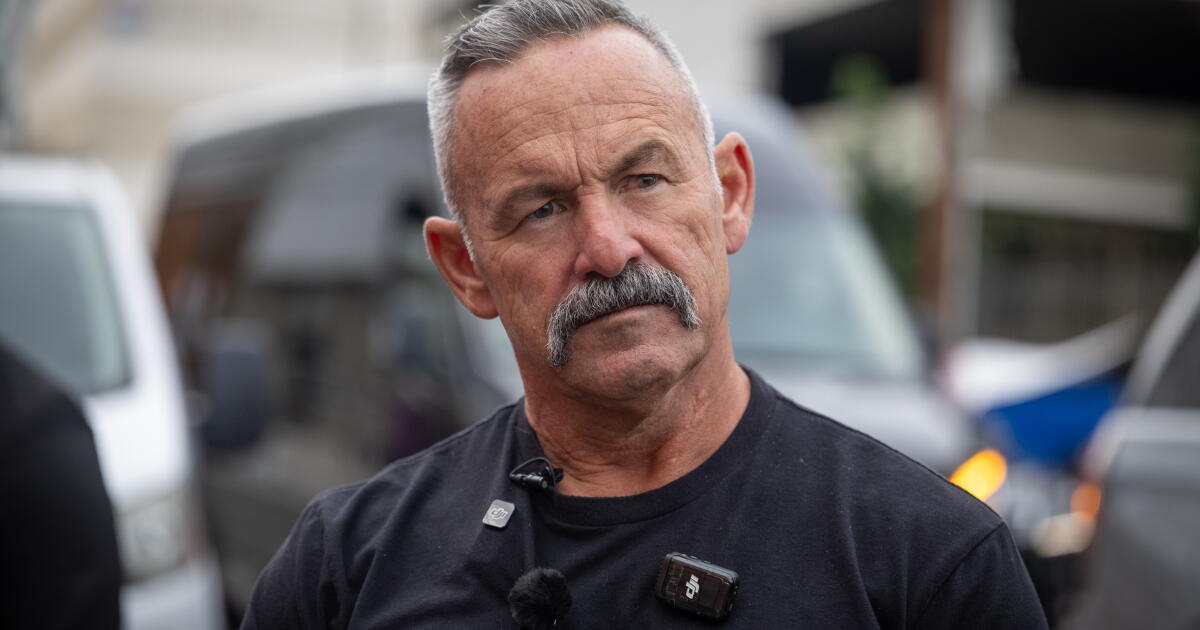

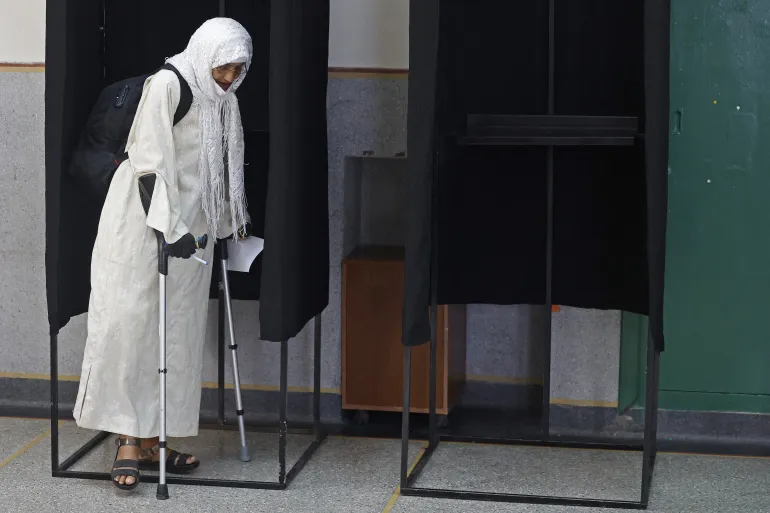
![A woman prepares to cast her ballot to vote in Morocco’s legislative elections at a polling station inside a school at the Udayas neighbourhood, Rabat, on September 23, 2026 [AFP]](https://i0.wp.com/www.aljazeera.com/wp-content/uploads/2026/09/afp_6ab3c71f1ac5-1790166815.jpg?w=640&ssl=1)