Are global oil reserves sufficient to withstand renewed US-Iran war? | US-Israel war on Iran News
Oil prices have climbed towards their highest levels in five months as attacks on tankers in and around the Strait of Hormuz mount and efforts to end the United States-Israel war on Iran are deadlocked.
Brent crude, the international benchmark, rose by more than $2 to $110.85 a barrel on Wednesday, close to a five-month peak.
Recommended Stories
list of 4 itemsend of list
A day earlier, Iran’s Islamic Revolutionary Guard Corps (IRGC) said two tankers were “set ablaze” after hitting mines at what it called an illegal crossing point in the strait. Then, on Thursday, the IRGC said it hit seven more tankers although Washington dismissed the claim. In a statement, the IRGC said four of the vessels were transferring oil when they were targeted and caught fire overnight.
In September, the Houthis, an armed group also known as Ansar Allah (Arabic for Supporters of God), seized territory in Yemen close to the Bab al-Mandeb strait, a critical chokepoint into and out of the Red Sea and a gateway to Egypt’s Suez Canal.
The escalation came as the world’s emergency oil stocks, already tapped heavily since the Iran war began on February 28, sit at their lowest levels in decades.
Al Jazeera put a question to analysts: If fighting resumes in full, the Strait of Hormuz is shut off completely and Houthi attacks choke off Bab al-Mandeb, how long could the world’s reserves last?
Here’s what you need to know:
What emergency oil reserves are there?
Strategic oil reserves are stockpiles of crude oil and fuel held by governments or by companies on their behalf for use in a supply emergency.
The International Energy Agency (IEA), which was established in 1974 after the Arab oil embargo, coordinates most of them. Its importing members must hold at least 90 days of net imports. China and India are not members.
How much of the reserves has already been released this year?
A record amount.
On March 11, days after the start of the US-Israel war on Iran, the IEA’s 32 members agreed to make 400 million barrels available from emergency supplies, more than double the volume released after Russia’s full-scale invasion of Ukraine in 2022.
The US pledged 172.2 million barrels from its Strategic Petroleum Reserve (SPR) and Japan 79.8 million, according to IEA figures.
The SPR has since fallen to 283 million barrels, its lowest level since October 1982, according to the US Department of Energy.
Much of that oil was lent rather than sold and must be returned with extra barrels, according to the US Energy Information Administration.
How much oil is left?
Far less than before the war began in February, and not all of it can be used.
Aaron Kildow, a senior crude oil analyst at Sparta Commodities, told Al Jazeera that global strategic stocks excluding China and Iran have fallen by nearly 327 million barrels since the end of December 2025 with the US, Europe and Japan accounting for about 95 percent of the draw.
He estimated that leaves only about 400 million barrels of usable reserves worldwide, excluding China’s stockpile, which is unlikely to be exported, and Gulf stocks, which could be cut off by a total closure of Hormuz.
Nearly half of these available stocks are in Japan.
Europe has about 76 million barrels uncommitted, but members such as Germany are holding some back for a local emergency, Kildow said.
“Europe is the real wildcard, both on timing and willingness,” Kildow said.
Meanwhile, China’s onshore crude stocks stand at 1.13 billion barrels, down from 1.23 billion in late February but still enough for about 80 days of refinery intake, Muyu Xu, a senior crude oil analyst at the analytics firm Kpler, told Al Jazeera.
India’s reserves cover just eight days of its imports, the Reuters news agency reported.
What would a full closure of Hormuz and Bab al-Mandeb mean?
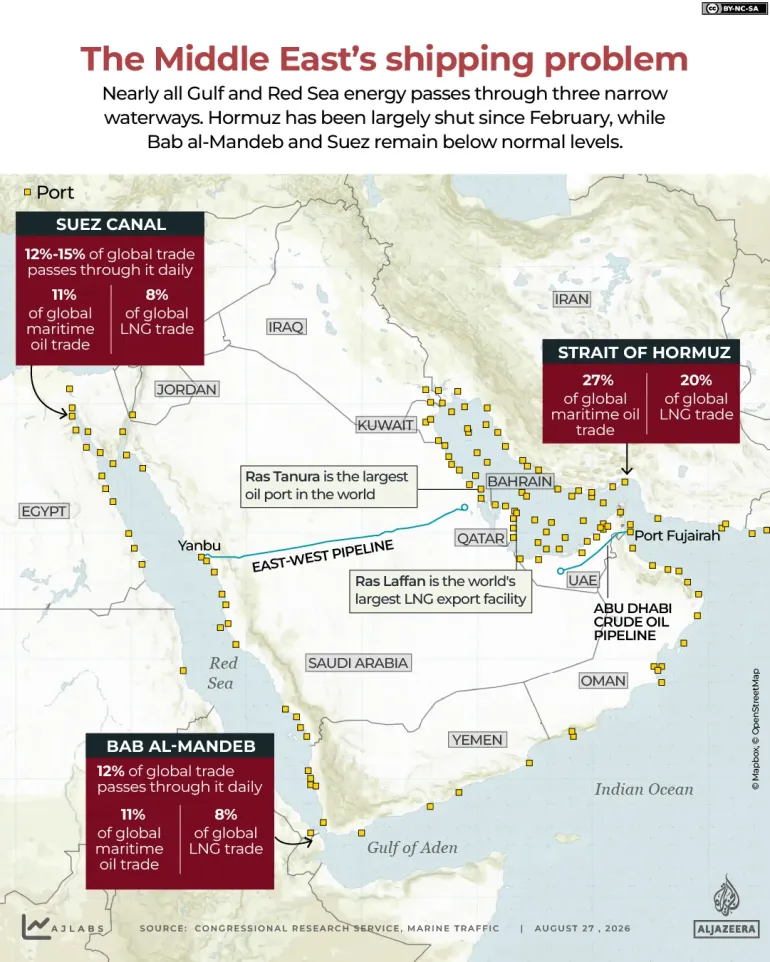
Before the war, about one-fifth of the world’s oil and liquefied natural gas supplies, or roughly 20 million barrels of oil a day, passed through the Strait of Hormuz.
Saudi Arabia has increased the amount of crude it transports from its oilfields in the east to its Red Sea port of Yanbu in the west via the East-West Pipeline, thereby bypassing Hormuz.
But there have been strikes on that pipeline, and tankers heading south from Yanbu must pass through Bab a-Mandeb, where the Iran-backed Houthis declared a blockade on Saudi shipping in July.
Only a confirmed 373,000 barrels a day of Saudi crude have transited Bab al-Mandeb so far this month, the lowest level since February, Xu said, with most Yanbu cargoes now heading north via Egypt instead.
If Hormuz were shut and the Houthis blocked all Saudi tankers, Gulf producers could export only through a few pipelines and Yanbu’s northbound route, Xu said.
That would leave about 7.5 million barrels a day of Middle Eastern crude, against 16.8 million now, a shortfall of about 9.3 million barrels a day, she estimated.
“If such attacks occur, the supply disruption could be even more severe and prolonged,” Xu said, referring to strikes on oilfields, terminals and pipelines.
![[Al Jazeera]](https://i0.wp.com/occasionaldigest.com/wp-content/uploads/2026/10/INTERACTIVE-MIDDLE-EAST-iran-hormuz-shipping-aug-27-2026-1787815800-1788488337.webp?w=640&ssl=1)
So how long would reserves last?
Not for long – possibly just weeks, according to experts.
If Kpler’s estimated shortfall had to be covered entirely from the roughly 400 million usable barrels that Kildow identified, they could not, in practice, be released that fast. Japanese and South Korean reserves can move quickly, Kildow said, but US barrels are staged over three months, and Europe’s contribution is uncertain.
Chris Beauchamp, chief market analyst at IG Group, said the world was fortunate after the first closure. “The salient feature of March and beyond was how a crisis didn’t actually develop. We got away with it,” he said.
“I don’t think the global economy will be as lucky next time if there is a protracted conflict,” Beauchamp said. “A month or two is all we have.”
The world would not literally run out of oil. Instead, prices would rise until enough demand disappeared. “One hundred fifty dollars [per barrel] becomes a very distinct possibility, which then sees significant demand destruction,” Beauchamp said.
The sharpest squeeze would be on diesel, which is already nearly double the price of crude, the IEA said.
Refiners would compete for crude grades rich in diesel, “a cost that ultimately lands on consumers,” Kildow said.
Who would feel it first?
Asian importers with thin reserves.
Most Gulf exports in September and October went to Asian buyers, and India and Pakistan are among the most exposed, Kildow said, adding that their nearest alternative supply, from West Africa, is 25 to 28 days away by sea, compared with two days from Fujairah in the United Arab Emirates.
“The squeeze won’t hit uniformly. It lands fastest and hardest where reserves are thinnest and substitute supply is farthest away,” Kildow said.
Who would gain?
Oil producers far from the Gulf.
In the second quarter of this year, as the US-Iran war was under way, ExxonMobil reported earnings of $14.5bn, its highest in four years while Chevron posted $12bn, its best in six years and Shell more than doubled its earnings to nearly $10bn. Their profits are largely down to the high oil prices.
A second shock would send refiners scrambling for supplies from the US, Latin America, West Africa and Russia, Xu said.
“This would allow non-Middle Eastern producers to benefit from higher crude prices, potentially alongside lower transportation costs,” she said.
In August, US President Donald Trump said companies such as ExxonMobil and Chevron were “making too much money based on a shortage”.