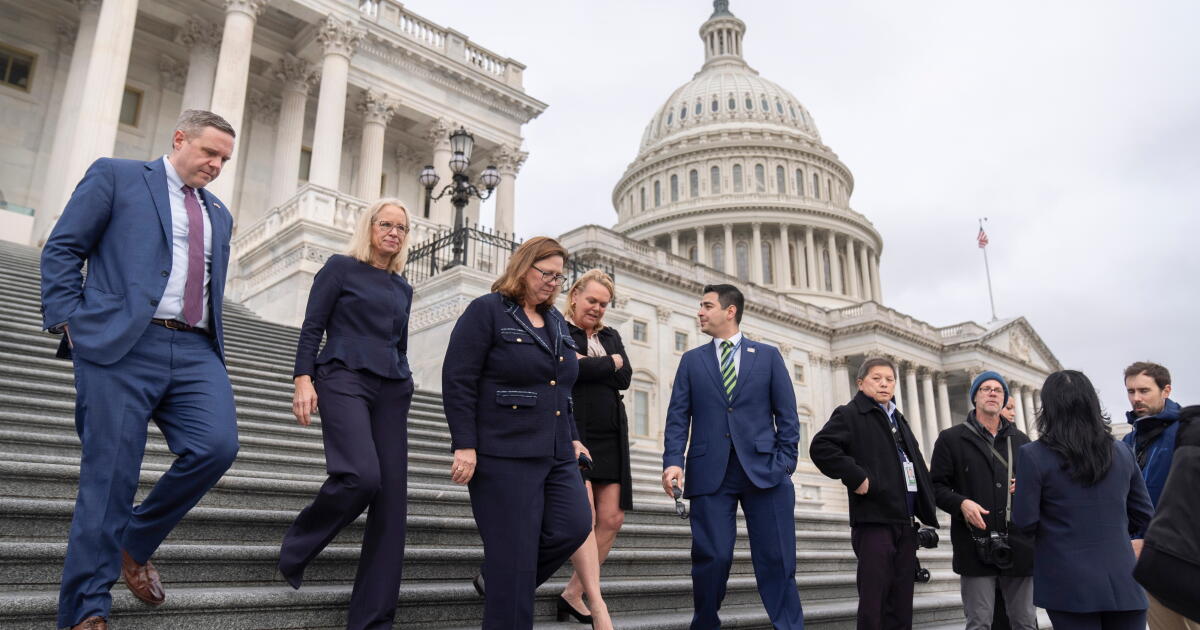
wipeout

Self-described ‘low drama’ Colorado Republican survived midterm wipeout

When he first ran for Congress in 2024, Colorado Republican Jeff Hurd was so devoid of the social media-optimized razzle-dazzle that characterizes much of modern politics that one local liberal commentator wrote that the lawyer was as interesting as a bread sandwich.

Now, amid the wreckage of the GOP’s performance in the recent midterm election, Hurd is the last Republican standing in Colorado’s 10-member congressional delegation and one of the few national success stories for his party.

The 3rd Congressional District has been reliably conservative and covers roughly half the state, stretching across Rocky Mountain and high desert communities to the border with Utah. It’s also the only U.S. House district that President Trump won by fewer than 10 percentage points two years ago where a Republican House member was reelected on Nov. 3.

Hurd and his supporters have embraced the “bread sandwich” line and after his win by 2 percentage points see it as a possible road map for reeling Republicans.

Democrats have secured at least 259 seats in the House, the largest majority since 1990, and won seven of Colorado’s eight seats in the chamber.

Hurd survived by focusing relentlessly on local issues. He challenged Trump’s position on issues such as tariffs and the president’s scrapping of projects, in retaliation for Colorado’s liberal lean, that would have benefited Hurd’s district. It was enough for Trump to briefly rescind his endorsement of Hurd and support a primary challenger before changing his mind and backing Hurd again.

Though Hurd also sided with Democrats in trying to reverse healthcare cuts in Trump’s big tax bill, which the congressman voted for, he has focused on avoiding national partisan disputes.

“I do think there is the need to seriously self-reflect as a party,” Hurd said in an interview, adding that he hopes his reelection prods the party to refocus on old-fashioned conservative values such as limited government. He also noted that he sold all his individual stocks before entering Congress and urged a greater focus on promoting clean government.

Describing what he believes to be voters’ perception of him, Hurd said, “Here’s somebody that’s low drama, he works hard, and he’s effective and he’s not part of our self-dealing machine.”

A rare GOP survivor

Trump won Hurd’s district by 9.7 percentage points in 2024, so a Republican incumbent hanging on to a congressional seat there would not be a remarkable achievement in a normal election.

But this midterm was no normal election. So thorough was the Republicans’ drubbing that Hurd’s performance stands out, along with a few other GOP House members representing districts that Trump won two years ago by about 10 percentage points.

Nick LaLota, a congressman from New York’s Long Island who occasionally broke with Trump, won in a district that voted for Trump by 10.2 points. Michael Baumgartner, who represents a mostly rural district in eastern Washington state and who also was a sharp critic of Trump’s tariffs, held on in what is now the third-least Trump-leaning seat. His district voted for Trump by 10.8 percentage points in 2024.

Hurd, 47, initially studied to be a priest before switching to the law. He became a lawyer in the western Colorado city of Grand Junction and a member of the conservative Federalist Society. He entered Congress by first mounting a challenge to Rep. Lauren Boebert in the 2024 Republican primary.

Boebert, a frequent social media user and partisan warrior, then moved to a far more conservative district in eastern Colorado, where she easily won the party’s primary and 2024 general election while leaving her previous district in Hurd’s hands. This year Boebert lost in her more conservative district while Hurd hung on.

Hurd “took a principled, practical approach rather than just showing off on social media,” said Cody Davis, a Mesa County commissioner and Republican.

Working with Democrats, focusing on local issues

Hurd also had a record of working well with Colorado Democrats.

He partnered with the state’s two Democratic U.S. senators to get a bill passed compensating local landowners injured by a 2015 spill of wastewater from the Gold King mine. He worked on Colorado public lands preservation and water issues, helped pass legislation that bolstered federal wetlands conservation and, just recently, a bill aiding tribal efforts to restore buffalo.

The state’s Democrats united behind Hurd’s challenger in the general election, former Aspen City Council member Dwayne Romero, but after election day some of them tipped their hats to Hurd.

“Although I was personally pulling for Romero, it is good to see that standing up on principle can have positive electoral benefits,” said Craig Hughes, a prominent Democratic strategist.

Hurd led the state’s delegation in opposing Trump’s veto of a bipartisan bill to finish a conduit from the Arkansas River to rural southeastern Colorado farms and communities in his district.

The president’s veto, which also was condemned by Boebert, was widely seen as retaliation against Colorado because a state court convicted Trump acolyte Tina Peters, a former county clerk and election denier, for allowing unauthorized access to voting equipment and copying election server data. Peters’ nine-year prison sentence was commuted by Democratic Gov. Jared Polis.

Hurd also clashed with Trump over tariffs, which were ruinous to his district’s farmers and to a steel mill that anchors one of the largest cities he represents. Yet he never was openly antagonistic toward the Republican president, instead supporting most of his party’s priorities in Congress. He limited himself to weighing in on issues of local importance.

“When I agree with the president, I say so,” Hurd said. “And when I disagree, I’m not afraid to stand up.”

Reflecting on the GOP’s midterm defeat

Hurd demurred when asked whether his was the best approach for his party going forward.

His diagnosis of the midterm results for Republicans was that the party needs to focus more on conservative principles and good government. Hurd said many in the GOP are still reeling after losing both the House and Senate and seeing Democrats claim strong majorities in both chambers.

He hopes for the opportunity for more bipartisan work in the upcoming Congress but does not know whether that will materialize.

Ian Billick is a political independent who is mayor of the ski town of Crested Butte, a heavily Democratic community. He backed Hurd’s reelection and worked with the congressman on a number of conservation issues.

“There’s a lot where I disagree with the representative,” Billick said, noting that Hurd voted for Trump’s tax and spending cut bill and supports more oil and gas development than Billick is comfortable with. “But for me, the priority is people with integrity who are thoughtful and pay attention to their communities.”

Dick Wadhams, a veteran Republican strategist in Colorado, noted that the western part of the state has long rejected partisan labels even as it leaned to the right politically. Democrats have successfully represented it, as have low-key Republicans who, like Hurd, focus mainly on serving the community, he said.

But Wadhams, a longtime critic of his party’s turn under Trump, sees a greater lesson in Hurd’s survival. He described Hurd as “a serious person who has serious policy chops, and that’s why he was running.”

“Overall,” Wadhams said, “we’ve just got to reassert that kind of elected official.”

Riccardi writes for the Associated Press.
Source link

Immigration arrests go on unabated despite Trump’s misgivings after the GOP’s midterm wipeout

It’s business as usual for President Trump’s deportation offensive despite the Republican wipeout in the midterm elections.

In Los Angeles, masked immigration officers in body armor blocked a hospital emergency room driveway in a heavily Latino neighborhood early Saturday. In central Alabama, twin 19-year-old brothers from Venezuela were arrested while driving back to college a day after the election.

Advocates reported arrests from California to Michigan to Massachusetts. U.S. Immigration and Customs Enforcement has not released numbers.

After Democrats trounced the GOP and won control of the next Congress, Trump said his immigration crackdown may have been “too tough” and suggested it was time to sit down with the rival party.

“I’d love to do something on immigration,” he said in an interview with CBS “60 Minutes” recorded Friday.

Hours later, he named Stephen Miller, the architect of his hard-line immigration agenda, as his new chief of staff. Homeland Security Secretary Markwayne Mullin, meanwhile, said his orders had not changed.

“Deportations will continue,” Mullin wrote in an online post the day after the election, warning that ICE takes no days off and that “this includes on Thanksgiving, Christmas, and Election Day.”

María Bilbao, a campaign coordinator for the American Friends Service Committee in Miami, said she has received at least one call a day from someone detained in South Florida since the election.

“Everything remains exactly the same. The arrests have not ceased at all,” Bilbao said.

Florida Highway Patrol officers and ICE agents have detained people in their cars, as well as places including supermarkets, pharmacies and gas stations. Immigrants under supervision have also been arrested when they showed up at ICE’s Miami office for their appointments.

Officers assembled outside a Los Angeles hospital

Erick Gasca, 31, got home Friday night after an evening playing board games with friends. He lives near Adventist Health White Memorial Medical Center in Los Angeles.

An “unprecedented” number of vehicles with tinted windows and no license plates were parked near the hospital’s emergency room entrance, he said.

“I thought they were going to raid the hospital or something,” he recalled.

The Department of Homeland Security declined to explain the officers’ presence there, though Bill Essayli, the top Justice Department prosecutor in Los Angeles, said they were bringing a detainee for medical treatment. Essayli said two people were arrested for assaulting federal agents.

“ICE does not target hospitals, schools, or churches,” the Department of Homeland Security said in a statement.

The agents’ presence attracted some 30 residents and passersby. Footage shot by Gasca’s cousin, Michelle Rivera, shows protesters shouting and officers pinning someone down.

The hospital said it wasn’t involved.

“White Memorial does not participate in immigration enforcement,” hospital president Daniel Fontoura said in a statement, adding it would not let such activities “compromise our commitment to patient care and safety.”

A couple is arrested at the Phoenix airport

A married couple from Orlando, Fla., was arrested Saturday at the airport in Phoenix while traveling to a funeral.

Gustavo Romanello and Agustin Baccega, both from Argentina, have work permits while they seek asylum after entering the United States about six years ago, according to Jonathan Batchelor, a family friend.

Batchelor was on the phone with them at the time. A mutual friend died Friday and the couple was visiting for the funeral Saturday. As the couple left the airport, two casually dressed officers asked if one was Agustin Baccega. Batchelor heard the officer say, “Asylum seekers are not in the United States legally.”

Batchelor said he could hear Romanello walking alongside his husband during the arrest and asking the officers how to collect his things. Batchelor said they then asked what his name was, “and then the guard said, ‘Oh, do you have another set of handcuffs? This is another one.’”

The voices grew distant, and the call then ended.

Both men remain in detention centers. They worked as acrobats in Florida and had no criminal record, Batchelor said.

“This is just taking good people who have been following the rules out of their lives and out of the lives of those who rely upon them and care about them,” Batchelor said.

The Department of Homeland Security did not immediately respond to requests for comment on the arrests.

Twin brothers seized while driving back to college

The brothers were headed back to college after visiting their parents when they were stopped in a small city in central Alabama.

Luis and Carlos Orta-Santoro, 19-year-olds born in Venezuela and living in the U.S. for four years, are soccer players at Wallace State Community College in Hanceville, Ala.

Relatives say they have pending asylum applications, valid work permits, and no criminal records. Both are now in an immigration detention facility.

“Our family is devastated,” said their aunt, Carolina Orta.

Homeland Security said that while they had entered the country legally, they had “overstayed in defiance of our laws,” and their case would be heard by an immigration judge. It said pending asylum applications do not confer legal status in the U.S.

The school said in a statement, “Both young men are valued members of the Wallace State community, and our thoughts are with them during this difficult time. We sincerely hope for a positive resolution to their situation.”

A Haitian boy is taken into custody, drawing protests in San Diego

An 8-year-old Haitian boy had been living with his uncle in San Diego since his father was deported last year. The uncle, who is not a legal guardian, took him to an ICE office when the boy was summoned Nov. 4 and taken into custody.

That left the boy “without the support of their family, community and their school,” according to a letter to top administration officials from San Diego Unified School District Superintendent Fabi Bagula and school board members.

“Children should not lose access to education simply because of circumstances unfolding around them,” they wrote.

ICE has defended its actions.

Johny Oxeda, pastor of the Fairmount Haitian Community Church, which helped get legal representation for the boy, said he’ll ultimately benefit by going through legal channels.

Activists, though, were furious.

“This is not child protection,” said Guerline Jozef of Haitian Bridge Alliance, adding, “this is state-inflicted trauma.”

Gonzalez and Sullivan write for the Associated Press. AP reporters Gisela Salomon in Miami and Elliot Spagat in San Diego contributed to this report.

Source link

Trump’s grip on party in question as GOP reels from midterm wipeout

Republicans aren’t holding back.

Florida Gov. Ron DeSantis described last week’s elections as an “extinction-level event” for the GOP. Sen. Ted Cruz of Texas likened it to a “Watergate-level repudiation.” Former Vice President Mike Pence called it a “reckoning.”

For all the apocalyptic talk emerging from a midterm that relegated Republicans to their thinnest ranks on Capitol Hill in decades, there’s little agreement on how the party should move forward.

A return to the bedrock fiscal and national security conservatism that defined Republicans under President Reagan risks alienating the more hard-line conservatives welcomed into the party under President Trump under the “Make America Great Again” banner.

But leaning even further into Trump’s coarse brand of politics could lead to more voter rejection.

“We have soul-searching to do,” Alex Latcham, the executive director of the Senate Leadership Fund, which spent $810 million to support Republicans, said in an interview. “We need to first understand and honestly admit why we just endured a wipeout of this magnitude. And then we have to regroup and agree to a path forward.”

Questions about Trump’s future role

As has been the case for the last decade, the central question is the role Trump will play in shaping the party’s future. His insistence on loyalty reached a zenith this year as he intervened in GOP primaries and pressed voters to make the elections a referendum on his second term. He held dozens of rallies in the final weeks of the campaign for candidates, most of whom lost their races.

Since Tuesday’s election, he’s refused to acknowledge any responsibility, placing blame on the candidates. His public events have focused on his pet projects in Washington, which have proved unpopular with voters. On Friday, he elevated Stephen Miller, the advisor behind some of his most contentious policies, to White House chief of staff.

In an interview, Oklahoma Gov. Kevin Stitt, a Republican, said that the election results were “shocking” but that Trump could still steer the conversation around issues such as immigration. The governor described the GOP’s current dynamic as a natural process for a party whose leader is deep into his second term.

“It just tells you that the American people, after 10 years, they’re pretty much tired of whoever’s in office,” Stitt said. “I think people want a little more stability. They want people to be nice to people, to say, ‘Hey, we’re all Americans.’”

Others were more blunt.

Longtime conservative commentator Tucker Carlson — for many years a Trump acolyte — said the midterms marked “the end of the Trump era.” John Sununu, a Republican who lost his bid for a Senate seat in New Hampshire, blamed Trump.

“It seems like he or his family is in on every transaction and deal that goes on in Washington,” Sununu told John Kasich, a Republican former governor of Ohio and onetime presidential candidate, on SiriusXM. “Those two things, I think, caused people to say, ‘You know, I just can’t vote for a Republican while he’s still in office.’”

Republican infighting likely to intensify

The GOP infighting is poised to intensify quickly.

When Republicans return to Capitol Hill this week, they’ll have to choose between Reps. Steve Scalise of Louisiana and Jim Jordan of Ohio to lead the new minority in the House. They may weigh whether to impeach Defense Secretary Pete Hegseth. There could also be tough votes on defense spending and keeping the federal government open after Dec. 11.

Already a leadership fight is brewing at the Republican National Committee, where there are early conversations about limiting Trump’s influence in picking the next chair. KC Crosbie, the co-chair, circulated a letter last week calling the midterms a “serious setback” and announcing plans to run for chair at the committee’s January meeting in Arizona.

Trump announced his support Friday for the party’s current chair, Joe Gruters.

That’s to say nothing of the emerging contest for the 2028 Republican presidential nomination. Vice President JD Vance, seen as a leading contender, will probably face a broad range of opponents if he enters the race. Stitt is among the Republicans calling for a “big open primary.”

“I don’t think we should crown anybody,” he said.

There will be pressure to revive the coalition of voters, particularly Latinos, who have lifted the party to success in previous elections but swung to Democrats on Tuesday. Former Rep. Carlos Curbelo (R-Fla.) said he thought Secretary of State Marco Rubio is best positioned to win back Latinos.

“The two main constituencies that Republicans have to quickly regain are white suburban voters and Hispanic voters,” Curbelo said in an interview. “Vance was out on the campaign trail this year, and it doesn’t appear that he was able to move the needle in terms of Hispanic voters.”

A representative for Vance didn’t comment on that characterization.

Broad election fallout

Still, the fallout for the GOP is broad, according to the AP Voter Poll, an expansive survey of about 80,000 voters in all 50 states.

Younger Republican voters who supported the Republican candidate in their House race were less likely to approve of the way Trump is handling his job as president, and more likely to say he worsened the economy with his policies.

About two-thirds of Republican voters under 30 said they approved of how Trump was handling the presidency, compared with about 9 in 10 Republican voters age 65 and older. About one-third of younger GOP voters said Trump had worsened the country’s economic conditions, compared with about 2 in 10 older Republican voters.

The war with Iran also appeared to divide Republican voters, with about 6 in 10 Republican voters under 45 saying the U.S. made the right decision in taking military action against Iran. That rose to about 8 in 10 among Republican voters who were 45 and older.

Young Republican voters were more likely to say U.S. support for Israel was “too strong.” Roughly half of Republican voters under 30 said the country’s backing of Israel was “too strong,” compared with about 1 in 10 voters 65 and older.

Despite rosy outlooks from top Republicans including Trump and House Speaker Mike Johnson (R-La.) in the final weeks of the campaign, Republican strategists had long seen the country’s confidence in the party unraveling.

In late August, the Senate Leadership Fund convened a donor retreat in Laguna Beach, where Latcham told the group that Republicans had lost the confidence of voters on handling the cost of living and the economy, according to two Republican Senate campaign sources who attended the event. They spoke on condition of anonymity to discuss a private meeting.

In defeat, Republicans are trying to take a broader view, knowing that it may take several election cycles before they one day return to power.

Rep. Christopher Smith was reelected to his 24th term last week and will soon be New Jersey’s only Republican in Congress. He took a long view on the party’s current struggles.

“The pendulum swings back and forth,” he told reporters. “These are cycles.”

Sloan and Beaumont write for the Associated Press. AP writers Steve Peoples, Kevin Freking and Linley Sanders contributed to this report.

Source link