Democrats say money from Trump’s tax cuts bill is paying for White House ballroom project
WASHINGTON — More than $350 million from President Trump’s “big, beautiful bill” has been quietly directed to White House security, an allotment that Democrats warn appears to be helping fund his new ballroom project — despite the president’s insistence that no taxpayer dollars would be used.
The apportionment of funds, which the White House’s Office of Management and Budget made late Friday, comes from two accounts that were intended to provide the U.S. Secret Service with extra money for hiring and training in the aftermath of last year’s assassination attempts on the president, according to Democrats on the Senate Budget Committee. The shift was made days after Congress rejected a $1-billion request for the White House in a Homeland Security bill that Trump signed into law and as the ballroom project is tangled in legal challenges.
Senate Judiciary Committee chairman Chuck Grassley, whose panel initially drafted the security funding, said Thursday he was unaware of the allocations.
“The president said that it was all going to be paid for with private money,” said Grassley (R-Iowa). “And that’s what the country expects.”
Sen. Jeff Merkley of Oregon, the top Democrat on the Senate Budget Committee, charged that Trump’s actions are potentially illegal.
“After repeatedly telling the American people that zero taxpayer dollars would be spent on his gold-plated ballroom boondoggle, now Trump appears to be using a smoke and mirrors tactic,” Merkley said in a statement.
“Trump has proven that he can’t be trusted to follow the law,” Merkley said. “He only cares about wasting taxpayer money on his vanity projects.”
Ballroom project hits setbacks
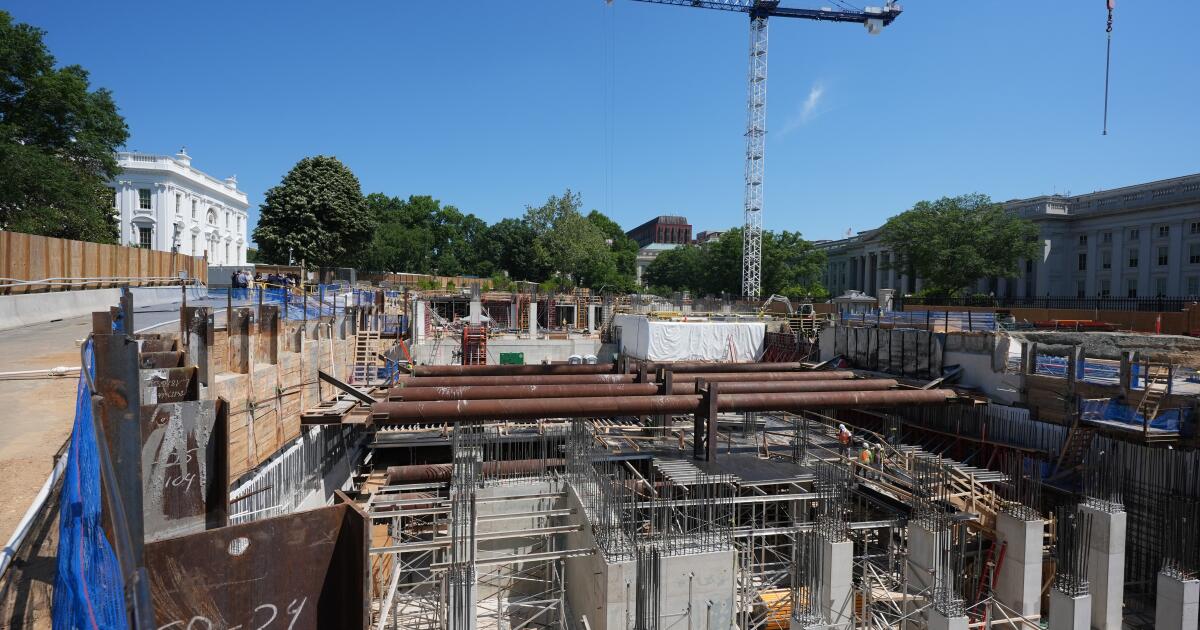
Trump has faced setbacks in his attempts to build the ballroom on the White House grounds, where he ordered the demolition of the storied East Wing to make way for it.
Touring the construction site last month, Trump called the development a “gift” to the American people. He has repeatedly said that it is being paid for by donations — which has also run into ethics questions from watchdogs concerned about potential corruption and conflicts of interest.
Congress refused the Trump administration’s request for $1 billion for the ballroom last month. The administration wanted the money as part of a Homeland Security bill, but Republican and Democratic lawmakers rejected efforts to tack it on. It became politically toxic at a time when Americans are reeling from inflationary high costs of living.
The Washington Post reported earlier this week that the price tag for the project has ballooned to $600 million, according to a project summary prepared by the contractor, with more than half of that funding coming from taxpayers. Roll Call first reported on the apportionment of new funds for White House security.
At its core, arguments are swirling over how much of the White House project is to bolster security underground, with bomb shelters and a medical facility, and how much of the costs are related to the president’s promised 999-seat ballroom on top.
White House says Trump and donors are paying for the ballroom
A spokesman for the White House said that Trump and donors are funding some $400 million for the ballroom development, and that the coordination with the Secret Service had been noted in the initial announcement of the project.
“The East Wing Modernization Project is inextricably tied to the security of the President, the White House grounds and the certain security infrastructure assets,” said White House spokesman Davis R. Ingle in a statement.
He said the events over the past weekend, including an alleged attack plan targeting the UFC Freedom 250 event at the White House, proves why the project is needed.
“President Trump and generous American patriots are funding the ballroom to the tune of approximately $400 million, which will be a secure and appropriate venue for Presidents for generations to come,” he said.
Government lawyers have argued that the project includes critical security features to guard against a range of threats, such as drones and missiles.
The White House has said in court documents that the East Wing project would be “heavily fortified,” including bomb shelters, military installations and a medical facility underneath the ballroom. The Secret Service told senators last month that $220 million of the White House’s $1-billion request would go to harden the ballroom addition, with bulletproof glass, drone detection technologies, chemical and other systems.
The rest of the money would go for other security improvements, according to a document provided to Senate Republicans, including $180 million for a new, “long overdue” White House visitors screening facility.
Congress holds power of the purse
The shifting funds are certain to ignite growing concerns in Congress over the separation of powers, and the president’s use of federal funds allocated by lawmakers.
The money comes from Trump’s big tax breaks and spending cuts bill that the president signed into law last summer. It provided more than $1 billion for Secret Service resources, including “personnel, training facilities, programming, and technology; and performance, retention, and signing bonuses.”
The provision was uncontested at the time, even as Democrats voted against the broader bill. Democrats said they did not challenge this section or try to strip it out from the package.
Under the Constitution, only Congress has the specific authority to allocate funds across the federal government, including the executive and judicial branch operations.
While the president holds the power to sign — or veto — those appropriation bills, once the funding becomes law, it largely must stand.
Mascaro writes for the Associated Press.