CHARLOTTE Dawson has shown off her incredible weight loss in before and after snaps.
The mum-of-three took to her Instagram page to share that she can fit back into her size 10 jeans again.
Charlotte Dawson was all smiles as she managed to fit into her size 10 jeans againCredit: InstagramThe star posted a video of her struggling to get into themCredit: Instagram
The star took to her account to share how she did it – and mentioned her new lifestyle and fitness platform.
Showcasing her amazing fat loss with a picture of her before and after, she told her 1.4m followers: “I’VE GOT MY FAVOURITE SIZE 10 JEANS ON.
Sign up for the Showbiz newsletter
Thank you!
“Honestly… I can’t believe I’m saying this. Looking at these pictures makes me SO proud of myself.
“Not because of a number on the scales, but because I’ve done this the RIGHT WAY. The Confidence Curve way.
Charlotte showed off her slim frame in the tight jeansCredit: InstagramShe later took to her Instagram Story to hit back at those who said she was lyingCredit: Instagram
“Sarah @nourishbysg has been sorting me out for over a year now with my food, gut and getting my skin looking glowy and Kelly @kellyameliaaerial has been training with me getting me feeling strong, healthy and fabulous now and I’ve been keeping my confidence in check!! Now it’s yours turn @confidencecurve_cc.”
She confessed that there were “no quick fixes” and she “didn’t punish herself”, but she just made “better choices” and “moved her body”.
Her fans rushed to the comments section to praise her efforts, with one writing: “Looking fab.”
Another said: “Go on my girl.”
A third chimed in: “You look amazing. Well done.”
In another video shared to her account and Confidence Curve, she filmed herself struggling to get into the item of clothing, followed by her with a smile on her face with them on her body.
But Charlotte, who is mum to Noah, Jude and Gigi, later had to take to he later had to take to her Story to vent after receiving some negative messages.
She said: “I don’t own a pair of jeans, every knows me, I don’t wear jeans, I don’t like the fit, they are uncomfortable.
“But these jeans, I have had these for years and years. Size 10. Can never get them on.
“I am just going to tell you something, I am not a size 10… I’m a size 12. well, 14-12, more to a 12-10 now. I’m so happy I got into a size 10 jeans.
“Nobody f***ing believes me, nobody believes me in the comments. What the f***?”
Somewhere in the overlap between William Friedkin’s 1977 action thriller “Sorcerer” and Kelly Reichardt’s 2020 Pacific Northwest pioneer indie “First Cow” lies Padraic McKinley’s directorial debut “The Weight.”
“Sorcerer” is about a group of fugitives driving a load of dynamite across the jungle; “The Weight” follows a group of Depression-era convicts transferring gold through the forest. “First Cow” is about the sweetness of friendship and French pastries in the wilds of Oregon during westward expansion; “The Weight” is about the corrupting forces of capitalism. McKinley’s movie marries the instincts of modern indie filmmaking with a New Hollywood ethos, while bringing an authenticity to the details of the period.
We follow the story of Murphy (Ethan Hawke), a World War I vet and single father in Eugene, Ore., struggling to provide for his daughter, Penny (Avy Berry), three years into the Great Depression. After an unfortunate run-in with the law, Murphy finds himself in a prison labor camp, building a road and trying to shorten his sentence so he can get out before his daughter is adopted by a new family.
Opportunity presents itself in Murphy’s foreman, Clancy (Russell Crowe), who takes a shine to him after he fixes his car and devises an ingenious way to remove boulders without dynamite. Cuddly but dangerous, Clancy makes a seemingly simple offer to Murphy: He and three friends can earn their freedom if they hike a load of gold out of a mining camp on the eve of President Franklin D. Roosevelt confiscation of all gold stockpiles.
The how and why details aren’t that important; the story is merely that the prisoners have to get from point A to point B through a rugged forested terrain, under the watch of two intimidating chaperones, Amis (Sam Hazeldine) and Letender (George Burgess). A mining camp servant, Anna (Julia Jones), joins their group as a runaway and while it seems a straightforward task, the arduous and brutal journey is one that is liable to turn these convicts into runaways.
Murphy’s gang weren’t really outlaws to begin with — he was imprisoned for defending his daughter from some undercover cops, while Singh (Avi Nash) was arrested for his associations with socialism. Olson (Lucas Lynggaard Tønnesen) was part of a group going after a judge for seizing Scandinavian farms, while the most hardened criminal among them is Rankin (Austin Amelio), who grew up in juvie. But in order to survive the woods, Murphy will have to dig deep into his wartime past and rely on his own skills and smarts to make out it out intact.
McKinley pours his craft into authentically representing the era, from the perfectly worn denim of the costumes to the refreshingly real and craggy faces of the cast (and thank goodness Hawke and Crowe are respectably aging into their character-actor looks). The Bavarian forest beautifully stands in for 1930s Oregon and cinematographer Matteo Cocco balances ’70s-inspired slow zooms with composed, high-contrast images that hark to early 20th century styles of photography. A score by Latham and Shelby Gaines balances discordant, atonal tones with suspense-driven sound design that captures the creaking noises of the forest and the concealed dangers it holds.
McKinley stages a few bullet-sweating sequences of peril, including a particularly brutal transport of gold bars across a crumbling rope bridge and an underwater accident exacerbated by floating logs. Both are nail-biters but you can’t help but think he could have pushed it even further. Tonally, the film is torn between wanting to be brutally bleak and offering some kind of hope for Murphy and his precocious, adorable daughter.
When “The Weight” leans into its nasty, mean and grim moments, it gets at something that seems closer to truth than the saccharine resolution we fear is coming. It seems like McKinley wants to deliver a crushing blow, but then feints at the last minute, opting for a more optimistic kind of fantasy.
Politically and culturally, what “The Weight” speaks to is as ugly as the violence that occurs in the mud and fog of the forest. But it ends on an oddly cheery note that doesn’t square with what we’ve seen. It’s a cutesy ’70s nod that feels more “Smokey and the Bandit” than “Sorcerer.” The bolder choice would have been to commit to expressing the despairing lessons of this world. We want to see these characters changed by what they’ve experienced, even if it’s dark. We want to see them actually carry the weight.
Katie Walsh is a Tribune News Service film critic.
‘The Weight’
Rated: R, for language and some violence/bloody images
Alison Hammond looked incredible as she showed off her 13 stone weight loss in a glam gown during London Fashion WeekCredit: GettyAlison looked sensational in her purple sequinned gownCredit: Getty
Alison looked sensational as she posed backstage ahead of the Vin + Omi “Anarchy” show during London Fashion Week.
The TV presenter was seen in a purple sequinned gown as she stared moodily at the camera.
Sign up for the Showbiz newsletter
Thank you!
With full glam makeup and voluminous hair, Alison looked absolutely fabulous.
The TV presenter was seen in a purple sequinned gown as she stared moodily at the cameraCredit: GettyAlison is known for presenting ‘This Morning’ TV showCredit: Shutterstock EditorialAlison, who is mum to Aidan, 21, works out three to five times a weekCredit: AlamyHer astonishing weight loss is actually the result of a gym routine, a toyboy boyfriend and a £2.85 supermarket secretCredit: Getty
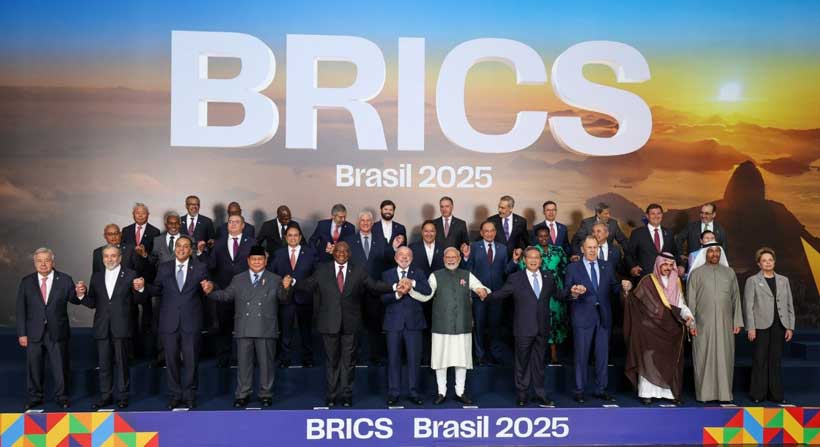
BRICS is moving into a more meaningful phase in its evolution. Its larger membership, considerable resources, population, and markets position it as a voice for the global south. Nevertheless, the fact that the BRICS is economically big does not guarantee that it will turn into a powerful organization. The difficult question is whether BRICS will be able to use the potential of its diversified members to create the institutions and means of collaboration that will meet the needs and interests of different countries, businesses, and banks.
This is where the next chapter of BRICS collaboration will be decided. It is definitely not in need of aspiration. The main question is not whether BRICS will develop a common geopolitical approach but whether BRICS will be able to simplify the issues of cooperation for countries with divergent economic interests and institutional capabilities.
The enlargement of BRICS has brought about both a chance and an enigma. An increased number of members boosts the economic and diplomatic power of the group, but it also entails the presence of more currencies, regulations, economic systems, and foreign policy priorities. States such as India and China may share a desire to amplify the role of developing economies while being in competition with regard to trade, technology, and geopolitics. Resource-rich countries may have their priorities with respect to the manufacturing countries. Financial centers may deal with payment integration differently from countries interested in getting more monetary independence.
Stay ahead of the geopolitical week.
MD Briefing delivers expert analysis across five global fronts — the Indo-Pacific, energy, geoeconomics, European security, and the Middle East — every Monday morning. Free.
The key challenge before BRICS is not about making all the members agree about everything; rather, it is about creating means for cooperation between different countries in the areas where their interests coincide.
This differentiation is essential because BRICS is frequently assessed based on scale indicators, including population, economic output, energy resource reserves, and trade. While these parameters demonstrate the affiliation, the affiliation is not the key to institutional power. BRICS is still functioning as an informal coordinating mechanism and not as a supranational institution due to the absence of an establishing treaty, budget, and secretariat. The conversion of its total economic capabilities into total actions should rely substantially on its members’ coordination. BRICS needs to change its approach, so instead of pursuing expansion, it should focus on implementation.
The issue of cross-border payments can serve as an example. The necessity to improve payment processes within BRICS may be easily explained. International transactions require correspondent banks, multiple currencies, currency exchange, and several commissions. Using local currencies and interoperable payment systems may help reduce some of these expenses and create additional ways of settlements for countries.
However, establishing a new financial structure is much more difficult than just talking about it. The real barriers are technical and institutional: interoperability between national payment systems, regulatory compatibility, foreign exchange liquidity, cybersecurity, anti-money laundering and know-your-customer norms, settlement systems, and trust among the entities participating in the payment system. A domestic payment system cannot simply be hooked up to a foreign payment system without addressing these problems. This leads us to a more practical goal for BRICS countries. Instead of concentrating on the joint BRICS currency, they should work on interoperability among national payment systems.
The example of India’s UPI-PayNow linkage to Singapore shows how this principle works. Two entirely different payment systems can be interlinked without destroying their own systems. The same gap can be figured out at the level of BRICS if all necessary regulations, settlements, and risk management conditions are fulfilled. In order to understand how this can be achieved, BRICS can refer to the examples of other countries that have already applied the same logic.
The same issue of coordination can be observed in trade and supply chains as well. BRICS countries have complementary assets such as resources in energy, agriculture, manufacturing, minerals, technology, and large markets for consumer goods. However, having complementary resources does not automatically result in integrated supply chains.
Businesses need predictable customs, standards that will fit one another, reliable logistics, availability of finance, and clarity of regulation. If countries have different certification systems, digital documents, and technical standards, the theoretical advantages of a large BRICS market will not be fully realized. Therefore, standards will probably prevail over declarations in the end.
So far BRICS has spoken about cooperation of national standard organizations and overcoming technical barriers between trade. Further work is getting cooperation of national standard organizations transferred into standards that will be in demand in real business. Common standards for digital trade documents, selected product certification, customs data, payment systems, and technical standards can connect BRICS economies without full harmonization of their economies.
This method would make it easier to justify politically. There would not be a need for members to give up their power when it comes to buying a wider range of economic policies. The only thing left is for countries with technology to agree on their particular rules where technology will help provide measurable benefits.
The same goes for agricultural projects, as the BRICS countries share similar problems in the fields of food supply, climate, water conservation, and productivity. The BRICS has started pushing for agricultural research and cooperation. So, the question is not whether the BRICS countries have recognized these areas; they already have. The larger question is whether anything can be implemented across borders.
In a situation where one country has effective technology to grow crops and another one has a good way of bringing the crops to a field, BRICS has to find a way to transfer that knowledge or have an organization that can help in that transfer. There should be a value on the moves made regardless of whether formal treaties have been produced or not. This points towards a different institutional model for BRICS: modular cooperation.
BRICS needs to develop a model that allows all members to be part of the major framework and subgroups of interested members cooperating with each other in specific areas that require deep integration. Countries interested in making payments and settlements between them could organize a coalition in charge of finding and implementing technical solutions for that. Those ready to work jointly in the field of agriculture can proceed with agricultural cooperation, while others can focus on critical minerals, logistics, AI technologies, energy, and development finance.
This model recognizes one uncomfortable truth: diversity is BRICS’ asset, but it also acts as an obstacle in its functioning. In a highly heterogeneous grouping, it is impossible to expect rapid integration in view of the differences among its members. Compliance with the needs of all BRICS states only produces long negotiations and ambitious statements that do not work. Modular cooperation, in its turn, enables countries to pursue their own policy while being part of the larger framework.
Moreover, it could also establish a more trustworthy framework for testing. A limited number of members would be given the opportunity to run an initial test of payment or trading procedures, determine any legal or technological obstacles, and welcome other participants once the system is successful. The outcome would be a lowering of the chances of running into challenges that would be involved in the launch of a full project for all members simultaneously. BRICS should also reconsider its parameters of success.
Rather than concentrating on the number of members or the quantity of agreements accepted, BRICS should focus on the outcomes of its activities. There are political benefits to this strategy as well. BRICS will find it difficult to forge sustainable alternatives simply by selling them as counters in the geopolitical confrontation with the West. Governments and businesses respond not just to geopolitical signals but also to incentives. If the BRICS mechanism is cheaper, quicker, safer, and more efficient, then the chances of adoption increase.
This point is especially important for the discussion of de-dollarization. The reduction of dependence on dollar-based systems may in itself be a rational objective for some members; however, viewing de-dollarization as a success in and of itself can overshadow the distinction between geopolitics and economic efficiency. A payment mechanism can only gain credibility if banks and companies use it to solve a problem at hand.
India’s BRICS presidency in 2026 is an excellent opportunity to work on the practical implementation of the above approach. New Delhi can focus on enhancing cooperation based on interoperability and standards, collaboration of sectors, and measurable results. Instead of trying to create a homogenous group, India can create a framework where willing participants will devise their solutions for implementation by others.
Instead of striving to make BRICS like other supranational bodies, we should acknowledge the fact that, given its diversity of membership composition and structure, it is not realistic nor necessary. BRICS differentials provide a comparative advantage of allowing a mix of countries with both different political and economic systems that nevertheless share aspirations for greater policy autonomy and a voice in international affairs.
BRICS does not need to reach consensus on every issue to become successful. What it requires is to be able to determine areas where cooperation can be beneficial economically and create institutions able to do that.
Thus, the biggest problem is not the absence of power. The problem is how to convert power into capacity and capacity into institutions. If BRICS succeeds in this task, its economic capacity will transform from empty statistics into collective power. If it does not, then enlargement might improve visibility of the group, but its effectiveness would stay at the same level.
*Kanav Sharma is a Public Policy Researcher from Jammu & Kashmir with a postgraduate degree in English Literature from the University of Jammu. His interests include public policy, governance, parliamentary and strategic affairs.