weak

South Korea offers $9.7B relief as weak won hits firms

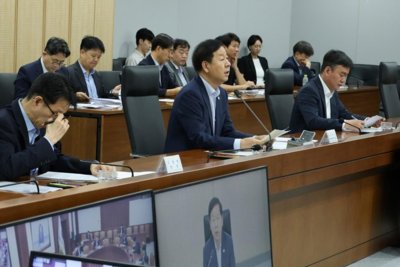
South Korean Finance Minister Koo Yun-cheol (C), who serves concurrently as the deputy prime minister for economic affairs, attends a meeting of the emergency economic headquarters at the government complex in Sejong, South Korea, 03 July 2026. Photo by YONHAP / EPA

July 3 (Asia Today) — South Korea will provide 14.9 trillion won ($9.7 billion) in emergency financing and expand tax and trade-insurance support for small and midsize companies struggling with higher import costs caused by the weak won.

The government announced the measures Friday during an emergency economic meeting chaired by Deputy Prime Minister and Minister of Finance and Economy Koo Yun Cheol at Government Complex Sejong.

The package is intended to improve liquidity for companies facing rising raw-material costs and financing pressures as the won remains weak against the U.S. dollar.

The government will redirect 13.8 trillion won ($9 billion) in unused capacity from a 23.7 trillion won ($15.5 billion) policy-financing program previously established in response to the Middle East crisis.

An additional 1.1 trillion won ($719 million) in new financing will also be provided. The government said the total could be increased depending on demand and the pace at which available funding is used.

The Korea SMEs and Startups Agency will establish a special emergency stabilization fund for companies affected by the exchange rate.

Small companies that import raw materials or components worth at least 20% of annual sales will be allowed to apply without meeting an existing requirement that sales or operating profit must have fallen by at least 10%.

The Export-Import Bank of Korea will increase its special crisis-response program from 7 trillion won ($4.6 billion) to 8 trillion won ($5.2 billion).

The bank will also increase its maximum interest-rate reduction from 2 percentage points to 2.2 percentage points.

A new ultralow-interest loan program will provide financing at rates close to the state-run bank’s own funding costs for companies affected by the high won-dollar exchange rate.

The Korea Technology Finance Corp. will raise the coverage ratio for its emergency business stabilization guarantees from 95% to 100%. The reduction in guarantee fees will increase from 0.3 percentage points to 0.4 percentage points.

Companies already using government policy loans may also receive repayment deferrals and loan-maturity extensions.

The government will expand import insurance and currency fluctuation insurance to help businesses manage exchange-rate risks.

Small and midsize companies without an export record will be allowed to purchase import insurance, which was previously more difficult for companies focused primarily on the domestic market to obtain.

Import insurance premiums will be discounted by 50% through April 2027.

Companies facing higher costs for essential imported raw materials may also receive up to twice the normal loan-guarantee limit from the state-run Korea Trade Insurance Corp.

The amount available under the government’s currency fluctuation insurance program will increase from 1.2 trillion won ($785 million) to 1.3 trillion won ($850 million).

Premium discounts for small companies will double from 15% to 30%.

Eligibility for the insurance will also expand from selected raw-material importers to companies importing nearly all categories of goods, excluding luxury products.

The government will establish a separate 10 billion won ($6.5 million) export-voucher program for companies affected by the exchange rate.

The maximum trade-insurance premium support available through the voucher system will temporarily double from 10 million won ($6,500) to 20 million won ($13,100).

The government also plans to allow insurance support to be paid in advance rather than reimbursed after the insurance contract ends.

Small companies borrowing from the Export-Import Bank of Korea will be offered a free option to convert loans between the won and foreign currencies or between two foreign currencies.

Tax relief will be provided alongside the financing programs.

Payment deadlines for corporate income tax, value-added tax, individual income tax and customs duties may be extended for companies experiencing exchange-rate-related financial difficulties.

The government will also provide consulting to help companies reflect currency movements in agreements that link subcontracting payments to changes in raw-material costs.

Companies that effectively operate the system may receive incentives, including exemptions from certain government-initiated investigations into subcontracting practices.

Financial institutions will receive credit under a government evaluation index for providing assistance to small companies affected by the weak won.

Regional export support centers will serve as one-stop contact points for companies seeking information on financing, insurance, tax relief and other assistance.

The government said it would continue reviewing the difficulties faced by businesses and consider additional measures if needed.

— Reported by Asia Today; translated by UPI

© Asia Today. Unauthorized reproduction or redistribution prohibited.

Original Korean report: https://www.asiatoday.co.kr/kn/view.php?key=20260703010001157
Source link

Gold jumps after weak U.S. payrolls report dents rate-hike bets (GLD:NYSEARCA)

stack of shiny gold bars 3d illustration

monsitj/iStock via Getty Images

Gold futures gained Thursday after a weaker-than-expected June employment report pressured the U.S. dollar and cooled near-term expectations for rate-tightening from the Federal Reserve.

Only 57K non-farm jobs were added in June, the Bureau of Labor Statistics reported, well below analyst forecasts

Source link

U.S. REIT giants aren’t immune: 10 large-cap stocks with weak momentum grades

wooden cubes spelling

Large- and mega-cap U.S. REIT stocks with market capitalizations from $10B to more than $200B, have generally held up better than their smaller peers, but several major names still carry weak Momentum Grades between D and C-.

Telecom tower REITs

Source link

Column: Obama’s strong terms curbed Iran. Trump struggles to secure even a weak deal

President Trump, it’s well known, is into gold. Every day brings new evidence that he’s thoroughly enjoying the “golden age” he pronounced in his inaugural address — as few other Americans are — with stock trades, crypto profiteering and much more, even a new taxpayer-financed slush fund to reward his allies.

As for me, I’ve gone into silver. That is, I constantly look for the silver linings in Trump’s heinous acts.

One silver lining, of course, is his cratering job-approval numbers in the polls, especially among the young and Latino voters who made his reelection possible. But here’s another: By his humiliating failure to bring Iran to heel, nearly three months after starting a war that he said would last weeks at most, Trump has brought new, more positive attention to what he again this week derided as “Barack Hussein Obama’s Iran nuclear deal.” (The emphasis on “Hussein” is Trump’s, always.)

The president, along with his Republican cheerleaders, counts his first-term abrogation of the 2015 Iran nuclear agreement, the Joint Comprehensive Plan of Action, as a signature achievement. This week, yet again, he falsely claimed that had he not done so, Iran would have a nuclear weapon. In fact, his action in 2018 taking the United States out of the multinational deal subsequently led to Iran’s rebuilding of its nuclear program, the emboldening of the Iranian hard-liners now in power and the Middle East morass in which the United States is now mired.

That quagmire has left Trump seeming desperate for a deal — almost certainly a worse deal than the one Obama struck. Call it JCPOA Lite.

If he were able to get Iran’s sign-off on the sort of detailed, restrictive agreement that Obama and other world leaders won 11 years ago, he’d be trumpeting himself as the world’s greatest dealmaker. (He does that anyway, but his record proves otherwise.) Instead, by his own failure to date, Trump has invited reconsideration of the very agreement he decried as the “worst deal ever” on his march to election and reelection.

No sooner was the 2015 deal signed than Trump and Republicans succeeded in defining it as a giveaway to Iran that assured, not hindered, its development of a nuclear weapon to threaten Israel and the world. Opponents condemned the agreement for not addressing Iran’s other threats, notably its support for militant proxies throughout the Mideast. Some Democrats, notably Senate Minority Leader Chuck Schumer of New York, were among the foes. Other Democrats, cowed by opposition to the agreement by Benjamin Netanyahu’s Israeli government and pro-Israel lobbyists, were all but mute in the pact’s defense.

Now some Democrats are belatedly finding their voice (and, post-Gaza, some willingness to defy Israel). Along with nonpartisan experts, those Democrats are drawing comparisons between the 2015 agreement, flawed yet successful, and Trump’s promised yet ever-elusive alternative. What’s ironic for Israel and Netanyahu, still implacably against negotiating with Tehran, is that they could end up, under Trump, with a nuclear deal that gives Iran more leeway than the hated JCPOA did.

As Americans are being reminded, the 2015 deal wasn’t just between Iran and Obama, as Trump has long suggested; other signatories were China, Russia, Britain, France, Germany and the 27-nation European Union. Reconstituting that group would be all but impossible today.

The pact’s 159 highly technical pages and five appendices — a far cry from the short-lived one-pager that Trump officials teased earlier this month — required Iran for 15 years to limit its nuclear program to civilian purposes, forfeit more than 97% of its enriched uranium and submit to intrusive monitoring by the International Atomic Energy Agency to ensure compliance. In return, Iran gradually got relief from some, but not all, international economic sanctions and access to Iranian funds that were frozen after the 1979 Islamic revolution. Presumably, after 15 years, the agreement would have been extended somehow.

By all accounts, including those of Trump’s first-term intelligence and national security officials, Iran was complying when he abandoned the deal. Its “breakout time” for building a nuclear weapon was about a year — time enough for the world to intervene — instead of two to three months. Now, though the president boasts he barred Iran from having that weapon by breaking the Iran nuclear deal, he incessantly tells Americans that he went to war against Iran on Feb. 28 because it was on the brink of a bomb — never mind that he also said he had “obliterated” Iran’s nuclear program last summer, a program that was in a well-monitored box until he first took office.

If you’re confused, you’re paying attention.

A month ago, Trump posted online that he was close to a deal “FAR BETTER” than the 2015 accord. “I am under no pressure whatsoever, ⁠although, it will all happen, relatively quickly!” To several reporters, he suggested he in fact had a deal and that Iran had agreed both to suspend its nuclear activities and to forfeit all of its enriched, near-weapons-grade uranium.

Preposterous claims, given Iran’s current government, and Tehran promptly denied them. It was a sign of Trump’s squandered credibility that few, if anyone, believed him in the first place. Nor have folks believed his more recent talk of imminent success; oil markets, too, have learned not to trust the president, as prices at the pumps attest.

On Tuesday at the White House, amid a noisy tour of the billion-dollar-ballroom construction site, Trump told reporters he’d been “an hour away” from striking Iran again that very day but Mideast leaders asked for more time for negotiations.

Don’t hold your breath.

But for the tragic consequences, Obama might be enjoying some justifiable schadenfreude about Trump’s travails.

“We pulled it off without firing a missile. We got 97% of the enriched uranium out,” he told Stephen Colbert in an interview last week. Both U.S. and Israeli intelligence agreed that Iran was abiding by the nuclear limits, Obama added, “and we didn’t have to kill a whole bunch of people or shut down the Strait of Hormuz.”

That sure doesn’t sound like the “worst deal ever.” It wasn’t.

Bluesky: @jackiecalmes
Threads: @jkcalmes
X: @jackiekcalmes

Source link