Weekly insights and analysis on the latest developments in military technology, strategy, and foreign policy.
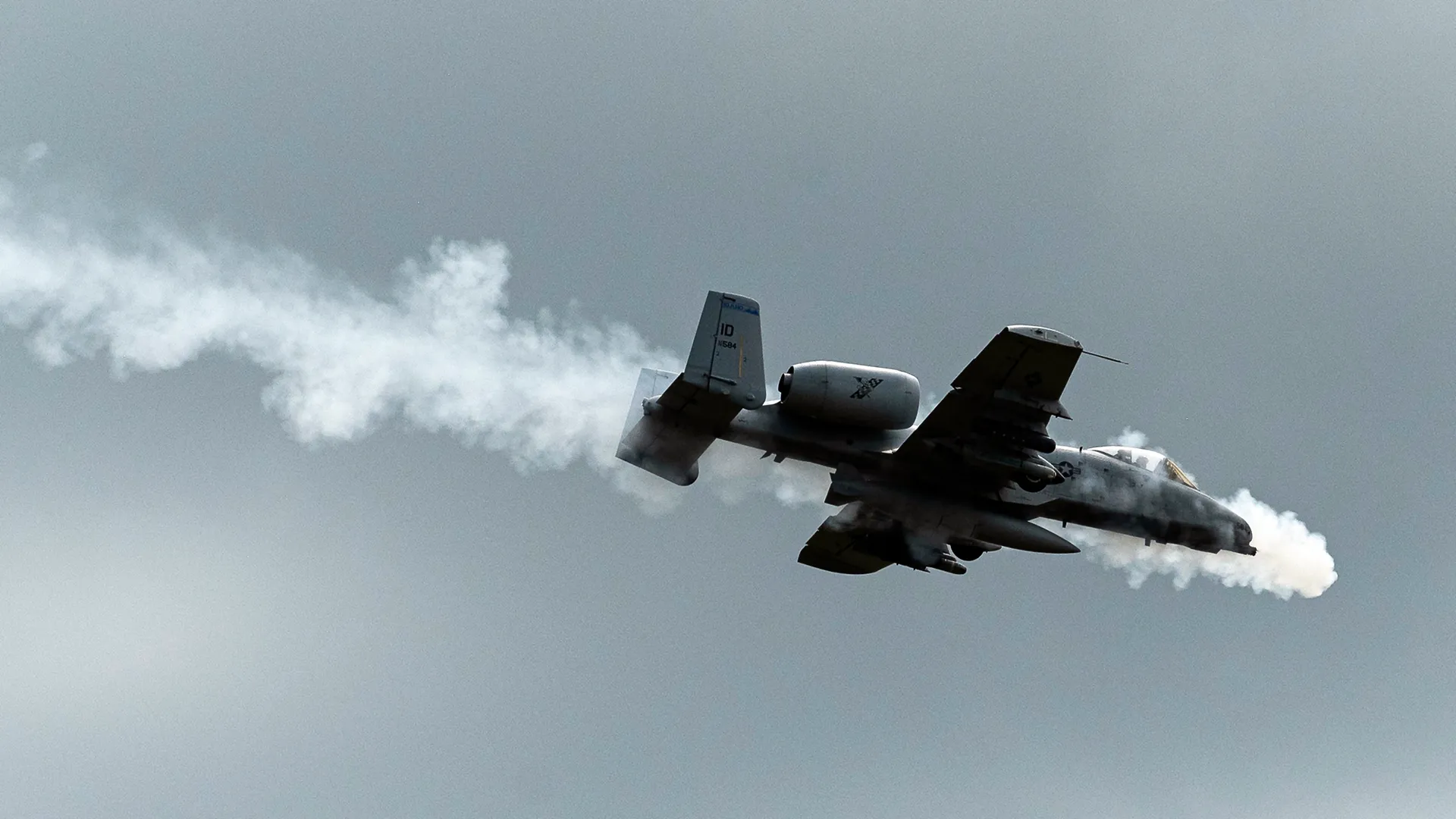
Videos have been going viral of A-10s doing strafing runs on targets in Iraq, largely focused on force protection of U.S. interests in the country. The threat from Iranian-aligned militias and other groups in Iraq has spiked since Operation Epic Fury began over four weeks ago. While seeing videos shot overseas of the Warthog using its GAU-8 30mm Avenger cannon is anything but new, the duration of some of the ‘trigger pulls’ shown certainly is.
One of these caught on camera appears to be roughly nine seconds long, with another being around six seconds long:
We reached out to various Warthog pilots to get commentary on what we are seeing with these prolonged strafing runs. They all have said the same thing, that it definitely isn’t normal or really trained for.
Dale Stark (@dalestartA10), a veteran A-10 pilot, told us that “it’s usually two to three seconds.” The A-10’s gun does its job by squirting out 3,900 rounds per minute, or roughly 65 rounds per second. It can technically deplete its 1,174 magazine drum in around 18 seconds of fire. But this is usually done in short bursts. The nine second gun run seen in the video above would have emptied half the drum. Accuracy also degrades during longer strings of fire. “Correct, bullet dispersion increases as the barrel heats up” from sustained firing, Stark told us.
Another A-10 pilot said the videos are indeed an outlier, and that they think doing such a long strafing run could only possibly make sense under very unique circumstances, such as dealing with a target dispersed over a large area, such as a group of troops, and with little time for subsequent strafing runs. Another former A-10 pilot said just the sound of the gun could be an intended effect to scare away potential attackers, but that isn’t a usual tactic.
Regardless, for ‘hog fans’ out there, seeing the A-10 in action during the swan song of its celebrated career is surely welcome, especially when some of the videos we are seeing showcase the aircraft’s most iconic feature in truly rare form.
The A-10’s activities during Operation Epic Fury also come as it appears that dozens more of the venerable attack jets are headed to the region to partake in the conflict. The timing is of special interest as a ground operation into Iranian territory could occur in the near future.
All of this comes as the USAF has demanded the A-10’s career comes to a close by the end of the decade, and has been pushing to retire the jets well before then, mainly due to concerns over the aircraft’s survivability. Still, its special capabilities are clearly in high demand, now apparently including extremely long-duration gun runs.
Weekly insights and analysis on the latest developments in military technology, strategy, and foreign policy.
With the iconic attack jet now in the twilight of its career, there are signs that the A-10C Warthog is set to deploy to the Middle East region for Operation Epic Fury. Such a deployment might well provide the combat swansong for the A-10, which the U.S. Air Force plans to retire for good by the end of the decade, if not sooner. The development comes as U.S. President Donald Trump ramps up his threats against Iran, including threatening to eliminate its civilian infrastructure and oil-producing capability.
Publicly available flight-tracking data today suggested that the Air Force was preparing to send a flight of A-10s across the Atlantic, with three KC-135 Stratotankers already airborne from RAF Mildenhall in England, apparently to meet TABOR 71, a flight of eight Warthogs headed in the opposite direction. Two of those jets were spares, according to unverified reports based on radio traffic.
Meanwhile, there are indications that as many as 20 A-10Cs have gathered at Portsmouth International Airport at Pease, New Hampshire, which is a standard jump-off point for a flight across to RAF Lakenheath in England, which has seen a major influx of U.S. combat jets in recent weeks.
Unconfirmed reports suggest these Warthogs are drawn from the 124th Fighter Wing of the Idaho Air National Guard at Gowen Field, and from the Michigan Air National Guard’s 127th Wing at Selfridge Air National Guard Base.
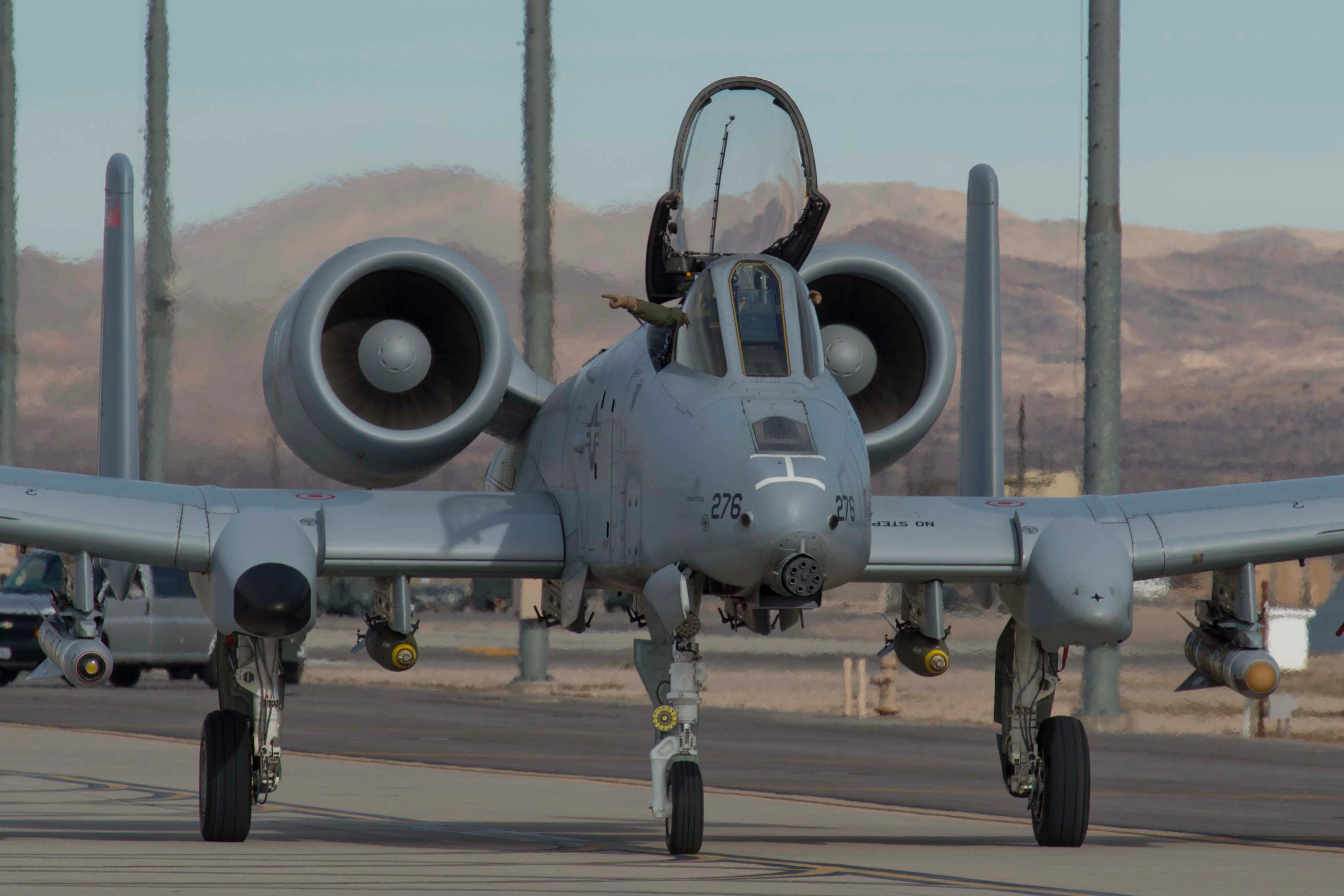
A-10Cs from the 190th Fighter Squadron at Gowen Field, Idaho, prepare for takeoff at Nellis Air Force Base, Nevada, taking part in a Green Flag exercise, designed to better train pilots in their role to support ground forces. U.S. Air National Guard Photo by Tech. Sgt. Sarah Pokorney/released Master Sgt. Sarah Pokorney
As we have discussed, A-10s are already helping dismantle Iran’s Navy, operating in the region in their long-standing, if often overlooked, maritime role. This is part of broader efforts by the U.S. military to find ways to reopen the critical waterway to normal maritime commerce, which has ground to a virtual halt in the face of Iranian attacks on shipping and its declaration that the strait is closed.
Having more A-10s in theater would provide additional capability, were the U.S. military to occupy or blockade Iran’s strategically vital Kharg Island, a prospect that we have discussed in detail in the past. A-10s could also provide valuable close air support for commando raids deeper into Iran.
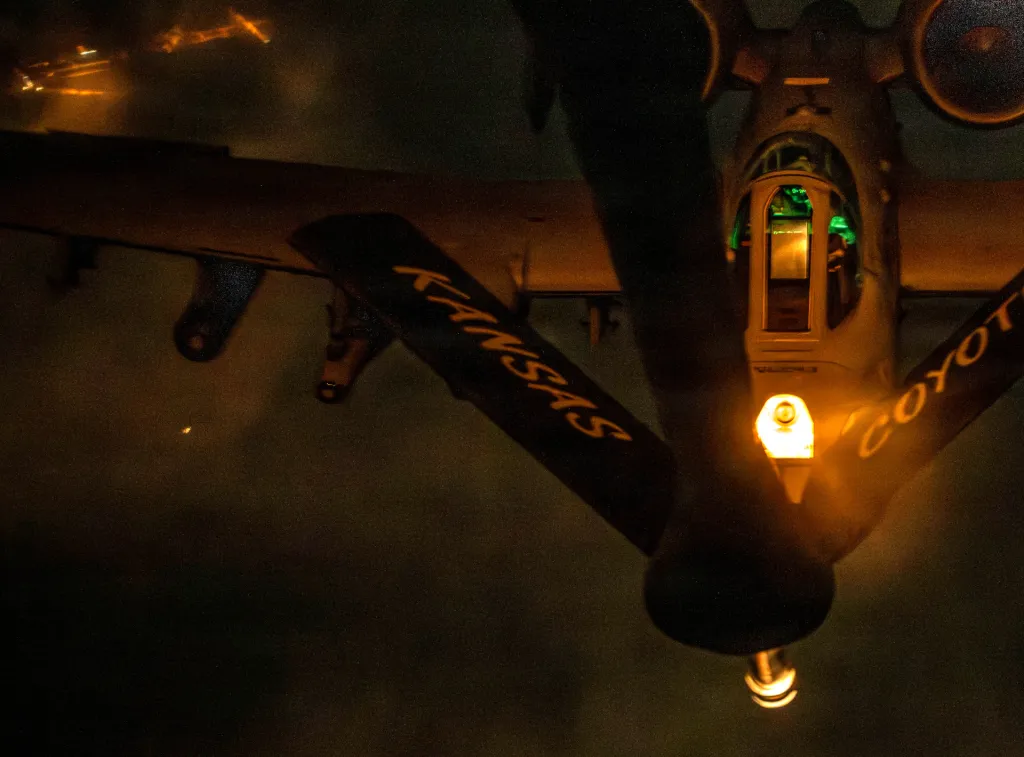
A U.S. Air Force A-10C prepares to refuel from a KC-135 Stratotanker aircraft over the U.S. Central Command area of responsibility during Operation Epic Fury, March 9, 2026. U.S. Air Force photo U.S. Central Command Public Affa
UPDATES:
A U.S. move against Kharg Island, as well as a potential commando raid to seize Iranian uranium, are two options apparently now on the table.
In his latest threat against Iran, President Donald Trump declared that the U.S. military will “obliterate” Iran’s Kharg Island if a deal is not reached shortly.
In a post on Truth Social, Trump today claimed the United States is in “serious discussions” with a “new and more reasonable regime” to end the war, but made direct threats against Kharg Island, as well as Iranian civilian infrastructure and oil-producing capability:
Great progress has been made but, if for any reason a deal is not shortly reached, which it probably will be, and if the Hormuz Strait is not immediately “Open for Business,” we will conclude our lovely “stay” in Iran by blowing up and completely obliterating all of their Electric Generating Plants, Oil Wells and Kharg Island (and possibly all desalinization plants!), which we have purposefully not yet “touched.”
President Donald Trump said Monday that the U.S. will “completely” obliterate Iran’s electric generating plants, oil wells and Kharg Island if the strategically vital Strait of Hormuz is not “immediately” reopened and a peace deal is not reached “shortly.”
In the same Truth Social post, Trump also raised the possibility of the United States declaring victory in the conflict without Iran reopening the Strait. This could come along with destroying much of Iran’s civilian infrastructure, including the Iranian people’s access to electricity and possibly clean drinking water.
In this message Trump:
– Signals the U.S. could end Iran mission without reopening Strait
– Threatens war crimes under international law
– Expects deal with Iran shortly despite mere days of intermediary-led message passing
Over the weekend, Trump said his “preference would be to take the oil” in Iran and that U.S. forces could seize the regime’s export hub on Kharg Island. Trump told the Financial Times that “my favourite thing is to take the oil in Iran, but some stupid people back in the US say: ‘why are you doing that?’” He also said: “Maybe we take Kharg Island, maybe we don’t. We have a lot of options.”
Trump to FT:
Maybe we take Kharg Island, maybe we don’t. We have a lot of options.
Over the weekend, the New York Timesreported that around a hundred U.S. special operations forces have arrived in the Middle East, joining thousands of Marines and Army paratroopers already in the region.
“The commandos, including Army Rangers and Navy SEALs, have not yet been assigned specific missions,” the report stated, citing unnamed U.S. officials, although a mission to try to seize Kharg Island is certainly a possibility.
Several hundred U.S. Special Operations forces, including Army Rangers and Navy SEALs, sent to Mideast to join thousands of Marines and paratroopers as Trump weighs ground operations against Iran w/@helenecooperhttps://t.co/Lcw9GnYHJY
Trump confirmed to Caitlin Doornbos of the New York Post that U.S. officials are negotiating with Iranian parliamentary speaker Mohammad Bagher Ghalibaf. The U.S. leader added that he expected to “find out in about a week” whether he is someone America can truly work with.
President Trump confirmed to me today that the US is negotiating with Iranian parliamentary speaker Mohammad Bagher Ghalibaf, saying we’ll “find out in about a week” whether he is someone America can truly work with.
On the nuclear issue, the Wall Street Journal is reporting that Trump is weighing up a military operation to extract nearly 1,000 pounds of uranium from Iran, citing unnamed U.S. officials.
TWZ had previously explored the possibility of U.S. and/or Israeli authorities launching a special operations ground raid to extract or otherwise neutralize Iran’s stockpile of enriched uranium. Given that this nuclear material is understood to be stored in deep underground bunkers, it is far from easy to achieve this objective from the air alone. Israel has demonstrated its ability and willingness to carry out complex raids on subterranean facilities, but any such operation would still face immense risks and uncertainties.
NEW; President Trump is weighing a military operation to extract nearly 1,000 pounds of uranium from Iran, according to U.S. officials, a complex and risky mission that would likely put American forces inside the country for days or longer. https://t.co/R87wGm2ukF
In related news, satellite imagery dating from last June was published over the weekend, suggesting that Iran might have moved at least some of its highly enriched uranium to a secure base to protect it from airstrikes.
Over the weekend, @lemondefr and @francoisdm published a VERY interesting image of what appears to be some of Iran’s highly enriched uranium enroute to a secure base in Isfahan last June. Amidst all this talk of seizing Iran’s uranium, it’s worth discussing…🧵 pic.twitter.com/hvmWNEsjq6
Using Pakistan as a mediator, the United States provided Iran with a 15-point ceasefire proposal last week, including reopening the Strait of Hormuz — which carries around 20 percent of the world’s oil supply — and curbs on Iran’s nuclear programs. So far, Tehran has rejected the proposals. U.S. Secretary of State Marco Rubio also toldAl Jazeera that another condition is that Iran must stop producing drones and missiles of the kinds used in combat in recent weeks.
For its part, Tehran wants an end to Israeli attacks on Iranian allies in the region as part of any negotiated deal. There are also suggestions that Iran is pushing for reparations for war damage and even the removal of U.S. military bases from the Middle East.
Speaking to journalists, Esmaeil Bagaei, an Iranian diplomat who is the current spokesperson for the Ministry of Foreign Affairs, said Iran had received messages via intermediaries indicating U.S. willingness to negotiate, but said that the American proposals were “unrealistic, illogical, and excessive.”
“Our position is clear. We are under military aggression. Therefore, all our efforts and strength are focused on defending ourselves,” Baghaei added.
Iranian Foreign Ministry spokesman Esmail Baghaei told reporters that the demands in the U.S. 15-point proposal were “excessive, unrealistic and unreasonable.” His comments directly contradicted Mr. Trump, who said last week that Iran had agreed to most of the points.…
Trump claims Iran will allow 20 oil tankers to pass through the Strait of Hormuz starting Monday morning and continuing over the next few days as a “present.”
“They gave us 10 [ships through the strait],” he said, in reference to earlier claims. “Now they’re giving 20…”
Trump added that Mohammad Bagher Ghalibaf, Iran’s parliamentary speaker, had authorised the additional tankers.
“He’s the one who authorised the ships to me,” Trump told the Financial Times. “Remember I said they’re giving me a present? And everyone said: ‘What’s the present? Bullshit.’ When they heard about that they kept their mouth shut and the negotiations are going very well.”
U.S. President Donald J. Trump tells reporters aboard Air Force One that Iran has given the United States a “tribute” of 20 oil tankers that are expected to begin crossing Monday morning through the Strait of Hormuz. pic.twitter.com/IBOt9OkumU
Scott Bessent, the U.S. Secretary of the Treasury, told Fox News today that “We are seeing more ships pass daily… but over time, the U.S. is going to retake control of the straits, and there will be freedom of navigation, whether through U.S. escorts or a multinational escort.”
Sec Scott Bessent on the Strait of Hormuz:
“We are seeing more ships pass daily… but over time, the U.S. is going to retake control of the straits, and there will be freedom of navigation, whether through U.S. escorts or a multinational escort.” pic.twitter.com/XwdHKRhwzT
The Economistreports that Iran, whose tankers continue to operate through the strait, is now earning nearly twice as much from oil sales each day as it did before the conflict began.
Absolutely remarkable. “Iran is now earning nearly twice as much from oil sales each day as it did before American and Israeli bombs started falling on February 28th. It may be pummelled on the battlefield, but the regime is winning the energy war.” https://t.co/Nnky62LjAW
PHOTO OF THE DAY: Tehran was loading five (5!!!) oil tankers simultaneously yesterday at Kharg Island, as the US-Israel-Iran war enters into its fifth week.
Based on information provided by U.S. government officials and Wall Street analysts, Bloombergpredicts that oil prices could continue to surge, up to unprecedeted $200 per barrel.
Elsewhere in the oil war, Iranian parliamentary speaker Mohammad Bagher Ghalibaf took to X to argue that pre-market statements from the White House or messages on the Truth channel are “often just a setup for profit-taking,” something that appeared to come true hours later.
The conflict expanded further over the weekend, bringing with it the prospect of additional disruption to commercial shipping, with the entry into the war of the Houthis in Yemen.
Houthi forces, close allies of Iran, said on Saturday they had fired a salvo of ballistic missiles at “sensitive Israeli military sites” and that they would continue military operations until the “aggression” came to an end on all fronts. Israel said today that it had intercepted two drones originating in Yemen.
There is now the risk that the Houthis could attempt to close the narrow Bab al-Mandab strait to maritime traffic. This would effectively close off the Red Sea to shipping, just as Iran has in effect shut the Strait of Hormuz.
The port in the northern Israeli city of Haifa was struck today, apparently by debris from an intercepted missile. Videos posted to social media showed part of the Bazan oil refinery there on fire. Israel’s fire and rescue service confirmed the incident, but there were no immediate reports of any casualties or damage to production facilities.
The Wall Street Journal is among those reporting that the oil refinery was hit by an Iranian missile.
The United Arab Emirates says its air defenses have intercepted 11 ballistic missiles and 27 drones launched from Iran today.
Overall, the defense ministry of the UAE says it has engaged 1,941 drones and 440 missiles since the war began.
“The Ministry of Defense affirmed that it remains fully prepared and ready to deal with any threats and will firmly confront anything that aims to undermine the security of the country, in a manner that ensures the protection of its sovereignty, security, and stability and safeguards its interests and national capabilities,” it said in a statement shared on social media.
UAE air defences engaged 11 ballistic missiles and 27 UAV’s.
The UAE air defences on 30th March 2026 engaged 11 ballistic missiles and 27 UAV’s launched from Iran.
Since the start of the blatant Iranian attacks, UAE air defences have engaged 425 ballistic missiles, 15 cruise… pic.twitter.com/l7vQknja23
Meanwhile, the Bahrain Defense Force (BDF) has also provided a tally of its air defense operations since the conflict began on February 28. The BDF says its air defense units have now intercepted and destroyed 398 drones and 182 missiles launched by Iran.
Oman’s port of Salalah was hit by a drone over the weekend, leaving one worker injured and causing minor damage to the facility. The Danish shipping firm Maersk announced today that operations at the port would restart from Tuesday.
Maersk said the damage was “limited” and that the port’s management would take “necessary measures” to progressively build up to full capacity.
Two kamikaze drones struck Salalah Port in Oman today, causing damage to a single container gantry crane.
So far, Oman’s keeping quiet and Iran hasn’t stepped up to claim the hit either. pic.twitter.com/E66GQNI02E
Another ballistic missile launched from Iran has been shot down after it entered Turkish airspace. Turkey’s defense ministry confirmed that the missile had been brought down by undisclosed NATO air and missile defenses deployed in the eastern Mediterranean.
This is the fourth such incident since the start of the Iran war, following three earlier interceptions by NATO air defense systems earlier this month.
BREAKING: Turkish MoD:
A ballistic munition, determined to have been launched from Iran and to have entered into Turkish airspace, has been neutralized by NATO air and missile defence assets deployed in the Eastern Mediterranean. pic.twitter.com/FnMfGJrKdA
Footage has emerged showing a British Army air defense team shooting down an Iranian attack drone over the Middle East with a Martlet Lightweight Multirole Missile (LMM). At least four RAF Regiment gunners have received ace status, shooting down five or more drones, the U.K. Ministry of Defense has said. Traditionally, an aerial ace applies to a pilot who has shot down five or more crewed aircraft in air-to-air combat.
Footage of a British air defense team shooting down an Iranian attack drone over the Middle East with an LMM Martlet SAM.
At least four RAF Regiment gunners have received ace status, shooting down 5 or more drones, while UK forces have shot down dozens of drones in the region. pic.twitter.com/HLKeHmQlc9
The Israeli Defense Forces (IDF) claims it has struck a university in Tehran run by Iran’s Revolutionary Guards Corps (IRGC), saying that the institution was used for advanced weapons research.
“In recent days, one of the IRGC’s central military infrastructure sites was struck, located within the compound of Imam Hossein University — the IRGC’s primary military academic institution, which also serves as an emergency asset for the regime’s military bodies,” an Israeli military statement said.
Israel’s military says that it had struck a university in Tehran run by Iran’s Islamic Revolutionary Guard Corps (IRGC), claiming the institution was used for advanced weapons research.https://t.co/NsNfly8fUh
Iran’s Ministry of Energy also claims that attacks were made on electricity infrastructure in the Tehran province, parts of the city of Tehran, and Alborz province, leaving them without electricity.
Iran’s Ministry of Energy has said following “attacks on electricity infrastructure in Tehran province, parts of the city of Tehran and Alborz Province”, electricity has been cut off in those areas and efforts are ongoing to resolve this matter, according to Iranian outlets. https://t.co/mcX4SVBVEG
— Ghoncheh Habibiazad | غنچه (@GhonchehAzad) March 29, 2026
On its second front, Israel has launched a new wave of strikes targeting Beirut’s southern suburbs — the first since Friday in the area, which is now largely deserted. Israel issued a warning for people in the Hezbollah stronghold to leave ahead of the latest strikes.
The Israeli military is also hitting targets in Lebanon’s south, one of which targeted an army checkpoint and killed a Lebanese soldier.
Lebanon was dragged into the conflict when the Iran-backed armed Hezbollah group began firing rockets at Israel on March 2, in revenge for the killing of Iran’s supreme leader at the start of the war.
Israel is conducting large-scale air strikes across Lebanon as well as a ground offensive in the south.
Spain has said it will not allow U.S. military aircraft involved in attacks on Iran to use its airspace.
“We don’t authorise either the use of military bases or the use of airspace for actions related to the war in Iran,” the country’s defense minister, Margarita Robles, told reporters in Madrid this morning.
Spanish newspaper El Paísreported the airspace closure, which forces U.S. military aircraft to bypass Spain other than in emergency situations, in which case the aircraft will be permitted to transit or land.
“We have denied the United States the use of the Rota and Morón bases for this illegal war. All flight plans involving operations in Iran have been rejected. All of them, including those for refuelling aircraft,” Spanish Prime Minister Pedro Sánchez said last week.
Morón Air Base near Seville serves as a key refueling and logistics hub for European and Middle Eastern operations by the U.S. Air Force. Naval Station Rota is another joint facility used by the U.S. Navy and also falls under Spanish sovereignty.
Israel apparently plans to invite the United States to relocate some of its bases in the region to Israel — and to establish new bases in the country — after the current conflict ends, Channel 12reports, citing unnamed security sources.
The security establishment sees an opportunity to “reshape the map” of U.S. military positioning in the Middle East, the report says, given that US forces are already present here now and in light of evolving security challenges.
Israel, for the first time, is planning to propose to the Trump Administration the development of U.S. military bases on its soil, including the construction of new bases and the relocation of existing military bases in countries across the Middle East, senior officials tell… pic.twitter.com/nZVM65cGON
Iran’s Revolutionary Guards Corps (IRGC) has now confirmed the death of Alireza Tangsiri, the IRGC naval commander who was killed in an Israeli airstrike last Thursday, according to a statement by the guards being carried in Iranian media.
According to the United States, Tangsiri oversaw the IRGC Navy’s testing of cruise missiles and sat on the board of a company that developed armed drones. Tangsiri had reportedly been leading Iran’s successful effort to effectively close the Strait of Hormuz.
The Islamic Revolution Guards Corps (IRGC) in a statement announced the martyrdom of the Commander of IRGC Navy Brigadier General Alireza Tangsiri and emphasized that the path of resistance will continue with strength. pic.twitter.com/RBJSJ8AqWQ
An Iraqi Air Force An-32 Cline turboprop transport was the victim of an apparent drone strike launched by Iran-backed militia. Last week, we reported on the apparent use of short-range kamikaze drones operated by militia to successfully target a U.S. military Black Hawk helicopter and a critical air defense radar at an American base in Iraq.
Iranian-backed militia drones managed to severely damage an Iraqi Air Force An-32B transport aircraft at Baghdad International Airport tonight pic.twitter.com/osdaqLoKdG
In a nod to Iranian attacks on high-end U.S. military hardware in the conflict, the nose of this Shahed-136 long-range one-way attack drone is marked with symbols denoting a U.S. Air Force E-3G Sentry radar plane — an incident you can read all about here, an AN/TPY-2 radar primarily associated with the Terminal High Altitude Area Defense (THAAD) anti-ballistic missile system, and an AN/MPQ-65 radar from a Patriot air defense system.
Weekly insights and analysis on the latest developments in military technology, strategy, and foreign policy.
Venerable A-10 Warthog attack jets are helping dismantle Iran’s Navy. Though the A-10 is most commonly associated with missions over land, the jets have a long-standing, if often obscure, maritime role. Moreover, Warthog pilots have been training for decades for the specific scenario of hunting Iran’s fleets of fast boats in and around the highly strategic Strait of Hormuz. All of this comes as the U.S. military works to find ways to reopen the critical waterway to normal maritime commerce, which has ground to a virtual halt in the face of Iranian attacks on shipping and its declaration that the strait is closed.
Chairman of the Joint Chiefs of Staff U.S. Air Force Gen. Dan “Razin” Caine discussed the A-10’s contribution to the current conflict with Iran at a Pentagon press conference this morning. The U.S. military has previously disclosed the basic fact that Warthogs have been supporting what is dubbed Operation Epic Fury. A-10s have previously been seen attacking Iranian-backed militias in Iraq. The A-10 is very much in the twilight of its career, with the Air Force hoping to have the type retired for good by the end of the decade, if not sooner.
An A-10 seen linking up with a tanker while flying a mission in support of Operation Epic Fury. CENTCOM
“The A-10 Warthog is now in the fight across the southern flank [of Iran] and is hunting and killing fast attack watercraft in the Strait of Hormuz,” Caine said.
Caine also said that AH-64 Apache attack helicopters are now operating in a similar manner as the A-10, but did not say specifically that they were being used against maritime targets. He did note that U.S. allies in the region have been using their own AH-64s to help shoot down incoming Iranian drones, something that has been observed already in the course of the current conflict. Israel has long used Apaches in the counter-drone role, and TWZ has been closely tracking work to expand the helicopter’s capabilities in this regard, including by the U.S. Army.
“We continue to hunt and kill [Iranian] afloat assets, including more than 120 vessels and 44 mine layers,” the Chairman also said, speaking more broadly. The total destruction of Iran’s naval forces is one of the core stated goals of Operation Epic Fury.
When it comes to the A-10, as noted, despite years of the aircraft being referred to as a ‘single mission’ platform geared solely to close air support missions in support of ground forces, it has long had a maritime role. Just weeks before the current conflict erupted, the U.S. military underscored this reality by releasing pictures showing Warthogs training together with the USS Santa Barbara, a U.S. Navy Independence class Littoral Combat Ship (LCS) in the Persian Gulf.
“The irony here is that the A-10’s continued use in the Middle East goes against a prevailing narrative that the Warthog needs to go because its utility is limited on the modern battlefield. This argument is not without merit, but it assumes that every tactical air asset in the inventory needs to be able to fight on the front lines on day one of a conflict with a peer-adversary, and that there are not many other tasks needing to be done beyond firing the shots at the ‘tip of the spear’ during such a conflict. It’s also worth noting that the A-10 remains the least expensive tactical jet to operate in the USAF’s stable.”
“Regardless of the A-10’s impending fate, its ability to deliver rapid, highly precise attacks on small, fast-moving targets, and its ability to loiter for extended periods while soaking up small arms fire, means that its talents can be applied directly to the maritime domain. This is especially true when it comes to countering small boats that can pose a big danger to much larger ships. Such asymmetric dangers are only amplified for ships operating in tight, complex littoral environments, where threats can emerge quickly and attack in large packs, leaving even the most powerful warship’s defenses overwhelmed.”
An A-10 flies past the Independence class LCS USS Santa Barbara during an exercise in the Persian Gulf in early February 2026. USN
This particular exercise also underscored the danger posed by Iranian naval mines, and how A-10s could help protect ships tasked to clear them. The Santa Barbara is one of three Independence class LCSs configured for minesweeping duties that had been forward deployed in the Middle East last year to fill gaps left by the decommissioning of a quartet of Avenger class mine hunters. Those ships have become a separate topic of discussion after two of them, the USS Tulsa and USS Santa Barbara, emerged thousands of miles away to the east, first in Malaysia and now in Singapore. Why the Navy sent those ships not just out of harm’s way in the Middle East in the run-up to the current conflict, but then to an entirely different theater remains largely unexplained.
In general, threats posed by small boats, especially operating in swarms, are not new. This is also an area where Iran’s Islamic Revolutionary Guard Corps has invested heavily for decades, as TWZ has explored in the past. U.S. officials have previously declared the Iranian Navy to have been rendered combat ineffective, but many of the more than 120 ships it has targeted so far have been larger vessels. Iran has hundreds of fast boats, some of which are armed with short-range anti-ship missiles, as well as artillery rockets and other weapons. They can also be used to lay naval mines. These fleets are inherently harder to find and fix, and do not need large ports to operate from. The A-10’s attributes, including its long loiter time, make it a key tool for interdicting these threats.
All of this is now further magnified by the expanding use of explosive-laden drone boats. Though kamikaze uncrewed surface vessels are now firmly in the public consciousness as a result of their use in the conflict in Ukraine, Iran and its regional proxies pioneered their use in Middle Eastern waterways years beforehand. This is a capability that Iran has now brought to bear in its efforts to keep the Strait of Hormuz closed to regular maritime traffic.
In terms of air defense threats around the Strait of Hormuz, this likely comes mainly from shoulder-fired surface-to-air missiles, or man-portable air defense systems (MANPADS), at this point in the conflict. Despite concerns voiced about their survivability over the years, A-10s are capable of fighting in that kind of threat ecosystem.
U.S. Central Command has previously released pictures showing Warthogs flying in support of Epic Fury carrying loadouts that include 70mm APKWS II laser-guided rockets and AGM-65 Maverick air-to-surface missiles, as well as AIM-9M Sidewinder air-to-air missiles. The A-10s also have their iconic built-in 30mm GAU-8/A Avenger cannons. APKWS IIs, AGM-65s, and the GAU-8/A are all weapons that can be effectively employed against targets at sea, including small boats, along with various threats on land.
An A-10 carrying a mixture of APKWS II rockets, AGM-65 Maverick missiles, and AIM-9M Sidewinders seen during a sortie in support of Operation Epic Fury. CENTCOM
These are also just the A-10 loadouts that have been shared publicly. The Warthogs can carry a wide array of other precision-guided munitions that could be employed against Iranian boats sitting in port or on the move in and around the Strait of Hormuz, as well as other targets.
As an aside, when A-10s carry AIM-9Ms, it is typically for self-defense, but the Warthogs could also possibly use those missiles to engage Iranian one-way attack drones if the opportunity were to arise. A-10s are also capable of employing air-to-air optimized versions of the APKWS II rocket against drones, as you can read more about here.
Chairman Caine’s confirmation this morning that A-10s are flying missions over and around the Strait of Hormuz also comes amid a clear uptick in overall U.S. operations in this particular area.
“As reported by U.S. Central Command yesterday, the U.S. military dropped 5,000-pound penetrator weapons into underground storage facilities storing coastal defense cruise missiles and other support equipment,” Caine also said. “These [bunker-buster] weapons are bespokely designed to get through concrete and or rocks and function after penetrating those barriers.”
The Chairman did not name the bombs in question, which have previously been reported to have been new GBU-72/B types, as you can learn more about here.
“We continue to hunt and kill mine storage facilities and naval ammunition depots,” Caine added.
It is possible that the A-10’s role in the littorals along Iran’s southern coast could expand in the coming weeks. Reuters reported yesterday that the U.S. military is considering a range of new options for trying to reopen the Strait of Hormuz, including a possible ground incursion to temporarily occupy parts of the Iranian shoreline. A potential mission to seize control of Iran’s highly strategic Kharg Island in the Persian Gulf has also been raised. A group of Navy amphibious warfare ships laden with Marines is already reportedly on its way to the Middle East. U.S. Navy warships escorting convoys of commercial vessels through the strait is another possibility, but American officials have downplayed the prospect of that starting any time soon. Any of these courses of action entails significant risks.
U.S. President Donald Trump has notably gone back and forth in recent days about a desire for a broader international mission to help get commercial ships flowing again through the strait. After being publicly rebuffed by several allies and partners, Trump said the United States no longer required any help.
“I wonder what would happen if we ‘finished off’ what’s left of the Iranian Terror State, and let the Countries that use it, we don’t, be responsible for the so called ‘Straight?’ [sic],” Trump then wrote yesterday in a post on his Truth Social site. “That would get some of our non-responsive ‘Allies’ in gear, and fast!!!”
Trump: “I wonder what would happen if we ‘finished off’ what’s left of the Iranian Terror State, and let the Countries that use it, we don’t, be responsible for the so called ‘Straight?’ That would get some of our non-responsive ‘Allies’ in gear, and fast!!! President DJT” pic.twitter.com/pwbF1lYELS
In the meantime, we know that A-10s are now actively on the hunt for Iranian maritime threats around the Strait of Hormuz as part of what could be one of the Warthog’s last major combat deployments ever.