warrant

Catalan separatist Puigdemont to return to Spain after warrant lifted | Elections News

Spain’s Constitutional Court ruled an amnesty law for Catalan separatists applied to the politician.

Self-exiled Catalan separatist leader Carles Puigdemont could be set to return to Spain after the country’s Constitutional Court ruled that an amnesty law for Catalan separatists applies to embezzlement charges against Puigdemont.

A Supreme Court judge then lifted a warrant for Puigdemont’s arrest on Tuesday, clearing the way for his return without fear of arrest.

Recommended Stories

list of 3 itemsend of list

Puigdemont, then president of Catalonia, fled to Belgium in 2017 after holding an independence referendum for his self-governing region to break away from Spain. Madrid said the vote was illegal.

Catalonia unilaterally declared independence from Spain that year after the referendum, with 90 percent of voters backing independence.

He has since avoided several extradition attempts by Spain to face trial over the vote, while many of his confidants and supporters spent time in prison.

Members of Puigdemont’s political party Junts welcomed his potential return.

“It’s a great victory for President Puigdemont and the two other exiled ‌[leaders in Belgium]”, Jordi Turull, secretary-general of Junts, told reporters.

“They held firm, they resisted, they prevailed in Europe, and today they have prevailed against the Spanish state.”

Junts’ role in Spain’s snap election

Puigdemont appears set to return to Spain just as the country is preparing for a snap election in November, although an official from his Junts party said he is unlikely to take part.

Prime Minister Pedro Sanchez was only able to remain in power in 2023 when Puigdemont’s Junts party, along with another Catalan party, backed his new government in exchange for the amnesties.

A year ago, Junts withdrew its support for the minority central government, and the party was decisive in Spain’s progressive government losing two key votes in parliament this week when it tried to push through emergency housing measures amid street protests.

Sanchez responded by calling a November snap election, hoping anger over housing will mobilise his voters.

The prime minister told ⁠reporters on Tuesday he did not regret launching the amnesty and welcomed the court ruling.

“I believe the important message is that of coexistence among Catalans,” he said.

Although separatism has lost ground and Junts is trailing in opinion polls, Puigdemont’s return could prompt renewed political drama.

Spain’s conservative People’s Party is leading in opinion polls ahead ‌of the election and may need to seek the support of Junts and other centre-right parties to govern.
Source link

Ex-NFL star Antonio Brown to accept plea deal in attempted murder case

Former NFL star Antonio Brown has accepted a plea deal that will reduce the charge of attempted second-degree murder he’s facing in Florida to aggravated assault, his attorney told The Times on Wednesday.

The move will result in a significantly lighter sentence for the Super Bowl LV champion, according to attorney Mark Eiglarsh, who said Brown would receive three years of probation with the possibility of early termination after half that time is served.

A conviction for the first-degree felony of attempted second-degree murder with a firearm would have brought a prison sentence of 20 to 30 years.

Eiglarsh added that Brown will be given a withholding of adjudication, meaning he will not be considered a convicted felon. He also said that the main requirement of Brown’s probation is simply “staying away from the alleged victim, which he has no problem doing.”

“No community service hours,” Eiglarsh said. “No anger management. No evaluation psychologically. No drug treatment, no evaluations for anything like that. No letter of apology, no fines, nothing.”

A spokesperson for the Miami-Dade County state attorney’s office would not confirm that a plea deal had been reached, stating in an email that “whatever is to transpire regarding an open & pending case will be fully clarified at the next hearing,” which is scheduled for Sept. 30.

A warrant was issued for Brown’s arrest in June 2025 stemming from an altercation outside a celebrity kickboxing event in Miami the previous month. According to the warrant, “cell phone video obtained from social media” showed Brown advancing toward the other man with a gun in hand and captured “two shots which occur as Mr. Brown is within several feet” of the alleged victim.

Brown wasn’t arrested until November, when he was apprehended by U.S. Marshals in Dubai. He entered a not guilty plea to the first-degree felony charge of attempted second-degree murder with a firearm.

In December, Brown filed a motion for the case to be dismissed under Florida’s “Stand Your Ground” law, which means an individual has no duty to retreat before using deadly force in certain circumstances of self-defense.

Earlier this month, the alleged victim, Zul-Qarnain Kwame Nantambu, released a statement through his attorney saying that he “does not wish to participate” in Brown’s prosecution.

In a statement sent to news organizations on Wednesday morning, Eiglarsh said that despite changing his plea, Brown still maintains that he acted lawfully during the incident.

“Antonio believes in his innocence. He believes strongly in his Stand Your Ground defense, and he believes he would ultimately prevail at trial,” Eiglarsh said. “But when prosecutors put an offer on the table that transforms a potential decades-long prison sentence into a significantly reduced charge and probation, there was simply no way he could reasonably turn it down.”

He added: “Antonio has eight children who depend upon him, and every additional day this case remains unresolved creates extraordinary obstacles for him in securing endorsement opportunities and other business opportunities necessary to support his family. He has spent more than 10½ months living under the cloud of a case with no realistic end in sight. At some point, closure has tremendous value.”

Source link

Newsom signs bills to shield California elections from Trump interference, increase transparency

Gov. Gavin Newsom on Saturday signed legislation to increase security for the state’s voting systems and protect Californians’ ability to cast ballots in an effort to guard against potential interference in the Nov. 3 election, including by the Trump administration.

Newsom pointed to the Trump administration’s recent effort to restrict mail-in voting through the U.S. Postal Service, which was struck down by the U.S. Supreme Court, and the presence of federal monitors at California polls last year as evidence that Trump “will continue his efforts to interfere with the November election.”

“Donald Trump won’t stop until he can exert dictatorial control over your free vote and disenfranchise millions of people this November. California will stop him at every opportunity,” Newsom said in a statement.”We have no bigger task than fighting to protect the right to vote from interference and meddling — the future of democracy is on the line. These bills today build upon the wall California has built to safeguard our electoral process.”

The governor signed the package of bills at the Japanese American National Museum in Little Tokyo, where a year earlier federal agents gathered outside a political rally he was hosting. Then Border Patrol Sector Chief Gregory Bovino, who had been leading the immigration operations in California, was among those outside the event, joined by agents in helmets, camouflage, masks and holding guns. Newsom described their presence as political intimidation.

One bill Newsom signed Saturday cites efforts to “weaponize law enforcement authority for political purposes,” including Republican “Sheriff Chad Bianco’s seizure of ballots in Riverside County,” and the election monitors sent by the U.S. Justice Department to polling sites in five counties during a 2025 special election on redistricting.

Such moves “have given rise to unprecedented concerns about law enforcement interference” in elections and “[demonstrate] that these threats are not merely hypothetical,” the bill by Sen. Tom Umberg (D-Santa Ana) reads.

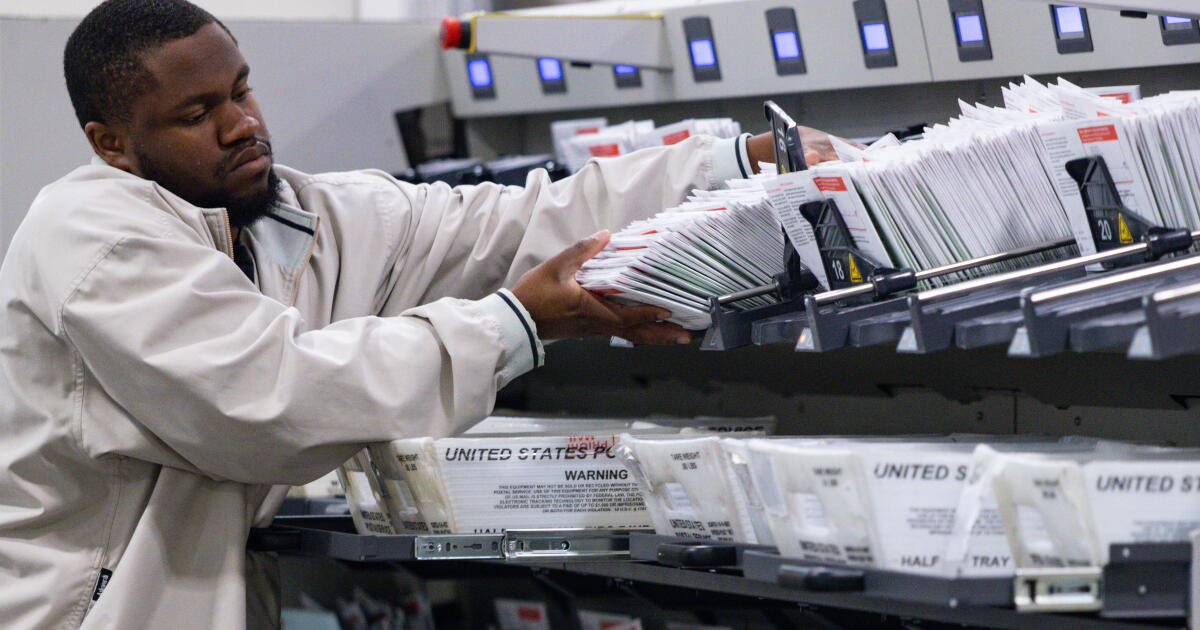
The law, Senate Bill 884, which takes effect immediately, requires counties to open ballot drop-off locations 30 days before an election — two days earlier than usual — and allows counties to ban electioneering, or trying to influence voters’ decisions, within up to 200 feet of polling sites. It also bans police from making arrests near voting locations except for crimes against people, property, or disrupting the voting process.

Bianco, a GOP candidate for governor who placed fourth in the primary, drew swift condemnation and legal challenges this spring after he ordered deputies to seize more than 650,000 ballots from the Riverside County elections office. Voting rights groups and Atty. Gen. Rob Bonta challenged the move, which is being decided by the California Supreme Court.

Bianco carted off truckloads of ballots from the Riverside County Registrar of Voters in February after securing a warrant based on claims that the office allowed fraudulent votes in the special election to redraw California’s congressional districts under Proposition 50 in 2025.

Earlier this year, Newsom signed a bill preventing local and federal law enforcement agencies from taking ballots without a warrant.

On Saturday the Democratic governor signed a bill making it a felony to seize or order the seizure of ballots, election records or voting machines. Future seizures could be punishable by up to four years in prison.

“The federal administration and those seeking to spread lies about our democracy continue to call for interference in elections in ways we have never seen before in this country,” Assemblymember Gail Pellerin (D-Santa Cruz), the bill’s author and a former longtime county elections chief, said last month. “AB 282 helps ensure that every lawfully cast vote can be counted, and that the will of the voters of every political party will be respected.”

Republican lawmakers argued in previous hearings that the bill is unnecessary because it is already a crime to steal ballots.

Another bill, Senate Bill 259, makes it a crime to interfere with a mail ballot on the way to or from a voter or order the seizure of ballots that are in transit to a local elections office.

Newsom signed Assembly Bill 1664, which requires elections officials to immediately notify the attorney general and secretary of state immediately upon learning of any warrants, subpoenas or law enforcement investigations involving election records or voting equipment.

Newsom also signed bills to boost protections under the California Voting Rights Act, including an explicit ban on voter suppression and expanded access to election materials in languages other than English.

The governor also signed legislation to require more transparency from social media influencers who are paid by political campaigns. The measure, Assembly Bill 1130, came in the wake of a controversy in the June primary election when social media influencers took on a more visible role in the campaigns.

Candidates including Democratic billionaire Tom Steyer paid thousands of dollars to influencers who posted videos endorsing Steyer or talking about him in a positive light. These videos did not always disclose that influencers were paid by a candidate’s campaign.

Source link