warner bros. takeover

Paramount-Warner Bros. deal on hold after court ruling

Hollywood’s biggest deal in decades is on hold.

On Monday, a federal judge temporarily blocked Paramount Skydance’s efforts to complete its purchase of Warner Bros. Discovery, ruling that the proposed $111-billion merger “raises serious questions” about whether the combination violates U.S. antitrust law.

District Judge Araceli Martínez-Olguín, based in Oakland, granted a request for a temporary restraining order from a coalition of 12 state attorneys general, led by California Atty. Gen. Rob Bonta, to freeze the deal while the court delves more closely into its impact on markets.

The order pauses the deal for 14 days. Martínez-Olguín’s ruling sets up a showdown for Aug. 3, when she considers a motion for a preliminary injunction — which, if granted, could tie up the deal for months in advance of a trial.

“This is a critical first win in our case to ensure this megamerger never sees the light of day,” Bonta said in a statement. “History tells the tale of what happens when a few people have great power over markets that are central to Americans’ lives: fewer opportunities for more people, worse products and services for all people.”

Two century-old film studios — with rights to Harry Potter, Batman, Scooby-Doo, “Top Gun,” “Ted Lasso” and “Game of Thrones” — would be combined, and HBO, CNN and HGTV would come under new ownership.

“The judge basically said, ‘Look, let’s not race to the finish line here,’” Eric Talley, a Columbia Law School professor, said in an interview. “At the end of the day, maybe this thing gets signed off on, but I think the AGs are going to be given a fair chance to bring their claims forward.”

The ruling dealt a blow to tech scion David Ellison’s efforts to quickly finalize his massive merger, which has the support of President Trump. Ellison wants to complete the deal by September to avoid a higher payout to Warner Bros. Discovery shareholders.

Paramount, in a statement, said the restraining order simply preserves the status quo, which Paramount had already pledged to do in court papers last week that offered to hold off on finalizing the transaction.

“We are confident the evidence will demonstrate that the State AGs’ antitrust arguments are without merit as their alleged markets and claims of anticompetitive effects are without any basis in modern market realities,” Paramount said in the statement.

Larry Ellison, co-founder of software giant Oracle, is bankrolling his son’s ambitions to acquire a second major entertainment company in less than a year. The Ellison family acquired the smaller Paramount in August.

The Democratic state attorneys general, including from New York, New Mexico, Nevada, Oregon and Washington, filed their lawsuit a week ago.

The 37-page lawsuit alleges that Paramount’s proposed takeover — the largest Hollywood deal in decades — would violate the U.S. Clayton Antitrust Act, a century-old law to prevent mergers that weaken competition and raise costs for consumers.

The lawsuit represents the stiffest challenge to a deal that had been swiftly clearing its various regulatory hurdles. Nearly two dozen regulators from around the globe, including Australia, Austria and Saudi Arabia, have already signed off.

The U.S. Justice Department last month approved the merger, saying the combination would probably bolster competition — not harm it. That decision wasn’t a surprise because Trump has been rooting for a CNN shakeup. The president told the network’s Jake Tapper earlier this month: “We’re trying to have CNN go on a normal path.”

“This merger is lawful, pro-competitive, and will benefit consumers, creators, workers, and the entertainment industry,” Paramount said. “We will continue to vigorously defend the transaction and will look forward to the hearings on the substance of the State AGs’ action.”

Paramount shares slid 2% to $8.57 on Monday. Warner shares tumbled nearly 4% to $25.86 — the stock’s lowest mark this year.

Martínez-Olguín’s order came after a hearing in Oakland on Friday that represented an opening salvo between the two sides in the fight over a merger that would dramatically reshape the entertainment industry.

“In many ways this case is a poster child for a much larger set of questions — some of which are specific to the entertainment industry but many are more specific to our regulatory state in general,” Talley said.

Because of the case’s expedited status, the judge said she looked closely at only one of the three markets where the plaintiff states allege the merger could bring anticompetitive harms — wide-release Hollywood films.

“Plaintiffs present compelling evidence that the combined firm resulting from the transaction will possess substantial market share in the wide-release theatrical distribution market,” Martínez-Olguín wrote in her 10-page order.

If allowed to merge, Paramount-Warner Bros. would control about 27% of the market of films that are initially released into more than 3,000 theaters.

“On this combined firm market share alone, the Court is persuaded that it can presume the proposed merger is likely to violate antitrust laws,” the judge wrote.

The ruling doesn’t signal that the states will win but, Talley said: “This is an important mark in the road that suggests that, in the eyes of the judge, at least one of their allegations has the seeds of a valid case.”

Paramount and Warner Bros. Discovery are “temporarily enjoined and restrained from closing or consummating the transaction or taking any steps, directly or indirectly, to integrate or consolidate their operations pursuant to the transaction,” the judge wrote.

The order extends to all officers, attorneys, and “other persons who are in active concert or participation with Defendants,” Martínez-Olguín wrote.

The merger is far from dead, Emarketer senior analyst Ross Benes said in a statement after the ruling.

“The order is likely to be a speed bump,” Benes wrote. “Thanks to the company’s symbiotic relationship with Trump, most challenges ahead that could stop the deal will be steamrolled.”
Source link

States sue to block Paramount’s $111-billion Warner Bros. takeover

California Atty. Gen. Rob Bonta and 11 other Democratic state attorneys general filed a lawsuit Monday to block Paramount Skydance’s proposed $111-billion takeover of Warner Bros. Discovery — a last-ditch effort to derail a deal that would transform Hollywood.

Tech scion David Ellison’s proposed merger has been hurtling toward the finish line after securing approvals from the U.S. Justice Department and numerous foreign governments. President Trump, an ally of Ellison’s billionaire father Larry Ellison, favors the deal. He is eager for a big shakeup at CNN, which is currently controlled by Warner Bros.

David Ellison now faces his biggest challenge yet as he attempts to build a new entertainment behemoth.

A Paramount representative did not immediately comment.

The suit, filed in federal court in San Francisco, alleges that the proposed merger would violate the U.S. Clayton Act, a century-old antitrust law to prevent mergers that weaken competition and increase costs for consumers.

“Consolidation here not only leads to higher prices — it also leads to fewer opportunities for important stories to come to life, and fewer ways for audiences to encounter stories, ideas, and perspectives beyond their own experiences,” Bonta said in a statement.

“California and our sister states are fighting for free and fair markets, not rigged markets,” he said.

California and the 11 other states, including New York, New Jersey, Washington and Colorado, allege the merger would devastate the theatrical film business by combining two historic film studio rivals. The Ellison family would control such storied franchises as Harry Potter, Bugs Bunny, Batman, “Top Gun” and “Game of Thrones.”

The proposed purchase also would unite two prominent news organizations — CNN and CBS News.

The states have asked Paramount to delay the closing of its Warner Bros. takeover until the litigation can be resolved.

If Paramount refuses, Bonta said the coalition would seek a temporary restraining order asking a judge to hold up the merger, a move that would cause costly delays and escalate legal expenses for Paramount in their quest to finalize the deal.

Larry Ellison, co-founder of software giant Oracle, is bankrolling his son’s ambitions to acquire a second major entertainment company in less than a year. The Ellison family acquired control of CBS-owner Paramount in August and, at the time, David Ellison touted the move of Paramount’s headquarters from New York’s Times Square to Hollywood.

Now, Paramount is reportedly threatening to leave California in the face of Bonta’s legal action.

If the merger goes through, Paramount would own four streaming services, including Warner’s HBO Max and the dominant U.S. cable TV channel owner with HBO, TBS, HGTV, Animal Planet, Food Network, Comedy Central and Nickelodeon.

The U.S. Justice Department last month approved the merger, saying the combination would likely bolster competition — not harm it. The agency’s decision had been expected because of Larry Ellison’s strong support of Trump.

In a show of confidence earlier this year, the Ellisons agreed to increase the payout to Warner investors should the regulatory approval process drag on. Those extra 25-cent-per-share payments begin with the October-December quarter, and would add more than $650 million in deal costs each quarter — giving David Ellison an increased incentive to quickly close the deal.

The proposed merger has sparked fears in Hollywood that it will bring thousands of job losses — similar to past consolidations, including Walt Disney Co.’s 2019 takeover of Fox entertainment properties.

Some theater owners, hard hit by the pandemic and production slowdowns, have expressed concerns the merger would lead to fewer films being made.

The new colossus would significantly dampen competition, Bonta and the other Democrat prosecutors argue. They pointed to the wide-release movie film distribution business, where Warner Bros. and Paramount control about 27% of the market.

After the merger just four companies — Paramount-Warner, Disney, NBCUniversal and Sony Pictures — would control 86% of the films that were widely released, Bonta said.

Paramount has said the deal will boost competition — not hamper it. Ellison has promised to continue releasing 30 films a year with a combined Warner Bros.-Paramount studio, roughly the current output of the two studios.

Ellison also vowed to protect the HBO brand.

Another concern is the licensing of basic cable TV channels, including CNN and HGTV, to pay-TV providers such as Charter’s Spectrum, DirecTV and Google’s YouTube TV. Warner Bros. is the second largest cable channel owner and Paramount is the third largest. Together their channels would represent about 27% of the market.

The typical threshold for antitrust concerns is at least 30% marketshare.

More than 5,000 entertainment industry workers, including Jane Fonda, Ben Stiller, Bryan Cranston, Javier Bardem, Lin-Manuel Miranda and Mark Ruffalo, signed an open letter calling on Bonta to block the merger.

Some have expressed concerns about marrying CNN and CBS News following months of turmoil at CBS News since David Ellison hired journalist Bari Weiss as CBS News editor in chief. Last month, Weiss orchestrated a dramatic shakeup at the iconic “60 Minutes” news program, with top executives and three well-known correspondents tossed out.

The Ellison family recently shed its movie theater chain, which it picked up as part of the Paramount acquisition, to clear the way for the Warner deal.

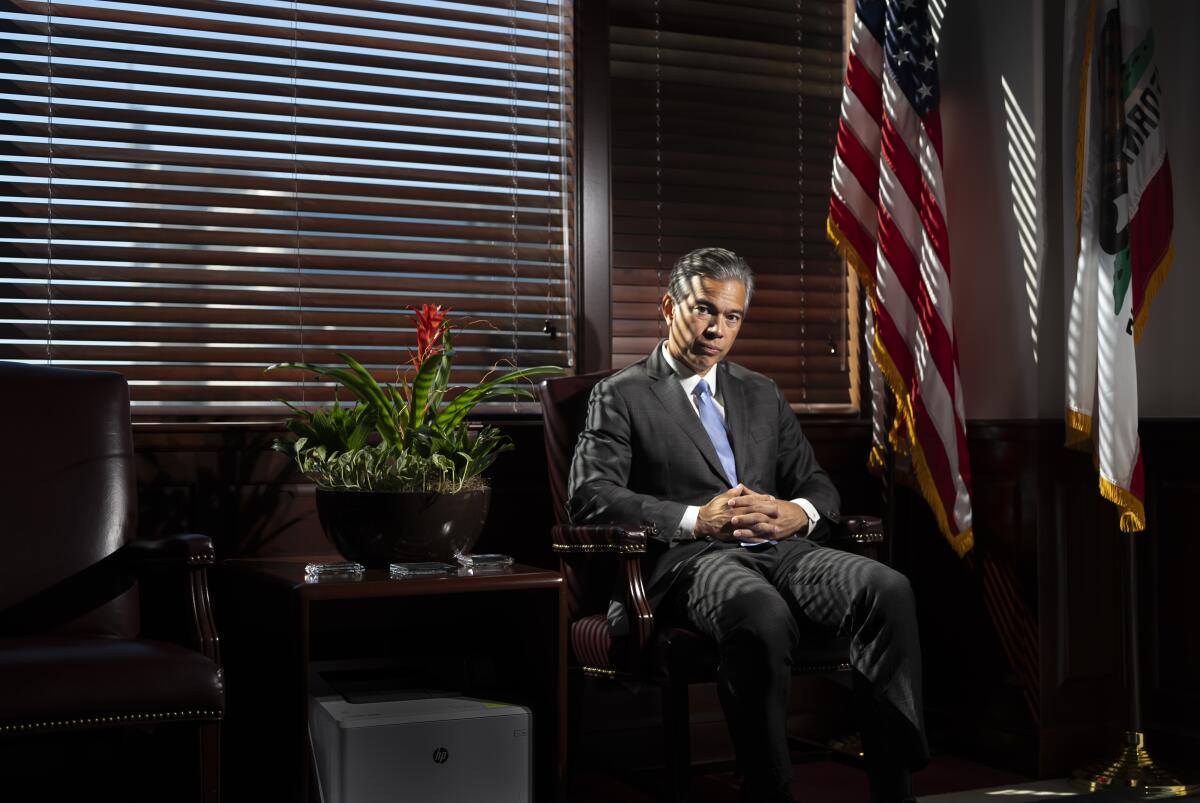
California Attorney General Rob Bonta in his office in 2024. (Paul Kuroda / For The Times)

California Atty. Gen. Rob Bonta is leading an effort by state attorneys general to block Paramount’s proposed takeover of Warner Bros. Discovery.

(Paul Kuroda/For The Times)

The deal also faces opposition outside the U.S.
. The British culture minister in late June said she was weighing whether to intervene in the deal due to concerns about maintaining a competitive media market. Britain’s Competition and Markets Authority also has opened an investigation into Paramount’s proposed merger.

In April, a federal judge in Sacramento granted a request from Bonta and seven other attorneys general for a preliminary injunction, which freezes the merger of Nexstar Media Group, which owns KTLA-TV Channel 5, and Tegna. The deal was designed to create the nation’s largest TV outlet group .

A larger group of state attorneys general also won a New York jury verdict against Live Nation Entertainment and its subsidiary Ticketmaster. Jurors found that Live Nation had illegally monopolized the live concert industry.

Bonta also has an ongoing case against Amazon for price fixing, which the company denies.

Still, legal experts say the states may face an uphill climb to detrail the Paramount-Warner Bros. merger because the arrival of Netflix, Amazon and Apple dramatically shifted the landscape.

The tech giants, which introduced consumer-friendly streaming options, have lessened the influence of traditional companies like Paramount and Warner Bros.

Paramount’s deal would mark the third time Warner has changed hands in the last decade.

AT&T bought the company in 2018 and then sold it to the smaller Discovery four years later. That deal left Warner Bros. burdened by debt, leading to deep cost cuts and setting the stage for the Ellison takeover.

Source link