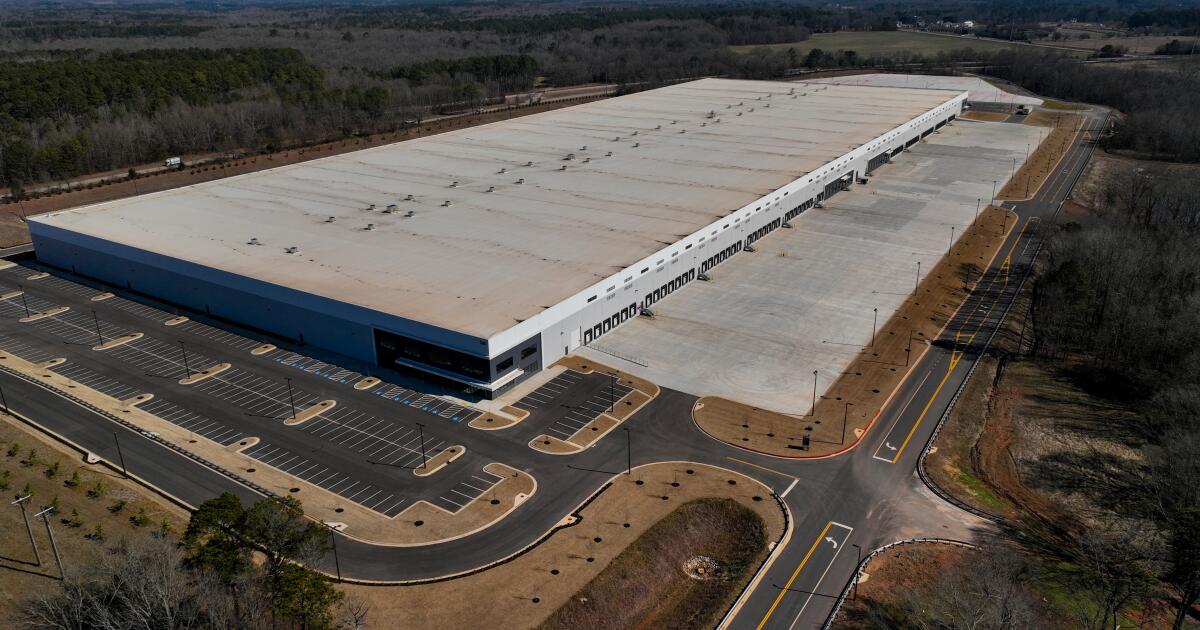
U.S. Immigration and Customs Enforcement is retreating from a plan to use warehouses to hold up to 10,000 people on a single site, jettisoning a key piece of former Homeland Security Secretary Kristi Noem’s $38-billion plan to rapidly expand detention capacity this year.
The federal government, which was sued by Michigan and a Detroit suburb, informed a judge Monday that a warehouse purchased in Romulus will be sold. Plans also are unraveling in Social Circle, Ga., and the El Paso suburb of Socorro, local officials said.
The three cities are among 11 where the federal government spent a combined $1.074 billion on warehouses.
The New York Times first reported last week that federal immigration officials now plan to get rid of seven of the 11 warehouses — either giving them to other federal agencies or selling them outright.
DHS didn’t confirm the reports but said in a statement that it is “moving swiftly to utilize EXISTING detention space with our state and county partners.”
“Wildly foolhardy” is how Claire Trickler-McNulty, a former ICE official under the Obama, Trump and Biden administrations described the plans to convert the buildings into immigrant detention.
One issue was that Noem’s purchases were largely carried out of public view and angered communities that were caught by surprise. Some only learned about ICE’s ambitions after the agency bought or leased space for detainees.
After Noem was fired, her replacement, Markwayne Mullin, quickly paused the purchase of new warehouses.
Objections came from Republicans and Democrats alike
Some were opposed on moral grounds to ICE’s presence in their neighborhoods, while others questioned whether the facilities would be a drain on local resources, such as sewer and water systems.
Seven federal lawsuits were filed, and regulatory roadblocks created hassles elsewhere.
Meanwhile, questions about how much DHS paid for some warehouses triggered an internal audit. The agency shelled out double what the New Jersey warehouse was valued at in tax records and nearly five times more than the assessed value of the Social Circle warehouse.
Trickler-McNulty, the former ICE official, said ICE does have a few facilities that it owns that it inherited from its predecessor agency, the Immigration and Naturalization Service, but generally ICE has contracted out its detention needs.
“Facilities over 2,000 people just break down. It’s very hard to run a very big facility, to keep it staffed, to keep all of it moving,” she said.
Mullin, who took over and expanded his family’s plumbing business before representing Oklahoma in the U.S House and Senate, acknowledged there had been issues at his confirmation hearing.
He noted that most municipalities don’t have the capacity in their infrastructure for waste and water.
Indeed the water issues were such a challenge that a federal lawsuit filed over the Salt Lake City warehouse, the costliest purchased at $145.4 million, said ICE officials told the mayor that they might need to truck water and sewage from the facility as an “interim solution.”
Plans begin to unravel
The New York Times story, which cited internal documents that the newspaper obtained, said the Salt Lake City warehouse is among those that federal immigration officials plans to hand off or sell. Also on the list is the Romulus warehouse, as well as one in New Jersey and two each in Georgia and Pennsylvania.
Michigan Attorney General Dana Nessel said it would have been an “abomination” if the 249,000-square-foot Romulus warehouse was transformed into immigrant detention, as was planned when it was purchased for $34.7 million,
“The ICE warehouse proposal was every bit as ill-conceived as it was cruel and unnecessary, and I am relieved that this chapter is coming to a close,” Nessel, a Democrat, said.
Social Circle, Georgia, announced last week in a statement that it has received notification from U.S. Rep. Mike Collins, a Republican, that the Department of Homeland Security is no longer pursuing an ICE detention facility there.
Meanwhile, acting ICE Director David Venturella told officials in the El Paso area during a visit there earlier this month that the agency has changed its plans for three warehouses it purchased in nearby Socorro for $122 million, said Rep. Veronica Escobar, who was present for the visit.
Escobar, a Democrat who represents El Paso, said during a news conference that ICE no longer plans to detain up to 8,500 immigrants in the facilities as originally envisioned, and instead will convert the property into an ICE campus, she said. The site will include an unspecified smaller number of detainees but also ICE offices and training space, she said.
Frustrations persist as communities seek details
However, many of the communities remained frustrated, as they struggled to get information about possible sales.
In Pennsylvania, state and local officials said Tuesday that they hadn’t received any new information from DHS about two warehouses bought earlier this year by the department. Both are being held up by the state’s denial of permits over concerns that drinking water and sewer service are inadequate to handle thousands of inhabitants.
U.S. Rep. Dan Meuser, whose district includes both warehouses, said he met Friday with DHS personnel, but that the agency hadn’t made a decision whether to use them as detention centers or sell them.
In Georgia, the city manager in Oakwood, said Tuesday he is talking to his state congressional delegation, trying to confirm rumors that a warehouse there will be sold. “I have not heard anything yet,” B.R. White said.
Work appears to continue on other warehouses
In Maryland, where a judge extended a stoppage on transforming a sprawling warehouse into a processing facility for immigrants, ICE is currently collecting public comments about the environmental impacts of the facility. And an announcement earlier this month disclosed more details on plans for the facility, including six secure recreation yards.
Patrick Dattilio, the founder of Hagerstown Rapid Response, which formed in opposition to housing ICE detainees in the warehouse, said there has been little communication outside of the lawsuit. But he remains committed to keeping it from opening.
“It’s a big warehouse,” Dattilio said. “It’s not meant for people.”
Hollingsworth, Foley and Santana write for the Associated Press. AP writers Marc Levy and Ed White contributed to this report.