war

Sudan condemns RSF chief’s visit to Uganda as minimising ‘human values’ | Sudan war News

Uganda Ministry of Foreign Affairs says Mohamed Dagalo’s meeting with President Yoweri Museveni focused on ending war.

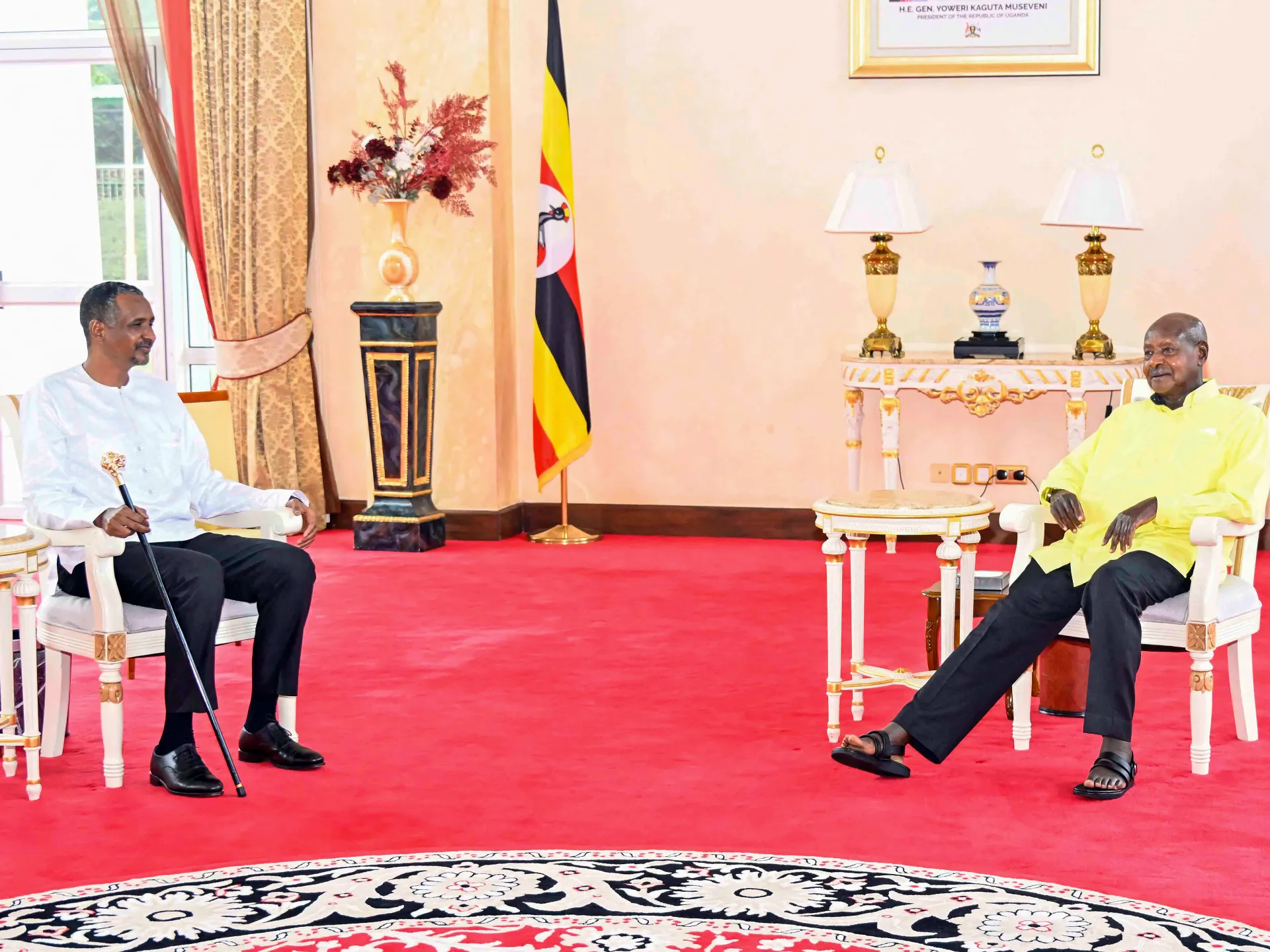
Sudan has condemned Uganda for hosting the head of the paramilitary Rapid Support Forces (RSF), Mohamed Hamdan Dagalo, as an “insult” to humanity and the Sudanese people.

In a statement on Sunday, Sudan’s Ministry of Foreign Affairs denounced the reception of Dagalo, also known as “Hemedti”, in the “strongest terms” and his meeting on Friday with Ugandan President Yoweri Museveni.

Recommended Stories

list of 3 itemsend of list

“This unprecedented step insults humanity before it insults the Sudanese people, and at the same time, it disregards the lives of innocent people killed due to the behaviour of Hemedti and his terrorist militia,” the Foreign Ministry wrote.

Rights groups and international organisations have accused the RSF of war crimes and targeting civilians in Sudan.

Khartoum said hosting Dagalo “disregards” human values.

It “completely disregards the laws governing relations between member states of regional and international organisations that prohibit providing any support for rebel forces against a legitimate, internationally recognised government”, the Foreign Ministry added.

In 2023, Sudan was plunged into a civil war between the Sudanese army, led by Abdel Fattah al-Burhan, and the RSF.

According to the Office of the United Nations High Commissioner for Refugees (UNHCR), at least 11.7 million people have been displaced by the conflict and an estimated 150,000 people have been killed.

Last week, the United States imposed sanctions on three RSF commanders over their alleged roles in the 18-month siege and capture of el‑Fasher, the capital of North Darfur State in western Sudan.

In a statement, the US Department of the Treasury accused the RSF of perpetrating “a horrific campaign of ethnic killings, torture, starvation, and sexual violence” during the siege and capture of el-Fasher, which fell to the RSF in October.

Separately, a UN mission found that the RSF campaign in el-Fasher was a “planned and organised operation that bears the defining characteristics of genocide”.

‘Poisonous’ identity politics

Uganda’s Ministry of Foreign Affairs issued its own statement on Dagalo’s visit and said his meeting with Museveni focused on “ending the ongoing conflict in Sudan and restoring regional stability”.

Museveni reiterated in his remarks to Hemedti that peace in Sudan could only be achieved through dialogue and warned against what he described as identity politics.

“When I last came to Sudan, I met [former] President [Omar al-] Bashir and advised against the politics of identity instead of the politics of interest,” Museveni said.

“Identity politics is poisonous. It does not yield good results. What is important are shared interests that unite people,” he said while calling for both parties to prioritise “peace over military confrontation”.

For his part, Dagalo thanked Museveni and said he shares the Ugandan president’s “principles and your commitment to peace”, according to a statement released by the Ugandan government.

“He noted that Sudan continues to face serious humanitarian and institutional challenges as a result of the conflict and stressed the need for a peaceful resolution,” the statement added.
Source link

At least one killed in widescale Russian attacks on Ukraine’s energy sector | Russia-Ukraine war News

Main target was the energy sector, but residential buildings and a railway were also damaged, Ukrainian President Volodymyr Zelenskyy says.

Russia has launched dozens of missiles and hundreds of drones at Ukraine, killing at least one person, according to Ukrainian officials.

The most powerful attacks were reported in the regions of Kyiv, Odesa and Kharkiv, the officials said on Sunday.

Recommended Stories

list of 3 itemsend of list

Ukraine’s air force said Moscow launched 50 ballistic and cruise missiles and 297 drones overnight, the majority of which were intercepted.

“Moscow continues to invest in strikes more than in diplomacy,” Ukrainian President Volodymyr Zelenskyy said, adding that this past week alone, Russia launched more than 1,300 drones, ‌more than 1,400 guided aerial bombs and 96 missiles against Ukraine.

The president added that Sunday’s attacks targeted the Dnipro, Kirovohrad, Mykolaiv, Poltava and Sumy regions.

The main target of the attack was the energy sector, but residential buildings and a railway were also damaged, he noted.

In a separate incident in the western city of Lviv, which has been largely spared the worst of the conflict, a policewoman was killed and 25 people were injured in the detonation of explosive devices inside a shop on a central shopping street.

Hours later, law enforcement said it had arrested a Ukrainian woman suspected of carrying out the bombing, without providing any further details and saying an investigation was ongoing.

Kyiv attack

Mykola Kalashnyk, head of Kyiv’s military administration, said on Telegram that Russian forces targeted five districts in the Kyiv region, injuring at least 15 people, including four children, and killing one person.

Russian attacks were also reported in the eastern region of Kharkiv, where Governor Oleh Syniehubov said at least 12 settlements were targeted and six people injured.

In southern Ukraine, fires broke out in the region of Odesa as Russian drones struck energy infrastructure, according to Governor Oleh Kiper.

“Fortunately, there were no deaths or injuries. An assessment of the state of energy facilities and elimination of the consequences is ongoing,” Kiper wrote on Telegram.

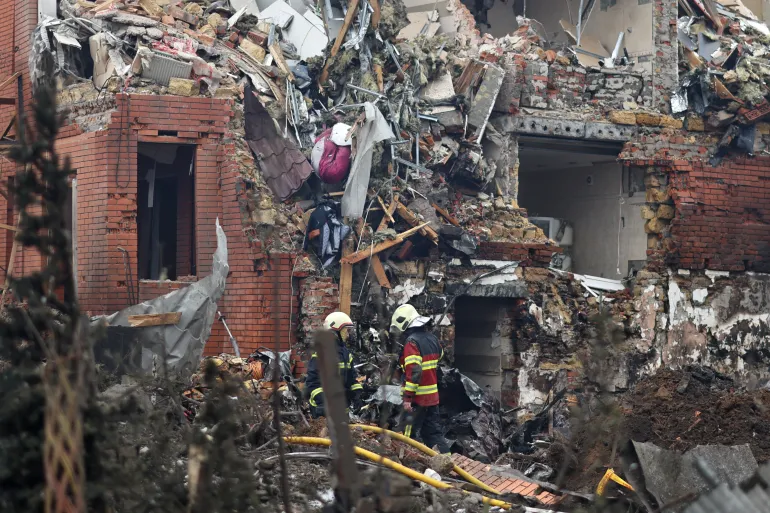
Ukrainian rescuers work at the site of a heavily damaged house following an air attack in Sofiivska Borshchagivka, Kyiv region on February 22, 2026, amid the Russian invasion of Ukraine.
A Ukrainian emergency crew works at a heavily damaged house after an air attack in Sofiivska Borshchagivka in the Kyiv region [Henry Nicholls/AFP]

Attacks on Ukraine’s energy facilities have become a near-daily occurrence in winter during Russia’s war in Ukraine, which started almost four years ago when Russian President Vladimir Putin ordered a full-scale invasion of the neighbouring country.

These attacks deprive millions of Ukrainians of heat, power and running water as temperatures have dropped below minus 10 degrees Celsius (14 degrees Fahrenheit), causing thick ice to cover roads and the Dnipro, Europe’s fifth largest river.

Last week, Russia unleashed a barrage of nearly 400 drones and 29 missiles on Ukraine’s energy infrastructure on the first day of two days of peace negotiations in Geneva, its second large-scale blow in six days.

On February 12, another attack had left 100,000 families without electricity and 3,500 apartment buildings without heat in Kyiv alone.

Sunday’s attacks come as the United States is trying to reach a ceasefire between Kyiv and Moscow.

But these efforts – including the talks in Geneva last week and two earlier sessions in the United Arab Emirates – have failed to reach any breakthrough.

A core sticking point is territory. Russia wants Ukraine to pull out from the remaining 20 percent of its eastern region of Donetsk that the Kremlin’s forces have failed to capture – something firmly rejected by Kyiv.

Ukraine does not want to make territorial concessions and is demanding clear security guarantees that it will not be attacked by Russia again if a ceasefire is reached.

Source link

Russia-Ukraine war: List of key events, day 1,459 | Russia-Ukraine war News

These are the key developments from day 1,459 of Russia’s war on Ukraine.

Here is where things stand on Sunday, February 22:

Fighting

  • A Russian drone attack on Ukraine’s northeastern Sumy region killed four people, including a 17-year-old boy, while another attack on the southeastern Zaporizhia region killed a 77-year-old man, according to Ukrainian authorities.
  • Russian attacks on Ukraine’s Odesa region wounded two people and caused damage to homes, cars and an energy facility, officials said. Another Russian attack on the Dnipropetrovsk region wounded a 77-year-old man.
  • In the Donetsk region, Russian shelling wounded four people in 18 attacks throughout the day, Governor Vadym Filashkin wrote on Telegram. Authorities evacuated 562 people, including 244 children, from front-line settlements.
  • Russian forces also hit the facility of US snack food company Mondelez in Sumy, sparking a reaction from Ukrainian Minister of Foreign Affairs Andrii Sybiha, who wrote on X that Russia was “targeting American business interests in Europe”.
  • “Moscow cannot speak of economic dialogue with the United States while attacking US-owned production facilities,” Sybiha added.
  • In the front-line Kherson region, Russian shelling wounded two police officers and one civilian, Ukraine’s National Police wrote on Telegram. Three apartment buildings, 18 homes, a hospital and numerous public buildings sustained damage.
  • Ukrainian President Volodymyr Zelenskyy claimed that Ukrainian security forces “neutralised Russian mercenaries preparing assassination attempts” against “high-profile” figures, including military personnel, intelligence officers and journalists.
  • Moscow’s ⁠forces ⁠took control of the village of ⁠Karpivka in Ukraine’s eastern Donetsk ⁠region, the Russian RIA state news agency reported on Saturday, citing ‌the Ministry of Defence.
  • A Ukrainian drone attack on Russia’s Belgorod region wounded a man and a three-year-old child, according to the Russian TASS news.
  • The Ukrainian General Staff said Ukraine’s home-produced “Flamingo” cruise missiles hit a Russian ballistic missile plant in the Udmurtia region, as well as a gas plant in the Samara region.

Politics and diplomacy

  • Zelenskyy held discussions with NATO Secretary-General Mark Rutte on the next round of trilateral negotiations with the US and Russia, as well as Ukraine’s energy situation. He said on X that “in many areas, our views align”.
  • Zelenskyy said in his evening address that “we continue working every day… so that the next round of negotiations can deliver results for Ukraine, results for peace”.The Ukrainian leader said he was closely coordinating with European partners so that the European Union is “involved in all processes and grows only stronger”.
  • Demonstrators in Washington, DC, Paris, and Prague rallied in support of Ukraine ahead of the fourth anniversary of Russia’s full-scale invasion on February 24.
  • Zelenskyy awarded Ukraine’s civilian award, the Order of Princess Olga, to Paris Mayor Anne Hidalgo in the Ukrainian capital. Hidalgo’s visit marked her sixth trip to Kyiv since the start of the war.
  • Sybiha, the Ukrainian foreign minister, condemned Russia’s alleged ongoing recruitment of Kenyans and other Africans into Moscow’s war, writing that it “evokes the worst memories of colonial attitudes from the past” and warning Africans against signing contracts with Russian recruiters.
  • Ukraine enforced new sanctions against the captains of vessels allegedly transporting Russian oil, a list that Zelenskyy said totalled 225 people.

Energy

  • Slovak Prime Minister Robert Fico threatened to stop providing emergency electricity supplies to Ukraine unless Kyiv resumed Russian oil transit to Slovakia over Ukrainian territory, through the Druzhba pipeline. Hungary said it would block a 90 billion euro ($106bn) EU loan for Ukraine for the same reason.
  • Shipments of Russian oil to Hungary and Slovakia have been cut ⁠off since January 27, when Kyiv says a Russian drone strike hit pipeline equipment in Western Ukraine. Slovakia and Hungary say Ukraine is to blame for the prolonged outage.
  • The Ukrainian Ministry of Foreign Affairs said it “rejects and condemns” Hungary and Slovakia’s statements and that the “provocative, irresponsible ultimatums threaten the energy security of the entire region”.
  • Polish Prime Minister Donald Tusk criticised Hungary’s move on X, writing, “Guess who’s happy”, in an apparent reference to Russia.

Military aid

  • The Czech Republic transferred 200 reconnaissance drones to five Ukrainian brigades, equipment worth about $800,000, Ukraine’s Interfax news agency reported.
  • Former UK Prime Minister Boris Johnson said in an interview with the BBC that the United Kingdom and the EU should send “peaceful ground forces” to “show our support for a free, independent Ukraine”.

Source link