wall

Mexico wins back fans, still faces familiar World Cup wall

After what may have been the most important game in the Mexican national team’s World Cup history, coach Javier Aguirre hugged each of his 26 players.

The embraces weren’t to celebrate a victory. They were hugs of gratitude, encouragement and, above all, resignation.

Minutes earlier, the players paraded around Azteca Stadium — traditionally an impenetrable fortress — to applaud El Tri fans with tears in their eyes. Mexico had just lost 3-2 to England, extinguishing the hope that it could parlay its World Cup co-host role into the deepest tournament run in the country’s history.

The goal was to advance to the quarterfinals for the first time since 1986 and, above all, to show the world that Mexican soccer finally had taken the leap that had been demanded for so long — defeating a past world champion, England, that hadn’t looked particularly dominant. But reality, once again, hit hard as the loss became Mexico’s eighth defeat in the round of 16 since 1994.

This time, Mexico had the support of its fans, playing on home soil. And it wasn’t enough.

“I’m satisfied with the work we’ve done, but when you lose — and I’ve lost a lot in my career — you never quite get over it,” Aguirre said. “It’s very painful because dreaming gives us hope; losing this way hurts a lot.”

Mexico fans wave flags and show their support before their team faced England in a World Cup match at Azteca Stadium.

Mexico fans show their support before their team faced England in a Round of 16 World Cup match at Azteca Stadium on July 5.

(Richard Pelham / Getty Images)

After weeks of celebrations following wins over South Africa, South Korea, Czechia and Ecuador, Mexico failed the test against England, ranked fourth in the world. El Tri dominated possession but could not convert it into goals, while the English were clinical, led by Jude Bellingham, Harry Kane, Anthony Gordon, Bukayo Saka and goalkeeper Jordan Pickford.

For Aguirre, the loss reopened a familiar wound. In the 2002, Mexico lost 2-0 to a U.S. squad led by Landon Donovan in what many consider the most painful defeat in the country’s World Cup history. This defeat to England very well could rival it.

“I would have liked to win five games, to leave home with five victories. That hurts — it hurts a lot,” Aguirre said. “A loss is a loss. Our opponent didn’t make the same mistakes we did.”

Judging Aguirre solely on the end of this World Cup run would be simplistic given what he inherited. Two years ago, he was asked to lead the struggling team for the third time. When he arrived, Mexico was ranked 17th in the world and had not won the Nations League. He leaves with Mexico ranked in the top 10 and as Nations League champion and two-time defending Gold Cup champion.

This World Cup wasn’t the disaster that Qatar was four years ago, when Mexico was eliminated in the group stage. This summer, Mexico secured its first knockout-round victory since 1986, advanced to a fifth World Cup match for the second time and swept three games during the group stage without conceding a goal — something no other Mexican team achieved.

In 22 months at the helm — having taken over in 2024 following Jaime Lozano’s failure at the Copa América, where Mexico failed to advance past the group stage — Aguirre achieved something that went beyond the scoreboard by uniting players previously accused of having too much ego and preferring not to sacrifice to help the team.

At this World Cup, that squad gave its all — body and soul — and rebuilt a relationship with the fans that had seemed broken since the 2024 Copa América. Thousands of fans filled the Ángel de la Independencia, the Zócalo and other squares across the country, as well as watch parties in cities like Los Angeles.

“We managed to restore the pride of being part of the national team — for the national anthem and for its people. It’s a privilege to be here, and they know it,” Aguirre said of his players. “I think we’ve returned to a Mexican identity.”

Green jerseys were seen all over Mexico as people set aside their differences to cheer on El Tri.

“Mexico was the best host of the three. It had the best atmosphere — it’s a country that truly loves soccer,” Mexico City native Santiago Mondragón said before the England match.

Mexico had standout and inspired performances from Erik Lira, Gilberto Mora and Roberto Alvarado, but its lineup struggled to keep pace with English players trained at elite European clubs.

Mora, just 17 years old and with tremendous potential, made a mistake on the play leading to England’s second goal. Alvarado, who provided strong passes to Raúl Jiménez and was solid in defense throughout the tournament, lost track of Bellingham on the first goal. Raúl Rangel, who was outstanding against South Korea and who three years ago was playing for Tapatío in the Mexican expansion league, stepped too far forward on the penalty kick that sealed the match, minutes after an English player was sent off in the second half. Edson Álvarez, who did not have a good season with Turkey’s Fenerbahce because of an injury, received little playing time and made a serious mistake marking Kane, which led to Gordon’s breakaway on the play that resulted in the penalty kick.

Mexico's Raúl Jiménez gets tangled with England's Ezri Konsa while going for the ball during a World Cup match.

Mexico’s Raúl Jiménez gets tangled with England’s Ezri Konsa while going for the ball during a World Cup Round of 16 match at Azteca Stadium on July 5.

(Francois Nel / Getty Images)

Following the loss, many in Mexico still are wondering why, despite having a one-man advantage for 36 minutes —plus 11 minutes of stoppage time — the team was unable to tie England. Aguirre replaced Mora and goal-scorer Julián Quiñones, bringing on an attacking lineup that focused on sending in crosses, which the English defense easily cleared.

While it’s possible a few changes could have shifted the match in Mexico’s favor, there were limits to how much the technical staff could get out of the roster.

El Tri lacks sufficient depth to assemble a truly competitive 26-man roster, as players such as Álvarez and Santiago Giménez didn’t arrive at their best form, and players such as Brian Gutiérrez weren’t ready for the pressure of a tournament of this magnitude, in need of more time to develop.

Mexico lacked game-changing players capable of breaking down tight defenses — the role Hirving Lozano played in 2018 or Giovani Dos Santos in 2014. The lack of creativity that showed against Saudi Arabia in 2022 flared up late against England.

Thanks to Jiménez and Quiñones, the team did show firepower, scoring 10 goals in five matches, but it lacked depth to break down a well-organized English defense.

The talent pool has been hindered by the Mexico club system.

Mexico's Julián Quiñones is tossed in the air by teammates as they celebrate a Round of 32 World Cup win over Ecuador.

Mexico’s Julián Quiñones is tossed in the air by teammates as they celebrate a Round of 32 World Cup win over Ecuador at Azteca Stadium on June 30.

(Kevin C. Cox / Getty Images)

Liga MX owners maintain a narrow view of domestic soccer, prioritizing foreign signings over the development of local players and promotion and relegation remain abolished — removing competitive pressure that is the backbone of English leagues.

Top Mexican players continue to be overvalued by their home clubs, which makes it difficult for European clubs to sign them when there are cheaper options with more impressive résumés.

“This was the opportunity; that’s why it’s frustrating, that’s why it’s sad,” Mexican journalist Javier Alarcón said of El Tri’s World Cup exit. “With the Mexican federation and its owners, there isn’t much hope.”

Rafael Márquez, a former FC Barcelona star and one of the greatest players in Mexican national team history, is succeeding Aguirre after serving as one of his assistant coaches. Márquez has formed a close bond with players, who tossed the 47-year-old former defender in the air after one of their World Cup wins, and is familiar with all the reasons Mexico continues to hit the same World Cup wall.

“Rafa is a great guy, a great coach,” said Aguirre, who noted that the team’s average age has dropped and that more and more players are playing in Europe. “Hopefully he can do better than we were able to.”

Source link

Watch: Fatal Typhoon Maysak floods burst dam wall in China

A reservoir wall broke in Nanning in China, sending out a torrent of water after rivers swelled from the passage of a typhoon. At least four people have been killed by flooding due to Typhoon Maysak, while another 62,000 have been evacuated across the southern city, officials say. The emergency flood control response has been raised to its highest level.

President Xi Jinping has called for “all-out efforts” to rescue people affected by the floods across China. Authorities have warned that torrential rains will continue in the coming days.

Source link

Trump administration’s $46 billion ‘smart wall’ races ahead on the U.S.-Mexico border

For decades, all that separated the U.S. from Mexico was barbed wire.

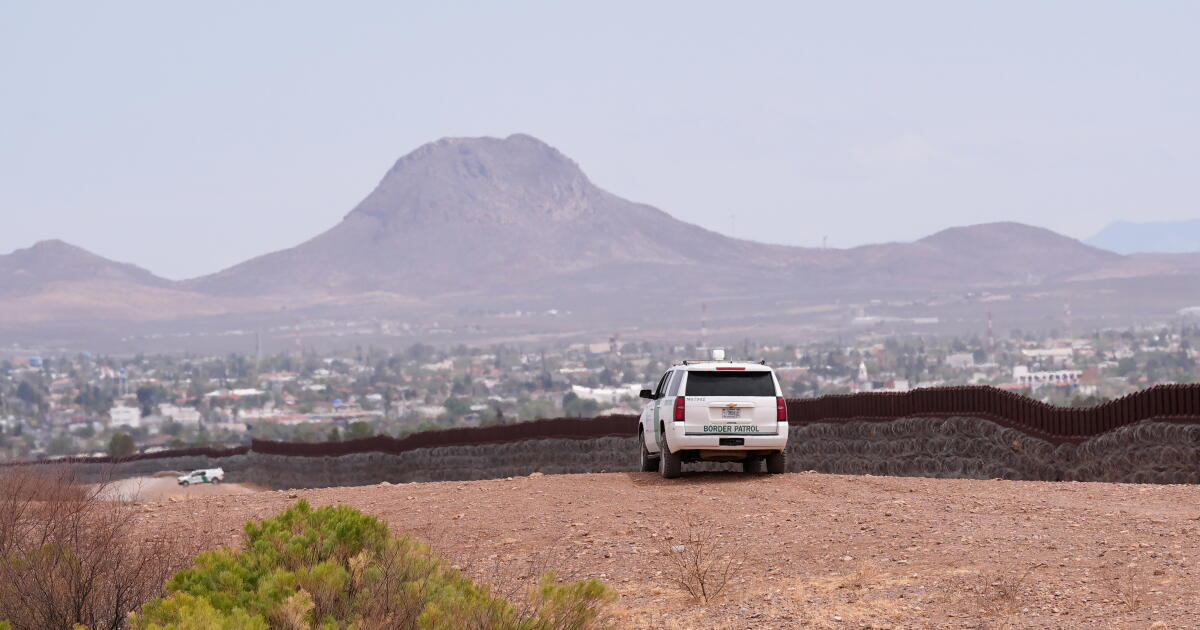
Now, after a massive infusion of cash from Congress, President Trump’s administration is swiftly building what it has dubbed a “smart wall,” a combination of 30-foot-tall steel fencing and an array of sophisticated technology like sensors, cameras and towers allowing Border Patrol to surveil the territory.

The wall is under heavy scrutiny for the billions of dollars being dedicated to it when border crossings are at their lowest in decades. Critics say the U.S. is militarizing the border as it increasingly deploys sophisticated surveillance technology to the area, impacting local communities.

“We are seeing a massive expansion of surveillance and surveillance technology across the borderlands,” said Ricky Garza, border policy counsel at the Southern Border Communities Coalition, an advocacy group. “The wall in all its forms is harmful to communities.”

Officials say the technology is complementary to the physical wall and frees up agents for other tasks.

“It’s a smart wall. It’s not just a barrier,” Customs and Border Protection Commissioner Rodney Scott said during recent congressional testimony. “It maximizes the use of our most valuable resource, which is our agents.”

Contracts for hundreds of miles of wall already inked

The wall has been a top priority for Trump, a Republican, since he first ran for president.

During the administration of President Joe Biden, a Democrat, the border emerged as a flashpoint, with thousands of people seeking to cross into the country each day. Those numbers started to taper off shortly before Trump returned to office last year and then slowed to a trickle, with his broader immigration crackdown serving as a deterrent for would-be migrants.

Flush with $46 billion to finish the wall after an infusion by Congress for immigration enforcement, CBP is inking tens of billions of dollars in contracts to build the wall and push along the president’s signature project.

Homeland Security Secretary Markwayne Mullin said recently that a preliminary part of the wall will be finished by “this time next year.” Scott said his agency is putting up 6 miles of wall a week.

Hundreds of miles had already been built before Trump returned to office. As of mid-June 2026, CBP has erected another 74 miles and aims to build hundreds more. There is no wall planned for roughly 535 miles of the roughly 2,000-mile-long border, because rugged terrain already serves as a barrier. Ground sensors and towers will be used instead.

CBP is also going back to hundreds of miles of already built wall and adding more technology, lights and roads. Along the long stretches of river in Texas that mark the border with Mexico, they’re deploying 12- to 15-foot-long cylinder-shaped buoys meant to keep migrants or smugglers from crossing the border.

More technology being deployed on the border

Technology is playing a greater role in the Trump administration’s effort to make illegal crossings along the border more difficult, part of a broader transformation of CBP in the years since Sept. 11, 2001, into an intelligence operation with a mass surveillance network whose reach extends far beyond the nation’s frontiers, according to reporting by The Associated Press.

And critics say the border technology poses a threat.

The Southern Border Communities Coalition says surveillance technologies can push migrants into more dangerous routes to avoid being detected.

Garza, the group’s policy counsel, warned that surveillance technology infringes on the privacy rights of border residents and that locals have found ground sensors used to detect smuggler or migrant traffic placed on their property without their consent.

Nayda Alvarez and her relatives own land along the Rio Grande roughly 125 miles inland from the Gulf of Mexico. She has found cameras placed on her family’s land, and just last week she spotted a surveillance tower about a quarter of a mile down the river from her house.

“Are we expecting a war or something?” she said. “It doesn’t make me feel safer.”

Dave Maass, director of investigations for the Electronic Frontier Foundation, a nonprofit that focuses on civil liberties related to digital technology, said the technology has made the border area “a hostile environment” for locals and would-be migrants.

The foundation has published a guide on the various types of surveillance towers in use along the southern border designed to help local residents.

These can range from fixed towers with video, infrared and radar technologies that have a range of roughly 8 miles to remote video surveillance systems that have cameras and a spotlight fixed on top. Some are mounted on the backs of trucks so agents can drive them to different parts of the border.

Increasingly, these towers are autonomous. They can scan an area, analyze what they’re seeing using artificial intelligence and alert Border Patrol agents to something suspicious. Proponents say this helps keep Border Patrol agents out in the field instead of sitting in front of computer screens watching for activity. But it also increases AI decision-making along the border when experts have warned about the technology’s potential for bias or other problems.

The big GOP tax cuts and spending bill passed by Congress last summer requires that CBP buys only the autonomous towers, and the department is deploying an additional 95.

Underground, buried fiberoptic cables can sense movement, capturing data that is also then analyzed by AI.

“We follow the contour of the land. We go through trees. We go down into the river banks. We can go absolutely everywhere,” said Magnus McEwen-King, CEO of Sintela, which has a contract with CBP to install the cables. He spoke at a recent border security expo in Phoenix, where some of the technology was on display.

CBP also uses ground sensors and trail cameras to detect smuggling routes.

Concerns over cost and future plans

The nonpartisan watchdog group Taxpayers for Common Sense has questioned both the huge amounts of money for the wall-building and whether taxpayers are getting their money’s worth.

In 2011, under Democratic President Obama, Homeland Security Secretary Janet Napolitano pulled the plug on a project to build a “virtual wall” of integrated technology like radars, sensors and cameras across the entire border after it ran over budget, faced technological glitches and was behind schedule.

Josh Sewell, director of research and policy at Taxpayers for Common Sense, said the organization would like to see more “robust evaluation” of the technologies being used to avoid similar scenarios. And he criticized the Trump administration for lack of oversight on how the money is being spent, a charge CBP has denied, citing “oversight mechanism.”

In the Big Bend area of southern Texas, opposition to the department’s wall-building plans gathered strong bipartisan support especially in the most sensitive areas that run through a state and national park and a wildlife area.

CBP now says it is not planning to build a 30-foot-high bollard wall in those areas. Its recently announced plans include installing patrol roads and some barriers designed to stop cars and using detection technologies.

Clara Benson, who is one of the founders of the No Big Bend Wall coalition, says bright lights in the area designed to illuminate the border could pollute the skies in an area renowned for having some of the best views of the stars. Even without a 30-foot-tall steel wall running through the land, there is concern about CBP’s plans.

“There’s still a lot of fear and dread that the plan is still going to be quite damaging,” she said.

Santana writes for the Associated Press.

Source link

Why has Wall Street fallen out of love with the ‘Magnificent Seven’?

For more than three years, the ‘Magnificent Seven’ or ‘Mag 7’, which includes Nvidia, Apple, Microsoft, Alphabet, Amazon, Meta and Tesla, carried Wall Street.


ADVERTISEMENT


ADVERTISEMENT

Then came June 2026.

Nvidia dropped over 5%, Microsoft fell about 17%, its worst monthly performance since December 2000, Alphabet declined nearly 6%, Amazon lost roughly 12% and Meta dropped around 11%.

As for Apple and Tesla, the companies had directionally different but equally volatile monthly moves.

Apple made a new all-time high closing price of $315.2 on the second day of the month but subsequently declined more than 10% from that peak.

On the other hand, Elon Musk’s company dropped more than 6% in the first week of June but clawed most of that back by the close of the month, ending roughly flat.

Taken together, the ‘Magnificent Seven’ erased about $2.3 trillion (€2tn) in market value in a single month.

What made the selloff remarkable was its breadth. Usually one or two stocks stumble while the others hold up. This time, nearly every member of the group moved lower.

The Roundhill Magnificent Seven ETF (MAGS), which holds all seven companies, fell about 13% from its late May record high.

So what happened to Wall Street’s favorite technology stocks? And why are investors backing away?

Growing pains and spending

The MAGS ETF bled more than $700 million (€615mn) over the month, its worst outflow since it launched in 2023, according to TradingView data. For a fund that had become the simplest way to bet on the US tech boom, the reversal was striking.

One name outside the club had it even worse. Oracle, a hyperscaler not included in the ‘Magnificent Seven’, crashed around 35%, its steepest month since September 1990, after alarming investors with a surge in AI spending and debt.

The fall wiped roughly $100 billion (€87.9bn) off the fortune of co-founder and billionaire Larry Ellison. The market punished the biggest AI spenders, and the numbers explain it.

The five largest hyperscalers are set to spend more than $700 billion (€615bn) on AI infrastructure this year. Microsoft alone is heading towards roughly $190 billion (€167bn), according to estimates from the Bank of America.

The bank said that hyperscaler capital spending has jumped from about 70% of operating cash flow in 2025 to nearly 100% in 2026.

The translation is simple: far less capital left over for share buybacks and dividends, and an increasingly larger bill that will need to be justified with future revenue as costs are climbing too.

The ‘Magnificent Seven’ are the biggest buyers of the memory that feeds AI data centres, and those chips have become scarce and expensive.

Micron Technology, one of the main memory chipmakers, reported earnings per share of $24.67 for its latest quarter, up from $1.68 a year earlier, close to a fifteenfold jump.

Prices for DRAM, the memory inside almost every device, rose as much as 98% in the first quarter alone, a surge some in the industry have nicknamed “RAMageddon”.

A quieter shift beneath the surface

While the biggest technology stocks struggled, the rest of the market continued to rise.

LPL Financial chief equity strategist Jeff Buchbinder points to that trend. Excluding the ‘Magnificent Seven’, the remaining S&P 500 companies grew earnings by 17.5% in the first quarter, helped in part by semiconductor and memory producers.

Buchbinder expects that figure to exceed 20.5% in the second quarter. Meanwhile, the earnings growth projection for the ‘Magnificent Seven’ will be lower than that.

In other words, the other 493 companies are now growing earnings faster than the market’s biggest stars, and investors have noticed.

By late June, the S&P 493 – which excludes the ‘Magnificent Seven’ – had climbed 13.7% for the year. In contrast, the ‘Magnificent Seven’ basket was down 6.6%, while the broader S&P 500 posted a more modest 7.4% gain.

According to veteran investor Ed Yardeni, investors are beginning to show signs of AI fatigue, questioning whether unprecedented spending on infrastructure will ultimately generate attractive returns as cheaper open source models proliferate and AI token prices continue to decline.

Are the ‘Magnificent Seven’ still “magnificent”?

The ‘Magnificent Seven’ still delivered an estimated 29% earnings growth in the first quarter, and they are unlikely to lose their leadership positions anytime soon.

Yet, the debate has shifted.

Investors are no longer asking whether AI will transform the economy. They are asking when hundreds of billions of dollars in AI investment will begin producing meaningful returns.

June may have offered the first clear answer.

The AI trade is no longer a one way bet on seven companies. The ‘Magnificent Seven’ created the AI boom, but they are no longer the only way to invest in it.

Source link

As Trump pulls funding for HIV care, Latino and queer communities are hit the hardest

In Lincoln Park, past Plaza de la Raza cultural center and under swaying pine trees, stands a row of 10-foot wooden panels etched with names. Robert Zaldivar stood quietly in front of the names, surrounded by community members holding lit candles as memories of old friends resurfaced.

The panels bear nearly 2,000 names, and more are added every year. Each one represents an Angeleno, mostly Latinos, who died of AIDS. Zaldivar led the movement to erect this monument, named the Wall Las Memorias, which was finalized in 2004.

Inspired by his late best friend, who was HIV-positive, the Wall represents to Zaldivar the power of remembering those in his community affected by HIV and AIDS. It was designed in the shape of Quetzalcoatl, or the “Feathered Serpent,” an Aztec deity and symbol of rebirth.

Robert Zaldivar leads a sunset vigil at The Wall Las Memorias AIDS Monument in Lincoln Park.

Robert Zaldivar leads a sunset vigil at the Wall Las Memorias AIDS Monument in Lincoln Park on the anniversary of the first HIV diagnosis in L.A. on June 4, 2026.

(The Wall Las Memorias)

That day in early June, he hosted a sunset vigil, joined by AIDS Memorial Quilt founder and Harvey Milk mentee Cleve Jones, to recognize the lives lost since AIDS was first diagnosed 45 years prior, when the Centers for Disease Control and Prevention published a report detailing immunodeficiency in five young gay men in Los Angeles.

At Zaldivar’s feet was a poem, one he wrote in 1995 with his friend Anna Contreras.

It reads:

It is here, we free ourselves from the teaching of guilt.
We unite as one people in our vision, our teaching, and our truth.
Through truth we live, through knowledge we survive.

Contending with stigma and misinformation has been a constant struggle for people who are HIV-positive, he said, a struggle that Zaldivar hopes to make more visible now than it has been in previous decades.

“Sometimes it feels like there’s no other way to draw attention to this problem than to have a physical reminder,” Zaldivar said of the monument. “This reminds us of real people, as more than statistics.”

The statistics Zaldivar refers to include the continuing rise in HIV diagnoses in Latinos across the United States. The most recent CDC data show 39,000 people across the U.S. received an HIV diagnosis. And a Kaiser Family Foundation analysis revealed that between 2010 and 2022, there was a 24% increase in new cases among Latinos. In 2022 alone, Latinos made up 31% of new diagnoses, despite only representing 19% of the American population, the KFF study found.

“Just last week, we had two new diagnoses of HIV in our clinic,” said Bernardo Gomez, assistant manager of HIV resources at the Wall Las Memorias Project. “For context, we had 15 in the past six months, including straight women … I think what we’re seeing is a dangerous loss of support for outreach and education.”

Last year, President Trump released his presidential fiscal year budget for 2026, much of which went into effect last October. In it, he revealed significant cuts to HIV health programs — amounting to $1.5 billion.

The budget recommendation signaled the administration’s yearly priorities, and Trump’s fiscal plan and staffing cuts to HIV teams under the so-called Department of Government Efficiency (DOGE) showed a shift away from HIV prevention and healthcare, which advocates say has led to providers losing jobs and places for testing and resources to shrink. In L.A., the Latino community is feeling the brunt of the loss, Zaldivar said.

The biggest cut to HIV care in the 2026 budget affected the CDC, which lost around $3.6 million. Another devastating loss was $1.7 million cut from the Ryan White HIV/AIDS Program, which many L.A. resource centers report relying on to fund part of their programming and staffing.

Robert Gamboa, associate director of public policy at the L.A. LGBT Center, said that in Trump’s first term, his “Ending the Epidemic” program created hope for soon seeing the end of HIV in the U.S. — a hopefulness that he said was quickly dashed in his second term.

“Now there’s this 180-degree shift in policy, we see these enormous proposals pulling away from funding, and his lack of acknowledgment of World AIDS Day, and Pride in general,” Gamboa said. “The message of that is loud and clear: [The Trump administration] is telling our LGBT community, ‘We don’t care about you.’”

Since Trump’s inaugural address last year, Gamboa said executive orders have only solidified Trump’s shift away from LGBT organizations, “challenging the structural integrity of almost everything we’ve done.”

Gamboa said that last spring, the Department of Public Health, Division of HIV and STD Programs), which supplemented L.A. organizations with substantial HIV funding, sent out a notice that all of their contracts were terminated.

“Well, this caused a massive alarm all across L.A. County. Everyone started freaking out. We had to say, ‘We need an emergency allocation [from state funds] so that we can continue providing HIV services across California,’” Gamboa said. “We’re used to getting upwards of around $20 million in funding at the county level, and it wasn’t happening.”

Robert Zaldivar leads a sunset vigil at The Wall Las Memorias AIDS Monument in Lincoln Park.

Robert Zaldivar leads a sunset vigil at the Wall Las Memorias AIDS Monument in Lincoln Park on the anniversary of the first HIV diagnosis in L.A on June 4, 2026.

(The Wall Las Memorias)

Since then, nonprofit representatives have confirmed that the contracts were restored at reduced rates. However, the impact of the uncertainty shook the health services community and only caused further distrust among Latino patients.

“We’re already seeing [the impact in L.A.]. In the Latino community, there’s so much fear from the ICE raids. People are afraid to even leave their homes,” Gamboa said. “We’ve worked so hard in building trust and relationships with our communities of color. Now, they’re afraid to even come in. Many of the places they’ve gone to in L.A. County have already closed their doors and ceased services.”

Most recently, the Trump administration announced plans to cut millions in public health funding. This includes $1.1 million that would be slashed from the National HIV Behavioral Surveillance Project, an early-warning system for HIV outbreaks, established by the L.A. County Department of Public Health.

On the White House website, a page called “Cuts to Woke Programs” reads: “President Trump is committed to eliminating radical gender and racial ideologies that poison the minds of Americans.”

Gamboa said that organizations have been discouraged of using “LGBT” in their programming to avoid being defunded as part of the targeted “woke” programs.

“It really affects me,” said Gomez, who has been living with HIV since 1996. “How long will I have medicine?”

Gomez, who is the breadwinner of his family, says his monthly supply of medication costs $1,500 a bottle. “It’s so expensive, and I have insurance. For people without insurance, [the Ryan White program] is the only way they can afford treatment,” Gomez said. “I’m afraid of what will happen to them.”

Gomez takes antiretroviral therapy, a lifesaving medication that reduces the number of infected cells, making the disease less transmissible and prevents HIV from developing into AIDS. According to 2024 HRSA data, the Ryan White program provided antiretroviral therapy to 602,000 people, preventing the spread of HIV.

As the program loses funding, jobs providing HIV care have become more sparse — and programs like the Wall and the L.A. LGBT Center have become more essential to support the thousands left without life-saving care.

HIV program funds are trickling back into L.A. County for nonprofits this year; although some, like the Wall, maintain that it’s “not enough to address the need.” Up until last May, the organization shared that the county funded $1 million of its annual HIV reduction efforts. This year, that number was drastically reduced to $100,000 per six-month contract.

“Many of my social worker friends are off the streets [where they helped at-risk communities] due to just not having enough funding to do their jobs,” said Miguel Rodriguez, program coordinator of HIV testing and prevention at the Wall. “People think only gay men are affected, but basic sexual health for everyone is at risk here. Less [testing] means more infections and transmissions across the board.”

As Robert Zaldivar stresses, the only way to protect L.A.’s Latino HIV-positive community is to support remaining HIV services to get tested or donate to local service organizations.

“What we saw in the ’90s, I’m scared that it will repeat. I want people to remember how serious [HIV] is, and to educate,” Zaldivar said. “Keep getting tested. We don’t report your immigration status or sexuality. Just come in.”

Source link

Investors look beyond the ‘Magnificent 7’ as Wall Street embraces the ‘FAB 10’

Published on

Wall Street’s most famous market label may be outdated.


ADVERTISEMENT


ADVERTISEMENT

The ‘Magnificent 7’ or ‘Mag 7’ defined the first phase of the AI rally, as it included Nvidia, Apple, Microsoft, Alphabet, Amazon, Meta and Tesla, but a fresh grouping is now circulating among investors keen to capture its next leg.

In the wake of SpaceX’s blockbuster listing, analysts are looking to add Elon Musk’s company, as well as OpenAI and Anthropic, which are expected to IPO later this year, to a new market label.

Coined by the British financial firm Vanda Research, the ‘FAB 10’ stands for Frontier AI & Big Tech 10, and takes the original seven companies from ‘Mag 7’ together with the three new market darlings.

According to Vanda, last Friday’s SpaceX IPO offered the clearest signal yet that attention is widening beyond the ‘Magnificent 7’.

After Monday’s close above $192 per share, Elon Musk’s space and AI firm is now the sixth most valuable company in the world by market capitalisation.

What the new label captures

The term ‘Magnificent 7’ was coined in late 2023 by Michael Hartnett, who wanted a single term for the megacap stocks powering the market to records.

Their combined value now sits at roughly $22.6 trillion (€19.5tn), with Nvidia alone worth more than $5 trillion (€4.33tn) as the most valuable company in the world by market capitalisation.

The three newcomers represent a different flavour of the same AI boom.

SpaceX brings aerospace and satellite connectivity through its Starlink unit, while OpenAI and Anthropic are among the leading developers of frontier AI models.

According to Vanda, the ten companies collectively map the direction of the AI and technology sectors over the coming decade.

However, a wrinkle in the label is that two of the additions are not yet listed.

OpenAI and Anthropic remain private, though both have filed to approach public markets this year, potentially at valuations surpassing $1 trillion (€861bn) and making the ‘FAB 10’ as much a shorthand as a tradable basket.

The ‘FAB 10’ is also not the only contender.

Bank of America has floated an ‘AI Big 10’ that instead adds the chipmakers Broadcom, Advanced Micro Devices (AMD) and Micron, reflecting the semiconductor rally.

Others have suggested smaller clusters, such as the rival ‘MANGOS’ label, which has surfaced and includes Meta, Anthropic, Nvidia, Google (Alphabet), OpenAI and SpaceX.

Strategists caution that none of the names signals the demise of the ‘Magnificent 7’, which still accounts for roughly a third of the S&P 500 index. Investors are not abandoning the originals but simply broadening the definition of who leads the AI era.

As Vanda frames it, the next decade’s winners may simply need a bigger tent.

Source link

Jo Adell revives José Canseco meme by giving up homer off his head

Nothing could possibly generate a headline Tuesday night when the worst American League team — the Angels — played host to the perhaps the worst National League team — the Colorado Rockies.

Except. . .

This.

A fly ball conked Angels right fielder Jo Adell on the head and bounced over the fence for a home run, reminding fans of José Canseco’s similar gaffe 33 years ago.

Adell chased TJ Rumfield’s fourth-inning drive onto the Angel Stadium warning track and reached up to catch it. The ball grazed his glove before bouncing squarely on his noggin and over the wall.

The ball caromed back into the outfield and Rumfield momentarily stopped at second base. But the umpires confirmed the home run, coupling Adell with Canseco in numerous social media posts.

Canseco, the steroids-fueled, defensively challenged left fielder of the Texas Rangers, made a similar blunder on May 26, 1993, when a ball hit by Cleveland’s Carlos Martínez bounced off his head and over the wall.

Mike Trout presumably has witnessed every possible blooper, blunder and boo-boo in 16 seasons with the woeful Angels. The center fielder stood only a few feet from Adell when this one occurred and did not make himself available for comment afterward.

To his credit, Adell faced reporters.

“It looks like I’ve never played in the field before, which is disappointing, because it’s beyond the truth,” he said. “I’m the only one that really knows what happened. I was out there, and it happened to me, so it is what it is.

“It was kind of the icing on the cake, because I was [expletive] all the way around the whole day today.”

Adell was hitless in four at-bats, striking out twice, in the 8-2 loss that dropped the Angels to 23-39, the worst record in the AL.

The play was emblematic of Adell’s seven-year career with the Angels, who made him a first-round draft pick in 2017. At first blush, his lifetime Wins Above Replacement of 0.3 would indicate that he’s little better than the fictional minor league “replacement player” to which MLB players are compared in calculating the statistic.

Yet Adell’s physical tools and occasional highlights scream stardom. He shouldn’t be an ordinary Jo. The antithesis of the embarrassing episode Tuesday night came less than two months ago when he robbed the Seattle Mariners of three home runs in one game.

“It was the Jo Show,” Angels manager Kurt Suzuki said at the time. “This guy works as hard as anybody I’ve ever been around. His work ethic, attention to detail, his desire to improve every single day. To see him do that, I don’t believe you’ll see that again.”

Suzuki, who was Adell’s teammate in 2021 and 2022, likely never thought he would see a fly ball bounce off the outfielder’s head and into the stands, the Jo Show shifting to Oh, No!

“I saw the play, but for me, Jo’s made great strides defensively from when I played with him,” Suzuki said Tuesday. “And obviously, he had the night he robbed three home runs. It was a tough play tonight, but at the same time, the strides that he’s made defensively have been great.”

Adell was considered a defensive liability early in his career and was saddled with a four-base error in 2020 when a fly ball hit his glove and went over the fence. But he steadily improved and became a Gold Glove Award finalist in 2024.

That didn’t stop the “Tarps Off” throng of shirtless fans at Angel Stadium from chanting Adell’s name after the gaffe against the Rockies. For his sake, they likely will revert to imploring Angels owner Arte Moreno to “sell the team” soon enough.

Adell might have to stay away from social media forever, but he would like to forget the ball bouncing off his head as soon as possible.

“That’s what we have to do,” he said. “I mean, there’s really no other way around it. Let it fester and tumble over, but these are plays I’ve made hundreds and thousands of times. I’ve got to just keep going, and as a team, we’ve got to keep going.”

Source link

Artist suing FIFA over destruction of Dallas whale mural before World Cup

The artist who painted a giant mural on a building in downtown Dallas of life-sized swimming whales has filed a $25 million lawsuit against soccer’s international governing body and others, saying they illegally painted over his work to promote the city’s upcoming World Cup matches.

The artist Wyland says he hand-painted the sprawling mural that covered roughly 17,000 square feet across two of the building’s walls.

The mural stood for nearly three decades before workers began painting over it last month, causing an uproar among residents who admired the mural’s grand scale and message of ocean conservation.

The area’s World Cup organizing committee said in a statement that, in place of Wyland’s mural, new artwork is planned “that captures this current historical moment and reflects the energy, unity, and global spirit surrounding the World Cup 2026.” It said a portion of Wyland’s mural would be preserved.

Wyland filed suit Monday in U.S District Court in Dallas saying that World Cup organizers, along with the building’s owner and management company, painted over his mural without his consent or even notifying him. He says their actions violated a 1990 federal law passed to protect visual artists from destruction of publicly displayed works.

Wyland is seeking at least $25 million in damages. His lawsuit says world soccer’s governing body, FIFA, and other defendants “hastily and irrevocably destroyed a civic landmark” to promote the World Cup.

“Though FIFA claims they were working to develop art for the host city, in truth, they defaced an historic fixture of the host city,” the artist’s lawsuit says.

A FIFA spokesperson said Tuesday the federation “has no involvement in this whatsoever” and referred a reporter to the tournament’s local organizing committee.

A spokesperson for the North Texas FWC Organizing Committee declined to comment. The committee isn’t named as a defendant in the lawsuit.

A spokesperson for Slate Asset Management, which manages the building where the mural was painted over, said in a statement that local World Cup organizers asked Slate in March to donate the mural space for “a new public art installation.”

“Slate is not being compensated in any way for the use of the wall space and was told by the local groups that Mr. Wyland had been notified,” the management company’s spokesperson said in an email.

Dallas is hosting more World Cup matches than any of the other sites in the event co-hosted by the U.S., Canada and Mexico, with nine matches set to be played at AT&T Stadium in suburban Arlington, home of the Dallas Cowboys.

Wyland’s Dallas mural, titled “Whaling Wall 82,” was finished in 1999 and is among more than 100 similar murals known as Whaling Walls the artist painted around the world to promote the conservation of ocean life.

An online petition protesting the mural’s destruction and calling for protecting of public artwork in Dallas has received more than 2,600 signatures.

Wyland’s lawsuit alleges violations of the Visual Artists Rights Act, a 1990 federal law that protects artwork of “recognized stature” even if someone else owns the physical artwork.

A judge cited that law in 2018 when he ordered a property owner to pay a group of New York graffiti artists $6.7 million for whitewashing dozens of their spray-painted murals on buildings that once housed a factory in Queens. The ruling was upheld on appeal.

Bynum writes for the Associated Press. Bynum reported from Savannah, Ga.

Source link

Why Wall Street & China Have the Same Problem in Venezuela

Venezuela holds the largest proven oil reserves on earth. It has lithium. It has agriculture, a coastline three hours away from Miami, and—for the first time in a generation a political window. The reconstruction investment case is real. So is the obstacle for every actor, across every ideology, that wants Venezuelan assets to perform.

The obstacle is not the oil price. It is not the OFAC sanctions framework, which has been substantially liberalized since January 2026. It is not even the absence of functioning institutions, though that is the proximate problem every investor will encounter. The obstacle has a nucleus with name, a title, and an active intelligence apparatus. And his continued presence in power is not merely a moral affront. 

This is not a story about mismanagement. Mismanagement leaves a paper trail.

What happened across Venezuela’s infrastructure ministries between 2002 and 2012 lest almost none, deliberately. Over $150 billion in documented railway, housing, and infrastructure contracts were disbursed across that decade. The projects largely do not exist. The documentation largely does not exist. The Tinaco-Anaco railway, a $7.5 billion contract signed with China Railway Engineering Corporation, produced looted campsites and empty concrete columns. The National Railway Plan, budgeted at $150 billion, produced less than one percent of its projected track. 

One of the ministers who oversaw that disbursement period of the infrastructure that is so dire, and who preserved an influence only surpassed by Hugo Chávez and Nicolás Maduro, today is the Interior Minister of Venezuela. He controls the national intelligence apparatus, the police, and the armed colectivos. He is Diosdado Cabello, your competing General Partner that has acted without impunity. He carries a live indictment from a New York court on narco-trafficking charges. He is sanctioned by the US Treasury. He hosts a television program that airs every Wednesday evening.

By 2011, the beneficial ownership architecture built by Venezuela’s ruling network spanned more than forty trustees across multiple jurisdictions: a parallel private equity structure embedded inside a sovereign state.

The distinction that every institutional investor must internalize is this: a mismanaged State is recoverable. A State whose productive apparatus was deliberately extracted (not ruined by incompetence but hollowed out because extraction was more profitable than production) presents a categorically different investment problem. The destruction was not the side effect of the governance model. It was the point of it. Cabello remains an icon of that governance model.

The counterparty problem

Conventional private equity rests on a foundational assumption: your counterparty has an interest in the underlying asset performing. Returns depend on it. Exit depends on it. The entire structure of an LP agreement, a term sheet, a co-investment right, all of it assumes a counterparty whose incentive is aligned with asset value.

In Venezuela, the sophisticated actor on the other side of the table for two decades was running a competing structure. One with no limited partners, no fiduciary duty, no quarterly reporting, and a sovereign intelligence apparatus for compliance. That structure had a single mandate: maximum extraction, minimum documentation, zero accountability. It executed that mandate with precision.

By 2011, the beneficial ownership architecture built by Venezuela’s ruling network spanned more than forty trustees across multiple jurisdictions. This is not a warlord’s operation. This is a parallel private equity structure embedded inside a sovereign state.

That sophistication is precisely what makes the residual presence of these networks so consequential for reconstruction capital. They did not disappear with the January 2026 transition. They repositioned. The structures that governed Venezuela’s extraction apparatus are experts at corporate layering: shell companies, nominee directors, off-channel financial instruments designed to distance beneficial owners from the assets they control.

This is the counterparty environment that reconstruction capital is walking into. Not a post-conflict landscape with residual corruption. An active, sophisticated, multi-jurisdictional extraction network that has spent 25 years perfecting its operational security

These are not improvised operations, they are multi-jurisdictional corporate architectures spanning Switzerland, Brazil, Spain, the Caribbean, and more recently Turkey and the Middle East. Each node chosen for its specific regulatory gap or enforcement lag. The $5.2 billion in gold shipped to Switzerland between 2013 and 2016, the Alex Saab procurement network running through Turkey and Cape Verde, the Zapatero indictment revealing consulting structures designed to siphon money from China, Venezuela, and Spain simultaneously these are documented examples of the same operational capability.

These networks retain the best advisors money can pay. Former heads of state, international law firms, financial intermediaries operating across jurisdictions. The Zapatero case is not the exception, it is the template. And they operate with the enforcement discipline of a cartel: strategic asset moves backed by the implicit and sometimes explicit willingness to use coercion when commercial pressure is insufficient. The SDNY indictments against senior regime figures on narco-trafficking charges are not separate from the financial architecture. They are evidence that the same command structure manages both.

This is the counterparty environment that reconstruction capital is walking into. Not a post-conflict landscape with residual corruption. An active, sophisticated, multi-jurisdictional extraction network that has spent 25 years perfecting its operational security, asset acquisitions by “patriotic”expropriations to serve their drug-logistic hubs and is now repositioning for the reconstruction window. 

Why China doesn’t actually want this

China’s position in Venezuela is widely misread as unconditional support. The reality is more commercially specific. China has over $60 billion in loan-for-oil exposure through CNPC and the China Development Bank. Those loans require one thing: barrels flowing. Barrels require functional production infrastructure. Functional production infrastructure requires institutional stability, contract enforcement, and (critically) a counterparty with an interest in assets performing.

Beijing understands this better than any outside observer because its own institutions have investigated the damage. Xi Jinping’s Central Commission for Discipline Inspection placed a CITIC Group vice president under investigation for serious disciplinary violations, the same CITIC that embedded confidentiality clauses in Venezuelan housing contracts barring the Venezuelan government from accessing financial information about its own projects. An Andorran court documented $100 million in bribes paid by CAMC Engineering to Venezuelan officials. China did not need backchannel meetings to understand the corruption. Its own companies were defendants in it.

China also enforces its own code of conduct internally. The CCP’s anti-corruption apparatus, operating through the Central Commission for Discipline Inspection, has a long reach, including over state enterprise executives who participated in overseas schemes that damaged China’s institutional reputation. Chinese firms implicated in Venezuelan bribery networks in Andorra for payments to PDVSA lobbyists related to Venezuela’s electricity system did not operate without consequence within their own system. Beijing does not publicize these accountability mechanisms, but they exist. The party does not tolerate reputational exposure that undermines its economic diplomacy, regardless of the geography.

Every dollar that disappears into the extraction apparatus is a dollar that does not produce the barrel that services the Chinese loans.

The Trump-Xi summit concluded in Beijing on May 15, 2026, the same day Lamargas exploded on Lake Maracaibo, a facility operated by China Concord Resources Corp under a PDVSA joint venture contract. At the moment, the US and Chinese governments are navigating toward economic stabilization and a framework for managed competition, building on their South Korea thaw. That G2 stabilization has direct implications for Venezuela: a China that is repositioning toward US capital markets, Boeing purchases, and agricultural commitments is a China with diminishing strategic incentive to backstop a Venezuelan network that embarrasses it commercially.

The Chevron model—US-anchored, internationally governed, with Chinese off-take embedded through structured contracts—is precisely the kind of framework that serves Beijing’s debt recovery needs without requiring it to defend the indefensible.

A ministry based in a kleptocracy whose financial architecture is premised on assets not performing for the state is structurally incompatible with Chinese debt recovery. Beijing is not sentimental about this. It is calculating.

China’s $50-60 billion in loan-for-oil exposure to Venezuela requires one thing above all else: barrels flowing. Barrels require functional production infrastructure. Functional production infrastructure requires institutional stability, contract enforcement, and a counterparty whose economic interest is aligned with assets performing. When the ministry overseeing oil production is the same apparatus that systematically extracted value from every sector it touched, railways that produced concrete columns and nothing else, housing programs with $76 billion in unaccounted deficits, power plants that were paid for and never built, you can see that the problem for Beijing is not political. Every dollar that disappears into the extraction apparatus is a dollar that does not produce the barrel that services the loans.

China tried to correct this internally before abandoning the effort. In 2018, Margaret Myers at the Inter-American Dialogue pointed out that Beijing “tried over the past couple of years to guide decision-making in Caracas by providing advice or by tying loans to production capacity projects in the oil sector, in order to try to help Venezuela right itself economically. That has not proven successful.”

By 2016, China stopped issuing new loans entirely. That is not a diplomatic signal. That is a credit committee decision. The same kind of decision any institutional lender makes when the counterparty’s governance structure has made repayment structurally unlikely.

The Brazilian vector

Brazil’s relationship to Venezuela’s reconstruction is complicated by a paper trail that runs through the largest corruption scandal in Latin American history. Odebrecht paid the highest figure of any country outside Brazil itself. Venezuela’s own former prosecutor general, Luisa Ortega Díaz, formally linked those payments to senior Socialist Party figures including Diosdado Cabello after being removed from office and forced to flee the country. The investigation was halted by Venezuela’s highest court. The Swiss banking system was asked to provide a list of Venezuelan recipients. Neither process was allowed to reach its conclusion.

In Brazil, the Odebrecht network reached the highest levels of political life. Federal prosecutors investigated Lula for allegedly lobbying foreign governments on Odebrecht’s behalf after leaving the presidency, and for his role in directing state development bank BNDES financing toward Odebrecht projects abroad. The contracts that linked Odebrecht to Venezuela were not arm’s-length commercial transactions. They were, by Odebrecht’s own admission in its US Department of Justice plea agreement, instruments of a coordinated bribery architecture that spanned twelve countries and operated through a dedicated internal division (the Division of Structured Operations) whose sole purpose was managing political payments.

What does not yet exist is the decision—by US institutional capital—to arrive with a governance structure that the extraction network cannot penetrate.

Brazil has significant commercial interests in Venezuela’s reconstruction, across energy, agriculture, and infrastructure. Those interests are legitimate and Brazilian private capital is a natural reconstruction partner. The complication is not Brazil. It is the specific political-commercial network that governed Brazil’s prior engagement with Venezuela. Odebrecht did not select its Venezuelan counterparties through competitive markets. Contracts were directed through political relationships — between heads of state, with BNDES as the financing instrument, and with the Odebrecht Division of Structured Operations managing the payments in between.

Political networks have institutional memory. The preferred partners that flow through certain diplomatic channels into Venezuela’s reconstruction window carry relationships forged in that prior architecture. A governance framework serious about reconstruction cannot simply exclude Odebrecht, the legal entity. It must screen for the network that Odebrecht served. That screening is structural, not political. It is the difference between Brazilian capital that competes on merit and Brazilian capital that arrives pre-selected by the same diplomatic infrastructure that enabled the extraction.

The structure that worked and the decision that remains

One Venezuelan asset survived twenty-six years of chavismo with its value intact. One. CITGO Petroleum, incorporated in Delaware, governed under US fiduciary law, with its governance architecture anchored entirely outside Venezuelan legal jurisdiction. It survived not because of political protection but because of structural protection. US law held when every Venezuelan institution around it failed. That is not a coincidence. It is the blueprint.

Venezuela sits very close to Miami. Capital will flow in. The question is whether it arrives with a governance structure equal to the threat, or whether it arrives the way it always has in captured states: trusting counterparties who already demonstrated, at extraordinary scale, that trust was the wrong instrument.

The SDNY indicted the man who sits in the Interior Ministry. The US Treasury sanctioned him. He is still in the building. Turkish construction conglomerates, Asian commodity traders, and European energy juniors are already positioning—without FCPA compliance costs, without fiduciary obligations, without LP reporting requirements. They will move faster. They will price lower. This is what happened in Iraq after 2003. It is what happened in Libya.

The architecture to do this differently exists. Human capital exists in the diaspora: eight million Venezuelans left and within them there are over a million that hold verifiable credentials embedded in US and European institutions, carrying the technical and legal knowledge to rebuild what was taken. The OFAC licensing framework exists. The proof of concept exists in CITGO’s survival. What does not yet exist is the decision—by US institutional capital—to arrive with a governance structure that the extraction network cannot penetrate. That decision is the only thing standing between reconstruction and a second extraction with better letterhead.

Source link

Border wall construction is desecrating sacred Indigenous sites

White sage burning, Norma Meza Calles gathers guests at a Mexican wellness resort into a semicircle facing Kuuchamaa Mountain and asks everyone to close their eyes and feel its presence.

“This is sacred to us like a church for you all. The mountain is our healer, our psychologist,” said Meza Calles, a Kumeyaay Nation tribal leader who explains that in its creation story a shaman transformed into the mountain. “Here is where we gather strength to live in this difficult world.”

Then she calls for a moment of reflection. But the silence is pierced by the crushing of rock. U.S. federal contractors have been blasting and bulldozing Kuuchamaa, which straddles the U.S.-Mexico frontier, to make way for new sections of border wall.

Indigenous leaders say that in the Trump administration’s rush to build border wall segments, contractors are desecrating Native American sacred places and cultural sites at an unprecedented pace, more than 170 years after the international boundary split the territories of dozens of tribes.

Blasts on sacred mountain

Wall construction has ramped up along the 1,954-mile border even as illegal crossings have plummeted to historic lows. Much of it began this year after the U.S. Department of Homeland Security waived cultural and environmental laws.

In California, explosions on Kuuchamaa, also known as Tecate Peak, send rocks hurtling down its Mexico side.

“We feel that in our DNA,” said Emily Burgueno, a California member of the Kumeyaay Nation, noting that “body” and “land” are the same word in the Kumeyaay language. Some tribal leaders met with Homeland Security officials to urge them to protect Kuuchamaa and are looking into legal action.

“No one ever consented or supported the use of dynamite on the mountain,” Burgueno said.

The nation consists of more than a dozen tribes in California and Mexico’s Baja California. The Kumeyaay have been working to block construction of the border wall since Trump’s first term.

In Arizona, Homeland Security contractors last month carved through a massive, 1,000-year-old fish-shaped geoglyph called Las Playas Intaglio. The rare drawing, etched into the desert floor much like Peru’s Nazca Lines, was created on a lava field in what is now the Cabeza Prieta National Wildlife Refuge.

Construction crews work on a new border wall segment on a steep slope.

Construction crews work April 24 on a new border wall segment near the end of a previously built section on Kuuchamaa Mountain, seen from Tecate, Mexico.

(Gregory Bull / Associated Press)

The Tohono O’odham Nation said it had pointed out the site on its ancestral land for contractors to avoid.

“This was a devastating and entirely avoidable loss,” Tohono O’odham Chairman Verlon Jose said in an April 30 statement. “There is nothing more important than our history, which is what makes us who we are as O’odham. The site was also an irreplaceable piece of the United States’ history, one none of us can ever get back.”

U.S. Customs and Border Protection said in a statement that a contractor “inadvertently disturbed” the site west of Ajo, Ariz., on April 23, but it vowed to protect the remaining portion. CBP Commissioner Rodney Scott is talking to tribal leaders to determine next steps.

Members of the Inter-Tribal Assn. of Arizona, which represents 21 tribes, traveled to Washington last month to lobby against a 20-foot secondary wall being built along that section of the border, as well as a primary 30-foot bollard wall planned on Tohono O’odham tribal lands.

They met with Homeland Security Secretary Markwayne Mullin, a Cherokee Nation member, who listened but made clear his intent is to build more border wall as fast as possible, the Tohono O’odham Nation said in a statement.

Hundreds of miles under contract

The Trump administration says the barriers are necessary to keep people and drugs from entering the U.S. illegally. It wants walls to cover at least 1,400 miles of the border.

Trump’s One Big Beautiful Bill Act last year devoted more than $46 billion to the effort.

CBP has awarded contracts or begun construction on over 600 miles of new border wall, with companion surveillance technology. A double wall is planned or under construction along an additional 370 miles.

In Arizona, where the Patagonia Mountains descend to the border, heavy machinery crawls along freshly graded roads to extend a double wall that could block a wildlife corridor for endangered ocelots and jaguars. Jaguars have long coexisted with the Tohono O’odham, who consider the species “spiritual guardians,” Austin Nunez, a tribal leader, said in a 2025 lawsuit that unsuccessfully challenged the Homeland Security waivers.

In Sunland Park, on New Mexico’s border with Mexico, crews this year set off blasts on Mt. Cristo Rey, a pilgrimage site topped with a limestone crucifix.

CBP is seeking to seize a strip of the mountain owned by the Roman Catholic Church for wall construction. The Diocese of Las Cruces asked a judge this month to deny the land transfer as an affront to religious liberties and the “faithful who seek to commune with God on Mount Cristo Rey.”

In western Texas, the federal government in February notified ranchers on the Rio Grande east of Big Bend National Park of its interest in their land that contains canyonland pictographs and petroglyphs, said Raymond Skiles, a retired Big Bend National Park ranger.

“There are pictographs, paintings of shaman figures and various things that we don’t know how to interpret,” said Skiles, describing the drawings on his family’s ranchlands.

After community backlash, CBP’s online planning map showed the 30-foot-wall plans were scrapped for surveillance technology, patrols and some vehicle barriers. A segment in the national park and neighboring Big Bend Ranch State Park would rely on technology alone.

CBP says it recognizes the importance of natural and cultural resources and is working to minimize the construction’s impact, including leaving drainage gates open in wildlife corridors for animal passage. Illegal border crossings have littered, polluted and trampled sensitive habitat, the agency says.

CBP also says 535 miles of remote, rugged border terrain will solely rely on detection technology.

Many tribes would prefer that to walls.

Norma Meza Calles, a Kumeyaay Nation leader, touches a branch.

Norma Meza Calles, a Kumeyaay Nation leader, leads a guided tour of traditional Kumeyaay uses for local plants at a wellness center in Tecate, Mexico.

(Gregory Bull / Associated Press)

Desecrating Native American sites is a felony

Tribes along the border “are all experiencing the same tragic desecration of our cultural and sacred sites,” said Burgueno, chair of the Kumeyaay Diegueño Land Conservancy, a nonprofit organization in California that works to protect Kumeyaay lands. “This is a great example of the federal government not following federal laws.”

Desecrating a sacred Native American site on U.S. federal or tribal land is a felony, punishable by imprisonment and fines. In 1992, the National Park Service listed Kuuchamaa Mountain in the National Register of Historic Places, giving it limited protection. It noted that “discarding or disturbing the mountain’s natural state would be sacrilegious.”

Rising 3,885 feet above sea level, Kuuchamaa has also captivated non-Native people.

Sarah Livia Brightwood Szekely said her father, Edmond Szekely, felt the mountain’s healing energy when he arrived in Tecate, Mexico, as a Hungarian Jewish refugee during World War II, and started the renowned wellness resort, Rancho La Puerta, which she now runs.

“There are all of these people that have a deep relationship with the mountain,” she said.

Meza Calles leads walks at Rancho La Puerta to teach guests about Kuuchamaa.

Traditionally, young men would spend 40 days at its base in a coming-of-age ceremony before becoming warriors or shamans, she said. Today’s rituals are shorter. People suffering from a death, debt, divorce or other difficulty seek Kuuchamaa’s healing, she said.

“It’s sad they are ruining the mountain,” she said. “We’ll see how far they go. Destiny is destiny. But the fight is not over.”

Watson and Lee write for the Associated Press and reported from Tecate and Santa Fe, N.M., respectively.

Source link

Trump’s Iran Brinkmanship Hits a Wall as Conflict Stalemate Deepens

During his first year, U. S. President Donald Trump’s aggressive negotiating style led to some gains with other countries, but when it comes to Iran, this approach seems to be failing. Instead of softening his stance, Trump has shown increasing frustration over the ongoing crisis, which has lasted for 11 weeks, and his tough tactics might hinder efforts to end the conflict that is impacting the global economy.

Analysts believe that one key issue is the Iranian leaders’ need to maintain their image at home, complicating any negotiations. Despite the U. S. and Israeli strikes weakening Iran’s military, Iran still controls the important Strait of Hormuz, allowing it to exert significant influence. Trump’s strategy has been marked by extreme demands and mixed messages, which may not lead to a quick resolution. His desire to frame any outcome as a U. S. victory, while expecting total defeat for Iran, poses further challenges, as no government, including Iran’s, can afford to be seen as surrendering.

The deadlock with Iran happens as Trump faces domestic pressures, including rising gasoline prices and low approval ratings due to an unpopular war ahead of the midterm elections. White House spokesperson Olivia Wales defended Trump’s tactics, claiming that he is a skilled negotiator and suggesting that Iran is becoming more desperate for a resolution.

In a notable threat, Trump warned on social media of destroying Iran’s civilization if a deal is not reached. He later backed down but has repeated his threats to damaging Iranian infrastructure. Trump’s harsh language towards Iranian leaders has continued, and while he claims Iran is on the verge of collapse, the Iranian response has been to portray their endurance as a victory.

Inside the White House, there has been no effort to moderate Trump’s messaging. Polls show his core supporters remain behind him, but some former allies now criticize his extreme threats and the ongoing conflict.

Some of Trump’s strongest statements on his Truth Social platform have come at crucial moments, like when he announced a blockade of Iran’s ports, which led to Iranian retaliation and threatened a fragile ceasefire. He recently rejected a peace proposal from Iran, calling it a “piece of garbage. ” Analysts like Dennis Ross said Trump’s lack of consistency in messaging undermines his intentions. During a visit to Beijing, Trump avoided harsh comments on Iran, focusing instead on relations with China, an ally of Iran.

Some experts believe it would be beneficial for Trump to lower his rhetoric if he truly wants to resolve the conflict. Iran’s Deputy Foreign Minister, Saeed Khatibzadeh, criticized Trump for talking too much. Trump claims that his unpredictability is a negotiation tactic, which has sometimes worked in trade discussions. However, in situations like the military actions in Venezuela and the Gaza ceasefire talks, his pressure tactics had positive outcomes.

Despite his desire to seem dangerous in negotiations over Iran’s nuclear program, analysts say this strategy is unlikely to succeed, given the entrenched nature of Iran’s leadership and their pride. Trump’s threats may have strengthened Iran’s current hardline rulers, who trust him even less after U. S. attacks during negotiations. Nate Swanson, a former State Department official, noted that the expectation of Iran capitulating under pressure is a misconception.

Barbara Leaf pointed out that Trump’s approach has been based on a misunderstanding of Iran’s resilience. Some experts warn that his tactics could backfire, making Iran more determined to develop nuclear capabilities for self-protection. There is a mismatch in timelines, as Trump prefers quick deals while Iran often prolongs negotiations. Academic Abdulkhaleq Abdullah suggested that Iran’s inflexibility is a bigger issue than Trump’s statements. Trita Parsi argued that Iranian leaders might see Trump’s unpredictable behavior as a sign of desperation, leading them to wait him out.

With information from Reuters

Source link

Palestinians run West Bank freedom marathon along separation wall | Israel-Palestine conflict News

In the occupied West Bank, a marathon is a political statement. Palestinians ran alongside the separation wall today, a structure that cuts them off from their land, their families, and even the sea. Al Jazeera’s @leila.shw reports from Bethlehem.

Source link

Marcus Smart says Lakers must be willing to run through a wall

Marcus Smart knows what it feels like to be on the other side. The last time the Lakers guard was in the playoffs, he was helping the Boston Celtics storm back from a three-game deficit in the Eastern Conference finals to force a near-historic Game 7.

Now he’s watched the Lakers’ seemingly insurmountable three-games-to-none series lead dwindle to 3-2 after a 99-93 loss to the Houston Rockets on Wednesday at Crypto.com Arena. Smart isn’t flinching.

Whether defending a three-game lead or coming back from one, Smart knows the mindset is the same.

“We really got to literally go out there and be ready to die,” Smart said Wednesday after the Lakers failed to close out the Rockets for the second consecutive game. “… When I was on the other end, that was our motto: be willing to run through a wall and sacrifice your body for the betterment of the team. And that’s what we’re going to do now.”

Lakers guard Marcus Smart knocks the ball away from Rockets guard Amen Thompson during Game 5 at Crypto.Com Arena.

Lakers guard Marcus Smart knocks the ball away from Rockets guard Amen Thompson during Game 5 at Crypto.Com Arena on Wednesday.

(Robert Gauthier/Los Angeles Times)

NBA teams are 159-0 with a 3-0 lead in a best-of-seven playoff series. Only four have even pushed it to the decisive Game 7. Smart’s 2023 Boston Celtics, when they clawed back against the Miami Heat in the Eastern Conference Finals, lost Game 7 at home after star Jayson Tatum turned his ankle on the first play of the game.

Hoping to avoid joining the historic list, the Lakers get a third try at vanquishing the Rockets for good in Game 6 on Friday at 6:30 p.m. PDT at Houston’s Toyota Center.

“Once we get on that plane and head down to Houston, we got to forget about it and understand what we are going for,” said LeBron James, who had 25 points and seven assists Friday. “It’s going to be even harder. Every game is hard. It’s so hard to close out a team in the postseason, to win a series, and this is our first time doing it as a unit.”

The Lakers built a three-game lead in the series despite playing without leading scorers Luka Doncic (hamstring) and Austin Reaves in the first four games. Reaves returned from a Grade 2 left oblique muscle strain Friday, scoring 22 points on four-of-16 shooting with six assists, but his presence couldn’t stop the gradual decline of the Lakers offense.

The Lakers have failed to reach 100 points in each of the last two games. From shooting 53.9% from the field and 51.7% from three in the first 10 quarters of the series, they have shot just 44.6% from the field and 29.2% from three in the last 10, excluding overtime of Game 3.

Luke Kennard, a flamethrower who scored 50 points in the first two games, has scored just eight in the last two. He was scoreless from the field Wednesday, including two missed three-pointers. A 91.2% free-throw shooter, Kennard even missed a free throw.

On the other hand, Houston has found its rhythm. The Rockets made 38.7% of their shots in the first 10 quarters — Games 1 and 2 and the first half of Game 3 — and have shot 46.3% in the 10 quarters since, excluding the Game 3 overtime period. Their three-point shooting has jumped from 30.9% to 34.1%.

“We just got to make shots,” Smart said of the offense’s struggles. “… And we’re not giving ourselves a chance by turning the ball over, which we can’t get a shot up on the rim because of that.”

The Lakers had 15 turnovers that resulted in 18 Rockets points Wednesday. The game started slipping away in the second quarter when they had five turnovers with the Rockets scoring nine points off the miscues. The Lakers let their 11-point first-quarter lead turn into a four-point halftime deficit.

Smart, who was asked to handle more ball-handling responsibilities while Doncic and Reaves were injured, had six turnovers and just two assists Friday. He called them “unacceptable.”

Rockets center Alperen Sengun yells out for the ball while Lakers guard Marcus Smart pressures the Houston ball hander.

Rockets center Alperen Sengun yells out for the ball while Lakers guard Marcus Smart pressures the ball hander during Game 5 at Crypto.com Arena on Wednesday.

(Robert Gauthier/Los Angeles Times)

“The turnovers come in all shapes and sizes, and it’s about limiting them,” Lakers coach JJ Redick said. “And you certainly have to give your guys freedom to make basketball plays. I would say in general though, turnovers of aggression are OK; turnovers of passivity are not.”

The Rockets only averaged 8.5 steals per game during the regular season, but had two players in the NBA’s top 10 in total steals with guards Reed Sheppard (sixth, 122 total steals) and Amen Thompson (eighth, 119). They had three and four steals, respectively, in Game 5.

A defensive play from Sheppard stifled the Lakers’ late comeback. The Lakers trimmed a 13-point lead to three in less than three minutes. The cheer from the sold-out crowd at Crypto.com Arena was deafening when James kissed a left handed layup off the glass to pull the Lakers to within one possession with 2:59 left.

Sheppard immediately responded with a midrange jumper then picked James’ pocket on the next Lakers possession, going coast-to-coast for a two-handed dunk that pushed the lead back to seven with 2:20 remaining.

The crowd went silent.

The Lakers had that same stunning effect on a road crowd already this series when they stormed back from a six-point deficit in less than 30 seconds in Game 3. The prospect of doing it again with even larger stakes brought an excited smirk to Smart’s face.

“We knew this was going to be a tough series,” Smart said. “I think everybody knew that, and it’s turning out to be exactly what we expected. And now the fun begins.”

Source link