Spate of outages fuel alarm about critical U.S. infrastructure vulnerability
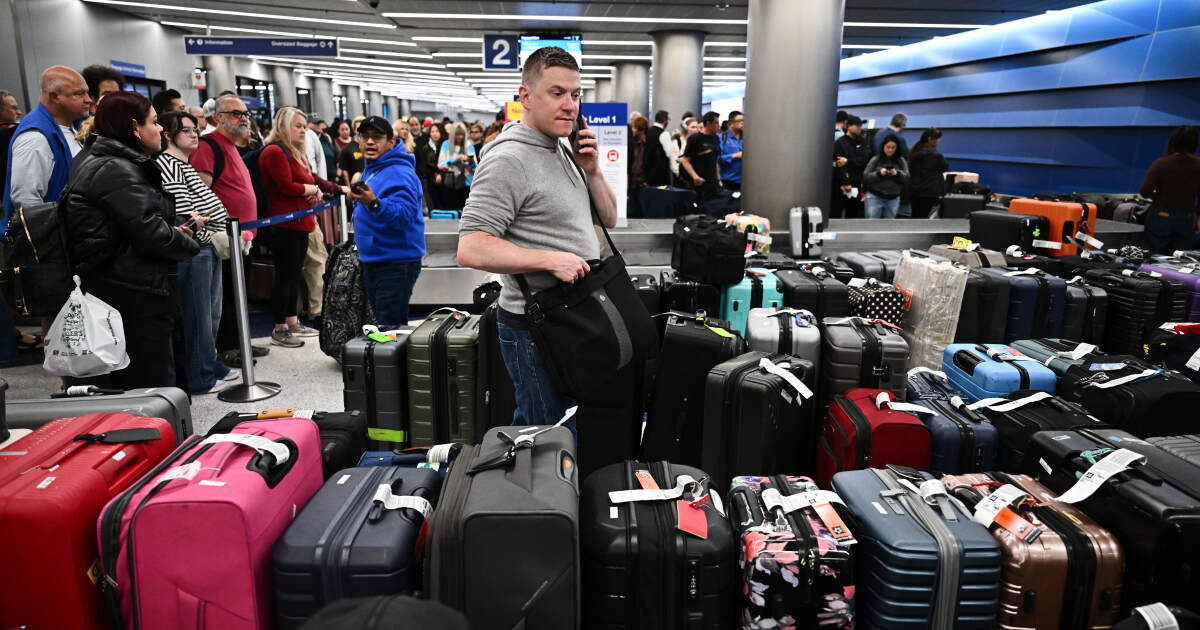
First, emails across the Microsoft system stopped working, then flights across the nation ground to a stop. Nationwide banking services at JPMorgan Chase went down on Monday and then major outages afflicted Apple and Marriott International on Tuesday along with the U.S. National Security Agency’s highly classified internal communications network.
As a spate of technology failures have disrupted critical United States infrastructure over the last several days, corporations and government officials have blamed many of the problems on system misconfigurations, faulty updates and technical errors. They have also played down any idea that the outages are part of a broader cyberattack or caused by artificial intelligence agents.
“It’s fine,” President Donald Trump told reporters in Manila, Philippines, where he was attending an international summit.
“This is not a cyberattack and this is not a coordinated action by a nation state,” Jay Clayton, Director of National Intelligence, said in Washington D.C., explaining the outages were the product of many companies and institutions patching and upgrading their vulnerable legacy digital systems.
But even if this week’s tech meltdown were random, experts in cyber policy and security said there is a need for more examination and accountability.
Some of the failures, they note, caused widespread disruption across critical sectors, from travel and banking to office work. Whatever the cause — small technical problems or a coordinated cyberattack — they argue it shows a pattern of vulnerabilities in internet security and the stability of the nation’s infrastructure.
“It’s not fine,” said Marcus Rogers, director of the Cyber Forensics Lab at Purdue Polytechnic Institute. “As time goes on, this is becoming a lot more of a muddy picture,” he said, noting that six incidents across different infrastructures starts to become “alarming.”
“There’s something wrong in the system itself and we can’t ignore that,” Rogers said. “‘Relax, it’s not cyberattacks and we don’t have to worry about it’ — that’s not the right message.”
If the problems were caused just by minor human errors or failure to upgrade infrastructure, he added, that made critical U.S. systems a potentially bigger target for bad actors: “If it’s that easy for this stuff to fail simply because of a tiny little human error,” he asked, “how much easier is it then for a targeted attack to go after these infrastructures?”
Rogers and others say there needs to be vigorous investigation into what went wrong.
“Six failures in a week, I don’t understand it,” said Herbert Lin, senior research scholar at Stanford University’s Center for International Security and Cooperation and a fellow in Cyber Policy and Security at the Hoover Institution. “Is there some common agent behind all of them? I think we don’t know the answer to that. It seems very unlikely, but we can’t rule out that possibility.”
T.J. Marlin, founder and CEO of Guardrail Technologies in Utah, said it was highly unlikely for a random breakdown of so many critical systems in such a short period of time. “Pure coincidence across this many critical systems is statistically improbable,” he said, “which points to something shared underneath, such as a common vendor, update or dependency (such as AI).”
Senate Intelligence Committee ranking member Mark Warner (D-Va.) said Tuesday that artificial intelligence appears to be playing a role in the outages as it transforms the cyber security landscape.
“AI is making it possible to identify vulnerabilities across enormous numbers of systems at unprecedented speed,” Warner said in a statement, “creating enormous pressure on companies and government agencies to patch those vulnerabilities immediately, often all at once, putting tremendous strain on systems that weren’t built to handle that pace of change.”
Companies and government agencies were releasing limited information, Rogers said, either because they don’t know or there was an active investigation or they don’t want to be liable for stockholder lawsuits when their stock starts tanking. What he found concerning, he said, is they’re delivering inconsistent messages right off the bat.
“All these companies, the first thing they say is ‘We’re not sure what’s causing this, but it’s not a cyberattack.’ Well, wait a minute. Either you know what’s causing it, or you don’t know. And if you don’t know, how do you know it’s not a cyberattack?”
After the Federal Aviation Administration halted flights nationwide on Friday, the agency and Department of Transportation scrambled to explain the problem, attributing the problem to a data overload and technical instability triggered by a newly installed router. Transportation Secretary Sean Duffy said the agency’s new artificial intelligence tool, SMART, played no role.
“First, it was a copper wire, then it was a vendor, then it was an overloaded network, then it was a router, there were data integrity issues,” Marlin said, noting the agency’s shifting explanations of the ground stop. “A lot was said, but it didn’t mean a heck of a lot.”
Four days after air traffic ground to a halt, Duffy told reporters: “The root cause of what happened, we don’t have clarity yet.”
After the disruption on Tuesday of the NSA’s NSANet system, a heavily isolated, classified internal network that does not connect to the public internet, the agency said in a statement that the incident was caused by “temporary degradation during scheduled routine maintenance.”
JPMorgan Chase attributed its outage to an internal software bug. Microsoft said a “latent defect caused servers to become overwhelmed and unresponsive under certain load conditions.” Apple blamed an unspecified internal update.
As alarm spread across the nation, some Republican lawmakers demanded Tuesday that the Trump administration brief them on the NSA incident and other outages. U.S. Rep. Mike Lawler (R-N.Y.) called on the administration to “immediately brief Congress on the exact nature of the problem, so that we can have an all of government response.”
When asked if artificial intelligence was going rogue, California Governor Gavin Newsom said “Trump has been a disaster when it came to creating truth and trust in AI.” California, he said, was “taking this very, very seriously in the absence of federal regulations.”
Asked by a reporter Tuesday if Californians should save up on food and toilet paper to prepare for a breakdown of more critical infrastructure, Newsom said “we should always be saving up for a rainy day.”
“It creates some anxiety certainly,” Newsom said of the outages. “And it requires mature leadership, requires someone who takes responsibility. The buck stops with the President of the United States.”
Concerns have accelerated over the last year over the threat of cyber hacking and rogue agents in the AI era.
Europe is facing a surge of high-impact cyberattacks targeting critical infrastructure, the energy sector, and commercial food supply chains. Last month, unidentified hackers took remote control of commercial refrigerators in hundreds of supermarkets across France, spoiling fresh food and igniting fires.
“We know that those were targeted attacks,” Rogers said. “If we look at this from a global picture, there’s a very concerning pattern that’s going on now.”
On Friday, the FBI issued a FLASH advisory warning that cyber criminals and state-aligned hackers were weaponizing ARTEX, an open-source, large language model-driven agentic platform to automate cyber intrusions at machine speed.
“Since at least August 2026, a variety of malicious cyber actors have used ARTEX to conduct campaigns targeting organizations globally across multiple sectors, including financial services, government, technology, defense, semiconductor, energy, healthcare, manufacturing, telecommunications, and legal industries,” the FBI said.
On Monday, Google warned the “era of autonomous attacks has arrived” driven by hackers using artificial intelligence.
“Imagine a hacker that doesn’t eat, sleep, or get tired, and never stops searching for a way in,” the company’s Google Threat Intelligence Group informed users. “According to the latest AI Threat Tracker report, bad actors are now using autonomous LLM frameworks to continuously scan software updates, figure out what flaw was patched, and build an attack for it — all without human involvement.”
Security researchers at Report URI also reported Monday that they had detected malicious code in Optimizely, a website tool used by 178 organizations, including CNN, the BBC, Peacock and Fox News and NPR. According to researchers, unidentified hackers targeted Optimizely, a service companies use to test different websites and layouts, inserting malicious code into web pages that allegedly enabled them to steal data from visitors to the websites with the goal of getting crypto payments and copying credit card information.
For Lin, the fundamental reality is we have gotten more dependent on very big and complicated networked information systems. When he went to buy a refrigerator recently, he noted, he could not get it without Wi-Fi.
“Buying more complexity, that means you’re buying more vulnerability,” Lin said. “At what point does the added functionality get outweighed by the risks that you’re going to take? Ultimately, in this, the enemy is ourselves.”
As the U.S. relies on more technology, many experts say that government should play a stronger role in preventing further outages and protecting the nation’s critical infrastructure.
“What steps are going to be taken to make sure it doesn’t happen again? “ Rogers asked, noting this is probably the new norm now. “I hate to say this, we’ve kind of hit that tipping point with infrastructure.”
Marlin said the system outages raise the question of “whether we need to take a step back in this moment” given the increased system risks posed by the widespread use of legacy government systems, interconnected services, and reliance on the same limited group of vendors for data, artificial intelligence and cyber security.
The outages, Marlin said, should serve as a wake-up call for government and citizens.
“We should be asking questions,” he said. “I don’t think we’re getting the true story here. I feel like we’re in this wag the dog moment because we don’t want to stoke public panic.”
Others suggested Americans make sure they are prepared for a breakdown of critical infrastructure.
“As a consumer, what should you do?” Lin said. “Well, make sure you have some cash on hand. Make sure you have emergency water.”